







Abstract
This article discusses the teaching of Chinese characters’ pictophonetic characters from a cognitive perspective. First of all, it clearly explains the characteristics of pictophonetic characters, meaning components are used as expressing categories, and sound components express sound and meaning at the same time. It also discusses the combination of pictophonetic characters in the square character space. Secondly, it introduces the main literacy methods of Chinese character teaching at present, and uses the image teaching method and the assortment method among them. Then, on the basis of the previous knowledge, the “conceptual integration theory” (conceptual integration) is used to integrate the sound and meaning of pictophonetic characters with the shape of the characters. After that, it compares the common core pictophonetic verbs in the new Chinese Proficiency Test Syllabus (Level 3) (also known as the Chinese Proficiency Test) with the Contemporary Corpus (COCT, National Institute of Education, Taiwan), and selects the overlapping items. Among them, 22 Chinese characters conform to the core verb vocabulary of the new HSK (Level 3). There are 13 core verb pictophonetic characters suitable for “positive cognition” teaching. This article first introduces five examples of the strongest phonetic association: standing zhàn (standing), staying zhù (live), singing gē (song), singing chàng (singing) and discussing/discussing yì (discussion). Lastly it deliberates conceptual integration theory, analyzing its rationale, reconstructing and demonstrating its diversified literacy teaching methods.
Introduction
Pictophonetic characters have always played a main role in Chinese characters. According to the Chinese Character Simplification Scheme (1956), among 7000 general simplified characters, pictophonetic characters account for more than 80%. In the article “The Trinity—the Teaching of Chinese Pictophonetic Characters from a Cognitive Perspective” (2011), 1 the author suggested that the pictophonetic characters should follow their historical development and the three-period lesson approach in teaching. However, owing to historical phonetic changes, the function of phonetic symbols for pictophones has been reduced. Additionally, with the simplification, the merging and the disappearance of pictophones in the simplified character system, some interesting questions have arisen. How should we adjust our teaching accordingly with different pictophones? And how should the pictophonetic characters be taught in the teaching Chinese as a foreign language classroom?
Wan (2000, 2004) conducted a scale survey on Chinese learners. Learners of different native language backgrounds all stated that they have encountered certain difficulties in reading Chinese characters since they cannot connect the form and pronunciation of a character together. Researchers pointed out that this is because the orthography of Chinese characters has its deep origin, and there is no clear correspondence between the shape and pronunciation of Chinese characters, which it makes it difficult for international students with a phonogram background to learn Chinese (Jiang, 2001). 2
In recent years, research in the field of cognition and Chinese character teaching has achieved fruitful results. Shi (2019) points out that “Second language teaching is struggling between the interaction of scene and practical and rule and rational.” Second language teaching is a subject that does not have absolute rules. It is required for the educators to come up with a combination of cognitive methods suitable for different students at different stages. The different combinations of methods form one’s cognitive style. Shi also advocates that second language teaching research should combine cognition in order to proceed to the teaching-oriented ontology research model. Moreover, he suggests that in addition to the grammar rules, the teaching materials should include examples with holistic and comparative cognition. The examples should be contextual for the convenience in teaching.
Although verbs are not an inevitable component of sentences in Chinese, they are still the center in most sentences. “Verb-centered Theory” is one of the key points in Chinese grammar. Generally speaking, it is believed that this theory is jointly constructed by two sources: internal and external. The internal representative is based on Lü Shuxiang's “Verb Center View,” 3 while the “Verb-centered Theory” in western grammar completes the whole picture.
In his “Eight Hundred Words of Modern Chinese,” Lü (1980) constructed a sentence pattern system with verbs as the core, highlighting the importance of verbs in sentence formation. He repeatedly emphasized the importance of the study on verbs, and points out that “in a certain sense, verbs are the center of a sentence, and other components are linked to it and attracted by it” (Lü, 1980). 4
Lü (1980) is familiar with western languages. In addition to learning Chinese grammatical study from western grammatical theories, he focuses on comparing the similarities and differences between Chinese and western grammars. Different from Indo-European sentences, which are based on verbs, in Chinese subject-predicate sentences, the verb-predicate is only one type of predicate. Therefore, unlike the western “Verb-centered Theory,” which focuses on the restriction of verbs on other components in the syntactic structure, Lü's “Verb Center View” focuses more on the semantic relationship between verbs and other components in the sentence. 5
Therefore, this article attempts to discuss the teaching of pictophonetic characters from a cognitive perspective. Since implementing systematic literacy teaching and getting the students ready to acquire large numbers of pictophonetic characters often require learners to first build a certain foundation in Chinese learning, this article compares the common core pictophonetic verbs 6 in the new Chinese Proficiency Test Syllabus (Level 3) (also known as Hanyu Shuiping Kaoshi; henceforth HSK 3) with the Corpus of Contemporary Taiwanese Mandarin (hereinafter referred to as COCT) by the National Academy for Educational Research in Taiwan. This article utilizes the conceptual integration theory in cognitive linguistics to analyze the rationale reconstruction and literacy teaching methods.
Characteristics of pictophonetic characters in current teaching situation
Research on the phonetic form of modern Chinese pictophonetic characters
Regarding the phonetic form of the pictophonetic characters, owing to different learning subjects, scholars studying and analyzing different texts, statistical results are different. For example, Zhou (1978) utilized the Xinhua Dictionary (1971 edition) for study, and obtained statistically effective rate of a pictophonetic character indicating its sound takes up only 39%. Yang (1986) counted 3755 commonly used modern Chinese characters. Among the characters, the fully effective rate is 7%, and the partially effective rate is 12%. Li et al. (1992) extracted 7000 characters from “Modern Chinese Common Characters” as research scope. According to statistics, the total number of pictophonetic characters is 3975 characters, and the total number of tonal characters is 1326, of which 1119 are collected in the “List of Commonly Used Characters in Modern Chinese.” The effective rate of a pictophonetic character indicating sound is calculated to be 71.54%. Li (1992) used the Modern Chinese Dictionary as a standard and counted a total of 3523 pictophonetic characters, among which 90.5% of the characters consist of their own phonetic component; the effective rate is 92.7%, and the accurate effective rate is 19.6%. In addition, Wang (1999) used the 2500 common characters in the “List of Commonly Used Characters in Modern Chinese” as research corpus to investigate the phonetics of the phonetic component of the pictophonetic characters. Within 1290 pictophonetic characters, 794 phonetic components can be analyzed, and 69.5% of them have the function of prompting pronunciation.
The above researches are based on the pictophonetic characters with common usage in modern Chinese. The research results are applicable to native speakers. Although the study corpus chosen for each is different from the judgment criteria of the pictophonetic characters, 7 they still share the important position of verifying the pictophonetic characters. The prompting effect of the phonetic components on the pronunciation of the whole character is still more than 50%, and the phonetic degree of the pictophonetic characters is about 70% or above as a whole.
As for the study of pictophonetic characters based on teaching Chinese as a foreign language, the research items are all based on the Syllabus of Chinese Proficiency Vocabulary and Characters (henceforth SCPVC) as the core. The research interest covers the proportion of included pictophonetic characters, the degree of phonetic pronunciation, the ability of picto-components to construct characters and so on, in order to put forth suggestions on the teaching with pictophonetic characters as a basis. The main research results are as followings. Feng (1998) sorted out 1920 pictophonetic characters in the SCPVC, accounting for 66.1% of the total number of Chinese characters in the SCPVC. On the other hand, Meng (1999) analyzed the pictophonetic characters in the “Modern Chinese Characters List,” and proposed the concept of “ideal phonetic component” for the teaching of Chinese pictophonetic characters. The pictophonetic characters composed of “ideal phonetic component” account for only 24% of the total vocabulary. Xing and Shu (2002) conducted research on the pictophonetic characters in the SCPVC, and the number of pictophonetic characters is 2090, accounting for 72% of all Chinese characters in the SCPVC. Zhong conducted a comprehensive investigation of the 1945 analyzable pictophonetic characters in the SCPVC from the dimensions of phonetic and semantic. Among them, only 480 initials do not function as phonetic components, namely, the pictophonetic characters account for 75%. Based on different extent of phonetic contribution, the rank obtained is rhymes come first, initials second and tones contribute least.
As can be seen from the above information, the general picture of the current pictophonetic characters used occupies 70% of the proportion in teaching Chinese as a foreign language. The proportion of characters with complete phonetic component take up more than 64%, of which two-thirds belong to Grade A and B characters, while still more than three-quarters of the pictophonetic characters have the function of prompting pronunciation.
Research on the cognitive learning effectiveness of pictophonetic characters
Regarding the cognitive learning status of pictophonetic characters among L2 learners, the researchers conducted experiments from the perspective of teaching to investigate whether the systematic phonological teaching literacy method can enable elementary L2 learners to recognize the function of pictophonetic characters.
Jiang (2001) found that second language learners of different grades are obviously affected by the regularity of phonetic components in characters in recognizing and reading tasks. The more the learners are aware of the pattern, the more they improve.
Wang and Gao (2004) aimed at the formation and development of the awareness of recognizing and reading pictophonetic characters in European and American second language learners. According to their research findings, European and American students who have studied Chinese characters for six weeks have initially acquired the awareness of regularity in pictophonetic characters. This awareness increase with the amount of learning as well. In the early stage of Chinese character acquisition, students in the character component class often adopt whole-character recognition strategies. Later, the phonological recognition strategies gradually become prominent. This points out that component teaching is beneficial to the recognition of Chinese characters’ sound symbols, and the teachers need to choose the appropriate stage for sound-form teaching. When the learner's Chinese proficiency has developed to be able to use the phonological cognitive strategy, the teaching of phonetic components should then be introduced.
Wu (2008) studied the development of the consciousness of the consistency of the pictophonetic characters in Japanese and Korean students, and found that with the increase of grade, the consciousness of the pronunciation consistency of the phonetic components gradually increased, and this consciousness can be extended to unfamiliar characters.
Hao and Shu (2005) found that the correct rate of recognizing regular characters was much higher than that of irregular characters when learning for the first time. When transcribing the pronunciation of characters, the more clues provided by the phonetic components, the more international students would recognize and read and thus the higher the accuracy of recognizing pictophonetic characters.
Most studies support that the recognition of pictophonetic characters by foreign students is influenced by the regularity of phonetic symbols, and they can consciously form awareness of regularity and consistency of phonetic components throughout the learning process. Various awareness is improved with the development of foreign students’ Chinese proficiency. Through appropriate teaching methods, it helps foreign students discover the sound and laws of the phonetic components of pictophones, and further apply them to unfamiliar pictophonetic characters. This result is of great significance for teaching Chinese as a foreign language. On the premise of beforehand listening and speaking, strengthening the awareness of sound symbols is beneficial to the development of oral skill and improvement of Chinese character literacy ability of foreign students. Teachers can help international students discover the rules of sound notes by means of induction.
Discussion of the current teaching methods of Chinese character literacy
The Chinese character literacy teaching method has existed for a while. In the early days, the most used teaching method was the single element literacy method. In recent years, there has been a more pluralistic comprehensive tendency. Wang and Zou (1998) arranged literacy teaching methods used by predecessors systematically, such as character origin teaching method, word meaning teaching method, grapheme teaching method, rhyme literacy method, image-text literacy method.
One-element literacy teaching method
Verse literacy
The Chinese characters are compiled into neat sentence patterns, mostly four-character, seven-character, but can also be three-character or five-character. The use of homophones to form rhymes is easy to read and remember. This kind of teaching method is often used in conjunction with the word meaning teaching method.
Image-text literacy
Learning to read with the aid of pictures is a traditional teaching method based on the concept that early childhood intellectual development is biased towards figure cognition. The teaching of literacy with pictures, the early “picture literacy method,” is now developed as “diagramming literacy teaching”.
Word origin teaching method
The “word origin” method of literacy implements the characteristics of Chinese characters. Ancient characters such as oracle bone inscriptions, bronze inscriptions and small seals present the concept of character creation, which is conducive to understanding the original meaning of the text and thereby strengthens the learning effect. The word origin literacy method is mostly used in teaching of characters with strong pictorial nature, in this case, pictographic characters.
Character family teaching method
The “character family” teaching method applies on composed characters with a same character component, a root, as it is in Origin of Chinese Characters. Characters with similar meanings in Chinese characters are compiled together. The characters are stringed together in a context for students to read a series of characters with the same or similar meanings; this is known as the “word meaning teaching method”. For example, “戔” has the meaning of tailoring and splitting, so most of the words with “戔” as the root contain the meaning of less, shallow, thin, and small related, like “qiǎn 淺 (shallow),” “xiàn 綫 (line).”
Grapheme literacy
This is a literacy teaching method that focuses on the characteristics of “square-ness” in Chinese characters. It focuses on the combination of ancient Chinese characters in the word formation space. For example, the word “chóu 愁 (worry)” is composed of “hé 禾 (grain),” “huǒ 火 (fire),” and “xīn 心 (heart).” It can not only show the structure of Chinese characters, but also allow learners to divide it into two parts either vertically or horizontally. The upper and lower parts can be further combined to form many different words.
The teaching of pictophonetic characters of the new HSK Level 3 core verbs from a cognitive perspective
Positive and negative cognition
Regarding the cognitive learning sequence, Shi (2019) pointed out that there should be a distinction between positive cognition and negative cognition. “Positive cognition” is the way of cognition from small components to a larger whole. Sentences are composed of morphemes–words–phrases, which further constitute texts. This is an assembling cognition. From the perspective of natural science, protons and neutrons make up the nucleus, and the nucleus and electrons comprise the atom, and multiple different atoms are synthesized into molecules; atoms, molecules and ions together constitute the three forms of bright matter. In this way, from small to large is a normal composition program. Therefore, it can be called a “regular formula” process. The cognition according to the positive formula can be called “positive cognition.” The second is “negative cognition,” a way of cognizing from the big whole to the small components. Contrary to the normal formula, starting from the big whole to disassembling into different small components, it is naturally a kind of reverse formula. This is a dismantling way of cognition, the most natural way for people to understand things. Knowing according to such a reverse formula, of course, is called “negative cognition.”
The traditional Chinese character-based teaching method emphasizes character and word, from characters to words, from words to chunks (phrases, sentences, texts), the so-called positive cognition. The pictophonetic characters are made up of picto-components and phonetic components; meanwhile, these are learned sequentially into a combination, to give a deeper understanding of the trinity of the form, sound and meaning. Compared with positive cognition, negative cognition is based on the simplicity of the whole, taking the whole as the most important cognition, with underlying “ab≠a + b” foundation. Currently, “word-based” is the prominent theme in second language Chinese textbooks. Most introductions of Chinese characters start from the whole character at the beginning, but not the strokes and radicals. Owing to the simplification and geometric evolution of Chinese characters, many characters can no longer withstand the process of decompositing and are no longer suitable for positive cognitive learning methods. Different cognitive methods play different roles in the development of the learning of second language. Second language teaching can therefore apply these cognitive methods to improve the success rate of teaching. This article agrees with the abovementioned theory. The teaching of pictophonetic characters should be in accordance with the changes in the form, sound and meaning of the components and the whole character. Teachers are recommended to adjust the teaching method according to the current situation and the performance of learners.
Cognitive concept integration
Conceptual integration theory
Lakoff and Johnson’s (1980) conceptual integration theory and Fauconnier and Turner’s (2002) cognitive concept synthesis space theory argue that words do not refer directly to entities in the world, but instead are a combination of the situation being described and the language structure used to describe the situation. Linguistic cues enable the speakers to selectively organize the attributes of the concept. Conceptual integration theory is based on the mental space theory, which uses people's thinking ability to construct, connect and activate corresponding spatial structures, frames and cognitive models to form conceptual concepts. Langacker (1987) proposes source space and target space. Fauconnier and Turner (2002) further puts forth a four-space mapping model as the basic structure for conceptual integration, input space 1 (input 1), input space 2 (input 2) and generic space, blended space. By mapping of multimode space in four spaces according to the number of spaces involved and the activity of the working space, many types are therefore derived. 8 Fauconnier and Turner (2002) believes that “meaning is not equal to the sum of its components. When they are constructed into a larger unit, they often produce new information. Concepts will undergo certain changes during the integration process, and new concepts will emerge from this significance.” 9 Shen (2006) went on to explain that the “emerging process” refers to the “emerging structure,” the innovative structure. The resulting outcome is the “emerging meaning,” the innovative meaning. He claimed, “The emergent meaning formed by conceptual integration is different from that of the integration. The simple addition of partial meanings cannot be directly derived from the latter. This emergent meaning is also called ‘innovative meaning.’”
Wang (2009:118), in his “Conceptual Integration Theory and Its Application Research,” pointed out one of the key points of the basic principle of “conceptual integration”: Combination is the basic way of thinking and cognitive form of the integration of the human mind. The integration of form and meaning, the meaning and the integration of meaning, the integration of form and form are all carried out in the human mind space. Conceptual integration theory is the development of the second generation of cognitive linguistics, which provides scientific cognitive basis for many inexplicable language phenomena.
The characteristics of pictophonetic characters of “Taking a picto-component and a phonetic component, these two elements, to create a character” is precisely the “combination of two into one” in cognition. Picto-component and phonetic element together each provide conceptual elements of form, sound and meaning. Through the interaction of three interrelated mental and cognitive activities of “combination,” “perfection” and “expansion,” an emergent structure is generated. It is very helpful to explain the positive cognition of pictophonetic characters with the concept synthesis space icon.
New HSK Level 3 core verb pictophonetic character teaching
A total of 22 Chinese characters that conform to the core verbs vocabulary of the new HSK (Level 3):
吃 chī (eat), 讀/读 dú (read), 喝 hē (drink), 話/话 huà (talk), 叫 jiào (call), 說/说 shuō (speak), 聽(听)tīng (listen), 站 zhàn (stand), 住 zhù (stay), 唱 chàng (sing), 動/动 dòng (move), 歌 gē (sing), 给 gěi (give), 講/讲 jiǎng (speak), 爬 pá (crawl), 怕 pà (fear), 跑 pǎo (run), 訴/诉 sù (sue), 跳 tiào (jump), 玩 wán (play), 聞/闻 wén (smell), 議/议 yì (discuss).
There are a total of 13 core verb pictophonetic characters suitable for the teaching of “positive cognition.” This article first describes five examples with the strongest phonetic association strength.
站 zhàn (stand)
Teachers’ prior knowledge
The word “zhàn 站 (stand)” came out late and first appeared as in regular script. The regular script form is composed of the form of “lì 立 (standing)” and the sound of “zhān 占 (divine).” “Lì 立 (standing)” means people straddling on the ground. Righteousness is related to standing upright. “zhān 占 (divine)” is used to infer good or bad according to signs. Here, it is only used as a non-meaning sound component to indicate sound.
Common core word meanings are: Refers to keeping the body upright and supporting it by touching the ground with both feet. Contrast with zuò 坐 (sit). A place to rest or change transportation during the journey. Examples include chē zhàn 車站 (station), yì zhàn 驛站 (post station) and xiū xí zhàn 休息站 (rest station). Small units established in various places by agencies or organizations to carry out certain tasks. Examples include fú lì zhàn 福利站 (welfare station) and jiā yóu zhàn 加油站 (gas station). Refers to units that have independent websites on the Internet and provide information services. Generally, there are web pages for users to connect to the Internet.
It is a level 2 character with word formation such as zhàn lì 站立 (standing), wǎng zhàn 網站 (website) and chē zhàn 車站 (station) in COCT. (See Figure 1)
Chinese character teaching
Picto-component: lì 立 (standing)
Based on ancient characters, “立” is reecorded  as in oracle bone inscriptions (Hé Jí 7365),
  in bronze inscriptions (integration 5064), as
  Warring States characters (Guō ‧ Zī ‧ 3 Jí Chéng 2778) and
  in seal script. Its form is like a figure of a person standing with open arms on the front, as a single-body pictogram. It is used to look like the ground, as a symbol that represents a person standing on it (See Table 1).
In A3 level, it has 45 words with strong word formation, such as lì kè 立刻 (immediate).
Initial: zhān/zhàn 占
占, written as  in oracle bone inscriptions (Hé Jí 20333), as
  in the Warring States period (bāo 2‧198),
  in seal script (Origin of Chinese Characters). The character consists of “bǔ 卜 (divine)” and “kǒu 口(mouth)”. 卜 refers to the cracks on the tortoise plate after burning the tortoise plate with fire. According to the direction and details of the zigzag pattern, the good or the bad can be predicted. As for 口, it means to judge and explain. Words should be used to explain the signs on the oracle bones to infer good or bad luck. This word is a polyphone with another pronunciation “zhàn,” which means “to seize by force, to seize as one's own.” Such as, zhàn jù 占據 (occupy), qiáng zhàn 強占 (deprive), zhàn lǐng 占領 (colonize). Or to refer to being in a certain situation or position such as “占優勢 to take advantage.”
It is listed in C6 word level with four word formations, all of which are categorized as either advanced or proficient level, such as zhàn yǒu 佔有/占有 (possess) (level 5), zhànlǐng 佔領/占領 (colonize) (level 5), zhànjù 佔據/占據 (occupy) (level 6) and dúzhàn 獨佔/獨占 (monopolize) (level 7).

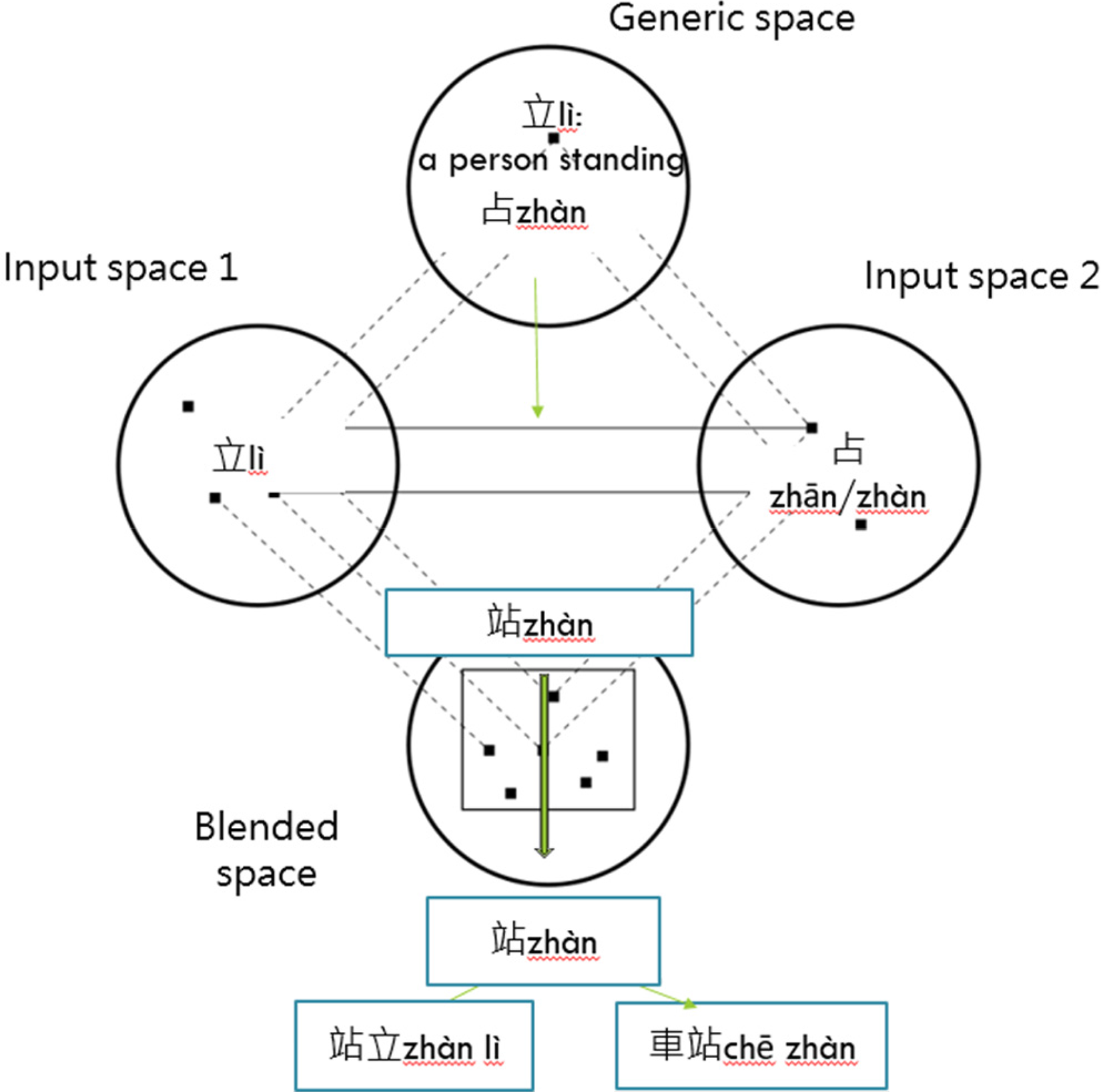
Conceptual space composite map of 站.
Schematic table of spatial synthesis of 站 word concept.

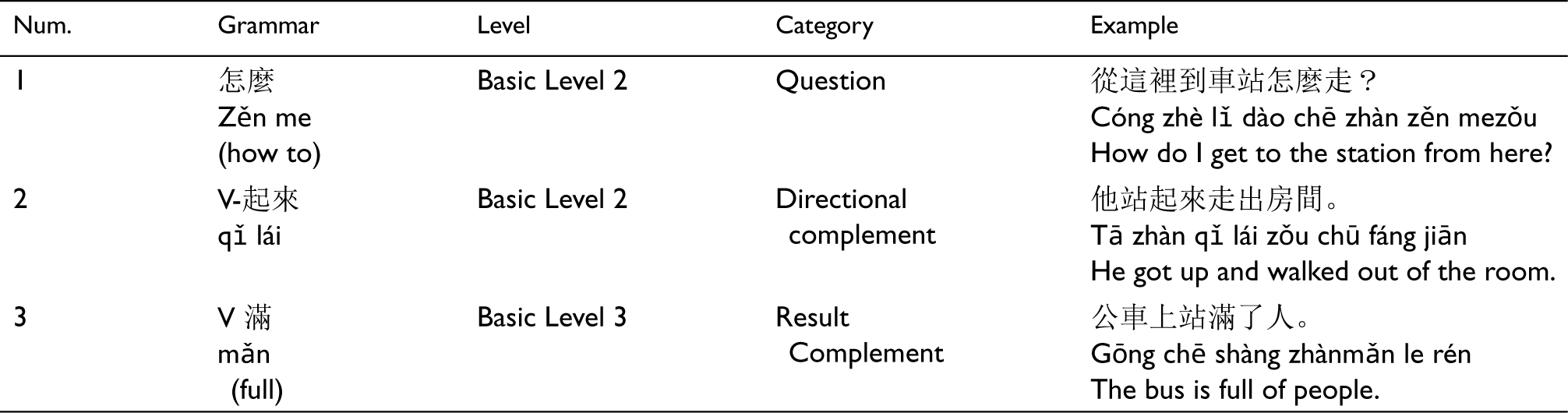
【 站 zhàn 】to stand
【中午 zhōng wǔ】noon 我 今天 ~去 火車站。 Wǒ jīn tiān ∼qù huǒ chē zhàn. “I am going to the train station ∼.” 我 已經 走~ 火車站了。 Wǒ yǐ jīng zǒu∼ huǒ chē zhàn liǎo “I've already left∼ the train station.” 我 下午 3點 去~。 Wǒ xià wǔ sān diǎn qù∼ “I will go at 3 pm∼.” 我要去火車站買車~。 Wǒ yào qù huǒ chē zhàn mǎi chē “I'm going to the train station to buy a car∼.” ~,附近有地鐵站 嗎? ∼, fù jìn yǒu dì tiě zhàn ma “∼is there a subway station nearby?”
【出 chū】exit
【火車站 huǒ chē zhàn】Railway Station
【票 piào】Ticket
【阿姨 ā yí】Auntie
住 zhù (live)
Teachers’ prior knowledge
The word 住 appeared late. It was first seen in regular script. It is composed of “人 rén (human)” and “ 主 zhǔ (owner).” “人” refers to where people live. “主” is a phonetic component which carries the meaning as well. The original meaning of homeowner is extended to the place of residence to stay and sleep. For example, 居住 jū zhù (to live in), or 住旅館 zhùlǚ guǎn (stay in a hotel); then further developed to the meaning of 住手 zhù shǒu (to stop) (See Figure 2).
It is listed as Level 1 characters in COCT. There are 13 word formations. The basic word is “住址 zhù zhǐ (address)” (Level 3).
Chinese character teaching
Picto-component: 人 rén (human)
人, written as Animals that have a high degree of wisdom and spirituality, can use language, and can make and use tools to engage in labor. Examples are rén lèi 人類 (humans), nán rén 男人 (men) and nǚ rén 女人 (women). Refers to others. The symmetry of oneself. Everyone, everybody. For example, rén shǒu yī cè 人手一冊 (one book per person). in oracle bone inscriptions (HéJí 6175). It is like a figure standing upright on the side of a person as pictogram in both oracle bone script and Chinese bronze inscriptions. In the seal script, the strokes of the figure extend and gradually depart from the original shape, as in
  . When it is written in the official script, the shape changes greatly, see
  ; the regular script follows. Thus, it is not easy to understand its original form in modern times. The commonly used core meanings are:
It is recorded as the first level characters with 172 word formations. The basic words are “jiā rén 家人 family” (level 1) and “tái wānrén 臺灣人 Taiwanese” (level 1).
Phonetic component: zhǔ 主 (owner)
This character was first seen in the Warring States period as  with its upper part like a burning fire, lower part like a stand lamp (Shuì ‧Yǔ3); it has
  as its variant. It is written as
  in seal script (Origin of Chinese Characters) and as
  in official script. The core meaning used today is the extended meaning as “an owner of power or property,” such as, 君主 jūn zhǔ (monarch), 店主 diàn zhǔ (shopkeeper) and 一家之主 yī jiā zhī zhǔ (head of household).
It is recorded as the basic level 3 characters with a total of 44 word formations. The basic word formation is zhǔ rén 主人 (master) (level 3) (See Table 2).
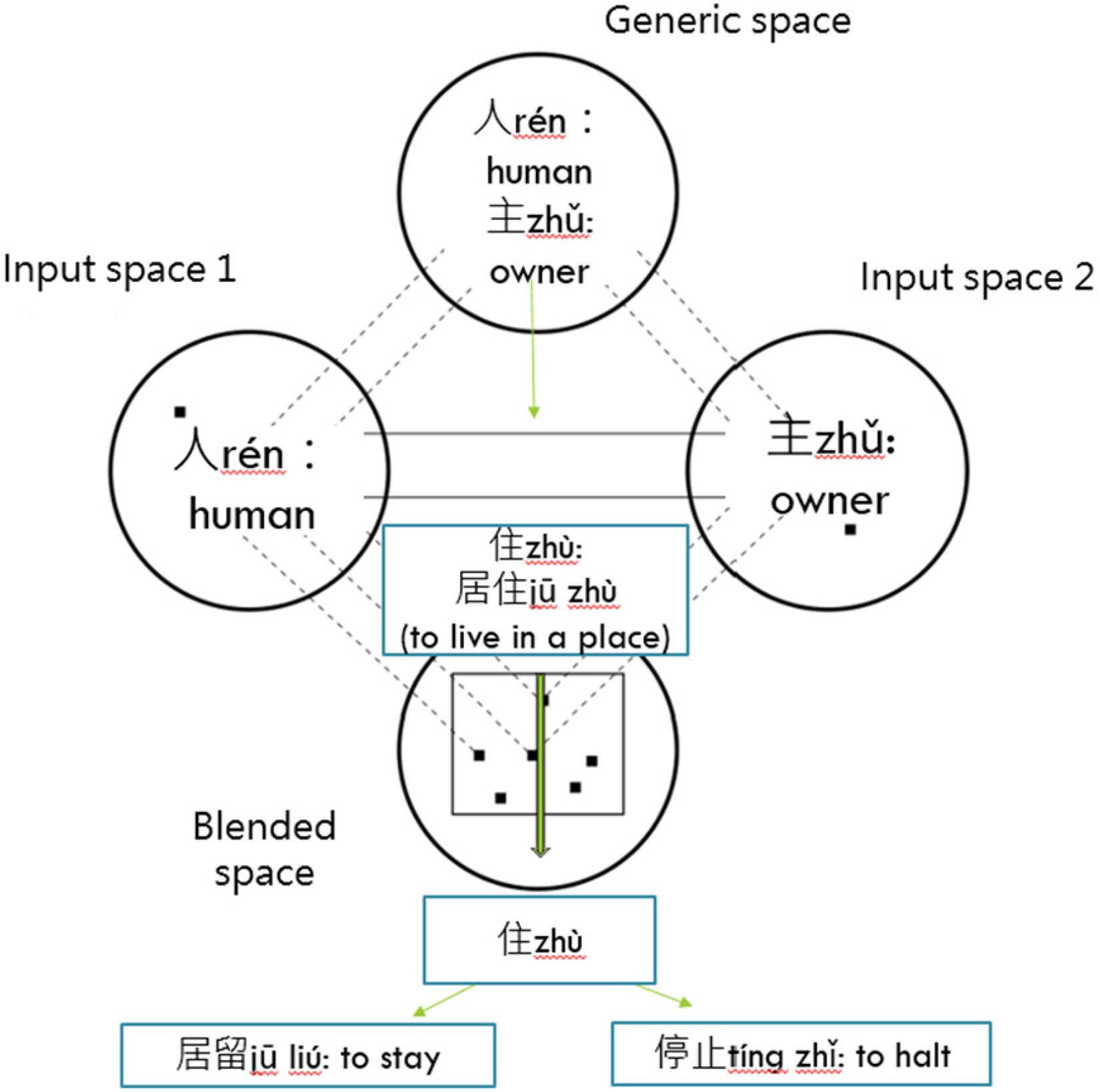
Conceptual space composite map of 住.
Schematic table of spatial synthesis of 住 word concept.

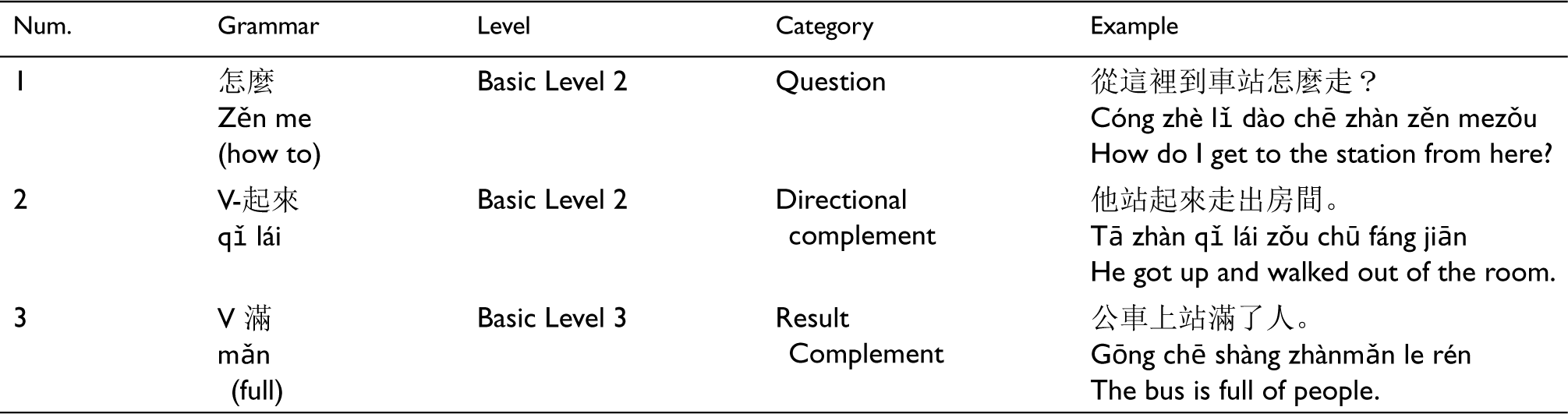
【住 zhù】live 他在 北京 ~ 了 很多年。 Tā zài běi jīng ∼ liǎo hěnduō nián “He has been in Beijing for many years.” 我 住 在~ Wǒ zhù zài∼ “I live in∼” 我 在 中國 住 了 三~ Wǒ zài zhōng guó zhù liǎo sān “I lived in China for three∼” 我們兩個人住一個~。 Wǒ men liǎng gè rén zhù yī ge “Two of us live in one∼.”
【北京 Běijīng】Beijing
【年 nián】year
【房間 fángjiān】room
歌 gē (song)
Teachers’ prior knowledge
歌 in Chinese bronze inscriptions is written as  (Jí Chéng 184); as
  in the Warring States period (Shuì‧ RìYǐ 132), as
  in seal inscription (Origin of Chinese Characters).
The shape of Chinese bronze inscriptions consists of 言 yán and 可 kě. 言 refers to recording words with a book knife. The meaning further extended to “to speak.” Serving as a symbol, it is used to indicate that meaning is relevant to the mouth; 可 means to agree or to permit, and is used here as a non-meaning relevant component to indicate only the sound of character. The characters from the Warring States period to the regular script had 欠 qiàn as picto-component and 哥 gē as phonetic component. 欠 is a symbol indicating opening the mouth, and it is used to specify that the meaning is related to the mouth. 歌 means a song, which is used here as a sound symbol to also indicate meaning. Origin of Chinese Characters includes its variants. 言 and 欠 are both related to the mouth. Commonly used meanings are: Singing. Sound in tune or beat. 引吭高歌 yǐn háng gāo gē (let's sing). Ballad music that sings words and sentences in line with the tune. Examples include 歌謠 gē yáo (ballads), 民歌 mín gē (folk songs) and 詩歌 shī gē (poems). To praise. For example, 歌功頌德 gē gōng sòng dé (singing praises and celebrating glory).
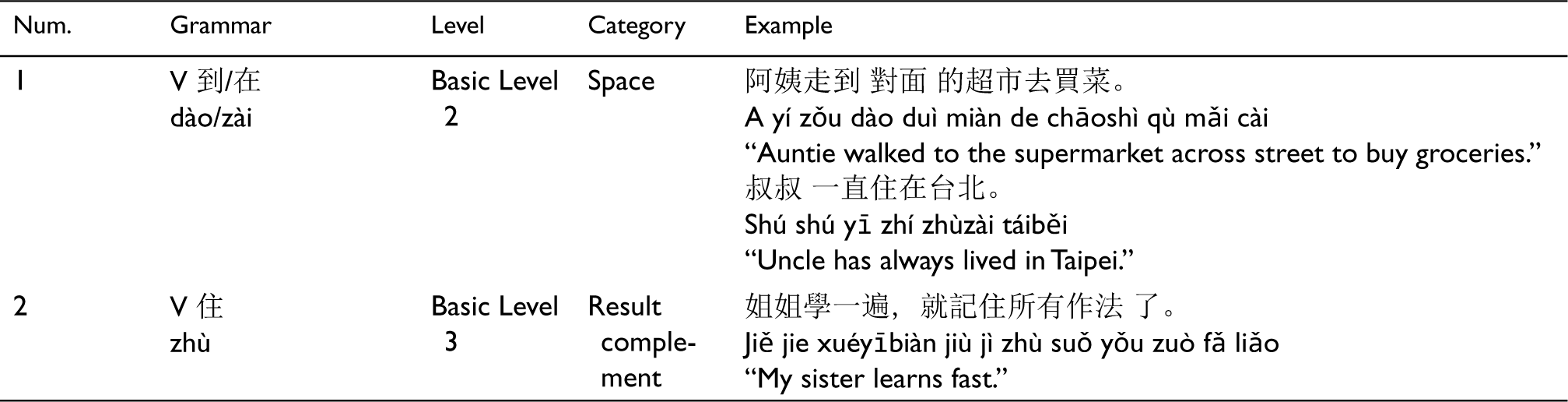
It is a basic level 2 character with 10 word formations in COCT. The basic word formation is 唱歌 chàng gē (to sing) (basic level 1) (See Table 3).
Chinese character teaching
Picto-component: 欠 qiàn (to owe)
欠, written as  in oracle bone inscriptions (Jí Chéng 7235), portraying a person opening their mouth. As
  in seal writing (Origin of Chinese Characters), the mouth is changed to “彡” to specify the meaning of spreading out breath. The official script of the character is changed into
  , which loses its shape, and the regular script follows it to fix its style. The original meaning is a person's open mouth, such as 哈欠 hā qiàn (yawn). The meaning extension means not enough, such as 考慮欠周詳 kǎo lǜ qiàn zhōu xiáng (not well considered) and 有欠妥善 yǒu qiàn tuǒ shàn (defectively). This leads to meaning in borrowing money but not repaying it, such as 欠債 qiàn zhài (in debt) or 欠錢 qiàn qián (owe others money). The meaning later extended to the state of lacking something, such as 欠揍 qiàn zòu (looking for physical punishment) and 欠罵 qiàn mà (looking for being lectured). Another extension meaning is dementia, such as 風欠 fēng qiàn (dementia by madness). It extended to be used as a euphemism to express inadequacy, such as 有欠妥善 yǒu qiàn tuǒ shàn (need improvement).
It is categorized as COCT advanced level 4 characters with four word formations. Vocabularies for advanced levels includes 哈欠 hā qiàn (yawn) (advanced level 4).
Initials: 哥 gē
This character was first seen in the characters during the Warring States period as To refer to the elder brother. Example: 大哥 dà gē (eldest brother), 哥哥 gē ge (elder brother). Respectful address for males of the same age. Example: 李哥 lǐ gē (Brother Li), 老哥 lǎo gē (Brother). (Shuì ‧Rì Jiǎ 40), seal script (
 ) Even in the regular script the character still consists of the combination of two 可 kě. 可 represents the flow of sound is restrained and stopped when exhaled. Two 可 means that when the airflow is exhaled, the temperance of the oral cavity forms a rhythmic melody singing. After borrowing the word as the meaning of elder brother, it is also noted as 謌 gē and 歌 gē. The common meanings in modern Chinese are:
Grapheme: 可 kě
可 as  in oracle bone inscriptions (Hé Jí 27990),
  Bronze Writings Jí Chéng 2738,
  in seal writing. From oracle bone inscriptions to regular script, the shape of 可 is derived from
  ; also indicates sounds. 口 is mouth, to show that the mouth is used to make a sound. The sound of indicates the pronunciation. is the inverse form of the Chinese character丂, which means that the airflow of sound is restrained and stopped when it is exhaled.
哥 is a basic level 1 COCT character, with four word formations, and the basic word is 哥哥/哥 gē (brother) (Level 1).

Schematic table of spatial synthesis of 住 word concept.

【唱歌 chàng gē】Singing 我最爱~了,我给你们唱一个。 Wǒ zuì ài ∼ liǎo, wǒ gěi nǐ men chàng yī ge “I love ∼ the most. Let me sing one for you.” 妹妹 ~ 喜欢唱歌,~爱跳舞。 Mèi mei∼ xǐ huān chàng gē, ∼ài tiào wǔ “Sister ∼ likes singing, ∼loves dancing.” 树上有很多~ 在 唱歌。 Shù shàng yǒu hěn duō ∼ zài chàng gē “There are many ∼ on the tree singing.” 妹妹会唱歌,也会~。 Mèi mei huì chàng gē, yě huì “My sister can sing, and also∼.”
【不但…而且…bù dàn…ér qiě…】Not only…but…
【鳥 niǎo】Birds
【跳舞 tiào wǔ】Dancing

唱 chàng (to sing)
Teachers’ prior knowledge
Singing. Example: 唱歌 chàng gē (singing), 合唱 hé chàng (chorus). Call loudly. Example: 唱名 chàng míng (roll call), 唱票 chàng piào (declaring voting count). Generally known as song, poetry, lyrics and music. Example: 絕唱 jué chàng (swan song), 新唱 xīnchàng (new song). was first seen in seal script, with 口 kǒu as picto-component and 昌 chāng as phonetic component. 口 indicates singing; 昌 specifies sound. 唱 chàng is a variant word for 倡 chàng (geisha). In ancient times, people who sang and performed art were called 倡. Its meaning was extended to singing. The word 唱 was therefore developed, meaning the sound of singing coming out of the mouth. Common meanings in modern Chinese:
唱 is a level 2 character with seven word formations in COCT. The vocabulary that meets A1 level is 唱歌 chàng gē (singing) (See Table 4).
Chinese character teaching
Picto-component: 口 kǒu (mouth)
As  in oracle bone inscriptions (Hé Jí 20575), as
  in bronze writing (Jí Chéng 5452), as
  seal writing, from ancient to regular scripts, they all look like a human mouth with an open mouth, and are created according to specific real images.
Common meanings in modern Chinese: The organs that humans or animals eat, and some are part of the vocal organs. Examples are 張口 zhāng kǒu (open mouth) and 閉口 bìkǒu (close mouth). The place where the container communicates with the outside. Examples are 瓶口 píng kǒu (finish of a bottle), 槍口 qiāngkǒu (muzzle), 碗口 wǎnkǒu (bowl rim). Places for entry and exit. Examples include 門口 mén kǒu (doorways), 港口 gǎng kǒu (ports), 巷口 xiàng kǒu (alleyways). Place of rupture. Cases of 裂口 liè kǒu (cracks), 缺口 quē kǒu (gaps), 傷口 shāng kǒu (wounds). Quantifiers.
According to COCT, it is categorized into basic level 1 characters, and there are a total of 62 words with strong word formation. The basic word formation is 門口 mén kǒu (doorways) (basic level 1), 十字路口 shí zì lù kǒu (crossroads) (basic level 2), 口渴 kǒu kě (thirst) (basic level 2), 入口 rù kǒu (entrance) (basic level 3), 出口 chū kǒu (exit) (basic level 3) and 口袋 kǒu dài (pocket) (basic level 3).
Initial: 昌 chāng
昌, as Exuberant and developed. Example: 昌盛 chāng shèng (prosperity). Beautiful and legitimate. Example: 昌言 chāng yán (good words). in oracle bone inscriptions (Hé Jí 19924), as
  in bronze writing (Jí Chéng 10171), as
  in Warring States writing (Shuì ‧Rì Jiǎ120), as
  in seal writing. It is derived from 口 kǒu (mouth), from 日 rì (sun), meaning the sunrise. Some scholars thought that the original seal script was related to 曰 yuē (word). According to Origin of Chinese Characters, 曰 is associated with beautiful words, moonlight and the sun rising from the east. The original meaning is bright and prosperous, extended to be beautiful words. Common meanings in modern Chinese:
昌 is listed as advanced level 5 word in COCT.

Schematic table of spatial synthesis of 唱 word concept.

【唱歌 chàng gē】Singing 我 最爱~了,我给你们唱一个。 Wǒ zuì ài ∼ liǎo, wǒ gěi nǐ men chàng yī ge “I love ∼ the most. Let me sing one for you.” 妹妹会唱歌,也会~。 Mèi mei huì chàng gē, yě huì “My sister can sing, and also∼.” 妹妹 ~ 喜欢唱歌,~ 爱跳舞。 Mèi mei∼ xǐ huān chàng gē, ∼ài tiào wǔ “Sister ∼ likes singing, ∼loves dancing.” 树上有很多~ 在 唱歌。 Shù shàng yǒu hěn duō ∼ zài chàng gē “There are many ∼ on the tree singing.”
【跳舞 tiào wǔ】Dancing
【不但…而且…bù dàn…ér qiě…】Not only…but…
【鳥 niǎo】Birds
議 yì (discussion)
Teachers’ prior knowledge
議, Discussion. Example: 協議 xié yì (agreement), 商議 shāng yì (negotiation). Criticism and comment. Example: 議論 yì lùn (discussion), 爭議 zhēng yì (controversy). Speech and opinion. Examples: 建議 jiàn yì (suggestions), 決議 jué yì (resolutions). Writing style used to discuss matters and state opinions. Example: 奏議 zòu yì (memorial), 駁議 bó yì (rebuttal). in bronze (picto-component: 言 yán; phonetic component: 義 yì) As
  in Warring States writing (Shuì ‧ Qín 39), as
  in seal script, same as in official script and regular script. 言 means actions related to speech; 義 represents both the sound and its meaning. According to Origin of Chinese Characters, the original meaning of the word 議 is connected with one’s prestige. In addition, 義 is closely related to the meaning of discussion and negotiation, with emphasis on appropriateness and the pursuit of justice. Common meanings in modern Chinese:
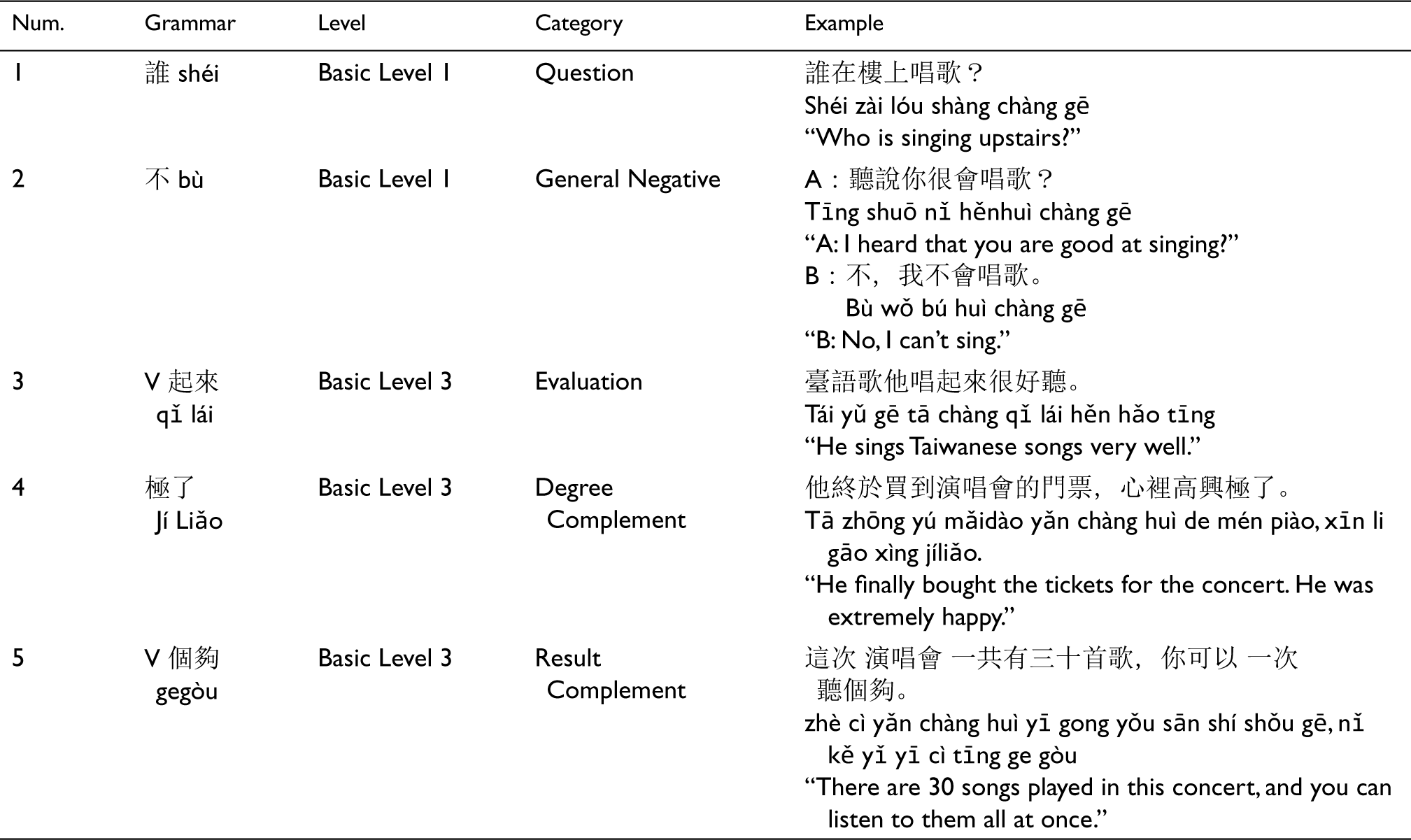
COCT is an advanced fourth-level word, with 17 word formation in total, and the basic word is (suggestion) (level 3).
Chinese character teaching
Grapheme: 言/讠yán
言, as  in oracle bone inscriptions (Hé Jí 19924), as
  in bronze writing (Jí Chéng 2456), as
  in Warring States writing (Bāo 2‧80), as
  in seal writing. In oracle bone inscription, 言 is composed of
  and 口.
  is a curved knife, with the top like a knife face, the vertical like a knife handle, the sides like handguards. 口, which resembles a human mouth, means to speak. Putting together, 言 has the extended meaning of “sin.” The combination of the components specifies the meaning of the need to be cautious when speaking, in order not to offend others. Some scholars consider
  as a curved knife, and by extension as a knife for engraving a book, while 口 means talking. The two are in configuration to indicate “recording words with knife on a book.”
Initial consonant: 義/义 yì (righteousness)
As In line with axioms and righteous ways. Example: 正義 zhèng yì (justice). Friendship. Example: 情義 qíng yì (affection), 忘恩負義 wàng ēn fù yì (ungratefulness). Meaning. Example: 意義 yì yì (meaning), 顧名思義 gù míng sī yì (as the name implies). Used for public welfare and relief. Example: 義賣yì mài (charity sale), 義演 yì yǎn (benefit performance). It is not natural but given the name to replace natural. Example: 義父 yì fù (foster father), 義肢 yì zhī (prosthetic limb). The nature of the obligation. Example: 義工 yì gōng (volunteer) (See Table 5). in oracle bone inscriptions (Hé Jí 27979), as
  bronze inscriptions (Jí Chéng 10175), as
  (Bāo 2.249), as
  in seal writing. 義 was first derived from the shape of ancient Chinese weapon. It developed into possessing the shape of 羊 yáng (sheep) owing to the decoration on the weapon in bronze inscriptions. Its configuration includes 我 wǒ (weapon) and 羊 yáng (sheep). 義 has its origin related to 儀 yí (ritual), the meaning is therefore extended to indicate appropriateness and principle. Throughout time, the original meaning of righteousness faded. 我 originally means a weapon. 羊 is relevant to the sacrifice in a ritual. In Taiwan, the standard character is 義; whilst in China, it is 义. 義’s common meanings in modern Chinese:
In COCT, it is listed as basic level 3 vocabulary with 28 word formations. The basic word is 義大利 yì dà lì (Italian).

Schematic table of spatial synthesis of 議 word concept.

【會議 huì yì】meeting 我們下午有個~。 Wǒ men xià wǔ yǒu gè∼ “We have one ∼this afternoon.” 這次會議有兩百多人~。 Zhè cì huì yì yǒu liǎng bǎi duō rén “There are more than two hundred people ∼ in this meeting.” 會議馬上就要~了。 Huì yì mǎ shàng jiù yào∼ liǎo “The meeting meeting is about to∼.”
【參加 cān jiā】participate
【結束 jié shù】end

Sense assimilation and chunking mode
Pictophonetic characters are the main structure of Modern Chinese characters. They display the characteristics of Chinese characters’ “form-sound character” in the trinity of form, sound, and meaning. If Chinese learners can grasp the characteristics of the trinity, learn Chinese characters constructively based on the principle of cognition and categorization, and combine philology and cognitive psychology with character source teaching method and word group diagram method, they can be motivated and achieve fast literacy.
This article is based on the form-sound characteristics of Chinese characters. By combining the regularization of cognitive psychology with other theories, we illustrate the scientificity of Chinese characters in the process of character creation, identification and use. 10
The trinity of “shape, sound, and meaning” is the distinctive feature that distinguishes pictophonetic characters from other types of Chinese characters. 11
From the perspective of cognitive coding, this is the reason why pictophonetic characters are better than other Chinese characters for learning. Because the intentional representations produced by the phonetic components are conducive to memory, such as sing chàng (sing), drink hē (drink), call jiào (call), 見/议 yì (discuss), which are all oral movements, crawling pá (crawl), to run pǎo (run), to jump tiào (jump), which are hand and foot movements, coupled with the effective stimulus of phonetic components to the auditory sense, the memory generated by the simultaneous activation of the two has significant persistence. This feature helps with memorization.
In addition, by combining positive cognition with the “chunk mode,” it would be more conducive to the memory and to the learning of pictophonetic characters. The so-called “chunk mode” means to combine context with words, phrases or sentences. Because the laws of cognition show that semantic memory can produce deeper and more meaningful codes than non-semantic memory, the deeper the code, the longer the memory. Therefore, the teaching of Chinese characters should not be carried out independently, but be taught in an integrated manner in the block mode.
Take “Station,” for example. This is a pictophonetic character with phonetic component on the right and picto-component on the left. Phonetic component is 立, and the original meaning is explained based on the source of the character. The phonetic component is 占. It is a character composed of 口 and 卜. The phonetic component has the close sound with the word. Among them, 卜 is a low-frequency word, so the learning process involves a high dependence on the word form. The semantic function obtained by the combination of the source of the word and the knowledge of integration can create an effective context for meaning memory and understanding. With its conceptual space composite map, the core meaning of 站 is “to keep the body upright and support it by touching the ground with both feet. It is the opposite of ‘坐.’”
With the practice of combining sentence structure with the context, the dominant position of semantic code in long-term memory can be strengthened repeatedly.
Starting from the conceptual features, the diffusion model is then initiated, and other concepts and features closely related to it are subsequently derived through the association to facilitate learning.
Conclusion
Teaching mode refers to the typical and standardized teaching or learning style. To be specific, a teaching model is created by using scientific methods to form a teaching program with various elements of teaching under the guidance of certain teaching theories and teaching thoughts with appropriate teaching strategies. With respect to the teaching mode of Chinese characters, it is believed that it contains a variety of elements, including teachers, teaching methods, text, multimedia, teaching and learning theories, teaching materials, context, students, and so forth. The most important issue is how to improve the effect of students learning Chinese characters. Therefore, in the entire teaching activities, the teacher is a teaching designer.
To sum up, pictophonetic characters are the main structure of the current Chinese characters, which show the characteristics of the Chinese characters in the trinity of form, sound, and meaning. This article suggests that the teaching of pictophonetic characters should be divided into two types of teaching: “positive cognition” and “negative cognition.” In the “positive cognition” category, learning Chinese characters constructively based on the principle of perceptual categorization, supplementing with word source teaching method and conceptual synthesis diagrams with combination of philology and cognitive psychology, strengthens the motivation in learners and therefore achieves the characteristics of rapid and impressive literacy. Future studies can look into teaching method of pictophonetic characters suitable for “negative cognition.”
Footnotes
Acknowledgment
This article was published in the International Symposium on “Important Fields and Issues of Chinese Character Research in the World” at the 7th Annual Conference of the the World Association of Chinese Characters Studies, Ritsumeikan University, Japan, 26–30 September 2019. I would like to thank anonymous experts for their valuable comments to assist in the revision of this article.
Declaration of conflicting interests
The author declared no potential conflicts of interest with respect to the research, authorship, and/or publication of this article.
Funding
The author received no financial support for the research, authorship, and/or publication of this article.
ORCID iD
Yafen Liu https://orcid.org/0000-0003-3887-0901