







Abstract
Recent studies have shown that young children’s orientation sensitivity is correlated with their reading ability. However, the development of orientation sensitivity to Chinese characters with different complexities (e.g., simple characters and compound characters) in preschool children is unknown. To fill this gap, the current three-year longitudinal study aimed to investigate the development of orientation sensitivity to Chinese simple characters and compound characters. A total of 50 Chinese children were first tested at their first kindergarten years (T1: mean age = 3.62 years) and then tested annually on a variety of tasks for three years (T2: mean age = 4.63 years; T3: mean age = 5.58 years). Children’s orientation sensitivity to Chinese characters was assessed using two perceptual-matching tasks. The results showed that the inverted and mirrored orientation sensitivity to Chinese characters demonstrated different developmental trajectories. Specifically, children possessed inverted and mirrored orientation knowledge of Chinese simple characters at the age of 4. They also displayed sensitivity to inverted Chinese compound characters at the age of 5. However, mirrored orientation knowledge of Chinese compound characters did not emerge until the age of 5. These results suggest that children’s inverted orientation knowledge of Chinese characters developed earlier. Moreover, the complexity of Chinese characters affected the development of orientation knowledge of Chinese characters.
Introduction
Young children often make mirrored or inverted errors when learning to read and write (Erlikhman et al., 2017; Terepocki et al., 2002). Typical orientation errors include reading errors and writing errors (e.g., ‘n’ is mistaken for ‘u,’ ‘元 yuan’ is written as ‘ ’). Previous studies have found that this phenomenon is closely related to the orientation knowledge of letters or words (Ahr et al., 2016; Dehaene et al., 2010; Fernandes et al., 2016). Crucially, significant associations between orientation knowledge of letters or words and reading ability in young children have been supported by some evidence (Badian, 2005; Fernandes et al., 2016; Lomax and McGee, 1987; McBride-Chang and Suk-Han Ho, 2005; Zhang and Li, 2018; Zhang et al., 2021b). While a number of recent researches have focused on the orientation knowledge of letters or words (Ahr et al., 2016; Dehaene et al., 2010; Fernandes et al., 2016; Lomax and McGee, 1987), little attention has been paid to the development of orientation sensitivity to Chinese characters in prereaders (Zhang and Li, 2018; Zhang et al., 2021b). Furthermore, given the complexity of the visual hierarchical structure of Chinese characters (Luo et al., 2017; Yeh and Li, 2002; Yeh et al., 2003), it is also necessary to investigate whether the complexity of Chinese characters (compound characters versus simple characters) has an impact on orientation sensitivity to Chinese characters. The current study aims to explore the developmental characteristics of children’s knowledge of different orientations (inverted and mirrored) of Chinese characters with different complexities (compound versus simple characters) through a longitudinal design in the context of emergent literacy.
Emergent literacy and print knowledge in preschoolers
A theoretical framework of emergent literacy assumes that the acquisition of literacy is conceptualized as a developmental continuum and highlights that children need to acquire precursory knowledge about reading and writing prior to conventional literacy (Mason and Stewart, 1990; Sénéchal et al., 2001; Teale and Sulzby, 1986; Whitehurst and Lonigan, 1998). More specifically, emergent literacy skills include children’s abilities to learn a great deal about literacy from birth to approximately 6 years of age. From this perspective, many researchers have theoretically discussed emergent literacy as a broad construct that includes print knowledge (whether broadly or narrowly defined) (Mason and Stewart, 1990; Sénéchal et al., 2001; Whitehurst and Lonigan, 1998).
Print knowledge or print awareness is an umbrella term that encompasses children’s cognizance of the form (specific conventions that govern the visual and orthographic aspects of print, including details and distinctive features) and function of print (Clay, 1993; Lomax and McGee, 1987). Indeed, numerous empirical studies on cross-language writing systems have confirmed that children acquire considerable knowledge about the visual/orthographic aspects of the writing system (Bader and Hildebrand, 1991; Lavine, 1977; Levy et al., 2006; Treiman et al., 2007).
Previous studies have demonstrated that young children develop knowledge and skills that are related to the visual and orthographic aspects of alphabetic scripts (Bader and Hildebrand, 1991; Lavine, 1977; Levy et al., 2006; Treiman et al., 2007). For example, 3-year-olds are able to distinguish words from pictures and believe that signature-like scribbles are writing (Lavine, 1977). With increasing age and interaction experience with prints, children at the age of 4 or 5 years can grasp more microscopic visual features of visual words (Lavine, 1977; Levy et al., 2006; Treiman et al., 2007) and can arrange the letters in a line from left to right (Bader and Hildebrand, 1991). In addition, before children enter primary school, children aged 6 years begin to acquire the spelling components of print knowledge (Levy et al., 2006) and can find word composition rules (Treiman et al., 2007).
Different from alphabetic scripts, Chinese characters are visually square-shaped and roughly the same size in a text (Luo et al., 2017; Yeh and Li, 2002; Yeh et al., 2003). It is worthy of note that the Chinese system has a strong hierarchical structure, and its perceptual organization consists of three levels: stroke, radical, and structure (Yeh et al., 2003). The stroke is the smallest writing unit in Chinese characters. Different strokes can combine to form stroke patterns, or so-called radicals. Different strokes or a single radical can constitute a Chinese simple character. More than two radicals can form a Chinese compound character. Considerable research has found that children can initially recognize the visual and orthographic aspects of the Chinese writing system in the preschool period (Chan, 1990, 1996; Chen, 2019; Treiman and Yin, 2011; Yin and McBride, 2015; Zhao and Li, 2014). For example, Chinese children at the age of 3 years can discriminate drawing/character-like stimuli from writing (Treiman and Yin, 2011; Zhao and Li, 2014). Moreover, children’s knowledge of characters increases with age. Chinese children at the age of 4 years can learn the shapes of Chinese characters (Chan, 1990, 1996) and recognize a learned component or a stroke pattern in new characters (Zhang et al., 2021a). Children at the age of 5 years show sensitivity to an individual stroke within a character (Li and Yin, 2017; Zhao and Li, 2014), can recognize stroke patterns in characters (Chan, 1990, 1996), and have some understanding of radical positioning rules (Zhang et al., 2021a). Children at the age of 6 years have a good command of radical positioning rules (Chan, 1996).
Combined with previous studies, it can be inferred that children acquire a large amount of print knowledge before entering school. Furthermore, detailed print visual information, including the orientation of letters and words, which is the more abstract notion of word constituents in print knowledge, also influences the whole process of phonological and semantic decoding (Lachmann, 2002). As mentioned above, print orientation errors are more common in young children. Nonetheless, the development of print orientation knowledge is far from fully explored, especially the two aspects of orientation of visual words. Generally, the orientation of visual words consists of two aspects. One is inverted orientation, which refers to rotating a word along the horizontal axis, and the other is mirrored orientation, which refers to rotating a word along the vertical axis.
The development of knowledge of letter/word orientation
In terms of letters/words, orientation is essential for alphabetic systems. Although print orientation can be processed automatically by fluent readers, it may be a source of confusion for beginning readers. The history of letter/word orientation errors (also known as reversal errors) in children’s literacy research has aroused much interest in studying letters/words orientation (Davidson, 1935; Orton, 1925). Evidence has suggested the tendency to make letter/word orientation errors in beginning readers (Cornell, 1985; Davidson, 1935; Liberman et al., 1971) and dyslexic children (Terepocki et al., 2002). Although letter/word orientation errors are likely to disappear in children with improved reading and writing skills, the early development of orientation knowledge is closely related to later reading development, as supported by some cross-sectional studies (e.g., Fernandes et al., 2016; Levy et al., 2006), longitudinal studies (e.g., Badian, 1993), and intervention studies (e.g., Torres et al., 2021). Therefore, it is of great necessity to study the development of print orientation in preschool children.
Children’s knowledge of print orientation has been documented by previous studies on alphabetic scripts (Badian, 1993; Davidson, 1935; Fernandes et al., 2016; Levy et al., 2006; Liberman et al., 1971; Lomax and McGee, 1987; Terepocki et al., 2002; Torres et al., 2021). Studies have found that children develop their orientation knowledge early. For instance, an initial study explored children’s confusion regarding letter orientation, such as d with b, q with p, and b with d. The results revealed that a smaller percentage of first-grade children (6 years old) than kindergarten children (5 years old) made every type of error in a letter perception test (Davidson, 1935). In addition, another study explored the development of children’s knowledge of letter orientation through a four-alternative, forced-choice discrimination task using flash cards. Fifteen flash cards were presented with one uppercase or lowercase letter in the correct orientation above four different orientations of that letter. Children were asked to point to the letter that looked exactly like the target letter. The results showed that the 5- and 6-year-olds pointed to more letters (13.45 or 14.22 letters) in the correct orientation and displayed more knowledge of orientation about print than the 3- and 4-year-olds (7.00 or 8.17 letters) (Lomax and McGee, 1987). Similarly, a study of a larger sample of children aged 4 to 7 years measured children’s understanding of word orientation by a simple two-alternative, forced-choice discrimination task using flash cards. Children were told to point to which one they thought Mommy would like to read in the flash cards. The results of regression analyses suggested that 4-year-olds began to understand word constituents and letter orientation (including inverted orientation and mirrored orientation) prior to reading words. Besides, children aged 5 and 6 years mastered more knowledge of word constituents and letter orientation (Levy et al., 2006).
In addition to the analyses of letter orientation errors and response accuracy, some studies have examined the orientation processing of letters in a fine-grained manner (Ahr et al., 2016; Fernandes et al., 2016), such as the reaction time between the normal print and the inverted or mirrored print. For instance, one study found that first graders (6.88 years) presented slower shape-based judgments of mirror images than identical pairs in same–different tasks and automatized mirror discrimination. Nevertheless, preschoolers (5.50 years) showed no difference between mirrored and identical pairs (Fernandes et al., 2016).
While previous studies have investigated the development of the knowledge of print orientation, these studies have either focused on one orientation (inverted or mirrored) alone (Fernandes et al., 2016) or included both orientations (inverted and mirrored) but have not examined them separately (Levy et al., 2006; Lomax and McGee, 1987). However, the scarce evidence to date has suggested that there might be a difference in the development between the two aspects of orientation knowledge. For example, the upside-down (inverted orientation) confusion can be largely overcome between the ages of 5.5 and 6 years, but the left-to-right (mirrored orientation) confusion cannot be completely avoided until the age of 7.5 years or more (Davidson, 1935). Recent studies have also suggested that knowledge of print mirrored orientation may develop later than that of inverted orientation (Blackburne et al., 2014; Fernandes et al., 2016). Therefore, it is necessary to explore the development of the two aspects of orientation knowledge simultaneously in one study.
The development of knowledge of Chinese character orientation
Distinct from alphabetic systems, Chinese characters have complex visual perceptual organization (Yeh and Li, 2002; Yeh et al., 2003). Some Chinese characters are composed of the same strokes or radicals but in different orientations, which have different phonetics and semantics (e.g., ‘士’ and ‘土,’ ‘陪,’ and ‘部’). For beginning readers, such characters are easily confusable. Hence, the understanding of Chinese characters’ visual properties, such as orientation, may be particularly salient in the successful recognition of Chinese characters in the early reading stage (McBride-Chang and Suk-Han Ho, 2005). For example, to test the influence of orthographic skills on Chinese character recognition, a study measured children’s ability to identify the correct orientation of print using a left–right reversal test (mirrored orientation). The results of hierarchical regression showed that orientation processing accounted for additional variance in 5-year-olds’ reading after removing the effects of rapid naming, vocabulary, and phonological awareness (McBride-Chang and Suk-Han Ho, 2005). Nevertheless, relatively little attention has been paid to the knowledge of Chinese character orientation in young Chinese children (Miller, 2002; Sun et al., 2022; Zhang and Li, 2018; Zhang et al., 2021b). For instance, Miller (2002), using a card-selecting task, asked children aged 4–5 years to pick up mirrored or inverted Chinese characters. Although children aged 4–5 years could not read Chinese, children aged 5 years were proficient at distinguishing spatially transformed (reversed) Chinese characters from the rest compared with 4-year-olds (Miller, 2002). However, the stimuli on the cards used in the study were a mix of inverted and mirrored Chinese characters. Another study examined children’s inversion effect on Chinese characters through a same–different matching task. The results showed that inverted orientation processing emerged at the end of the first grade (6–7 years old) (Sun et al., 2022). Recently, two cross-sectional studies focused on both aspects of orientation knowledge using a perceptual-matching task. The results discovered that children approximately at age 4 years showed sensitivity to inverted Chinese simple characters (Zhang and Li, 2018) and Chinese compound characters (Zhang et al., 2021b). In contrast, 6-year-old children showed sensitivity to mirrored Chinese compound characters (Zhang et al., 2021b). These studies have provided important evidence for the early development of orientation sensitivity to Chinese characters. However, the development of the two aspects of orientation knowledge remains unclear.
It is worth mentioning that Chinese characters are different from linearly arranged alphabetic words because each Chinese character consists of strokes or radicals and is more complex than an alphabetic word (Yeh and Li, 2002; Yeh et al., 2003). In fact, Chinese character recognition involves a hierarchical process involving at least two lower levels of representation: strokes and radicals. Although Chinese simple characters can be easily processed by young children, over 80% of Chinese characters are compound characters (e.g., Shu et al., 2003). Therefore, it is important to explore the influence of the complexity of Chinese characters (compound characters versus simple characters) on the development of young children’s knowledge about Chinese character orientation. However, to our knowledge, it remains unresolved whether the complexity of Chinese characters affects the development of young children’s character orientation knowledge.
The present study
Based on the literature review above, the difference in the development of orientation knowledge (mirrored orientation and inverted orientation) of Chinese characters remains poorly understood. In addition, studying simple and compound characters alone cannot fully explore the development of orientation knowledge of Chinese characters. Therefore, to comprehensively explore the development of orientation sensitivity to Chinese characters, the present study is aimed to examine the development of the two aspects of character orientation knowledge simultaneously and focuses on Chinese simple characters and compound characters by a longitudinal design. The results of the present study allow us to address the following questions: (1) Does the development of mirrored and inverted orientation sensitivity to Chinese characters show different trajectories in the preschool period? (2) Do the different types of Chinese characters with different complexities (simple characters and compound characters) have an impact on the development of orientation sensitivity to Chinese characters?
In the current study, a computerized perceptual-matching task (with stimuli presented simultaneously) (Zhang and Li, 2018; Zhang et al., 2021b) was used to measure children’s orientation sensitivity, which can reduce the potential problems in previous studies, such as children’s subjective responses (e.g., Levy et al., 2006; Miller, 2002) and cognitive load (e.g., Ahr et al., 2016; Fernandes et al., 2016; Sun et al., 2022). Specifically, children were asked to decide whether stimulus pairs on the screen were the same by touching the screen. The contrast between the two conditions (inverted pairs versus normal pairs; mirrored pairs versus normal pairs) can explain the orientation sensitivity to Chinese characters. The underlying logic of this experimental design is that children with orientation sensitivity will process normal characters more efficiently, and they will have better performances (e.g., shorter reaction time or higher accuracy rate) in processing normal pairs in comparison with their performances in processing inverted or mirrored pairs.
Overall, it is hypothesized that if children of a certain age show orientation sensitivity to Chinese characters, then they should be slower in processing inverted or mirrored pairs than in processing normal pairs. Specifically, it is expected that orientation sensitivity will develop early, with differences between inverted/mirrored pairs and normal pairs found in children of a certain age, based on previous findings from cross-writing systems (e.g., Fernandes et al., 2016; Levy et al., 2006; Miller, 2002; Sun et al., 2022; Zhang and Li, 2018; Zhang et al., 2021b). Importantly, given previous related findings (Blackburne et al., 2014; Davidson, 1935; Fernandes et al., 2016; Zhang and Li, 2018; Zhang et al., 2021b), it is predicted that the contrasting patterns of the two conditions (inverted pairs versus normal pairs; mirrored pairs versus normal pairs) will show differences in children at different ages and that mirrored orientation sensitivity will emerge later. In addition, the contrasting patterns of the two conditions (inverted pairs versus normal pairs; mirrored pairs versus normal pairs) will also show differences in simple Chinese characters and compound Chinese characters, as suggested by the results of adult studies (Li et al., 2022; Luo et al., 2017). However, since findings from previous similar studies with preschoolers are scarce, we do not formulate any specific hypotheses with regard to the expected characteristics of possible effects.
Methods
Participants
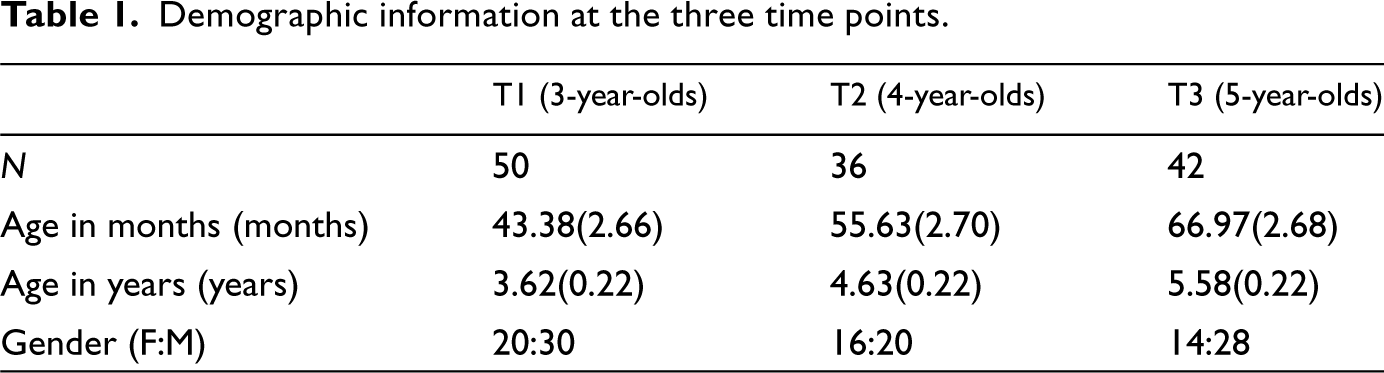
The participants were 50 typically developing Chinese children from a three-year longitudinal study, The behavioral and neural predictors of early development of visual specialization of Chinese character processing, in China. These children were recruited from one public kindergarten in Beijing. Initially, they were tested in the fall semester of their first year in kindergarten (Time 1 – T1, mean age: 43.38 months, SD = 2.66 months; range: 39–48 months, 20 girls). These children were tested annually on a variety of tasks with an interval of approximately 12 months. In the fall semester of K2 (Time 2 – T2), 36 children from the initial sample continued to participate in the study, whereas 14 children did not participate in the study due to self-selection of transferring to other kindergartens. In the fall of K3 (Time 3 – T3), 42 children from the initial sample continued to participate in the project, and 7 children transferred as decided by themselves and their families. Table 1 lists the details across the three time points. To assess the problem of longitudinal attrition, we performed a series of independent t-tests for the two independent samples (i.e., the retained children and the transferred/lost children) in all measurements. None reached significance (all ps > 0.05), suggesting that longitudinal attrition did not bias our sample. All children in our study were native Mandarin speakers. All children were right-handed, with normal or corrected-to-normal vision. Informed consent was obtained from the legal guardians of the children included in the study. These children also gave oral assent prior to their participation. All the experiment procedures and protocols were approved by the Institutional Review Board of the Institute of Psychology, Chinese Academy of Sciences (No. H15044).
Demographic information at the three time points.
Measures
Perceptual-matching task
Surface Pro with E-prime 2.0 software was used to display the perceptual-matching tasks (Zhang and Li, 2018; Zhang et al., 2021b). The children finished two perceptual-matching tasks (inverted orientation and mirrored orientation) by touching the screen, where both their response time and accuracy were obtained.
The perceptual-matching tasks both contained two conditions (i.e., normal Chinese character versus inverted Chinese character; normal Chinese character versus mirrored Chinese character) using two types of Chinese characters (simple characters and compound characters) (see Figure 1). Under each condition, there were 20 stimulus pairs, half of which were the same and half of which were different.
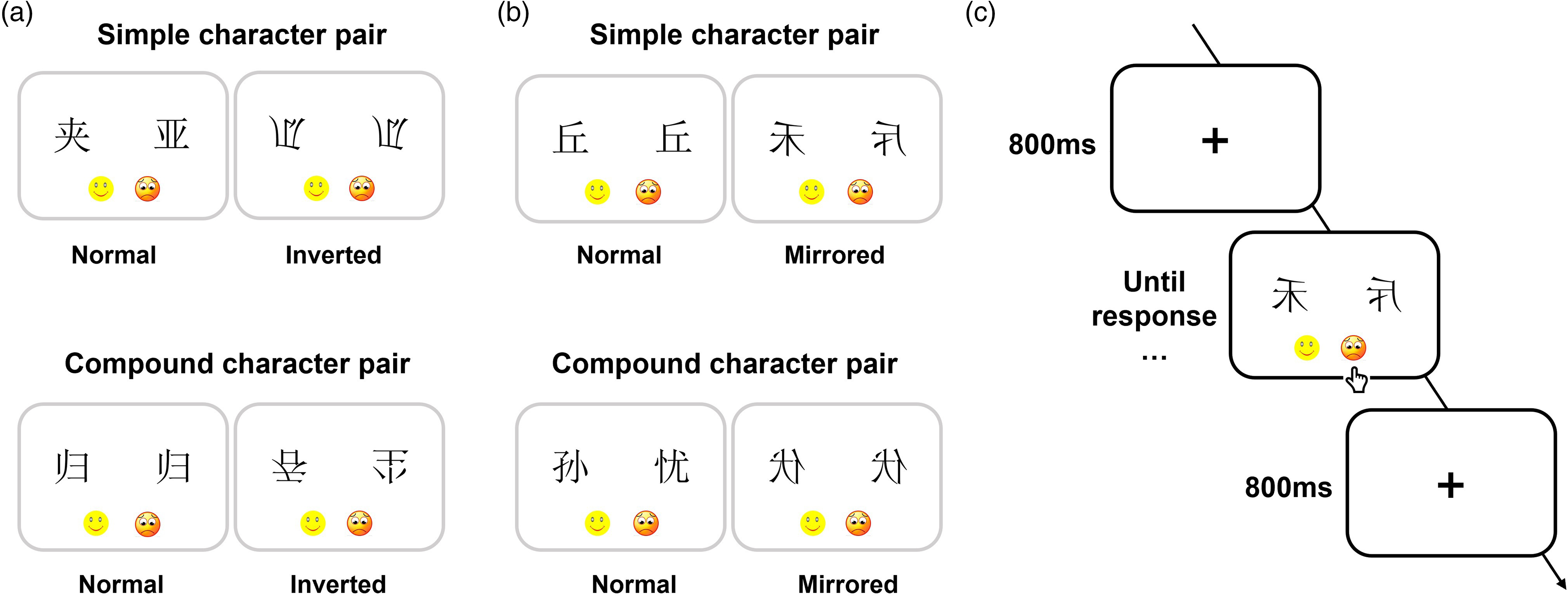
(a) Sample stimulus pairs in the inverted orientation perceptual-matching task. (b) Sample stimulus pairs in the mirrored orientation perceptual-matching task. (c) Schematic representation of the experimental procedure in two perceptual-matching tasks.
For each trial, following an 800 ms fixation, each stimulus pair was presented until participants made responses (see Figure 1). Participants were instructed to decide whether the two paired stimuli on the screen were the same or different and to indicate their responses as quickly as possible by using the index fingers of their right hands to touch the happy or sad face on the screen. If children considered that the pairs were the same, then they should touch the happy face; if different, they should touch the sad face. Six practice trials before the formal experiments were conducted to ensure that children could understand the tasks. The same and different stimuli pairs were presented randomly, and their left–right positioning methods were counterbalanced across subjects. The order of the two conditions in the tasks was also counterbalanced across subjects.
Materials
In the inverted orientation perceptual-matching task, two types of Chinese characters with different complexities were chosen, consisting of 10 Chinese simple characters and 10 Chinese compound characters (containing two radicals). The average number of strokes of these characters was 5.95 (range: 5–7). These Chinese characters were low-frequency words (average 54.7 per million, range: 11–94 per million; Language Teaching and Research Institute of Beijing Language Institute, 1986). Copying these 20 formal characters, we flipped them vertically as the inverted characters. Thus, the experimental stimuli comprised 20 normal Chinese characters and 20 inverted Chinese characters. All stimuli were in the standard typeface of Chinese, 180-point with 300 × 350 pixels.
Similarly, in the mirrored orientation perceptual-matching task, the average number of strokes of the chosen Chinese characters was 5.95 (range: 5–7). These Chinese characters were low-frequency words (average 52.3 per million, range: 15–93). Copying these 20 formal characters, we flipped them horizontally as the mirrored characters. Thus, the experimental stimuli comprised 20 normal Chinese characters and 20 mirrored Chinese characters. All stimuli were in the standard typeface of Chinese, 180-point with 300 × 350 pixels.
Data analysis
According to the data situation, data with a correct rate of less than 0.50 and data greater than 10,000 ms or ±2.5 standard deviations during the reaction in each subject were excluded. These operations deleted approximately 4.57% of the data, and the remaining data were analyzed using the lmerTest package of R software (R Core Team, 2022) for linear mixed model analysis (Kuznetsova et al., 2017) as follows.
In the inverted orientation perception matching task, a linear mixed model analysis was performed after the children’s response time log transformation at three time points (because the distribution of the reaction time distribution was nonnormal). In this model, the participants and items were used as random factors, while the Chinese character orientation conditions (inverted, normal), the types of Chinese characters (simple and compound characters), and the time points (T1, T2, T3) were fixed factors.
In the mirror orientation perception matching task, linear mixed model analysis was carried out after the children’s response time log transformation at three time points (because the distribution of the reaction time distribution was nonnormal). In this model, the participants and items were used as random factors, while the Chinese character orientation conditions (mirrored, normal), the types of Chinese characters (simple and compound characters), and the time points (T1, T2, T3) were fixed factors.
During model fitting, the intercept and slope were added to the model; if the model could not converge, the random slope was removed. In addition, if the interaction was significant, a simple effects analysis was performed using the emmeans package (Lenth et al., 2018).
Results
Accuracy rates and reaction times in two perceptual-matching tasks
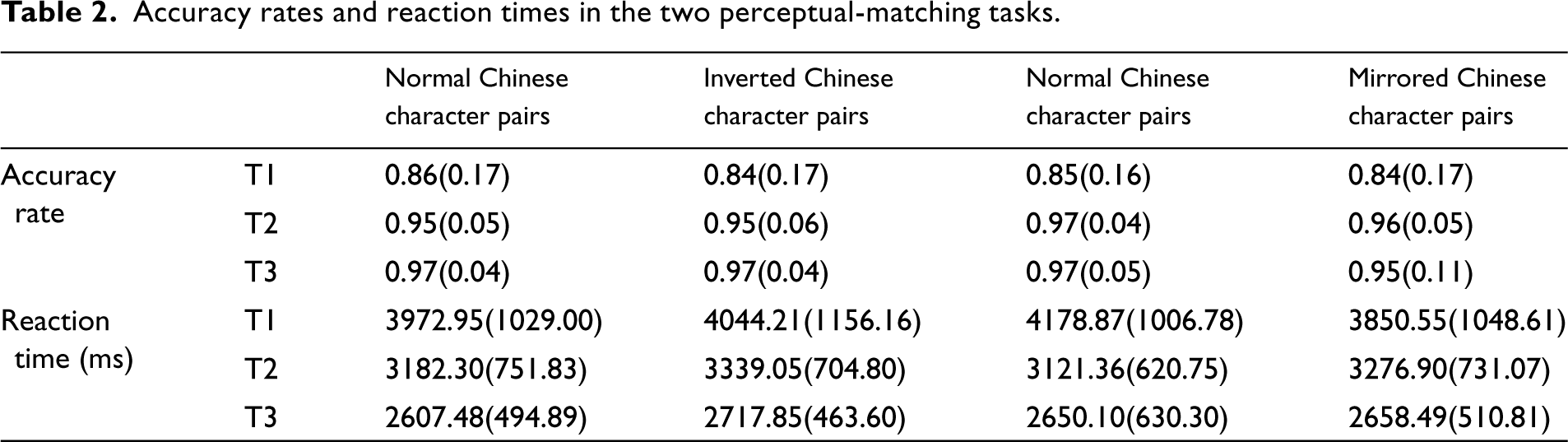
Table 2 shows the accuracy rates and reaction times of children in the inverted and mirrored orientation tasks at different time points. The accuracy rates were above 0.80, indicating that the difficulty of the task was suitable for children at various time points. In addition, the accuracy rates were not significantly different between the two aspects of orientation of Chinese characters, so the linear mixed model analysis was only performed on the correct reaction in the subsequent analysis.
Accuracy rates and reaction times in the two perceptual-matching tasks.
Children’s performance in the inverted orientation perception matching task
The linear mixed model analysis showed a significant difference in the response between inverted and normal conditions (b = 0.04, SE = 0.01, t = 2.70, p < .01), and children responded slower under the inverted condition than under the normal condition. Children’s responses developed faster with age (b = –0.23, SE = 0.01, t = –22.03, p < .001; b = –0.43, SE = 0.01, t = –40.67, p < .001). In addition, the interaction between Chinese character orientation conditions and time points was significant (b = 0.05, SE = 0.02, t = 2.30, p < .05; b = 0.02, SE = 0.02, t = 2.56, p < .05). Meanwhile, the interaction among Chinese character orientation conditions, the types of Chinese characters, and the time points was significant (b = –0.10, SE = 0.04, t = –2.40, p < .05) (see Table 3).
Results of the linear mixed-effects models for reaction times in the inverted perceptual-matching task.
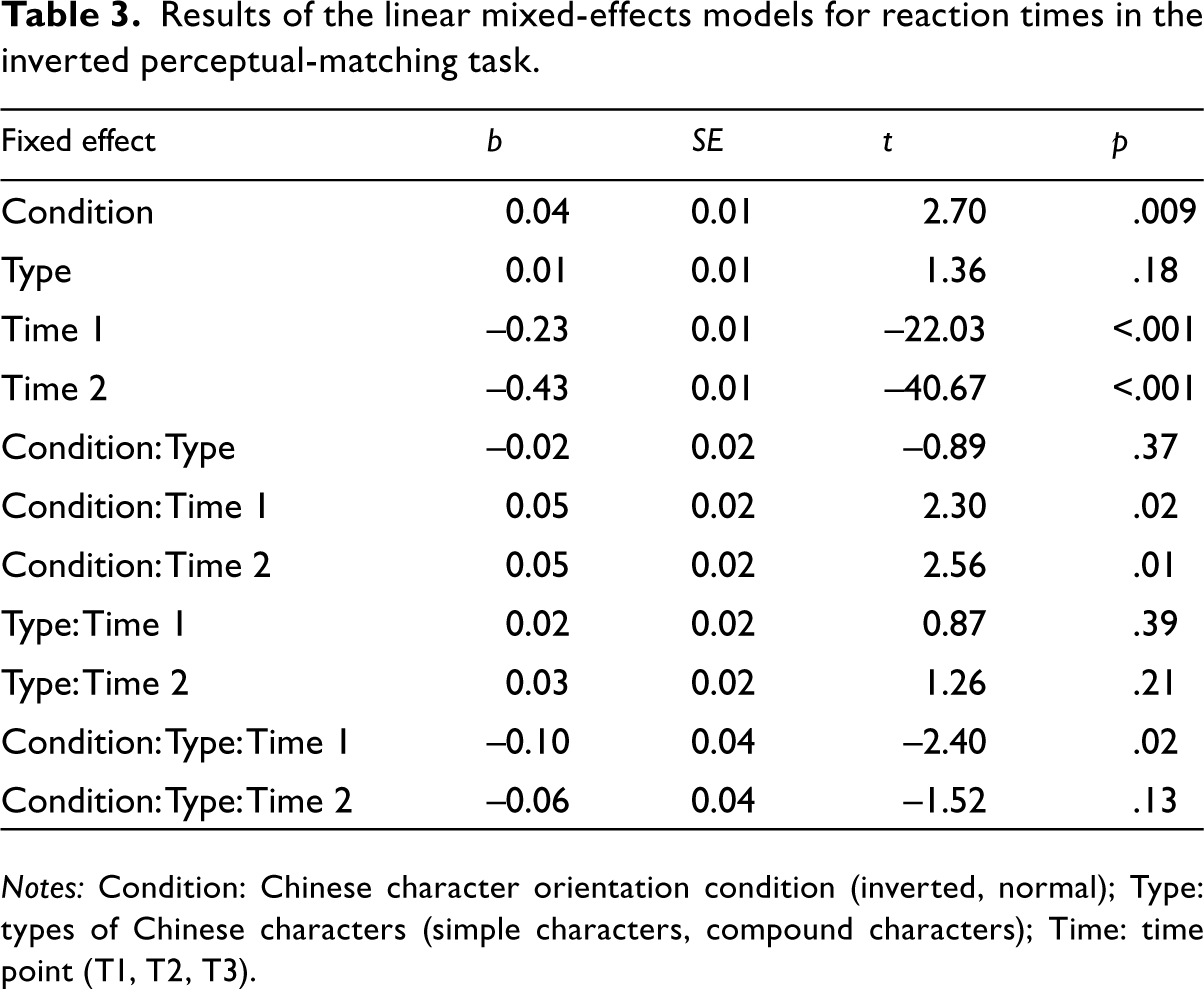
Notes: Condition: Chinese character orientation condition (inverted, normal); Type: types of Chinese characters (simple characters, compound characters); Time: time point (T1, T2, T3).
A simple effects analysis of the interaction showed no significant difference in the children’s reaction times between the inverted orientation and normal orientation at the T1 time point (3 years) (b = –0.003, SE = 0.02, z = –0.17, p = .86) and longer reaction times in the inverted orientation at the T2 time point (4 years) and T3 time point (5 years) (b = –0.05, SE = 0.02, z = –2.80, p < .01; b = –0.05, SE = 0.02, z = –3.22, p < .01). In addition, the simple effects analysis results of the triple interaction showed that the children had longer reaction times in the inverted orientation of Chinese simple characters at the T2 time point (4 years) and T3 time point (5 years) (b = –0.08, SE = 0.02, z = –3.46, p < .001; b = –0.07, SE = 0.02, z = –3.02, p < .05). However, the inversion effect of Chinese compound characters appeared only at the T3 time point (5 years) (b = –0.04, SE = 0.02, z = –1.95, p = .05).
Children’s performance in the mirrored orientation perception matching task
Linear mixed model analysis indicated a significant difference in the response between Chinese simple characters and Chinese compound characters (b = 0.03, SE = 0.01, t = 2.66, p < .01), and children had longer reaction times in the case of Chinese compound characters. Children’s reaction times became shorter rapidly with age (b = –0.24, SE = 0.01, t = –22.12, p < .001; b = –0.42, SE = 0.01, t = –38.36, p < .001). In addition, the interaction between Chinese character orientation conditions and time points was significant (b = 0.05, SE = 0.02, t = 2.48, p < .05) (see Table 4).
Results of the linear mixed-effects models for reaction time in the mirrored perceptual-matching task.
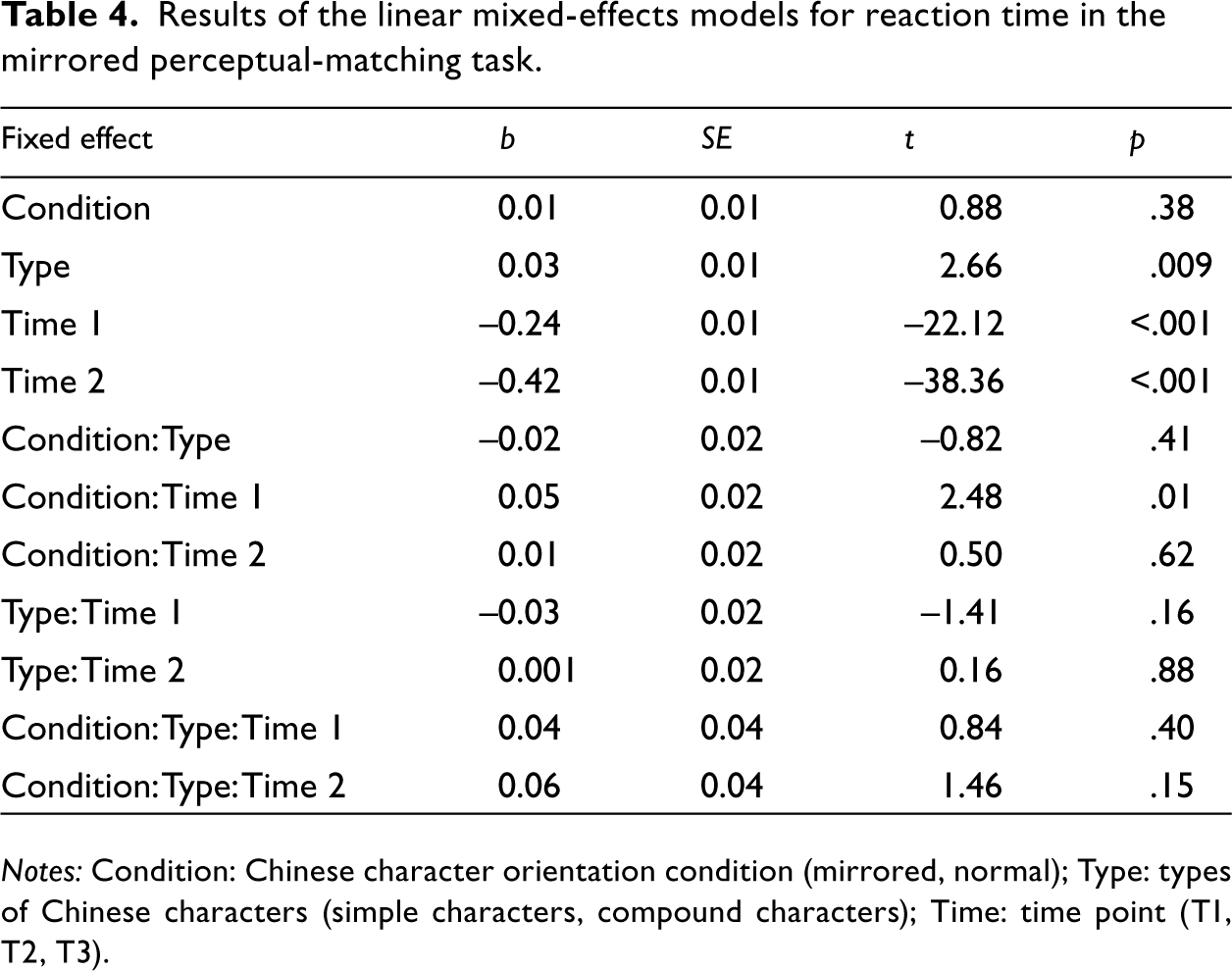
Notes: Condition: Chinese character orientation condition (mirrored, normal); Type: types of Chinese characters (simple characters, compound characters); Time: time point (T1, T2, T3).
A simple effects analysis of the interaction showed that children had longer reaction times in the mirror orientation only at the T2 time point (4 years) (b = –0.04, SE = 0.02, z = –2.45, p < .05). Furthermore, children mainly responded slower under the mirrored condition than under the normal condition for Chinese simple characters at the T2 time point (4 years) (b = –0.05, SE = 0.02, z = –2.11, p < .05).
Discussion
The current study explored young children’s early orientation (inverted and mirrored) knowledge of Chinese simple characters and Chinese compound characters using perceptual-matching tasks. It was found that the orientation knowledge of Chinese characters developed early. Interestingly, children demonstrated different developmental trajectories in the two aspects of orientation knowledge of Chinese characters. Moreover, the complexity of Chinese characters affected the development of the inverted orientation and mirrored orientation knowledge.
Development of the two aspects of orientation knowledge of Chinese characters
Our results exhibited that the children possessed inverted and mirrored orientation knowledge of Chinese simple characters at the age of 4 (4.63 years old). In addition, they showed sensitivity to inverted Chinese compound characters at the age of 5 (5.58 years old). These results suggested that children’s orientation knowledge about Chinese simple and compound characters developed from an early age, which was consistent with the findings from previous studies (Miller, 2002; Sun et al., 2022; Zhang and Li, 2018; Zhang et al., 2021b). Moreover, these results expanded the research on recognizing the visual/orthographic aspects of the Chinese system in the preschool period (Chan, 1990, 1996; Chen, 2019; Treiman and Yin, 2011; Yin and McBride, 2015; Zhao and Li, 2014), such as the discrimination between drawing/character-like stimuli and writing (Treiman and Yin, 2011; Zhao and Li, 2014), the recognition of a learned component or stroke pattern in new characters (Zhang et al., 2021b), sensitivity to an individual stroke (Li and Yin, 2017; Zhao and Li, 2014), and some understanding of the radical positioning rule (Zhang et al., 2021b).
Specifically, the different performances between the normal condition and inverted condition/mirrored condition indicated that children had orientation sensitivity to Chinese characters. This orientation sensitivity to Chinese characters caused the ‘inversion effect’ (Kao et al., 2010; Luo et al., 2017; Sun et al., 2022) and ‘mirror cost’ (Ahr et al., 2016; Fernandes and Leite, 2017; Fernandes et al., 2016; Fernandes et al., 2022), which was reflected by the increased efficiency of processing normal characters but decreased speeds in processing inverted and mirrored characters. In the current study, children had longer reaction times in the inverted orientation of Chinese simple characters at the age of 4 years and longer reaction times in the inverted orientation of Chinese compound characters at the age of 5 years. In addition, children also had longer reaction times in the mirror condition mainly at the age of 4 years when they processed the Chinese simple characters.
Furthermore, it was held that inverted and mirrored orientation sensitivity to Chinese characters demonstrated different developmental trajectories. Combined with the results of Chinese simple characters (Zhang and Li, 2018), the current results also showed that inverted orientation sensitivity to Chinese simple characters (approximately at the age of 4 years) and Chinese compound characters (approximately at the age of 5 years) developed early. However, the mirrored orientation sensitivity to Chinese compound characters did not appear until children were 5 years old. These results were in line with the findings in children learning alphabetic scripts (Blackburne et al., 2014; Fernandes et al., 2016; Fischer and Tazouti, 2012). For example, mirrored writing appeared very frequently (more than 20%) for children aged 5–6 years in a digit and capital letter writing task (Fischer and Tazouti, 2012). Moreover, one study to explore the neural basis of orientation sensitivity to letters showed that children aged 5–12 years failed to exhibit significant differences between normal and mirrored (reversed) letters on the P1 and N170 ERP components (Blackburne et al., 2014). These different developmental trajectories suggested that the underlying mechanisms to support inverted and mirrored orientation sensitivity might be different. Specifically, the different performance between the normal and inverted Chinese character conditions was related to the inversion effect in perceptual processing (Yin, 1969). The inversion effect reflected holistic/configural processing for visual stimuli. For example, Chinese adult readers showed that the proportional correct responses of matching upright real characters were significantly better than those of matching inverted real Chinese characters (Kao et al., 2010). Combined with the results found in 4-year-olds in the present study, holistic/configural information might be crucial in processing the inverted orientation of Chinese characters. Regarding mirrored orientation, processing mirrored characters could be explained by breaking or inhibiting mirror-image generalization (Bornstein et al., 1978; Logothetis et al., 1995; Rollenhagen and Olson, 2000), symmetry generalization (Lachmann, 2002; Orton, 1925), or mirror invariance (Dehaene et al., 2010). Mirror-image generalization or invariance, referring to identifying visual stimuli regardless of their orientation, was an important term in the neural recycling hypothesis (Dehaene and Cohen, 2007). The neural circuits for recognition of visual objects, which had mirror generalization properties, were progressively recycled during reading acquisition. Consequently, mirror errors or mirror generalization occurred frequently during the process of learning to read. It was precisely because of this mirror-image generalization or invariance that the mirrored orientation sensitivity to Chinese compound characters did not appear until children were 5 years old in the current study.
Influence of the complexity of Chinese characters on orientation sensitivity
The second major finding of the current study showed that the complexity of Chinese characters had an impact on inverted and mirrored orientation sensitivity. Although children at the age of 4 years displayed sensitivity to inverted Chinese simple characters, they showed sensitivity to inverted Chinese compound characters at the age of 5 years. Regarding mirrored orientation, although children had mirrored orientation knowledge of Chinese simple characters at the age of 4 years, their mirrored orientation knowledge of Chinese compound characters was not shown until the age of 5 years. These results suggested that compared with the orientation sensitivity to Chinese simple characters, the orientation sensitivity to Chinese compound characters might develop later to some extent due to their complexity. Our study provided the first and direct evidence for the influence of the complexity of Chinese characters on the development of print orientation knowledge.
Evidence from a study in adults showed that the inversion effect of Chinese characters was modulated by radical organization. Moreover, the inversion effect in reaction time was larger for compound characters (left–right and top–bottom structure) than for simple characters (Luo et al., 2017). Regarding the weak inversion effect of Chinese simple characters observed in adults, it was believed that the size of perceptual units in Chinese characters increased with increasing reading experience (Yeh et al., 2003). Specifically, configural/holistic processing, which was reflected by the inversion effect, was determined by the relative positions of radicals rather than strokes (Yeh et al. 2003). As simple characters had highly simple structures, their inversions might less disrupt the configural processing. Hence, a weak inversion effect appeared in skilled readers when they processed the inverted Chinese simple characters. As suggested by a previous study, children did not have a good command of the positioning rules of stroke patterns or radicals until 6-years-old or older (Chan, 1996), so the younger readers did not have sufficient reading experience to process larger perceptual units, such as radicals. Therefore, inverted orientation sensitivity and mirrored orientation sensitivity to Chinese compound characters might appear later than that to simple characters in the current study.
Limitations and future research directions
We have investigated inverted and mirrored Chinese character orientation knowledge through a three-year longitudinal study. Although the results at the three time points provided important evidence for the developmental course of print orientation acquisition, children did not show mirrored orientation knowledge of Chinese compound characters at the last test time point. To further describe the developmental progress in print orientation acquisition, more assessment across a longer period of time is needed.
Since young Chinese children did not need to learn to read or write in kindergarten, we did not assess their reading ability. Future studies need to examine the relationship between children’s orientation knowledge and their reading skills. In addition, we found an effect of the complexity of Chinese characters on the development of print orientation knowledge. Future research can explore the influencing factors based on the specific characteristics of Chinese characters, such as the structure of Chinese characters (i.e., left–right structure, top–bottom structure), which can contribute to understanding the influence of writing orientation and reversibility of words (e.g., Fernandes et al., 2016; Fischer and Tazouti, 2012).
Conclusion
The current three-year longitudinal study has examined the development of inverted and mirrored orientation sensitivity to Chinese simple and compound characters simultaneously. The results have suggested that children’s knowledge of inverted Chinese characters developed earlier. Moreover, the complexity of Chinese characters affected the development of orientation knowledge of Chinese characters. These results have highlighted the early development of the two aspects of orientation knowledge of Chinese simple and compound characters.
Footnotes
Authors’s Contributions
Wenfang Zhang: conceptualization, data curation, methodology, project administration, original draft, review and editing; Su Li: funding acquisition and supervision, conceptualization, methodology, project administration, original draft, review and editing.
Declaration of conflicting interests
The author declared no potential conflicts of interest with respect to the research, authorship and/or publication of this article.
Funding
The authors disclosed receipt of the following financial support for the research, authorship, and/or publication of this article: This work was supported by the National Natural Sciences Foundation of China (grant number 31571140).

Correction December 2023
The authors' affiliations have been revised.