







Abstract
This study focuses on Chinese characters with the radical “zou 走,” positing that specific semantic features among zou’s semantic features play a central role in their core meanings. The objective is to elucidate the core semantic features observed within the group of characters incorporating zou as a radical. According to the findings, characters with the zou radical can primarily be categorized into two semantic fields: “motion” and “movement,” with a total of 17 related semantic items identified. These generated semantic items appear to differentiate each meaning item due to factors of focus, akin to creating a new lexicon. The core semantic features were derived as [ + Motion][ + Action][+Tool (feet)]. Thus, it is discernible that characters with the zou radical are all related to actions involving feet, indicating motion.
Introduction
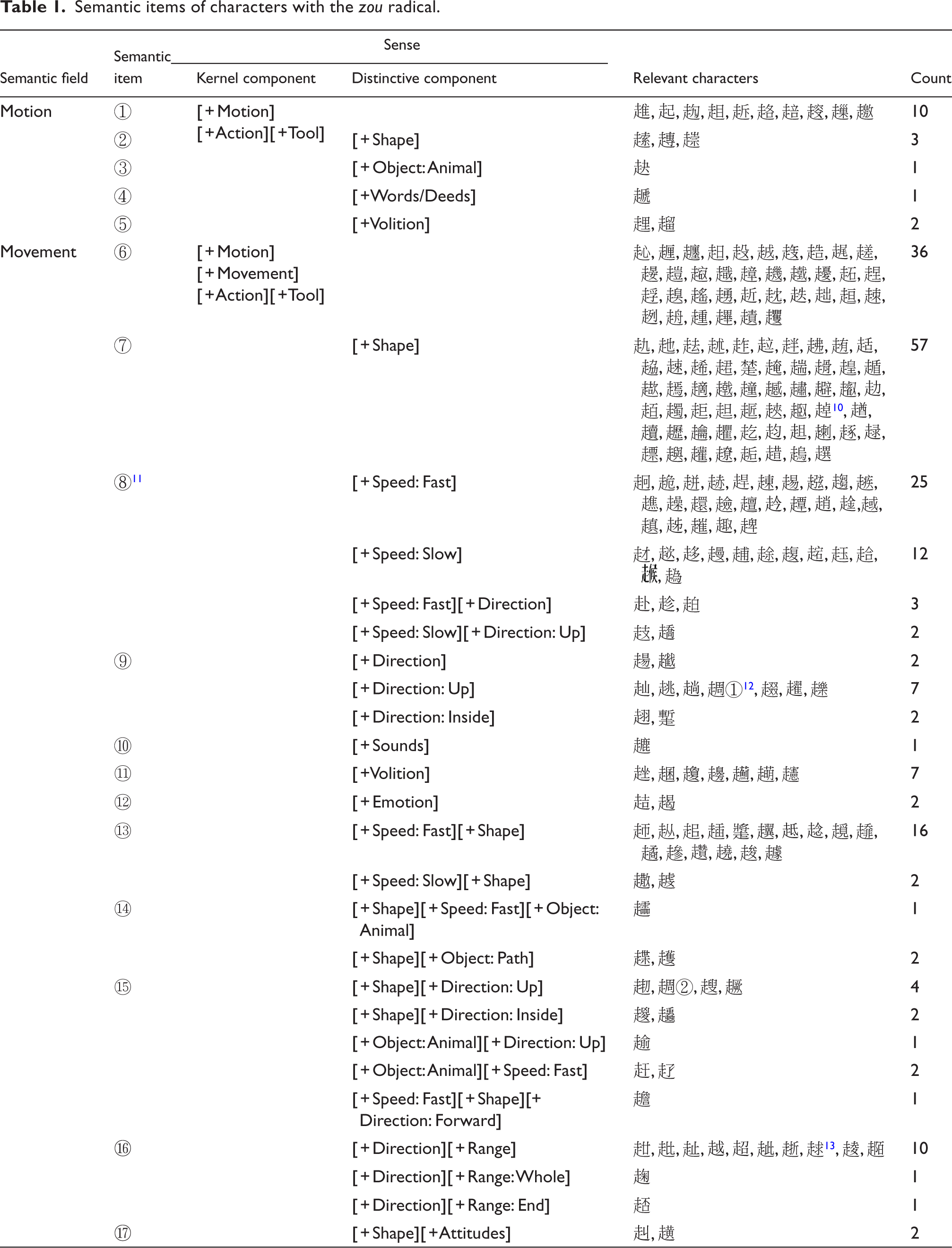
This research aims to discuss the core semantic features related to the radical’s core meaning in the formation of characters within a radical group. The structure of Chinese characters reflects people’s cognition of lexical meanings at the time of character creation; hence, the interpretation of character forms reveals understanding and cognition of lexical meanings (Kong, 2018: 103). Radicals, indicating groups of related words, not only transmit meanings but also serve as a criterion for distinguishing meanings. A collection formed by the same radical becomes an assembly sharing a common denominator, differentiating it from collections formed by different radicals. Therefore, examining characters through radicals offers insights into people’s thoughts on the meanings of characters at the time of their creation. In addition, exploring the semantic typification of characters with the same radical can aid in understanding the semantic system of those characters. During the formation and semantic derivation of characters, radicals are thought to perform a crucial semantic function throughout. What then, among the various semantic features of radicals, plays a pivotal role in connecting them? Generally, observable features stand out more than non-observable ones, making action behaviors prominently feature semantic traits (Dong, 2005: 288). According to Miller and Johnson-Laird (1976: 527), motion verbs are considered prime examples of “prototypical verbs” that best reveal verb characteristics (cited in Lim, 2009: 280). Thus, when studying “zou 走” (referred to as “zou” in subsequent mentions), a verb denoting the most basic movement, “to move,” its semantic features are expected to be significantly pronounced. Notably, zou is a radical while also being a monosyllabic word with its own sound and meaning, and it is polysemous, holding multiple meaning items. The relationship between the meaning items in polysemy is seen as a general development pattern in semantic derivation, where meanings are not derived arbitrarily but are connected through a core meaning. However, research on core semantic features, especially in relation to groups of characters with the same radical, remains limited. 1 Thus, it is necessary to explore the relationship between multiple meaning items of a radical and the semantic types observed in a group of characters formed by that radical. The radical characters of zou denote a collection of characters with semantic traits of zou, sharing relatedness among their members. Hence, the hypothesis of this article is that specific semantic features among zou radical characters involve core meanings, playing a crucial role in binding them into a cohesive group. The purpose of this study is to illuminate the core semantic features shown by the group of characters with zou as a radical. The study selected a total of 217 zou radical characters listed in Hanyu Dazidian (2010) for detailed analysis (as shown in Table 1). 2
Semantic items of characters with the zou radical.
Core semantic features and the relationship of the semantic field represented by radical
In the process of analyzing meanings, it is believed that the meaning of a word should be considered from three aspects: First, the internal meaning structure of the word itself; second, the paradigmatic relations, which are the semantic relations between words that are similar or opposite in meaning; and third, the syntagmatic relations, which are the relations between a word and other words that are necessarily required in a sentence. The first aspect analyzes the internal meaning structure of a word, while the second and third aspects analyze the external semantic relations with other words. (Hong, 2008: 19–20)
First, the concept of “core semantic features” can be examined in relation to the internal semantic relations of a word. In the case of polysemous words, the semantic features of each meaning item within the internal meaning structure are divided into common and individual meanings, with the core semantic feature being the one that plays the most crucial role in the common meaning. When referring to “core semantic features”, it is easy to think of “core words (Chi. hexinci 核心詞)”. However, it is important to note that these two concepts are different. “Core words” refers to words that express “core concepts”. “Core concepts (Chi. hexin gainian 核心概念)” refer to the most basic and commonly used concepts shared by all humans (Wang, 2018:3). “Core words” signify words that represent the most fundamental and universal concepts, which are different from the features explored in this study. Therefore, the “core words” differ from the attributes investigated in this research as they denote the most basic and common concepts. That is, the core semantic feature refers to the semantic component that not only is commonly included across multiple meanings of a word (lexeme) but also plays the most significant role (Kim, 2023: 66). While the prototype theory is commonly used to explain the issue of polysemy in vocabulary, caution must be exercised when applying it to core semantic features, as the prototype theory often cannot guarantee flexibility between meanings that are not directly connected through derivation (Hong, 2008: 96–97; Lim, 2010: 18), implying that the concept of core semantic features cannot be fully explained by prototype theory alone. However, the “classical categorization” model, which can be considered the foundation of the prototype theory, suggests that the process of meaning development follows certain rules, particularly that all meanings of a polyseme must share a “core meaning” as a necessary and sufficient condition of the members. This “core meaning sharing” provides a theoretical basis for the existence of core semantic features, meaning that the core semantic feature of a polyseme must satisfy the condition of “core meaning sharing” in the hierarchical development of meaning items. The emergence of the more flexible “prototype theory” as an alternative to the classical view was due to the lack of precise interpretation for complex polysemous relations, prompting reference to the flexibility of categorization in the prototype theory for this article. Thus, the perspectives from both classical categorization and prototype theory provide clear clues for establishing the concept of core semantic features, which is seen as meeting both the necessity of “core meaning sharing” from classical categorization and the flexibility of categorization from prototype theory. Essentially, not all attributes within a categorization need to be shared compulsorily; it suffices to share a few essential qualities; that is, the core semantic features. In a way, the core semantic features can be considered even more privileged and superior than the non-prototypical examples suggested by the prototype effect. 3 In this context, Wang and Wu (2021: 164) introduced the Cactus Development Model (Chi. xianrenzhang fazhan moxing 仙人掌發展模型), which proposes that the process of lexical meaning evolution is not unidirectional but rather involves both radiation and concatenation changes, 4 with radiation changes sometimes intersecting within a series of concatenation changes.
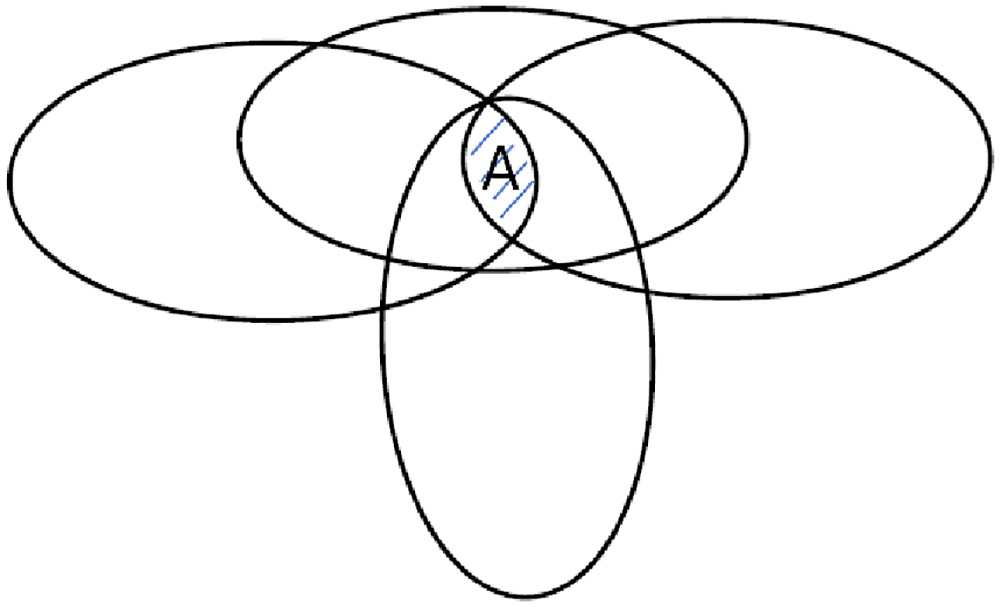
As shown in Figure 1, the ‘Cactus Development Model’ can be described as such: each prototype represents a semantic item of lexicon, with the lowest prototype indicating the word’s original meaning, and other prototypes representing meanings that have evolved from this original and basic meaning. The development process is a mix of both radiation and concatenation, showing that evolution can intersect and proceed in various directions. The solid line below the lowest prototype represents the roots of the cactus, signifying that the meanings of words all originate from the soil of a specific culture, absorbing cultural nutrients. The Cactus Development Model appears to be highly useful in explaining the issue of polysemy in vocabulary. Whether through concatenation or radiation, it is believed that all derived meanings share common semantic features. 5 Applying this concept can be visualized, as shown in Figures 2 and 3.
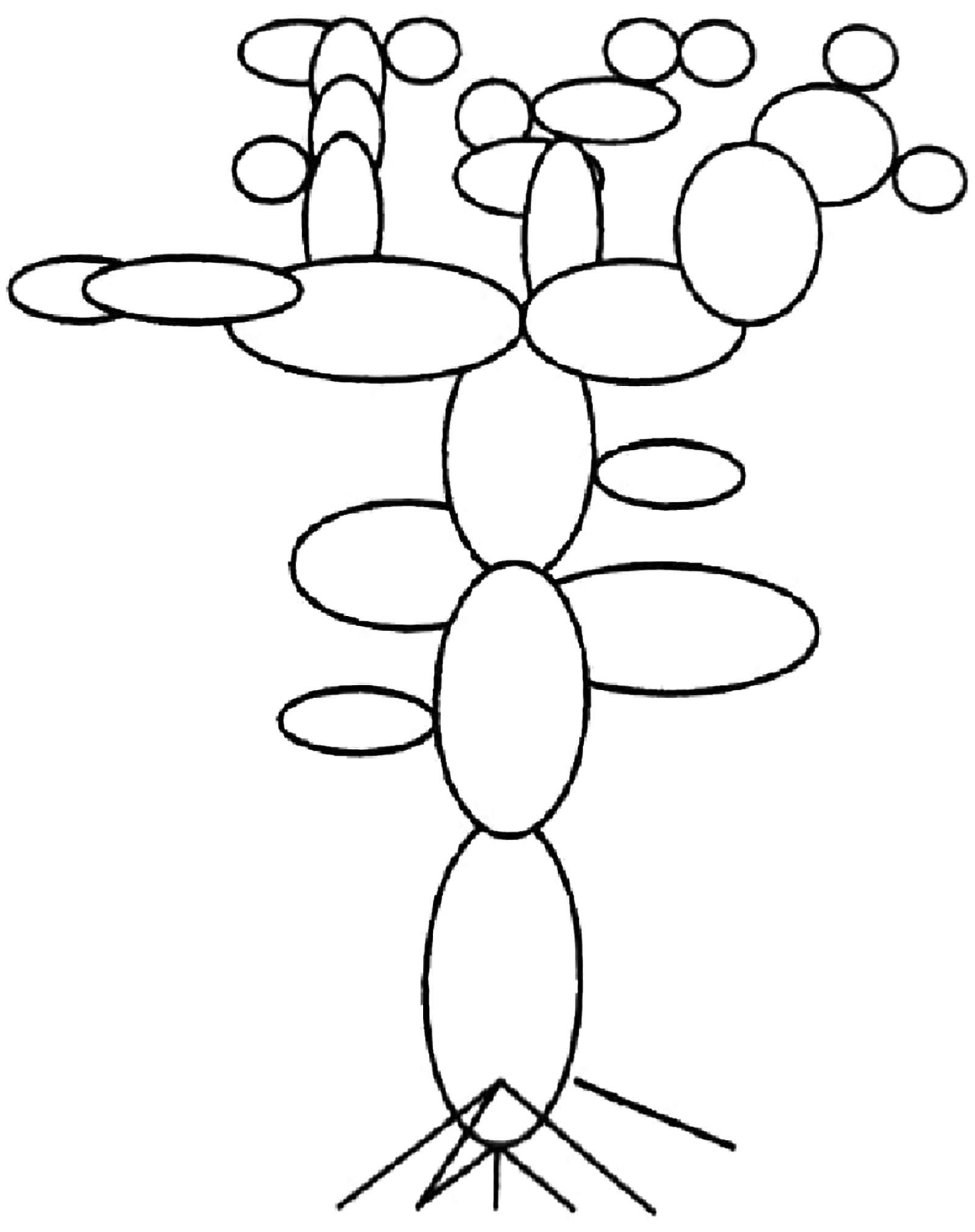
The Cactus Development Model (Wang and Wu, 2021).

Concatenative derivation.
Radiative derivation.
It can be inferred that a common attribute “A” exists in both concatenative and radiative derivations. This attribute “A,” universally present across all semantic items, is regarded as the core semantic feature. Indeed, there might be multiple instances of “A.” Alternatively, “A” could be envisaged as the domain where the core semantic feature resides. Considering that the development of meaning cannot be viewed as unidirectional, employing the Cactus Development Model previously discussed to re-depict the core semantic features would proceed as shown in Figure 4.
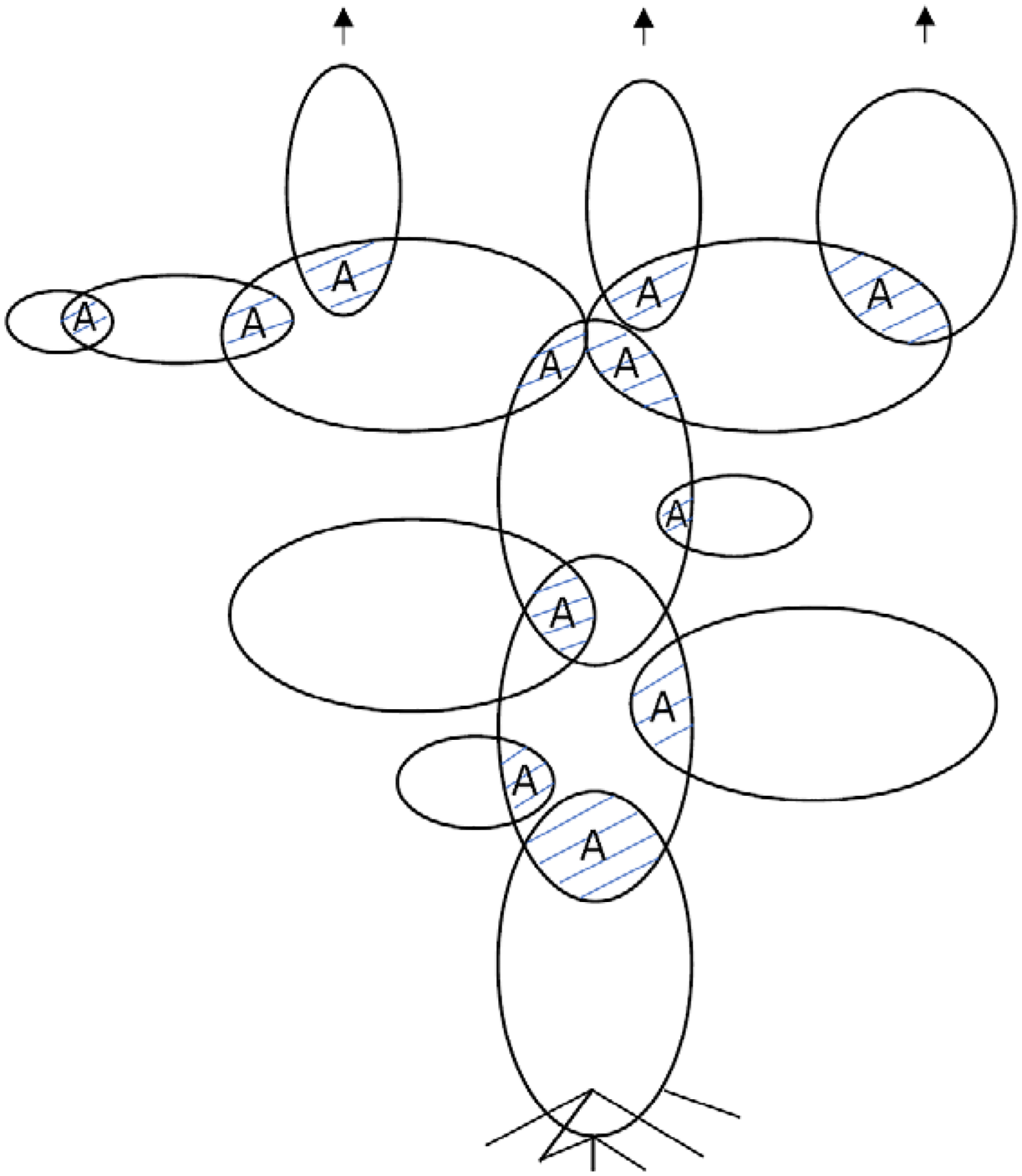
Core semantic features in the Cactus Development Model.
In the process of meaning derivation, both vertical and horizontal directions can coexist. However, like the growth direction of a cactus stretching towards a particular direction, there seems to be an ultimate direction of development. Furthermore, it is predicted that the core semantic features play a pivotal role in guiding this development direction.
Next, the concept of the “semantic field” can be examined in relation to the external semantic relations of words: “In semantics, the theory of ‘field’ from physics is borrowed to place lexically related and influential words within a single field, which is precisely the concept of a semantic field” (Zhan, 1997: 65–66). The interior of a field is a hierarchical structure divided into the semantic fields of superordinate and subordinate, and their relationships can be explained through paradigmatic relations. Therefore, the paradigmatic relations of word meanings can be understood as relationships within a set bound by some criteria, that is, within a semantic field (Lim, 2018: 220–250). As previously referenced, groups formed by the same radical become a collective entity sharing a common denominator, distinguishing them from groups formed by different radicals. Generally, radicals convey meaning and share a common meaning, thus forming both a formal common denominator and a semantic common denominator, 6 creating a semantic field among lexicon items. Hence, the group of characters with the zou radical can also be considered a zou radical semantic field, where the zou radical plays an integrating role as a common denominator among the components of the zou radical semantic field.
Based on this, the concept of core semantic features seen in polysemous relationships can be applied to the zou radical character group, which is the zou radical semantic field. Assuming each meaning type observed in the zou radical character group represents a semantic item, these items share a common “core meaning.” In other words, the core semantic features applied in the internal semantic relations can be extended to explain the relationships among the members forming the character group in the external semantic relations.
The semantic types and core semantic features of characters with the zou radical
This section will explore the process of deriving specific core semantic features of characters composed of the zou radical. First, we will examine the original meaning of zou, and then represent the attributes of each character within the zou radical semantic field as semantic features. Following this, the Cactus Development Model will be used to diagram the semantic relationships of characters with the zou radical before extracting the core semantic features.
The original meaning of zou
The original meaning of a word plays a crucial role in the process of meaning change of a word. The derived meanings of a word, regardless of their number, all stem from its original meaning. Thus, identifying the original meaning of a word is tantamount to understanding its entire network of meanings. The original meaning of a character typically refers to the meaning reflected in the character’s form. (Jiang, 2012: 112)
甲骨文 金文 楚系簡帛 說文 隸書 楷書
As demonstrated by the evolution of the character zou, in Jiaguwen 甲骨文 (oracle bone script), zou was a xiangxingzi 象形字 (pictographic character) depicting a person running with arms flailing. In Jinwen 金文 (Chinese bronze inscriptions), the addition of the character ‘zhi 止’ clarified the meaning to explicitly denote ‘to run.’ That is, the upper part illustrates the image of a person flailing their arms while rushing or running, and the lower part ‘zhi 止’ emphasizes the action of the feet.
From xiaozhuan 小篆 (Small Seal Script), changes in the character’s form occurred, with the upper part transforming into “yao 夭,” depicting a person with a bent head. In the Clerical Script, zou is divided into an upper and lower structure, “土” and “龰,” respectively. It appears that, with its adoption into lishu 隸書, “
走,趨也。从夭、止,夭止者,屈也。 ” transformed into “
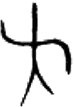 ” and “
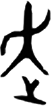 ” evolved into “
 ” (Xu and Ha, 2013: 420; Lv, 2016: 506), resulting in their current forms. The interpretation of zou in Shuowen Jiezi is as follows:
Xu and Duan (1981) says: According to Shiming 释名: Walking slowly is called “bu 步,” going quickly is “qu 趨” and running fast is “zou 走.” This is an analysis of the meanings of characters, but Xu Shen did not distinguish between them. It is incorrect to commonly say today that zou is slow and qu is fast. Yao means to bend. As stated in zhibu 止部: “zhi 止” means the foot. The reason zou uses yao and zhi as semantic components and is “huiyizi 會意字” (associative compound characters) is because when walking slowly, the legs and feet are relatively straight, but when running, there are more bending parts.
According to Xu and Duan (1981), Xu Shen 許慎 focused on the commonalities between zou and qu, not making a special distinction between them. Of course, this is also a reason to view the semantic component of zou as “kuai zou 快走” (fast running), meaning qu (Wang, 1982: 196). Regardless, from the Small Seal Script, zou has evolved to incorporate the meanings of yao and zhi, becoming more specifically a character that means “a person (swinging arms and bending legs and feet) running quickly.” Thus, the semantic features manifested through the original meaning of zou can be surmised as [ + Human][ + Arm][ + Swing][ + Foot][ + Leg][ + Bending][ + Speed][ + Action: Running]. However, there is another aspect to consider: typically, humans run using their feet. That is, feet are used as a tool to perform the running action. Therefore, the emphasized point in the original meaning of zou can be viewed as the semantic qualities [ + Human][ + Tool][ + Speed][ + Action], while the specific bending of the limbs depicted as [ + Arm][ + Swing][ + Leg][ + Bending] can be considered redundant features. 7
Semantic items of characters with the zou radical
This section analyzes how the semantic items of characters formed with the radical zou appear. Since zou serves as the radical, most characters related to it are expected to involve meanings related to walking or running actions, speed, direction, shape, or posture (Lv, 2016: 506). For a more precise analysis, characters with the zou radical are grouped according to semantic types. The individual semantic items formed in this way are like the multiple meanings seen in polysemous words in dictionaries, giving rise to a new lexicon. Thus, a semantic system between the radical zou and the characters containing it is formed, allowing for the understanding of semantic relations.
In Hanyu Dazidian (2010), the explanation method for polysemous words arranges the meanings in the order of original meaning, extended meaning, loan character, place names, and surnames. Therefore, when there are multiple semantic items among the characters with the zou radical in Hanyu Dazidian, focus will be placed on the original meaning, which is the most central among the appearing semantic items, to typify the meaning. 8 By unifying related meanings under the original meaning, it is possible to examine the relation of each radical character's original meaning when they were first formed.
For semantic analysis of the 217 characters containing the zou radical, semantic features were categorized as [Action], [Attitudes], [Direction], [Emotion], [Motion], [Movement], [Object], [Range], [Shape], [Sounds], [Speed], [Tool], [Volition], [Words/Deeds]. Among these, [Action] represents specific movements of the body or limbs. [Attitudes] reveal mental states through physical posture, including shape. [Motion] signifies a change from a stationary posture. [Movement] is the spatial change occasioned by moving. [Object] refers to the specific object of an action or situation, excluding humans. [Range] describes attributes of a confined area, such as width or limit. [Shape] refers to the external appearance or form. [Speed] encompasses the concepts of “fast” and “slow” as the entity movement. [Tool] indicates the feet of humans or animals utilized for related motion or movement. [Words/Deeds] combines both speech and actions. Through these 14 semantic features, the study aims to present the semantic items observed in characters with the zou radical.
Before Hanyu Dazidian (2010), the initial character meaning of zou was “to run,” which changed to “to walk” after the Ming dynasty (Wang, 2006: 443). However, in the explanations provided by Hanyu Dazidian, it seems that there was no special distinction made among “走,” “步,” “行,” and “走行.” 9 That is, the explanations for characters with the zou radical do not distinguish between the specific actions of running or walking but simply represent related movements.
When classifying semantic types according to semantic features, characters with the zou radical can be broadly divided into two semantic fields: motion and movement. Each semantic field shows sub-concepts hierarchically, which can be considered newly constituted semantic items. There are a total of 17 semantic items. These are listed in Table 1.
In Table 1, characters with the zou radical are broadly categorized into two semantic fields, “motion” and “movement,” contributing to the formation of characters related to motion expression. Upon examining the semantic fields individually, the following can be observed.
First, characters in the “motion” field represent movement itself and are divided into five semantic items (①–⑤). This category includes characters denoting specific actions, characters related to shapes, and progressively abstract characters embodying [ + Words/Deeds] and [ + Volition] features.
Second, the “movement” field encompasses the majority of characters with the zou radical. These characters, leading with 12 semantic items (⑥–⑰), not only express movement and transit themselves but also demonstrate a more diverse and detailed development of meaning. The process of movement involves a series of actions, during which various [ + Action] and [ + Shape] features further extend to [ + Speed], [ + Direction], [ + Sounds], [ + Volition], [ + Emotion], [ + Range], and [ + Attitudes] features. This indicates that the development of meanings generally progresses from concrete to abstract notions. The formation of characters aligns with human cognition, where concrete characters are created before abstract ones.
14
Characters incorporating the zou radical primarily denote human movement. However, there are exceptions, such as the character “
 ,” which refers to the movement of animals, and “
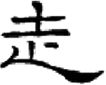 ,” which describes a place for running or walking, namely “a path,” showing a deviation towards the [ + Object] feature in some characters. This analysis of the semantics of characters with the zou radical demonstrates that they did not emerge in isolation but rather evolved from notions of movement and transition, along with various aspects related to these actions.
The [ + Speed] feature in some characters with the zou radical is seen as a significant factor. Indeed, zou can imply sprinting or slowing down. The analysis showed that under the premise of [ + Speed] being fast, the [ + Action] feature of “running” is emphasized. This ties back to the [ + Action: Running] feature in the original meaning of zou. 15 There are many characters related to this concept, such as “𧺸, 𧻜, 𧻓, 䞰, 趕, 𧼓, 䞶, 𧼏, 趨, 𧽑, 趭, 趮, 𧾎, 𧾏, 𧾍, 赺, 𧽼, 趙, 趛, 𧼑, 𧽍, 趀, 𧽠, 䞙, 𧺣, 𧺽, 𧼰, 𧽩, 𧾰, 趆, 趝, 𧽨, 𧾁, 𧽻, 𧾮, 赶, 𧺐, 赴, 趁, 䞟, 䟋, 䟃, 趲.” On the other hand, when [ + Speed] is presumed to be slow, the [ + Action] feature of “walking” becomes apparent, with related characters including “䞗, 趑, 趍, 䟂,” and so forth. 16 Thus, characters with the zou radical distinguish specific actions of running and walking through speed.
Core semantic features of characters with the zou radical
In polysemy, every action is not independently or singularly originated but evolves through various aspects related to the action or movement. These varied aspects become the background against which actions are depicted. Typically, the focus is placed on the action itself, transforming it into a figure, while associated aspects become latent background factors. 17
Thus, when one aspect is highlighted as a figure, other aspects recede into the background. This transition between figure and background can also explain the formation of multiple semantic items. The numerous semantic items observed in characters with the zou radical can be interpreted as polysemous relationships formed through these transitions. For instance, when focusing on “speed” to explicitly express related actions, the [ + Speed] feature becomes the focus, and other elements become latent background factors around this feature. In items ①–⑰, the factor that receives focus becomes more prominent, establishing the figure and background. This differentiation serves to divide the semantic parts and distinguish each semantic item from the others, allowing for varying degrees of semantic independence among them. Even when core semantic features are latent as background factors, they play a pivotal role in piercing through the central meaning, producing and connecting semantic relationships. Through the Cactus Development Model, the emergence of each semantic item in characters with the zou radical can be depicted, with all elements possessing a [ + ], although this is omitted in Figure 5 for simplicity.
In Figure 5, every prototype represents a semantic item seen in characters with the zou radical. The prominent [ + Action: Running] feature from the original meaning encompasses both [ + Motion] and [ + Movement] features, closely relating to the semantic characteristics of zou’s original meaning. From zou’s original meaning, related semantic features semantically contribute to the formation of characters with the zou radical, revealing a common meaning indicated by each lexical item. As previously introduced in Figure 4, “a” is considered the space where the core semantic feature exists, similar to the intersection in a Venn diagram, where the common core semantic features found in “a” are [ + Motion], [ + Action], [ + Tool]. This proves that characters with the zou radical are all closely related to “motion,” “action,” and “tools (feet).” While the [ + Movement] feature also plays a significant role in forming many characters, it is considered not a core semantic feature. “Movement” involves “motion,” so these concepts can be conflated, yet they are different. Considering that an object can be in motion without relocating, but it cannot relocate without moving, [ + Motion] is a prerequisite for [ + Movement] and thus the common meaning for zou radical characters. Seo and Choi (2011: 66–83) expressed curiosity about how “qi 起” meaning “to rise” could serve as the radical for zou meaning “to run.” However, it is clarified that only about 30% of characters with the zou radical mean “to run,” and others have different meanings. This issue relates to the core semantic features discussed here, ultimately explaining the reasons through these core features. Characters with the zou radical’s core semantic features are [ + Motion], [ + Action], [ + Tool (feet)], showing that even if qi does not directly mean “to run,” it is related to movement actions involving feet.
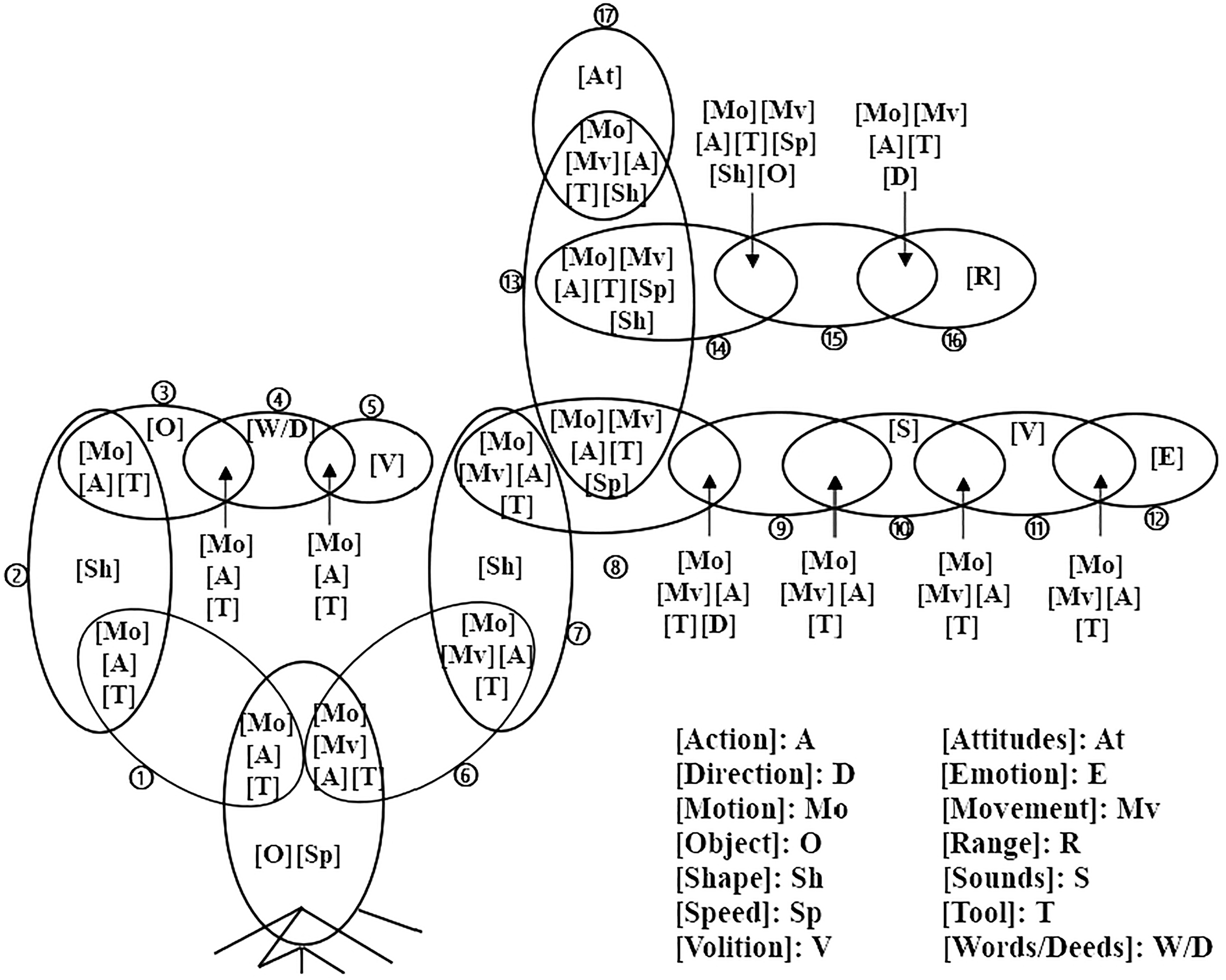
Core semantic features of characters with the zou radical in the Cactus Development Model.
In addition, the [ + Shape] and [ + Speed] features also play significant roles in the semantic items of characters with the zou radical. As shown in the Cactus Development Model for zou radical characters, these qualities continuously diversify semantic items and drive the evolution of meanings. The directional analysis of semantic items in zou radical characters supports the general view that meaning derivation typically progresses from concrete to abstract, highlighting how cognitive processes of language users are intricately linked to character formation.
Conclusion
This study provides important theoretical implications for understanding the evolution and structure of Chinese character meanings by analyzing the semantic features of characters using zou as a radical and their inter-semantic relationships. The research conclusions are articulated as follows.
First, the role of radicals in meaning transmission and differentiation: through the theory of semantic fields, this research explains how characters with the zou radical share common meanings while developing unique meanings. The radical zou plays a crucial role in integrating these characters into a semantic field.
Second, classification of semantic types and generation of semantic items: by categorizing radicals according to semantic types, it enables the differentiation between semantic items and the creation of new semantic systems akin to a lexicon. Characters with the zou radical are primarily divided into two semantic fields: “motion” and “movement,” from which a total of 17 semantic items are derived.
Third, derivation of common and core semantic features: this study identifies core semantic features common to characters with the zou radical, interpreted as [ + Motion], [ + Action], [ + Tool (feet)], suggesting that these characters all relate to motion or actions involving feet.
Fourth, additional important semantic features: beyond the core semantic features, such as [ + Movement], [ + Speed], and [ + Shape], features play significant roles in the formation of meanings for characters with the zou radical, contributing to the diversification of semantic items.
Fifth, directionality of semantic derivation: semantic derivation generally progresses from concrete to abstract, a trend also observed in the semantic items of characters with the zou radical. This suggests the importance of cognitive reasoning in the formation of characters.
This research makes a theoretically significant contribution to understanding the formation and evolution of meanings through Chinese radicals. By introducing a new approach to the study and analysis of meanings in characters using radicals, it inspires future research. This methodology provides a useful tool for exploring the semantic relationships and development of polysemous characters using various radicals, not limited to those with the zou radical.
Footnotes
Declaration of conflicting interests
The author declared no potential conflicts of interest with respect to the research, authorship, and/or publication of this article.
Funding
This work was supported by the Ministry of Education of the Republic of Korea and the National Research Foundation of Korea (NRF-2018S1A6A3A02043693).
