







Abstract
In 21st century Toronto, the labour of caring for urban trees is entangled with both gentrification processes and the social reproduction of settler colonial space. This paper contributes to the study of environmental gentrification through a study of the social reproduction of settler colonial relations to land in the Parkdale–High Park area of Toronto. Specifically, I take up the hyper-visibility of some forms of social reproduction, in order to shed light on how the mundane, quotidian ‘non-work’ of living in/with/for capitalism becomes a site of privilege and a luxury pursuit for more affluent residents. The paper highlights the processes and practices whereby settler colonial urban subjects seek out ‘nature’ as a temporary outside where they can escape from widely accepted downsides of capitalist urbanism, including a diverse array of social and physical ills, from stress, to obesity, to ecological degradation. The paper asks: whose social reproduction does the presence of urban trees serve? In the context of 21st century financialized gentrification, cities are increasingly normalized as spaces of wealth and luxury. It is therefore crucial to pay attention to the raced, gendered, and colonial micro-politics through which urban ecologies are transformed in the service of an anti-democratic vision of the city as a space of leisure and luxury.
Nature changed in the 1970s.
–Cindi Katz
Introduction
This paper examines how trees, as symbols of multiple and conflicting social values, are implicated in struggles over gentrification, displacement, and the right to stay in contemporary Toronto. As physical objects, trees are important as integral aspects of wider greening activities and associated contests over the realization of particular environmental imaginaries underway in contemporary cities. As symbols of nature, health, and ecological citizenship, they are also important discursive markers in what feminist geographer Leslie Kern (2015a) has referred to as ‘environmental gentrification through the body’. This paper draws together feminist writings on social reproduction, environmental gentrification, and settler colonial theory to show how urban trees are constitutive aspects of the landscapes and subjectivities of gentrification, and how they are woven into the very process of producing and socially reproducing forms of spatial violence, inequality, and injustice. It further draws upon settler colonial theory in order to situate contemporary struggles in the longer history of Indigenous displacement from land in general and urban land in particular, and to highlight how settler epistemologies continue to animate contemporary processes of urban development. Beyond acknowledging the social nature of trees, it confronts the value that trees have, and have had, for white, settler society in Canada.
Focusing on the Parkdale–High Park area of west Toronto, the study extends existing scholarship on gentrification in the area (i.e. Epstein, 2018; Horgan, 2018; Keatinge and Martin, 2015; Kern, 2010; Masuda et al., 2012; Mazer and Rankin, 2011; Slater, 2004; Teelucksingh, 2009; Whitzman and Slater, 2006). This literature has focused on the race and class-based dynamics through which a single-family ownership model of housing has been privileged, both by market forces as well as by the active intervention of municipal governments (Slater, 2004; Whitzman, 2009). In these environs, the space of gentrification is racialized and class coded such that whiter, and more affluent residents are viewed as the ‘natural’ residents of the northern and western areas, known as Roncesvalles and sited adjacent to High Park, while South Parkdale is stigmatized as a space of racialized poverty and social service dependence which is in the process of being ‘cleaned-up’ (Masuda et al., 2012; Mazer and Rankin, 2011; Parish, 2017; Slater, 2004; Teelucksingh, 2002; Whitzman, 2009). However, the place of natural amenities and urban greening activities within these dynamics has not been studied. This paper contributes to the existing literature on Parkdale by showing how the production of non-residential space (i.e. commercial space and the quasi-public space of streets and parks) draws on trees as symbols of ‘wild’ authentic nature in ways that render the social reproduction of whiter, more affluent lives and bodies hyper-visible while simultaneously suppressing and displacing those of poor, racialized, and Indigenous people.
Environmental, ecological, and green gentrification literatures have highlighted how forms of green development, environmental remediation, and related trends, such as the explosion of urban farmers markets and community gardens, can be implicated in the broader race and class remake of the city (Checker, 2011; Curran and Hamilton, 2018; Dooling, 2009, 2018; Goodling, 2019; Joassart-Marcelli and Bosco, 2018; Kern, 2015a; Safransky, 2017). Drawing on a binary understanding of social and environmental issues, green development has tended to privilege environmental cleanup over social justice (Dooling, 2018; Goodling, 2019). These issues are especially relevant to the Parkdale–High Park area, where green streetscape redevelopment and sustainability initiatives like farmers markets have coincided with intensified gentrification particularly in the northern part of the neighbourhood. Moreover, High Park, the largest park in central Toronto, covering some 161 hectares and sited to the immediate west, is a significant site of conflict over settler and Indigenous uses and meanings. Best known as Toronto’s ‘year-round playground’ the park is also the site of a rare Indigenous maintained ecosystem, as well as several burial mounds.
While the classed and racialized character of spatial injustice in Parkdale has been discussed in the literature, less attention has been paid to settler colonial dynamics. Geographer Kim Jackson (2017) has taken up the limits of Marxian theory for addressing the entanglements of settler colonialism and gentrification in Toronto’s Junction neighbourhood and critical health scholar Jon Johnson (2013, 2015) has explored the Indigenous environmental history of these areas of Toronto. However, the stories that are told about Parkdale and High Park both in the critical and more mainstream literatures either make no mention of Indigenous people, or Indigenous presence is treated as an historical artefact: once upon a time there were Indigenous people, then Europeans came, they subdivided the land, sold it, and now we have the contemporary landscape (i.e. Gibney, 2018).
Social reproduction refers to the daily and generational labour of caring for life, in for, and against capitalist social relations. Social reproduction theory refuses to relegate everyday life to the periphery of urban theory (Ruddick et al., 2018). Instead questions of how daily life happens, whose labour makes it happen, and how that labour is valued are understood to be constitutive aspects of the ‘the urban’. If social reproduction is taken seriously as integral to ‘the production of space for progressively more affluent users’ (Hackworth, 2002), then we must consider, broadly, the processes through which the normalization of ‘particular bodies in particular spaces’ (Mitchell, 2004) happens and is sustained. This includes the reproduction of physical bodies and material spaces, as well as the reproduction of less tangible entities, like values norms, and forms of common sense. The normalization of specific social relations, for example those that presume women to be better or more natural caregivers, itself requires work to be sustained or contested, as the case may be (Mitchell et al., 2003). As Indigenous scholar and political theorist Glen Coulthard (2014) has underscored in his development of the concept of urbs nullius, this taken-for-grantedness of bodies in space must include a reckoning with the fact that gentrification is not simply the class remake of the central city; it is also a reassertion of urban space as settler space (see also Jackson, 2017).
People presume trees to be ecological or natural components of the urban landscape. They often fail to recognize how trees are infused with a diversity of values and competing agendas related to urban spaces (Braverman, 2008; Poe et al., 2014). Trees are also significant in the context of individualized notions of ecological citizenship accompanied by ‘new conceptions of the human body and health strategies that emphasize the need to restore and “re-wild”… bodies that have become separated from nature’ (Leiper, 2017: 2; see also McKeithen and Naslund, 2017; Hadsell, 2016). This understanding of nature as a ‘universal “first nature” is entangled with and reifies social difference and hierarchy’ (Poe et al., 2014: 3; see also Dooling, 2018). It can observed in the proliferation of body-centred commodities such as natural foods, cosmetics, and health services that have emerged to assuage this anxiety around separation from nature (Hadsell, 2016; Kern, 2015a; Lavrence and Lozanski, 2014; Leiper, 2017; Parish, 2017, 2019). As ‘re-wilding’ the body emerges as commodifed tactic of consumer capitalism, it becomes more urgent to ask who can be seen to go ‘wild’? For, as urban political ecologists studying the use of wild nature in the city have shown race, class, national identity, and perceived expertise are all powerful factors mediating official rules and everyday attitudes towards access to urban wilds for food, medicine, and crafts (McLain et al., 2014; Poe et al., 2013, 2014).
This paper highlights the significance of trees as symbols of ‘wild’ nature in the reproduction of what Mazer and Rankin (2011) have described as ‘the social space of gentrification’, while situating contemporary discourses and practices pertaining to urban trees and forests in a longer story of colonialism, conservation, and commodification. The meaning of trees as ‘wild’ or ‘natural’ and therefore not properly a part of urban, capitalist, modernity is a form of meaning and signification which simultaneously renders the availability of trees (as well as the parks and forests from which they come and the wood they might become) central to the successful social reproduction of the subject of gentrification as a settler subject. As gentrification scholar Kim Jackson (2017) has recently argued, ‘[W]hile gentrification theory often looks at the ‘who’s’ and ‘why’s’ of gentrification, it does not analyze the involvement of the settler subject’ (45). Like the work of social reproduction itself, trees are interestingly positioned as both within and outside formal circuits of value production. In the social space of gentrification in Parkdale, trees as natural elements are woven into the very process of producing and socially reproducing this form of spatial inequality and injustice. However, at the same time, the very presence and economic value of urban trees in and around Parkdale–High Park depends on the availability of the ‘natural resource’ of forms of past and present unpaid labour, in order to bring trees (and other aspects of external nature) into economies of profitability and normalization. As the case addressed here will show, the invisibility of Indigenous labour in the past, and the promise of more visible forms of unpaid gendered labour in the future, are integral to the placing of trees, and to the real and perceived value of urban spaces of leisure and luxury in the present.
The research methods used combine three main strategies for understanding transformations in the Parkdale–High Park area. First, I collected data from the City of Toronto archives, print and on-line media, and websites and blogs of local businesses and organizations to develop a picture of how the commercial landscape in the area has changed since the 1980s. Second, in the spring and summer of 2015, I identified and contacted 33 organizations located in the area whose primary business involved natural health services or products, the majority of which had been established since the year 2000. Of those I was able to conduct in-depth semi-structured interviews with 11 representatives. Interviews focused on how the participants understood the concept of health and its relationship to nature, their relationship with the neighbourhoods in question, and their thoughts about the changes that were taking place there. Third, I used place-based observation and photography to collect data on street-level dynamics. This included participating in guided and informal walks and documenting the discursive strategies of local businesses and community organizations as found in public spaces such as sidewalk gardens and community notice boards.
The paper consists of four sections, plus an introduction and a conclusion. In the first section, I draw out theoretical connections between social reproduction, settler colonialism, and gentrification. In the second section, I discuss the historical importance of escaping to the ‘wilderness’ of northern Ontario as the constitutive outside of/for urban, settler colonial spaces and subjectivities. In this practice of (temporary) escape, Toronto and the North are produced relationally: the latter, construed as an ‘anachronistic space’ (McClintock, 1995), is produced as outside and other to the time-space of capitalist modernity, in ways that sustain colonial relations between people and places. Drawing on Katz’s (1998) observation that, in the latter decades of the 20th century the colonization of nature turned inward, the third and fourth sections of the paper shift to a consideration of contemporary dynamics in the reproduction of the ‘social space of gentrification’ (Mazer and Rankin, 2011) in the Parkdale–High Park area. As a space of leisure and recreation, High Park (see map in Figure 1) is characterized as a place of wilderness escape within the city. Through an analysis of shifting understandings of ‘nature’ we can see how the labours of making nature privilege the work of some ways of caring for life over others, and how the ostensible benevolence of care is not really outside or beyond the normalization of settler colonialism.
‘High Park Attractions’: Land uses in the park. Image credit: Base map, Google, 2018; Overlay map, High Park Grenadier Fund, 2014.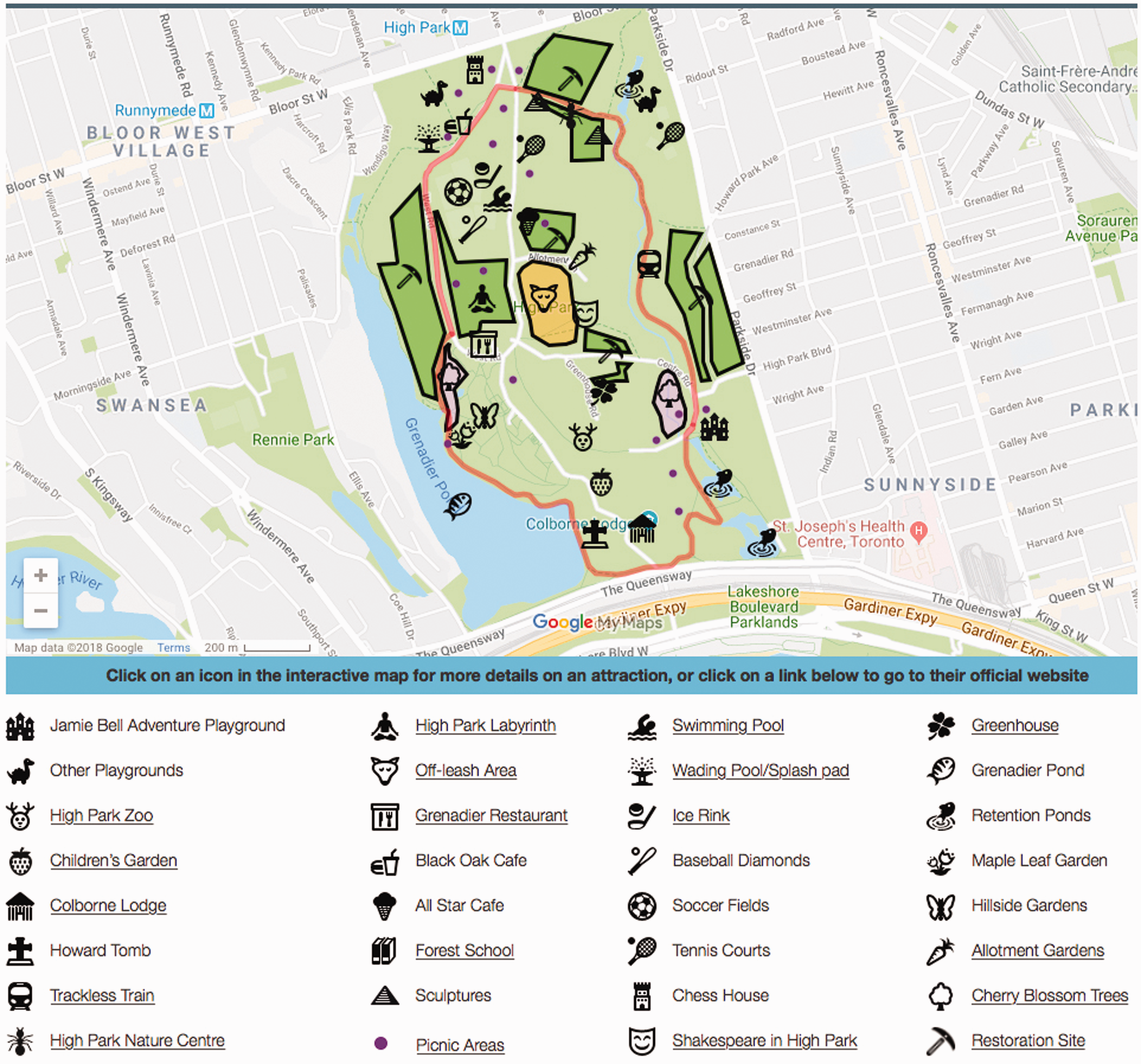
The process of gentrification in the adjacent neighbourhood of Parkdale is characterized by an uneven and racialized division between north and south parts of the area. Indeed, in recent years the north part of the neighbourhood, centred along the Roncesvalles Avenue commercial area, has succeeded in rebranding itself as ‘Roncy’ and ‘not Parkdale’ (Parish, 2017). The enhancement of ‘natural’ elements within the urban setting has been a crucial hinge on which these struggles to name, claim, and define the area have swung. This is evident both in the literal and figurative placing of trees and nature in the city as the product of the valued and valuable labours of the gentrifying subject. Settler bodies and spaces thus appear as sites of ‘re-wilding’ in ways that conform to normative governmental objectives of producing responsible, healthy, and environmentally conscious citizen consumers (Fusco, 2006; Hadsell, 2016; Lavrence and Lozanski, 2014).
Environmental gentrification as social reproduction
Research into struggles over urban natures and their place in the valorization of the built environment can benefit from the kinds of questions that animate the revivified contemporary interest in social reproduction (i.e. Andrucki et al., 2017; Bhattacharya, 2017; Ferguson et al., 2016; Katz, 2017; Parish and Montsion, 2018; Ruddick et al., 2018). Initially developed by Marxist Feminists in the 1970s and 1980s, social reproduction seeks to understand the specificity of women’s oppression under capitalism, and to contest the marginalization of women and domestic labour in studies of political economy. Social reproduction theory challenges the narrowness of an exclusive focus on production and highlights ‘naturalized’ forms of unwaged and/or under-valued feminized labour that perform the essential task of reproducing, on a daily and generational basis, the labour force upon which capital depends (Ferguson et al., 2016).
As geographer Cindy Katz (2017) points out, under capitalism, this is necessarily a differentiated labour force, and, therefore, social reproduction also includes the ‘cultural forms and practices’ that ‘maintain these differences and make them make sense’ (1). Social reproduction thus begins from a critique of the invisibility of some forms of work and their intrinsic link with the forms of oppression that make a differentiated labour force both possible and necessary. The social reproduction of capitalism depends upon ongoing processes that divide working people across ‘differences of gender, race and colonial status’ (Mitchell et al., 2003: 428) among others. Social reproduction is also fundamentally a question of life (Mitchell et al., 2003). It can be thought of as the ‘fleshy, messy, and indeterminate stuff of everyday life’ (Katz, 2001: 710): caring for self and others by preparing food, teaching the young, caring for the elderly, or taking in a yoga class as the case may be. Attention to these activities raises the question of which modes of living and being can flourish in the context of neoliberal capital and which must be given ‘the push’ (Push, 2019). As the stuff of everyday life, social reproduction must happen in space, and spatial differentiation is inextricably linked to the ways in which gendered, racialized, and classed forms of differentiation are made to make sense. Social reproduction theory is therefore a useful resource for understanding the paid and unpaid forms of work that produce the gentrifying landscape as natural, normal, and morally virtuous.
Environmental gentrification highlights the complexities surrounding processes of urban neighbourhood change that take place in the name of ‘sustainability’, ‘health’, and/or the redress of environmental injustice (Checker, 2011; Curran and Hamilton, 2012, Kern, 2015a; Teelucksingh, 2002; Wolch et al., 2014). For example, studies have shown that predominantly white neighbourhoods tend to have more green space and higher ‘walkability’ scores, and, presumably, more opportunities for ‘health’ (Wolch et al., 2014). At the same time, poor and racialized communities are more likely to be living near locally undesirable land uses such as previously contaminated land and water or presently active polluters (Teelucksingh, 2009). Environmental gentrification may take place either when a formerly industrial site is redeveloped for residential or mixed-use purposes (Bunce, 2009), or, when there are efforts to remove pollutants in or near existing residential neighbourhoods (Checker, 2011; Curran and Hamilton, 2012). In the former case, the ‘instant’ gentrification (Teelucksingh, 2009) of brownfields redevelopment is seen as part of a broader trend in which the city is remade as a post-industrial space of leisure and consumption (Zukin, 1987), privileging the lives and bodies of a ‘new middle class’ (Ley, 1996) over the housing needs of lower income people.
In the latter instance, environmental gentrification may arise from the efforts of local residents and activists to address forms of environmental racism and racialization (Curran and Hamilton, 2012); or, it may represent efforts to build on ‘the material and discursive successes of the environmental justice movement’ and appropriate them ‘to serve high-end development’ (Checker, 2011). In either case, this literature illuminates how the process of ‘cleaning up’ formerly industrial areas of the city in the name of health and environmental justice may also have negative effects, including reduced affordability of housing (Teelucksingh, 2009); diminished access to services (Kern, 2015a, 2015b); increased surveillance and policing (Braverman, 2008; Dooling, 2009); and reduced access to the public sphere and to forums through which governmental problems are formulated and definitions of what exactly constitutes ‘good’, ‘green’, or ‘healthy’ uses of space are decided (Checker, 2011).
The problem is a complex one, since efforts to clean up industrial contamination or to address other kinds of environmental health risks may originate from residents themselves, including long-standing residents. As Checker (2011) and Wolch et al. (2014) have separately argued, in practice the language of ‘sustainability’ that informs these types of efforts tends to privilege ecological sustainability at the expense of social sustainability (see also Bunce, 2009). These scholars therefore argue that policy solutions should be ‘just green enough’, meaning that communities and policy makers should strive for solutions which are able to bring environmental benefits without generating displacement pressures, and to protect jobs, including working class manufacturing jobs (Curran and Hamilton, 2012, 2018).
The logic of ‘just green enough’ highlights the ways in which capitalist development constrains the possibilities for environmental justice by reducing environmentalism to questions of individual morality and access to ‘green’ urbanism as a function of purchasing power (Hadsell, 2016). While gentrification may be accompanied by the loss of traditional manufacturing jobs and an associated model of employment, environmental gentrification also happens in relation to a diversity of other forms of labour that often take place outside of formal employment. This includes forms of activism, environmental stewardship, and modes of subsistence provisioning which take place outside of the formal economy, such as foraging for food or medicines, fishing in urban rivers, or cultivating abandoned and interstitial lands (Goodling, 2019; McLain et al., 2014; Poe et al., 2014; Safransky, 2017). At the same time, urban land use, including what plants go where and who is allowed to use them for what purposes, is highly regulated in ways that prohibit or frown upon using urban nature in these ways, and privilege aesthetic and ecosystem services use of nature instead (McLain et al., 2014). The challenge therefore is to make visible the stories, assumptions, and techniques through which different forms of life and ways of living are produced, reproduced, circulated, and valued. Whose social reproductive labours are acknowledged as producing greener, more natural and therefore more ‘lively’ spaces, and who ultimately benefits from that labour? How are these labours assimilated and appropriated by 21st century capital and when, instead, do they point towards new, diverse, and genuinely resilient socio-ecologies (Dooling, 2018)?
In highlighting these dynamics, scholars have called attention to the ways in which bodies and spaces are produced relationally through discourses, rationalities, and forms of common sense about who belongs where and what constitutes a ‘good’, ‘healthy’, or ‘ecological’ use of space and resources (Kern, 2015a; Masuda et al., 2012; Teelucksingh, 2002). Whereas some efforts to rehabilitate industrially contaminated urban space for re-use and rezoning as residential and mixed-use development might focus on specific environmental pollutants and toxins to be removed, in other instances the concept of ‘cleanup’ might be deployed more liberally, to include removal or marginalization of things as well as people deemed ‘out of place’ or undesirable by agents of gentrification (Kern, 2015a). Class dynamics and racialization are therefore integral to space and to processes of urban development (Safransky, 2017; Teelucksingh, 2002). As Kern (2010) argues in environmental gentrification discourses ‘spaces of crime and decay’ are mapped onto particular bodies. Consequently, ‘the homeless, the poor, racialized minorities, those with disabilities or mental illnesses, sexual minorities and sex workers have all been targeted for removal by revitalization campaigns’ (29). These bodies, in turn, are made by symbolic agents of gentrification to ‘mark spaces as diseased and “other”’ (29). The language of gentrification, by contrast, ‘implies an infusion of health to this diseased body/space: revitalization, renewal, replenishment, new “lifeblood”’ (29). Other bodies are symbolically marked as ‘good’ and ‘healthy’ through diverse practices, including forms of consumption (Kern, 2015a, 2015b), and municipal policies that privilege familialism (Keatinge and Martin, 2015; Slater, 2004). These dynamics highlight the extent to which contemporary processes of gentrification celebrate and support the social reproduction of whiter more affluent subjects while invisibilizing, denigrating, or even criminalizing that of marginalized populations.
Urban trees are a useful entry point into these dynamics because they are valued by diverse constituencies for a host of reasons. They are valued by ecologists and planners for their provision of ‘ecosystem services’ or, their ability to cool surface temperatures, regulate air quality, and absorb rainfall (Dooling, 2018; Poe et al., 2014). Street trees are also valued by municipalities and business improvement districts for their ability to enhance policing and surveillance efforts in the regulation of the use of urban space (Braverman, 2008; Valverde, 2012; Figures 3 and 4). They are also an important part of growing inter- and intra-city competition for affluent travellers and ‘creative class’ migrants, as urban trees have been associated with higher property values and higher spending rates in shopping districts (Poe et al., 2013; Valverde, 2012). More broadly, urban ‘greening’ initiatives are valued by municipalities confronting the present and future threats associated with climate change, such as extreme temperatures, drought, flooding, and wind damage, and the need for climate resilience in the face of these (Dooling, 2018). And, indeed, property developers and real estate investors are increasingly looking towards green development as a way to protect the value of long-term investments from the physical as well as social and political effects of a changing climate (i.e. Mercer, 2017; OPTrust, 2017).
‘Modern urban meets Mother Nature’: Selling the park to condo buyers. Image credit: Created by Daniels Oakmount Corporation, 2014. Leisure and luxury: Yoga in the treetops. Image credit: Created by Daniels Oakmount Corporation, 2014. ‘Keep our soil clean’: Governing care in Parkdale. Photo credit: Jessica Parish, 2016.


In the context of growing urban food insecurity, fruit and nut bearing urban trees can also be important sources of nourishment and medicine for residents who forage or participate in community gardening (McLain et al., 2014; Poe et al., 2013). Conversely, when planners and landscape designers decide to plant non-fruiting cultivars or edible plant varieties for strictly ornamental purposes, harvesting food is ‘clearly not intended’ and may even be impossible (Poe et al., 2014: 6). These practices mark specific urban spaces as belonging to class and culturally specific regimes of ownership and exclusion, by creating distinctions between legitimate and illegitimate uses and users of urban space and natural amenities (Blomley, 2004; Dooling, 2009; McLain et al., 2014; Poe et al., 2014).
Because of these diverse and conflicting meanings and uses, urban trees and forests are deeply entangled in gentrification dynamics. They are implicated in struggles over displacement and the right to say, and are frequently mobilized in the work of normalizing the violence of speculative development. In these ways and others, urban greening efforts and the trees, plants, and shrubs that form an integral part thereof are being draw into the local, global, and increasingly financialized dynamics of 21st century gentrification.
Theorizing the ‘outside’: Trees, wilderness, and the reproduction of settler colonialism
Settler society constructs Indigenous peoples as ‘not-modern’. In Canada this modern–not modern binary has been mapped onto the rural–urban divide, in a process which facilitated the legal, physical, and epistemic removal of Indigenous peoples and life worlds from land in general and urbanizing land in particular (Coulthard, 2014; Johnson, 2015; Peters and Anderson, 2013). As Glen Coulthard (2014) writes: ‘Historically, Canadian cities were originally conceived of in the colonial imagination as explicitly non-native spaces – as civilized spaces – and urban planners and policy makers went through great efforts to expunge urban centers of native presence’ (174). Coulthard connects attempts at the physical and epistemic erasure of urban Indigenous life both to the Lockean logic of gentrification discourse and to conventional political economy critiques thereof. However, as environmental historians Jocelyn Thorpe (2012) and Sharron Wall (2009) show, in the late 19th century in Canada the idea of the ‘wilderness’ came to have a new meaning, different from the fear-inspiring and ‘wasted’ space that Lock imagined North America to be, from his desk in 17th century England (Locke, 1980). For settlers in the rapidly urbanizing spaces of the newly confederated ‘Canada’, the ‘wild’ was represented as benevolent, passive, and threatened with impending extinction. In response to bourgeois panic about the various ills of urbanization – be they health, moral, or economic – wild nature was increasingly valued both as a source of commodities such as minerals and timber, and also as a space endowed with special therapeutic and pedagogical qualities (Thorpe, 2012; Wall, 2009). Thus, as an anachronistic and fundamentally ‘not-modern’ space in the white settler imagination, wilderness was understood to be both outside of, and yet of fundamental importance to, the production of a modern, urban, capitalist society. As a spatial and temporal ‘outside’, it was central to the social reproduction of the raced and classed bodies and subjectivities needed to propel that society, make it grow, and ensure its aggregated prosperity.
In her book Temagami’s Tangled Wild: Race, Gender and the Making of Canadian Nature, Thorpe (2012) demonstrates the fundamental commensurability of the commodification and preservation of trees and forests in the traditional territories of the Teme-Augama Anishnabai in northern Ontario. The category of wilderness was crucial, because it was able to reconcile these seemingly incommensurate ends and facilitate their exploitation. Between 1901 and 1903, the government of Ontario declared some 6000 square miles of land as the Temagami forest reserve, in order to ‘secure future timber supplies’ (Thorpe, 2012: 33). The declaration of these territories, known to the Teme-Augama Anishnabai as n’Dakai Menan, the Temagami forest ‘reserve’ allowed the Ontario government to ignore and deny the Teme-Augama Anishnabai’s claims to land as traditional territory and their requests to be granted the European legal right to a hunting and fishing reserve (Thorpe, 2012). As early as the 1870s, the Teme-Augama Anishnabai expressed concern about logging activities in the area and attempted to secure hunting and fishing rights from the European authorities in the provincial capital, Toronto. However, this and subsequent requests were persistently avoided and ignored. Ultimately, and without the consent of the affected Teme-Augama peoples, in 1943 the Ontario provincial government sold a small portion of land on Bear Island to the Federal Department of Indian Affairs for the creation of a reserve on a tiny portion of the territory to which they had originally laid claim (Thorpe, 2012: 83).
Beyond the size of the reserve, the process of its creation is key to the enactment of a settler-colonial relation to land. Whereas the Teme-Augama’s request for a reserve presumed nation-to-nation agreements for peaceful co-existence, the process through which the reserve was actually created was predicated on the sale of land from one level of settler government to another, bypassing Indigenous sovereignty (Coulthard, 2014). The colonial reserve is distinct from the hunting and fishing reserve that was requested, therefore, not only in size or location but in the legal presumption of public ownership that made the alienation and sale of the land possible in the first place (Thorpe, 2012).
Environmental regulations enacted by the province cleverly carved up the forest reserve into areas designated for different settler colonial uses. The intention was to ensure that from the lakes and portages all that was visible to tourists escaping the hustle and bustle of urban life was a ‘pristine’ and ‘timeless’ forest (Thorpe, 2012). Meanwhile, in areas not visible to tourists from their canoes, the area was opened to resource extraction. In this way, the expropriated territories were drawn into circuits of capitalist and settler colonial value. The Temagami Forest reserve was made to exist both as a space of wilderness retreat for the social reproduction of affluent settler urbanites and as a source of ‘raw’ natural resource inputs for capital. Furthermore, quite conveniently for the Ontario government and the bourgeoning tourist industry, this dispossession of the Teme-Augama people from their land had the side effect of creating a reserve labour force of Aboriginal ‘guides’ to, among other things, teach hunting and fishing skills, do chores, and carry supplies for wealthy tourists visiting from Toronto (Thorpe, 2012; see also Wall, 2009). Thus, while the Teme-Augama lived, hunted, fished, and worked for wages in European tourism industries in the Temagami Forest Reserve throughout this period, ‘they and n’Daki Menan had been’ physically and discursively ‘displaced by the construction of the area as a natural and national space’ (Thorpe, 2012: 45).
Beyond pointing out that the forest reserve provided valuable resource commodities and a tourist destination, the brilliance of Thorpe’s argument is that she also shows how the production of Canadian ‘wilderness’ was essential both to the dispossession of the Teme-Augama from their territory, and to the social reproduction of the white settler subject, as simultaneous, entangled moments. The presence and presumed availability of spaces deemed outside of the time of progress and capitalist modernity were essential to the reproduction of capitalist and colonial social orders. As Thorpe (2012) writes: ‘promoters advertised Temagami as a place where tourists could escape the forward movement of time and access both traces of a past era and the nostalgia associated with its erasure’ (63). For Thorpe, the impending disappearance of such places uncorrupted by progress marked them all the more valuable and visiting them all the more urgent. At the same time it naturalized colonialism and ecological destruction as the inevitable outcomes of European history as progress.
This vision is internal to the process of urbanization in Ontario (and to elsewhere in North America during this period). As an ‘originally’ rural society
1
the massive rural–urban migration which took place in the late 19th and early 20th centuries in settler Canada was the cause of a tremendous amount of anxiety. The ‘urban’ was the spatial form of what contemporaries referred to as ‘over-civilization’ and it was, as many people have pointed out, thus associated with a number of perceived threats or hazards: to health, morality, race, and nation. Wilderness, in this context, was a crucial space of escape and recuperation: one goes wild temporarily in order to return to the civilized, urbanized space of capitalist value production as a better, stronger, more effective worker. Again, in Thorpe’s (2012) words, white men, unlike Aboriginal people, became savage for a reason: to become more effective contributors to civilization. As one travel writer put it, a wilderness vacation allowed “the brain fagged, nerve-racked, denizens of our great cities” to recover from “the hurry and worry of the ten months’ grind in the treadmill of business life so that they might return to work with added zest and vim”. (63) competing images of the North could be held simultaneously. In the first negative view, the North was constructed largely in terms of populace: who was there, the work they did, the ways in which their social world was organized. In a second, more positive view, the North was pure landscape: rugged shield territory, empty space except for when urbanites chose to descend upon it. From this perspective the North invariably meant parkland, summer and leisure. (45)
High park: Conservation and commodification in the 21st century
Feminist geographer Cindy Katz (1998) has argued that a fundamental change in the orientation of urban society towards ‘nature’ took place in the 1970s. In the context of decolonization and environmental movements, ‘access to nature for metropolitan capital’ was no longer assured. As nature ceased to be an ‘open frontier’ for capitalist accumulation, the strategies of corporate capital turned inwards, and reworked the ‘internal subdivisions’ of social nature (46–48). The nature conservancy movement that was borne out of this is notable in that it seeks to carve out, map, and catalogue discrete elements of ‘nature’ as investment. These internal subdivisions could be watersheds, ecosystems, parks, or specific species of wildlife or genetic material. What mattered for the nature conservancy movement was that biodiversity not be destroyed before its value could be exploited and absorbed into circuits of capital. What this amounts to, in Katz’s argument, is an increased ‘privatization of public environments’ (47). These dynamics have played out in Toronto’s High Park, as scientific consensus has moved towards a realization that preserving nature in the city is not just aesthetic luxury, but ecological necessity.
The area known as High Park was bequeathed as parkland to the City of Toronto in 1873 by English settler, land surveyor, engineer, and architect, John George Howard. Howard gave it to the city in exchange for an annual pension, the right to continue to live there, and a promise from the city that the Park be maintained ‘for the free use, benefit and enjoyment of the citizens of the City of Toronto for Ever’ (Howard, cited in Johnson, 2013: 65–66). Since the early 20th century, the park has been characterized by a ‘people-centered design’, earning it the reputation of ‘Toronto’s year round playground’ (Foster and Sandberg, 2004: 186). Beginning in the early 1900s, the area was increasingly developed for recreational use, with the removal of trees and the addition of trails, manicured gardens, mowed lawn cover, picnic and play areas, as well as paved access roads and parking lots. Indeed, by the 1980s, ‘the city considered only 58 hectares of the [116 hectare] park “natural,” comprising 30 hectares of dry woodland and 28 hectares of mesic woodland’ (Foster and Sandberg, 2004: 187). Today, the range of attractions contained within the park include an outdoor swimming pool, a skating rink, a large restaurant, outdoor picnic pavilions, an amphitheatre which hosts an annual summer-long Shakespeare in the Park festival, a large (and controversial) off-leash dog area, children’s play structures, soccer fields, baseball diamonds, tennis courts, English gardens, a petting zoo, a wheeled ‘train’ which retraces the route of a past train track, and more (see Figure 1; see also Foster and Sandberg, 2004: 186). The density of people-centered uses notwithstanding, in the 21st century Toronto’s largest urban green space has been characterized as both a ‘forest’ and a place that ‘provides visitors with a unique and unusual sense of wilderness’ (High Park Grenadier Fund, n.d.; see also Freed, 2016; Monocle, 2016). Leaving aside the accuracy of these descriptors, both are aimed at describing the park as a place to escape the hustle and bustle of the surrounding capitalist metropolis.
The people-centered design of the park is a legacy of the post-War epistemology that ‘considered cities ecological sacrifice zones’ and a Cartesian dualism that separated nature from civilization for the purposes of domination (Dooling, 2018: 49). However, beginning in the 1980s, a new attitude towards nature conservation in High Park began to emerge, as Western educated scientists realized that High Park is also one of Toronto’s most ecologically significant areas, with a number of locally, regionally, and nationally rare species (Foster and Sandberg, 2004; Johnson, 2015; Johnson, n.d.). At the centre of this nexus of rarity, its condition of possibility, is the Black Oak Savannah. The Black Oak Savannah is an anthropogenic landscape. As a transitional ecosystem, between sandy grassland and pine forest, its perpetuation depends on periodic burning. The Savannah is estimated to be approximately 4000 years old, and its ‘presence and integrity is due to the efforts of Indigenous people, who maintained the delicate balance of this ecosystem through judicious use of controlled burns’ (Johnson, 2015: 202). As with the expanse of Black Oak Savannah that existed in North America prior to European settlement, the savannah in High Park is the product of Indigenous knowledge, care, and labour. Maintaining the Savannah encouraged the growth of plants that were recognized as valuable sources of food and medicine. It also discouraged the presence of biting insects and created habitat for game animals, in turn making it good for hunting. In short, Indigenous people cared for the Black Oak Savannah for so many years because the landscape supported superior living conditions than a closed canopy forest (Johnson, 2013, 2015). The high ground, dry climate, lack of trees, and relative scarcity of biting insects that characterized the landscape of the Black Oak Savannah are also what made it attractive to European settlers to clear for farming and housing construction. As a result it is estimated that less than 1% of pre-colonial oak savannah remains in North America. And while the existing Black Oak Savannah in the park today is just a fraction of its pervious size, it is nevertheless thought to be the fourth-largest fragment of this type of ecosystem in the world today (High Park Grenadier Fund, n.d.).
Efforts to restore the Savannah from the effects of urban development began in earnest in the 1990s, after its ecological significance was ‘rediscovered’ by scientific experts. In the late 1980s, the Ontario Ministry of Natural Resources designated the park as an ‘Area of Natural and Scientific Interest’. Subsequently, in May of 1992 Toronto Parks and Recreation published a document entitled High Park: Draft Proposals for Restoration and Management (Franklin, 1994). As naturalist and park enthusiast Jill Franklin (1994) wrote in the first edition of a quarterly devoted to appreciation of the park, there were many elements of nature in the park that were identified as significantly degraded and in need of restoration. However, The recommendations that really turned peoples’ heads were those relating to the Black Oak Savannah. It was in the wake of the release of the management study that many of us learned for the first time that High Park is home to this rare ecosystem. According to the Ontario Ministry of Natural Resources, High Park’s Black Oak Savannah is a seriously degraded provincial treasure that needs protecting. (3)
Today, the work of protecting this rare provincial treasure is performed by the Parks and Recreation Department of the City of Toronto, as well as a number of volunteer groups that lay claim to the park through their environmental stewardship and governance activities. The work of conservation includes a general prohibition on ‘the injury and removal of plants in public parks, forests and ravines’ (High Park Nature, 2016), which co-exist with the recreation intensive design of the park outlined above. On the one hand, this could be seen as a rational compromise that carves off the parks’ natural and ‘wilderness’ areas, preserving them from incorporation into capitalist commerce and exploitation. On the other hand, the specific logic of preservation which encourages recreational use in ‘developed’ areas of the park alongside a strictly aesthetic engagement with ‘wild’ nature echoes the simultaneous commodification and preservation of nature which was characteristic of the process of colonization and Indigenous dispossession in n’Dakai Menan.
And, indeed, the best efforts of contemporary preservationists notwithstanding, High Park’s unique physical, cultural, and ecological features are at the centre of an increasing commodification, fetishization, and enclosure of the park. In 2013, construction began on a new condominium development directly overlooking the park along its Northern residentially zoned edge. The land, which was previously the site of a row of single family homes, was bought up by a developer who then partnered with the Daniels Corporation to build a new 346 unit, 14 story condominium (White, 2013). The development was controversial for many reasons familiar to Torontonians: parking and traffic, height, shading, and architectural style were all debated at consultations (White, 2013; see also Valverde, 2012). However, one unique feature of debate focused on the fate of three large oak trees on the properties of the houses slated for demolition. A Toronto-based urban forestry scholar held that these trees were 200-year-old original growth and a part of the black oak savannah ecosystem in the park. By contrast, the scientific consultant hired by the developer held that they were in fact 80-year-old ‘landscape trees’ and dismissed the suggestion that they might provide important genetic diversity and ought to be transplanted at the cost of some 300,000 to the developer. In the end, the developer won out and the trees were cut down. Contrary to suggestions made, no acorns were saved, and nor was a cross section of the felled trees examined to verify their age. The trees were conveniently outside of the bounds of what could be conserved.
Yet the trees inside the park have been central to the marketing of the condos that now stand facing the park. Arial photographs and architectural renderings make use of sight lines that cause the building to appear as an isolated outpost in a sea of trees, echoing the branding slogan: ‘modern urban development meets mother nature’ (Figures 2 and 3). They depict a modern, urban terra nullius: ‘pure landscape’ where humans, their land uses, and environmental impacts are conveniently obscured from view, just beyond and below the trees. Indigenous labour produced an ecology and municipal government and local volunteers maintain it. Urban land markets appropriate these labours by circulating the image and ethico-aesthetic appeal of trees.
As Katz (1998) explains: while nature ‘preserves’ appear to, and indeed do, protect particular environments from a range of “inappropriate” uses and thus from damage, they also invite and encourage scientific documentation and analysis of endemic flora and fauna with the explicit intent of facilitating future expropriation. To all appearances the preserved landscape is secure; but in a world of action, mediated by particular axes of knowledge, power, and wealth, its conversion to resource in some global accounting ledger has fundamentally altered its status and temporality. (48–49)
Rewilding Parkdale?
In July of 2016, a local herbalist and naturopathic doctor based in the Roncesvalles Avenue shopping district of north Parkdale advertised a ‘Plant ID walk through High Park’ as follows: Time for a Plant Walk! Sign up to join [the doctor] as he guides you through High Park, identifying and explaining the medicinal properties of many of our local plants and trees surrounding us right here in the city. Space is limited, so if you’d like to join, please email […] to secure your spot. Cost is $20 or PWYC. (Herbal Clinic and Dispensary, 2016)
On the one hand, this walk is merely one of many group walks that are offered in High Park (see, e.g. High Park Nature, 2018). On the other hand, the walk is part of a broader commodification of the park, and explosion of natural health consumption in Parkdale, and the north part of the neighbourhood in particular. The latter area is increasingly branded by real estate agents, property developers, and the local BIA as a distinct neighbourhood. While there is an existing literature on gentrification in Parkdale, there is no corresponding literature for Roncesvalles, also known as ‘Roncy’, the hip shorthand name for the area used by the BIA and the travel and lifestyle magazines promoting the area (i.e. Freed, 2016; Kaminer, 2011; Monocle, 2016). This is at least partly due to the fact that the emergence of Roncesvalles as a distinct space, understood as separate from Parkdale, is a recent phenomenon, coming on the heels of a municipal infrastructure redevelopment which has garnered the area significant global and local attention both as an ideal place to purchase property and shop along its newly tree and garden adorned main street (Parish, 2017, 2019). Roncesvalles is repeatedly referred to in the media as ‘leafy’, ‘tree lined’, ‘tucked around the corner [i.e. separate] from Parkdale’, ‘low-slung’, and in ‘close proximity’ to the ‘forest’ of High Park (Freed, 2016; Kaminer, 2011; Monocle, 2016). These descriptors aim to present the neighbourhood as park-like in its own right, an oasis in the midst of the big city, while creating epistemic distance from the lower income and racialized part of the neighbourhood to the south.
In 2005, Roncesvalles Avenue, one of the main commercial streets in Parkdale, was slated by the City of Toronto for a coordinated replacement of its streetcar tracks and of the area’s 100-year-old water mains and sewers. Street trees and gardens were not originally part of the plan. However, the BIA saw the infrastructure redevelopment project as a ‘unique chance …to advocate for improvements along our street’ (Roncesvalles Village BIA, 2007), and to advance ‘a new model’ of community collaboration with the city. It commissioned the architecture and planning firm Brook McIlroy to develop a Street Scape Strategy for Roncesvalles Avenue. In order to be an effective intervener in the redevelopment process, the BIA also sponsored the development of two organizations: Roncesvalles Renewed (2005–2011) and RoncyWorks (2011–present). The first was established to lobby the city for specific design and beautification elements favoured by the BIA and local residents’ associations. The second group, RoncyWorks, was established to organize the (largely white and female) volunteer labour of the RoncyWorks Green Team required to maintain the gardens and engage in other beautification and street cleaning activities (Kapenda, 2018). As one RoncyWorks blogger explains: When plans for the reconstruction of Roncesvalles Avenue were in formation, trees and plant beds were one of the top features that residents and businesses wanted to see along [the] main street. So, when the sidewalks were reconstructed in 2011, the City installed 100 new trees of different species and 21 plant beds and several hydrants with the agreement that they be maintained by the Roncesvalles Village BIA. (veroncy for RoncyWorks, 2014) ‘No boots, no butts, no problem’: Class coding nature. Photo credit: Jessica Parish, 2014.
The revitalization project took some three years to complete, and the changes introduced in the wake of the project are not confined to the new streetscape. In the wake of the construction, the broader social and economic character of the street itself changed. As one research participant, the owner of a herbal medicine shop with a relatively long-standing connection to the area, informed me It’s as easy as saying pre- and post-construction. Because for almost two years [2009–2011] they tore the whole street up and it was incredibly unpleasant. Roncesvalles–the whole neighborhood–it changed. So that is a very clearly marked example. Before that, it was less gentrified and post-construction it’s increasingly gentrified. (Interviewee 1, 28 March 2015, personal communication) As the neighborhood got fancier, we had to–-and I also kind of wanted to––have an increasingly nice space. The old junky, junk shop look just doesn’t work in this neighborhood anymore. We prefer to think of ourselves as an herbal boutique rather than an apothecary. (Interviewee 1, 28 March 2015, personal communication) The word is getting out that we’re here and we have a fancy sign outside decorated with tree bark, so more natural than what you’d expect at a inconventional [i.e. publically insured] medical setting. Our space just looks different so that catches people’s attention. (Interviewee 2, June 2015, personal communication, emphasis in original) It’s common for people to express surprise when they come in because on the outside it’s an ugly, conventional building. But inside we have hardwood floors, gorgeous shelves made of wood – of trees – and it’s really nice. (Interviewee 3, July 2015, personal communication)
These remarks also point us towards a distinct politics of visibility: if we cannot see the nature we consume are we really living ‘naturally’? What is the difference between being treated in a room furnished with ‘trees’ and not ‘wood’? Who can be seen to steward the connection between human health and the integrity of the natural environment? In these ways, trees as nature are used in and for the reproduction of a privileged subject in the context of neoliberal capitalist urbanism, in practices reminiscent of earlier attempts to ‘escape the forward movement of time and access both traces of a past era and the nostalgia associated with its erasure’ (Thorpe, 2012: 63).
Against this backdrop, we can return to the Plant ID nature walk, referenced above. In particular, it is necessary to consider this nature walk as commodity: what exactly is it that is being bought and sold for the suggested price of $20 a head? Its value comes neither from the ‘expert’ knowledge of the naturopathic doctor or the mere presence of interesting/useful herbs in isolation. The fee for this service presumes a combination of specialized knowledge and time spent in a unique natural setting. But as we have seen, the ‘nature’ in High Park is already the product of many forms of labour, including that of Indigenous people and communities. This labour is the invisible background of the $20 price tag for a nature walk. If one visits the volunteer-based websites about the park, one will learn readily about the forms of labour – both lay volunteer and expert scientific – which have gone into identifying, cataloguing, and restoring the Black Oak Savannah, and therefore the numerous rare and beautiful species this landscape supports, many of which also have uses as food and medicine. What is less emphasized are the 4000 years of Indigenous labour, which is the condition of possibility for all present-day appreciation of this landscape, whatever form that appreciation takes.
Conclusions
I wrote this essay as a settler on the lands on which I live and about which I write, lands that are the traditional territories of the Haudenosaunee, Wendat, and Mississauga of the New Credit Nation. In Canadian academic circles and elsewhere it is, rightly, becoming commonplace to acknowledge Indigenous land and the shared responsibility of stewardship for land and for one another that this implies. As a settler I must ask myself: what does this really mean? What does it ask of me? How can I be a better party to the work of reconciliation, which is only just beginning in Canada? Settler relations to land are specific and come, in many ways, as forms of unearned and unexamined privilege. In this paper, therefore, I draw on concept of settler colonialism to develop an analysis and critique of the social reproduction of idealized spaces and subjects that privilege whiteness, and which construct bourgeois settler claims to space as both natural and innocent (Tuck and Wang, 2012).
Part of that privilege is predicated upon a failure to acknowledge the millennia of Indigenous labour which produced the beauty, usefulness, and economic value of land that continues to be drawn upon as sources of wellbeing and wealth for settler society. According to Marx, human labour changes the forms of the materials furnished by nature, in such a way as to make them useful to him. The form of wood, for instance, is altered, by making a table out of it. Yet, for all that, the table continues to be that common, every-day thing, wood. (Marx, 1976 quoted in Smith, 1990: 371)
Highlights
Synthesizes insights from social reproduction theory, theories of settler colonialism, and environmental gentrification literatures. Illustrates how seemingly benevolent urban trees are drawn into the violence of speculative development. Highlights the relationship between gentrification as a spatial phenomenon, and bodily practices associated with individualized ecological citizenship such as natural health consumption and street greening initiatives. Contributes to the study of environmental gentrification in Parkdale.
Footnotes
Declaration of conflicting interests
The author(s) declared no potential conflicts of interest with respect to the research, authorship, and/or publication of this article.
Funding
The author(s) disclosed receipt of the following financial support for the research, authorship and/or publication of this article: This research was supported by the Social Sciences and Humanities Research Council of Canada (Grant Number 77522).