







Abstract
Livelihoods in rural communities have become increasingly complex due to rapidly changing socio-economic and environmental forces, with differing impacts on and responses by female and male youth. This study contributes to feminist political ecology through an explicit focus on youth and an examination of the intersections of age and gender in educational choices, livelihood systems, and human–environment interactions. We undertake double exposures analysis to explore female and male youths’ livelihood-related decision-making in Rayón, a semi-arid rural community in Northwest Mexico, undergoing global environmental change and globalization-related shifts in agriculture, climate, water, and socio-economic conditions. Global environmental change exacerbates an already fragile, local ecological context. A focus on gender issues among youth in three age categories (14–15, 16–19, and youth in their 20s) with respect to their decision-making concerning the future is critical to gaining a better understanding of the roles women and men will play in linked agricultural and non-agricultural, rural to urban livelihood systems. Agricultural employment increasingly includes global agribusiness where local youth compete with people from other areas. Access to employment, education, as well as water and land resources varied by gender, age, and social class, and played significant roles in livelihood diversification and migration decisions and outcomes. Mothers’ access to government assistance for their natural resource-based livelihoods positively impacted daughters’ opportunities. Educational curricula failed to link environmental change with local livelihoods and to prepare students for urban careers. This study offers insights related to female and male youths’ needs associated with environmental education, technology access, job training, and child and sibling care in order for them to more successfully confront the future across village, town, and city spaces.
Keywords
Introduction
Global climate change is modifying hydro-, land-, and socio-scapes and altering the ways society responds across time and space. Global environmental change combines with ongoing dynamics of globalization. In this study, we use the double exposures framework (DEF) (Leichenko and O’Brien, 2008; O’Brien and Leichenko, 2000) as well as feminist political ecology (FPE) (Rocheleau et al., 1996) to study how combined socio-economic and environmental change in Rayón, a rural community in Northwest Mexico, is affecting youths’ future-oriented, livelihood decision-making. Global environmental change in Rayón exacerbates an already fragile, local ecological context.
Rural youth are a vulnerable and usually overlooked social group in studies on livelihoods and global change. Youth-centered research helps place their viewpoints at the forefront as active social agents (Gallagher, 2013). We focus on middle school (ages 14–15) and high school (ages 16–19) students, contributing to geographical literature that differentiates them from children in their degree of dependence on adults and in how social axes of difference like gender and social class affect them (Weller, 2006). We place these youth in context by examining how their families’ changing access to land and water and non-agricultural employment affects their livelihood decisions. In addition to teenagers, we interviewed youth in their 20s becoming more independent, but still partly dependent on older adults. Youth in their 20s are beginning to experience localized global environmental and economic change effects but are also increasingly active decision-makers, shaping current and future local food production, adaptation and mitigation, water resource management, and rural–urban interactions. Thus, gaining a greater understanding of rural youths’ decision-making around employment, education, and migration in the context of double exposures is essential for multi-level planning. However, youth should not be treated as homogeneous; differences by age (young teens, older teens, and those in their 20s) should be assessed. A focus on gender helped tease apart differences in opportunities between youth and consequent effects on their livelihood decision-making. A focus on youth and gender helped address questions about the viability of agriculture as a principal livelihood strategy and changing roles of women in regional economies.
Our study builds on previous work on rural youths’ livelihood decision-making in the Global South including gender and social class analyses as well as linkages between labor markets, migration and, often, education (Elias et al., 2018; McCune et al., 2017; McGrath, 2001; Porter et al., 2011), and related work on rural Mexico (Azaola, 2012; Carpena-Méndez, 2007; Ladrón de Guevara, 2017; Wainer, 2013). Additionally, our study imagines the future by examining youths’ livelihood decision-making in dynamic, multi-local spaces under global environmental change.
Changes in water access and climate have been significant in Northwest Mexico. In Rayón, traditionally, surface water for irrigation was distributed through earthen dams and canals, but due to multi-year drought from 2000 to 2015, groundwater extracted with electric pumps was substituted (Navarro-Navarro et al., 2017). Irrigation here is necessary with 465 millimeters average annual rainfall (during winter, monsoon, and hurricane seasons). Both surface and groundwater sources in Rayón are approaching overdraft and no new wells are allowed to be drilled (Diario Oficial de la Federación, 2007). In the San Miguel river basin, where Rayón is located, water use is primarily agricultural, domestic, and for a highly water-consuming gold–silver mine in the headwaters (Lutz-Ley and Buechler, in review). Irrigation costs have risen due to increasing energy costs for pumping from declining (0.2 meters per year) groundwater tables (CEA Sonora, 2005; Navarro-Navarro et al., 2017). A recently completed multi-year study of Rayón found that monsoon rains are starting later, the time between wet periods and the number of days above 100°F is increasing, and farms further downstream in the watershed are more vulnerable to these shifts Lee et al. (in preparation). Earlier studies predicted for Northwest Mexico 3–5℃ temperature increases, rainfall reductions of 5–8%, and more numerous and longer dry spells which would increase evapotranspiration and soil moisture loss (Arriaga-Ramírez and Cavazos, 2010; Romero-Lankao et al., 2014; Wilder et al., 2010).
Land in Rayón is becoming dedicated to highly mechanized cultivation of a small number of commercial vegetable crops, diminishing availability and affordability of food crops for Rayón’s population. This is occurring as land is being sold and/or leased by smallholders to larger landowners connected with agribusiness (in part due to increased groundwater pumping costs). This is similar to processes documented in other Mexican regions (Ahlers, 2010). These developments are translating into less employment, higher local production costs, and other stressors for youth.
Our study addresses how socio-economic, age, and gender variables interact with environmental change (social–ecological-induced water scarcity, increases in average temperatures) to impact livelihood decision-making in Rayón among youth aged 14–15 (middle school students), 16–19 (high school students), and 20–29 (young adults). By investigating age- and gender-differentiated dynamics related to access to employment and natural resources, as well as differential impacts of environmental change by social group, our analysis reveals structural and institutional barriers rural youth experience. This study adds to current studies on livelihoods, youth, and adaptation to global environmental change by integrating these topics to explore how youths’ current actions and decision-making will impact the future of rural communities and how youths’ agency to shape their own and their communities’ future can be strengthened.
Theorizing global change effects on rural youths’ livelihood decision-making
DEF
We utilize the DEF (Leichenko and O’Brien, 2008; O’Brien and Leichenko, 2000) to show how socio-economic and environmental changes at the global scale interact and are manifested in local impacts and responses in Rayón. Four of the framework’s components are most relevant to this study:
Global processes, i.e. globalization (cultural, economic, and social) and global environmental change are the set of events, actions, or activities that produce large-scale transformations in a continuous or intermittent manner. These processes combine to produce stressors on communities with progressive impacts (in this study, drought, increasingly globalized, precarious agricultural employment) or appear as rapid, short-term events or shocks (hard winter frosts and summer heat waves). Exposure is “the condition of being subjected to some effect or influence resulting from a process of global change” (Leichenko and O’Brien, 2008: 34). The exposure frame is the bounded space affected by the exposures (in this study, Rayón). Units within this frame are social and/or ecological elements impacted by stressors and shocks (in this study, youth and land and water). The context, influenced by social, economic, biophysical, technological, institutional, political, and cultural conditions, which in turn affects (a) the level of exposure of the units and (b) responses these units develop to adapt or cope. The responses, which are all the decisions, behaviors, actions, or policies developed by any of the exposure units (actions of youth and others from Rayón) to mitigate, cope with, or adapt to stressors and shocks.
We analyze how these elements manifest in Rayón in terms of youths’ gendered livelihood decision-making under globalization and global environmental change. With respect to globalization, this study builds on feminist studies on gender, agrarian change, and globalization in Mexico, such as women’s important, precarious, yet often invisible roles in globalized agribusiness (Barndt, 2002; Chiappe and Martelo, 2004; Flores Lara and Saldaña, 2017); gender differences across time in rural agricultural versus non-agricultural labor participation (Arias, 2003; Garay, 2014); gender, globalization, and rural environmental degradation (Cruz-Torres, 2001); and gender, international migration, and rural landuse change (Radel et al., 2010). We add to these a focus on gender issues among rural youth and their livelihoods under globalization and global environmental change and how education and livelihoods span rural to urban spaces.
In studying the responses and context of the exposure units—the youth—we also applied a FPE perspective. This increased our understanding of the contextual and individual dynamics of young women and men as they interacted in power relationships that influenced their access to material and natural resources. Also revealed was how the consequences of these power relationships for youth took on new significance with global environmental change.
FPE
FPE scholars have examined gendered access and control over natural resources and uneven effects of environmental change on different social groups (Bee, 2013; Hanson and Buechler, 2015; Rocheleau, 2015; Rocheleau et al., 1996). In rural Mexican communities, feminist political ecologists have shed light on the persistence of unequal access and control over land between women and men (Bee, 2014), partly due to a conceptualization of farming as male (Buechler, 2005; Zapata et al., 1994). The lack of recognition of women’s agricultural livelihoods hinders their prospects of obtaining government support that could lessen environmental change-related livelihood impacts (Buechler, 2015, 2016). As Mersha and Van Laerhoven (2016) contend, women confront different cultural, social, financial, and institutional barriers to climate change adaptation than men.
FPE research, building on work by African American scholars such as Hill Collins (2009), has begun to focus on intersectionality effects, that is how ethnicity, race, caste, and class differences interact from the individual to the regional scale to produce certain outcomes in natural resource-related social, political, and economic issues (Bezner-Kerr, 2014; Hayman et al., 2015; Mollet, 2016). Kimura and Katano (2014) conclude in their study of organic farming in Japan: “FPE points to the need for intersectional analysis, and future studies need to examine other matrices of power including class and age as other factors” (115). Elmhirst et al.’s (2017) FPE analysis of palm oil production in Indonesia begins to incorporate age (through generational analysis that includes but is not centered on youth); however, it focuses more on political and socio-economic than on environmental change. Our study builds on these FPE studies, using ethnographic methods to examine age, gender, and social class interactions and how these are mediated by adults, government programs, structural factors in labor markets, and environmental change processes to shape access to livelihood resources and decision-making.
Methods
Study site and fieldwork
Rayón is located within the San Miguel Watershed (SMW), 70 miles north of Hermosillo, the state’s capital (see Figure 1). In 2015, Rayón had a population of approximately 1444 people (INEGI, 2015) representing a decline of 156 inhabitants since the census of 2010 (INEGI, 2010). Whereas the median age in Sonora’s municipalities was 28 in 2015, Rayón had the highest median age at 41 (INEGI, 2015), adumbrating the conclusions we reach regarding youths’ decisions to remain or leave.
Location of Rayón within the San Miguel Watershed (SMW). Source: Map developed by the authors.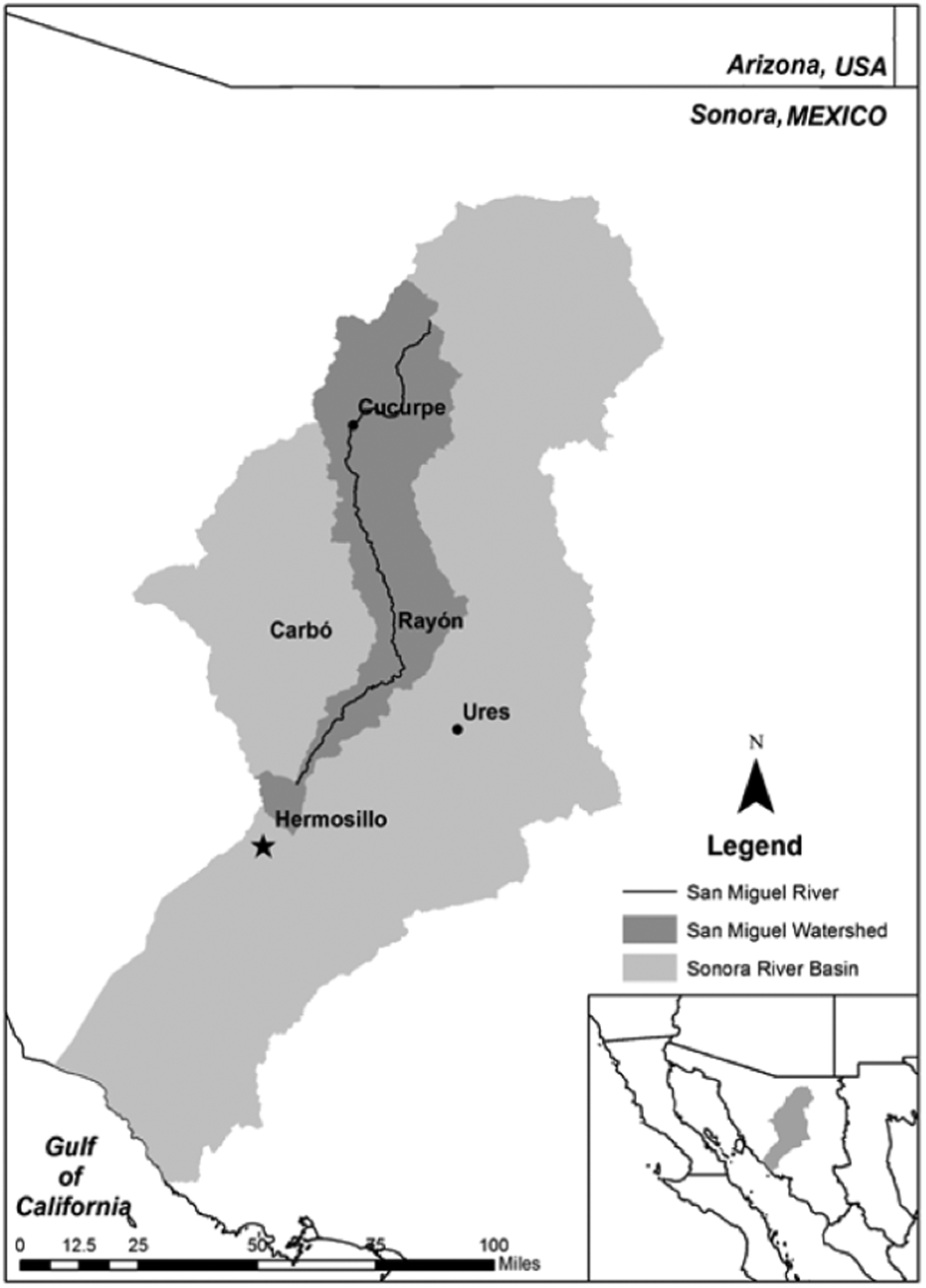
Neoliberal reforms combined with global environmental change in Sonora have led to a growing concentration of land as smallholders lease or sell their land to larger landholders who can afford to access groundwater, install and maintain irrigation systems, and pay for other inputs and who have national and international market networks (Lutz-Ley, 2016).
Rayón’s agriculture has faced rapid change. Large-scale, export-oriented production was initiated in the early 2000s by a Mexican-U.S. joint capital agribusiness that rented from small producers (Lutz-Ley, 2016). The globalization of agriculture in Mexico with new types of extensive, intensive, commercial, and export-oriented agriculture resulted, in part, from neoliberal policies fostered by the 1994 North American Free Trade Agreement (NAFTA) (Hewitt de Alcántara, 1978; Kay, 2008). The end of agricultural input subsidies and the privatization of ejido and communal land (allowing land sale and rental) by the early 1990s was also largely because of NAFTA (Otero, 1999). A consequent shift ensued from agrarian toward mixed agricultural, manufacturing, and service-oriented employment (Greenberg et al., 2012; Ruiz-Corral et al., 2016). In Rayón, agribusiness offers seasonal employment for local youth and rent for smallholders, but remuneration is lower than for off-farm work. However, little urban or industry-related employment is available due to lack of proximity to larger towns and cities. Small crop and fodder producers predominated in 2015 in Rayón; the social sector of ejido and communal small landholders represented 40% of the municipal population and owned 37% of the municipal land (Lutz-Ley, 2016; RAN, 2015). 1 Vastly unequal distribution in surface and groundwater allocations in the San Miguel aquifer exists; among 911 concession holders, 60% had allocated volumes totaling 0.52 million cubic meters while the largest 20 received 13.56 million cubic meters of water, according to an April 2015 REPDA (Public Registry of Water Rights) report (Navarro-Navarro et al., 2017). Also, the region is subject to increasingly variable and extreme hydro-meteorological events like drought, heat waves, and hurricanes (Gay and García Rueda Abad, 2016) that affect communities’ natural resource base, impacting livelihood-related decision-making (Buechler, 2015). Environmental impacts have particularly affected social sector producers in Mexico (ejidos and comunidades) (Liverman, 1999).
This study was part of a larger project on livelihoods in Rayón and other riparian communities in the SMW. Buechler conducted background research for this study during 2012–2014 while studying gendered adaptation to climate change and water resource pressures in Rayón. A stakeholder workshop with ranchers and municipal and state level government officials in 2014, and interviews conducted by Lutz-Ley during 2015–2016 with ranching and farming household heads (n= 33) also inform this research. This prior research provided insight into adults’ livelihood decision-making useful to contextualize youth’s decision-making.
Study participants
Research for this study was conducted from June 2014 to March 2015 with follow-up in May–June 2016 with youth aged 14–29. In addition, some of their parents, employers, and middle school and high school staff were interviewed. Methodologies for the study of middle school, high school, and 20-year-olds and important adult figures consisted of focus group interviews, individual interviews, and surveys. 2
Survey and interview themes and analysis
Interview themes focused on youths’ plans for future education and who would support them; if they had left school, their reasons for studying up to that level; their parents’ work and each parent’s influence on their career aspirations; household landholding status, and whether or not they planned on working that land; concerns they had for future work in agriculture and where they wished to live in the future. Surveys conducted with high school students were similar to the interviews but also assessed whether they wished to continue their education after high school, whether they were learning about climate change effects on agriculture in high school and what types of post-high school scholarships existed. Findings presented here emerged from focus group participant interactions, content analysis of recurring themes in interviewee responses, and extraction of direct quotes that best encapsulated common responses among a particular age group and gender. Case studies were developed from key interviews with youth. Statistical analysis was performed on survey responses and government census data. All interviewees’ names used are pseudonyms.
Youths’ livelihood decision-making
Employment and livelihood diversification
Youth and older women and men are among those hired for harvesting export-oriented crops, but only the poorest perform this work due to the low remuneration and hard physical labor in increasingly hot summers. Although the average daily wage for agricultural workers in Sonora is 250 pesos (around US$13 in September 2019), plus a meal and water, our interviews revealed that male youth often only earn as little as 150 pesos and female youth 120 pesos (less than US$8, and a little more than US$6 in September 2019, respectively). Women (assisted by their daughters) are also hired to prepare and serve food for seasonal agricultural laborers. Locals compete for these agricultural jobs with non-Sonorans. An estimated one of three agricultural laborers working in Sonora are from poorer southern Mexican regions (Ochoa, 2018). Women are more involved in commercial and family-based agricultural activities in northern than other regions in Mexico (Prina, 2015).
Small- and often, medium-scale farming households utilize family, and seasonal hired labor. Most households with dairy cattle produce cheese year-round for self-consumption and sale (Buechler, 2015). In households producing for the market, one male youth typically remains in Rayón after finishing high school to work in the family’s cheese business. Although cheese production is usually directed by women, their sons commonly milk cows and purchase additional milk in Rayón (or as far as Carbó and Ures, 44 and 40 kilometers away, where, at least at present, there is more groundwater to grow fodder). The cheese is sold in Sonora’s capital city Hermosillo in the municipal market (by adult male household members), in urban squares (by male migrants via informal and family networks) or from homes (by female migrants), and is also sold in U.S. cities especially in neighboring Arizona.
There are gender, age, and social class differences in the availability and remuneration of agriculture-related work. Male youth are more likely than female youth to find work as field hands for relatives. High school aged male youth are hired to milk and feed cattle, and assist in small family food processing enterprises. High school youth also sometimes assist in non-family micro-enterprises and are much more likely to be paid than middle school youth who work as informal apprentices to gain experience useful for their future work. Apprentice-oriented paid and unpaid jobs in agriculture are more available for male than female teenagers, and for those with landowning relatives, indicative of how gender, age, and social class interact to produce different opportunities regarding skill-building and resource access.
Girls are more involved in agricultural processing than agricultural production for relatives or close family friends. Two girls relayed they milked cows or worked in cultivation-related tasks with their fathers; this occasioned laughter during the middle school student focus group, suggesting these are not deemed appropriate activities for girls. Instead, female youth are frequently involved in cheese production for family or neighbors’ enterprises. They stir boiling cheese, pour it into molds, wrap and freeze it. Teenage girls without relatives in cheese production can gain experience through work for neighbors. As with teenage boys, this usually takes the form of an unpaid apprenticeship. Although their mothers have been able to focus on cheese production, female youth will likely have to combine this with other agricultural and non-agricultural activities due to environmental change impacts on dairy production, such as declining groundwater tables thus higher pumping and production costs.
Middle and high school youth ages 14–19 work in other agricultural enterprises such as peanut processing and candy production. Owners are usually a husband–wife team. Girls are hired to work in candy-making supervised by the female business owner. Boys, who earn approximately 30–40 pesos (US$1.5 to US$2 in September 2019) more than girls per hour, are hired for processing, carrying peanut sacks, and sweeping the workshop, and are supervised by the male business owner. Gender divisions in the labor market revealed in tasks and remuneration already exist for youth’s work.
Non-agricultural employment in Rayón is also more abundant for men. Young men in their late teens or early 20s find work in car mechanic shops, tire businesses, construction-related businesses, stores, the gas station, or in delivering products from trucks. Many combine agricultural and non-agricultural employment. Young men often engage in both simultaneously or add daily wage work in agriculture during peak seasons.
Non-agricultural employment varies in remuneration and type for girls of different ages. Girls younger than 16 perform unpaid household chores and care for younger siblings; some find paid work as babysitters. Girls 16 and older find a greater array of non-agricultural work than agricultural work but all have low pay. These jobs are mainly in small enterprises like tortilla production, small stores, water purification shops, small restaurants, food stalls, food sold from homes, babysitting, house cleaning and outsourced, small-scale, door-to-door catalog retailers for which they assume responsibility for unsold merchandize and/or customers’ delinquent accounts. 3 Remuneration differences between girls and boys are evident; a 16-year-old girl interviewed was paid 300 pesos a week to work during vacations in a small store from 7 am to 8 pm whereas a 16-year-old boy earned 200 pesos a day as an assistant bricklayer. Teen girls from the lowest income households combined non-agricultural work with seasonal agricultural work.
Non-agricultural employment for young men or women in their 20s with education beyond high school, or with the relevant job or volunteer experience, is available through the municipal government, but only for the select few. Social networks must be carefully nurtured with community members in high-level political and economic positions to obtain coveted municipal staff positions which last only while the political party and its municipal president are in office. Salaries though are low relative to similar, urban-based positions. Men occupy most office positions, with the exception of the 2012–2015 administration led by a female municipal president. Rayón’s labor market is similar to other Mexican rural communities experiencing gradual ‘deagrarianization’ (desagrarización) (Carton de Grammont, 2009) in which young individuals now combine agriculture and animal husbandry with non-agricultural activities (Macías Macías, 2013). Data from Mexico’s National Institute of Statistics and Geography (INEGI) confirm this process, revealing a progressive decline between 1997 and 2007, followed by a leveling, in the proportion of Mexicans working in the agrarian sector (INEGI, 2016) (see Figure 2). Our research shows that agricultural activities have persisted primarily because they are increasingly combined with non-agricultural activities.
Economically active population engaged in agricultural activities in Mexico 1995–2014. Source: Developed by the authors with INEGI data; (INEGI 2016).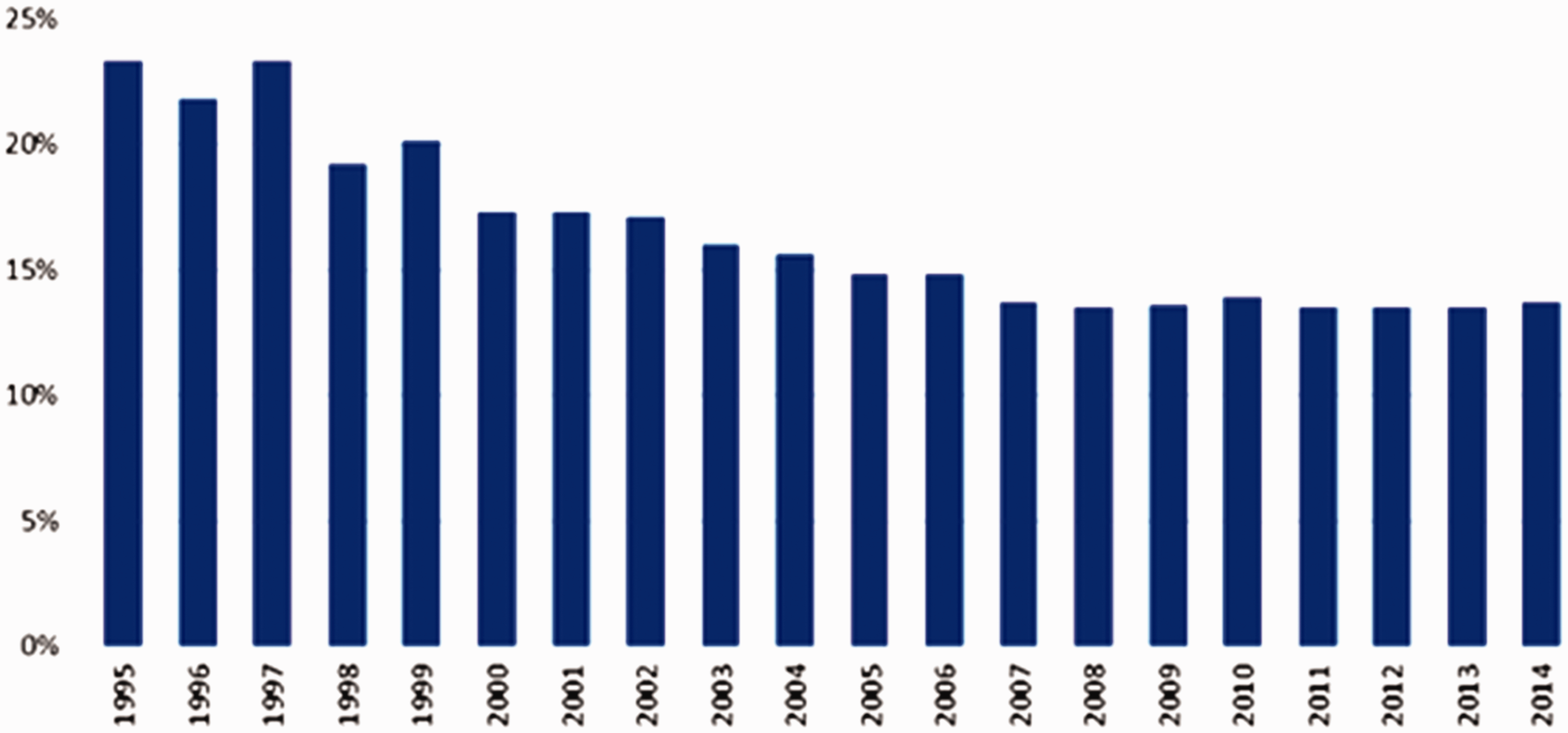
“Deagrarianization” in Rayón implies fewer agricultural jobs for rural youth. The majority of Rayón middle school students stated during the focus group that it would be difficult to find a job in agriculture. A future in farming is usually predicated upon secure access to sufficient land and water. Male youth whose families have access to these natural resources are still considering engaging in agriculture. Female youth rarely inherit land. Landless youth, who are poorer, have few options besides agricultural day labor if they want to remain in agriculture. Thus, it is not surprising that many female youth and landless families’ children do not wish to enter agriculture. Since fewer households, in general, engage in agricultural activities today, there are also fewer young people acquiring knowledge related to farming, and agrarian jobs are increasingly in precarious, seasonal, large-scale export agriculture.
Youth in Rayón attempt to diversify livelihoods. This was visible in their participation in household labor, apprenticeships, and paid employment. Among those active in agriculture, most combined agriculture and non-agricultural activities but age and gender shaped the degree of control they had vis-à-vis adults, type of opportunities, and level of job formality. Parents and guardians encourage training facilitating diversification; as an aunt/guardian explained, “In case something happens, they will be able to support themselves.” This multi-dimensional training is also likely to help them confront increasing climate and water resource variability and socio-economic change. Youth are encouraged to engage in traditional apprenticeships, as well as newer activities related to technology and services even if they are underpaid or not paid. The case of Adan, a 14-year-old boy, is not unusual. He learned from a male adult how to repair cell phones and now charges a minimum of 150 pesos (almost US$8 in September 2019) for this service. Adan is also involved in agriculture. He learned to make cheese by working with his aunt for their female neighbor. He is not paid, explaining “I go and help not to earn money but to learn.” He gained farming skills by helping his uncles on their land. Adan also harvests and occasionally plants squash for an agribusiness in Rayón, earning 200 pesos for a partial day and 250 for a whole day of work (roughly US$10-13 in September 2019). Inspired by his friend’s electrician father, Adan envisioned studying to be an electrician and opening up his own business in Rayón. He also planned to purchase land for agriculture. He exclaimed: “I do not like being far from Rayón.” He expressed a short-term perspective about the prospects of agriculture: “It rained very well in the past few weeks, so agriculture is doing well. The water levels in the wells have risen … [T]he water-levels in the river are also high [an increasingly rare phenomenon].” He finished middle school in May 2015 and enrolled in high school with a scholarship received due to his family’s low income and his good grades. Adan lives with and receives support from his grandmother and grandfather, the high school bus driver. His grandfather reverted to transporting crops after the municipal administration ended in September 2015 since the bus driver is a political position—demonstrating the temporary nature of non-agricultural employment.
Girls also combine agricultural and non-agricultural work, but most envision future work outside of agriculture, partially because they are less likely to inherit land or be able to afford to purchase land and there is less agricultural work available for them. As in the case of middle school boys, their work in agriculture is usually unpaid “training,” revealing a lack of agency regarding the terms of employment. Fifteen-year-old Rosa is Adan’s cousin and lives in the same household; she is also a student in the same middle school class. Rosa does earn some money babysitting her neighbor’s children after school. Like Adan, she stirs cheese without pay with her mother for their cheese-maker neighbor. She would like to become a policewoman and live in Hermosillo because, in her own words: “I like it better there because there is more work.” Unlike Adan, she expressed no interest in future work in agriculture or cheese production.
Livelihood diversification as an adaptation strategy is also exemplified by 18-year-old high school student Sandra, a single mother. Her parents, with agricultural and non-agricultural income, have supported her and her child. Her father owns land and livestock, and works in agriculture for another landowner, while her mother works in Rayón’s municipal public library, and sews and mends clothes. Sandra earns a small sum tutoring classmates and typing documents for school staff and aspires to be a teacher. As an older teenager, she is able to earn a small income. Sandra and her mother are typical of many Rayón women: they engage in diversified non-agricultural work and their daughters do not envision a future in agriculture.
Migration
Gender, age, and social class are important variables in migration. Our analysis of INEGI data revealed that between 1990 and 2010 in Rayón the net loss of young men from birth to 20 years old was 47%; the net loss of women in this same age group was even higher at 55% (INEGI, 2010). Female youth tended to migrate before marriage. As a study in Cucurpe in the same watershed revealed, by the 1980s young women’s migration was common due to a broader array of employment options for men than women in agriculture (Sheridan, 1988). The number of migrants from Rayón migrating to Mexican and foreign locations annually is unknown. A common pattern is circular migration: if migrants lose their jobs or upon sickness or death of older relatives, they return at least temporarily. Older women also engage in return migration to Rayón, largely due to lower rural costs.
With these high rates of migration, the future of Rayón’s agriculture is in jeopardy. Regarding out-migration of rural Mexican youth to cities, Sánchez-Cohen et al. (2012) warn: “… [I]f this tendency continues, the primary [agricultural] sector could collapse by 2030” (68). Yet, data from 2007 onwards on Mexico and our own study do not support a continued decline in agricultural employment or a total collapse of this sector, but a qualitative change toward more commercial, large-scale export agriculture with precarious, temporary jobs. Some of Rayón’s youth plan to return to practice agriculture after pursuing higher education and/or working in urban centers. Others plan to combine non-agricultural work such as mining with agricultural labor in Rayón. Still, the future of agriculture in Rayón will look very different if climate change continues to negatively impact agriculture because this could increase out-migration. Past, current, and likely future, higher female out-migration deserves special attention. Female out-migration could rise faster than men’s due to women’s current concentration in a narrower set of activities highly vulnerable to environmental change such as dairy production (discussed below). With these combined socio-economic and environmental stressors, deagrarianization could have more of a female face.
In Rayón, polarization is visible in the migration experiences of the landless poor and those from better-endowed households. Many male migrants from lower to middle-income households in Rayón living in Hermosillo work as mechanics, and both men and women work in various types of jobs in hospitals, assembly plants, service industries, and offices. Some combine this with the sale of Rayón cheese. Women migrants in Hermosillo from lower to middle-income families work as maids, nannies, janitors, teachers, secretaries, and lower to mid-level hospital workers. In contrast, children from better-off households (with larger landholdings and/or cattle herds) have the opportunity to acquire college and graduate-level education, and work as professionals, mostly in Sonora and Arizona.
The most important recent changes affecting social class, age, and migration linkages include greater accessibility of Sonora’s villages to urban centers through new roads and better transportation, as well as relatively higher education of youth compared to older generations. Some Sonoran roads were paved from the 1930s, but roads connecting rural communities to larger population centers came much later. The road connecting Rayón with Carbó was completed in 2002 (Rodríguez Ochoa, 2005). Most people in their 50s and older interviewed by Lutz-Ley in 2015–2016 completed middle school, whereas younger generations have had access to high school thanks to the opening of a school in a nearby town. Before, only better-off households were able to send their children away to study.
Social class is an important factor in Rayón youths’ decisions to migrate. For youth from households with fewer resources, the main reason to migrate is to find more highly remunerated employment to support themselves and rural-based family members; they are at a disadvantage, though, because they have fewer social networks placed in positions to help them obtain employment with decent pay. Youth from rural households with more land migrate to contribute to agricultural expenses such as deepening wells and for higher education and upward social mobility, similar to other areas in Mexico (Arizpe, 2014; Azaola, 2012).
All youth interviewed expressed concerns related to procuring rural employment. Social inequities and out-migration have increased as large-scale agribusiness expands in Rayón. Growing inequality in land distribution and employment impacts youths’ prospects for engaging in local agriculture and fuels migration. A large proportion wanted to migrate to Sonora’s largest cities. Among middle school student focus group members, none mentioned a desire to migrate to the U.S. even though this was common historically and the interview was conducted in the pre-Trump era (Buechler, 2015).
Education
Rayón provides education only through ninth grade (middle school in Mexico). The only middle school in town is devoted to teaching agricultural-oriented skills. After middle school, the high school of choice is the Agricultural Technology High School #161 (Centro de Bachillerato Tecnológico Agropecuario, or CBTA 161), inaugurated in 1982 and located in Ures town, 26 miles from Rayón. Students from Rayón and surrounding communities take a government-run school bus to CBTA 161 but students with significant family-related duties cannot continue their education. Some better-off households with relatives in Sonoran cities send their children to high school there, where their education becomes more urban-oriented, another example of socio-economic status and family networks shaping rural youths’ livelihood pathways. Rural and urban spaces though are fluid: rural products support rural and urban economies and youth become incorporated into these combined economies.
CBTA 161 offers common high school courses together with agricultural-related curricula. Students select one of three areas of concentration: (1) Agricultural technician (técnico agropecuario), (2) Livestock farming technician (técnico en explotación ganadera), and (3) Rural entrepreneurship technician (técnico en emprendimiento rural). In the 2014–2015 academic year, among all Rayón students in CBTA, around 70% selected tracks 1 and 2, while 30% were in the rural administration track. Young men usually pursue agricultural and livestock areas, while most girls enter the administrative one, which requires a higher grade-point average and has a higher workload but offers better qualifications for urban-based careers.
The assistant director of CBTA 161 divulged that in March 2015 of the 41 boys and girls from Rayón who attended CBTA, 18 did not know what they would do when they completed high school, while the rest planned on studying further. In our survey, 31 out of 34 high school students (91.2%) responded they wanted to pursue non-agrarian careers. The three students who wished to work in agriculture were male. However, this education may not prepare them for non-agricultural employment.
The middle or high school training may also not prepare youth for engaging in increasingly diversified livelihoods necessary to confront socio-economic and environmental change. The long-term sustainability and current availability of agriculture-related employment depend in large part on environmental processes such as climate–water challenges. However, middle and high school students said that local effects of global climate change were barely covered in their classes. One high school student recognized he would be most impacted by climate change in rural employment that requires outdoor work; however, as with middle school students, he did not provide evidence he understood the impacts on agriculture despite pursuing the livestock track. Migrants working outdoors, as in landscaping and construction, will also be exposed to climate change effects but youth did not mention this. Several male and female middle school youth interviewed mentioned dehydration as a risk for day laborers in agribusiness, but again, this is first-hand experience rather than content in the schools’ curricula.
Advanced training or higher education was important to most youth, and all perceived that migration would be necessary to obtain this. Among middle school youth interviewed (14–15 years old, n = 18), 83% wished to leave Rayón and 17% to remain. During the focus group with 14–15-year-olds (n = 15, three students less than in the interviews), 73.3% indicated they wanted to pursue post-high school education. Two 14–15-year-old focus group members were unsure how they wanted to make a living; the rest gave responses corresponding to non-agricultural careers. Among high school youth surveyed (16–19 years old, n = 34), 85.3% wanted to migrate mainly for higher education and better employment, and 14.7% to remain. Desires for non-agricultural employment were related to agricultural working conditions; as one student exclaimed: “Agriculture requires a lot of effort … I prefer to look at atoms through a microscope.” However, as noted by other researchers (Brooks and Redlin, 2009), there is a difference between educational and career aspirations and options poor rural youth globally will actually have open to them.
Federal and state scholarships for high school are available to teens. Amounts vary but are modest, helping families buy school supplies and defray costs associated with maintaining children in school and foregoing income children could otherwise earn. Influences of multiple stressors on youths’ livelihood decision-making are visible in the case of 15-year-old Pamela, the only child of a middle-income family who works weekends with her father on their ranch. Concerning future plans, she said emphatically: “I would not want to live in Rayón.” Pamela had a merit scholarship, was about to enter CBTA, and planned to attend college in Hermosillo. She reasoned: “The hardest part will be to find a job … I would be open to looking for work both in Mexico and in the U.S., where I have relatives.” She was interested in three different careers and said she would have to remain flexible in the type and location of prospective jobs. Pamela relayed with concern that her father worked 12 hour days. Her father told us separately he had longed for a university education but was unable to afford it, therefore remained in Rayón, starting his own small construction-related business due to the lack of employment. He recently inherited his mother’s ranch and now worked on it with the same young workers he employed in the construction business. Although he had a sizeable cattle herd, he responded to environmental and economic risks through diversification and his wife did the same as a teacher and municipal office assistant. Although Pamela would be heir to her father’s ranch as an only child, thoughts she expressed at 15 made it appear unlikely she would want to farm it, following a family pattern. Pamela’s widowed maternal grandmother, upon her husband’ death, farmed her ranch with the help of an old field hand but after two years decided to rent it out, citing hotter temperatures coupled with rising crop and livestock water demand and rising groundwater extraction costs. Pamela’s mother and aunts also did not want to manage the ranch, thus Pamela's grandmother leased it out.
While the majority of students in their last year of middle school desired to continue their education, family composition and economic conditions prevented some from attending high school. Generally, government scholarships are insufficient if a family has very low income and/or if the child has important domestic responsibilities. This was the case with Nancy, a low-income 14-year-old in middle school who wished to become a kindergarten teacher. She relayed it was unlikely she would attend high school due to the costs, even if she received a scholarship. She was responsible for caring for younger brothers after school while her single mother worked in a cafeteria serving migrant workers. Nancy sometimes worked with her mother in exchange for a meal. If she attended high school she would be away from home longer, impinging upon her ability to care for her siblings. By mid-2016, Nancy had entered then dropped out of high school, attempting to find work in agricultural fields while caring for her brothers.
Obstacles to education Nancy has faced are more common among girls than boys in Rayón (and in rural communities globally, see e.g. Aikman and Unterhalter, 2005) because girls are usually tasked with the care of younger siblings, older relatives, and domestic chores (Horbath-Corredor, 2004). Gendered divisions of labor such as caregiving in Sonora are established at an early age and have been slow to change. Literature indicates that when girls spend significant time in caregiving, a generational transfer of poverty results, partly because of foregone education (Dodson and Dickert, 2004; Levison et al., 2001), but rural girls’ education remains understudied in feminist literature (Pini et al., 2014). A focus on age revealed these barriers faced by rural, low-income girls in Rayón.
Social mobility opportunities via education are often impacted by circumstances like health. For example, 19-year-old Miranda’s father (a rancher) and mother Lola (a large cheese-maker in Rayón) were able to send Miranda to the capital city to study to become a chef; however, due to a rare and debilitating tick-borne illness (more common with climate change), she had to return home. Her mother helped her recuperate, then began purchasing watermelons for her daughter to sell outside their house. By spring 2016 she was able to continue her studies. Difficulties inherent in living away from home, combined with poor nutrition and unsafe dwellings, can impact rural youth who migrate for higher educational opportunities. It was mainly her mother’s financial help that enabled Miranda to continue studying. Lola explained that she herself wanted to study but could not because of financial barriers, entering cheese production because there was very little work for women in Rayón. She was among a minority of women in Rayón to receive government support for her cheese business. The support funded an enclosed room to protect cheese freezers from increasingly hot temperatures and reduce energy use (Buechler, 2015). The support helped Lola earn more, which in turn enabled her to support her daughter’s educational aspirations, indicating that these government programs can have a positive magnifying effect on the next generation of women. Lola hopes for future assistance to purchase solar panels to further reduce energy costs, which would allow her to continue supporting her daughter.
The case of Sandra similarly illustrates a mother’s central supportive role in her daughter’s education. Sandra’s mother helped care for Sandra’s daughter (age 2) while she attended high school. She also motivated her to continue her education. She told Sandra about a post-high school scholarship for single mothers. Sandra expected to apply to college to be a pediatrician or preschool teacher in a city. Miranda and Sandra’s cases are not unique in Rayón. In our survey with 34 CBTA high school students (16–19 years old) from Rayón, 52% mentioned their mothers as the most important influence on career decision-making, indicating the important—although often unrecognized—role women play in shaping rural futures. This role can be strengthened if rural women’s economic activities (frequently dependent on natural resources) are supported.
Climate change and water access
Studies in Rayón show that water resource issues influence labor-related decision-making (Buechler, 2015; Lutz-Ley, 2016; Navarro-Navarro et al., 2017). Youth interviewed did not connect climate change with agriculture or water but mentioned that now crops need more fertilizer, temperatures are more extreme, and frequent drought undermines production. Men’s experiences show these linkages. Mainly men go to the U.S. for seasonal work, and the authors’ research here (and in other Sonoran communities) revealed that these migrants’ numbers increase when climate stressors have significantly impacted agricultural activities. Barrios Puente et al. (2015) also found that higher levels of rainfall significantly reduce emigration from small Mexican communities to the U.S., and that a 20% below historic average rainfall can increase migration by over 10%. According to Jessoe et al. (2015), higher temperatures will lead to declining local employment in rural Mexico, and consequent higher out-migration to cities. Rayón’s urban migrants are also impacted because rural relatives have less food to give them, there is less Rayón cheese and dried beef (machaca) to sell in cities (Buechler, 2015), and the economy may become too weak to successfully incorporate return migrants. Thus, environmental change fosters spatial changes in flows of people and goods.
Many youths’ fathers mentioned that agricultural wells were becoming depleted. Women also relayed that their livelihood activities have been negatively affected by greater climate and rainfall variability. As a female cheese-maker explained, we were able to let our cattle feed on the buffelgrass in the communally owned land; we also had a well to irrigate feed crops, but now there is only enough water in the well for the cattle to drink … frequent drought is what has most impacted dairy and cheese production.
Irrigation can cushion drought’s effects for a period of time (Liverman, 1990), but women tend to have less access and control over it in Latin America and globally (Bennett et al., 2008; Theis et al., 2017). The majority of agricultural households in Rayón do not have access to groundwater irrigation (Lutz-Ley, 2016). For those that do, the volume available is declining. Milk purchases from locations almost an hour away with more groundwater may only be possible temporarily; pumping there and in Rayón by large-scale farmers for water-intensive crops like alfalfa is likely to cause groundwater tables to drop to levels unprofitable for dairy production (Buechler, 2015). Social groups not directly dependent on natural resources are also affected because demand for goods and services is derived largely from crop and livestock-related income.
Individuals’ experiences of environmental change were intensified due to intersecting age, gender, and social class effects. Nancy’s (Education section) mother lamented it was hard to find stable work. She worked as a day laborer or in a cafeteria during harvests for agribusiness, and as occasional maid, street sweeper, and highway construction worker. Her mother (Nancy’s grandmother) owns rainfed land her late husband willed her but she recently had to sell her cows due to progressive impacts of drought on fodder grass cultivation; she had no coping mechanisms available like access to supplemental irrigation or funds to purchase feed. Families with multiple stressors are more vulnerable due to: (a) combined socio-economic and climate change-related exposures that impact agricultural activities and employment, and (b) the precarious context of female household heads who often lack access to better employment and irrigation. In Nancy’s case, these exposures created repercussions for her education and employment.
Seventeen-year-old Maria has seen her parents struggle with ranching and cheese-making in Rayón. These struggles include climate change-related rainfall variability that harms the fragile natural vegetation in the scrubland their cattle feed on, and more frequent and intense temperature extremes that kill cultures necessary for cheese production. Maria assists her parents by packaging the cheese, which gives her insight into these problems. The sustainability of all livelihoods is at risk due to changes related to climate and water, which are already major causes of livelihood diversification in Rayón. A large landowner and rancher’s son expressed his concern: “the young in Rayón think that in the near future there won’t be enough water. They also fear their family’s land value will be reduced due to water scarcity.” In 2015, this 28-year-old divided his time between working in the municipal government and assisting his rancher father. A much lower-income, 20-year-old metal worker and field hand exclaimed: “I would work more with my father in agriculture if there was more water.” He often wishes he had urban-based work. These cases, and that of Pamela’s family, reveal increasing diversification among landowners and their children as a response to environmental stressors and shocks.
Older teens (18–19) and those in their twenties earn money by working in dairies but the sustainability of this employment is threatened by environmental change. José, an 18-year-old young man with a middle school education from a landless family said that during the last three years he worked 8–10 hours every day earning 1600 pesos weekly (around US$82 in September 2019) milking cows and producing cheese for his employer. Males from low-income households predominate in paid labor milking cows. José works with another male hired laborer and his employer’s son who replaced his deceased mother in this business. In 2010, his employer’s household owned 80 dairy cattle (considered a middle-size rancher in Rayón), but, due to the long-term stressor of drought, in 2013 they only had 32 cattle. In 2011, they still purchased 1200 liters of additional milk for cheese; however, in 2016 they used only the milk from their own reduced dairy cattle herd. These processes may mean less stable future employment for low-income, young men. Years with better rainfall (such as 2014–2015 with El Niño conditions) do see an upswing in agricultural employment.
Although harsh environmental conditions represent an additional challenge for youth in rural communities affected by stressors and shocks from double exposures, education enables youth to gain skills in innovation and access information. Older youth can use those resources, training, and education obtained for diversifying their agricultural activities to adapt. An example is Pancho, a 23-year-old young man who studied agronomy for 18 months in Hermosillo, then had to return to work in his mother’s cheese business to contribute to family income. Since this cheese-making business was increasingly impacted by declining groundwater levels that made fodder irrigation too costly, Pancho needed to develop other income-generating activities. He thus produced chiltepín peppers (native chili species) in his family home’s backyard and in a joint venture with his godfather, whose sons had migrated. He installed drip irrigation technology to save water as he had learned in university. Pancho obtained funding from two government sources (SAGARPA, the national agency for agriculture, livestock, and fishing, and CONAFOR, the national forestry agency) to expand his chiltepín cultivation. In 2015, he lost the crops due to a freeze. In follow-up interviews in 2015 and 2016, Pancho said the chiltepín business was not lucrative due to market oversupply causing lower prices. Producers throughout the watershed had planted chiltepín and production rose due to above average rainfall (resulting from climate change-induced, stronger hurricanes in the Pacific) in late 2014. Pancho’s funding application to SAGARPA to develop an organic egg business was denied in 2016 after a year of waiting. He planned to apply in 2017 to SAGARPA for a loan to purchase milk cattle to support the family cheese-making business.
This is an example of economic, institutional, and environmental processes linked with global change that pose challenges to specialized livelihood niches. The vagaries of government support, climate, and markets hindered Pancho’s efforts to diversify. It also reveals that youth in their 20s may have some access to means of agricultural production but this access is still only partial, mediated by older adults’ (kin and/or fictive kin) access. Male youth were more able than female youth to utilize social networks to access such means of production, especially land. Youth in their 20s and younger youth’s narratives in Rayón included discussions of water resource pressures, drought, and higher temperatures but left out mention of links to climate change. This resonates with literature addressing adult’s decision-making in agriculture in other climate-change affected regions (Eakin et al., 2014; Nyantakyi-Frimpong and Bezner-Kerr, 2015). Due to temperature, rainfall, and other climate change effects predicted and already visible in the region, future education and training programming will need to start from a better understanding of the linkages between local livelihoods (rural, town, and urban) and climate change. Livelihood diversification, including within agriculture, and technology adoption is common in Rayón and may partially insulate its residents from future challenges climate and water resource variability will bring.
Discussion and conclusions: Rural youth’s livelihood decision-making with double exposures
Inserted into a dynamic context with double exposures, youth in Rayón face difficult choices concerning their futures. A double exposures perspective combined with FPE helped illuminate gender, age, and social class issues with respect to natural resource dependent livelihoods in a context of accelerated global environmental and socio-economic change. This study used these frameworks and a focus on the future to better understand what types of initiatives will be needed to ensure the viability of gendered, multi-local livelihood systems.
The DEF facilitated a consideration of how socio-economic globalization combines with global environmental change, creating new stressors for communities across temporal and spatial scales. In Rayón, globalization manifests, on the one hand, in the form of intensive, commercial-scale agribusiness offering precarious jobs to community members and fostering a re-concentration of land and resources through leasing agreements, in already monopoly-controlled and gender-biased land tenure structures. On the other hand, globalized agriculture represents an ever smaller part of the rural–urban continuum as rural people seek to escape a limited and exploitative labor market and become integrated into, again, frequently precarious urban-based jobs. These dynamics are further accelerated by global environmental change, which makes natural resources more scarce and expensive for poor rural populations to appropriate, and expels would-be and current small farmers out of local food production systems. In all these equations, rural people suffer in varying degrees, and poverty tends to deepen. Our study, by adding FPE and an intersectionality perspective, captures how women, especially young women, are facing limited opportunities and livelihood challenges that were already there, but now are enhanced by these global-scale transformations. They lack means to adapt to climate change-induced impacts such as access to irrigation and their narrower range of employment options in comparison to male counterparts increase their dependence on seasonal, low-paid day labor in globalized, export agriculture, and in precarious non-agricultural rural and urban employment. Young women from families with more means desired futures outside of agriculture.
An analysis of micro-level effects of global environmental and socio-economic change on decision-making of female and male youth in three distinct life stages provided insights into constraints and opportunities they faced and will face as they become less dependent on adults, more educated, and move from unpaid to paid employment. It also pointed to particular needs based on gender and age that could be met by community organizations and governmental agencies. Figure 3 summarizes local dynamics in Rayón explained above in reference to age, gender, socio-economic, and environmental conditions.
Intersections of employment, migration, education, and environmental factors in Rayón youth’s livelihood decision-making. Source: Developed by the authors from interview material.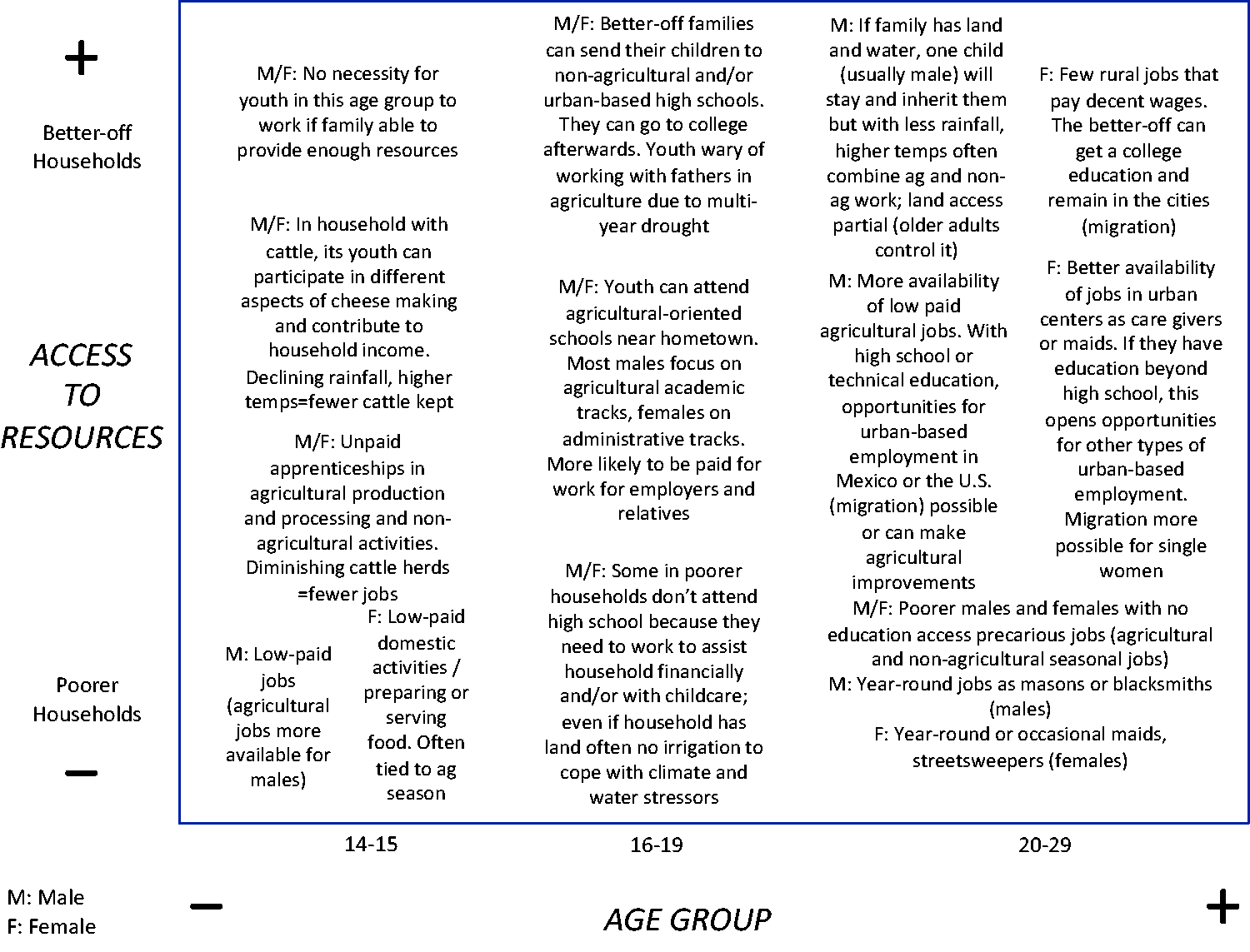
Age, gender, and social class intersected to shape youths’ options regarding employment, migration, and education. These intersections also influenced how environmental and socio-economic factors affected livelihoods. As seen in Figure 3, greater differences between genders existed in livelihood opportunities as we move from richer to poorer households (top-down on the vertical axis), and from younger to older youth (left to right on the horizontal axis). Youth’s responses to long-term stressors and shocks included learning agricultural and non-agricultural skills. These skills also increased youths’ likelihood of adapting to future environmental and socio-economic changes that included physical and socio-economic constraints in accessing natural resources like land and water. Government assistance for technology adoption and crop diversification facilitated youth’s ability to respond. Female youth age 16 onwards had fewer options for paid rural employment than male youth and were paid less, fueling higher female out-migration. Mothers with stable, better-paid employment were able to provide children with greater education and training. From age 16 youth navigated towns and cities for higher education and employment, and villages and towns with better groundwater endowments for procuring agro-processing inputs. Such mobility revealed tightening linkages between village, town, and city locations due to environmental and socio-economic change. These spatial and environmental, social and economic linkages, made visible by examining community members of different age groups, are usually not considered in gender, agricultural, and globalization research.
Young men and women in their 20s who wished to remain in Rayón faced greater odds if their families did not own farmland, livestock, or a business. This was because they were less likely to have access as older teens to formal work (paid) or as younger teens to informal apprenticeships (usually unpaid); this limited skill-building. Teens with little household access to land and water resources and sibling care responsibilities (girls’ work) experienced barriers to educational opportunities beyond middle school. Rural, government-run daycare centers should be a priority as should job training programs for low-income girls and boys to ensure better livelihood opportunities for them and for their children.
Education and training programs for supporting the next generation in confronting increasing climate and water stressors and shocks are necessary. Middle and high schools are critical in this rural context because those are the educational levels at which the majority of youth participate. Thus, grass-roots, government, and non-profit interventions in educational programming aimed at these levels will reach more rural youth. Education surrounding global environmental change and globalization effects needs to be improved. Education should also train students broadly to include both agricultural and non-agricultural skills because under these circumstances in order for agriculture to persist, the current trend of combining agriculture with non-agricultural pursuits will need to accelerate. Otherwise, education systems will continue to fall into the trap of equating rural with farming. Feminist research dedicated to lower-income, rural female teens’ preparation for future urban and rural-based careers is crucial for policymaking in rural Sonora and elsewhere. Farmers and food processors in their 20s should also be involved in training so that they can become successful rural residents. Youth in their 20s who had studied beyond high school, even those unable to complete this higher education, were better able to diversify, increasing their ability to cope with double exposures. This points to the importance of increasing government funding of higher education including for scholarships.
Female and male teens ages 14–19 experience hard physical labor in the sun and dehydration and begin to comprehend climate and water related effects on relatives’ income-generating activities since they collaborate in these activities. However, only in their 20s do youth begin to experience environmental change impacts on their own livelihoods. Youths’ access to means of production such as land at this life stage is crucial to their resilience to short-term socio-environmental shocks but their access is often at best partial, mediated by adults. To adapt to changing environmental, social, and economic conditions, their agricultural and agro-processing needs include access to technologies like drip irrigation, freezers, and renewable energy and to knowledge including about hardier crop varieties. Government support of innovative initiatives of youth can assist adaptation.
Understanding the factors exerting influence on female and male youths’ aspirations and decisions in Rayón and other rural communities undergoing rapid change is critical to enabling them to realize their full potential and to securing a brighter future for rural communities and the urban areas they are linked to.
Highlights
DEF and FPE shed light on rural female and male youth’s decision-making during rapid change. Youth’s decisions will affect future food production and rural–urban interactions. Youth 14–15 with relatives with more resources were able to gain experience in apprenticeships. Youth 16–19 more likely to be paid for their work, but more and better employment available for males than females. Rural education currently does not reflect youth’s urban-based and rural non-agrarian aspirations or address global environmental effects on local agriculture.
Footnotes
Acknowledgements
We thank the anonymous reviewers of the manuscript and especially thank community members of Rayón, Sonora who were incredibly generous in myriad ways during our fieldwork there.
Declaration of conflicting interests
The author(s) declared no potential conflicts of interest with respect to the research, authorship, and/or publication of this article.
Funding
The author(s) disclosed receipt of the following financial support for the research, authorship, and/or publication of this article: We gratefully acknowledge the National Science Foundation (NSF, Grant DEB-1010495) that provided funding for this research.