







Abstract
Infrastructure is critical to the ways in which urban inequality is produced and experienced. Across US post-industrial contexts urban infrastructures are decaying, causing problems to the capacity of various systems to deliver essential resource flows for social reproduction. This paper examines the US pipeline crisis to understand why, how and with what effects infrastructure has undergone a process of physical decay, concentrated across inner-city areas. It uses a case study of Camden, New Jersey, a poor city in which infrastructure has undergone decades of neglect, privatisation and under-maintenance. This decay has created difficulties in sustaining a safe, universal and fully functioning infrastructure. To understand these dynamics, the paper advances an urban political ecology approach to examining these infrastructural geographies. It makes three key contributions. First, it considers how to conceptualise decay and its effect on the urban circulations that have been enabled/disabled by infrastructure through the notion of unbounding. Second, given the highly segregated infrastructural experiences between a black city and white suburbs, the paper draws on recent geographic scholarship on racial capitalism, emphasising the role of race in the governing of infrastructure and in accounting for Camden’s conditions of decay. Third, the paper advances a relational theorisation that draws on concepts emanating from urban political ecology and associated research on infrastructure in cities of the global South. With the reported, widespread decay of infrastructures in global North, post-industrial contexts, a relational theorisation can draw on long-established vocabularies that challenge where we locate the ‘infrastructural South’ and prompt new political urban questions.
Introduction
Understanding urban inequality requires paying attention to the infrastructures that sustain social reproduction in the city. The physical decay of infrastructure in global North, post-industrial contexts means long-held assumptions about safe, fully functioning and universal services are fracturing, leaving communities exposed to intensifying forms of techno-environmental injustice. This crisis is becoming more visible every day in the US, most prominently in Flint, where primarily poor, black populations have been experiencing infrastructural failure (Pulido, 2016; Ranganathan, 2016). This city is among dozens of others whose residents increasingly have become concerned about the condition of thousands of miles of underground pipelines. From lead poisoning in Flint, to water shut-offs in Detroit, affecting over 50,000 households (Hunter, 2016), to the re-emergence of waterborne diseases such as Legionella, with over 20,000 cases recorded in the US between 2000 and 2009 (Centre for Disease Control and Prevention, 2011), the decay of infrastructure has become crucial to contemporary urban crisis. Among populations concentrated across older, rusting pipelines throughout the post-industrial Northeast, the human right to safe water and sanitation (United Nations General Assembly, 2010) is arguably insecure. Underlying these pipe geographies are the expenditures required to address such conditions, estimated at up to $1 trillion for drinking water alone (AWWA, 2012). Without large-scale investment, infrastructural decay will create and sustain injustice and inequality across inner-city areas and marginalised populations. Assumptions concerning infrastructure have long held that urban regions in the global North provided safe, universal, fully functioning urban service provision (Graham and Marvin, 2001; Melosi, 2000). If this is no longer the case, then new explanatory frameworks are needed to understand the underlying factors generating physical decay, the associated operational problems across the pipeline geographies of US cities and the implications for urban populations and inequality.
In this paper, I examine the US pipeline crisis to understand why and how infrastructure has undergone a process of physical decay across inner-city areas, as well as the effects emanating from it. I use, as a case study, post-industrial Camden, New Jersey, which has experienced decaying conditions first-hand, to develop a critical response to these transformations. Popular (if troubling) media examinations of the city offer grim narratives, e.g. ‘Apocalypse Camden’ (Taibbi, 2013), highlighting urban decline and despair. Despite a recent stabilisation, the city remains mired in the geographies of austerity, environmental injustice and poverty (Gillette, 2006; Smith et al., 2001) that both reinforce and reflect the infrastructural conditions experienced by some communities.
Infrastructural decay is the product of decades-long historical disinvestment in urban systems in Camden as deindustrialisation hit hard. These decaying conditions provided the impetus for the privatisation of water and sanitation-system operations in the late 1990s. The failure of United Water to invest in, maintain or repair this infrastructure exacerbated the various ways in which the pipelines were decaying, causing a series of operational problems – from high leakage rates to unsafe drinking water. American Water replaced United Water in 2016 after the contract was terminated and the municipality took the corporation to court due to mismanagement that ‘cost taxpayers millions of dollars while leaving important public safety assets improperly maintained’ (New Jersey Office of the State Comptroller (NJOSC), 2009: 1). Under American Water many of the problems of decay remain and new issues such as water supply shut-offs threaten to further reinforce infrastructural injustice in the city. Camden also has experienced problems with lead contamination in school pipelines dating back two decades and resulting in new non-networked forms of delivering water to children, as well as problems providing a safe water supply in its neighbourhoods due to various operational interruptions. Meanwhile, low-lying communities have been forced to navigate the toxic effects of obdurate technology in the form of combined sewer outflows (CSOs). Neighbourhoods have been inundated with wastewater and sewage, particularly since the system’s regionalisation in the 1980s. Taken together, these piped geographies shape everyday experiences for residents in Camden already facing various forms of marginality and exclusion in the city (Gillette, 2006) and have led to commentators drawing comparisons with conditions elsewhere. For instance, Cowie (2001) comments that ‘Today the south Jersey city may be more akin to the Third World’ (205).
This paper’s objective is to develop a critical approach to decaying infrastructures in Camden and other post-industrial, global North cities more generally. It mobilises an UPE approach. This literature has generated understanding on the ways in which the relations between capital, environment and technology have come to shape the city (Keil, 2003; Loftus, 2012; Ranganathan, 2015; Swyngedouw, 2004). The paper advances these debates in three ways. First, it considers how to conceptualise decay and its effect on the urban circulations that have been enabled/disabled through infrastructure. UPE studies have explored how major shifts in urban governance of technologies have transformed the operations of resource flows. This literature has emphasised the ways in which infrastructure acted to technologically bound these resource flows under various systems of control in order to deliver universal service provision and establish control over what Gandy (2006) termed the ‘bacteriological’ geographies of rapidly urbanising cities in the late 19th century (see also Melosi, 2000). Graham and Marvin’s (2001) notion of the ‘infrastructural ideal’ conveyed how this bounding of resource flows through infrastructure was a critical techno-environmental achievement of urban modernity because it conceived, ‘of the city as a “system of systems”, a total bounded entity that renders the urban as a set of ordered relationships’ (Macrorie and Marvin, 2019: 9). UPE work on infrastructure that has focused on these urban circulations and technologies of control might also then be extended to help explain the ways in which the management of resources flows could become unbounded through factors such as disinvestment, privatisation or conflict. The term unbounding therefore draws attention to the ways in which the various infrastructure networks that make up the ‘system of systems’ are no longer ordered relations nor able to control the socio-natural circulations across the city.
As such, this paper begins with the premise that decay may instigate a reversal of the promises of urban modernity and the infrastructural ideal to unbound circulation from infrastructure, resulting in both the interruption of urban service provision and the failure to keep harmful, socio-natural flows (e.g. disease, raw sewerage, contaminated water) across the city under control. Furthermore, a UPE approach would insist that such processes are politicised arguing that unbounding (and therefore infrastructural decay) is an active, more-than-technical restructuring of networked systems imbued with power relations. This focus on the process of unbounding draws attention to the political dimensions of such changes to the operation of infrastructure. It pushes analysis to interrogate the role of the state and accumulation regimes as potentially critical in explaining infrastructural decay and the subsequent unbounding of both circulation and the broader promise of urban modernity.
Second, the paper emphasises the role of racism in the governing of infrastructure in accounting for the decay and subsequent unbounding of various urban circulations. UPE has not always properly considered racial logics of governing resource flows, nor the role of infrastructure in reflecting and reinforcing racism in the city, instead paying attention to broader governance regimes such as neoliberalism. Given the highly segregated infrastructural landscape between a black city and white suburbs, any analysis of decay in Camden must emphasise the infrastructural dimensions of racial division. The white population in Camden city dropped from 60 to 31% between 1970 and 1980, as the black population rose from 39 to 53% (US Census). This paper draws on recent debates on racial capitalism across geographical scholarship (Pulido, 2017; Robinson, 1983), and increasingly in UPE (Heynen, 2016; Safransky, 2014) and on infrastructure (Pulido, 2016; Ranganathan, 2016), to place race and capital at the centre of UPE analyses. To do so highlights how racism has structured infrastructure planning, operation, maintenance and lived experiences, and how the accumulation regimes of racial capitalism have come to operate across urban systems in US inner cities, causing and profiting from infrastructural decay.
Third, the paper develops a relational theorisation that draws on concepts emanating from UPE and associated research on infrastructure in cities of those regions we term the global South. This work extended understandings of non-centralised infrastructure systems in cities without universal service provision (Ranganathan, 2015; Silver, 2014; Truelove, 2011). UPE studies have proceeded in conversation with other interventions on infrastructure that have helped elucidate urban systems that are neither universally accessible nor operationally safe or equitable (Anand, 2011; Björkman, 2015; Simone, 2004). With the reported, widespread decay of infrastructures in global North, post-industrial contexts, a relational theorisation can draw on long-established vocabularies concerned with examining infrastructures that remain partial and prone to disruption, and require constant, incremental interventions to sustain urban circulation. Doing so responds to calls to provincialise UPE (Lawhon et al., 2014) and problematise the regional geographies of urban theory (Roy, 2013). Furthermore, undertaking this mode of relational comparison prompts new questions about where we locate the ‘infrastructural South’. This comparative practice has already begun to contribute to existing UPE literature (Ranganathan and Balazs, 2015), and this paper attempts to add to the growing focus in urban studies on ‘thinking cities through elsewhere’ (Robinson, 2016).
Research was conducted in Camden in 2016–2017, incorporating semi-structured interviews with 25 stakeholders from local NGOs, public agencies, utility companies, social movements and community groups. Some of these participants were interviewed several times. Site visits across Camden were part of a walking-based methodology to better understand and experience the infrastructural landscape. This included walks across downtown Camden and through neighbourhoods such as Waterfront South, along with guided visits to the sewage-treatment plant and sites that had received interventions or suffered from badly functioning piped infrastructure. Further material was collated through secondary sources, including city plans, reports, official documents and media.
Theorising infrastructural decay
This paper places itself in debates on UPE and urban geography centred on infrastructure (Heynen et al., 2006), a crucial domain of urban research (Bulkeley et al., 2014; Graham and Marvin, 2001; Simone, 2004; Tarr, 1984). UPE has extended conceptions of infrastructure in several directions. Crucial to these contributions is the foundational thinking on UPE that has allowed scholars to challenge so-called natural phenomena and open up the political processes that shape urban natures (Harvey, 1996) and the infrastructures that carry resource flows (Swyngedouw, 2004). This effort to critique technocratic, depoliticised approaches to the study of urbanisation makes visible the socio-natural accumulation process and the differentiated experiences that populations face when trying to access services.
Urban circulation and decay
This paper’s first contribution is to show that UPE offers generative literature to research the production of and effects from decay. UPE long has emphasised infrastructure’s role as cities’ life-support systems, structured by, and itself structuring, the circulation of capital and socio-natural resources across urban environments (Kaika, 2004; Swyngedouw, 2004). Extant studies have shown how these circulations mediate operation, distribution and usage of networked systems (Heynen et al., 2006). Broto and Bulkeley (2013) argued that ‘circulation is inherent to the processes whereby wider circuits of capital and politics structure urban metabolisms and confer stability to the city’ (1936). In the global North, the historical development of universal service provision through networked urbanism enabled circulations to be bounded into technologies under utility operators’ control (Graham and Marvin, 2001; Kaika, 2004; Melosi, 2000). Doing so allowed for safe, reliable and universal provision of urban resource flows. In this history, bounding refers to the ways in which socio-natural resources were controlled and managed through infrastructure. It also highlights how technologies enabled control over, or disposal of, harmful circulations such as human waste or toxins, keeping at bay circulations of pathogenic diseases such as cholera.
Public discourse in the US has highlighted infrastructural decay to convey the wider geographies of urban decline across post-industrial cities. A Financial Times headline proclaimed: ‘US infrastructure decay forecast to cost trillions’ (Fleming, 2016). The American Society of Civil Engineers (2017) warned of a lack of investment leading to decay of vital infrastructure, and various studies, policy briefings and media reports have highlighted what Graham and Marvin (2001) term, ‘the obsolescence and physical decay of urban infrastructure’ (24). However, there has been noticeably little work using UPE to understand infrastructural decay as an active, unequal socio-ecological process through which various circulations – from water to human waste to toxins – exceed utility operators’ ability to control them technologically. The paper’s first contribution argues that the UPE focus on circulation should be expanded to better consider how socio-natural flows are shaped by and intersect with decay. This involves understanding how urban circulations become unbounded from the technologies through which they have been controlled since the establishment of networked infrastructure (Graham and Marvin, 2001). If UPE work on infrastructure has paid attention to how resource flows shape the city, less attention has been focussed on the more-than-technical ways through which these socio-natures shift beyond the technologies designed to control them. Therefore, the notion of unbounding is used to draw the analytical focus towards the process of infrastructural decay that enables/disables various circulations across urban space. In doing so, it also emphasises the broader political economy of unbounding by focusing on the role of state and capital in fracturing the promise of urban modernity and the ‘infrastructural ideal’ (Graham and Marvin, 2001), of safe, fully functioning urban service provision.
Racialised infrastructures
This paper’s second contribution is to explain the proliferation of infrastructural decay as a racialised, socio-ecological remaking of the city. It centralises the importance of racial logics in the geographies of infrastructure. This is important because Camden is a black city surrounded by white suburbs. As Kornberg (2016) argues, ‘The racial significance of larger technical systems such as water and sewage have not been seriously considered’ (263). Some historical work on race and infrastructure in the US (Harrison, 2015; Melosi, 2000), and longstanding research on racism and housing (Massey and Denton, 1993), can inform this approach. And UPE, despite examining major shifts in the urban governance of technologies, particularly in the global South, has had less to say about the role of racism and racialised forms of capital accumulation on infrastructure. Addressing the role of capital and race is a vital analytical and political imperative within UPE. The field necessarily must respond to the demands emerging from geographical scholarship concerned with racial capitalism (Pulido, 2017; Robinson, 1983), particularly in the ‘Age of Ferguson’ (Derickson, 2017) and Flint (Pulido, 2016; Ranganathan, 2016). Calls to examine racialised, capitalist urbanisation echo growing articulations within UPE to decolonise (Simpson and Bagelman, 2018), provincialise (Lawhon et al., 2014) and think intersectionally (Doshi, 2017; Heynen, 2018) within and beyond a Marxist, political economy tradition.
Heynen (2016) asserts that ‘racial capitalism has always produced urban political ecologies’ (2), and Pulido (2016) suggests that researchers need ‘to adopt a more intersectional conception of capitalism in which its deeply racialised nature is fully recognised’ (1). Here, UPE holds promise in its analytical scope to draw together capital and these racialised natures through a focus on the underlying governance of technologies through which resource flows in the city circulate. UPE studies already have set about this task in North American contexts, examining the ‘ongoing colonial socionatural order’ in Vancouver (Simpson and Bagelman, 2018); the management of urban natures in Milwaukee (Heynen et al., 2006); the poisoned water in Flint (Pulido, 2016; Ranganathan, 2016); and the settler-colonial rationalities underpinning green redevelopment (Safransky, 2014) and dispossession (Safransky, 2017) in Detroit. This work shows how inequalities generated across North American urban environments are beginning to be understood within UPE through the lens of capital and race, pushing scholars towards developing analysis that makes visible the ‘racialised processes that lead to uneven development within urban environments’ (Heynen, 2016: 839).
Where is the infrastructural South?
This paper’s third contribution involves undertaking a relational theorisation of infrastructure across the established binary of global North and South. The paper draws on UPE traditions of researching infrastructure in the South and using these postcolonial, conceptual vocabularies to account for and ‘provincialise’ (Lawhon et al., 2014) Camden’s socio-ecological and infrastructural conditions. From the informal water-sellers of Guayaquil (Swyngedouw, 2004), to the self-built energy systems in Accra (Silver, 2014), to the micro-politics of water inequality in Delhi (Truelove, 2011) and the stormwater drains of peripheral, informal Bangalore (Ranganathan, 2015), UPE has opened up how we have come to understand infrastructure, as multiple, fragile, unequal and ever-shifting. Focusing on everyday geographies has been useful in elucidating the constant need to adjust infrastructure in the context of poverty and technological deficits (Loftus, 2012). This work has taken place in conversations with wider theorisation on ‘incomplete’ Southern infrastructures (Anand, 2011; Baptista, 2019; Björkman, 2015; Simone, 2004). A relational theorisation questions where we locate the infrastructural South. This is important in an urban age in which new high-tech enclaves are being built on a massive scale across regions such as Asia and Africa (Datta, 2015; Watson, 2014). Simultaneously, some poor urban communities in the North no longer can rely on access to networked services. From poisoned water supplies (Pulido, 2016) in Flint, to off-grid energy poverty and clandestine connections in Athens (Petrova and Prodromidou, 2019), and Catalonia (Angel, 2019), these contemporary infrastructural dynamics problematise the binary between infrastructural North and South, finding different resonances across varied comparative axes.
The question of locating the infrastructural South amid the rapidly shifting geographies of global urbanisation draws on calls in comparative urbanism to shift ‘from expected to unexpected comparisons’ while ‘changing the flows of ideas about cities in a postcolonial urban world’ (Myers, 2014; see also Roy, 2013; Robinson, 2016). This does not necessarily seek to find direct comparative findings from particular cities, but rather generate a relationally informed analysis that is open to the possibilities of bringing longstanding work within UPE into a geographic region in which assumptions about infrastructure are beginning to fracture. As Robbins (2002) argued, ‘First World political ecology will benefit from a close reading of the results of previous research in the Third World’ (1511). Relational theorisation opens up important questions about urban politics in global North cities by highlighting how some urban populations no longer have access to fully functioning, universal and safe urban service provision.
Bounding and unbounding Camden’s infrastructure
Municipal dreams
In a Dream, I Saw a City Invincible.
–Walt Whitman (1867)
Whitman’s ‘City Invincible’ was typical of 19th century, rapidly industrialising cities. Infrastructure emerged from the requirements of capital to sustain the social reproduction of labour and address the demands of the working class. It operated as a series of technologies to control and bound the socio-natures circulating across the ‘bacteriological city’ (Melosi, 2000). An Act of the State of New Jersey (1845) incorporated the Camden Water Works Company, allowing for land holdings ‘sufficient for erecting water works necessary to supply said city’ (198). In 1846, plans were drawn up for the first supply system, including a wharf along the River Delaware, a brick building on Cooper Street, piping, a 10-horsepower steam engine and attendant pumps (Public Ledger, 1846: 3). A private, piped system in 1853 allowed for water to ‘be conveyed into the city by a capacious and magnificent aqueduct, a distance of about two and a half miles’ (Public Ledger, 1853: 1). In 1870, the City of Camden purchased the water system for $200,000 (Cooper, 1909), as the State granted the municipality ‘exclusive right of furnishing water to the citizens of Camden’ (State of NJ, 1871: 415). Municipalisation ensured public ownership and control over urban circulations as the city expanded. In 1886, the size of the pumping and distributing main was increased, i.e. over 5 million gallons a day flowed across 46 miles of pipeline, generating over $75,000 annually (Prowell, 1886: 439) and highlighting how the municipality was willing to invest in a growing infrastructure to bound the socio-ecological flows of the ‘modern city’ (Graham and Marvin, 2001; Tarr, 1984).
Alongside water, a municipal sanitation network was established in the 1880s through the creation of a CSO system. The establishment of a CSO system, from clay or brick-lined pipes, was designed to treat sewage flows, as well as contain rainwater runoff and wastewater generated in the industrial city. These publicly owned water and sanitation networks remained relatively unchanged during the 20th century, serviced by municipal departments in the city itself and surrounding suburbs, financed by the growing ratepayer base. This urban history of using technology to control and manage urban circulations and provide near-universal public access mirrored the experience of other ‘modern’ global North industrial cities (Graham and Marvin, 2001).
Regionalisation
In the 1970s, the decision was made to locate the County Regional Wastewater Treatment System in Waterfront South, Camden. This involved connecting the sewage systems from the 37 municipalities of Camden County, each of which would pay to process 58 million gallons of sewage a day at a plant adjacent to the Delaware River. This regionalisation was a response to the 1972 Clean Water Act and a failure to comply with new standards. At the time, four separate treatment plants served the County. By 1975, various Democrat politicians at the County level negotiated with the city for the newly created Camden County Municipal Utility Authority (CCMUA) to pay $11.3 million for the existing plant and upgrade the facility to process sewage from all County municipal sewage systems. The treatment plant became operational from 1985.
The treatment plant’s location meant that communities in Camden have since had to face the indignity of outflows, which have been experienced because despite CSO systems being considered cutting-edge technology in the late 19th century, they created particular technological configurations that effectively have been locked in. The CSO’s operational capacity declined over the course of the 20th century as Camden’s vegetative cover disappeared. Thus, surface runoff increased, even as industry and residents left the city, overwhelming the CSO’s capacity. New Jersey Futures (2014) reported that the CSO ‘essentially has no line capacity for additional sewage during wet weather periods’ (86). The physical disintegration and lack of servicing of Camden’s sewage system has contributed further to lowering the CSO’s capacity. A CCMUA official described the city’s sewer system as ‘dilapidated and poorly maintained’. These operational difficulties show how infrastructure has come to be unbounded in recent years. The outflows generated toxic circulations as wastewater and sewage were pushed above the surface, incorporating ‘high levels of suspended solids, pathogenic microorganisms, toxic pollutants, floatables, nutrients, oxygen-demanding compounds, oil and grease, and other pollutants’ (EPA, 1994). Over 70 overflows were recorded in 2017 in Camden, violating the Federal limit of four (EPA, 2018).
A decaying water system
It was not just outflows of sewage causing problems in the 1990s and showing how infrastructure was becoming unbounded. Issues also began to emerge across the water system due to a lack of municipal investment. Obsolete pipelines were common, some even made of wood and over 100 years old, generating a series of technical issues in providing a safe supply. As Hall et al. (2010) wrote, ‘Camden residents have long complained of poor water quality and brown water from their faucets…the potential for contamination in the water system is grave’ (4).
This physical decay of the system – including the rusting of pipes – compounded by a lack of maintenance and investment, made the water supply a potential health hazard. Furthermore, various metals and poisons were detected in school pipelines. In 2002, high lead levels (up to 100 times the accepted Federal limits for adults, i.e. 12 parts per billion) were detected in samples. These dangerous contamination levels were only made public after activists, working through the Camden County Recovery Coalition, forced the school district to disclose its findings in a Federal Court (DNJ, 2003). The response was to cut off the pipeline supply. Unable to afford the substantial costs to replace the pipelines, the water supply was delivered through trucks, and in the form of plastic bottles and water coolers. This delivery system continues to the present day, costing the underfunded school district $75,000 annually.
Contamination of school pipelines highlighted the effects of a decaying system, which required an estimated investment of $88 million by the late 1990s (ICIJ, 2003). The municipality did not have the fiscal capacity to address these problems. In 2001, its operating budget was sustained through State-aid contributions accounting for 65% of the total (Bowman, 2004). Privatisation conditions were ripe. In a poor city, the Water Department’s capacity to operate adequately was under severe pressure, lacking what Anand (2011: 487) terms ‘hydraulic expertise’ required to sustain operations. The ICIJ reported that the ‘Water Department regularly lost records and often could not keep track of its own billing’. During this period, the State of New Jersey threatened not to renew the city’s Water Allocation Permit, and the municipality had few other options available. By the late 1990s, Camden was at risk of bankruptcy (declared by Mayor Milan in 1999), had a neglected public infrastructure and already sold off many physical assets (Gillette, 2006). Promises of private investment, improved maintenance and low bills were all offered as reasons why operations should be privatised.
Privatisation
A 20-year, $215 million contract to operate the municipal water and sewer system was awarded to Bechtel Group/United Utilities in 1999 under conditions that reportedly bypassed a competitive tendering process (ICIJ, 2003). This shifted the governing of Camden’s water from the public to the private-sector, reversing 120 years of municipalisation and unbounding the infrastructural promise by the state (Graham and Marvin, 2001). The contract subsequently was sold to United Water, a subsidiary of conglomerate Suez in 2002. The under-resourced municipality’s failure to establish robust contractual terms allowed the operator to extract value without reciprocal investment in the system. The ICIJ (2003) reported, ‘There were no standards built into the contract, and no requirements for the company to upgrade infrastructure’.
Systemic infrastructural decay through lack of maintenance and investment can be highlighted by considering losses across the system, reported at up to 45% during the 2004–2008 period. United Water was obligated contractually to limit this to 10% (NJOSC, 2009). Losses were attributed to leaking from aging pipes, demonstrating the city’s history of under-maintenance and the scale of investment required to address the effects from decay. As a utility worker reflected, ‘There were sections [of pipelines] that were not jetted or cleaned for ten years’. Conditions were described by the NJOSC (2009) as ‘more comparable to that of cities in developing countries’. Problems addressing leakage were complicated by an extraordinary lack of contractor knowledge concerning the location of system parts. The NJOSC (2009) reported that officials ‘attempted to locate seventeen city-owned assets purportedly maintained by United Water––including pumps, valves and hydrants––and could not locate fifteen of them’ (1).
The contract with United Water was characterised by overcharging, uncompetitive subcontracting and deterioration of city-owned assets. The City of Camden sued United and in turn countersued by the water company. Food and Water Watch (FWW, 2010) reported that ‘at the end of 2009, Camden sought to recover $28.9 million from United Water for poor performance (and) unauthorised payments’ (7). During this period of privatised operation, decay accelerated through a lack of servicing, failure to fix pipes, inability to locate infrastructure and little investment in replacing obsolete technologies. The City Council voted unanimously to terminate the contract in 2015.
A new private operator
A 10-year operation agreement was issued to American Water in 2016, which had already owned the Cramer Hill part of Camden’s water system for decades. The new contract was issued not long after the company agreed to move its headquarters to Camden, garnering a $164 million NJ State tax incentive. This contracting and corporate relocation highlighted the way Camden has been governed. Rather than invest in infrastructure, then-Gov. Chris Christie’s ‘Grow New Jersey’ programme spent hundreds of millions of dollars on tax breaks to convince companies to move to the downtown waterfront’s securitised ‘zone’ (Wiig, 2018). Hopes were raised that the headquarters’ presence in the city would encourage the operator to perform better than United Water. However, as FWW (2015) cautioned, the city ‘may ultimately doom itself to many of the same problems it experienced with its previous contractor’. A Philadelphia Inquirer report confirmed this outlook (Feuer, 2018), quoting American Water telling its shareholders, ‘Historically, we have made minimal long-term capital investment under these contracts; instead, we perform our services for a fee’. And as workers moved into their new headquarters, with American Water’s public relations team extolling the company’s support from surrounding communities, news emerged of the prospect of water shut-offs for Camden’s poorest residents. In early 2019, it was estimated that such a move potentially would target roughly 400 households, meaning Camden would seem likely to join cities such as Detroit, where hundreds of residents can no longer access water due to poverty, generating concerns about a potential future health emergency.
Supply interruptions, safety concerns and low pipeline pressure continued as a result of the neglect over previous decades. In one incident in 2016, over 40,000 residents, roughly half the city’s population, were issued a ‘boil water advisory’, including non-piped sources for activities such as cleaning teeth. This incident was attributed to a fault with a crucial pipe, leading to neighbourhoods west of the Cooper River losing pressure. Camden continues to experience interruptions regularly, with little evidence suggesting that the same service problems occur in surrounding suburbs. For example, in neighbouring Collingswood, service users can access drinking water that ‘meets or exceeds all federal and state monitoring requirements’ (Collingswood Water Dept, 2017), and the municipal Water Department has created a capital investment plan to ‘upgrade our existing treatment plants, replace undersized water mains and water-service connections from the street to the curb’.
Repairing decaying infrastructures?
In Camden, attempts to repair infrastructure and ensure the operation of essential resource flows emerged in response to decaying infrastructural conditions. Here, repair is understood in the broadest sense of seeking to ensure the safe, fully functioning operation of pipelines.
Public mobilisation against the initial privatisation involved a coalition of activists, residents and politicians in the late 1990s. The mobilisation failed due to various leaders’ intransigence (including the City Council), as they sought to shift the governing of Camden’s resource flows towards a corporate operator. A looming ‘state takeover’ already was minimising local actors’ capacity to challenge privatisation. Little coordinated activism sprang up during the 2015 contracting process beyond the work of FWW, attributed to multiple crises, from crime to education, that this poor city faces. A more successful mobilisation was elicited to protest lead contamination in Camden’s schools in 2002, in an effort to ensure safe water for students. An activist attributes this to public health concerns: ‘We connected the issue of water contamination to health, gaining the interest of mothers, seniors and people that were sick because we said if the water is contaminated with these type(s) of toxins, these are the health effects’. A Federal Court ordered an immediate shutdown of potentially contaminated water lines to schools, alongside over $30 million in repairs to some parts of the city infrastructure (but not the pipelines of the schools). The establishment of non-networked infrastructures became a type of repair, in responding to the contaminated pipelines and inability to provide safe drinking water to children. An activist commented, ‘What’s amazing is of the 22,000 children and 3,500 adults, in every school, they have to drink bottled water every day’. In other words, such mobilisation was unable to force the replacement of existing pipelines, but it was successful in engineering a way to deliver safe drinking water.
Incremental interventions, using various types of investment in an austerity-hit city, have become evident in recent years. Public-sector attempts to address outflows established a series of ‘rain gardens’ designed to retain water otherwise destined for the CSO. Developed through the Camden Smart coalition of agencies, including Jersey Water Works and the CCMUA, various ‘green infrastructure’ technologies are being assembled and layered across the existing system. These are adjustments to existing circulations, rather than the transformation of underlying infrastructures, but have made some difference in residents’ experiences. As New Jersey Futures (2014) reported, ‘the sewer system collection system in Camden will require extensive and expensive upgrades’ (85), but the $1 billion bill is not feasible for such a poor city. Fifty green infrastructure projects were implemented between 2011 and 2017, focusing on neighbourhoods with the worst outflows, including Cramer Hill (five) and Waterfront South (eight). Camden Smart estimated that 62 million gallons of water were being captured annually through these interventions.
Recent years also have seen new forms of maintenance regimes that seek to enhance the care given to Camden’s pipelines – another form of repair. The work by PowerCorps has become an important element in this practice, as ‘youth’ labour is deployed to ensure that drainage is operating at a higher capacity. Small teams of young people, who are paid stipends, are enrolled in the maintenance regimes and clear drains, remove garbage from streets and learn about the workings of infrastructure under mentorship. This mobilisation of unemployed young people, while providing important training opportunities, also suggests that the private operator is unwilling to finance necessary everyday infrastructural repairs and maintenance, and would rather rely on underpaid labour.
Infrastructural repair and maintenance in Camden now relies on two principal actors in the city. Investment primarily should come through American Water, which has a contract that requires it to look after, invest in and generate profit from the city’s physical assets. Despite promises of investment and associated schemes, such as a Community Investment Agreement, the company remains beholden to shareholders rather than the Camden communities that it serves. Actions during the contract’s early years, including potential water shut-offs and a 12.3% rate hike, reinforce the view that it remains an extractive actor in the city. The CCMUA, responsible for regional sewage treatment, but not any city infrastructure, has become more active in seeking to address issues of under-maintenance and decay, using some of its $100 million in annual revenues to invest in infrastructure. This included millions of dollars in the treatment plant to deal with bad odours, as well as undertaking a supervisory role in the American Water contract on the city’s behalf. This progressive leadership, connecting to other initiatives such as Jersey Water Works, shows the importance of public-sector management and involvement in pipeline governance, and holds out the possibility that the private operator might live up to (some) of its commitments.
Racialised infrastructure
Infrastructural decay across Camden’s pipelines can be explained through the logics of racism and new accumulation regimes of racial capitalism. Camden experienced many of the hallmarks of decline familiar across the racialised, post-Fordist landscapes of US cities (Marcuse, 1997). Gillette (2006) described this history simply as ‘the fall’. The economic collapse of the city led to pronounced racial segregation between Camden and surrounding, suburban Camden County. The white working class had dominated the demographic profile of the City of Camden up until the 1950s. Workers were sustained through municipal run infrastructures. However, white flight accelerated as deindustrialisation began to bite, jobs disappeared, a labour surplus was recorded and race riots occurred in 1969 and 1971. The population changed significantly as African-American and Puerto Rican communities were established. This demographic transition was significant compared with the 1950s, reaching a peak between 1970 and 1980 (see Figure 1). During this decade, Camden shifted from a majority white city (falling from 60% of the total population to 31%) to a majority black city (rising from 39 to 53%).
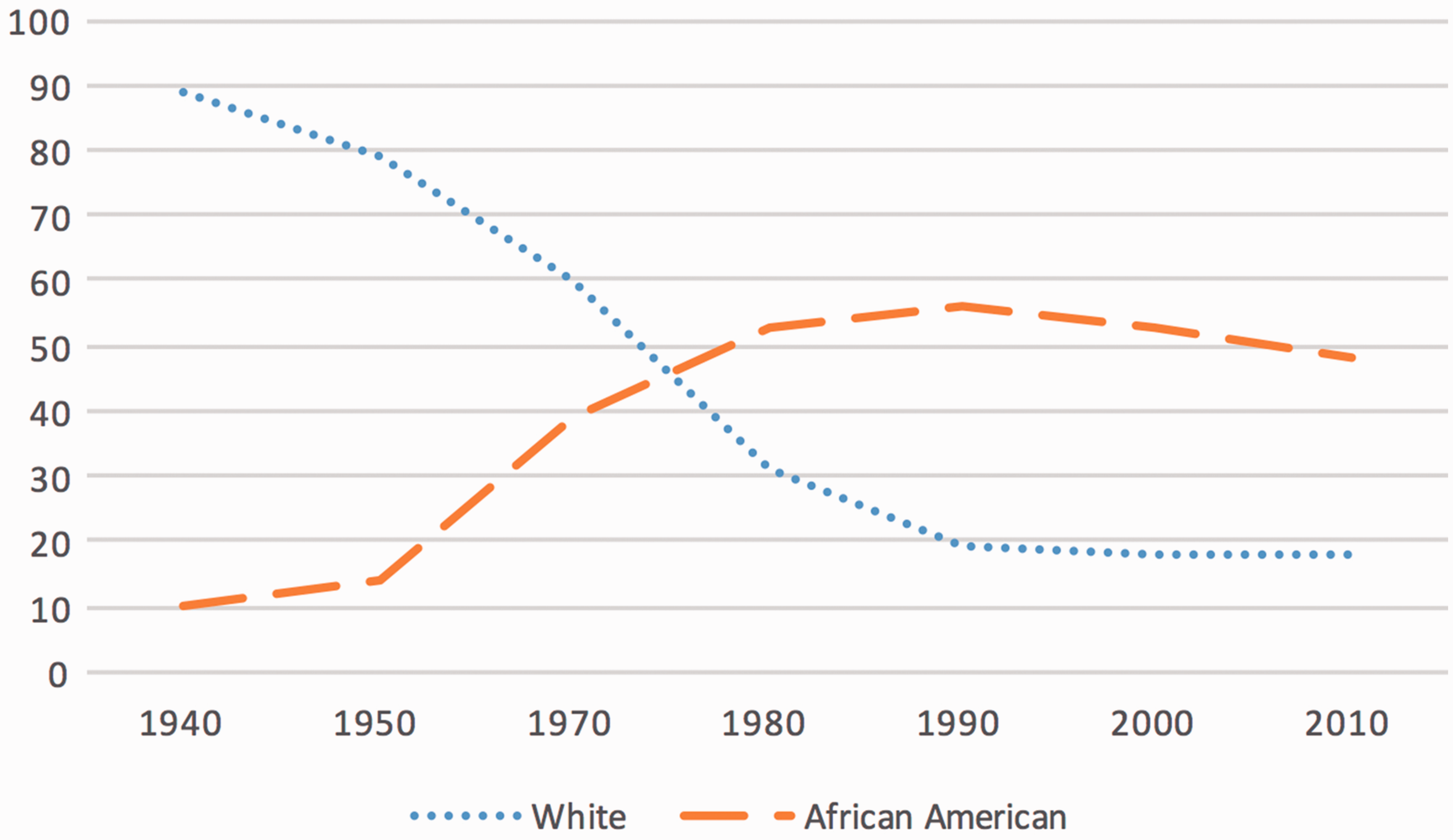
Black and white population in Camden City, 1940–2010. Source: US Census.
A business leader explained that the segregation between city and suburb was now ‘racially and economically very stark’, with the white population in 2010 comprising only 17% in the city, compared with 65% in the surrounding suburbs (US Census Bureau). The collapse of industry and the loss of so many taxpayers hit Camden hard, leading to 39.9% of residents living in poverty by 2010 (US Census Bureau). Popular representations of the city frame it as a paradigmatic example of the collapse of the industrial age, drawing on statistics such as ‘America’s highest per capita murder rate in 2012’ (Mathis, 2015). The business leader went on to outline how he felt that only those without any other choices now lived in the city, noting, ‘A lot of people don’t realise that Camden is the last stop on the way to hell; there’s no other place to go’. This extreme poverty highlights the class dynamics that intersect with racial segregation and how, combined, they result in a territorial stigmatisation of an entire city (Wacquant, 2007) that reinforces further private-sector and government disinvestment, and elicits notable infrastructural effects (Kornberg, 2016; Pulido, 2016).
The shift to a black city, surrounded by a jurisdictionally separate, white, suburban hinterland, resulted in inner-city infrastructural decay. Over subsequent decades as the previous section described, various actors failed to adequately maintain or invest in Camden’s systems leading to a failure to operate a safe, fully functioning infrastructure. This negligence in caring for the technologies of social reproduction shows how racial capitalism devalues the lives of black communities based on what Pulido (2016) described as, ‘their blackness and their surplus state’ (1). Cramer (2015) argued, in relation to the situation in Detroit: ‘The possibilities for social reproduction of white and non-black groups within the city limits have been differentiately shaped by the anti-black racism that has marked flows of and access to infrastructure in the city’.
Like housing conditions produced through practices of ‘redlining’ (Massey and Denton, 1993), infrastructure can be implicated in race (and class) based segregation, which combines with what Kornberg (2016) described as the ‘legacy costs of an overbuilt infrastructure and regional balkanisation’ (264). This ordering shapes variegated experiences of systems due to the ways investment is geographically differentiated. Camden and its suburbs reflect the ‘splintered urbanisms’ (Graham and Marvin, 2001) of post-industrial US cities as an infrastructural geography of racial capitalism. This is a dynamic through which the siting of technologies, logics of (dis)investment, maintenance, repairs and everyday experiences are structured through racialised hierarchies of value.
The racist logics of ordering arguably structured the location of the treatment plant in Camden City, rather than the white suburbs. The decision was taken in the 1970s as the city moved from a majority white to a majority black population. The rationale from CCMUA states that ‘it was cheaper and better for the environment to locate the main plant to discharge into the Delaware River rather than one of the smaller interior streams of Camden County’. However, this does not account for locating the plant in Camden City and not nearby Gloucester City, also along the Delaware River, which had an existing, albeit smaller, plant already and a lower population density. Suspicion that it was likely to be placed in poorer black neighbourhoods, rather than the white suburbs, was supported by the 2010 US Census. It shows that Gloucester City is over 90% white and only 0.14% black. A CCMUA official noted that the ‘burden of cleaning the rivers’ (for the Clean Water Act) ‘was put on 1,800 people’ in the Waterfront South neighbourhood. This community remains a ‘poster child for environmental injustice in the state’, not only for the treatment plant, but also for the nearby county-waste incinerator, which burns 1000 tons of trash daily. A resident explained that everyday life in the neighbourhood means experiencing the effects of ‘the poop that everyone else is pumping from outside the city’.
These outflows that the CSO system produces mean that the 180 miles of piping carrying sewage flows from 510,000 residents of the city and suburbs towards the plant often are overrun during heavy rainfall. Flows move from the wealthy, white suburbs of Camden County towards the plant and rupture the surface in the low-lying, black neighbourhoods of Camden, such as Cramer Hill and Waterfront South. Residents experience the outflows’ effects in various ways. A public official described outflow events in Cramer Hill in which ‘homes around that area were going to be flooded out’, and residents ‘were going to have to clean up their basements’. A business owner summed up the mobility issues: ‘If you’re a pizza-delivery guy, you are screwed. If you are trying to get to school on a rainy morning, you are screwed. If you are trying to get to work, you are screwed’. A resident commented on how ‘children are seeing combined sewage and needles and toilet paper wash up in their park’.
Racism shaped the location of infrastructure in Camden, and it also contributed to decades of under-investment in maintenance. While physical infrastructure required for the regional governing of resource flows remained sited in Camden, the suburban municipal sewer and water systems yielded revenue from wealthier ratepayers, with investment and operational capacity becoming splintered between the white suburbs and the black city. This is visible when considering property-tax payments, the primary tax income in New Jersey’s cities. Rates differed between Camden City, with a total 2007 taxable-property value of $1.1 billion, compared with nearby Cherry Hill, which, despite a lower population, had a value of $9.2 billion (CAM Connect, 2007). This fiscal inequality between the white suburb and the black city precipitated a long-term crisis, requiring the municipality to find ways to cut back, including the Water Department’s expenditure on maintaining pipelines. This is a critical factor in understanding the racialised geographies of infrastructural decay. Those left in Camden, whose population in 2000 dropped to 76,773 (US Census), now had, alongside the treatment plant, a water system built for a population of over 100,000, designed to serve various industries that also fled the city. It meant that the required maintenance costs could not be recovered from the mainly impoverished ratepayers who remained. The post-industrial city had been left in a precarious fiscal position with an infrastructure on a scale that no longer was needed. The impacts on the city’s pipelines were significant as disinvestment took hold. New Jersey Futures (2014) reported: ‘Silt and debris are accumulating in sewer lines, reducing capacity to a fraction of what it was originally and causing backups and flooding across the city’. Conditions from racialised disinvestment, resulting in technical problems and bad user experiences, established the context through which operation of the water system became privatised.
The privatisation of operations in Camden also can be understood through the logics of the racial differentiation of urban services and associated new forms of racialised accumulation across US inner-cities. An organiser from FWW highlighted how the logics of capitalism and infrastructure extend far into the ideology of the state, as ‘even governments are seeing water as a way to profit, as a way to make money, and not seeing it as a public good that should be protected’. This transformation was undertaken as part of a broader shift in the governing of cities in New Jersey around neoliberal austerity logics (Peck, 2017). In 1999, this included ‘full control of daily operations in the city’ (Gillette, 2006: 195) by a New Jersey State Financial Review Board appointed by then-Gov. Whitman and a full State takeover of Camden in 2002. Both measures can be understood as the state meting out fiscal discipline upon the black city through the integration and intensification of commodification into much of public life and to be repeated in another black New Jersey city, Atlantic City years later in 2016. These racialised austerity measures imposed by NJ State made it difficult to resist privatisation, despite a campaign led by civil society and some local politicians such as Ali Sloan El, who argued this neoliberal imposition was punishment from, ‘the financial looters who wish to capitalize on Camden’s current conditions by changing our form of government and returning to a time of the past where voting is reserved for a particular race or class of people’ (in Gillette, 2006: 201). As an activist explained about attempts by a white Republican administration running NJ State to curtail democratic decision-making in a black city in the run-up to the contracting: ‘You could not get a referendum because the State was then managing the city, and they took that power away from the city council and the mayor, but they also took that democratic right away from the citizen’.
Another activist reflected, ‘What was the point of privatisation, except for political reasons and exploitation?’ highlighting the widespread sense that the deal was another way in which the non-white population in Camden was specifically targeted by State authorities for austerity measures and in which, ‘only those social and urban needs compatible with a particular vision of economic growth are given attention’ (Pulido, 2016: 9).
The state’s role in opening up accumulation opportunities for racial capitalism is integral in explaining the unbounding of infrastructure as the ‘reprivatisation of social reproduction’ (Bakker, 2003) after more than a century of public, municipal operation. The Camden case supports Pulido’s (2016: 1) contention that ‘surplus populations’ become devalued, and ‘their lives subordinated to the goals of municipal fiscal solvency’ because they are ‘disposable’. Disposability resonates with the experience of Camden’s residents as public infrastructure was first abandoned (through disinvestment) and subsequently transferred to capital actively facilitated by the state and its neoliberal governing through the language of austerity that highlights Pulido’s (2017) contention that, ‘racism has been and is deployed to facilitate maximum accumulation’ (527). As an activist explained ‘All through this process, African Americans in particular have been inordinately affected’. Pulido articulated how infrastructure, race and capital produce ‘hierarchical regimes of reproduction’ (McIntyre, 2011: 1466) and ‘surplus populations’ in inner-cities (cf Gilmore, 2002; McIntyre and Nast, 2011). In Camden, this twin process of devaluing the population (and the disinvestment regime justified through austerity measures in a black city) enabled the appropriation of the city’s public infrastructures as a new site for racial capitalism to accumulate from. In effect, racial capitalism is both the cause of infrastructural decay, through abandonment, leading to white flight, state withdrawal and disinvestment and in recent times has become the outcome as it repurposes the post-industrial city as a space of accumulation across the technologies of social reproduction.
McIntyre and Nast (2011) argue that ‘the geographical dynamics of accumulation have become increasingly racialised’ (1466). The case of Camden supports growing evidence that accumulation in US inner-cities is proceeding through the appropriation of infrastructures of social reproduction and attendant resource flows from mainly non-white, poor communities that are devalued (Cramer, 2015; Pulido, 2016; Ranganathan, 2016). Public pipelines in Camden have become integrated into this latest wave of racialised accumulation across urban environments, i.e. the ‘transfer [of] infrastructural resources and their control out of or away from marginalised urban populations’ (Cramer, 2015). This appropriation of urban resource flows is a key outcome and further determinant in the production of infrastructural decay in the city. Writing about Flint, Pulido (2016) argued that the poisoning of the water supply is merely one example of how racial capitalism functions through infrastructure, in which ‘vulnerability, contamination and death are produced’ (1). In Camden, accumulation is primarily linked to the privatisation of water-system operations within the city, valued at $125 million over a decade. However, an organiser from FWW observed that the school system now essentially also runs a private system, i.e. ‘Bottled water is a form of water privatisation’, and questions why it became the ‘default to care for our water services, rather than putting in the necessary capital to improve the water infrastructure’.
Where is the infrastructural South?
The condition of Camden’s pipelines poses questions about how we should understand infrastructures in contexts in which decay has eroded assumptions about universal, fully operating and safe pipelines, thereby necessitating a re-evaluation of where we locate the infrastructural South. As mentioned earlier, auditors were comparing Camden’s leakage rates of 45% to those in the ‘developing cities’. In Mumbai, Anand (2017: 24) observed, ‘The prolific leakages of water from the city’s underground network’ showed how infrastructure ‘is a living, breathing, leaking assemblage of more-than-human relations’ (6). Understanding leakage in this way reframes the losses from Camden’s water system as a predicament shared with cities such as Mumbai. Leakage is one way in which Camden’s pipeline might be understood as the infrastructural South, and one factor as to why its operations are unreliable and prone to disruption. Throughout the UPE literature on global South cities, infrastructure is understood ‘as suffering from ongoing disruption and sometimes failure’ (Silver, 2015: 984; see also Graham, 2010). As such, Truelove’s (2011) description of Delhi’s water supply might be a productive example to compare with Camden’s experiences in which this Indian city is ‘…categorised by the intermittent hours that water runs, insufficient and irregular pressure of water when it is running, sudden breakdowns…and problems with contamination’ (147).
The aforementioned, underpaid youth labour, now part of the maintenance regime, does essential work seemingly beyond the capacity (or willingness) of the state or capital. Repairs can be understood as ‘the dialectical infrastructure-social relations’ through which people and technologies interact (Ramakrishnan et al., this issue) for systems that require ‘constant support and maintenance’ Graham (2010: 10). This is an infrastructure experience that is lived with and ‘embodied’ in many poor communities (Doshi, 2017). Accounts of repairs in global North contexts focus on utility companies and the state, and these practices remain ‘black-boxed’ to users. This is in contrast to the visibility of infrastructure in Southern contexts and the everyday ways in which people interact with, repair, maintain and adjust these systems. Baptista (2019) draws attention to the ‘relentless character of the work conducted by users and service providers alike to keep the infrastructure going’ (517). In considering the work of PowerCorps, similar dynamics arguably are in play, in that sustaining infrastructure operations rely on under-valued labour.
The water supply for schools is noticeably ‘improvised’ and ‘peopled’ (Silver, 2014; Simone, 2004), sharing more in common with the informal systems of the global South than the centralised networks previously understood as the North. Baptista (2019) argues, in the context of electricity in Maputo, that ‘the practice of delivering the service itself requires considerable creativity in the translation of the ideal into situated, context-specific alternative arrangements’ (515). In Camden, these translations are also present through the non-networked system that became and remains operational, enabling supply beyond the main network and peopled by ‘water carriers’ previously understood to be present in cities like Guayaquil (Swyngedouw, 2004). Kooy (2014) argues that ‘informal water providers are, thus, assumed to gradually disappear through the growth of the urban infrastructural ideal’ (34). Without the financial capacity to repair existing pipelines, Camden’s experience of non-piped water, facilitated by water providers beyond the utility operator, questions whether the modernist vision of infrastructure has been sustained.
We also can consider the unsafe water that residents must live with and the outflows that submerge neighbourhoods in toxic floods. Truelove (2011), in discussing Delhi, highlighted health issues from ‘the contamination of most groundwater to the city’s failure to provide healthful piped water’ (147). Through Resolution 64/292, the United Nations General Assembly (2010) recognised the human right to water and sanitation, acknowledging that clean, safe drinking water and sanitation are essential aspects of the foundation of all human rights – rights that evidently are not being met in Camden. Furthermore, the potential water shut-offs about to hit the city’s poorest households will exacerbate such health problems. Such shut-offs would echo attempts by companies such as Suez to force through cost-recovery schemes as part of a two-decade wave of accumulation across global South cities. Pauw (2003) described the effects of water shut-offs on residents in South Africa, ‘forcing them to get their water from polluted rivers and lakes and leading to South Africa's worst cholera outbreak’ (819). If Camden has yet to suffer such a public health emergency, the potential remains if American Water pushes forward with disconnection, or fails to invest in repairs and maintenance of the city’s water infrastructure.
These various pipeline geographies of Camden suggest that the city might be better understood as the infrastructural South. Schindler (2017), in seeking to articulate a Southern urbanism, argues that in these cities, ‘metabolic configurations are discontinuous, dynamic and contested’ (47). The findings from Camden suggest that this perspective can be extended to this North American urban space, but these geographies also must be understood within the particular historical and contemporary urban conditions through which infrastructural decay has unfolded. This paper has argued that the capacity to operate a safe, fully functioning infrastructure is experiencing severe pressure in Camden due to the effects of long-term, racialised processes of decay. Struggles for survival across infrastructure and within poor communities are not just located across cities in the global South (Ranganathan, 2015; Swyngedouw, 2004; Truelove, 2011). Since the introduction of publicly run, networked services in global North cities, the model of universal services has been a key motif of modernity and of the welfare state (Graham and Marvin, 2001; Kaika, 2004). In Camden, despite assorted state/non-state efforts at repairs and investment, the underlying infrastructural conditions remain in place. They highlight how the modernistic vision of universal, well run and safe services (Graham and Marvin, 2001) may not return and has been replaced by an infrastructural landscape that requires incremental intervention in the absence of large-scale investment. This outlines a situation in which concerned actors simply try and mitigate the worst excesses of decaying systems through a patchwork, hybrid approach to infrastructural governance (Monstadt and Schramm, 2017). In cities such as Camden, assumptions about the infrastructures of urban modernity may no longer hold.
If significant investment in infrastructure remains unlikely under the techno-political regime of racial capitalism, we can see that Camden’s trajectory does not foretell a better future. Pieterse et al. (2018) argue, ‘Over the next decade, academic thinking on urban life and infrastructure is likely to flow from and/or critique the sustainable development goals’ (151). Camden illustrates how this thinking and the aspirations of the Sustainable Development Goals (SDGs) cannot be confined to the global South, under the assumption that the global North has solved its infrastructure challenges. The struggle for basic rights, investment and fully functioning, safe infrastructure crosses the geographical and theoretical binary of North/South.
Conclusion
This paper used a case study of Camden to try and understand how, why and with what effects infrastructure decay has occurred across US post-industrial, inner-city spaces. Its key contribution was to develop a UPE approach to this growing pipeline crisis. In engaging existing UPE literature, the paper provided three principal contributions.
First, it argued for a UPE approach to infrastructural decay to politicise these processes and understand decay as a more-than-technical process. This meant considering how decay unbounds infrastructure and circulation across and beyond these systems including lead contamination in school pipelines, water leaking from pipes and CSO outflows. It also questioned whether the promise of universal services in the modern city has itself become unbounded in Camden. Unbounding offers a term that can help draw focus to the growing effects of decay on the relations between technology and its control of urban circulation.
Second, the paper sought to respond to growing calls to integrate racism and racial capitalism into analysis of infrastructure geographies (Heynen, 2016; Pulido, 2016). This case showed the ways that the black inner-city/white suburbs are ordered through racist logics and how this comes to shape both the location of regional infrastructures and investment regimes in (under)maintenance. The status of black populations as ‘surplus’ and ‘disposable’ (Gilmore, 2002; McIntyre and Nast, 2011), and the devaluation of these ‘surplus populations’ after white flight, led to disinvestment and decay, setting up conditions conducive to privatisation and a new wave of racialised accumulation. This has elicited severe consequences. As Cramer (2015) warns, ‘These resource and infrastructure seizures in the present generate, almost immediately, acute crises of social reproduction’. The paper argues for the analytical, political imperative to integrate race into UPE and emphasise the racialised ways in which infrastructure is governed in US cities. It asks researchers to pay attention to how black populations come to experience water and sanitation inequalities, as well as the new accumulation regimes targeting the infrastructures of social reproduction across inner-cities.
Third, the paper undertook a relational theorisation to account for Camden’s pipeline conditions, drawing on a conceptual vocabulary developed from work focusing on infrastructure in the global South. From high leakage rates to undervalued labour involved in maintenance, to the existence of improvised, non-networked infrastructures, to the spectre of unsafe drinking water, toxic outflows and ongoing disruption in supply, the paper found that what we have come to know as the infrastructural South can be found in Camden. The case showed assumptions concerning infrastructure as a universal, safe and fully functioning system in global North contexts should no longer be taken for granted. As global urbanisation follows multiple trajectories, parts of the global South far exceed the technological performance of Camden’s infrastructure. Other spaces with partial provision and malfunctioning infrastructure share similarities in process/condition with Camden (despite obvious differences). The findings on Camden should prompt scholars to think anew about how we locate the infrastructural South, develop relational theorisation across the North/South binary and further consider the political imperatives that emerge from understanding global North cities through such conceptualisations.
Camden, like other US cities, is at an important historical moment. Contemporary infrastructural geographies are being exposed as racialised ghettos with decaying technologies, spaces of accumulation for racial capitalism, struggles over social reproduction and limited expectation of returning to the modernist promise of universal, safe and fully functioning infrastructure. The pipeline crisis has put urban dwellers in the world’s richest country at risk of failing to secure human rights established by the United Nations General Assembly (2010). Furthermore, under goal No. 11 of the SDG’s – to ‘make cities and human settlements inclusive, safe, resilient and sustainable’ (Pieterse et al., 2018) – the case of Camden prompts questions about whether US cities require assistance from international development agencies such as UN-Habitat to achieve safe, universal and fully functioning infrastructure.
Highlights
Critical analysis of the urban geography of the pipeline crisis across US post-industrial cities using case of Camden, NJ. Outlines an UPE of decay across the infrastructures of the city. Shows the ways in which decay unbounds urban resource flows from circulatory technologies designed to control them. Argues that infrastructural decay reflects and reinforces racism and racial capitalism accumulation dynamics across urban space. Questions whether Camden might be understood as part of the ‘infrastructural South’.
Footnotes
Declaration of conflicting interests
The author(s) declared no potential conflicts of interest with respect to the research, authorship, and/or publication of this article.
Funding
The author(s) disclosed receipt of the following financial support for the research, authorship, and/or publication of this article: This research was funded through the Leverhulme Trust and relied on the generosity of many people including Alan Wiig, Renee Tapp, Daniel Aldana Cohen, Daniel Silver, Mariana Chilton and Thérèse d’Auria Ryley.