







Abstract
In this paper, we examine what Gopal Guru has called the “blocked dialectic of the commons,” which obstructs rights over common resources from moving from upper caste to lower caste communities. The case of urban lakes in Hyderabad is particularly illuminating in examining the politics, ideologies, and processes by which this occurs. By juxtaposing different kinds of lake spaces in the city of Hyderabad, we make a two-part argument. The first part of our argument is that caste communities grasp at a diminishing and increasingly polluted commons through divergent and non-co-operative caste-based strategies, which prevent them from effectively generating livelihoods, value, or other ecological benefits from the lake. The second part of our argument is that these identitarian, divergent and non-co-operative politics are not a result of ignorance or myopia, but rather they result from a squeeze on the political agency of lower caste communities enacted by the environmental casteism of larger structures of municipal governance and real estate expansion.
Introduction
Hyderabad (in the state of Telangana, India) is a city of lakes and streams, despite its reputation for being an arid place. The most prominent features of its hydro-ecology are the numerous tanks constructed over the past 500 years, which are now ubiquitously referred to as “lakes”. According to the Greater Hyderabad Municipal Corporation (GHMC), there are 168 extant lakes within the municipal limits of Hyderabad. Although substantially absorbed into urban landscapes today, until quite recently most of these lakes were common-pool resources connected to village communities and were shaped by diverse customary claims to their resources based on caste. During their urbanization over the past twenty to thirty years, their surrounding areas have been developed into built-up areas. They now house both the erstwhile villagers and new migrants both poor and elite. During this transformation, the lakes have been shrunken by disruptions to streams, by the dumping of solid waste and sewage, and by land reclamation to accommodate more residential development. Despite these transformations, the lakes have not merely become urban public infrastructures. Instead, they remain politically and culturally important to communities living near them, who continue to maintain claims to the resource and carry out ritual practices in the lake space irrespective of the level of pollution (Vidyapogu, 2018; Vidyapogu and Jonnalagadda, 2023).
In this paper, we examine two kinds of lake spaces in Hyderabad to demonstrate what Gopal Guru (2014: 7) has called the “blocked dialectic of the commons,” which obstructs rights over common resources from moving from upper caste to lower caste communities. The first kind are contested commons, which are shaped on the one hand by the divergent caste-based interests of lower caste occupational groups, and on the other, by the growing domination of caste elites over urban resources exercised through real estate development and municipal governance. The second kind are lakes which have been converted into ornamental ecologies through public-private projects for lake beautification. We describe them in terms of environmental domination because they promote a fixed and exclusionary teleological imagination for all urban lakes.
Through this juxtaposition, we make a two-part argument. The first part of our argument is that caste communities grasp at a diminishing and increasingly polluted commons through divergent and non-co-operative strategies, which prevent them from actually generating livelihoods, value, or other ecological benefits from the lake. We describe this process through the concept of caste governmentality, which entails the use of strategic essentialism around caste identity to make demands for governmental patronage for exclusive group rights in competition with other caste groups. This reliance on caste as the limited platform for claim-making excludes lower caste communities from mainstream processes of urban development. The second part of our argument is that this divergence and non-co-operation is not a result of ignorance or myopia, but rather it results from a squeeze on the political agency of lower caste communities enacted by the environmental casteism of larger structures of municipal governance and real estate expansion. By environmental casteism we mean the uneven distribution of environmental opportunities and harms, which structurally disadvantage marginalized caste groups whose environmental safety and freedom are routinely undermined to serve goals such as beautification which benefit corporate and elite interests.
Building on Malini Ranganathan's (2022b) work, we conceptualize environmental casteism as the differentiation of access to environmental resources, services, and freedoms. Further, not only does environmental casteism result in the reproduction of unequal distributions of environmental harms (also building on: Bullard, 2002; Chalwadi, 2023), it is also based on a symbolic differentiation between spaces seen as value-generating and spaces perceived as waste-ridden (Gidwani and Maringanti, 2016). Applying this perspective to urban lakes in Hyderabad, which have gradually receded from being vital infrastructures to becoming either hazardous zones or highly selective sites of beautification, is particularly illuminating.
The policy of lake beautification with funding from private corporations has become the invariable approach for the management of all lakes in the city. Such a strategy is firstly promoted by governments with an exclusive focus on recreational uses by an elite population with explicit exclusion of livelihood or cultural uses (see D’Souza and Nagendra, 2011). Further, project proposals and plans for this work are assembled by architectural firms to meet aspirational aesthetics of urban parks with little attention to the social and cultural geographies of lake spaces. While welcomed by elite citizens dwelling in gated apartments, this beautification process is viewed by local caste communities as a public-corporate enclosure of the commons and a domination over their political, economic, and cultural practices (Unnikrishnan et al., 2016; Vidyapogu and Jonnalagadda, 2023). We argue that it is this squeeze of environmental casteism and its resulting unfreedoms which compel different caste communities to heavily invest in the identitarian strategies of caste governmentality to secure their local interests. Thus, while communities desire and demand that their dispossessed customary rights to lake spaces should be compensated with new property rights, they are instead met with further marginalization. This is the blocked dialectic of urban lakes and in this paper we show how it influences environmental claim-making and governance in the city.
We carefully demonstrate this blocked dialectic through two cases. To examine the contested commons and caste governmentality, we look at the Ramanthapur Chinna Cheruvu in South-Central Hyderabad. This area is relatively remote to the booming real estate belt of Western Hyderabad, which allows for a focused examination of the local politics and contestations around the lake. This case is juxtaposed with the case of Malkam Cheruvu in Western Hyderabad, which has been successfully converted into an ornamental ecology through enclosure by the municipal corporation and one of Hyderabad's most prosperous real estate developers known as Aparna. Malkam Cheruvu is located along a core artery of the IT corridor in Western Hyderabad and its success has emboldened a narrowly imagined vision of lake beautification through public-private partnership. Although the two lakes are not physically connected, we show how they are nonetheless relationally entangled. Their respective perceptions as either value-generating or waste-ridden are the result of the multi-faceted structure of environmental casteism.
The research for this paper was conducted over four months in 2023–24, through collaborative field visits and interviews with various stakeholders at twelve lakes across Hyderabad. Two of these we designated as ornamental ecologies which have been heavily transformed through public-private investment, while the rest were contested commons with active inter-caste competitions, and contestations between local residents and governments. In the contested commons sites, our key interlocutors were office-holders in local caste associations, resident welfare associations, and local political leaders. Most of these interlocutors belonged to marginalized caste groups. In addition, we spoke to other local actors in the course of site visits. For the ornamental ecology sites, we spoke to maintenance workers and local residents with customary claims. We reviewed news discourse in the English and Telugu language newspapers. We also spoke to city-level activists and commentators. These research activities are complemented by Vidyapogu's longer term research and advocacy, since 2013, on the conservation efforts, cultural practices, and caste politics relating to Hyderabad lakes.
The paper proceeds in five sections. Section 1 situates our contributions among ongoing debates about urban environments and politics. Section 2 is centered on Ramanthapur Chinna Cheruvu and it details the caste governmentality and contested constitution of the lake as a commons. Section 3 presents Malkam Cheruvu as a case of how ornamental ecologies have captured policy and elite imaginations of urban water bodies and have allowed the state and big real estate to enclose and dominate spaces which have histories of claims by lower caste communities. Section 4 highlights and conceptualizes the contrasts between these spaces and reveals how a multi-faceted environmental casteism structures the political ecology of the contemporary city. In the concluding section, we describe how our theoretical arguments connect to urban praxis in Hyderabad and we outline some strategies toward anti-caste policies and politics for lake management.
Examining caste in urban environments
By theorizing the relationship between contested commons and ornamental ecologies, we contribute to three pertinent debates in political ecology. Firstly, the role of caste in urban and environmental politics. Second, the question of urban commons. And finally, the structures of environmental casteism in the city.
We take inspiration from the special issue theme to think with anti-caste frameworks. Owing to the naturalization of the caste system, anti-caste thought and action is especially circumspect on the question of nature (Crowley, 2023; Guru, 2014; Paik, 2022; Ranganathan, 2022a). Thus, we deconstruct environmental policies and practices which attempt to naturalize unequal social relations, building on a critical anti-caste tradition stretching back at least to Jyotirao Phule and Dr B. R. Ambedkar (see Crowley, 2023; Jangam, 2019). Instead, we examine and analyze the dynamic and relational constructions of both social and ecological relations. However, our research sites and interlocutors do not organically provide us with strategies for an anti-caste environmentalism. Instead, we see our task as contributing to an understanding of how caste shapes politics and environments, as groundwork towards an anti-caste political ecology.
In the last twenty years, studies of urban politics in India have been dominated by frameworks which have dichotomized elite and subaltern strategies (Chatterjee, 2004), or formal and informal spatial practices (Roy, 2005), but these frameworks largely elided questions of both caste and environment. More recently, a growing interest in urban political ecology has elicited sharp new frameworks to analyze the casteist constitution of urban environments (Ranganathan, 2022a, 2022b; Shankar and Swaroop, 2021). In this paper, we build on this emerging scholarship and argue that caste relations are crucial for understanding urban environments both locally and structurally. Locally, we show how a highly contested and fragmentary caste politics shapes the political ecologies of lakes, we call this caste governmentality and view it in contrast to theorizations of both elite civic governmentality (Anjaria, 2009; Roy, 2009) and subaltern political strategies for organized claim-making (Appadurai, 2001; Chatterjee, 2004).
While caste privilege is central to the civic governmentality of elite environmentalists in the city (Baviskar, 2011; Krishna, 2024), and caste is also central to the dynamics of subaltern mobilizations to derive benefits from neoliberal governmentality (Jonnalagadda, 2022; Vidyapogu and Jonnalagadda, 2023), we wish to suggest a more specific definition for caste governmentality. Caste governmentality is one where caste essentialism is reified and reinforced through bottom-up demands. Thus, as opposed to demanding civic procedures that are theoretically open to anyone, communities explicitly demand recognition and patronage for exclusive group rights. This relates to civic governmentality in that marginalized communities are unable to mobilize the privileges needed for articulating a demand in the idiom of abstract civic rights. Further, not only do these communities often lack certain privileged idioms and platforms, they are also actively experiencing processes affecting their environmental freedoms, livelihoods, and cultural practices. Thus, structurally, we show that the “environmental unfreedoms” (Ranganathan, 2022a) produced by environmental casteism squeeze lower caste groups into re-enforcing and strategically essentializing their narrow caste interests to seek rights and resources in the city.
In urban political ecology, there has also been a keen interest in the commons and processes of commoning as potential pathways to a progressive environmental politics in cities (Maringanti, 2011; Narayan, 2023; Sen and Nagendra, 2018). This question has been given excellent attention in the case of Bengaluru, where scholars have shown that a politics of commoning cannot make headway without attending to the historical and situated cultural practices and livelihoods of different communities who live near and define their identities based on water bodies (Unnikrishnan et al., 2016; Unnikrishnan and Nagendra, 2015). We build on this rich work, but our approach differs in two ways. Firstly, we modify the schema of classifying lakes as “public” or “private lakes” (Unnikrishnan and Nagendra, 2015), by instead characterizing them as contested commons and ornamental ecologies. We do so because, although many lakes are nominally under public control, the influence and agency of the government is constrained by local contestations. Further, the ornamental ecologies which are dominated by private interests are either produced through public-private partnership or are reliant on heavy-handed intervention by public authorities in the name of the public good. Our second distinguishing feature from studies from Bengaluru is our use of the term “contested commons”. While previous studies have focused on the crucial contestations between customary claimants and new users (Unnikrishnan et al., 2016) or between elite and subaltern populations (Kunduri, 2024; Shivanand, 2024), to this we also add a focus on a different set of contestations. These are contestations between caste groups and public authorities, and contestations among different caste groups who no longer share cohesive interests in the commons. These less visible contestations emerge from the sense among diverse caste communities that they are facing prospects of political domination and cultural erasure in the city, leading them to contest the public-private enclosure of lakes through a variety of strategies to demand that their specific caste rights be recognized.
We connect this experience and fear of domination to research that has shown how spaces are shaped by segregating practices structured by a casteist categorical matrix of purity and pollution (Ranganathan, 2022b). Such processes have variously been called “eco-casteism” (Sharma, 2018), or “out-placing” (Chalwadi, 2023), or “environmental casteism” (Ranganathan, 2022a). We work with the concept of environmental casteism and show how it is enacted through spatial decisions about property and pollution. Both everyday discourses and mainstream policies about lakes construct them as either value-generating nature or life-harming nuisance. As a result, some lakes become ornamental icons and others become out-placed cesspools. This dynamic requires an attention to how casteism and the political economy of land interact in urban environments (Gidwani et al., 2024; Ranganathan, 2018, 2022a). We show how a calculus of property and value underlies the politics of the urban commons at large and also mediates local caste politics.
Finally, we offer some methodological comments on studying the political ecology of caste and the city. Vidyapogu and Jonnalagadda have contrasting positionalities in significant ways. Vidyapogu comes from a Dalit background and grew up in a small village in Kurnool district, Andhra Pradesh. Jonnalagadda comes from a dominant caste Brahmin background and grew up in Mumbai with many urban and savarna privileges. Our collaborative fieldwork led to sharper questions and richer conversations with interlocutors, but in complex ways that must be critically analyzed. Owing to Vidyapogu's deep research and lived experience, his presence opened up many worlds of knowledge, action, and strategy which might never have been revealed to Jonnalagadda. But despite this deep research commitment, as someone from a marginalized background, Vidyapogu has repeatedly experienced the difficulties, limitations, and sometimes denigrations of doing fieldwork among strangers in the city (see Vidyapogu, 2017). Consider also Jonnalagadda's urban savarna habitus, language, and a more entitled approach to strangers based in his privilege, which increased access and opportunities in the field but also subtly altered the narratives and political articulations elicited from interlocutors. This difference between researchers shaped our perception of caste in the field. For example, as the paper was being developed, Vidyapogu reasonably asked, if by calling OBCs “lower caste” we are reifying an upper-caste view, while from his standpoint they are not “lower.” This dual perspective resulted in our approach to caste dynamics as thoroughly relational and contextual. Thus, caste shapes not just analysis, but also methodology (see Guru and Sarukkai, 2012). Further, we also realized the stark contrasts in how the field perceives us as researchers. The identity of researcher as construed by interlocutors in the field is never abstract, but rather the researcher is perceived in conjunction with the embodied cultural identities and social histories they bring to the field. Interlocutors ask about the researchers’ caste just as often as the opposite. The stories of caste at both local and municipal scales brought to light through our research are influenced by these relational dynamics.
Contested commons and caste governmentality
During fieldwork in Ramanthapur among communities with customary claims to lakes, our interlocutors narrated a uniform nostalgic tale about a rural past. For example, an interlocutor named Gopal who belonged to the fisher caste of Gangaputras told us, “once upon a time, when this was still a village, all the communities in the village had a relation to the lake. We Gangaputras would fish, the Rajakas would be washing along the shore, the Yadavs would be bathing their buffalos.” This was also what we heard from Shiva, a member of the caste association for Rajakas, whose traditional occupation is washing clothes.
That this narrative emerged from members of different social groups reveals continued affective attachments to the water body and its past as a co-operatively used commons. For each of these groups occupying a relatively marginalized social position (they are all groups classified as Other Backward Classes or OBCs), the waterbody and its environs continue to shape their cultural identity, as well as their visions for their political and economic fortunes in the city. Consequently, they continue to engage with the waterbody as a commons, but in the present context their engagements are exclusively based in their specific caste interests. While they narrate a past of co-operation and harmonious co-existence, in the present, they have widely divergent and often competing views on what the future of the commons should be.
As a result, the lake today is a contested commons, characterized by the following features: 1.) caste groups with dissonant interests and claims regarding the lake, which are physically manifested through caste-specific temples, rituals, and welfare associations. 2.) Various speculative practices of property-making made evident by fences or graffiti of proprietary claims. And 3.) the ruins of incomplete municipal beautification processes which were begun at some point but ground to a halt due to contestation; for example, unfinished walkways, broken boundary walls, old and fading municipal signboards. All of these around a polluted lake where the pollution continues to accumulate. Below we describe a brief history of Ramanthapur, followed by a description of the competing claims over the lake made by three different communities, and finally how under the pressures of potential enclosure through beautification the communities enact a caste governmentality to tenuously stake their claims and exercise their influence.
History of a commons undergoing urbanization
Ramanthapur used to be a village on the periphery of Hyderabad. A common characteristic of many such villages was that much of the land was held by a single landlord belonging to the dominant Reddy caste. The lands were cultivated by tenant farmers from various caste groups and the village also consisted of a number of other lower caste communities like Gangaputras (fisherpeople), Rajakas (washers), Yadavs (goat and cattle herders), Kummaris (potters), and Malas and Madigas (Dalits) who carried out their traditional occupations and also performed agricultural labor.
The period after Hyderabad's integration into India in 1948 was generally a transformative period for many occupational groups, particularly because the post-colonial state institutionalized caste in various ways even as it sought to convert the hierarchical caste system into an open social and economic order (Jodhka, 2023). The large Reddy landlords converted their estates into smaller agricultural plots and some marginal lands in places like Ramanthapur even came to be redistributed to marginalized caste households. In this changed context, occupational communities also forged specific and intimate relations with the state. These relations have had an enduring influence over the relationship between caste groups and government and have undergirded the emergence of caste governmentality. For example, customary rights to the fish in local lakes was institutionalized through the formation of government-authorized co-operatives which came to be monopolized by specific groups like Gangaputras in Ramanthapur. Similarly, washers were encouraged to form associations to become eligible for land grants and other benefits, as the Rajakas in Ramanthapur did.
From the 1950s to the 1980s, the area retained a partly agrarian character with the persistence of agriculture and traditional occupations. But this changed in the 1990s, when urban real estate development picked up pace across Hyderabad. During this time, the agrarian smallholders in the area gradually sold or converted their agricultural plots, eventually making way for rapid residential development. The urbanization of the area had a series of impacts on the political ecology of Ramanthapur. With inadequate capacity to extend municipal infrastructure for waste management, especially because much of the development was unplanned, both sewage and solid waste started to be dumped inside and on the shore of the lake respectively. Over time this meant that the increasingly polluted lake water was untenable for washing, fishing, or bathing animals.
For the occupational caste communities in Ramanthapur, the degrading lake commons resulted in a growing sense of environmental unfreedom. On the one hand, their traditional occupations have either been destroyed by pollution or have been legally prohibited in the city. But on the other hand, owing to their social marginalization they have limited capital and opportunities to participate directly in the economic growth of the city (also see Sundaresan, 2011; Unnikrishnan and Nagendra, 2015). Ramanthapur today consists of a large population of recent low and middle-income migrants who outnumber the original villagers. The original villagers today largely occupy the low and middle-income brackets. It is in the context of this environmental and social marginalization that villagers articulate claims to the space and exert influence over the lake through political and cultural practices.
Inter-caste competitions and contestations
The first time we visited the Ramanthapur Chinna Cheruvu, we found ourselves on a large open ground where children were playing. This open ground also consisted of two temples. The first was a temple to Gangamma, a water deity worshipped by the Gangaputra community. The temple had a unique design with fish ornaments along its roof. The other temple had an architectural style that was more popular in the neighboring state of Maharashtra. Attached to the second temple was a cow shed that stretched into the lake itself. The other sides of the lake were ringed by an unused narrow walkway. On the far side of the open ground, we saw a community hall belonging to the welfare association of the Rajaka community and a temple to their community goddess Eeramma. The lake itself was an unpleasant green, cattle egrets and other water birds waded in the murky water, and plastic and other solid waste littered the shore (see Figure 1).
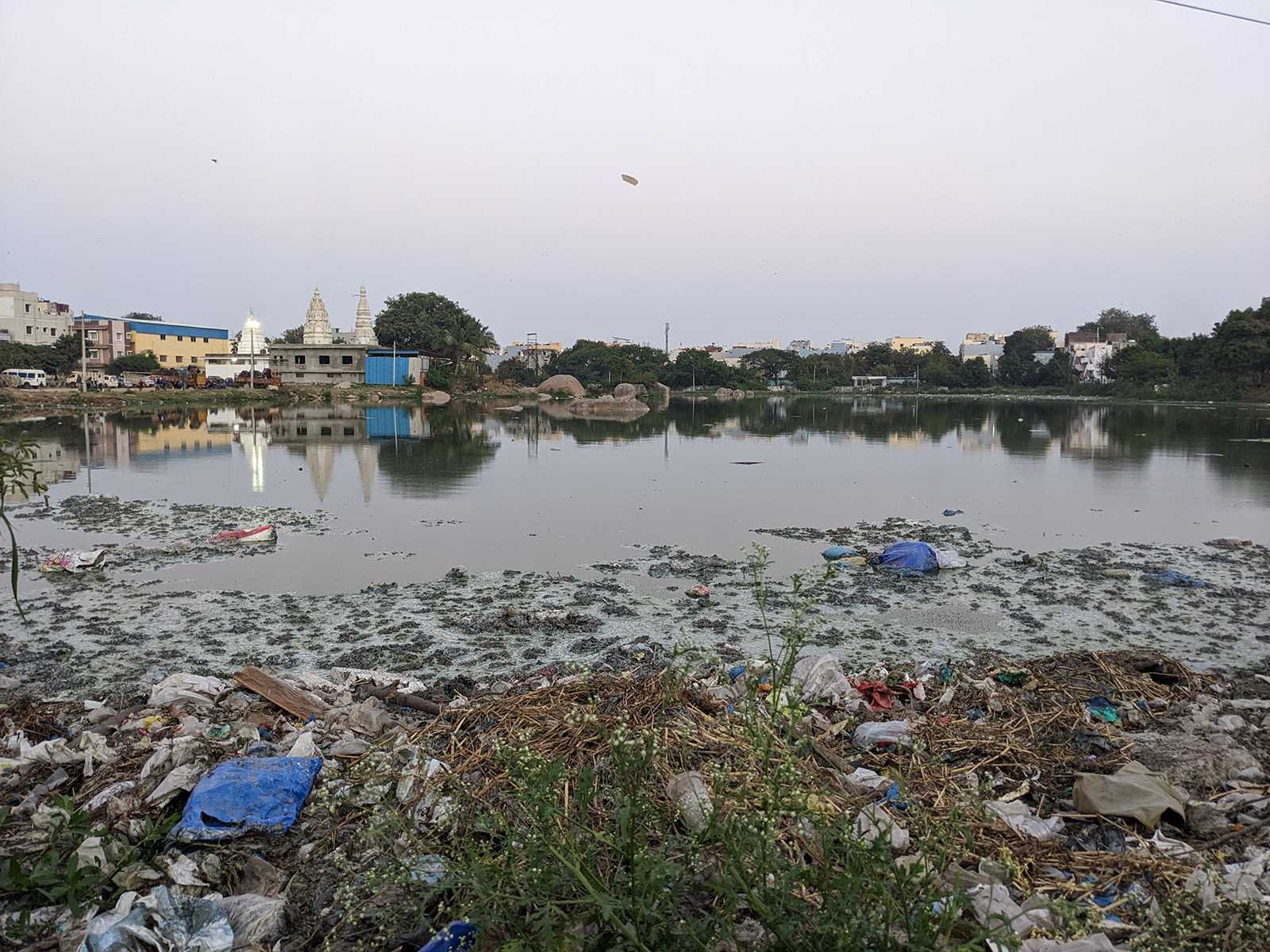
Ramanthapur Chinna Cheruvu.
In our earliest conversation with Shiva, a member of the Rajaka welfare association, the first thing he shared with us was a disgruntled complaint about the stench of the lake and the mosquitoes it breeds. “We are unable to bear it,” he told us and the “we” was seemingly an undifferentiated reference to everyone living around the lake. But after learning of our awareness about the Rajaka association and interest in their Eeramma temple, he opened up to us about the fragmentary caste politics around the lake.
In the early 2000s, when the lake had become choked with sewage and infested with hyacinth, a series of political leaders came up with plans to transform the landscape during their tenures as state representatives of the area. For example, a former Member of the Legislative Assembly (MLA) Raja Reddy from the Congress party, allegedly came up with a plan to eradicate the lake altogether and in its place have a park and real estate development. The leader had enough clout to start reclaiming land from the lake to create the open ground we see today, and he gained support from the Rajaka community. At this time, the Rajaka association had been around for 30 years, but they were no longer dependent on the polluted lake for livelihood. They had access to groundwater for washing, and they had moved the washing beds into their association premises. But because they historically washed on the shore of the lake, they argued that they had property rights over an area of land measuring an acre stretching into the lake. This argumentation was particularly suitable to a scenario where the draining of the lake seemed possible.
However, the project to drain the lake failed due to strong objections from the Gangaputras and due to jurisdiction issues between the municipal, revenue, and irrigation departments of the government. In this light, Raja Reddy backed off from the lake but left behind a new stretch of land and a shrunken lake. On the new land, the fishers and a new migrant community of Marathi migrants had built the two large temples mentioned earlier. The Rajakas felt they also deserved to expand their claims on the lake space, so they decided to claim the open street space outside their association premises, which sits at one of the main entrances to the lake space.
Unfortunately, this open space has other competing claims over it. Apart from the Rajakas, the municipal corporation also lays claim to it and has been using it to hold solid waste dumpsters and public toilets. This use of the space for waste management particularly rankles the Rajakas. In response, they planned to erect a statue of the historic icon Chakali Ailamma (a freedom fighter from their community), in order to compel the government to move the dumpsters out of fear of hurting Rajaka sentiments and hence, to consolidate their claim. But the Rajakas have been obstructed by an altogether different actor, the Yadavs. In Ramanthapur, the Yadavs traditionally herded animals including buffalo, which they historically brought to the lake for bathing. Despite their historical link to the lake, the Yadavs did not build any physical or symbolic presence in the lake environs since they stopped buffalo rearing some years ago. This strip of open space being the last unclaimed and undeveloped space near the lake, they demanded that they should be given certain rights over it for the welfare of their own lower caste community.
We learned about this contestation between Yadavs and Rajakas from the Gangaputras. As the fishing community, they are perhaps the customary claimants in the area who are most entangled with the lake in terms of livelihood and also espouse deep affective intimacies to the multispecies dimensions of the lake space (see Govindrajan, 2018). Their engagement with the lake is different than the other groups, who today mostly look to the lake as property-in-waiting. For the Gangaputras, the lake as a water body, not as property, is central to their livelihood and economy because they cannot customarily claim rights to land in the lake environs.
Ravi Kiran, one of our Gangaputra interlocutors, told us that in the 1970s when the fishing cooperatives were formed, each fisher was eligible to fish a hectare's worth of surface area of water bodies. Further, fishers had rights over not one but a chain of lakes. This meant that they could move their operations between lakes, allowing time for indigenous fish varieties to reproduce and replenish, and for each fisher to have access to larger areas of the lake. As the chain-links have been disrupted and as villages have become isolated through urbanization, fishers are reduced to having rights over single lakes and, if they are able to fish at all, they must depend on buying seeds for exotic mass-marketed fish. Officially, they are prohibited from carrying out regular fishing operations in urban lakes, which the government designates unfit for fishing due to their use for waste disposal.
All of these transformations anger the Gangaputras. The prohibition on fishing is especially seen as a blow to the community. Dependent on fishing for their livelihoods over generations, and dependent on it for their economic reproduction, fishers argue that while the government was responsible for the lake contamination, it is the fishers who are paying the price because the government has prohibited fishing without promising any benefits or compensation for fishers. Because of their interest in the water and ecosystem of the lake, the fishers seem to be advocates for lake protection, as long as it occurs by empowering them as custodians of the polluted lake environs.
Similarly, the Yadavs and Rajakas too are grasping at a degrading and diminishing resource, while fearing economic and cultural marginalization in the city. Although there are other caste communities in the area as well, these three communities are numerically and symbolically the most prominent. They all have interests and investments in the lake and its environs, but their strategies and politics are starkly divergent and prevent local cooperation. In the absence of access to the higher echelons of real estate development and accumulation in Hyderabad, the degrading commons of Ramanthapur are a polluted and limited platform for them to seek political, economic, and ecological influence.
The competing caste politics of different marginalized groups promotes very narrow caste interests which are defined in mutually exclusionary ways, resulting in what Gayatri Nair (2021) has called “competing dispossessions”. Thus, pollution and hegemonic environmental policies formed at the municipal scale direct the aspirations of all the communities towards the limited goal of seeking special group rights over the place, but on the flipside, their politics are fragmented and further aggravate their marginalization.
Caste governmentality re-enforced
In the discourse about urban water bodies, allegations of encroachment are not just commonplace, but are often the exclusive framing of the issue (Ranganathan et al., 2023). In the case of Ramanthapur and many other erstwhile villages, owing to the competing dispossessions described above, a distinctive register of encroachment-talk emerges. Stemming from the dissonant caste politics with regards to the commons, each group talks of encroachment onto their specific group rights and relationships with land and water, not necessarily over “public” resources.
For example, the Gangaputras see prohibitions on fishing as an encroachment of their community right. They also see the construction of concrete walkways as an encroachment, not because it is within the so called “full-tank level,” which is the concern of the wider urban environmentalist movement (see Coelho, 2020; Hussain, 2018), but because it disrupts fish-life in the lake. This encroachment-talk can get even more fine-grained. For example, Gangaputras talk about the encroachment of other groups onto their fishing rights by another community called the Mudirajus, who are traditionally associated with foraging (though they have historically fished in some locales). Now Mudirajus no longer have access to forests or forest products as they did in the past and are thus trying to refashion themselves as traditional fishers. This has become a deeply contentious issue being fought over by two lower caste communities over a dwindling resource. Similar conflicts have also emerged because Yadavs have a very prominent political representative at the state level, who is seen to be using his influence to expand the rights attributed to the Yadav community at the expense of encroaching over the customary claims of other caste groups. Encroachment can also encompass cultural practices, e.g., Rajakas see the construction of temples by new migrants as an encroachment on to their historical relations to the lake. This very local and caste-based register of encroachment-talk is central to the organized lobbying by which communities confront external pressures to transform the space of the lake.
In their turn, elected leaders and government agencies also predominantly engage with the communities as caste groups. Another MLA from the area called Prabhakar from the Bharatiya Janata Party promised the residents of Ramanthapur that if they agreed to his terms for the beautification of the lake, he would commission buildings for caste association for each of the occupational communities on prime land on the banks of the Musi river. Our Rajaka interlocutors told us they were initially swayed by this promise, but ultimately realized the leader did not have the power to see it through.
This specific dynamic between government and governed, where both focus on narrow caste interests for governance and welfare, is a caste governmentality that is distinct from earlier theorizations of governmentality in urban spaces. While ethnographies of the organizations of the poor have discursively produced a dichotomy of elite civic organization based on abstract rights and subaltern political organization based on contingent demands (Appadurai, 2001; Chatterjee, 2004), this schema misses a vast middle spectrum of strategies where caste-based idioms and organizations shape urban spaces.
In the polluted environs of Ramanthapur Chinna Cheruvu, caste governmentality is not merely a product of caste sentiment, but rather the product of environmental unfreedoms. Unfreedoms resulting from difficulties in reproducing cultural and economic practices, like the fishers who cannot fish to consolidate their social capital. Unfreedoms from being marginalized from municipal projects of harnessing property and value from lakes, like the Rajakas who rely on customary use rights as the tenuous basis of property claims. And finally, unfreedoms from being alienated from lakes over which they have customary claims and having to rely on political elites to exercise any influence over the space. These unfreedoms become more conspicuous in a comparative frame, so we turn next to our contrasting case of an ornamental ecology.
Ornamental ecologies and public-private enclosures
Along the western flank of Hyderabad runs the Old Bombay Highway, which only twenty-five years ago mostly cut through small peri-urban villages and clusters of ancient granite boulders distinctive to the Deccan landscape. Hyderabad's growth as an IT hub, and later a global real estate hub, took root in this western flank of the city (Das, 2015; Kennedy and Sood, 2016). In that process, the Old Bombay Highway has become the central axis of a staggering boom in real estate development.
Along this road, lies a relatively small tank known as Malkam Cheruvu, which was constructed centuries ago as part of a chain of tanks to service the settlements in and around Golconda fort. Malkam Cheruvu's career as an irrigation tank survives in the memories of residents in places like the nearby Dargah and Shaikpet villages, where Vidyapogu has conducted research since 2013. But there are also influential new migrant residents in the area, who populate the new glass office buildings and soaring residential towers. In the shorter experience of these new residents, the tank has been nothing but a sink for waste.
In 2016, the government of Telangana announced the statewide Mission Kakatiya project to restore lakes in the region, portraying them as both cultural and natural heritage. From the outset of the project, they had pre-established a distinctive agenda for urban water bodies; not restoration, but beautification. The difference being that urban lakes were not being restored to a hydro-ecological functionality, but rather were being converted into highly manicured landscapes for the pursuit of aspirational urban practices like jogging, leisure, and sightseeing. Further, beautified lake parks would also elevate the value of surrounding real estate. In light of such dynamics, we find it helpful to think with the framework of “accumulation by restoration” (Huff and Brock, 2023), whereby nature becomes valued not just for its use but also for its potential to generate value. The choice of whether a lake in Hyderabad is beautified or neglected, however, is determined not by ecological reasoning, nor by considering the socio-economic needs of communities either historically or newly living near water bodies, rather the process is determined by real estate potential. A process that reveals multiple structural facets of environmental casteism.
From nuisance to nature
Given the new real estate potential of water-front properties, beautification is thought to synergistically facilitate the best use of urban real estate while also providing for elite urban lifestyles and tourism. By this logic, Malkam Cheruvu was favorably located and the GHMC set out to beautify the lake with a budget of INR 25 crores (250 million). In doing so, they partnered with one of Hyderabad's pre-eminent developers, Aparna Infrastructure Limited who would provide support through a Corporate Social Responsibility (CSR) program.
Development around the lake began with the erection of the entrance plaza constructed by Aparna. This was followed by earth works to build a boundary along the lake, to develop walkways, and to build a tank for the immersion of religious idols, primarily Bathukamma (Roohi, 2024; Vidyapogu and Jonnalagadda, 2023). This work drew negative press and legal challenges as accusations were raised about GHMC encroaching into the lake boundary.
The accusations came from high profile residents of the area including a retired officer from the powerful Indian Police Service (The Times of India, 2018). The campaign was also taken up by a renowned organization in the city known as Save Our Urban Lakes (SOUL), who espouse a strident goal of lake preservation; advocating for the restoration of lakes to their full tank levels and the prevention of all new constructions and encroachments, in a bid to protect lakes as natural and cultural heritage. Lubna Sarwath, a leading voice in SOUL argued that the lake beautification “is just land grab” (Nanisetti, 2018). These complaints led to a court case that was closely followed in the local news. Although SOUL is engaged in activism and advocacy about the health of numerous lakes in the city (including Ramanthapur), it is the case of Malkam Cheruvu that was taken up in court and widely reported in the press owing to its privileged location.
During the legal standoff, the GHMC argued that the full-tank level of the lake is already heavily developed and in fact some of the petitioners themselves technically live “inside the lake” as per the official full tank level (Hussain, 2018). Thus, the court reprimanded the GHMC for excessive disturbance to the lake boundaries, but subsequently the beautification of Malkam Cheruvu continued smoothly and the lake is today completely enclosed by a boundary fence.
Some of the culturally and historically specific features of lakes are still visible around the lake but now located outside the boundary wall; such as the Dalit burial ground, a Katta Maisamma temple, and a mosque near the weir of the tank. The municipal preference for beautification projects is blithely unconcerned about such customary claims and about lower income residents living near lakes. While low-income residents living near lakes are labeled encroachers, the municipal corporation partners with real estate developers in capitalizing on water bodies to facilitate real estate development in the same areas, and it does so without considering the hydro-ecology of the lakes. In a news story about Malkam Cheruvu's beautification, a worker operating a JCB excavator is quoted saying “I do not know what is being made out of [this lake]. My job is to remove the silt [from the lake] and throw it on the bank” (Hussain, 2019). This quote signifies the dominant process of lake beautification in Hyderabad, which moves waste from one site and relocates it elsewhere.
With such powerful forces shaping the lake geography, even the activism of SOUL and other prominent environmentalists is unable to forestall the enclosure of lakes as mere extensions of luxury residential developments. Instead, owing to the privileged locations of these lakes and their connections to luxury real estate development, huge investments are made to sanitize the spaces and minimize overt signs of pollution with supporting pressure from the High Court and other powerful institutions. Even more spectacular than Malkam Cheruvu, is the case of the larger lake upstream known as Durgam Cheruvu located in the midst of posh residential and top-tier commercial spaces. Durgam Cheruvu, like Malkam Cheruvu, has also been developed into an enclosed lake park with CSR funds from the Indian real estate giant K. Raheja Group. In the case of Durgam Cheruvu, which has become an icon of Hyderabad’s global city status, the Court even took suo motu action to tackle pollution in the interest of fish life as a matter of public good. A kind of proactive concern that doesn’t often extend to human habitats suffering from pollution or toxicity. Such disparities in concern, attention, and ultimately administrative action are one facet of the environmental casteism underlying ideologies of nature which I describe next.
Pristine and ornamental nature
After beautification, Malkam Cheruvu now attracts many local and tourist visitors. Residents from the mid-to-high income colonies take walks, young adults from a variety of backgrounds loiter and hang out in groups or couples, children play, and indeed a wide range of users populate the lake park. Every few meters, visitors to the park are met with proscriptive messages about how not to use the lake, “fishing is prohibited,” “do not throw pooja items in the lake” (see Figure 2). This shows a tension between a variety of uses of the lake (Nagendra, 2010), with the government using its disciplinary apparatuses to prescribe a certain model of behavior premised on elite environmental ideas, while prohibiting longstanding customary uses.
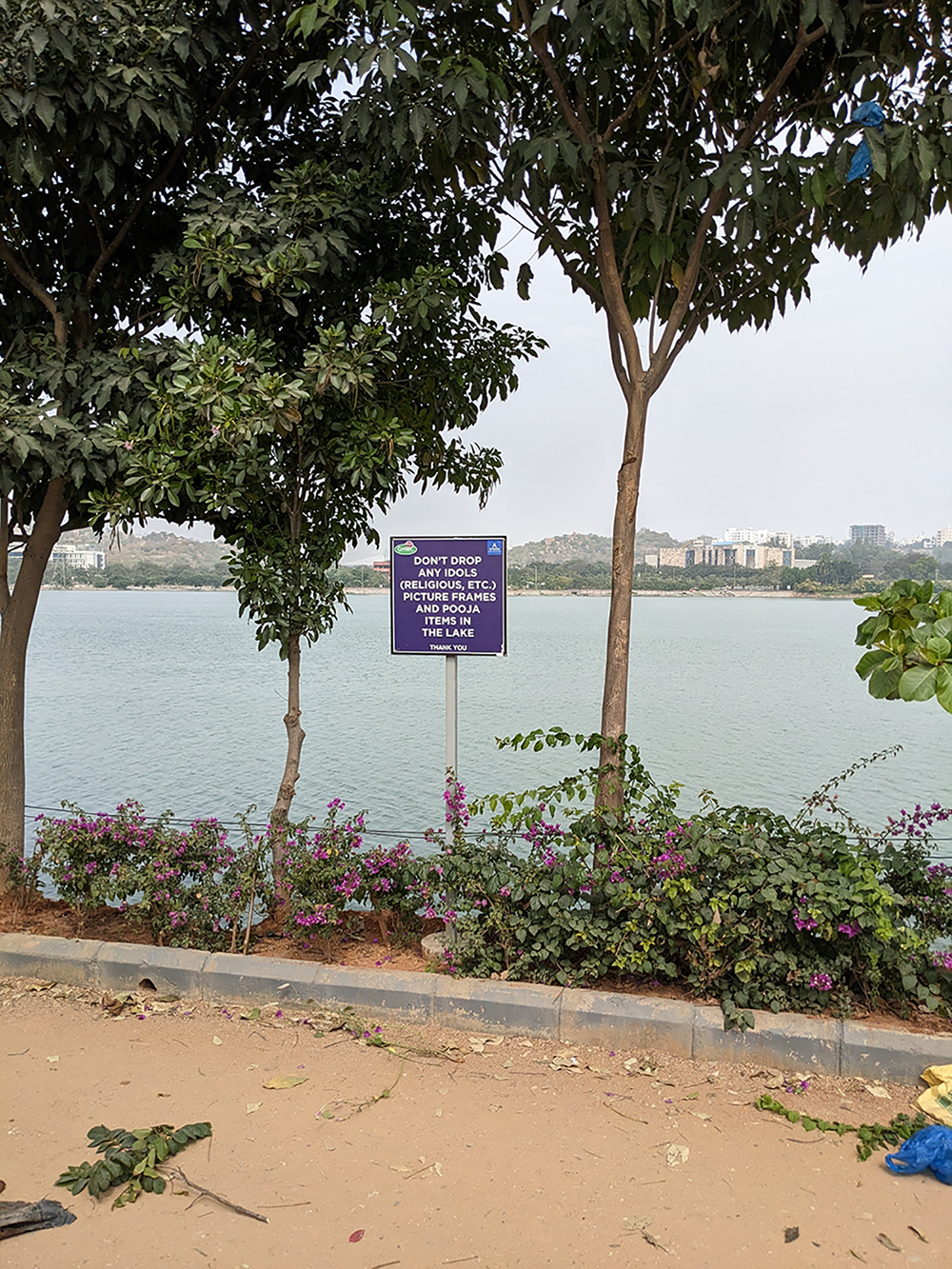
Signboard in Malkam Cheruvu Park.
A visitor to the lake would also constantly be reminded about the corporate partnership promoting this new park; every few meters there are signs for Aparna Builders. And during our research in early 2024, visitors could also see massive cranes going up behind the lake constructing mega projects by Aparna (see Figure 3) and other big real estate developers. Next to the lake is also another new project by the multi-city real estate powerhouse Prestige Group, called Rainbow Waters which promises “lakefront living at its finest” through access to nature, luxury, and an elevated lifestyle. A promotional billboard for Rainbow Waters says, “live inside a jewel” and shows a man floating lazily in a blue pool of water whose boundaries are a diamond ring. They brand their proximity to the lake through terms like pristine and pure, and thus heavily imbue the lake space with not just economic but also symbolic value. And they are able to do so by promising and accomplishing (with the government's support) a heavy-handed eradication of pollution and undesirable uses from the lake.
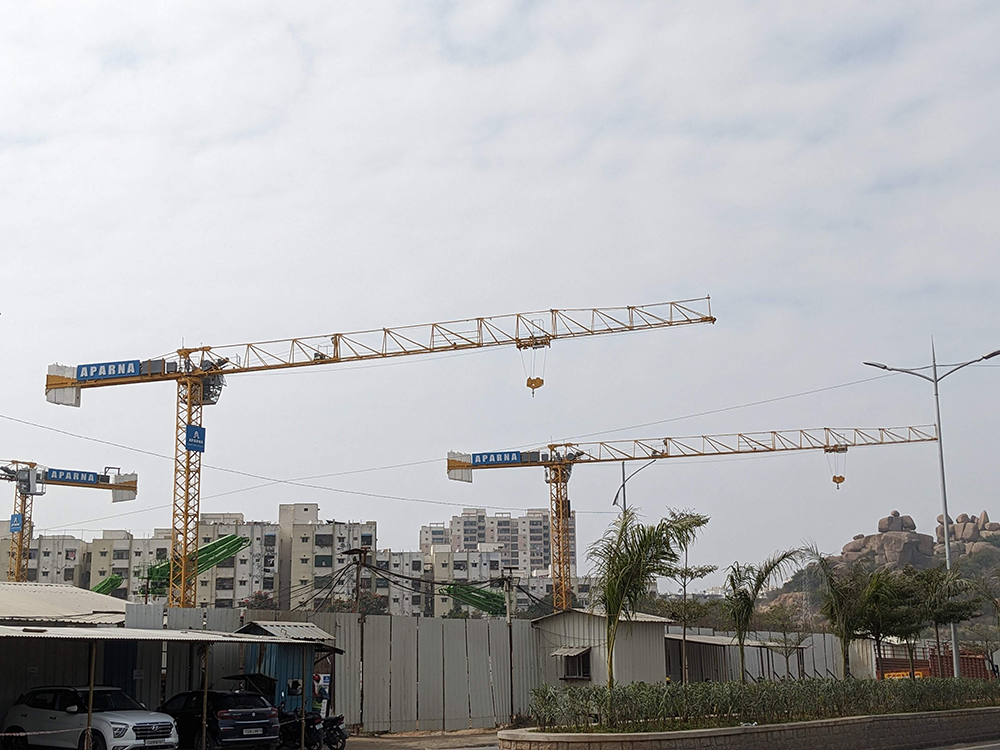
Ongoing construction behind Malkam Cheruvu.
In a conversation with a representative of the fishing community Narayan, who was previously part of the national fisheries board, we asked about lakes like Malkam and Durgam Cheruvu which are enclosed and have become platforms for real estate promotion. Narayan said that the act of enclosure is a betrayal for the fishing community. He said, “it is like being barred from one's own home”. He argued that the real estate companies are destroying the ecology for their private gains. Remarkably, Narayan noted that, “we are normally prohibited from fishing in the waters of Durgam Cheruvu, but when someone throws themselves off of the Durgam Cheruvu suspension bridge, then the government calls on us to fish out the dead body.”
Similarly, in conversations with Sashi, a middle-aged member of the local Rajaka community in the nearby Dargah area, we learned of how the Rajakas have customary rights over the rocks and streams around Malkam cheruvu. A right they exercised even into his youth, but are today unable to successfully mobilize to negotiate for compensation from the GHMC or other builders who are destroying or developing the rocky areas.
The GHMC has increasingly collaborated with big corporate real estate to promote this exclusionary model of urban nature. While the enclosure of lakes dispossesses the customary rights of lower caste communities and excludes their traditional livelihood and ritual uses of the lake, on the other hand, the maintenance of the lake as pure and pristine nature requires armies of workers from these very same excluded caste groups, who are employed for dredging, gardening, sweeping, and maintaining the lake environs. The ubiquitous maintenance workers also populate and use the lake space, but with a marginalized and alienated position in the urban division of labor and laborers.
New ideologies of nature
The capitalization of water bodies for grand new real estate projects has become a common feature across Hyderabad. As a result, real estate companies are scrambling for greater control over water bodies; to tame them through extensive use of pesticides without any environmental considerations other than the eradication of foul odors for their elite residents. In southwest Hyderabad, downstream from the drinking water reservoirs of Himayat Sagar and Osman Sagar, and along the Musi riverbanks, the area called Bandlaguda has become the site of multiple new projects of gated communities with luxury villas. Driving by, we were greeted by two signboards. One billboard advertised a gated community of villas proclaiming, “Nature is the Ultimate Luxury.” Next to it, tellingly, another billboard for a high-rise residential tower urged the passerby to “Live Where the Growth Is”.
Jonnalagadda visited one of these gated developments, where workers and machines were busy at work on rows and rows of villas. A marketing agent named Ravi guided a golf cart tour of the model villas, which ended at the under-construction private park overlooking the river. The river was carpeted with algal blooms and it was stagnant. Ravi said they were waiting for permission to privately “clean the river”. Once they get it, they would do it themselves without needing to rely on the government. He said, “nowadays, we can get drones to spray the pesticide on the water.” To this he added, “but even now there is never a smell.” The river was the unique selling point of this project being developed by Reddy land owners for an elite, often expatriate clientele, who belong mostly to dominant caste groups. The new ideology of living amidst nature as a luxury is premised on obsessions with purity and the domination of space through the management of smells (see Lee, 2017).
One interpretation of the ideological promise of ornamental ecologies is that they are capitalist non-places meant for elite consumption of nature and elevated civic amenities (Baviskar, 2015). But in practice, they are not the product of economic abstraction, they are the product of a deeply emplaced casted labor process and a regionally specific caste-inflected politics of property valuation. Only some lakes get to be “nature” and to fulfill their real estate potential. In the next section, we elaborate on the contrasts between contested commons and ornamental ecologies to demonstrate the multi-faceted structure of environmental casteism.
Environmental casteism in the city
Just as the water knows the ground's incline, it knows the generations-old strife between the village and the wada. Like the dampness on the well's edge that never dries, it knows that untouchability never disappears.
The water knows everything.
- “Water” by Challapalli Swaroopa Rani (2013 trans. Uma Bhrugubanda)
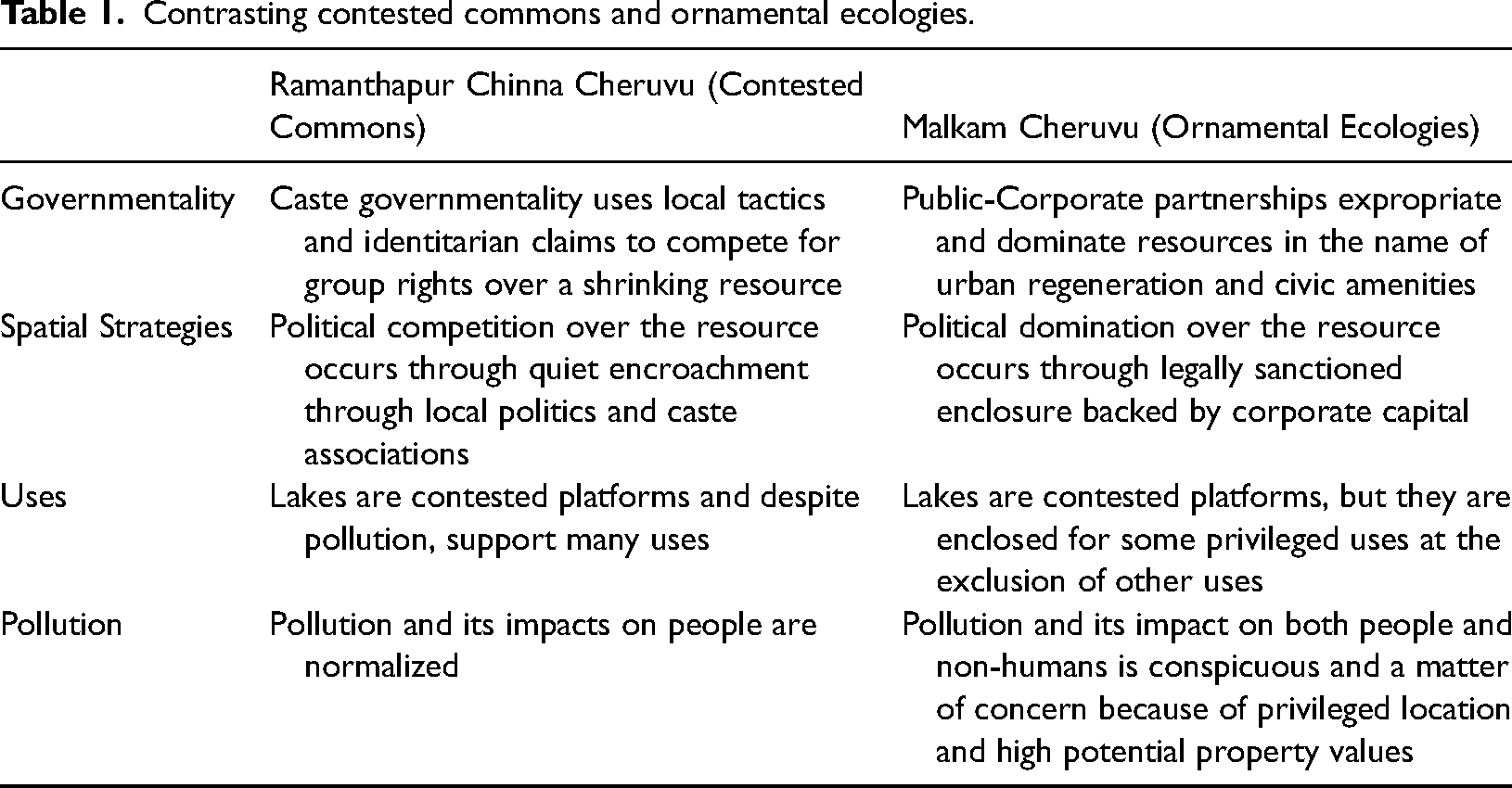
Following Hyderabad's waterlines (Coelho, 2022), both along the ground's incline and along history's injustices as we have done above, reveals important contrasts (see Table 1) between urban environments that are restored in the name of a luxurious nature, and those that are out-placed through unjust distributions of pollution.
Contrasting contested commons and ornamental ecologies.
Caste governmentality vs civic governmentality
Our case study of Ramanthapur shows the continuous struggle and competition among marginalized caste groups to access resources. In the context of widening environmental and economic unfreedoms in the city, communities in Hyderabad rely on caste-based strategies to form local solidarities, to lobby with political parties, and to negotiate with the bureaucracy. While the civic organizations of elites benefit from caste power and privilege, the goal of their organizing is not to reify caste but to use their caste power to pursue their economic interests. In contrast, the welfare associations of the villagers and slum-dwellers are overtly determined by caste, and the interventions they seek are overtly identitarian and reify boundaries between caste groups.
Caste associations are crucial intermediaries in the everyday workings of political parties, and by extension in the everyday workings of governance itself (Rudolph and Rudolph, 2012; Vidyapogu and Jonnalagadda, 2023; Waghmore, 2019). In our sites we find people's collective demands through the idiom of caste to be a strategic essentialism. Different caste groups, both OBC and Dalit, are making claims from subordinated social locations. In the absence of other opportunities, they invest heavily in valorizing their caste identities, their religious practices and symbols, and for OBCs, also their traditional occupations. They sometimes articulate this valorization as a resistance to the erasure of their cultural identity.
Spatial practices or “encroachment”
This brings us to the second contrast around spatial practices. As many have argued, “encroachment” is a powerful category in the politics of Indian urban environments (Ranganathan, 2022a). What complicates matters is that everyone is engaging in encroachment talk (Ranganathan et al., 2023): elites see poor encroachers as the cause of ecological damage, the bourgeois environmentalists accuse the government of promoting both poor and elite encroachment resulting in ecological degradation, and finally the lower caste groups living near lakes see the wealthy, the political elites, the environmentalists, and all the rest as encroachers capitalizing on shrinking resources. Further, all these actors not only call out encroachment, but participate in some spatial practice that might be construed as encroachment by someone else, resulting in a “gray ethics” of the city (Ibid.).
But while everyone participates in gray ethics, our cases show the stark divergence in strategies available to different people structured by caste and location. On the one hand, in Ramanthapur different caste communities stake partial and contested claims on the lake through quiet encroachment, occupational shifts, and incremental symbolic assertion. On the other hand, in Malkam Cheruvu, the GHMC and Aparna Builders accomplish a wholesale enclosure of the lake despite being dragged to the High Court and being accused of damaging the lake. The caste-based strategies of Ramanthapur residents have far less environmental power and freedom than the real estate interests around Malkam Cheruvu.
Lifestyle vs livelihood uses
The third contrast pertains to differences in ideologies of use. Governmental and environmentalist discourses about urban lake beautification are premised on fixed ideas of nature and heritage which promote new aspirational lifestyles and uses of the lake premised on the erasure of livelihood-uses. Their objective is to control and tame the lakes as an architectural feature of the landscape, rather than an ecological system. In this way, seemingly abstract modern ideologies of use and fixed nature (Crowley, 2023; Sharma, 2018) enact an environmental casteism.
The fisher communities act through a caste governmentality, using their caste power to locally block lake destruction, prevent waste disposal, and fight for fishing rights. However, they are unable to generate a wider discourse of lake value or enlist their neighbors into a re-commoning of the lake ecology. Thus, leaving lakes to one of two fates. Either they persist as “cesspools,” like the lakes in Ramanthapur, which are nonetheless politically fraught with competing claims and livelihood uses that operate at cross-purposes and prevent change in any form. Or like Malkam Cheruvu, they will be enclosed by real estate companies, who will employ both private and public resources to sanitize lakes with an army of casted labor to promote new urban lifestyles and consumption of the lake as an urban experience. And they will be supported by governments to use new technologies and pesticides to preserve the lakes as static ornaments in their unsustainable landscape designs.
Pollution and its management
The final contrast pertains to how pollution in these spaces is rendered a matter of concern, or not. The environmental casteism of the Indian city particularly manifests around the placement and circulation of waste. In Hyderabad all varieties of public lands expropriated from communal uses of lower caste communities have become the only collection points for waste. Among these public lands, most prominent are the city's numerous water bodies. Thus, in the city's pursuit of speculative real estate expansion, lakesides, streamsides, and riversides are over-exploited for the purpose of waste management. Along with the spaces, the people living by them are also burdened with disproportionate exposure to pollution. This situation remarkably changes in a few special contexts. Owing to their location and the stakes of the city's emergent elite, some lakes like Malkam Cheruvu have received special attention and undergone a dramatic transformation to rid them of waste disposal and pollution. In contrast, residents in Ramanthapur had to struggle vigorously using local political pressure and employing caste governmentality to block the government from dumping solid waste in the Chinna Cheruvu.
Spaces like Malkam Cheruvu, Durgam Cheruvu, and elite gated communities, due to their real estate potential garner extra-ordinary attention and investment. Their waterbodies are rendered free of smells with governmental support by redirecting the flows of sewage away from them. But in a land-locked city, where will the sewage go? Unlike in coastal cities like Mumbai, where the Arabian Sea provides a perceptual elsewhere to dump untreated sewage (Anand, 2022), in Hyderabad the sewage can only go somewhere else. Specifically, other water bodies like Ramanthapur Chinna Cheruvu within the city, with some other people living in dense concentrations around it. This unequally distributed real estate potential mediates investment and protection of some water bodies from pollution, at the expense of others, thus revealing the contours of an environmental casteism that organizes urban spaces along the axis of value and waste.
Conclusion
The contrast between Malkam Cheruvu and Ramanthapur Chinna Cheruvu exemplifies the blocked dialectic of the commons. Despite historical and cultural claims, despite economic necessities, and despite carrying out labor in maintaining lakes, lower caste communities are systemically alienated from the commons or effectively dispossessed of use rights and instead disproportionately exposed to pollution. But on the other hand, these commons are made available to large corporate real estate companies through spectacular enclosure for the purpose of constructing high-end residential areas and office spaces. Within this structure of environmental casteism, the environmental politics of marginalized communities is squeezed into a strategic essentialism around caste.
The environmental outcomes of caste governmentality are best captured by our Rajaka interlocutor, Shankar. In the course of one of our conversations with Shankar, we were walking along the rim of Ramanthapur Chinna Cheruvu and stopped at a spot which was especially thick with plastic waste and mosquitoes. Vidyapogu pointed to this and asked Shankar, “don’t all the caste communities ever come together to talk about the lake and to cooperate?” Shankar responded, “We do [come together to talk]. Some leaders have tried to bring us together under one tent. We met right there [on the open ground] by the lakeside under a big tent. But when we all get together, all any group talks about is their own rights and their own interests. No one has a care for the lake.”
Guru’s (2014) call for a vision of environmental justice that encompasses both emancipation in the present and sustainability for the future, thus faces an enormous challenge. The challenge for an aspirational anti-caste political ecology would be to imagine new pathways for urban governance and environmental resource governance, which will protect the environmental interests of dominated caste groups, and protect them from disproportionate harm and pollution, while also promoting new casteless idioms and co-operative institutions to pursue environmental sustainability.
There is a broad interest today among environmentally-minded and politically progressive groups to foster shared and collaborative place-making in the lake ecologies of cities, which would include both customary claimants from marginalized caste and class backgrounds and new urban migrants from elite and subaltern classes (like in Sen and Nagendra, 2018). However, such an aspiration cannot be accomplished without socially and politically addressing environmental unfreedoms structured by caste and without appreciating situated understandings and politics of urban environments. Our dominant analytic lenses for studying the city are inadequate for this task due to their narrow focus on economic, architectural, and governmental abstractions, at the exclusion of caste relations, local cultural meanings, and the messy politics of urban co-existence.
Studying the urban commons as a foregone tragedy misses the many living stories and claims, the many physical stakes and constructions, and the many consequential politics and practices to be found in the lake environs. Instead, our approach in this collaborative project has been to acknowledge the stakes and speculative gambits of marginalized caste communities. This entailed a method of examining the dynamic, relational, cultural practices of Hyderabad's urban lakes. For example, paying attention to the cultural cartography of these spaces in terms of religious sites. As we circumambulated numerous lakes in the city, we paid attention to every shrine, every smear of vermillion on a rock or tree trunk, and every goddess temple in these lake ecologies.
The standard template for goddess temples is particularly telling in its symbolism. These temples are not just on the land, but in it (see Figure 4). A symbolic claim to belonging and to persistence. These material and symbolic claims form a gravitational field around them drawing other multifarious cultural practices. Enfolded within these cultural practices are more expansive political attitudes interested in political ecological dimensions of the lake, which demand recognition and rights in the city. If recognized and if approached co-operatively across group identities, rather than competitively, they could potentially be harnessed towards both sustainability and emancipation.
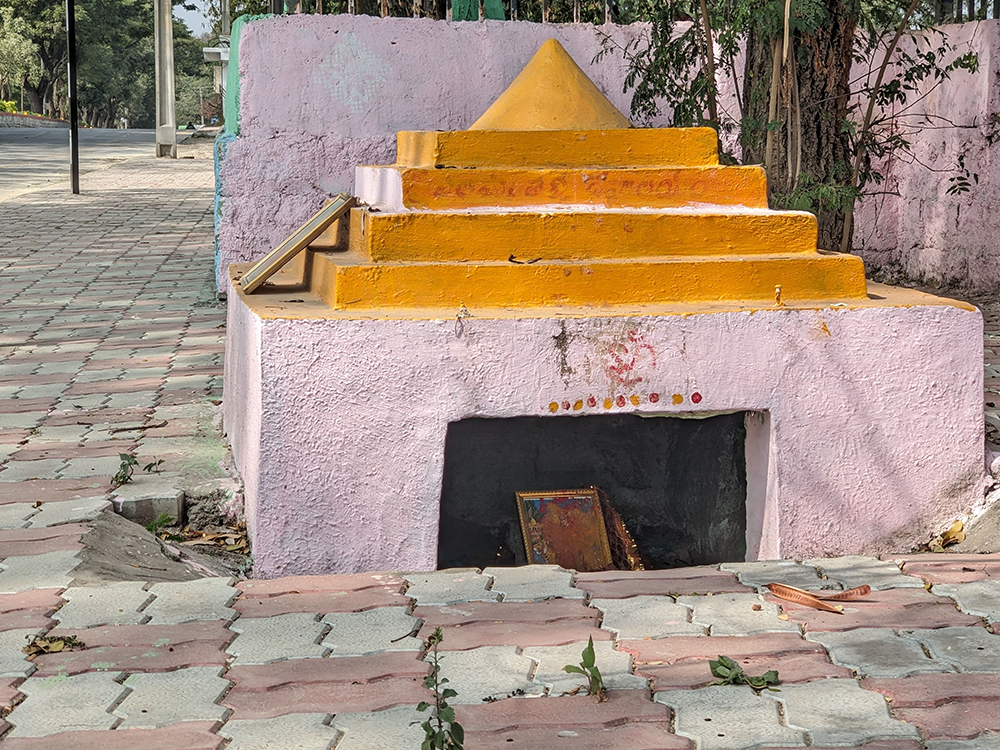
Typical goddess temple near lakes, embedded in the earth or in a bund.
Highlights
Lake beautification enacts an environmental casteism through domination over the environmental interests of lower caste communities.
Lower caste communities re-enforce their caste identities and reify divisions between caste groups when making claims to environmental resources.
Real estate capital is able to accomplish wholesale enclosures of contested commons with support from municipal and judicial authorities.
Structures of environmental casteism squeeze the political agency of lower caste communities and relegate them to identitarian strategies.
A waste-value dialectic mediates whether a lake will persist as contested commons, or be transformed into an ornamental ecology.
Footnotes
Acknowledgements
The authors would like to thank Malini Ranganathan and the anonymous reviewers for valuable feedback on earlier drafts of this paper. We also thank Amani Ponnaganti, Sahithya Venkatesan, and Tanya Matthan for their guidance and help. The authors are indebted to Anant Maringanti for his support and insights and Hyderabad Urban Lab for the vital infrastructure that made this research possible. An early version of this paper also received valuable comments from John Casellas Connors at a session on Revisiting the Commons at the 2024 DOPE Conference.
Funding
The authors received no financial support for the research, authorship, and/or publication of this article.
