







Abstract
This article discusses how worker-led decarbonisation strategies can move beyond the “jobs vs environment” tension in the context of European just green transition plans. Focusing on the Green Steel Plan, a decarbonisation plan developed by the trade union at the IJmuiden steel factory in the Netherlands in response to the threat of job losses, we show how workers in alliance with environmental communities articulated a vision for industrial transformation that links production with broader questions of reproduction. This case challenges two dominant narratives. First, that environmental protection inevitably threatens jobs, and second, that climate action is primarily driven by environmental movements. Whilst existing research on labour environmentalism and feminist political ecology has examined alliances between labour and environmental movements, labour-environment dynamics remain under-researched and under-theorised. Drawing on interviews, field observations, document analysis, and media coverage, we trace how the trade union and workers at the factory attempted to give rise to an ecological consciousness, driven not only by conditions of production but also by questions around reproduction. While the Green Steel Plan initially generated strong support from environmental groups, tensions and rifts emerged over time. This case reveals that, despite efforts to reconcile the tensions between production and reproduction, labour-environment dynamics are being continuously reconfigured and renegotiated. However, understanding these entanglements offers an avenue to move beyond the “jobs vs environment” tension.
“There is no transition without workers. Without the working class, no transition is possible. These are the people who will soon have to operate the new factories. These are the people who will soon have to install those wind turbines. These are the people who will soon have to transport hydrogen.” (Trade Unionist, November 24, 2024)
Introduction
In 2020, the steel company Tata Steel, located in the IJmond region in the Netherlands, responded to demands for decarbonisation by investing in Carbon Capture and Storage (CCS) technology and announcing 850 layoffs. Concerned about job losses and the uncertain future of CCS, the trade union organised a 24-day strike and collaborated with environmental organisations to promote an alternative Green Steel Plan (henceforth GSP) based on green hydrogen use (instead of CCS), for environmental protection and job security. Published in May 2021, the GSP can be seen as an effort to resolve the “jobs vs environment” tension, which often portrays environmental protection as inherently threatening to jobs. Here, steelworkers united to pressure the company to decarbonise the plant while ensuring that no jobs would be lost. This case challenges the assumption that environmental protection threatens jobs and that visions of alternative or radical futures are more likely to emerge from climate movements than from organised labour (Huber, 2022). However, while the plan was initially warmly welcomed by various groups, ongoing negotiations and tensions around health and the pace of change persisted, highlighting the dynamic nature of labour-environment relations. This case shows that, although tensions between labour and environmental concerns remain, they are not as fixed or one-dimensional as often depicted. This article aims to explore the extent to which the Green Steel Plan (re)configures labour–environment relations.
The growing, albeit recent, field of Environmental Labour Studies (thereafter ELS) has been interested in the diverse and evolving relations between labour and the environment, seeking to move beyond this binary opposition (Barca, 2024; Räthzel et al., 2021; Räthzel and Uzzell, 2011). This field examines alliances between labour and environmental organisations (Barca, 2012, 2024; Kalt, 2021; Stevis et al., 2018), as well as the role of trade unions in shaping climate policies, e.g., the just transition (Stevis and Felli, 2015). However, “most social science research on environmental conflicts pays attention to community agency “ (Barca, 2024, p.40) and “labour does not feature explicitly in the discussions” (Pearse and Bryant, 2022, p.1874). Therefore, the relationship between labour and ecology remains under-examined and under-theorised (Barca, 2024; Barca and Leonardi, 2018). In particular, labour–environment dynamics are still largely examined as two distinct domains rather than as entangled, co-constituted spheres.
To study the GSP as an attempt to overcome the “jobs vs environment” tension, we propose to use the lens of working-class environmentalism. Working-class environmentalism, which draws from ecofeminism, looks at how workers can (also) develop an ecological consciousness and how their everyday experiences of work influence broader perceptions of environmental challenges (Barca and Leonardi, 2018). This comes with understanding the interconnected and fluid dynamics between productive and reproductive realms as well as the necessity of situating workplace struggles within their wider ecological, social, and economic contexts (Barca, 2024; Feltrin and Leonardi, 2023; Feltrin and Sacchetto, 2021). Ecofeminists defined reproduction as “a means to be engaged in nurturing living processes by enhancing our human interchange with nature.” (Salleh, 2000, p. 31). The reproductive realm thus refers to the activities and conditions that sustain human and non-human life in all its gendered, ethnic, and other dimensions (García-López et al., 2021).
Through the lens of working-class environmentalism, this article deepens this understanding by tracing how the GSP emerged as an effort to connect production and reproduction concerns. Our analysis reveals labour–environment relations as flux, dynamic, malleable, and contested processes that evolve over time and the inherent contradictions of labour-environment dynamics. This case, therefore, shows both the promises and fragility of worker-led attempts.
First, we introduce the conceptual framework, drawing on insights from ELS. Second, we outline our methodological approach. Third, we present the results and analysis, situating the study within the development of the Green Steel Plan. We then examine the struggles and tensions that emerged around the plan. Finally, we conclude by offering a nuanced account of labour–environment dynamics that foregrounds their inherent tensions and contradictions, while also showing that bridging workplace and community struggles and connecting production with reproduction is key to moving beyond the “jobs vs environment” tension.
Case study and methodology
This article draws on a single case study of the Green Steel Plan. Fieldwork was conducted between September 2023 and June 2025. This research is part of a larger project on “Just Transitions”, which began in September 2022 and forms the basis of the first author's PhD dissertation, allowing for sustained engagement with the field over an extended period.
In total, 30 interviews, including trade unionists, workers, members of environmental and residents’ groups, and actors directly or indirectly involved in the plan (consultants, journalists, scientists) (Appendix Table 1). As we aim to grasp the role of labour in this process, we did not explore residents’ groups in depth. More precisely, we focused primarily on environmental organisations and their interactions with trade unions and workers, as these actors played a more prominent role in relation to the GSP.
Informants were contacted by the first author. In particular, workers and trade unionists were first approached through the work council at Tata Steel, followed by snowballing. Interviews were held in Dutch or English, depending on participants’ preferences. Before each interview, informed consent procedures were explained. Participation was voluntary, anonymity was guaranteed, and participants retained the right to withdraw at any stage. With permission, interviews were recorded, transcribed, and translated into English. Using an interpretive approach, we aimed to understand informants’ perspectives with a semi-structured format. Interviews focused on key issues surrounding the factory, including the Green Steel Plan, local health concerns, and collaboration between groups.
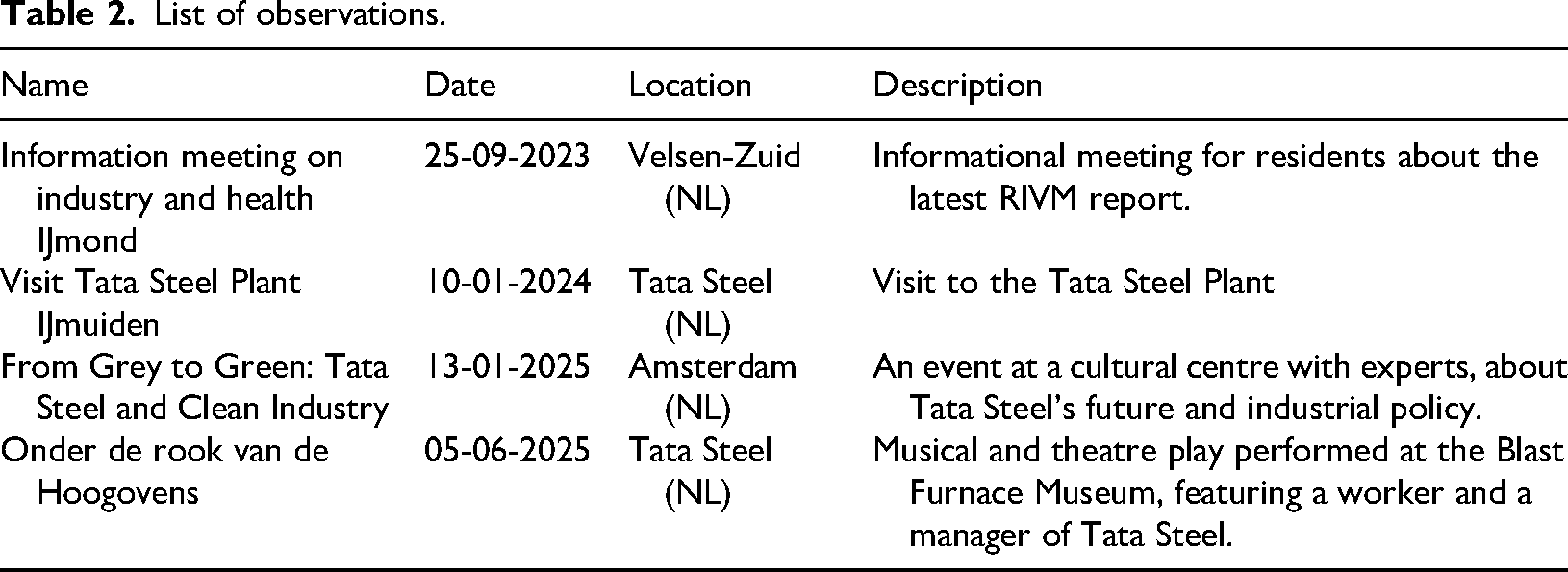
Interviews were triangulated with secondary sources such as observations and site visits (Appendix Table 2) and documents and media analysis. The first author visited the factory for the first time in January 2024, attended several public events such as an information meeting on industry and health in Velsen (September 2023), a public debate in a cultural centre in Amsterdam (January 2025), and a theatre production explicitly engaging with health concerns around the plant (June 2025). These occasions provided insights into how the factory and associated health issues were narrated, contested, and reimagined across different arenas.
For the document and media analysis, a broad set of documents was collected and analysed, including policy reports, publications from environmental organisations, trade union material, government health reports, and extensive media coverage. This material provided important contextual information and complemented the interview and observational data.
The data collected were analysed and coded using an abductive approach in ATLAS.ti (Timmermans and Tavory, 2022). Rather than applying predetermined categories, coding was iterative, moving back and forth between the conceptual framework and themes emerging from the interviews. Particular attention was given to how health and environmental issues were discussed and to the dynamics of collaboration between different groups.
Mapping labour environmentalism
Beyond the “jobs vs environment tension”
In Western thought, nature and society have long been conceptualised as two distinct and opposing realms (following Cartesian dualism), where nature is relentlessly extracted, commodified, and transformed through labour, technology, and profit-driven capital investment (Kaika, 2004; Malm, 2016; Moore, 2015). Although the environmental movement originated with industrial labour demands to work and live in non-toxic environments, in recent decades, industrial labour has come to be perceived as fundamentally at odds with the environment. On the other hand, the protection of the environment is often presented as a threat to economic growth and employment (Räthzel and Uzzell, 2011). The actions and protests of the French Yellow Vest movement of 2018 are an important example of the rift between the labour and environmental movements. Initially sparked by opposition to rising fuel taxes, this movement revealed deeper societal divides, highlighting frustrations over declining purchasing power and rising living costs, while voicing strong criticism of political elites.
Many authors explain the rift between environmentalists and labour movements by the fact that in recent decades, environmentalism has largely reflected the perspectives of a middle-class, urban, and predominantly white movement concerned with consumption (Barca, 2014, 2024; Huber, 2022). Huber (2022) notes that this consumption-oriented framing casts environmental politics as a politics of limits, leading to opposition from working-class communities. Yet, climate change is a “product of class power, or, that is, very few individuals who, in Marxist terms, control the means of production.” (Huber, 2017, p. 345).
Whatever the cause may be, however, the opposition of labour versus the environment is deeply problematic for two key reasons. First, as argued by ecological Marxist scholars, it is this separation, through the externalisation and commodification of nature, that has led to the current ecological crisis (Kaika, 2004; Malm, 2016; Merchant, 1990; Moore, 2015). Second, as this article will show, it offers an inaccurate and overly simplified portrayal of working-class communities, particularly industrial workers, who are often depicted as defenders of polluting industries. In this narrative, workers are often portrayed either as obstacles to change (Harry et al., 2024) or as a vulnerable group in need of education or retraining (Bueno Patin and Stapper, 2025). This obscures the many forms of ecological consciousness and activism that can emerge from within the working class (Barca, 2014; Barca, 2024). Working-class communities are not directly responsible for the climate crisis, but they are the most affected by its consequences, as they often work and live in polluted and toxic places (Feltrin, 2022; Feltrin and Leonardi, 2023; Feltrin and Sacchetto, 2021). Hence, they possess a deep, embodied understanding of the tensions and contradictions that shape their work and their lives. While the history of environmentalism is marked by conflicts between workers and environmental movements, it also includes examples of alliances (Barca, 2024). In fact, Feltrin and Leonardi (2023) have shown how the conflicts surrounding pollution in the 1960s and 1970s became widely politicised because organised labour embraced environmental initiatives (and not despite them).
Introducing environmental labour studies
The field of ELS emerged from the call by scholars to integrate environmental studies, traditionally separated from labour studies in Western scholarship (Räthzel and Uzzell, 2011). The aim is to explore the intersections and tensions between labour and environmentalism (Feltrin and Leonardi, 2023; Räthzel et al., 2021; Stevis et al., 2018), to understand the causes of the climate crisis and to explore possible solutions and alternatives (Pansera et al., 2024).
ELS examines how trade unions and workers engage with or influence environmental policies or practices, how alliances between labour and environmental organisations are formed, and how working-class communities are impacted by environmental degradation (Cha, 2020; Felli and Stevis, 2014; Räthzel et al., 2021; Snell, 2018; Stevis and Felli, 2015). Authors in this field emphasise that these relationships are not antagonistic, but deeply intertwined. They argue that the solution to the “jobs vs environment” tension lies in creating convergences between the struggles workers face in the workplace and those in their communities (White, 2020). The underlying idea is that, for the transition to be ‘successful’, movements must align and come together. One example is the notion of a “just transition” (Bueno Patin et al., 2025; Morena et al., 2019; Räthzel and Uzzell, 2011; Stevis and Felli, 2015). It is perceived as a pivotal moment in labour politics, seeking to resolve the longstanding conflict between labour and environmental concerns. The idea of a “just transition” has enabled trade unions and workers to engage in climate mobilisations alongside environmental and feminist organisations around the slogan “there are no jobs on a dead planet.” (Barca and Kenfak, 2015; Velicu and Barca, 2020). Although it has been described as “one of the most promising ‘hybrid’ environment–labour concepts,” it is also marked by ongoing struggles and paradoxical outcomes (Harry et al., 2024, p. 1). Moreover, there is considerable variation in the extent and depth of union engagement with environmental issues across time and space (Stevis and Felli, 2015).
Recently, some scholars have suggested that there has been an increase in strategic alliances between labour and environmental movements, such as those seen at Ri-Maflow in Milan, where workers occupied a factory and regenerated it as a cooperative (Orlando, 2020), and at the GKN plant in Campi Bisenzio, where demands shifted from job preservation to a vision of a territorially and ecologically embedded factory (Andretta and Imperatore, 2024).
While ELS has explored instances where movements align, it also highlights moments of conflict and struggles. Räthzel et al. (2018) further show how dividing the social (workers’ interests) from the environmental (nature) makes it more difficult to embed ecological concerns within trade union agendas. As a result, environmental issues tend to be treated as just one priority among many and are easily pushed aside when other matters are considered more pressing. Trade unions are also still perceived as delaying climate action (Harry et al., 2024).
Yet, it would be misguided to assume that all trade unionists and workers involved in these movements have the same perspective on environmental issues or climate change. Significant differences persist, particularly between the Global North and South, across various sectors, and in organisational structures (Stevis et al., 2018). Overall, these studies reveal the diversity and fragility, but also potential of labour–environment coalitions, ranging from green growth/eco-modernist approaches to more transformative ones (Barca, 2019a, 2019b; Snell, 2018; White, 2020).
Nonetheless, some scholars argue that this focus on labour as waged and organised (often through trade unions) overlooks the complexities and trade-offs inherent in the “jobs versus environment” tension. By concentrating primarily on the responses of organised labour unions situated in the productive realm, Barca (2014) suggests that this approach obscures the diverse nature of environmental activism and offers a limited understanding of the working class and its connection to the ‘reproductive forces’. ELS often frames workers primarily within the productive realm, focusing on workers as producers rather than as social beings embedded in broader ecological and reproductive relations. As such, the intersections of work and ecology remain under-theorised (Barca, 2024; Barca and Leonardi, 2018).
To understand how labour–environment dynamics are being (re)configured in the case of the GSP, we need a deeper analysis of labour–environment dynamics. This calls for analysing these relations through the lens of working-class environmentalism (Barca and Leonardi, 2018; Bell, 2019).
Towards working-class environmentalism: Bridging production and reproduction
Working-class environmentalism calls for the convergence between the sphere of production and reproduction, both in theory and practice. Barca (2024) specifically examines the ecological consciousness of the working class, driven by concerns for the reproduction of both human and non-human life. This ecological consciousness is rooted in workers’ direct experiences of industrial labour — particularly industrial accidents and ongoing air and water pollution — that affect their health and that of their communities. For example, she shows how workers alongside other organisations, after the announcement of the closure of the Ilva steel plant (in Taranto, Italy), asserted that “working-class people have a right to breathe clean air, drink clean water, and live in a safe environment” (Barca, 2014, p. 4).
This form of consciousness is distinct from the consumer-focused environmental consciousness often associated with the middle class (Barca, 2024). As such, workers are “characterised by specific contradictions” (Barca and Leonardi, 2018, p. 490), such as job blackmail, where they face a non-choice between employment and health (Barca, 2014). It is precisely these contradictions that shape their understanding of the harms they experience and the broader impacts of their work on surrounding communities. More specifically, this lens allows us to understand how workers are both producers and reproduced (Feltrin, 2022). Understanding ‘the working class’ not as a unified subject, but as a diverse political entity, reopens the possibility of worker control and economic democracy, both within the workplace and in society at large (Azzellini and Vieta, 2025; Barca, 2019a, 2019b).
Moreover, it is important to note that working-class environmentalism, as defined by Barca (2024, p.14), also accounts for “something much broader than its blue-collar version, because both domestic and subsistence workers, or else reproductive labour, have played significant agency in the history of environmentalism”. While this paper does not focus on unpaid care work and subsistence workers, we adopt this lens because it enables us to situate workers’ struggles in relation to both production and reproduction - that is, the conditions that sustain and reproduce human and non-human life.
In the following sections, these issues will be explored in this paper through the Green Steel Plan, a strategy developed by trade unions and workers of the IJmuiden Tata Steel Plant, which set up a route for the decarbonisation of the steel plant, while preserving jobs.
Results and analysis
Setting the context: Steel and toxicity
Established in 1918 as the Royal Dutch Blast Furnaces and Steelworks (in Dutch: Koninklijke Nederlandsche Hoogovens en Staalfabrieken), the IJmuiden steel plant was intended to reduce the Netherlands’ dependence on imported steel. The coastal location, north of Amsterdam, offered strategic advantages for constructing heavy installations (see Figure 1). Steel production began in 1924, followed by the creation of company-sponsored leisure programmes such as sports and chess tournaments (Museum Kennemerland Beverwijk, 2019). After the Second World War, the factory expanded through the recruitment of migrant workers from Portugal and Spain, the addition of multiple blast furnaces and rolling mills, and the construction of new facilities (ibid). As of today, the site includes an extensive infrastructure of 80 km road network, a 100 km railway system, its own gas pipeline and electricity network, 55 km of conveyor belts, and a (small) port (Tata Steel Netherlands, n.d). The factory has two blast furnaces, two coke plants, a sinter plant, a pellet plant, and a steel plant and remains one of the world's top producers of high-quality steel and supports around 10,000 jobs directly (ibid). The company's history includes several mergers and acquisitions: in 1999, Hoogovens merged with British Steel to form Corus, which was acquired by Tata Steel in 2007. In 2021, Tata Steel Europe was split into Tata Steel UK and Tata Steel Netherlands (TSN). Figure 2 shows a recent picture of the factory.
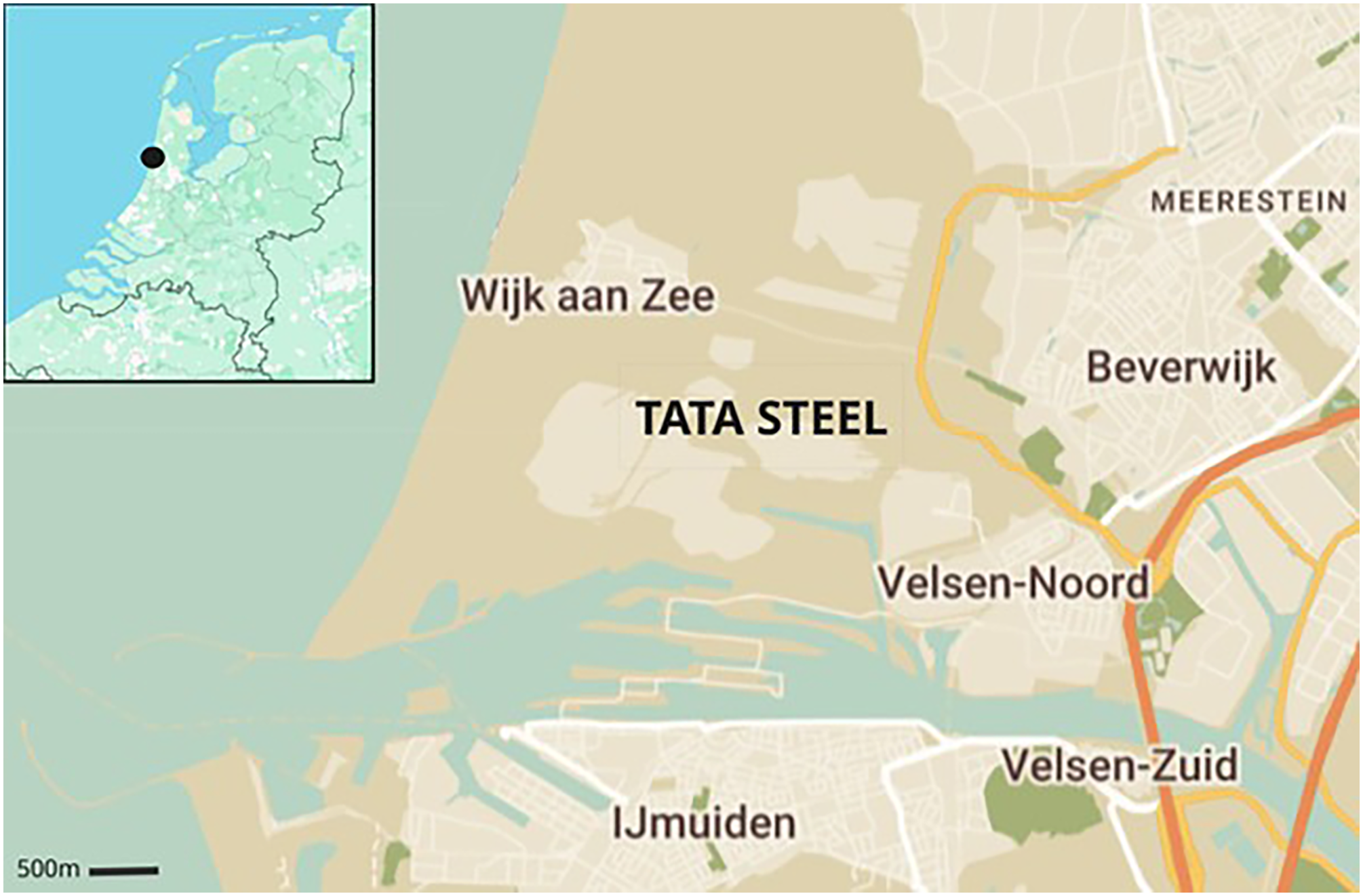
Tata Steel Plant (in black) and surrounding villages (Source: ©2026 Google & own elaboration, February 2, 2026).
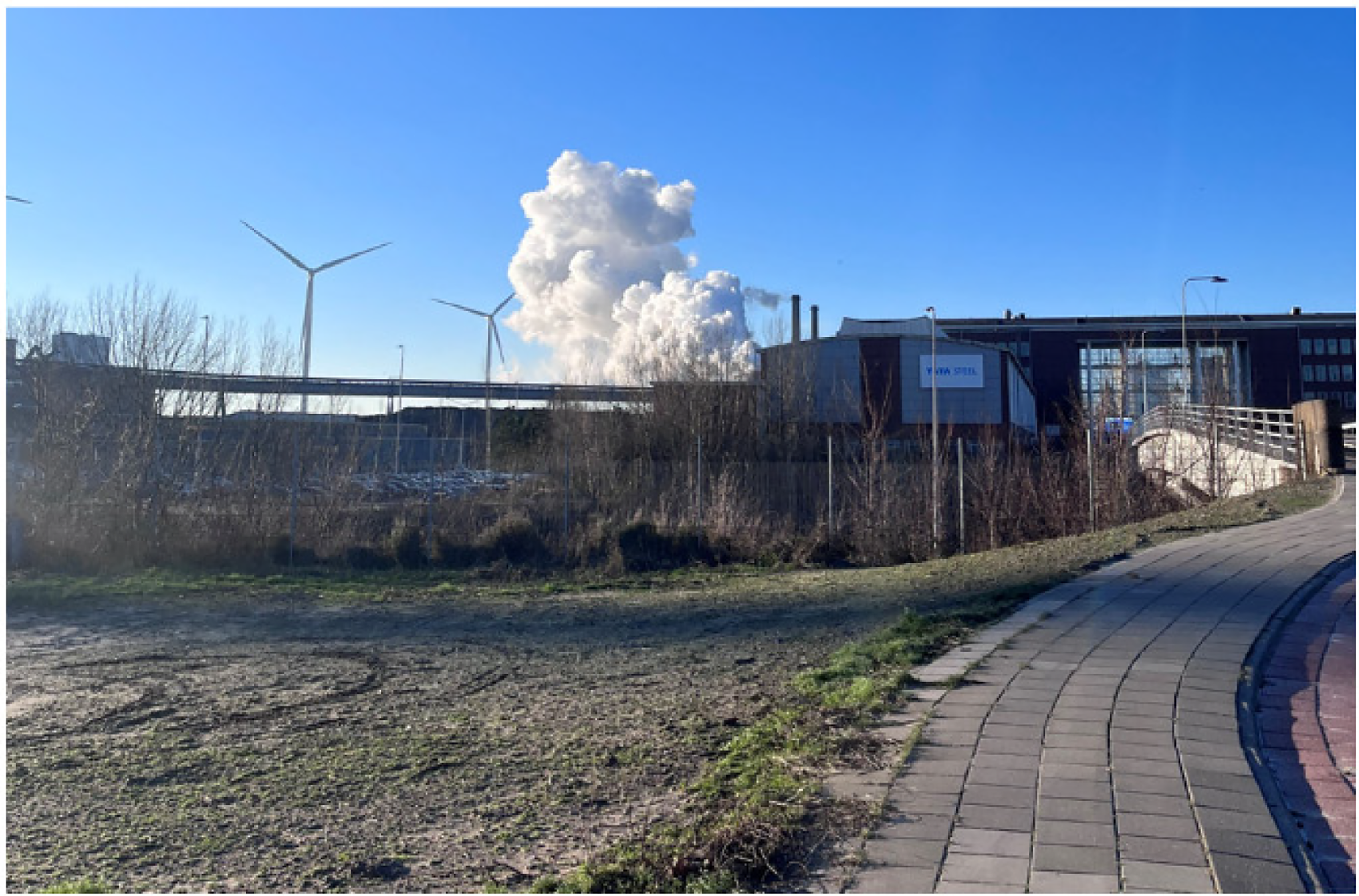
Tata Steel Entrance IJmuiden (Source: author 1).
With its colossal infrastructure, the plant is also the largest polluter in the Netherlands, emitting more than 11 million tonnes of CO₂ annually (Tata Steel, 2023; Urgenda, 2023). Health concerns related to the factory are not new but have rarely been reported, until recently. For decades, the factory has been contributing to the pollution of the soil, air, and water. Episodes of graphite rains have been reported on multiple occasions in the nearest village of Wijk aan Zee (for example, in 1991 and 2018). This happens when steel production byproduct (slag) is poured into the open air in liquid form from slag pans, slipping into dust clouds (OVV, 2023). As a result, the company cleans the playground and bus stop equipment daily in the village (De Gruyter and Boink, 2024; Jak, 2022).
Moreover, it was discovered that in 2014 and 2018, the plant had breached its environmental license 30 times. In 2021, the Dutch Health Institute (RIVM) found that residents near the steel factory experienced acute health complaints significantly more often than the general population. This was followed by a series of alarming discoveries, including the detection of toxic and carcinogenic Chromium-6 in the groundwater by the RIVM in 2022 (Ministry of Infrastructure and Water Management, 2023). In 2023, a new RIVM report confirmed that pollution levels, including PAHs and metals, had remained unchanged since 2020. This report established a clear causal link between Tata Steel's emissions and the declining health of residents (RIVMb, 2023). The report states that residents living near the plant have a reduced life expectancy, losing approximately 2.5 months on average due to its emissions (ibid). It also established that Tata Steel is by far the largest source of nitrogen, fine dust, lead, PAHs, and other very hazardous substances in the Netherlands. These high levels of pollution and release of other toxic substances are closely linked to the use of coal, which is used in the coking and gas plants and in the blast furnaces (FNV, Tata Steel and Roland Berger, 2021). This was followed by the establishment of a government-appointed expert group of ten scientists tasked with advising the Dutch cabinet on the future of Tata Steel (field observation, 23/09/2023). Figure 3 shows a timeline of the events.
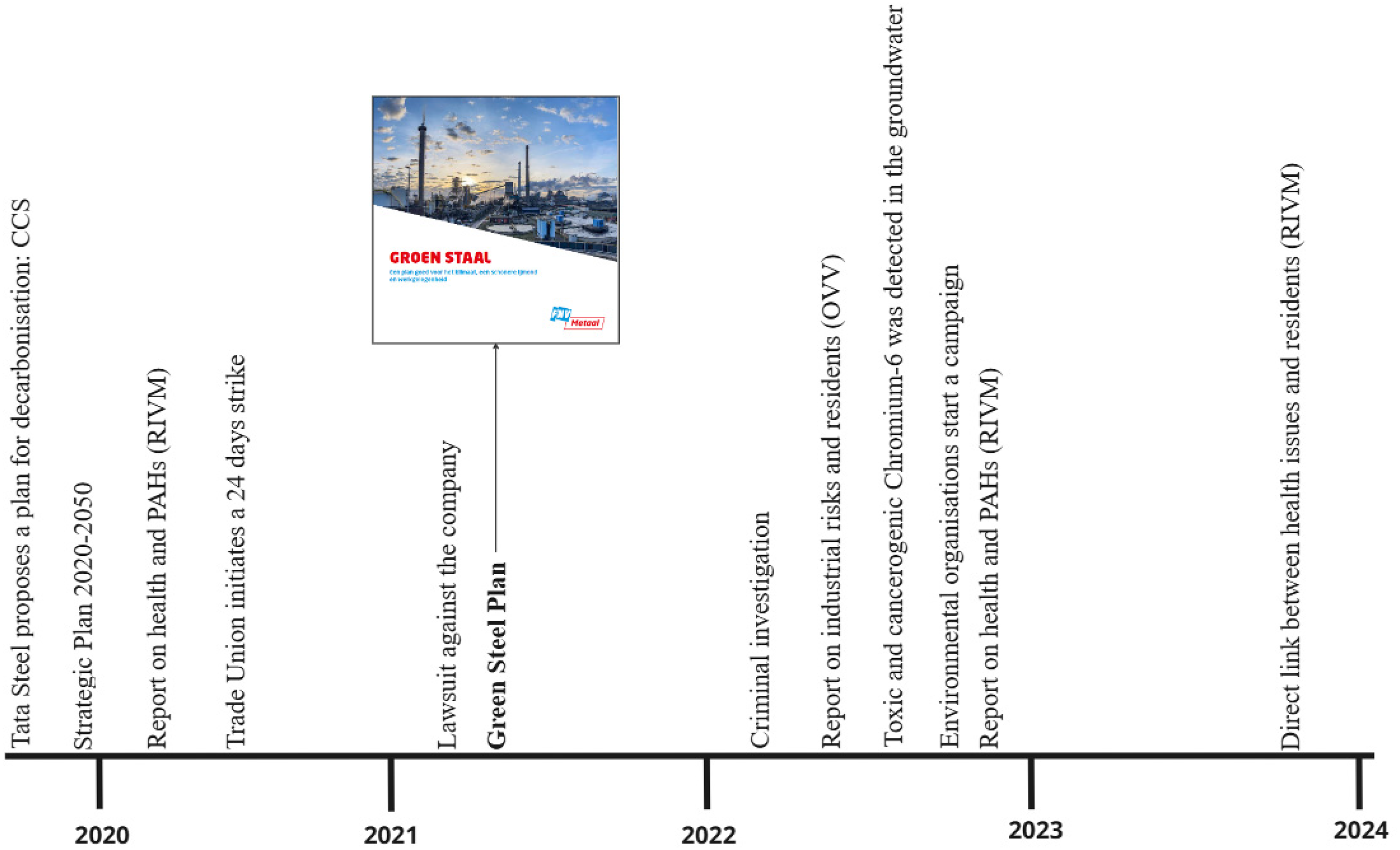
Timeline of events surrounding the Green Steel Plan (Source: documents. Image: FNVMetaal).
In 2020, the company suggested a decarbonisation plan through the investment in Carbon Capture and Storage (CCS) technology. At the time, the engineering and construction firm McDermott won a pre-contract with the company to implement a so-called EVEREST (Enhancing Value by Emissions Reuse and Emission Storage) project (‘McDermott International, Ltd, 2020’). This involved 850 job losses (FNVa, 2020). The Green Steel Plan was a strategy developed by the trade union and workers (together with the work council. 1 In 2020, a route was set up for the decarbonisation of the steel plant at IJmuiden without job losses and CSS investments. Tata Steel's board adopted this plan, also referred to as the hydrogen route, in September 2021. The plan set out a pathway to reduce noise pollution, PAHs, dust, odours, and particulate matter and metal emissions. With the phase-out of coal use, “major sources of particulate matter, NOx (nitrogen oxides), and SO₂ (Sulfur dioxide) emissions” are expected to decline (FNV, Tata Steel and Roland Berger, 2021, p. 18).
The green steel plan
The GSP document was the outcome of a 24-day strike and an attempt to propose a new route towards decarbonisation, one that would be more respectful of workers and the environment than the company's proposal to develop a plan investing in CCS technology. As explained by an employee from the factory: “We knew from the European Green Deal that we had to reduce our CO₂ emissions, meaning that we had to look for alternative technologies to reduce them. A while back, we started to look into CCS because we have a lot of empty gas fields in the North Sea […].” (Tata Steel management, April 15, 2025). At the time, this technology was perceived as the best option, as it was already available and had been used in other sectors for quite some time (Consultant, March 20, 2025).
At the time, this sparked the interest of the Zeester Group, a working group composed of former directors and professors with expertise in technology, strategy, and governance, among other fields (Zeester Group, 12/2020). As one key member of the group explained: “Why I became angry in the first place is because it is a dangerous technology [referring to CCS] […]. And that there were dangers of leakage” 2 (Zeester member, May 22, 2024). Moreover, as stated by one informant: “the problem with CCS is that it allows for the continuation of current production processes, such as using a blast furnace and operating a coke plant, which are the main sources of pollution” (Consultant, March 20, 2024).
These concerns, from the Zeester group, led them to seek support from the trade union: “We decided that if we wanted to be successful changing the [CCS] plan, we needed a stakeholder who had power. And the most natural stakeholder we could find was the [trade union].” (Zeester member, May 22, 2024) Meanwhile, as the company pushed for CCS technology, major budget cuts and layoffs were announced by the European management of Tata Steel (FNVa, 2020). These announcements spurred the trade union to take action for the first time in 28 years. In 2020, a ‘historic strike’ was declared, with workers demanding that the company provide “plans and guarantees for the future” (FNVa, 2020). Dissatisfaction with the management was growing: “The announced cutbacks, the associated layoffs, and the dismissal of the CEO were the proverbial straw that broke the camel's back” (FNVa, 2020).
The protest began gradually and escalated to a strike when management failed to respond to an ultimatum issued by the trade union regarding concrete demands for job retention. When the management ignored the ultimatum, the trade union began drafting a plan and organising a mass action, convincing more workers to join the movement. While it was sometimes difficult to mobilise workers, the trade union noted: “We [the trade union] have a very good degree of organisation within Tata Steel, which also indicates that we have influence, that we have power, that we also get other things done that are probably not possible so quickly at other companies. And the Green Steel Plan is one of them” (Trade Unionist, November 24, 2024). They further explained that “a great sense of solidarity quickly developed” (FNVa, 2020, p.10). Unionists described the process as organic, with a general willingness to take action: “We made it very clear from the union that if this company does not change, it will no longer have a right to exist in the near future” (Trade Unionist, November 24, 2024). The plan drew inspiration from a document developed a few months earlier by the Zeester group, called Strategic Plan 2020–2050 (see Figure 3) (Zeester Group, 2020). This document outlined a future scenario in which the steel company would operate using green hydrogen. Building on this proposal, the trade union and the works council mobilised their internal expertise. As one works councillor explained (March 18, 2024), “there is so much knowledge within our group of people […], and we realised that we had to use it”. Trade unions drew on the knowledge acquired through years of experience on the shop floor, mobilising it as a resource for collective action. As Wainwright et al. (2025) argue, this “tacit knowledge” can be a foundation for developing alternative industrial plans.
Several days of strikes followed, with different departments joining the movement. Convincing management “wasn’t easy” and required courage to “interfere with the strategy of the company” (Trade Union, March 18, 2024). Moreover, the trade union commissioned a consultancy to compare the management's plan with their own (FNV et al., 2021). The consultancy analysed the technical feasibility of green hydrogen and CCS, as well as the financial aspects (Consultant, March 20, 2024). During the process disputes over the timeline and hydrogen availability emerged (Consultant, March 20, 2024). This exemplifies the politics of knowledge that Scoones et al. (2015) identify as central to ‘green’ transitions. Different actors drew on different knowledge claims to define what was feasible and what was urgent. Yet, the consultancy concluded that the trade union's plan was more cost-effective in the long term. As a result, on July 3, Tata Steel management and the trade union reached an agreement.
The GSP outlines a pathway that prioritises both the “protection of employment and environmental sustainability” (FNVb, 2021). Within the document, CCS is characterised as a technology that requires substantial investment and offers only a temporary solution (FNVb, 2021, p. 4). As an alternative, the use of Electric Arc Furnace (EAF) and Direct Reduced Iron (DRI) technologies (as a replacement for Cooking and Gas plants as well as Blast Furnaces) was proposed 3 , with the argument that these could become operational sooner than CCS. Given the current limited availability of green hydrogen, DRI could initially operate using natural gas (however, it is still an emission-intensive process), which would already result in reduced CO₂ emissions and lower environmental impact. The document projected that green hydrogen could be used as a substitute by 2030 (FNVb, 2021). From the management's point of view, the final acceptance of the plan was driven by purely financial logic: “CCS was too expensive” (Tata Steel management, April 15, 2025).
Bridging within and beyond the workplace: Forging alliances
The GSP is described as: “the plan that was drawn up on the shop floor by the trade union in response to the plans that the steel company itself had, namely, not changing much in what they do. So there has been a strike for sustainability. Not for a CEO and not for pay increases, but for sustainability and a future-proof company.”(Trade Unionist, November 24, 2024). The GSP presents a unique case in which labour and environmental concerns were brought together, and an attempt was made to connect production with reproduction. The debate over the company's future remained closely tied to its initial intention to invest in CCS technology. As one trade unionist explained: “They wanted to capture it and put it under empty gas fields in the North Sea. So, not actually a solution, but rather brushing it under the carpet, as we also call it. Well, okay, we managed to stop that because we believe that if you do that, within five to ten years, this company will cease to exist. And then you're talking about 9000 jobs disappearing. […] So we didn’t start with a romantic story about the earth needing to be saved or climate action. We started with: dude, if we don’t do anything, you’ll soon lose your job. So we created that urgency in the workplace” (Trade Unionist, November 24, 2024).
Recognising that the shift to less labour-intensive technologies would inevitably result in job losses (and that this shift is inevitable), especially for workers in coke plants and blast furnaces, the union also emphasised the need for social contracts (FNV & TSN, 06/07/2023). According to them, a clear plan and protection for affected workers are essential for a successful transition: “There is no transition without workers. Without the working class, no transition is possible. These are the people who will soon have to operate the new factories. These are the people who will soon have to install those wind turbines. These are the people who will soon have to transport hydrogen” (Trade Unionist, November 24, 2024).
While job protection remained a central concern, the union recognised that this goal was indivisible from investment in ‘future-proof’ decarbonisation technologies. Although, as they acknowledged, this was not a “romantic story about saving the earth”, it nevertheless disrupted conventional “jobs vs environment” tensions in several ways, revealing traces of an ecological consciousness. This ecological consciousness was visible in the recognition of the interdependence between the productive and reproductive spheres, where sustaining life and sustaining industrial jobs were understood as inseparable.
First, by perceiving themselves both as workers and as residents, workers adopted a dual role that allowed them to reconcile environmental and employment concerns. Here, workers brought their productive and reproductive interests together, framing employment security and a liveable, healthy environment as inseparable. As one trade unionist noted: “Yes, if you don't do anything, you will soon lose your job, but mind you, you live here too. You also live around the corner from that steel company, so you and your family and your loved ones can also be at risk there. Well, if you can bring those two things together […] then you have them in two roles, namely as an employee, but also as a resident who also lives there. We brought that together” (Trade Unionist, November 24, 2024).
This is also emphasised in the following quote: “We are part of society, and we all have our place in society” (Works Council member, March 18, 2024). This statement reflects how steelworkers and the union understood their role beyond the confines of the plant.
Second, by opposing the management's original plan, workers and trade unionists contested the dominant “job blackmail” narrative that posits employment against health, thereby prompting the emergence of an ecological consciousness. Here, they did not passively accept the management's plan but opened up an alternative path in which labour–environment relations could be reconfigured. As explained by another trade unionist: “The storage of CO₂ is not a quick or good solution. It takes just as long and just as much money. So why not immediately go [for] the good and final decision […] that would create a much healthier environment” (Trade Unionist 1, February 18, 2024). The union underscored that imagining a future for steel production was only possible if it was tied to ecological concerns. A sustainable and environmentally friendly future was not seen as an external demand but as a condition for their own survival: “There is only the possibility of having a clean future, otherwise we don’t have a future” (Works Council member, March 18, 2024). The points above illustrate that the trade union and workers’ interests do not lie solely in “their conditions of production, but also in their conditions of reproduction” (Feltrin, 2022, p. 1144). If their struggles were concentrated around production, they were driven by reproductive concerns (the conditions for sustaining human and non-human life).
Third, they assert their role as knowledge producers alongside environmental groups by collaboration with climate organisations (see Figure 4). One trade unionist recalled: “At that moment we were all together, we had one goal: to block Tata Steel's CCS plan and to ensure that a sustainability plan would be created” (Trade Unionist, November 24, 2024). This new collaboration was warmly welcomed by the trade unions and workers: “If you build a coalition, then you become stronger together than on your own” (Trade Unionist, February 18, 2024). To promote the plan, several environmental organisations wrote a letter to the government asking them to support the GSP as an alternative to the CCS plan (Trade Unionist, November 24, 2024). On June 1 2021, Friends of the Earth Netherlands (henceforth: Milieudefensie), Urgenda, Greenpeace, the Young Climate Movement (Jonge Klimaatbeweging), Nature & Environment (Natuur & Milieu), and the Environmental Federation North-Holland (Milieufederatie Noord-Holland) addressed a joint letter to the Minister and State Secretary of Economic Affairs and Climate (Milieudefensie et al., 2021). Figure 4 visualises the different groups that supported the Green Steel Plan.
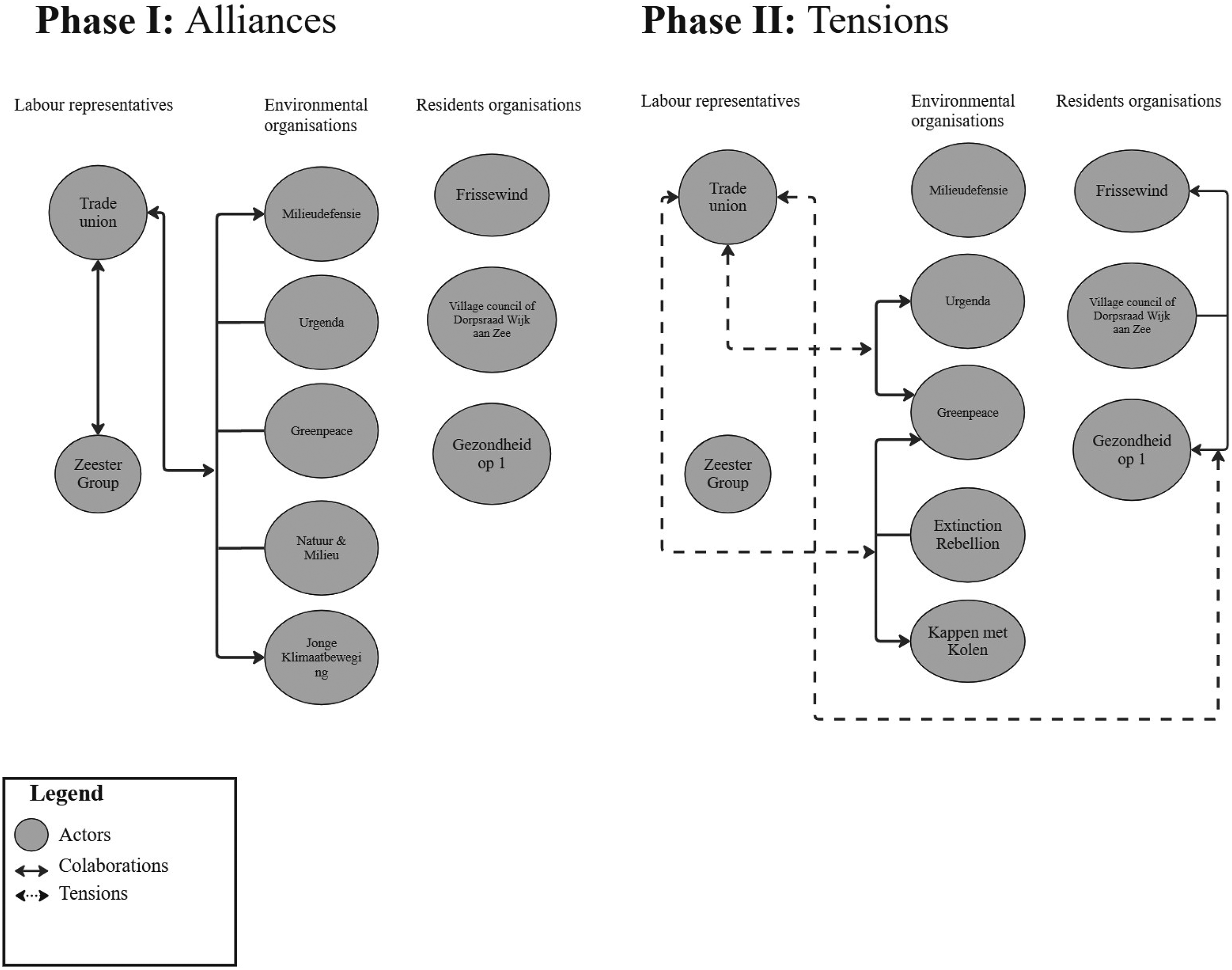
Overview of the collaborations and tensions between the trade union & workers and other organisations involved with the (creation) Green Steel Plan (Source: Authors).
As explained by one environmental organisation: “At the beginning, we thought the plan was a good alternative. So we adopted it. We also sent a letter to the government saying that, yeah, we should work towards green hydrogen” (Environmental organisation, June 18, 2024). Another environmental organisation stated: “Initially, there was also a lot of praise from us. What has happened so far is also unique […] To name just CCS, which a large part of the environmental movement is very critical of. Here, employees shot down a CCS plan, for which three billion and something had already been reserved, and set a different course” (Environmental organisation, April 24, 2024). At the time, stopping the CCS route was prioritised over other concerns.
Through these developments, we observe a convergence of struggles taking place both within and beyond the workplace, offering an alternative (re)configuration of labour–environment relations. However, while the GSP initially generated strong enthusiasm from diverse organisations, these alliances evolved, giving rise to tensions. These issues are explored in the following sub-section.
Beyond the workplace: Tensions around the green steel plan
Although the GSP momentarily disrupted the “jobs versus environment” tension, the alliance between labour and environmental groups began to fracture over time. What lies at the heart of this fraction is the health and environmental crisis, produced by decades of industrial pollution and regulatory neglect. Initially praised, the plan later came under criticism as its implementation was delayed and the company's health impacts on residents became more visible, both in public debates and official government reports. Environmentalists increasingly viewed the plan as insufficient (in light of the new health reports), a technocratic and eco-modernist fix that failed to address the immediate environmental and health concerns. Environmental movements began to voice demands for scaling down production, which implied potential layoffs and thus conflicted with the trade unions’ goal of preserving jobs. These tensions reactivated the very contradictions the plan had aimed to overcome. Figure 4 (above) illustrates these tensions.
Tension 1: Slow progress in the midst of a health crisis
First, tensions intensified as health issues became more visible in public debate. Reports from the Dutch Safety Board (in Dutch: OVV) and the Dutch Health Institute (in Dutch: RIVM) began to appear, drawing increasing public attention. More specifically, the 2023 RIVM study linking the company's emissions to health impacts experienced by surrounding communities escalated the conflict (RIVMa, 2023).
Environmental groups accused the company of neglecting promised hydrogen investment and postponing the ambitious timeline of the plan (Urgenda et al., 2024). As expressed by one environmental group: “At that time, I also read more about public health issues, and I became concerned about the Green Steel Plan. It's much better, of course, than the present situation, but it doesn't solve all the problems, especially if you delay it. And then Tata Steel started to delay it. So it became 2030 instead of 2025” (Environmental Group, June 18, 2024).
Or, as explained by another environmentalist: “They call it a Green Steel Plan, but it is actually a blue steel plan because they want to start with using gas instead of green hydrogen. And they say [here: the management] they only want to move to green hydrogen when that's cheap, and the price that I've heard from them will never be reached here […] they want to stay as big as they are and really don’t change” (Environmental Group, March 13, 2024).
At the same time, some residents began organising themselves and forming various resident organisations (see Figure 4). These residents’ groups launched legal actions in 2021 (DutchNews.nl, 2024) and 2023, supported by groups such as Frisse Wind, Gezondheid op 1, and the Village council of Dorpsraad Wijk aan Zee, culminating in a case in 2024 demanding the immediate closure of the most polluting parts (see Figure 4). This generated tensions between workers and some residents. These resident groups displayed frustration with the state and a company (and sometimes workers) that seemed to value jobs above health: “Economics are always far more important… this is the kind of argument that is always put forward. I feel that the GSP is, of course, a better idea than CCS, but I also think they always want to make it larger in scale to ensure economic profitability” (Resident Group, July 3, 2025). Moreover, it appears that trust has been broken between the company and these residents’ groups: “Our organisation also joined these lawsuits because we found out we can’t trust this company. They have lawyers and they fight everything in court. So that's the way we also do it, otherwise it won’t work” (Resident Group, July 3, 2025).
Environmental and residents’ groups themselves diverged in strategy. This also highlights that none of these groups should be understood as homogeneous. Environmental and residents groups, much like workers, were internally diverse and at times marked by tensions and divergent priorities. Some sought to preserve fragile collaboration with the union, despite differences over timelines and scale: “We try to maintain a good relationship with the union. It isn’t always easy! … but we do see that we have the same objective” (Environmental Group, April 24, 2024). Others launched more disruptive campaigns. Under the banner People vs. Polluters: Tata Steel, Greenpeace, Extinction Rebellion, and Stop Coal organised demonstrations in 2023 and 2024. Although Greenpeace insisted its protests were not directed at workers (personal communication; Greenpeace Netherlandsa, 2023), these tactics strained relations, leading the union and workers to feel ‘under attack’.
More specifically, union members grew frustrated with protests and public actions seen as undermining their efforts to secure a ‘just transition’: “Instead of putting your energy into this, put your energy into making sure we can get it done quickly!” (Trade Unionist, February 11, 2024). The trade union saw their plan, i.e., investing in hydrogen to reduce pollution, as a solution to the health crisis and perceived environmental organisations as delaying the plan by generating negative public opinion. In contrast, environmental organisations, in alliance with residents’ groups, argued that the current plan was inadequate to safeguard both the environment and public health. In this regard, their concerns aligned with reproductive issues centred on caring for the environment and future generations, yet without being tied to the logic of production. For example, FrisseWind was established by parents advocating for their children's and grandchildren's fundamental rights to clean air, safe water, a healthy environment, and a sustainable future (Stichting FrisseWind.nu, n.d).
Specifically, environmentalists demanded the immediate closure of the most harmful facilities, such as Coke Fabric 2. The Green Steel Plan (GSP) proposed by the union sought to decarbonize steel production through Direct Reduced Iron technology, using natural gas first and then hydrogen in combination with electric arc furnaces (FNV et al., 2021). However, environmental groups criticised the company for prioritising natural gas over green hydrogen, thereby delaying the transition to ‘low-carbon’ production. As one Greenpeace representative noted, “the company is instead focusing on natural gas, primarily in the form of imported LNG (Liquefied natural gas). This is problematic, as the greenhouse gas emissions across the entire LNG chain are significantly higher” (Greenpeace Netherlandsb, personal communication, 2025). Moreover, the existing coke and gas plant facilities at Tata Steel have long exceeded their technical and economic lifespans and suffer from leakage of highly concerning substances (such as carcinogenic ones) (ibid). In the original GSP, the new installation was scheduled to be operational by 2025 (FNVa, 2020), but this target has not been met. While Coke and Gas Plant 2 is now slated for closure before 2030, the timeline for Plant 1 remains unclear, and the new DRI plant has no fixed schedule for switching to hydrogen (FNV et al., 2021).
Company management, for its part, cited uncertainty around financial viability, the lengthy permitting process, and technological readiness, particularly the limited availability and high cost of green hydrogen, as justification for the delays. As one manager explained: “The disadvantage of hydrogen is that it is quite expensive to make. So we will be connected to the hydrogen grid, but at this moment, there is not sufficient hydrogen available. So we'll start with natural gas”(Tata Steel management, April 15, 2024). Moreover, it remains unclear where the hydrogen will come from (Tata Steel management, April 15, 2024).
The trade union supported these claims. However, this does not imply that the union or workers align with management. Rather, they recognised that implementing such changes is complex and dependent on external actors, including government authorities responsible for subsidies and permits. From their perspective, they were already doing everything within their power. This also illustrates how their agency and the broader labour–environment dynamics operate within the constraints of the capitalist system.
However, it is also important to note that workers are not a unified group, and there are more critical voices among them. In the recent documentary STAAL (De Gruyter and Boink, 2024), for instance, a worker expressed both pride in his long-standing connection to Tata Steel and scepticism toward the company's environmental transition which he perceived as insufficient to adequately address its environmental impacts. As he stated, “I have always been a proud employee of Tata Steel. But I have also been critical of the greening plans”. The documentary concludes with a scene in which this worker receives a dismissal letter from the company.
Tension 2: Mobilising an environmental politics detached from labour
As the enthusiasm for the GSP decreased among environmental and residents groups, the trade union and (some) workers came to be perceived as defenders of the status quo (saving their jobs at the cost of health) rather than agents of transformation, narrowing the space for solidarity. As one environmental organisation put it, “They [workers] have never been interested in health… it should be important for everyone” (Resident Group, July 3, 2024). As another environmental group remarked, “Yeah, the only reason that people want to stay with Tata Steel is that these are relatively easy jobs for relatively good money. And in other jobs, you may have to work harder or earn a little bit less. And that's why they don't want to move. But it's not that there are no jobs available. There are plenty of jobs, actually. We have a shortage of people, not a shortage of jobs” (Environmental organisation, April 13, 2024).
This pushed some environmental and resident organisations to propose new plans and ideas for the factory, advocating for its downsizing and/or relocating it elsewhere in Europe (e.g., Spain).
In June 2025, the environmental organisation Urgenda and Gezondheid op 1, in collaboration with an architectural firm, presented the ‘Wijmond’ project (Kalavasta, 2025). This initiative outlines three alternative future scenarios for the Tata Steel site, e.g., ranging from the development of a new ‘green’ city, to the creation of a nature reserve and business campus, or the continuation of steel production through semi-finished products and using electric arc furnaces (ibid). In addition, Urgenda and Greenpeace commissioned a report (2023) demonstrating that, in the event of closure or downsizing of the plant (where employees would be forced to find new jobs), workers could easily find employment in the region . They argued that regional labour shortages would absorb displaced workers, downplaying fears of mass unemployment. In North Holland, direct employment at Tata Steel accounts for only 0.6% of the working population, suggesting limited regional dependency. However, this perspective is sharply contested by labour representatives. In an open letter, the trade union warned that “closure of the coke plants will inevitably lead to the closure of Tata Steel in IJmuiden and to a social disaster in the region” (NH Nieuws, 2022). According to the union, between 2000 and 3000 families could be affected, underscoring the factory's perceived centrality to the regional economy and social fabric (ibid).
Environmental organisations and residents’ groups were primarily motivated by concerns about reproduction, such as protecting health h, local living conditions, and caring for the next generation, rather than by the logic of industrial production. This focus often left the trade union and workers feeling unheard, as their priorities around jobs were then sidelined. This does not suggest a disappearance of health-related concerns but a reordering of concerns under the threat of job losses.
Tension 3: Divergent understandings of health
When this report was published, it sparked differing opinions among the groups active around the factory. As one member of an environmental organisation explained: “The report claimed there is enough employment, but that goes against the employees [because] they have very good employment conditions, which were fought for. There is 100 years of tradition, of families, and pride” (Environmental group, June 5, 2024). For workers and the union, such claims ignored the social history and pride tied to steel jobs. As one trade unionist recalls: “We used to talk with pride that we worked here. Nowadays, people remove their stickers [of the company] from their car windows” (Trade Unionist, November 11, 2024). Employment in this sector not only guaranteed a stable income but also fostered a strong sense of community and the conviction that one's labour contributed meaningfully to the broader society (Non-profit, November 6, 2023). For the trade union: “Health is also a good living environment, health is work, which saves seven years from your life. “ (Work council, March 11, 2024).
Moreover, the trade union contends that current challenges must be understood within a broader context: “Aspects such as emissions and pollution obviously affect health. But socio-economic prosperity, work, a good income, and the lifestyle that goes with it, of course, also have a huge effect on your life expectancy” (Trade Unionist, November 11, 2023). They also argue that conditions have already improved and that changes have been made concerning pollution and health risks. For example: “We used to work with asbestos, but now that is no longer allowed. We have more lung cancer because many people here have worked with asbestos. But then you shouldn't say that lung cancer is more common because Tata is here” (Trade Unionist, March 11, 2024).
While health is a shared concern across the different groups involved, it is defined, understood, and cared about in different ways. For some, health is primarily linked to protection from pollution; for others, it is intertwined with economic security. When these perspectives come into contact, contradictions inevitably emerge. This also reflects the entanglement between production and reproduction realms, with conflicting understandings of what a ‘healthy body’ and a ‘healthy environment’ are (Mandler et al., 2025).
While trade unions and workers initially resisted the “job blackmail” narrative by articulating their own alternative through the Green Steel Plan, the ongoing public health crisis and public attention introduced new fractures within the alliance. As revelations about environmental pollution and health risks emerged, workers were increasingly perceived as aligned with management and maintaining the status quo. In contrast, the workers and the trade union saw themselves as taking action and promoting a feasible alternative to produce green steel while reducing health impacts. They viewed environmental and residents’ groups as, conversely, prioritising environmental concerns over jobs and obstructing the implementation of the Green Steel Plan. In this context, the labour and environment alliance began to dissolve.
This emerging ecological consciousness was limited by the persistent forces of capitalist relations, which continued to shape how workers imagined both industrial and ecological dynamics. Furthermore, environmentalist groups began to focus their concerns solely on issues related to reproduction. While concerns for health and the environment can be understood as preconditions for production (since you need a healthy body to work), this focus nonetheless reinforced, from the workers’ perspective, the sense that these groups were disregarding employment concerns (implying a dichotomy between health and work). This reaffirms the positioning of workers within the productive sphere, emphasising their role in safeguarding employment at the cost of the environment.
Conclusion: The malleable dynamics of labour-environment
Through the study of the Green Steel Plan, a strategy developed by the trade union and workers to decarbonise their steel company, we have sought to understand how labour-environment relations were being continuously reconfigured and renegotiated during this process.
This case study adds to the many examples of waged and unwaged workers taking action to ensure the environment remains healthy and fit for human and non-human life alike (Barca, 2024). Here, the trade union and workers proposed an alternative route for their company, aiming to protect both jobs and the environment. The strike they initiated to pressure management arose from a dual threat, a threat to their jobs but also to the environment. There was also an underlying recognition that, to secure jobs in the long term, production itself had to be transformed in line with environmental objectives. In the face of economic restructuring and exposure to toxicity, workers and trade unionists actively intervened, proposing a concrete plan to change the trajectory of their factory.
Through the GSP, the trade union and workers reaffirmed their identities as creative beings, giving rise to an ecological consciousness. They did not “only protest, occupy, or resign […], they [took] the initiative and became the protagonists of their own socio-economic and political destinies” (Azzellini and Vieta, 2025, p.11; Kaika, 2017). By opposing the management's original route of investing in CCS technology, they actively contested the job blackmail narrative that presents a false choice between a job and health. This ecological consciousness was also made visible when environmental groups became allies and supported the plan. This aligns with Barca's argument (2024), which defines working-class environmentalism as a form of activism that seeks to transform the economy based on the mutual interdependence between production, reproduction, and ecology. Here, concern extends beyond merely protecting jobs (although this remains important) to encompass the reproduction of human and non-human life within the biophysical world (Barca, 2024). Therefore, the Green Steel Plan is an attempt where the production and reproduction realms were (temporally) brought together around a dispute over the future of a polluting industry.
However, what began as an alliance between trade unions, workers, environmental organisations, and residents gradually gave way to tensions and struggles. From the environmental groups’ perspective (though with different positions and opinions), initial optimism quickly gave way to frustration when the company's management pushed deadlines, and the plan began to be perceived as co-opted by the company's profit-driven logic. Not enough was being done; the plant needed to be downsized, which would result in job losses. Unlike the union, these groups tended to frame their claims in terms of reproduction without tying them to the material realities of production. Environmental groups’ focus was on the health impacts and environmental damages, as well as the urgency of addressing these issues. This reinforced a “jobs versus environment” or “jobs versus health” tension. Consequently, the union came to perceive these groups as a threat to workers’ jobs. In doing so, these dynamics inadvertently reinforced the very dualism that the strike had cracked open. If health can bring production, ecology, and reproduction together, as argued by Barca (2024), here it instead became a point of contention.
This trajectory illustrates that trade unions and workers are not operating in a vacuum but are “constrained by capitalist relations” (Pearse and Bryant, 2022). Here, the economic power of capital and the necessity to keep a job is stronger than concerns over health and the environment (Mau, 2023). In the case of the GSP, what began as an initiative that disrupted economic flows gradually became entangled with the logic of the market. The temporality of these relations also deserves attention. While the alliance failed, the plan nonetheless shows us that it is precisely in the convergence of struggles between the workplace and the community that alternatives to the “jobs vs environment” tension can emerge (Feltrin, 2022).
This argument resonates with long-standing research in feminist political ecology that insists on placing social reproduction at the centre of the protection of human and non-human life (Barca, 2024; Mies and Shiva, 1993). Ecofeminists argue that patriarchy creates hierarchical oppositions, e.g., body versus mind, nature versus culture, or women versus men, where the qualities perceived as linked to the feminine are seen as inferior and are instrumentalised and exploited, while those linked to the masculine dominate (Federici, 2004; Merchant, 1990). Yet it is through this separation and opposition, and through the understanding of nature as a limitless resource to be relentlessly extracted, that capitalism sustains itself (Fraser, 2022). Ecofeminists call for a recognition of the deep interdependence between production and reproduction as co-constitutive processes that sustain the conditions of life, always in relation to our environment (Barca, 2024, p.7). More precisely, reproduction refers to the actions and practices through which a liveable world is sustained (García-López et al., 2021). This follows a call from Collard et al. (2018, p. 5) to move beyond “this artificial split between humanity and environment,” which they identify as “a key impediment to our understanding of, and appropriate engagement with, environmental issues.” They argue that engaging with feminist political ecology is imperative, as it enables us “not only [to] more fully comprehend socio-natural problems, but also propose more robust and far-reaching solutions” (p.10). By drawing upon working-class environmentalism, an approach which focuses more on the connection between production and reproduction, our article contributes to the field of ELS. Workers are not only producers but also have their bodies reproduced as an integral part of the biophysical world's metabolism.
While we follow Huber's (2022, p.294) statement that, “we do not need better environmental policy ideas to solve climate change; we need a stronger working class”, we argue that it does not suffice to look at the “hidden abode” of production and aiming at changing it, but that it needs to be seen as mutually constitutive with reproduction, i.e., “media[ting] humanity and nature without turning it into dead matter” (Salleh, 2000, p.31). Similarly, as this case study shows, focusing solely on reproduction is also insufficient. Although the tensions between jobs and the environment were not resolved in this case, it nonetheless indicates that overcoming this tension requires engaging with the entanglements of production and reproduction (Barca and Leonardi, 2018; Kaika and Ruggiero, 2024). The example of the Green Steel Plan presents both possibilities to move beyond dualist framings. It highlights the contradictions, capitalist forces, and tensions inherent to labour-environment dynamics, and how deeply these dualisms form part of people's identities, thinking, and practices. This also reaffirms a long-standing argument in feminist political ecology: that the distinction between production and reproduction is not only analytically problematic, but potentially damaging for both environments and societies, and, arguably, for the economy too.
Highlights
This paper explores how a worker-led decarbonisation strategy reconfigures the “jobs versus environment” tension.
It analyses the Green Steel Plan as a labour–environmental alliance for industrial and ecological transformation.
It shows that labour–environment dynamics are continuously reconfigured and renegotiated.
Understanding the entanglement of production and reproduction offers an avenue to move beyond the “jobs vs environment” tension.
This supports feminist political ecology's argument that the separation of production and reproduction is harmful to the environment and societies.
Footnotes
Acknowledgments
First, we would like to thank all the informants who took the time to answer our questions. We also thank Michiel Stapper, Emma Griffith, Mirte Jepma, and Phillip Paiement for their helpful comments on earlier drafts. Finally, we thank the anonymous reviewers and editors whose feedback enhanced the quality of this work.

Ethical approval and informed consent statements
This study received ethical approval from the Ethical Review Board of Tilburg Law School, Tilburg University (decision number TLS_RP907). All data were collected with the written or oral informed consent of the participants.
Funding
The authors disclosed receipt of the following financial support for the research, authorship, and/or publication of this article: This work was funded by the Horizon Europe BOLSTER-project (grant number 101069586).
Declaration of conflicting interests
The authors declared no potential conflicts of interest with respect to the research, authorship, and/or publication of this article.
Data availability statement
The datasets generated and/or analysed during the current study are not publicly available due to confidentiality considerations.
Notes
Appendix
List of observations.
| Name | Date | Location | Description |
|---|---|---|---|
| Information meeting on industry and health IJmond | 25-09-2023 | Velsen-Zuid (NL) | Informational meeting for residents about the latest RIVM report. |
| Visit Tata Steel Plant IJmuiden | 10-01-2024 | Tata Steel (NL) | Visit to the Tata Steel Plant |
| From Grey to Green: Tata Steel and Clean Industry | 13-01-2025 | Amsterdam (NL) | An event at a cultural centre with experts, about Tata Steel's future and industrial policy. |
| Onder de rook van de Hoogovens | 05-06-2025 | Tata Steel (NL) | Musical and theatre play performed at the Blast Furnace Museum, featuring a worker and a manager of Tata Steel. |