







Abstract
Afforestation initiatives have been and remain a key tool to “improve” the desert and to allay state anxieties around arid lands, including in the world's newest desert, the Aralkum, which has emerged as the Aral Sea has dried and shrunk. The Uzbek state regularly announces the latest statistics on their large-scale high modernist afforestation of the Aral Seabed with the native salt-tolerant plant saxaul. Their stated goal: to mitigate the Aral “catastrophe” by stabilizing the soils of the seabed and restoring the landscape. In this paper, I present results of a critical remote sensing analysis of actual growth of afforested saxaul on the seabed. Thinking with and against different technologies of seeing (e.g., human eye, satellite sensor), I compare these results to reported afforestation activities, embedded observations from participant observation, and insights from key stakeholder interviews. Detailing human and plant labor as well as different temporalities of care for saxaul, I show how Aral Seabed afforestation is not simply an effort to create a functioning more-than-human infrastructural forest, but to perform global environmental stewardship to the world. I argue that we should see the Aral Seabed as an already extractive landscape where restoring functioning ecosystems is less important than narrating hectares planted and showing tractors moving in unison to produce and extract spectacle value. I suggest ecosystem restoration requires moving away from emergency temporalities, accepting non-scalability, and appreciating the quiet complexity of drylands, without countable trees, or forest aesthetics.
Introduction
In January of 2019, more than 500 tractors from across Uzbekistan were sent to the dried Aral Seabed for what would be the first mass afforestation campaign since the independence of Uzbekistan in 1991. News footage shows the tractors moving together, digging parallel black furrows in sharp contrast to the salt crusted dried seabed, interspersed with footage of the camp, enormous vats of food, officials looking at maps, and traditional dancing to celebrate the work (O’zMTRK, 2019). They were planting saxaul, a native salt-tolerant tree. During my fieldwork, an interviewee explains how this spectacular planting event came about: Our president, when he visited in 2018, he asked “Why you are so slow with this saxaul plantation on the dried bottom? Why during the last 15 years, only 300,000 [hectares]?” As I told you my work is 11,000 hectares and 8000 hectares. He ordered why we cannot scale up. Again, we explained to him, for example, I am working with Muynak forest enterprise. They have only 20 people, 3 tractors, 1 car, and a very small budget. So no capacity for big scale works. Similarly, I have worked with Kungrad's forest authority, they have similar, they have 30 people, 2 tractors so we cannot work in big scales. He immediately found a solution. He invited [the] Minister of Emergency and told him, “During two weeks you should create a special engineering battalion under the Ministry of Emergency, 400 persons from the Uzbek Army, to collect 400 young guys who can work on the tractors”…Then the President organized a video conference with all the provinces and he asked each province to allocate 50 tractors for three months…the video conference was 16th of December, by the 25th December in Muynak there were 570 tractors (P3).
The use of the military to implement afforestation makes real Soviet discourses of development as a “battlefront” (Obertreis, 2017: 468), while the visual of this high modernist (Scott, 1998) large-scale afforestation has strong parallels to Soviet and post-Soviet cotton monoculture. As described by Scott, high modernist agriculture and afforestation are both “radical simplifications” with a “systematic, cyclopedian shortsightedness” for both long-term sustainability and negative externalities (1998: 262–264). From the start of Russian colonization of Central Asia in the 1860s and particularly during the Soviet period, the main approach to “improving” deserts has been irrigation, primarily to grow cotton, or “white gold” (Obertreis, 2017; Peterson, 2019). Starting with the process of collectivization, which began in 1929, cotton was grown on collective farms or kolkhoz according to cotton production plans. 1 Cotton production in the Soviet Union reached its peak in 1981, and between 1945 and 1988, Uzbekistan produced on average 65% of the cotton of the Soviet Union (calculated based on data in Pomfret, 2002). Post-independence, collective farms were officially broken up, but large landholders remain, the imprint of the kolkhoz persists in the landscape, 2 and landowners have continuing obligations to grow cotton. 3 While cotton production in Uzbekistan has decreased, monoculture cotton remains an important part of Uzbekistan's economy, with cotton exports accounting for 11.6% of total foreign trade in 2021 (Figure S1) (Statistics Agency under the President of the Republic of Uzbekistan, 2023). Globally, Uzbekistan remains a key producer of cotton and in 2020 was the sixth largest producer of ginned cotton 4 in the world (FAO, 2023). Even after independence, children, students and civil servants were forced to pick cotton during the harvest each year. It was only after the 2021 harvest that the International Labour Organization (ILO) certified Uzbekistan to be free of forced labor for cotton picking (ILO, 2022). Cotton monoculture has been largely responsible for the desiccation of the Aral Sea (Spoor, 1998), the creation of the Aral “catastrophe,” and the formation of a new desert, the Aralkum (Aral Sands) on the dried seabed.
Yet despite the consequences of high modernist agriculture (Obertreis, 2017) for the Aral Sea region, high modernist afforestation has come to be seen as the solution. The promised value of afforestation is the trees’ ability to stop the circulation of dust and salt from the dried Aral Seabed. Recent modeling on the impacts of salt and dust from the dried seabed suggests that “landscape restoration” can prevent losses of and generate additional benefits of ecosystem services including timber, carbon sequestration, and reduced disease costs, up to 83.2 million USD per year (Akramkhanov et al., 2021). The report argues that primary succession is “slow, spontaneous, and contributes little to reducing erosion” (2021: 1) and that “restoration” means active planting, preferably of saxaul plantations, because “only a uniform combination of vegetation cover can achieve the desired results toward protecting the erosion prone surface” (2021: 34). I question the epistemology and projections of this study, particularly the high global valuation of carbon sequestration compared to benefits accruing directly to locals in areas including health and agriculture, that justify the expansion of these forests.
This paper unpacks the spectacle of state-sponsored and crowed-funded afforestation of the dried Aral Seabed through a critical remote sensing analysis. I quantify afforestation activities to suggest that large-scale state-sponsored afforestation is less extensive with fewer surviving plants than claimed in circulating statistics. Connecting human and plant labor on and near the seabed to care (or lack thereof) for both plants and human laborers, I argue that afforestation is less about plant life and its potential benefits than it is about extraction of spectacle value from the Aral Sea region. This occurs through a performance by the Uzbek state of the promise of saxaul as infrastructure to mitigate the Aral “catastrophe”. I suggest that co-creating the future of the Aral Sea region requires that development and forestry actors slow down, accept nonscalability (Tsing, 2012), and relinquish notions of control and orderly green infrastructure in drylands. I first situate this work at the intersection of ecosystem restoration, critical infrastructure studies, and vegetal geographies before providing additional context about drylands afforestation and the Aral Sea region.
Ecosystem restoration as growing infrastructure
In the same ways that mining sites (Adomako, 2026), forests (Peluso, 2012), and refugee camps (Morris, 2020), among others, have been theorized as extractive landscapes, the Aral Sea region is also an extractive landscape, where irrigation of cotton monoculture from the two rivers that once fed the Aral Sea, the Amu Darya and Syr Darya, has resulted in the desiccation of the sea. Following Barua (2014), I understand landscapes as “dwelt achievements” of the human and more-than-human world. Landscape operates in many registers, as a thing, a process and/or struggle, and as a representation 5 (Mason and Riding, 2023; Mitchell, 1996). Extractive landscapes then are ones in which some humans have taken and profited from the “achievements” of the more-than-human or human world, past or present, including resources (i.e., fossil fuels, minerals, water, timber), as well as knowledge, bodies (including labor), and identities (Fluri, 2021). Davis (2016: 166) highlights that in drylands with “no obvious extractive value”, governments have produced value, through for example nuclear testing. This kind of value production is facilitated by a “wasteland” discourse (see also Koch, 2021), which is pervasive in/about the Aral Sea region.
Another option to generate value is for humans who have extracted to contribute back to the landscape through processes of landscape or ecosystem restoration. This may return use value to the landscape for livelihoods (Reisman-Berman et al., 2019), recreation (Sen et al., 2021), or ecosystem services, such as carbon sequestration (Bastin et al., 2019). There is a growing body of work scrutinizing the political economy, political ecology, and ongoing injustices of ecosystem restoration (Beckett and Keeling, 2019; Lave, 2012; Osborne et al., 2021; Thompson, 2018; Usher, 2022) as authors raise questions of “restoration for whom, by whom” (Elias et al., 2021).
One might expect that ecosystem or landscape restoration in the Aral Sea region would be focused on bringing back the Aral Sea, and indeed the main intergovernmental organization focused on the issue is the International Fund for Saving the Aral Sea (IFAS). How then does afforestation fit (or not) within discourses and practices of ecosystem restoration? Within the restoration community there has been a shift from restoration as the return of the ecosystem to some previous historical baseline, generally prior to degradation/extraction, to creating functional ecosystems (Higgs et al., 2014; Hobbs and Harris, 2001) given the impossibility of returning to a past state (Alagona et al., 2012). Within this perspective, it is now generally accepted that it is not possible to return the entire Aral Sea to its pre-1960 state, although the North Aral Sea in Kazakhstan has been partly refilled and stabilized through the construction of the Ko’k Aral Dam (Wheeler, 2021). Without the possibility of returning to a watery baseline in the rest of the Aral Seabed, attention has turned to possibilities of plant life on the dried seabed.
Scholars have recently begun to bridge conversations around more-than-human infrastructure and ecosystem restoration, for example Law and Goldstein's conception of infrastructural land repair, “the process of restoring dynamic ecosystems for specific anthropocentric and economic aims, mediated through an amalgam of expertise, technology, and finance” (2024: 110). While we usually think of infrastructure as comprised of concrete, rebar, etc. there is nothing that requires that infrastructure be non-living, and as Nelson and Bigger (2022) argue, “ecosystems as infrastructure” is widely accepted in areas such as conservation. Geographers have recently begun to theorize more-than-human infrastructure (Barua, 2021), including pigs (Gutgutia, 2020), arthropods (Shani, 2020), oysters (Wakefield, 2020; Wakefield and Braun, 2019), trees (Maurer, 2024; Rosengren, 2022), giant tortoises and gecko gardens (Krieg, 2020). Creating more-than-human infrastructure, such as using oysters as climate infrastructure (Wakefield, 2020), is, however, beset with challenges since nature may not function as intended.
In order to probe beyond the functioning of infrastructure, I think with Larkin's “poetic mode of infrastructure” where the form and function of infrastructure are disconnected and the “state proffers these representations to its citizens and asks them to take those representations as social facts” (2013: 335). This performance of infrastructure is closely tied with what Appel et al. call the ‘promise of infrastructure’ noting that “material infrastructures…have long promised modernity, development, progress, and freedom to people all over the world” (2018: 3). Larkin explains that the referent of this promise “is not to the here and now of things but to an uncertain future that infrastructure is to bring about and institutes a temporal deferral that refuses to deliver something in the present” (2018: 181). While ecosystem restoration often harkens back to a pristine past, it also incorporates this same “temporal deferral” to a time in which restoration will be finished. Like the ‘promise of infrastructure,’ restoration promises care for the landscape, and a future without degradation, and with the (perhaps imagined) benefits of the pre-degradation past including stronger communities, and improved livelihoods and health. Thinking with a poetic mode of restoration, this paper asks: what is the form (rather than the function) of ecosystem/landscape restoration in the Aral Seabed? Why this form? What do saxaul as infrastructure promise, to whom, and with what result? Does it matter if saxaul do not work?
As fruitful as it is to think about ecosystem or landscape restoration in infrastructural terms, however, Rosengren warns how the “co-constitutive agential potential” (2022: 187) is lost when trees like willows and other plant life are folded into anthropocentric plans for “green” infrastructure. In other words, the focus from an infrastructural perspective has been on the ecosystem as an entity, rather than the more-than-human bodies within an ecosystem that have both individual and collective agency. It has also been on what the more-than-human world does/can do for humans (Barua, 2021), as Law and Goldstein (2024) make clear in their definition of infrastructural land repair. Vegetal geographers emphasize that as agential beings, plants have the ability to be unruly, although Lawrence (2022) cautions that we must not equate unruliness or more human-like actions of plants with agency and rather think across a spectrum of what it means for plants to have agency. Weisser (2015) highlights that trees are “efficacious objects”, while Ernwein provocatively asks, when infrastructures are made of trees if “trees themselves actually constitute the infrastructure…[o]r should they qualify as infrastructural workers, piecing together gutters, soils, and reservoirs through their metabolism, their relations, and even their communication” (2021: 107–8). This proposal to consider trees as infrastructural workers contrasts sharply with theorization of infrastructural labor as a solely human activity (Stokes and De Coss-Corzo, 2023).
Laborers, including humans and plants, require care. Krieg's differentiation between “building and growing of infrastructure” (2020) where growing more-than-human infrastructure requires collaboration between the more-than-human and human worlds echoes Elkin's (2022) contrast between the planting and growing of trees in afforestation projects, where growing trees requires care beyond the initial planting. In both cases, the relationships between plant and human life are centered, linked by care. Krzwoszynska suggests that good care requires “attentiveness, responsiveness, and adaptation” (2016: 293).Yet despite our assumptions of care as a benign or positive force, Reisman highlights that care is always “relational, contextual, and political” (2021: 414).
For example, care and violence are narrowly separated, with care for one species, like cotton, often coming at the expense of others (Bellacasa, 2017). Bellacasa reminds us that past actions reverberate to the present where “the care and neglect that have been put in circulation in the past are still in circulation, effects and consequences transmitted across more than human entanglements” (2017: 221). Care for cotton with the neglect of and violence to other more-than-human life created the Aral “catastrophe” in the present.
In addition to the echoes of past in present, care itself has different temporalities, including the slow and ongoing carework that is maintenance (Reisman, 2021: 401), and the more urgent care in times of crises, including emergency feeding of sick calf (Enticott and O’Mahony, 2024) or intensively watering my office jade plant, shriveled from nine months of COVID-19 neglect. Care for plants also follows different temporal rhythms, including diurnal and seasonal rhythms of plants, and worker schedules (Mincytė et al., 2020). In this paper I ask, how do we think about care when vegetation is a promised future rather than an actual present? What does good care for this promised vegetation look like? What would it mean to do restoration, not simply plant or grow trees (Elkin, 2022), but co-create landscapes together with plants, viewing them as agential beings?
Afforestation histories
Arid lands have long provoked state anxieties and the idea of “improvement” of deserts is an old one, dating back to at least 1627 (Davis, 2016). Davis (2016) argues that even though understanding of drylands ecology has improved, development policy has not changed. One key intervention to allay state anxiety over arid lands and to increase their control over them has been afforestation. Elkin (2022) argues that the idea of “tree-planting good” undergirds these efforts, because planting is automatically framed as the good and moral thing to do. Examples of afforestation in arid lands to create forests legible to and controlled by the state abound: French afforestation in North Africa (Davis, 2007), British afforestation in India, Russian “halfhearted” attempts in Central Asia (Keating, 2022), the US shelterbelt program during the Great Depression (Gardner, 2009; Zon, 1935), the planned shelterbelts of the Great Stalin Plan for the Transformation of Nature (Brain, 2010, 2011), the great green walls of China (Jiang, 2016; Stein, 2015) and the Sahel (Goffner et al., 2019), and Zionist efforts to turn the desert green in Israel/Palestine (Cohen, 1993).
One tree, the saxaul, 6 is at the center of Aral Seabed afforestation efforts (Figure 1A and B). Saxaul are salt-tolerant trees which can grow up to seven meters and are found across Central Asia. Saxaul used to cover large areas of the cold deserts of Central Asia, and have been described as “perhaps Turkestan's quintessential plant” (Keating, 2022: 14). There is an estimated 120,584 km2 of potential saxaul vegetation area in Uzbekistan currently (not including the dried Aral Seabed), of which 22,680 km2 remained as of 2010 (Thevs et al., 2013). The saxaul has always been an important source of fuel because it emits nearly as much energy as coal. Particularly starting with Russian colonization in the mid-1800s, saxaul were cut down to build infrastructure such as railways, and burned in much larger quantities to fuel trains to the point that by 1900 the saxaul forests of the cold winter deserts of Central Asia were in danger (Keating, 2022).

A: Saxaul; B: Close up of flowering saxaul; C: Qorabaraq; D: Juzgun/qandim [Source: A-C: K.F. Shields; D: H. Bendsen].
Despite the newness of the current afforestation program, successful saxaul planting has a longer history in the region. After train tracks became buried in sand, Tsarist administrators started afforestation programs with saxaul to protect train tracks (Keating, 2022). According to the memories of my participants, planting of saxaul around Nukus, the capital of the Republic of Karakalpakstan, to mitigate dust storms was carried out with aerial seeding in the 1960s. Afforestation as a mitigation strategy on the dried seabed itself began at the end of the Soviet period in 1988. As Zinoviy Novitskiy, a key architect of the current afforestation program, wrote in a co-authored article for the Russian forestry journal Lesnoe Khoziaistvo: “we do not flatter ourselves with the hope that a forest will grow at the bottom of the sea in the full sense of the word. But the creation of protective plantations is possible, and this is the only way to block the way for sand and dust storms. There are no alternative routes” (Khanazarov and Novitskiy, 1990: 37). Development organizations were experimenting with the most effective ways to plant on the dried seabed in the early 2000s.
While in scientific forestry, the goal is usually to maximize timber, the aboveground part of trees, it is the belowground value of the tree roots and their ability to stabilize soils that are touted as the primary instrumental value for afforestation of the Aral Seabed. 7 Unlike other cases of afforestation in arid lands, the Aral Seabed is unique for studying the relationship between hoped-for forests-in-process and the state because the seabed itself does not currently have any permanent residents. There are a few seasonal or temporary residents including workers in natural gas extraction and foresters. While residents of the region and tourists make their way across the seabed for various reasons, the thorny question of state vs. resident control over resource governance and use does not arise on the Aral Seabed.
Methods
Ethnographic
Ethnographic data comes from a variety of sources, most from nine months of fieldwork based in Nukus in 2021. The first is daily fieldnotes from participant observation with the Nukus offices of two development organizations, here given pseudonyms, 8 in 2021: International Partners in Development (IPD), a multilateral, and Development and Cooperation Agency (DCA), a bilateral. I was an unofficial intern at DCA for three months and an official intern at IPD for three months. There is a small tight knight community of people from outside the former Soviet Union in Nukus which I was quickly folded into, and my work at DCA was facilitated through this network. The internship at IPD was created after I met with the coordinator and outlined my goals for participant observation, and he said so, like an internship? The internship was advertised internationally, and I applied, interviewed, and got the internship through an extremely competitive process. During participant observation, I spoke in English and Uzbek, and residents and organization staff responded in English, Uzbek and Karakalpak (a closely related language which I understand but speak minimally). At the few formal events held in Russian, staff members would kindly provide some summary of the discussions. In addition, I conducted 22 interviews with development stakeholders (Table S2) in English and amassed a collection of development project documents, government documents and legislation. I used DeepL for translation of the few Russian documents I used. These data were assembled and coded in MAXQDA.
At IPD, my main responsibility became leading a crowd-funded afforestation campaign, called #trees4aral. The campaign was initiated directly by IPD due to their inability to find an appropriate national partner. An initial team of three internationally educated Uzbekistanis 9 created the project which was turned over to the Nukus IPD office and I was given the lead role. The campaign website leads the reader through a simplified narrative of the history and consequences of the Aral “catastrophe” before informing them that their contribution can help create a greener and better tomorrow for the region. Donations are accepted internationally through an established crowdfunding platform, and domestically through a local bank. In addition to planting trees, one of the major goals was awareness raising. The project uses Instagram and Facebook to connect with potential supporters and has in-person outreach events with corporate donors, local schools, and universities. During my fieldwork I gave presentations at two universities and a high school about the project. This was a particularly interesting assignment, because I had been following the campaign since it was launched two years prior. Because I was now making decisions about how the campaign would evolve even as I studied it, part of this work became a sort of autoethnography. Since my internship, I have remained in contact with the staff of IPD, and occasionally provide them support, since as English-language editing of reports, and recently the English-language voiceover for an Instagram video. While I include examples and thinking from my involvement with #trees4aral in this paper, more influential was the access that both internships provided me to development organization and government discussions about the logics of afforestation. This was particularly important because I was never granted permission to do my planned interviews with government staff (including foresters) or environmental oral histories with Aral Sea region residents.
Visual classification
I was initially very reluctant to use remote sensing data because it has been used primarily to advance the story of the Aral Sea as a catastrophic wasteland, but working and traveling in the region forced me to rethink the stories that satellite imagery can tell. Afforestation loomed large in my fieldwork and wanting to see what “successful” afforestation looked like in person, in November 2021, I took a trip to a 2002 afforestation site where saxaul grew in long straight lines that had clearly been planted. I took pictures with my phone which were geotagged automatically. After returning home and accidentally pulling up the heat map of the photos, I realized I could see the sharp rows of trees in the satellite imagery. I found further evidence of afforestation on the seabed through Google Earth Pro. During my fieldwork, I continued to read statistics of hectares planted, see images of successful afforestation projects, and be told that perhaps things were not exactly as successful as they seemed. My remote sensing analysis emerged from these fieldwork experiences and questions, and draws from and contributes to the nascent sub-field of critical remote sensing (Bennett, 2020; Bennett et al., 2022; Segarra et al., 2024), leveraging both visual classification of high-resolution satellite imagery and my ethnographic work.
In order to systematically explore the extent and success of afforestation, two undergraduate research assistants at the University of Oregon, Desiree Braziel and Megan Brown and I performed visual classification using Open Foris Collect Earth (Open Foris Initiative of the FAO, https://openforis.org/), an open-source software that allows for systematic visual classification of imagery from Google Earth Pro, using a two-by-two-kilometer grid with a 40N UTM projection. We classified the entire seabed with the categories of “evidence of afforestation”, “no evidence of afforestation”, and “unclear” between October 31, 2022, and February 12, 2023. Evidence of afforestation included patches of furrow lines and patches of trees growing in straight lines (Figure 2). If there was any evidence of afforestation within the square, the entire square was classified as “evidence of afforestation”. We also documented the year(s) of the imagery, which ranged from 2004 to 2022. Some imagery did not have a documented date. If imagery within a square was from multiple dates, this was recorded. Both research assistants classified the entire seabed, and I reviewed any discrepancies between results from the two research assistants for both classification and date data, as well as squares both research assistants had designated “unclear” to create the final classification. Data were then mapped and unexpected squares (i.e., one square with no evidence of afforestation surrounded by squares with evidence of afforestation) were re-checked. During the visual classification process, my research assistants and I took notes about the process and interesting or unexpected observations of the dried seabed, which were analyzed together with the ethnographic data.

Afforestation lines on the Aral Seabed. Left shows project from 2002 with mature trees, while center and right show furrows with no tree growth. Map data: Google, ©2023 Maxar Technologies.
Performing afforestation on the Aral Seabed
In this section, I describe the implementation of afforestation, highlighting the differing ideas of care (and lack thereof) for both plants and people in the process. Resolution #1031 presents a “roadmap” which indicates that for 2019–2020 forest activities, 700,000 hectares should be planted, of which 600,000 hectares or 86% should be planted with seeds (Cabinet of Ministers of the Republic of Uzbekistan, 2019b). A colleague explained the process of planting seeds: they paid people 15,000 (UZS) per kilo of saxaul seeds that they collected. They dug the furrows because saxaul needs sand to survive – it can’t survive if just thrown onto the salty crust. Then airplanes come and seed perpendicular to the furrows. And only the seeds that land in the furrows have a hope of surviving – this is why you see the green lines (Fieldnotes 6/15/2021). The roadmap calls for harvesting of 2400 tons of seeds 10 and includes a provision for locals to be identified to harvest seeds as well as engaging an aircraft for planting of seeds.
For seedlings, the roadmap calls for the procurement of swords of Kolesov
11
(Figure 3) for planting. The process for using the ‘sword’ to plant saxaul seedlings for best survival is detailed in a November 2020 #trees4aral monitoring report. The report's detailed step-by-step explanation of the interaction of these workers with each other, the seedling, the ‘sword’, and the earth itself stands in stark contrast to large-scale afforestation using 500 + tractors and airplanes. This multispecies description echoes Elkin's (2022) distinction of planting and growing trees where growing trees is a collaborative effort between species. Saxaul seedlings are planted under the sword of Kolesov by two workers: one works with the sword, the other places the…seedling in the slot and sets it off. The process of work proceeds as follows: The worker with the sword of Kolesov, standing facing the planting place and holding the sword convex side to himself, plunges it to a depth of 25–30 cm and with two to three swings from himself and on himself expands the slot to the required size. At this time, another worker…accurately plants the seedling, making sure that the seedling roots are not intertwined with each other and do not twist. To do this, the seedling right there in the slot is shaken with a quick movement or a pinch of soil is thrown into the slot. After making sure that the seedling roots have taken the correct position, the worker puts the seedling to the flat side of the slit at such a level that the seedling's root neck is deeper than the ground surface by a finger width (1–1.5 cm). After that, the worker with the sword again drives the sword to the original depth of 10 cm from the slot and by pushing on himself first pinches the lower part of the roots, and then, by pushing away from himself, the upper part of the roots and the root neck. The hole in the soil left by the sword next to the seedling is filled with soil. (#trees4aral monitoring report, 2020).
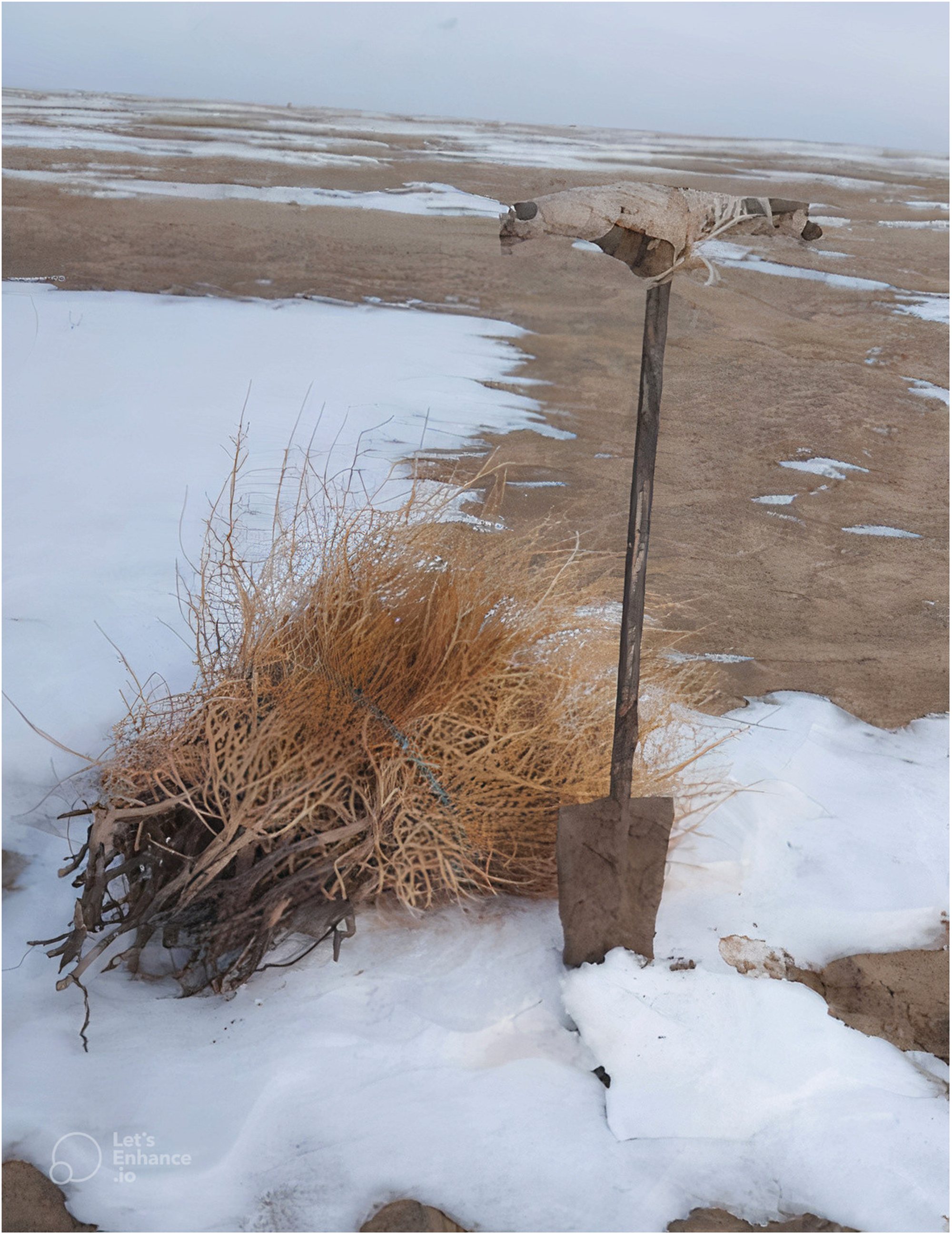
Sword of Kolesov used for 2022 planting.
Critiques of areal seeding were volunteered readily when I asked about doing afforestation. A staff member at DCA discussed the important interaction between the plant and human when we visited an afforestation site done by DCA in the early 2000s. He told me they're doing this mass afforestation work, but they just spread the seeds and so it really it doesn't work very well at all, and it [saxaul] needs to be hand planted (Fieldnotes 11/3/2021). One of my interviewees also had strong criticism of aerial sowing. Giving advice to a delegation from Kazakhstan on afforestation he had told them “Guys, it's a stupid idea. Let's use our traditional [approach], by tractors, [and] by hands, not by seeds but seedlings.” (P3). These comments reflect ideas about planting by hand as more care-ful and aerial seeding as care-less. One likely reason for the much higher number of acres to be planted with seeds, at least in the initial years of large-scale afforestation was the time lag between planting seeds in the nursery and transplanting seedlings onto the dried seabed, and an insufficient number of seedlings ready to go at short notice. Despite the higher labor and time costs of planting seedlings, some state organizations have abandoned areal seeding and are returning to their traditional afforestation practices of planting seedlings, in effect prioritizing care-ful planting and the function of saxaul as infrastructure over form.
The dried seabed is a formidable landscape for a tiny seed or newly transplanted seedling with high winds, extreme temperatures, and no protection from an existing community of plants. This landscape, which spills over into populated areas through dust storms and local climate change, has generated a sense of urgency that dominates afforestation practice, epitomized in the organization of planting activities by the Ministry of Emergency. To my knowledge, there is no active tending to these seeds or seedlings by humans once they are in the ground. In this emergency temporality, care has been limited to planting and there was minimal discussion and/or critique about the lack of care for seeds or seedlings after they are sowed/planted. Lack of ongoing care is also likely due to resource and time constraints of returning to these very remote areas.
A staff member at a bilateral development organization criticized the lack of care for afforested trees which would be necessary for them to achieve their infrastructural function, suggesting how they would do things differently: “to innovate with, we feel that it's absolutely critical to have water available for the first two years of these tree plantings, as opposed to the aerial sowing technique, which is kind of spreading your seed and keeping your fingers crossed, right, and there's no follow up watering” (P1). The type of care advocated by this staff member begins to resemble Reisman's (2021) idea of care as relational maintenance.
Between a high level of care by providing water to trees for the first two years, an immense logistical challenge, and no care at all after planting, lies an intermediate level of care. One option of providing intermediate care to enhance plant survival and infrastructural function piloted by #trees4aral is to plant seedlings using a hydrogel that absorbs water when there is precipitation and then releases it slowly. In the first round of #trees4aral planting in April 2020, they planted seedlings using UPL's Zeba gel, a cornstarch-based product that helps with water regulation (UPL, n.d.). The corresponding contract stipulated that 60,000 black saxaul seedlings should be planted on 30 hectares. Of these 30 hectares, Zeba gel was tested on two hectares, in amounts of 15 g, 20 g, 30 g and 35 g per seedling. Monitoring from November 2020 indicates survival rates from 30% with no Zeba gel to 87% with 35 g of the gel (Figure 4).
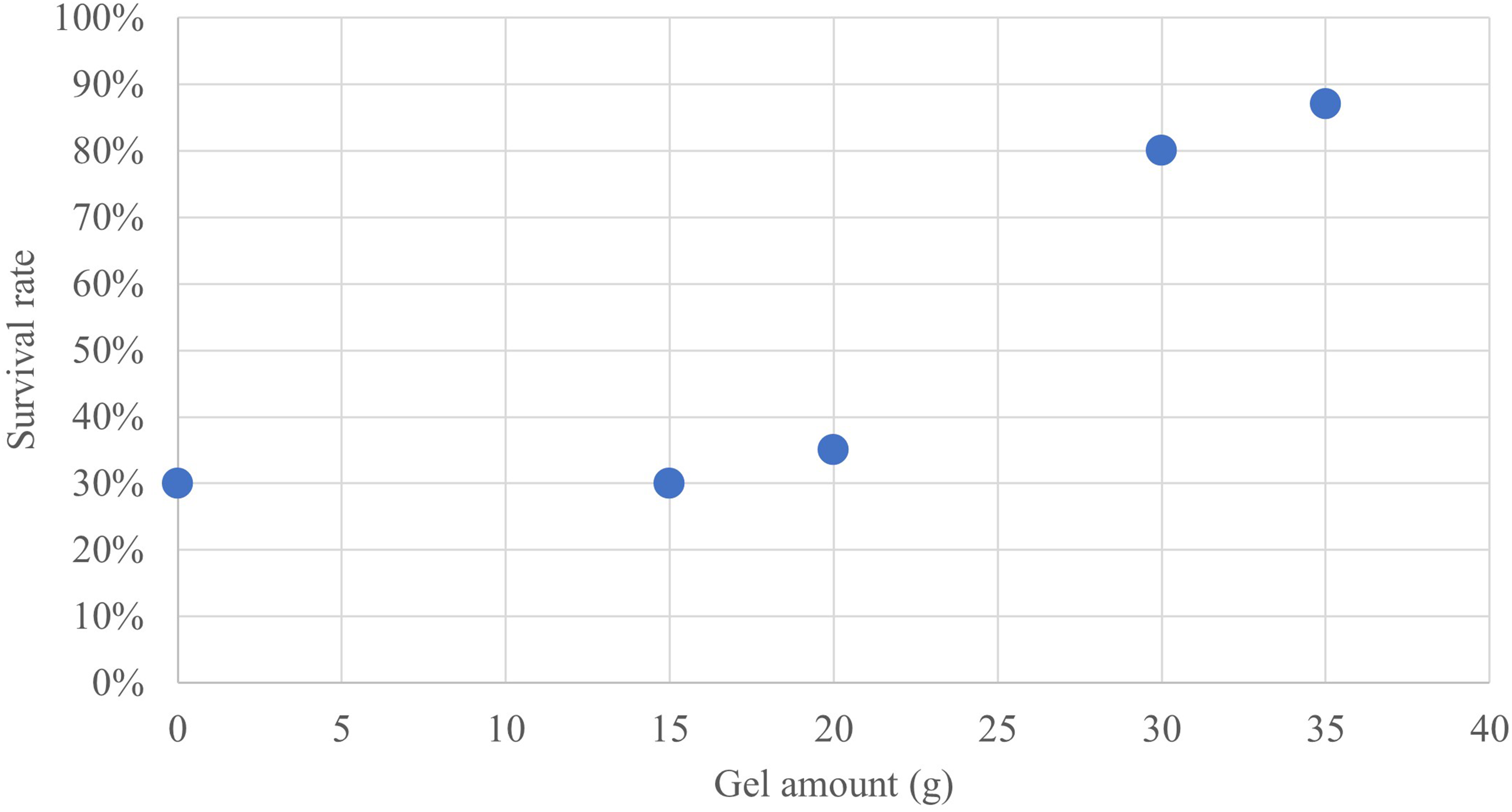
Tree survival rates for afforestation with Zeba gel. 28 hectares were planted without Zeba gel, and 0.5 hectares were planted with each other amount. Data source: #trees4aral monitoring report (unpublished).
Despite the success of the Zeba gel pilot, Zeba gel was not used on further plantings. In planning the 2022 planting, a different hydrogel was provided for free and piloted on two hectares instead. There is no evidence however that these two hydrogels were taken up at a larger scale, even by #trees4aral. From deep in trying to move the #trees4aral campaign forward, my fieldnotes reveal frustrations about why these hydrogels are not being scaled up: what are the ‘innovative’ things that should be used to increase survival rates? Is that even cost effective or is it just labor and plants are so cheap that you just plant with poor survival rates and then you plant again? (Fieldnotes 11/29/2021).
Part of the reason for low success rates is that despite the perception that saxaul can grow everywhere, they do require certain environmental conditions, such as groundwater within reach of their roots. Hydrogels and other temporary care measures that help plants become established do no good if the environmental conditions mean they cannot survive long term. However, the groundwater depth of the seabed, even in a small area, is variable and therefore care-ful selection of planting sites for saxaul and other groundwater dependent vegetation is required. Care-ful selection also extends to consideration of the long-term impact of saxaul on available groundwater. An overly high density of planting or of larger vegetation can draw down groundwater, compromising future vegetation growth (Lu et al., 2018).
There are already rumors circulating over saxaul's non-functioning because of low survival rates. One interviewee shared how they had crossed the dried Aral Seabed from Muynak to the western basin. They went through 80 km of area with these furrows and found that “the result is zero” (P3). Repeat afforestation has become necessary. As Atchison (2021) highlights, to see plants as ‘replaceable’ is to ignore, in this case, their potential labor on behalf of others. P3 explained: “so 375,000 [trees] now this year, just to repeat planting in places where [they do] not survive. Because again, they used the completely new technology. They started plantation by seedings from airplanes and I don't believe that it will be efficient, but they did, now we will see in another maybe two, three years, we will observe if there is any result or not” (P3). The reason for this time delay is that it can take 3–4 years to know if a tree has survived since much of the early growth is underground in the root system. According to Order No. 48 of May 7, 2012, of the Forestry Committee of the Republic of Uzbekistan, a 50% survival rate in sandy soils is good, 26–50% satisfactory. An evaluation of saxaul on the Kazakh side of the dried seabed indicated survival rates from 0–78%, with lower rates due to playa and salt crusted soils, excessive water, animal grazing, and human logging, and higher rates found in coastal sandy loam and salt marsh light loamy soils (Salmukhanbetova et al., 2020).
Who does this planting? What are the conditions of their labor? Taking up Ernwein's call to continue to think about how human “work is distributed, organized and renumerated” (2021: 115) even as we think with plant labor, I return now to the 500 + tractors moving across the dried Aral Seabed that I opened this paper with, and the engineering battalion that was created from the Uzbek army within two weeks. This labor solution has antecedents in Soviet propaganda that had a strong militaristic view where development was a “battlefield” where they were “attacking the desert” (Obertreis, 2017: 468). Uzbekistan requires one year of military service of all men between the ages of 18 and 27, although it is possible to pay for a shorter service and remain in the reserves until age 27 (The World Factbook, 2023). This differentiation based on ability to pay increases that likelihood that those serving in the January 2019 engineering battalion were from families of lower socioeconomic status. Who does afforestation, the conditions of their labor, and how it is remunerated also highlight inequities.
Cabinet of Ministers resolution #1031 (2019b) and subsequent resolutions show an increasing concern with the labor conditions of afforestation. Resolution #1031 provides for the employment of 1000 more people and specifies that workers should be provided with food, special clothing, means of combatting diseases and pests, shelters to live in, transportation to the afforestation site, and fuel, equipment, services and supplies to do their work. These specific provisions suggest that there were logistical problems with the labor of afforestation during the first planting period (i.e. 2019). Subsequent resolutions also highlight these material aspects of afforestation labor.
News reports from earlier planting in the 2000s highlight challenging working conditions: “The workers planting the forests live in a camp, 41 kilometres away from the Aral's former shore, where the sea's depth once reached 17 metres. They live in barracks, in rather harsh conditions” (Kozlova, 2006). On her personal website, Kozlova later elaborated on what she meant by harsh conditions during that visit: “I was then struck by two things: the water that they drink in the camp - for my taste, even in the form of tea, it was nauseating, and the toilet - where in one building the holes in the floor were not separated even by thin partitions” (Kozlova, 2019). Salaries and therefore overall costs of afforestation were low. Workers earned 70–80USD per month, slightly higher than the poverty line of 60USD per month. This translated into a cost of 150–200USD per hectare compared to typical costs around the world of 500–700USD per hectare (Kozlova, 2006, 2019).
For the #trees4aral campaign, planting is done by a district forestry committee, the same workers who implement the state's large-scale afforestation. The first planting had a total cost per hectare of 256USD of which planting costs were 59USD per hectare. The second planting had a cost per hectare of 173USD of which planting costs were 97USD per hectare. In both cases, salaries were low, even lower than those reported by Kozlova. One difference is that #trees4aral plantings are done through one-off contracts with the district forestry committees. It is unclear whether the workers who did the planting earned extra money, or whether this went into the general budget for the committees. In general, the district forestry committees are under resourced, as I learned after my visit to the afforestation site: the car is actually owned by the driver. The government has not given them any 4 × 4 vehicles…Not only does the driver own the car, but government does not even provide any fuel, so they have to buy their own fuel (Fieldnotes 11/3/2021). If the work of foresters is one type of landscape care work, this example highlights the care of foresters, and the lack of care for their labor by the state. Overall, afforestation labor is not forced like cotton harvesting of the past, with the state mandating service. Laboring on saxaul afforestation is connected to poverty and inequality, for families who cannot pay to release their children from military service, or who need whatever income they can get, no matter how small, echoing the ways that infrastructural labor can deepen precarity globally (Stokes and De Coss-Corzo, 2023).
Afforestation: what, how much, when, and where?
This section probes how much afforestation there has been of the seabed, where this afforestation is, and when planting could have occurred, intertwining our qualitative and quantitative findings. High modernist afforestation is instantly recognizable once you know what to look for (Figure 2). What is particularly striking about this imagery is the furrows that cover broad swaths of the land in parallel lines or afforestation lines.
The #trees4aral campaign consistently claimed to be planting only saxaul, evidenced in their contracts for planting and in discussions with project staff, but what in fact was planted by airplane, tractor, or hand? When I unexpectedly met some of the foresters who did the February 2021 planting for #trees4aral, I was surprised when they told me that they had actually planted a mix of saxaul, yulgun 12 (Tamarix leptostachys) and qorabaraq (Halostachys belangeriana) (Figure 1C). This in fact aligns with the evolution of what is meant by “green coverings” in the legislation. Originally, only saxaul was to be planted. Resolution #1031 (2019b) expanded this to saxaul, qorabaraq Figure 1C), and qandim (species of Calligonum) (Figure 1D). The final resolution, #31 (Cabinet of Ministers, 2022), identified other potential species, including yulgun, but in the workplan continued to list only saxaul, qorabaraq and qandim for dried seabed planting. Why is afforestation discourse, including the #trees4aral campaign and news reporting on the high modernist afforestation focused on saxaul while other species are in fact being planted, at least in some areas? I suggest that this simplification, a key aspect of high modernism, to focus on the keystone species, is an important part of the performance of afforestation, and the form (rather than functioning) of this infrastructure.
In November 2021, I attended a one-day conference in Tashkent hosted by the Ministry of Innovative Development. One of the speakers was Zinoviy Novitsky, the forester who advocated afforestation of the seabed in a 1990 article. His speech recounting the current large-scale afforestation initiative reminded me of war stories, or the bonding that occurs with disaster. He described how in six years everything would be fine, all of this land would be covered in green. Like most of the speeches I had heard, this one was full of statistics on how much was planted, in this case how 1.5 million hectares had been planted in three years. This statistic of 1.5 million hectares circulates broadly, performing the stewardship of the Uzbek state. Speaking at the UN Water Conference in 2023, Saida Mirziyoyeva, President Mirziyoyev's daughter, claimed that “our country has set an ambitious task – to turn the dried-up floor of the Aral Sea into a garden and now almost one and half million hectares are covered with greenery” (2023).
In contrast, through our visual classification we found evidence of afforestation in 2272 2 × 2 km grid squares. The maximum area with evidence of afforestation is thus 9088 km2, 908,800 hectares, or 30% of the dried seabed in Uzbekistan (Figure 5). However, not all squares are fully covered with evidence of afforestation, meaning that these area numbers are overestimations.
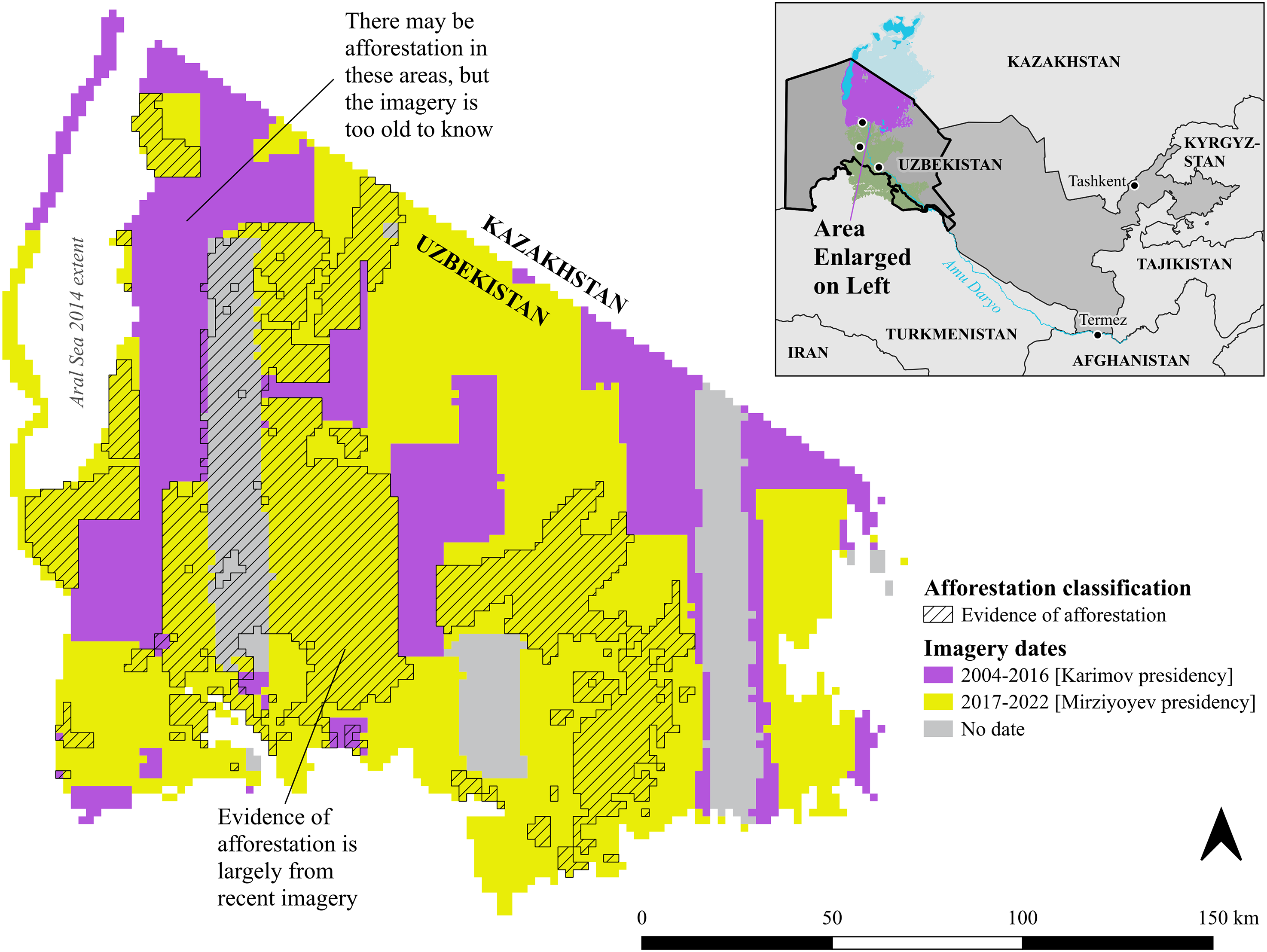
Afforestation of the dried Aral seabed in Uzbekistan and dates of imagery (for squares with imagery from multiple dates, the newest imagery is shown).
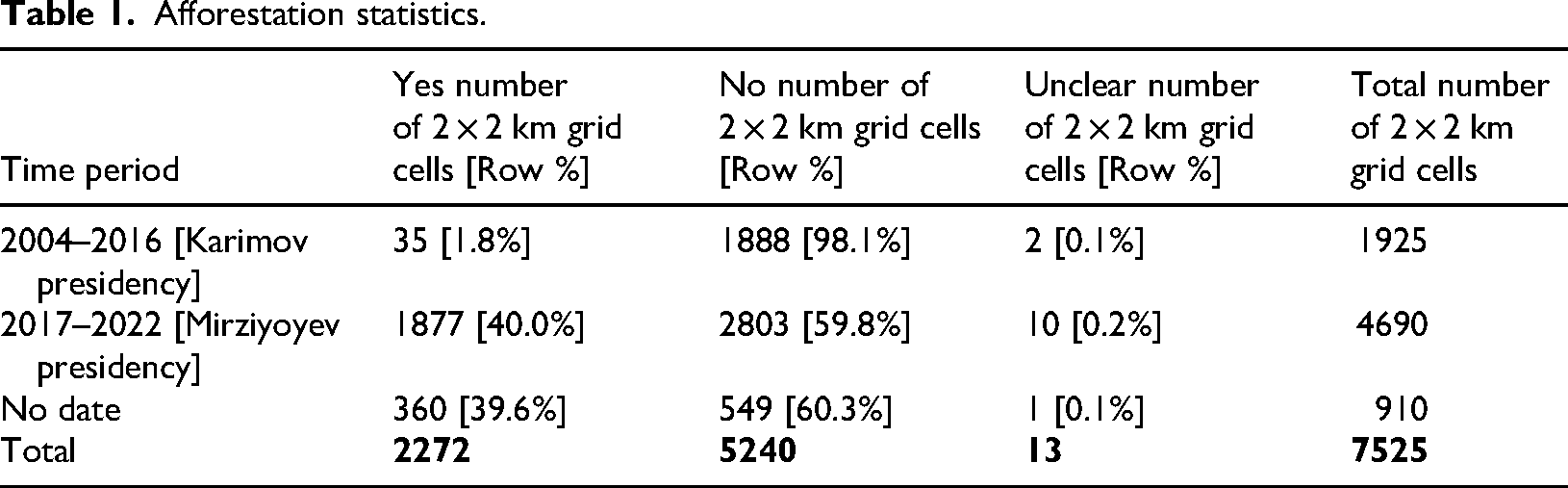
There are several possible reasons for the discrepancy between the widely reported 1.5 million hectares and our results. The first is the temporalities of Google Earth Pro data on the seabed (Table 1). Twenty one percent of the high-resolution satellite data for the Aral Seabed in Google Earth Pro is from 2004, well before large-scale afforestation efforts began in 2019. The consequences of this lack of data are clearest at the seams where data are stitched together, where afforestation lines are present on the newer side of the seam and absent on the other. Lack of evidence of afforestation is therefore not lack of afforestation but only indicates that afforestation was not present at the time the imagery was taken. It is unclear why newer data are not available for these areas. Of squares with evidence of afforestation, only 1.5% (n = 35) are imagery from 2004–2016. A chi-squared test of independence demonstrates that there is evidence of a significant relationship (p < 0.01) between date of imagery and evidence of afforestation on the seabed. This is unsurprising given that the drive for large-scale afforestation began after Mirziyoyev became president in 2017. Second, it is possible that planting is lower than what is reported. Finally, it is also possible that the strong winds of the region could have filled in some of the furrows.
Afforestation statistics.
Extractive restoration
In this section I think with the ‘poetics’ of restoration. I suggest that the tension between form and function is more pronounced in more-than-human infrastructure, compared to infrastructure like a pipeline or bridge, because trees are both alive and lively and may or may not function as expected – or even live at all after being planted. Above I highlighted the care in hand planting of saxaul; however, in the context of the emergency temporality of the Aral “catastrophe,” this is limited to the planting event itself. In most cases, apart from the hydrogel trials, seedlings are not given any care post-planting, and seeds and seedlings are planted in a uniform high modernist manner, over areas both suitable and not suitable for long-term growth.
With little to no evidence so far of tree survival, why has the Uzbek state continued with their approach? I argue that what is important here, at least in the short term, is the form of infrastructure, rather than its function. The form of infrastructure is created through the performance of afforestation which is made visible through statistics of acres planted and images of planting, like the one I opened this paper with. As Elkin states, “[a]s long as trees are being planted, trees can be counted” (2022: 2). Furthermore, these statistics or metrics not only show change, but are themselves performative, as they shape the world that they purport to only measure (Cusworth et al., 2023).
What then is being produced by this performance and why? What is the ‘promise’ of this infrastructure? If the afforested saxaul were to function as infrastructure, this could be valued as ecosystem services including carbon sequestration and sand and dust storms averted (Akramkhanov et al., 2021). However, this is not the case here. I did not, for example, hear of any carbon offset programs during my research. Instead, I suggest that what is produced through afforestation and its associated images, including those of the 500 tractors, and statistics of hectares planted is spectacle. Koch (2018) highlights that spectacle requires unspectacular others. Scale and scalability is key here (Tsing, 2012). The dried Aral Seabed as an already spectacular extractive landscape (spectacular in large part because of its scale) in need of urgent intervention sets the stage, seemingly necessitating an equally spectacular and large-scale response. Afforestation by the three tractors of the Muynak forestry enterprise or two tractors of the Kungrad forestry enterprise described in the quote that opened this paper, as well as other small-scale ecosystem restoration and livelihood projects in the region, comprise the unspectacular others to mass planting events with 500+ tractors and aerial seeding.
More specifically, this is restoration as spectacle. This spectacle helps to cement the Uzbek state as an environmental steward deserving of international development financing for attempting to mitigate the Aral “catastrophe” and distances it from its Soviet past and cotton monoculture. The spectacle of restoration takes on monetary value when development finance materializes for projects both within and outside of the Aral Sea region. Beyond mobilizing development funding for the rest of the country, this repositioning of Uzbekistan may also support a better seat at the table in international decision making, increasing foreign direct investment in local industry and increasing flows of tourists and tourism dollars. The spectacle of restoration also overflows into the activity of other organizations. For example, in November 2022, USAID announced 1.2 million USD for afforestation in the Aral Sea region of Uzbekistan (USAID, 2022) and in December 2022, the EU planted 27,000 trees as a “gift” from the 27 member states to the people of Karakalpakstan (Press and information team of the Delegation to Uzbekistan, 2022).
I argue that it is this spectacle value that is now being extracted from the Aral Seabed, as well as the seeds/seedlings planted and laborers who do the planting. In an already extractive landscape, one often deemed catastrophe or wasteland, why does it matter if spectacle value is extracted? First, the extraction of spectacle value is also the extraction of the promise of plant labor as infrastructure to stabilize the seabed, which is deeply linked to the promised future of restoration. In this promised future, the seabed is home to a novel ecosystem, supporting more-than-human communities on the seabed and human and more-than-human communities nearby. Second, unsuccessful afforestation may break the natural crust formed over the dry seabed, leading to further soil destabilization (Normile, 2007) and exacerbated negative human and environmental health consequences. Finally, extraction of spectacle value limits not only imagined futures, but actual future intervention. Care-less or approaches, where care is limited to the planting event, use up resources – material, financial, and energy for change – that have been allocated for mitigation of the Aral “catastrophe.” These are resources with limits that now may not be available for smaller scale more care-ful afforestation as well as other interventions co-created with the more-than-human world that could be used to make new “dwelt achievement,” truly restoring this landscape. Extractive restoration, in short, is not benign or neutral, but detrimental like all other types of extraction.
Conclusion
The Aral Sea region has been subject to decades of high modernist development. In the Soviet era this primarily took the form of cotton monoculture on collective farms, which has continued past independence, even as collective farms nominally no longer exist. One of the consequences of water extraction for cotton, the dried Aral Seabed, is now the site of large-scale high modernist saxaul afforestation. In this paper, I have quantified evidence of afforestation on the Aral Seabed, and detailed how afforestation is done. Although it is not possible to quantify afforestation ‘success’ at this point given that most of the early growth is in the root system as described above, the observations from my participants indicate that this large-scale afforestation effort has not been successful. Yet the Uzbek state, and other organizations, have largely continued with their approach, prioritizing the form rather than function of saxaul as infrastructure and extracting value from the Aral Seabed through the spectacular performance of afforestation. The Uzbek state proffers the promise of mitigation of the Aral “catastrophe” to residents through planting saxaul seeds and seedlings, while performing global environmental stewardship of the region at a global scale. Restoring landscapes or ecosystems through functioning more-than-human infrastructure becomes less important than narrating hectares planted and showing tractors moving in unison. These statistics and images continue to shape how the Aral “catastrophe” is mitigated, as spectacular high modernist planting becomes seen as the only solution. The broken promise of more-than-human infrastructure leaves behind a new layer of ruins, putting off once again other imagined futures of this region. The landscape of the Aral Sea region has thus become doubly extractive with first water removed for cotton, and then spectacle value.
I am not arguing, however, against growing saxaul, or the functioning of saxaul (and other species) as infrastructure. Following Elkin, I suggest that afforestation could be done in different ways, or that we “could also learn to love drylands” (2022: 5). In the case of the dried Aral Seabed, learning to love drylands means ending high modernist agri/silviculture with countable trees and forest aesthetics. Learning to love drylands means approaching the dried seabed from a perspective of humility to co-create novel ecosystems (Hobbs et al., 2013) with the more-than-human world. It is not just saxaul that live in the cold deserts of the Aral Sea region. Like most biomes, this is a complex system. Numerous other plants thrive in the same areas as saxaul, including qorabaraq (Halostachys belangeriana), juzg’un/qandim (species of Calligonum), ching’il (Lycium ruthenicum), yulgun (Tamarix leptostachys), and qorasho’ra (Salicornia europaea). Xo’ja Savdogar (Podoces panderi) is a bird that nests in saxaul and several other of these plant species (Burnside et al., 2020). Other animals eat the saxaul, especially new shoots, such as jayron (Gazella subgutturosa) (Geptner et al., 1988) and insects (Mombaeva et al., 2017). I suggest that ecosystem restoration would require moving toward the quiet complexity of drylands, and away from emergency temporalities and requirements for scalability (Tsing, 2012). In ending this way, I do not intend to romanticize care, for creating alternative futures and ecosystems on the Aral Seabed is an enormous undertaking requiring years of labor and huge amounts of resources. As Reisman emphasizes, “[c]are itself is not a solution but a perpetually open and deeply political question of how relational maintenance takes place” (2021: 420). Yet with sufficient resources and support, there is joy to be found in doing this work (Bellacasa, 2017), in fostering abundance, one small piece of the seabed at a time. Examples of a new quietly thriving desert exist at the edges of the seabed, through the infrastructural labor of plants and in some cases care-ful human intervention (Figure 6), providing inspiration for the future.

Ecosystem restoration (in progress) in November 2021 Top: natural colonization by various species; bottom: large saxaul in rows from 2002 afforestation project, with smaller, younger saxaul growing in between the rows, and a large yulgun (Tamarix leptostachys) growing at the end of the row. Right: close-up view of yulgun with holes around it, suggesting further more-than-human presence [Source: K.F. Shields].
Highlights
Saxaul are planted as more-than-human infrastructure through high modernist afforestation with the stated goal of stabilizing the dried Aral Seabed.
Vegetal geographies in conversation with critical infrastructure studies highlights human and plant labor embedded in the promise of more-than-human infrastructure.
Critical remote sensing analysis provides evidence of afforestation of 908,800 hectares of dried Aral Seabed in Uzbekistan.
Prioritizing saxaul's infrastructural form of over function results in extractive restoration, with spectacle value extracted through performative afforestation, foreclosing alternate futures.
Ecosystem restoration requires slowing down, accepting non-scalability, and appreciating the quiet complexity of drylands, without countable trees, or forest aesthetics.
Supplemental Material
sj-pdf-1-ene-10.1177_25148486261447677 - Supplemental material for “There are no alternative routes”: Performing afforestation in the Aral Seabed in Uzbekistan
Supplemental material, sj-pdf-1-ene-10.1177_25148486261447677 for “There are no alternative routes”: Performing afforestation in the Aral Seabed in Uzbekistan by Katherine F Shields in Environment and Planning E: Nature and Space
Footnotes
Acknowledgements
I would like to thank the staff at both organizations where I did my participant observation, the participants in my interviews, my research assistant and translator in Uzbekistan, and my host institution in Nukus. Thanks also to my research assistants at the University of Oregon, Desiree Braziel and Megan Brown, who conducted the visual classification. The analysis and conclusions of the paper as well as any errors are my own and do not necessarily represent the views of any of the people and organizations listed above. I would also like to thank Leigh Johnson, Holly Moulton, Laura Pulido, Pat McDowell, Yvonne Braun, and the University of Oregon Science, Environment and Society Lab for their support and feedback on this paper. Finally, my thanks to the three anonymous reviewers for their suggestions.
Ethical approval and informed consent statements
Ethical approval for this project came from the University of Oregon Office of Research Compliance Services (Protocol Number: 05222019.029) and the US Department of Education. Research approval was granted by the Ministry of Foreign Affairs of Uzbekistan (Letter No20/6711). I obtained verbal consent from interviewees. Staff at the organizations where I did participant observation were informed of my research and given the opportunity to opt out at any time. These approaches to consent were approved by both the University of Oregon Office of Research Compliance Services and the US Department of Education. Individual details about participants are not included in this paper, and all quotes and fieldnote segments are anonymized.
Funding
The authors disclosed receipt of the following financial support for the research, authorship, and/or publication of this article: This work was supported by the Fulbright-Hays Doctoral Dissertation Research Abroad Fellowship, National Council for Eurasian and East European Research (NCEEER) Dissertation Completion Grant, Oregon Sasakawa Young Leaders Fellowship Fund (Sylff) Graduate Fellowship for International Research, Margaret Trussell Fellowship from the Association of Pacific Coast Geographers (APCG), American Association of Geographers (AAG) Cultural and Political Ecology (CAPE) Specialty Group Field Study Award, AAG Eurasia Specialty Group Field Research Travel Award, UO Geography Rippey Award and UO Geography Rippey Dissertation Writing Grant.
Declaration of conflicting interests
The authors declared no potential conflicts of interest with respect to the research, authorship, and/or publication of this article.
Data availability
Visual classification data is shared at the Rhodes College Digital Archives (DLynx):  . Ethnographic data from this project are not available, because as part of the consent process participants were informed that data would not be shared, even if it were deidentified, due to the risk of deductive disclosure.
Supplemental material
Supplemental material for this article is available online.
Notes
References
Supplementary Material
Please find the following supplemental material available below.
For Open Access articles published under a Creative Commons License, all supplemental material carries the same license as the article it is associated with.
For non-Open Access articles published, all supplemental material carries a non-exclusive license, and permission requests for re-use of supplemental material or any part of supplemental material shall be sent directly to the copyright owner as specified in the copyright notice associated with the article.
