







Abstract
India's multi-billion-dollar Namami Gange program is simultaneously a celebrated river restoration success and an ecological failure. This study analyzes how the project's failure to restore ecological integrity nevertheless functions as a productive and stable system of governance. Using multi-sited ethnography, including interviews with state officials and external consultants, analysis of government documents, and event ethnographies at key water summits, this paper demonstrates that the program operates through a logic of maintained disrepair. This system is driven by two interdependent engines: a financial engine of ‘Accumulation by Restoration’ that turns pollution into de-risked, bankable assets for private investors and a political engine that manufactures public consent through a spectacle of repair by mobilizing sacred and nationalist sentiments. I argue that the program does not fail to clean the river but rather succeeds in its unstated goal: to maintain the river in a state of profitable, politically generative crisis. The concept of maintained disrepair offers a critical framework for understanding an emergent mode of governance that thrives not on resolving environmental crises, but on perpetually and profitably managing them.
Introduction
In an era defined by ecological crises, the long-standing practice of restoration has been reframed as a powerful new logic for environmental governance. Moving beyond earlier models of preservation, this approach centers on actively repairing degraded ecosystems (Brock and Huff, 2017; McLaren, 2018; Pauwelussen and Vandenberg, 2024). Here, the goal is to protect, restore and rehabilitate degraded ecosystems (Aronson et al., 2020; Meli et al., 2023). This turn towards restoration has also been institutionalized internationally through the United Nations (UN) Decade on Ecosystem Restoration (2021-2030) and reframes ecological damage not as a limit to growth but as a vast frontier for new investment, technological intervention, and economic opportunity (Aronson et al., 2020; Huff and Brock, 2023; Meli et al., 2023).
This logic is visible in India's multi-billion-dollar effort to save its sacred river, the Ganga. The original Ganga Action Plan (1985) was a state-led, technical river cleanup project focused mainly on urban sewage (Alley, 2016; Simon and Joshi, 2022; Tripathi and Tripathi, 2014). Today, the flagship Namami Gange program (NGP) is viewed as a grand “rejuvenation” mission (Mishra et al., 2021). It aims to restore the river's “wholesomeness,” defined by the goals of Aviral Dhara (uninterrupted flow) and Nirmal Dhara (unpolluted flow) (Centre for Ganga River Basin Management and Studies [cGanga] & National Mission for Clean Ganga [NMCG], 2015). This new focus has been a political success. In 2022, the mission gained global recognition with the UN celebrating it as one of the world's top ten Restoration Flagships, highlighting its environmental leadership (Press Information Bureau, 2022; UN Environment Programme, 2022).
However, despite its international praise, extensive data from national audit bodies and scientific assessments reveal a persistent state of ecological and administrative failure (Dutta et al., 2020; Public Accounts Committee [PAC], 2024; Savita and Dwivedi, 2025; Sharma et al., 2025; Singh et al., 2025). Basin-wide water quality assessments show sharp declines in Dissolved Oxygen downstream of major urban centers, while heavy metal contamination in key pilgrimage cities has rendered the water a significant health risk (Mishra et al., 2025; Tiwari et al., 2025). The river remains polluted, plagued by the same failures of untreated sewage, industrial effluent, and administrative deadlock that have thwarted previous efforts (Alley, 2016; Simon and Joshi, 2022). How can a project be both a political success and an ecological failure? This paper explores this question by looking beyond the program's outcomes. It analyses how its failure functions as a productive and stable system of governance. It joins a critical conversation in political ecology that bridges the literature on Accumulation by Restoration (AbR) (Brock and Huff, 2017; Huff and Brock, 2023; Srivastava and Mehta, 2023) with the political ecology repair and restoration (Elias et al., 2021; Kanoi et al., 2024; Law and Goldstein, 2024) to understand how a profitable economy of repair sustains itself (Fairhead et al., 2012; Huff and Brock, 2023). This paper applies and extends this framework to reveal the governmental logic at work in one of the world's most ambitious and politically significant restoration projects.
I argue that the NGP does not fail to clean the river but rather succeeds in its unstated goal: to maintain the river in a state of profitable, politically generative crisis. This system operates through a logic of what I term maintained disrepair. While the term is inspired by Law and Goldstein (2024), this paper develops it as a specific analytical concept that builds on critical analyses of the “limits of repair” in late capitalism (Guthman, 2019; Law and Goldstein, 2024) and operates through two linked engines. The first is a financial engine that turns the river's pollution into safe, “bankable” assets for investors (Kay, 2018; Knuth, 2019). It uses complex financial tools like the Hybrid Annuity Model (HAM), among others, to facilitate that. The second is a political engine of spectacle (Brock, 2023; Hrckova, 2021), which manufactures public consent and shields the project from criticism by leveraging the river's sacred status and nationalist sentiment. Drawing from multi-sited ethnography, this paper follows the project from high-level water summits to district committee meetings. It shows how this “spectacle of repair” is created (Brock, 2023; Hrckova, 2021; Huff and Brock, 2023) through visible construction, grand festivals, and the mobilization of religious sentiment. This spectacle provides the political cover needed for the project's financial structure. In turn, this structure creates large-scale actions that fuel the spectacle. This forms a loop where political legitimacy and financial opportunity keep producing each other.
This research is important because it provides a new analytical framework for understanding a powerful and emergent mode of environmental governance that thrives at the intersection of financialization, spectacle, and ecological crisis. Introducing and breaking down maintained disrepair gives scholars, activists, and policymakers a critical tool. It moves beyond a general critique of the state's role in capital accumulation to show the mechanisms through which failure is made productive. It highlights a dangerous yet appealing new paradigm to handle the wicked problems of the twenty-first century (Alami et al., 2023).
The paper proceeds as follows: First, it lays out the theoretical framework of ‘maintained disrepair,’ showing how it builds on the literature on AbR by integrating insights from the political ecology of repair to explain the political durability of a failing system. Second, the paper outlines the multi-sited ethnographic methods used in this study. It also provides important historical context. It traces the shift from the Ganga Action Plan's ‘cleanup’ model to the politically charged ‘rejuvenation’ approach of Namami Gange. Third, the paper analyzes the two engines of maintained disrepair. It starts with the economic engine, discussing financial tools and how the river's pollution is transformed into a de-risked asset. Next, it examines the political engine, illustrating how local institutions become paralyzed and the ‘spectacle of repair’ manufactures the consent needed for the system to continue. Finally, the paper concludes by discussing the broader implications of this analysis.
Theorizing maintained disrepair: Accumulation, finance, and the politics of repair
Understanding how the NGP operates through the logic of maintained disrepair requires a theoretical framework that can account for both its economic drivers and its political durability. The global turn towards restoration is a hopeful response to a “broken world” (McLaren, 2018). Yet as this paper will show, the practice of repair is not always restorative. As Kanoi et al. (2024: 33) argue, restoration initiatives are never apolitical but are “deeply embedded in local and national politics,” often involving “state-centered visions… that intersect with ongoing political dynamics.”
A singular focus on political economy can explain why a profitable “repair economy” emerges. Still, a political economy analysis alone cannot fully explain how this system sustains itself politically and socially despite its obvious ecological failures. Therefore, this section develops a framework by bridging two key scholarly conversations. First, it draws on the literature on Accumulation by Restoration (AbR) and the financialization of nature to unpack the economic engine that profits from perpetual and incomplete repair (Brock and Huff, 2017; Huff and Brock, 2023; Law and Goldstein, 2024). Second, it turns to the political ecology of repair and restoration (Kanoi et al., 2024; Osborne et al., 2021; Pauwelussen and Vandenberg, 2024) to analyze the performative logics that generate the public legitimacy necessary to mask this failure and sustain the entire enterprise.
The economic engine: Accumulation by restoration as a socioecological fix
The economic logic of maintained disrepair is best understood as a contemporary socio-ecological fix: a strategy that addresses crises of capitalism not by resolving their root causes, but by reorganizing socio-ecological relations to create new opportunities for investment and growth (Ekers and Prudham, 2017). This fix operates through what has been termed Accumulation by Restoration (AbR), a process that marks a significant shift from a “conservationist mode of production” (Huff and Brock, 2023: 2116) to a “growth economy of repair” where nature is valued for its capacity to be fixed (ibid: 2128). As Fairhead et al. (2012: 242) argue, “The damage inflicted by economic growth…creates the basis for the new growth economy of repair.” A polluted river or a degraded forest thus becomes a frontier for huge public and private investment in costly engineered solutions (Knuth, 2019; Law and Goldstein, 2024).
Law and Goldstein (2024: 125) argue that this process generates a “second-order ‘value from ruin’”: first by externalizing the costs of degradation, and then by profiting from state-funded contracts to clean or restore it (see also Dressler et al., 2018; Knuth et al., 2019). In their study on wetland restoration in Southeast Asia, Law and Goldstein (2024) term this process as “infrastructural land repair.” It helps in describing how the complex work of ecosystem recovery is reduced to the construction of legible, measurable infrastructure. This infrastructuralizing of nature makes repair investable through public-private partnerships that guarantee returns for private firms (Ekers and Prudham, 2017). However, the financialization of nature is not a seamless process. Critical analyses of carbon markets reveal challenges in creating environmental commodities. Huff (2023) calls them “frictitious commodities.” State support for these accumulation strategies is often undermined by tensions between capitalizing nature and the ongoing need to appropriate it cheaply (Bryant, 2018).
Profits in this new repair economy are generated through various mechanisms. Kay (2018) terms this as a “hostile takeover.” Value is extracted by unbundling a landscape's various attributes, such as its real estate potential, its resource commodities, its public subsidies, and its newly created “ecosystem services” and selling each to different buyers (ibid). Success, in this model, is measured by the construction of the asset and the generation of financial returns, not the health of the ecosystem. This aligns with the broader critique within restoration studies that projects are often driven by engineering and technocratic goals rather than integrated social-ecological outcomes (Smith et al., 2014; Linton, 2021). Hence, this creates a powerful incentive for a state of perpetual, incomplete repair. A fully restored ecosystem would, ironically, end this lucrative market (Huff and Brock, 2023; Schoemaker, 2025).
This economic engine is sustained politically through the “spectacle of repair” (Brock, 2023; Hrckova, 2021). Igoe (2010: 376), building on Debord, defines the “spectacle of nature” as the management of interactions between individuals and the environment through images, which functions to replace complex, contradictory socio-ecological realities with a simplified and consumable narrative. Hrckova (2021) extends this concept to the “spectacle of repair,” characterized as a social governance technology (Huff and Brock, 2023) designed to address environmental degradation by managing images and performing initiatives. This is the visible performance of repair that generates political legitimacy and ensures the continued flow of funds regardless of ecological outcomes.
This spectacle acts as a “social technology of green governance” that depends on a “management of visibility” (Hrckova, 2021). It showcases conspicuous and appealing yet ecologically superficial initiatives, such as beautified riverfronts or tree plantations, which influence the public's perception of effective governance while depoliticizing the crisis and diverting attention from the failure to tackle its underlying causes (Corson et al., 2013; Igoe, 2013). The spectacle creates unity and action amid fragmentation and failure. It legitimizes the dominant political system (Brock, 2023). This spectacle is not only about public relations, but it connects directly to AbR's economic engine. By creating a “hyperreal ‘spectacle of nature’ to be consumed” (Huff and Brock, 2023: 2119–2120), it creates the political legitimacy needed for financialized deals and generates new, organized “ecologies of repair” (ibid) that can themselves become sites for further accumulation.
A political ecology of repair and restoration
The AbR framework explains why the system of maintained disrepair is profitable. To understand its political resilience, I now turn towards the political ecology of repair and restoration (Bliss and Fischer, 2011; Elias et al., 2021; Kanoi et al., 2024; Law and Goldstein, 2024; Osborne et al., 2021). Scholars here argue that the act of repair is a deeply political process that reconfigures social and material relations (Corwin and Gidwani, 2021; Henke, 2018; Kanoi et al., 2024; Law and Goldstein, 2024; Pauwelussen and Vandenberg, 2024; Valve and Valkama, 2024). They become a site of contestation over justice, power, and world-making (Usher, 2023). It provides a tool for distinguishing between two fundamentally opposed modes of intervention: a reparative fix that seeks to mend the underlying social and ecological relations of harm, and a capitalist fix that merely patches failing systems in ways that perpetuate injustice and extraction.
This capitalist fix operates through “repair as maintenance” (Henke, 2018; Graziano and Trogal, 2019). This concept is based on Steven J. Jackson's idea of “broken world thinking” (2014). He suggests that breakdown and decay are normal. Functionality only comes from constant, often unseen maintenance work. This maintenance can show care, but it can also support an unfair status quo (ibid). Unlike transformative repair, which tackles the root causes, repair as maintenance only stabilizes the existing order. It keeps a broken system operating just enough to maintain its political legitimacy and economic roles. This approach deals with the symptoms but ignores the deeper structural issues (Osborne et al., 2021).
This logic of maintenance is often driven by what disability studies scholar Eli Clare (2014), in work extended by Kanoi et al. (2024), calls an “ideology of cure.” This ideology frames environmental degradation as a “disease” in a “damaged” ecosystem that requires a technical cure administered by experts. This model is inherently depoliticizing as it pathologizes the environment, locates the problem in the object to be fixed, and privileges a narrow range of technical expertise (ibid). This approach overlooks the complex social and historical causes of degradation (Elias et al., 2021). It also dismisses the possibility that “Target conditions inescapably reflect and privilege particular patterns of human activity…” (Bliss and Fischer, 2011: 138). Ultimately, it is this ideology of cure that fuels the “spectacle of repair,” allowing the state to perform an act of benevolent care while its actual operations serve to maintain the political economy of restoration.
The politics of legitimacy: Right-wing ecology and mobilizing the sacred
Framing the issue as technical normalizes the ideology of cure. However, this alone doesn’t create the strong political support needed for a multi-billion-dollar project, especially when facing failures. This support is instead built through a powerful “spectacle of repair” (Brock, 2023; Hrckova, 2021; Igoe, 2010) that is tied to a specific right-wing ecology (Sharma, 2023) and claims to a more-than-human cosmopolitics in India (Bhan and Govindrajan, 2023). While the Ganga's sacred significance has deep autonomous roots in popular devotional practice that predate and exceed state intervention (Alley, 2002; Drew, 2017), the analytical focus here is on how this pre-existing attachment is strategically mobilized as a governmental technology within the spectacle of repair. This political strategy provides the cultural and emotional substance for the spectacle, using religious symbolism and national pride to justify state actions, shielding them from technical or ecological criticism.
Sharma (2023) explains that the environmental politics of Hindu nationalism since 2014 are “deeply enmeshed with aggressive nationalism.” The Ganga serves as a main symbol in this story, presented as Maa Ganga (Mother Ganga). This view mixes environmentalism with “defending a Hindu motherland from perceived pollution, both material and cultural” (ibid: 106). The river is seen as a vulnerable mother figure who has called the state, led by a prime ministerial “saviour,” to come to her aid (ibid). This narrative is not merely metaphorical, but a core component of the spectacle that functions to depoliticize the project's failures. When the program is framed as a sacred duty, technical questions about functionality or financial accountability can be dismissed as unpatriotic or attacks on the motherland itself.
This nationalist spectacle is strengthened by a claim to a more-than-human political reality. Bhan and Govindrajan (2023) argue that modern Hindu supremacy supports its politics by saying that nonhuman entities like rivers, mountains, and animals are agentive political actors (Drew, 2017; Bhan and Govindrajan, 2023). They demand the return of a primordial Hindu order. From this view, the Ganga is not just a symbol to protect; it is a sentient being with “shakti” (world-making power) (Bhan and Govindrajan, 2023). This cosmopolitical framing serves as a strong governmental tool. It makes the state's actions seem like a response to the sacred river's will. This approach makes the project feel organic and natural instead of state imposed. Importantly, it lets the Hindu Right present its politics as an indigenous, decolonial effort. It aims to restore a natural order disrupted by foreign invaders and colonial ideas. Any critique of the project can be dismissed as colonial violence that “refuses the reality of Hindu world-making” (ibid: 4). Together, nationalist and cosmopolitan views create an ideal cover for the ideology of cure and the spectacle of repair in this program.
Methods and field sites
This research was not centered on the riverbank itself, but on the key institutional sites where the Ganga is constructed and managed as a governance object. Using multi-sited ethnography, I followed the policy narratives, financial tools, and governance practices across national, state, and local levels (Wood, 2016) to analyze how maintained disrepair is produced and sustained. The research used three main methods: semi-structured interviews, a review of government and policy documents, and ethnographic observation at key water conferences organized by the water bureaucracy.
To understand the official logics and on-the-ground implementation of the program, I conducted a documentary analysis of a wide corpus of official documents. At the national level, this included budgetary reports, contracts with financial advisors, and strategic plans for structuring Sewage Treatment Plants (STPs) from the National Mission for Clean Ganga (NMCG). At the local level, I examined meeting minutes from District Ganga Committees (DGCs) in 20 districts across Uttar Pradesh. To analyze these documents, I followed the principles of grounded theory (Charmaz, 2017), employing an iterative qualitative coding process that involved simultaneous data collection and analysis to identify recurring themes, patterns, and categories (Creswell and Poth, 2017; Saldaña, 2016). This process helped reveal recurring agenda items, budget priorities, and participation patterns that pointed to institutional paralysis. I also analyzed key technical assistance documents from international partners, which are central to the program's ‘capacity building’ efforts. These materials, such as the German development agency (Deutsche Gesellschaft für Internationale Zusammenarbeit GmbH) GIZ's Handbook on District Ganga Planning and the World Bank's project appraisal documents, provide standardized frameworks, planning templates, and risk assessments. This analysis was crucial for understanding how the narrative of a local ‘capacity deficit’ is constructed and operationalized, justifying the need for external expertise and financialized solutions.
A core component of the methodology was event ethnography, a method aligned with “following the meetings” (Wood, 2016) that involves ethnographic research at temporally bounded events like conferences and summits (Koch, 2023). These events are political arenas (Campbell et al., 2014) that provide glimpses into the production of environmental governance in real-time (Massé et al., 2020). Here, governance is performed, networks are created, and policy narratives are built. I conducted event ethnography at two key forums for India's water governance: the India Water Week (IWW) (September 17–20, 2024) and the India Water Impact Summit (IWIS) (December 4–6, 2024). This approach allowed for observation of the sites where bureaucracy, corporate finance, and international consulting converge. This approach provided detailed insights into how the spectacle of repair is produced and how the logic of AbR is articulated and legitimized (Massé et al., 2020).
To understand the perspectives and rationales of key actors, this study draws on 20 semi-structured interviews. Using purposive and snowball sampling, I interviewed individuals within the state water apparatus, including engineers and project managers from Uttar Pradesh's Jal Shakti and Irrigation departments, as well as external consultants and officials involved in the NMCG. Many of these contacts were established during the events discussed above. The interviews aimed to gather officials’ views on the program's goals, challenges, and measures of success. This paper draws from a broader dissertation study investigating the NGP in India, with multiple field visits to India between 2022 and 2024. While this specific paper analyzes 20 key semi-structured interviews, the larger project included over 50 interviews and informal discussions. This study received ethical approval from The University of Alabama Institutional Review Board (Protocol: 22-05-5663).
As a researcher from India conducting this work through a U.S. university affiliation, I navigated a dual positionality throughout this project. Growing up in Lucknow, in the Ganga basin, the river's cultural and political significance was part of my everyday environment long before it became a research subject. My institutional affiliation facilitated initial access to officials and policy forums, while my regional identity and familiarity with the Indian bureaucratic landscape helped build the rapport necessary for candid conversation. This familiarity, however, also required reflexive attention to the risk of naturalizing the very governance logics I aimed to critique.
From cleanup to rejuvenation: The evolution of ganga governance
The ganga action plan (GAP) era: A legacy of technocratic failure
Launched in 1985, the Ganga Action Plan (GAP) was India's first major effort to clean its rivers. It followed a modern, engineering-focused approach based on a “river control” mindset (Baghel, 2014; de Micheaux, 2019). The issue was defined narrowly: urban sewage was the main pollutant, so the answer was to build infrastructure to manage it (Simon and Joshi, 2022). The main strategy of both GAP-I (1985) and GAP-II (1993) involved intercepting and diverting sewage from major towns to new STPs (Alley, 2016). The plan was a top-down scheme, funded by both central and state governments, with state-level engineering agencies handling implementation (Alley, 2016; Simon and Joshi, 2022).
Despite its intentions and significant expenditure, the GAP is widely regarded as a failure (Simon and Joshi, 2022). The problems were systemic and foreshadow the challenges the current program faces. The approach was piecemeal, addressing pollution town by town with no integration of urban planning and river health. Projects were plagued by delays. A lack of planning and funding for long-term operations and maintenance (O&M) meant that many expensive STPs quickly fell into disrepair or operated far below capacity (Alley, 2016). The plan did not address non-point source pollution, such as agricultural runoff, lacked a basin-wide view, and failed to improve river water quality in a lasting manner (Srinivas et al., 2019).
The paradigm shift: From cleanup to “rejuvenation”
The conceptual shift began in 2008 when the Ganga was declared a National River. This change raised its status from just a water body to a strong national symbol. In 2009, the National Ganga River Basin Authority (NGRBA) was formed. For the first time, it adopted a holistic, basin-level management approach (Hussain et al., 2020). This period ended with the launch of the NGP in 2014, which embraced the idea of “rejuvenation.”
The term “rejuvenation” was a deliberate and significant departure from “cleanup.” The Ganga River Basin Management Plan (GRBMP), created by a group of Indian Institutes of Technology (IITs), defined “rejuvenation” as restoring the river's “wholesomeness” (cGanga & NMCG, 2015; Tare and Roy, 2015). This included two main goals: Nirmal Dhara (unpolluted flow) and Aviral Dhara (uninterrupted flow). It also focused on protecting the river's overall ecological health (ibid). This represented a shift from the narrow, pollution-focused view of the GAP. Choosing “rejuvenation” instead of a term like “restoration” was more than a technical choice; it was deeply political.
The Ganga has deep spiritual and cultural significance for Hindus and is frequently invoked in right-wing Hindu nationalist discourse (Alley, 2002; 2019). Sharma (2023: 114) also argues that “defence of motherland, river and animal, form an integral part of contemporary discourse of the Hindu nationalists in India.” This framing helps explain why the term “rejuvenation” was a political choice, interpreted as an attempt to appeal to cultural sensibilities and political ideologies in India (de Micheaux, 2019) (Table 1).
Overview of programs on the Ganga.
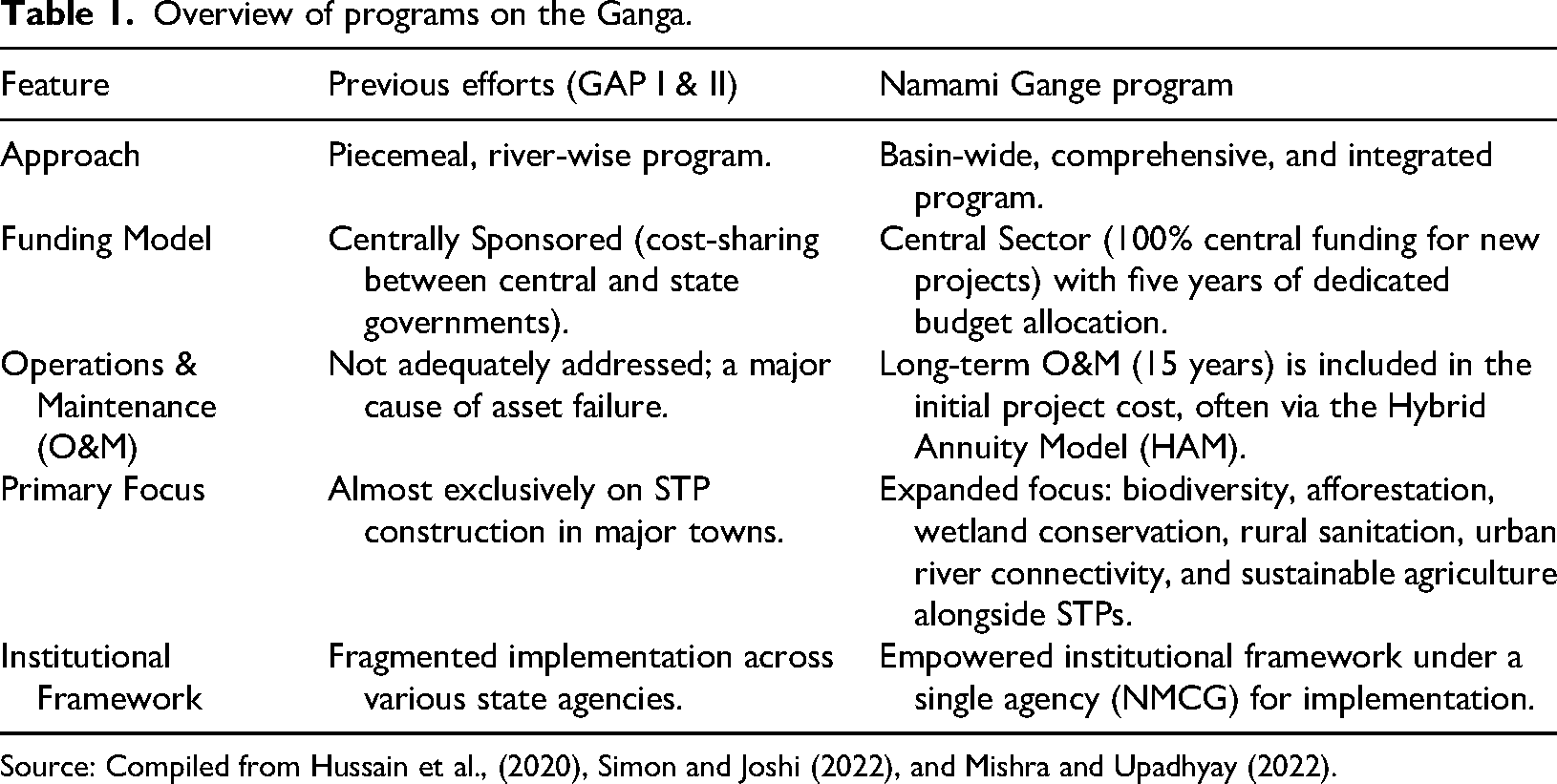
Source: Compiled from Hussain et al., (2020), Simon and Joshi (2022), and Mishra and Upadhyay (2022).
Analysis: The architecture of maintained disrepair
The economic engine: Accumulation by restoration through financialization
As I walked into Bharat Mandapam for the 2024 summits, the atmosphere was striking. The venue, which hosted the G20 meetings, buzzed with international investors, sharp-suited corporate executives, foreign diplomats, and top Indian bureaucrats. There was an irony in this setting; it was being hosted in Pragati Maidan, a place for trade fairs, where commodities are bought and sold. Here, the commodity seemed to be the river itself. Talks were filled with terms like climate financing, impact investments, and bankable projects. Pairing the IWIS with the Climate Investment and Technology Impact Summit was also no accident. It highlighted framing environmental issues as investment opportunities. The grand stage, international presence, and scale of the event created a powerful narrative: rejuvenating the Ganga was a national goal and was also being positioned as a global financial opportunity.
In IWIS, however, a different reality emerged. During the session on “Enablers for River Rejuvenation & Conservation – I: Science & Technology,” the tension between the program's massive budget and its lack of clear objectives presented itself. This confusion is set against a history of failure. The Ganga Action Plan (GAP), launched in 1985, faced heavy criticism. It is known for its limited success and for creating a “malfunctioning system” of costly, energy-heavy infrastructure as state agencies struggled to operate and maintain it (Alley, 2016). This legacy of a “Design-Build-Neglect-Rebuild (DBNR) model” (NMCG, 2020) still haunts the current program.
During the session, a senior academic questioned the unclear goals behind the huge spending. He captures the feeling of aimless implementation: “Did we have a plan that this is what I will do in 20,000 crores, or did we keep on doing it on an Ad-hoc basis[…]? Have we said that yes, with this 20,000 crore, I had set my objective that I will make sure that the Ganga in this state is in the present condition, and I will promise that in 5 years, this is what will happen. Do we have that kind of system in place?” (Observation, 2024). “I have never faced the difficulty of a shortage of funds… all I can do is pressure, upar se [from the top], executive pressure, you know, itna kharcha ho, kharcha karo [spend this much money].” He describes pushing money to state governments without a clear plan, only to have to “recover almost 850 crores” that went unspent because the local capacity to absorb the funds and technology wasn’t there (Observation, 2024).
The economic engine of maintained disrepair is powered by instruments like the Hybrid Annuity Model (HAM), which are designed to transform the state's historical failure to maintain infrastructure into a de-risked, profitable asset for private investors. The official rationale for HAM is to overcome the historical failures of the GAP (NMCG, 2024), which, as Alley (2016) notes, were plagued by a “deficit of operation and maintenance funds.” Under HAM, the financial risk for the private developer is significantly mitigated through upfront capital support (40% from the government) and guaranteed 15-year annuity payments from the NMCG.
This structure protects the private partner from major risks. The HAM model centralizes payment guarantees through the NMCG. This gives a sovereign guarantee that turns a sewage treatment plant into a stable, long-term financial asset. The “One City One Operator” (OCOP) concept supports this. It combines a city's entire sewerage system under one private operator. This creates larger, more appealing contracts with “Single ownership and accountability” (NMCG, 2020). This strategy transforms fragmented public services into a unified, investable asset class that suits major national and international infrastructure firms.
The official narrative is strongly supported by partners like the World Bank, which celebrates the HAM model's efficiency. The Bank's appraisal for the Second National Ganga River Basin Project states that the HAM contract achieves an “appropriate allocation of risks” by linking annuity payments to performance and transferring the cost of failure (e.g., “non-functional… STP, non-compliance with discharge standards, poor O&M”) to the private operator (World Bank, 2020, p. 27). However, this narrative of efficiency is directly contradicted by the reality on the ground. The 2024 Public Accounts Committee (PAC) report documented that the program is plagued by non-functional and underutilized STPs. The PAC noted that of 128 monitored STPs in towns along the Ganga, 26 were completely non-operational, and the utilized capacity of those that were operational was only about 74% (Public Accounts Committee [PAC], 2024).
An account from a non-profit worker, detailing a conversation with an STP worker in Haridwar, reveals the logic behind this systemic failure. The STP worker explained that the private contractor he works for is incentivized to cut costs to maximize profit. This results in severe labor exploitation: “The work which should be done by 5 people,” he explained, is done by him alone. He works “minimum 18–19 h” but is only paid for eight. When asked what happens to the sewage during the hours he is not working, he replied with resignation, “God will take care of it.” The STP is run just long enough to generate the necessary reports for the contractor to receive payment. For the rest of the time, he stated, “…there is no treatment.” This creates what he called a “shitter ecosystem” of corruption and neglect, where the financial model incentivizes the performance of repair, not its actual execution (Interview, 2024).
Hybrid annuity model (HAM) through an accumulation by restoration lens.
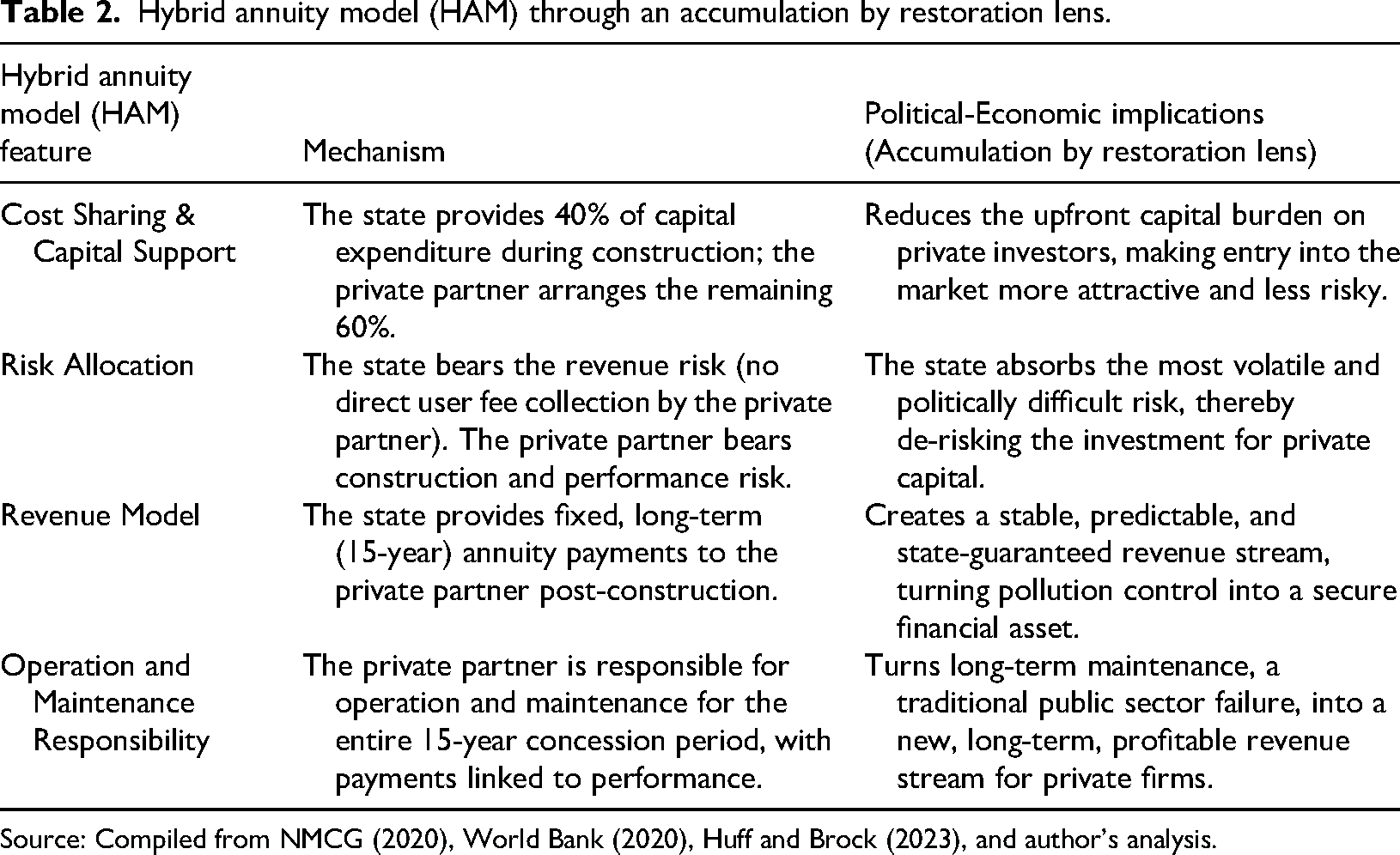
Source: Compiled from NMCG (2020), World Bank (2020), Huff and Brock (2023), and author's analysis.
This financial logic creates a strong market for expertise, supported by international consultants and finance institutions. The market is not left to chance; expert consultants design it. The NMCG has enlisted top global and domestic firms, including KPMG, Deloitte, PricewaterhouseCoopers, and Ernst & Young, as “Transaction Advisors” (NMCG, n.d.-b). Their job is to structure financial deals, prepare bidding documents, and manage the tendering process. They shape financialization. These advisors turn ecological issues into bankable projects. International financial institutions, like the World Bank's International Finance Corporation, are not just funders. They actively create markets, serving as the “lead transaction advisor” for innovative HAM projects. They also design risk allocation frameworks to attract capital (International Finance Corporation, n.d.).
This entire apparatus, which consists of financial models, consultants, and international partners, works together to reshape the river. It shifts from being a sacred entity and a vibrant ecosystem to a piece of failing infrastructure needing an upgrade. The issue of the polluted Ganga becomes a technical treatment gap. And the solution is to build more STPs. This reflects what Law and Goldstein (2024) call “infrastructural land repair.” They show how a complex social and ecological problem turns into a clear engineering task that requires concrete, steel, technology, and, most importantly, finance (Table 3).
Deconstructing the repair economy: From ecological problems to financial products.
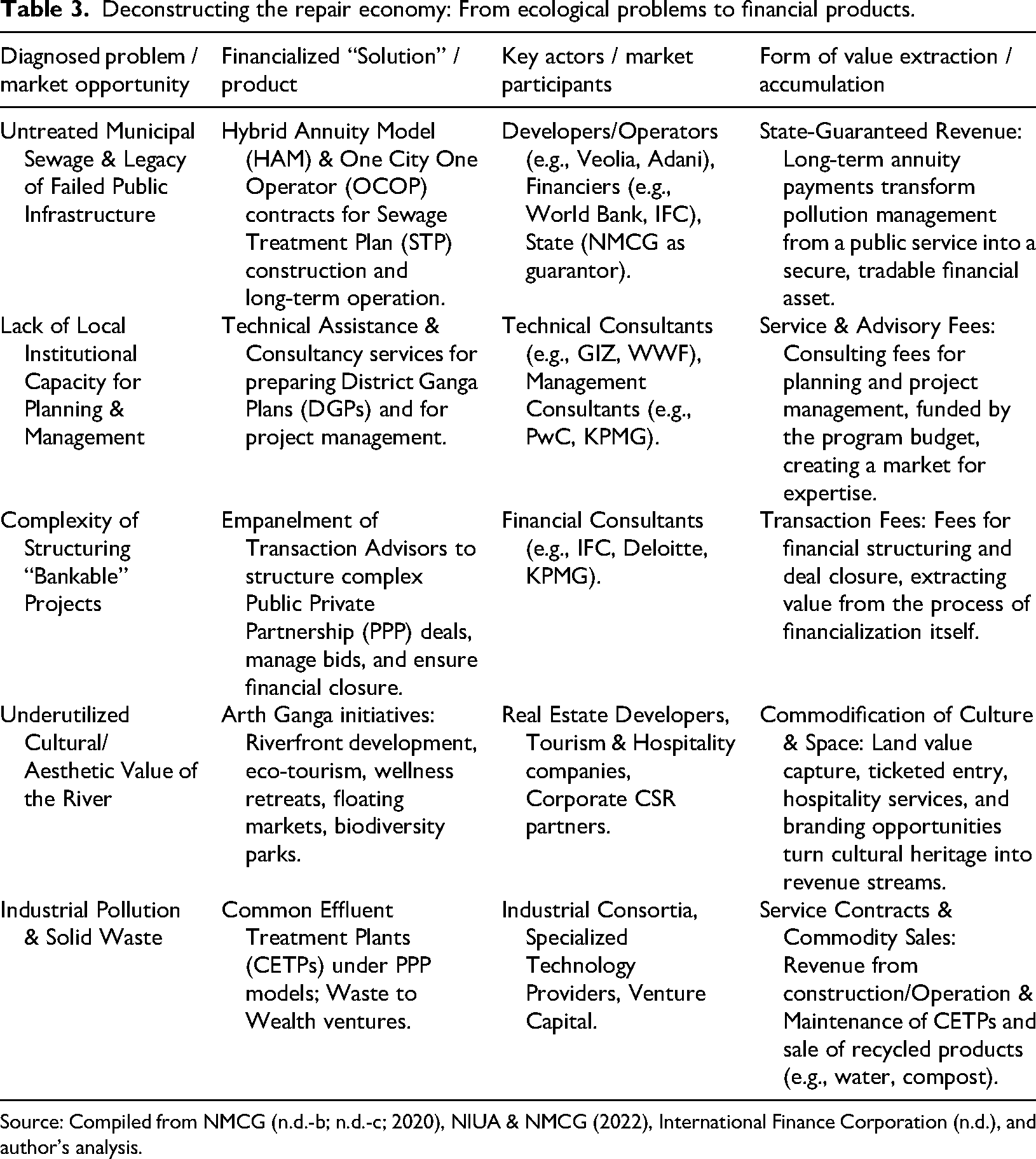
Source: Compiled from NMCG (n.d.-b; n.d.-c; 2020), NIUA & NMCG (2022), International Finance Corporation (n.d.), and author's analysis.
The NGP also presents this financial ideology through the “Arth Ganga” framework. It shifts focus from merely reducing pollution to tapping into the river's economic potential. The aim is to link economic growth with river conservation in modern India (cGanga & NMCG, 2020). The head of cGanga (Centre for Ganga River Basin Management and Studies) explains that “Arth Ganga” has two meanings. “Arth means the spirit, and it also means its economics. Together it is ‘Arth Ganga’” (ibid). This clever framing presents the project as both a sacred duty and a smart economic strategy. He states the goal is to measure river conservation efforts by their economic contributions to local and global GDP (ibid).
This river-centric economy is described in clear terms. A 2022 report from National Institute of Urban Affairs (NIUA) and NMCG, titled “Harnessing the Economic Potential of a River,” outlines how to monetize the river's beauty and cultural value. The vision goes beyond STPs to include Urban Riverfront Biodiversity Parks, Light and Sound Shows, Floating Markets, River Theatres, Wellness Retreats, and Water Adventure Retreats (NIUA & NMCG, 2022). Each proposal focuses on economic activities, such as ticket sales, rental fees, and opportunities for cafes and tour operators. This shows a clear plan to turn riverbanks into real estate and commercial sites.
This vision aligns with more abstract financial ideas discussed elsewhere. For instance, the IWIS 2018 proceedings propose a Water Trading Corporation, Ganga Bonds, Impact Bonds, and water certificates to create a monetizable currency from water conservation (cGanga & NMCG, 2018). Thus, the Arth Ganga framework works on two levels: it supports immediate financial investments in infrastructure and riverfront real estate, while also paving the way for a complex financial market where the river's functions are considered. Such as its water, waste, ecological processes, and cultural value, become tradable assets.
The architecture of productive failure: How district-level paralysis enables maintained disrepair
On paper, the District Ganga Committees (DGCs) mark a big step toward decentralized river governance. NMCG Authority set up the DGCs in 2016 to fix the failures of past cleanup efforts. Their main job is to ensure the “prevention, control and abatement of pollution in River Ganga” by promoting local planning and ownership (Mishra et al., 2021). These committees include members from municipalities, gram panchayats, state departments (like Irrigation and Public Works), environmental experts, and local industries. This setup aims for a bottom-up approach and a tiered framework, from national to district level, that incorporates local needs and knowledge into the broader rejuvenation effort (ibid). However, the analysis that follows will demonstrate how this promising institutional architecture becomes a site of paralysis.
The DGCs face more than just administrative issues. Their paralysis seems to be a key factor that supports the maintained disrepair needed for the program's economic and political goals. The DGCs have become centers of productive inaction. The focus on performative gestures over substantive environmental regulation creates the very conditions of failure that justify the capital-intensive interventions detailed in the previous section. This institutional paralysis is not an accidental byproduct of bureaucracy. Rather, as evidenced from official interviews, documents, and even official government audits reveals, it is a crucial condition that enables the maintained disrepair at the local level.
A senior bureaucrat in the Uttar Pradesh Irrigation Department, when asked about inter-departmental coordination, was blunt: “In Namami Ganga, no one has any conflict. Those who want to pass their time, they are passing their time… There is no synergy effort. It's just your own simple effort”. He explained that the DGCs only convene when compelled by external judicial pressure: “…our officers don’t know the issue of what is the Ganga committee's mandate…The NGTs [National Green Tribunal] are ordering in the districts…After that, out of fear of the NGTs, they do their own work” (Interview, 2024). “The biggest problem is, there are different departments, who want to do their work… we are told that this land is yours, you are maintaining it, so this river is yours.” (Interview, 2024).
This focus on spectacle harms real program goals, which often face delays. The delays and issues with STPs across the districts serve as a clear example. In Ghazipur, the committee gave “strict instructions” for new STPs in key towns. Yet, meeting minutes from July to November 2024 show the status as “not yet received” (DGC Meeting Minutes for Ghazipur, November 2024). This points to a serious administrative bottleneck. In Kanpur Nagar, private agencies manage sewage pumping stations. Their operational efficiency is poor, and the District Magistrate has shown “deep displeasure [translated from Hindi]” at the slow repairs (DGC Meeting Minutes for Kanpur Nagar, October 2024). In Farrukhabad, the STP rollout faced many issues. These included poor construction and a lack of coordination for electricity connections (DGC Meeting Minutes for Farrukhabad, September 2024). This paralysis has serious ecological effects. Ghazipur minutes show that while upstream water quality is good, Dissolved Oxygen levels drop sharply downstream. The Pollution Control Board links this decline to untapped drains from towns where STP projects are stalled (DGC Meeting Minutes for Ghazipur, July 2024). Though the state claims progress through construction, non-functional assets mean pollution issues persist, leading to more repairs and more spectacle. This local institutional failure sets the stage for a centralized, financialized model. It supports the idea that local bodies cannot solve the problem, requiring external, expert-led intervention.
The Public Accounts Committee (PAC) report also confirms the above-mentioned issues. that the core infrastructure required to stop pollution remains incomplete. In a stretch of the Ganga River from Bijnor to Kanpur in Uttar Pradesh, 37 drains remain “Partially Tapped & untapped,” continuing to discharge raw sewage into the river (PAC, 2024: 69). These setbacks led the committee to voice significant concerns about the program's issues: “The Committee…express their concern over the tardy progress and undue delays in the implementation of the project Namami Gange in the State of Uttar Pradesh. The Committee also feel that it is not just an aberration [emphasis added] that cost overrun and delays have been reported from the State of Uttar Pradesh, but have shown a consistent trend [emphasis added] in the entire Namami Gange Programme.” (PAC, 2024: 189).
The paradox of capacity: How a deficit narrative creates expert markets
The idea of local capacity deficits is key to the logic of AbR. It provides a reason to outsource repairs to a profitable network of external experts. The institutional paralysis of the DGCs is seen not as a lack of political will or financial freedom. Instead, it is viewed as a technical issue: local officials lack the skills for complex river basin management. This view, pushed by international partners and consultants, shifts the blame for failure downwards. At the same time, it creates a profitable market for their expertise. The World Bank (2020: 40) identifies this explicitly in its risk assessment, rating the institutional risk at the Urban Local Body (ULB) level as “high,” noting that “ULBs have weak capacity, lack autonomy in functioning and are financially near-completely dependent on the State government.”
The creation of an expert market begins with the deliberate framing of local institutions as directionless. This is key to building the capacity deficit needed for the repair economy to justify itself. A GIZ consultant, tasked with helping DGCs create their mandated District Ganga Plans (DGPs) (WWF-India & NMCG, 2023), described the core problem that emerged after the 2016 notification by the government for establishing DGCs that required them to create a plan: “But what should be there, nobody knows… What should be the scope?” The consultant explained that this diagnosed gap in local knowledge created the need for external experts to provide standardized frameworks and guidance. Their job, as the consultant put it, was to “put together a scope” so the plans would be “comparable among districts” (Interview, 2024). A key issue is that the DGC is “a committee made up of people from different departments. Their main role is within that department… They can coordinate… They can provide inputs… But they cannot do the [actual] work.” This work would fall outside the bounds of their existing responsibilities. The proposed solution is to hire “dedicated people” for the DGCs, but these are often temporary staff (Interview, 2024).
The political engine: The spectacle of repair
The political engine runs on a spectacle of repair, a governing strategy that gains legitimacy by carefully managing what is seen and what remains unseen. It works well because it substitutes an obvious, aesthetic cleanliness for the largely invisible, complex reality of ecological health. This spectacle is not generic and is specifically driven by the powerful cultural elements of Hindu nationalist politics. The state manufactures consent by showcasing freshly painted ghats and cleaning crews. Meanwhile, the public misses the heavy metal contaminants and low oxygen levels that are more telling of the river's health. By making repair symbols visible and keeping failure metrics hidden in technical reports, the spectacle of repair becomes a strong tool. It conceals ecological failure, protects the project from criticism, and secures political support.
While the state celebrates the construction of ghats and riverfronts, scientific data reveals a river in crisis. For example, a 2025 basin-wide study found the entire estuarine zone of the river not suitable for consumption (Mishra et al., 2025), and heavy metal contamination in Prayagraj has rendered the water a significant health risk (Tiwari et al., 2025). This discrepancy highlights how the spectacle functions: it directs public attention to aesthetically pleasing, but ecologically superficial, interventions while the invisible but critical parameters of water quality continue to decline.
The mobilization of religious and nationalist values is a key political tactic that helps the state gain legitimacy and protects its actions from criticism. By presenting the Ganga's revival as a sacred duty to Maa (Mother) Ganga, the state leverages the right-wing ecology to reframe a technical and environmental project into a moral and patriotic quest (Sharma, 2023). This narrative of defending a Hindu motherland is central to the spectacle, allowing the state to perform the role of a savior responding to the river's call. Consequently, critics of the project's execution can be easily labeled as unpatriotic or anti-Hindu, a powerful method for silencing dissent.
A key part of this spectacle is outsourcing visible repair work to the corporate sector through Corporate Social Responsibility (CSR) initiatives. The government supports this effort. The NMCG holds workshops to bring private sector partners into the NGP. The Clean Ganga Fund (CGF) channels these contributions, which are classified as CSR activities (NMCG, n.d.-a). This creates a win-win situation: corporations earn “green” credentials by funding visible projects, while the state can demonstrate progress without direct costs. The specific activities designated as CSR-eligible reveal a clear bias towards the performative. The list prioritizes tasks like “Ghats Construction/Modification,” “Cleaning of Ghats,” “River Surface Cleaning,” and “Tree Plantation” (NMCG, n.d.-c). These are selected for their photogenic quality rather than ecological efficacy, creating a legible image of a ‘clean’ river while the primary sources of pollution go unaddressed. These highly photogenic projects thus contribute directly to the spectacle of a cared-for river while the deeper, systemic ecological problems persist.
This performance is amplified on the global stage as well. In December 2022, the United Nations named the NGP one of its ten “World Restoration Flagships.” This award was celebrated widely by the government (Press Information Bureau, 2022; UN Environment Programme, 2022). Other awards are also celebrated widely by the government and highlighted by its international partners like the World Bank, which noted that the NMCG received the “Global Water Awards Distinction for Public Water Agency of the Year” in 2019 for its efforts (World Bank, 2020: 11). These serve as a strong tool for external validation. The state uses it to show global success and environmental leadership. This creates a story that often misses the real issues of delays and pollution. This international recognition insulates the program from domestic criticism and technical scrutiny, as questioning the project can be framed as questioning a globally acclaimed success story.
The strategy of mobilizing nationalist and religious sentiment is most visible during the Maha Kumbh Mela preparations. This event is one of the largest religious gatherings on Earth, attracting millions of Hindu pilgrims to cities like Prayagraj (Lucia, 2023). They come to bathe in the sacred Ganga, believing it cleanses them of sin. The event's immense visibility makes the river's condition a high-stakes political issue, turning the festival into the ultimate stage for the spectacle of repair. Here, the state's performance of care for Maa Ganga is at its most intense. DGCs in key pilgrimage areas, such as Prayagraj, see the Kumbh as a critical deadline. This urgency drives a flurry of short-term clean-up activities. DGC meeting minutes show a focus on making the river appear Nirmal (clean) and Aviral (uninterrupted) for the festival. Temporary measures include bioremediation of drains (DGC Meeting Minutes for Hardoi, December 2024; DGC Meeting Minutes for Kanpur Nagar, August 2024), shutting down polluting tanneries and industries (DGC Meeting Minutes for Kanpur Nagar, December 2024), and deploying large cleaning crews to manage waste (DGC Meeting Minutes for Prayagraj, August 2024). These efforts create a strong image of a clean river for pilgrims and the global media, generating political and religious capital for the state by affirming its role as the protector of the faith and the motherland. However, this temporary success hides long-term neglect. The same DGC minutes from Prayagraj note that the permanent sewage treatment plant infrastructure needed to treat sewage will not be complete until well after the Kumbh ends (DGC Meeting Minutes for Prayagraj, October 2024; DGC Meeting Minutes for Prayagraj, December 2024). The state invests heavily in a temporary fix for the event, while the root sources of pollution go unaddressed. During the Kumbh, performing care for Mother Ganga becomes politically advantageous (and necessary), overshadowing the challenging long-term work needed for real ecological repair.
Thus, the act of repair, shown through aesthetic governance, global awards, and mobilizing nationalist and religious sentiment, is not just propaganda. It is a crucial political force. This force provides the legitimacy needed for the economic engine to work. It creates a cycle where the performance of care helps maintain ongoing crises (Table 4).
Deconstructing the spectacle: the political technologies of maintained disrepair.
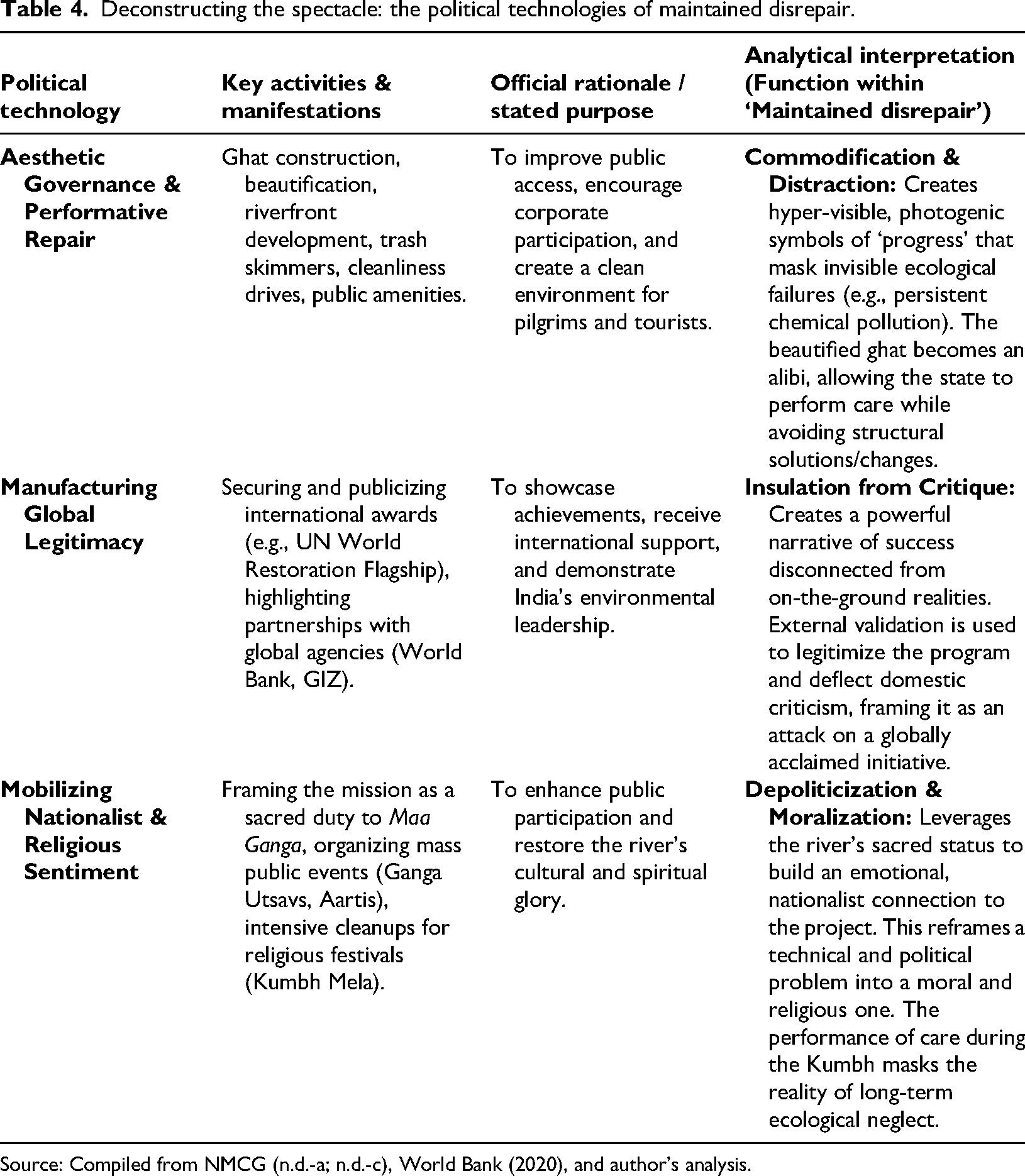
Source: Compiled from NMCG (n.d.-a; n.d.-c), World Bank (2020), and author's analysis.
Discussion
The politics and significance of maintained disrepair
A vast body of scholarship has demonstrated the neoliberal state's role in creating markets and de-risking private investment (e.g., Bryant, 2018; Fairhead et al., 2012; Kay, 2018; Srivastava and Mehta, 2023). The contribution of this paper is to dissect the specific governmental logic that makes such a project politically durable and socially acceptable, despite its clear ecological failures. This research highlights a particular mode of governance: maintained disrepair. It is a system that is not failing to fix the river but rather succeeding at producing a politically and economically productive state of perpetual crisis.
While the program's failures could be attributed to familiar issues of bureaucratic inefficiency or corruption, even a nuanced institutional reading like Robbins’ (2000) fails to explain the NGP's paradox. This perspective, centered on extra-legal institutional frameworks, does not explain the main paradox of this paper: the program's political and financial success. Incompetence alone does not win UN awards, nor does a localized “rotten institution” (ibid) typically create the stable, low-risk assets that attract investment. ‘Corruption’ may explain illegal profits and rent-seeking behavior, but it fails to account for the highly visible, state-sanctioned spectacle of repair that generates widespread public and political legitimacy.
This is where the analytical power of maintained disrepair becomes important. It moves beyond simply diagnosing failure to reveal the mechanisms through which failure is made productive for specific actors. The ‘success’ of the NGP, in this light, is not a universal good; it is highly specific. The winners are a concentrated set of actors: private infrastructure firms and financial investors who gain from state-guaranteed, de-risked contracts; a global class of technical and financial consultants who profit from the ‘capacity deficit’ of local institutions; and the political leadership of the ruling government, which successfully performs environmental stewardship, gaining political legitimacy and international awards.
The NGP is a system where the economic engine of AbR links with a political engine of performative governance (Huff and Brock, 2023). As shown in Figure 1, this is a self-reinforcing cycle, not a simple linear process. The initial ecological crisis is seen as a market opportunity. This framing activates a key condition, which is the productive paralysis of local institutions, through a capacity deficit. This narrative justifies using the ‘Financial Engine’, which employs consultants and financial tools to turn pollution into profitable assets. In turn, this financial activity fuels the ‘Political Engine’ which produces the spectacle of repair. This engine creates the public consent needed for political support of the entire enterprise. The system's stability comes from this feedback loop. The spectacle legitimizes financial deals, and those deals enhance the spectacle, leading to one main outcome: a state of maintained disrepair.
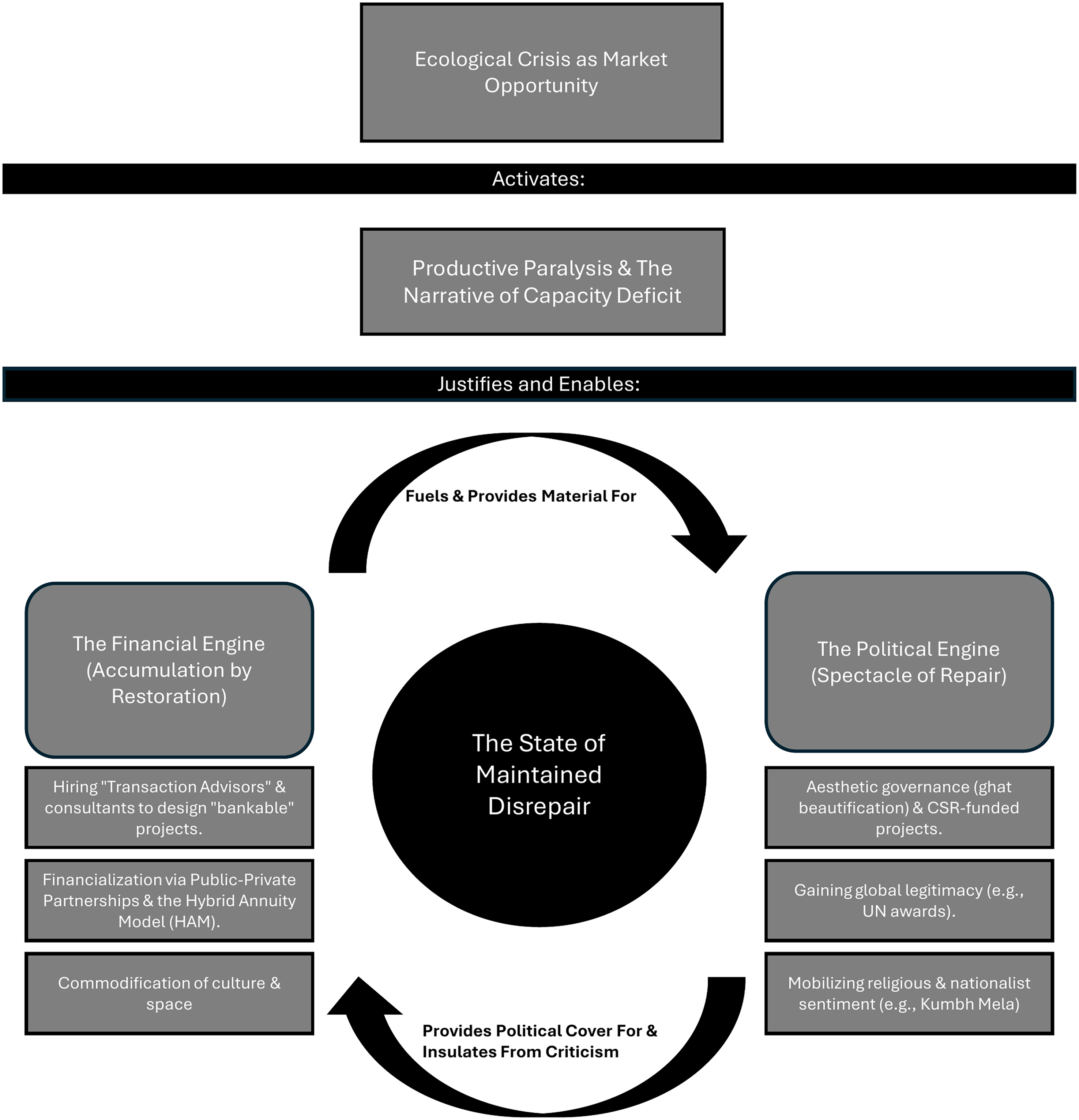
The cycle of maintained disrepair.
The Ganga River's ongoing pollution is not a problem to solve but a vital asset. This pollution justifies ever-growing budgets starting with Rs. 20,000 crores (∼$2.395 billion USD) and adding Rs. 22,500 crores (∼$2.5 billion USD) for the second phase (NMCG, 2024). It also leads to a steady stream of contracts to international consulting firms and corporations that support the repair economy. This supports Corwin and Gidwani's (2021) view of the “double-sidedness of repair.” The program shows a public image of transformative care but maintains a polluting political and economic system. This logic of maintaining a system in a state of crisis resonates with what Law and Goldstein (2024), drawing on Julie Guthman (2019), identify as the inherent ‘limits of repair’ within capitalism. The NGP is not a genuine effort at restoration. It acts as a socio-ecological fix that prevents real change (Law and Goldstein, 2024). The program does not resolve the pollution crisis. It institutionalizes it, creating a cycle of crisis management that is both politically and financially productive (Schoemaker, 2025).
Maintained disrepair also manages and absorbs dissent. The system creates a narrow corridor of acceptable participation: civil society actors who align with the program's performative logic such as organizing festivals and funding ghat beautification are welcomed as co-producers of the spectacle, while those who raise structural questions about ecological outcomes are marginalized, as the experiences of critical DGC members discussed above illustrate. The program's mobilization of sacred and nationalist sentiment further forecloses political space by rendering ecological critique reframable as unpatriotic (Sharma, 2023). Civil society is thus selectively incorporated in ways that reinforce the architecture of maintained disrepair.
Beyond the state vs. Market Binary
This analysis also complicates the simplistic binary of a rolled-back state versus a growing market. The NGP is not a case of the state retreating to let private actors take over. Rather, the state is hyper-present and active and plays a key role in shaping the market (Brock and Huff, 2017). Through the NMCG, it carefully builds the market for repair. The state sets the rules, hires “transaction advisors” to turn pollution into investment opportunities and ensures revenue streams to make projects more appealing to private investors and infrastructure firms. It also takes on the biggest financial and political risks. Moreover, the state directs the spectacle, taps into religious sentiments through its political leaders, and shapes the success story on global platforms. It creates the narrative of success, securing recognition like the UN World Restoration Flagship award to protect the project from domestic critique.
What this demonstrates is a hybrid governmental rationality where the state's power is expressed through its capacity to create and manage markets for its own failures. A key finding is the institutional paralysis of the DGCs. Their managed incapacity is clear. Officials admit they only act under judicial pressure. Meeting minutes are often filled with performative gestures. This is not an accident. It sets the stage for the centralized, financialized, and expert-led “cure” that the program offers. This approach is more subtle than just deregulation. It governs by creating failures at one level to promote accumulation at another (Knuth et al., 2019).
To understand why this research matters, we must view maintained disrepair as more than a case study. It is a blueprint for a new mode of crisis management. This approach appeals to states facing what Alami et al. (2023: 1) call the “‘wicked trinity’ of late capitalism”: economic stagnation, surplus humanity, and environmental breakdown. In this time of overlapping crises, the idea of maintained disrepair offers a seductive path: it allows the state to perform action and channel vast sums into spectacular infrastructure while avoiding the structural drivers of the crisis itself.
Conclusion
This paper started with a paradox: the NGP is praised as a global success while facing clear ecological failures. The analysis has demonstrated that this is not a paradox but the function of a clear and politically durable system of governance. By examining the link between a financial system that profits from pollution and a political system that manufactures consent, this study reveals how the program works through the logic of maintained disrepair. This system is not really failing. Instead, it achieves its main, though hidden, goal: creating a politically and economically productive state of ongoing crisis.
This paper contributes to the scholarship of AbR and the political ecology of repair. It goes beyond criticizing the state's role in capital accumulation. Instead, it details specific mechanisms that help failing projects survive. These mechanisms range from the financial structure of the HAM to the political technique of mobilizing nationalist and religious sentiments. The paper shows that the spectacle of repair is not just a distraction. It is a crucial element that offers political cover for financial activities. At the same time, these financial activities supply the material for the spectacle.
The implications of this logic extend far beyond the banks of the Ganga. Maintained disrepair offers a critical lens for understanding an emergent and dangerous paradigm for governing the complex crises of the twenty-first century. This model is appealing to states precisely because it allows them to perform decisive action, channel vast sums of public and private finance, and generate powerful nationalist narratives without having to confront the politically difficult structural drivers of the crisis itself. It is a model for governing through crisis, rather than governing to resolve it.
Future research can use and apply this framework to other large-scale restoration projects, climate adaptation infrastructure, or even public health and social policy arenas where the performance of intervention has become a replacement for substantive change. Further investigation is needed to understand how this logic travels, how it is adapted in different political contexts, and what forms of resistance are most effective against a system that absorbs and neutralizes critique.
Maintained disrepair should be understood as a governmental tendency, not an inevitability. The framework itself reveals the conditions under which the system must adapt to survive. The Arth Ganga initiative, discussed above, already signals that the program's legitimation currency is shifting from sacred duty toward economic development, suggesting the spectacle requires periodic reinvention as its political returns diminish. Whether such reinventions can outpace the accumulating material and ecological contradictions the system defers rather than resolves remains an open and urgent question. The analytical value of maintained disrepair lies precisely in making this governmental logic visible and therefore contestable.
In an era of increasing ecological crises, there is an immense demand for solutions. The logic of maintained disrepair offers a seductive, but hollow, response to governments and investors seeking to manage, rather than solve, ecological crises. Recognizing and challenging this logic is therefore not just an academic exercise. It is a critical task for forging more just and genuinely restorative futures.
Highlights
Introduces ‘maintained disrepair’ to explain a river restoration project's simultaneous political success and ecological failure.
Shows how pollution becomes a de-risked financial asset through ‘Accumulation by Restoration’.
Argues, a ‘spectacle of repair’ uses sacred and nationalist sentiment to manufacture public consent.
Demonstrates a governance model that thrives by perpetually and profitably managing environmental crises.
Footnotes
Acknowledgements
I wish to convey my deep gratitude to the numerous officials, scientists, and participants involved with the Ganga River for their generous sharing of time, insights, and experiences. This research would not have been conceivable without their important contributions. I also want to express my deepest appreciation to my advisor, Jared Margulies, for his guidance and support during this project. Any errors or omissions are my own.

Ethical approval and informed consent
This study received ethical approval from the University of Alabama Institutional Review Board (Protocol ID: 22-05-5663). All participants were provided with information about the study's purpose and procedures. Informed consent was obtained from all individual participants included in the study, and measures were taken to ensure anonymity and confidentiality.
Funding
The author received no financial support for the research, authorship, and/or publication of this article.
Declaration of conflicting interests
The author declared no potential conflicts of interest with respect to the research, authorship, and/or publication of this article.
Data availability statement
The data that support the findings of this study are not openly available due to the sensitive nature of the ethnographic interviews and to protect the privacy and confidentiality of the participants.