







Abstract
The spread of artificial light at night (ALAN) has become a growing concern in conservation science and environmental governance. In France, the Trame Noire policy (TNP) was introduced as a spatial response to ALAN's ecological effects and institutionalised through the concept of Dark Infrastructure (DI). Framed as a science-based, data-driven solution, DI embodies a technocratic vision of environmental control, reducing the complexity of nocturnal ecologies to zoning tools, cartographic templates, and optimisation algorithms. Drawing on a decade of situated fieldwork and research-action programmes, this article adopts a constructivist and critical policy approach to analyse how scientific knowledge is translated into planning instruments. We show how DI, as a policy device, standardises darkness, marginalises local ecological and social knowledge, and promotes a narrow, depoliticised intervention logic. Far from transforming lighting practices or power relations, DI often consolidates existing infrastructural norms and spatial routines. To move beyond this epistemic and political dead end, we mobilise the concept of Dark Ecological Network (DEN) as a strategic horizon for adaptive and territorially grounded governance. We also introduce the Lit Infrastructure (LI) as a situated logic of action that emphasises stakeholder engagement, collective deliberation, and infrastructural restraint. Rather than engineering darkness through technocratic fixes, this approach focuses on reducing ALAN at its source by questioning lighting norms, dismantling excessive illumination, and enabling territorial experimentation. This shift reframes darkness not as an object to be designed and controlled, but as a condition to be collectively reclaimed through democratic negotiation, care, and spatial retreat of ALAN. In doing so, we contribute to outlining an ecology of withdrawal—an alternative approach to environmental governance grounded in infrastructural downscaling, situated action, and the reconfiguration of normative spatial interventions.
Keywords
Introduction
Artificial light at night (ALAN) has become a paradigmatic case of how modern infrastructures disrupt ecological processes and challenge environmental governance. Intensified by urbanisation and the rebound effect following widespread LED adoption (Falchi and Bará, 2023), ALAN alters natural light–dark cycles and interferes with biological rhythms across a wide range of species—not only nocturnal ones (Barré et al., 2021; Godet et al., 2025; Hale et al., 2015; Miller, 2006; Nordt and Klenke, 2013). It affects activity patterns, reproductive behaviours, and predator–prey dynamics in insects, birds, amphibians, and mammals alike (Bennie et al., 2018; Gaston et al., 2017; Grubisic et al., 2017). By fragmenting habitats and creating illuminated barriers, it constrains the mobility of many species (Lewanzik and Voigt, 2014; Van Grunsven et al., 2017), and reshapes spatial–temporal ecological dynamics (Rodríguez et al., 2017). As a pervasive, multispecies, and multi-scalar disturbance, ALAN has emerged as a key driver of biodiversity loss (Svechkina et al., 2020), demanding new regulatory frameworks (Morgan-Taylor, 2023) and adaptive modes of spatial planning.
Yet addressing ALAN is far from straightforward, given its entrenchment in contemporary life (Straw, 2013). Artificial lighting enables nocturnal activities (Gwiazdzinski et al., 2018; Shaw, 2018), supports economic and social interactions (Casciani, 2020), contributes to public safety (Trop et al., 2023), and plays a role in urban aesthetics (Ebbensgaard, 2015; Edensor, 2015). In response, several policy initiatives have emerged. In France, mitigation efforts have coalesced around the Trame Noire policy (TNP 1 ) (Sordello et al., 2021), which aims to preserve darkness and ecological connectivity for nocturnal species through Dark Infrastructure (DI) (Sordello et al., 2022)—a policy instrument aimed at structuring nocturnal landscapes by maintaining contiguous dark areas. Complementing broader conservation strategies like the Trame Verte et Bleue (TVB, for Green and Blue Infrastructure), TNP integrates darkness into land-use planning to curb light pollution and safeguard biodiversity. Despite being presented as ‘sound science’ and data-driven, TNP and DI are not neutral technical solutions. They are embedded within socio-political and epistemological frameworks that shape how nocturnal environments are conceptualised, governed, and managed, reflecting and reproducing particular framings of environmental action.
Key terms used in the article.
This article adopts a constructivist lens to explore how scientific knowledge on light pollution is mobilised, transformed, and instrumentalised within environmental governance. Focusing on TNP and DI, we examine how expertise, policy design and intervention interact, highlighting the assumptions and power dynamics underpinning their implementation (Goldman et al., 2018; Turnhout, 2018). In line with research on ecological networks (Mougenot and Meliin, 2000), the TVB policy (Alphandéry and Fortier, 2012; Alphandéry et al., 2012), and the EU's Green Infrastructure strategy (Lennon, 2014, 2015), we draw on public policy analysis and Science and Technology Studies (Callon, 1984; Jasanoff, 2004) to show how scientific knowledge is reconfigured through policy instruments—often simplified into doctrinal or symbolic narratives aligned with institutional goals (Jobert, 1994; Muller, 1985; Vimal et al., 2012). We show how this knowledge is operationalised through technical tools, ecological models, and selective representations of the nocturnal environment—what recent critiques describe as part of an “infrastructural turn” in environmental governance, where ecosystems are increasingly framed not as complex ecological entanglements, but as service-oriented infrastructures to be managed, secured, and valued (Nelson and Bigger, 2022). The TNP exemplifies this shift: it reconfigures darkness not simply as an ecological condition to preserve, but as an infrastructure to be mapped, zoned, and controlled in service of conservation goals.
The analysis draws on more than a decade of interdisciplinary research on ALAN and nocturnal environments conducted between 2013 and 2025. It is based on multi-sited empirical material gathered through fundamental research, action-research, and stakeholder-facing engagements carried out across several collective research and field-based programmes. Given the paper's focus on controversy, knowledge production, and policy instrumentation, the authors’ positionality is detailed in Box 2. Figure 1 provides an overview of the main research sites and terrains informing the study. This material was gathered across a wide range of territorial contexts—including national parks, regional natural parks, rural territories, metropolitan areas, municipalities, and overseas contexts—and combines document analysis, interviews, participant observation, collective workshops, and practice-based engagements. The corpus analysed includes legislative and policy texts, planning documents, methodological guides, grey literature, tender and procurement documents—including Cahiers des clauses techniques particulières (CCTP), namely project-specific technical specifications used in public procurement procedures—consultancy reports, technical studies, maps, ecological modelling outputs, and records produced through meetings, territorial visits, stakeholder exchanges, and collective discussions related to the development and implementation of the TNP. Our methodological approach combines document analysis, cross-site comparison, long-term field engagement, and sustained observation of the arenas in which the trame noire has been discussed, translated, and operationalised. This includes participant observation—and, in some cases, observant participation—in technical meetings, policy workshops, training sessions, conferences, stakeholder forums, and territorial engagements where nocturnal issues are framed, negotiated, and turned into actionable categories, instruments, and procedures. Taken together, these materials make it possible to follow the trame noire through its emergence, circulation, institutionalisation, and local translation, and to examine how its instruments, categories, and implementation procedures are assembled and stabilised across heterogeneous sites and scales.
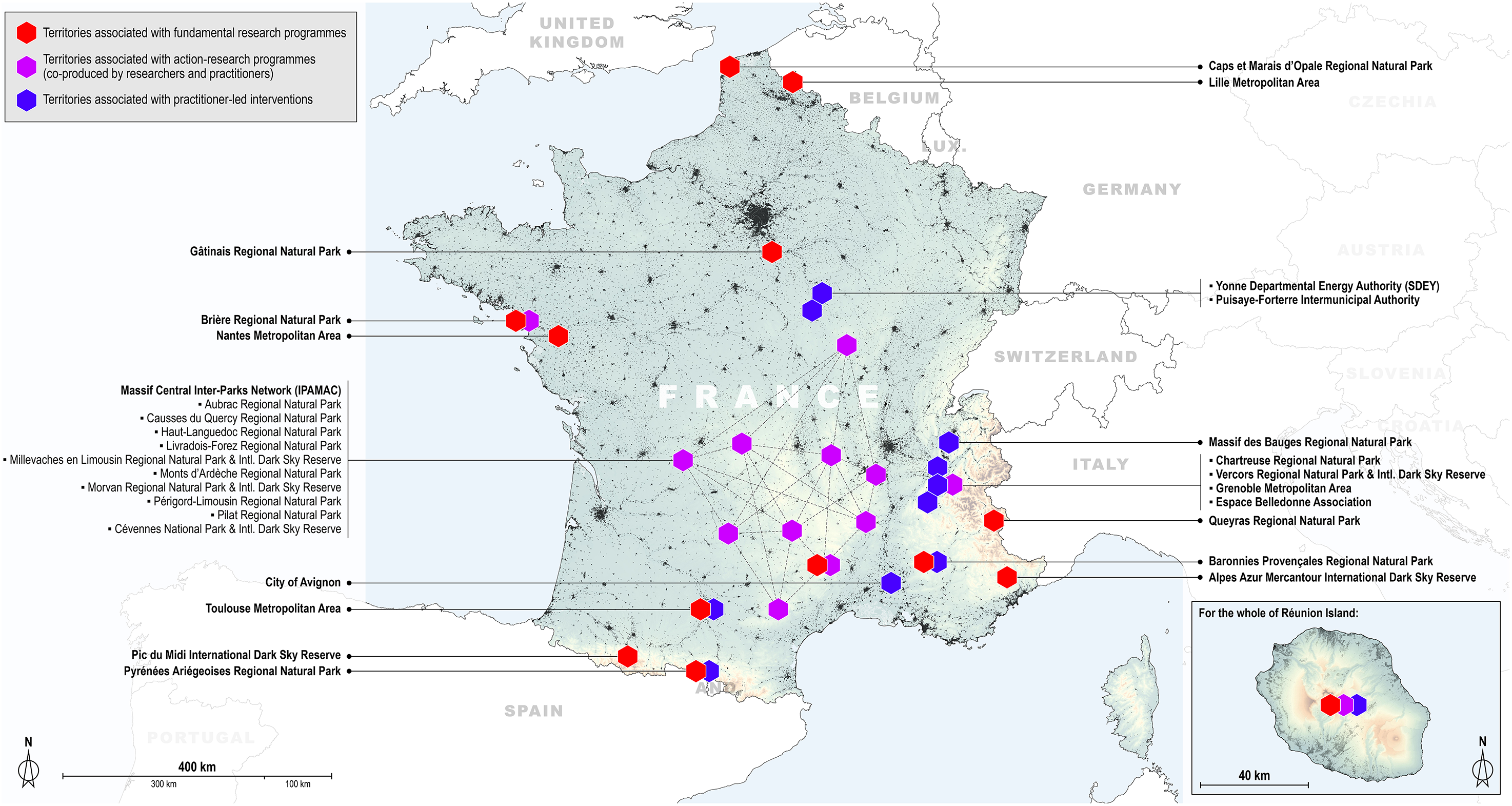
Main research sites and empirical terrains informing the study.
Positionality statement.
Given the paper’s focus on controversy and knowledge production, we consider reflexivity about authorial position to be a methodological requirement. This article is written by a team of seven academic researchers and practitioner–ecologists involved in research, action-research, and stakeholder-facing work on artificial light at night.
The team occupies complementary positions across ecology, geography, planning, and action-research on artificial light at night. Collectively, it brings together expertise on biodiversity and wildlife behaviour, environmental governance, territorial planning, lighting practices, and stakeholder-facing interventions on nocturnal environments. All authors are involved in the Nocturnal Environment Observatory (OEN) and most also participate in the CNRS-backed GDR2202 LUMEN network.
More specifically, Samuel Challéat is a researcher in geography and spatial planning, working on light pollution, nocturnal environments and the territorial governance of artificial light at night; his work has been closely associated with the emergence and development of the trame noire concept. Johan Milian is a researcher in geography, whose work engages with nocturnal environments, territorial practices and the socio-spatial dimensions of ALAN governance. Hélène Foglar is a practitioner–ecologist involved in stakeholder-facing work on artificial light at night, with practical experience in lighting reduction strategies, territorial accompaniment, and the co-development of situated responses to nocturnal environmental issues. David Loose is a practitioner–ecologist involved in stakeholder-facing work on artificial light at night, with practical experience in ecological diagnosis, lighting practices, and territorially grounded interventions on nocturnal environments. Kévin Barré is a researcher in ecology and conservation biology, working on biodiversity responses to environmental change, including the ecological effects of ALAN on species and habitats. Magalie Franchomme is a researcher in geography and planning, whose work addresses territorial governance, environmental planning and the place of nocturnal issues in public action. Laurent Godet is a researcher in ecology, working on the impacts of human activities on changes in the spatial and temporal distributions of wildlife, including the effects of ALAN on birds’ vocal activity rhythms through passive acoustic monitoring.
The team’s proximity to expert, policy, and stakeholder-facing arenas concerned with artificial light at night and the conservation of nocturnal environments is an analytical asset. It provides access to the often less visible “backstage” of instrumentation, including problem framings, categories, standards, procurement routines and evaluation formats through which nocturnal issues are rendered knowable and actionable. At the same time, such proximity entails risks, including familiarity with dominant expert categories and overexposure to particular institutional framings. We sought to mitigate these risks through triangulation, cross-site comparison, internal cross-review within the author team, and explicit attention to emic/etic distinctions in interpretation.
Our discussion of the Lit Infrastructure (LI) logic of action is also informed by this situated engagement. Two practitioner co-authors coined the term “LI” to describe a recurrent orientation developed through stakeholder-facing work around attenuation, withdrawal, and the collective renegotiation of lighting norms (Foglar and Loose, 2022). Our contribution was then to examine this logic across additional sites and arenas through interviews, participant observation and action-research engagements, in order to assess the extent to which it had traction beyond its initial formulation.
Hélène Foglar and David Loose currently hold contracts with territorial authorities on ALAN-related issues. This practice-based involvement informed the articulation of LI and is reported here as part of the authors’ positionality and in the interest of transparency.
The argument proceeds in three parts. First, we trace TNP's historical trajectory, from its emergence within ecological network thinking to its institutionalisation in French biodiversity policy, highlighting the epistemological shifts, territorialised framings, and strategic appropriations that shaped its evolution. We also critically examine its implementation through DI, interrogating its underlying assumptions and governance challenges, and analysing how technical tools operate as boundary objects (Star and Griesemer, 1989), structuring specific issue framings, selective alliances, and hierarchies of expertise (Dodge and Metze, 2024; Grossmann et al., 2022). Second, we analyse DI as a policy instrument, examining how its infrastructure-led, expert-driven orientation engages with the socio-political dynamics of nocturnal environments. Third, we outline an alternative perspective grounded in the DEN framework (Challéat et al., 2021a)—understood not as a means to an end, but as an end in itself—and in the LI logic of action. This opens the way for more adaptive, deliberative, and politically engaged forms of governance beyond zoning and technoscientific fixes, foregrounding spatial reconfiguration, inclusive processes, and context-sensitive interventions that account for the plural uses of nocturnal environments.
From concept to policy: The rise of the trame noire
An immediate history of the trame noire
The trame noire (written in lowercase here to indicate its conceptual status before institutionalisation) emerged in 2010 as an extension of France's broader efforts to integrate biodiversity into policy (Figure 2). More specifically, it extended the principles of the TVB policy, institutionalised under the Grenelle I Law in 2009 following the Grenelle Environment Forum (2007–2010), which placed ecological continuity at the core of France's environmental policies. Although light pollution was recognised as an environmental issue in the Grenelle I Law and incorporated into the French Environmental Code (Challéat and Lapostolle, 2014), its implications for ecological continuity remained largely overlooked. Yet ensuring habitat connectivity—the core aim of the TVB policy—requires attention to both daytime and nighttime conditions. The notion of trame noire emerged to address this gap by extending the logic of ecological continuity into nocturnal environments and advocating the integration of darkness preservation into urban and land-use planning.
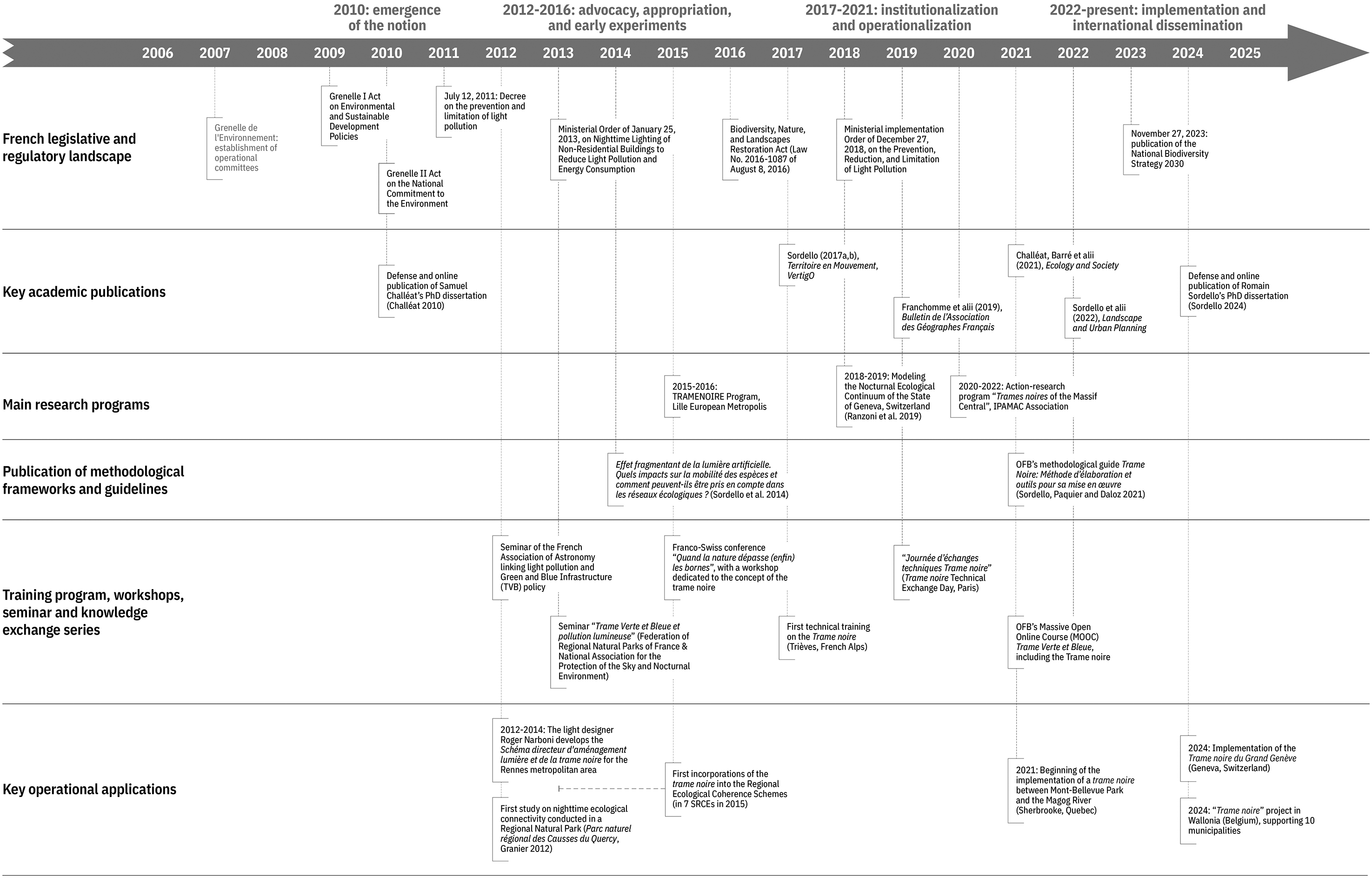
Multi-entry timeline showing the key stages in the emergence, development, and institutionalisation of the trame noire policy (TNP) since 2010. Designed and produced by the authors.
This perspective was first articulated by Samuel Challéat in his 2010 PhD dissertation in geography and spatial planning, where he proposed to “reinforce the nocturnal component of ecological corridors and TVB” (Challéat, 2010: 413, our translation). The term trame noire itself emerged in this context as a critical extension of the TVB framework, highlighting its neglect of ALAN's ecological effects. Initially anecdotal, the concept progressively circulated beyond the dissertation through exchanges among researchers, conservationists, advocacy organisations, and public actors concerned with nocturnal environments and biodiversity.
A second phase, beginning around 2012, was marked by growing advocacy, scientific debate, and institutional interest in darkness preservation. That year, the Association Française d’Astronomie (AFA) organised a seminar linking light pollution to the TVB framework, calling for integrating nocturnal ecosystem functions into ecological network planning (AFA, 2012). Further technical and institutional events followed, including the 2013 seminar Trame Verte et Bleue et pollution lumineuse, co-organised by the Fédération des Parcs Naturels Régionaux de France (FPNRF) and the Association Nationale pour la Protection du Ciel et de l’Environnement Nocturnes (ANPCEN). 2 Hence, trame noire moved from a conceptual proposition into a circulating category within expert, advocacy, and public-policy arenas.
At the same time, the concept was appropriated in more operational and territorial contexts. Between 2012 and 2014, lighting designer Roger Narboni developed the first Schéma Directeur d’Aménagement Lumière et de la Trame Noire for the Rennes metropolitan area. While primarily aesthetic in intent, this initiative marked an early appropriation by lighting professionals and introduced nocturnal ecological continuity into urban planning. Later, the Lille metropolitan area's TRAMENOIRE programme (2015–2016) signalled an interdisciplinary phase, combining ecological and social-scientific approaches to assess ALAN's impact on landscape connectivity and explore public lighting reduction policies. Ecological research confirmed ALAN's disruptive effect on bat movements and showed how targeted lighting management could mitigate impacts (Laforge et al., 2019), while social-science research examined lighting practices, stakeholder motivations, and the acceptability of darkness preservation strategies (Franchomme et al., 2019). By bridging ecological research with governance and urban planning, TRAMENOIRE helped consolidate trame noire as both an ecological and a policy-relevant object.
The 2016 law for the Restoration of Biodiversity, Nature, and Landscapes represented a pivotal institutional step. By amending the Environmental Code, it recognised the need to address artificial light at night within the broader TVB framework. 3 Although ALAN management was not a core TVB objective, this legislative recognition gave formal legitimacy to previous advocacy efforts and strengthened the integration of nocturnal ecological concerns into biodiversity policy (Lapostolle and Challéat, 2021; Sordello, 2017).
From 2017 onwards, trame noire shifted from circulation and advocacy to institutionalisation, with the development of training, technical events, methodological resources, and implementation tools. Governmental and institutional support for the Trame Noire (TN, now capitalised to reflect its formal public policy status) grew as its principles were integrated into local and national planning. This process culminated in the publication, in 2021, of a methodological guide by the Office Français de la Biodiversité (OFB), France's public agency for biodiversity, 4 providing a structured framework for implementation and dissemination (Sordello et al., 2021). Since then, TN has become increasingly embedded in national biodiversity strategy and territorial planning, though integration into regulatory planning documents remains uneven. Although not yet fully binding under hard law, TN has begun to shape the planning categories, evidentiary formats, and procedural routines through which nocturnal issues are rendered legible and actionable in territorial planning.
This immediate history illustrates how a theoretical concept evolves, through circulation, experimentation, advocacy, and institutional uptake, into an established public policy framework—TNP. As this policy evolves, stabilising and operationalising efforts generate a technical-instrumental framework of methods, tools, and procedures contributing to governmentality (Foucault, 2004; Lascoumes, 2004), shaping both public action rationales and its implementation means. The OFB's methodological guide initiated this structuring, later refined and disseminated internationally through a publication in Landscape and Urban Planning (Sordello et al., 2022). There, trame noire was translated as “dark infrastructure”, aligning TNP with the EU's GI framework (European Commission, 2013), signalling efforts to embed TNP within broader European strategies.
This alignment has helped the trame noire concept extend internationally, inspiring initiatives in neighbouring countries (Switzerland, Belgium, Germany) and Quebec. In Switzerland, the Geneva canton mapped light pollution to identify dark zones and establish a “nocturnal ecological continuum” 5 (Ranzoni et al., 2019), leading the Grand Genève region to implement its own trame noire in 2024. 6 In Belgium, the Walloon government launched a programme assisting municipalities in developing TN action plans. 7 In Quebec, Sherbrooke initiated the Oasis nuit étoilée project to restore dark corridors between natural areas, facilitating nocturnal species’ movements. 8 While these initiatives may not yet fully constitute public policies, they reflect a growing international interest in integrating darkness preservation into environmental strategies and urban planning—reinforcing nocturnal ecological networks’ role in biodiversity conservation.
Enchanted by design: TNP affective-technical assemblage
The TNP is built on a powerful discursive architecture that renders it nearly impervious to critique. Its vocabulary—widely used in territorial branding and public communication—is emotionally charged and framed in reassuring, consensual terms: “preserving or recreating an ecological network conducive to nocturnal life”, 9 sketching out a “starry network”, 10 or calling to “protect the night to safeguard life”. 11 These formulations carry an implicit moral proposition, framing darkness as a vehicle for care, restoration, and virtue. TNP thus establishes a normative asymmetry—between a discourse that spontaneously equates darkness with ecological good and the limited space available for rational or political debate. This asymmetry is partly sustained by the emotional alignment between language and ethical value, which fosters a strong presumption of legitimacy. By invoking darkness, public policy enacts an ecological virtue that appears self-evident (Morton, 2010). Naming a trame noire means not merely designating a policy or a technical instrument; it is an ethical and symbolic gesture asserting a moral horizon where darkness becomes the vehicle for safety, ecological repair, and the restoration of natural order. This nocturnal reconnection promise reinforces TNP legitimacy (Capano et al., 2023) and makes it all the more resistant to contestation.
TNP constructs a reassuring affective imaginary, making ecological engagement both emotionally gratifying and politically indisputable. It thereby functions as a post-political device—not through eliminating but neutralising politics: by translating dissensus into technical consensus and rendering disagreement invisible within a grammar grounded in aesthetic and moral affects (Mouffe, 2005; Rancière, 1999; Swyngedouw, 2010). It operates through an emotional conviction that positions it as ‘the only right thing to do’—to the point where challenging it is no longer a matter of debating means, but might appear as questioning the very value of “natural night” itself. Its aesthetic appeal and ethical resonance work together to foreclose the space of conflict, structuring ecological governance less around democratic deliberation than around affective adhesion. TNP's intrinsically positive valence also makes it performative: for a territory, merely invoking it is enough to signal one is already ‘doing good’. Affect is therefore treated not as decorative layering, but as a technology of government. Because night and darkness are directly lived and sensed—through fear and security imaginaries, aesthetic attachments to starry skies, intimacy, and everyday uses—affect shapes their governability by creating alliances, rendering some options sayable while disqualifying others. It produces a presumption of legitimacy, raises the costs of critique, and shifts debate from ends to means: once darkness is established as an unquestionable good, controversy is displaced toward implementation technicalities. In this sense, affect operates both as an acceptability condition and as a mechanism for displacing politics into instrumentation, paving the way for standardised methods and implementation infrastructures.
This affective governmentality is, in turn, sustained by a technical architecture shaped by environmental consultancies, which stabilises TNP's affective power while defining its methodological logic and institutional appeal through standardised tools and procedures. The growing influence of these consultancies in policy-making reflects broader shifts in environmental governance, where expertise and technical knowledge increasingly dictate the direction and legitimacy of public action. This is particularly evident in TNP, where consultancies have played a central role in guiding both its design and practical rollout—a dynamic also observed in other environmental policies (Keele, 2019; Lennon, 2014; Maglia, 2022; Newell et al., 2012). Often framed as neutral intermediaries, environmental consultancies do not merely apply existing knowledge—they actively define what counts as legitimate expertise, marginalising alternative approaches and reinforcing technoscientific rationales in policymaking. In France, institutions behind the TNP have primarily collaborated with environmental consultancies, rather than engaging a broader interdisciplinary research base on light pollution. This close relationship is particularly visible in the OFB's methodological framework, which has since shaped public procurement procedures—most notably the Special Technical Specifications used in trame noire tenders issued by local authorities. A self-reinforcing cycle may emerge: methodological standardisation creates favourable conditions for consultancies already invested in the framework, insofar as it privileges the kinds of expertise and service formats they helped stabilise. Several authors of the Landscape and Urban Planning article (Sordello et al., 2022) are affiliated with major French consultancies specialising in light pollution, whose interests align with the institutionalisation of this framework. As a result, environmental consultancies do not simply provide technical expertise—they also help shape both the direction and the content of public policy. In some cases, this may favour standardised methodological approaches at the expense of a broader range of perspectives tailored to territorially situated needs. Backed by scientific credibility, this dynamic can in turn help consolidate their position in the field.
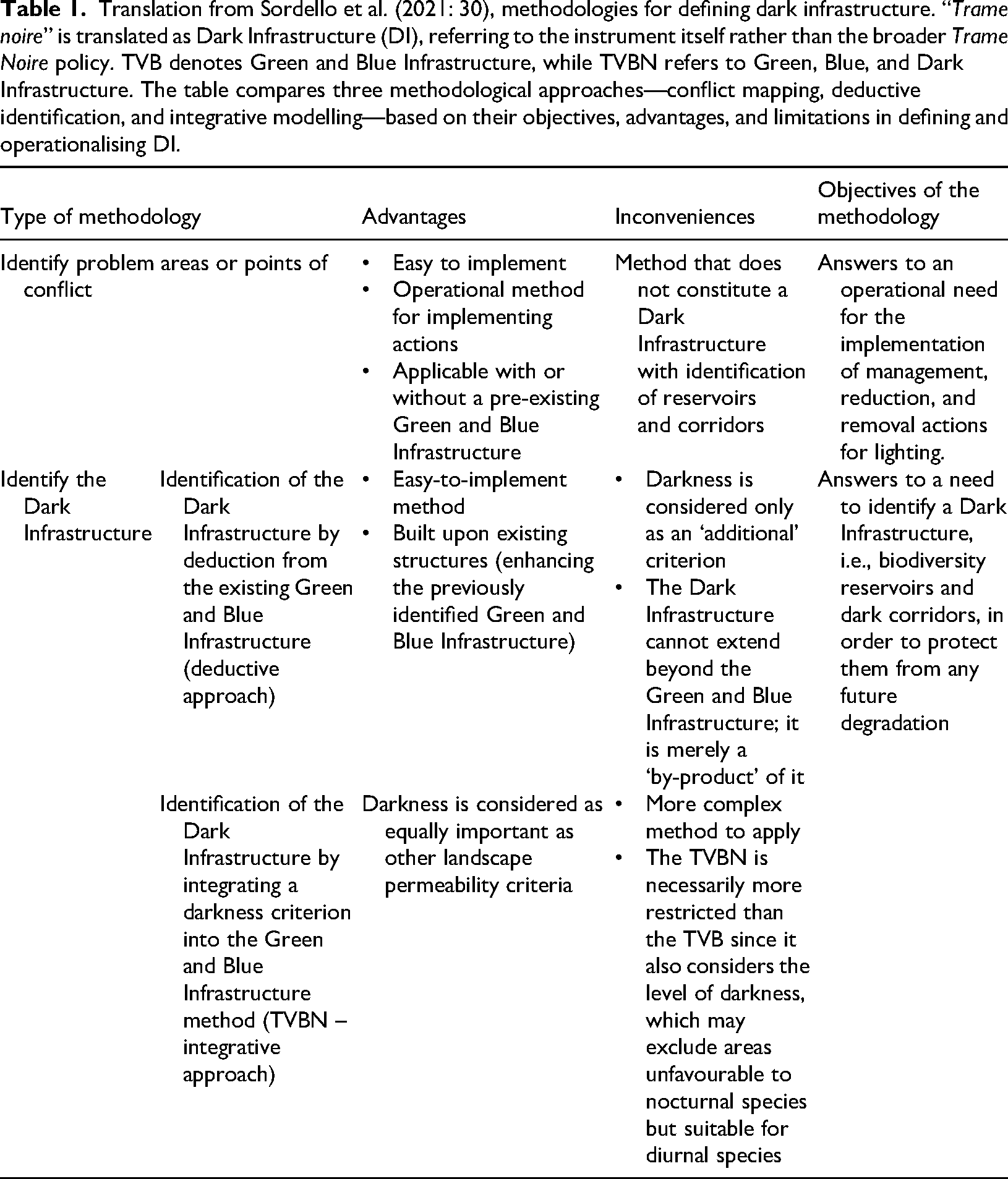
These dynamics also point to a broader epistemic consequence: TNP's legitimacy is not only discursive or procedural, but also embedded in the design of its methods. Like any response to a socio-ecological issue, TNP cannot be considered a neutral or self-evident solution to the ecological challenges posed by ALAN. Its establishment reflects a selective process that privileges certain experts, criteria, and methodologies while sidelining others, narrowing the range of perspectives deemed legitimate in its formulation, implementation, and evaluation. This exclusionary dynamic reinforces a technocratic and instrumental logic. In this sense, TNP tends to consolidate itself as the most legitimate and actionable framework, not because alternative approaches are absent, but because its categories become embedded in the instruments through which the problem is defined and governed, thereby sidelining other possibilities. Table 1 shows the reasoning is circular: the 2021 OFB guide presents the methodology “Identify the Dark infrastructure” as the best for identifying Dark infrastructure… precisely because it “answers a need to identify a Dark infrastructure […]” (Sordello et al., 2021: 30, our translation). Another methodology—the identification of priority areas or conflict points—is thus marginalised with its only drawback being that it “does not constitute a Dark infrastructure with the identification of reservoirs and corridors” (ibidem).
Translation from Sordello et al. (2021: 30), methodologies for defining dark infrastructure. “Trame noire” is translated as Dark Infrastructure (DI), referring to the instrument itself rather than the broader Trame Noire policy. TVB denotes Green and Blue Infrastructure, while TVBN refers to Green, Blue, and Dark Infrastructure. The table compares three methodological approaches—conflict mapping, deductive identification, and integrative modelling—based on their objectives, advantages, and limitations in defining and operationalising DI.
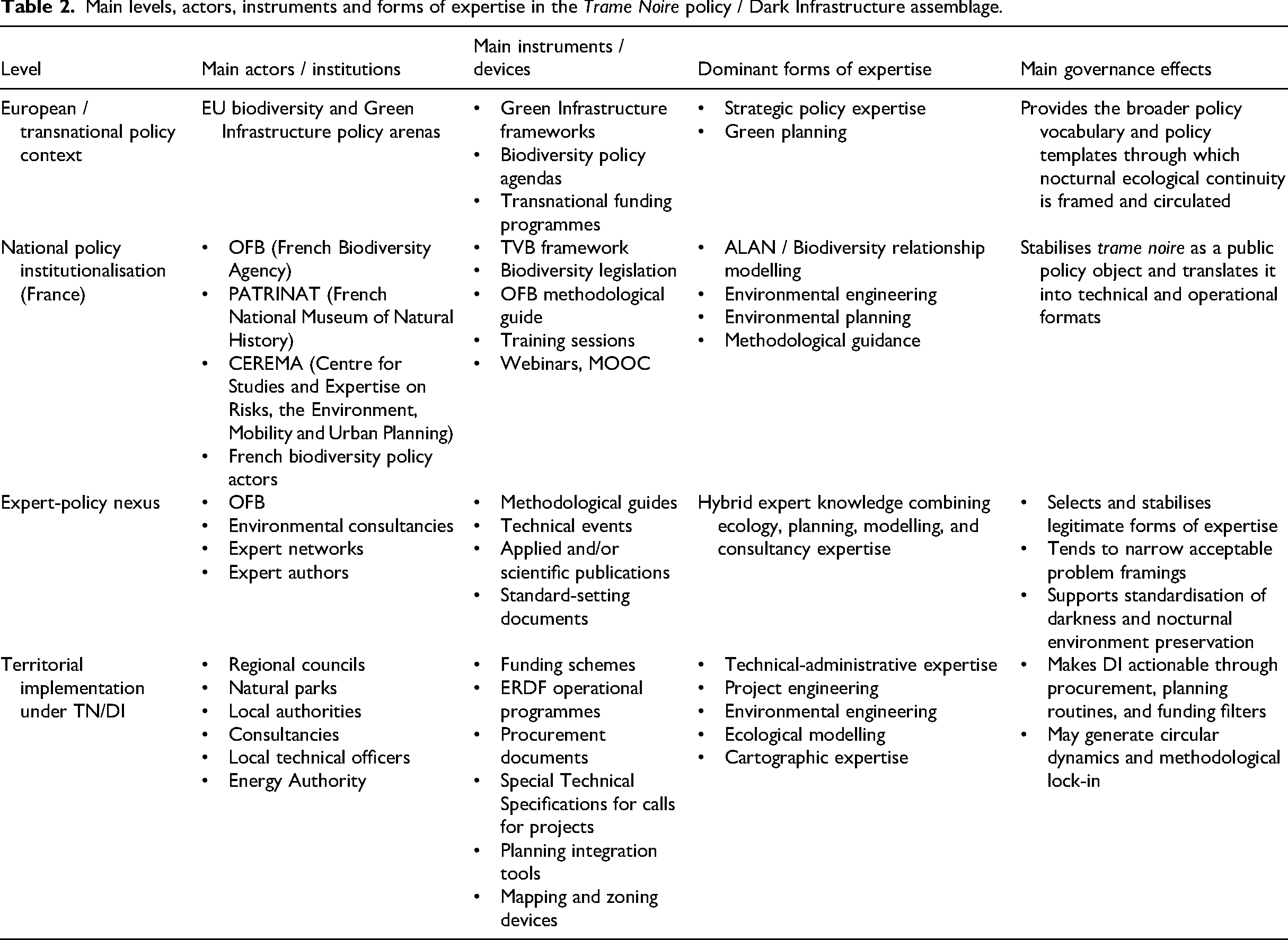
Taken together, these processes reveal a multi-scalar assemblage of actors, institutions, policy instruments, and forms of expertise. For clarity, a schematic overview is provided in Table 2.
Main levels, actors, instruments and forms of expertise in the Trame Noire policy / Dark Infrastructure assemblage.
Is TNP a success? Between policy recognition and territorial dissonance
TNP's success requires critical examination regarding institutional uptake, ecological effectiveness, local ownership, and governance diversity. Sordello et al. (2022) present several cases they describe as the “first successful ‘dark infrastructure’ projects”. Yet, in public policy, success is always a constructed metric: evaluation methods often reshape—or even distort—the very effects they are meant to assess (Dahler-Larsen, 2011, 2014; Fischer, 2003; Muller, 2018). The TNP is no exception: the perceived success of its overarching framework does not necessarily imply that its local implementations are effective, particularly from a conservation perspective. Assessing the TNP solely by the number of territories reporting implementation leads to self-referential conclusions. 12 Yet, one may ask whether the representations put forward by its proponents genuinely reflect its actual implementation on the ground.
A closer examination of local practices reveals that what falls under the TNP label often extends beyond strictly ecological concerns. The dominance of a narrow, ecology-focused framing has weakened the influence of other justification regimes (Boltanski and Thévenot, 2006) that territories have mobilised to address light pollution. This tension is reflected in our decade-long research, which highlights the plurality of local approaches to preserving the nocturnal environment, shaped by ecological, socio-economic, cultural, and political priorities (Challéat et al., 2018; Milian et al., 2023). Our work with ten regional and national parks in France's Massif Central Inter-Parks Network has identified four ‘Major Modes of Engagement’ (MMOE) with darkness as a resource (Lapostolle and Challéat, 2021; Milian et al., 2022), each corresponding to a distinct order of justification (Table 3). The same patterns emerged across our other study areas. Together, these MMOEs show how reductive it is to group such initiatives under the single label of TN implementation. While these actions demonstrate strong territorial commitment, they also reveal a significant gap between locally grounded strategies and TNP's standardised methodology, which tends to subsume diversity under a uniform framework (Sordello et al., 2021). This warrants a more differentiated understanding of territorial action.
Major modes of engagement (MMOEs) with darkness as a resource. This typology emerged from collaborative work conducted between 2020 and 2022 with ten Regional Natural Parks (Parcs Naturels Régionaux) located in the Massif Central, as part of the Trames Noires du Massif Central programme supported by the European Regional Development Fund (ERDF). Drawing on participatory workshops and nocturnal fieldwork involving over 300 stakeholders—including park agents, elected officials, local authority staff, civil society actors, environmental association representatives and residents—this research identified four key modes through which actors engage with the nocturnal environment and its governance challenges. MMOE 1 frames energy sobriety as an economic and ecological lever for sustainable lighting policies. MMOE 2 highlights the symbolic and narrative construction of the nocturnal landscape as part of territorial identity. MMOE 3 addresses the branding of natural night as a tourism resource, revealing tensions between economic valorisation and ecological integrity. MMOE 4 focuses on biodiversity conservation, underscoring the difficulty of translating scientific knowledge into governance. Together, these MMOEs reveal the diversity of meanings, values, and practices mobilised around the nocturnal environment—and the tensions between them.
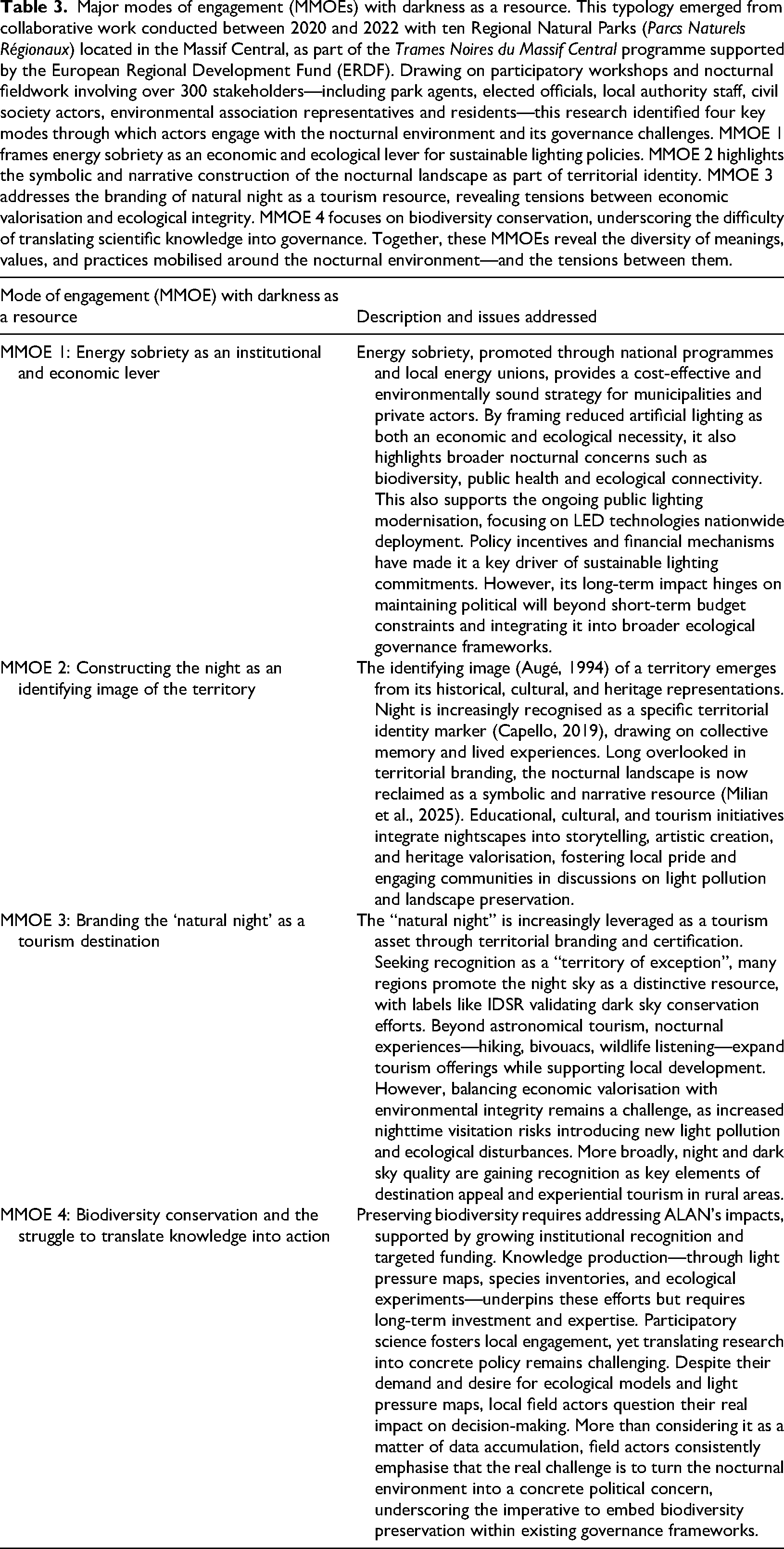
Closer attention to local trajectories shows that TN non-adoption is variegated and cannot be reduced to the outright absence of the framework. In many cases, municipalities act on technical parameters that reduce light pressure without mobilising TN as a formal framework, whereas in other territories the TN label is adopted retrospectively to recast actions already initiated under different logics, including energy sobriety or dark-sky valorisation. More broadly, TN uptake may remain partial, discursive, or weakly translated into practice: some actors mobilise ecological expertise, light-pressure maps, and TN-related tools, yet still struggle to turn them into actionable decisions with elected officials and locally embedded governance arrangements. As MMOE 4 highlights (Table 3), the main difficulty often lies less in a lack of data than in turning the nocturnal environment into a concrete political concern within existing territorial governance frameworks.
Meanwhile, TNP's widespread uptake stems largely from its strong conforming pressure. Through the managerial logics inherent in public action instruments—particularly “government from a distance” (Epstein, 2005, 2009), which standardises local action forms, objectives, and methods through project-based approaches (Lascoumes and Le Galès, 2004)—it prompts actors to label intiatives as such to legitimise their countering light pollution and darkness preservation efforts. Since the mid-2010s—notably with the 2016 law for the Restoration of Biodiversity, Nature, and Landscapes, and even more so following the 2021 publication of the OFB's methodological guide—the term trame noire has become the dominant institutional label, offering national recognition to initiatives addressing the ecological impacts of ALAN.
Consequently, some actors frame the trame noire in ways that not only invoke environmental concerns but also signal alignment with public policy priorities. The label goes beyond structuring action: it can operate as a means of demonstrating adherence to national objectives and gaining institutional recognition. Here, the term ‘trame noire’ can function as a strategic lever and communication tool, signalling alignment with national public policy. Our interviews and participant observations across relevant policy and expert arenas consistently indicate that, a number of local authorities categorise nocturnal environment initiatives under this heading for the sake of project-selection and funding routines, in which TN vocabulary may operate as a quasi-compulsory passage point for access to certain schemes—notably, in rural territories, under European Regional Development Fund (ERDF) regional operational programmes, where Regional councils act as managing authorities and translate programme priorities into calls for projects and eligibility criteria. As one interviewee explained: “As soon as we talk about the ERDF, we have to put ‘trame noire’, and then we roll out the methodology. […] Funding goes through the trame noire approach.” (Head of the Transitions and Economy Unit at a Regional Natural Park). As TNP has become a central public framework for addressing light pollution in France, it increasingly formats access to funding by defining eligibility and legibility in national and regional calls—thereby reinforcing this passage-point effect. This reflects a broader trend in environmental policy, in which standardised approaches gain traction not necessarily because of their ecological superiority, but because they are more readily aligned with existing administrative and economic logics (Lennon, 2015).
While TNP has achieved institutional visibility and widespread adoption, its success remains ambivalent. Behind the apparent policy consensus lie fragmented practices, strategic appropriations of the TN label shaped by funding opportunities, and a growing disconnect between local realities and the national framework. This raises serious questions about both its ecological effectiveness and the inclusiveness of its governance model. The tensions and contradictions observed in TNP's local implementations invite scrutiny of the instrument that supports it. While trame noire remains the dominant term in French policy and practitioner vocabularies, we distinguish analytically between the broader Trame Noire policy (TNP) and Dark Infrastructure (DI), understood here as its technical-instrumental translation into planning and public action. Building on the formulation proposed by Sordello et al. (2022), we use DI to refer to the public policy instrument whose design, methods, and effects warrant critical scrutiny.
The Dark Infrastructure: From technical promise to the epistemic dead ends of a public policy instrument
Ecology lost in translation: When heuristics turn into technical templates
Dark Infrastructure, like many contemporary conservation frameworks, originates in landscape ecology—particularly in the Patch-Corridor-Matrix (PCM) model developed by Forman and Godron (1986). In France, this model has been adapted to agricultural contexts emphasising the importance of incorporating farming systems and social dynamics into landscape-level biodiversity strategies (Burel and Baudry, 1995, 1999). While analytically powerful for describing spatial patterns in population dynamics, its direct translation into conservation planning raises significant epistemological and practical issues (Boitani et al., 2007). PCM configurations are inherently species-specific, spatially contingent, and sensitive to observation scales (Fahrig, 2003). Ignoring these constraints, policy efforts to universalise the model risk flattening ecological complexity into sloganised heuristics. The growing enthusiasm for ecological connectivity has sometimes led to a deterministic and prescriptive application of corridors as panaceas (Bennett, 2003; Taylor et al., 1993), obscuring that corridor effectiveness is highly context-dependent (Hilty et al., 2012). This shift from a heuristic model to an operational template represents a problematic slippage—one that conflates ecological understanding with conservation planning. It exemplifies a broader policy tendency to transform scientific abstractions into universal tools, losing sight of their original contextuality and theoretical nuance.
Technocratic logics embedded in the EU's GI strategy lead to the transformation of the PCM model into a policy instrument. The very term “infrastructure” imposes a framework grounded in engineering rationality, where nature is managed like a transport or energy network (Lennon, 2014). This infrastructural metaphor brings with it specific expectations: linearity, optimisation, connectivity, and above all, governability. The result is an environmental policy where ecological systems are reframed as service providers, expected to demonstrate measurable benefits. Conservation thus becomes increasingly justified through its contributions to socioeconomic objectives, rather than its intrinsic ecological value (Maris, 2014; Turnhout et al., 2013). Bureaucratic alignment ensures DI institutional legitimacy. Standardised methodologies—diagnostics, planning, and evaluation—appear clear, but restrict acceptable knowledge and practice. This lock-in benefits environmental consultancies and expert networks, reinforcing a managerial rationality favouring compliance over ecological specificity (Lennon, 2014). By privileging plannable and reportable, such proceduralisation narrows epistemic diversity, sidelining place-based forms of knowledge. As one public lighting manager from the city of Douai (France) remarked, “DI is a diagnosis, an action plan, an impact study”—revealing bureaucratic logic over ecological specificity. Darkness becomes an object to be zoned, audited, and administratively managed, not experienced or contested (Maris et al., 2016).
While promoted as essential to light pollution mitigation, DI's foundations deserve closer scrutiny. Can this policy instrument truly hold within the scientific and political modes of existence (Latour, 2013) it claims to engage? At its core, it relies on functional zoning—carving out spaces for darkness rather than addressing drivers of artificial lighting. Consequently, key ecological, social, and political dimensions of the nocturnal environment are left unaddressed. These contradictions raise questions for public policy (Ellul, 1965, 1977). By privileging zoning and technical fixes (Hajer, 1995) over adaptive governance (Folke et al., 2005; Olsson et al., 2006), light pollution mitigation risks becoming a postpolitical (Swyngedouw, 2010) and technocratic exercise.
Although the PCM model provided the ecological grammar for DI, and the GI framework supplied its technocratic infrastructure, procedural compatibility explains its rapid institutional dissemination. DI is neither purely ecological nor merely technical; rather, it is a standardised administrative template, easily rolled out across diverse territorial contexts. Its modularity—from mapping and diagnostics to mitigation planning—makes it legible to expert systems, consultancies, and planning institutions, facilitating its adoption. But this ‘transportability’ is costly. Its procedural grammar reinforces a managerial logic where conservation is treated as a programmable sequence. Instead of fostering adaptive experimentation or critical engagement with local socio-ecological realities, DI promotes a “state simplification” (sensu Scott, 1995): a tool privileging administrative visibility and operational feasibility over ecological complexity or political nuance.
Proceduralisation is not simply politics seeking legitimacy from science. The relationship is reciprocal, as ecological science also has political agendas. Concepts such as systematic conservation planning (Margules and Pressey, 2000), and associated tools such as Zonation software (Lehtomäki and Moilanen, 2013) illustrate how political technologies have become naturalised under the guise of scientific neutrality. Ecologists themselves assume roles traditionally occupied by cartographers and GIS specialists, often at the expense of engaging with ecological interactions, species-specific complexities, and place-based realities. By doing so, they contribute to an optimisation-driven conservation model that enacts eco-algorithmic governmentality (Tironi and Lisboa, 2023) and reduces biodiversity to a spatial and computational issue. Incorporating political rationalities strengthens DI's technoscientific character, producing a regime of convergence among political, scientific, legislative, and technical actors—extending to military-led Earth observation (Grevsmühl, 2015). As infrastructures become sites of ontological experimentation (Jensen and Morita, 2015), DI displaces the political project of darkness preservation into the ostensibly neutral domain of technical management. This shift toward bureaucratic compliance sets the stage for examining how such managerial dynamics manifest concretely through maps, metrics, and the seductive illusion of control.
Modelling darkness: Maps, metrics, and the fiction of control
Cartographic and model-based representations cannot fully capture the lived complexity of nocturnal ecosystems. While maps, statistical data, and spatial metrics remain indispensable planning tools, their deployment within technical-rational frameworks often reduces ecological phenomena to standardised procedures (Owens et al., 2004; Owens and Cowell, 2011). The resulting abstraction overlooks the dynamic ecosystem interactions and marginalises local, situated ecological knowledge (Turnhout et al., 2013). Initiatives such as France's TVB have illustrated these limitations: ecological networks, though shaped in part by public input, remain embedded within bureaucratic structures that impose schematic visions onto complex socio-ecological realities (Charvolin et al., 2011; Vimal et al., 2012; Vimal and Mathevet, 2011). Similarly, by framing darkness as a spatial resource subject to cartographic delineation, DI reinforces a governance mode that privileges measurable parameters over ecological complexity. It thereby embodies the key features of a high-modernist project (sensu Scott, 1998)—notably, the colonisation of governance by expert knowledge (Evans, 2011) and the use of “simplifying fictions” (Scott, 1998) that render ecosystems administratively legible at the expense of their complexity. This abstraction prioritises quantifiable metrics over qualitative, context-rich ecological realities (Blythe et al., 2018; Klenk and Meehan, 2015; Turnhout et al., 2020; Wyborn et al., 2019), dictating which ecological dimensions become visible in policy and planning, and which remain obscured.
Reductionism is particularly evident in how DI operationalises darkness's ecological value. ALAN research and mitigation have predominantly focused on nocturnal species with readily measurable responses, overlooking broader physiological disruptions and ecosystem-level cascades (Gaston et al., 2015a; Grubisic and Van Grunsven, 2021; Secondi et al., 2020). Consequently, crucial effects on diurnal species, pollination networks (Giavi et al., 2021; Knop et al., 2017), and overall ecosystem functionality remain hidden. The selective definition of model species exemplifies this limitation, reflecting ecological complexity narrowing into simplified cartographic and governance templates. DI's reliance on simplified impact matrices, which categorise ecological responses into manageable classifications (Musters et al., 2009; Quémard et al., 2015; Verny and Busson, 2017), further entrenches this issue. While matrices facilitate planning, they blur distinctions between physiological, behavioural, and ecosystem-level effects, often conflating inferred impacts with empirically demonstrated ones. As a result, uncertainty is masked rather than genuinely managed, weakening ecological credibility and undermining adaptive governance.
This instrumental reduction is compounded by deeper epistemological challenges—most notably, the difficulty of defining reliable ecological baselines for darkness independently of human perception (Hölker et al., 2021). Traditional conservation often relies on reference ecosystems representing relatively undisturbed conditions, but most contemporary landscapes targeted by DI have experienced decades of incremental illumination. Thus, the notion of restoring or preserving darkness depends on historically and ecologically compromised reference states, with questionable validity and ecological relevance (Godet et al., 2023). Spatial models delineating dark zones therefore risk misrepresenting ecological realities by employing thresholds calibrated against already altered environments.
Furthermore, ALAN's ecological impacts are highly context-dependent, exhibiting significant variability both between and within species populations (LaPoint et al., 2013; Liczner et al., 2024; Maiorano et al., 2017). These biological responses are more heterogeneous than the fixed spatial thresholds embedded within DI methodologies can accurately explain. In addition, artificial light is diffuse, dynamic, and highly variable depending on atmospheric conditions (Aubé et al., 2016; Jechow et al., 2017; Kyba et al., 2011; Mariton et al., 2022; Ribas et al., 2016; van Hasselt et al., 2021). Yet DI planning typically relies on maps produced under optimal (clear, dry) conditions, dramatically underestimating real-world variability. As a result, areas designated as “dark” under idealised conditions may experience substantial nocturnal illumination during meteorologically unfavourable nights (Gaston et al., 2015b). Further limitations stem from the epistemic bias of top-down mapping approaches, which depict light-scapes as abstract, static surfaces detached from the lived, ground-level experiences of organisms navigating illuminated environments. Light reflected from vertical surfaces (e.g., buildings, cliffs, vegetation), combined with perceived luminance at varying distances, generates spatial patterns that simplified radiance-based maps miss. These cartographic simplifications produce illusory boundaries and reductive conservation outcomes.
From regulation to reproduction: The political aporias of the Dark Infrastructure
The growing institutionalisation of the DI framework reflects a shift from the normative and political potential for systemic critique carried by the very idea of darkness—as a challenge to dominant lighting regimes—toward a logic of managerial containment. Rather than opening space for a political and ecological rethinking of our relationship to artificial light, current policies channel this potential through instrumentation, translating darkness conservation into zoning-oriented spatial planning tools (Martin et al., 2016). The ambition to interrogate the territorial, social, and cultural implications of pervasive illumination is thus reduced to the task of designating controlled spaces of regulated darkness. In doing so, darkness conservation strategies risk neutralising their own political potential. By adapting to pre-existing spatial and infrastructural norms, they preserve darkness only where it does not conflict with dominant uses, values, or territorial expectations. Rather than confronting the structures sustaining large-scale illumination—economic growth imperatives, infrastructural inertia, cultural associations with light and progress—these approaches operate within them. As a result, conservation may end up reinforcing the very logic that rendered darkness marginal to begin with.
DI depoliticisation also aligns closely with broader public lighting policies, notably the push toward widespread modernisation through LED conversion—a shift propelled by the economic interests of lighting manufacturers and reinforced by public agendas prioritising energy savings and cost-efficiency. Rather than questioning artificial lighting expansionist logic, DI risks becoming an instrument to accelerate the technological upgrading of lighting systems under the guise of ecological rationality. Thus, it participates actively in reproducing the illumination territorial paradigm, embedding light pollution mitigation within the same managerial frameworks historically used to legitimise artificial lighting as progress and modernity.
TNP and DI institutionalisation reveals a broader political economy in which environmental consultancies do not simply translate science into policy but actively shape what counts as legitimate evidence, narrowing the scope of political debate. This raises concerns about the institutional dependencies, strategic alliances, and economic constraints that influence policy design. Reliance on expert-driven frameworks reinforces this dynamic, as procedural rigidity and methodological standardisation can erode policymaking autonomy, stifle innovation, and hinder context-sensitive responses. Predefined methodologies foster a compliance culture that prioritises procedure over ecological effectiveness. This tension between national frameworks and local governance is a concrete concern among biodiversity policy practitioners. During our interviews, one officer involved in regional ecological planning stressed that the success of the TVB programme had largely relied on trust-building and time-intensive engagement with local elected officials. He expressed concern that the implementation of TNP through top-down instruments such as the DI risked undermining these hard-won institutional dynamics by applying rigid procedures disconnected from local realities. This testimony underscores the institutional frictions that emerge when technocratic procedures override deliberative, place-based action. It highlights a key form of methodological lock-in: not just technical standardisation, but the erosion of dialogical, iterative, and trust-based policymaking.
At the heart of DI's political limitations lies its anchoring in evidence-based policy-making (EBPM). Seeking legitimacy through science, TNP mobilises DI as an instrument that functions as an experimental “factish” (Latour and Porter, 2010). Yet as scientific apparatuses grow increasingly refined, the gap between ecological description and actionable explanation widens—with knowledge becoming ever more situated, contingent, and resistant to generalisation (Stengers, 2022). The proliferation of scientific outputs aimed at ever more precise ecological insights heightens the risk of “paralysis by analysis” (Devictor, 2021: 31, our translation), as EBPM tends to demand scientific validation before policy action is deemed necessary—or better yet, indisputable. This apparent objectivity conceals a deeper entanglement: EBPM not only informs policy but shapes the very conditions under which action is considered legitimate, often obscuring the political underpinnings of scientific agendas (Parkhurst, 2017; Saltelli and Giampietro, 2017). There are cases where “scientific knowledge complicates the problem and does not provide a ready-made decision to be taken” (Stengers, 1997: 29, our translation). TNP illustrates this precisely: embedded in DI's methodological framework, it blurs the boundaries between scientific and political modes of existence (Latour, 2013). The 2021 OFB methodological guide makes this ambiguity explicit (Table 1), raising a critical question: is DI promoted for its ecological effectiveness—or does its mere existence suffice to legitimise institutional resource mobilisation, regardless of outcomes? This issue is not merely epistemological—it is deeply political.
Beyond Dark Infrastructure: Towards situated and ecopolitical governance of nocturnal environments
From infrastructural planning to the emergence of dark ecological networks
Ecological networks are not fixed infrastructures but evolving patterns. No individual component remains static, yet the network persists by adapting to its environment. What appears stable at one scale may be highly dynamic at another. This challenges the planning logic inherent to DI: if planning merely formalises what persists despite ALAN, it risks reinforcing the status quo rather than transforming it. Such an approach does not reclaim darkness or counteract the damage inflicted by light pollution—it simply preserves the fragments that have managed to survive. The promise of planning is alluring—a vision of darkness strategically restored through rational design. Yet the very act of modelling a dark ecological network risks reducing the living to what can be calculated, categorised, and controlled. As Devictor (2021: 31, our translation) warns: “The census and accounting measurement of biodiversity are not an issue for many ecologists. The problem is more political because by focusing too much on the counter, we forget to look at the road—or more precisely, the path taken”. The real danger lies in treating (dark) ecological networks as if they could be designed like transport or energy infrastructures. No single, static model can adequately capture ecosystems fluidity and adaptability. Even a model perfectly tailored to a specific set of species biological needs would offer only a temporary alignment—one statistically unlikely to last. Ecosystems are not static: they evolve through stochastic processes, shifting interactions, and unpredictable dynamics.
Ecological networks consist of diverse interactions among living organisms—predation, competition, symbiosis, mutualism (Guimarães, 2020)—embedded in nonlinear feedback loops. As demonstrated by the sandpile model and the self-organised criticality theory (Bak, 1996; Bak et al., 1987), small perturbations in one part of the system can produce large, unpredictable consequences elsewhere. These networks evolve constantly in response to environmental changes, anthropogenic disturbances, and evolutionary pressures (Segar et al., 2020)—the arrow of time counts for the living, and systems cannot revert to previous states. Moreover, the processes that sustain ecological networks unfold across multiple spatial and temporal scales, producing feedback effects that may be delayed, diffuse, or contradictory. These interdependencies generate emergent behaviours that render the whole irreducible to the sum of its parts.
This complexity challenges the assumptions embedded in many modelling approaches. Ecological models often expand to incorporate additional variables, but as Damos (2024: 10) notes, “we will always need more information to fully understand a complex system from sources external to the system under consideration.” Hence this paradox: the more comprehensive the model, the less usable it becomes. As models strive to account for ecological reality, they tend to lose explanatory power, becoming black boxes that offer little actionable insight beyond controlled settings. While useful in laboratory contexts, they remain fictions—simplified abstractions built on assumptions that cannot fully capture the intricacies of living systems.
Our critique is not directed at all forms of mapping, GIS, or spatial representation as such. Rather, it concerns those top-down modelling and cartographic practices that reify the nocturnal environment into static surfaces to be identified, zoned, and managed remotely. The problem arises when such outputs are treated not as heuristic and revisable artefacts, but as if they were direct representations of nocturnal ecological continuities. Used instead as contextual and revisable supports for diagnosis, discussion, and experimentation, cartographic tools may help orient action without claiming to exhaust the complexity of nocturnal environments. This tension is heightened by the current monitoring regime, marked by massive ecological data accumulation and increasingly powerful computational tools (Devictor and Bensaude-Vincent, 2016). These developments feed into what Varenne (2005) calls the “modelling utopia”: the belief that greater precision guarantees better control. The illusion deepens when policy frameworks reinforce this ideal by suggesting that refining models, rather than transforming systems, is the path to solving socio-ecological problems.
Breaking this impasse requires abandoning the fantasy of mastering ecological complexity through design—not by abandoning governance, but by rethinking what and how we seek to govern. The problem is not planning per se, but the technocratic assumption that the living can be stabilised, segmented, and channelled through purpose-built infrastructures.
Towards situated action: The Lit Infrastructure logic of action
Rather than engineering darkness as a programmable ecological object, we propose to displace the infrastructural fix—from top-down ordering to the situated and collective questioning of our dependence on ALAN. This is the Lit Infrastructure (LI) logic of action: a pragmatic, context-sensitive approach targeting the only infrastructure directly available for intervention—the systems, devices, and networks that produce and distribute artificial light. Through iterative and reversible interventions, the LI approach reframes darkness not as a designed space, but as a condition to be enabled, emerging from negotiated withdrawals and material reconfigurations of luminous environments. This reframing directly challenges the foundations of the prevailing lighting regime. It redirects action away from speculative dark corridors towards the dismantling of the “technician system” (Ellul, 1977) that institutionalises illumination as a normative default. The question is no longer how to design darkness, but how to turn off the artificial light tap—by acting, practically and locally, on the diffuse network of lighting sources.
We mobilise “Lit Infrastructure” (LI) as an ideal-typical logic of action, using it here as an analytical construct grounded in recurring empirical patterns rather than derived solely from an external conceptual framing (Box 2). This logic entails a methodological rupture: from promissory infrastructure-building to the situated attenuation of existing lighting infrastructures, and from expert-led planning to the collective reassessment of what lighting is necessary, excessive, or unnecessary. Identifying what counts as “the right lighting” cannot be reduced to a purely social, ecological, or health-based question. It is a socio-environmental question shaped by the intertwined needs of human and non-human actors and actants (Latour, 2007). From an ecological standpoint, the most effective conservation measure is also the simplest: turning the lights off. Yet most real-world contexts involve complex trade-offs, where ALAN is both beneficial and harmful. Recognising this context-dependence calls for territorially grounded decision-making, engaging communities in shaping their nightscapes through dialogue and learning. It favours an adaptive and place-based vision of ALAN governance, grounded in a simple truth: darkness returns when light pressure is reduced.
While DI and LI may partly converge in their broad aim of reducing the ecological impacts of ALAN, they differ markedly in the pathways through which this objective is pursued. The issue, therefore, is not only what kind of nocturnal environment is sought, but also how change is organised politically and operationally. This difference is not merely procedural: pathways shape what changes become feasible, acceptable, and implementable. From this perspective, success cannot be assessed solely through the formal adoption of a framework, but through concrete changes in lighting practices and their local appropriation—for example, fewer lighting points, lower intensity levels, warmer colour temperatures, shorter operating times, and the capacity to sustain such changes through negotiated territorial arrangements.
The LI logic of action is not necessarily named as such by the actors involved in lighting reduction policies and interventions, yet it is strongly reflected in the ways lighting reduction is framed and operationalised through flexible, locally negotiated interventions rather than fixed, top-down prescriptions. Initiatives in Wallonia provide an illustration. Under the POLLEC 2021 call—supporting municipalities in Sustainable Energy and Climate Action Plans—the Public Service of Wallonia developed a mapping system to identify superfluous and ecologically disruptive lighting (Figure 3). Rather than imposing fixed rules, this framework offers flexible guidance grounded in subsidiarity, helping local actors reconsider public lighting through environmental concerns and balance these against its more conventional functions. This orientation is also evident in the Interreg VI LUNÉfil project (Berger and Quadu, 2025), where transboundary cooperation, contextual diagnostics, and citizen engagement reflect the LI logic of action. The project combines typo-morphological analysis, participatory mapping, and field-based experimentation to identify areas where light pressure can be reduced to enable the (re-)emergence of nocturnal ecological continuities.

Mapping the potential ecological effects of public lighting—based on the environmental context of each lighting point and its distance from buildings—supports local climate action plans (PAEDC) in Wallonia (Belgium), under the 2021 POLLEC initiative. The resulting classification establishes a hierarchy of priorities, ranging from high (e.g., near Natura 2000 sites and more than 50 m from buildings) to moderate or low-impact zones, and encourages municipalities to reflect on the necessity and appropriateness of each lighting point. Source: https://geoportail.wallonie.be/catalogue/ffc97e33-2af7-4e06-adfd-e76b1a137fe0.html
In both approaches, governance becomes a space of democratic deliberation (Rawls, 1997), where officials, residents, ecologists, and technicians balance human and ecological needs. This deliberative governance is not only about redistributing power, but about enhancing local capability—that is, the real freedom to act, choose, and value (Sen, 1999). This epistemological shift has political consequences. The LI logic of action places deliberation at the heart of public action. Governance of the nocturnal environment takes the form of an open-ended negotiation aimed at multiplying the allies of darkness—not through compliance, but through shared engagement. Its strength lies not in the number of its allies (Stengers, 1995), but in the diversity of their positions, attachments, and situated commitments. Such governance resists the standardisation of territories and populations, which flattens local knowledge and agency (Scott, 1998), and instead values contextual diversity and lived experience.
Far from excluding regulation, embracing situated governance requires frameworks that support subsidiarity and reinforce local adaptation. Such institutions are essential insofar as they refrain from imposing top-down templates and instead create conditions for democratic experimentation. Organisations like France's Regional Natural Parks can support such processes through methodical facilitation—providing frameworks, experience, and legitimacy, framed from above yet grounded in local realities. In other words, the LI logic of action must be actively cultivated: not through data alone, but through embedded practices and the everyday negotiation of lighting norms. Our fieldwork over the past decade has illustrated this dynamic, with awareness-raising sessions followed by nocturnal walks during which participants—officials, residents, and business owners—regularly reassessed their lighting practices. When engaged, communities tend to favour lower, warmer, and less intrusive lighting, or even remove fixtures altogether. These shifts are not driven by better data or models, but by renewed attachments to place and a heightened sense of responsibility—reaffirming the epistemic and political relevance of lived experience in environmental governance.
Darkness as an ecopolitical concern
Latour's (2004) distinction between matters of fact and matters of concern offers a useful lens for analysing contrasting ways of governing ALAN. DI largely reflects a matter-of-fact logic, treating light pollution as a technical problem to be quantified, mapped, and managed through expert-led regulation, whereas DEN points toward a matter-of-concern approach in which darkness is treated as a contested socio-ecological issue requiring deliberation, hesitation, and plural negotiation (Stengers, 2013). In this perspective, darkness is no longer merely the absence of light, but a territorial common (Kebir and Wallet, 2019): a shared good whose meanings, uses, and forms of care must be collectively composed. This shift resonates with Stengers (2010) ecology of practices, in which scientific knowledge is embedded in reciprocal relations with society, and highlights deeper epistemological and political tensions at stake in the governance of nocturnal environments: between technical optimisation and collective inquiry, spatial standardisation and situated judgement, conservation as remote control and the democratic composition of habitable nocturnal environments.
These tensions are particularly apparent in technoscientific approaches to conservation, which tend to reduce complex ecological problems to standardised tools and algorithmic management. The TNP exemplifies this logic, mapping nocturnal connectivity via rigid spatial designations that flatten dynamic ecosystems into static GIS layers. Such cartographic reductionism fosters a false sense of control, obscuring the unpredictability and site-specificity of ecological interactions. By privileging abstract spatial fixes (Harvey, 1981) over lived realities, technocratic conservation sidelines place-based knowledge, adaptive governance, and participatory processes essential to effective environmental stewardship. A truly adaptive approach to darkness preservation cannot be imposed through top-down models or algorithmic prescriptions. It must emerge from situated, iterative, and deliberative processes. Ecosystems are not static landscapes to be managed remotely, but fluid, relational spaces shaped by ongoing human and non-human interactions. A matter-of-concern perspective emphasises negotiation, experimentation, and co-creation, allowing diverse actors to collectively navigate trade-offs between light and darkness.
Yet governing darkness cannot mean merely isolating it in designated refuges. The nocturnal environment is not a passive backdrop for conservation—it is actively shaped by urban policies, economic imperatives, technological systems, and cultural practices. To govern darkness is to govern light. This entails confronting the systemic over-illumination embedded in modern infrastructures, and transforming the political, economic, and material arrangements that determine how the night is inhabited, valued, and disputed. It also requires acknowledging the multiple agencies—human and non-human—that co-produce nocturnal environments. Governance must thus attend not only to human needs and values, but also to the rhythms and vulnerabilities of non-human beings shaped by light and darkness alike. As Swyngedouw (2011: 254–255) puts it, “the question is not any longer about bringing environmental issues into the domain of politics as has been the case until now but rather about how to bring the political into the environment.”
This tension reflects a broader crisis in conservation science and environmental governance—one that favours depoliticised regulatory models over collective inquiries into habitability. Moving beyond this technocratic impasse demands a shift in ambition: not a withdrawal from intervention, but a reorientation toward a “terrestrial” approach (Latour, 2017)—situated, contested, and attentive to the multiplicity of beings, practices, and attachments that compose the night. Such a shift calls for new institutional architectures that enable democratic experimentation rather than enforce standardised prescriptions. Instead of replicating spatialised conservation frameworks, nocturnal governance should cultivate individuals and collectives’ capacity to articulate locally meaningful ways of inhabiting darkness. This involves recognising the legitimacy of plural values, uses, and meanings, and supporting processes that allow them to be expressed, negotiated, and translated into action. Darkness becomes a bearer of ecological, aesthetic, epistemic, cultural, and existential values (Stone, 2018, 2019), warranting moral consideration and democratic deliberation. This re-conceptualisation challenges the default assumption that night must be optimised, lit, or regulated. It invites us to consider darkness as a common—not a resource to be managed, but a sensitive space calling for collective care.
Reframing nocturnal environment governance this way does not mean scaling back ambition. It means shifting from optimising darkness as an object to cultivating democratic capabilities to inhabit the night otherwise. National or supranational policies could draw inspiration from situated initiatives—not to homogenise them into a new standard, but to support their recognition, connection, and longevity. Ultimately, the governance of darkness is not just a question of what is preserved, but of how, by whom, and through which relations of care, conflict, and cohabitation.
Conclusion: Breaking away from infrastructural fixes through an ecology of withdrawal
Governing the nocturnal environment lies at the intersection of competing epistemologies: one sees it as a space to be managed through technocratic planning; the other recognises it as a dynamic socio-ecological condition requiring democratic negotiation and adaptive governance. TNP and its associated DI embody the former, rooted in a technoscientific utopia where night—and the ecological, physiological, and cultural processes it sustains—is treated as a controllable variable to be regulated through zoning, modelling, and standardised conservation tools (Star and Griesemer, 1989; Turnhout et al., 2016). This managerial logic offers the illusion of control over a space that is fundamentally relational, contested, and shaped by diverse human and non-human interactions (Büscher and Fletcher, 2020; McAfee, 2012). Contemporary conservation increasingly replaces ecological transformation with optimisation, avoiding the deeper socio-economic logics sustaining degradation (Devictor, 2021; Murphy, 2017). TNP follows this trend, promoting infrastructural fixes that aim to rationalise darkness within a bureaucratic framework. By integrating nocturnal constraints into protected corridors without challenging the infrastructures and socio-technical systems that continually erode nightscapes, TNP risks reproducing the very paradigm it seeks to contest—one in which light remains the norm, and darkness must be zoned, regulated, and justified, in line with broader trends of infrastructural governmentality (Bakker, 2012; Bathla and Backhaus, 2026).
Against this accumulation logic, a different orientation is possible. In the case of ALAN, effectiveness often lies in subtraction—not building darkness, but dismantling the over-illumination that suppresses it. This calls for moving beyond the technoscientific model embedded in TNP, which frames darkness as a variable to be managed through thresholds, maps, and algorithms. It also calls for both a politics and an ecological ethics of withdrawal. Governing darkness is not about layering new regulations, but undoing the infrastructural and normative defaults that have made ALAN ubiquitous. The DEN framework and LI logic of action reorient conservation away from accumulation and toward strategic removal—asking what can be unlit, rethought, or relinquished to allow nocturnal ecological continuities to reconstitute themselves. This perspective resonates with ongoing debates on ‘managed retreat’ (O’Donnell, 2022; Siders et al., 2021), albeit through less centralised, less spatially prescriptive approaches. Far from abandoning responsibility, it assumes it differently: by acting upstream to reduce harm, rather than compensating after the fact. Conservation becomes a practice of restraint, enabling responsive governance attuned to the relational complexity of nocturnal environments (Haraway, 2016).
While grounded in the specific politics of nocturnal conservation, the case of the French TNP is emblematic of a broader epistemic and institutional shift in biodiversity governance. As Nelson and Bigger (2022: 87) put it, “The assertion that ‘ecosystems are infrastructure’ […] is now relatively uncontroversial in mainstream conservation science and advocacy, but its policy and political economic implications are only starting to emerge.” They observe that “the terms natural, green, blue, and ecological infrastructure have proliferated in scientific and planning literature since the late-2000s, used to describe the management of ecosystems to ensure the delivery of various ecosystem services” (ibidem). From green and blue to dark, brown, or white infrastructures, this chromatic logic now extends to “different living compartments—from soil to air—and more drivers—both physical and sensory—that lead to habitat loss and fragmentation” (Sordello et al., 2025: 110), mobilising an ever-expanding palette to render ecosystems governable. Yet as this spectrum widens, so too does the risk of flattening ecological complexity into a colour-coded managerial fantasy—where each compartment is matched with a pigment, and each pigment with its ready-made protocol.
The expanding ambition of what could be called the ‘Pantone paradigm’ of conservation (Challéat et al., 2021b) is illustrated by the recent Manifesto for multidimensional ecological networks (Sordello et al., 2025), which advocates for the integration of dark, brown, aerial, olfactory, and noise-free infrastructures into an increasingly saturated and prescriptive vision of ecological governance. Alongside earlier programmatic texts such as the Plea for a worldwide development of dark infrastructure for biodiversity (Sordello et al., 2022), it illustrates how scientific discourse increasingly operates through pre-formatted and normative templates (Gieryn, 1983). The repeated use of performative forms such as manifestos and pleas marks a shift from open-ended inquiry to prescriptive governance design. These texts act as epistemic scripts—performative devices that preconfigure governance through scientific authority, much like mediating instruments (Miller and O’leary, 2007). In other words, institutionalised forms of scientific advice often function less as neutral evidence than as normative blueprints for governance (Lentsch and Weingart, 2011) that define not only what needs to be governed, but also how and by whom.
Contemporary responses to ecological complexity increasingly rely on spatialised, expert-driven dispositifs rather than deliberative experimentation (Ferguson, 1994). While these approaches aim to render disturbances more governable, they often multiply technical and administrative layers without addressing the infrastructures driving degradation. Governance becomes fragmented across tools, metrics, and procedures that reinforce a managerial rationality—treating ecosystems as calculable domains. In this framework, territories risk becoming “the instruments of their instruments” (Lapostolle, 2013), as governance devices dictate not only how to act, but how to think. Far from neutral, such instruments embed specific epistemologies and normative frameworks that shape what can be known, valued, and governed (Turnhout et al., 2016). The expectation that science provides indisputable legitimacy sustains a technopolitical vision in which results are framed as immutable facts rather than situated contributions to collective reasoning (Jasanoff, 2004, 2011; Longino, 2020). By conflating experimental questions—“questions that are interesting because they allow experimental demonstration” (Stengers, 1997: 75, our translation)—with socially relevant ones, decision-makers risk sidelining the ethical and democratic stakes of environmental governance. Moving beyond a narrow logic of “what works” demands asking “what is appropriate” (Sanderson, 2003) in contexts marked by ambiguity, conflict, and uncertainty.
Embracing an ecology of withdrawal invites us to reconsider what environmental politics entails. It shifts the focus from governing environmental objects to collectively inhabiting fragile, contested worlds (Haraway, 2016; Tsing, 2015). Rather than perfecting control through increasingly fine-tuned instruments, it foregrounds the political work of unlearning dominant norms—asking not only how to preserve, but what to dismantle, decentre, or let go (Leach et al., 2010). This means resisting the managerial closure of environmental futures and opening space for agonistic, situated, and care-driven modes of cohabitation—in line with the commitments of more-than-human geographies (Lorimer, 2015; Whatmore, 2006), the arts of survival described by Tsing (2015), and Povinelli's (2016) critique of late liberal governance. Conservation, from this perspective, is no longer about buffering nature from society, but about composing new relationships between humans and more-than-human agencies—not through control, but through withdrawal, attention, and the shared capacity to live with uncertainty. In doing so, it forces us to confront a fundamental political question that haunts every conservation policy: does it serve the governed—or those who govern?
Highlights
French Trame Noire policy reframes darkness as infrastructure, reducing complex ecologies to spatial metrics and algorithmic planning tools.
Dark Infrastructure standardises darkness, marginalising local knowledge and promoting technocratic zoning over adaptive governance of nightscapes.
Mapping and modelling tools obscure ecological complexity, leading to reductive governance and misleading representations of nocturnal environments.
The Lit Infrastructure approach prioritises lighting reduction, democratic deliberation, and territorial experimentation over technoscientific control.
We advocate an “ecology of withdrawal” to dismantle over-illumination and enable context-sensitive, plural nocturnal conservation practices.
Footnotes
Acknowledgments
This research was carried out as part of the CNRS Nocturnal Environment Observatory and the CNRS GDR2202 LUMEN (Light & Nocturnal Environment). The authors are grateful to all project partners and contributors for their valuable support and collaboration. We also thank Vincent Devictor, Ruppert Vimal, Laura Payton, and Damien Tran for their careful reading and constructive feedback on earlier versions of this manuscript. We are also grateful to the two anonymous reviewers for their careful reading and constructive comments, which helped improve this manuscript. Finally, we thank Dominique Macabies for proofreading the English.
ORCID iDs

Author contributions
S.C., H.F., D.L., J.M., and L.G. contributed to the conceptualisation by initiating the core idea of the work. All authors (S.C., J.M., H.F., D.L., K.B., M.F., and L.G.) contributed to the development of the manuscript through investigation and methodology. S.C. led the original draft preparation. All authors participated in the review and editing process, collaboratively improving the text. Final validation was carried out by all authors, who reviewed and approved the final version of the manuscript.
Funding
The authors disclosed receipt of the following financial support for the research, authorship, and/or publication of this article: This work was supported by the LARN programme (Artificial Light At Night on Coastal Areas, Fondation de France, 2019–2026), the Trames Noires du Massif Central programme (European Regional Development Fund, Association Inter-Parcs du Massif Central, 2020–2025), and the MITI·PLUM programme (CNRS, 2024–2025).