







Abstract
Entrepreneurship Education (EE) is growing and considered to support many beneficial economic and personal developments. This article aims to enrich the scarce research on student assessment in EE, because assessment is a powerful tool to motivate and encourage students to engage in and experiment with venture creation activities even when they have no initial intrinsic motivation in entrepreneurial practice. First, EE research and assessment literature from related disciplines were analyzed. Second, the derived results have been used to redesign student assessment in an undergraduate venture creation course. Lessons learnt—what worked well and what did not work well—are discussed. The results indicate that more innovative assessment formats are needed because they are best suited for action-based, experiential, and learning-by-doing (ABELD) venture creation courses. An enriched pool of assessors, peer feedback as well as reflective self-assessment, and a shift to formative and process-oriented assessment are promising student assessment methods in this context, because they account better for ambiguous entrepreneurial real-life situations. However, educators’ resources should be taken into account. The article contributes to our understanding of student assessment of venture creation courses in EE in higher education and offers practical recommendations for educators.
Keywords
Introduction
Researchers have come to an understanding that entrepreneurship education (EE) is associated with economic growth (Sirelkhatim & Gangi, 2015; Lourenço & Jones, 2006) and innovation (Ollila & Williams-Middleton, 2011). The discussion has moved from the question if EE is useful to how EE courses and programs should be designed and delivered to fit in higher education (HE) and to provide efficient support for entrepreneurs in the real world (Jones & Matlay, 2011)—and best both. Numbers of EE programs are mushrooming around the world since more than two decades (Fox, Pittaway, & Uzuegbunam, 2018; Valerio, Parton, & Robb, 2014; Honig, 2004), with more than 3,000 institutions teaching EE in the United States alone (Morris & Liguori, 2016).
An entrepreneurial skill set (e.g., capacity to innovate) is important not only for future entrepreneurs but also to prepare students for a changing job market (Mwasalwiba, 2010) in a rapidly developing and dynamic economy (Rae, 2010). The “new” economy of the 21st century, which relies on knowledge, service, and information, asks for a workforce with higher levels of skills to ensure business success in light of growing competition in the market (Boyles, 2012). Thus, EE targets not exclusively on the development of entrepreneurs who found their own venture but to generally increase students’ employability (European Commission, 2018), for instance, by releasing graduates with the ability to move backward and forward between employment and self-employment (Carey & Matlay, 2010). Moreover, a broad range of societal contexts profits from entrepreneurial participants who have emphasized a culture of personal responsibility and autonomy (Van Gelderen, 2010), because uncertainty and complexity driven by globalization affect not only entrepreneurs but society as a whole (Gibb, 2002).
Assessment is an essential motivational factor in students’ learning in HE courses, which should be closely aligned with the intended learning outcomes of the course (Biggs, 1999). Rooted in the need to assess students’ progress (formative assessment) and performance (summative assessment) as the foundation to provide certified qualifications, student assessment is a key concern for students themselves, educators, as well as society and business (e.g., Draycott, Rae, & Vause, 2011). In the face of the importance of entrepreneurial skills and student assessment nowadays, it comes as a surprise that literature about assessment in EE is rather underrepresented (e.g., Pittaway & Edwards, 2012).
Thus, this work is motivated by the importance of EE and a lack of insights into student assessment in this area. Therefore, the article aims to reach a better understanding of student assessment for venture creation courses in HE to equip students with an entrepreneurial skill set and mindset to prepare them not only for a career as entrepreneur and a challenging job market, but also to mature human aspects such as, for example, their resilience. Traditionally taught courses are not the best-suited course format for students to develop entrepreneurial skills, and subsequently standard assessment methods are not the most appropriate means to evaluate students in such a context (Gibb, 2002; Mwasalwiba, 2010; Pittaway & Edwards, 2012). Therefore, this work focuses on an action-based, experiential, and learning-by-doing (ABELD) approach in EE and investigates student assessment for venture creation courses, in which student teams have to create their own business idea and start launching their venture. On a practical side, the results of this work intend to support educators in their choice of assessment methods for ABELD approaches that practice venture creation.
The remainder of this article is structured as follows. The Literature Overview section introduces relevant core concepts and gives an overview about student assessment in general before research on student assessment in EE for venture creation courses is analyzed. Because of the scarcity of literature in the second area, also innovative ideas for student assessment from related disciplines are analyzed and transferred to the EE context. The Case Study section provides a case description of how student assessment in an ABELD venture creation project has been redesigned and delivered based on the literature analysis. The case gives an example how more appropriate assessment types such as process-oriented ones have been integrated into an undergraduate e-business course, which is partly assessed through a venture creation project and had originally relied on a standard assessment format. The case offers some insights into practical considerations. The article concludes with a discussion that summarizes findings and outlines implications.
Literature Overview
Entrepreneurship subsumes identifying opportunities, engaging in innovation, taking and managing risk, as well as organizing and coordinating resources (e.g., Gibb, 2002). It is seen as a competitive advantage and therefore emphasized for all education levels including HE institutions, for example, by the European Commission (2012) and in the United Kingdom enterprise education policy (Carey & Matlay, 2010). While this clearly recognized importance of entrepreneurship for the society ensures that it is a permanent element of the curriculum, it introduces the “need for institutional control, order, and ultimately learning which is programmed by prescribed and measurable outcomes” (Draycott et al., 2011, p. 675). This shall obviously affect common assessment methods for entrepreneurial learning.
Entrepreneurship Education (or Enterprise Education, this term is mainly used in the United Kingdom; Blenker et al., 2012) can be defined broadly as “the activities aimed at developing enterprising or entrepreneurial people” (Heinonen & Poikkijoki, 2006, p. 81) or more focused on business creation as “developing the mind-set, skill set and practice necessary for starting new ventures” (Neck & Corbett, 2018, p. 10). Entrepreneurial learning is marked by creativity, curiosity, emotion, and application of knowledge and skills to real-world problems and opportunities that ideally should lead to innovation and new venture creation (Draycott et al., 2011). However, there exists no absolute agreement on an explicit definition for the entrepreneurial concept (Gibb, 2002; Neck & Corbett, 2018; Pittaway & Cope, 2007).
This piece of work focuses on venture creation courses because of two main reasons. First, venture creation represents one of the core aspects of entrepreneurial learning (Liguori et al., 2018). A venture creation course “seeks to simulate learning in entrepreneurship by engaging in experiential learning and reflective practice” (Pittaway & Cope, 2007, p. 211). A whole venture creation program is defined as one type of EE program that is dedicated to support students in creating a real-life venture as an ongoing project, which is part of the curriculum at HE level (Lackéus & Williams Middleton, 2015). It aims to build core competences of opportunity recognition and evaluation, exploiting opportunities and building organizations to spur graduate start-ups (Bager, 2011). The intention is that students actually launch and run the business (Lackéus & Williams Middleton, 2015). Second, it is highly relevant for a growing number of venture creation courses to answer the question how entrepreneurial learning is best measured and assessed (Morris & Liguori, 2016).
Student Assessment in General
Assessment of learning in HE including EE serves three major purposes (Gibb & Price, 2014). First, the educator gets to know if learning goals have been achieved. Second, students receive feedback about their own learning. Third, students receive a mark and accreditation for benchmarking purposes. Current scientific insights for sustainable assessment in HE strengthen the importance of assessment in an even broader sense. They emphasize that assessment should be designed in a way to encourage continued learning and that students need to be taught how to make an informed judgment about their own capabilities to prepare them for the world after university (Boud & Soler, 2016).
Building on experiential learning theory (Kolb, 1984) as a theoretical lens, this article defines learning as a process of making sense from experience in a transformative way, emphasising the creation and recreation of knowledge. This view highlights the importance of supporting learners in learning how to learn (Kolb & Kolb, 2009). In terms of student assessment, a formative type fits this perspective, which intends to improve students’ performance by providing them with feedback that helps them to learn from mistakes. Thus, formative assessment clearly focuses on the process of learning. It is distinct from summative assessment, which gives an indication about how much a student has learnt (Rust, 2002), which emphasizes on the learning outcome instead of the process.
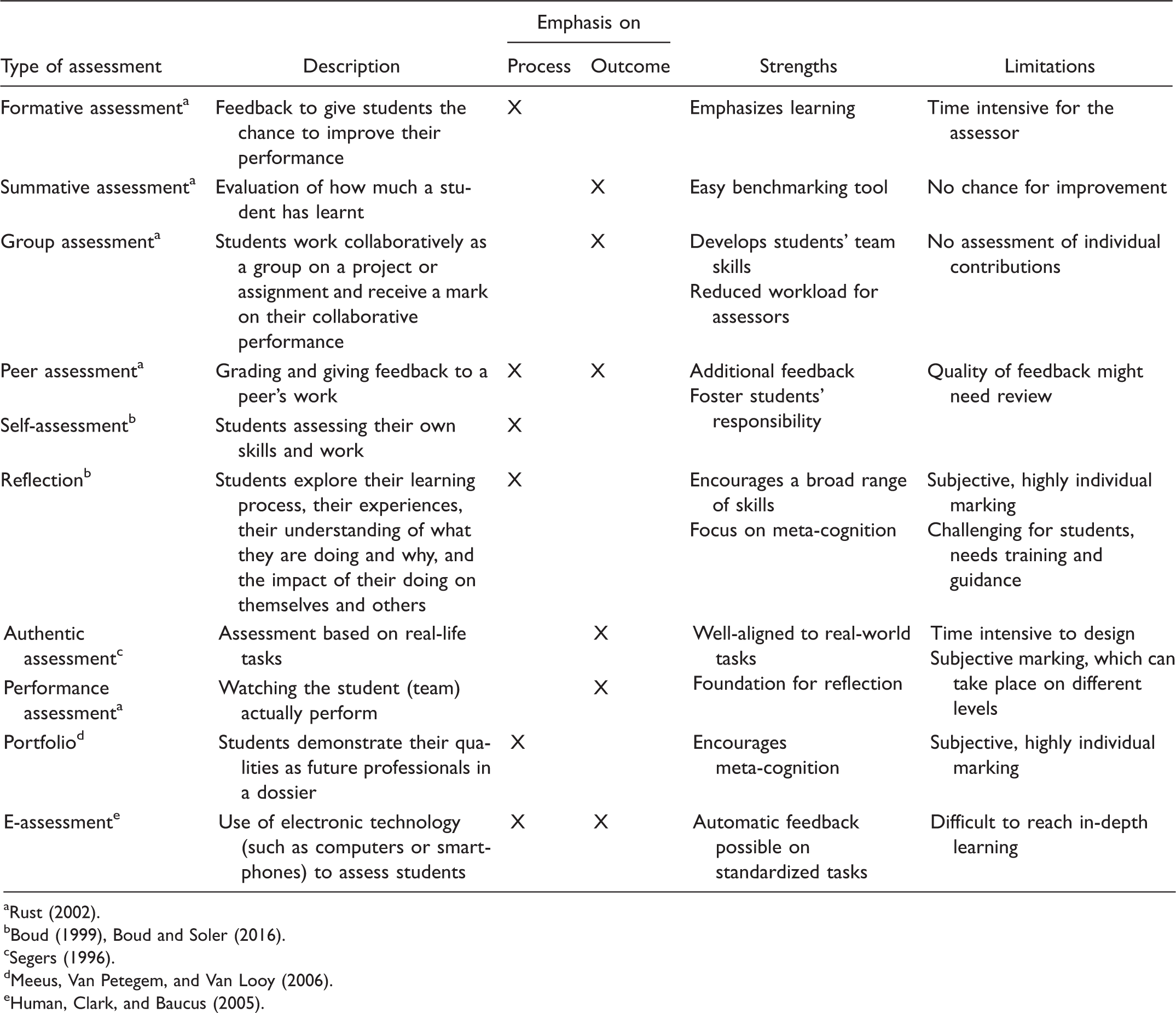
Overview of Student Assessment Types.
Rust (2002).
Boud (1999), Boud and Soler (2016).
Segers (1996).
Meeus, Van Petegem, and Van Looy (2006).
Human, Clark, and Baucus (2005).
In HE, in most cases the educator acts as the assessor. However, students can and should be integrated in the assessment process in form of self- and peer assessment. This not only has educational benefits (Rust, 2002), but also enriches the pool of assessors for rather subjective tasks. Assessment types can further be divided if they assess students individually or as a group.
In addition, strengths and limitations for students and assessors are listed in the last two columns of Table 1, which might be helpful to support educators in the evaluation of assessment methods.
It should be noted that the assessment types presented in Table 1 are not mutually exclusive. Students conducting an online self-assessment such as “The Entrepreneur Test” (Human et al., 2005) get a feel about their own standing (self-assessment), which may help to develop strategies for improvement (formative assessment) and may serve as a starting point for an in-depth diagnostic exploration of their own doing (reflection) using technology to collect responses (e-assessment).
Student Assessment in Entrepreneurship Education
In the context of EE, assessment should support students in gaining knowledge about entrepreneurial topics and, even more important, developing entrepreneurial skills (Gibb & Price, 2014). The recommended approach to teach those skills is an ABELD one (Gibb & Price, 2014; King, 2006; Lackéus, 2014; Pittaway & Edwards, 2012). This approach treats students as responsible participants who are highly involved in active learning experiences (Hoover & Whitehead, 1975).
Action is an important driver of creating a new venture. For instance, it includes the exploration of customers, validation of products, services, or prototypes with potential customers, networking, and relationship building with business partners and mentors (Bager, 2011). Action is an essential element for experiential learning, because it helps to build up experience as a basis for reflection, and abstract conceptualization, which again is the foundation for a new round of active experimentation (Kolb, 1984). For example, opportunity spotting requires a highly individualistic learning approach, which takes “everyday practice” or the learner’s personal background into account (Blenker et al., 2012).
However, EE is often delivered through normative theory-based approaches rather than contextual, experiential, and reflective methods (Rae, 2010). Many entrepreneurship programs teach business planning and tend to neglect the development of entrepreneurial skills that emphasize creativity, flexibility, critical thinking, communication, and teamwork (Boyles, 2012). A challenge for assessment of entrepreneurial courses using this approach lies in the assessment of skills and tasks that students have to develop and prove under circumstances that ask for creativity and include conditions of uncertainty. Till now, there has been a “focus on analytical approaches […] where assessment outcomes are clearly defined and predictable” (Penaluna & Penaluna, 2009a, p. 719), which is less suitable for assessing innovation and entrepreneurial activity (Pittaway & Edwards, 2012).
Therefore, this work concentrates on student assessment of EE courses that apply an ABELD approach and, specifically, courses where students have to work on real new ventures. Although by far not always used in EE (Pittaway & Edwards, 2012), it is the advised approach (Mwasalwiba, 2010). One reason for this situation might be rooted in the difficulty to assess students within such a highly flexible, creative, and complex learning environment (Lackéus, 2014). However, assessment methods of traditionally taught courses may not fit into this format (Carey & Matlay, 2010) and research investigating student assessment in action-based EE is limited.
Some examples of student assessment for ABELD EE are as follows. For instance, evaluating students on how well they do on a task to generate and evaluate sustainable business ideas for the agri-food sector (Lans, Biemans, & Baggen, 2015) uses authentic performance assessment for opportunity-related skills. Another performance assessment example for an ABELD EE course is to measure the number of clients and the profitability of the business for students running a summer consultancy business as part of their entrepreneurship program (Haines, 1988). E-assessment tools such as LoopMe or OctoSkills can be used to assess students’ attitudes toward entrepreneurship (Ruskovaara, Pihkala, & Oy, 2016). Reflective approaches (Deacon & Harris, 2011) and peer assessment (Jones & English, 2004) are well suited for students to develop relevant entrepreneurial skills such as self-esteem, as well as the ability to recognize and exploit entrepreneurial opportunities.
Student Assessment in Entrepreneurship Education for Venture Creation Courses
Even more scarce is research on student assessment of venture creation courses (Lackéus & Williams Middleton, 2015; Pittaway, Hannon, Gibb, & Thompson, 2009). Only one article systematically investigated course outlines and syllabi of entrepreneurial courses regarding student assessment (Pittaway & Edwards, 2012; see Syllabus Analysis of Venture Creation Courses section). Most research on student assessment in EE is exploratory in nature. Merely, three relevant single case studies of venture creation courses could be detected and included into this analysis (Chang & Rieple, 2013; Pardede & Lyons, 2012; Pittaway & Cope, 2007; see Single Case Studies of Venture Creation Courses section). Therefore, articles that transfer insights from related disciplines into the EE context were also considered (e.g., design thinking; Nielsen & Stovang, 2015; see Related Research section).
Figure 1 provides a framework of the focus of this article. It shows the investigated form of EE, its associated learning outcomes, the course type, and relevant key assessment considerations. More specifically, this work examines an ABELD approach that intends students to engage in real-world entrepreneurial activities in the context of a venture creation course. This research considers if the courses (a) use rather formative or summative assessment, (b) whether process- or outcome-oriented assessment is advisable, (c) who does the assessing (e.g., the educator, students, external stakeholders, etc.), (d) whether individual students or groups are assessed, and, finally (e) which assessment tasks are common.
Framework of Investigated Entrepreneurship Education and Assessment Considerations.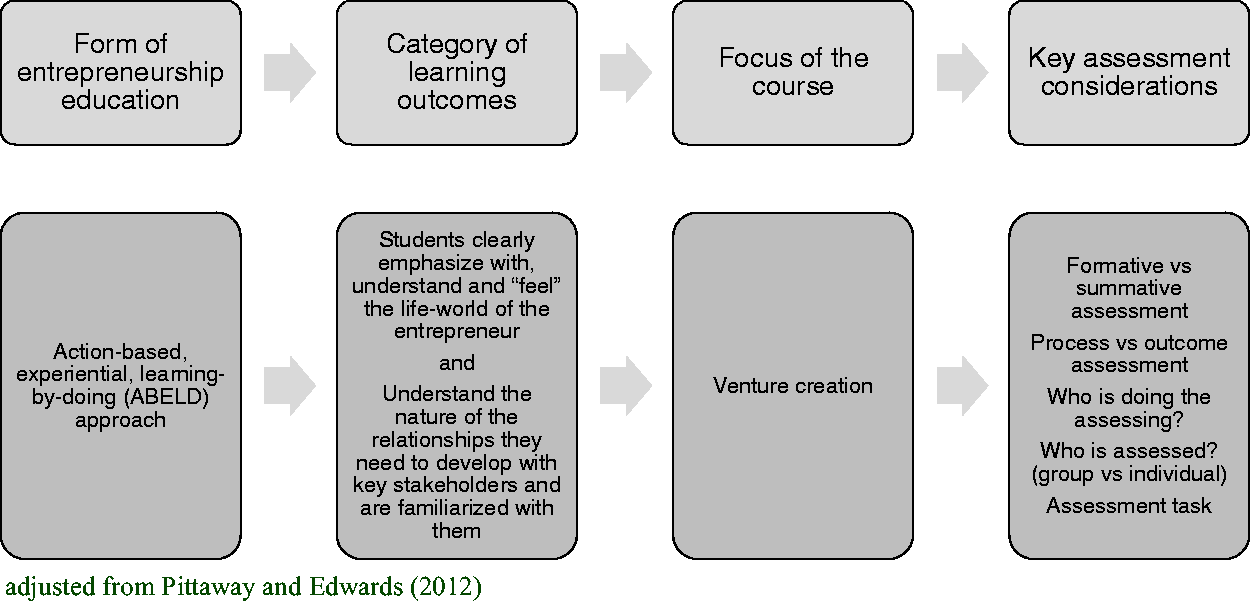
Syllabus analysis of venture creation courses
Pittaway and Edwards (2012) categorize what and how is taught in EE into four categories: “About” entrepreneurship indicates that knowledge about entrepreneurship is part of the curriculum; “For” refers to the acquisition of general skills (like idea generation) by students engaging in certain tasks; similar to the second category but more comprehensive and real; the “Through” approach is focussed on learning-by-doing activities, for example, by creating a real company within the scope of an EE course; finally, the “embedded” category integrates the first three approaches. Driven by the scarcity of research on assessment practice in EE, they conducted a comprehensive analysis of course outlines and syllabi of EE courses in the United Kingdom and the United States. They investigated assessment practices of educators or what educators actually “do” for student assessment in EE. Their first insight is a strong focus (more than half of entrepreneurial courses) on the assessment of “About” entrepreneurship content. Most common assessment forms of “For” and “Through” EE approaches are business plans or business reports (20%), presentations (16%), and in-class assessment (16%), while self-assessment (8%), peer assessment (4%), and reflective assessment practices (8%) have been far less used (Pittaway & Edwards, 2012). This highlights a tendency for subjective (vs. objective) and formative (vs. summative) assessment methods for the “For” and “Through” forms of EE. In addition, the article emphasizes the value of the inclusion of a variety of stakeholders in the process. Currently, educators are the main assessors. They found hardly differences for student assessment on undergraduate versus graduate level (Pittaway & Edwards, 2012).
Single case studies of venture creation courses
Overview of Student Assessment for ABELD Venture Creation Courses.
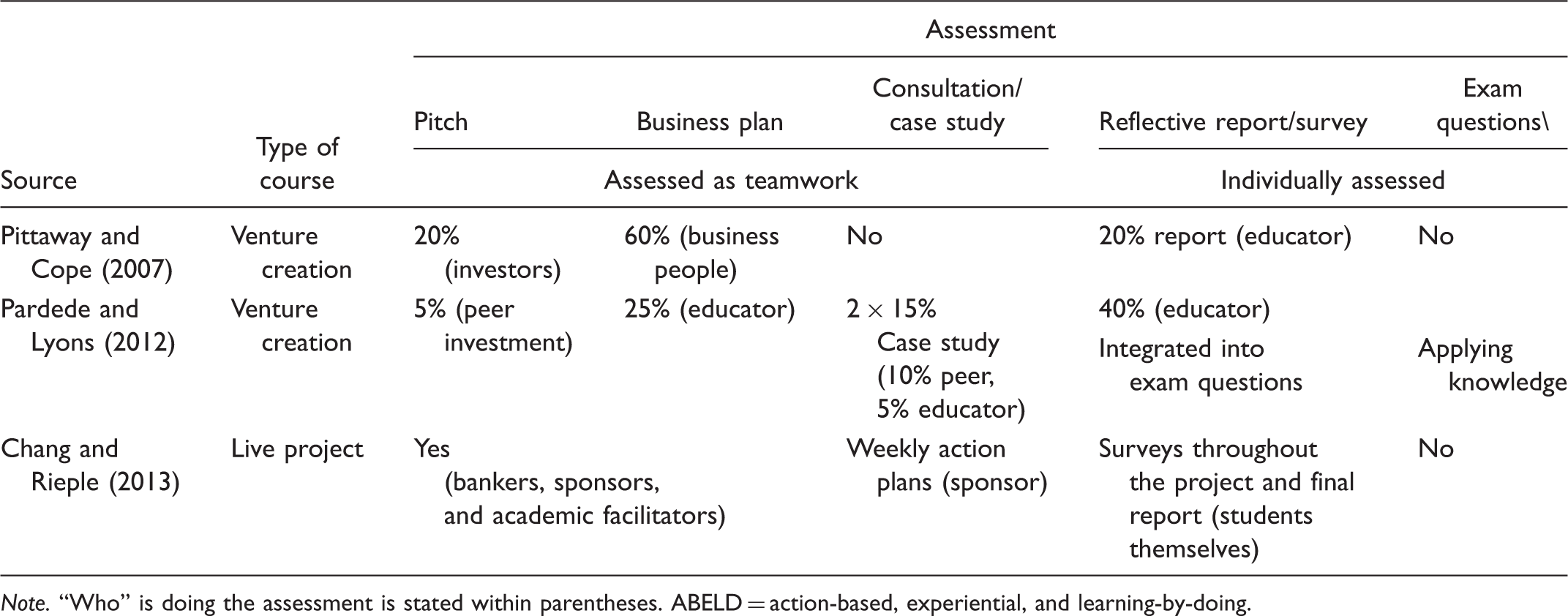
Note. “Who” is doing the assessment is stated within parentheses. ABELD = action-based, experiential, and learning-by-doing.
Pittaway and Cope (2007) emphasize an action-learning approach for entrepreneurial learning, which requires teamwork, the development of a business idea, the subsequent formulation of business propositions or a business model, as well as a verbal presentation of the venture to (potential) investors. The venture creation course’s assessment was threefold. First, student teams gave 15-minute presentations to external investors who also interviewed them (counting for 20% of the mark). Second, teams had to submit a written business plan, which was assessed by local business people, if available (worth 60% of the overall mark). Third, the final 20% of students’ mark consisted of an individual reflection on their own learning linked to management learning theories. Peer feedback was not part of the assessment. The authors state that learning loops during the whole venture creation process are important for student learning thereby emphasizing formative forms of assessment. They do not report on the usefulness of different forms of students’ assessment but focus rather on the learning activities during the course which are based on collaborative teamwork under conditions of ambiguity and time pressure (Pittaway & Cope, 2007).
Pardede and Lyons (2012) investigate the assessment of an entrepreneurship course in an Information Technology program at an Australian university. After following the examined course, students should have knowledge and skills that are required to start a new venture. The course contained different types of student assessment. The first task is assessed as a group and includes the presentation of an application of a previously taught topic to a real-life example (10% of the mark assessed by peers, 5% by the educator on peer feedback quality). Consultation hours before the presentation provide an opportunity for formative feedback. The second task is similar to the first, but it is expected that student teams integrate feedback from the first round (again 10%/5% of the mark). For the third assessed task, student teams had to write a business plan based on a novel case study and pitch it to their peers who acted as potential investors (25% assessment of the written business plan by the educator, 5% based on the virtual amount of investment from peers). The fourth and last one is a final examination based on reflective transfer questions (summative assessment, 40% of mark). Making the procedure and rationale behind the assessment tasks and in particular the peer-review process clear emerged as a major challenge for the teaching staff. Positive results for IT students’ grades and evaluation indicate that the assessment tasks were well suited for the course’s intended learning outcomes, although they are not common for Information Technology courses.
Chang and Rieple (2013) analyze the development of students’ entrepreneurial skills in the context of a live project. Real-life entrepreneurs and financiers were closely involved into the projects. This experiential learning approach significantly contributed to students’ skill development. Regular feedback and intensive mentoring through academic mentors help to check on students’ learning progress, while presentations and interactions with real-world stakeholders like bankers, sponsors, and entrepreneurs simulated uncertainty and complexity of real entrepreneurial projects and help to develop students’ entrepreneurial skills. This approach is time and resource intensive for university staff because very close supervision of student teams is needed as well as maintenance of collaboration with external partners. Students’ learning is not synchronized with traditional assessment schemes, because a decrease of self-assessed entrepreneurial skills is common for students in real-world projects.
Related research
Innovative Student Assessment for Action-based Learning Approaches in EE.
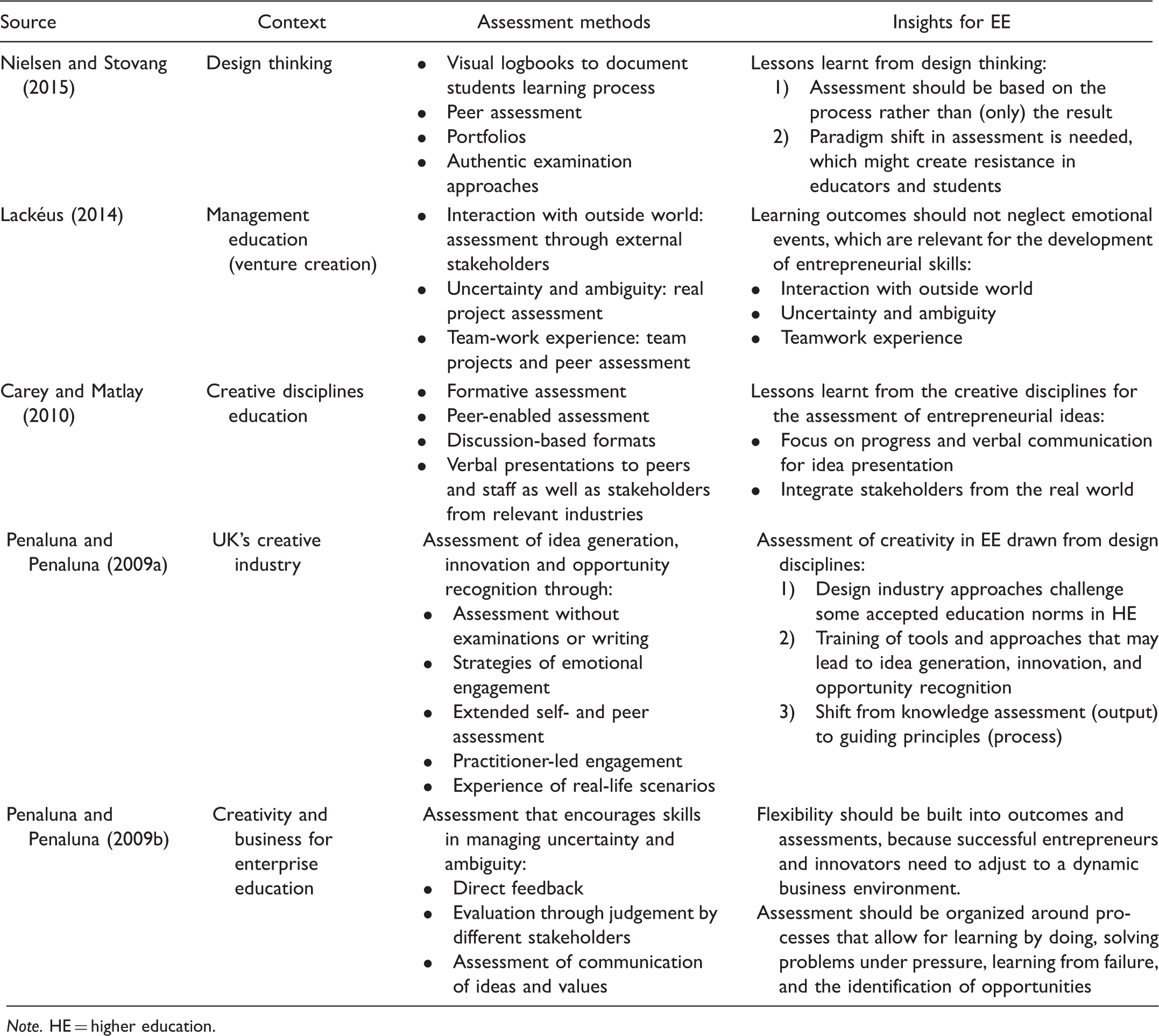
Note. HE = higher education.
A few observations from the selected related research are outlined as follows. Details can be drawn from Table 3. First, there is consensus that the focus of student assessment should shift from outcomes toward process assessment to take creativity and real-world conditions into consideration (Carey & Matlay, 2010; Nielsen & Stovang, 2015; Penaluna & Penaluna, 2009a, 2009b). Assessment methods that are well suited to cover the process component are, for example, repeated self-assessment formats (Penaluna & Penaluna, 2009a) and visual logbooks (Nielsen & Stovang, 2015). Second, considering the real-world environment marked by high levels of uncertainty and ambiguity (Lackéus, 2014; Penaluna & Penaluna, 2009b), the involvement of a variety of different stakeholders, for example, entrepreneurs from relevant industries, might offer a fruitful assessment approach. Third, some commonly accepted assessment norms might make a paradigm change for HE assessment methods necessary (Nielsen & Stovang, 2015; Penaluna & Penaluna, 2009a). Based on the nonstandard format of ABELD approaches in EE, emotional events are likely to play an important role in students’ learning process and might be considered in the assessment methods. First empirical evidence highlights the significance of emotional events that occur when students engage in teamwork and interact with the outside world, where they experience high amounts of uncertainty and time pressure (Lackéus, 2014).
Results
Taken together, the analyzed EE papers on venture creation clearly indicate that group presentations of business ideas and written business plans emerge as key assessment tasks. It is advisable to design the assessment task as a project drawn from the real world to train students to work under circumstances of uncertainty. The importance of formative assessment opportunities such as assessment without examinations but with direct feedback requires close supervision of students’ projects. The integration of various stakeholders into the assessment, including investors, entrepreneurs, peers, and the students themselves through self-assessment and reflective practices, is highly recommended in all three case studies and from literature about assessment in the context of design thinking and creativity. Instruments for reflection are, for example, logbooks to document students’ learning progress. They are a process-oriented assessment method that supports learning. Traditional assessment types such as exam questions do not play a major role, which highlights the paradigm shift that is needed to establish the proposed assessment methods.
Case Study
Background
The following descriptive case study examines assessment types applied for a venture creation project, which is part of an undergraduate e-business course at a business and management school of a university in the United Kingdom. The project incorporates real venture creation. It teaches relevant tools and aspects for creating a venture and gives students the opportunity to experience the venture creation process in an experimental learning environment. The assessment was redesigned based on the aforementioned literature review and is still subject to change for future deliveries of the course. Lessons learnt from the case can be used to evaluate other venture creation courses and more broadly, to get a better understanding of (re)designing student assessment in ABELD courses in higher education.
The investigated e-business course assesses students partly through an Internet-based venture creation project. E-business is defined here as “the transformation of key business processes through the use of Internet technologies” (Laudon & Traver, 2015). Thus, the venture has to have at least one business model component based on Internet technologies. The course includes a coursework task, which asks student teams to develop and validate their own Internet-based venture idea and present their business in a pitch at the end of the course. The course is an elective and open to all final year students. However, with very few exceptions, the majority of students are enrolled in business and management study programs and have a basic understanding of general business concepts but not necessarily of entrepreneurial aspects. This means by far not all course participants have intrinsic entrepreneurial motivation and assessment is a strong incentive for many to participate actively who are not naturally drawn to entrepreneurship.
Case Description
The 10-week venture creation project follows an ABELD approach, which encourages student teams to (a) create their own problem-based venture idea, (b) develop a business model that encompasses all relevant components, (c) take action and validate the most risky assumptions with real customers or business partners, (d) reflect on the learning of the product, service, or prototype validation, and, finally, (e) present their Internet-based venture in a pitch at the end of the course.
The intended learning outcome that is relevant to students’ venture projects reads as follows: Communicate and present business information related to e-business. The course is organized around lectures and tutorials. In particular, tutorials are designed to give students time to work in teams on their ventures with close guidance from the educators. The final group presentation takes the form of a 10-minute pitch and is assessed regarding the following criteria: (a) creativity and feasibility of the e-business venture idea and (b) impactful presentation of the e-business model.
Originally, the summative assessment of the venture creation project consisted of the educator assessing the final group presentation (pitch). Students had to present their business model including an initial validation of their most risky assumption. Formative feedback took the form of student teams informally discussing the progress of their start-ups with the educator who guided them in the development and validation of their e-business idea in the tutorials.
During one of the first lecture sessions, students got input on how to come up with problems worth solving through a business. They were encouraged to draw ideas based on their own background, experiences they made or from contexts they know, which are also of relevance to a broader segment, in other words, which have a market (Blenker et al., 2012). Every student was asked to generate at least three ideas of that kind. In the following tutorial, students presented their most promising idea to their team and decided which one to continue with and to develop further with the intention to launch as a start-up. In a second step, students were introduced to a business model framework during the lecture (e.g., Laudon & Traver, 2015, Chapter 5). During the subsequent tutorial, student teams got the chance to discuss their ideas and the initially completed business model with the educator to receive formative (unmarked) feedback for further improvement of their businesses. Because the businesses were not yet running at this time, the most risky assumptions of the business models were identified for real-world validation (Ries, 2011). Thus, students had to take action and get in contact with potential customers or relevant stakeholders. For example, a start-up that aimed at developing a Tinder-like matching system for students searching for a job and companies with open positions interviewed human resource departments responsible for the organizations’ recruitment. The validation intends to proof or reject the assumptions made in the business model. Based on the feedback the team collected, they switched from vacancies to placements, which fitted the playful matching much better. Finally, students were briefed on a general structure for their final pitch to present their business and its current status.
Thus, in terms of assessment, the original setup used a real-world venture creation project (task), which took place under conditions of uncertainty and ambiguity and relied on discussions as formative assessment and group presentations as summative assessment. The focus was clearly on the final pitch indicating an orientation towards the outcome. The only assessor was the educator.
Course Assessment Redesign
Building on the outlined investigation of relevant literature, the course’s student assessment was analyzed and consequently redesigned. The assessment task as well as the final group pitches were retained. Thus, task and group assessment stayed the same. Changes were undertaken on the assessor side and for formative and process assessments.
Originally, only the educator assessed the pitches at the end of the course. The adjustment included the invitation and participation of external guests who had the chance to ask student teams questions regarding their businesses, give oral feedback, and to fill in an assessment form that provided students with additional critical and positive aspects of their venture idea.
The formative feedback changed format as well to receive a better alignment with the final summative assessment: the group presentation of students’ venture ideas. The previously informal discussions between student teams and educator were replaced by an additional unmarked presentation before the final pitch to provide students with the opportunity to practice for the assessed presentation. This change emphasized the process, which is an essential part of learning for ABELD courses. In addition, not only the educator provided student teams with feedback on their presentation, but also other student teams from the same tutorial group could give comments and express interest or concerns (peer assessment). The increase of different opinions on the business ideas is a necessary shift to consider the creative and subjective nature of real-world venture creation.
Case Analysis and Implications
In particular, the change in formative feedback worked very well and student teams were able to integrate the received feedback into their presentations, which increased the overall quality of the final pitches and showed that learning occurred. Students had a clear conception of the educator’s expectations for the final marked presentation. The additional peer feedback also worked out quite well and students could incorporate more perspectives for the development of their venture. Because students represented the target market for quite a number of teams’ venture ideas, it was also a fruitful opportunity to get firsthand feedback from potential customers.
The invitation of external guests emerged as an organizational challenge. The course had 80 participants distributed over six tutorials, which took place at three different days. Thus, we ended up with a varying quality of feedback depending on the background of the external guests and had even a few teams without external visitors. For the tutorials with guests, the feedback was overall positive but sometimes challenging and students got a real-world impression about the potential of their ventures from people with various backgrounds and perspectives from the entrepreneurial context, policy agencies, or business.
Next, steps for further improvements of student assessment in this course are planned. For the summative assessment, they include the integration of peers’ virtual investment decision and an individual component that covers students’ self-assessment in form of an individual reflective essay. Both measures increase the pool of assessors. While fellow students’ virtual investment decision for the final pitch can be integrated easily by providing them with a fixed amount of virtual investment and a form to distribute it among the remaining teams, the reflective essay needs more preparation. Not all students might be familiar with the format of self-assessment. Thus, the educator needs to teach at least an introductory lecture about goals and expectations of reflective essays. Coordinating external stakeholders among multiple presentation time slots emerged as a challenge in the trial run. Offering one large plenary session instead of several tutorials, where all student teams shortly present their ventures, could be a solution to this organizational problem. Then, external guests need to commit only to one appointment and all student teams have the same chance to receive external feedback.
On a more general level, the case crystallizes how an educator can enrich existing course assessment with appropriate assessment types that are well suited for ABELD venture creation courses without knocking the whole course design on the head. It also demonstrates some practical challenges educators may face, for example, with the integration of external stakeholders and uncommon assessment formats for the students. Thus, integrating those assessment types needs careful consideration about preparation and organization, which research on assessment types unfortunately often neglects.
Discussion and Conclusion
Assessment is a powerful tool to direct students’ learning. With the aim to support students optimally in the development of entrepreneurial skills, this article presents an analysis of student assessment methods for ABELD venture creation courses. The findings rely on the sparse literature on student assessment of venture creation courses and research that borrows assessment ideas from related disciplines. In particular, creative disciplines have developed assessment formats building on decades of experience, which educators can utilize for venture creation courses in the business and management context. Based on the learnings from the literature review, the case study describes the redesign of student assessment of a particular ABELD venture creation project. This provides the reader with a critical reflection on the impact and feasibility of assessment redesign and offers educators a guideline for their choice of student assessment for ABELD venture creation courses.
The contribution of this work is twofold. First, results show an agreement between authors that assessment for venture creation courses needs to be different from traditionally taught courses. The literature review reveals that more innovative assessment methods should be used to assess ABELD venture creation courses. Taking insights from EE literature and related research into account, several conclusions can be drawn regarding key assessment considerations (Figure 1). Formative assessment methods are important to integrate into overall student assessment to foster learning under circumstances of uncertainty. The focus on the process is advisable above pure outcome assessment. Both recommendations are in line with experiential learning theory. Further, results highlight that the use of self-assessment and reflection methods supports the process character of learning under ambiguity and incomplete information. Self-assessment is also well suited to reflect on teamwork experienced during venture projects. Because of the creative nature of venture creation, more than one assessor should be considered, ideally drawn from different backgrounds. The consultation of relevant stakeholders like investors and entrepreneurs from target industries ensures a more holistic evaluation of business ideas and their potential, and takes creative and subjective elements better into consideration. In addition, peer assessment can further enrich perspectives and the pool of evaluators. Business plan development and pitching are among the more frequently used assessment tasks for venture creation courses and represent authentic assessment tasks in the context of venture creation.
Second, the insights from the abovementioned analyses are applied for the redesign of an undergraduate e-business course, which uses a venture creation project for student assessment. The case offers an example of how student assessment can be shifted to more intensive process evaluation and the integration of various stakeholder perspectives into the assessment. Because student assessment of venture creation activities in EE asks for more innovative methods than traditionally taught courses, students need to be taught the respective methods such as how to write a reflective report to reach depths of reflection before those assessment types can be applied in a truly useful way.
Taken together, by combining findings from the literature review and the descriptive case, this article theoretically consolidates research on student assessment for EE and provides practical guidance for educators in their choice of student assessment for ABELD venture creation courses to help students in the development of entrepreneurial skills. The recommendations take not only the current state of research into account but also include some very practical aspects an educator of such a course may encounter. Applying uncommon student assessment formats for courses offered at business and management schools needs careful consideration to align process and outcome assessment and prepare students to be able to engage successfully with the innovative assessment types. Therefore, the integration of more creative student assessment formats into venture creation courses should also consider the resources such as the workload of the educator to make it attractive for them to engage with the methods.
This investigation is not without limitations, which however offer promising opportunities for future research. First, the investigated venture creation project uses an ABELD approach but can be seen only as a starting point for a full venture creation program. In a whole program, assessment can be used to monitor students’ progress in an extended way. Second, the descriptive case study does not rely on data gathered from course participants but only on observations from the educator. Future research should integrate how learners respond to the new assessment types and the changed learning paradigm.
Overall, applying appropriate student assessment methods for ABELD venture creation courses in HE could help to prepare business schools and their alumni better not only for dynamic market conditions and a changing workforce, which require transferable skills including creativity and problem solving, but also to generate graduates’ engagement and inspiration to unleash their potential to tackle societal challenges (Lackéus, 2015).
Footnotes
Declaration of Conflicting Interests
The author(s) declared no potential conflicts of interest with respect to the research, authorship, and/or publication of this article.
Funding
The author(s) received no financial support for the research, authorship, and/or publication of this article.