







Abstract
This article describes a novel visual art-based exercise (VAE) that was developed and conducted as part of an introductory-level, project-based entrepreneurial leadership course. The VAE engages students in reflective explorations of paintings and analogical and metaphorical thinking and analysis in support of two learning outcomes. The first outcome is for students to gain greater awareness of their emergent entrepreneurial identities. The second outcome is for students to enhance their capacities to effectively integrate analogies and metaphors with entrepreneurial narratives. Participatory inquiry guides the structure and delivery of the VAE with its application being focused on opportunity identification and conceptualization, solution development, and entrepreneurial narrative development and delivery. The three stages of the exercise (i.e., Staging, Transfer, and Integration) are described in detail, and its effectiveness is qualitatively assessed specific to the intended outcomes in order to facilitate and support adoption.
Keywords
Introduction
The learning innovation presented in this article is a novel visual art-based exercise (VAE) that was implemented as part of an introductory-level entrepreneurial leadership course that primarily targets students pursuing degree programs outside of the management fields. In the context of this course, entrepreneurial leadership is defined as, “the strategic process for identifying and understanding opportunities for change within and across organizational environments, formulating innovative models for acting on such opportunities, and mobilizing and allocating the resources needed to advance and sustain the targeted change” (Mars & Torres, 2018, p. 112). This broad definition does not confine the course or the VAE to a particular type of entrepreneurship (e.g., commercial entrepreneurship, social entrepreneurship). Instead, students are encouraged to view entrepreneurial leadership as the creation of scalable change via entrepreneurial strategy with applicability and relevancy spanning all fields of study, organizational environments, and professional pathways.
The VAE, which actively engages students in the exploration and analysis of paintings, was designed based on two outcomes. First, students will gain greater awareness of their emergent entrepreneurial identities through analogical and metaphorical thinking and analysis. This intended outcome is consistent with existing research that indicates analogical and metaphorical thinking and analysis can positively influence the development of entrepreneurial identities (Cardon, Zietsma, Saparito, Matherne, & Davis, 2005; Clarke & Holt, 2017). Second, students will develop enhanced capacities to effectively integrate analogies and metaphors with entrepreneurial narratives. This intended outcome is based on the recognition that analogical and metaphorical thinking and analysis can assist entrepreneurial leaders in the identification and conceptualization of opportunities for innovation as well as in the development and delivery of compelling entrepreneurial narratives to diverse audiences (Cornelissen, Holt, & Zundel, 2011; Manning & Bejarano, 2017; Martens, Jennings, & Devereaux, 2007).
The implementation of the VAE is guided by the following three objectives:
Students will explore and situate paintings in the contexts of themselves as entrepreneurial leaders. Students will evoke deeper meaning and understanding of themselves as entrepreneurial leaders through their engagement with paintings. Students will compose painting-based analogies and metaphors that bring greater meaning, depth of understanding, and clarity to their entrepreneurial leadership project narratives.
Returning to the aforesaid learning outcomes, the first two objectives require students to deeply reflect on their entrepreneurial identifies, while the third demands entrepreneurial action in the form of narrative development. Overall, the design of the VAE is consistent with the practice of transdisciplinary art integration, which is a pedagogical approach that challenges learners to “explore knowledge and perspectives of academic disciplines while using artistic and integrated methods that disrupt discipline-specific habits of mind” (Marshal, 2014, p. 107).
Course Context
In this article, the VAE is described specific to applications that occurred as part of two separate offerings of the same introductory-level entrepreneurial leadership course. The first application took place in 2018 and the second in 2019 with no notable variation in the structure or delivery of exercise. The course offerings were both composed mostly of third-year undergraduate students (2018, n = 35; 2019, n = 37) who were pursuing degree programs that spanned agriculture, business, education, engineering, health sciences, humanities, natural sciences, and social and behavioral sciences. Such disciplinary diversity is reflective of the broader movement to expand entrepreneurial learning beyond the conventional boundaries of management education to include all fields of study (Katz, Roberts, Strom, & Freilich, 2014).
Consistent with the previous definition of entrepreneurial leadership, the course was developed to equip students with the knowledge and skills necessary to effectively lead change within their communities and professions. On both occasions, the delivery of the course was project-based with students working in teams of two to three over the duration of a 16-week semester period to create entrepreneurial strategies for advancing innovative solutions to community- and market-based opportunities. Teams were allowed the complete freedom to identify the opportunities that would become the focus of their projects. As such, the project topics varied widely to include, for example, healthcare for the homeless, waste management, and wellness in the workplace. The course culminated in public presentations and follow-up discussions with expert panels that included academics, experienced entrepreneurs of various backgrounds, community leaders, classmates, and other invited guests.
Exercise Structure and Application
The VAE includes three phases that progressively span the ways of knowing (experiential, presentational, propositional, and practical) that Heron and Reason (1997) argue together constitute participatory inquiry. This type of inquiry empowers students with the skills needed to craft their own interpretative understandings of phenomena. In the case of the VAE, engaging paintings through participatory inquiry encourages students to develop deeper insights into their entrepreneurial identities and bring more sophistication and familiarity to the stories they aim to convey through their projects (see Leavy, 2015).
As described here, the VAE began during the second week of each of the two course offerings and continued to unfold over the remainder of the respective semesters. The VAE concluded with each team integrating at least one painting-based analogy or metaphor in their entrepreneurial narrative that aligned with the opportunity they aimed to address or with their proposed innovation. Each team presented their narrative during the closing rounds of public presentations and ensuing discussions with the expert panels. Next, each of the three phases (i.e., Staging, Transfer, and Integration) of the VAE is described in detail.
Staging Phase
The Staging Phase begins with an introduction to the meaning and relevance of analogical and metaphorical thinking to entrepreneurial narrative development and storytelling. This initial step should underscore for students the efficacy of analogies and metaphors in making unfamiliar elements and value propositions of proposed entrepreneurial initiatives more relatable to audience members (Lounsbury & Glynn, 2001; Manning & Bejarano, 2017). As an example, discussing the persuasive power of visual images in advertising campaigns is a particularly effective way of illustrating such efficaciousness in a context that is recognizable to students (see Branthwaite, 2002; Hagtvedt & Patrick, 2008).
Initial discussions should also explore the relevance of visual analogies and metaphors to leaders who are consistently challenged to better understand and articulate to others the complexities associated with various opportunities for change and impact (Barry, 1996; Koivunen & Parush, 2019; Nissley, 2010; Parush & Koivunen, 2014). This exploration also serves to further introduce students to the relevance of analogies and metaphors to entrepreneurial leaders who are inherently tasked with mobilizing change within contemporary environments that are marked by “change, ambiguity, unpredictability, and turbulence” (Adler, 2006, p. 490). In addition, it is at this point that instructors should emphasize the value of using visual analogies and metaphors to turn individual perceptions of innovative ideas and entrepreneurial strategies, including those uniquely held by team members, into collectively understood storylines (Seidel & O'Mahony, 2014).
The next step in the Staging Phase involves introducing students to a set of basic skills and practices to aid the independent engagement and interpretation of works of art, especially paintings. This task is likely to be one of the more challenging pedagogical elements of the VAE considering entrepreneurial educators are themselves unlikely to also be experts in art education. Accordingly, instructors are encouraged to seek the assistance of relevant experts (e.g., curators, art history and fine arts faculty, practicing artists) to work with students and themselves on developing the skills and knowledge needed to find and convey meaning in paintings. In both of the two applications of the VAE that are described here, the curator of the university's art museum provided students with a primer on engaging paintings early in the Staging Phase. She also continued to be available throughout the duration of the VAE to provide students and the instructor with further guidance on engaging paintings.
The primer took place at the museum during the third week of each of the course offerings and involved both a lecture and an exploratory discussion of 26 purposefully selected paintings that spanned a range of artistic representations of human ingenuity and progress. The ingenuity and progress theme of the paintings directly aligned the primer with the opportunity identification and analysis and innovative solution development content of the course and corresponding components of the team projects. In addition, the curator provided the students with background information on each of the paintings (e.g., painter's name, year and period of creation, genre, general description), which they were instructed to independently review in preparation for the museum visit. Once at the museum, the curator initiated the primer with a brief synopsis of each of the paintings, which included a condensed overview of the artists' backgrounds, techniques used, and periods of creation.
Most importantly, the primer provided the students and the instructor with a set of basic questions to ask when independently engaging and deriving meaning from paintings. Examples of such questions included: Why was a particular color(s) likely selected? Why was a particular object(s) likely included? What message does the appearance(s) and expression(s) of individuals included in a painting convey? What meaning might an abstract image(s) convey? What is most striking about the painting? What type of emotional, physical, and intellectual response does the painting evoke within you?
Returning to Heron and Reason's (1997) view of participatory inquiry, experiential knowing involves the inner interpretation and development of subjective realities through the sharp attunement with and deep reflection on a being or object (i.e., work of art; Heron & Reason, 1997). To reinforce experiential knowing, the students were at this point instructed to begin journaling their responses to and reflections on particular pieces as well as any insights into themselves and their course projects that were revealed through their engagement with the paintings (Hubbs & Brand, 2005; Pavlovich, Collins, & Jones, 2009). Specifically, the students were asked to reflect in writing on the following four prompts:
Discuss how a particular painting(s) conveyed meaning to you as an aspiring entrepreneurial leader or to your entrepreneurial leadership team. How, in your view, did a particular painting(s) reflect, if at all, the influence of entrepreneurial leadership on the human condition? How might a particular painting(s) be used to depict and convey the opportunity for an entrepreneurial leadership intervention? How might a particular painting(s) be used to depict and convey the value proposition of an innovation and/or entrepreneurial leadership initiative?
Student journaling continued throughout the remaining phases of the exercise, which worked to bring further contemplation and internalization to the learning process. To bring consistency and depth to the reflections, students were asked to consider the same four prompts whenever journaling occurred. The one exception was the third and fourth prompts being revised in the later stages of the course to be made specific to the student projects. Consistent with Kolb and Kolb's (2009) recommendation, students were asked to submit to the instructor through the course website a one-page summary of their responses to each prompt at the conclusion of each phase. The summaries served as a mechanism for consistent dialogue and feedback between the students and the instructor.
While partnering with art experts is strongly advised, instructors who adopt the VAE are also encouraged to develop their own working knowledge of how to engage paintings in order to best support student learning over the duration of the exercise. One particularly accessible resource for helping entrepreneurship educators and their students to further develop their abilities to meaningful engage paintings is Justin Paton's (2005) How to Look at a Painting. This concise text, which was written specifically for novice viewers and those who otherwise struggle to meaningfully connect with paintings (Deeth, 2012), provides readers with a practical, yet thorough approach to engaging paintings. Particularly relevant to the VAE is Paton's (2005) belief that “museum going is never more memorable than when you find the work that seems painted for you and you only” (p. 36). Indeed, the intended outcomes of the VAE are largely dependent on students seeking out their entrepreneurial identities and positioning the entrepreneurial narratives of their projects within the meanings and messages that are conveyed to them through the paintings that they engage.
The memorable moments that Paton (2005) encourages rely on viewers not being “passive observer(s) of something bolted to the walls of history, nor … [as] a focus-group flunkey(s), ticking boxes. You're [viewers] a participant(s) in the life of art” (p. 45). Accordingly, he describes a number of practical steps and sensible perspectives to support the active engagement of viewers with paintings. One such strategy is to learn the history of paintings prior to viewing them, which is consistent with the individual preparation the students were asked to perform by the curator as the first step of the previously described primer. More specifically, Paton advises that “a few sharp facts are often all you [viewers] need to force open the door of the past and find your way into a painting” (p. 47). Other examples of the strategies described by Paton include: (a) taking time to fully explore and experience each piece without rushing to initial judgment; (b) paying careful attention to what is noticed about a piece and the emotional and physical responses that arise from it rather than simply deciding whether or not a piece is likable; and (c) trying to imagine the perspectives of those who may have different reactions to, experiences with, and views of a particular piece.
A full exploration and detailed summary of Paton's (2005) steps to actively engaging paintings is beyond the scope of this article. However, instructors are encouraged to review the book in its entirety and, if compelled by its accessibility and usefulness, include it as a required reading to be discussed at the onset of the Staging Phase and returned to as needed over the duration of the exercise. Paton also closes his book with a list of 26 additional readings that instructors and students alike can use to further their capacities to more meaningfully engage and evoke meaning from paintings.
Transfer Phase
The Transfer Phase centers on in-class discussions and the processing of the insights that were generated during the previous phase. In particular, the experiential knowing that occurred through the Staging Phase is transferred to the development of painting-based analogies and metaphors that are reflective of the students' emergent entrepreneurial identities and informative to the entrepreneurial stories they are crafting through their projects. This transfer process requires students to engage in both presentational and propositional knowing as articulated by Heron and Reason (1997). Presentational knowing involves the creation of symbolic illustrations of the meaning and significance of an individual's subjective interpretations of the world that evolve from experiential knowing. Propositional knowing entails further refining the symbolic illustrations into more sophisticated articulations of one's subjective views of phenomena (e.g., analogies and metaphors). In the two applications of the VAE that are described here, the Transfer Phase was facilitated during the two class meetings that immediately followed the museum visit. The four prompts used to guide students in their reflective journaling were again used to frame the group discussion and processing.
Insights raised during the class discussion of Grosz's 1934 watercolor painting titled Waiting for a Job (see Figure 1) are illustrative of the intent of the Transfer Phase. This Great Depression era painting relies on shades of blues and grays to depict four men of apparent working class status looking off despairingly into the distance. A number of students reported sensing within the painting a mix of helplessness and hopelessness. The students were then prompted to relate the meaning they derived from their interactions with the painting to both entrepreneurial leadership and themselves as entrepreneurial leaders. While specific responses varied from one student to the next, a common perspective was the understanding of entrepreneurial leaders as those who impact society through innovative problem-solving and opportunity creation. Theoretical views on the intersection of entrepreneurial leadership and social change and progress had been covered previously through lecture and assigned readings. Yet, the students' reflections and perspectives on such views deepened through their engagement with Grosz's painting. Such meaning-making was particularly impactful to those students pursing degrees outside of the management fields and struggling to intersect entrepreneurial leadership with their primary academic interests and chosen career paths.
George Grosz, Waiting for a Job, 1934; watercolor on paper; ©2019 Estate of George Grosz / Licensed by VAGA at Artists Rights Society (ARS) NY. Collection of The University of Arizona Museum of Art, Tucson; Gift of C. Leonard Pfeiffer.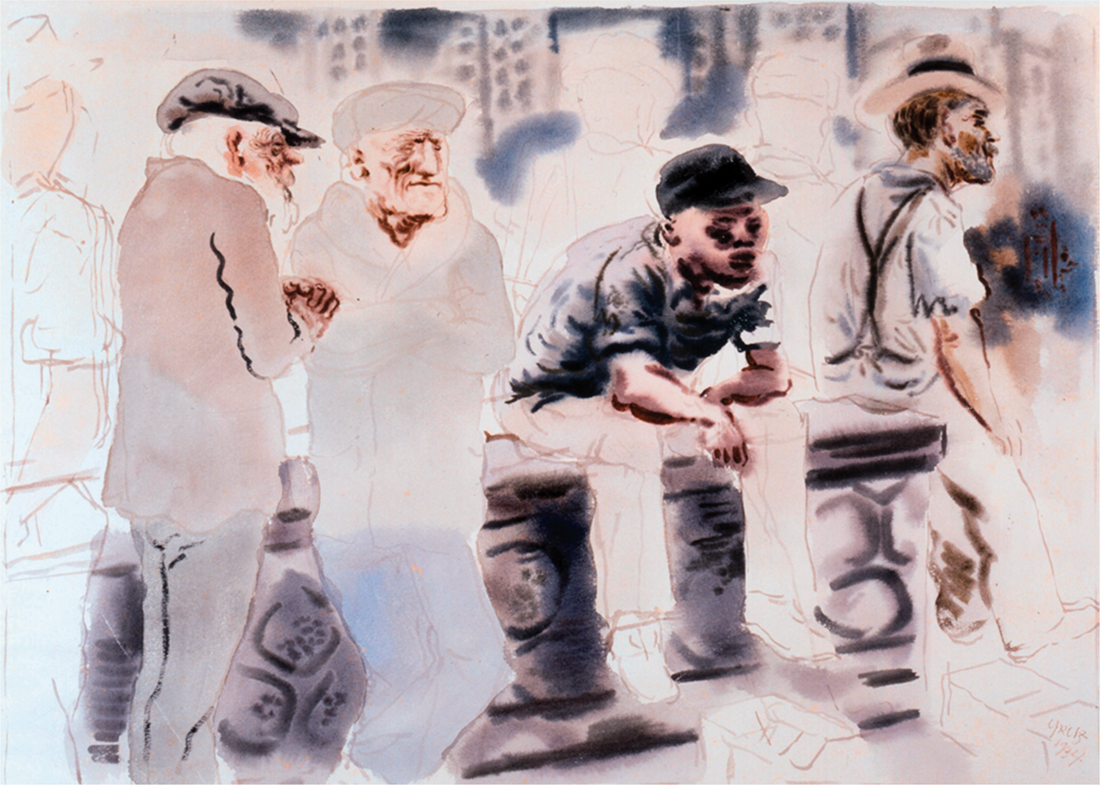
The students also described how certain paintings further revealed to them the communicative potential of painting-based analogies and metaphors. For example, consider the following thoughts shared by one student when commenting on her engagement with Erik Desmazieres's 1974 etching titled Les Roues (see Figure 2): “It [etching] is too positive. It would be a more complete metaphor if the edges became darker as the floors build upward. This would remind us of the trade-offs that always happen with innovation.” Here, the student struggled with a disconnect between the unintentional costs that are inherently created through innovation and the one-sided message of optimism that was conveyed to her by the painting. This critique is an indication of propositional knowing in that the student was able to discern how if she were the artist she would have altered the painting to more clearly articulate her own subjective worldview.
Erik Desmazieres, Les Roues, 1974, etching; ©Artists Rights Society (ARS), New York / ADAGP, Paris. Collection of The University of Arizona Museum of Art, Tucson; Museum Purchase with Funds Provided by the Edward J. Gallagher, Jr. Memorial Fund.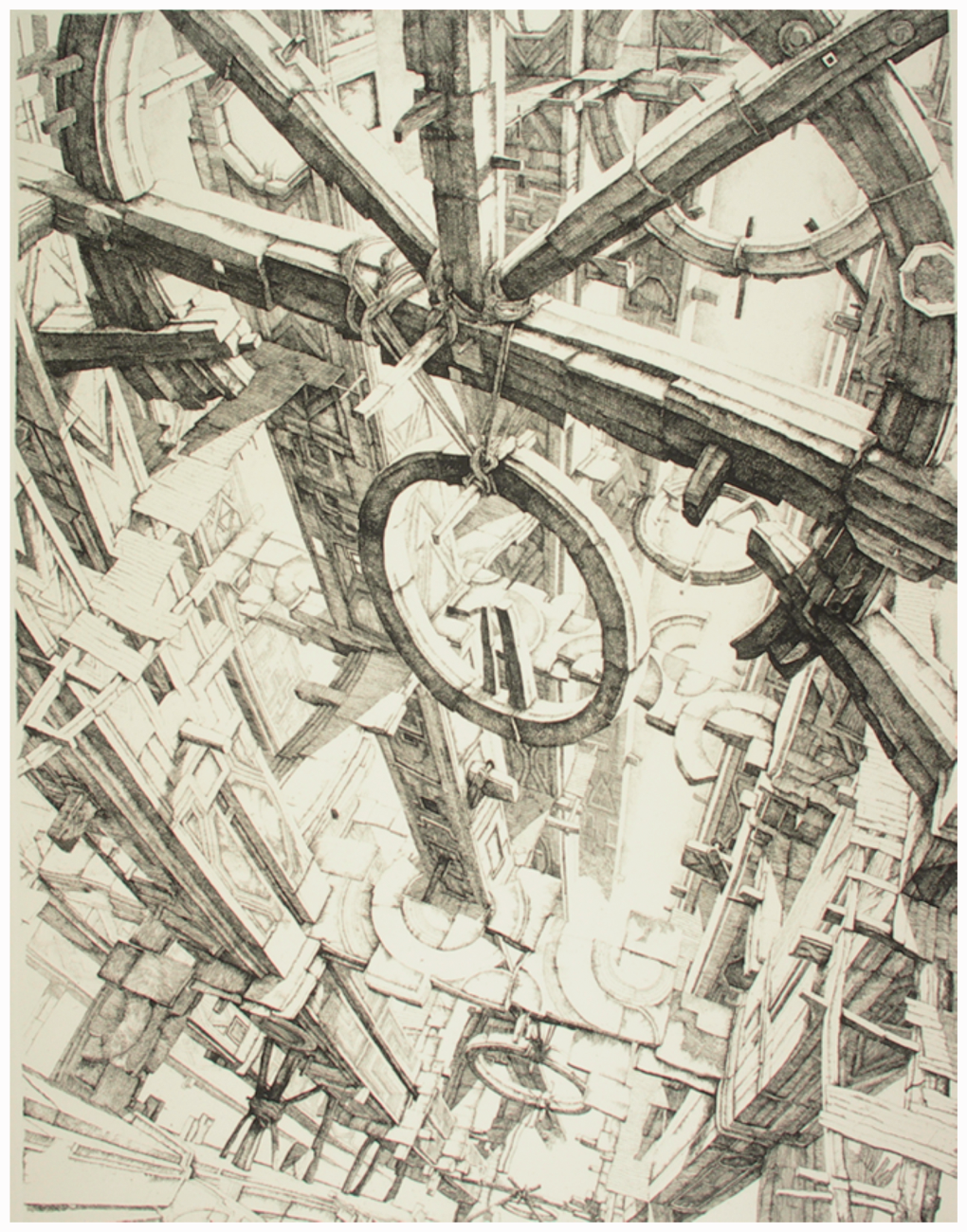
In some cases, engagement with the paintings helped students more firmly position their emergent entrepreneurial identities within the contexts of their already established academic and professional goals. For example, one student described how her engagement with and reflection on a number of the pieces reduced her initial skepticism regarding the relevance of entrepreneurial leadership and action to her own interests in scientific research. She stated: Being an entrepreneurial scientist can help me get others to support the use of new technologies in ways that are good for us [society] and the environment. Yeah, entrepreneurship could be a good way to get others excited about science! Just like the paintings helped inspire me to think more about myself as an entrepreneurial scientist.
The analogical and metaphorical thinking and analysis that the students performed throughout the Transfer Phase also had early influence on the conceptualization and development of their project narratives. For example, members of one team described how George Arntz's 1975 untitled (Big Bertha) watercolor had helped them individually and collectively better understand the meaning and value that they were subjectively placing on their own project (see The University of Arizona Museum of Art's Collection Database, nd). Specifically, the team was developing an innovative process for collecting and repurposing food waste from restaurants. By actively reflecting on Arntz's piece, the students began to view their project as a weapon to be applied to the “war between consumption and conservation.” This example is illustrative of the influence of presentational and propositional knowing, as well as analogical and metaphorical thinking and analysis, on the students' positioning of their projects in broader economic, environmental, and societal contexts.
Integration Phase
Finally, the Integration Phase encourages students to undertake practical knowing, which is a culmination and expression of all three of the prior forms of knowing (Heron & Reason, 1997). Practical knowing occurs through the VAE when students are able to demonstrate their individual and collective abilities to engage paintings in ways that heighten their awareness of their entrepreneurial identities and continue to enhance their entrepreneurial storytelling capacities. Specifically, the requirement that they develop and integrate painting-based analogies and metaphors with their entrepreneurial narratives challenges them to directly act on the knowledge and wisdom that they had gained by engaging paintings. Equally important, the continuation of reflective journaling pushes the students to individually explore the insights into their own entrepreneurial identities as they engaged various paintings in search of meaningful analogies or metaphors.
In both of the two applications of the VAE that are being described here, the Integration Phase unfolded throughout the remainder of the semester with teams identifying, contextualizing, and integrating at least one painting-based analogy or metaphor with their project narratives. The teams had full discretion in identifying paintings to engage apart from those 26 pieces that were included in the museum primer. Thus, the teams were required to engage in self-directed explorations of paintings using lenses that were specific to themselves and their team projects. The autonomy that was demanded of students throughout this phase is consistent with Ranciere's (1991) notion of intellectual emancipation, which is a pedagogical approach that provides students with the freedom to “take the measure of his [or her] intellectual capacity, and decide how to use it” (p. 17). Such emancipation is especially relevant to entrepreneurship education considering the importance of autonomous action and decision-making to the entrepreneurial process (Lumpkin, Cogliser, & Schneider, 2009; van Gelderen, 2010).
The progress made by each team during this final phase of the VAE was guided and monitored through weekly meetings with the instructor, the continuation of reflective journaling, and during periodic class discussions similar to those that occurred during the Transfer Phase. Teams received further feedback on the integration of the painting analogies or metaphors with their entrepreneurial narratives during a round of presentation run-throughs that spanned the two class meetings leading up to the final public event. In addition, a majority of the teams continued to seek guidance from the museum curator.
The analogy that one particular team formulated to help convey the potential impact of their innovative approach to reducing prison recidivism rates exemplifies the learning that took place during this phase. Specifically, the team developed a provocative analogy based on a painting that characterized an incarcerated individual as being part human and part ape. Specifically, the team called on the analogy during the public presentation of their project as follows: We know how bold it is to compare prisoners to this, to something inhuman. These ex-offenders are looked at as subhuman, not as the people they are, and often times through no fault of their own. We want to transform this common perception, because they aren't animals, they're people, and they will only become better people by the time they finish our program.
Assessment
Postexercise Reflection Protocol.
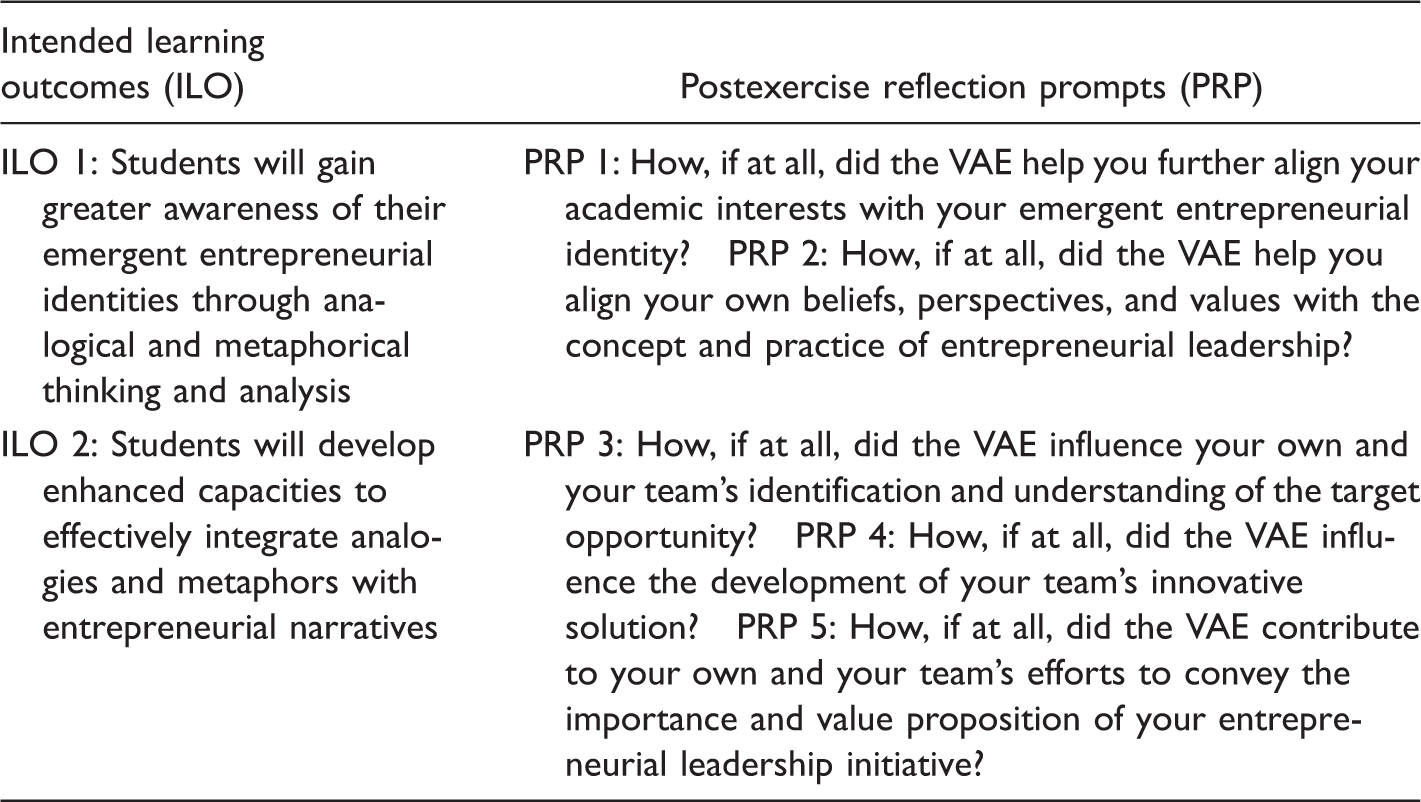
Preparation for the assessment took place during the class meeting immediately following the public presentations of the projects and discussions with the expert panel. Preparation involved a live review of each prompt, which allowed students the opportunity to seek clarification on what was being asked of them. The students were also encouraged to return to and further consider the self-observations they recorded in their journals at the end of each of the three VAE phases when completing the assessment prompts. The students individually submitted their assessment responses through the course website prior to the next class meeting. Completion of the assessment outside of class time allowed the students adequate time for contemplation and reflection. All 37 students completed and submitted the assessment. The assessment concluded with a 30-minute open discussion of the students' experiences with and perspectives on the VAE, which occurred during the class meeting that immediately followed the submission of the assessment. Recommendations for improvement and refinement provided by the students during this open discussion were noted.
Learning Outcome One: Sample of Evidence of VAE Influence on Learning and Development.
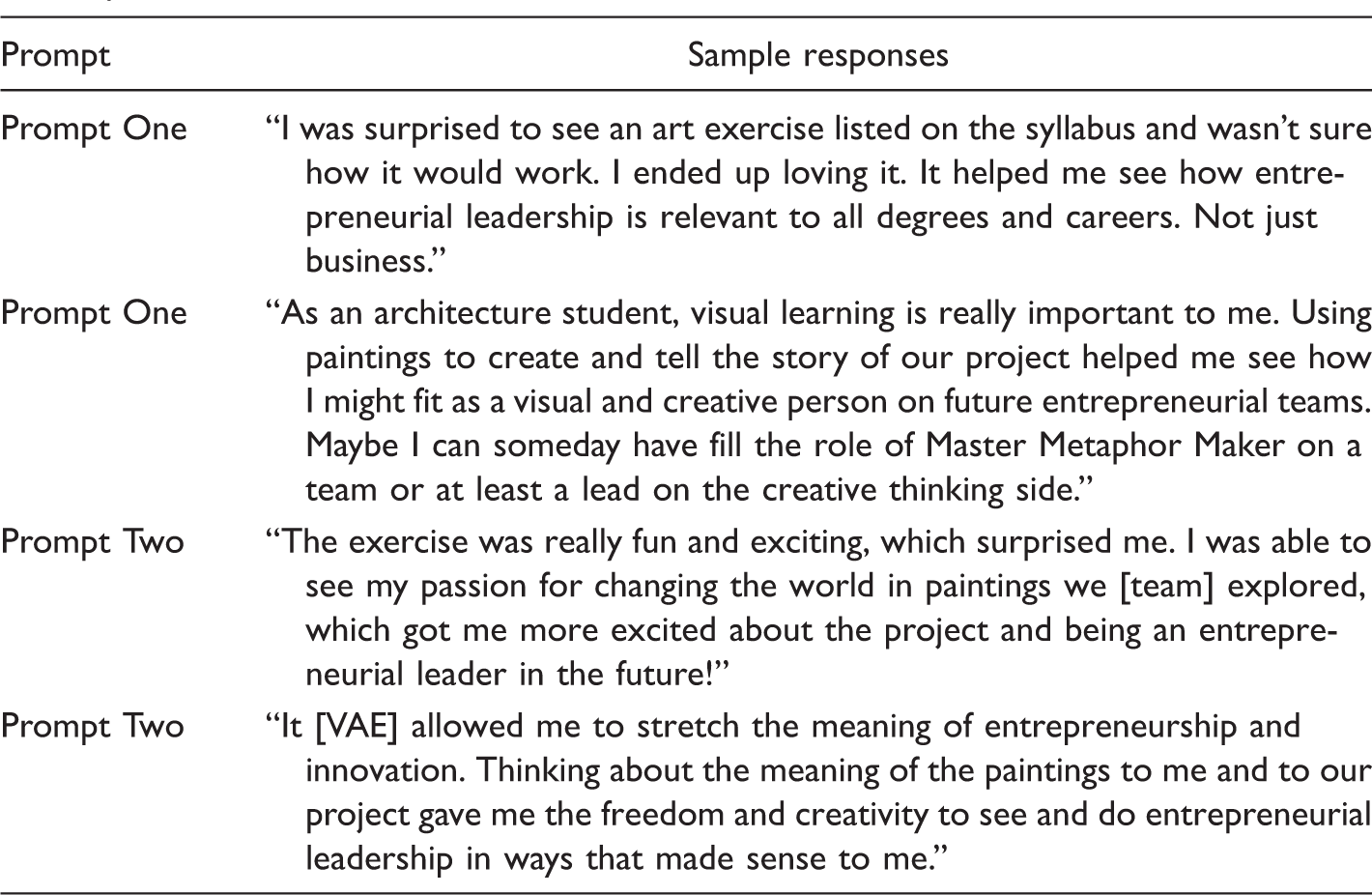
Learning Outcome Two: Sample of Evidence of VAE Influence on Learning and Development.
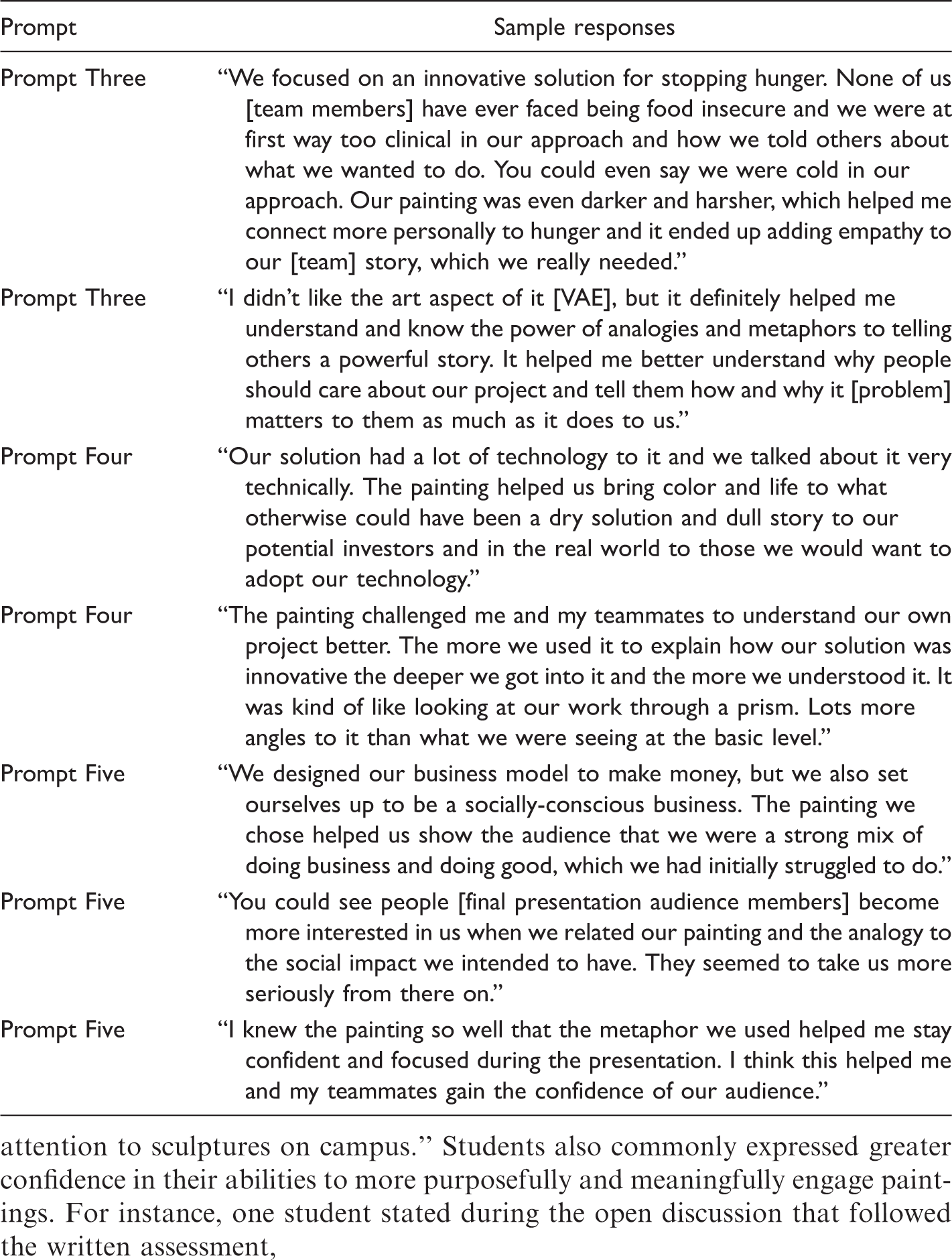
The student comments also showed the VAE to be an effective tool for fostering abstract and critical thinking and analysis. For example, one student wrote, “the process forced me to think less concretely and more creatively. My engineering courses do not require this and it was hard. But, I think it'll help me in the future as an engineer and potentially an entrepreneur.” Similarly, another student wrote, “My team and I considered possibilities that we probably would not have thought of if it weren't for the [VAE] assignments. It helped us ask what else we should be thinking of besides the obvious.” This result is consistent with existing research that shows a positive association between the development and use of analogies and metaphors and the capacities to think both abstractly and critically (Mayo, 2001). This underlying outcome of the exercise is especially promising in relation to the high demand for such capacities within academic and professional environments (Trilling & Fadel, 2009).
An additional unintended outcome that was revealed through the assessment was an overall increase in student interest in paintings and, more generally, art. For example, one student wrote, “Art has never done much for me, but now I am really interested in seeing more paintings and am also paying more attention to sculptures on campus.” Students also commonly expressed greater confidence in their abilities to more purposefully and meaningfully engage paintings. For instance, one student stated during the open discussion that followed the written assessment, I am now much more interested and less intimated by art. I am looking forward to visiting new museums and continuing to build by skills and confidence to view and make sense of art. I think this will be great for me both personally and professionally.
The students also offered several suggestions for improving the VAE during the open discussion. The first suggestion was to encourage future students to complete an art history course before or enroll in one concurrent to their enrollment in the entrepreneurial leadership course. The intent of this suggestion is to enhance (not replace) the preparation for engagement that occurs during the Staging Phase as well as to further develop the confidence and capabilities needed to effectively complete the Transfer and Integration Phases of the VAE. Similarly, the students also encouraged the participation of a painter as a complement to the perspective and mentorship provided by the museum curator over the duration of the exercise. Finally, the students recommended broadening the scope of the exercise to include other visual art media (e.g., architectural design, photographs, sculptures). In the words of one student, “doing so would make many more artworks, such as the sculptures and statues around campus and in the city, available to us and our projects.”
Conclusion
In closing, the three phases that structure the VAE have been outlined using its application as a backdrop during two separate offerings of an introductory-level entrepreneurial leadership course (see online Appendix A). The exercise is based on two intended outcomes that together aim to foster among students a greater awareness of their own entrepreneurial identities and enhanced capacities to effectively integrate analogies and metaphors with entrepreneurial narratives. The engagement of paintings (or other media) is undoubtedly central to the exercise. Yet, the primary value of the learning innovation described here rests squarely in the identity development and deeper learning it fosters among emergent entrepreneurial leaders via analogical and metaphorical thinking and analysis.
Footnotes
Declaration of Conflicting Interests
The author(s) declared no potential conflicts of interest with respect to the research, authorship, and/or publication of this article.
Funding
The author(s) received no financial support for the research, authorship, and/or publication of this article.

Supplemental Material
Supplemental material for this article is available online.