







Abstract
This conceptual article aims to stimulate the educational discussion in entrepreneurship by identifying instructional differences among the three modes of entrepreneurship education, that is, the so-called “about,” “for,” and “through.” Based on a common understanding of instructional design, restricted to knowledge, skills, attitudes and inclusive to the vast majority of educators, differences in priorities, requirements, methods, and content for building up each separate mode are critically addressed. These differences reveal the nature and latent expectations for each instructional mode and possibilities for future studies. It emerges that the “about” mode follows the positivistic paradigm, the “for” follows the vocational education and training one, while the “through” is inherently transformational. Critical entrepreneurship education can be regarded as a distinct form closely related with the three previous modes in specific ways. It can be concluded that there is an inequality among the modes (“about” < “for” < “through”) regarding their revolutionary perspective (i.e., transformative at macro-level) associated with efficient confrontation of attitudes. Implications mostly pertain to future implementations and empirical research in the field.
The primordial question one is faced with in literature when entering the field is “can entrepreneurship be taught?” In some scholars’ reflective inquiries, “what do we teach when we teach entrepreneurship?” also appears (e.g., Fayolle, 2013; Hytti & O’Gorman, 2004; Liguori et al., 2018; Neck & Corbett, 2018; O’Connor, 2013; Pittaway & Cope, 2007a, 2007b; Williams Middleton & Donnellon, 2014). Even before the influential article of Shane and Venkataraman (2000), scholars questioned the theory of entrepreneurship, particularly regarding the individual unit of analysis (cf. Bygrave & Hofer, 1992). Liguori et al. (2018) note the rapid growth of entrepreneurship education (EE) “has come at a cost: we grew so fast we outpaced our own understanding of what to teach, how to teach it, and how entrepreneurial learning is best measured” (p. 5).
Given the previous field-specific perspective, the educational research question for this study pertains to “how different forms of entrepreneurship education (hereafter EE) can be compared regarding the core KSA triptych (i.e. knowledge, skills, attitudes) which the majority of educators adopt for instructional design.” Despite the wide literature of EE and multiperspective reflections, some referred in this article, scholars have provided poor guidance and practical insights on how educators are capable of developing efficient entrepreneurial teaching. Theoretical elaboration on entrepreneurial KSA (i.e., the very core of instructional design) has been scant leaving educators to empirically, or even improvisationally, develop curricula. Courses can be hardly compared each other maintaining the observed fragmentation in the field (e.g., Fayolle, 2013). This article offers a critical examination of the instructional intersection between different forms (or modes) of EE suggesting that “about” entrepreneurship mostly refers to (contingent) knowledge, “for” entrepreneurship to skills, and “through” entrepreneurship to attitudes. Complementing this point, a further question needs to be addressed: “How is critical EE related to the KSA triptych and the previous forms of EE?” This is a second concept of criticality, that is, different to the critical examination of the three modes of EE, related to the principles of critical pedagogy addressed in a subsequent section. Critical aspects of EE—a certain objective of this volume—have recently appeared in the domain (see Berglund & Verduyn, 2018); nonetheless, it remains ambiguous how entrepreneurship educators perceive criticality and embrace it in their practice. An educationally consistent connection of critical aspects of EE with KSA and different forms of EE, especially the “through” mode, also contributes in the extant literature toward a more critical EE with progression as a transformative form of pedagogy (cf. Kyrö, 2015).
Therefore, the impetus of this article is twofold. First, it critically discusses certain differences among forms of EE as regards the instructional base they build upon (the prioritization of learning domains—KSA—and the hierarchy they imply on them), and hence, their conservative or revolutionary perspective. In Dubin’s terms of theory building (cf. Dubin, 1978; Lynham, 2002), this article aims to address relationships, and possible interactions, among the fundamental KSA domains of Bloom’s taxonomy (Bloom et al., 1956), utilized in any instructional design effort. Second, it introduces underlying critical aspects of entrepreneurship, which concern all learning domains and thus forms of EE, in order to render future EE more critically aware. As a result, the present conceptual analysis tends to steer educators and educational bodies toward a clearer comprehension of expectations, goals, and obstacles of existing or forthcoming entrepreneurial programs.
In the remainder of the article, the background of EE is briefly addressed, a reconsideration of entrepreneurial KSA follows with a structured implementation in the pedagogy, critical aspects of EE are introduced and finally, insights and implications for educators and future research are derived.
Background of Contemporary EE
Evolution
EE has unequivocally exhibited an expanding phase during the last two decades across the globe (Katz, 2003, Kuratko, 2005; Pittaway & Cope, 2007a; Solomon, 2007). There has been a vast amount of relevant literature; however, it is less referenced compared with other subjects of business venturing (Kakouris & Georgiadis, 2016). Research scholars (e.g., Fayolle, 2013, Kyrö, 2005, 2015; Liguori et al., 2018; Mwasalwiba, 2010; Neck & Corbett, 2018; Vanevenhoven, 2013; Winkel, 2013) have discussed intrinsic difficulties toward coherence in instructional approaches, content, and outcomes that require deeper educational research in order to attain academic rigor and impact. Academic legitimacy issues have also been raised for EE (Fayolle et al., 2016; Kuratko, 2005). Despite these critiques, EE is usually described as a (rather simple) delivery of knowledge and skills, and more rarely of attitudes, with an underlying diversity in content and methods. The European Commission considers entrepreneurship “a skill that can be learnt” while “people with EE are more employable” (see https://ec.europa.eu/growth/smes/promoting-entrepreneurship/support/education_en). But in many practitioners’ views (e.g., https://www.forbes.com/sites/andrewyang/2016/02/25/entrepreneurship-education-does-not-work/), EE appears to be failing. Given the previous indicative considerations, an emerging picture is that the entrepreneurial mindset has been widely fostered particularly in higher education and in accordance with educational policies, but entrepreneurial learning just happens, in either academic or nonacademic settings. In other words, the causal relation between EE and learning has not been adequately proven. Quoting Hytti and O’Gorman (2004) “individuals can learn but are unlikely to be taught” (p. 14).
For the clarity of concepts referred to here on, (human) learning is a broad term pertaining to the process of acquiring (or advancing) knowledge and knowledge structures, skills, attitudes (along with values, beliefs, habits, and others depending on the holistic nature of learning). This is a working definition as there is ongoing discussion in psychology regarding a precise definition of learning (e.g., De Houwer, et al., 2013). Learning can take place as a result of instruction (formal learning) or any other kind of experience (informal learning) or circumstance, and it may only effect changes in a part or the entire self of a person (holistic learning). Thus, education can be defined as a systematic process of facilitating learning therefore targeting formal learning without excluding other forms of it. Pedagogy, interchangeably used with didactics and instruction in literature, pertains to the method of teaching, that is, the theory and practice of education.
The About/For/Through Classification
Gibb (2002), a founder of the European EE, writes: “In an educationalist context this challenges the notion (see below), that one can separate ‘for’ entrepreneurship from ‘about’ entrepreneurship in an academic sense (p. 252).” From early writings on the subject (e.g., Jamieson, 1984; Johnson, 1988; Gibb, 1983, 1987; Hannon, 2005; Heinonen & Hytti, 2010; Kirby, 2004; O’Connor, 2013) three types of EE have appeared as distinct: the “about,” “for,” and “through” ones. Certainly, a historical investigation of the emergence of the classification would be of special interest. To our brief search (e.g., Piperopoulos & Dimov, 2015, p. 973), Jamieson (1984) discussed the distinction among “(a) education about enterprise; (b) education for enterprise; and (c) education in enterprise.” Lately, Lackéus (2015) summarizes these types as follows: teaching “about” entrepreneurship “ … a content-laden and theoretical approach aiming to give a general understanding of the phenomenon,” teaching “for” entrepreneurship “ … an occupationally oriented approach aiming at giving budding entrepreneurs the requisite knowledge and skills,” and teaching “through” entrepreneurship “ … a process based and often experiential approach where students go through an actual entrepreneurial learning process (Kyrö, 2005)” (p. 10). In the same vein, Williams Middleton and Donnellon (2014) refer to the “about” mode as know-what, the “for” mode as know-how, and the “through” mode as know-why. The analysis in the next two sections aims to elucidate fundamental differences among these three modes while avoiding overlaps allowed by hitherto definitions.
Although the previous modes of EE are commonly accepted by the academic community, there are poor empirically based comparisons among them as well as insights into their particularities and different approaches. Very often, educators vary these three modes of teaching in practice as they seem to oscillate between them. Ergo, there is a scarcity of entrepreneurial literature with a focus on understanding the pedagogical base of teaching entrepreneurship. Similar issues and critique to the about/for/through distinction was recently presented by Aadland and Aaboen (2018) who concur with Lackéus (2015) in defining the “through” mode as an activity-oriented form. In this case, the authors remark that there is overlap with the “for” mode making differences in real programs indiscernible and the associated classification uncertain. Instead, the scholars propose a typology based on the learning approach (passive, participative, and self-driving) and of either a student-centered (time-limited) or contextual (indefinite lifetime) impact. Apparently, passive learning corresponds to traditional teaching and the “about” mode. The subsequent analysis will manifest the “through” mode as a domain with contextual focus which is only possible via a shift in attitudes.
Entrepreneurship as a Form of Pedagogy
The consideration of entrepreneurship as a form of pedagogy emanates from the manifestation of entrepreneurship as an autonomous research domain and field of study. Notably, Venkataraman et al. (2012) maintain that entrepreneurship can be a science of the artificial (i.e., different from natural or social science) seen as a method with transformational potential. Four distinct yet complementary worldviews of entrepreneurship taught in various contexts have been addressed by Neck and Greene (2011). The researchers propose to teach the entrepreneurship method similar to Venkataraman’s et al. (2012) consideration.
Furthermore, Johannisson (2016) critically discusses the status of EE across the boundaries of the university considering entrepreneurship as an enactable process of entrepreneuring, hardly confined to academic settings. Hence, the design of relevant education should consider both the instrumental and the existential perspectives for entrepreneurship. Johannisson reveals different teacher–student relationships and different conditions of delivery when teaching “for” entrepreneurship, which pertain to the competing ideologies of entrepreneurialism and managerialism; the former requiring existential awareness and volitional action and the latter supporting academic legitimacy. The scholar proposes reconsideration of the affective and conative capabilities of individuals and collaboration with external stakeholders as a means to depart from the dominant managerial ideology within universities. Such efforts challenge the existing structures of universities, demand paradigmatic foundations of entrepreneurship and closer ties with society and the regional economy. In a similar vein, O’Connor (2013) demarcates the entrepreneurial and business perspectives and he discusses further how different conceptualizations of entrepreneurship interweave with educational policies drawing upon the Australian example. Fayolle (2013) remarks that “no research really focuses on ontological, epistemological and ethical issues” (p. 695) of EE to point out the need of the critical stance.
Kyrö (2015) conceives EE as a different form of pedagogy which applies to modern studies in a changing and uncertain global environment. To examine the connection between entrepreneurship and education, they points out that human action should be presumed inherent to the phenomenon of entrepreneurship, otherwise such a connection appears highly unsettled. Besides, education has always been interconnected with society and its institutions, and therefore, EE has followed from a demand in the modern society and economy. Such relationships imply the why dimension in the design of entrepreneurial courses, albeit, they need consideration of the philosophical stance, that is, the ontology, epistemology, and axiology (i.e., ethics and aesthetics) of entrepreneurship. Kyrö explicates the historico-cultural divide between the Continental European and the Anglo-American educational perspectives; the former depart from philosophy to construct teaching and learning models, while the latter start from practice to develop teaching and learning. Therefore, the what and how dimensions of EE have been dominated by the Anglo-American perspective with less focus on the why dimension that is more central in the Continental European one. In summary, Kyrö maintains that EE challenges the preceding pedagogies and provides a new, sociohistorically grounded, learning paradigm consistent with the highly uncertain and changing socioeconomic environment. It assumes a new role for the human being, that is, the holistic human being, whose creative actions determine the whole process. The creative action is only demanded by entrepreneurship and in this way the previous learning paradigms (considering passive knowers or social constructors of knowledge) are challenged (p. 613). It practically means that the starting point for entrepreneurship as a pedagogy is a learner-led process where creative action-orientation, autonomy, and interplay between risk and responsibility are fundamental yet new cornerstones.
Interpretation of the About/For/Through Taxonomy
To return to the scope of the article, Williams Middleton and Donnellon (2014) focus on the know-why in entrepreneurship that pertains more closely to the “through” mode of EE. They consider the “about” mode referring to the generic learning, the “for” mode to both generic and personal, and the “through” mode solely to personal (see “entity of analysis” row in Table 1). Based on the personal learning approach, they recognize that the know-why mode is much more critical than the other two. Furthermore, Hytti and O’Gorman (2004) offer a conceptual schema for capturing objectives of EE and indicating the need to train the trainers. In their study, they echo the critique that EE may fail if merely seen as setting up businesses as part of vocational education and training (VET, e.g., Onstenk, 2003).
Forms of Entrepreneurship Education.
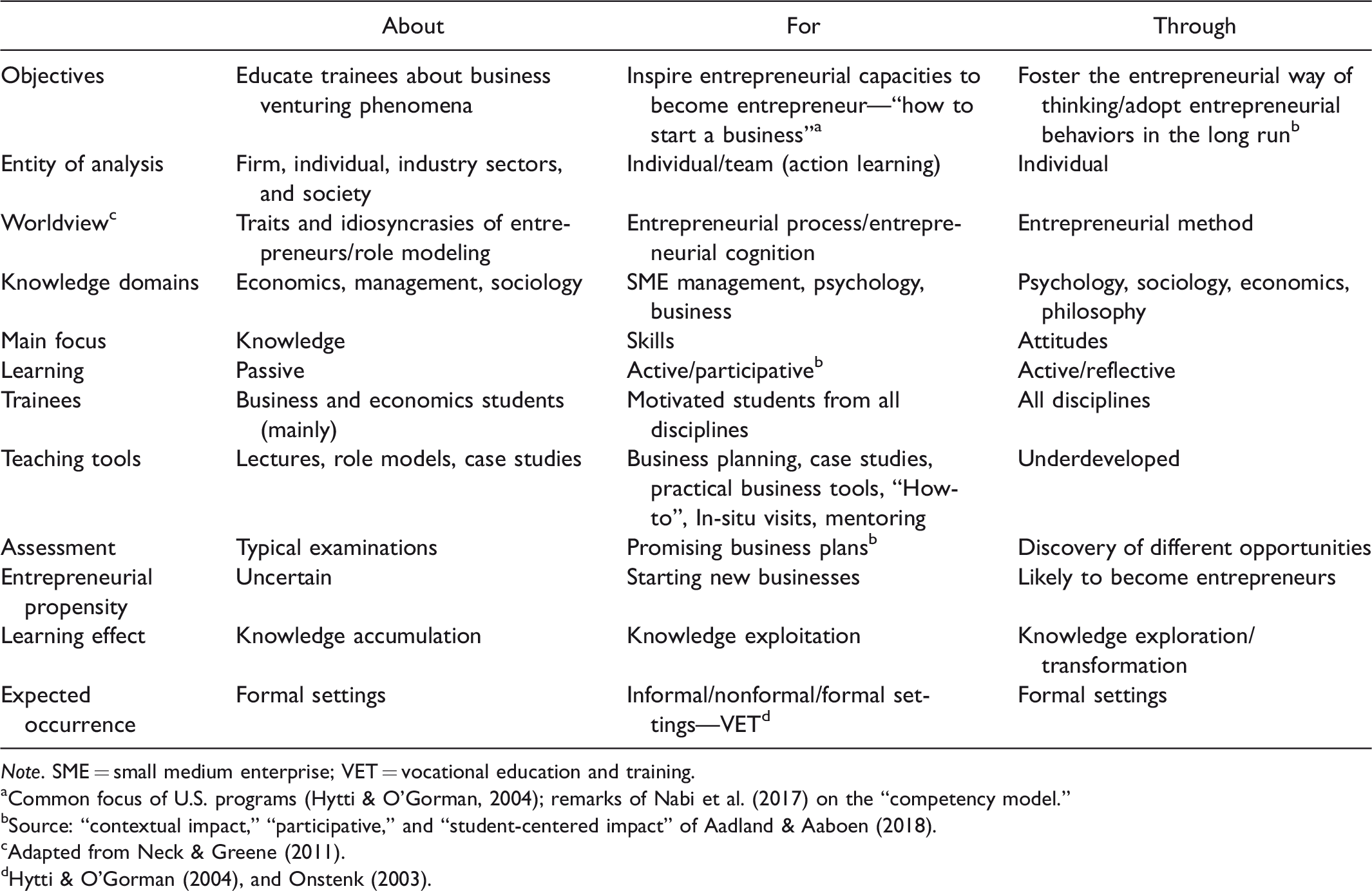
Note. SME = small medium enterprise; VET = vocational education and training.
Common focus of U.S. programs (Hytti & O’Gorman, 2004); remarks of Nabi et al. (2017) on the “competency model.”
bSource: “contextual impact,” “participative,” and “student-centered impact” of Aadland & Aaboen (2018).
cAdapted from Neck & Greene (2011).dHytti & O'Gorman (2004), and Onstenk (2003).
Basic elements of each mode for EE are summarized in Table 1 as they emerge from the literature. A concise description of Table 1 suggests the “about” mode educates about phenomena in general. The unit of analysis may vary among a firm, an economic region/country, the local society, or more rarely the individual (e.g., a role model). Contingent knowledge (Fiet, 2001) is sought in these domains for theory teaching. The objective is knowledge transfer (through passive learning) based on traditional teaching, examined by the end of the courses and without evidence for entrepreneurial propensity. The “for” mode (frequent in VET and optional across academic curricula) assumes trainees are motivated and with threshold capacities to practice with business tools (SWOT, PEST, CANVAS, 4Ps, etc.). Teamwork (action learning) is pursued toward the formation of virtual enterprises. Focus is given to skills regarding the targeted behavior (start-up). Predominantly action-oriented, the “through” mode focuses on positive attitude to become entrepreneurial (in indefinite time and independently of the field of study). Reflection on any kind of direct (or indirect, Jarvis, 2004) experience or knowledge is a fundamental intellectual mechanism and entrepreneurial opportunity the core-concept considering change as a natural state. No conclusions are appropriate thus letting learning be self-directed. Unlike the other modes, where learning is instrumental, the modification of attitude may demand existential learning.
The aforementioned, multiperspective reflections and suggestions of EE scholars have revealed particularities and needs of modern EE; nonetheless, they offer limited guidance to educators on how to tackle KSA in their everyday instructional design. In the following, a retrospective discussion for the interplay among KSA aims to address how they are used, or could potentially be used, regarding the three modes of EE.
Reconsidering the Entrepreneurial KSA Triptych
Bloom’s et al. (1956) taxonomy of learning domains has been the most used framework for instructional design and evaluation. According to the 1956 educational psychology committee, led by Benjamin Bloom, the cognitive, psychomotor, and affective domains are distinct in the human learning process. The cognitive domain deals with the acquisition of knowledge, the psychomotor with the cultivation of skills, and the affective with the development (or moderation) of attitudes.
Bloom’s taxonomy has received critiques and amendments over time, mainly for concealed hierarchies among the domains, which are beyond the scope of this article. The three learning domains have been developed in different times and by different lead authors (namely, Bloom et al., 1956; Krathwohl et al., 1964; Harrow 1972). A certain revision, especially for the cognitive domain, appeared in 2001 (Anderson et al., 2001). Nonetheless, the three domains, this study focuses on, remain the same, introducing to the vast majority of educators the KSA triptych to schedule learning objectives. Since the current discussion simply adopts these domains and their interplay, the details of the amendments and revisions, though useful, overwhelm its scope.
Usually, in educators’ practice, instructional design is confined toward KSA. Adult education scholars (cf. Jarvis, 2004) extend the previous triptych with two more categories: emotions and values, despite these categories already existing in Bloom’s affective domain regarding the formation of attitudes. Jarvis considers experiential learning a holistic process—that is, the whole person changes—and also includes beliefs and senses as separate categories beyond the five already referred in his classical definition for learning (Jarvis, 2004, p. 111), while scholars who study competencies may also add behaviors. Nonetheless, the complete and consistent inclusion of emotions and values in entrepreneurship expands the educational approach into psychology, moral philosophy, and political economy domains.
The emotional dimension of EE has been considered as important (e.g., Cope, 2005; Kyrö, 2008) but poorly explored so far. The consistent follow-up of emotions is only possible in highly “hands-on” pedagogies, as for example, the study of Lackéus (2014) for an action-based program at Chalmers University where postgraduate students serve as surrogate entrepreneurs as part of the curriculum (Ollila & Williams Middleton, 2011). Following a mixed methodology, supported by a mobile app, Lackéus (2014) found that emotions are related to the generation of entrepreneurial capacities, and thus, they should be included in the assessment of EE. Zampetakis et al. (2015) found that anticipated emotions during entrepreneurial courses can lead to negative entrepreneurial behavior. In the same line, Kakouris (2016) adopts the Illerian approach to learning (Illeris, 2007) to address multidimensional learning environments for entrepreneurship where emotions along with incentives formulate one of the three Illerian dimensions of learning. Thus, emotions and the affective dimension of entrepreneurial learning is an emerging stream of research promising to provide new insights for EE.
Similar to emotions, the inclusion of values triggers the axiology of EE (Kyrö, 2015). Values are also central in critical pedagogy and a great aspect for epistemological and philosophical discussion especially in the context of critical EE (cf. Alvesson & Deetz, 2000; Berglund & Verduyn, 2018; Brookfield, 2012) and some applications to entrepreneurship (e.g., Berglund & Johansson, 2007; Kakouris, 2015). Despite the importance of values in (not only) entrepreneurial teaching, the majority of entrepreneurship educators and bodies bypass axiological issues in scheduling, implementing, and assessing entrepreneurship programs (Kyrö, 2015). Such issues may be tackled in the business ethics context, albeit genuine entrepreneurial ethics—or more precisely axiology—needs to be developed beyond a mere extension and replication of ethical practices from large corporations. This aspect is discussed later within the context of critical EE.
Despite the significance of emotions and values in learning, for which further research and development are needed, the mere adoption of the KSA triptych for the content and outcomes introduces a simple, rudimentary, and common understanding of EE that has not been fully and critically discussed and thereby, theoretically deployed. Many scholars define EE as a delivery of knowledge and skills underestimating attitudes and their role despite the fact that fostering the entrepreneurial mindset purely refers to an attitude. Focusing on the basic KSA triptych for entrepreneurship, there are inherent difficulties in each of the incorporated learning domains. Beyond the classical debate and criticism about the systemicity of Bloom’s domains, that is, KSA are interrelated and evolve together, therefore, changes in one of them affect the other two and the whole of learning, intrinsic questions for academic EE pertain to entrepreneurial knowledge and skills themselves. Let us suppose, for convenience, that each KSA category can be understood as separate as the vast majority of educators and educational designers tacitly accept, what constrains the entrepreneurial knowledge and how many entrepreneurial skills exist? Despite the efforts to answer such questions (e.g., Johannisson, 2016), the knowledge domain encounters the shortage of a genuine theory for entrepreneurship (e.g., Bygrave & Hofer, 1992; Fiet, 2001), while entrepreneurial skills remain inadequately explored and discussed in a rigorous framework (e.g., Bird, 1995; O’Connor, 2013). Attitudes are possibly the least explored learning domain and have been predominantly confronted through the Theory of Planned Behavior (e.g., Ajzen, 1991; Krueger & Brazeal, 1994; Krueger & Carsrud, 1993). They are recognized as the most affected learning domain from the local culture and other external influences (e.g., Nicholson & Anderson, 2005). Shane (2008) has addressed a series of existent “illusions” for entrepreneurship that can play a significant role in the formulation of entrepreneurial beliefs and attitudes. Despite extensive fostering of the entrepreneurial mindset during the last decades, which has led to an increase in youth with a positive attitude toward becoming entrepreneurs—an issue that requires a more critical approach and analysis in future studies—Nabi et al. (2017) remark that “ … recent reviews suggest that the impact of EE programmes on attitudes and behaviour is equivocal as studies suggest both positive and negative outcomes” (p. 278). The authors further argue that much of the pedagogy, especially for technology startups, is concentrated around the competency model (i.e., skill-based) for EE.
In sum, the KSA triptych that is widely—and sometimes uncritically—adopted in entrepreneurial instructional design underpins the development of pedagogy, teaching models or teaching philosophy, and educational assessment. Any insight that advances each of the three KSA categories, strengthens the theoretical foundation of EE as a distinct form of pedagogy (Kyrö, 2015) demarcated from business or management instruction (Johannisson, 2016; O’Connor, 2013). In the following section, three different hierarchies (structures) and the interplay among the KSA categories are discussed in order to reveal different possibilities for entrepreneurial instruction.
Before proceeding, remarks on how KSA categories are treated are necessary. In the psychological context (e.g., Baartman & De Bruijn, 2011), these categories interweave and coevolve through learning. As customary instructional design is the main concern of this study, the notions are kept as simple as possible. Generally, knowledge has many forms including tacit knowledge. In this instance, knowledge refers to its demonstrated form, that is, something that can be consciously accessed and communicated. In various definitions, skills are considered associated with a task and can be hard or soft, motor, or cognitive, and so on. Attitude refers to disposition toward a certain action, that is, what people prefer to do. Definitions of attitude have been complex and controversial in literature (depending on certain psychology streams) regarding generality/specificity, stability, and implicitness/explicitness. Educators tend to include specific and contextual attitudes in their design despite ambiguity on how attitudes are formed and evolve. In the context of VET, Baartman and De Bruijn (2011) discuss the previous categories along with learning mechanisms for the integration among KSA and the formation of the more generic notion of competence which “is generally defined as consisting of integrated pieces of knowledge, skills and attitudes” (p. 126) and can be “an outcome of learning” toward “more complex professional tasks.”
Structuring the KSA Triptych
The requisite to teach theory-based entrepreneurship has become imperative (e.g., Fiet, 2001) specifically in academic settings. Since genuine theory building in entrepreneurship appears a formidable endeavor, particularly at the individual level, as far as such a possible theory ought to enforce entrepreneurship to creatively change to remain profitable, a current educational concern may not strictly refer to what entrepreneurship actually is, as in the vast majority of the contextual research, but how the curriculum defines it. This concern mostly applies within universities and can be related to the legitimacy of entrepreneurship as a field of study (e.g., Fayolle et al., 2016; Kuratko, 2005). Once a theory for entrepreneurship could be hypothetically developed (in a similar manner that natural sciences achieve it), the discipline should be taught similar to the majority of other subjects throughout academic curricula. Nonetheless, entrepreneurship significantly varies in this regard from other disciplines to date. Even from the economics perspective “there is at present no emerging possibility of an all-encompassing, single theory of entrepreneurial behavior that could make the three [i.e. neoclassical, Austrian, behavioral] approaches commensurable” (Endres & Woods, 2006, p. 200).
In studying entrepreneurship similar to other academic disciplines, and especially the positivistic paradigm followed in natural sciences, knowledge has to be acquired. Knowledge pertains to the cognitive domain of Bloom’s taxonomy that is a “backbone” for instruction. Depending on the specific perspective of Table 1, and the adopted unit of analysis, contingent knowledge (Fiet, 2001) may be derived from economics, management, sociology, or more rarely psychology and personality theories, addressing different aspects of entrepreneurship and its associated phenomena in the micro/macro levels. O’Connor (2013) remarks that “Views about the activity of the entrepreneur vary considerably, framed as both formal business activities and informal enterprise activities, and sometimes as a confused combination of both” (p. 552). Lectures and analyses of case studies aim at knowledge transfer especially in economics and management departments. When confronting the entrepreneur, relevant knowledge is consistent with the entrepreneur worldview of Neck and Greene (2011). Apparently, the “about” entrepreneurship mode builds upon knowledge to develop the curriculum following the positivistic paradigm. Skills can be more general or domain-specific (i.e., entrepreneurial skills) and refer to what the learner is capable of doing. It is implicitly supposed that skills exploit part of the acquired knowledge, along with innate aptitudes of the individual, toward specific task completion. Hence, relevant instruction cultivates skills through which accumulated knowledge can be exploited. Finally, (entrepreneurial) attitudes can be affected through relevant knowledge acquisition and skill development (Baartman & De Bruijn, 2011).
Supposedly, knowledge, as a starting domain for teaching, is abundant since no piece of knowledge can be excluded, ex ante, from the entrepreneurial process (economic, management, product development, finance, etc.). It is quantitatively assumed a larger domain than skills, which exploit part of knowledge. Attitudes can be thought an even smaller domain if there is a focus on certain dispositions toward business venturing actions. Such a comprehension allows to schematize the “about” mode of EE through the pyramid illustrated in Figure 1A. The starting point is knowledge that offers the initial base to cultivate skills and to further affect attitudes. Certainly, the illustrated shapes of the domains, and the pyramidal construction, are indicative depending on how one defines the domains and especially attitudes. The format of illustration in Figure 1 follows an analogy with the well-known data, information, knowledge, wisdom (DIKW) pyramid of knowledge management where data (or noise) are filtered to extract information that can be further converted to knowledge and finally to wisdom. The substantial message of Figure 1A is that educators who traditionally attempt to start from knowledge transfer encounter a vast, unjustified, and overwhelming knowledge base. The only reaction can be own-classification of knowledge as relevant or nonrelevant.
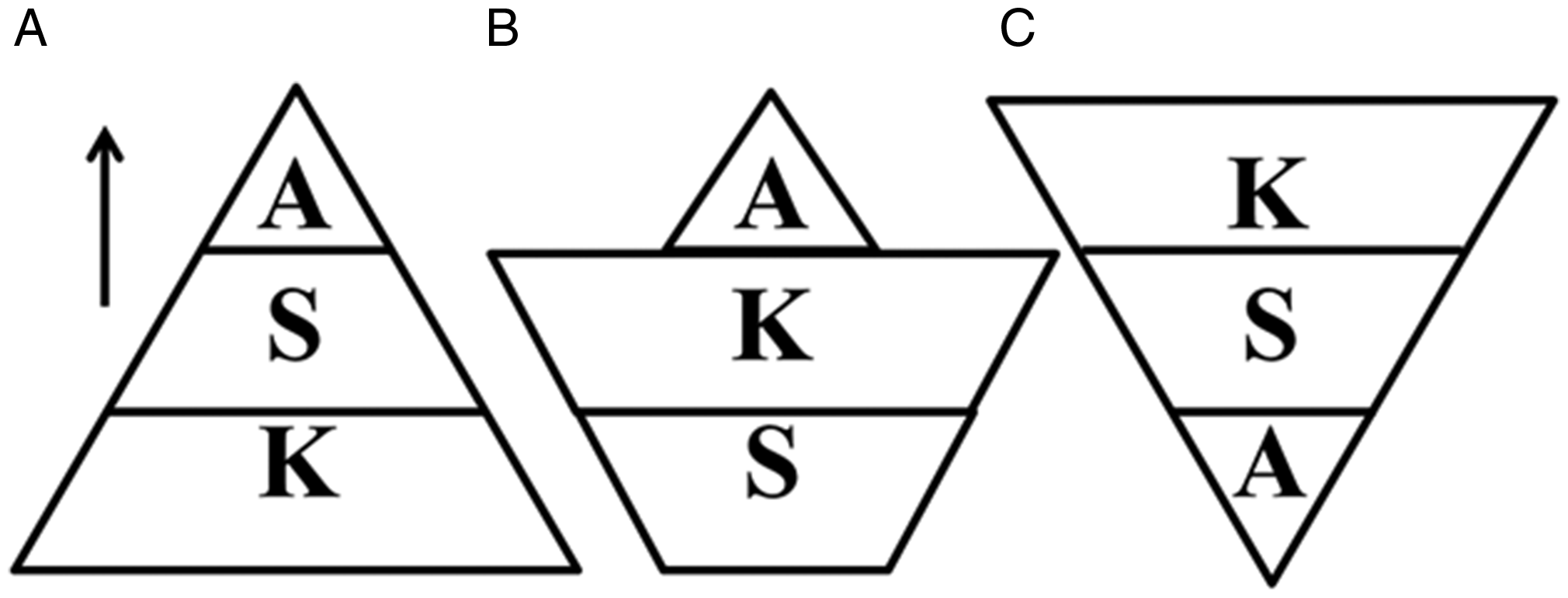
Building Entrepreneurship Education Modes Upon Knowledge, Skills, and Attitudes: (A) “about,” (B) “for,” and (C) “through.”
To envisage different structures, alternative to Figure 1A, the competency model (Nabi et al., 2017) corresponding to the “for” mode can be considered. In this form of instruction, the individual and their skills offer the initial base, that is, the starting point, to develop the curriculum. Even entrepreneurially unknowledgeable, one is thought capable of starting-up a business similar to the many examples of successful entrepreneurs who had little education. Depending on the individual’s skills, experience and prior knowledge base (e.g., domain-specific), entrepreneurial knowledge is usually achieved through experiential learning (Minniti & Bygrave, 2001; Politis, 2005). The broadening of the knowledge base relevant to business phenomena is assumed feasible depending on certain skills (mainly cognitive) the person possesses. To ensure adequate experience transfer and practical knowledge transmission, mentoring and exposition to real case studies often supplement the experiential learning process. Notwithstanding, the skill base is the underpinning for this mode of EE (Figure 1B). Skills can be innate or experience/knowledge-based and, in some cases, related to the personality of the individual (trait-like). To exemplify the difference between structures of Figure 1A and 1B, one may acquire extensive business knowledge (Figure 1A) that she can hardly exploit due to skill shortage while another (Figure 1B) may develop a new business (business idea, model, plan, etc.) with certain weaknesses due to underdeveloped entrepreneurial knowledge. In the former case, the new venture creation is unlikely to happen, while in the latter, the novice could gradually amend her own-business through experience. In a scenario where there is a (tacit) presupposition of equally skilled individuals, the previous difference between (Figure 1A) and (Figure 1B) dissipates. Educationally, it is a different instruction to start loading (or overloading) with information/knowledge than scrutinizing the skill-base of the attendees.
The third alternative is shown in Figure 1C. Starting from attitudes is a genuinely person-centric approach (Table 1) assuming that the attendee possesses established attitudes able to drive the learning process further. This structure aligns with Kyrö’s (2015) remarks : “In entrepreneurial learning, this [i.e. social constructivism of knowing in a changing reality] means that learners are actors in this knowing and learning process, and that their interests guide the process” (p. 612), and “For learning practices, it [i.e. change the idea of human being] means that the starting point is a learner-led process and the context, arrangements with teaching practices are organized accordingly.” (p. 613). By adopting such a highly humanistic perspective, the individual’s attitudes, interconnected with beliefs, motives, emotions, values, and past experiences, are thought a progenitor for the cultivation of skills and business knowledge acquisition. Independently whether a person is capable of coping with entrepreneurial tasks (i.e., possesses the skills) they may not be doing so because of certain underlying attitudes. Collectively, attitudes are expected to intrude in the learning environment and influence the educational climate of the classroom. Experienced educators are aware that attitudes, even not directly voiced, underlie the process and may undermine or aid it. The difficulty with starting the instruction from attitudes pertains to what these attitudes rely on, especially for inexperienced and unknowledgeable attendees. Since attitude is formed by a person’s past and present and influences her thought and behavior, it has been a crucial but complex construct in social psychology. In the previous two structures (Figure 1A and 1B), attitudes are thought implicitly affected through the specific (and usually imposed) learning experience contrary to Figure 1C that assumes attitude is required to drive the learning process. This is the clear message of Figure 1C independently whether the second step concerns skills or knowledge or a combination of both. In relevant assessments, changes in attitudes appear the most ambiguous outcome of the instruction (Nabi et al., 2017) only expected by a long-term and highly experiential (Piperopoulos & Dimov, 2015) course or program. Nonetheless, attitudes have been an antecedent of entrepreneurial intention and behavior (Krueger & Brazeal, 1994; Krueger & Carsrud, 1993) concentrating on relatively short research and poor pedagogical models with underdeveloped tools. To deal with attitudes in the very beginning of instruction, demands capacity for collective and individual reflection on diverse phenomena pertaining to the person in society (contingent knowledge from the psychology, sociology, economics, philosophy domains, Table 1), while appropriate methods can be found in the domain of adult education (Neck & Corbett, 2018). It naturally emerges that the inverse pyramid of Figure 1C, which directly confronts the attitudes, corresponds to the “through” mode of EE and the know-why of entrepreneurship. When entrepreneurship is embedded in a traditional discipline (e.g., engineering), it aims to capture the interest of those positively inclined to its phenomena in order to proceed with relevant skills and knowledge in an as inclusive as possible way. Unlike the competency model (Figure 1B) that aims at producing start-ups, the goal of Figure 1C is to primarily transform the attitude of the attendees for business venturing. This is apparent in the use of the “through” mode as depicted in Lackéus (2015, Figure 1, p. 8) where the “through” mode is usually met in primary/secondary education and in lifelong VET.
Once the differences among the three constructs of Figure 1 are acknowledged, the emergent pattern suggests that educators who start from different learning domains encounter qualitatively different learning situations and are gradually led to different forms of EE. Beyond the positivistic (natural sciences) and VET paradigms of the Figure 1A and Figure 1B, the “through” Figure 1C aims at transforming attitude in a deliberate and self-directed manner and in accordance with the interests of the trainees. Critical aspects of Figure 1 constructions are discussed in the sequel.
The Critical Aspect
Critical education has been developed as a school of thought, that is, a philosophy and a movement, within education largely based on Freire’s work on critical pedagogy in the 60s (Freire, 1970) which builds upon the critical theory of sociology. This perspective has been addressed through the work of the prominent French scholars Michel Foucault, in the 60s, and Pierre Burdieu in the early 70s and through the essays of the Frankfurt School during the interwar period. The purpose of critical pedagogy is emancipation against dominant ideologies through critical thinking and discourse (Brookfield, 2012). Scholars in this stream often address and criticize capitalism as the hegemonic ideology imposing norms and habits in society. Thus, the expansion of entrepreneurship in modern times, associated with the knowledge-driven economy concept, offers a new economic trend for critical analysis. For instance, Ogbor (2000) discusses the effects of ideological control in conventional entrepreneurial discourses and praxis. The author draws upon critical theory to argue that “ … . the concept of entrepreneurship is discriminatory, gender-biased, ethnocentrically determined and ideologically controlled … ” (p. 605). Critical approaches propose self-reflection and critical discourse as means to become aware of stereotypes and to adjust for dominant ideologies.
Berglund and Johansson (2007) present a case of Freirean critical pedagogy embedded in a Swedish project (Diversity in Entrepreneurship) aiming to empower entrepreneurship in a vulnerable region. Apparently, the Freirean notion of conscientization propels their instruction and reflection, mainly self-reflection, as the mechanism to achieve it. Another example of “aberrant” learning and emergence of criticality is described in Kakouris (2015) for lifelong learners in Greece, where critical discourse and omnidirectional reflection were employed to reconcile conflicting assumptions and conceptualizations of entrepreneurship. These incidents are indicative of how critical questions intrude on entrepreneurial learning calling for critical approaches in EE.
Furthermore, critical aspects of entrepreneurship can be sporadically found in the extant literature. Social constructivism studies that analyze cultural influences and metaphors to communicate entrepreneurship (e.g., Anderson et al., 2009; Nicholson & Anderson, 2005) stimulate critical discussion. Johannisson’s (2016) perspective addresses the role of hegemonic ideologies that underlie entrepreneurship. One of his cases is based on Freirean conscientization and the relevant “shock therapy” instruction they describe is a form of deep reflection. Fayolle’s (2013) and Kyrö’s (2015) comments about missing ethical aspects also urge for adoption of the critical stance when teaching entrepreneurship. Shane’s (2008) illusions of entrepreneurship discloses how myths about entrepreneurship can be circulated without adequate empirical evidence from worldwide data. Finally, sustainability education, based on the concept of responsible entrepreneurship, tends to discern itself from EE as a more socially justified approach in entrepreneurial learning. This new role of EE has been addressed early by Rae (2010). A more general discussion by O’Connor (2013) on changes in the Australian policy that connect education with innovation and the inclusion of social entrepreneurship into economic models also conforms with the critical aspect of EE. In Berglund and Verduyn’s (2018) book, some of these recent aspects are discussed in the educational context.
Criticality concerns all categories of the KSA triptych. Knowledge becomes more critical when it incorporates all relevant data from any discipline (business ethics included), alternative theories—even heterodox ones—and perspectives drawn from different units of analysis, examples of failure apart from success ones, new research findings toward theory-building, and so on. Shane’s (2008) illusions is a leading example along with other studies that scrutinize myths of entrepreneurship (e.g., Rehn et al., 2013). For skills, some intellectual aptitudes advance critical thinking. Brookfield (1987), for instance, presents educational methods to leverage critical thinking. The capability to reflect (Lundmark et al., 2019), participate in collective reflection, self-reflection, distancing, challenging assumptions, creative problem solving, and empathetic reasoning, are some examples. Metacognitive skills are also of major importance. Attitudes are known to be connected with past experience, personal values, virtues, and beliefs, all drivers of entrepreneurial behavior. Discussing the formation of attitudes and the role of beliefs from the cognitive perspective, Krueger (2007) notes: “Behind entrepreneurial attitudes are deep cognitive structures; Behind deep cognitive structures are deep beliefs” (p.124). Tendency for self-awareness and self-actualization, propensity for morality and openness to new knowledge and experience, leverage the critical perspective. To this end, the isolation of personal assumptions (i.e., deep beliefs of Krueger), which underlie attitudes and learning, is a prerequisite to critically examine and transform them. Albeit, this is a nonstraightforward process unlikely to happen through ordinary instruction. Concerning attitudes, the existence of the aforementioned dispositions favor the critical aspect of teaching entrepreneurship.
It is evident that any structure of Figure 1 might become more critical. Pyramid of Figure 1A (i.e., the know-what) demands an exhaustive knowledge-base to embrace different perspectives capable to support critical thinking in a later phase and ultimately, attitudes. The competency model of Figure 1B (i.e. the know-how) needs to seek the critical thinking skills in the beginning of the instruction through which contingent knowledge will be quested and critically interweaved with coevolving attitudes. The inverse pyramid of Figure 1C (i.e., the know-why) requires an initial examination of the underlying attitudes, fostering the ones that render openness to critical skills and further acquisition of possible knowledge. Criticality, in general, manifests itself through critical questions (Berglund & Johansson, 2007; Kakouris, 2015). These questions are likely to appear, should that occur (some incidents of critical thinking and self-reflection following constructivist teaching are presented in Kakouris, 2017), in a later stage following the instruction of Figure 1A. Contrary, they are expected to immediately emerge in structure of Figure 1C. This could explain why Williams Middleton and Donnellon (2014) connect know-why with critical learning.
Examples of critical learning in entrepreneurship pertain to lifelong learners (e.g., Berglund & Johansson, 2007; Kakouris, 2015; Rae, 2005). This fact signals that critical aspects concern those who have more life experience. This is in line with transformative education which applies only in adult learning settings. In early developmental stages (e.g., primary/secondary education, Lackéus, 2015), this type of teaching is new and radical. For inexperienced attendees, the “through” mode will encounter attitudes largely based on influences which need to be critically examined. Education will evidently become critical as far as critical questions cannot be overlooked. From the educator’s perspective, Kakouris (2015) suggests an extensive derivation of critical questions in entrepreneurship and systematic treatment of them. In this way, educators will be informed for possible learning disorientations and EE will become more anticipatory in regard to its critical “through” mode.
Finally, values have only been referred in the present analysis that focuses only on the KSA triptych. Values invoke the axiology of entrepreneurship (Kyrö, 2015), with poor systematic and rigorous research, that cannot be intrinsically eliminated from the discussion as (personal) values are antecedents of attitudes. Not surprisingly, most of the critical pedagogy builds upon (social) values as deep sense and behavior-making structures. These issues are implicitly discussed in the following section. In summary, EE of all forms embodies critical aspects that may become more central in future expanded fostering of the entrepreneurial mindset.
Discussion
To accommodate the current analysis into the scope of this article, it is argued that different forms of EE adapt differently on the KSA triptych which constitutes the very basic and rudimental framework required to understand teaching objectives (i.e., the didactics). Structures of Figure 1 enable educators and educational bodies to comprehend why prominent scholars in the field of EE envisage different forms of teaching entrepreneurship with associated complexity and variance in prerequisites, perspectives, and objectives. Despite their common goal to foster the entrepreneurial mindset and to unlock the entrepreneurial phenomena, differences among the three modes exist because they confront and interweave entrepreneurial KSA in different ways. The “about” mode is the sustaining mode, cumulating knowledge in the field, the “for” is the evolutionary one, examining via which skills parts of this knowledge are transformed into exploitable knowledge (an analogy with the conversion of potential to realized absorptive capacity of Zahra & George (2002) could be drawn), and the “through”’ mode is the progressive, horizontally transforming attitudes in all disciplines, converting them into entrepreneurial attitudes, with participants capable of coping with rapid changes in society. In educational terms, the perspectives of the three modes are different because of different underlying structures, sequences, and priorities among the KSA categories (Figure 1). Contrary to the two forms which are largely discussed via examples and cases in literature, the “through” mode needs further consideration as it appears underdeveloped regarding its role in the present and future of EE.
It emerges from Figure 1 that the question on how to further develop the “through” mode (i.e., the know-why) yields inquiries on how to cope with attitudes. First, beyond Theory of Planned Behavior (Krueger & Carsrud, 1993), self-efficacy constructs (e.g., Piperopoulos & Dimov, 2015; Santos & Liguori, 2020; Winkler & Case, 2014) and entrepreneurial metaphors (Anderson et al., 2009), other belief structures and their impact on attitudes need to be explored. Second, in accordance with the structure of Figure 1C, the attitudes have to be examined, and possibly measured, not only after the completion of the program but also in its origin. This compels educators to not merely and passively observe the emergence of attitudes and cognitive maps (e.g., Santos et al., 2010) but to capture them as a starting point attempting possible transformations through instruction. Thus, the initial stance of the audience becomes suggestive for underlying assumptions or beliefs and also for the type of pedagogy and content to be pursed further. In Johannisson’s (2016) terms, a move from instrumental to existential learning is needed.
To cope with attitudes and belief structures, educators need to be capable to discuss entrepreneurship historically, sociologically, philosophically, and psychologically, among other approaches. As entrepreneurship is a social phenomenon per se, relevant attitudes can be grounded in any aspect of the social life and the perception of the human being in society. Some deep beliefs and assumptions, related with attitudes, can even be existential (cf. the Ontology of Becoming, Johannisson, 2016). A rigorous and multiperspective discussion of entrepreneurship as a simultaneously personal and social phenomenon directly confronts the participants’ attitudes and associated beliefs. Accordingly, the “through” mode of EE becomes more inclusive, destined beyond those who are immediately disposed to start businesses. Therefore, an initial regard of attitudes advances the inclusiveness and the potential of learning “through” entrepreneurship, while attitude moderation is known to be a genuinely transformative process in education. Accordingly, EE can appear as a progressive movement in pedagogy (Kyrö, 2015). Simultaneously, alteration of attitudes needs to substantially encounter the critical aspects of entrepreneurship. Only socially adjusted approaches are expected to systematically fulfill the why inquiries of the individuals leading to increased possibility for self-actualization. In conclusion, stating clearly that the “through” mode of EE builds upon existent attitudes and asymptotically seeks for attitude change, revolutionizes all education in the macro-level, but this kind of transformation owes to happen in a critical manner.
What is missed from the present discussion is a deeper examination of emotions and values as parts of the pedagogy. In Kakouris (2015), the learning disorientation induces strong feelings and formulates the vein of the discussion. This is indicative of the expected resistance when attitudes, associated with beliefs and assumptions, are affected by the learning process. Therefore, the full instructional consideration of the affective domain needs to be integrated into the pedagogy as scholars have suggested. Furthermore, axiological issues need to be considered. In Kakouris (2015), only personal values are implicitly discussed leaving the social ones undetermined (a fact that differentiates his pedagogy, classifying it as neutral, from genuine critical pedagogy which considers social values promoted through hegemonic ideologies). These values are important as they underpin entrepreneurial learning. Venkataraman et al. (2012) remark: “Through examples such as these, the issue of opportunity creation in the face of strong and value-laden resistance bubbles up as an important but underresearched topic in entrepreneurship (p. 29).” Nonetheless, social values have been fundamental constructs in critical pedagogy. The confrontation of them introduces political and politico-economic aspects in the discussion. Studies which tend to connect entrepreneurship with neoliberalism offer an example of the modern concerns in the field (e.g., Lackéus, 2017; Rhoads, 2018). Rae (2010) also notes: “The prevailing mode of entrepreneurship education has been dominated by an ideology of neo-liberal deregulated market economic growth … ”(p. 591). Brookfield (2012) argues that (individualistic) entrepreneurship is tied to the popular ideology about society and democracy, while Ogbor (2000) suggests “. … entrepreneurship research in particular, should be placed under ideological scrutiny” (p. 611). Such topics may transcend the current practice of entrepreneurship educators but they are expected to enter the stage as EE progresses challenging the existent pedagogies (Kyrö, 2015). Relevant issues have to be resolved under a development of the axiological base of entrepreneurship.
Despite educators being accustomed with the Bloomian framework and the KSA triptych, the present analysis offers an insight to the educational discussion in entrepreneurship. By contrasting the structures and the hierarchies of Figure 1, it becomes apparent why distinct forms of EE exist. Figure 1A informs how to teach entrepreneurship as per the majority of natural sciences disciplines, Figure 1B aligns with the VET paradigm, while Figure 1C is idiosyncratic to entrepreneurship thought as a form of transformational pedagogy. When Figure 1C is applied inclusively to wide populations, confronting the underlying attitudes, it tends to be revolutionary. Future research has to firstly validate the consistency of the Figure 1 representation. Do educators conceive latent, or hidden, prioritizations in instructional design? What type of audience do they contact? Do they build differently upon KSA? How do they start the instruction? What goals and outcomes do they expect? Action research in the field (e.g., Winkler et al., 2018), guided from the previous questions, could explicate different priorities in the instructional design. All aspects of the general teaching model of Fayolle (2013) have to be observed and measured through appropriate constructs. Furthermore, how is active/reflective learning facilitated by the pedagogy (Lundmark et al., 2019)? Analysis of case studies that exploits the present framework focusing on the underlying didactics relevant to possible learning disorientations may explain why some entrepreneurial courses fail to achieve the expected positive impact (Nabi et al., 2017; Oosterbeek et al., 2010). The present conceptualization also sheds light on the type of evaluations needed to investigate the outcomes of EE (e.g., Duval-Couetil, 2013). Beyond Kirkpatrick’s dominant model for summative evaluation and other alternatives (Fayolle, 2013, p. 698), Fetterman’s (2001) approach for empowerment can be employed. Future results in these directions will enlighten educators how to choose among the different philosophies (Hannon, 2005) and how to exploit their rich toolbox of methods (Gibb et al., 2014) to meet the objectives of the present and future EE.
Conclusion
The aim of this article is to interconnect pedagogy and entrepreneurship—following Kyrö’s call for tightening up humanities with entrepreneurship—by critically discussing the very components of entrepreneurial instructional design that compose the KSA triptych. KSA penetrate all learning theories but their interplay introduces different learning perspectives associated with different pedagogies and learning objectives. Future EE, envisioned as a progressive and probably revolutionary form of pedagogy consistent with needs to encounter a rapid changing reality, claims learning “through” entrepreneurship across disciplines. Contrary to learning “for” entrepreneurship that builds upon skills to increase the number of graduate entrepreneurs, the “through” mode appears inclusive in nature, aiming at transforming the entrepreneurial attitudes of attendees. As such, measurements for attitudes need to be consistently developed along with instructional methodologies to cope with and potentially transform attitudes. In addition, the rigorous connections of attitudes with beliefs, assumptions, emotions, and values need to be further researched educationally. To a similar end, Neck and Corbett recently suggested: “studying EE through a teaching lens … encourage a transition to teaching approaches based on adult learning, namely andragogy and heutagogy,” thus “ … moving away from pedagogy and traditional pedagogical approaches … ”. Furthermore, this radical approach should enclose all critical aspects of entrepreneurship and simultaneously be critical in nature. Accordingly, future EE will embrace the whys of the individuals in both social and existential domains as prominent scholars in the field suggest.
To readdress the initial focus of this article, what we define entrepreneurship as when we teach it and how we teach it, may be of specific and crucial importance to educators. Researchers scope the field to extract the entrepreneurial knowledge, nonetheless education, as it is customarily and traditionally conceived, starts from given knowledge domains. The present discussion addressed different forms of EE, as they have stemmed mainly from Nordic studies, in connection with the fundamental Bloomian framework that underlies any instructional design. Once these ties have been understood better, EE will become more able to address itself, its different identities, its legitimacy, and finally its way to respond in current and future needs of the economy and society.
Footnotes
Acknowledgments
An early version of this article was presented at the ECIE 2018 conference in Aveiro, Portugal. The authors are grateful to Connie Spanos for proofreading the manuscript. They are also grateful to the anonymous referees who contributed to the improvement of the final article through their insightful comments.
Declaration of Conflicting Interests
The author(s) declared no potential conflicts of interest with respect to the research, authorship, and/or publication of this article.
Funding
The author(s) received no financial support for the research, authorship, and/or publication of this article.
