







Abstract
While recent research explores the dark side of entrepreneurship there remains little exploration of what, if any, role entrepreneurship education (EE) plays in producing dark side outcomes. Accordingly, we explore dangers and unintended consequences EE poses to students and universities as well as the role of both student and instructor in mitigating dark side concerns. Specifically, we use a Delphi technique to distill from a panel of experienced educators the dangers EE may pose as well as strategies for mitigating dark side consequences. In sum, this work contributes to EE research by providing a unique mixed-methods view of the dark side of EE and raising awareness of the unintended consequences borne by the students and institutions we serve.
The negative aspects of entrepreneurship have been studied at individual and societal levels (Shepherd, 2019). These include the adverse consequences to the individual, as the psychological and emotional suffering entrepreneurs experience (Byrne & Shepherd, 2015), the organizational crises that lead to failures (Beaver & Jennings, 2005), economic losses (Ucbasaran et al., 2013) and environmental harm (Shepherd et al., 2013). However, work on the possible negative aspects of entrepreneurship education (EE) for students and the scholastic community is far less explored and subject of debate. While entrepreneurship education is generally lauded by administrators, social media, business owners, politicians, practitioners, and scholars, it likely has potential costs.
Entrepreneurship education “represents the confluence of unreasonable thinking and focused discipline” (Morris & Liguori, 2016, p. xix). Being the education of the reasonable and unreasonable, EE must address entrepreneurial failure as a learning opportunity and way to improve student’s ability to regulate emotions (e.g., Shepherd, 2004). For example, lean startup methodology is a common content covered in entrepreneurship education which allows students to fail quickly and pivoting, creating an incentive to learn from mistakes. These pedagogical tools position the student to fail quickly and typically result in experiencing negative feelings. If students only have one EE experience, and it is negative, their intention to engage in entrepreneurial activity drops. This is especially problematic given it often takes multiple courses in entrepreneurship before a student’s self-efficacy is recalibrated to effectively process the negative emotion and accurately determine their level of entrepreneurial intention (Vanevenhoven & Liguori, 2013). Consequently, helping students to manage the emotions of learning from failure should be part of the entrepreneurial pedagogy (Shepherd, 2004) if the goal of EE is the development of more and better entrepreneurially-minded students. Similarly, Olaison and Meier Sørensen (2014, p. 207) observe that “the public and academic discourses celebrating entrepreneurs in terms of success have recently evolved to include entrepreneurial failures, as an attempt to integrate the “darker” sides of entrepreneurship into the “success” discourse.”
In contrast, others object to an overly positive characterization of entrepreneurial failure. Coad (2014, p. 731) argues that “entrepreneurship research has gone too far in trivializing the death of businesses and rebranding these exits as successes.” Olaison and Meier Sørensen (2014, p. 207) warn that “by shifting attention to acceptable failures our gaze is turned away from the unacceptable consequences of entrepreneurial failures, such as the plight of real people who lose their homes, jobs and health.” These insights cause one to question what, if any, dangers and unacceptable consequences (i.e., dark side effects) are there within entrepreneurship education.
The dark side of entrepreneurship “refers to an actor’s negative psychological and emotional reactions from engaging in entrepreneurial action” (Shepherd, 2019, p. 3). It is the psychological price of entrepreneurship (Bruder, 2013). Because EE entails teaching the unreasonable, the dark side of EE can refer to the student’s negative psychological and emotional reactions from engaging in educational entrepreneurial practices (e.g., Shepherd, 2019), such as anxiety in acting in uncertain and unstructured contexts or grief over the rejection of their business concepts. While it is likely all entrepreneurship educators can anecdotally discuss where they have witnessed the dark side of EE (e.g., overconfident students struggling with evidence that their business concept is not feasible; students anxiety in dealing with scarcity of resources), we were unable to identify any prior scholarly research on this topic within the context of EE. Thus, this paper helps fill this void by identifying, synthesizing, and articulating the potential dark side of EE.
This paper proceeds as follows: (1) we review and discuss prior work on the dark side of entrepreneurship and theory of planned behavior; (2) we present a two-round Delphi study, (3) we present results from the analysis of panelist responses, and (4) we conclude with a discussion of these results, future research, and implications.
Theoretical Background
The Dark Side of Entrepreneurship Education
Any discussion on the dark side of entrepreneurship education benefits from a clarification of key terminology in the discourse, including risk, danger, and failure. The Merriam-Webster dictionary defines risk as “possibility of loss or injury” and danger as “exposure or liability to injury, pain, harm, or loss.” Thus, risk is a statistical property of a negative outcome, whereas danger is the negative outcome (i.e., a negative psychological and emotional reaction). When teaching students about negative outcomes and risk mitigation strategies, we often use case studies with virtuous conclusions, such as the entrepreneur who ultimately succeeds like a mythical hero (Verduijn et al., 2014).
The definition of failure is contextual, as there is good and bad failure. “The good and honest failure is productive failure … and a potential stepping-stone towards success if the entrepreneur has the right attitude or moral character” (Olaison & Meier Sørensen, 2014, p. 207). Bad failure, on the other hand, does not lead to any measure of success. Khelil (2016) presents a comprehensive framework for bad failure that integrates three perspectives: determinist (markets cause failure), voluntarist (mismanagement of assets causes failure), and emotive (lack of determination and motivation cause failure). Two different entrepreneurs experiencing the same failure in identical settings could define the failure differently, with one entrepreneur learning from the failure and advancing to success while the other succumbing to grief (Yamakawa et al., 2015). Leading students to bad failure is an example what we refer to as the dark side and unintended consequences of EE.
The dark side of entrepreneurship is part of the Triple-Ds framework of entrepreneurship: dark, down, and destructive (Shepherd, 2019). In this model, Shepherd defines the dark side of entrepreneurship as the negative psychological effects, the down side as the entrepreneur’s loss of capital due to engaging in entrepreneurship, and the destructive side as the negative consequences that affect the society. Shepherd (2019) posits that the destructive side does not necessarily originate from unethical behavior, but can originate from the process of entrepreneurship itself even when participants follow it with the best intentions. In their discussion of critical entrepreneurship education, Berglund and Verduijn (2018, p. 8) describe the opportunity for societal harm inherent in entrepreneurship, stemming in part from a neoliberal focus on self, and advocate “attempts to “open up” our understanding of the entrepreneurship phenomenon to a more affirmative stance”.
In another study on the dark side of entrepreneurship, Hmieleski and Lerner (2016) distinguish productive from unproductive entrepreneurial motives, defining the former as the intent to generate economic and societal value, and the latter as the intent to appropriate (or extract) economic and societal value. The relationship between these motives and the “dark triad” of personality traits – narcissism, psychopathy, and Machiavellianism – among business students, revealed that narcissism correlates with entrepreneurial intent, whereas psychopathy and Machiavellianism correlate with unproductive motives.
Even though EE is part of the overall entrepreneurship environment, these two differ in ways that affect our study. First, educators affect EE directly, but their impact on the outcomes of entrepreneurship overall is still questioned (Fayolle & Gailly, 2015; Rideout & Gray, 2013; Testa & Frascheri, 2015). Second, at least in the near term, the impact of the main actors in EE (students and educators) is stronger on the university ecosystem than on society overall. For example, quality of life and job placement, criteria by which students, administrators, and rankings evaluate universities, are also negatively impacted by students who pursue entrepreneurial opportunities unprepared and at the expense of other life priorities, such as completing their education and obtaining job experience. These differences between EE and entrepreneurship overall motivated our study to focus on the university ecosystem when considering the dark side of EE.
Lastly, we clarify the concept of unintended consequences of EE. Instructors and researchers have traditionally viewed the intended consequence of EE as the creation of successful new ventures (Duval-Couetil, 2013) and empowerment (Santos et al., 2019), although among instructors this goal is shifting to the creation of skills that are applicable to innovation and value creation in more diverse settings than just the startup (Lee et al., 2018; Neck & Corbett, 2018). We illustrate the disparity between intended and unintended consequences grounded on the Theory of Planned Behavior.
Unintended Consequences of Entrepreneurship Education through the Lens of the Theory of Planned Behavior
Entrepreneurship education researchers often use the Theory of Planned Behavior (TPB) to model entrepreneurial intent as an antecedent of new venture creation (e.g., Krueger et al., 2000; Schlaegel & Koenig, 2014). An entrepreneurship educator can influence the TPB’s three constructs by improving the student’s attitude toward entrepreneurship, his/her perception of the acceptance of entrepreneurship in his/her social environment (subjective norm), and the perceived ease of entrepreneurship (behavioral control). We can thus view intended consequences of EE through the lens of the TPB. For example, explaining to students the societal and self-realization benefits of entrepreneurship promotes the attitude toward entrepreneurship, recounting to students the challenges and eventual successes of entrepreneurs promotes subjective norms, and teaching students’ methods of entrepreneurship (e.g., lean, market research, and new venture finance methods) promotes behavioral control.
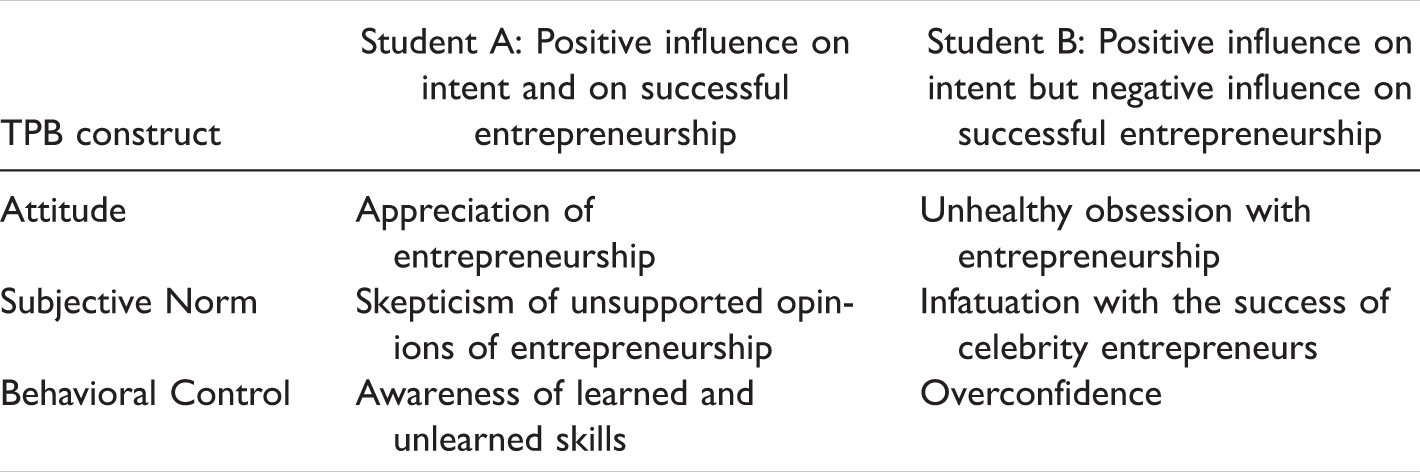
The unintended consequences of EE can similarly be viewed through the lens of the TPB. Consider two students with high entrepreneurial intent, which correlates with high values for the three TPB constructs (Table 1). Student A has learned an appreciation for entrepreneurship, the ability to distinguish informed from uninformed opinions for and against entrepreneurship, and has developed innovation and entrepreneurship skills but is also aware of obstacles to entrepreneurship success that her skills might not overcome. Student B is convinced he/she can launch a unicorn startup if he/she devotes her/himself to it. Student B may be more likely to launch a new venture in the near term and fail, while Student A may be more likely to launch a new venture in the long term and succeed. Moreover, Student B is more likely to succumb to entrepreneurship addition (Spivack & McKelvie, 2018).
Potential Entrepreneurship Education Outcomes That Increase Entrepreneurial Intent But Which May Have Unintended Consequences.
As with other disciplines, both the student and the instructor play a role in EE. A traditional metric of EE effectiveness is an increase in the intent of the student to practice entrepreneurship (Nabi et al., 2017). Using the three aforementioned constructs, the TPB presents this intent as a predictor of student entrepreneurial action which, in turn, has consequences to both the student and the school. Figure 1 illustrates these relationships. While the consequences of EE can be good and bad, this study focuses on the negative consequences, and what the instructor and student can do to mitigate them. In particular, the two leftmost and two rightmost items in Figure 1 correspond to the four questions in the first round of the Delphi study.
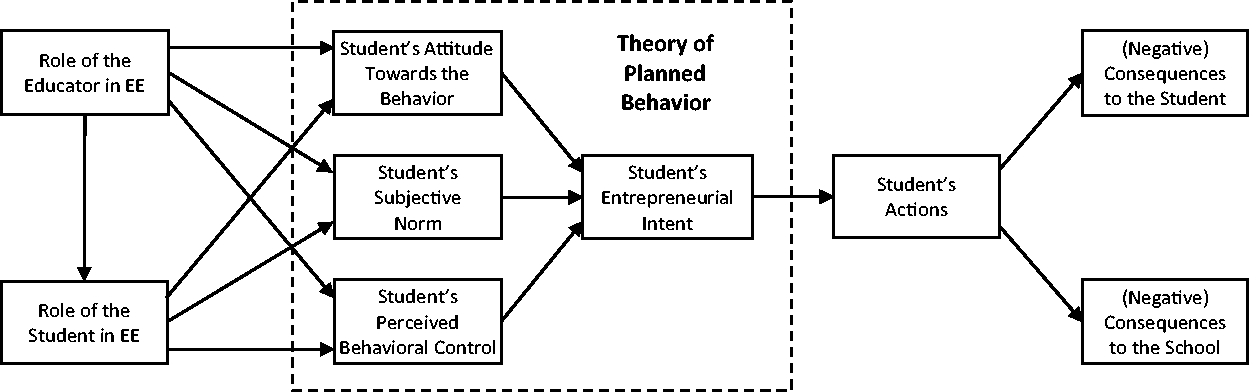
Conceptual Schema of the Unintended Consequences of EE.
While both the educator and the student play a role in the student’s TPB constructs, these roles are not independent. The role of the educator customarily includes providing students with a detailed description of the educator’s expectations of each student, such as a course syllabus. Through these expectations, the educator influences the role of the student (a different matter is whether or not the student complies). Consequently, in the conceptual schema of Figure 1, the role of the educator influences the student’s role in addition to the student’s TPB constructs.
Modern EE pedagogy challenges new venture creation, or increasing intent thereof, as a metric of EE effectiveness. Indeed, for many reasons it is difficult to know if a particular student should start a new venture. The entrepreneurship educator faces a multitude of indicators with which to assess effectiveness (Pittaway & Edwards, 2012) and the entrepreneurship discipline lacks the certifications, minimum criteria, standardized exams, and performance metrics that guide assessment in other disciplines such as management, engineering and medicine. Moreover, the entrepreneurial competencies promoted by EE require considerable practice (defined as the “enactment of the kinds of activities and interactions that constitutes doing entrepreneurship,” Neck & Corbett, 2018, p. 18) and necessitate novel and experiential approaches (Bandera et al., 2018; Kassean et al., 2015). For example, the definition of entrepreneurial opportunity recognition requires tacit knowledge that one only gets with experience (Neck & Corbett, 2018; Smith et al., 2009), promoting the notion that students should defer entrepreneurial aspirations until acquiring such experience. In the same line, prior knowledge is an important predictor of opportunity identification (e.g., Shane, 2003), raising the old debate whether venture launch should come right after school or later in the professional path. Hallam et al. (2015) find that entrepreneurial intent has a temporal component, and the educator should distinguish between short term and long-term intent.
In summary, the extant literature implies there may be many reasons for the entrepreneurship educator to reflect on the potential unintended consequences of entrepreneurship education.
Method and Research Design
The Delphi Method
The Delphi technique is “a group facilitation technique that seeks to obtain consensus on the opinions of ‘experts' through a series of structured questionnaires (commonly referred to as rounds)” (Hasson et al., 2000, pp. 1009–1010). The Delphi method generates opinion consensus of a group of experts by subjecting them to a series of questionnaires interspersed with controlled opinion feedback (Dalkey & Helmer, 1963). The fundamental principles of a Delphi method are: (a) anonymity, (b) iteration (i.e., the procedure is executed in a series of rounds), (c) controlled feedback (i.e., the facilitator decides on the type of feedback, as after each Delphi round, the survey data is statistically analyzed and re-stated in aggregated form), (d) statistical “group response,” comprising measures of central tendency (median, mean), dispersion (standard deviation), and (e) frequency distributions (von der Gracht, 2012).
The Delphi method has been used in prior entrepreneurship research. Gartner (1990) conducted a Delphi study to explore the underlying meanings researchers and practitioners have about entrepreneurship (Gartner, 1990). The relevance of entrepreneurial competencies to entrepreneurship education was also explored using via a Delphi approach (Morris et al., 2013). Last, and most recently, Neck and Corbett (2018) used a Delphi approach with a similar panel of experts to explore the scholarship of teaching and learning entrepreneurship.
The Expert Panel and Data Collection Process
Experts invited to participate in this study had several relevant publications in entrepreneurship education in the last 5 years, held full-time academic positions, and won academic or teaching awards at the Academy of Management, United States Association for Small Business and Entrepreneurship, or ESU European University Network on Entrepreneurship. Participation was voluntary, panelists were unaware of whom else was participating, and were promised anonymity of their individual responses.
The Delphi study included two rounds of data collection spanning a 60-day period of time and the questions were motivated by models of the negative societal impact of entrepreneurship (Berglund & Verduijn, 2018; Hmieleski & Lerner, 2016; Shepherd, 2019). Round 1 asked four questions: What dangers (i.e., hidden consequences) might entrepreneurship education pose to students?; What is your role as an educator in preventing the dangers of entrepreneurship education?; What is the students’ role in learning the dangers of entrepreneurship?; and What dangers might entrepreneurship education pose to the school?
Content analysis of experts’ answers was conducted following the strategy suggested by Guest and Zijlstra (2012). The authors annotated the Round 1 responses, highlighting their key propositions for each question. An annotation codebook was then compiled, listing these propositions. Similar propositions in the codebook were merged so that the codebook was the shortest list of distinct propositions that accurately described all the annotations of all the Round 1 responses from the experts. Each annotation in a Round 1 response mapped to one (and only one) proposition in the set, and different annotations from the same or different experts could map to the same proposition in the set.
Round 2 presented the panelists with the complete list of propositions generated from Round 1, and asked them to rate the importance of each proposition to the respective question on a three-point scale: 1 “not very important,” 2 “moderately important,” or 3 “very important.” Experts were also asked to add any other important propositions and comments that they consider relevant. This last request was intended to allow the expert to raise in Round 2 any key proposition in her/his Round 1 response that was overlooked by the annotation process.
Results
Round 1: Identifying the Unintended Consequences of Entrepreneurship Education
A panel of 13 expert entrepreneurship educators participated in this study. The response rate was 76.48% (17 experts were invited, and four declined). Experts were both male and female and spanned the U.S., Canada, and Europe.
The average response to a question was 121 words and experts frequently included contextual information and justifications with their responses. The codification of Round 1 responses yielded a codebook with 29 distinct propositions. Nine propositions emerged from all the answers to question 1 on the dangers to students, seven propositions emerged from the answers to the last question on the dangers to the institution, ten propositions emerged from the answers to the second question on the role of the educator, and three propositions emerged from the answers to the third question on the role of the student. The open-ended nature of Round 1 allowed experts to express a proposition as a problem (e.g., “students lack XYZ…”) or as a solution (e.g. “I advocate XYZ”); in either case, the expression was annotated to the same proposition in the codebook.
For each expert, we formed a 29-element response vector where the i’th element contained the number of times the expert mentioned in her/his Round 1 response the i’th proposition in the codebook. Table 2 presents these response vectors (the 13 leftmost columns, one column per expert), the propositions corresponding to the vector elements (one proposition per row), and the total number of times each proposition was mentioned across all experts. The vectors represent a sparsely populated high dimensional space; of the 377 response vector elements (13 experts × 29 codebook propositions), all but 103 are zero. 83 elements have a value of 1 indicating that the corresponding expert cited the corresponding proposition once in her/his Round 1 response, and that most experts cited responses only once. 17 elements have a value of 2 indicating that the corresponding expert cited the corresponding proposition twice in her/his Round 1 response, and three elements have a value of 3. The average number of propositions cited by an expert was 9.69 (sd = 2.81).
Number of Times Each Expert Cited a Proposition.
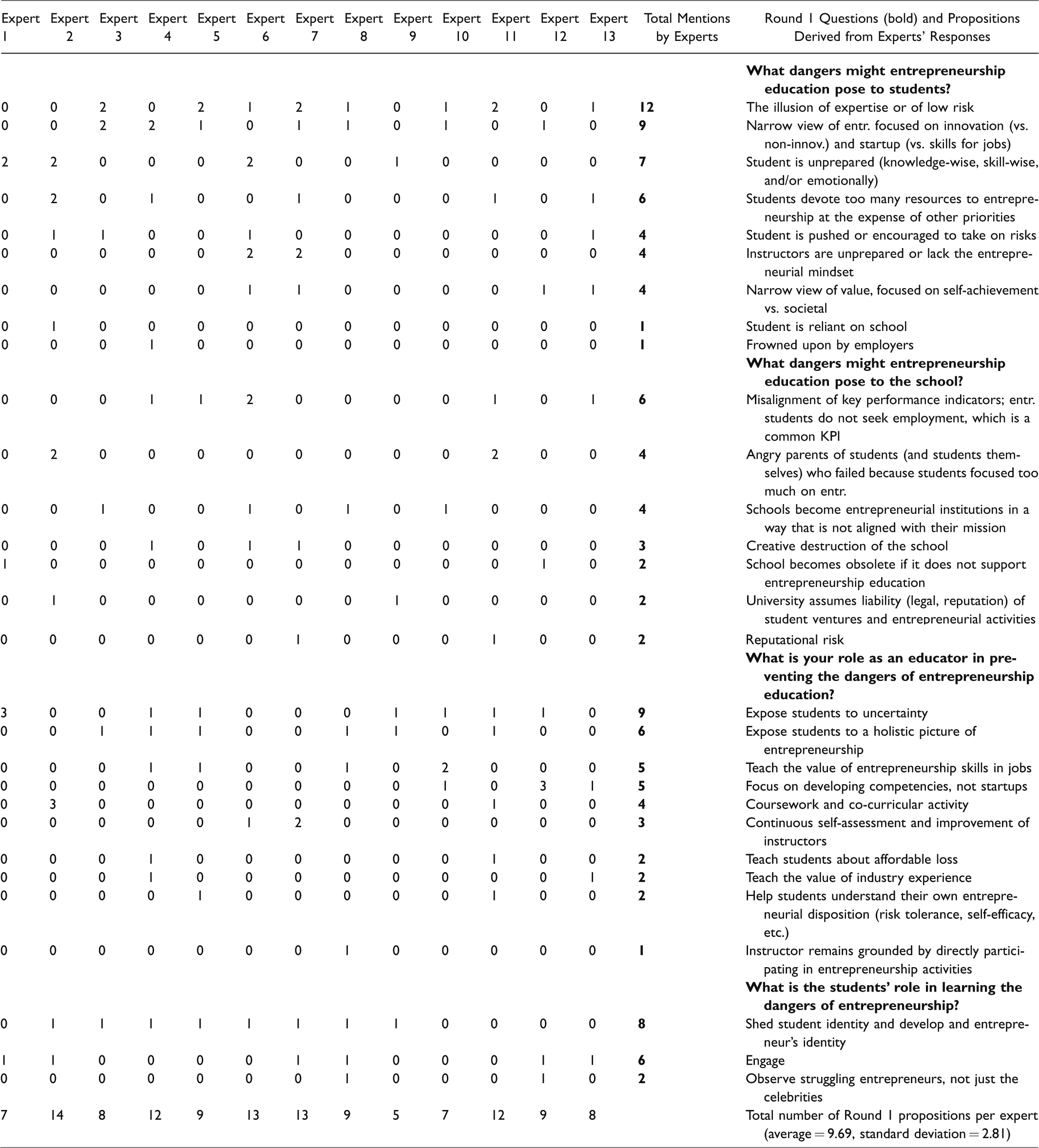
We next analyze the experts’ responses. We first focus on the dangers of entrepreneurship education to the students and to the school, and then focus on the roles of the educator and the student.
Dangers of Entrepreneurship Education to the Students
Answers to this question clearly called for the differentiation of entrepreneurship education focusing on venture creation (Katz, 2003) and on the development of a mindset and competencies (Neck & Corbett, 2018). When defined as starting a new business, one expert claimed that “the act of engaging in entrepreneurship can be dangerous (e.g., creating new products that may cause unintentional harm to users; the loss of jobs and money if the business fails; creative destruction when new technology displaces old; post-traumatic issues related to stress or failure; abuse of power that comes with prestige and wealth, etc.).” EE contributes to this danger by “focusing too strongly on venture creation” (Expert 8) and by the tendency to “measure the quality or worth of a program by how many students start companies, then such instructors could find themselves in positions of encouraging students to take unnecessary and unwarranted risks with respect to business startup activities” (Expert 2).
Most experts mentioned dangers associated with the perspective of EE as focused on new venture creation, including “push students to entrepreneurship and to the creation of their own ventures” (Expert 3), “make students believe that everyone should become a business owner” (Expert 10) and “creating a false sense of confidence and possibility surrounding starting a business” (Expert 8). In such a perspective, entrepreneurship education risks “giving students the illusion of expertise” (Expert 6), “unrealistic expectations” and pushing them to “jump into ventures that are ill-fated” (Expert 4). Also, when venture creation is part of a course, there is a “tendency for students working in a university- based incubator to develop a co-dependent relationship” (Expert 2). This relationship initially benefits students by providing “free place to work 24/7; free prototyping services; free mentoring; free legal services; access to lower levels of seed funding. The problem here is that students get so used to all of the free stuff that they don’t develop the drive and the creativity to survive on their own outside of the friendly confines of the university environment. We need to help them to develop resiliency and grit.”
Regarding content, there is a danger on placing “so much emphasis on lean startup activities (…) and neglect to educate students as to issues related to managing a growing venture” (Expert 2), or not to “prepare the students on how to apply the (entrepreneurship) principles and skills in other contexts” (Expert 4). In addition, overemphasizing the importance of pitching and examples from popular shows like Shark Tank may lead students to believe that “entrepreneurship is all about presentation” (Expert 9), or that “everyone should become a business owner” (Expert 10).
There was also agreement that “giving to the students a too heroic picture of entrepreneurs and entrepreneurship” or “providing the students with a too neoliberalism view of economic life” are potential unintended consequences of entrepreneurship education (Expert 3). As such, there is a “lack of protection against an often very stressful and potentially harming ‘lifestyle’” (Expert 13) typical of the entrepreneurial journey. There is also the danger of “emphasizing some entrepreneurial situations (opportunity entrepreneurship) and keep silent about others (necessity entrepreneurship),” noting that “in some instances entrepreneurs can live under poverty and insecurity” (Expert 3).
From the perspective of entrepreneurship education for the development of competencies and skills, experts raised concerns that students might “build naïve confidence in their entrepreneurial abilities” (Expert 11) and create “a false sense of confidence and possibility surrounding starting a business” (Expert 8). Clearly, “giving students the illusion of expertise is (…) a huge risk” (Expert 6) as increasing students’ entrepreneurial intentions and self-efficacy without significant cognitive change and the acquisition of the necessary skills can yield negative outcomes (Nabi et al., 2017; Santos & Liguori, 2019). The entrepreneurial competency of risk mitigation or risk management is defined as the ability to take actions that reduce the probability of a loss or reduce the potential effect if the risk were to occur (Morris et al., 2013). On this issue, one expert mentioned “we want to encourage risk-taking, and develop a healthy attitude toward failure, but there may be a danger if it is not grounded in data, market feedback, and so forth” (Expert 4). While experts’ responses to this question were detailed and provide a rich context for discussion, it is also important to note that it was mentioned that “the danger to students today is not having entrepreneurship education” (Expert 1).
Dangers of Entrepreneurship Education to the School
Experts were asked to reflect on what might be the dangers of entrepreneurship education to the school. Responses included threats to the reputation of the school and legal dangers. For example, “students engage in illegal activities while working under the auspices of a school…” (Expert 2) and “the school’s reputation may suffer if too many entrepreneurship graduates do not achieve strong career paths” (Experts 7 and 11). Schools often use job placement as key performance indicator and as a metric with which to recruit new students. However, “a portion of entrepreneurship students may not fit in the traditional measurement of placement and that could negatively impact the perception of the performance of the school” (Expert 4). This could also have an impact on “measures of student success (e.g., average salaries for new grads not going to graduate school)” (Expert 6). Expert 10 mentioned that “those (measures of student success) are likely to suffer for those students commencing or even working for new ventures.”
In a way, the above responses raise a paradox. There is a call for universities to be entrepreneurial (Etzkowitz, 2004), create university-based entrepreneurial ecosystems (Rice et al., 2014), and promote entrepreneurship education across campus (Costa et al., 2018; Kuratko & Morris, 2018), but most schools are not prepared for the required break with the status quo, such as traditional performance measures. Such changes to a school’s educational and administrative practices addressed by Expert 4: “The greatest danger to the school may be that entrepreneurship education may lead to creative destruction of the school. At least some may consider that a danger. If we are effective in our entrepreneurship education, it will permeate all aspects of the school. It will result in changes in the way we do things. It may even lead to alternative methods or industries forming that more effectively meet needs that were previously handled by business schools or universities.”
One expert responded that there are schools with an overemphasis on the “creation of new start-ups for the obvious visibility that derives from this. On average however, the results on startups are often disappointing” (Expert 7) as it is typical of the entrepreneurial journey, and that might lead to poor perceptions of the school. Schools need to focus on “the skills and the creation of an innovation culture (…) that can promote engagement and employability as well as the critical mass of ideas from which the occasional star will emerge” (Expert 12).
The balance between entrepreneurial activities at school and other disciplines might also pose challenges to the school as “student(s) might be so focused on their business development activities that they start neglecting their other coursework. Taken to the extreme, this can sometimes lead to the students dropping out or failing out of school” (Expert 3). This might also have an impact on students’ families and “could lead to unhappy parents.” Beyond that, “parents may not appreciate the paths that a school might be leading their children down” particularly “when the students lose (…) money pursuing their entrepreneurial efforts”, says Expert 3.
Financial risks for the school were also posed. One expert mentioned knowing “examples where schools have supported misinformed projects” (Expert 7). Similarly, “students might assign blame to the school for failing to warn them about the risks of forming new ventures” (Expert 10). These financial and emotional risks are “especially prevalent when inappropriate pressures are brought to bear, such as shortened time scales, high visibility or financial burden” (Expert 7).
While these are legitimate concerns, Expert 1 countered that “if the school does not support entrepreneurship education there is a danger to that school of becoming obsolete.” The danger can also come when entrepreneurship “doesn't match the school culture and capabilities” (Expert 8) which in turn can marginalize EE.
Role of the Educator in Preventing These Dangers
The educator role in entrepreneurship education has been moving from the traditional lecturer to being a coach, and ideally in the future will be a facilitator of learning (Neck & Corbett, 2018). Experts extensively agreed that educators should acknowledge, develop and discuss the “positive and negative consequences of entrepreneurship (…) all dimensions, economic, social, ethical, sociological, philosophical, human values, should be addressed in entrepreneurship education” (Expert 3). In doing so, educators have the responsibility to be “transparent about potential dangers” (Expert 4), on all the “realities of entrepreneurship” (Expert 8), and covering “the different paths that individuals can take towards entrepreneurship” (Expert 13).
Experts indicated that educators should “emphasize the probability and role of failure in entrepreneurship” (Expert 9), “teach about affordable loss” (Expert 4), “continually call out the risks and failure possibilities of forming new ventures” (Expert 11), and “help students understand their own personal risk tolerance profile” (Expert 11). Overall, educators should ensure that the projects assigned “don’t put students in compromising or dangerous situations (…) we never want to put students in harm’s way.” Yet, the nature of entrepreneurship education entails placing students in “situations where things are uncertain, chaotic, challenging, and unsure” (Expert 1).
One expert urged to “actively stop romanticizing entrepreneurship” and rather “show all sides of entrepreneurship and not just what is commonly perceived as a success” (Expert 12). Focusing on the “importance of developing competencies” should provide a view on the “the versatility of such competencies to be applied in several circumstances” beyond new venture creation (Expert 10). Overall, educators should “offer a fairer picture of what entrepreneurship is and how it can be integrated or get in the way of their education” (Expert 3). It is an educator’s role to “help students know what they do not know (…) identify opportunity cost tradeoffs in career choices (…), mentor students who are considering launching a new venture” (Expert 11). Strategies that educators can use include “bring in key people to talk to the students about these matters (i.e. lawyers, entrepreneurs, professional service providers and investors etc.),” challenge students to “observe and interview people struggling with entrepreneurship,” and “providing data about systemic risk, (and) methods to assess and mitigate business risks” (Expert 2).
It is also the educators’ responsibility to “keep learning (…) study the entrepreneurship education research (…), keep deeply engaged/immersed in the entrepreneurial world” (Expert 5). The growth in entrepreneurship education research (Fellnhofer, 2019) implies that there is significant scholarly knowledge in entrepreneurship education theory and practice that needs to be bridged and integrated in teaching practices. Entrepreneurship education based on evidence (Pittaway & Cope, 2007) and efforts to bridge the gap between science and pedagogy (Frese et al., 2012) are part of the role of the educator in preventing the dangers of entrepreneurship education. Along with the emphasis on educators’ training needs to be grounded on “good educational research” (Expert 7), experts also mentioned the importance of having “one foot in entrepreneurship as a profession” (Expert 8).
Student’s Role in Learning the Dangers of Entrepreneurship
This question received the shorter answers from the experts. Whereas educators have a role in preventing the dangers of entrepreneurship education, the experts remind that students also have a responsibility in the education process. The majority of the experts referred to aspects related to “accept ownership of their education, their career” (Expert 4) and “control over their entrepreneurial learning” (Expert 6). In doing so, students are expected to “effectively manage their time and prioritize these types of events that can put them in situations to build their competencies and develop their professional networks” (Expert 2).
Mentoring has a significant impact on experiential learning entrepreneurship programs (Bandera et al., 2018; Lutz et al., 2015; Radu Lefebvre & Redien-Collot, 2013). While, some students might resist to be mentored and are not very coachable, it is their role to “be very open to the mentoring and coaching they receive through such programs” (Expert 2). Students have the role of “asking questions” and “being candid and honest in responding to instructor inquiries” (Expert 11). Students are expected to “understand that competency development is a riskier environment to learn in when compared to pure knowledge development” (Expert 7) that requires their “willing to get out of their comfort zone, their bubble and experience the realities” (Expert 8); to “take an active role and be proactive” (Expert 5).
Experts were also consistent on calling for students’ role in becoming “critical thinkers” (Expert 9), and for them to “critically reflect on what they like about it and what fits with their skills and abilities” (Expert 13). The entrepreneurial experience is personal (Morris et al., 2012) and students should be accountable to “ask questions that are relevant for them” (Expert 12). One expert also highlighted that practicing entrepreneurship is how students will learn how to “identify, anticipate, mitigate, and navigate potential danger” (Expert 1) while being aware of “how much they are able to deal with uncertainty and risk” (Expert 5).
Round 2: Identifying the Unintended Consequences of Entrepreneurship Education
All thirteen experts in the first round participated in the second round. Based on the different propositions that emerged from the content analysis on Round 1, we built a survey that was distributed to all experts on Round 2. Experts were asked to rate the importance of each proposition to the respective question in a three-point scale: 1 “not very important,” 2 “moderately important,” or 3 “very important.” Experts were also asked to add any other important propositions and comments that they consider relevant.
Following the data analysis procedure suggested by Guest and Zijlstra (2012) we analysed the level of consensus in each proposition using the percentage of answers for each level of the scale. The criteria for consensus was that agreement above 75 percent indicated a strong level of consensus among experts. Agreement among experts was not measured with the interrater agreement index Rwg(j) described by Biemann et al. (2012) because “the use of fewer response options (e.g., a 3-point response format) can result in artificially low estimates of interrater agreement” (p. 68).
The intraclass correlation coefficient was used as an index of the reliability of the ratings (McGraw & Wong, 1996). The average (or sum) of the scores of the 13 expert panellists is highly reliable (0.87, p < 0.001; interval of 0.77 to 0.93 with 95% confidence), suggesting that despite their apparent differences in scoring, there is overall consistency among the judges. The Single Measure Intraclass Correlation in our panel is 0.33 (interval of 0.20 to 0.52 with 95% confidence) and statistically significant (p < 0.001).
While in Round 1 the answer to the question “What dangers might entrepreneurship education pose to students?” received the longest answers, in Round 2 experts did not report strong consensus that any of the nine propositions is very important (according to the defined threshold of 75% of agreement). This is a signal on the need to better inform, clarify and specify these in future research paths focusing on the dangers of entrepreneurship education. While strong consensus was not achieved, there are three propositions with high mean values (Table 3). Roughly 77% of the experts agree that the “Student being unprepared (knowledge-wise, skill-wise, and/or emotionally)” to pursue entrepreneurial activities is a very or moderately important danger of entrepreneurship education (M = 2.23, SD = 0.83). Similarly, about 77% of the experts agree that the “narrow view of entrepreneurship that focuses on innovation (vs. non-innov.) and new venture (vs. skill sets for the job market)” (M = 2.15, SD = 0.90) is a very or moderately important danger of entrepreneurship education. Finally, while the proposition “narrow view of value (focused on self-achievement vs. societal benefit)” reported a high mean value (M = 2.15, SD = 0.80), there was more diversity among experts on the importance of that to the dangers of entrepreneurship education. Additional comments from the experts to the proposition “Frowned upon by employers” were clear in pointing “this is an old view (…) employers want the entrepreneurial students today (…), they are more holistic thinkers and understand business as an integrated enterprise that relies on innovation and change for survival” (Expert 1). In the same line, other experts added that “entrepreneurial competencies should also be needed employee-competences” (Expert 10) and ultimately entrepreneurial competencies are “becoming much more widely accepted, so I don't worry about this” (Expert 8).
Propositions Included in Round 2: Descriptive Statistics and Percentage of Consensus Among Experts.

Regarding the dangers of entrepreneurship education posed to the school, mean values in all propositions are below “2” (moderately important), suggesting that these are not so prominent to the panellists. However, the two propositions which a higher percentage of responses in the “very important” category are “misalignment of key performance indicators (KPI); entrepreneurship students do not seek employment, which is a common KPI” (62% rated as very important) and “reputational risk” (54%). These concerns are also addressed in extant discussions on the performance measures of universities (Kirby, 2004; Morris et al., 2013). While most schools assess their results based on indicators related to students’ job placement, universities focusing on entrepreneurship education are likely lower on these traditional indicators (Gault et al., 2010). There is an apparent conundrum here. What key performance indicators should universities also use? It is important to note that some experts integrated relevant comments to this proposition. Specifically, it was noted that “entrepreneurship students do seek employment unless they are actively engaged in running their own venture at the time of graduation” (Expert 2). Our results open avenues for discussions in future research on entrepreneurship education and sparks the discussion among practitioners.
Among all the propositions, the average importance rate was higher in four propositions related to the role of the educator in preventing the dangers of entrepreneurship. As expected, this emphasises that experts highly value the role of the instructor in the educational process (Neck & Corbett, 2018). First, experts expressed strong consensus (85%) that “expose students to a holistic picture of entrepreneurship” (85% of consensus rated as very important; M = 2.85, SD = 0.38) and that “expose students to uncertainty” (M = 2.77, SD = 0.60) are both very important roles of the educator in preventing the dangers of entrepreneurship. Second, experts reported that focusing on developing entrepreneurial competencies, not startups, is also very important (consensus of 70%) (M = 2.69; SD = 0.48) to prevent the dangers of entrepreneurship education. Third, experts reported that it is very important to continuously self-assess and improve instructors (consensus of 70%) (M = 2.69; SD = 0.48). Experts also reported a strong consensus (>75%) that “teach students about affordable loss” and “teach the value of industry experience” is important to prevent the dangers of entrepreneurship education. Interestingly, propositions referring to the role of the educator in preventing the dangers of entrepreneurship education gathered a higher strong consensus (>75% of the experts rated 2 propositions as “very important” and 2 propositions as “moderately important”) and the higher mean values.
On the role of the student learning the dangers of entrepreneurship education, experts expressed strong consensus that it is very important to “engage” (84%; M = 2.77, SD = 0.44) and to “observe entrepreneurs struggling, not just the celebrities” (77%; M = 2.67, SD = 0.65). The complete list of the 29 propositions included in round 2 are listed in Table 3, including the mean and standard deviation of experts’ ratings, and the percentage of consensus among experts.
Discussion
There is a palpable excitement in entrepreneurship education (EE), pulling students, educators, stakeholders, administrators, and researchers to participate. Current scholarship on entrepreneurship and EE eclipses what existed as recently as the nineties (cf., Fellnhofer, 2019; Kuratko & Morris, 2018; McMullan & Long, 1987). EE is conducted in a growing number of schools (Barnard et al., 2019; Honig, 2004; Liguori et al., 2019), disciplines (Béchard & Grégoire, 2005; Beckman, 2011; Souitaris et al., 2007), and interdisciplinary settings (Neumeyer & Santos, 2020). Understandably, research on EE has adopted a positive perspective, focusing on new venture creation (Harms, 2015), entrepreneurial competencies (Morris et al., 2013), intentions (Nabi et al., 2017) or the mindset (Fayolle & Gailly, 2008). Yet, beyond the excitement, there is little research on what might be on the other side, i.e., the dark side of entrepreneurship education. Recently, Shepherd (2019) called for “more research on the dark side of entrepreneurship – what are its dimensions, why does it generate suffering, and how we can reduce it and speed recovery?” (p. 4). Our research is a direct answer to this call.
This paper explores dark side dimensions of entrepreneurship education and sheds light on how to mitigate it. Results showed several of the propositions are associated with TPB constructs: “illusion of expertise or of low risk” inflates behavioral control, “narrow view of entrepreneurship” (that focuses on innovation, new venture) presents a subjective norm that ignores other entrepreneurial roles and career paths, and “student is pushed or encouraged to take on risks” inflates attitude. When viewed through the lens of the TPB, these propositions place the student at risk by having entrepreneurial intentions while at the same time being unprepared for entrepreneurship. This risky outcome was itself the most supported proposition in the study: “Student is unprepared (knowledge-wise, skill-wise, and/or emotionally).” Correspondingly, “expose students to uncertainty” and “expose students to a holistic picture of entrepreneurship,” were the two most cited recommendations with which to mitigate the dark side of EE.
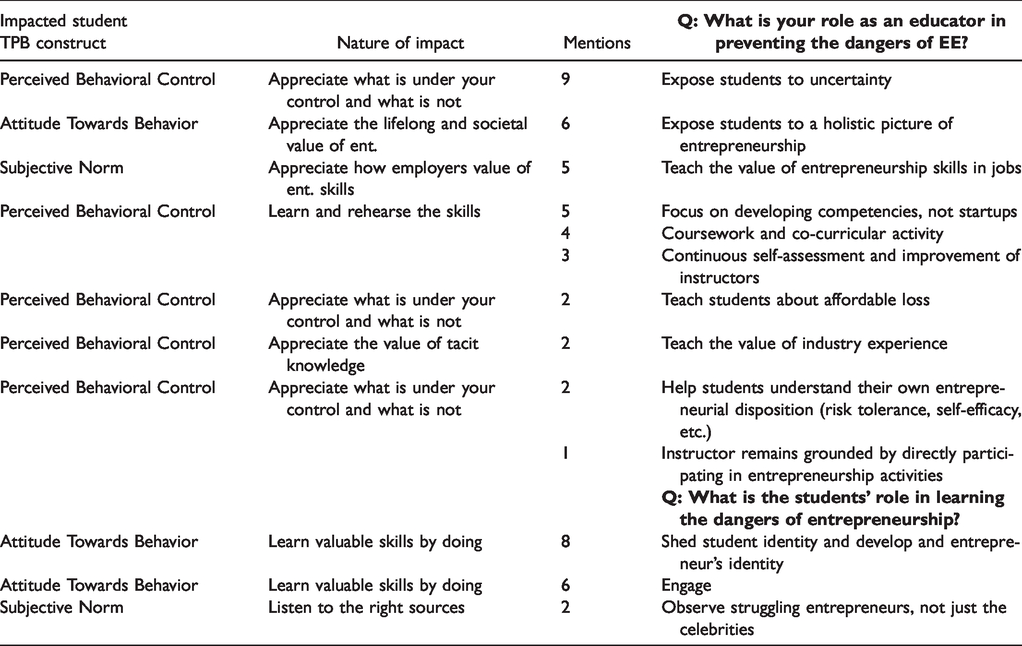
Two of the Round 1 questions address the inputs to our EE model (Figure 1): “What is your role as an educator in preventing the dangers of EE?” and “What is the students’ role in learning the dangers of entrepreneurship?” We reviewed the responses to these questions and in Table 4 note the TPB construct influenced by each proposition (note that some propositions, such as “continuous self-assessment and improvement of instructors,” do not directly impact student TPB constructs and were left unassigned). Most recommendations for educators impact the student’s perceived behavioral control whereas most recommendations for students impact the student’s attitude. It thus seems that the experts participating in this study put most (but not all) of the responsibility for the consequences of EE on the educator and not on the student. An implication of the schema in Figure 1 is that the educator’s role includes making sure that students know what their role is. Through online syllabi common in many schools, the educator influences the student’s role even before the semester begins.
Propositions for EE and the Impacted TPB Construct.
Even though the Delphi questions focused on EE stakeholders within the school environment, experts cited propositions involving stakeholders outside this environment. Among the more cited propositions, “students devote too many resources (time, money) to entrepreneurship at expense of other priorities (studies, graduation, employment/work experience, health)” impacts stakeholders outside the school. Another proposition, “narrow view of value (focused on self-achievement vs. societal benefit)” also challenges EE to consider the consequences of entrepreneurship action on society.
Future Research
Our understanding of the benefits of EE has outpaced our understanding of its downside, leading to some potential unintended consequences. Additional theoretical groundwork on entrepreneurship education and pedagogy is needed to specify the mechanisms (i.e., mediating variables) and boundary conditions (i.e., moderating variables) underlying the dangers of EE, so instructors and administrators can implement specific recommendations in their practice. This is in line with “an evidence-based teaching approach [which] can contribute towards instilling and disseminating entrepreneurial awareness among students using theoretically and empirically well-grounded perspectives on entrepreneurship” (Santos et al., 2016, p. 83).
We encourage future research to gather empirical data on students in different disciplines, ideally following a longitudinal design so that short- and long-term consequences can be assessed. In additional, experimental designs will be needed to test the effect of strategies on different topics including affordable loss and risk. Future research should also discuss further EE at the school level, questioning the pertinence of traditional key performance indicators, and working towards a multidisciplinary paradigm shift at the leadership that embraces more than the traditional economic virtues bestowed on entrepreneurship.
Study Limitations and Implications
This study is not without some limitations. First, students and university administrators were not included in the panel. Second, the expert panel was comprised only of established, award-winning educators. While our intent was to conduct the study with experienced educators presently in the classroom, this approach does potentially limit the range of responses received and generalizability of the results. Educators are implementing changes in EE, including shifting the focus from venture creation to skills creation, from constructivism to constructionism, from management to innovation, and from the business school to interdisciplinary settings (Fayolle, 2007). However, it is not clear how (or if) any of these changes reduce the dangers of EE to students and their environments. This study contributes to EE in the midst of these changes by providing a mixed-methods view into the dark side and raising awareness of the unintended consequences borne by the students and institutions we serve. The disparity in the dangers and recommendations collected from experts indicates that we educators have the best intentions but not consensus. Future research should continue to head the challenge put forth by Liguori et al. (2018) in the opening editorial of this journal: to boldly help bridge the gap between theory and practice in entrepreneurship education while embracing inclusion and facilitating translation.
Footnotes
Acknowledgments
The authors thank the reviewers for their valuable comments. The authors also express their appreciation to the experts who participated in the Delphi panel: Silvia F Costa, Alex DeNoble, Mike Dominik, Alain Fayolle, Dan Holland, Benson Honig, Luca Iandoli, Norris Krueger, Francisco Liñán, Heidi Neck, Xaver Neumeyer, Andy Penaluna, and Doan Winkel.
Declaration of Conflicting Interests
The author(s) declared no potential conflicts of interest with respect to the research, authorship, and/or publication of this article.
Funding
The author(s) received no financial support for the research, authorship, and/or publication of this article.
