







Abstract
The overall purpose of this research is to be able to understand how engineering students believe they are developing EM throughout their higher education experiences. Is EM development attributed to the inclusion of EM based projects and activities within their engineering course work? Perhaps, EM development occurs more readily through engineering students’ participation in extracurricular or co-curricular activities? Alternatively, maybe EM development is not tied to the higher education ecosystem at all, and engineering students develop EM as a result of job or volunteer experiences. As such, this research study seeks to answer the following research questions: (1) Which types of experiences contribute to engineering students' EM development? And (2) What types of attributes of EM do engineering students perceive are developed through these experiences? The study involves a qualitative analysis of engineering student interviews to determine the experiences that have contributed to student EM development as well as EM traits that were specifically focused upon within these experiences. Through understanding engineering students’ perceptions of how they developed an EM, it will provide the necessary information to determine best practices for EM student development in the future.
Entrepreneurial mindset (EM) is a widely encouraged way of thinking and has become a popular topic of study in the past decade (Bosman & Fernhaber, 2018; Byers et al., 2013; Huang-Saad et al., 2018; Ridley et al., 2018). It has been proven that training students to think entrepreneurially and learning how to learn has led to development of crucial skills such as communication, leadership, and critical thinking (Ali et al., 2012; Blaschke, 2012; Ghazi Nezami et al., 2016; Hase & Kenyon, 2013; Huerta et al., 2017; Jensen & Schlegel, 2017). Likewise, the understanding that combining business and technical skills is crucial in an evolving society has helped with stakeholders buying into the importance of developing EM within engineering programs (Brunhaver et al., 2018; Dabbagh & Menasce, 2006).
Many college and university engineering departments have taken to tailoring projects and courses to encourage student development of EM (Cook & Cuper, 2010; Kim et al., 2016; Riofrío et al., 2015; Wang, 2017). Many of these curricular interventions have been successful, with engineering students having learned or refined important technical and business skills (Ghazi Nezami et al., 2016; Jensen & Schlegel, 2017; Riofrío et al., 2015). Research has also shown that co-curricular and extracurricular activities have encouraged student development of EM, as well as interventions outside of the university setting (Chen et al., 2017; Ramsgaard & Østergaard, 2018; Yasuhara et al., 2012). The wide variety of EM interventions that occur throughout a student's undergraduate experience has led to the shaping of young minds to greatly benefit society in the future (Chen et al., 2017; Dabbagh & Menasce, 2006; Huerta et al., 2017; Jensen & Schlegel, 2017).
Although it has been proven that EM skills are being developed through interventions, this is often assessed using grading rubrics or surveys. Though surveys address student perceptions of their EM development to a certain degree, these surveys often ask students to rank specific skills that the instructors or researchers feel they should have developed through the specified intervention (Ali et al., 2012; Hsiao, 2013; Kim et al., 2016). In addition, the assessment of EM development is often done immediately after an intervention takes place (Ali et al., 2012; Hsiao, 2013; Kim et al., 2016), which may not effectively measure if students associate that specific intervention with their overall EM development. These approaches may not allow for students to fully express their perceptions toward their EM development as a whole, which is what this study seeks to address.
Yasuhara et al.’s (2012) study is an example in which students were asked to reflect on EM development through a variety of experiences, using both surveys and interviews. Their surveys were limited to junior and senior level students, and their supplemental interview data focused on senior students from a specific academic program. Our study plans to address the need for better assessment of EM development (Liguori et al., 2018; Morris & Liguori, 2016) by examining student perceptions from all engineering undergraduate levels and academic programs, allowing for them to reflect on their entire academic career including experiences pre-college or outside of university settings. Overall, this study addresses the types of experiences students believe are most beneficial to their EM development (curricular, co-curricular, external to the university, etc.) and the EM attributes they believe were developed through these experiences. This paper will address the existing literature in curricular, co-curricular, and outside of university EM development in undergraduate engineering students. It will then cover the contextual framework for the study, entrepreneurial ecosystems, and present the research questions, qualitative methods, results, and then discuss the results' relevance to the field of entrepreneurship engineering education.
Literature Review
Curricular EM Interventions in Undergraduate Settings
Entrepreneurship education (EE) has exploded in recent years, with more institutions incorporating entrepreneurial learning into their courses and programs (Liguori et al., 2018; Neck & Corbett, 2018). The push for EE continues as it is necessary for all types of students to develop “the mindset, skill set, and practice necessary for starting new ventures” (Neck & Corbett, 2018, pp. 29–30). Though EE and the assimilation of EM are necessary for all students, EM in engineering has been an area of particular focus over the last several years (Huang-Saad et al., 2018). EM integration through curricular activities has been shown to have a positive impact on undergraduate engineering students' EM development (Bernal et al., 2017; Fraley et al., 2018; Ghazi Nezami et al., 2016; Huerta et al., 2017; Jensen & Schlegel, 2017; Kim et al., 2016; Kirkpatrick et al., 2016; Riofrío et al., 2015; Wang, 2017). Interventions in first year engineering are widely studied, often within general engineering courses that utilize design and problem solving (Huerta et al., 2017; Jensen & Schlegel, 2017; Riofrío et al., 2015; Wang, 2017). In these types of projects, students often work in groups to solve a real world problem by utilizing the design process to produce a product or service (Bernal et al., 2017; Fraley et al., 2018; Ghazi Nezami et al., 2016; Huerta et al., 2017; Kim et al., 2016; Kirkpatrick et al., 2016; Wang, 2017). First year students who had participated in these types of projects were shown to have improved in skills such as communication, teamwork, understanding of design, curiosity, and creativity (Ghazi Nezami et al., 2016; Jensen & Schlegel, 2017; Riofrío et al., 2015).
Projects and courses offered at all levels of engineering instruction focus on developing specific skills related to both engineering and entrepreneurship such as CAD, 3D printing, marketing, understanding of patents, and financial organization (Brouwer et al., 2011; Cook & Cuper, 2010; Kim et al., 2016; Park, 2017; Riofrío et al., 2015). Due to their elevated levels of experience from having taken more classes within their engineering curriculum, it is assumed that students who receive EM interventions in their upper class years are more likely to apply their EM (Yasuhara et al., 2012). In many cases involving upper class level students, EM is integrated through a design capstone project (Ali et al., 2012; Brouwer et al., 2011; Cook & Cuper, 2010). Students who participate in these projects are often given an entire semester or two to develop a full scale design and working prototype while also factoring in a business plan. In a survey of students who participated in senior capstone projects relating to EM development, the students had reported significant growth in areas such as leadership, problem solving, and team building skills, but much less improvement in financial understanding and creating a business plan (Ali et al., 2012). An important takeaway from the studies done on curricular interventions within engineering is that in order for students to develop an EM, they need to participate in consistent curricular interventions throughout their undergraduate years (Fry & Pistrui, 2011).
EM Interventions in Co-curricular Activities
Students who are self motivated and highly confident in their professional and interpersonal skills are often involved in extracurricular activities (Sheppard et al., 2010), which have been shown to positively influence their entrepreneurial skills (Bonesso et al., 2018; Chachra et al., 2009; Davis & Amelink, 2016; Sheppard et al., 2010; Yasuhara et al., 2012). As a result of participating in extra- and co-curricular activities, students have the opportunity to be exposed to experiences that allow them to expand their knowledge and nurture the attributes and skills they have obtained in their curricular activities (Chachra et al., 2009; Yasuhara et al., 2012). Extracurricular activities such as undergraduate research, engineering clubs, service and community based learning, and study abroad have been shown to have a significant influence on students’ motivation, professional skills, problem solving abilities, networking opportunities, and innovative thinking (Bonesso et al., 2018; Davis & Amelink, 2016; Sheppard et al., 2010; Yasuhara et al., 2012).
The development of entrepreneurship based centers and clubs have also played a key role in developing EM in engineering undergraduates through making connections between the classroom and the real world, building a sense of community, and providing a space for EM activities outside the classroom (Ndou et al., 2018; Ridley, 2016). Partaking in these types of clubs and activities have been shown to increase entrepreneurial interest in students, with many more graduates leaning towards starting their own businesses in the future (Rodriguez et al., 2018). Although not as heavily studied, undergraduate research has also been shown to have a positive impact on students' EM in terms of confidence, social skills, emotional intelligence, and critical thinking (Yasuhara et al., 2012). Some universities also offer paid research experiences related to entrepreneurship to help strengthen communication, leadership, writing skills, and retention within engineering programs and careers (Burkey et al., 2019; Scheiner, 2016). The results of these studies show that there is the potential for improvement in EM and its associated skillsets when students participate in extra- and co-curricular activities and research.
EM Interventions Outside of University Ecosystems
EM is often thought of as something that is solely developed within an academic setting, however, experiences outside of university ecosystems such as internships, co -ops, and activities can also have a positive impact on a students’ EM development (Chen et al., 2017; Yasuhara et al., 2012). Students who participate in outside work and internship experiences during their university career have been shown to develop extrinsic motivation, curiosity, professional development, opportunity recognition, and strengthen their leadership skills (Chen et al., 2017; Ramsgaard & Østergaard, 2018; Sheppard et al., 2010; Yasuhara et al., 2012). In a study by Yasuhara et al. (2012), some students stated that working outside of the university was crucial to their experience, and others were able to develop entrepreneurial skills, a sense of community, and gained qualifications that they felt would be beneficial for their future careers .
In another study by Chen et al. (2017), it was observed students felt strongly that internships outside of the university sparked their leadership qualities and entrepreneurial capacity much more than any professor had before. Similarly, a study by Ramsgaard and Østergaard (2018) on health and nutrition graduate students concluded that the students' skills in practical applications and general understanding of theory were strengthened through their internship. They found that when students used their entrepreneurial learning approach throughout their internships, they were able to identify opportunities easily, felt as though they belonged in the workforce, and had a better understanding of their learning outcomes (Ramsgaard & Østergaard, 2018). Many of the traits developed in students through internship and work experiences relate to their self-confidence in their work, as well as their interest in entrepreneurship, which in turn has been shown to be related to the development of their entrepreneurial self-efficacy (Andayani et al., 2020).
Literature has shown that internships and jobs are effective in developing students' EM but, there is also some evidence of EM development through secondary education. Students who participated in entrepreneurship training in high school reported having a higher entrepreneurial alertness, self efficacy, and felt that they were better equipped to find success in their future work (Dragoi, 2019; Ringo Ho et al., 2018). Students cited that these types of entrepreneurship programs strengthened their EM through development of creativity, critical problem solving, and communication skills (Dragoi, 2019; Rodriguez & Lieber, 2020). It is evident based upon the progressive development of skills and attributes from EM interventions outside of the university ecosystem that these experiences are beneficial to students’ EM development.
Entrepreneurial Ecosystems
According to Brush (2014), the concept of entrepreneurial ecosystems dates back to a study on the creation of an automobile-centric ecosystem. This included the idea that there are many pieces that contribute to building a functioning automobile, and turned that into an ecosystem. From there, others built upon that idea, bringing in economics and marketing until the theory of business ecosystems was described by Moore (1993). Moore stated that each business is a part of an ecosystem, as it depends on other businesses and strategies. Eventually, entrepreneurial ecosystems began gaining popularity within a university setting based on the idea that there are many factors working together that contribute to successful entrepreneurship practice (Brush, 2014; Shekhar & Bodnar, 2020). University based entrepreneurial ecosystems are becoming crucial to the economy, as universities are often involved in projects that contribute to benefiting society (Fetters et al., 2010).
In Brush's (2014) work, it was shown that the success of a university based entrepreneurial ecosystem is dependent on the implementation of three domains (curricular, co-curricular, and research) in conjunction with four dimensions (infrastructure, resources, people, and culture). Brush (2014) concludes that it is beneficial for students to have a significant understanding of entrepreneurship through many different types of curricular, co-curricular, and research activities. Opportunities for students to engage in different types of activities relating to entrepreneurship may not only shape their individual entrepreneurial mindset, but also contribute to the entrepreneurial ecosystem of the university and its benefit to society.
We have decided to utilize the contextual framework of entrepreneurial ecosystems to examine the different types of entrepreneurial activities that students have taken part in and how they believe it has led to their development of an entrepreneurial mindset. We will focus on each of the three domains and four dimensions presented by Brush (2014), as well as look into activities outside of the university experience that may have contributed to student EM development.
Research Questions
This study seeks to answer the following research questions: (1) Which types of experiences contribute to engineering students' EM development?, and (2) What types of attributes of EM do engineering students perceive are developed through these experiences?
Methods
This section outlines the procedures followed in data collection and analysis as part of this qualitative research study.
Study Design
Nineteen total undergraduate engineering students agreed to participate in a research study on the entrepreneurial mindset. These 13 male and 6 female students were given the opportunity to complete a video testimonial that could be used for a promotional video for the university's engineering program, and then consented that their video testimonial be used for research purposes. Out of these 19 interviewees, 9 were fourth year students, 3 were third year, 4 second year, and 3 first year. Even though the study consisted of almost half senior level students, all six of the engineering disciplines offered at the university were included. It is also important to note that none of the students of the same year were all consisting of only a single engineering discipline, which further shows that there is variety in class level and curricular background represented within the study population. There were a total of 3 Electrical and Computer Engineering students, 1 Chemical Engineering student, 4 Biomedical Engineering students, 2 Civil and Environmental Engineering students, 5 Mechanical Engineering students, and 4 Engineering Entrepreneurship students that participated in this research study.
Data Collection
Engineering undergraduate students in attendance at a Northeastern American University were recruited to participate in an entrepreneurial mindset related video testimonial. Multiple forms of recruitment were used including an email to all undergraduate engineering students as well as researchers' individual networks. After students agreed to the video testimonial, they were provided the opportunity to consent to participate in the research portion of the study. At the beginning of each interview, participants were also asked for verbal consent. Proper human subjects' approval was obtained prior to the study's initiation.
The interview protocol for the study consisted of five questions, and was semi-structured so that researchers could ask follow-up questions based on responses obtained from participants. The interview protocol was developed based upon prior research conducted in the engineering entrepreneurship field. Students were asked to define EM in their own words and list any attributes they felt could be associated with someone who has an EM. Interviewers then provided the students with a definition of EM which was formulated from the background literature search conducted before the creation of the protocol and asked further questions of the students given both their EM definition and the literature based definition. Subsequent questions asked students to reflect on their past experiences and select an experience in which they felt their EM was developed. These 20–35 minute interviews were conducted over Zoom and audio and video recorded for further analysis. After the interviews, the audio files were sent to a third party for professional transcription.
Data Analysis
The first research question was analyzed using provisional coding, a technique in which a codebook was generated prior to reading through the transcripts (Miles et al., 2020). The code book was developed based on Brush's (2014) contextual framework of entrepreneurial ecosystems in a university setting. The three domains (curricular, co-curricular, and entrepreneurship research) were considered main codes, with sub-codes being added to further refine each domain. The four dimensions (infrastructure, stakeholders, culture, and resources) were also defined within the codebook. As students were provided the opportunity within this study to be able to reflect upon EM development throughout their entire lives, an additional section was added for experiences students may have had outside of entrepreneurial ecosystems, including high school, paid positions (such as internships), and other significant events that students may have believed influenced their EM development. This codebook is shown in Table 1. It is important to note that portions of the code book that do not contain examples represent codes that were not observed within the collected data set.
Provisional Codebook on EM Student Experiences.
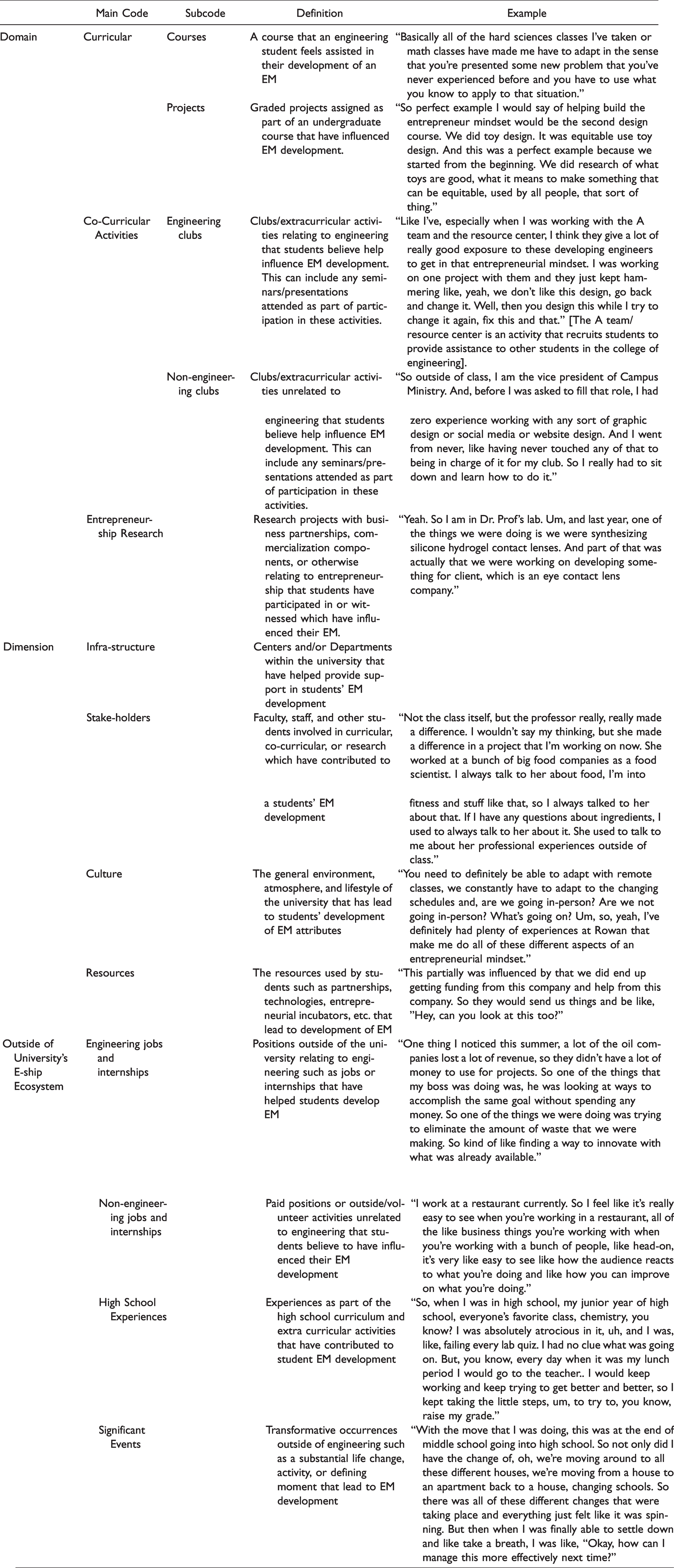
Transcripts were coded by three separate researchers. Initially, three transcripts were chosen at random and coded separately by each researcher, and they then met to discuss the discrepancies and refine the codebook to ensure that all of the researchers were interpreting the codebook in a similar manner. The three researchers then coded the remainder of the transcripts and met to reconcile the final results. Overall, the researchers were in agreement on the finalized transcripts and had a high degree of similarity within their individual coding. Although coding was primarily focused on students’ responses to what activities contributed to their EM development, it should be noted that if students mentioned experiences contributing to EM development at other points within their interview they were still coded in order to capture the full picture of the students’ EM development.
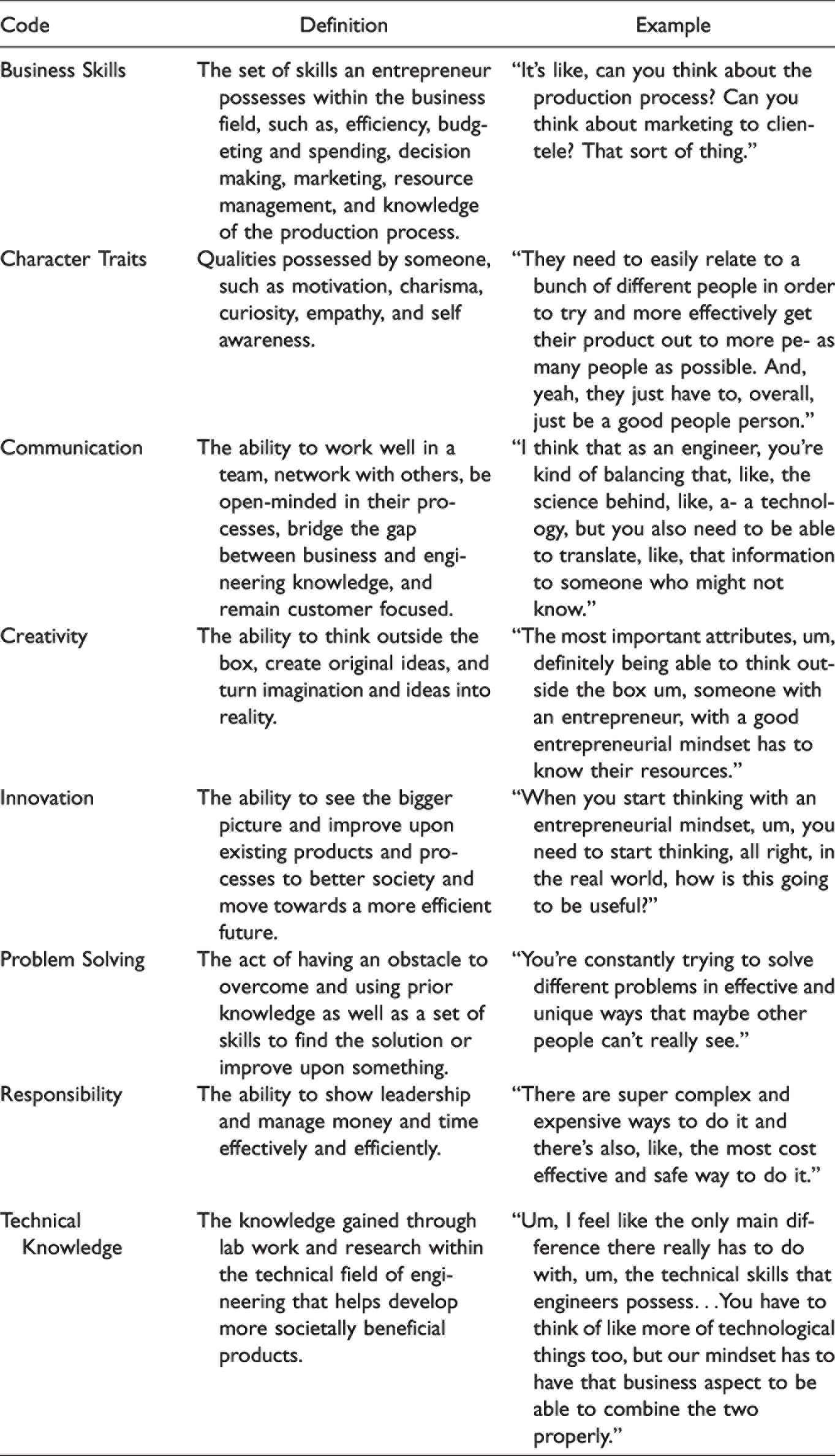
Similarly, the second research question was also analyzed using a provisional coding approach as was discussed for Research Question 1. The transcripts were coded using a previously generated codebook of attributes students had initially used to define EM (Jackson, Resnick et al., 2021). This codebook is shown in Table 2.
Provisional Codebook on EM Attributes (as found in Jackson, Resnick et al., 2021).
Research Quality Considerations
In order to ensure quality of the research process, the constructs presented by Walther et al. (2013) were used as guides in the data collection and analysis procedures. For theoretical validation, which determines whether the study reflects the reality that is being studied, literature was extensively reviewed when creating initial codebooks and definitions, and the resulting data was cross-referenced with existing literature to ensure its ability to reflect EM development. In terms of procedural validation, which established that the procedures used in data collection aligned with the selected contextual framework, the codebook in Table 1 was generated based on the framework of entrepreneurial ecosystems, and the coded transcripts were coded and reconciled by three researchers to ensure its effectiveness. Communicative validation focuses on the results being socially relevant to the community in question. This form of validation was taken into consideration by allowing the interviewers to ask follow up questions and take notes and the interviewees to expand upon their responses to each question. The codebook was also agreed upon by all of the researchers, and they met consistently to adjust and refine it as needed. Pragmatic validation is concerned with the study's relevance, but in the sense of it being truly meaningful to the situation of concern, which was addressed by making sure that student interviewees were engineering undergraduates and that underlying themes stemming from the coded transcripts were thoroughly investigated. Finally, Process Reliability was ensured by keeping audit trails of changes to all data collection and analysis procedures, as well as keeping track of meeting notes and individual files from each of the researchers.
Results
This section details the results obtained from qualitative analysis of the student interviews. The provisional coding analysis provided an understanding of student experiences that were relevant to the development of entrepreneurial mindset as well as the specific EM related characteristics that were strengthened throughout these experiences.
Research Question 1: Which Types of Experiences Contribute to Engineering Students' EM Development?
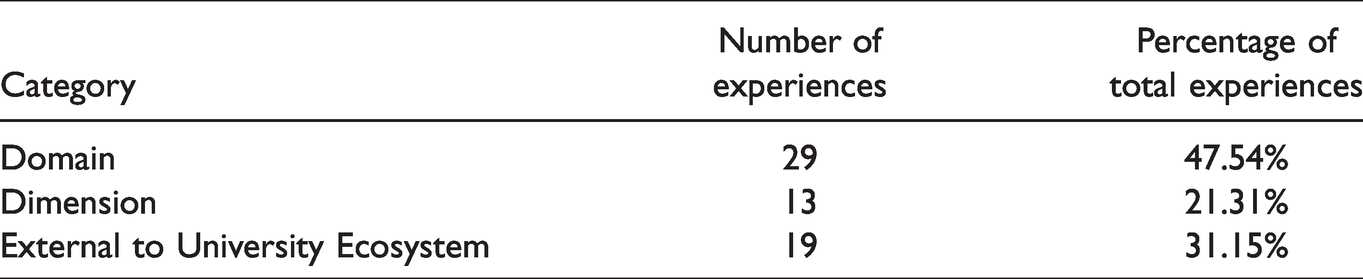
This question was geared towards understanding the various types of events and experiences that engineering students associated with their EM development. A total of 53 experiences were discussed by the 19 participants, with an average of 3 experiences per interviewee. A few experiences were relevant to two codes, and as such were counted for both in Table 3, bringing the total number of experiences to 61. Table 3 depicts the results in terms of domain codes which encompass curricular, co-curricular, and research experiences, dimension codes which encompass infrastructure, stakeholders, culture, and resources, and external experiences to the university ecosystem.
Code Occurrence for Experience Based Codebook.
Domain Results
Out of the 19 total participants, 15 students mentioned a curricular experience within a project and/or a course that contributed to their EM development. Students that mentioned this type of experience mainly discussed the general engineering courses required for early undergraduates, which had many projects specifically geared towards EM. These courses are offered every semester, and are heavily focused on design projects, building entrepreneurial efficacy, and working in teams throughout the first two years of the engineering curriculum. For example, Participant 987 stated, “My freshman year, um, in first-year design, we started learning Onshape, which was a CAD software … And, um, one of the projects we had to do was we had to create something we had to 3D print using one of the 3D printers in the labs … And I loved it so much, I loved creating and watching, you know, the thing 3D print that I actually that summer, I went and bought my own personal 3D printer.” Participant 562 discussed their experiences in that class as well, “That's why I liked the design class, because I didn't really have a- a business class my first semester, so that was more of what I like. The part of engineering I like is … the design part … So like, for someone to say, “Okay … so, I want this. You know, we make this.” Like, I want to be able to do that. I want to go and tell them … I can figure it out from the entrepreneurship side, what to do with it and all that.”
The number of curricular experiences (24 total) brought up by students heavily outweighed the number of research (3) and co-curricular (2) based experiences. However, the few students that discussed these types of experiences often shared how the situations were related to solving a problem for their club or an outside company. Participant 48 highlighted this in their recount of filling a role they were unfamiliar with, which is used as the example for non-engineering clubs in the provisional codebook (Table 1). Participant 39 discussed their biomedical research experience in which they were funded by a company to create contact lenses for clinical usage: “We were synthesizing silicone hydrogel contact lenses. And part of that was actually that we were working on developing something for our client, which is an eye contact lens company. And so though we were working to find a way, um, to more effectively make contact lenses and remove ethanol from the process, which was the end goal, we had a further application of being able to market it to this company. So we were thinking bigger picture than what we were just doing in the lab.”
Dimension Results
The four dimensions of the Brush (2014) entrepreneurial ecosystems framework made up the lowest percentage of experiences discussed by the student interviewees. Out of the 13 experiences categorized into a dimension, Stakeholders made up almost half with 6 experiences. These stakeholders were mostly instructors or fellow students who incited motivation or assisted in gearing the students toward a more positive mindset. Participant 560 discussed the impact of a professor in an entrepreneurship based class they had: “Entrepreneurship can't be taught but the mindset can be taught. My professor actually said that and it really like, really stuck with me in sophomore year.” Participant 606 was also motivated by a stakeholder, but in their case the stakeholder was a fellow student who they worked with on a project: “And I mean, he's the most organized person I have, I have ever seen. Like, he … We have like a Trello account and he makes, he makes those like guided maps on what we're supposed to do. We have a budget that he refers to. There's effective communication. He tells you your responsibilities, what you need to do … I think that, that has taught me, you know, to be on top of it.”
External to University Results
As shown in Table 3, 31.1% of the total number of experiences presented were from students reflecting on their experiences outside of the university ecosystem. Most of these came from non-engineering jobs and internships as well as some high school experiences, which were each discussed by 7 of the interviewees. The non-engineering positions varied from student run businesses to working in food service, with many students discussing working with managers, customers, and clients. Participant 55 highlighted their experiences working for a landscaping company, “I've worked in a couple different businesses and stuff like that, so … maybe that has shaped me in the idea of, like, okay, being on the inside of the business, I can see how it works and then I can see how I would, like, change that per se.” Participant 877 brought another perspective from their observations as a sailing instructor, “I've been a sailing instructor for several years and last year was my first year being the head instructor at my program. So, I was basically in charge of it all. So, it really taught me about how I had to work to make the program really good for the kids. Not only for their benefit, uh, but also for my benefit where I got to, uh, make connections with parents through them seeing the good job I did, or even just impressing my bosses to get letters of recommendation.”
Some students brought up curricular experiences from before they began their college careers. A few students discussed their engineering specific experiences in high school, such as Participant 803, who recalled an engineering based project they completed, “I went to a career like technical vocational [high] school, so like I did like the engineering track there so like, it like got into engineering a little bit. One of our projects was you had to build a boat completely out of cardboard that didn't like melt in our pool, like our chlorinated like pool we had in our school.” Participant 329 also reflected on a high school engineering design project, “In particular I was part of a program called PLTW in high school, which was like an engineering education thing. And specifically, uh, in our senior year, we did a project where we had to talk to customers and, uh, try to create a novel product that … we had to, like, identify markets and stuff like that, fill a market gap.”
Through the interviews performed it became evident that a wide variety of different experiences across all domains, dimensions, and external experiences impacted engineering student EM development. However, it seems as though most students associated EM development specifically with curricular experiences they had within engineering. Curricular experiences alone made up 24 [39.34%] of the 61 total experiences, and 75% of curricular experiences described were focused on an engineering class. When curricular experiences were compared to experiences external to the university, 8 out of the 15 students who had discussed a curricular experience also talked about an external experience, which shows that students feel they are developing their EM through a variety of experiences rather than only in the classroom. Overall, curricular experiences with an engineering focus seemed to be the most prominent in contributing to EM development, but many students were also influenced from experiences external to the university ecosystem.
Research Question 2: What Types of Attributes of EM Do Engineering Students Perceive Are Developed Through These Experiences?
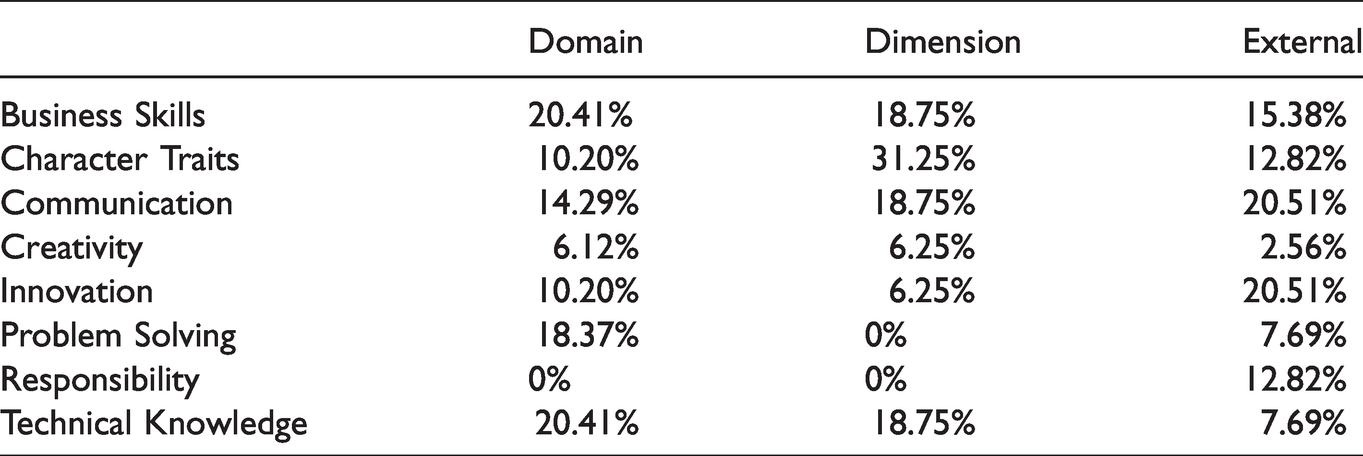
To address this research question we reviewed the 53 experiences discussed by the 19 interviewees and identified which EM attributes students felt were enhanced due to these experiences. Table 4 shows the results for the distribution of EM traits associated with each experience category.
Attributes of EM Percentage Results for Each Category of Experiences.
Domain Results
The domain codes encompassed curricular, co-curricular, and research experiences, which made up the highest percentage of experiences discussed overall. Through these experiences, it was shown that the EM attributes students believe are most strongly developed during these experiences are Business Skills, and Technical Knowledge. As stated previously, students at this university take lower level general engineering courses that have EM projects integrated within the curriculum, so the 7 students who felt they developed business skills through their curricular experiences often cited these courses. Participant 987 said: “And so, like, now I've kind of turned this 3D printing that I learned in a class to now have my own 3D printer, and I can, you know, I charge people for certain things. And, uh, create all different types of projects … So, um, it's just crazy to me how, like, this one class just kind of shaped, uh, basically an entrepreneurial journey venture.” Students who took courses related to business also felt that business skills such as marketing and budgeting were developed, such as Participant 560, who took a social entrepreneurship class: “You can get to people across the world through social media, you know, social media adverti- advertising, YouTube, stuff like that. So, that was a really cool class because it also expanded my mind in the sense of marketing without talking about marketing directly.”
An increase in technical knowledge was also cited by 7 students who discussed curricular experiences. They commonly mentioned engineering design as a significant piece of technical knowledge, such as Participant 42, who said “It's so, um, crazy because I'm building so many skills. Like I just learned how to use a 3D modeling website. I just learned how to work on team screen parts that would fit together. And um, like I was able to like really take that and be able to build it and work with 3D printing and realize that's something I'm definitely going to be using in my future.” Participant 39 also discussed the steps of physical product design: “And it was really simplified. Like we learned about the manufacturing processes, like, how would you want to make this? Would you want to use injection molding, or what would you want to 3D print it? It was all like that step of the way.”
In terms of research and co-curricular activities, problem solving was discussed in 60% of the experiences brought up by students. Research is often coupled with solving a problem for a company, or in hopes to get picked up by a company, as stated by Participant 33: “I was researching specific drugs to work for cancer therapeutics, and … there's a lot of drugs that they use in cancer therapy, uh, but I was kind of hyper fixating on using this one specific thing that was shown to work really, really well, and this other thing that was shown to work really, really well … And then, you know, things aren't like looking right, and I'm wondering why and I, you know, a quick little search and I find out that these two drugs are used really, really commonly but they're never used together because they hinder each other. But you know, now that I've seen that, I kind of like learn from that mistake of like, okay you need to know at the end of the day, even if these two things work separately, is it all going to be put together.” Engineering clubs are also sometimes geared toward a certain project or seeking to solve a problem to better the university in some way, as stated by Participant 769, “I was working on one project with them [the club] and they just kept hammering like, yeah, we don't like this design, go back and change it. Well, then you design this while I try to change it again, fix this and that. And just constantly going back and feeling that sense of like failure, like, oh, I thought this was like the design, that having to go back. So just constantly having the persistence of that. I think that's a quality that I've developed into a strength.”
Dimension Results
In terms of dimension, students most commonly shared how they developed specific character traits such as motivation and perseverance. In terms of Stakeholders, Participant 560 talked about influence from a fellow student; “I don't think I really realized it until I had one my like friends and I started pushing more like freshman year in college. And then one day, he said, “You just don't want it enough.” And I'm like, “You know what? You're right.” Like, I don't know, from then on my mindset kind of changed. I've always been somebody that's like not afraid to talk to people. I think outgoing is an important part of being an entrepreneur. I aspire to own a business one day, I, you know, you can be within a company and be an entrepreneur.” Participant 803 also developed motivation through the changing culture of being a university student during a pandemic; “I think I definitely have an entrepreneurial mindset in the type- in like making the most of situations, especially right now. I mean everyone in the Zoom call is making the most of, you know, being in college during a, you know, global pandemic where we can't really, you know, go anywhere without like a mask on and like, you know, the proper like protective equipment.”
External to University Results
One of the most prominent skills developed through external experiences was Communication, which was discussed in 75% of the job and internship experiences brought up by students. Participant 42 was able to make connections between their job at a restaurant and how those communication skills are useful within engineering: “I'm just a food runner, so I'm making sure everything's going out. And like making sure everyone's happy at the table and gets what they want. And then all the chefs are making all the food. Like it's all like, it's one big thing together. And like with one piece struggling, everything's gonna go downhill. Oh, well I mean engineering, like you're working on a team majority of the time, depending on if you're working on a project by yourself or um, with anyone else, but you're working with other people. And if one thing is going down with someone else, like you have to check in with every single person that's involved because if one thing someone's doing and like isn't checked in on, or you don't know the answer to something like it's going to affect the whole project and you guys have to like draw back to where you were.” Participant 606 made similar connections through their experience as a swim instructor: “I think whatever job you have, if you have people skills, it's super beneficial. Um, also, um, it, the … my, my, my experience through these jobs has also helped me with like teamwork at Rowan when, uh, going into teams, I, it's easy for me to just, you know, speak openly, uh, and contribute to my group. I don't get the … I don't get the like, “Oh, I wonder if I'm, I'm saying it right,” or, “I wonder if I'm, um, kinda.” You know, I, it put confidence in me in that way, too.”
The other skill that was discussed a lot was Innovation, which was brought up in half of the high school experiences and half of the job experiences. Participant 1,000 discussed innovation in terms of taking risks based on what they learned from a project in high school: “I think, like, being able to take risk, I guess, is a, is a huge part of it, because then, if you just do the same thing as everyone, everything else, then, you know, you're probably not going to do much better. It, there's a chance, you know, you do worse, but there's also a chance that you do better.” Participant 562 learned how to be innovative from a business they started selling high quality guitar picks: “There are a certain amount of people in the world who play guitar, and there's a certain amount of people who don't want to spend, like, $30 on a single guitar pick (laughs). So, you have to learn to have patience and you have to learn to look at what you can do and what ideas you can come up with to sell them.”
Overall, students seemed to take different EM related skills from different types of experiences, with students developing technical knowledge and business skills from university curricular experiences, character traits and personality attributes from dimension based experiences, and communication and innovation from experiences outside the university.
Discussion
This section will address the results from both research questions coinciding with the domain, dimension, and external to university findings.
Within the domain experiences (curricular, co-curricular, and research), it was clear that students found curricular experiences to be the most prevalent in nurturing their EM, making up 39.34% of the total number of experiences. It has been shown throughout literature that curricular interventions are extremely beneficial in introducing creative and entrepreneurial thinking to students to better prepare them for their future careers (Bernal et al., 2017; Fraley et al., 2018; Ghazi Nezami et al., 2016; Huerta et al., 2017; Jensen & Schlegel, 2017; Kim et al., 2016; Kirkpatrick et al., 2016; Riofrío et al., 2015; Wang, 2017). Much of these studies are focused on analysis of EM growth immediately after an intervention takes place (Ali et al., 2012; Hsiao, 2013; Kim et al., 2016), but this study shows that after giving students time to reflect across multiple experiences, they still consider curricular interventions to be the most beneficial to their EM development. These students often cited having enhanced business skills and technical knowledge, often through general engineering courses focused on the design process and marketing to customers. Many EM based curricular interventions are focused on the development of these specific skills within students, with some creating projects centered around a specific problem or customer (Bernal et al., 2017; Fraley et al., 2018; Ghazi Nezami et al., 2016; Huerta et al., 2017; Kim et al., 2016; Kirkpatrick et al., 2016; Wang, 2017). This shows that the students are receptive to these methods, picking up on the marketing and budgeting aspects of design while also heightening technical skills like 3D printing, prototyping, and making connections with the knowledge obtained from other courses.
Although only a few students discussed research and co-curricular activities, augmentation of problem solving skills was a noticeable trend throughout these experiences. This is consistent with the literature which has determined participation in co-curricular and research activities can assist in students' growth of problem solving and critical thinking skills (Bonesso et al., 2018; Davis & Amelink, 2016; Sheppard et al., 2010; Yasuhara et al., 2012). The goal of these activities is often to create a product or solve a problem for a certain company or for a specific industry (Burkey et al., 2019; Scheiner, 2016), which was shown in our results and can help explain the frequency of this code.
The dimension space was discussed the least out of all of the experiences, with the most frequent dimension code being Stakeholders with a heavy influence from instructors. It has been shown that instructors have a significant influence on student EM development, in that an instructor's attitude toward EM directly impacts how it will be perceived by students (Jackson et al., 2021; Jordan et al., 2016). Students often cited having improved character traits as a result of instructor influence, with motivation one of the most prevalent. This shows how instructors that students encounter may positively shape their perception of EM and their motivation to learn new skills and persevere through obstacles.
Outside of the Brush (2014) contextual framework, students often brought up their jobs and internships as experiences that have enhanced their EM through communication skills. As stated in the literature, participation in outside job experiences has been shown to improve confidence, sense of community and belonging, and leadership (Andayani et al., 2020; Chen et al., 2017; Ramsgaard & Østergaard, 2018). These results can be linked to the communication code, as many of the interviewees discussed improved confidence in themselves in both their individual and teamwork abilities. The innovation code also appeared throughout job experiences, which can be explained by the claim that outside work experience can enhance entrepreneurial skills including curiosity, professional development, and opportunity recognition (Chen et al., 2017; Ramsgaard & Østergaard, 2018; Sheppard et al., 2010; Yasuhara et al., 2012). Innovation also appeared within high school experiences, which aligns with the more recent introduction of entrepreneurial elements into high school curricula. As most of the students who had discussed high school were first and second year students, they would have been more likely to recall innovative activities during their high school years as opposed to their limited university experiences, as discussed by Participant 803 (a first-year student) in their recollection of a high school project in which they had to construct a boat.
Limitations
Though this study provides meaningful contributions to the understanding of engineering student EM development, there were some limitations. Due to the timing of this study taking place during the COVID-19 pandemic, this limited in person interaction may have impacted the overall participation in the study itself. Our sample also doesn’t provide even representations across genders and all majors within engineering. The pandemic also limited the classroom experience, so it is likely that first and second year interviewees may have had more limited experience with EM integration due to remote learning delivery. Finally, these results were reflective of only a single institution, which may limit the transferability of these findings to other institutional contexts.
Conclusion
There are many different experiences that influence engineering students’ perceptions of their EM development. Experiences within the university ecosystem have the largest impact on EM development based on the results of this study. Students identified that experiences within the classroom have helped shape their EM through a better understanding of engineering and business practices that they can then apply to their future careers. Students also developed problem solving skills and the ability to work in teams through co-curricular and research experiences. Although not as prevalent in the interviews, dimension experiences were also seen as integral in EM development. Students identified certain professors they had who greatly influenced their attitudes towards and retention of class material. Experiences external to the university’s ecosystem also play a large role in EM development in engineering students. Many students cited jobs unrelated to engineering as the main source for their development of communication skills and innovative thinking. Through working in different fields outside of engineering, students gained confidence in their ability to speak to other professionals. In addition, the students were able to more easily recognize where improvements can be made in a process or product.
Through this study, it has been concluded that providing multiple opportunities for student EM development is crucial, as students tend to cite multiple experiences when reflecting on the entirety of their EM development. Different types of experiences, whether within the university or outside, provides a distinct skill set that when combined together will create entrepreneurially minded individuals. This complete skill set drawn from all types of experiences will provide students with opportunities for success in their career and allow them to reap the full benefits of an EM.
Footnotes
Declaration of Conflicting Interests
The author(s) declared the following potential conflicts of interest with respect to the research, authorship, and/or publication of this article: I, Cheryl Bodnar, am a faculty professional development consultant for the Kern Family Foundation, a company that may be affected by the research reported in the enclosed paper. I have disclosed these interests fully to Sage Publications, and I have in place an approved plan through my university for managing any potential conflicts arising from my consulting involvement.
Funding
The author(s) disclosed receipt of the following financial support for the research, authorship, and/or publication of this article: The authors would like to acknowledge funding provided from a Kern Family Foundation Rising Star Grant Award for the work conducted as part of this study.
