







Abstract
The Is It Real? exercise gives students a glimpse into the entrepreneurial experience by prompting them to have a brief experience with and reflect on the pressures, constraints, and incentives of new business creation. Given that entrepreneurship education encourages the creation of more ventures, and generally encourages students to act entrepreneurially, this exercise helps students understand the importance of the opportunity formation process and ethical decision-making under pressure. Through a 30-minute moneymaking competition, completed in small teams, students develop an appreciation for the variety of business models, the benefit of creating sustainable revenue streams, and the importance of doing business in an ethical way. The debriefing following the exercise gives students an opportunity to reflect on these activities and learn from the experiences of others in the class, building knowledge of the entrepreneurial experience.
Keywords
Overview
Being an entrepreneur is an aspiration for many college students in the United States. Surveys have found that more than 30% of undergraduate students would like to start a business, and another 48% have at least contemplated the idea (Pruett et al., 2009; Shinnar et al., 2009). Indeed, acquiring the skills needed to succeed as an entrepreneur is also prudent career preparation given that these skills have been identified as critical to career development and professional success regardless of whether someone starts a new business or works for an existing one (Savickas et al., 2009).
However, a barrier to students’ fulfillment of their entrepreneurial intentions is a perceived lack of entrepreneurial competency, often because they lack experience in performing such activities (Pruett et al., 2009; Shinnar et al., 2009). Entrepreneurial competency (skills, knowledge, and experience) can be acquired through training and education (Lyons & Zhang, 2018; Man & Lau, 2005; Walter & Block, 2016). This exercise allows students to briefly experience the challenges associated with creating a sustainable business, which creates an opportunity for them to reflect on their experiences and actions (and those of others) in a manner that develops entrepreneurial knowledge. In turn, this knowledge may lead to competence when practiced further (EU, 2006, p. 13).
In this exercise, called Is It Real?, the instructor meets a class of students who have gathered in a busy public place, preferably close to campus, where many potential customers are easily accessible. The students are divided into teams of three or four. All the teams receive $10 in $1 bills and are instructed to convert it into as much profit as possible, legally, in only 30 minutes. They are told that the team earning the most profit will keep all the money earned by the other teams. The instructor gives the students no further direction but leaves them to make their own decisions on how they can achieve the desired outcome. After the 30 minutes have elapsed, all the teams return to the classroom, the winning team is determined and rewarded, and the instructor leads the class in a debrief session. After completing the exercise, students should be able to demonstrate knowledge of the following learning objectives: 1. The distinction between entrepreneurial opportunity discovery and creation, and acknowledge each as a foundational step in the entrepreneurial process.
Entrepreneurs act on opportunities. But this exercise does not allow students to create or discover opportunities that are “revealed through analysis over time to be lucrative” (Short et al., 2010, p. 55). Instead, it forces them to take a readily available opportunity that may not be sustainable or meet the needs of a target market. As such, the exercise helps students understand that opportunity formation is a foundational step in the entrepreneurial process of discovering or creating innovative opportunities. In addition, students learn that forgoing this preliminary process, or making fundamental mistakes during it, can lead to a failed venture in the long term. 2. The various factors to consider when forming a business model that will provide sustainable revenue in the long term.
Entrepreneurs can pursue high-growth ventures or independence-oriented ventures. While the former gets most of the attention, there are many more entrepreneurs in the latter category, sometimes referred to as “everyday entrepreneurs” (Welter et al., 2017). This exercise lets students see the variety of business models created by the teams in their class; they then use the business model canvas method (or alternative) as a tool for analyzing a business model’s long-term earning potential. When participating in this exercise, students often choose to buy low-value items to resell, offer services (often to be redeemed at a later date), or ask for donations to meet the “highest earning” goal. Once the class reviews these business models in the debriefing, the instructor is able to highlight the challenges that many of these business models will face in generating revenue in the long term. In doing so, the students can identify ways to modify their original business model and increase the likelihood that it would be successful and sustainable. 3. Recognize the ethical consequences of entrepreneurial decision-making.
After the exercise, students will reflect on the ethical dimensions of the decisions they made (theirs and those of their classmates). Given the high-pressure environment, the time constraint imposed and the fact that the highest-earning team takes the profits from the rest of the class, the exercise is designed to give students an opportunity to reflect on the decisions they made under these constraints. They may have chosen to generate revenue by offering something of value that they knew they might not be able to deliver. Or, they may have asked for monetary donations that would not be used for the reason given to the donor. An instructor can discuss these decisions and help students assess the ethical implications of their entrepreneurial decision-making.
This exercise is most effective when used as an initial experience (the first day of class, for instance) in an introductory entrepreneurship course at the undergraduate or graduate level. By briefly experiencing and reflecting upon some of the specific challenges associated with being an entrepreneur (e.g., opportunity discovery, sustainable revenue streams, ethical decision-making), students should have more awareness of their actions later in the course (or thereafter) to stop, think, and analyze an entrepreneurial situation more effectively. In doing so, they may be more successful in opportunity recognition using business models which have the potential for long-term revenue growth and acknowledge their own ethical choices in this process.
Evidence from our experience of this exercise at four institutions with different student makeups suggests that it allows instructors to introduce many of the topics discussed in most introductory entrepreneurship courses such as business models, different types of entrepreneurial ventures, revenue-generation strategies, customer identification, and ethical decision-making. In the sections that follow, we provide theoretical background that establishes the importance of the opportunity formation process to building scalable and sustainable business models while creating value for stakeholders. In addition, we introduce the theory of ethical decision-making by entrepreneurs. Finally, we provide instructions for how to run the Is It Real? exercise, discuss our experience using this exercise in different settings, and share additional guidance to help instructors carry out this exercise in a manner that achieves its learning outcomes.
Opportunity Formation
Over many years, research into entrepreneurship has identified the concept of opportunity formation as fundamental to the entrepreneurial process (e.g., Baron, 2006; Baron & Shane, 2007; Hills & Shrader, 1998; Shane & Venkataraman, 2000; Tang et al., 2010). An opportunity “is an idea or dream that is discovered or created by an entrepreneurial entity and that is revealed through analysis over time to be lucrative” (Short et al., 2010, p. 55). The person who acts on the opportunity identified is called an entrepreneur (McMullen & Shepherd, 2006).
According to Alvarez and Barney (2007), there are two processes by which entrepreneurs form opportunities. The first process is opportunity discovery. In opportunity discovery, new opportunities are created by an exogenous shock, such as a technological, social, demographic, or regulatory change. These opportunities are observable by everyone, but only certain kinds of people—entrepreneurs—have the ability, or “alertness” (Kirzner, 1979), to identify their business potential.
The more common process by which entrepreneurs form opportunities is opportunity creation. The entrepreneur may exploit a previously unrecognized opportunity to meet existing demand with existing products (e.g., creating Italian-style cafes for coffee connoisseurs in Seattle). Or, the entrepreneur may start with a product or service that currently exists and create a new product or service to generate demand for it (e.g., developing spreadsheet software to encourage people to purchase personal computers). Finally, the entrepreneur may start with a product or service for which there is known demand and create a new product or service to satisfy that demand (e.g., developing a smartphone application to reduce stress). In opportunity creation, there may be neither a product or service, nor an obvious demand for it. In this instance, the entrepreneur must create both (e.g., creating an Internet browser and a programming language to make it easier to create and manage web pages).
Given that it is the entrepreneur’s actions that generate new opportunities, each of these processes requires an entrepreneur to engage in three types of actions (Tang et al., 2010). The first is to monitor the environment in search of new information. The second is to connect previously disparate or unassociated information to come up with new ideas and approaches to solving customer problems. The third is to evaluate these ideas and approaches to assess their profitability potential. In other words, the entrepreneur’s challenge is not only to identify opportunities but also to define and validate the business concept—by developing an offering (i.e., product or service and value proposition), identifying an appropriate business model (i.e., resources, processes, and finances), and crafting a market strategy that will deliver the offering reliably to the target customer at a profit (Picken, 2017). Moreover, laying the foundation for a scalable enterprise is critical to the long-term success of a venture.
The 30-minute exercise Is It Real? sets students up to fail in this foundational step in the entrepreneurial process and then to reflect on why they failed. By giving them little time to experience the entrepreneurial process, this exercise greatly reduces the possibility of students creating opportunities, and instead nudges them to act on opportunities they discover, such as selling water to thirsty construction workers or selling sweets to college students.
Sustainable Business Models
According to Neck et al. (2019), successful business models help entrepreneurs generate value and scale by creating businesses that present offerings to satisfy a target market profitably. These might include traditional business models such as manufacturing or reselling consumer goods or a less traditional one such as generating revenue through content marketing and advertising. Is It Real? is designed to ignite conversations and reflections about the variety of models hastily devised by the student teams, their ability to scale, and the type of value created by each.
Value creation (Bowman & Ambrosini, 2000) is based on the product or service’s “use value” and “exchange value.” Use value is how the target users subjectively assess the qualities of the product or service as it relates to their needs. Exchange value is the price paid when the product or service is delivered to the target user. In other words, value creation depends on the product or service’s subjective value as determined by the target user and what they are willing to pay to obtain this value.
In relation to a new venture’s business model, value creation can be examined from the perspective of the “source”—the entity creating the value—and the “target”—the stakeholders that are benefiting from the product or service (Lepak et al., 2007). A sustainable business model is one that focuses both on the value being created for its stakeholders and for the venture itself (Freeman, 2010; Freudenreich et al., 2019). Broadly speaking, a new venture can create value in five ways (Lackéus, 2018). The venture can create value for both entities by offering products or services that address the needs of its stakeholders and create wealth for the founders (economic value). The venture can create more value for the founders than the stakeholders by offering products or services that primarily help the founders gain more power and influence (influence value), or increase their enjoyment and happiness (enjoyment value). Finally, the venture can create more value for stakeholders than for the founders by offering products or services that increase the prevalence of values that advance the common good (harmony value) or increase the happiness and well-being of others (social value). The Is it Real? exercise does not allow the participants time to understand how to create value for the stakeholders. Consequently, students are typically focused on value creation for the source in order to get as much revenue as possible and win the competition. This value imbalance can be explored in the debrief, allowing students to learn the importance of creating value for both the source and target to improve the likelihood of the venture’s long-term sustainability.
Ethical Decision-Making by Entrepreneurs
Given the high level of uncertainty, ambiguity, time pressure, and emotional intensity in entrepreneurial decision-making (Baron, 2008), many scholars have tried to understand whether and how exploiting entrepreneurial ideas can be done ethically (Wiklund & Shepherd, 2008). Some say that entrepreneurs “break the rules” and argue that they have to do so in order to create something truly innovative: “Practices such as bending or breaking rules, putting other people’s resources at risk, creatively interpreting the facts, exaggerating one’s position, and promising more than one is currently able to deliver are presented by some as clever manifestations of the entrepreneurial spirit” (Morris et al., 2002, p. 334). However, “this [rule breaking] only works as long as most of us live by an honorable moral compass” (Bhide & Stevenson, 1990, p. 9). In other words, entrepreneurialism raises important questions about the ethics of opportunity exploitation: How does an entrepreneur distinguish between ethically sound value creation and opportunistic and potentially harmful exploitation (Harris et al., 2009)? Entrepreneurs possess a strong “action bias” whereby they are focused on the tasks at hand (Bhide, 1996). Research also suggests that entrepreneurs emphasize personal financial gain, even when it comes at the expense of others (Longenecker et al., 1988, 1989). Action bias and personal gain suggest that entrepreneurs’ capacity to make ethical business decisions may be inherently compromised and so must be reflectively monitored. Generally speaking, these ethical impediments result from a tension between upholding moral standards and trying to create a successful new venture (Chau & Siu, 2000). The status quo must be stretched or shaken to make room for entrepreneurship, and entrepreneurs may feel that behaving ethically offers no real benefit to the success of their new venture.
There are three types of ethical conundrums that entrepreneurs typically face (Hannafey, 2003). The first stems from the relationships and roles the entrepreneur has with others who are involved with the new venture (e.g., partner, investor, and employee) and how those relationships change over time. For example, a family member may become an investor, and a friend may become a partner or employee. When it comes to their roles, entrepreneurs wonder what social norms to flout in order to change the status quo. As for their relationships, entrepreneurs wonder what responsibilities they have to others who participate in the new venture and how to manage any potential conflicts of interest that may arise.
The second type of difficulty is how to promote the new venture to actual or prospective stakeholders (e.g., customers, suppliers, investors, employees). Entrepreneurs struggle with how much information to convey about the risks of the new venture in order to balance honesty with their goal of gaining stakeholders’ support. In many cases, entrepreneurs present the status of their venture in the most positive way possible, resorting to exaggeration when discussing the capabilities of the venture, funding sources, and firm size (Brenkert, 2009).
The third type of difficulty arises from how the entrepreneur’s innovative product or service will affect society. Specifically, entrepreneurs struggle with how much responsibility their venture should bear for these eventualities.
Research in ethics has proposed that people undergo cost-benefit analyses when deciding whether to behave unethically: that is, they weigh the perceived benefits of the behavior against the perceived costs (e.g., Greve et al., 2010). We designed Is It Real? to pose ethical difficulties for students. The competitive and high-pressured nature of the exercise encourages unethical behavior. Whether in a psychology lab, a classroom, or an organization, people in an environment requiring short-term competition, where their success depends on defeating others, are more likely to engage in unethical behaviors to improve their performance (Day et al., 2011; Hegarty & Sims, 1978; Kish-Gephart et al., 2010; Potters & Stoop, 2016; Schwepker, 1999; Schwieren & Weichselbaumer, 2010; Schurr & Ritov, 2016). This is because the incentives to engage in unethical behavior outweigh its costs (Kajackaite & Gneezy, 2017). Worse yet, because in-group identification can encourage people to imitate each other, it may take only one person to lay ethics aside for the sake of expediency. When one person in a group acts unethically, others in the group are more likely to do so (Gino et al., 2009).
Although not all teams will make unethical decisions, we have had instances in running Is it Real? where team members encouraged one another to make ethically questionable decisions. The fact that the winning team keeps all the profit from the exercise invites unethical behavior, which is later explored through reflection and debriefing.
The Is It Real? Exercise
Below we provide detailed instructions on how to run the exercise. Then, we provide guidelines for reflection to discuss the opportunity formation processes, introduce tools to guide the creation of scalable business models, and stimulate conversation on the ethical implications of decisions entrepreneurs typically face. Lastly, we conclude with details on a recommended homework assignment that reinforces the learning outcomes.
Preparing to Run the Exercise
This is a 75-minute exercise that requires some advanced preparation and allotted time for debriefing. The exercise is most effective when used as an initial experience, such as on the first day of class, in an introductory entrepreneurship course for undergraduates or graduates. The exercise is suited for classes with fewer than 50 students so that all teams can share their experiences with other class members. Larger class sizes can also be accommodated if the debrief time is increased or the class is broken out into smaller sections during debriefing. To prepare to run this exercise, instructors must do the following: 1. Identify a suitable location. We suggest selecting a location with high foot traffic on or near campus, such as a mall or strip mall or street lined with shops. The location should be nearby to minimize travel time. 2. Obtain cash. Each team should receive $10 in $1 bills. Instructors may obtain these funds from their department, use their own money, or ask each student to bring $2–$3. Although the authors believe that the most effective method is to give students seed money, asking them instead to use their own money or combining outlays from instructor and students can also be effective, as it raises students’ own stake in the game, which might affect the type of risks they choose to take. 3. Send reminders to the students to let them know where to meet. We suggest giving multiple reminders to students about the meeting time and location. Provide directions, a map, and other logistical information, and we suggest that the instructor also take a selfie at the location and send it to students so that they have another visual cue. The instructor should inform students that no other materials (e.g., book, backpack, and notebook) are required and may be a hindrance to the activity. 4. Place a notice on the classroom door or whiteboard on the day of the exercise. This step is particularly important for an instructor who decides to run the exercise on the first day of class (which we did in some instances). If the meeting point is only a few minutes away from the classroom, the notice should advise students to proceed to the meeting point as soon as possible. If the meeting point is farther away, the notice should tell students to wait in the classroom, as the rest of the class will be returning in about 45 minutes.
Running the Exercise
As students arrive at the designated meeting point on the day of the exercise, begin by assigning them to teams composed of three to four students (Step 1). If students have already formed teams for the course, they can perform this exercise with those same teammates. Alternatively, teams can be formed using random assignment. Once teams are formed, provide each team with the $10 of seed funding.
Next, announce the instructions (Step 2): “Teams have 30 minutes to make as much money as they can, legally. Whichever team makes the most profit will keep all the money from all the groups. Winner take all!” This announcement prompts students to make quick decisions and creates an atmosphere of intense pressure and competition.
The exercise is most effective when the instructor gives no further guidance. We recommend not answering student questions so as to create an environment of uncertainty and possibility. Instructors should tell students that they must meet back at the classroom 35 minutes later (30 minutes to complete the activity [Step 3] and 5 minutes to return to the classroom [Step 4]) and then walk away.
Steps in the Is It Real? Exercise (75-Minute Session).
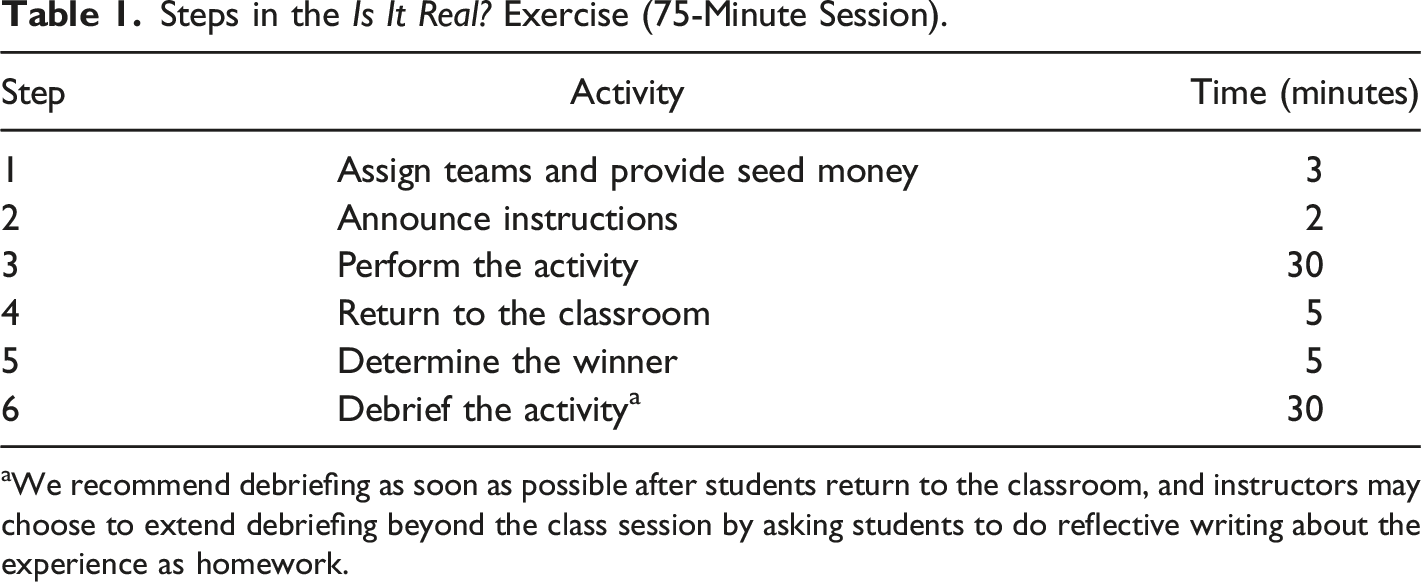
aWe recommend debriefing as soon as possible after students return to the classroom, and instructors may choose to extend debriefing beyond the class session by asking students to do reflective writing about the experience as homework.
Debriefing
Debriefing and offering time for reflection is fundamental to achieving the exercise’s learning objectives. Debriefing should be completed as a class so that students can learn from one another’s experiences, but a deeper reflection can also be given as a homework assignment. Debriefing is essential because it encourages students to assess and reflect on their development, learn from their experience, and develop skills needed to practice entrepreneurship (e.g., Cope, 2003; Pittaway & Cope, 2007).
The instructor starts by pointing out that the activity is not a real-world situation. Businesses are not created in 30 minutes, and the winner does not take all. But by participating in the exercise, students can start to understand the importance of opportunity formation, variations in possible business models, and also the potential ethical consequences of their actions in a setting of intense competition. Suggested discussion questions and writing prompts, grouped by learning outcome, can be found in Appendix A.
Objective 1 of this exercise is to acknowledge that opportunity formation is fundamental to the entrepreneurial process. However, in rushing this process and not first identifying the target market or customer needs, students will probably fail to identify scalable and sustainable business opportunities. Using the students’ experiences as a way to illustrate this principle is highly effective and can be used to create new knowledge (Neck & Greene, 2011). The instructor should invite each team to share the venture it created: what product or service was offered, to whom, and how much was charged for it. (As examples of ventures, we had teams that solicited donations, resold bottled water, or promised tutoring sessions.) Instructors can explore how teams went about forming opportunities and connecting the students’ experiences to opportunity creation and discovery.
Objective 2 of this exercise is to allow students to gain insight into the factors to consider when creating business models that provide sustainable revenue in the long term. Instructors can explore the business models of select teams by articulating them through analytical tools such as the business model canvas (Osterwalder & Pigneur, 2010) or the lean canvas (Maurya, 2012). After illustrating a team’s business model, the instructor can ask the students to comment on the long-term potential of each venture, primarily by looking at the value being created for the various stakeholders and for the firm itself. In addition, students should review their business idea and what changes could be made to increase its potential viability. The instructor should also explore how changes to the business model would support the long-term sustainability of the venture.
Objective 3 of this exercise is to encourage students to acknowledge the ethical consequences of entrepreneurial decision-making. Instructors can use the debriefing as an opportunity to explore the ethical choices the teams made to increase their likelihood of winning. In our experience, the two venture choices that lead to good discussions of ethical decision-making are (1) gleaning donations from friends, family, and the general public and (2) asking people to invest in a business that cannot exist unless the team wins the competition. The donations model lets the instructor address the issues of scalability and sustainability, neither of which are features of donation dependency because friends and family cannot finance a business indefinitely. As for the investment model, teams ask for an investment from their peers (mostly friends) to win the challenge and promise a quick and high rate of return. This provides an excellent opportunity for reflection and discussion of the potential legal and ethical considerations of failing to deliver on promises. (We urged students who made promises to provide a product or service later in exchange for money paid up front [e.g., tutoring services] to honor their promise even when they did not win the exercise.)
To help students internalize the key concepts, it is critical to debrief the exercise in class so that students are able to ruminate on their experience and assigning a homework assignment that prompts students to reflect more deeply on the learning objectives. The questions in Appendix A can be used as examples of questions that can be used to debrief the exercise or as writing prompts for a homework assignment. Instructors can choose to add, delete, or modify questions as they see fit. We also encourage instructors to supplement this assignment with relevant readings from an entrepreneurship textbook—Hisrich et al. (2019) and Neck et al. (2019) are two possibilities—to help students forge links between experiential learning and the key concepts of opportunity formation.
Our Experience
The authors have used this exercise in four instances, with a total of 117 students at four universities in the United States. Below is a synopsis of the results we have observed from these four instances. • Instance 1 (with an entrepreneurship course at a large state school with 30 business students: 35% female and 65% male). Three of the students were graduate students, and the rest were seniors. The winning team used a service-oriented model where they offered to undertake tasks for their fellow students (e.g., return books to the library, provide tutoring services) in return for payment. They did not use any of the seed money and generated $68 in profit. • Instance 2 (with an “introduction to entrepreneurship” course at a small private liberal arts university with 28 undergraduate students: 40% male and 60% female). The majority of the students were juniors and seniors. Approximately half of the students were business majors, and the other half were other majors (such as physics, communications, theater, and music). The winning team asked for an investment from their peers (mostly friends) to win the challenge and promised a quick return at a high rate of interest if they achieved their goal. This was a high-risk strategy given that they would have to return the money if they did not win. They did win, however, and this strategy provided an excellent opportunity for a discussion of the ethical implications of this strategy. They did not use their seed money but used their social capital and leveraged trust to increase $10 to $140 in 30 minutes. They took all the money from the class, distributed it back to their investors with interest, and kept the rest. • Instance 3 (a first-year undergraduate business course at a large state school with 27 undergraduate business students: 20% female and 80% male). The winning team took advantage of the hot weather to sell bottled water. They initially tried to sell water to students on campus, but when they had little success there, they quickly moved to a nearby construction site and sold water to workers. They used their seed money to purchase the bottled water and generated $76 in profit. • Instance 4 (an “introduction to entrepreneurship” course at a large state school with 32 undergraduate business students: 25% female and 75% male). The winning team helped a local downtown business move boxes and furniture into their new office space (the team began helping with the moving process during the exercise and went back later to complete the job). They did not spend their seed money and generated $500 in profit.
In our experience, most teams chose a business model of generating revenue from reselling a product or providing a service. Other teams, however, pursued less common strategies, such as asking for investments, asking for donations, or buying instant lottery tickets with their seed money. When students were asked to identify how they went about determining their business model, they typically talked about how they were forced to make decisions constrained by limited time and the given location, how they sought to satisfy customers’ immediate needs in order to make money quickly, and how the seed money was little enough that they did not hesitate risking it all.
Student Feedback
We found this exercise to be a highly engaging way to start an entrepreneurship course. As one student remarked, “I knew this class was going to be an adventure when, in our first class, we met off campus and the professor handed us cash! This was such a powerful exercise to teach us how hard it is to actually make money.” Many students noted how this activity provided a reality check on the challenges of entrepreneurship and the importance of having an idea that would meet the needs of targeted consumers in the long term.
Student comments also revealed that the key learning objectives of the activity were achieved. With regard to opportunity formation and sustainable business models, students noted that they needed to spend more time thinking about innovative ways to serve the market. One student remarked, “I thought this was going to be easy, I mean … how hard can it be to make a quick buck? WOW!! was I wrong.” Another said, “after we failed the challenge, I realized that we needed to listen more carefully to our customer.” One student reported having learned “that there are so many different ways to make money. Each group had a completely different method!”
With regard to ethical decision-making, students reflected deeply about the choices they made under time and resource constraints. The winning team from Instance 2 argued with the professor: “Our methods were competitive!” they claimed. “Isn’t that what entrepreneurship is about?” However, in hearing the responses of their peers and reflecting on their actions, they could see how asking for an investment without the appropriate legal protections in place was not a suitable strategy. Students also remarked on the importance of being transparent and honest in their transactions, as they “didn’t want their peers to think badly of them.”
Finally, many students reported that the exercise allowed them to do entrepreneurship and “learn from their mistakes, instead of just reading about it.” While most students felt excited and motivated by the exercise, there were some who felt overwhelmed or anxious by having to generate ideas quickly, approach potential customers, and succeed with such limited instruction in so short a time frame.
All of this evidence underscores how critical it is to spend adequate time in, and reflecting upon, the opportunity formation phase in order to build a scalable business model with a sustainable revenue stream without compromising ethics.
Modifying the Exercise
Although this exercise was designed to fit in one 75-minute class period, with additional time for out-of-class reflection and writing, it could be modified in various ways. 1. Students can be given more time to complete the exercise. For a class that runs 2 or 3 hours, additional time can be given for execution and reflection but not for opportunity formation, as this would work against the learning outcomes. 2. Instructors can require students to invest their own seed money (equal quantities for each team) or generate income with no resources, as some of the winning teams in our instances opted to do. However, our experience has been that having cash in their hands creates a sense of excitement. 3. Instructors have found benefit in repeating the exercise later or at the end of the semester. Once students have had an opportunity to reflect on their choices and develop their entrepreneurial skill set throughout the semester, they should feel more confident in completing the exercise and having a more successful outcome. This presents a powerful opportunity for students to reflect on and internalize their learning over the entire course. 4. If the teams were formed solely for the purpose of this activity, we suggest that the money earned by each team could be retained by the professor and distributed equally to the entrepreneurial teams as seed money to enhance entrepreneurial opportunities later in the semester (e.g., to purchase a domain name or advertisements on social media). This modification would, of course, remove the winner-take-all condition that, we believe, heightens competitiveness among the teams and may impact the achievement of objective 3.
At this juncture, we must acknowledge a previously proposed exercise that bears some similarity to our own. Seelig (2009) introduced a similar exercise but with some notable differences. First, Seelig does not recommend that her activity be used at the start of the semester or in an introductory course. Her preferred participants are already aware of business models and are thinking more strategically about the outcomes. Is it Real?, on the other hand, throws students into a situation where they have to brainstorm and make money with limited time and knowledge. Second, in Seelig’s exercise, participants are given the seed money in a sealed envelope so that the amount of money is unknown. Students have to decide on business models in advance, and the time allocated for the activity commences the moment they open the envelopes. As such, Seelig’s version encourages students to consider multiple business models with more care because they do not know how much money they will get to implement one.
Conclusion
Is It Real? gives participants an opportunity to briefly experience entrepreneurial activity and to reflect on their decisions and actions while doing so, thus building entrepreneurial knowledge. This exercise also provides a class with a common experience at the start of the term that they can draw on for the remainder of the course to develop a deeper understanding of the theoretical models within entrepreneurship. Moreover, it lets instructors quickly assess students’ knowledge (or knowledge deficits) of basic concepts or terminology in entrepreneurship (target audience, opportunity recognition) and so establish a baseline for their learning over the term.
Footnotes
Declaration of Conflicting Interests
The author(s) declared no potential conflicts of interest with respect to the research, authorship, and/or publication of this article.
Funding
The author(s) received no financial support for the research, authorship, and/or publication of this article.

Debriefing Questions and Writing Prompts,for Is It Real?
Learning Outcome
Discussion Questions
Understand the distinction between entrepreneurial opportunity discovery and creation as a foundational step in the entrepreneurial process.
• How did you go about completing this activity? How did you decide what product or service to sell?
• Which opportunity formation process did you use (discovery or creation)? Provide specific information about how your team formed opportunities.
• Who was your target customer? How did you identify that customer?
• What problem did you solve?
• How did you determine how much to charge for what you were selling?
• What research and planning would you undertake in the future to ensure that your product or service solved a problem for a particular segment of customers?
Gain insight into the factors to consider when creating various business models that provide sustainable revenue in the long term.
• Describe the business model you used, and review the models used by others in the class. Which of these would be most successful in the long term? Why?
• Who are the various stakeholders in your team’s business model? What value is created for each stakeholder? What is the value created for the venture’s founders?
• Is value being created for both the source (founders) and the target (stakeholders)?
• How did you or other teams generate revenue?
• Is your revenue stream is sustainable? Why or why not?
• How might each team’s business model be changed to ensure the long-term sustainability of the business?
• How might you scale up your business idea to generate larger or additional streams of revenue? (Put differently, how might you encourage repeat customers or add new customer segments?)
Acknowledge the ethical consequences of entrepreneurial decision-making.
• Did the winner-take-all premise encourage your team to make unethical decisions? If so, describe how.
• Did you promote your good or service in an honest and transparent manner to all the stakeholders? Why or why not? What might be the long-term outcome of these decisions?
• Was the team honest about the benefits of what you were offering to customers? What are some possible outcomes of exaggerating what you claimed?
• In the brief relationships formed in this exercise (with investors, team members, customers), did you detect any conflicts of interest?
• If asked to complete the exercise again, would you make the same decisions about what to do?
• If the winner had not taken all, what might have changed about your team’s approach?
• How could you and your team make better ethical decisions to ensure the long-term success of the venture?
• In undertaking additional reading, reflect on why is it important for entrepreneurs to consider the ethical consequences of their actions?