






Abstract
Entrepreneurship education in Latin America has expanded rapidly yet remains shaped by institutional voids that constrain entrepreneurial action. This paper explores how entrepreneurs in Guatemala learn and adapt amid weak institutions, limited financing, and fragmented ecosystems. Drawing on 19 qualitative interviews with founders, investors, and ecosystem actors, we identify how entrepreneurs compensate for financial gaps, substitute for absent infrastructure, and leverage networks as informal learning platforms. These practices, built on learning mechanisms of multi-perspective reflection, sensemaking, and deliberate trial and error, constitute a form of self-education in navigating institutional complexity. We argue that entrepreneurship education in Latin America must move beyond imported Western models to embrace void navigation and hybrid financial literacy. Extending ecosystem-embedded education to include ecosystem-spanning pedagogy enhances entrepreneurs’ ability to recognize and adapt to institutional voids. Our findings also reveal how resilience and social and sustainability missions emerge organically as entrepreneurs design around institutional failure, suggesting that Latin America provides fertile ground for rethinking the future of entrepreneurship education globally.
Introduction
Entrepreneurship education has long been framed as a catalyst for innovation, competitiveness, and social mobility (Fayolle, 2013; Nabi et al., 2017). Within management and entrepreneurship scholarship, a central conversation has focused on how entrepreneurship education can foster entrepreneurial intentions and behaviors, often drawing on evidence from North American and European contexts (Bae et al., 2014; Kuratko & Morris, 2018). Another strand of this literature has emphasized the importance of pedagogy, legitimacy, and the development of entrepreneurial ecosystems (Fayolle et al., 2016; Guerrero et al., 2020). A third, more recent strand highlights contextualization, arguing that the design and impact of entrepreneurship education vary substantially depending on institutional, cultural, and economic environments (Nabi & Liñán, 2011; Thomassen et al., 2020).
However, despite Latin America’s prominence as a region with some of the world’s highest entrepreneurial activity rates (Amorós et al., 2019; Bosma et al., 2020) and rapidly developing ecosystems (Kantis et al., 2021), the region has been largely underrepresented in entrepreneurship education scholarship (Amorós et al., 2021). Where it has been addressed, the literature often imports Western assumptions, presuming functioning institutions, reliable financing mechanisms, and formalized support systems. This creates a crucial gap, because entrepreneurs in Latin America operate under what Khanna and Palepu (2010) call “institutional voids”: gaps in infrastructure, finance, and legal systems that manifest as patterned institutional frictions requiring alternative coordination. These voids shape not only entrepreneurial outcomes but also the ways entrepreneurs learn, adapt, and sustain their ventures (Aguinis et al., 2020; Guerrero & Urbano, 2017).
The purpose of this paper is to join and extend the conversation on contextualized entrepreneurship education by examining how Latin American entrepreneurs navigate institutional voids, what enables them to do so effectively, and what this implies for educational design. Whereas prior research has highlighted the importance of context in abstract terms (Fayolle et al., 2016; Thomassen et al., 2020), our study provides empirical evidence from Guatemala, illustrating concrete practices of void navigation and the informal learning that accompanies them. More importantly, we identify the underlying resources that enable them to do so. In doing so, we respond to calls for more region-specific entrepreneurship education research (Amorós et al., 2021; Lasso et al., 2019) and contribute by (1) identifying hybrid financial literacy, infrastructural substitution, and networks as core learning processes in institutionally voided contexts; (2) exploring the enabling role of exposure to other ecosystems through personal experience or mentors; (3) detailing specific learning mechanisms and theorizing how these mechanisms can inform entrepreneurship education pedagogy; and (4) highlighting how void navigation often embeds social and sustainability missions, broadening entrepreneurship education’s scope beyond enterprise creation.
This study contributes to the broader literature by reframing entrepreneurship education in Latin America as a pedagogy of “void navigation.” Our qualitative analysis shows that rather than being peripheral challenges, institutional voids are central learning environments. By documenting how entrepreneurs self-educate in contexts of financial gaps, infrastructural absence, and network dependency, we extend theory on contextual entrepreneurship education and offer actionable implications for universities, accelerators, and policymakers seeking to strengthen entrepreneurship education in the region.
Literature Review
Entrepreneurship in Latin America and Guatemala
Latin America presents a paradoxical entrepreneurial landscape: comparatively high rates of entrepreneurial intention and early-stage activity coexist with structural barriers that constrain firm growth, survival, and scaling. Global Entrepreneurship Monitor (GEM) reporting has long documented strong entrepreneurial attitudes and activity across many Latin American economies, even as national framework conditions vary widely across the region (Bosma et al., 2020). At the same time, scholarship on Latin American entrepreneurship emphasizes that regional patterns are shaped by heterogeneous, and often fragile, institutional environments, including uneven market infrastructures, policy volatility, and persistent informality. For example, Amorós and colleagues (2021) underscore how vulnerable institutions and weak market infrastructures condition entrepreneurship in Latin America and shape the challenges facing ecosystems and educators alike.
These regional dynamics matter for entrepreneurship education because many entrepreneurs operate at the intersection of formal market institutions and informal coordination systems. As a result, pedagogical models built primarily around institutionally “complete” environments where financing pathways, enforcement mechanisms, and intermediaries are relatively stable, may mis-specify the learning demands facing entrepreneurs in settings characterized by institutional inconsistency. Guatemala is a particularly consequential empirical setting within this broader regional landscape because it combines high levels of entrepreneurial participation with persistent informality and pronounced socioeconomic and territorial disparities.
Recent World Bank reporting underscores the centrality of informality and inequality for understanding entrepreneurial life in Guatemala. The World Bank’s Guatemala Poverty and Equity Brief (World Bank, 2025) reports that the labor market is highly informal, with an informality rate of 70.3% in 2023, and highlights disparities across regions, ethnic groups, and economic sectors. The same World Bank reporting notes that 56% of the population lived below the national poverty line in 2023, indicating persistent constraints on household resources and market demand that shape both necessity- and opportunity-driven entrepreneurship.
Multiple sources point to exceptionally high levels of entrepreneurial participation in Guatemala. A GEM national-report summary indicates that 45.6% of the adult population was engaged in entrepreneurial activities in 2023, including both nascent and established entrepreneurs (Río-Nevado de Zelaya & Casasola, 2024). This prevalence underscores why entrepreneurship education in Guatemala cannot be treated as a niche intervention aimed solely at a small subset of high-growth founders; rather, entrepreneurial learning is a broad-based developmental concern spanning diverse types of ventures, including informal and hybrid forms.
Guatemala’s economy is also strongly shaped by micro-, small-, and medium-sized enterprises (MSMEs). A WTO Trade Policy Review summary reports that MSMEs generate at least 40% of GDP and approximately 70% of jobs, and it notes the updating of Guatemala’s Policy for the Development of MSMEs 2024–2032 aimed at strengthening MSME integration into the economy (World Trade Organization, 2025). This MSME centrality reinforces the importance of educational designs that prepare entrepreneurs for the realities of operating in fragmented ecosystems, where resource access and legitimacy often depend on institutional arrangements that differ across industries, locales, and networks.
Institutional Voids and Institutional Theory
The concept of institutional voids originates from institutional theory, which examines how formal and informal rules structure economic and social behavior (North, 1990; Scott, 2008). Khanna and Palepu (2010) popularized the term to describe the absence, unreliability, or inaccessibility of market-supporting institutions such as contract enforcement, credit systems, and regulatory mechanisms.
This early framing, most associated with international business research, emphasizes “absence” and the transaction costs and uncertainty that follow. More recent organizational research, however, cautions that treating voids primarily as lack can weaken conceptual precision and risk deficit labeling of non-Western contexts. Bothello et al. (2019) argue that the concept has been stretched across settings in ways that dilute construct clarity, and they call for a more careful re-grounding that treats voids as analytically generative rather than merely obstructive.
Consistent with this work, we conceptualize institutional voids not as empty spaces but as patterned institutional frictions: durable misalignments, contradictions, and enforcement gaps across formal and informal arrangements that shape how coordination is accomplished. Mair et al. (2012) illustrate this shift by showing how intermediaries “work” voids through institutional processes that redefine market architecture and legitimate new actors, assembling alternative coordination mechanisms rather than simply filling gaps. Similarly, Nason and Bothello (2023) argue that informal economies are “far from void”: growth is shaped less by institutional absence than by how entrepreneurs navigate and recombine institutional arrangements at the interface of formal and informal systems.
This updated framing matters for entrepreneurship education because it clarifies how institutional fragility can become instructional. When coordination cannot be delegated to stable intermediaries or uniformly enforced rules, entrepreneurs must learn to translate governance across institutional interfaces, design substitutes for unreliable infrastructures, and build legitimacy through networks that function as de facto institutional carriers. At the same time, conceptualizing voids as patterned frictions helps differentiate our argument from adjacent constructs such as bricolage, improvisation, or resilience. Those concepts capture adaptation under constraint, whereas the contemporary voids literature foregrounds how entrepreneurs assemble alternative coordination and legitimacy arrangements: work oriented toward stabilizing exchange and constructing workable market order under institutional inconsistency.
Accordingly, we retain “institutional voids” as a bridging term in emerging economy entrepreneurship research, but we employ it in this updated sense: institutional voids are structured frictions that invite institutional work and alternative coordination. This positioning provides a clearer theoretical foundation for the mechanisms developed in this study and for the pedagogical claim that entrepreneurship education is most effective when it deliberately scaffolds the translation, substitution, and legitimacy-building work entrepreneurs repeatedly undertake in such environments.
Entrepreneurship Education in Emerging Contexts
The scholarship on entrepreneurship education has traditionally emphasized models developed in advanced economies, focusing on opportunity recognition, venture planning, and investment readiness (Fayolle, 2013; Kuratko & Morris, 2018). However, scholars increasingly call for contextualization, stressing that entrepreneurship education outcomes vary with institutional environments (Fayolle et al., 2016; Thomassen et al., 2020). In emerging contexts, educational approaches must account for informality, resource scarcity, and volatility (Nabi & Liñán, 2011). In Latin America, despite the region’s entrepreneurial vibrancy, few studies have examined how entrepreneurship education programs explicitly prepare students for institutionally voided contexts (Amorós et al., 2021). This lack of contextual research limits the ability of entrepreneurship education to inform policy and practice in the region (Lasso et al., 2019).
For entrepreneurship education, these conditions imply that venture formation and growth often occur under institutional interfaces where formal contracting, infrastructure reliability, and standardized intermediaries are unevenly accessible across sectors and territories. The educational problem is therefore not simply that institutions are “missing,” but that entrepreneurs must repeatedly learn how to create workable coordination and legitimacy under inconsistent rules, enforcement, and infrastructure, precisely the kinds of conditions that can shape what learning looks like, how it is acquired, and what forms of pedagogy are likely to be effective.
Taken together, these indicators suggest that entrepreneurship education in Guatemala must be designed for an environment characterized by: (i) high participation in entrepreneurship, (ii) extensive informality, (iii) resource constraints associated with persistent poverty, and (iv) coordination that often relies on intermediaries and networked arrangements rather than standardized institutional infrastructures. The pedagogical implication is not simply “more experiential learning,” but experiential learning explicitly structured around the recurring institutional frictions entrepreneurs face. This could include translating formal financial or legal templates into locally workable agreements, designing operational substitutes when infrastructures fail, and developing legitimacy pathways through intermediaries and networks that function as de facto institutional carriers in fragmented environments.
Finance as a Pedagogical Blind Spot
Access to finance remains the most frequently cited barrier to entrepreneurship in Latin America (Amorós et al., 2019). Scholars highlight that financing structures in the region often combine elements of informality, international development funding, and nascent venture capital markets (Kantis et al., 2020). Yet entrepreneurship education programs tend to privilege Western venture capital logics, neglecting hybrid financial strategies such as revenue-based loans, remittances, or community finance (Alvarez & Barney, 2014; Doblinger et al., 2019). This represents a major blind spot in both research and pedagogy. Building financial literacy that is attuned to local realities is essential for fostering sustainable ventures in the region (Aparicio et al., 2016).
Networks and Informal Learning
Mentorship and networks are well-established drivers of entrepreneurial development (St-Jean & Audet, 2012). In weak institutional contexts, they often function as substitutes for absent or unreliable systems (Minola et al., 2016). In Latin America, networks play a dual role: they provide practical knowledge and resources while also granting legitimacy in environments where formal institutions lack credibility (Kantis et al., 2021). Expatriate mentors, diaspora ties, and accelerators frequently become central to entrepreneurial learning, underscoring the relational dimension of entrepreneurship education in the region (Stephan & Pathak, 2016).
Networks in such environments often provide not only material resources but also design-oriented guidance, where entrepreneurs learn by modeling, framing, and performing within locally meaningful contexts (Neck & Greene, 2011). In rural and peripheral regions, networks become even more central, as they embed entrepreneurial learning in place-based practices and ensure that education remains relevant to local challenges and opportunities (Galvao et al., 2020).
Broadening Entrepreneurship Education Beyond Enterprise
Recent literature critiques the economistic framing of entrepreneurship and calls for a broader understanding that includes social, cultural, and political dimensions (Farias et al., 2019; Hjorth & Holt, 2016). Latin America’s unique socioeconomic challenges, including poverty, inequality, and environmental degradation, make this expansion particularly relevant. Research shows that entrepreneurship education can serve as a vehicle for social inclusion and sustainable development when aligned with contextual needs (Kantis et al., 2021). By embedding social and environmental objectives alongside economic ones, entrepreneurship education in Latin America has the potential to contribute to national development plans and regional innovation agendas (Audretsch et al., 2019).
Methods
Research Context and Sample
This study focuses on Guatemala, a country emblematic of both the entrepreneurial dynamism and institutional fragility characteristic of Latin America. Entrepreneurial activity in Guatemala consistently ranks among the highest levels in the region, driven by both necessity and opportunity entrepreneurship (Amorós et al., 2019; Bosma et al., 2020). At the same time, the country faces structural challenges: more than 70% of its workforce operates in the informal sector, financial systems are underdeveloped, and regulatory frameworks are weakly enforced (Kantis et al., 2020). These conditions make Guatemala an ideal setting to investigate how entrepreneurs learn to navigate institutional voids.
Participant List
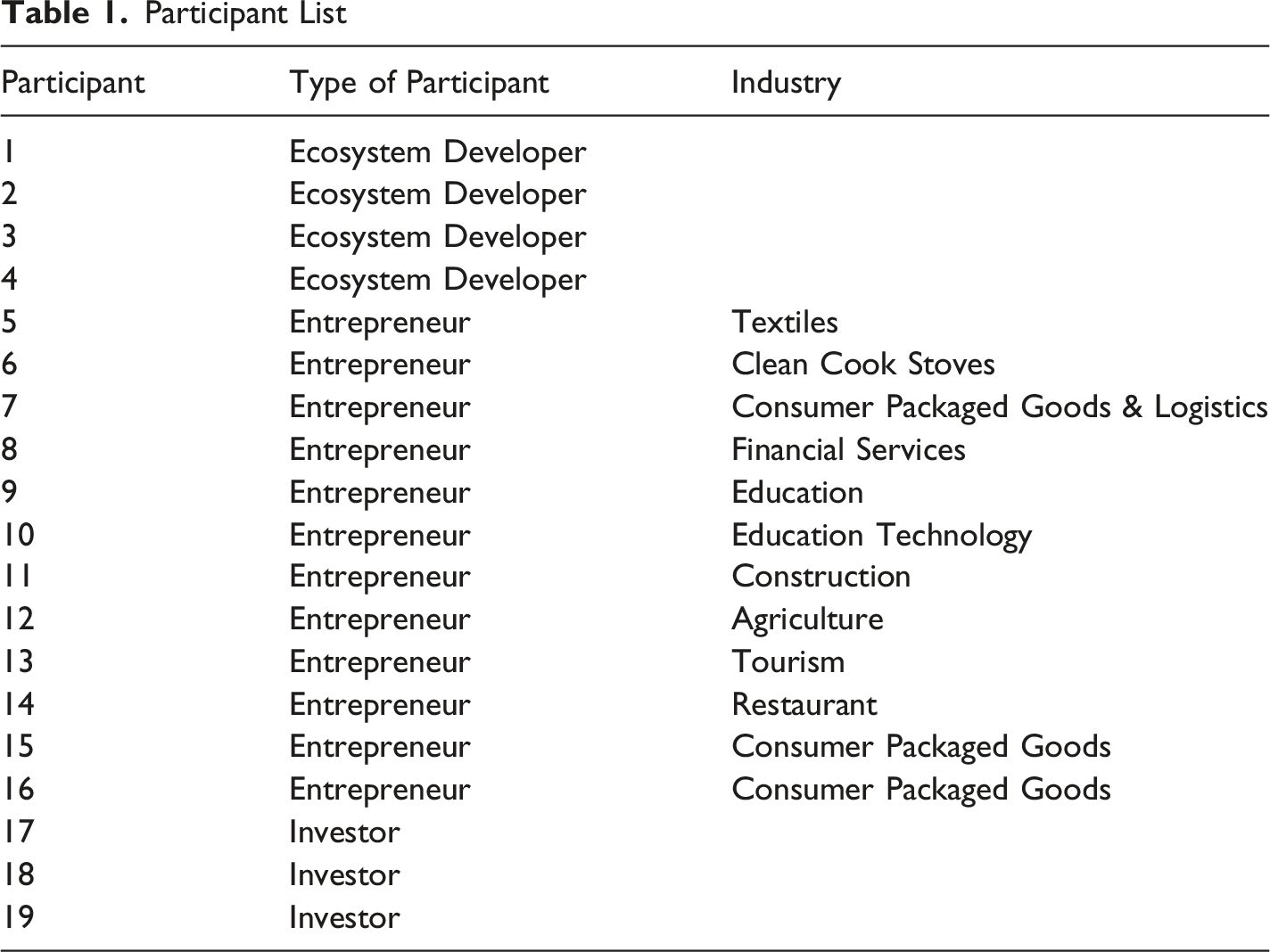
Research Design
We adopted a qualitative, interpretivist research design to capture the lived experiences of entrepreneurs. This approach is well-suited for exploring under-researched contexts and for generating theory grounded in participants’ narratives (Creswell & Poth, 2017).
Data Collection
The data collection plan was approved by the University of Denver Institutional Review Board on February 6th, 2025, package number 2285398-1. Participants provided verbal informed consent, which was recorded by the primary investigator at the beginning of the interview. Verbal consent was the original plan approved by IRB due to the minimal risk associated with the study design. Additionally, the mix of in-person and virtual interviews, along with the lack of access to technology for some entrepreneurs, would have made signatures difficult for them. Interviews ranged from 45 to 90 minutes in length, were conducted both virtually and in person, in English and Spanish, and were transcribed verbatim. Additional contextual information was retrieved via publicly available sources from the organizations.
Data Analysis
We employed thematic coding (Braun & Clarke, 2006), iteratively analyzing transcripts to identify instances of institutional voids, coping strategies, and learning mechanisms. Codes were organized into second-level themes before being clustered in the aggregate dimensions. The dimensions included three main thematic strategies: (1) financial voids, (2) institutional and infrastructural substitution, (3) networks and hidden curricula. Additionally, we identified two outputs: (1) resilience and adaptive learning, (2) embedded social mission. Finally, we identified the enhancing effect of ecosystem-spanning activities that facilitate void recognition and adaptive mechanisms. Figure 1 depicts the coding process across first-order codes, second-order themes, and aggregate dimensions. While the thematic coding structure in Figure 1 captured the explicit “what” of our participants’ strategies, the process models depicted in later figures were elaborated abductively. By iteratively moving between the empirical data of repeated adaptations and existing cognitive learning theories, we mapped the sequential “how” of the underlying learning mechanisms across cases. Thematic coding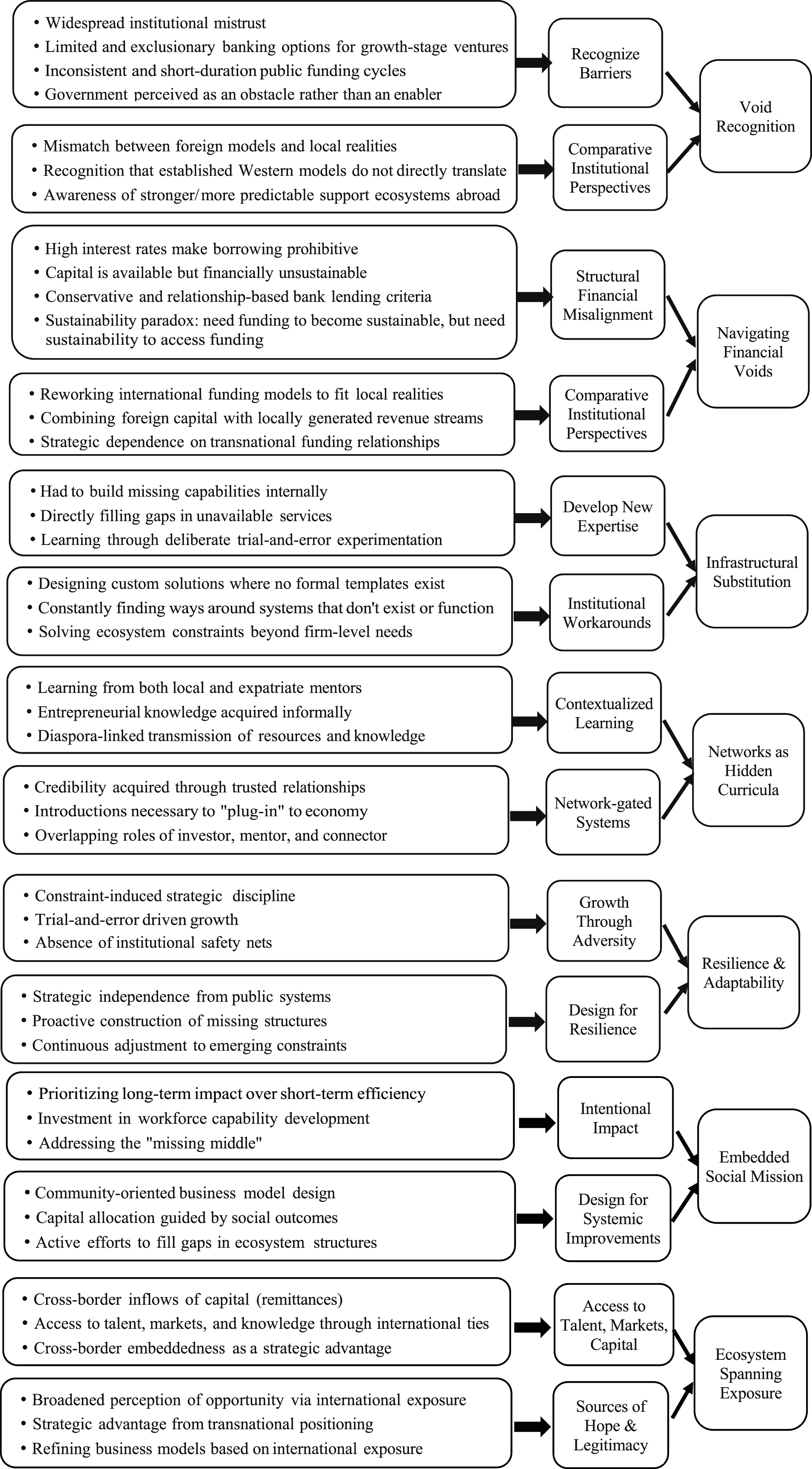
Trustworthiness
To ensure credibility, we used investigator triangulation, comparing interpretations among researchers. Reflexivity was maintained by documenting the researchers’ positionality, including partial insider status within the Guatemalan entrepreneurial ecosystem.
Findings
Our analysis revealed three interrelated adaptive strategies that illuminate how entrepreneurs in Guatemala approach institutional voids: (1) navigating financial voids, (2) substituting for missing institutions and infrastructure, (3) relying on networks as hidden curricula. The application of these strategies led to the development of resilience and increased adaptability, along with a natural inclusion of social objectives. These themes are not isolated but mutually reinforcing, together forming a framework of “void navigation learning.” Exposure beyond the local entrepreneurial ecosystem routinely provided the necessary perspective and access to the resources that were lacking within the local ecosystem. Figure 2 presents a visual model illustrating how the recognition of institutional voids triggers adaptive strategies in finance, infrastructure, and networks, which in turn generate experiential learning, fostering resilience and adaptability, as well as increased social objectives. Institutional void navigation framework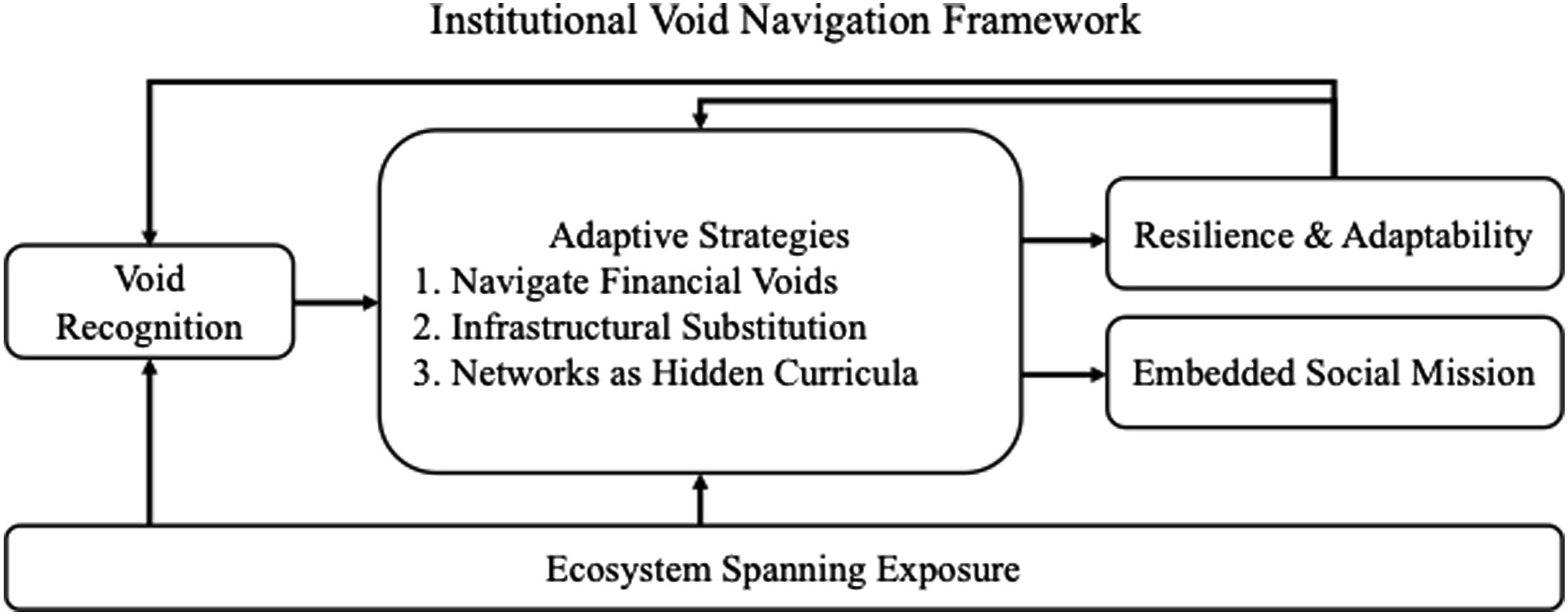
Strategy 1: Navigate Financial Voids
Access to capital emerged as the most consistent challenge, shaping nearly every entrepreneurial journey in our sample. Entrepreneurs spoke at length about the absence of reliable financial instruments and the need to improvise alternative arrangements. Without functioning credit markets or accessible investment instruments, entrepreneurs improvised hybrid solutions, blending personal savings, grants, family remittances, and informal agreements.
Participant 11, the founder of a sustainable construction company, illustrated the problem of affordability and trust: “Most people that buy from us, 75% use their own savings. We tried to fight for micro-mortgages, but 25% interest was impossible. Migrants are a huge potential market for housing, but we need to build trust that their money won’t be stolen.” His remarks highlight the dual pressures of high costs and institutional mistrust. The lack of affordable and trustworthy financial products forced him to pivot to alternative target markets that weren’t dependent on the missing institutional support. Similarly, participant 10 recounted how he reworked foreign financing models to comply with Guatemalan law, opening the door to new investment: “The SAFE doesn’t exist in Guatemala, so we registered it as a private contract with the legal requirements. At the end of the day, it’s a private contract that can exist; it’s just the formalities.” Rather than merely coping with a regulatory vacuum, Participant 10 actively translated governance across institutional interfaces by rewriting Western SAFE mechanisms into standard Guatemalan private contract law, constructing a workable alternative legal order.
For participant 8, learning came through the transition from grants to hybrid financing: “It was good to see investors excited that we had real returns. Before, the challenge was even finding an investable pipeline. We had to prove we could grow revenues without depending on endless grants.” Lacking robust banking infrastructure, the small team assembled alternative arrangements to navigate these structural frictions, developing competencies in grants, equity, and private-debt structures to fund their scaling efforts. Participant 4, reflecting on his accelerator experience, reinforced the structural nature of these issues: “Access to finance continues to be a big limitation for businesses to scale and thrive. Even when talent and ideas exist, the financing ecosystem just isn’t there yet.”
Together, these accounts reveal how entrepreneurs in Guatemala must cultivate entrepreneurial financial literacy, simultaneously negotiating grants, convertible notes, remittances, and informal agreements. Financial learning, which enables alternative coordination in response to patterned institutional frictions, is therefore inseparable from void navigation.
Strategy 2: Substituting for Weak or Missing Institutions and Infrastructure
The absence of reliable infrastructure and institutional support often pushed entrepreneurs to build systems from scratch, transforming necessity into a source of expertise. The strategic responses to these infrastructural failures reveal that entrepreneurs do not merely settle for coping with absence. Instead, their adaptations represent a sophisticated process of assembling alternative coordination and building legitimacy where formal state mechanisms have broken down. Participant 7, the founder of an upcycling home goods company, captured this dynamic vividly: “When the postal system collapsed, we had to build our own logistics networks. We couldn’t depend on anyone else to deliver, so we had to create the whole chain ourselves.” In response, he founded a social enterprise logistics venture to provide a solution for his own company, as well as for other business owners affected by the collapse. To ensure their solution didn’t also collapse, he described “shipping lots of empty boxes in the beginning to ensure we hit the quotas.” Participant 7 further reflected: “We had to invent our own distribution model because existing systems simply didn’t work. That process was our education; it was trial and error, and it made us experts in logistics we never thought we’d need.” That improvisation became an education in itself.
Participant 6 echoed this process: “We had to figure out payment collection ourselves because traditional banking options weren’t available. It meant designing our own processes just to make basic transactions possible.” Participant 3 summarized the ethos: “It’s about constantly finding ways around systems that don’t exist or don’t function. You learn by doing because no textbook has the answers for this environment.” Entrepreneurs thus substitute for absent or ineffective institutions through alternative coordination, effectively teaching themselves logistics, payment processing, and compliance along the way. The learning process is embedded in survival.
On the funding side, recognizing the lack of available resources, participant 18 resolved to create an early-stage impact investment fund with proceeds from a family business to “invest in impactful companies creating quality jobs and interesting solutions in Guatemala.” Meanwhile, participant 19 focused on deploying capital through alternative investment structures such as revenue-based financing, given the low likelihood of an exit, which would fit the Western venture capital model.
Strategy 3: Networks as Hidden Curriculum
Given the weakness of formal institutions, networks became an informal curriculum where entrepreneurs accessed mentorship, resources, and legitimacy. Participant 10 described how both expatriate and Guatemalan mentors in Antigua shaped his journey: “I found great mentors here in Antigua, expats and Guatemalans, sharing their knowledge and helping us grow. They gave us lessons we couldn’t get in any university.” Participant 8 reflected on the role of a Guatemalan accelerator in shaping both his business and his own learning: “[The accelerator] provided not just funding but also the learning I needed to structure the business. They helped me understand how to build financial models, how to pitch, how to organize a team.”
Participant 4 recounted his own entry into the ecosystem: “I had no idea what an accelerator was. But they valued my financial experience, and that became my entry point. It wasn’t a classroom; it was immersion learning.” For others, networks were a form of long-term capital. Participant 11 highlighted relational capital as a sustaining force: “Our investor was also a client and a long-term partner. Those relationships are what really sustain us in the long run.” This example also highlights the need for stakeholders to fill multiple roles, compensating for voids in other areas.
At the same time, networks were not equally accessible. Participant 9 noted the exclusivity of upward mobility: “You can work 24 hours a day, but if there’s no upward mobility, why would you? Networks and connections become the only way forward. Without them, the system locks you out.” These narratives suggest that networks act as a “hidden curriculum,” transmitting knowledge, legitimacy, and resources in ways formal entrepreneurship education rarely acknowledges.
Output 1: Resilience and Adaptability
For many, these periods exposed the structural limits of their environment while also cultivating resilience. Participant 9, for example, pointed out that structural barriers left many entrepreneurs stuck in necessity-driven ventures: “It doesn’t matter how much I work, the system itself creates limits. That’s when you realize entrepreneurship is about necessity, not just opportunity.”
Participant 7 reflected on what the pandemic taught him about his entrepreneurial strategy: “COVID forced us to rethink everything. It pushed us to pivot and design for resilience. That was the hardest period, but also the period where we grew the most as entrepreneurs.” Participant 11 similarly reflected on how financial hardship sharpened his experience as an entrepreneur: “2023 was a terrible year financially, but it forced us to fix processes and come out stronger. We learned more from that year than from any of the successful ones.” Participant 2 recalled the aftermath of failure: “We had to rebuild almost from scratch. It was brutal, but the lessons from that failure were invaluable. They stay with you forever.”
These experiences highlight how crises can trigger void navigation learning, representing a unique dimension of entrepreneurship education in Latin America, where volatility is the norm rather than the exception. These experiences suggest that resilience is not simply a trait, but a competency developed through repeated adaptation.
Output 2: Embedded Social Mission
While not a focal point in the discussions, the entrepreneurs, ecosystem actors, and investors in our study consistently embedded societal objectives into their endeavors, often focused on addressing some of the institutional voids that plagued them. When participant 7 formed a logistics supply company, he embedded social impact, stating that the core idea is “to use business as a force for good and that sustainability is the way.” Participant 10’s edtech business focuses on improving science, technology, engineering, and math (STEM) education throughout Guatemala, given that the public education system lacks in this area. Participant 5 developed a textile upcycling company with a goal of “improving the sustainability of the textile industry by providing an example of what’s possible.” Participant 8’s business fills the financial void needed for solar energy expansion, enabling renewable power that is both more affordable and reliable than the current grid power. Finally, participant 11’s sustainable construction company adapts to limited local infrastructure, embedding responsible water and energy capture, storage, and use into their projects in addition to relying on sustainable construction materials.
Each of these businesses reflects the ingenuity of local entrepreneurs in recognizing voids and turning them into profitable opportunities that also advance societal objectives. Their unique, localized understanding and passion for supporting the local ecosystem naturally result in them embedding social and environmental impact into their businesses. While local, contextual knowledge is essential, these entrepreneurs also leveraged exposure to other ecosystems to recognize and pursue the opportunities.
The Enabling Role of Ecosystem-Spanning Exposure
Navigating institutional voids requires an understanding of the void, alongside the resources to pursue an adaptive strategy. Entrepreneurs in our study consistently referenced the importance of direct or network-mediated exposure beyond the local ecosystem in developing and implementing adaptive strategies. Crucially, international connections often provided the leap from survival-focused entrepreneurship to ventures with broader visions.
Participant 12 credits a foreign missionary with providing the idea and seed capital for his family to start the business. Later, the same missionary leveraged his personal network to open international markets for the company to scale up and expand into more profitable lines of business. Connections gained through participant 6’s participation in a global incubator provided the funding and human capital needed to move beyond initial prototyping and begin to scale production. Participant 7 received their first $100,000 from an international donor the founder connected with on an unrelated personal trip several years earlier. Additionally, participant 10’s access to an international consulting firm, established through a connection made while studying abroad, provided the expertise, legitimacy, and capital necessary to form partnerships with local governments and universities, launching and scaling his education technology company. Such stories underscore that entrepreneurship education in Latin America must not only train technical skills but also teach how to strategically build and leverage regional and global networks.
Each of these examples demonstrates how transnational ties can substitute for weak domestic institutions and enhance the adaptive strategies available to entrepreneurs. While some entrepreneurs leverage financial resources from outside the ecosystem, the broader perspective gained emerged as a powerful subtheme in the interviews. Recognizing what had been accomplished in other ecosystems increased hope and encouraged entrepreneurs to dream bigger. Participant 10 also exemplified this as he described how exchanges in Mexico, Miami, and Madrid transformed his outlook: “Sometimes all we need is one success case to prove it’s possible. Watching what was happening in other countries shifted my sense of possibility—that those privileges and challenges don’t necessarily define you.” Entrepreneurship education should thus expose entrepreneurs to relatable successful examples and create connections to resources and markets beyond the local ecosystem to support the transition from need-based to opportunity-driven entrepreneurship.
Our analysis reveals that ecosystem-spanning exposure operates through two analytically distinct mechanisms that occur at different temporal moments in the framework: comparative institutional awareness and material resource provision. Comparative institutional awareness occurs early in the process, allowing entrepreneurs to view local institutional arrangements through a comparative lens, fundamentally altering their sense of possibility and helping them explicitly recognize the void as a navigable space rather than a permanent barrier (e.g., Participant 10 witnessing models in Miami/Madrid). Material resource provision, on the other hand, occurs later, providing the physical transnational capital, diaspora-backed networks, and structural credibility required to actively deploy and scale an adaptive strategy (e.g., Participant 7 securing a $100,000 international donor, or Participant 12 accessing international markets).
Integrative Framework: Void Navigation as Entrepreneurship Education
Taken together, these themes illustrate how entrepreneurs in Guatemala rely on examples and insights from other markets amid institutional voids. Figure 2 shows how voids in finance, infrastructure, and institutions trigger adaptive strategies, enabled by international exposure. These strategies include hybrid finance, infrastructural substitution, and networks, and they create experiential learning processes. Over time, these cycles build resilience and often embed social or sustainability goals: affordable housing, circular economy models.
Ecosystem-spanning connections often serve as accelerators within this framework: they transform entrepreneurs’ trajectories from subsistence-driven improvisation to ventures capable of scaling, attracting investment, and envisioning systemic change. They provide not only capital but also legitimacy, knowledge, and, perhaps most importantly, examples of what is possible.
Success stories matter here. Entrepreneurs like participant 7, who leveraged the collapse of Guatemala’s postal system into a thriving logistics company, or participant 10, whose international accelerator experience unlocked new levels of growth, illustrate how void navigation can generate models of hope. Participant 9 captured this shift well when reflecting on her team’s disbelief that ambitious targets could be reached, until they were: “Three years later, I told them we’d reached it. And they said they never really believed we would. Now they do.”
This framework suggests that entrepreneurship education in Latin America should be reconceptualized as the pedagogy of “void navigation.” Rather than treating institutional absence as a background constraint, it should be placed at the center of curriculum design, preparing entrepreneurs to improvise, adapt, and learn in precisely the ways our participants described. Crucially, however, education must also integrate exposure to international networks and success stories; these narratives widen horizons, counteract generational mistrust, and cultivate the belief that scaling impact is possible.
Yet participants also stressed that crises can spark new horizons when combined with international exposure. These experiences suggest that entrepreneurship education in Guatemala must prepare students not only to endure volatility but to reinterpret crises as potential catalysts, especially when coupled with exposure to broader networks and success stories that expand their sense of what is possible. Next, we explore the specific learning mechanisms that facilitate the learning process as entrepreneurs navigate voids.
Underlying Learning Mechanism
As entrepreneurs confronted the friction associated with institutional voids, a consistent learning process emerged across the adaptive strategies. Entrepreneurs typically entered with a sufficient degree of contextual knowledge of the local environment and at least a small degree of familiarity with outside ecosystems. When a void constrained performance, entrepreneurs engaged in multi-perspective reflection, integrating insights about how the void manifested locally with examples of how similar coordination problems are addressed elsewhere. Participant 10’s reflection on the legal structures existing in other contexts to bridge the needs of investors and entrepreneurs exemplifies this process. As he stated, “Sometimes all we need is one success case to prove it’s possible. Watching what was happening in other countries shifted my sense of possibility—that those privileges and challenges don’t necessarily define you.” By combining these diverse perspectives, they could view the challenge more holistically and begin a process of sensemaking as they translate established institutional models to fit their operating context. Participant 8 emphasized this idea stating, “exposure to understanding what possibilities are out there is huge.” In this process, mentors with local and international expertise functioned as interpretive bridges, enabling entrepreneurs to critically evaluate external models and recalibrate them to fit the constraints and opportunities of their own ecosystem. Entrepreneurs then implemented these strategies through deliberate trial-and-error action, iterating in response to market feedback as an indicator of fit and feasibility. Feedback, in turn, updated their contextual knowledge and shaped subsequent responses to future voids.
These mechanisms operated across all three adaptive strategies, but their emphasis varied: financial voids foregrounded comparative sensemaking around legal and financing templates, infrastructural substitution foregrounded trial-and-error experimentation, and networks functioned as the primary channel through which multi-perspective reflection became possible. Figure 3 summarizes this process and its enabling mechanisms. Underlying learning mechanisms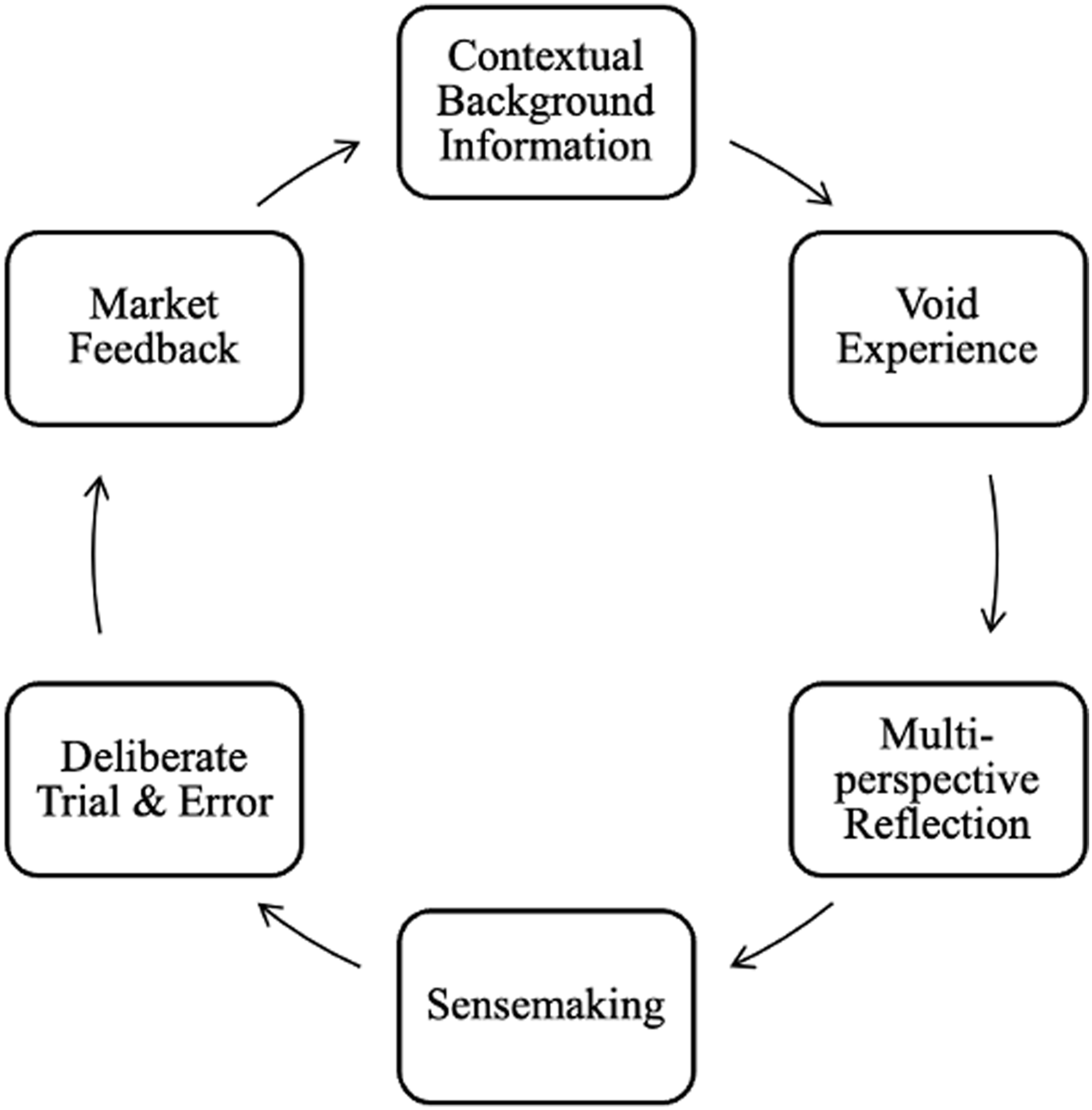
Discussion
Integrating Lessons From the Findings
The findings reveal that entrepreneurs in Guatemala leverage personal and network exposure to international markets as they develop adaptive strategies to navigate institutional voids through interrelated strategies in finance, infrastructure, and networks. These strategies do not operate in isolation; instead, they form a reinforcing cycle of experiential learning. For example, efforts to overcome patterned institutional frictions and weak infrastructure often depend on networked mentorship, while hybrid financial arrangements require both relational trust and adaptive resilience built through crises. This interconnected process constitutes a pedagogy of “void navigation,” where learning emerges directly from entrepreneurial improvisation in the face of institutional absence. Figure 2 captures this dynamic: ecosystem-spanning exposure facilitates the recognition of voids and the development of adaptive strategies, which in turn foster experiential learning, resilience, and socially embedded outcomes. Teachable underlying mechanisms, including multi-perspective reflection, sensemaking, and deliberate trial-and-error testing, enable the entrepreneurs to learn through this process of void navigation. The evidence suggests that entrepreneurship education in Latin America must foreground this cycle and these learning mechanisms rather than treating institutional challenges as peripheral constraints.
Theoretical Implications
This study contributes to entrepreneurship education theory in several ways. First, it advances contextualized entrepreneurship education scholarship by repositioning institutional voids from being background obstacles to becoming primary learning environments and a platform for fostering informal networks. This extension complements calls by Guerrero et al. (2020) and Thomassen et al. (2020) for deeper theorization of context in entrepreneurship education. Second, the findings highlight hybrid financial literacy as an overlooked learning domain. Entrepreneurs’ reliance on improvised contracts, remittance flows, and blended financing underscores the inadequacy of venture capital–centric pedagogies (Alvarez & Barney, 2014). Third, the study links void navigation with social and sustainability outcomes. Consistent with Hjorth and Holt’s (2016) critique of narrow economistic framings, the entrepreneurs in our sample embedded climate, housing, and inclusion goals into their adaptive strategies, thereby expanding theoretical conceptions of entrepreneurship education toward more holistic, socially embedded models. Fourth, this study identifies the important role of ecosystem-spanning exposure as a core enabler of adaptive strategies for void navigation. Finally, the study identifies concrete learning mechanisms that facilitate the ability to learn and grow through the process of void navigation instead of simply being constrained by the voids. Leveraging these learning mechanisms enabled an understanding of institutional complexities and the enactment of institutional work to not only engage in the market but also shape the market. This may also offer insight for developed economies where strong institutions exist, but where access to those institutions remains uneven. By examining where the institutions break down and engaging in multi-perspective reflection and sensemaking, we can engage in institutional work to continually enhance how institutions support market development.
Practical Implications
The results point to several actionable lessons for educators, accelerators, and policymakers. For universities, entrepreneurship curricula should integrate modules on hybrid finance, legal improvisation, and crisis management. Case-based teaching drawn from a mix of local and international ventures can help students develop contextual knowledge needed to anticipate the realities of void navigation while cultivating the resilience needed to manage uncertainty. Additionally, multi-perspective reflection and sensemaking can be designed into courses through activities that require students to adopt multiple stakeholder roles and engage in facilitated reflection to instill these learning mechanisms. For example, instructors could assign students to redesign a Western SAFE agreement, bank-loan application, or logistics plan for a Guatemalan context, requiring them to identify the institutional assumptions embedded in the original model, consult local stakeholders, and justify an adapted version through a reflective memo.
Accelerators can formalize the hidden curriculum of networks by structuring mentorship programs, strengthening diaspora ties, and embedding relational learning into their models. Educators and accelerators should integrate international exposure through partnerships and exchange programs or by bringing in mentors who have worked abroad. Connections with diaspora can provide a unique blend of local understanding and international perspective.
For policymakers, interventions should focus on co-designing financial instruments with local banks and remittance intermediaries, thereby enhancing trust and accessibility. Instead of looking to model Western institutions, policymakers can look to and support the systems that entrepreneurs develop to navigate the institutionally complex environments and help to legitimize the locally developed adaptations. Together, these practices can ensure that entrepreneurship education in Latin America equips entrepreneurs with the competencies most relevant to their institutional environments.
Limitations and Future Research
Several limitations open avenues for further research. First, the study is limited to Guatemala, which, while illustrative of regional trends, may not represent the diversity of contexts across Latin America. Comparative cross-country studies could examine how void navigation varies with different institutional configurations. Second, the data are cross-sectional and based on retrospective accounts. Reflective accounts likely depict a more linear and coherent learning journey than entrepreneurs experienced in real time as they continue to reflect and make sense of the lessons learned. Longitudinal research could trace how entrepreneurs’ learning evolves through repeated encounters with voids and crises to provide a more comprehensive view into the learning mechanisms. Third, this study focused on entrepreneurs, ecosystem actors, and investors; future work should examine how educators and policymakers interpret and respond to institutional voids in entrepreneurship education.
Fourth, as Participant 9 powerfully observed, “entrepreneurship is about necessity, not just opportunity” in environments with restricted upward mobility. While our sample includes a mixture of necessity- and opportunity-driven entrepreneurs, our integrative framework of void navigation relies heavily on individuals who have leveraged transnational capital, accelerators, and international exposure. Therefore, the pedagogy of void navigation developed here speaks primarily to a stratum of the Guatemalan entrepreneurial ecosystem with at least some international exposure and professional connections. Applying this framework to purely resource-constrained, necessity-driven local entrepreneurs who lack access to international corridors remains an open question for future research and warns against treating emerging market ecosystems as monolithic entities. Finally, further inquiry into the gendered and intersectional dimensions of void navigation could shed light on how institutional fragility disproportionately affects women and marginalized groups, and how entrepreneurship education might address these inequities.
Conclusion
This study examined how entrepreneurs in Guatemala navigate institutional voids and what these experiences imply for the future of entrepreneurship education in Latin America. By analyzing how entrepreneurs adapt to gaps in finance, infrastructure, and institutions, we showed that void navigation is not a peripheral challenge but the central site of entrepreneurial learning. Our findings highlighted hybrid financial literacy, infrastructural substitution, and network-based mentorship as key adaptive strategies that, together, foster resilience and embed social and sustainability goals into entrepreneurial practice. International exposure helps entrepreneurs recognize the voids and develop these adaptive strategies. Learning mechanisms, including multi-perspective reflection, sensemaking, and deliberate trial-and-error, facilitate learning through the application of these strategies.
Theoretically, this paper reframes institutional voids as active learning environments, extending contextualized entrepreneurship education scholarship and challenging the dominance of venture capital–driven pedagogies. Practically, the results suggest that universities, accelerators, and policymakers must design education and support systems that prepare entrepreneurs for absence, complexity, and improvisation, rather than assuming institutional completeness. By teaching void navigation and providing international exposure, entrepreneurship education can become more relevant, equitable, and impactful in emerging economies.
Limitations related to scope, context, and methodology point toward future research that is comparative, longitudinal, and attentive to diversity across the region. Such work can deepen our understanding of how entrepreneurs learn in fragile institutional contexts, with greater attention to need-based entrepreneurship often overlooked in the literature, and how entrepreneurship education can support them more effectively.
Ultimately, the experiences of Guatemalan entrepreneurs illustrate that institutional fragility does not preclude innovation and growth; rather, it shapes the very conditions under which entrepreneurial learning unfolds. Recognizing void navigation as a central pedagogical process can enrich both theory and practice, ensuring that entrepreneurship education in Latin America speaks to the realities of the region and contributes to inclusive, sustainable development.
Footnotes
Author’s Note
John Sebesta received his PhD in Business Administration from the University of Denver and is currently an assistant Professor of the Practice in Entrepreneurship and the Koch Endowed Chair of Entrepreneurship at the Daniels College of Business at the University of Denver. Courtney Cassidy is a research assistant in the Daniels College of Business.
Acknowledgments
The authors acknowledge the significant contributions of time and valuable insights provided by the community partners and entrepreneurs engaged in this study. We are also grateful to the special issue editors and anonymous reviewers for their constructive feedback, which substantially strengthened the manuscript.

Ethical Considerations
The study was approved by the University of Denver Institutional Review Board, Package Number 2285398-1 on February 6th, 2025.
Consent to Participate
Participants provided verbal informed consent as that was the original plan as approved by IRB due to the minimal risk associated with the study. Additionally, the mix of in person and virtual interviews along with the lack of access to technology for some entrepreneurs would have made signatures difficult for them. The verbal consent was recorded by the primary investigator at the beginning of the interview.
Funding
The authors disclosed receipt of the following financial support for the research, authorship, and/or publication of this article: The lead author received no financial support for the research, authorship, and/or publication of this article. The second author, and undergraduate student, received a small internal grant at the University of Denver to support this research project.
Declaration of Conflicting Interests
The authors declared no potential conflicts of interest with respect to the research, authorship, and/or publication of this article.
Data Availability Statement
Given that the interview transcripts contain sufficiently detailed descriptions of the businesses and business partners that the participants’ identities could be determined, they are not available.
Use of Artificial Intelligence
The authors used artificial intelligence as a tool to provide feedback on writing and as a brainstorming aid in how to communicate specific ideas.