






Abstract
Entrepreneurship education research has largely focused on how formal courses and pedagogical design shape entrepreneurial skills, intentions, and learning outcomes. Yet in contexts marked by institutional voids, the central challenge is not only educational but also institutional: students may develop entrepreneurial interest and capabilities while still lacking reliable access to the external networks, legitimacy, and resources required for venture creation. This tension is especially visible in Latin America, where high levels of entrepreneurial activity coexist with fragmented support infrastructures, informality, and uneven ecosystem development. We argue that extracurricular entrepreneurship initiatives such as incubators, hackathons, mentoring programs, and venture competitions should therefore be understood as mechanisms through which universities address this concern. Drawing on institutional theory, we conceptualize these initiatives as forms of institutional work through which universities create compensatory structures that reshape roles, norms, and linkages across university and regional entrepreneurial ecosystems. This perspective advances entrepreneurship education theory by shifting attention from student-level learning outcomes to the university’s role in constructing the conditions under which entrepreneurial action becomes feasible. In doing so, we reposition universities as institutional actors that help mitigate institutional fragility and support entrepreneurship in emerging-economy contexts.
Introduction
Entrepreneurship education has emerged as a central mechanism for fostering new venture creation, innovation, and regional development (Fayolle & Toutain, 2013; Nabi et al., 2017). Its importance is particularly pronounced in Latin America, where universities have increasingly taken on roles as entrepreneurial ecosystem builders amid the rapid growth of start-up activity (Amorós et al., 2021; Guerrero et al., 2021). Extracurricular initiatives like hackathons, incubators, and bootcamps are widely recognized as important complements to formal curricula that provide students with opportunities to acquire resources, experiment with ideas, and cultivate an entrepreneurial mindset (Mandel & Noyes, 2016; Neck & Corbett, 2018). Surveys such as the Global Entrepreneurship Monitor and the Global University Entrepreneurial Spirit Students’ Survey also report high levels of entrepreneurial intentions and activity among Latin American students (Amorós et al., 2019; Content et al., 2020; Sieger et al., 2023).
Yet a central tension remains. In many entrepreneurial ecosystems, universities are expected to support entrepreneurship precisely where the surrounding institutional environment is least supportive of entrepreneurial action (Guerrero & Urbano, 2017). While extracurricular activities may provide students with training, exposure, and visibility, these benefits do not necessarily translate into new venture creation or sustained entrepreneurial engagement when students face weak market intermediaries, unreliable financing, fragmented support organizations, and limited legal protections (Aguinis et al., 2020). In such contexts, the challenge facing universities is therefore not simply educational; it is also institutional. If entrepreneurial action depends not only on knowledge and skills but also on access to support and networks beyond the classroom, there is a pressing need to better understand how universities can help construct the conditions under which entrepreneurship becomes feasible (Guerrero & Urbano, 2017; Scott, 2017).
This challenge is particularly visible in the Latin American region. Weak and inconsistent institutions restrict access to resources and support, while informality shapes how entrepreneurs navigate opportunity recognition, exchange, and new venture development (Guerrero & Urbano, 2017; Williams & Kedir, 2018). At the same time, cultural and organizational factors such as collectivist orientations, hierarchical norms, and uneven collaboration between universities and external actors shape how students form teams, mobilize networks, and pursue entrepreneurial opportunities (Hofstede, 2001; Stephan & Pathak, 2016). Under these conditions, extracurricular initiatives cannot be understood simply as value-adding complements to formal entrepreneurship education. Rather, the significance of these initiatives depends on the extent to which they bridge disconnections between students and the broader entrepreneurial ecosystem, especially where formal supports are weak, fragmented, or unreliable (Guerrero & Urbano, 2017; Williams & Kedir, 2018). As such, we ask: how do universities use extracurricular entrepreneurship initiatives to support student entrepreneurship in institutionally constrained environments?
Drawing on institutional theory, and particularly the concept of institutional work (Lawrence et al., 2013), we argue that extracurricular initiatives in institutionally fragmented contexts are best understood as mechanisms through which universities can address institutional voids and reshape the conditions under which student entrepreneurship becomes feasible. Rather than only delivering additional training or practice opportunities, activities like incubators or hackathons can create compensatory structures that connect students to networks, legitimacy, and resources that are otherwise difficult to access in institutionally fragile environments (Guerrero & Urbano, 2017). Accordingly, we develop a rubric for how universities become gap-bridging actors: we specify the causal mechanism through which extracurricular initiatives reduce structural disconnection, the engagement forms that activate it, and the conditions under which it succeeds or fails (Scott, 2017; Stephan & Pathak, 2016; Williams & Kedir, 2018).
We offer two contributions to theory. First, institutional work research has examined how purposive actors engage in institutional work to create, maintain, and disrupt institutions, often emphasizing field-level interventions and overt efforts to reshape institutional arrangements (Lawrence & Suddaby, 2006; Scott, 2017). We show that extracurricular entrepreneurship initiatives can also be understood as forms of institutional work through which universities construct compensatory structures that connect students with networks, legitimacy, and resources across weak or fragmented institutional settings. This extends the literature by showing how institutional work can be carried out through routine educational programs and organizational activities that broker legitimacy, stabilize cross-boundary relationships, and reshape access to entrepreneurial support under institutionally fragmented conditions. The causal logic runs through repeated, university-convened interactions: by recurrently placing students alongside external actors under university auspices, extracurricular initiatives transfer institutional credibility to student ventures, render previously opaque ecosystem actors legible and reachable, and convert one-off exposure into durable channels of access.
Second, scholars increasingly recognize universities as key participants in entrepreneurial ecosystems, where these institutions function primarily as knowledge producers, technology transfer nodes, and sources of human capital, and, more recently, as boundary-spanning actors whose linkages emerge from co-evolving ecosystem dynamics (Guerrero et al., 2021; Link & Sarala, 2019; Miller & Acs, 2017; Theodoraki & Messeghem, 2017). We build on this work by showing how universities use extracurricular initiatives not only to participate in entrepreneurial ecosystems, but also to actively reorganize how students access ecosystem resources in contexts marked by institutional voids and fragmentation. Where ecosystem accounts treat cross-boundary linkages as emergent properties of co-evolving systems, an institutional work lens specifies the purposive organizational process through which universities construct linkages that would not otherwise form under institutional fragmentation. This shifts theory from viewing universities primarily as ecosystem participants to understanding universities as institutional actors that broker legitimacy, reduce institutional distance, and shape the linkages through which students access entrepreneurial opportunities, resources, and support.
Theoretical Grounding
Universities as Entrepreneurial Sub-Ecosystems
Entrepreneurial ecosystems consist of interdependent agents, resources, and environments whose interactions shape venture creation (Isenberg, 2016; Moore, 1993; Stam, 2018). The ecosystem perspective highlights the interdependency and evolutionary nature of entrepreneurship, in which cooperation and competition among actors shape balance and resilience (Harima & Harima, 2024; Tedesco, 2022). Core systemic conditions include talent, finance, knowledge, networks, infrastructure, culture, and policy (Spigel, 2017; Stam, 2015), and these resources must co-evolve in supportive environments to foster new ventures (Stam, 2018). Appendix A summarizes these ecosystem resources, drawing on Feld (2012), Spigel (2017), and Stam (2015, 2018), and provides the foundation for the framework developed in this paper. Entrepreneurial ecosystems can also be observed at different levels—universities, cities, regions, or nations—with each level functioning as a sub-ecosystem comprising resources, relationships, and shared purposes (Tedesco, 2022; Theodoraki & Messeghem, 2017). This multilevel view is especially important for student entrepreneurship because entrepreneurial action depends not only on conditions internal to the university, but also on the quality of linkages between university and regional ecosystems (Link & Sarala, 2019; Miller & Acs, 2017).
Within this broader literature, universities are increasingly understood as sub-ecosystems that provide knowledge, talent, infrastructure, and networks that contribute to entrepreneurial activity and regional development (Link & Sarala, 2019). Universities operate as boundary-spanning nodes that sit at the interface between internal academic resources and external markets, investors, and support organizations, and their influence depends on the strength and reach of the ties they sustain across that boundary (Malecki, 2018). Yet university-based resources alone are rarely sufficient for entrepreneurship. Student entrepreneurs may benefit from internal support, knowledge, and infrastructure, but venture creation and development also depend on access to finance, markets, and external relationships beyond campus (Link & Sarala, 2019; Miller & Acs, 2017). The gaps universities cannot fill internally are particularly consequential in emerging institutional contexts: risk capital, customer access, and credible legitimacy signals to outside actors typically reside outside the university and cannot be reliably substituted by curricular or research infrastructure alone. This creates an important tension: if universities are embedded within broader entrepreneurial ecosystems but cannot supply all the conditions necessary for entrepreneurship internally, then the key question becomes how universities connect students to the wider ecosystem under conditions in which those external supports are weak or fragmented.
Student Entrepreneurship, Embeddedness, and Boundary Spanning
Research on university entrepreneurship has often emphasized spin-offs created by faculty and researchers, yet student ventures also represent an important mechanism through which universities contribute to entrepreneurial activity and regional development (Lange et al., 2014; Roberts & Eesley, 2011; Wright & Mustar, 2019). Student entrepreneurs are often adaptable and able to leverage university resources, while universities facilitate innovation and new venture creation through curricular programs, incubators, and support services (Hassan et al., 2021; Hoang et al., 2021; Link & Sarala, 2019; Miller & Acs, 2017). This body of work suggests that universities can play a meaningful role in supporting entrepreneurial action by equipping students with knowledge, skills, and access to relevant support structures.
At the same time, students’ embeddedness within the university sub-ecosystem can generate a “nesting effect,” in which protection from the university isolates student entrepreneurs from the external actors and resources necessary for venture launch and scaling (Jack & Anderson, 2002; Longva, 2021; Mian, 1996). Universities host important internal assets—knowledge, talent, infrastructure, networks, and finance—but those assets are often insufficient for successful venture development (Miller & Acs, 2017; Theodoraki, 2021). Universities therefore must connect students with external actors and resources from the regional ecosystem, including investors, mentors, customers, and support organizations (Feld, 2012; Link & Sarala, 2019). This makes boundary spanning central to student entrepreneurship: the challenge is not only supporting students within the university but also reducing disconnection between student entrepreneurs and the surrounding entrepreneurial ecosystem. Theoretical attention therefore needs to move beyond whether universities support student entrepreneurship to how specific university mechanisms reduce ecosystem disconnection and expand access to entrepreneurial opportunities (Feld, 2012; Link & Sarala, 2019). This tension motivates our focus on extracurricular initiatives as mechanisms through which universities can bridge those boundaries.
Extracurricular Initiatives as Institutional Work
Universities act as resource intermediaries within entrepreneurial ecosystems (Arranz et al., 2017; Feld, 2012). Extracurricular entrepreneurship initiatives such as incubators, hackathons, mentoring programs, workshops, and competitions extend this intermediary role by linking students with resources, experiences, and external actors that can help transform entrepreneurial intentions into entrepreneurial action and, potentially, ventures with regional impact (Fox et al., 2018; Preedy et al., 2020). Research has emphasized the flexibility of initiatives relative to formal curricula, particularly their capacity to embed learning in students’ ongoing activities and interactions with external actors—and to mobilize non-academic structures that facilitate exchanges with investors, customers, and other ecosystem actors (Cui et al., 2021; Harima & Harima, 2024). This literature also highlights extracurricular initiatives as boundary-spanning practices, showing how “permeable boundaries” enable universities to connect with ecosystem actors beyond campus (Aldrich & Herker, 1977; Ernst & Chrobot-Mason, 2011). Unlike curricular activities, extracurricular initiatives can be adapted more quickly, involve external actors more directly, and operate across organizational boundaries with fewer formal constraints.
Extracurricular initiatives are especially consequential in contexts where entrepreneurial ecosystems are fragmented or formal support structures are weak. As a result, the intermediary role of extracurricular initiatives becomes compensatory rather than complementary. Institutional work refers to purposive action aimed at creating, maintaining, or disrupting institutions (Lawrence & Suddaby, 2006). In this context, institutional work is expressed primarily through the creation of compensatory structures and the reorganization of linkages that make entrepreneurial support accessible where formal institutions are weak or incomplete. We therefore conceptualize these initiatives as forms of institutional work through which universities create parallel structures that connect students with networks, legitimacy, and resources across formal and informal boundaries (Guerrero & Urbano, 2017; Lawrence & Suddaby, 2006; Scott, 2017). Activities such as incubators, hackathons, mentoring programs, and competitions can reshape interaction patterns, redefine role expectations, and reduce institutional distance between universities and external actors. In this way, extracurricular initiatives reorganize access to entrepreneurial resources and relationships where formal ecosystem supports are incomplete.
At the same time, connectivity alone does not automatically translate into new venture development outcomes because resources may remain misaligned, underutilized, or unevenly accessible. Prior research has recognized extracurricular initiatives as complements to formal entrepreneurship education and as boundary-spanning mechanisms (Fayolle & Toutain, 2013; Mandel & Noyes, 2016; Nabi et al., 2017; Neck & Corbett, 2018), but has been less explicit about how such initiatives function as institutional work that reshapes the institutional conditions under which entrepreneurial action becomes possible in contexts marked by institutional voids.
Institutional Fragmentation in Entrepreneurial Ecosystems: Latin America
Latin America presents a distinctive entrepreneurial context in which entrepreneurial activity is shaped by weak and inconsistent institutions, informality, and uneven ecosystem development (Guerrero & Urbano, 2017; Williams & Kedir, 2018). Across the region, universities operate in environments where access to financing, intellectual property protections, contract enforcement, and coordinated support infrastructures cannot be assumed in the way many Western models of entrepreneurship education imply (Guerrero & Urbano, 2017). Cultural and organizational conditions further shape entrepreneurial engagement, including collectivist orientations, hierarchical norms, and varied patterns of collaboration between universities and external actors (Hofstede, 2001; Stephan & Pathak, 2016). Broadly, this literature suggests that entrepreneurship education in Latin America unfolds within environments characterized by institutional fragility, plural logics, and uneven access to the supports required for venture development.
More specifically, Latin America reflects a recurring paradox that is central to our study: high levels of entrepreneurial activation coexist with institutionally fragmented ecosystem conditions. Reports such as the Global Entrepreneurship Monitor and the Global University Entrepreneurial Spirit Students’ Survey consistently highlight strong entrepreneurial activity and entrepreneurial intentions among Latin American students, even as ventures face persistent constraints in finance, policy coordination, and support infrastructure (Amorós et al., 2019; Sieger et al., 2023). In such activation-rich but institutionally fragmented ecosystems, entrepreneurial entry is not the primary constraint; the more persistent challenge lies in translating entrepreneurial intent into durable venture pathways. Under these conditions, universities operate as compensatory ecosystem actors, and extracurricular initiatives become especially consequential because their flexible, boundary-spanning design enables universities to mobilize networks, legitimacy, and support in environments where formal institutions remain incomplete or inconsistently accessible. Latin America provides an analytically important context for developing our argument because institutional fragmentation, uneven ecosystem development, and high levels of entrepreneurial activation make compensatory institutional work by universities especially visible.
Taken together, these arguments and perspectives collectively position extracurricular initiatives as the mechanism through which universities respond to ecosystem fragmentation by constructing compensatory structures that connect students to external actors, resources, and legitimacy. The propositions that follow specify how this institutional work operates and under what boundary conditions it is most likely to shape entrepreneurial action.
Propositions
Building on the foregoing argument, we conceptualize extracurricular entrepreneurship initiatives as mechanisms through which universities can connect students to surrounding entrepreneurial ecosystems under conditions of institutional fragmentation. The propositions below specify how these initiatives function as institutional work, which engagement forms are most likely to matter, and the conditions under which those effects are strongest.
Our core causal claim is that extracurricular initiatives reduce structural disconnection by transferring institutional credibility from the university to student ventures and by converting one-off exposure into recurring, university-convened access to external actors. Under institutional fragmentation, ecosystem resources remain structurally disconnected from student entrepreneurs, even where entrepreneurial interest is high (Alvarez & Barney, 2014; Guerrero & Urbano, 2017). Extracurricular initiatives operate on this disconnection through two linked processes: legitimacy transfer, in which the university’s institutional standing renders student ventures legible and credible to external actors, and recurrence, in which repeated convening stabilizes ties that would otherwise dissipate after a single interaction. Naming this institutional work—rather than brokerage or boundary-spanning—captures its purposive, organizationally embedded character: universities construct and sustain these compensatory structures as durable substitutes for missing institutional supports, not as ad hoc ties.
In contexts characterized by institutional voids, extracurricular entrepreneurship initiatives function as institutional work by transferring institutional credibility to student ventures and converting episodic exposure into recurring access, thereby reorganizing and stabilizing student access to external resources, relationships, and legitimacy under institutionally fragmented conditions.
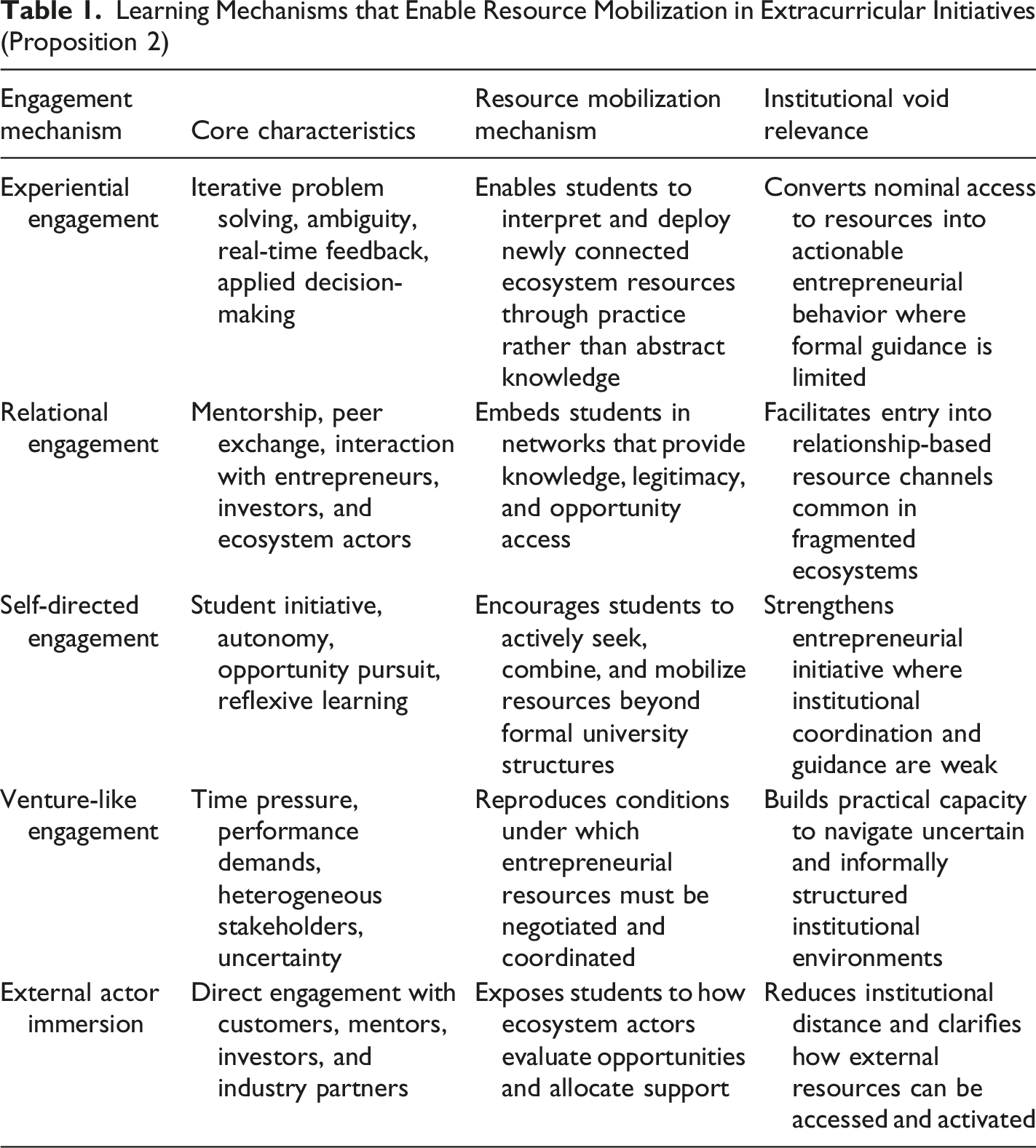
Next, the P1 mechanism does not operate uniformly across initiative types. The entrepreneurship education literature distinguishes between activities that primarily transmit knowledge and those that embed students in experiential, relational, self-directed, and venture-like engagement as well as direct engagement with external actors (Arranz et al., 2017; Johannisson, 1991; Preedy et al., 2020). Legitimacy transfer and recurrence require sustained, situated interaction between students and external actors; without it, exposure remains episodic and credibility does not adhere to specific ventures. This is particularly consequential under institutional voids. Navigating fragmented ecosystems depends on tacit, locally embedded knowledge—which external actors to trust, how informal channels operate, how to read ambiguous legitimacy signals—that cannot be transmitted through classroom instruction and is acquired only through repeated direct exposure to the environment itself. Initiatives organized around these five engagement forms therefore activate the P1 mechanism more fully than knowledge-transmission formats because they produce the repeated, evaluative contact through which external actors come to recognize and back student ventures (Morris et al., 2012).
Extracurricular initiatives activate the institutional-work mechanism more fully when their design produces sustained, evaluative interaction between students and external actors—through experiential, relational, self-directed, venture-like, and external-actor-immersion engagement forms—enabling legitimacy and access to attach to specific student ventures rather than to one-off events.
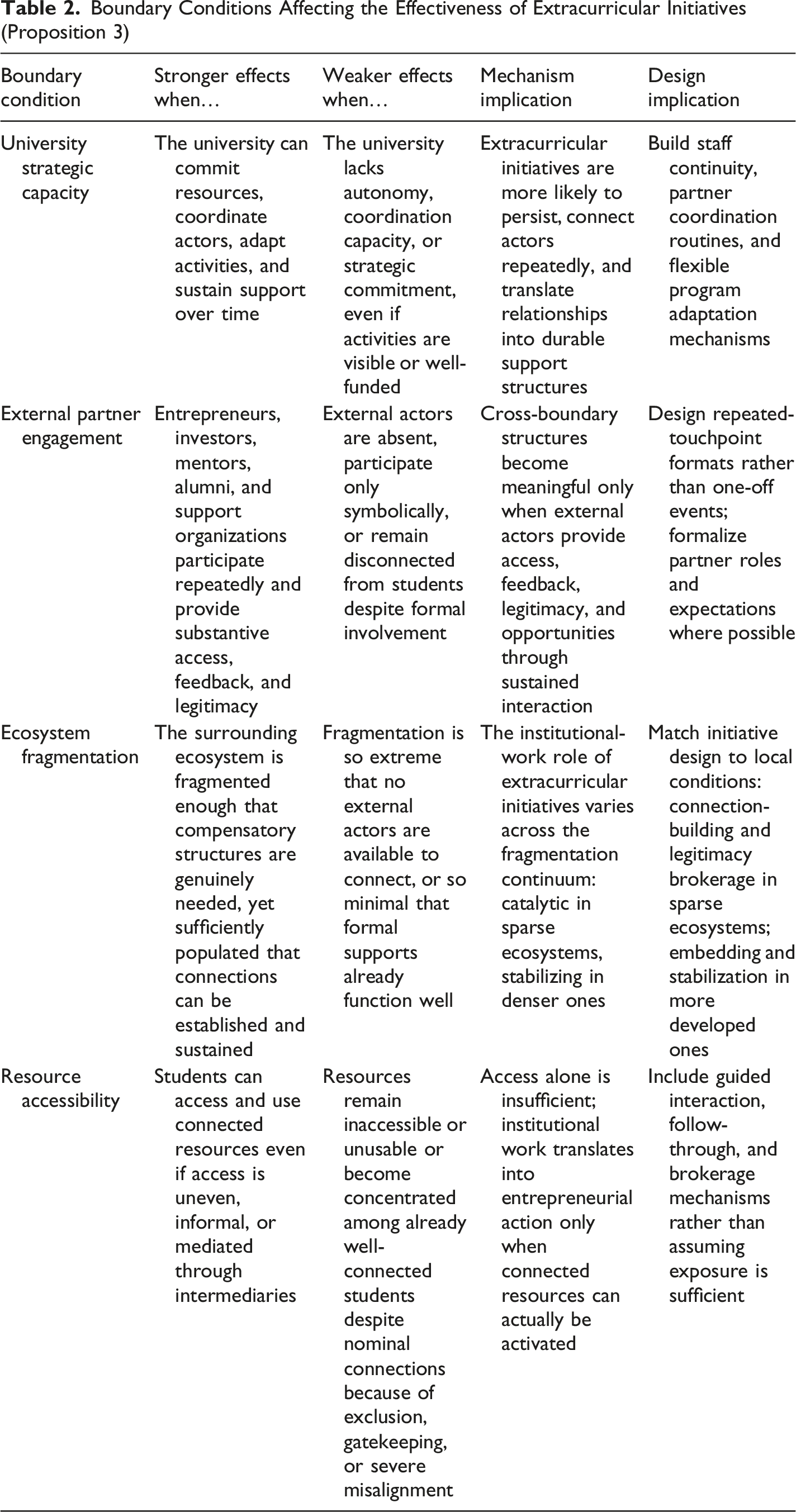
Finally, the P1 mechanism is conditional. Constructing a compensatory structure requires four elements: a problem condition that creates demand for it, a constructor capable of building it, counterparties willing to populate it, and usability of what it carries. The four boundary conditions below follow directly from this requirement set.
Demand
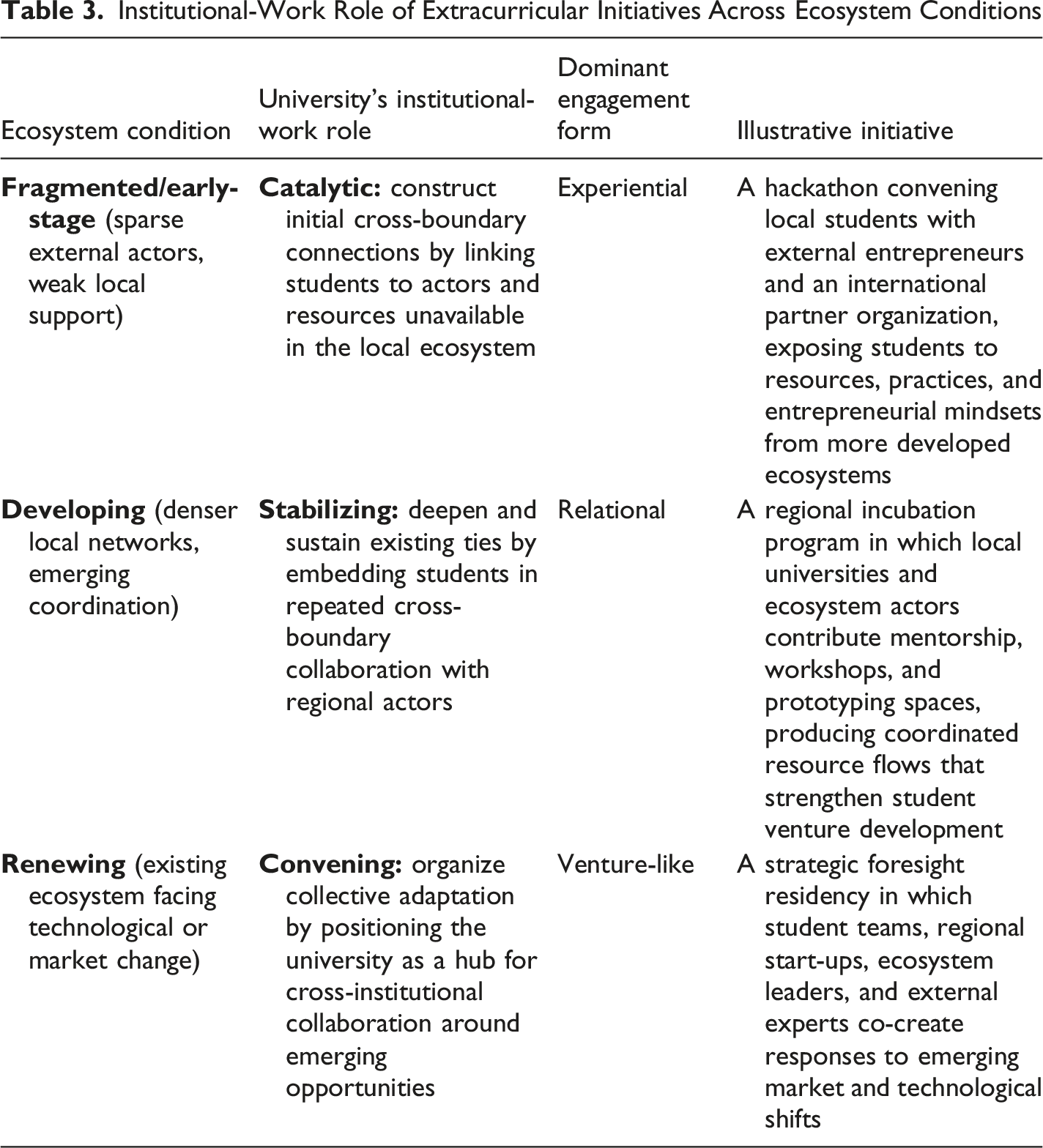
Ecosystem fragmentation must be real but not absolute. Ecosystem conditions may also include renewal dynamics, in which technological, market, or coordination shifts require universities to support adaptation as well as connection-building (Stam, 2015; Theodoraki, 2021). External supports must be incomplete enough that compensatory structures are genuinely needed, yet sufficiently present that cross-boundary connections can be established and sustained. Universities embedded in fragmented or early-stage ecosystems often play catalytic roles, attracting external actors and creating initial connections (Guerrero & Urbano, 2017; Miller & Acs, 2017), whereas universities in denser ecosystems are better positioned to deepen and stabilize existing relationships (Spigel, 2017; Theodoraki, 2021). Where fragmentation is so extreme that no external actors are available to connect, or so minimal that formal supports already function well, extracurricular initiatives add less incremental value.
Constructor Capacity
Universities differ in their ability to mobilize internal resources, sustain external partnerships, and adapt support activities to local conditions (Heaton et al., 2019). Resources remain misaligned or underused when universities lack sufficient autonomy, coordination capacity, or strategic commitment.
Counterparty Participation
Entrepreneurs, investors, mentors, alumni, and support organizations vary in their willingness to provide sustained access, feedback, and legitimacy (Feld, 2012; Spigel, 2017). Where external partners participate only symbolically or intermittently, compensatory structures remain shallow regardless of university design.
Usability
Even when universities reduce structural disconnection and external actors engage meaningfully, students may still face exclusion, gatekeeping, or severe misalignment between available resources and venture needs, leaving some only symbolically connected despite formal participation. Exclusion operates along two dimensions. Access to compensatory structures may be distributed unevenly across students depending on prior networks, social class, gender, race, language, or field of study. Legitimacy within those structures may be conferred selectively on ventures that fit dominant expectations of growth-oriented entrepreneurship, while informal, local, or necessity-driven ventures remain peripheral even when nominally included. Institutional work translates into entrepreneurial action only when newly connected resources are substantively accessible to the students nominally exposed to them.
Four conditions shape whether extracurricular initiatives produce institutional-work effects—demand, constructor capacity, counterparty participation, and usability—and each can compromise the mechanism in a distinct way.
Together, the three propositions form a single mechanism-driven argument. P1 specifies the causal process, P2 identifies the engagement forms through which that process is activated, and P3 specifies the requirements a compensatory structure must meet for the mechanism to operate.
Learning Mechanisms that Enable Resource Mobilization in Extracurricular Initiatives (Proposition 2)
Boundary Conditions Affecting the Effectiveness of Extracurricular Initiatives (Proposition 3)
Institutional-Work Role of Extracurricular Initiatives Across Ecosystem Conditions
Discussion
Universities are increasingly expected to foster entrepreneurship in environments where the surrounding institutional infrastructure provides limited support. In many Latin American settings, fragmented support organizations, weak market intermediaries, and uneven access to finance complicate the translation of entrepreneurial interest into sustained entrepreneurial activity. Under these conditions, the role of universities extends beyond developing relevant knowledge and skills. Student entrepreneurs require access to external networks, legitimacy, and resources that formal educational programs alone rarely provide.
Extracurricular initiatives represent one mechanism through which universities address this challenge. Activities like incubators, hackathons, mentoring programs, and competitions create structured interactions between students and actors in the broader entrepreneurial ecosystem, organizing channels through which students gain access to mentors, investors, entrepreneurs, and support organizations. In contexts characterized by institutional fragmentation, these initiatives operate as forms of institutional work that construct compensatory structures linking student entrepreneurs to external sources of support. Viewing extracurricular initiatives through this institutional lens clarifies how universities reduce structural disconnections between students and ecosystem resources, thereby expanding opportunities for entrepreneurial action in environments marked by institutional voids. The sections that follow discuss how this perspective advances theory on entrepreneurship education and entrepreneurial ecosystems.
Implications for Theory
Extracurricular Initiatives as Institutional Work
Research on entrepreneurship education has primarily approached extracurricular initiatives through a pedagogical lens. Across this literature, a key question concerns how universities design learning environments that cultivate entrepreneurial skills, intentions, and mindsets via experiential learning, exposure, and access to resources (Fayolle & Toutain, 2013; Mandel & Noyes, 2016; Nabi et al., 2017; Neck & Corbett, 2018). Related work on extracurricular entrepreneurship activities similarly emphasizes their value as complements to coursework that strengthen entrepreneurial engagement and learning (Arranz et al., 2017; Cui et al., 2021; Preedy et al., 2020). As a result, the dominant focus has remained at the level of the student; success is typically evaluated in terms of intentions, competencies, or venture-related outcomes. Although this framing has generated important insights, it overlooks a central concern in institutionally fragmented contexts: how universities shape the conditions that connect students to the broader ecosystem. This is particularly important in institutionally fragmented entrepreneurial ecosystems, where extracurricular initiatives matter not only because of what students learn in them but also because of the external relationships and access structures they help organize.
We address this gap by conceptualizing extracurricular initiatives as forms of institutional work (Lawrence & Suddaby, 2006; Scott, 2017). This perspective shifts the analytical focus from student-level learning outcomes to the university’s role in constructing compensatory structures that connect students to surrounding entrepreneurial ecosystems. In institutionally fragmented environments, extracurricular initiatives do more than enrich entrepreneurial learning; they organize channels through which universities broker access to mentors, investors, entrepreneurs, and support organizations whose resources are not reliably reachable through formal institutional arrangements alone. Our reconceptualization carries several implications for theory.
First, our framework extends institutional work research by identifying a form of institutional work that operates through routine organizational programs and activities instead of only through overt field-level interventions or formal institutional redesign (Lawrence & Suddaby, 2006; Scott, 2017). Prior work has largely examined how purposive actors create, maintain, or disrupt institutions and institutional arrangements. We show that universities can also engage in institutional work by constructing compensatory structures that connect students to networks, legitimacy, and resources in settings where formal institutional supports are uneven, unreliable, or incomplete. In these contexts, the central problem is not simply whether institutions are created, maintained, or disrupted, but how entrepreneurial action becomes possible when institutional supports are only partially available. Extracurricular initiatives therefore illustrate how institutional work can proceed through brokered ties, legitimacy channels, and recurring points of access that enable action under conditions of institutional fragmentation. In Latin American ecosystems, where formal venture finance, contract enforcement, and intermediary infrastructure are unevenly distributed, this kind of institutional work is often the practical alternative to waiting for institutional reform. And unlike ecosystem participation arguments that primarily identify universities as contributors to entrepreneurial environments, our institutional work perspective explains how universities actively structure and stabilize access to entrepreneurial support where those connections would otherwise remain weak or fragmented.
Second, our framework changes where entrepreneurship education research locates the primary source of causal influence. Research has generally treated student development as the main site where extracurricular initiatives matter, which makes intentions, competencies, and venture outcomes the dominant indicators of program effectiveness (Nabi et al., 2017). We suggest that, in contexts characterized by institutional voids, this focus can misidentify success and failure. Programs may appear ineffective when judged only by immediate student outcomes even though they are performing the more fundamental work of building access structures that make entrepreneurial action feasible. Conversely, initiatives that generate enthusiasm or self-reported learning may appear successful even when students remain disconnected from ecosystem actors. The theoretical implication is that entrepreneurship education research has tended to attribute outcomes primarily to changes within students, even though those outcomes are often shaped by the structural relationship between universities and surrounding ecosystems.
Third, our framework reframes how the outcomes of extracurricular entrepreneurship initiatives are understood. A pedagogical framing evaluates these initiatives primarily through learning outcomes such as skill acquisition, entrepreneurial intentions, or venture creation. These outcomes remain important, but they do not fully capture the mechanism through which extracurricular initiatives exert influence in institutionally fragmented settings. When extracurricular initiatives are understood as institutional work, the relevant theoretical outcome becomes whether universities reduce structural disconnection between students and entrepreneurial ecosystems by expanding access to networks, legitimacy, and support that students could not reliably reach otherwise. This perspective also helps explain why initiatives that appear similar in design often produce different effects across contexts and ecosystem conditions. Variation in outcomes reflects not only differences in pedagogy but also whether initiatives successfully create channels linking students to ecosystem actors and resources.
Universities as Institutional Actors in Entrepreneurial Ecosystems
Our second contribution lies in repositioning the role of universities in the entrepreneurial ecosystem literature. Scholars increasingly recognize universities as important participants in entrepreneurial ecosystems but have generally conceptualized their role in terms of knowledge production, technology transfer, and human capital development (Guerrero et al., 2021; Link & Sarala, 2019; Miller & Acs, 2017). From this perspective, universities contribute to ecosystem development by generating spillovers, training talent, and supporting innovation through their core educational and research functions. Although this literature increasingly recognizes universities as boundary-spanning actors within co-evolving ecosystems (Theodoraki & Messeghem, 2017), it has paid less attention to the purposive organizational processes through which universities actively shape the linkages that connect student entrepreneurs to those ecosystems, especially in contexts characterized by institutional fragmentation.
We build on and extend this stream by conceptualizing universities as institutional actors that shape the conditions through which students connect to entrepreneurial ecosystems. In institutionally fragmented environments, universities help organize the relational and legitimacy structures that make entrepreneurial participation possible. Extracurricular initiatives provide one mechanism through which this occurs. By convening students with entrepreneurs, mentors, investors, and support organizations, universities create cross-boundary linkages that reduce disconnection between university sub-ecosystems and the broader entrepreneurial environment. Our work here carries several implications for theory.
First, our framework expands how university influence within entrepreneurial ecosystems is understood. Research often explains variation in ecosystem impact primarily through differences in internal resources such as research capacity, technology transfer infrastructure, or the supply of entrepreneurial talent (Guerrero et al., 2021; Link & Sarala, 2019). We argue that ecosystem influence also depends on universities’ ability to organize relationships that connect students with external actors and resources. Influence is thus not only a byproduct of internal capabilities but also of how effectively universities structure cross-boundary access to ecosystem resources. As a result, universities with similar internal capabilities may produce very different ecosystem effects when one succeeds in building durable cross-boundary linkages and the other does not. This pattern is visible across Latin American settings, where universities with comparable research and teaching capabilities differ substantially in their ability to convene investors, alumni founders, and regional support organizations around student ventures, producing markedly different ecosystem effects despite similar internal resources.
This perspective also clarifies when and why university influence fails to materialize. Influence weakens when universities lack the strategic capacity to sustain partnerships, when external actors engage only symbolically, when ecosystem fragmentation is so extreme that connections cannot be established, or when connected resources remain inaccessible despite nominal exposure. By deriving these boundary conditions from the mechanism itself, we shift the literature from describing uneven university influence to explaining it theoretically.
Second, we relocate agency in entrepreneurial ecosystem development. Research on entrepreneurial ecosystems increasingly emphasizes systemic and co-evolutionary dynamics in which outcomes emerge from interactions among multiple actors rather than from the deliberate actions of any single organization (Spigel, 2017; Stam, 2018). Our argument complements this view by specifying how universities exercise directed agency within those broader dynamics. By organizing cross-boundary interactions and constructing compensatory structures that connect students to external actors, universities help shape the relational infrastructure through which opportunities become accessible. This does not mean universities determine ecosystem trajectories; rather, universities can influence who gains access to networks, legitimacy, and support, and under what conditions entrepreneurial participation becomes feasible. Our contribution, then, is a more actor-centered account of university influence within entrepreneurial ecosystems, one that explains how universities affect ecosystem development not only through spillovers and talent formation but also through deliberate efforts to shape the linkages through which students access entrepreneurial opportunities, resources, and support.
Implications for Practice
Our work has several implications for university leaders, ecosystem policymakers, and practitioners seeking to strengthen entrepreneurship education in Latin America and other resource-constrained contexts. For universities, extracurricular activities should be treated as strategic assets rather than peripheral programs. Hackathons, incubators, and mentoring schemes are often managed as isolated initiatives. These initiatives function most effectively when intentionally designed as forms of institutional work that connect students with external actors and create durable channels of access to ecosystem resources. University entrepreneurship programs should move beyond content delivery and consider how specific activities connect students to mentors, investors, entrepreneurs, and support organizations beyond the university.
For practitioners working within resource-constrained ecosystems, extracurricular initiatives can serve as bridges to external legitimacy and support. When structured as institutional work, these initiatives can help student entrepreneurs access mentors, investors, and markets that compensate for weak formal institutions. Competitions, bootcamps, and mentoring programs, for example, can incorporate external stakeholders as judges, advisors, or collaborators. This design embeds students within broader entrepreneurial networks and reduces the “nesting effect” that can isolate university-based ventures from external opportunities. From this view, extracurricular initiatives function not only as student development tools but also as mechanisms that stabilize entrepreneurial activity in environments where institutional supports are fragile or incomplete.
For policymakers and donors, extracurricular entrepreneurship initiatives should be recognized as policy-relevant tools. Governments, development agencies, and multilateral donors often emphasize regulatory reform or SME financing when promoting entrepreneurship in emerging economies. Strengthening extracurricular initiatives in universities may offer an additional lever for ecosystem development by attracting external actors, facilitating interaction among stakeholders, and expanding access to entrepreneurial resources. Such initiatives can also increase the visibility of emerging entrepreneurial communities and help connect local actors with broader regional and international networks. In Latin America, where high levels of entrepreneurial entry coexist with persistent challenges in venture sustainability, these initiatives can help address structural gaps that limit access to resources, legitimacy, and support.
Finally, the voluntary, flexible, and informal character of extracurricular initiatives should be recognized as a strength, not a weakness. These initiatives operate outside rigid curricular structures; this makes rapid adaptation, integration of external partners, and experimentation with new formats more feasible. Universities that embrace this flexibility are better positioned to support students who engage meaningfully with surrounding entrepreneurial ecosystems. For policymakers and practitioners, supporting this flexibility through funding, partnerships, and recognition can amplify the ability of universities to act as connectors in fragmented settings.
Future Research Directions
Our study opens several promising directions for future research. First, future work should examine the mechanisms through which extracurricular initiatives operate as institutional work. Latin American universities offer a particularly fertile setting for this work given the visibility of compensatory institutional dynamics across the region, but the mechanism we describe should also be examined wherever ecosystems are fragmented. Much of the entrepreneurship education literature evaluates such initiatives in terms of student intentions, competencies, or venture outcomes. Our framework suggests that an equally important question concerns whether and how extracurricular initiatives construct compensatory structures that alter students’ access to external networks, legitimacy, and resources. This creates an opening for research that traces how specific extracurricular forms—incubators, competitions, hackathons, mentoring programs, and venture bootcamps—broker relationships across university and ecosystem boundaries. Under what conditions do these initiatives generate durable channels of access rather than one-off moments of exposure? When do extracurricular initiatives actually reduce structural disconnection, and when do they merely create the appearance of connection? Future studies could also examine whether these effects depend on repeated interaction, sequencing, and accumulated trust rather than on any single activity alone. A one-off event may generate temporary visibility, whereas repeated exposure to external actors may gradually produce durable pathways of access and legitimacy. Longitudinal work would be especially valuable here because it could show whether certain initiatives matter because of discrete interventions or because universities build architectures of connection over time.
Second, future research should study universities more explicitly as organizational actors within entrepreneurial ecosystems. Latin America provides a useful comparative laboratory for this agenda because universities across the region operate in similar institutional environments but with substantial variation in how they organize relationships with external actors. Existing work has often focused either on student-level outcomes or on universities as background sources of knowledge, talent, and technology transfer. Our framework suggests that universities play a key role in organizing access, brokering legitimacy, and shaping the relational infrastructure surrounding entrepreneurship. That shift opens a more actor-centered research agenda. How do universities decide which external actors to convene, which relationships to prioritize, and which student ventures to expose to outside audiences? Under what conditions do extracurricular initiatives become durable organizational infrastructures rather than isolated programs or symbolic events? Why do some universities become credible brokers between students and ecosystem actors while others remain peripheral, even when internal resources appear similar? These questions would deepen understanding of how universities exercise agency in fragmented entrepreneurial contexts and would help explain variation in university influence that cannot be reduced to internal resource endowments alone.
Finally, future research should treat Latin America and other institutionally fragmented settings as sources of theory development rather than simply as research contexts. Institutional voids, informality, uneven access, and plural normative orders are often framed as contextual complications relative to theories developed in more institutionally consolidated environments. Our work suggests the opposite: such conditions make visible mechanisms that remain obscured in more formalized ecosystems. Comparative research could examine whether the institutional-work role of extracurricular initiatives becomes especially consequential where formal supports are weak, unreliable, or inaccessible. It could also explore whether the same extracurricular form performs different functions across institutional settings—for example, whether a mentoring program primarily builds confidence in one context but primarily brokers legitimacy and access in another. Framed this way, Latin America is not simply a setting in which theory is tested. It is a setting from which theory can be generated, refined, and challenged.
Conclusion
Universities are increasingly expected to foster entrepreneurship in environments where the institutional foundations of entrepreneurial ecosystems remain incomplete. In this paper, we reframe how that role is understood. Rather than viewing extracurricular initiatives simply as pedagogical supplements, we conceptualize these activities as forms of institutional work through which universities shape the linkages connecting students to the broader entrepreneurial ecosystem. This perspective shifts the analytical focus from individual learning outcomes to the structures that enable entrepreneurial participation. Extracurricular initiatives do not only cultivate entrepreneurial capabilities but also structure access to mentors, investors, legitimacy, and support. In contexts characterized by institutional fragmentation, these initiatives function as compensatory structures that reduce structural disconnection between aspiring entrepreneurs and the ecosystems in which their ventures must operate. From this vantage point, extracurricular initiatives are a central mechanism through which universities influence who gains access to entrepreneurial opportunities and under what conditions entrepreneurship becomes feasible.
Footnotes

Ethical Considerations
This study did not require ethical approval.
Consent to Participate
This study did not require consent to participate.
Funding
The authors received no financial support for the research, authorship, and/or publication of this article.
Declaration of Conflicting Interests
The authors declared no potential conflicts of interest with respect to the research, authorship, and/or publication of this article.