






Abstract
Entrepreneurship education research has generally focused on formal programs for adult entrepreneurs and university students in the Global North, while this research is in its infancy in Latin America. To add to this nascent body of research, we present an abductive study of Paulo Freire’s critical pedagogy in primary education in rural northeastern Brazil. Combining interviews, focus groups, and participant observation, we explore how critical pedagogy can engender individual entrepreneurial orientation (IEO) in children. Our study makes three contributions to entrepreneurship education in Latin America. First, we show how principles of Freire’s philosophy affect entrepreneurial dispositions and behaviors in primary education, particularly in the cultural context of rural Brazil, in which entrepreneurs were seen by some of our informants as capitalist oppressors. Second, we study the antecedents of an IEO, which is rare given that most studies explore IEO’s outcomes. Finally, we present practical implications for educating future entrepreneurs in Latin America that go against the grain of present educational approaches in this context.
Introduction
Since the rise of entrepreneurship programs in higher education in the 1990s, entrepreneurship education has blossomed into a mature field. Studies in entrepreneurship education examine how entrepreneurship is taught and offer recommendations for educators seeking to improve its instruction (Nabi et al., 2017). Many studies in this field use cross-sectional, longitudinal, or experimental approaches (Blenker et al., 2014; Englis & Frederiks, 2024; Nabi et al., 2017), thereby shedding various degrees of light on causal mechanisms. Further, the vast majority of studies examine adults (e.g., Beeri et al., 2020; Huis et al., 2019; Zappe et al., 2023) and university students (e.g., Hahn et al., 2020; Sánchez, 2011), with a smattering of studies exploring entrepreneurship education in secondary education students (e.g., Kim et al., 2020; Rodriguez & Lieber, 2020). And while some research examines entrepreneurship education outside the USA, Canada, and the EU (e.g., Alaref et al., 2020; Fiala, 2018), model entrepreneurship education programs are generally considered to reside in the Global North.
However, entrepreneurship education in contexts beyond teaching adults in the Global North requires contextualization and novel approaches. In particular, entrepreneurship education in Latin America is in its infancy and presents significant yet unique challenges due to cultural context and gaps in our knowledge about the topic (Kickul et al., 2025). The prevalence of institutional voids, poverty, and a lack of infrastructure, as well as unique cultural and political traditions in this part of the world, calls for innovative educational strategies to promote entrepreneurship (Aguinis et al., 2020; Guerrero & Urbano, 2017) that differ from those taken in the Global North. Additionally, we presently lack comprehensive research on entrepreneurship education in developing countries (Nabi & Liñán, 2011), particularly in Latin America (Amorós et al., 2021). Finally, the general focus on adult education neglects a large population of potential future entrepreneurs that would contribute to Latin American countries’ economic futures: children.
One unique educational approach for children of the rural poor was created and promoted over 50 years ago in Latin America and beyond by Brazilian educational philosopher Paulo Freire. Freire (1970) advocated for critical pedagogy to break the perpetual cycle of social inequality through education. Freire (1970, 2018) conceptualized critical pedagogy as an empowering force grounded in three pillars: dialogue, praxis, and conscientization (consciousness + action), resulting in students becoming critical citizens, rather than simply passive subjects who cannot change their circumstances. Thus, critical pedagogy is foundational to citizens’ willingness to act in the public sphere (Giroux, 2020). Taken together, these factors showcase the influence that context plays on designing and practicing entrepreneurship education (Kickul et al., 2012; Thomassen et al., 2019), with implications for research and practice that affect millions. We therefore ask, how effectively does critical pedagogy in primary school education develop entrepreneurial dispositions and behaviors in children?
The purpose of this article is to explore how Freire’s educational philosophy promotes and/or hinders the development of entrepreneurial dispositions and behaviors in primary school students in Kindergarten-ninth grade (hereafter K-9; about 6–14 years old) in rural Brazil. We provide three contributions to the theory and practice of entrepreneurship education. First, we build on recent research (i.e., Verduyn & Berglund, 2019) that applies Freire’s critical pedagogy to the entrepreneurship education literature. Through interviews, focus groups, and field work, we show how principles of his philosophy affect entrepreneurial dispositions and behaviors in primary education, particularly in the cultural context of rural Brazil, in which entrepreneurs were seen by some of our informants as capitalist oppressors. Second, we offer a rare study into the antecedents of an individual entrepreneurial orientation (IEO), or the “autonomous, proactive, innovative, competitive, and risk-taking dispositions and behaviors that individuals exhibit when pursuing value-creating opportunities” (Clark et al., 2024, p. 351). Through our abductive grounded study, we show how principles of critical pedagogy affect the development of an IEO in children. Finally, we present practical implications for educating future entrepreneurs in Latin America that go against the grain of present educational approaches in this context.
Theoretical Background
Critical Pedagogy
Critical pedagogy is defined as an approach for educating students to become engaged citizens who actively pursue positive societal change (Giroux, 2020). Paulo Freire is the leading theorist, with the seminal work Pedagogy of the Oppressed (Freire, 1970, 2018). This work continues to generate debate regarding its profound engagement of politics in education, as well as its Marxist orientation. That said, it is essential to understand Freire’s background and the cultural environment of rural Brazil to fully grasp his theory. Born in the 1920s in one of the poorest regions in northeast Brazil, Freire lost his father at a young age, and his mother was a pre-school teacher. This, combined with the Communist Revolution of 1935 and the effects of the Great Depression, created a fertile context for Marxism to play an essential role in Freire’s educational ideology (Bhattacharya, 2011, pp. 9–20). Freire applied the Marxist concept of false consciousness to the classroom, using it to explain how laborers and marginalized groups may remain unaware of their exploitation by the dominant class. According to Freire (1970), false consciousness in the educational system keeps students confined in a symbolic cave; without true consciousness, there is no action, and societal inequalities perpetuate themselves. Freire (1970, 2018) characterizes the Western education model as a “banking system” in which professors present facts and students absorb those facts. It is a hierarchical, structured approach, positioning the professor as the sole source of knowledge to be deposited in students’ minds, like a bank.
Freire (1970, 2018) developed critical pedagogy around three sequential and conceptual pillars: (a) dialogue, (b) praxis, and (c) conscientization. First, proper education occurs when there is constant dialogue between teachers and students, allowing both to understand each other’s contexts. Dialogue reverses the traditional roles of teachers and students, with all parties assuming both roles. This dialogic relationship rejects the “banking model” of education and instead positions learners as active subjects capable of producing knowledge from lived experience. Giroux (2020) argues that dialogue is essential to democratic education, understood not as preparation for liberal political and economic institutions, but defined as a public good intended to nurture civic responsibility, social justice, and critical agency, rather than merely workforce training. Democratic education enables students to connect their personal experiences with broader social, political, and cultural structures, thereby cultivating critical reflection and civic responsibility.
Dialogue fosters reflection, which leads to the second concept known as praxis, from the Greek word for practice, prassein. For Freire, theory must be paired with practice so education leads to action. Through praxis, learners critically analyze their conditions, design collective responses, and act to transform their reality, continually reflecting in an ongoing cycle of learning and transformation. Praxis, therefore, positions education as an ethical and political practice, on the premise that knowledge gains meaning only when enacted in the struggle for humanization. This process aligns with experiential and participatory learning traditions that view learners as agents rather than passive recipients of information.
According to Freire (1970, 2018), praxis positions humans as protagonists in their own story, which leads to the third pillar, conscientization (consciousness + action), in which the individual is fully aware of their identity and becomes an agent of societal change. Conscientization reverses the false consciousness of the oppressed and marginalized sectors of society. The ultimate outcome of critical pedagogy is the creation of critical citizens. Giroux (2020) showed how conscientization is foundational for democratic life because it cultivates moral judgment, ethical responsibility, and the courage to intervene in the public sphere. Through conscientization, education becomes a process of empowerment in which learners come to see themselves capable of shaping history—beyond just their own story—rather than objects shaped by it. Indeed, Giroux (2020, p. 1) states that the primary goal of critical pedagogy is to produce “citizens who are critical, self-reflective, knowledgeable, and willing to make moral judgments and act in a socially responsible way.” The goal of creating critical citizens through education is a unique contribution of critical pedagogy and differentiates it from critical theory more generally.
Critical pedagogy has been implemented in many impoverished communities within developing countries where education aims to address structural inequality and social exclusion. In Latin America, this aim led to a convergence between Marxist social analysis and the Catholic Church’s social teaching, resulting in the movement known as Liberation Theology. Initially developed by Gustavo Gutiérrez in 1968, this theology advocated a more active role for the Catholic Church in addressing social issues (Gutiérrez, 2023), particularly during a period when Latin America faced several totalitarian regimes. According to Gutiérrez (2023), Liberation Theology is a Christian theological movement that interprets faith through the lived experience of the poor and oppressed. It argues that social, political, and economic injustice are not only moral concerns but structural realities that must be transformed through collective action. In Brazil, grassroots ecclesial communities emerged, and some Catholic priests applied the Liberation Theology to their impoverished contexts (Boff, 1987).
Liberation Theology parallels critical pedagogy in its emphasis on lived experience, collective reflection, and action as pathways to emancipation. Boff (1987) taught that faith should emerge from engagement with the concrete realities of marginalization, such as hunger, poverty, and exclusion, rather than from abstract doctrine alone. These lived experiences prompt collective reflection within faith communities, fostering critical awareness of oppressive social conditions. This process culminates in action as individuals and communities seek to transform unjust structures in line with their interpretation of biblical principles of justice and dignity. Scholars have explicitly mapped this process onto the three pillars of critical pedagogy, aligning dialogue with lived experience, praxis with collective reflection, and conscientization with action (Boff, 1987; McLaren & Jandrić, 2017). Thus, Liberation Theology mobilizes faith toward emancipatory ends just as critical pedagogy uses education as a way to free the oppressed.
Critical pedagogy has expanded to other regions like South Africa, where it was adopted in majority-Black schools to denounce the Apartheid regime through the slogan “education before liberation” (Perumal, 2016). Critical pedagogy has also been applied in underprivileged regions within developed economies. Scholars propose critical pedagogy as a tool of liberation for African-American communities in the US (Allen, 2004; Childs, 2017; Jennings & Lynn, 2005; Lynn, 2004) or economically depressed areas in Sweden (Berglund & Johansson, 2007).
Critical Pedagogy and Entrepreneurship Education
Research on the connection between critical pedagogy and entrepreneurship education is in its infancy. Berglund and Johansson (2007), Berglund and Wigren-Kristoferson (2012), and Verduyn and Berglund (2019) have described using critical pedagogy as a framework to teach entrepreneurship in higher education, demonstrating how education can become a tool for individual freedom. Berglund and other scholars initiated the TrEE project (Transforming Enterprise Education), a consortium of European higher education professors using critical pedagogy to rethink the role of entrepreneurship education in addressing societal challenges. These studies conclude that entrepreneurial potential is latent in communities, but dominant discourses can inhibit initiatives aimed at challenging the status quo. Critical pedagogy, in this sense, can ignite entrepreneurs to rediscover themselves as agents of change.
Critical pedagogy and effective entrepreneurship education seemingly share common foundational principles centered on action, reflection, and empowerment. Entrepreneurship education requires praxis because the cycle of acting and reflecting is inherent to entrepreneurial activity (Hägg & Kurczewska, 2016). Reflection also enables entrepreneurship students to become lifelong learners, even outside the classroom (Achtenhagen & Johannisson, 2018). More recently, Walmsley and Wraae (2022) identified five common principles between critical pedagogy and entrepreneurship education, suggesting that the former can serve as a more effective framework for teaching entrepreneurship. Both subjects are action-oriented, transformation-oriented, emphasize empowerment/autonomy, are reflexive, and seek reconciliation between professor and student. An entrepreneurial training program for impoverished farmers in Rwanda successfully applied critical pedagogy not for revolutionary goals, but to spur entrepreneurial activity (Rubyutsa et al., 2024), for example. Additionally, leading entrepreneurship pedagogy emphasizes how the way in which content is taught is as important as the content itself (Neck et al., 2014). Indeed, a chapter in Neck and colleagues’ (2014, pp. 84–102) shows similarities with Freire’s Pedagogy of the Oppressed, with a suggestive title: “The Practice of Reflection.” They state that “one of the hardest things we have seen people struggle with in preparing to teach in new ways (as opposed to stand and deliver) is to let go of the power, in essence giving the student more responsibility for the learning” (Neck et al., 2014, p. 99).
Critical pedagogy also has its downsides, primarily its heavy Marxist orientation (Lather, 2002) that delegitimizes its pragmatism in the eyes of its detractors. Because it was developed in an environment of political oppression, critical pedagogy embeds an insurgent orientation that positions oppressed classes against the elite. The strong revolutionary content casts agreement between oppressor and oppressed as unattainable. In the context of education, scholars have provided a compelling critique of Marxist-influenced pedagogical approaches by exposing how emancipatory intentions can paradoxically generate new forms of constraint within the classroom. Ellsworth’s (1989) analysis demonstrated that critical pedagogy often operates on the basis of implicit assumptions about “false consciousness,” positioning educators as ideologically enlightened and students as subjects in need of political awakening. This dynamic can silence dissent, discourage genuine dialogue, and reframe disagreement as a moral or intellectual deficiency rather than a legitimate critique. Extending this concern, Biesta (2017) argued that when education is oriented toward producing a predetermined form of political or critical subjectivity, pedagogical authority shifts from facilitating open inquiry to directing students toward normatively defined outcomes. In such cases, education risks becoming instrumentalized for ideological formation rather than oriented toward intellectual autonomy and democratic plurality. It becomes an issue of who controls the narrative about the myths of oppression that are being demystified. Together, these critiques suggest that when Marxist approaches in the classroom (i.e., neo-Marxist pedagogical theories) are treated as prescriptive frameworks rather than interpretive tools, they may undermine the very goals of emancipation and agency they claim to advance by narrowing the space for independent judgment and plural perspectives.
Taken together, these critiques highlight the tension between critical pedagogy’s emancipatory aspirations and the risks associated with its ideological prescriptiveness. Yet, even as scholars caution against treating critical pedagogy as a normative political framework, its core educational tenets regarding dialogue, praxis, and the cultivation of agency seemingly align with how individuals learn to initiate action and shape their futures. This raises the question of how the formative effects of critical pedagogy can extend beyond its political aims to shape individual dispositions related to entrepreneurship.
Individual Entrepreneurial Orientation
Individual entrepreneurial orientation (IEO) captures what it means for an individual to “be entrepreneurial,” independent of firm ownership, venture creation, or formal organizational roles (Clark et al., 2025, p. 672). The construct extends from organizational-level research on entrepreneurial orientation (Covin & Lumpkin, 2011; Lumpkin & Dess, 1996) to measure durable individual orientations toward initiating action, shaping one’s future, and navigating uncertainty. As such, IEO is not limited to being a narrow skill set utilized when founding a new firm, but it can be enacted across a range of everyday contexts, including social, civic, and personal pursuits (Clark et al., 2024).
Research on IEO has primarily focused on outcomes rather than origins, with most studies examining IEO as an explanatory variable, examining its relationship to entrepreneurial intention, innovation, intrapreneurship, strategic behavior, or performance outcomes across organizational and educational settings (see review in Clark et al., 2024). By contrast, less attention has been devoted to understanding how IEO develops. Clark and colleagues (2024, p. 374) identify this imbalance and call for greater attention to “formational” questions regarding antecedents, including how individuals can develop IEO, and how the environment might shape its development. This gap is particularly salient in educational contexts, where pedagogical practices may aim to cultivate agency, future orientation, and resourcefulness.
In summary, the literature suggests many points of convergence between critical pedagogy and entrepreneurship education. While critical pedagogy has historically viewed education as a means for societal transformation within explicit sociopolitical contexts, scholars are beginning to integrate its core principles to reframe entrepreneurship education as a tool for empowerment and societal advancement. However, it is essential to understand how to apply the concepts of critical pedagogy in a more politically and ideologically neutral approach in the classroom. This tension is especially salient given calls for greater attention to the antecedents of IEO, which remain underexplored in educational settings. Accordingly, we examine how critical pedagogy shapes entrepreneurial dispositions and behaviors in primary school students, illuminating both its developmental potential and its limitations as a way of preparing children for a possible future of entrepreneurship.
Methods
Our study grew out of a larger research project that explored the creation and growth of a community primary school (nonprofit cooperative social enterprise) called the School of Hope (SOH; a pseudonym) in rural northeastern Brazil. We did not begin the study with an a priori interest in examining how Freire’s critical pedagogy might foster entrepreneurial dispositions and behaviors, rather this topic gradually emerged from the data. Our initial data collection revealed that students at this community school were learning in substantially different ways from public and private schools in the same small town, with implications for IEO and a possible future of entrepreneurship among these children. In parallel, our literature review indicated that the relationship between critical pedagogy and educating children in rural contexts to be more entrepreneurial remains underdeveloped, prompting us to build theory around critical pedagogy and an IEO. “Grounded theory is highly useful in explanations about substantive areas where we have limited or no theory, to see how those explanations fit the realities of the situation” (Glaser & Strauss, 2017, p. 98). Accordingly, our abductive study adopts an interpretivist lens to build theory about critical pedagogy and IEO (Gioia et al., 2013; Strauss & Corbin, 1997). We conducted our data analysis according to the principles of grounded theory, including constant comparison, emergent coding, theoretical sampling, and theoretical saturation (Charmaz, 2014). University of Oklahoma Institutional Review Board approved our interviews (approval: #17097) on June 26, 2024. The IRB also approved verbal consent because many respondents were illiterate or had only basic literacy and could not read formal consent documents.
Research Context and Sample
Our research context is the state of Paraiba, which places 21st out of the 27 states in Brazil in the Human Development Index according to the last Brazilian Census in 2022 (PNUD & João Pinheiro Foundation, 2022). Paraiba also ranks 25th in the nation in terms of illiteracy (Derevecki, 2025). Our context of a community school in Paraiba adds another layer of complexity to this research since the school is in the rural city of Bananeiras, with a population of about 23,000.
Primary and Secondary Education in Brazil
Brazil combines primary and lower secondary education into a single continuous progression. It is free in public schools and divided into two phases: the initial years (Anos Iniciais) and the final years (Anos Finais). The curriculum includes core subjects such as Portuguese, Math, Science, History, Geography, Arts, and Physical Education, forming the foundation for further study and active citizenship. This stage is federally guided by the Base Nacional Comum Curricular (BNCC), which aims to ensure consistent learning goals across the country (Brazil. Ministry of Education, 2017). Fundamental education plays a crucial role in developing basic literacy, numeracy, and broader competencies necessary for personal and social development.
The Catholic Church strongly influenced the educational system in Brazil. Since Brazil’s colonial period, the Order of the Jesuits saw education as a tool for evangelization (Bittar & Ferreira, 2024). Jesuits’ pedagogy was called the Ratio Studiorum (“Plan and method of Studies” in a free translation). The Ratio Studiorum was published in 1599 as a comprehensive plan regulating curriculum, teaching methods, assessment, and classroom discipline across Jesuit institutions worldwide. The Ratio Studiorum is a highly standardized and hierarchical model of instruction, centered on lectures, repetition, memorization, and strict obedience to authority (Lorenz, 2018). Knowledge is transmitted from teacher to student, leaving little room for dialogue, critical inquiry, or learner autonomy. This pedagogical framework reinforced passive learning and conformity, privileging doctrinal correctness over intellectual exploration. Exported to colonial Brazil, the Jesuit model became the dominant foundation of formal education for centuries, shaping schooling practices well into the 20th century and contributing to an enduring tradition of teacher-centered, content-heavy instruction (Bittar & Ferreira, 2024). We also note that two authors of this article were educated in Brazil through this methodology.
With the exception of schools operated by churches, private schools in Brazil are run as for-profit businesses. According to the Brazilian Education Census of 2023 (National Institute for Educational Studies and Research Anísio Teixeira, 2025), Brazil has 151,104 schools from elementary to high school levels, of which 35,207 are for-profit private schools charging tuition. A KPMG report (KPMG, 2019), identified 3624 nonprofit schools in Brazil, which may choose to charge tuition. This number is less than 3% of the total number of schools and slightly more than 10% of the total number of private schools. Private schools cater to various income levels, from affordable tuition for low-income families to much higher tuition, providing high-level education comparable to that of private institutions in the Global North.
Sample
The focal primary school in our study is called the School of Hope, and is an ideal context in which to examine Freire’s critical pedagogy in developing an IEO and thereby educating future entrepreneurs. Not coincidentally, the SOH is in the State of Paraiba, between Pernambuco, where Freire was born, and Rio Grande do Norte, where Freire applied critical pedagogy with poor farmers in the early 1960s. Indeed, SOH’s founder conveyed that Leonardo Boff, a prominent Liberation Theology proponent in Brazil, helped secure the donation of land where SOH’s initial building was constructed (field notes). The location of the SOH is in a rural, impoverished area with substantial socio-economic inequalities. Our sample of informants includes administrators, school board members, faculty, parents, and students from three schools in Bananeiras: SOH, an elite private school, and the largest public school. The educational philosophies of private and public schools follow the Western model detailed in the Findings. There are thus structural and philosophical differences between the SOH, and the private/public schools. A final external group in our sample included individuals associated with the local high school and the local state university.
Data Collection and Analysis
We began data collection for our larger research project when one author (native of Brazil) first heard about the SOH. Two authors conducted 12 individual exploratory interviews and three focus groups with 70 informants to learn about the context and how the SOH operated. After initial analyses, these authors conducted a second round of individual interviews with 25 informants and three focus groups with 25 informants, along with classroom observations of an eighth-grade class at the SOH. These first two rounds were focused on the SOH: students, parents, administrators, board members, faculty, and staff. Finally, we conducted a third round of data collection that focused on the elite private and large public schools, and on the local high school that receives students from all three K-9 schools, to understand how students, parents, faculty, and administrators perceived the SOH and its students. This round consisted of interviews of 21 informants and six focus groups of 34 informants, along with classroom observations of sixth-grade classes at the elite private and large public schools. In total, we conducted 58 interviews (1690 min) and 12 focus groups with 129 informants (575 min).
To analyze our data, we used Kreiner’s (2015) twin slate approach, an abductive grounded theory analysis technique (Murphy et al., 2017). In contrast to purely inductive methods, the twin slate approach balances theory engagement with analysis grounded in the data (Smith et al., 2010). We began our analysis by studying background material on websites and publicly available videos to familiarize ourselves with the context. Two authors independently coded transcripts. We then held joint-coding meetings to analyze in vivo grounded codes and to develop theoretical codes. Throughout the process the author team moved between data and theory on critical pedagogy and entrepreneurship, providing what Kreiner (2015, p. 350) calls “analytical flexibility” as we integrated codes and literature. We also mapped the data with codes and arranged the codes into a hierarchy, following Kreiner (2015) and colleagues (Kreiner et al., 2017), as shown in our data structure in Figure 1. As we progressed through the data analysis, we began to identify recurring themes, such as the vital role that critical pedagogy played in the educational journey of the students. We also noticed that informants spoke of core entrepreneurship ideas like autonomy and proactiveness, even though students were not taking part in overt entrepreneurship training. By revisiting theory between rounds of interviews, we started to identify how critical pedagogy affected the development of entrepreneurial skills and dispositions. We also presented our findings to organizational leaders after each round of interviews during debriefing sessions to build trustworthiness. Data structure with in vivo first-order codes, second-order themes, and theoretical constructs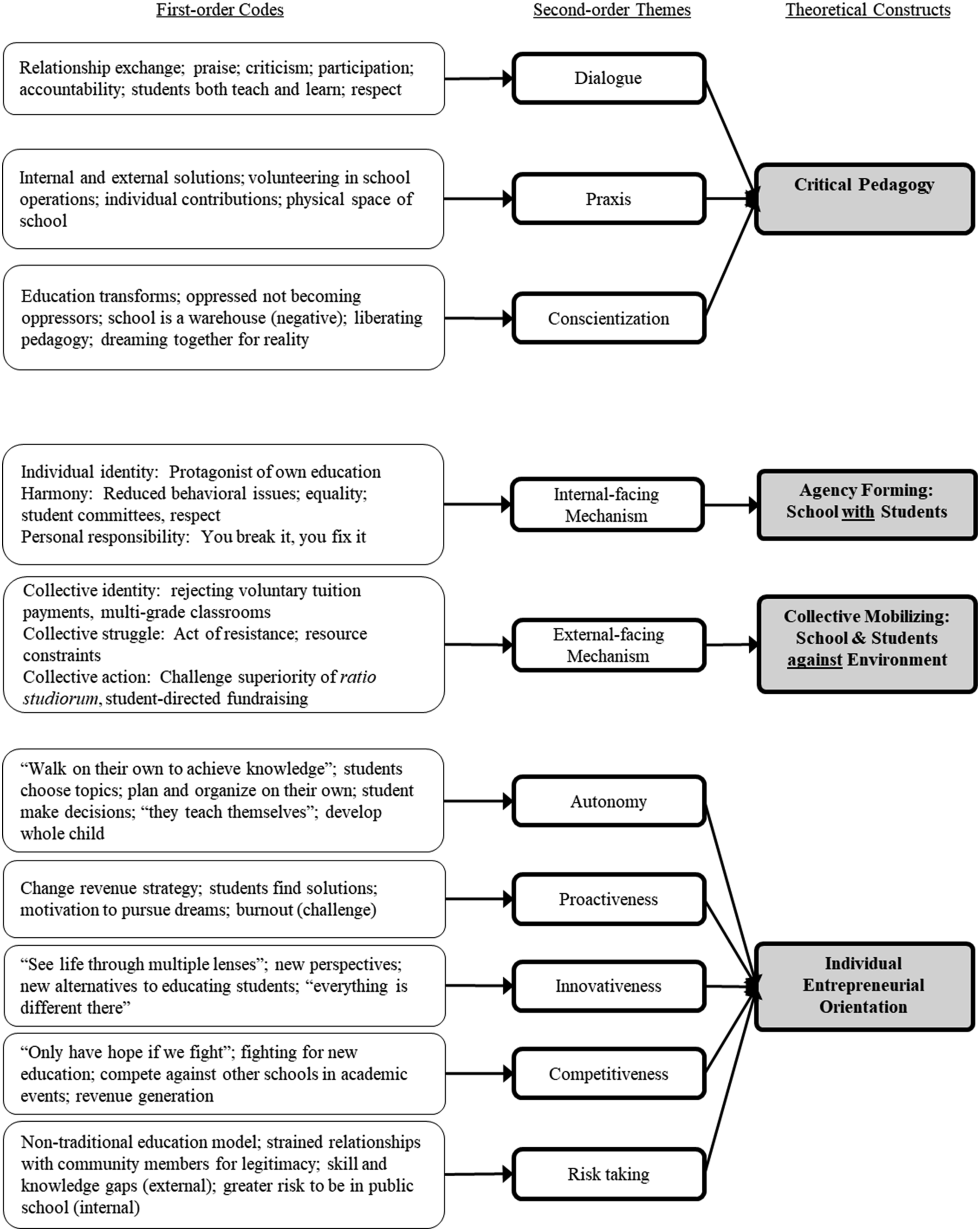
Findings
Our findings tell a story of how critical pedagogy creates a learning environment in which primary school students develop an IEO through mechanisms that are both internal-facing and external-facing. We first report on observations of Freire’s three pillars of critical pedagogy at work in the SOH—dialogue, praxis, and conscientization. We next detail ways in which students at the SOH displayed IEO dimensions of autonomy, proactiveness, innovativeness, competitiveness, and risk taking in different degrees. Finally, we find that the critical pedagogy taught at the SOH develops agency in the students (internal), as well as mobilizes the students with parents, faculty, and administrators collectively against their common challenging environment (external), which explains the connection between critical pedagogy and IEO.
Education at the School of Hope
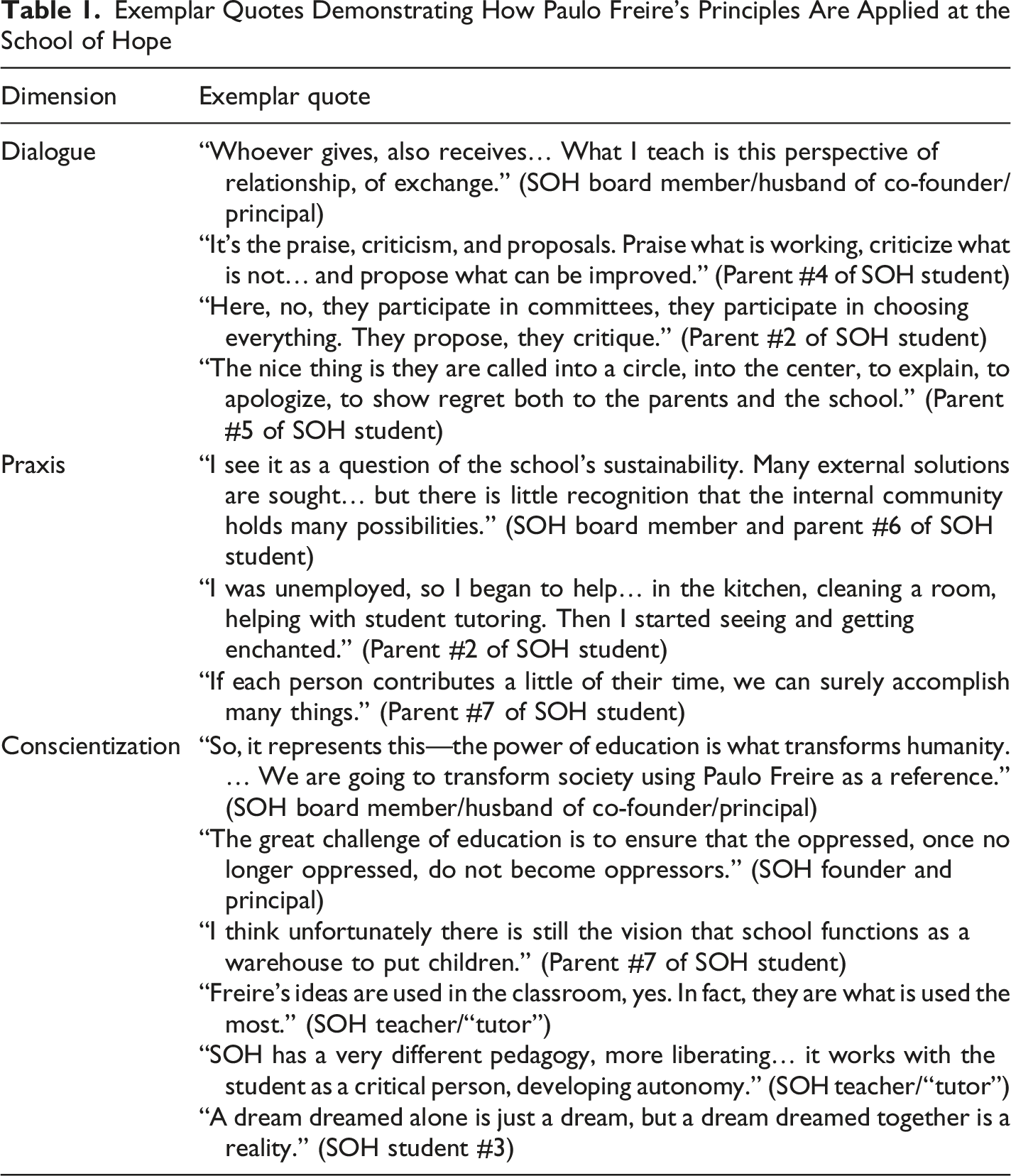
Exemplar Quotes Demonstrating How Paulo Freire’s Principles Are Applied at the School of Hope
Dialogue
We observed that the Ratio Studiorum education approach is disrupted when the hierarchy between faculty and students is removed. The “top-down” educational approach is nonexistent at the SOH, particularly in the role of the tutor. Tutors (teachers) do not teach; they facilitate the learning process. This facet is reflected in one statement by an eighth-grade student: “We do not have professors here; we have tutors.” Each lesson is called a “knowledge trail,” in which students choose a subject to learn and tie specific curriculum concepts to it, and tutors ensure subjects are mapped to the official government curriculum. For instance, a group of students want to know how sugar is produced. Students must choose specific concepts from Math, History, and/or Science to learn while studying how sugar is made. Each student will thus know how sugar is made, but will also learn complementary concepts according to their personal choices, such as the historical or economic significance of sugar to Brazil, while practicing math concepts to determine levels of production. Usually, students choose subjects related to their lived experience in rural Brazil. The tutor’s role is essentially to ensure that the process runs smoothly. Students learn in groups of three or four, and then they teach each other what they learned. All students and tutors learn from and teach one another. An eighth-grade student said: “Do you see that poster? It says teaching and learning. Who can teach the one who needs help?” (SOH student).
The student also referred to the tutor as a “mediator,” as the tutor facilitates the learning process, which differs from the traditional education method, where the professor leads the entire process. When we interviewed the group of students, they were dialoguing about the project with each other before the tutor arrived. When asked what they were doing, the student answered: “We are deciding what to do. What we are going to study and how we are going to build our knowledge trail” (SOH student).
Tutors and students are placed on more equal footing because students sometimes select subjects that tutors do not already know. Tutors and students learn together, rather than through a top-down approach. We had an unexpected opportunity to observe this phenomenon when a group of students was studying entrepreneurship, and the tutor was no more knowledgeable than the students; they thus learned entrepreneurship together. One interviewee, an alum who runs his own architecture firm, emphasized how dialogue impacts the way students relate to others, communicate, and interact in society: “… education not knowledge, but to be educated like parents that educate their children. Like the way that we treat each other, there is order, there is respect. So, we all get shocked when we leave the School of Hope and go to study in another place, the way that people treat each other. … For instance, Portuguese, the way that we learned that there. They will teach the word supermarket. So, we will know what a supermarket was, but what are we supposed to do in a supermarket? How would we greet people there? How would we ask for information? How have I ever worked in a supermarket? We learned how to communicate.” (SOH graduate)
Statements like this show how dialogue guided the learning process and outcomes at the SOH.
Praxis
We noticed several instances of praxis, in which knowledge became meaningful because it was enacted in the students’ struggle for humanization; they became agents rather than passive recipients. The SOH acquired a vacant lot and through entrepreneurial bootstrapping and bricolage, built a school with outdoor pavilions and moveable classrooms surrounded by gardens of flowering plants, fruit-bearing trees, and vegetables (field notes; observation). This physical artifact of Freire’s educational vision for humanization in learning immerses students in experiential learning and opportunities to apply what they learn. As expressed in an essay by a 13-year-old student who had recently transferred to the SOH from the large public school: “Have you noticed that [the public] school has prison-like characteristics? Think about it: in prison, uniforms are mandatory, at school too; in prison there's a sunbathing break; at school it’s recess; … in prison there are guards; at school, teachers; in prison, the general; in school, the principal. But one school won me over, where the student has a voice, the classrooms are open, nature is everywhere, learning is free, and teachers are not commanders but tutors of our learning. A school where dreams are treated as they should be. … At the School of Hope, there are no walls. At the School of Hope, the birds are free and not kept in cages like prisoners. And what is this school really like? Classrooms without walls, nature everywhere, a vast area to play, trees and plants all around and, in addition, Paulo Freire is displayed all over. Freire’s words were the inspiration for this place, where dreams matter, where love multiplies like learning, where students are valued, and a dream is a form of hope.” (Translated by the lead author)
This statement provides a counterpoint to the Ratio Studiorum Brazilian system enacted in the public and private schools, in which the learning in a prison-like environment is completely detached from meaningful reality. The SOH is integrated into nature, so the classrooms are open, without walls, similar to the environment surrounding Bananeiras. The SOH pedagogy believes students learn when integrated into their environment since they are being educated to be agents of societal change. The classroom cannot be dissociated from students’ daily routine. This setup leads to the praxis of critical pedagogy, the reflection of the acquired knowledge and action. The environment allows students to put into practice the knowledge learned in the “classroom without walls.”
Conscientization
We saw evidence that the conscientization concept from critical pedagogy is embedded in SOH, since the individual is aware of their role in society. The student is also an agent of change, which ties with one of the most heard statements (with slight variations) from SOH students: “I am ready to pursue my dream” (field notes). Unlike private and public school students, SOH students were less focused on pursuing careers as physicians or lawyers, the two most sought-after professions in Brazil. Their focus seemed to be mostly on self-actualization, which stems from playing a positive role in society, no matter the chosen career (field notes). Different from other students with a more self-serving mindset, SOH students seem to possess a sense of purpose to give back to society embedded in their dreams. This sentiment is reflected in the words of a parent and is typical of what we heard from many parents at SOH: “The School of Hope changes the way you think because they open a totally new world of possibilities for our kids. It's not like I was educated. I am going to finish school, and then I am going to college, and then I am going to get a job. It's not just about being a lawyer or a doctor or engineer, okay? It is about how he can do whatever he wants.” (Parent #8 of SOH student)
This sense of empowerment is embedded in the student body, and this sense of giving back can be noted in many alumni—and an alumni culture is quite usual in Brazil. Returning to the alumni architect, when we asked why he decided to design the new building for the School of Hope pro bono, his answer was, “I would have done it even if they had not asked me to.” Additionally, we saw conscientization manifest in SOH students, faculty, staff, and students’ parents—all of whom are proud of the “outsider” role the school plays in the community. Society is seen as an environment full of inequalities, and the students are taught to become empowered agents of change for these inequalities. The SOH views the current educational system as broken, and the school aims to provide an alternative to the shortcomings of the learning process in Brazil (field notes).
Individual Entrepreneurial Orientation at the School of Hope
In our interviews and observations, it became clear that the pedagogy promoted at the SOH was developing entrepreneurial dispositions and behaviors in the students. Indeed, when we asked the SOH principal for the name of an alumnus to interview, the young architect entrepreneur was at the top of mind. While the students were not receiving “targeted” entrepreneurship education to train them in frameworks such as lean start-up or business model canvas, they were nonetheless being taught how to become entrepreneurial. In essence, they were being prepared to become future entrepreneurs by seeing the world around them as an entrepreneur would see it. Additionally, while not the focus of this paper, we believe that the “revolutionary” educational example set by the principal—the school founder and a social entrepreneur herself—and how she was praised by parents and SOH staff, contributed to students seeing her as a positive role model worth emulating (field notes).
While the founder and principal of the school is a social entrepreneur and Ashoka Fellow, her view of traditional entrepreneurship was seen through Freire’s critical lens; traditional entrepreneurs are the capitalist oppressors, such as real estate developers who buy small farmers’ land to build high-end gated communities (field notes). Indeed, she viewed the traditional ratio studiorum pedagogical approach as a model in which administrators and faculty are the oppressors and students are the oppressed (field notes). She cited Freire’s teaching that “the great challenge of education has to do with the oppressed leaving their oppression, without them turning into the oppressors themselves.” Yet, while decrying entrepreneurship, the SOH founder and principal was unknowingly using a pedagogical approach that fostered entrepreneurial dispositions and behaviors in the students. We found this paradox intriguing.
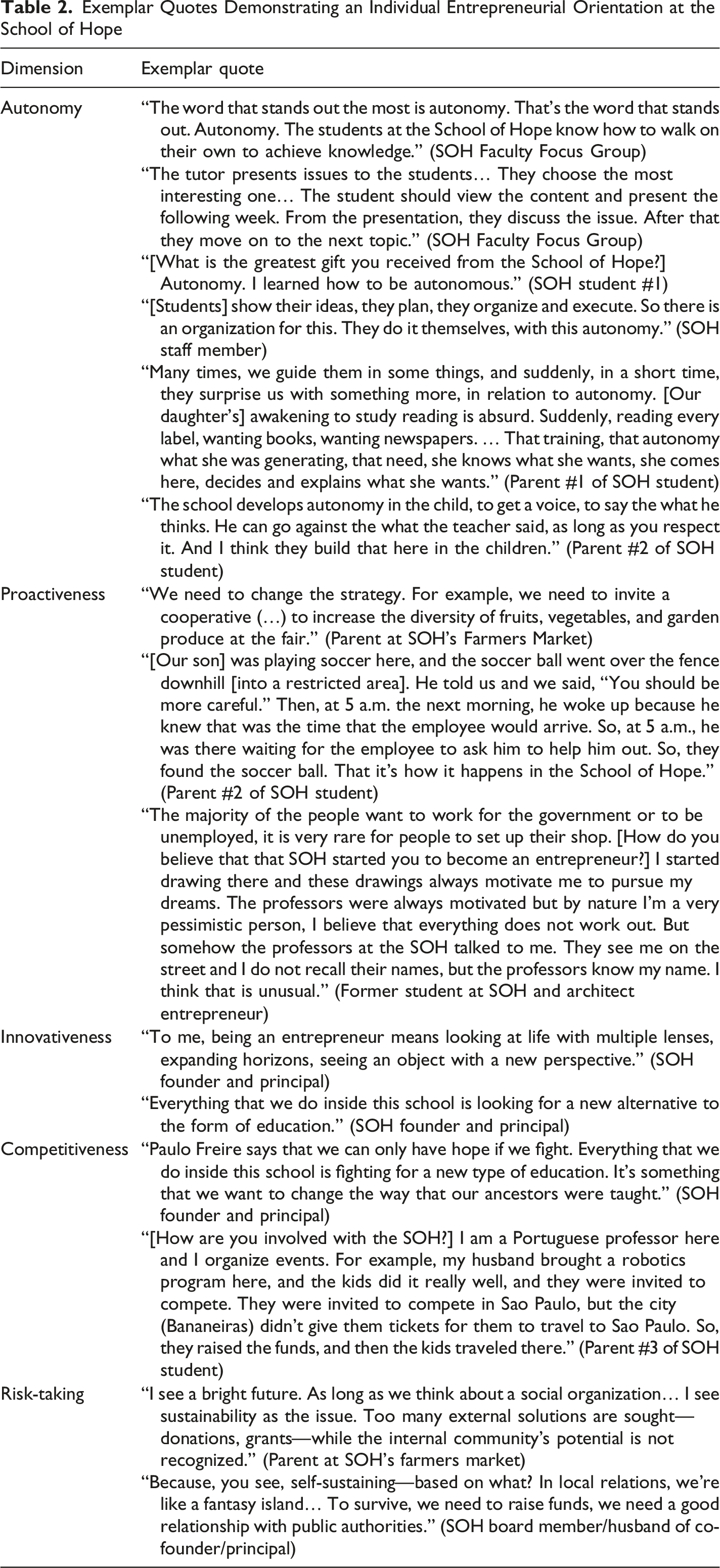
Exemplar Quotes Demonstrating an Individual Entrepreneurial Orientation at the School of Hope
Autonomy
Autonomy was the most oft-mentioned dimension of an IEO developed in students through their education at the SOH. We define autonomy as “embracing the freedom and flexibility to take independent action, outside of established norms and routines; being willing to assume responsibility and champion new ideas” (Clark et al., 2025, p. 673). That students are given broad leeway for the focus of their “knowledge trails” for a given subject teaches them from age five that they truly are protagonists. This difference in autonomy between schools was clear to one student who had recently transferred from the elite private school to the School of Hope: “In the beginning, I was enrolled in both schools, the private school and the School of Hope. But then, there was something there that clicked with me. They learn by themselves. They go after the learning. They go, and they teach themselves.” (SOH student #2)
Through critical pedagogy, the SOH faculty consciously nurture autonomy in the students so that they become independent learners. This was confirmed in an interview when the municipal coordinator for the public school system talked about the differences between students at the SOH and students at the public schools: “I find the pedagogy they use very interesting, because it develops the child as one whole. To develop the student as a critical person, of the development of autonomy. … [If there were something you could apply in the municipality, what would it be?] This issue of autonomy. Of the student's autonomy. Of working as a whole.” (Municipal coordinator of the Bananeiras Public School System)
Further, the principal of the public school mentioned the philosophical differences between the public school and the SOH: “The traditionalist, when you get to the classroom, you will still see a boy sitting at the desk. We have the rules, we have content that they have to follow, we are the ones who impose it. The content is different from the School of Hope. They get to choose what they study, so it still follows that traditionalist bias, but it becomes constructivist at the moment when they allow him to choose which theme he will work on in the project.” (Public school principal)
Proactiveness
Students at the SOH are taught to be self-motivated and proactive in their education, which carries over to other aspects of their lives (see quotes in Table 2). We define proactiveness as “being alert and scanning for possibilities; anticipating and envisioning the future; being willing to act on opportunities ahead of future demand” (Clark et al., 2025, p. 673). When asked about how the SOH helped him, one student talked about envisioning the future: “I have one dream, I have one idea. But there I have to sell that one idea. So, the more people believe, the more I will have the motivational power and knowledge to execute it. Whether it is a service or a product.” (SOH student #3)
Those outside of the SOH recognize the proactiveness of its students and how they are different from others. For example, the provost of the local university explained: “What I have information about is not at a university level but at the level of a citizen, of the parents who relate to the change that the children experienced because of the SOH. I think it's a matter of motivation, the SOH is not like in our time [education in the past]; we just would go to school or else our parents spank us, and now they are extremely motivated to go.” (Provost at local university)
Innovativeness
In research on IEO, innovativeness refers to “being inventive and experimental; using fresh insights, novel thinking, and new knowledge to create or improve products, services, and processes” (Clark et al., 2025, p. 673). We found evidence that the students themselves develop fresh insights and novel thinking compared to students in other schools. For example, the “knowledge trails” discussed in the Dialogue section direct students towards novel thinking to make new connections between subjects. They do not learn subjects in isolation; every “knowledge trail” combines subjects to promote these connections. We saw this principle in practice as students prepared to discover fresh insights through novel thinking with one group of eighth grade students. The four students each chose their own topic to link with entrepreneurship: the Russian Revolution, the independence of Haiti, figures of speech in Portuguese, and quadratic equations—which were sure to prompt fresh insights into entrepreneurship (field notes). Additionally, it is clear that the school itself is quite different compared to the existing primary school options, as expressed by this informant: “They do not communicate with us. Everything’s different there. The calendar, the training of the professors, everything’s different” (Municipal coordinator of the Bananeiras Public School System).
Competitiveness
We define competitiveness as “being willing to directly challenge rivals; being assertive in response to threats and changing conditions; being vigorous in efforts to seek advantage” (Clark et al., 2025, p. 673). At first glance, critical pedagogy may appear incompatible with competitiveness, particularly if competition is understood as students competing against one another. Yet we observed that students are taught how to make their ideas more competitive in the broader marketplace, as one student expressed: “We already sell popsicles here at school, and if we improved the popsicle, added more flavors or made it gourmet, that would be it” (SOH student). We also observed that the students in the SOH compete against the traditional educational system, to show “the system” that their educational model is valid and legitimate: “Everything that we do inside this school is fighting for a new type of education” (SOH founder and principal).
Risk-Taking
We define risk-taking as “making judgments and decisions and taking action under conditions of uncertainty; some initiatives may involve making substantial resource commitments in the process of venturing forward” (Clark et al., 2025, pp. 673–674). We saw students taking action under uncertainty in the process of moving their education forward. Students at the SOH seem to engage in risk-taking constantly as part of their non-traditional education model. This is not unexpected because change is seen as an opportunity for improvement, and because change is part of life (field notes). Uncertainty is a constant feature of life at SOH, given the shared struggles faced by students, parents, faculty, and administration; yet, students routinely move forward, treating uncertainty as a normal condition for action. This quote is evidence of this behavior: “The project will start on Monday. We know what we are going to study, but we don’t know what that is” (SOH student focus group). This quote is emblematic of embracing uncertainty, as respondents showed no signs of anxiety or concern. Students were aware they had no prior knowledge of the subject matter, which was precisely why they chose to study it. Additionally, the quote shows evidence of students taking the reins of their learning journey.
One final way in which students at the SOH take on risk is by trusting their futures to an educational model that differs substantially from the norm in Bananeiras, specifically, and in Brazil generally. The SOH students and parents viewed being a part of the public school as being high-risk due to the environment and education received there. Yet we saw an opposing view when we interviewed faculty from the public and private schools that received students who were transferring out of the SOH, and we interviewed a few of these students. While faculty pointed out and students demonstrated the above-average communication capacity and excellent articulation, both faculty and students also noted negative consequences, including gaps in math concepts. Indeed, the students who left the SOH mentioned that the reason for the transfer was that their parents wanted them to be better prepared for the university entrance exam; parents wanted to enroll their children in a school that would “teach to the test” (field notes). Additionally, one public school teacher indirectly mentioned the risk that SOH students may not receive an education in all the areas they need to know: “[At the SOH] they have another way. They will choose what they will study, they will choose what they will work on, the project. And I keep thinking, what if they don't choose? What if the necessary skills for them to develop all of this aren't present there?” (Public school teacher)
In summary, the critical pedagogy process of dialogue, praxis, and conscientization changes students as they move through their educational journey year after year, and that students were learning how to develop an IEO through their education at the SOH. We found evidence that internal-facing mechanisms and external-facing mechanisms explain why students who become “critical citizens” (Giroux, 2020) as a result of critical pedagogy also develop the entrepreneurial dispositions and behaviors of an IEO, which we now explain.
Mechanism 1—Agency Forming: School With Students
We found that a number of internal-facing elements related to agency formation explain why critical pedagogy develops increased autonomy and proactiveness in the SOH students. These elements include individual identity, harmony, and personal responsibility and were most evident at the individual level (Figure 1). First, we observed the SOH promotes an individual identity in the students as self-directed learners. This facet of the school is manifest as students oversee their own learning process, being the protagonists in the school environment. Indeed, a sign at the entrance to the SOH reads, “I am the protagonist of my own education” (field notes).
Second, the SOH teaches students to be in harmony with each other. We observed harmony at the SOH in several ways. For instance, there is no distinction between faculty, staff, students, and parents. This does not mean there is no conflict, yet it does mean everyone has an equal opportunity to express themselves. From the student perspective, students are seen as equals, regardless of grade, age, or income level. The first time we visited the school, we were received by a “hospitality committee” composed of students of all ages. No faculty or staff received us, and students guided us on a tour through the school. Additionally, when one person raises their hand, students are taught that no matter the age or position, everyone listens to this individual. Finally, while our context is a very conservative region in Brazil, students with disabilities or from the LGBTQIA+ community are treated as equals and do not suffer bullying as expected in other schools (field notes). This stands in contrast to the large public school, where the principal mentioned that their behavioral problems include illegal drugs and sexual assault; these problems are addressed through increased security in the school with webcams and security personnel (field notes).
Finally, students are expected to take personal responsibility for their behaviors. The conscientization promoted by the school reframed students’ relationship to the future. Rather than adapting to given conditions in the broader society, these critically conscious students begin to see themselves as responsible for shaping those conditions. The school encourages personal responsibility, as demonstrated by one parent: “If there is a door that is broken, the students have to find a solution. How to fix this? How to fix a window that is broken [at school]? So if they broke it, they must find a solution. He has a lot of knowledge, and it changes the way that he thinks.” (Parent #2 of SOH student)
Mechanism 2—Collective Mobilizing: School and Students Against Environment
We also observed a number of external-facing elements related to collective mobilizing that explain why critical pedagogy develops increased innovativeness, competitiveness, and risk-taking in the SOH students. By collective mobilizing, we refer to the process of individuals coming together to confront challenges faced by marginalized social groups seeking to protect themselves from economic, political, social, and environmental harms (Almeida, 2019). We found this to be a weaker relationship than the agency forming mechanism we observed for Autonomy and Proactiveness. These elements were occurring at the level of the group and include collective identity, collective struggle, and collective action. We term these “collective” because it was clear that the school and students were working together to become more innovative, competitive, and risk-taking to rise above their external circumstances in the face of severe challenges they encountered in society, and they expressed the belief that these challenges could only be overcome by working together against a common “other.”
First, the administration, faculty, parents, and students work to create a collective identity in which they seem to prioritize group goals and cohesion over personal desires. Given the lack of tuition revenue and its associated challenges, some parents offered to pay tuition because they could afford to, but the principal would not accept the funds as doing so might upset the sense of togetherness they were striving to achieve (field notes). Additionally, classes consist of students from multiple grades in one room, which created a “school identity” rather than an “8th grade identity,” for example (field notes).
We saw clear manifestations of collective struggle as the SOH students, parents, faculty, and administration engage in revenue-generating activities to stay solvent. For example, the principal’s husband (and board member) stated that the School of Hope’s existence is a symbol of resistance to the de facto public and private education system because the SOH is an institution with no public funding and is tuition-free (field notes); they receive their funding from grants, donations, and earned income activities. This struggle is so pronounced that the school leadership nearly accepted a “buy out” offer from the municipality that would guarantee resources, while constraining their independence because they would become part of the public system (field notes).
Regarding collective action, students at the SOH were actively developing the critical literacy necessary to resist the oppression they perceived from the local municipality. Students, parents, and the principal challenge dominant narratives surrounding the superiority of the ratio studiorum model taught in the public and private schools; this was stated by the director of curriculum for the municipality. Students likewise challenge this narrative when relating their experiences with friends near their homes and discussing how their schools are different (field notes). Finally, we observed students acting collectively in their efforts to transform unjust conditions, or emancipation from oppression through education, such as self-formed groups engaging in fundraising for school improvements. In this sense, the students were not merely informed but critically conscious, ethically grounded, and committed to social responsibility, embodying Freire’s vision of education as a practice of freedom (Giroux, 2020).
Discussion
In this article we explore how the educational philosophy advocated by Paulo Freire promotes and/or hinders the development of entrepreneurial dispositions and behaviors in primary school students in Brazil. We thus provide three contributions to theory and practice of entrepreneurship education. First, we extend research applying Freire’s critical pedagogy to the entrepreneurship education literature by examining primary education. We show how principles of this philosophy affect entrepreneurial dispositions and behaviors in children, particularly in a context in which—paradoxically—entrepreneurs were spurned by some of our informants as capitalist oppressors. Second, through an abductive, grounded study we show how the principles of Freire’s critical pedagogy affect the development of an IEO (Clark et al., 2024) in children to prepare them for future entrepreneurship.
Based on our findings, we create the conceptual model in Figure 2 in which dialogue leads to praxis, praxis leads to conscientization, and conscientization leads to the five IEO dimensions to varying degrees through both internal- and external-facing mechanisms. We elevate this model beyond the Brazilian context in this section to suggest that these principles apply to primary education more broadly. We found that a number of internal-facing mechanisms related to agency formation explain why critical pedagogy develops increased autonomy and proactiveness in the SOH students, represented by the solid lines in Figure 2. The dotted lines in Figure 2 represent a weaker relationship for external-facing that explain Innovativeness, Competitiveness, and Risk Taking than the agency forming mechanism we observed for Autonomy and Proactiveness. We thus offer a rare study into the antecedents of entrepreneurial orientation generally, and of IEO specifically. Finally, we present practical implications for educating future entrepreneurs in Latin America that go against the grain of present educational approaches in this context. Conceptual model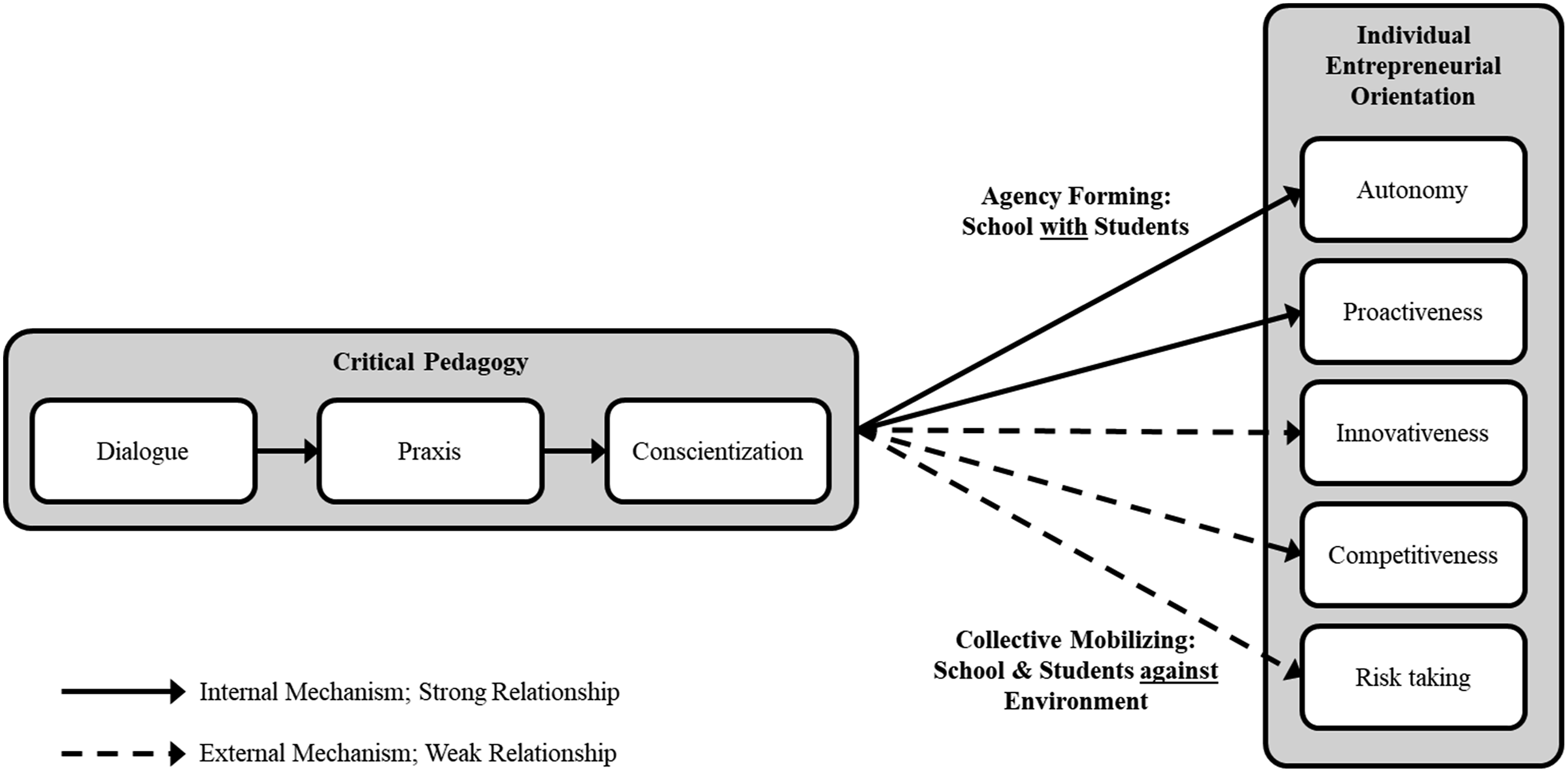
First, when it comes to entrepreneurship education, Freire’s critical pedagogy has been principally applied to adults in formal entrepreneurship education programs—either in their ventures or to university students. To complement these studies, we examined critical pedagogy in the context of a K-9 primary school in rural Brazil to show its relevance. The final result of Freire’s critical pedagogy is critical citizens. Critical citizens would thus express many of the dispositions and behaviors as those with a high IEO. The tenet of conscientization (consciousness + action) is a citizen who has become critical of their reality and engages in societal change. This critical citizen seems to be an entrepreneur in essence since the “needed change” in society requires the individual to engage in the five dimensions of IEO. A critical citizen must be autonomous to provoke change; change implies breaking a paradigm (innovation); an individual provokes this change by being proactive; changing structures in a society demands risk-taking and competitiveness to “confront” those who will be affected by the proposed changes.
A central insight from this study is that critical pedagogy can cultivate entrepreneurial dispositions even when entrepreneurship is not an explicit pedagogical objective. At SOH, education is intentionally grounded in dialogue, praxis, and conscientization, with a normative focus on critical citizenship, collective problem-posing, and social transformation rather than market participation. Yet these practices consistently foster individual-level dispositions associated with IEO, including autonomy, proactiveness, and innovativeness. In this context, entrepreneurial orientation emerges as a byproduct of critical consciousness rather than as a curricular goal: students develop the capacity to initiate action, navigate uncertainty, and advance ideas not because they are taught to be entrepreneurs, but because they become critically conscious protagonists of their own lives.
This finding points to surprising points of convergence between critical pedagogy and entrepreneurship education. Two pedagogical traditions grounded in very different normative commitments—one oriented towards emancipation and social justice, the other toward opportunity recognition and venture creation—may nevertheless activate similar developmental mechanisms. In entrepreneurship education, experiential learning, reflective practice, team-based problem-solving, and real-world engagement are often used to cultivate initiative, experimentation, and action under uncertainty (e.g., Neck et al., 2014). Although these practices are framed as entrepreneurial competencies rather than emancipatory aims, they similarly contribute to the formation of autonomous and proactive individuals. Together, these insights suggest that the capacities required to resist and transform dominant social systems overlap substantially with those required to disrupt markets or pursue entrepreneurial opportunities, positioning critical pedagogy as an unexpected pathway for developing IEO.
Second, we contribute to the IEO literature by offering a rare study that explores its antecedents—factors that foster autonomy, proactiveness, innovativeness, competitiveness, and risk-taking—directly responding to calls in the IEO literature (Clark et al., 2024, 2025). By instilling an IEO in individuals aged 6 to 14, the SOH is creating engaged citizens for whom entrepreneurial dispositions and behaviors are a natural part of who they are. Rather than treating IEO as a stable individual difference or merely as an explanatory variable predicting performance outcomes, our findings show how educational practices can shape the formation of IEO, even when entrepreneurship is not an explicit instructional goal. We also answer calls in the entrepreneurship literature to study IEO in non-traditional settings, including different cultures (Clark et al., 2024). Due to historical factors such as dictatorships, deep-rooted poverty, and Liberation Theology, rural Brazil provides a fertile context for examining how Brazil’s distinctive culture might influence an IEO. Indeed, while we found strong support for autonomy and proactiveness, support was more nuanced for innovativeness, competitiveness, and risk-taking.
Our findings also have implications for the role of entrepreneurship education in addressing the embedded agency of marginalized communities. The paradox of embedded agency refers to how actors subject to institutions can effect change by envisioning new practices and persuading others to adopt them (Garud et al., 2007). By studying primary school students alongside SOH’s founder, this study extends research on social entrepreneurs as embedded agents driving social change (Grimes et al., 2013) to examine the impact on the entrepreneurial agency of students who are among the most vulnerable members of society. We gained insights into how a social enterprise can cultivate the IEO of stakeholders, including students, parents, and other community members (Clark et al., 2024). The SOH offers an example of a social enterprise that is not only organically embedded in a community to both enact and modify local institutions (e.g., educational standards), but also to change local poverty dynamics through a collective action orientation that empowers local community members to think and act entrepreneurially (Seelos et al., 2011). Thus, we found that Freire’s critical pedagogy—and its emphasis on dialogue, praxis, and conscientization—contains the raw ingredients for increasing relational agency that supports entrepreneurial sensing (Burkitt, 2016; Giudici et al., 2018) and encourages sensemaking in institutional voids (Mair et al., 2012). These insights point to the importance of entrepreneurship pedagogy that addresses the complexities and nuances of embedded agency when educating marginalized communities, more so than selecting curriculum solely based on teaching business model design or lean startup concepts.
Finally, our study has surprising practical implications for educating future entrepreneurs in Brazil, as the country is currently at the beginning stages of formal entrepreneurship education. Indeed, entrepreneurs in rural Brazil are driven more by necessity than by opportunity, given the economic constraints faced by the local economy. A pedagogical method that unintentionally teaches entrepreneurial dispositions and behaviors raises questions about whether it can be intentionally used to teach entrepreneurship. The Brazilian Small Business Administration (SEBRAE, 2025) has three primary missions, and Mission A is to expand transformational entrepreneurship. SEBRAE seeks to fulfill this mission through special programs, but it seems that critical pedagogy could serve as the medium for a more comprehensive program across elementary, middle, and high school, as well as higher education. Currently, SEBRAE is more focused on training and skills development courses than on structured or degree-seeking education.
Another practical implication of our findings concerns mitigating the risks of a Marxist educational philosophy, like critical pedagogy, to support entrepreneurship. These risks can be mitigated by intentionally shifting critical pedagogical practices away from prescriptive political or ideological commitments, thereby preserving critique as a method rather than an outcome. Rather than framing education around cultivating a specific political consciousness, educators can treat structural analyses of power as open to interrogation, comparison, and contestation. Doing so repositions the teacher not as an ideological guide but as a facilitator of inquiry, reducing the asymmetries of authority identified by Ellsworth (1989) and restoring the openness and plurality emphasized by Biesta (2017). When critical reflection is grounded in dialogue and respect for intellectual disagreement, students are empowered to develop their own judgments rather than adopt predetermined positions. In this way, critical pedagogy can retain its emancipatory potential while avoiding the dangers of indoctrination, ideological closure, and the erosion of intellectual autonomy that arise when political commitments are embedded as educational ends.
Limitations and Future Research
Like any study, ours is not without limitations, which stem primarily from the data source and context. Primary school education in Brazil and the possibilities for necessity or opportunity entrepreneurship differ from those in other parts of the world, such as the Global North. This calls into question the transferability of our findings. Our findings are particularly relevant to much of Latin America, given the similar economic and political development paths taken by these countries. Future research could examine the extent to which Freire’s critical pedagogy is being applied to primary school education in other countries, and with what implications for the development of entrepreneurial dispositions and behaviors. While we found strong support for autonomy and proactiveness as a result of critical pedagogy, results for innovativeness, competitiveness, and risk-taking were more nuanced. We recognize that developing entrepreneurial dispositions and behaviors was not consciously being pursued at the SOH; this was an unexpected spillover from the school’s desire to educate critical citizens. Future research might explore how the principles of critical pedagogy might more purposefully foster innovativeness, competitiveness, and risk-taking. We also recognize the potential difficulties of transferring a Marxist educational philosophy to many parts of the Global North, given different political leanings. This fact challenges educators and scholars to examine how the principles of dialogue, praxis, and conscientization can be separated from politically divisive ideologies to find common ground in education that will benefit future entrepreneurs.
Footnotes
Acknowledgments
The lead author thanks the Bob Moore Foundation for its generous funding. The remaining authors thank the Price College of Business for its generous funding.

Ethical Considerations
The Institutional Review Board at the University of Oklahoma approved our interviews (approval: #17097) on June 26, 2024.
Consent to Participate
The IRB also approved verbal consent because many respondents were illiterate or had only basic literacy and could not read formal consent documents.
Funding
The authors received no financial support for the research, authorship, and/or publication of this article.
Declaration of Conflicting Interests
The authors declared no potential conflicts of interest with respect to the research, authorship, and/or publication of this article.
Data Availability Statement
Data are unavailable due to confidentiality.
Use of Artificial Intelligence
Artificial intelligence was not used in the research or in manuscript preparation.