






Abstract
Background
Venous thromboembolism (VTE) is a leading cause of preventable harm in hospitalized patients. However, many doses of prescribed pharmacologic VTE prophylaxis are frequently missed. We investigated the effect of a patient-centered education bundle on missed doses of VTE prophylaxis in a community hospital.
Methods
We performed a pre-post analysis examining missed doses of VTE prophylaxis in a community hospital. A real-time alert from the electronic health record system facilitated the delivery of a patient education bundle intervention. We included all patient visits on a single floor where at least 1 dose of VTE prophylaxis was prescribed during pre- (January 1, 2018, - November 31, 2018) and post- (January 1 - June 31, 2019) intervention periods. Outcomes included any missed dose (primary) and reasons for missed doses (refusal, other [secondary]) and were compared between both periods.
Results
1,614 patient visits were included. The proportion of any missed dose significantly decreased (13.8% vs. 8.2% [OR, 0.56; 95% CI, 0.48, 0.64]) between the pre-post intervention periods. Patient refusal was the most frequent reason for missed doses. In the post-intervention period, patient refusal significantly decreased from 8.8% to 5.0% (OR, 0.54; 95% CI, 0.46, 0.64). Similarly, other reasons for missed doses significantly decreased from 5.0% to 3.2% (OR, 0.62; 95% CI, 0.51, 0.77).
Conclusions
A real-time alert-triggered patient-centered education bundle developed and tested in an academic hospital, significantly reduced missed doses of prescribed pharmacologic VTE prophylaxis when disseminated to a community hospital.
Introduction
The administration of risk-appropriate pharmacologic prophylaxis is the best defense against venous thromboembolism (VTE) for hospitalized patients.1,2 Numerous risk factors contribute to the development of VTE, 3 and lead to morbidity and mortality among patients and higher medical costs. 4 Yet, many patients still miss doses in the hospital.5–7 Given the clinical implications of preventable harm and the growing evidence of hospitalized patients being at risk for in-hospital complications, healthcare professionals and organizations have dedicated themselves to improving patient-centered care.8,9
At our urban academic hospital, we focused on quality improvement (QI) efforts to standardize prescribing practices, which dramatically increased the proportion of patients prescribed risk-appropriate VTE prophylaxis.10–12 However, 12% of prescribed VTE prophylaxis doses were missed and 36% to 46% of hospitalized patients missed ≥1 dose. 7 Two administration barriers were identified: nursing knowledge and patient refusal.13,14 To address gaps in nurse knowledge regarding the importance of VTE prophylaxis, we conducted a trial to educate nurses about evidence-based prevention practices.10,15 For patient refusal of prophylaxis doses, 14 we conducted a second trial and found that a real-time, alert-triggered patient-centered education bundle significantly reduced any missed dose of VTE prophylaxis by 43% and patient refusal by 47%, 16 with no difference by race. 17
Following a successful implementation of the patient-centered education bundle, the Patient-Centered Outcomes Research Institute (PCORI) funded a project to disseminate and implement the education bundle intervention to a community hospital in The Johns Hopkins Health System. We aimed to evaluate whether the intervention could be implemented in a community hospital without dedicated research team support to perform the intervention, and decrease missed doses of VTE prophylaxis in hospitalized patients. We hypothesized that the real-time, alert-triggered patient-centered education bundle would reduce any missed doses, and missed doses due to patient refusal and for other reasons, thereby increasing dose administration.
Methods
This pre-post study evaluated whether the patient-centered education bundle intervention decreased missed doses of pharmacologic VTE prophylaxis. We chose a suburban community hospital in our health system (Howard County General Hospital) whose baseline rate of missed doses was 15%. 6 The intervention was pilot tested on a single hospital unit with both adult medicine and surgery patients. Patients prescribed at least one dose of pharmacological VTE prophylaxis during their hospitalization were included for analysis. We collected baseline data retrospectively for January 1 through November 30, 2018, and intervention data prospectively from January 1 through June 30, 2019, from the electronic medication administration record (eMAR). December 2018 was used as a wash-in period in which the nurses were trained to administer the bundle. The Johns Hopkins Medicine Institutional Review Board approved the study and waived consent.
Intervention
Details of the development and validation of the intervention have been previously published. 16 As part of the overall implementation, floor nurses were asked to take a single online educational module about the importance of VTE prophylaxis and how to talk to patients about the topic. 15 Figure 1 illustrates the sequence of the intervention. Every VTE prophylaxis dose requires documentation in the eMAR and the reason when missed (patient refusal, other reasons). When missed, the electronic health record (EHR) system automatically sent an alert to the VTE pager carried by a charge nurse on the unit. If the patient refused the dose, the charge nurse served as a resource and ensured the assigned nurse delivered the patient-centered education bundle. If the reason given were reasons other than patient refusal, the charge nurse provided in-services. For example, a contraindication (a hold or discontinued order) the nurse resolved the issue with the prescriber.
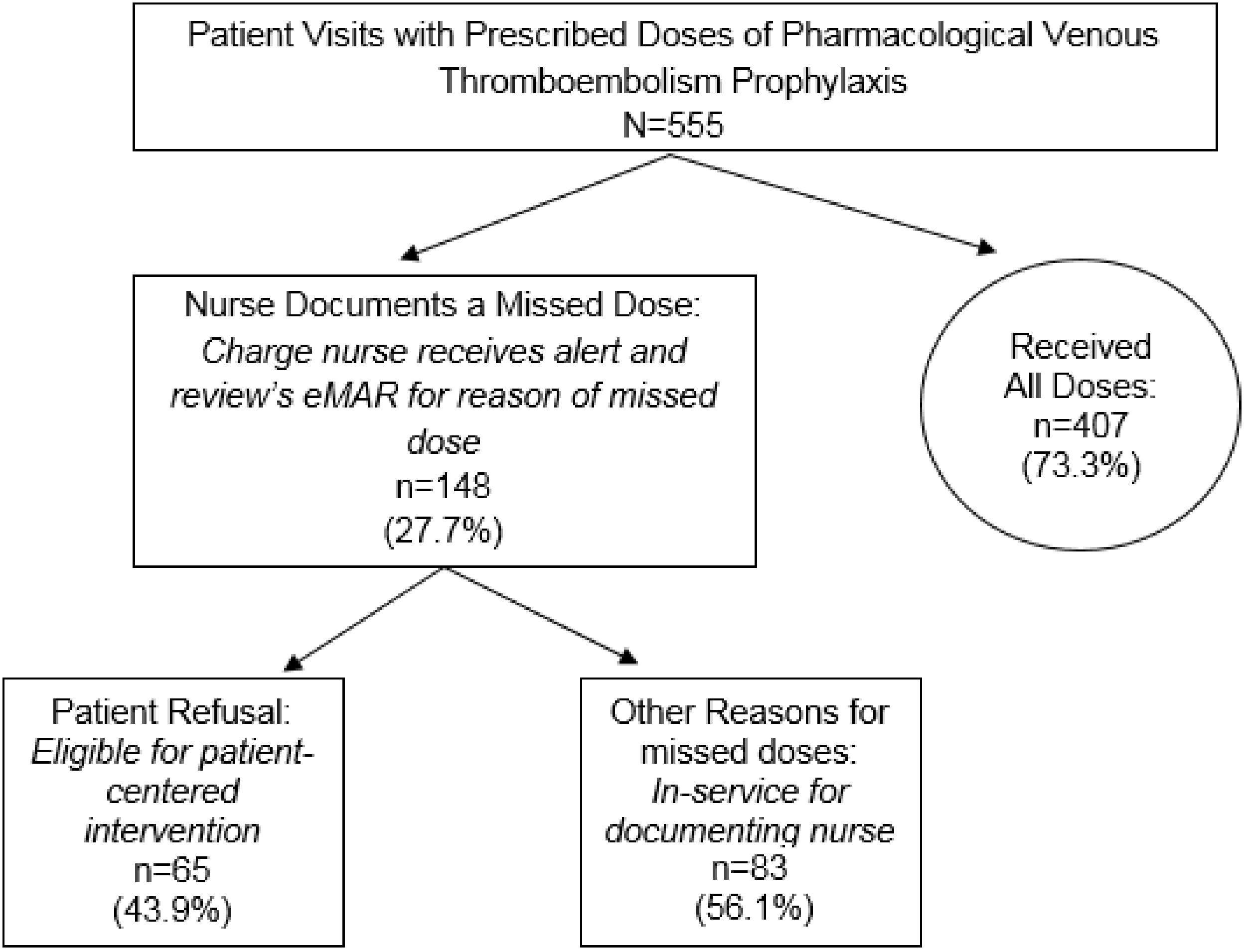
Delivery pathway for patient-centered education bundle during the intervention period. Patient visits indicate prescribed pharmacologic venous thromboembolism (VTE) prophylaxis doses in one hospital visit. During the intervention period, a missed dose triggered an alert facilitating the delivery of an intervention.
The patient-centered education bundle is comprised of a one-on-one discussion between the patient and the nurse about VTE prevention, a two-page paper handout (available in 13 languages), and/or a 10-minute patient education video. All materials are freely available online (bit.ly/bloodclots).14,16 Unit nurses took ownership of the intervention and adapted delivery of the patient-centered education bundle into their workflow. Before the intervention was implemented (December 2018), we conducted several in-services with unit nurses, charge nurses, physicians, nurse practitioners, and physician assistants. Nurses also completed an online VTE training module. 15 We used standardized VTE materials, including a poster, slides, and a badge-sized card with scripted VTE dialogue for discussions with patients.
Statistical analysis
Our primary outcome was the proportion of missed doses of prescribed pharmacologic VTE prophylaxis. Secondary outcomes included the proportions of missed doses due to patient refusal or for other reasons (e.g., contraindication). To evaluate the effect of the intervention, we compared the proportion of missed doses in the pre- (January through November 2018) with the post- (January 1 through June 2019) intervention periods. December 2018 was not analyzed as it was a wash-in training period.
Patient clinical and demographic characteristics were descriptive and compared by pre-and post-intervention periods. We used Chi-square tests to compare proportions for sex, race, and the number of prescribed doses per patient visit. We used non-parametric Wilcoxon rank-sum tests to compare the median age. To compare missed doses of VTE prophylaxis by group and time, we used generalized linear models (GLM) with the binomial family and a logit link. We report adjusted odds ratios (OR) and corresponding 95% confidence intervals (CI). We also report trends of missed doses over time using a quasi-experimental time-series design to assess the rate of missed doses pre-post intervention periods.18,19 All comparisons were performed at the 0.05 level of statistical significance, with 2-tailed p values. Statistical analyses were performed using Stata/MP software (version 14.1, Parallel Edition; StataCorp).
Results
A total of 1,614 patient visits in which at least one dose of VTE prophylaxis was prescribed, were analyzed. Of these patient visits, patients were older in the pre-intervention period compared to the post-intervention period. Overall there were more white patient visits compared to black and other in the pre-intervention (White 59.4%, Black 20.9%, Other 19.7%) and post- (White [68.1%], Black [22.2%], Other [9.7%]; p < 0.001) intervention periods (Table 1). Male sex had a higher proportion of patient visits in the pre- vs. post-intervention (51.7% vs. 32.4%; p < 0.001).
Demographic characteristics of patient visits in the pre-post intervention periods.
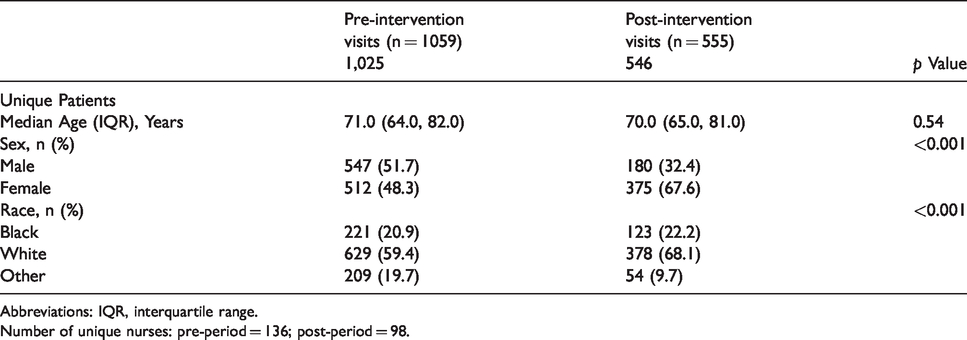
Abbreviations: IQR, interquartile range.
Number of unique nurses: pre-period = 136; post-period = 98.
The proportion of any missed dose of pharmacologic VTE prophylaxis decreased from 13.8% to 8.2% (p < 0.001), with a significant reduction in odds of any missed dose in the post-intervention period (OR, 0.56; 95% CI, 0.48, 0.64, p < 0.001 [Table 2]). Patient refusal was the most common documented reason for missed doses. The proportion of refused doses decreased from 8.8% to 5.0% (p < 0.001), with a significant reduction in the odds of patient refusal in the post-intervention period (OR, 0.54; 95% CI, 0.46, 0.64). Similarly other reasons for missed doses decreased from 5.0% to 3.2% (p < 0.001), with a significant reduction in the odds of missing a dose due to other reasons, in the post-intervention period (OR, 0.62; 95% CI, 0.51, 0.77).
Missed doses of pharmacologic VTE prophylaxis pre-post intervention periods.

ap values calculated using chi-square tests.
bOdds ratios, confidence intervals (CI) and p values adjusted for sex, and race.
Examining whether the education bundle intervention had significantly greater effects than any concealed secular trend, we found that any missed dose, refused doses and other reasons for missed doses, were significantly lower in the post-intervention period (p-interaction <0.001) (Figure 2).
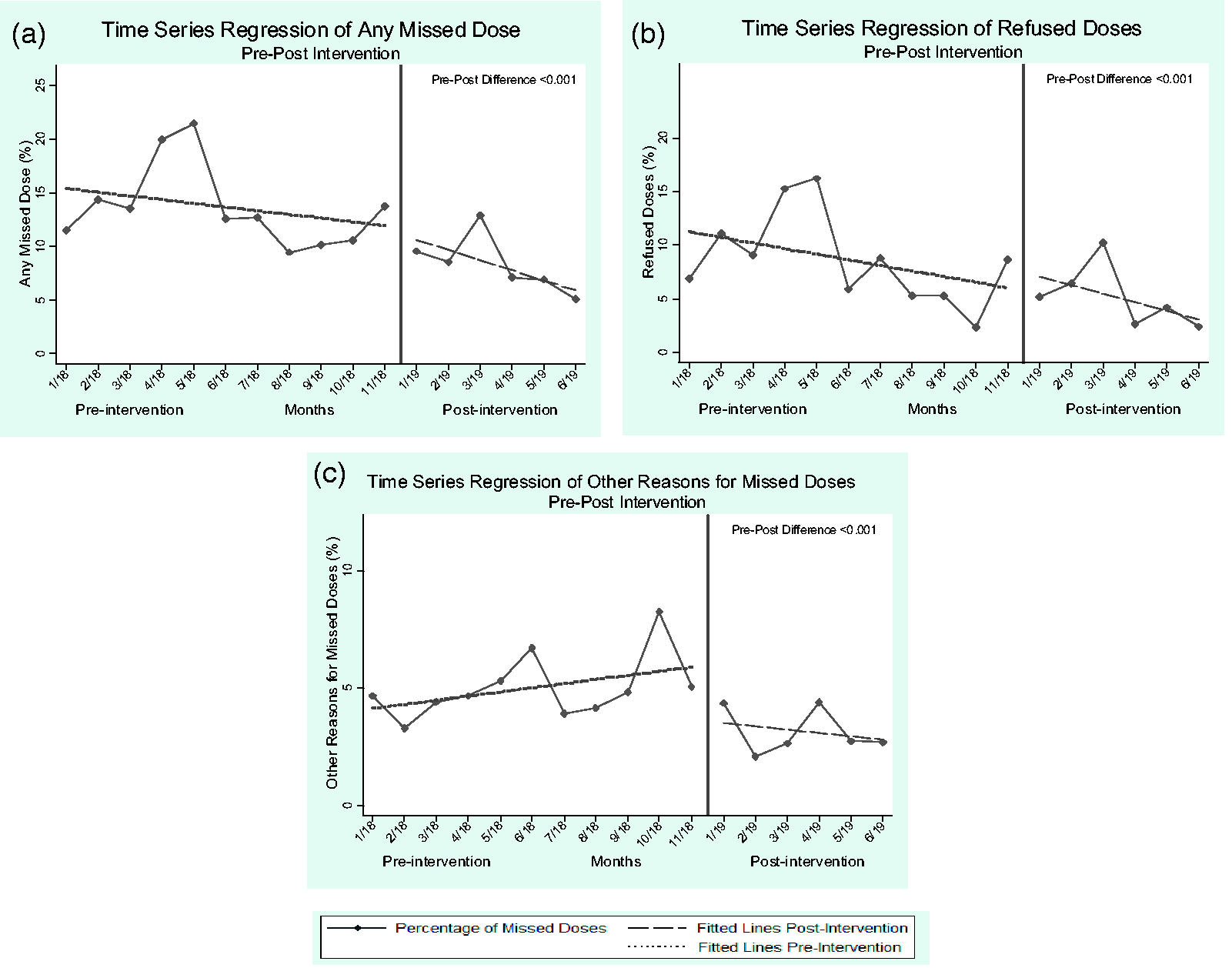
Time series analysis for missed doses pre-post intervention periods. This trend analysis reflects repeated measurements over time of missed doses of VTE prophylaxis in the pre-post-intervention periods. Data for December 2018 were excluded (washout period). Our findings show significantly greater effects than any concealed secular trend.
Discussion
In this dissemination project, we found that the real-time electronic health record alert and delivery of the patient-centered education bundle was effective in a community hospital setting by reducing the odds of missed doses of prescribed VTE prophylaxis by 44%. The odds of a missed doses due to patient refusal decreased by 46%, and other reasons for missed doses decreased by 38%. We scaled the intervention from an urban academic hospital to a community hospital, and it was readily adapted into the workflow despite existing differences in these two settings. The intervention was efficient by only targeting patients who refused prophylaxis, which reduced unnecessary interventions by nurses. There was no new dedicated personnel or expense required to support this dissemination effort.
The magnitude of reduction observed in this suburban community hospital is similar to our findings in the urban academic hospital. 16 Although we adapted the intervention into the single unit’s workflow, such adaptations were most apparent not in the critical components of the patient-centered education bundle, but rather in how the patient-centered education bundle was delivered. The difference at this site was that the charge nurse held the pager and intervened when a dose was documented as missed. The core elements (face-to-face nurse-patient discussion, 2-page handout, 10-minute video) did not change and were mandatory across on the unit.
Other studies advocate for the use of alert systems to improve care. Diduszyn et al. implemented a nurse alert fall monitor for hospitalized elderly patients and observed a 22% reduction in fall rates post-implementation. 20 Consistent with our study, Miller et al. stress the importance of targeted alerts to decrease alert fatigue and enhance efficiency. 21 They describe an algorithm built into the computer physician order entry system that categorizes alerts and prioritizes delivery of recommendations to providers. In our study, it was essential to prevent interruptions in nurse workflow by only generating alerts when a VTE prophylaxis dose was not administered. Administration of risk-appropriate VTE prophylaxis is supported by clinical guidelines. Thus, our intervention is a mechanism to translate this evidence into practice at the bedside.1,22,23 While the patient-centered education bundle informed patients about the detrimental impact of a VTE on their health and how to best prevent it, the intervention also prompted nurses to query prescribers about the best course of care.
In our previous work, the nurse education initiative and patient education bundle interventions were studied separately. In this dissemination project, we provide data for the overall missed doses after a combination of the two interventions. We are unable to tease out which intervention had a larger effect, although our past projects have shown that the patient education bundle had a much larger magnitude of effect. We suggest that nurse education is a key first step before the patient bundle can be implemented.
Our study findings should be interpreted considering the following limitations. First, this manuscript describes the intervention on one unit at one hospital, and our findings may not be generalizable to all patient populations. We chose a single floor to pilot the intervention, which favored the ease of implementation of our intervention and data collection. We strategically chose a unit that admits medical and surgical patients, where missed doses of VTE prophylaxis is a common occurrence, and accounts for a large proportion of prescribed doses. Second, we are unable to give detailed information about balancing measures between prophylaxis and adverse events. Although we do not have data to report on this, there were no reports of any adverse events following the administration of the pharmacological VTE prophylaxis.
In conclusion, our study provides evidence for operationalizing care for patients at risk of VTE at a community hospital. The real-time alert-driven patient-centered education bundle significantly improved the administration of prescribed doses of pharmacologic VTE prophylaxis in a community hospital setting. Dissemination of quality improvement efforts built at academic centers can be effectively transitioned to other hospital types and settings. Targeted alerts for patients at risk of a VTE event and the approach used in the delivery of the intervention should be prioritized to increase appropriate administration of VTE prophylaxis and patient adherence.
Footnotes
Authors’ contributions
All authors listed have contributed sufficiently to the project to be included as authors and those who are qualified to be authors are listed in the author byline. ERH and BDL made substantial contributions to the conception and design of the study, BDL acquired the data, OPO analyzed the data, and all authors interpreted the data. OPO drafted the manuscript and CGH, BDL, DLS, DBH, PSK, KLW, MVK, MBS, and ERH made critical revisions for intellectual content.
Acknowledgements
We thank our key stakeholder organizations- the National Blood Clot Alliance (NBCA), the North American Thrombosis Forum (NATF), Clot Care, and The Johns Hopkins Hospital Patient and Family Advisory Council (PFAC).
Declaration of conflicting interests
Mr. Lau, Ms. Shaffer, Drs. Owodunni, Webster, Streiff and Haut were/are supported by contracts from the Patient-Centered Outcomes Research Institute (PCORI) entitled “Preventing Venous Thromboembolism: Empowering Patients and Enabling Patient-Centered Care via Health Information Technology” (CE-12-11-4489) and/or “Preventing Venous Thromboembolism (VTE): Engaging Patients to Reduce Preventable Harm from Missed/Refused Doses of VTE Prophylaxis” (DI-1603-34596). Mr. Lau, and Drs. Owodunni, Streiff and Haut are supported by a grant from the AHRQ (1R01HS024547) entitled “Individualized Performance Feedback on Venous Thromboembolism Prevention Practice,” and/or a grant from the NIH/NHLBI (R21HL129028) entitled “Analysis of the Impact of Missed Doses of Venous Thromboembolism Prophylaxis.” Mr. Lau received support from the Institute for Excellence in Education Berkheimer Faculty Education Scholar Grant and a contract (AD-1306-03980) from PCORI entitled “Patient Centered Approaches to Collect Sexual Orientation/Gender Identity Information in the Emergency Department.” Ms. Hobson has given expert witness testimony in various medical malpractice cases. Dr. Streiff has received research funding from Boehringer-Ingelheim, Janssen, Portola and Roche and consulted for Janssen and Portola and has given expert witness testimony in various medical malpractice cases. Dr. Haut is a paid consultant and speaker for the “Preventing Avoidable Venous Thromboembolism— Every Patient, Every Time” VHA/Vizient IMPERATIV® Advantage Performance Improvement Collaborative. Dr. Haut receives royalties from Lippincott, Williams, Wilkins for a book - “Avoiding Common ICU Errors.” Dr. Haut was the paid author of a paper commissioned by the National Academies of Medicine titled “Military Trauma Care’s Learning Health System: The Importance of Data Driven Decision Making” which was used to support the report titled “A National Trauma Care System: Integrating Military and Civilian Trauma Systems to Achieve Zero Preventable Deaths After Injury.” All remaining authors report no disclosures.
Funding
The author(s) disclosed receipt of the following financial support for the research, authorship, and/or publication of this article: This work was supported by contracts from the Patient Centered Outcomes Research Institute (PCORI) entitled “Preventing Venous Thromboembolism: Empowering Patients and Enabling Patient-Centered Care via Health Information Technology” (CE-12-11-4489) and “Preventing Venous Thromboembolism (VTE): Engaging Patients to Reduce Preventable Harm from Missed/Refused Doses of VTE Prophylaxis” (DI-1603-34596). The funders had no role in the conduct of this study.
