






Abstract

“To err is human, to cover up is unforgiveable and to fail to learn is inexcusable” – Sir Liam Donaldson
Avoidable unsafe care is one of the ten leading causes of death and disability worldwide. 1 It has recently been described by the G20 Health and Development Partnership as ‘The Overlooked Pandemic’. 2
While there is much good work by many people and organisations seeking to improve patient safety, many of its systemic causes are resistant to change. This results not only untold physical and emotional damage, but also inflicts a huge financial penalty, forecast to cost the global economy approximately $383.7 billion by 2022. 3
Six foundations of safe care
Our charity, Patient Safety Learning, was born from the frustration of seeing the persistence of avoidable harm and the same themes emerging time and again in healthcare systems around the world. We believe that patient safety is not just another priority; it is a core purpose of health and social care.
In our report, A Blueprint for Action, we set out what we believe is needed to progress towards a patient-safe future.
4
Underpinned by systemic analysis and evidence, it identifies six foundations of safe care for patients and practical actions to address them:
Shared Learning – organisations should set and deliver goals for learning, report on progress and share their insights widely for action. Leadership – we emphasise the importance of overarching leadership and governance for patient safety. Professionalising patient safety – recognising that organisational standards and accreditation for patient safety need to be developed and implemented. These need to be used by regulators to inform their assessment of safe care. Patient Engagement – to ensure patients are valued and engaged in patient safety. Data and Insight – better measurement and reporting of patient safety performance, both quantitative as well as qualitative. Just Culture – all organisations should publishing goals and deliver programmes to eliminate blame and fear, introduce or deepen a Just Culture and measure and report progress.
Shared learning
Too often when effective solutions are found to prevent avoidable harm there is simply a lack of means by which we share these more widely. This gap between learning and implementation means that while we may we know what improves patient safety, this information can often remain siloed in specific organisations and health care systems, resulting in patients continuing to experience harm from problems that have already been addressed by others.
In identifying the need for shared learning to improve patient safety, in A Blueprint for Action, we make the case that for patients to be safer, we need people and organisations to share learning when they respond to incidents of avoidable harm, and when they develop good practice for making care safer. Patients, clinicians, managers, and health and social care system leaders should all be able to easily share learning about safety practice and performance.
The hub – an award-winning platform for patient safety
To encourage and support shared learning for patient safety we have created the hub (www.pslhub.org).
Designed by and for patient safety professionals, clinicians and patients, the hub offers a powerful combination of tools, resources, stories, ideas, case studies and good practice to anyone who wants to make care safer for patients. Its core features include:
Learn – the knowledge repository area of the hub, moderated to ensure the content is consistently high quality. Communities – place to discuss patient safety concerns and how to address them. News and Attend – updates on patient safety initiatives, current issues, and upcoming events.
Early use and impact
Since its launch in October 2019, we have seen its members use the hub to:
Share experiences and knowledge of good practice, such as this patient safety initiative at Homerton University Hospital National Health Service (NHS) Foundation Trust.
5
Have open and honest conversations about patient safety concerns and campaigns, such as issues around hysteroscopy care and treatment. Create private communities of healthcare professionals to share experiences and good practice, explore challenges and provide peer support.
the hub has had over half a million page views, 243,000 visits, with 178,000 unique visits from 198 different countries. the hub has 1,900 members from 765 organisations across 57 countries.
We gather and monitor the impact that the hub on a continual basis. We know that patient groups and communities of interest are using it to network and campaign with greater visibility and effectiveness. Health and social care professionals use the hub to source proven good practice and apply to their own organisations. We are also seeing it being used as an informal source of research, collecting insights and perspectives from the ‘patient safety front line’ – staff and patients.
Our global vision for the hub
In its first couple of years the promotion and engagement of the hub have mainly been through social media and word of mouth networks.
We aim to develop further the content scope and coverage of the hub across healthcare settings and enable the site to function in all six UN languages. We plan to strengthen our network of partners and volunteers to increase the visibility of the hub and embed the platform into their own products, making it even more accessible to health care workers, leaders and communities in all healthcare systems.
In connecting those with an interest in patient safety across the world through the hub, we hope to encourage:
True global sharing of knowledge and learning related to patient safety. Organisational, local, national and global communities of interest and campaigns about patient safety issues. An interchange of patient safety ideas and improvements between health care workers and patients. the hub is unique as most other health-related sites are only for staff or patients but not both. A global social movement for change with freely accessible, evidence-based knowledge on how to reduce avoidable harm.
Join the hub
We welcome the support of the Journal of Risk and Patient Safety and look forward to welcoming its readers to learn, contribute and to share knowledge for safety.
Please sign up for free to www.pslhub.org (Figure 1) and join the growing number of patients, frontline staff, managers, regulators, researchers, policymakers and campaigners as we support the global online community of people who share the same vision as us – a world where patients are free from avoidable harm.
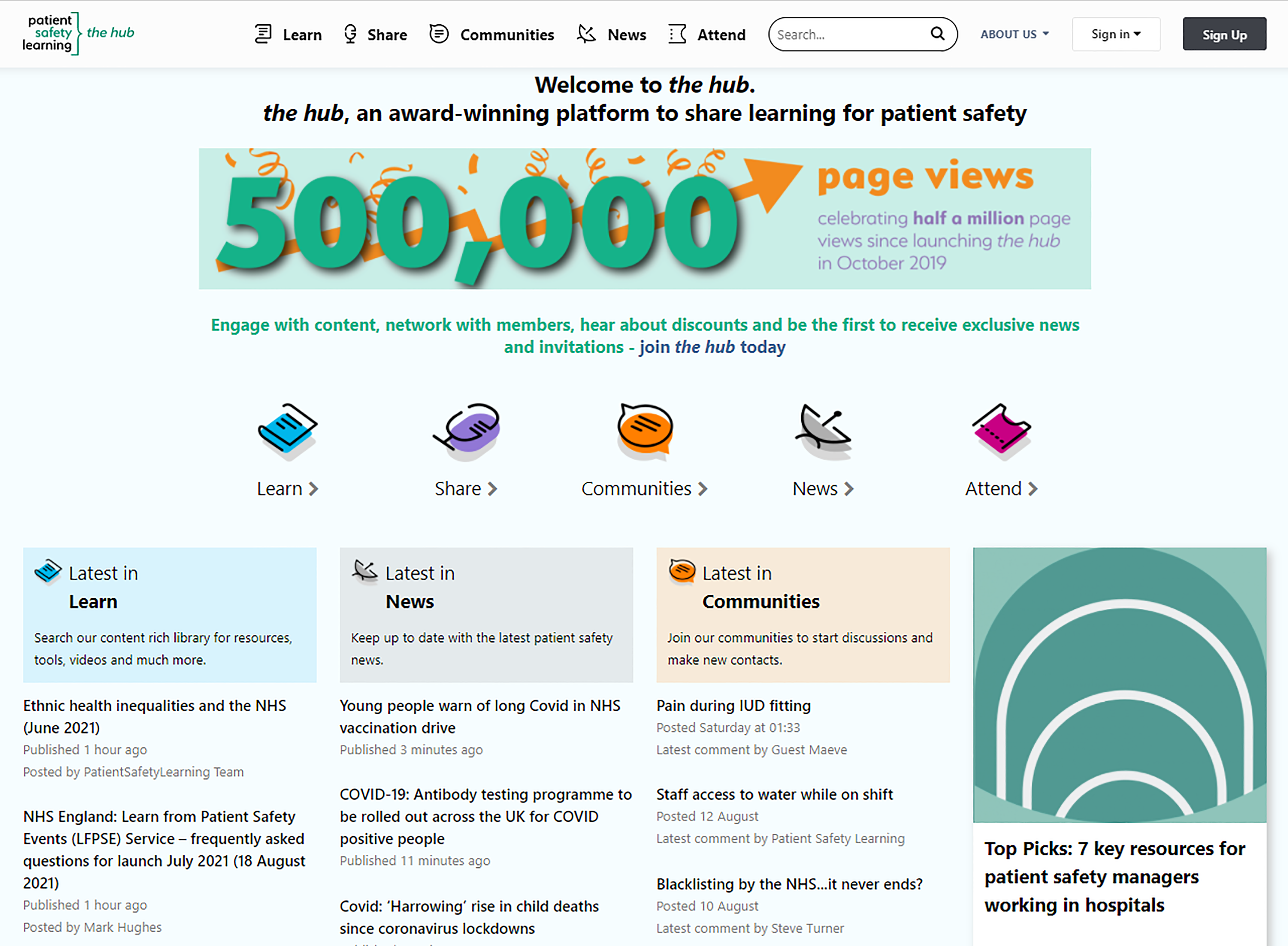
Homepage of the hub.