







Abstract
The purpose of this paper is to explore Indian orphaned young people’s perspectives on leaving care. To accomplish this, the researcher conducted in-depth interviews with 13 Indian youth with significant care experience in institutional and residential arrangements. The understanding of care leaving presented here is based on retrospective insights that young people with care experience shared regarding their experiences of leaving care. The results included four themes: ‘miscommunication about care leaving’, ‘an undesirable ending’, ‘limited knowledge about new life’ and ‘key factors for a better transition’. The findings imply that care leaving should be an extended process, not an event. Thus, a dedicated program focusing on care leaving is required. Also, allowing young people to participate in transition planning is essential and can be best ensured with effective communication and carefully formulated care plans. Further, access to extended support in the form of comprehensive and compulsory ‘aftercare’ services is suggested for achieving better outcomes for young people with care experience.
Introduction
Leaving care is a global phenomenon concerning young people, social workers, and caregivers across all alternative care arrangements (Shaw & Frost, 2013). But the experience of transitioning out of care varies among young people, depending on their particular intersectionality of race, gender, and ethnicity (Courtney et al., 2018). A recent multinational comparative study of care leaving policy and legislation also provides evidence for diversity based on region (Strahl et al., 2021). Strahl et al. (2021) found that young people with care experience do not have enough support services and legal entitlements to address the diverse challenges they experience after formal care ends. They are often reported to be far behind their non-care peers of a similar age group across many measures of wellbeing (Courtney et al., 2018) and exposed to a higher risk of social exclusion after leaving care (Stein, 2006). Thus, care leaving has received increasing research interest across countries, although predominantly in the global north. However, little is known about the peculiarities of care transitioning in global south countries. This paper attempts to capture experiences of care leaving in the Indian context.
Indian context of care and care leaving
In India, the social care of children and youth without parental care falls within the Juvenile Justice System (the JJ system). The system oversees their entry, care, and transition from any care arrangements and is guided by the Juvenile Justice (Care and Protection of Children) Act (2015) (JJ Act, 2015) and recently adopted implementing guidelines of Mission Vatsalya (2022), the federal child protection scheme. Predominantly, the JJ system relies upon the government, faith-based and non-governmental institutions and smaller residential arrangements to ensure the wellbeing of children and youth without parental care (Dutta, 2016c). Institutional care refers to large-scale, dormitory-type arrangements within institutional facilities, offering more regimented and impersonal care. The state governments mainly run such care arrangements. In contrast, residential care arrangements offer a small group home living environment or family-like care. These arrangements are mainly funded and run by faith-based and non-governmental organizations. According to recent estimates, 9259 such arrangements look after 370,227 children/adolescents under 18 years of age in need of care and protection (Government of India, 2018). Bajpai (2017) explained that these children predominantly belong to poor socio-economic backgrounds and have single parents or extended family members. Although these children have an adult who can look after them, most continue to live in care arrangements to fulfil their functional needs (i.e., education and health care) whilst staying in contact with their families (Bajpai, 2017; Mortensen, 2018). Recent data suggest that this number is around 32% (Government of India, 2018). However, 15% of children in the Indian care system are social orphans, meaning orphans, abandoned and surrendered children (Government of India, 2018). For them, lack of family support and spending a more extended period in care can exacerbate the complexity of care leaving. Therefore, this study uniquely includes the voices of young people from this group in order to understand their distinctive experiences of care leaving. According to the Juvenile Justice (Care and Protection of Children) Act (2015), the process of placement in institutional as well as residential care is the same. The JJ Act (2015) states that all children and youth, who might require such placement, must appear before the child welfare committee (CWC). The CWC is a statutory body with the power to decide whether care placement is necessary or not. Also, in cases where care is required, the committee determines what type of care arrangement is suitable. However, Dutta (2016c) found that the scenario is different in practice as various care arrangements privately admit children without CWCs intervention. Further, where CWCs are involved, the availability of care arrangements often plays a significant role in suitability decisions, because other forms of family-based alternatives (especially foster care) are still evolving.
The term ‘social reintegration’ includes care leaving in India as per the JJ Act (2015). Social reintegration represents the process that needs to be followed as children/youth exit any care arrangement on or before completing the maximum tenure of care—reaching the age of 18 years. Post 18 years of age, the care of young people falls under the category of ‘aftercare.’ According to Mission Vatsalya (2022), the aftercare program should provide diverse support (i.e., education, employable skills and placement, industry apprenticeship, small business loans and providing shelter) to any young person leaving a care arrangement to re-join society’s mainstream. The tenure of such support is flexible and can last till the young person is mainstreamed in society (Mission Vatsalya, 2022). Thus, the age of care leaving can vary in the Indian system. Those receiving ‘aftercare’ support leave the JJ system between 18–23, while many others exit it before 18 to be adopted or reunited with their families (Dutta, 2016b; Mission Vatsalya, 2022; Wanglar, 2021). Although there are no dedicated national guidelines or policies on leaving care, some states have drafted guidelines for the aftercare programme (2019) or are in the process of preparing them (Guidelines on After Care for children leaving child care institutions for the state of Karnataka, n.d.). Nevertheless, there are no published data available on the number of young people leaving care each year in India.
Issues and challenges of care leaving in India
Existing practices of care leaving have been critically examined in previous Indian studies. One key issue, which emerged, is the differences in preparation for leaving care among young people across different care arrangements. Dutta (2018) found that the structure, model, and nature of the services offered by a care arrangement significantly affect preparation for social reintegration. For instance, care leavers from residential care arrangements, which provide family-like care in a group home for fewer young people over extended periods (i.e., 25 years), experienced better outcomes than young persons living in institutional care facilities with impersonal care in dormitory setups with a large number of peers (e.g., over 150 children). Wanglar (2021) added that most childcare institutions lack the required infrastructure, human resources, and funding to adequately aid in the care leaving process, creating key bottlenecks in ensuring planned and effective social reintegration.
Dutta (2016a) argued that state support for care leaving is insufficient, lacking standardised interventions, adequate funding, and the operational details for higher education, life skills training, employment, and housing arrangements for care leavers. Shankaran (2018) found that the care leaving process does not equip young people to cope with the challenges of independent living. They need extended psycho-social support after leaving care in order to reintegrate successfully (Shankaran, 2018). Care leaving support and services often do not bring desired outcomes in care leaver’s education, financial independence, housing, career development, social relationships, and mental and physical health (Bhargava et al., 2018). Modi et al. (2021) further argued that the gaps in support for care leavers are evident as only a few of these young people can access higher education. Most instead complete low-quality vocational training, limiting their economic opportunities and adding to their marginalisation. Given the above description, it is evident that care leavers experience many challenges during and after transitioning from the care system. Therefore, care leaving is an emerging area of research in India.
In this context, the purpose of this study is to expand the extant information on care leaving. To do that, the researcher explored how the care transition takes place through the perspectives of Indian young people with experiences of care leaving. The retrospective insights of care leavers can indicate the future challenges which a care leaver might encounter in their independent living. Identifying these areas is valuable in planning interventions that can aid in achieving better outcomes among young people with similar backgrounds. In this way, the findings of the study contribute to a comprehensive picture of the care transition. Also, the results of this study give some platform in the existing narrative of care leaving to underrepresented care leavers in a global south country. Thus, these findings can help develop a more localised understanding of the care transition in India and provide a contrasting scenario in the emerging global conversation around issues of care leaving. Finally, the lessons learned through this study could be especially beneficial for other global south countries with similarly large numbers of care leavers and minimal government support programs and resources.
Method
Study purpose and design
This study employs a qualitative approach to explore care transitions in the Indian context. The researcher positioned himself in a constructivist paradigm (Creswell, 2003), focusing on how young people with care experiences construct their own meaning about transitioning from care arrangements.
Inclusion criteria and recruitment process
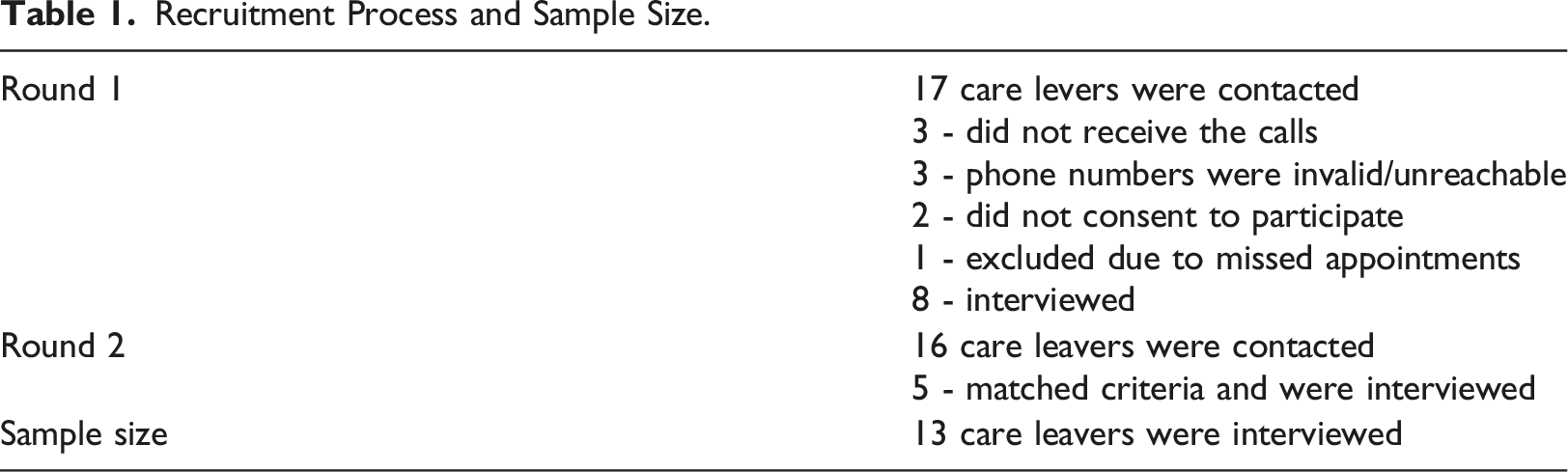
Recruitment Process and Sample Size.
Ethical considerations
This paper is part of an MPhil dissertation approved by the Tata Institute of Social Sciences, Mumbai. The purpose of the study was shared with all the interested care leavers. Ethical considerations of confidentiality, anonymity and voluntariness (Flick, 2007) were followed throughout the study process. Further, the researcher also obtained informed consent from each participant.
Data collection procedures
All the participants completed one sitting of in-depth interviews, varying between 30 to 120 minutes long. The interview guide revolved around four different phases (‘before care’, ‘in care’, ‘leaving care’ and ‘life at present’) in a young person’s life course. This paper presents the information gathered on the ‘leaving care’ phase. A previous article documents the ‘life at present’ phase (Keshri, 2021). Questions included in the ‘leaving care’ phase of the interview focused on participants’ understanding of care leaving, the reason for leaving care, changes after leaving care, challenges during care leaving, and causes for such challenges. All interviews took place within Mumbai in locations chosen by the participants. Interview venues included participants' residences, workplaces, offices of their previous care arrangements, and public spaces (i.e., parks and outside of a railway/bus station).
Data analysis
All the interviews were conducted in Hindi. The researcher recorded, transcribed and translated the interviews to reduce the loss of meaning. Data were analysed using a thematic analysis framework (Braun & Clarke, 2006) with the help of Atlas.ti eight software. For the initial open coding, the researcher read through the interview transcripts to familiarise himself with the data and develop various codes. Next, the researcher re-engaged with these open codes to identify frequent and significant categories for arriving at a more selective and focused understanding. Next, these categories were sifted through ‘across’ and ‘within’ data for further comparison. Categories that reflected similar ideas or responses from the participants were merged into themes. Throughout the process of thematic analysis, “the coding categories were reconceptualized, renamed, reorganized, merged and separated in search of alternative interpretations” (Lioness, 2008, p. 867).
Results
Profile of the Study Participants.
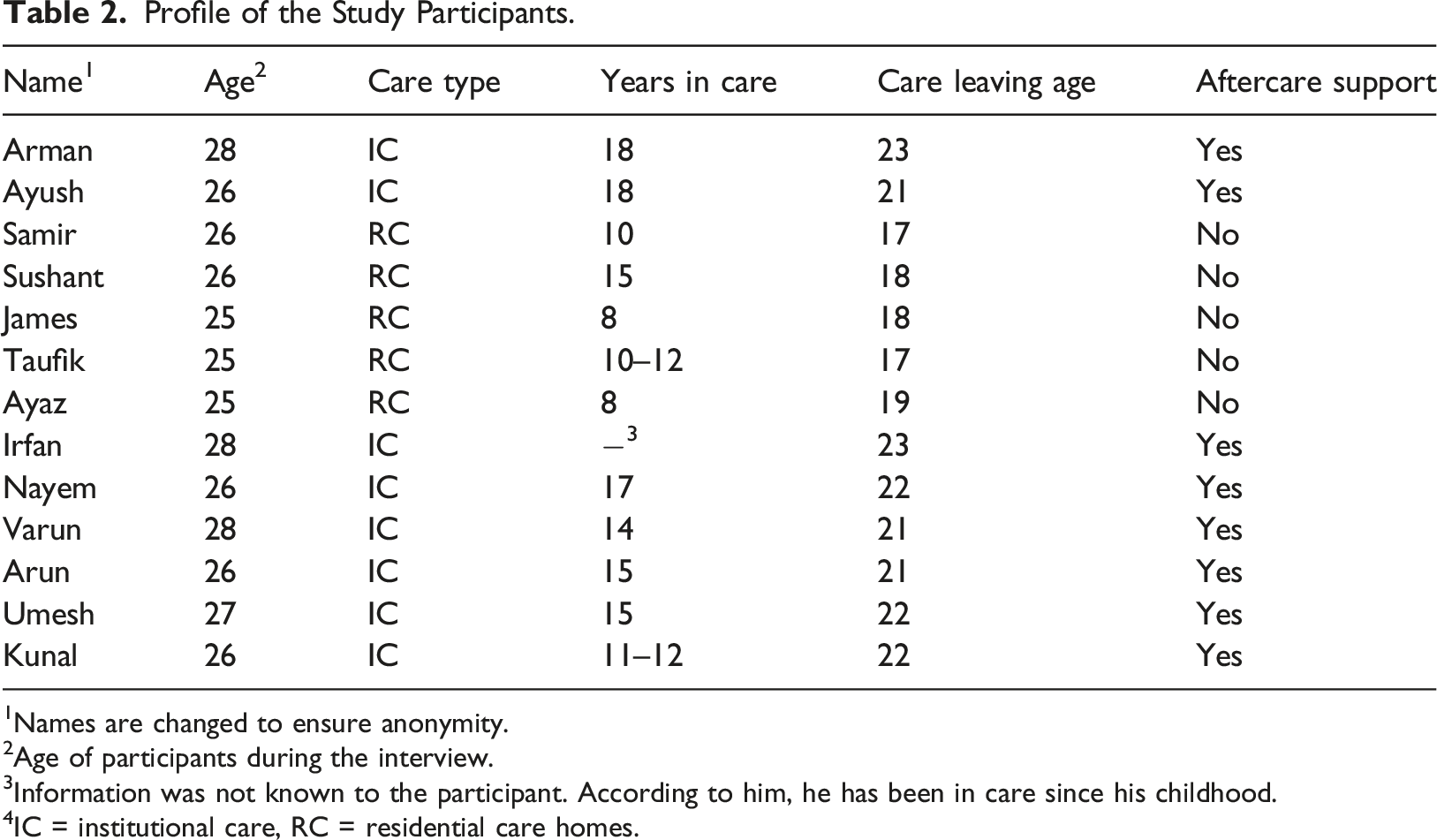
1Names are changed to ensure anonymity.
2Age of participants during the interview.
3Information was not known to the participant. According to him, he has been in care since his childhood.
4IC = institutional care, RC = residential care homes.
The results are structured according to the following four themes: ‘miscommunication about care leaving’, ‘an undesirable ending’, ‘limited knowledge about new life’ and ‘key factors for a better transition’. These themes together contributed to forming an understanding of the transition from care to out-of-care.
Miscommunication about care leaving
All participants were asked to describe and share their transition experiences. The young people revealed themselves to be previously aware of the limited extent of care and the inevitability of care leaving. However, this transition out of care was not gradual. It did not include comprehensive care leaving planning, shared decision making, and subsequent goal setting. This resulted in miscommunication between the ‘care system’ and the young people.
For seven participants, care leaving was an abrupt event. For instance, Ayush, who exited from ‘aftercare’ support immediately after turning 21, described care leaving as a predetermined event rather than a process. He shared, “this should have certainly happened…they are not going to support me all my life.” The story of Ayush indicates that not all care leavers are involved in their care leaving, which is meant to transition from dependence on care arrangements to independent living. For a few others, this process of leaving care was even worse as they had limited knowledge about their transition. Such a situation generated ambiguities among the care leavers.
That was reflected in what Arman shared, “…it was a planned decision, but I was informed only a week earlier. They (the staff) asked me to search and arrange my accommodation…I was like roaming here and there along with my bags.” Interestingly, Arman’s care was extended by 2 years because he received ‘aftercare’ support until turning 23. He stayed in a private care facility offering extended care to young people with similar backgrounds. During those 2 years, he accessed various services such as free accommodation, food, and health care. He also participated in various recreational activities (i.e., such as sports, group picnics and birthday celebrations) and learning activities (i.e., workshops for career guidance, CV making, and job interview preparation). He was also recommended for the available job vacancies based on his educational qualifications and skill set. During this time, he was supposed to earn, save as much as possible, and move out of the facility to live independently. However, despite having a more extended care period, he struggled during his transition because of miscommunication about care leaving, indicating that only extending tenure of care will not result in better outcomes among young people until the care leaving is managed effectively.
Miscommunications or lack of communication about timing contributed to the challenges of care leaving, making the transition an unexpected event for some care leavers. James’s case is an example; he left care immediately after turning 18 without any aftercare support. For him, the transition was surprising and had an adverse effect on his life. For example, he experienced difficulties finding a job because his schooling was incomplete. He shared, If they had allowed me to stay inside the organization during my class 12 exams…I would have passed it. If they could have managed for the time being by keeping the importance of the exam, then I think my life could have been different…
An undesirable ending
While describing their transition experience, eight care leavers shared that it was undesirable for various reasons. Most participants left care only because they reached a certain age or maximum tenure stipulated for care. Umesh, who exited aftercare support at 22, shared, It is the rule of the hostels that they can only keep us there for a period of 3 years, so after that, we have to leave. I also feel that three years is a short time. It would have been nice if they allowed us to stay there longer…
Sushant, who was only 18 while leaving care, said his care ended because “…in 2010, the agreement of our group home got over…I was very confused…I was in a great dilemma that whether we are under the care of the organization or we are not…”. At the time, he could not decide what to do. Because he was unsure whether his supported group home living would continue, he also wasn’t very confident about living independently.
Some young people had to leave care because they were perceived to be better positioned than others in care. The officials of the aftercare arrangement consider that if someone is employed or has financial independence, they should no longer receive aftercare support. For example, Arun recollected that he exited ‘aftercare’ support before his maximum tenure could be completed. His caregiver told him that since he had started working and saved enough money, he no longer needed any support from them, and his place should be available for another needy young person deserving aftercare support. Although Arun came out of care after turning 21—the maximum age for staying in care—he still felt that the tenure was insufficient. That was the case for other care leavers, too. They expressed their desire for extended ‘aftercare’ support or, at the least, continued support until the maximum tenure was completed. They believed it would have benefitted them in getting ready for independent living. However, it is interesting to note that the young people interviewed did not feel empowered to be independent even after completing the maximum stipulated tenure of aftercare support.
A few participants believed their support ended because they participated in activities against the rules of their care arrangement—for instance, disobeying the caregiver’s instructions, being troublemakers, and raising complaints about the services they received. James said, “…actually, what happened, you know…they (the staff) organised some sports activity on one Sunday, but I…went outside to roam with some of my friends…because of that, I was asked to leave by them…” While narrating his experience, Irfan shared, “I came out suddenly because some people did not like my behaviour…I was unhappy with the food quality, and I tried to speak on behalf of all the boys…” Therefore, a variety of factors contributed to the shared experiences of undesirable endings to care.
Limited knowledge of new life
Limited knowledge of independent living was another key aspect that occupied significant space in young people’s description of their care transition experience in this study. Nine young people believed they had a limited understanding of life outside their care arrangement. For instance, Arun, who had spent 15 years in care, felt that young people like him had minimal familiarity with anything outside their care arrangement. He shared, Actually, we were unaware of the outside life because our entire life we have been only in the hostels. The outside world is very different from the hostel world, and we were not exposed to that. We do not know anyone from outside.
Also, several care leavers expressed doubts regarding their ability to earn money and fulfil their basic needs for food, clothing, and shelter. Kunal, for example, was unsure how to sustain his life, despite having extended aftercare support (until 22 years). He said, “What will happen to me after I come outside (care)? Who will look after me?”
For most participants, this concern was related to the fact that they have grown up in institutions and do not have any support (i.e., family or others) outside of these settings after leaving care. For example, Ayaz, while sharing his transition experience, said, “You know how the feeling is? It is like one fine day you don’t have any place to go, all your support has been stopped, and all your responsibilities are on your shoulders.” For Nayem, the transition from his care arrangement to independent living was also uncertain for similar reasons. He shared, “when I came out, I was confused about what to do. I had always lived in an orphanage and had nowhere to go….” Thus, different factors contributed to the shared experience of limited knowledge of new life after the care transition.
Key factors for a better transition
Key factors that positively contributed to the transition from care arrangements to independent living appeared in all 13 young people’s descriptions. For some, having prior knowledge about their care transition was one of the critical factors in mental preparation for independent living. Thus, participants who had some knowledge about their maximum stipulated tenure of care felt more ready to leave care. They considered it an inevitable process and developed a natural acceptance of the change. While describing his transition experience, Taufik said, “they have told us this in the very beginning. We knew about this much before we came outside. We also understood, and sir told us about this.…”
Additionally, completing higher education, having a stable source of income, and financial security before leaving care were essential factors that require increased attention according to most young people. While sharing his transition experience, Varun said, “What I am saying is that when you are coming outside, then you should know how to find work, and you can make yourself settled by that working.”
The narrative of Ayaz emphasizes that the absence of these key factors can cause uncertainties among young people during care transition. Also, it is interesting that Ayaz was one of those study participants who received no aftercare services. He said, “I used to think about how I will get a job. Who will give me a job? I was worried because my qualification was not that good....”. All participants said that doing well in these areas made them less dependent on the care system. Thus, their transition was less stressful. For example, Arun felt that having some savings before leaving care and knowing how to save was crucial. He believed he only survived because of these savings, which helped him secure accommodation.
Some participants shared that leaving care in groups and seeking help from phased-out young people worked for them. Ayush shared that in Mumbai, finding a place to live is expensive and requires some amount of money as a security deposit. Thus, finding a house is a challenging task that he could only manage by leaving care in a group. He said, If we are only two people together, then it becomes difficult for us…so for that reason, we have searched for four boys, so like these, we came out (of care). If there are only two people, we have to bear the entire rent, which comes to around rupees 5000 additionally for each of the roommates, so it becomes difficult for us….
Others, such as James, felt that interactions with former care leavers assisted him in the transition. According to him, they helped him in finding a place to stay and knew the outside world better than he did. For most young people, this informal network of peers provides a buffer to challenges during their transition to independent lives. They rely on other care leavers whenever they need assistance with finding accommodation, finding a job, small loans, emotional support, and seeking advice/suggestions concerning anything going on in their lives.
Discussion
This paper attempts to capture the perspectives of young people with care leaving experience. In order to better understand this study’s results, the following section discusses them in light of prior research, underscoring findings contextual to the Indian care system. The current study showed that the care transition is not a systematic phase in the Indian care system. Exclusive focus on achieving better outcomes for care leavers is also infrequent. Although the Juvenile Justice (Care and Protection of Children) Act of 2015 laid out provisions for aftercare, the care transition is essentially jeopardised because of several factors. The care leavers lack comprehensive care planning, adequate transitioning preparation and access to structured support systems from formal or informal sources.
This finding confirms the results of a recent study by Strahl et al. (2021) that explained well-developed care leaving policy does not necessarily ensure a better care transition. For instance, India was categorised as a country with ‘well-developed’ legislation on care and aftercare (Strahl et al., 2021). However, care leavers were still reported to experience challenges in most domains (such as employment, education, housing, poverty, and mental health) presented in the study (Strahl et al., 2021). Further, the author found that not all care experienced young persons received aftercare services to support their transition to independent living. This study indicated that not all young persons could access ‘aftercare’ as a right. Even if young people desire this support, the decision to transfer a young person to an aftercare home is primarily in the hands of the management and staff of the care facility (Dutta, 2016a). Also, most care leavers are unaware of the aftercare provisions and other government support available to aid their care transition (Modi et al., 2021). In addition, those who receive ‘aftercare’ mostly access an extended stay in aftercare homes, which is insufficient to buffer the difficulties experienced during their care transition. However, the new Indian federal child protection policy now places this provision of extended stay as the last aftercare service (Mission Vatsalya, 2022), unlike its predecessor, indicating a change in policy.
Aftercare services, as demonstrated in the current study, must not be limited to providing extended stay in care. Instead, the focus of aftercare services should be on the holistic preparation of young people to transition out of care and into independent living (Bhargava et al., 2018; Modi et al., 2021; Shankaran, 2018). To do so, intervention frameworks for aftercare should incorporate support with education (i.e., tuition fees), housing (i.e., rent support, group housing), career planning (i.e., job skills, interview skills, resume making), independent living skills (i.e. cooking, budgeting, household tasks, finding housing), financial management (i.e., bank accounts, savings schemes), health care (i.e., health insurance), psycho-social support (i.e., counselling), and building a social network (i.e., care peers group, relationship management). Although some of these provisions are incorporated in the new Indian federal child protection policy (Mission Vatsalya, 2022), further detailing is required on how they will be made available and accessible to the care leavers.
The results of this study indicate that the care leaving process was a planned yet unexpected event in the lives of most participants, meaning the young people were aware of the limited extent of care. They knew it would end at a certain age or after predetermined years. However, this knowledge did not aid their situation, and the care transition still surprised most, pointing to a lack of effective communication between the care system and the young people regarding care leaving preparation.
Dutta (2018) explains that not all care leavers think they have a choice regarding their care transition process, and a few also remain unsure how the process will take place. Such circumstances are inevitable until young people are guided in their journey towards leaving care and included in their care planning. For that, individual care plans (ICP), which include care leaving, must be effectively executed. The stakeholders responsible for care and rehabilitation planning should have the expertise and knowledge to prepare a robust plan. Further, the entire process should not be reduced to a last-minute job with little monitoring (Udayan Care, 2019; Wanglar, 2021). Shaw and Frost (2013) similarly argue that effective and participative care planning is a critical component of the care transition. Planning for the transition can facilitate positive care experiences that significantly impact young people’s lives after leaving care. Although desirable, instances of such decision-making are limited in Indian care arrangements (Wanglar, 2021). The findings of the current study indicate that effective transition communication through carefully formulated care plans is one way to address this gap. The new Indian federal child protection policy also acknowledges the importance of early planning for care leaving. It encourages residential childcare arrangements to prepare a separate individual aftercare plan (IAP) for each child at least 2 years before they are expected to leave care (Mission Vatsalya, 2022).
Stein’s (2006, 2008) theory about the care transition, which categorises it as “extended and abrupt”, fits well with the findings of this study. Young people in the Indian care system are expected to become independent by the age of 21. But for most, this transition takes place on premeditated but still sudden short notice (i.e., biological age) and arbitrary parameters (i.e., financial stability, employment), making it undesirable. The study findings suggest that for sample young people, the care transition signifies a stable source of income, financial security, completion of higher education, and support from care peers. Dutta (2016a, 2018) also made similar observations about the importance of employment and education in young people’s self-reports of leaving care. But young people’s perceptions of the care leaving process seldom match the unsatisfactory academic, financial, and social attainments reported in current and previous studies (Bhargava et al., 2018; Shankaran, 2018; Udayan Care, 2019).
This one-size-fits-all care leaving policy is problematic, because it has no association with developmental readiness to transition (Dutta, 2018). Throughout the process of care leaving, the goal should be to guide young people’s way out of care, giving each individual attention. Since each young person has a different life trajectory, a single plan of care leaving will not adequately address their unique vulnerabilities. For the care leavers in this study, the one-size-fits-all approach interrupted critical support networks, in some cases hampering the achievement of their goals (i.e., completing education). Such practices can exacerbate the vulnerability of young people and negatively affect the care leaving process (Dutta, 2016b). Thus, it is time to rethink the parameters of care transitioning beyond a predefined age or arbitrary circumstances (i.e., being employed, having financial stability), instead focusing on providing need-based personalised services to each care leaver, ensuring better preparation for the care transition.
Implication for practice
This study’s overall objective was to bring an in-depth understanding of the experiences and perspectives of care leavers to draw lessons for care leaving practice and policy.
Children’s institutional and residential care homes are recommended to design a dedicated program, focusing on transition preparation and readiness for care leaving. An adequate number of trained and qualified staff (e.g., social workers, counsellors, psychologists and caregivers) are essential to facilitate this type of program. In addition, transition planning should ideally start right from the day children enter any social care arrangement, and the care leavers must be treated as participants—not passive beneficiaries.
Further, there needs to be a consistent effort to bridge the gap between the needs of young people and the existing services (i.e., education, employment, life skills training, and health care) available to them. Extended support in the form of aftercare services must be accessible to every care leaver. These services must be upgraded to address care leavers’ dynamic needs and must not be limited only to providing them an additional 3 years of stay in a care facility. Post aftercare, assisting young people in getting accommodation in group homes without holding any control over their functioning can also be beneficial. Finally, ensuring smooth transitions out of care for young people will require identifying and strengthening peer networks as informal support for care leavers.
Limitations and scope for future research
The main limitations of this study revolve around the study’s small sample size, which consists of purposively selected young people and includes only orphan male participants. Excluding female, and non-orphan care leavers limits the comparative aspect of the findings. Also, the results and conclusions of the study could not be triangulated. Thus, further studies that include the perspectives of other stakeholders, such as social workers and caregivers, can offer more diverse insights into the care transition. Also, the study is based on retrospective self-reports of young people, introducing recall bias, producing varying degrees of insights affecting the results. For instance, the post-care independent living experience has influenced the participant’s perception of the care transition. Therefore, capturing the experiences of young people who are still in care and on the verge of leaving could indicate different complexities in future studies. Besides this, generalisation of the study findings is limited by the use of a qualitative approach as well as the specific setting within the Mumbai context. Further studies on this topic are therefore needed in rural and semi-urban communities across India to deepen research evidence on the topic.
Conclusion
Issues surrounding care leavers are a growing concern in India. Therefore, an increased understanding of the experiences of care leavers and their particular challenges is necessary to pursue their wellbeing. This article strengthens the knowledge base and advances understanding of the central issue that care leavers are associated with: their care transition. The study shows that a care transition is an undesirable event that comes unexpectedly without reference to the diverse backgrounds and needs of care leavers. In light of this, greater attention should be given to the care transition in order to ensure care leaving is an extended process where young people’s participation in transition planning is encouraged. Finally, the author recommends the introduction of comprehensive extended support in the form of aftercare services to ensure better care transition outcomes for young people with care experience.
Footnotes
Acknowledgements
I want to convey my gratitude to Dr. Mohua Nigudkar for her support and guidance in conducting the study. I also wish to thank all the young adults for sharing their experiences and views.
Declaration of conflicting interests
The author(s) declared no potential conflicts of interest with respect to the research, authorship, and/or publication of this article.
Funding
The author(s) received no financial support for the research, authorship, and/or publication of this article.
Data availability
Datasets in this study are generated from primary sources and are not publically available given the privacy and ethical restrictions.
Ethical approval
This paper is based on my M.Phil thesis ‘Understanding Social Reintegration: A Study of Out-of-Care Orphaned Youth in Mumbai’, approved by Tata Institute of Social Sciences, Mumbai, India.
Informed consent
Informed consent was obtained from each participant involved in this study.
