







Abstract
Hybridizing non-traditional machining (NTM) processes, such as micro-ECDM, is a great challenge in measurement and microfabrication. To find out the solution to this problem, in the present research, the overall model is demonstrated in three steps, during the first stage, ANN is used to construct the linear model of width of cut (WOC), metal removal rate (MRR), and surface roughness (SR) from experimental data consisting of process parameters, that is, voltage (V) pulse frequency (PF), electrolyte concentration (EC), and duty ratio (DR). In the second phase, to get the best-fitted model, we applied both Particle Swarm Optimization (PSO), Genetic Algorithm (GA), and a hybrid of these two algorithms for cross-validation and validation on the train and test datasets. Based upon root mean square error, accuracy, and computational time, the proposed algorithm is more efficient than PSO and GA. Furthermore, in the final phase, the ANN model was optimized using hybrid GAPSO, which helped to determine the optimal process parameters responsible for maximum MRR, minimum WOC, and SR formation. The result shows that maximum MRR, minimum WOC, and SR were formed for the optimized value of voltage 45 volts, electrolytic concentration 30 wt%, DR 0.45, and PF 75 Hz. Moreover, hybrid GAPSO-ANN shows better convergence, accuracy, and computational time (seconds) for micro-machining characteristics analysis.
Introduction
Hybrid machining processes, such as the ECDM process, accrue better performances to cut brittle hard materials like silica glass, wafers, and advanced ceramics. Chak et al. 1 reported that the amount of material detached from the job specimen was augmented with an increase in electrolyte conductivity, voltage (V), and duty factor. Kulkarni et al. 2 designed micro-channels on glass using the electrochemical spark micro-machining (ECSMM) process with the square pulsating waveform as a machining power source to investigate the duty cycle effects on the micro-machining performances. Biswas et al. 3 presented an optimization technique to optimize experimental data by utilizing multi-objective optimization by ratio analysis (MOORA). To enhance the efficiency of milling particulate-reinforced metal matrix composites (MMCs), a grinding-aided electrochemical discharge machining (GECDM) method has been suggested. To enhance the efficiency of milling particulate-strengthened MMCs, Liu et al. 4 proposed a GECDM method. Cao et al. 5 Research was done into a combined ECDM/micro-grinding process using polycrystalline diamond (PCD) tools to speed up milling and enhance the surface quality produced by the ECDM process. A random model based on experiments was presented by Jiang et al. 6 for electrochemical discharge machining spark energy estimation. The electrolyte used was 30-weight percent NaOH, and the tungsten instrument had a width of 250 m. Different types of electrolytes, as well as various shapes of micro-tools, are used to consider their effects during the ECDM process. 7 Mallick et al.8–11 applied Genetic Algorithm (GA), RSM, and ANOVA for multi-criteria optimization during the ECDM process. Machining performances, as well as machining depth and surface quality, have been improved using mixed electrolytes in the ECDM process by Mallick et al.12, 13 Bellubbi et al. 14 applied the GRA-Taguchi technique for multi-objective optimization during micro-channeling on glass. A square heat source is applied for the simulation of the metal removal rate (MRR). 15 Temperature distribution for the Gaussian heat source predicted MRR of micro-ECDM. 16 MRR increases by escalating energy distribution and reduces with enlarging spark radius. 17 Experimental discharge energy is anticipated, and spark energy ensures the mixed log-normal distribution. 6 Heat is dissipated during the machining channel to the job specimen. 18 At present, Gaussian heat sources are mainly considered during micro-machining performances. 19 Finite element approach modeling propounded by Paul for the prediction of MRR and width of cut (WOC) during the ECDM process. 20 Due to ineffective mathematical modeling of input and output process parameters of micro-ECDM, selecting effective optimization algorithms to achieve the optimal process parameters is still a challenging task for the researcher.
Population-based optimization techniques like Particle Swarm Optimization (PSO) and GA each have advantages and disadvantages. Although the GA technique is highly resilient and better suited for addressing numerous objective problems, the existence of evolutionary operators like selection, crossover, and mutation in the solution generation process causes the method’s convergence to occur slowly.21, 22 On the other hand, the PSO offers quick convergence as it generates solutions using mathematical rather than evolutionary operators.23, 24 Due to a lack of diversity, PSO generates premature convergence, which is a disadvantage. Thus, a better algorithm would incorporate the strengths of these two algorithms to achieve fast convergence and high diversity.
25
A hybrid algorithm, HGAPSO, combines GA and PSO for their feasible approach, similar working methodology, and finding non-dominant solutions.
26
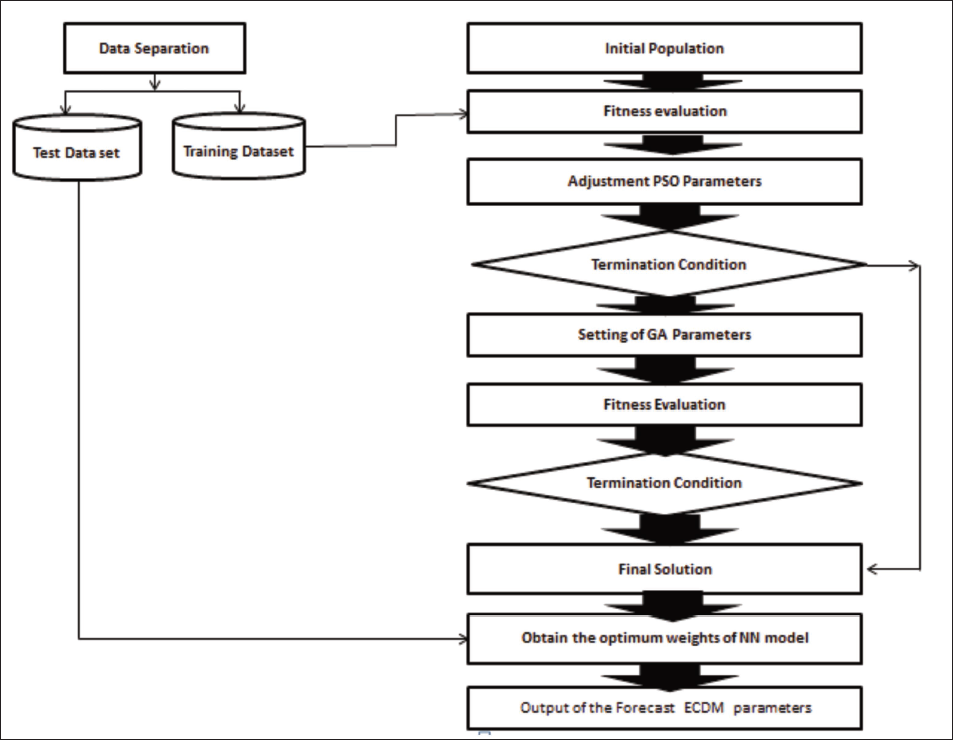
The main procedural steps of the hybrid GAPSO algorithm are as follows: In the first stage. The initial population is generated. Binary codes 1 and 0 are used to encode the hidden nodes. In Step 2, the training dataset was applied, and the fitness of each particle was updated to the best position
Earlier several authors have proposed different hybridized evolutionary algorithms, GAPSO is a hybrid methodology combining PSO, and GA for cloud process optimization, enhancing task assignment efficiency, reducing costs, and improving resource utilization, 27 robust analysis in breast cancer diagnosis, 28 optimizing chemo virotherapy treatment schedules, 29 optimizing electric logistics vehicle routing, 30 working path of an AUV manipulator, 31 optimizing circular antenna arrays, 32 optimizing micro-tools ambient temperature, 33 and Taguchi process design in drilling. 34 Different tools were designed to increase the discharge rate for the enhancement of machining accuracy. 35 Lower HAZ achieved during groove cut on titanium alloy using laser power of 90 kHz. 36 Hybrid GAPSO optimization played a vital role with ANN during the manufacturing process for finding the optimal results. 37 L9 Taguchi design proposed during micro-machining of borosilicate glass by WECSMM. 38 Micro-features, as well as micro-holes on the composite, were created by the ECDM process precisely. 39
Motivated by the aforementioned discussion, we propose a novel hybrid approach that considers the GA and PSO algorithms for the parametric optimization of micro-ECDM.
The present research is organized into the following parts: Section “Experimental setup and methodology,” describes the experimental setup and methodology, followed by the result analysis in section “Results analysis for hybrid-optimization.” This section describes linear model implementation with a neural network, and the mathematical model is optimized by three algorithms: GA, PSO, and hybrid GAPSO. In the last section, explain the key points observed in this research along with the future scope in the conclusion section.
Experimental setup and methodology
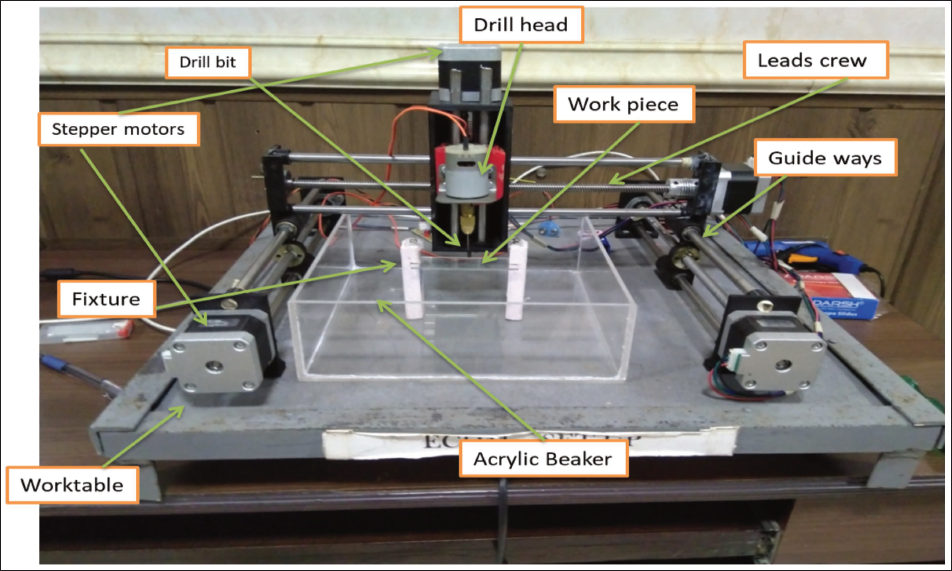
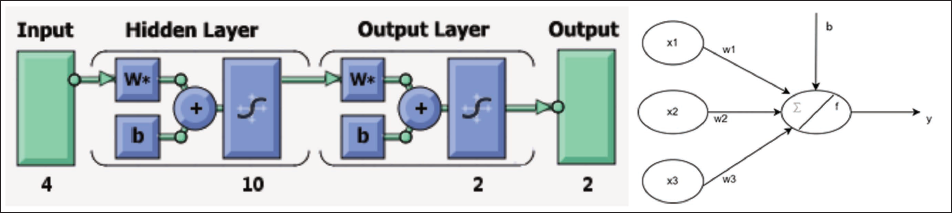
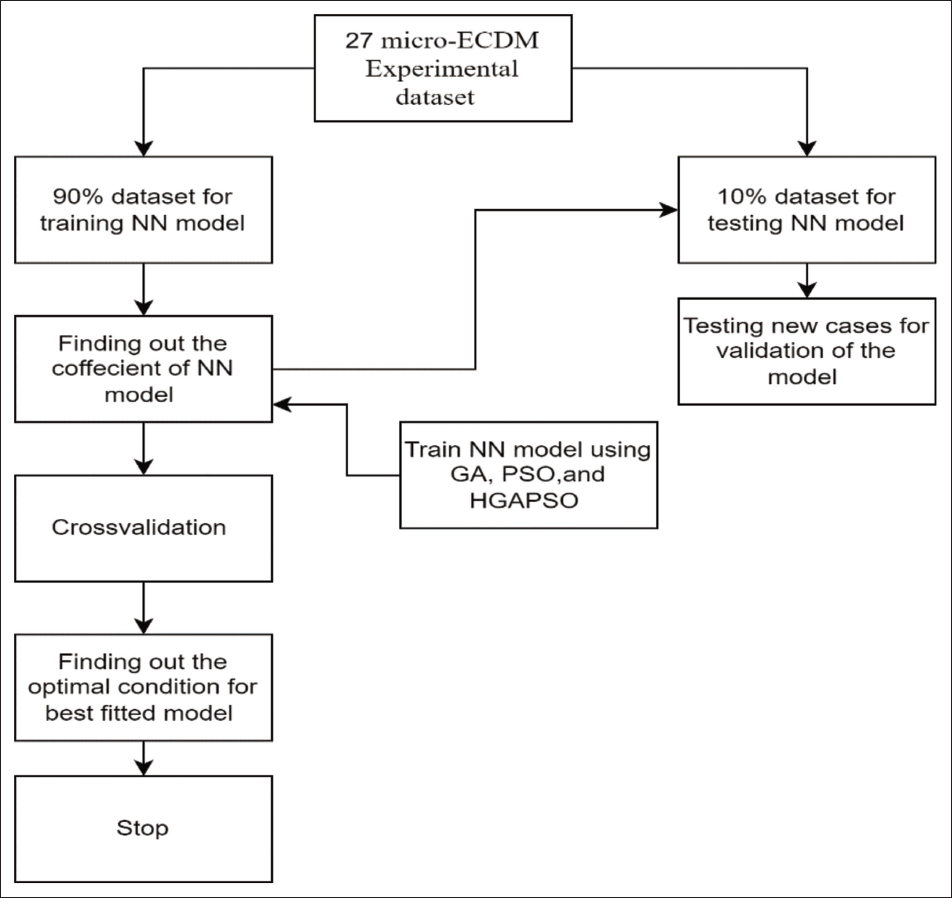
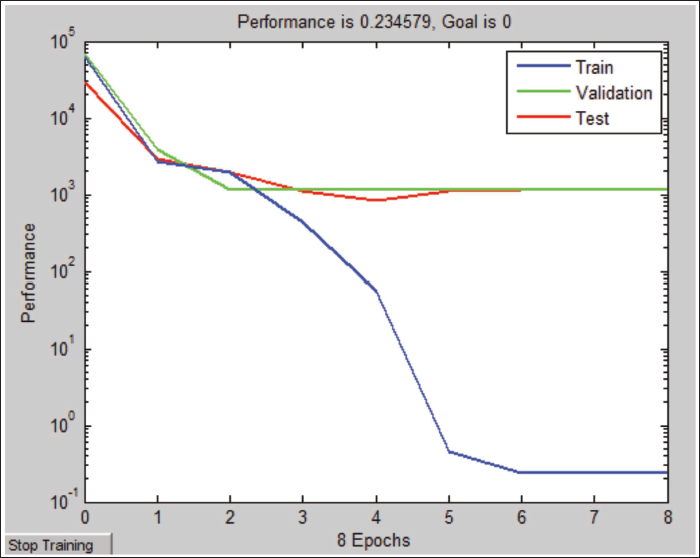
Figure 1 depicts this experimental setup, which consists of an electric power supply with an oscilloscope, main chamber, graphite auxiliary electrode, micro-tool holder unit, and spring feed. The template acts as a CAM, and the guide pin acts as a follower. Silica glass is the job specimen that has been repeatedly used. Figure 2 shows the neural network configuration with input, hidden and output layers. In the hybrid GAPSO algorithm, the flexible operator of GA merges into the PSO algorithm to construct the appropriate network with optimum connection weights, as shown in Figure 3. Hybrid GAPSO with ANN has an effective convergence to find optimized outputs with proper input combinations. Figure 4 represents the performance characterization based on ANN models.
Micro-ECDM experimental setup.
Neural network architecture of the proposed model.
Flowchart of the hybrid GAPSO algorithm.
Proposed methodology in the present research.
ANN models are highly used in AI and are stimulated by the neuron topology to solve critical nonlinearities and complex problems. An NN model can create a complex structure make a computer learn from given datasets and predict better results in the domain. A conventional ANN model consists of layers: input, hidden, and output layers with a feed-forward configuration of an architect. The input layer is connected to the hidden layer with the output layer response.
Input vectors

The node’s threshold is b, which indicates offset values are shown in Equation (2).

Earlier, ANN initialized the random weight values, but after training, these weight values are updated according to the input and hidden layer structure. In such cases, we used either backpropagation learning or other updated learning algorithms. These updated weighted values are adjusted in such a manner that we get optimized calculated responses for an unknown set of inputs.
Experimental planning
Every experiment is conducted in the laboratory three times, and the average value of the results is used for analysis.
For the three sets of experimental results, only average values are taken, and the deviation for MRR, WOC and surface roughness (SR) 5%–10%.
MRR is measured by the Toledo weighing machine by calculating the weight of the job specimen before and after machining for 20 minutes, and WOC is measured by an optical microscope, and a Taly surf stylus of 5 µm is used to find out SR.
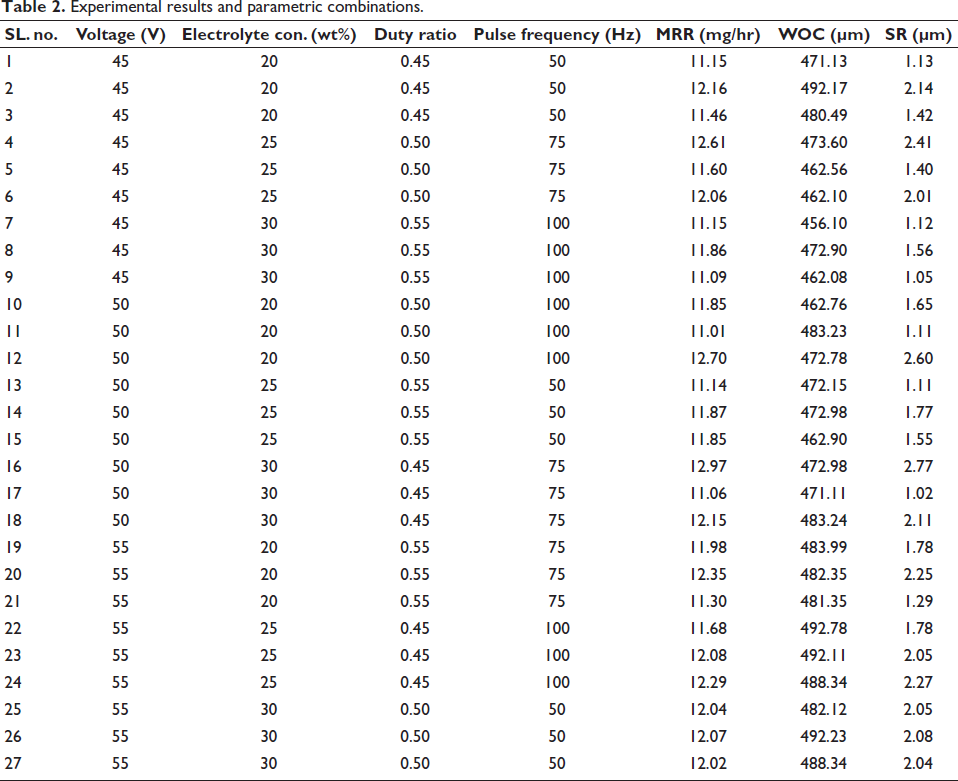
NaOH and KOH are mixed in equal proportions for preparing electrolytes, and a tungsten carbide tool of 250-µm cylindrical micro-tool has been used for micro-channeling on silica glass. Face-centered design (FCD) of experiments of 27 experiments are conducted, ranges of variables are shown in Table 1, which consists of V, electrolyte concentration (EC), pulse frequency (PF), and duty ratio (DR) and parametric combinations as well as results of experimentation have been disclosed in Table 2. From Table 2, it is seen that MRR, WOC, as well as SR are increased due to high voltage, EC and DR and decrease due to higher PF because of the sparking rate falling.
Variables range.

Experimental results and parametric combinations.
Results analysis for hybrid-optimization
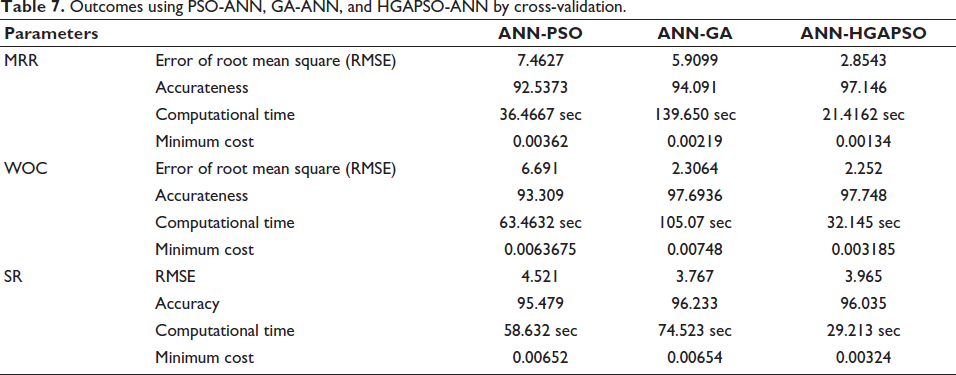
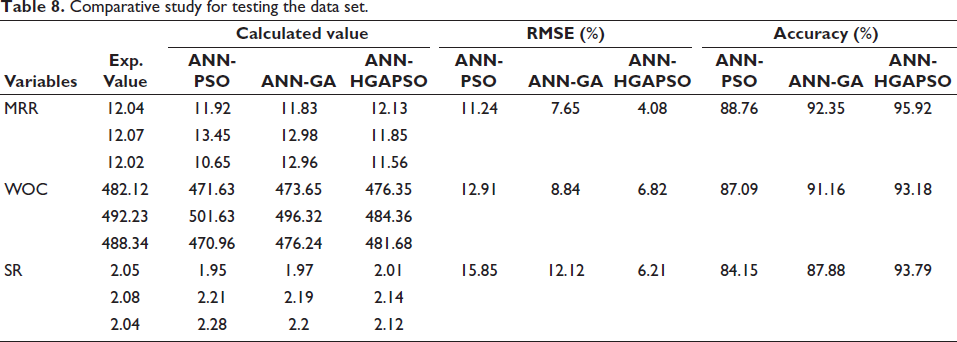
The overall optimization is done by 27 experimental data of micro-electrochemical discharge machining (Micro-ECDM) process parameters, including input parameters V, EC, PF, and DR and output parameters WOC, material removing rate (MRR), and SR. Overall, research was performed in three sections. In the first phase, cross-validation was performed on 90% (24) of the datasets. Table 7 represents the RMSE and accuracy of all the applied optimization techniques. In the second phase, the rest of the 10% (three datasets) data was used for validation of the proposed model, Table 8 representing the accuracy and RMSE of GA-ANN, PSO-ANN, and the hybrid algorithm. In the final stage, the optimal micro-ECDM process parameters were obtained for maximum MRR, minimum WOC and SR. The overall research is represented in Figure 4. These extensive simulations have been performed on MATLAB 2015a, with a system configuration of Processor 16GB RAM, 11th Gen Intel (R) Core (TM) i5 @ 2.50GHz.
Finding a neural network model for MRR, WOC, and SR
In this work, three output variables, MRR, WOC, and SR, are considered a linear function of input variables V, EC, DR, and PF, which can be represented by Equations (3–5).



Four weights, 


Now PSO, GA, and HGAPSO evolutionary algorithms are used to generate the optimum values of neural network weights and bias values from Equations (6) to (8). From 27 experiment datasets, 90% of the data has been taken for training and the rest of the data for testing. ANN-based linear mathematical model designed using a training dataset. Proposed three optimization techniques applied to random populations 
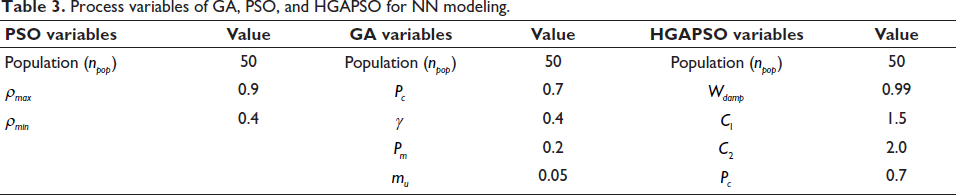
Objective function E is a function of t and c (target and calculated output), which should be minimized by optimization techniques. From optimization technique, an optimal solution is obtained when the error is minimized. The process variables of PSO, GA, and HGAPSO are shown in Table 3. Tables 4–6 represent the coefficients of the ANN-based linear model of MRR, WOC, and SR. Statistical results and computational time of each algorithm are represented in Table 7, and the best-fitted model. The mathematical equation of RMSE can be defined as follows


Process variables of GA, PSO, and HGAPSO for NN modeling.
Coefficient of MRR after optimization.

Where,
Table 7 represents a comparative study on cross-validation, where it has been seen that the proposed ANN-optimized hybrid GAPSO obtained an accuracy of 97.146% and 97.748% with the least computational time of 21.4162 sec and 32.145 sec for MRR and WOC, while the ANN-optimized GA achieved maximum accuracy for SR.
Equations (12–14) representing the nonlinear mathematical model of ANN-based hybrid GAPSO of output variables are as follows:



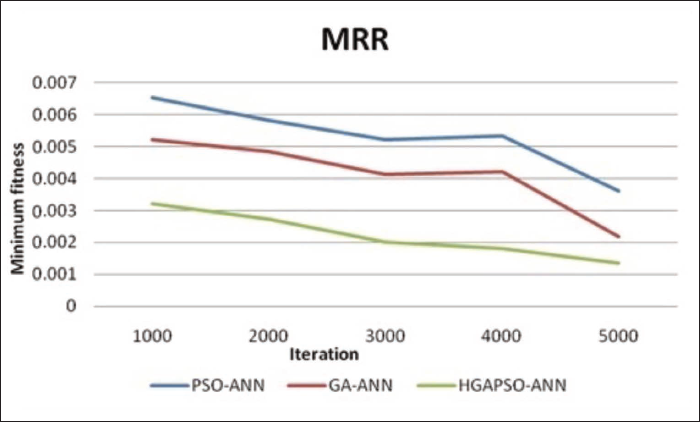
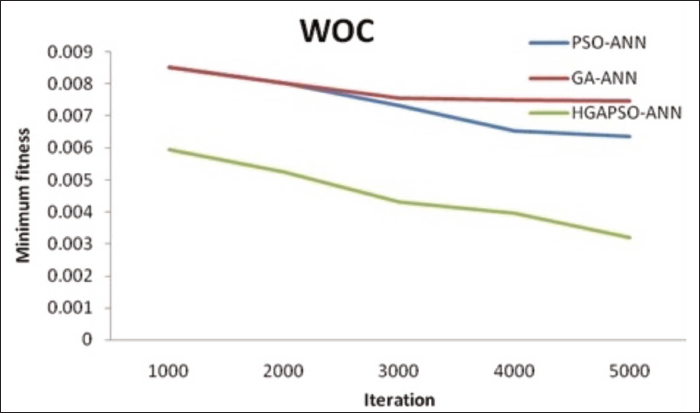
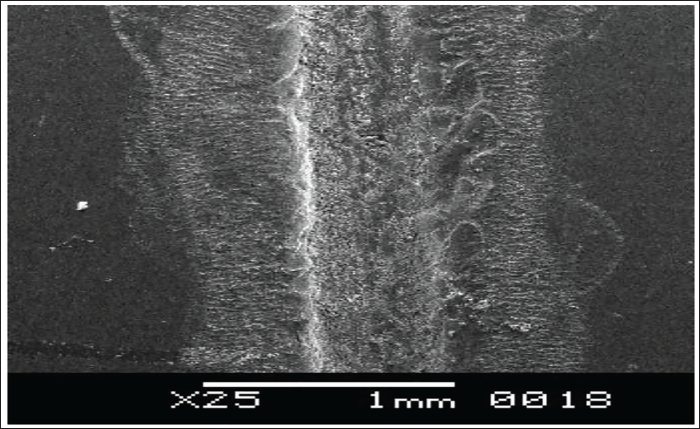
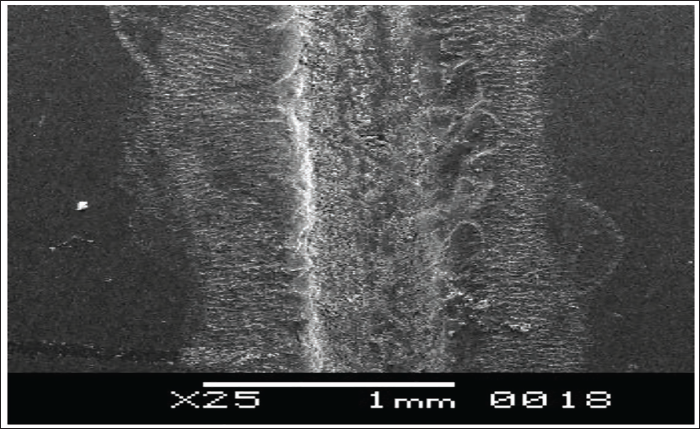
The remaining 10% of the data is used to check the accuracy of testing the dataset or forecasting the model. The entire model can accurately forecast MRR, WOC, and SR for new conditions. Table 8 represents the efficacy of proposed model efficacy of the proposed model. Convergence characteristics of the proposed algorithm decreased abruptly for all the response variables shown in Figures 5, 6 and 7, from where, by testing convergence, it is obviously found that hybrid GAPSO is the best method for optimization. From Tables 7 and 8, it is clear that hybrid GAPSO with ANN provides less error of root mean square (RMSE) with higher accuracy and minimum computational time as well as minimum cost. Figure 8 represents SEM of the micro-channel with HAZ on Silica, and validated the test results of the micro-channel fabricated at 45 volts, 30 (wt%), 0.45, and 75 Hz.
Coefficient of WOC after optimization.

Coefficient of SR after optimization.

Outcomes using PSO-ANN, GA-ANN, and HGAPSO-ANN by cross-validation.
Comparative study for testing the data set.
Characteristics graph between performances with the number of epochs of the ANN model.
Convergence curve for MRR using different algorithms.
Convergence curve for WOC using different algorithms.
Convergence curve for SR using different algorithms.
Optimal conditions for model
Optimum input variables are obtained when the objective function contains maximum MRR, and minimum WOC and SR represented in Equation (15).

To obtain the optimized objective function for a given range of input, it has been discovered that the best combination of V, E, D, and f is 45 volts, 30 (wt%), 0.45, and 75 Hz, respectively, and it takes 56.433 seconds by the hybrid GAPSO-ANN model. This result indicates that the best drilling condition was obtained for maximum electrolytic concentration and the least value of V and DR. Figure 9 shows the SEM of micro-channel cutting at 45 volt, 3owt%, 0.45 duty ratio and 75Hz.
SEM of micro-channel with HAZ at 45 volt, 30 (wt%), 0.45 duty ratio, and 75 Hz.
Conclusions
Finally, an account of the present research on micro-ECDM performances
ANN is the best fitness linear model, while hybrid GAPSO is the most relevant optimization technique.
The best combination of input parameters is 45 V, 30 wt% electrolytes, 0.45 DR, and 75 Hz PF when WOC and SR are minimized and MRR is maximized during multi-objective soft computational hybrid GAPSO is used in the ECDM process.
From cross-validation, it is seen that the ANN-hybrid GAPSO optimization technique provides maximum accuracy rather than ANN-GA and ANN-PSO.
During the testing dataset, it has been observed that the proposed hybrid algorithm achieved maximum accuracy for MRR, WOC, and SR at about 95.92%, 93.18%, and 93.79%, respectively.
A heat-affected area was also observed at the micro-channel after proper SEM investigations.
Test results are cross-validated for micro-channeling on (silicon dioxide + sodium silicate) silica.
Footnotes
Acknowledgments
The authors are thankful to Shobhit Institute of Engineering and Technology (Deemed to be University), Meerut, UP, India and GIMT, Nadia, WB, for permitting us to conduct the experimentation work.
Authors’ contributions
All the authors have equal contributions in experimentation, results analysis and writing of the manuscript.
Availability of data and material
The datasets generated during and/or analyzed during the current study are available from the authors and would be provided to the journal if required.
Compliance with ethical standards
This article does not contain any studies with human participants or animals performed by any of the authors.
Consent to participate
The authors are free to contact any of the people involved in the research to seek further clarification and information.
Consent for publication
The authors give their consent for the publication of identifiable details, which can include photograph(s) and/or details within the manuscript to be published in the esteemed journal.
Declaration of Conflicting Interests
The authors declared no potential conflicts of interest with respect to the research, authorship, and/or publication of this article.
Funding
The authors received no financial support for the research, authorship, and/or publication of this article.
