







Abstract
The purpose of this study is to explore the critical success factors (CSFs) for operational excellence by organizations in the Sudanese aviation industry and to determine if it will result in improved organizational performance and competitive advantage. In this study, a comprehensive literature review is done to determine the CSFs and develop an initial CSFs hierarchy model to achieve operational excellence in the Sudanese aviation industry. Analytic hierarchy process (AHP) is used for evaluating and ranking the determined CSFs. The study’s findings propose a conceptual model, using the AHP approach for operational excellence implementation in Sudanese aviation industry. As a result, the CSFs of operational excellence were provided and dissected to reveal its integrated components and the levels of their importance, without any of which the achievement of operational excellence would be impossible. These include leadership, people management, continuous improvement, operational strategy, and asset optimization.
Keywords
Introduction
It is generally well acknowledged that various businesses, irrespective of industry affiliation, are operating under increasing pressures to improve their productivity and quality. In addition, they also intend to reduce the cost and waste, minimize lead-time, and optimize efficient asset utilization and flexibility (Duggan, 2012; Jaeger et al., 2014; Muazu & Tasmin, 2017). As a result, businesses have realized that it would be challenging for them to excel with only a single business strategy dimension. Therefore, from the strategic perspective, firms are now resorting to operational excellence strategy as the best option to overcome or reduce the rising pressure from their stakeholders and improve performance results with minimal resources. In the pursuit of excellence, the industries are merging their unique constructs from the main performance metrics to pursue operational excellence (Jaeger et al., 2014; Wahab et al., 2016). Moreover, thriving companies during the recession were found to have adopted and maintained operational excellence as a strategy. As a result, thriving firms can reduce production costs while improving their operational efficiency (Muazu & Tasmin, 2017; Wahab et al., 2016).
Operational excellence is not a new concept, but current conditions create a unique opportunity for the aviation industry, particularly in Sudan, to realize its full promise. External economic factors pressure the industry to be more efficient and cost-effective without ground safety standards. In addition, advances in asset management offer new tools and techniques to leverage airlines’ capabilities to streamline operations while increasing service levels.
In Sudan, the central area experiencing challenges is the aviation sector. Currently, Sudan contends with very poor performance levels in aviation activities and facing varying challenges, including aircraft maintenance and overhaul services, aircraft operation services, and even aviation training services, to mention only a few (Fusion Aero Consultancy, 2015). Instead, business concerns in various aviation industry sectors in the country require an approach to doing business that will ensure their survival during periods of upheavals, decreased operational errors and costs, improved performance, efficiencies, productivity, and customer satisfaction, and finally, business growth, an approach to business such as operational excellence. This is supported by a report by Fusion Aero Consultancy (2015).
In pursuit of gaining potential benefits, organizations in the Sudanese aviation industry have a vested interest in ensuring that their operational excellence implementation initiatives are successful and sustainable. Therefore, they need to understand the underlying critical factors towards the success of operation excellence implementation. These so-called critical success factors (CSFs) need to be identified for decision-making purposes to support operational excellence by organizations in the Sudanese aviation industry.
In this study, the CSFs of operational excellence were provided and dissected to reveal its integrated components and the levels of their importance, without any of which the achievement of operational excellence would be impossible. These include leadership, people management, continuous improvement, operational strategy, and asset optimization. The impact (outcome) has been presented, and each outcome’s weightage has been highlighted. Achieving this study objectives will lead to an improved understanding of operational excellence and the factors responsible for achieving operational excellence in the Sudanese aviation industry. In addition, a CSF model will give service providers in the Sudanese aviation industry a decision support basis, consisting of guidelines for the effective implementation and delivery of operational excellence.
The main contribution to the knowledge of this study is creating the framework for the achievement of operational excellence by organizations in the Sudanese aviation industry. The developed framework can be used as a model for the improvement of currently implemented performance improvement initiatives. The purpose of the framework is to guide Sudanese aviation companies through a structured and procedural approach to determine, diagnose, and improve the current performance level and successful implementation of operational excellence among Sudanese companies.
This article presents the three phases of results using the Delphi hierarchy process (DHP). This section provides an introduction to this article. The second section discusses the success factors for operational excellence based on the literature review. The third section discusses the Delphi expert panel structure, preliminary theoretical framework, and final hierarchy structure, followed by the main steps and timeline. The fourth section discusses the detailed processes and results obtained from the Delphi Round 1 study. The fifth section discusses the findings obtained from the second round of the Delphi study. The sixth section discusses the pairwise comparison questionnaire used for the third round of the Delphi technique for ranking the CSFs to sustain the total quality management (TQM) implementation in Sudan. The seventh section shows the discussion of results obtained from the DHP methodology. Finally, the last section presents the summary of this article.
Success Factors for Operational Excellence
Most industries consider operational excellence as an atmosphere that triggers optimal performance in all business facets in a continuous manner. Tasmin and Woods (2007) viewed that operational excellence could be attained through innovation, working process improvement, and means in managing organizational knowledge via knowledge leadership, knowledge culture, knowledge technology, knowledge process, and knowledge measurement. Another view by Russell (2009) suggests that operational excellence is about having the strategy management capability, excellent execution of the plan quickly and cheaper, and continuous improvement over the long term. That notwithstanding, it is rooted in various business process improvement approaches employed by industries in the last three decades. They include Six Sigma, lean manufacturing, continuous improvement, business process management, and process excellence.
An organization’s operating excellence is linked with organizational efficiency and effectiveness. In the competitive environment, every organization is under intense pressure reducing cost without decreasing output and quality, often termed as efficiency. When organizations become efficient in reducing waste of time, raw materials, unnecessary processing, and energy used in transportation, storing, and operating, the state of organization efficiency is generated (Booz Allallen, 2014). Besides, when an organization achieves its long-term goals through increased customer satisfaction and proves its reason for being, this state is called effectiveness. operational excellence assures both.
According to Rana Shehadeh et al. (2016), operational excellence can be attained by linking the organizations’ leadership with human resources management, operations strategy, and organizational commitment. Additionally, they stated that operational excellence is a competitive weapon that different service firms should seek if they target a world-class operational performance. In previous research, it has been acknowledged that leadership is the most significant single factor responsible for operational excellence. There is always a rapid technological change in the service delivery systems in the service industry, which puts additional responsibility on this sector’s leaders to draw a clear vision to respond to those changes while considering customer’s demographic and lifestyle variations. Moreover, leadership is a critical factor in driving operational excellence, but leadership can work better if it aligns with affective organizational commitment.
EY Oil and Gas Company (2015) states that operational excellence can be attained by asset reliability and integrity, cost efficiency, supplier and contractors management, integrated planning, outlines how processes, people, and systems interact to support the business and how they are arranged and prioritized to achieve optimum efficiency (operating model) in addition to health, safety, environment, and quality management.
Wahab et al. (2016) conducted a study to examine the effect of internal environmental factors on small and medium enterprises (SMEs’) operational excellence. The internal environmental factors in their study refer to the resources and capabilities of a firm. These factors consist of complex factors (operation strategy, organizational structure, and process management) and soft factors (leadership style, human resource practices, and organizational culture).
The literature reviewed suggests possible relationships between corporate strategy, strategic leadership, and sustainable organizational performance. This review contributes to existing knowledge on corporate strategy by providing an insight into relationships among corporate strategy, strategic leadership, and sustainable organizational performance (Mukhezakule & Tefera, 2019)
Operational excellence can only be successfully implemented if the organization can identify and work in opportunity, applying the most relevant critical factors to achieve success and competitive advantage. These results will help organizations and professionals focus on continuous improvement methods and lean manufacturing to increase their product or services’ efficiency (Aguilera & Treviño, 2019)
Ranking of the CSFs for the Achievement of Operational Excellence by Using Delphi Experts Panel and DHP Process
The DHP processes used in this study consist of three rounds of the survey conducted with 10 industrial and academic experts consisting of practitioners and academics with more than 10 years of working experience and research in the Sudanese aviation industry. Results for each round were analyzed, and feedback were provided to the respondents that were asked to re-examine their opinions in light of the overall results. The analysis started with the results from Rounds 1 and 2 of the Delphi technique to analyze the data obtained from selected experts from Sudanese aviation organizations to obtain consensus from the experts’ panel. The ranking of CSFs for the achievement of operational excellence in the Sudanese aviation industry from the Analytic Hierarchy Process (AHP) was conducted with a pairwise comparison questionnaire Round 3 of the Delphi technique.
Time-wise, Delphi Round 1, including forming a panel of experts and selecting experts, was conducted in December 2019 till July 2020, and Round 2 was conducted in August 2020 till October 2020. Round 3 was conducted at the beginning of November 2020 and completed in December 2020. The 10 experts participated in all rounds through emails or interview sessions.
Delphi Round 1
In the first round, the experts’ panel was asked to validate some general factors of the preliminary theoretical framework of CSFs for operational excellence derived from the literature review. The semi-structured interview was conducted with selected experts. This interview aims to collect data for the Round 1 DHP method. All expert panel members participated in this round. A set of questionnaires for Round 1 was sent via email to all experts to ensure that experts are prepared beforehand.
According to the panel members, there is a lack of implementation of the operational excellence tools. It was observed that most Sudanese aviation companies were not implementing statistical techniques and improvement methodologies such as kaizen and Lean Six Sigma. Even for companies certified as ISO 9001, it was observed that there were no continuous improvement methodologies in place. As validated by panel experts, most commonly adopted Sudanese aviation companies’ tools include simple quality tools, corrective actions, and preventive actions. Other tools are used in Sudanese aviation companies, as per expert panel feedback, such as brainstorming, SWOT analysis, and seven quality tools. The result also indicates a lack of implementation of advanced operational excellence frameworks and models such as the Shingo model for operational excellence due to psychological barriers.
The last section of the first round Delphi method was to investigate further the expert panel’s opinion concerning the hierarchy model of CSFs for achieving operational excellence in the Sudanese aviation industry. The proposed critical factors were decomposed into a graphical hierarchical form. Figure 1 presents the initial AHP structure for achieving operational excellence in the Sudanese aviation industry. The panel was asked to determine whether they agreed with the identified CSFs and sub-factors under each CSFs. If they disagree with the CSFs and sub-factors under each CSFs, they can make adjustments by deleting, moving, or modifying CSFs and sub-factors and to write down any comments regarding the proposed CSFs model.
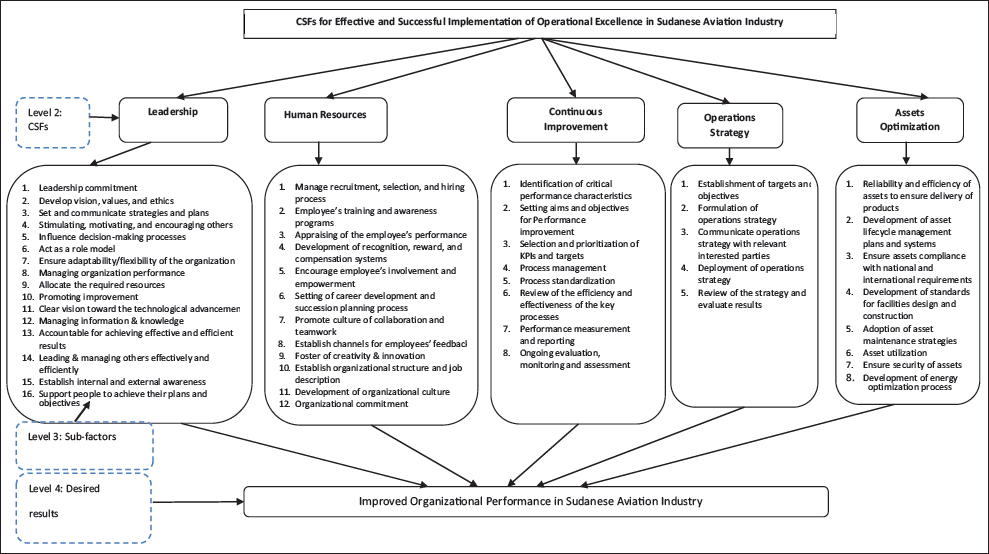
All expert panel members responded to Delphi Round 1. Generally, they agreed with the five categories of CSFs for achieving operational excellence in the Sudanese aviation industry. However, many suggestions were provided concerning Level 2 and Level 3. According to these suggestions, changes were made, and the structure of CSFs was revised, as shown in Figure 2.
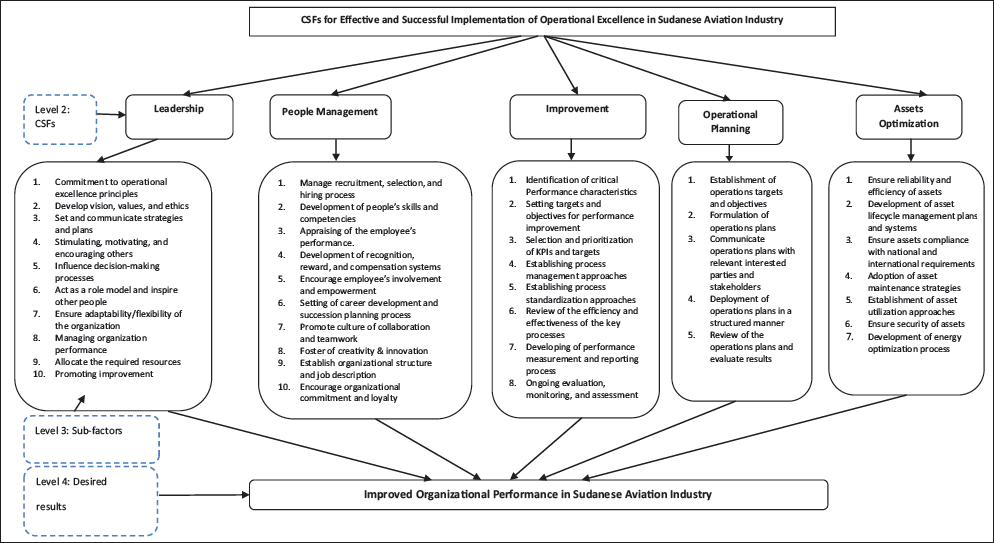
Level 2: Experts made adjustments to the proposed AHP model by replacing the “human resources” with “people management, continuous improvement with improvement,” and “operations strategy” with “operational planning” at Level 2.
Leadership: “Act as a role model” edited to become “Act as a role model and inspire other people.” “A clear vision toward technological advancement” was merged with “develops vision, values, and ethics” sub-factor. Additionally, “managing information and knowledge, accountable for achieving effective and efficient results,” and “leading and managing others effectively and efficiently” sub-factors were placed under “managing organization performance.” Moreover, “establish internal and external awareness” and “support people to achieve their plans and objectives” were deleted as sub-factors. “Leadership commitment” was renamed as “commitment to operational excellence principles.”
People Management: At Level two, “human resources” was replaced with “people management.” At Level 3, for sub-factors under people management, promoting fairness and equality and developing organizational culture was moved to the leadership category and placed under develop vision, values, and ethics sub-factor. Furthermore, “establish channels for employees’ feedback” sub-factors was placed under “encourage employee’s involvement and empowerment.” Additionally, “employee training and awareness programs” were renamed as developing “people’s skills and competencies, and organizational commitment was also renamed as Encourage Organizational commitment and loyalty.”
Improvement: According to the Delphi panelists, they replaced “setting aims and objectives for performance improvement” by “setting targets and objectives for performance improvement” at Level 3. Process management and process standardization sub-factors were renamed as establishing process management approaches and establishing process standardization approaches under the same dimension. Additionally, “performance measurement and reporting” were placed under the “developing of Performance measurement and reporting process” sub-factor.
Operational Planning: At Level 2, “operations strategy” was replaced with “operational planning.” For sub-factors under operational planning, the establishment of targets and objectives was edited to establish operations targets and objectives. Under the same dimension, “formulation of operations strategy” and “review of the strategy and evaluate results” sub-factors were renamed as “formulation of operations plans” and “review of the operations plans and evaluate results.” Furthermore, “communicate operations strategy with relevant interested parties” and “deployment of operations strategy” sub-factors were edited on to become “communicate operations plans with relevant interested parties and stakeholders” and “deployment of operations plans in a structured manner” in turn.
Assets Optimization: “Reliability and efficiency of assets to ensure delivery of products or services” sub-factor was edited to become “ensure reliability and efficiency of assets.” Additionally, “ensure asset management capabilities” and “ensure the effective use of technology” sub-factors were placed under the “development of asset lifecycle management plans and systems.” Moreover, the “development of standards for facilities design and construction” was removed as a sub-factor. The sub-factor “asset utilization” was renamed as the “establishment of asset utilization approaches.”
Thus, Delphi Round 1 relating to the hierarchy structure of the CSFs model became the new proposed model of CSFs for achieving operational excellence in the Sudanese aviation industry.
Academic and industrialist experts agreed that this is a robust framework. However, there are some suggestions from participants to promote improvement and assets optimization, customize the advanced tools for Sudanese companies, and design a simple approach for continuous improvement to reduce the physiological barriers toward advanced operational excellence frameworks and models. It is also suggested to link operational excellence CSFs with strategic directions. It is also suggested to consider the organization and its context because some hidden factors from the internal and external environment can affect operational excellence projects and initiatives.
Table 1 shows the fundamental changes made by the panel of expert to review the initial AHP for CSFs for achieving Operational Excellence in the Sudanese aviation industry.
Key Changes for Initial AHP Structure.

Delphi Round 2
The main objective of the second round of Delphi technique is to obtain the consensus among the experts in terms of the final AHP model of CSFs for effective implementation of operational excellence principles and continuous improvement. The experts’ panel were asked to review the revised AHP model, after adjustments and changes were made to the model (Figure 2), using e-mail and visit with interview.
Statistical feedback of group and individual responses are given to encourage convergence towards consensus. For each of the factors which did not gain consensus during the first round, group feedback in the form of the median and standard deviation are included. The median is an indication of location of the most selected responses, while the standard deviation gives an indication of the response variances. Individual feedback is given in the form of a panelist’s own first round responses. Panelists are asked to rate the factors on the same 5-level scale as in the first round. By taking the group feedback into consideration, the panelists can change their first-round responses or keep them the same.
Table 2 summarizes the descriptive statistics from the second-round responses. Similar to the first round, the response percentage is shown for each of the factors. Similar descriptive statistic ranges are seen between the first and second round results. Contrary to the first-round results, all factors (40 factors) achieved the level of consensus of 66.7%. This is more than double the factors which gained consensus in the first round. It can, therefore, be concluded that the group and individual feedback in the second-round lead to the convergence in responses which came close to consensus in the first round. This convergence is one of the underlying principles for which the Delphi method is known.
Second Round Delphi Descriptive Statistics and Response Percentages.
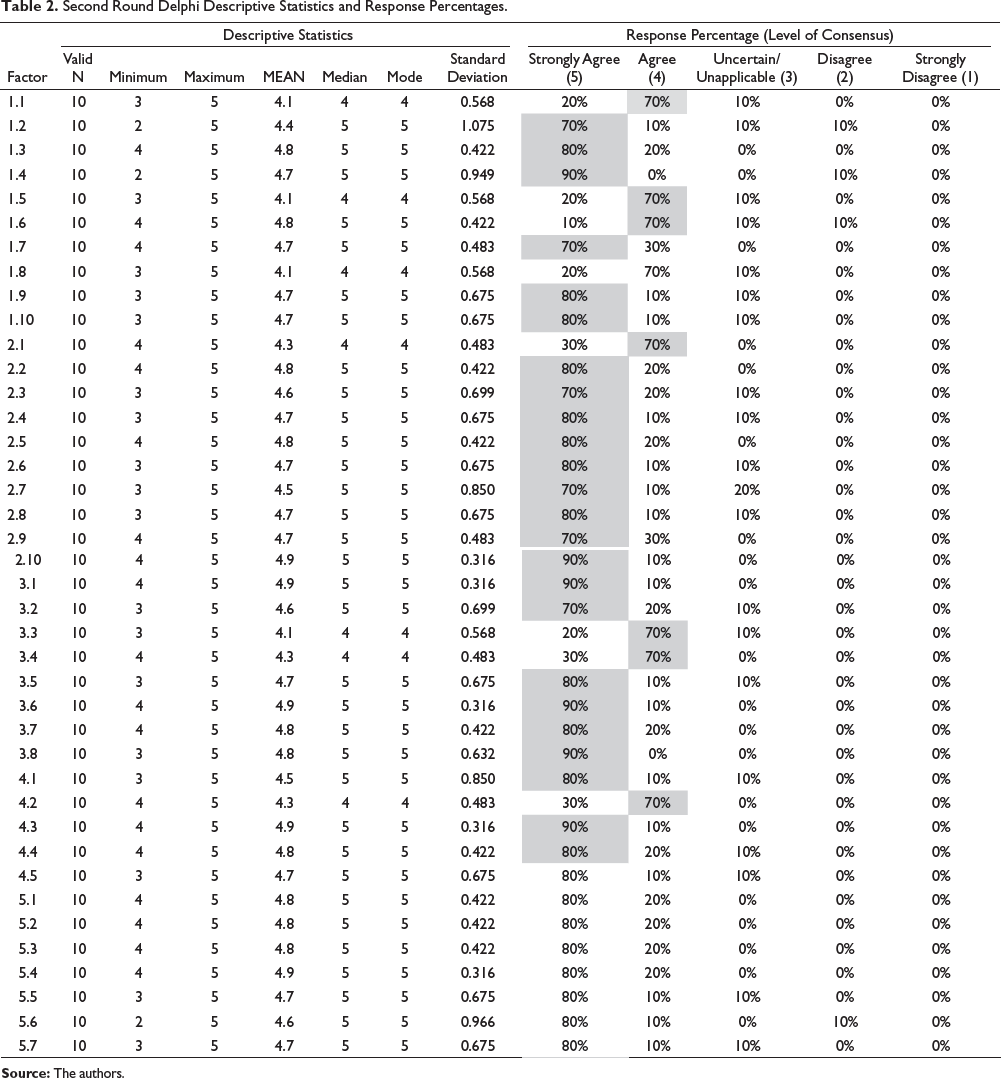
All the experts participated in this round and agreed with the revised hierarchy model of CSFs for achieving operational excellence in Sudanese aviation industry. Furthermore, the experts strongly agreed that the CSFs for achieving operational excellence derived from the literature review and Delphi technique rounds are consistent with Sudanese aviation industry and therefore appropriate to be used for the third round of Delphi technique.
Delphi Round 3
In the last round of the Delphi technique, the experts were asked to determine the relative scales of a given list of critical factors and sub-factors affecting the achievement of the operational excellence in the Sudanese aviation industry pairwise fashion. The pairwise was constructed by referring to Saaty (1980), using point scale and score. All expert panel members participated in this round. The participants assessed the pairwise comparison among the 5 CSFs and the related 40 sub-factors as the output of Delphi Rounds 1 and 2, and lastly, a series of judgment matrices for the critical factors and sub-factors were obtained. The importance weight or relative weights to critical factors and sub-factors were calculated to conduct Delphi Round 3. A pairwise comparison matrix was developed to calculate “weights,” which involved the relative significance among the criteria in the second level of the hierarchy. Excel was used to determine the ranking of critical factors and sub-factors. By using this software, the researcher can obtain the local and global priority weight. The local priority weight is relative to the parent elements, whereas the global priority weight is relative to the goal.
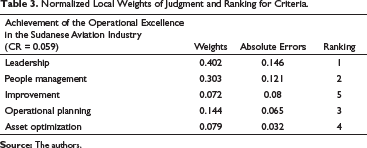
The local weight is the priority of an element related to the primary element, and it is first calculated. Meanwhile, each element’s global weight is related to achieving the operational excellence in the Sudanese aviation industry was calculated by multiplying the local weight of an element by the weight of its primary element. Tables 3 and 4 show the normalized local weights of judgment and ranking for criteria and sub-criteria from expert panels. After that, the consistency ratio (CR) was calculated to measure how consistent the expert panels’ judgment was. CR indicates how consistently respondents compared criteria. According to Saaty (1980), who developed the AHP, a CR of 0.10 or less is considered acceptable. As illustrated in Table 4, overall pairwise comparisons were consistent (CR = 0.059). This means that evaluator judgments’ overall consistency falls within the suggested ratio of 0.10 (Saaty, 1980).
Normalized Local Weights of Judgment and Ranking for Criteria.
Normalized Local Weights of Judgment and Ranking for Enabling Factors and Sub-Factors Based on the Outcomes of Experts Panel.
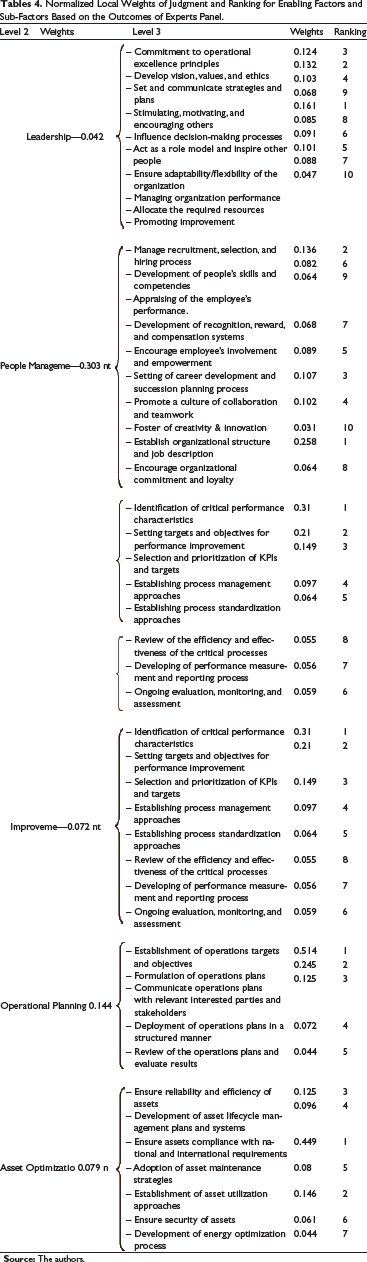
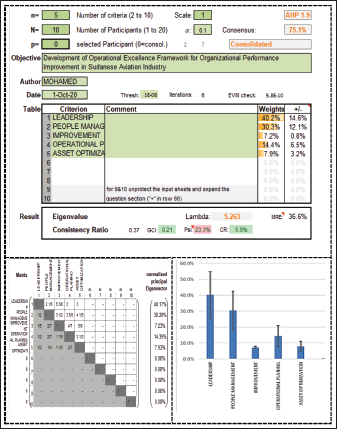
Table 4 summarizes the priorities of criteria for enabling factors and sub-factors. The geometric mean was used to synthesize the assessment of each evaluator. The results from the geometric mean of evaluators were combined into judgment matrixes of pairwise comparison. Figure 3 shows the summary of critical factors affecting the operational excellence’s achievement based on judgment matrices and evaluation results. Based on the results, the CR for these matrices falls under 0.10, which means that the results are within the acceptable level of 0.10 according to the CR.
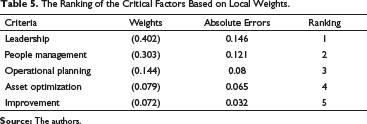
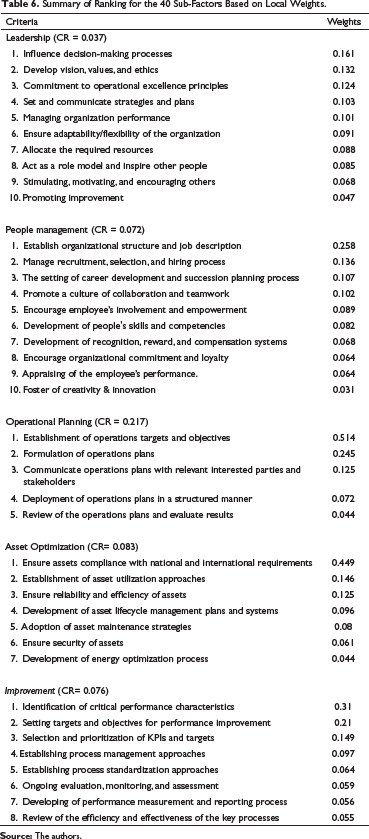
The following section discusses each criterion’s relative weights for categories and sub categories based on priorities calculated. Table 5 shows the ranking of the critical factors based on local weights. Additionally, Table 6 summarizes the ranking for the 40 sub-factors based on their local weights.
The Ranking of the Critical Factors Based on Local Weights.
Summary of Ranking for the 40 Sub-Factors Based on Local Weights.
Level Two: For the main categories of CSFs, leadership (0.402) is the most important factor, followed by people management (0.303), operational planning (0.144), asset optimization (0.079), and improvement (0.072) based on global weights calculation. The results show that the most critical sub factors affecting the Sudanese aviation industry’s operational excellence were leadership, people management, and operational planning. It is observed that asset optimization (0.079) and improvement (0.072), obtained nearly the same weights and placed at the fourth and fifth rank. This may indicate that evaluators agree that there is an insignificant difference in CSF’s importance compared to the other. However, it was evident that the most minor influential factor is an improvement (0.072).
Leadership: “Influence decision-making processes” was the most crucial criterion. The following most important criterion for leadership is “develop vision, values, and ethics,” followed closely by “commitment to operational excellence principles.” Then, “set and communicate strategies and plans,” followed by “managing organization performance, ensure adaptability/flexibility of the organization,” and “allocate the required resources, respectively.” After that, the following important criterion for leadership is acting as a role model, inspiring other people, and Stimulating, motivating, and encouraging others. “Promoting improvement” was the least essential sub-factor.
People Management: For people management, the “establishment of organizational structure and job description,” “management of recruitment, selection and hiring process,” and “career development and succession planning process” were the most important three criteria. The following most essential criteria were to “promote collaboration and teamwork,” “encourage employee involvement and empowerment,” and “develop people’s skills and competencies,” respectively. These sub-factors were followed by the “development of recognition, reward, and compensation systems.” The “encouragement of organizational commitment and loyalty” and “appraisal of the employee’s performance” received the following highest importance ratings. It is observed that “encouragement of organizational commitment and loyalty” (0.064) and “appraisal of the employee’s performance” (0.064) obtained the same weights and placed at the eighth and ninth rank. This may indicate that evaluators disagree with which one is more important than the other “foster of creativity and innovation” was the least important.
Operational Planning: Concerning operational planning, the “establishment of operations targets and objectives” is the most crucial sub-factor. “Formulation of operations plans” and “communicating operations” plans with relevant interested parties and stakeholders was the next most important criterion, with their priorities nearly similar. This indicates that the relative importance of these two criteria for operational planning is similar. The deployment of operations follows these two sub-factors “plans in a structured manner,” whereas the “review of the operations plans and evaluate results” was the least essential sub-factor.
Asset Optimization: For this category, “assets compliance with national and international requirements” and the “establishment of asset utilization approaches” were the two significant sub-criteria for assets optimization. The following most essential criteria were “reliability and efficiency of assets,” “development of asset lifecycle management plans and systems,” and “adoption of asset maintenance strategies.” “Reward and compensation systems,” “security of assets and the development of the energy optimization” process received the least importance ratings.
Improvement: For this dimension, the “identification of critical performance characteristics” was the major sub-criteria for improvement. The following most essential criteria were “setting targets and objectives for performance improvement and selecting and prioritizing KPIs and targets.” The establishment of process management approaches then followed these sub-factors and the establishment of process standardization approaches sub-factors. The ongoing evaluation, monitoring, and assessment received the next highest importance rating. The next sub-factor was developing the performance measurement and reporting process, which was slightly more than the review of the critical processes sub-factors efficiency and effectiveness.
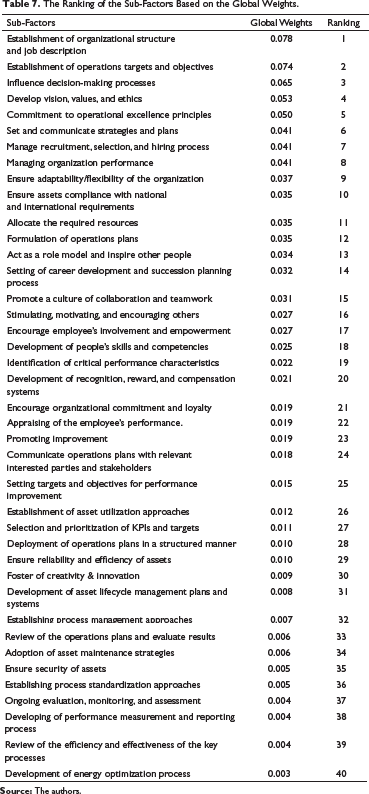
The global weights calculation results for the 40 sub-factors in Table 7 show that the 10 most important sub-factors are establishing organizational structure and job description, establishing operations targets and objectives, and influencing decision-making processes. Development of vision, values, and ethics, commitment to operational excellence principles. Setting and communicating strategies and plans and management of recruitment, selection, and hiring process.
The Ranking of the Sub-Factors Based on the Global Weights.
Discussions
The Delphi process used in this study was for three rounds. The primary purpose of the first round is to determine the CSFs for the achievement of the operational excellence by organizations in the Sudanese aviation industry. In this round, the panel of experts were asked to validate some general factors of the preliminary theoretical framework of CSFs for operational excellence which are derived from literature review.
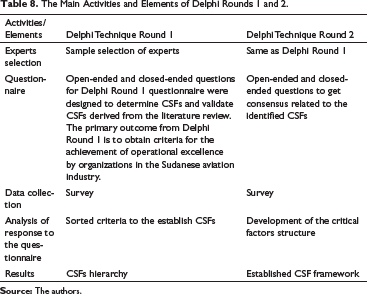
The second phase was to conduct the Round 2 of the Delphi technique. The main outcome from this phase is to come up with the final hierarchy model of CSFs for the achievement of operational excellence by organizations in the Sudanese aviation industry. Table 8 shows the main activities and elements of Delphi Rounds 1 and 2.
The Main Activities and Elements of Delphi Rounds 1 and 2.
The Third Phase of Delphi technique was the AHP application. This phase involved deploying the AHP approach in Delphi Round 3 to rank the CSFs for achieving operational excellence by organizations in the Sudanese aviation industry. A set of AHP related questionnaires was used during interview activities to construct the AHP model. The main outcome from Delphi Round 3 is to calculate the importance weight to criteria and sub-criteria of the proposed operational excellence framework elements.
After the validation through the DHP methodology, comprehensive CSFs criteria for achieving operational excellence in the Sudanese aviation industry were collected and structured into an AHP criteria model, specifically in a judgment hierarchy based on the feedback from industrial and academic Sudanese experts. The top level of the proposed hierarchical structure was to improve the organization’s organizational performance in the Sudanese aviation industry and provide an effective and successful implementation. There were five main factors: (a) leadership, (b) people management, (c) operational planning, (d) assets optimization, and (e) improvement in the next level. Based on the AHP, the relative priorities of factors, sub-factors, and criteria were determined using pairwise comparison. In addition, the third level analysis considered 40 sub-factors for the operational excellence achievement in the Sudanese aviation industry.
Based on all the feedback received from the experts, the leadership factor was the most critical factor in achieving improved organizational performance and goals, followed by people management. Hence, these two factors were considered the primary elements of the proposed framework for achieving operational excellence for the Sudanese aviation industry. Based on the results, leaders play crucial roles in the operational excellence achievement in the Sudanese aviation industry. The leaders should be committed to the operational excellence principles and demonstrate the ability to influence the decision-making processes and develop the organizational vision, values, and ethics. This statement supported the new amendment proposed by the European Foundation for Quality Management (EFQM) excellence model and Shingo model for the operational excellence view. Next, the operational planning factor received the third ranking. Therefore, this factor can be considered vital for achieving operational excellence in the Sudanese aviation industry. The results showed that the sub-factors of establishment of operation targets and objectives and formulation of operation plans obtained the highest ranking in the operational planning category. This result implied that establishing operation targets and plans should be considered significant to sustain the TQM implementation in Sudan. Operational Excellence Consulting (2016) stated that operational excellence organizations follow a well-defined strategy and operational planning and deployment process that ensures the collaboration and alignment among the different organizational parts besides effectively linking strategic and operational objectives, initiatives, and execution.
The results revealed that asset optimization obtained nearly the same weight as improvement and was placed at the fourth rank. Hence, the evaluators agreed with the insignificant difference between the importance of CSF with others. However, the overall evaluation of global weight (as shown in Table 7) indicated that the most critical sub-factor in assets optimization was asset compliance with national and international requirements. This result indicated the importance of compliance with national and international civil aviation regulations. The aviation industry is highly regulated under various agreements and regulations due to its instinctive safety risks associated with aircraft operations. These results were proven and supported by the EFQM excellence model (EFQM, 2012) and Chevron’s (2010) Operational Excellence Management System. Even though the sub-factor of selection and prioritization of KPIs and targets obtained a higher ranking than establishment of asset utilization approaches, the overall evaluation of global weight (as shown in Table 7) indicated that establishment of asset utilization approaches (0.012) obtained higher weight compared to selection and prioritization of KPIs and targets (0.011). This result confirmed the importance of asset optimization in the achievement of improved organizational performance.
The sub-factor of improvement achieved the least ranking. Furthermore, the sub-factors of review of the efficiency and effectiveness of the critical processes and development of energy optimization process obtained the lowest ranking based on the global weight calculation. These results indicated that the performance measurement was more crucial than reviewing the key efficiency and effectiveness processes. Additionally, the asset’s energy consumption had little or no effect on the operational excellence in the Sudanese aviation industry. Based on the results, it can be concluded that establishment of organizational structure and job description, establishment of operation targets and objectives, influencing of decision-making processes, development of vision, values, and ethics, and commitment to operational excellence principles play important roles in improving the Sudanese aviation organizational performances. These findings supported the experts’ opinions that the lack of top management commitment and lack of exact assignment of roles and responsibility towards operational excellence sub-factors were primary barriers affecting the operational excellence achievement in the Sudanese aviation industry.
The analysis of key barriers that hinder the achievements of operational excellence in the Sudanese aviation industry pointed out some key shortcomings, such as the lack of understanding of the potential benefits of operational excellence implementation, the lack of knowledge/understanding about the different operational excellence models and approaches, the lack of linkages between improvement projects and operational excellence results, the psychological inertia towards the advance operational excellence techniques, poor measurement, analysis, and improvement system, and the lack of structured and straightforward approaches for operational excellence in the aviation industry. These issues proved the needs for self-assessment tools that help the Sudanese aviation organizations to measure, analyze, and evaluate their performances and capabilities, especially in the organizational performance measures and benchmarking performances of within and among the organizations. To overcome the psychological barriers of the Sudanese aviation companies towards the international advanced operational excellence frameworks, like the Shingo model, it is suggested that future studies should design and implement a simple, structured, practical, and integrated framework for operational excellence. The framework can determine the opportunities for improvement, analyze the root causes, implement robust solutions, and sustain outstanding results from the improvement projects.
Conclusion
The topics of operational excellence are increasingly gaining researchers’ attention, especially in the field of applied sciences over the recent decades. However, past research have relatively over-emphasized the unilateral “result-driven” perspective of operational excellence that corresponds with the limited concern for enablers, critical forms, and focus of operational excellence. Thus, this article attempted to address this issue. With the operational excellence’s conceptual framework, the CSFs to achieve operational excellence were identified.
One limitation of this study is its generalizability across all Sudanese aviation industry. The research sets out to investigate the CSFs for the operational excellence in its broadest sense, while it is anticipated that response rate and sample composition could negatively influence this study outcomes. Although the analysis shows no overall adversity between the responses for the Delphi questionnaire and panelists at the different the sub-sectors in the Sudanese aviation industry, a limitation is the unlikelihood that all possible sub-sectors in the Sudanese aviation industry are represented adequately in the samples. For example, only one of the tenth Delphi panelists and a relatively small percentage of survey respondents represent the aerial work and crop protection services. Although the differences are potentially marginal, the study outcome cannot be fully generalized across all sub-sectors in the Sudanese aviation industry, especially those forming part of the aerial work sub-category.
This study also has other limitations, as with all research. The limited amount of research available on operational excellence in the aviation industry and particularly in the Sudanese context, has limited the opportunity to gather content-rich information from previous research.
Additionally, the findings of the sub-factors in this study were insufficient. So, future studies must focus on the detailed descriptions of sub-factors related to each of the critical factors.
An organization’s operational excellence is linked with organizational efficiency and effectiveness. In the competitive environment, every organization is under intense pressure to reduce costs without decreasing the output and quality, often termed as efficiency. Efficiency in the organizations is generated and enhanced when the organizations become efficient in reducing time wastage, raw materials, unnecessary processing, and energy used in transportation, storing, and operating plant. Besides, the state of effectiveness is achieved when the organization achieves its long-term goals through increased customer satisfaction and proves its reason for being. Therefore, operational excellence is critical as it assures both the efficiency and effectiveness of organizations. From the five main factors, the expert panel members suggested that the leadership factor was the most important factor to achieve operational excellence in the Sudanese aviation industry. The ranking of five CSFs and 40 sub-factors provided a better understanding of the Sudan situation, specifically concerning the effective implementation of operational excellence philosophy. In conclusion, the ranking introduced in this study can help in developing a robust framework for the operational excellence achievement in the Sudanese aviation industry.
Footnotes
Acknowledgment
The authors would like to express their greatest appreciation and utmost gratitude to the Razak Faculty of Technology and Informatics and Universiti Teknologi Malaysia (UTM) for all the support towards making this study a success.
Declaration of Conflicting Interests
The authors declared no potential conflicts of interest with respect to the research, authorship and/or publication of this article.
Funding
This research was funded by Universiti Teknologi Malaysia with “Geran Universiti Penyelidik” (GUP) Tier 2 Scheme, Vote No: Q.K130000.2656.16J42 for the financial support provided throughout the course of this research project.
