







Abstract
Against the backdrop of increasing ecological challenges, in connection with excessive use of resources, a rethinking of the current mode of operation of the economy and consumers is required. The circular economy, which describes a system in which products, components, and materials are preserved in recurring cycles, is seen as a counter-design to the currently dominant form of economy. The development of circular products plays a central role in the development of both consumer and capital goods. Design methods from circular design—a part of circular economy—form the basis for the development of circular products. Therefore, this contribution identifies and investigates evaluation criteria for the optimal selection of these design methods for use in small and medium-sized enterprises (SMEs). It is shown that design methods shall promote circular development of a product and focus on a systemic consideration of the product context along the entire product life cycle as well as closing technical and biological cycles. The contribution formulates evaluation criteria that address the assessment of the applicability, integrability in SMEs, and circularity of a design method and thus provide a basis for the evaluation of design methods from circular design. Product developers in SMEs are thus provided with a set of criteria to support them in product development for the circular economy.
Introduction
In recent years, the concept of the circular economy (CE)—a more sustainable system of doing business—has gained increasing attention in politics, research, and industry. The CE is based on the principle that resources are preserved in circular flows and, accordingly, waste does not exist. Excretions into nature do not constitute waste, but nutrients that flow back into the ecosystem. Accordingly, biological materials are fed back into the environment as nutrients and limited available technical materials such as plastics and metals are preserved in the economic system (Ellen MacArthur Foundation, 2015). The CE represents an alternative to the current economic model, which is often referred to as a linear economy in the context of the discussion about CE (Murray et al., 2017). The simplified illustration of the two economic systems (Figure 1) shows that the linear economy is based on the extraction and processing of resources into products that are disposed of after use (Ellen MacArthur Foundation, 2015; Gheewala & Silalertruksa, 2021; Sauvé et al., 2016).
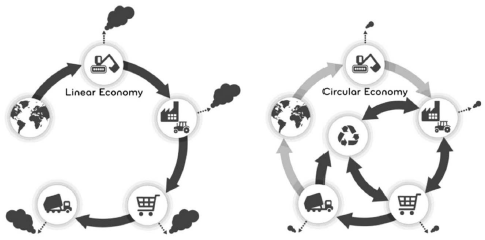
Webster (2017) emphasizes that although recycling is taken into account in the linear economy, it is not a matter of completely closing material cycles. Even for products with high recycling rates of 90%, such as aluminum cans, there is a large loss of value and negative impact on the environment if the life cycle of a product is only a few weeks or months (Webster, 2017, p. 15). The CE, on the other hand, refers to an alternative economic concept that aims to eliminate the negative impact on the environment by preserving resources in the economic system with minimal loss of value without generating waste (Sauvé et al., 2016; Webster, 2017). The concept of CE pursues the goal that through the design of products, systems, and business models, natural systems are regenerated, energy is generated from renewable sources, materials are harmless, and renewable for people and nature, and waste is avoided (Ellen MacArthur Foundation, 2021a). Today the CE gains social and political relevance through its integration into the United Nations’ 2030 Agenda for Sustainable Development (SDG 9: Build resilient infrastructure, promote inclusive and sustainable industrialization and foster innovation; SDG 12: Ensure sustainable consumption and production patterns) (Ellen MacArthur Foundation, 2021a; United Nations, 2022) and into the European Commission’s Circular Action Plan, which is part of the European Green Deal and makes the transition from a linear economy to a circular economy a key industrial strategy in the European Union to achieve climate neutrality by 2050 (Europäische Kommission, 2020).
Companies are thus increasingly faced with a politically forced conversion of product development (PD) for a linear economy to a CE. This transition requires a rethinking of product development processes (PDP), new skills and knowledge of new methods by product developers. Especially in SMEs, a transition is a complex task due to limited resources and application hurdles (De los Rios & Charnley, 2017; Den Hollander, 2018; Garcés-Ayerbe et al., 2019; Ghisellini et al., 2016; Hartanto & Chang, 2022; Ormazabal et al., 2018; Rizos et al., 2016). The development of circular products is a complex task for which the use of new design methods is necessary (Bocken et al., 2016). A design method is understood to be a planned approach to achieving a specific outcome (Gericke & Eckert, 2017; Standard VDI 2221, 2019). Planned procedures support the processing of complex tasks in PD in particular (Graner, 2013). Accordingly, the use of design methods can support product developers in the processing of a comprehensive task by systematically breaking down the task into individual work steps and task areas. In addition, the communication and cooperation of the teams in the PD are supported. Therefore, this contribution addresses the question of which requirements must be placed on design methods from circular design (design for CE; Fifield & Medkova, 2016) so that they can be applied in SMEs and support circular PD in a targeted manner. In this contribution, circular design methods are methods that meet the definition of a design method to support an activity in the PDP and are assigned to circular design by the creators of the method. As examples of method catalogs containing circular design methods, The Circular Design Guide by Ellen MacArthur Foundation and IDEO (2018) and the Use2Use Toolkit by Rexfelt and Selvefors (2021b). Last one contains design methods to help designers consider multiple product lifecycles and have a strong user focus. In addition to a long product lifecycle, designers in PD must take into account that products have a range of different users in multiple use cycles and consider how the process of replacing products can take place (Rexfelt & Selvefors, 2021a, 2021b). In addition, associated criteria are formulated, which provide information about the fulfillment of a specific requirement. In the context of this contribution, circular PD is one that aims to develop products in terms of CE. By establishing requirements, for the design methods, developers of future methods and tools are provided with information about the criteria to be considered during method development, which are relevant to the use of design methods in SMEs. Also, the requirements and evaluation criteria provide guidance for the method selection of product developers in SMEs and aim to support the method selection process in the PD of SMEs. The overall aim of this contribution is to improve the transfer of circular design methods into practice to support SMEs in the development of circular products.
In the context of CE, a corresponding design approach is being discussed in the field of design research, namely, the circular design mentioned above. This results in new principles, guidelines, and methods with the help of which the development of products for CE is to be accelerated. In contrast to eco-design, there is no scientific consensus on the concept of CE (Homrich et al., 2018), which makes it even more difficult for the PD team to select suitable design methods for circular developments. New design methods that refer to circular design often address different focal points. Therefore, in this contribution, on the one hand, the basic building blocks of circular design will be formulated into requirements for design methods within the scope of CE. On the other hand, general requirements for design methods in the context of an application in SMEs will be formed. In the following sections, the principles and goals of circular design will be discussed, followed by the challenges of applying the method in SMEs.
Goals and Principles of Circular Design
The aim of circular design is to present an action plan for PD, which shall make it possible to achieve the objectives set out in the CE and take into account its basic principles. It represents a kind of procedural model with a focus on the circularity of the product. In this context, it is relevant to consider the basic principles of the concept of CE, since CE brings together many different schools of thought (Blomsma & Brennan, 2017; Webster, 2017). Therefore, as it stands now, CE can be described more as an umbrella concept that encompasses various existing concepts in order to relate them to each other (Blomsma & Brennan, 2017). One of the existing concepts that has a meaningful impact on the concept of CE is cradle-to-cradle (C2C). At its core, C2C describes a closed biomimetic system in which there are both biological and technical cycles and is based on the study of non-linear systems from nature in which waste does not exist as such (Braungart & McDonough, 2021; Ghosh & Ghosh, 2021; Webster, 2017). Closing these loops and avoiding waste are essential basic principles of CE (Ellen MacArthur Foundation, 2021b). In their analysis of 114 definitions of the term “circular economy”, Kirchherr et al. (2017) conclude that closing the loops with the help of so-called r-strategies (strategies, such as, repair, reuse, refurbish) represents an essential component of CE. Furthermore, a systemic perspective and consideration of the interrelationships of objects and individuals in a system is a characteristic feature of CE (Kirchherr et al., 2017; Webster, 2017).
The basic principle here is to identify, understand, and be able to use the relevant relationships and connections of different elements in a system to change an existing system. In context to the PD, the systemic perspective in circular design is considered by considering the reuse of materials, components, and resources as well as the anticipation of multiple product use cycles. This replaces, thus the assumption that a product becomes waste after use. Accordingly, during PD, both the company’s business model and the system or societal and environmental context in which a product is developed shall be considered.
Other objectives in a circular PD deriving from the explained concept of the CE are the use of renewable energy, the avoidance of toxic chemicals and materials that prevent the possible reuse of the product, and the elimination of waste (Moreno et al., 2016; Murray et al., 2017). The goals pursued are with the help of a targeted selection and design of material, product, system, and business model for a CE (Ellen MacArthur Foundation, 2021a; Moreno et al., 2016). The principles of circular design are to close biological and technical cycles and to keep products in cycles for as long as possible (Den Hollander et al., 2017; Moreno et al., 2016).
Different principles, strategies and recommended actions for circular PD can be found in the literature to achieve the described goals (Bakker et al., 2019; Den Hollander et al., 2017; Mestre & Cooper, 2017; Moreno et al., 2016). At this point, Moreno et al. (2016) propose a conceptual approach to circular design based on an analysis of several strategies from the literature on circular design and CE. For PD, the approach proposes a set of strategies of DfX that can be used to complement circular design. The approach is based on a classification of DfX strategies by De los Rios and Charnley (2017) that are suitable for circular design. The result of the analysis is five strategies for circular design, each of which is derived from the three DfX approaches for circular design (Table 1).
Circular Design Strategies in the Circular Design Framework.
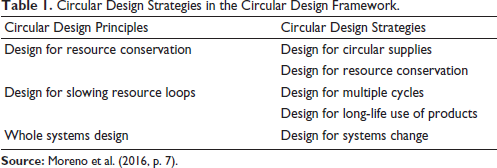
The strategies listed in the table focus on the concept of CE on PD that aims to close resource cycles. The design for circular supplies strategy focuses on biological cycles and points to the principle that waste equals food, which is based on the C2C approach. Resources extracted from nature are processed into products and can be returned to the environment after use without negative consequences for the environment (Moreno et al., 2016).
The two strategies—design for resource conservation and design for multiple cycles—refer to both the biological and technical cycles of a product. The design for resource conservation strategy aims to develop products with minimal use of resources (Moreno et al., 2016). Specific recommendations for action to minimize the use of resources in PD are to reduce the number of parts and components required and to reduce the weight and volume of product components and a product (Mestre & Cooper, 2017). The design for multiple cycles strategy aims to develop products in such a way that the materials used can circulate in several cycles and remain intact (Moreno et al., 2016). Specific recommendations for action here include, for example, the possibility of meaningful disassembly and possible reassembly (design for disassembly and reassembly). When pursuing this strategy, the aim of PD is to ensure that an obsolete product can be taken back by the company and that the product, materials, or components can be offered again in the form of the same or a new product after reprocessing (Bakker et al., 2019).
The design for long life use of products strategy, which relates to technical cycles, aims to develop products with the longest possible service life and useful life (Moreno et al., 2016). In PD, the aim is to find ways of repairing, reconditioning, and maintaining products (Bakker et al., 2014). Another important component of circular design is the holistic view of systems (De los Rios & Charnley, 2017). The design for systems change strategy relates to technical and biological cycles and aims to think in terms of complex systems between the elements involved and their interrelationships in order to find innovative solutions (Moreno et al., 2016). The basic principle is to identify, understand, and use the relevant relationships and connections between different elements in a system in order to change an existing system (Charnley et al., 2011).
Challenges of SMEs in the Application of Design Methods
However, the successful use of design methods is associated with an additional effort for the user, due to the search and selection as well as the learning of the method (Beckmann, 2021). In addition, there is a perception in research that new design methods are rarely used in practice. Wallace (2011) sees the lack of transfer of methods from design research to practice as one of the reasons for this. He names the insufficient recognition of researchers aiming to transfer design methods into practice as a problem (p. 244). According to this, the target audience of most methods originating from academic literature does not focus on product developers in practice, but they are aimed at the scientific community, which means that the literature on new design methods often lacks didactic elements such as application-oriented explanations, hints, aids, and evaluations to make a problem-oriented selection of a method (Birkhofer et al., 2002).
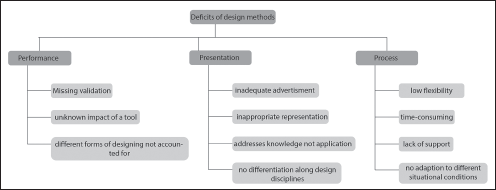
In addition, the application of the methods is inhibited because design methods are often perceived by practicing product developers as too complex, abstract, inflexible, and theoretical. The application is also made more difficult by the fact that design methods often only exist in the form of prototypes (Wallace, 2011). New design methods from academic literature do not seem to meet user requirements. Further, the impression arises that product developers do not consider an extensive selection of new methods, besides time pressure, as their task (Wallace, 2011). Badke-Schaub et al. (2011) categorize the reasons of low acceptance of design methods in practice into three groups (Figure 2). In the first place is the unclear performance or result that a method achieves. In the second place is an inappropriate presentation of the method, lack of differentiation between different design disciplines, and a focus on knowledge instead of application. Likewise, process-related problems such as insufficient flexibility, high time requirements, or a lack of support for the implementation of the method lead to a low acceptance of methods in practice (Badke-Schaub et al., 2011).
Other barriers to the use of methods are the lack of knowledge of potential users about the implementation of a method as well as the large selection and wide range of use of methods, which can lead to overwhelm in the selection process (Guertler, 2018; Wallace, 2011).
Design methods developed by the scientific community are often seen by industry as too abstract for real-world applications (Braun, 2005). The methods are often very complex, require a lot of resources, or do not meet the needs of product developers, or are not compatible with their way of working. In addition, insufficient training or guidance is provided (Rossi et al., 2016; Wallace, 2011). Regarding methods for CE, Saidani et al. (2017) point out that existing methods for product evaluation often lack relevant information to be operationally applied in practice and the methods often do not represent a holistic product evaluation in the context of CE because they do not reflect the complexity of CE (p. 10).
All the above-mentioned gaps are hurdles leading to the necessity of this contribution as a tool to overcome these hurdles in order to achieve a PD towards higher sustainability. Product developers of SMEs are until now faced with the challenge of selecting from the pool of circular design methods—methods that are both applicable and integrable into existing processes for a specific task, such as strategy definition, material selection, idea generation, or concept evaluation. In order to meaningfully assess and select a method from this pool of existing methods to embed a circular PD (i.e., a method which focuses on the cycle of resources in CE), some evaluation criteria are needed, which are discussed in the following section. The evaluation criteria are intended to enable a more targeted selection of design methods that meet the requirements of a CE.
Requirements for Design Method Selection
From the challenges discussed in the above sections, three requirements emerge that need to be considered when integrating design methods from circular design into SME PDPs. In order to select an applicable and integrable design method for a specific task, product developers can compare several options using an evaluation matrix. The evaluation is based on predefined evaluation criteria for the design methods.
The aim of a method shall be to support the development of products in terms of CE, taking circularity into account already in the early phases of the PDP. Furthermore, this method must be integrable and applicable to the PDP of SMEs.
For the formulation of requirements for circular design methods, the work is based on a list of evaluation criteria by Kokoschko et al. (2021) which have been formulated for the evaluation of methods and tools from ecodesign for integration into the PDP of SMEs. This contains the three requirements: sustainability, applicability, and integrability (Figure 3).
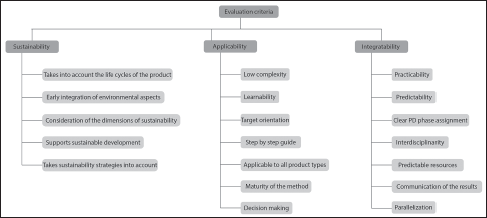
The requirements “applicability” and “integrability” with the associated evaluation criteria can be transferred to design methods from the circular design due to their focus on the application of a method in SMEs. On the one hand, a method must be applicable in PDP of SMEs and on the other hand, it must be integrable into them. According to the challenges in applying design methods in practice, the requirements for design methods are considered by the evaluation criteria of applicability and integrability.
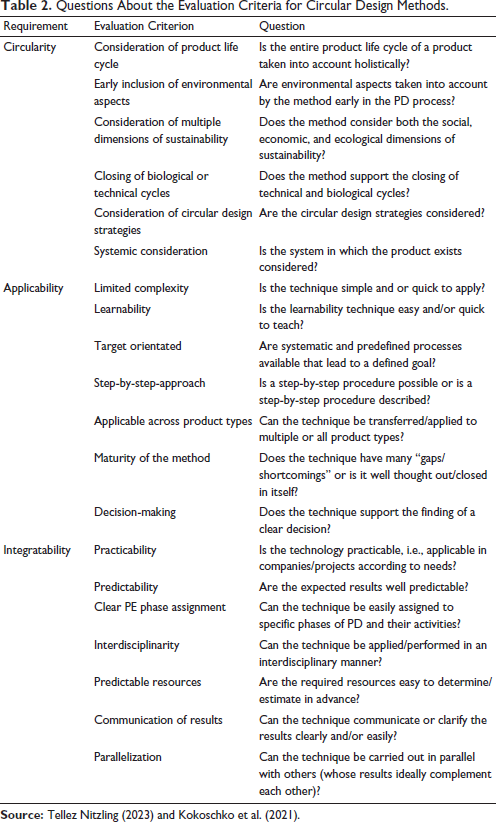
The requirement “sustainability” evaluates the extent to which a design method supports the development of sustainable products (Kokoschko et al., 2021). Due to the differences between circular design and ecodesign as well as other sustainable design approaches (Den Hollander et al., 2017), it is necessary to adapt the requirements (from Figure 3) to include the transformation to CE through design methods in the assessment. The extent to which a design method takes circularity into account for the development of a product is determined by the principles of circular design and following CE. Therefore, the requirement of “circularity” is formed at this point. Since the circular design strives for the development of sustainable products for CE, requirements from the sustainability are considered by the “circularity” in parts. The requirements of “circularity”, “applicability”, and “integrability” provide information on whether a circular design method can be used in SMEs for the development of circular products. Evaluation criteria are grouped within the requirements, the assessment of which provides a statement about the answer to the associated question and the fulfillment of the associated requirement (Table 2).
Questions About the Evaluation Criteria for Circular Design Methods.
Circularity
The evaluation criteria included under circularity (Figure 4) are derived from the information provided previously in this contribution. For the development of a product for CE, the pursuit of its objectives is relevant. Therefore, it is important that, during the PD, the context of a product to the environment and society on nano-, micro-, meso-, and macro-level is illuminated. Furthermore, CE aims at closing loop flows and maintaining products, components, and materials in technical and biological cycles. In addition, sustainable and holistic PD requires consideration of the entire product life cycle.
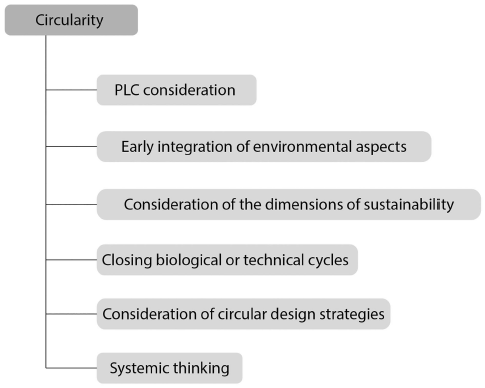
As discussed previously, CE also aims at sustainable and responsible use of natural resources, which is why the evaluation criteria of the sustainability requirement according to (Kokoschko et al., 2021) are brought together with the new circularity requirement. Accordingly, the dimensions of sustainability and the early incorporation of environmental aspects through the application of a design method are also considered at this point. Also relevant to the development of circular products is the consideration of the circular design strategy during the PDP. These points shall also be reflected in the design methods and form the basis for the evaluation criteria shown in Figure 4.
Applicability
To ensure that design methods are applicable in PD teams in SMEs, the weaknesses of PD methods discussed in the section “Challenges of SMEs in the Application of Design Methods” are translated into evaluation criteria. The complexity, learnability, and goal orientation of circular design methods are evaluated under applicability. Furthermore, it is evaluated whether, and to what extent, a guideline for implementation is available and whether the method can be applied to all product types. The maturity of the design methods is also taken into account by checking for gaps and logic errors.
Integratability
The requirement of integrability is directly linked to applicability and provides a statement on whether a design method can be incorporated into PDPs of SMEs. The integrability into the PDP is of importance in order to identify methods that can be integrated into the PDP of SMEs. Evaluation criteria such as practicality, predictability, interdisciplinarity, use of resources, communication of results, and possibility of parallelization are considered via the requirement.
In total, 3 requirements with 19 criteria result, which provide insights if a design method can be used purposefully in the PDP of SMEs to develop circular products. The criteria offer the potential to improve the method selection process in PDPs by allowing product developers to use the criteria when selecting and considering methods to check whether they are suitable for their own PDP. The criteria will be used in further contributions to analyze existing circular design methods with an evaluation matrix. As SMEs work in diverse and specific environments, conducting an evaluation matrix can also be useful for SMEs when selecting methods, as it allows the criteria to be weighed against each other and thus individual priorities can be addressed.
Summary and Outlook
This contribution shows relevant evaluation criteria for the selection of design methods, which help to develop a circular product. This clearly presents relevant evaluation criteria and can be applied as an evaluation matrix. In order to evaluate the status quo of circular design methods for use in SMEs, general evaluation criteria are required that are relevant for SMEs. The evaluation criteria for this are derived from scientifically sound sources and are suitable for a general evaluation in the context of generally relevant criteria for SMEs. These requirements for PD methods provide a basis for evaluating design methods from circular design and selecting them on a company- or project-specific basis. In the next step, the state of the art of existing design methods from circular design can be analyzed based on the requirements. This can provide an overview of design methods that are suitable for use in SMEs regarding circular PD.
Thus the hurdle, that product developers do not consider as their task to select design methods, whereby also the method selection is very time-consuming and connected with high research expenditure, can be overcome (Wallace, 2011). This problem will be addressed in future research. A selection of existing circular design methods will be tested for circularity, applicability, and integrability to finally create a pool of design methods. This pool of methods is then divided into content categories in order to offer potential users a pre-selection of suitable design methods from circular design and to support SMEs in a transformation towards CE.
The potential of the contribution lies in the increase in the general fulfillment of political requirements by SMEs, general economic and ecological cost reductions, increased raw material security, higher customer satisfaction, and the increase in regional economic forces through the dissemination of knowledge about methods and their application as well as a targeted provision which will be developed in subsequent contributions. In addition, concrete results are also able to demonstrate potential, for example, the Use2Use Toolkit has been extensively tested, and the experiences and results will be made available to SMEs in order to accelerate its application in industry. Furthermore, the methods are tested after their selection and thus checked and evaluated for their practical applicability. This ensures that only tried and tested methods are proposed for use. These methods will be compiled into method cards in subsequent work and prepared for easy selection in the PDP using the selection criteria established in this contribution.
Footnotes
Declaration of Conflicting Interests
The authors declared no potential conflicts of interest with respect to the research, authorship, and/or publication of this article.
Funding
The authors received no financial support for the research, authorship, and/or publication of this article.
