







Abstract
Strategic Information Systems Planning (SISP) enables organizations to align information technology investments with business objectives; however, evidence of its adoption determinants and value outcomes in resource-constrained small and medium enterprises (SMEs) remains limited. This study examines the factors influencing SISP adoption and the value outcomes realized by SMEs in developing economies using the Unified Theory of Acceptance and Use of Technology (UTAUT) framework, extended with outcome constructs. Employing a qualitative multi-case study design grounded in critical realism, we conducted semi-structured interviews with 15 participants across three SMEs in Northern Ghana. The findings reveal that performance expectancy, effort expectancy, social influence, and facilitating conditions collectively shape SISP adoption intentions, with social influence emerging as particularly salient in collectivist business contexts. The identified value outcomes include operational efficiency, enhanced decision-making, improved resource allocation, and increased profitability. Technical feasibility mediates the relationship between adoption determinants and value realization, whereas resource constraints moderate these relationships. This study contributes to theory by extending the UTAUT from individual technology acceptance to organizational strategic planning practices in SME contexts and provides empirically grounded insights into SISP adoption dynamics in developing economies. Practically, the findings guide SME managers to prioritize human capital development and leverage social networks for effective SISP implementation.
Keywords
Introduction
Strategic Information Systems Planning (SISP) has emerged as a critical organizational capability for aligning information technology investments with business objectives (Grover & Segars, 2005; Kearns & Sabherwal, 2006). SISP, defined as the process of identifying computer-based applications that support organizational goals (Lederer & Sethi, 1988), enables firms to leverage IT for competitive advantage, resource optimization, and strategic positioning (Bechor et al., 2010). The strategic deployment of information systems has become increasingly imperative as organizations navigate complex, technology-mediated business environments in which IS-business alignment determines competitive success (Chen et al., 2010; Newkirk & Lederer, 2006).
Small and medium enterprises (SMEs) constitute the economic backbone of most economies, contributing substantially to employment, gross domestic product, and innovation (Santoro et al., 2018). In Ghana, SMEs account for approximately 70% of industrial employment and contribute over 50% of the GDP (Abor & Quartey, 2010). Despite their economic significance, SMEs face distinctive challenges in technology adoption, including resource limitations, skill gaps, and infrastructure constraints that fundamentally shape their capacity for strategic IS planning (Levy et al., 1999; Kamariotou & Kitsios, 2019). These challenges are particularly acute in developing economies, where unreliable power supply, limited Internet access, and inadequate computing resources compound existing organizational limitations (Mhlanga, 2023; Owusu & Broni Jr, 2020).
Technology adoption research has evolved through individual acceptance models (Davis, 1989; Venkatesh et al., 2003) and organizational readiness frameworks (Parasuraman, 2000; Weiner, 2009). The Unified Theory of Acceptance and Use of Technology (UTAUT) synthesizes eight prior acceptance models into a comprehensive framework explaining technology adoption through performance expectancy, effort expectancy, social influence, and facilitating conditions (Venkatesh et al., 2003). However, existing UTAUT applications predominantly examine individual-level technology acceptance decisions, leaving questions about organizational-level strategic planning practices underexplored (Dwivedi et al., 2019). Moreover, UTAUT studies predominantly assume baseline infrastructure conditions characteristic of developed nations, rendering them inadequately sensitive to the resource-constrained environments typical of SMEs in developing economy SMEs.
This limitation manifests as three interrelated challenges in developing countries: First, the factors enabling or constraining SISP adoption among SMEs remain ambiguously defined regarding the relative importance of expectancy constructs versus social and environmental factors. Second, the value outcomes that SMEs realize from SISP adoption lack systematic empirical examination. Third, the understanding of how contextual factors moderate adoption–outcome relationships is absent, obscuring how resource constraints shape the dynamics of SISP implementation. Furthermore, few studies have employed qualitative approaches to illuminate the mechanisms through which adoption determinants translate into value realization in resource-constrained settings.
This study addresses these gaps by extending the UTAUT to examine SISP adoption at the organizational level, while incorporating outcome constructs to capture value realization. Specifically, we investigated performance expectancy, effort expectancy, social influence, and facilitating conditions as adoption determinants, with technology availability and behavioral intention as mediating mechanisms and resource constraints as moderating factors. This conceptualization enables a systematic examination of how adoption determinants interact within resource-constrained SME environments and reveals the value outcomes that emerge from the implementation of SISP. With this framing, we address the following research questions:
What factors influence SISP adoption among SMEs in developing economies, and what value outcomes emerge from such adoptions?
This study makes four primary contributions to the literature. First, we extended the UTAUT from individual technology acceptance to organizational strategic planning practices, demonstrating its applicability in examining SISP adoption in SME. Second, we incorporated outcome constructs into the UTAUT framework, responding to calls to examine “new outcome mechanisms” beyond behavioral intention (Venkatesh et al., 2016). Third, we provide rare qualitative evidence from sub-Saharan Africa, revealing the mechanisms through which adoption determinants translate into value outcomes in resource-constrained environments. Fourth, we identify the moderating role of facilitating conditions and resource constraints in shaping adoption–outcome relationships, extending our understanding of contextual contingencies in technology adoption.
The remainder of this article is organized as follows: Section “Literature Review” reviews the relevant literature on SISP and technology adoption. Section “Theoretical Framework and Research Propositions” presents the theoretical framework and research propositions. Section “Research Methodology” details the research methodology. Section “Findings” presents the findings of the three cases. Section “Discussion” discusses the study’s theoretical and practical implications. Section “Conclusion” concludes with the limitations and future research directions.
Literature Review
Strategic Information Systems Planning in Small and Medium Enterprises
SISP emerged in the 1970s and 1980s as organizations sought systematic approaches to managing increasingly substantial IT investments (Lederer & Sethi, 1988). Early SISP efforts focused on creating comprehensive information architectures and application portfolios aligned with organizational needs (McLean & Soden, 1977). As IT’s strategic potential became apparent, SISP evolved to encompass competitive positioning, business-IT alignment, and capability development (Peppard & Ward, 2004). Contemporary SISP scholarship recognizes multiple dimensions of planning activity, including thoroughness, formalization, focus, flow, participation, and consistency (Grover & Segars, 2005).
The SME-specific SISP literature remains nascent compared to that on large-enterprise research. Levy et al. (1999) found that SMEs’ strategic IS approaches differ fundamentally from large enterprise practices, constrained by resource limitations, skills gaps, and owner–manager decision-making styles. Kamariotou and Kitsios (2017, 2019) examined SISP’s impact of SISP on SME performance and found that planning stages affect performance outcomes, but SMEs face unique challenges in implementing formal planning processes. Several characteristics distinguish SME IS planning contexts: SMEs typically lack dedicated IT departments or IS planning roles, concentrating IS decisions in owner–managers who may lack technical expertise (Duhan, 2007); resource constraints limit the capacity for formal planning exercises; and SMEs often exhibit reactive rather than proactive IS orientations (King & Teo, 2000).
Research on SISP value outcomes has primarily examined large organizations, identifying benefits such as improved IT-business alignment, enhanced competitive positioning, and superior resource allocation (Bechor et al., 2010; Chen et al., 2010). However, whether these outcomes translate to SME remains empirically unexamined. The distinctive characteristics of SMEs, including informal decision-making structures, resource constraints, and owner–manager centrality, may fundamentally alter both the adoption process and the nature of the value realized from SISP implementation in SMEs.
Technology Adoption in Developing Country Contexts
Technology adoption research in developing economies has identified distinctive dynamics that differentiate these contexts from those in developed countries. Infrastructure deficits, including unreliable electricity supply, limited Internet connectivity, and inadequate computing resources, create structural constraints on technology implementation (Baidoo-Anu et al., 2024; Mhlanga, 2023). Human capital limitations, including technical skill gaps and limited digital literacy, compound infrastructure challenges (Ayyoub et al., 2025). These constraints shape both the feasibility and nature of technology adoption in ways that existing frameworks, developed primarily in resource-rich contexts, may inadequately capture.
Ghana exemplifies the paradox of relative regional advancement amid absolute infrastructure constraints. With a Government AI Readiness Index score positioning Ghana among the top 10 nations in sub-Saharan Africa (Oxford Insights, 2024), Ghana demonstrates significant technological capacity within its regional context. However, persistent infrastructure limitations, inconsistent Internet coverage, unreliable power supply, and uneven digital connectivity continue to constrain organizations (Kwarkye, 2025). Understanding how SMEs navigate these constraints to adopt and derive value from strategic IS practices requires analytical frameworks that are sensitive to resource-constrained realities.
Social influence dynamics in developing economies also differ from those in individualistic developed countries. Collectivist business cultures, strong peer networks, and community-oriented decision-making patterns shape technology adoption in ways that may amplify the role of social influence relative to individual expectancy constructs (Baguma et al., 2023). The bricolage literature suggests that resource-constrained organizations “make do” through the creative recombination of available resources, human capital substitution, and collaborative resource sharing (Baker & Nelson, 2005; Garud & Karnøe, 2003). These adaptation mechanisms may enable SISP adoption through alternative pathways that are not captured in conventional adoption frameworks.
Unified Theory of Acceptance and Use of Technology and Its Extensions
The UTAUT synthesizes constructs from eight prior technology acceptance models, including the Technology Acceptance Model (TAM), Theory of Planned Behavior (TPB), and Innovation Diffusion Theory (Venkatesh et al., 2003). The UTAUT posits that four core constructs predict technology adoption: performance expectancy (the degree to which using a technology benefits the performance of activities), effort expectancy (the ease of use associated with the technology), social influence (the degree to which important others believe the individual should use the technology), and facilitating conditions (the degree to which organizational and technical infrastructure supports technology use).
The UTAUT has been extensively validated across technology domains and cultural contexts, demonstrating robust explanatory power for adoption intentions and use behavior (Dwivedi et al., 2019). However, several limitations constrain its application to SISP adoption in SME. First, UTAUT was developed for individual-level technology acceptance decisions, whereas SISP adoption involves organizational-level strategic planning practices with multiple stakeholders and complex decision processes. Second, UTAUT focuses on adoption intentions and use behavior as outcome variables, leaving value outcomes beyond usage underexamined. Venkatesh et al. (2016) explicitly called for extending UTAUT to explore “new outcome mechanisms,” acknowledging this limitation.
Third, UTAUT assumes baseline infrastructure and resource availability that may not characterize SMEs in developing economy SMEs. The facilitating conditions construct partially addresses environmental factors but was conceptualized for contexts where basic infrastructure exists. In severely resource-constrained environments, facilitating conditions may operate as boundary conditions that enable or disable the effects of other constructs, rather than simply adding explanatory power. These limitations motivate the extension of the UTAUT for an organizational-level SISP adoption analysis with explicit attention to outcome constructs and contextual constraints.
Theoretical Framework and Research Propositions
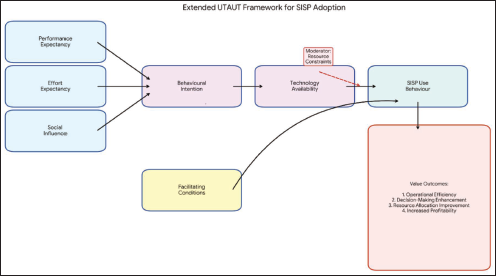
Extended Unified Theory of Acceptance and Use of Technology Framework for Strategic Information Systems Planning Adoption
Building on UTAUT’s theoretical foundation while addressing its limitations for SME SISP contexts, we develop an extended framework incorporating both adoption determinants and outcome constructs. Our framework reconceptualizes UTAUT constructs at the organizational level, adding technology availability as an enabling factor and value outcomes as the ultimate dependent variable. This extension responds to calls to examine outcome mechanisms beyond use behavior (Venkatesh et al., 2016), while maintaining theoretical coherence with established acceptance research.
The framework comprises four adoption determinants (performance expectancy, effort expectancy, social influence, and facilitating conditions), two mediating mechanisms (technology availability and behavioral intention), and four value outcome dimensions (operational efficiency, decision-making enhancement, resource allocation improvement, and profitability increase). This structure enables a systematic examination of both the factors driving SISP adoption and the value realized from implementation.
Research Propositions
Performance expectancy represents SME owner–managers’ beliefs that SISP will enhance organizational performance. Human Capital Theory (Becker, 1964) posits that knowledge-based resources enable organizations to exploit opportunities effectively. In the SME context, owner–managers’ expectations that SISP will improve productivity, enable smooth operations, and enhance competitiveness shape their willingness to invest in strategic IS practices. Prior research has established performance expectancy as a strong predictor of technology adoption intention (Chao, 2019; Venkatesh et al., 2003).
Effort expectancy captures the perceived ease of learning and using SISP. TAM research consistently demonstrates that perceived ease of use predicts adoption intention (Davis, 1989). For SMEs lacking dedicated IT expertise, the perceived complexity of strategic IS planning significantly shapes their willingness to adopt it. Technologies perceived as simple to understand and implement face lower adoption barriers (Rahi et al., 2019).
Social influence encompasses the effects of peers, family, competitors, and the community on adoption decisions. In collectivist business cultures, characteristic of many developing economies, social influence may exert particularly strong effects on technology adoption (Bozan et al., 2016). SME owner–managers embedded in business networks observe competitors’ technology use, receive recommendations from trusted peers, and respond to community expectations regarding technology adoption. The subjective norm construct from the TPB suggests that perceived social pressure shapes behavioral intentions (Ajzen, 1991).
Facilitating conditions represent the organizational and technical infrastructure supporting SISP implementation. For SMEs, these conditions encompass resource availability, access to expertise, and technical infrastructure. This construct aligns with perceived behavioral control (Ajzen, 1991), capturing beliefs about the capability to perform a behavior given the available resources. In resource-constrained contexts, facilitating conditions may function as enabling factors that determine whether adoption intentions translate into implementation (Chen et al., 2019; Venkatesh et al., 2003).
Technology availability refers to the presence of appropriate technological tools that enable the implementation of SISP. For SMEs, available technologies, including computer systems, point-of-sale applications, mobile payment platforms, and social media tools, constitute the technical substrate upon which strategic IS practices operate (Brynjolfsson & McAfee, 2014). Technology availability mediates adoption intentions and actual use behavior, as intentions cannot translate into behavior without appropriate technological means.
Behavioral intention represents the motivational factors that influence SISP adoption behavior. The intention–behavior relationship is well established in the technology acceptance literature (Ajzen & Fishbein, 1970; Venkatesh et al., 2003). Strong intentions to adopt SISP, which are shaped by expectancy beliefs and social influences, translate into actual implementation efforts. However, intentions alone are insufficient; use behavior emerges when intentions combine with facilitating conditions and technology availability.
Value outcomes extend beyond usage behavior to capture the organizational benefits realized from SISP adoption. Drawing on the IS success literature (DeLone & McLean, 2003), we conceptualize value outcomes across four dimensions: operational efficiency (streamlined processes and reduced errors), decision-making enhancement (improved information quality and analytical capability), resource allocation improvement (optimized deployment of organizational resources), and increased profitability (revenue growth and cost reduction). These outcomes represent the ultimate dependent variable in our framework, capturing the benefits of SISP adoption.
Research Model.
Research Methodology
Research Philosophy and Design
This study adopts a critical realist philosophical stance, which holds that social phenomena have real causal mechanisms that exist independently of our awareness, while acknowledging that our access to these mechanisms is mediated through interpretation (Mingers et al., 2013; Volkoff & Strong, 2013). Critical realism is particularly pertinent for examining SISP adoption in SMEs because the factors shaping adoption and the mechanisms linking adoption to outcomes may not be explicitly recognized by the organizational actors themselves. Critical realism enables researchers to move beyond surface-level descriptions to identify underlying generative mechanisms while respecting the interpretive nature of social phenomena.
We employed a qualitative multi-case study design (Yin, 2018). The case study methodology is appropriate for investigating contemporary phenomena within real-life contexts, particularly when the boundaries between the phenomenon and context are not clearly evident. Our focus on SISP adoption embedded within ongoing SME operations makes the case study an apt methodological choice. The multi-case design enables analytical generalization through pattern identification across cases while preserving the contextual richness essential for understanding adoption dynamics.
Case Selection and Description
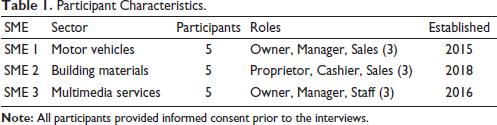
We selected three SMEs in Northern Ghana for investigation using purposive sampling methods. The selection criteria included: (a) active use of IT in business operations; (b) SME classification per Ghanaian standards; (c) willingness to participate; and (d) accessibility for data collection. The cases represent diverse sectors, enabling analytical generalization across contextual variations. Maximum variation sampling across industry sectors (retail, construction materials, and multimedia services) facilitates the identification of patterns that transcend sector-specific dynamics.
SME 1 is an Apsonic motorbike dealership established in 2015 that sells motorcycles, tricycles, and spare parts. The owner holds an HND in Accounting. Technologies employed include point-of-sale systems, mobile payment platforms (MTN MoMo, Vodafone Cash), QR code systems, accounting software, CCTV surveillance, and social media platforms (Facebook, WhatsApp) for customer engagement and marketing purposes.
SME 2 is a building material supplier established in 2018 that sells cement, iron rods, paint, and tiles. The proprietor holds a university degree. Technologies employed include desktop computers for record keeping, point-of-sale applications, GPS for delivery tracking, and mobile payment systems for customer transactions.
SME 3 is a multimedia enterprise established in 2016 that provides photography, videography, graphic design, and printing services. The owner holds a university degree. The technologies employed include specialized photographic equipment (cameras, triggers, softboxes), computers for editing and design, and social media platforms for portfolio display and client acquisition.
Data Collection
Primary data were collected through semi-structured interviews with 15 participants across three cases between April and May 2021. The participants included owners, managers, sales personnel, IT support staff, and service attendants. The interview guide was structured around UTAUT constructs adapted for organizational-level SISP practices: performance expectancy (expected benefits from strategic IS practices), effort expectancy (perceived ease of implementing IS strategies), social influence (peer, competitor, and community effects on IS decisions), facilitating conditions (resource and infrastructure availability), technology availability (IS tools in use), behavioral intentions (plans for IS development), and value outcomes (benefits realized from IS practices). The interviews ranged from 30 to 60 min and were recorded with informed consent. Table 1 presents the participants’ characteristics of the study.
Participant Characteristics.
Data Analysis
We employed Miles and Huberman’s (1994) approach to qualitative data analysis, which comprises data condensation, data display, and conclusion drawing. The interview recordings were transcribed verbatim and imported into NVivo for systematic coding. Initial coding utilized UTAUT constructs as deductive categories while remaining open to emergent themes. The within-case analysis examined patterns within individual SMEs, while the cross-case analysis identified patterns across cases. Multiple iterations of coding and theme refinement ensured analytical rigor. Pattern matching across cases enabled the assessment of proposition support while preserving the contextual nuances essential for understanding the mechanisms of adoption.
Findings
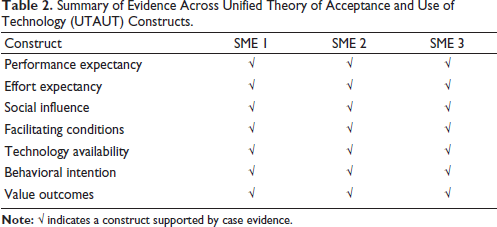
This section presents the findings organized by theoretical constructs, demonstrating how each factor influences SISP adoption and the value outcomes realized. Table 2 summarizes the evidence across the cases.
Summary of Evidence Across Unified Theory of Acceptance and Use of Technology (UTAUT) Constructs.
Performance Expectancy
All three SMEs demonstrated strong performance expectations regarding strategic IS practices. Owner–managers consistently articulated the belief that aligning IT investments with business objectives would enhance productivity and operational effectiveness. The owner of SME 1 explained, “Before we use any technology or software, we consider how we can align it with our business set target. We have seen that when technology is properly coordinated with our objectives, productivity increases significantly.” Similarly, the proprietor of SME 2 noted, “We recognize that our IT systems must support our business goals. When we implemented the point-of-sale system, we expected it to improve our sales tracking and customer service, and it has delivered on those expectations.”
Participants across all cases identified specific performance benefits they expected and subsequently observed from strategic IS practices, including increased sales volume, improved customer service, enhanced record-keeping accuracy, and operational efficiency. The manager of SME 3 articulated: “Our investment in digital tools directly supports our mission to deliver quality services. The technology enables us to serve more clients efficiently while maintaining quality standards.” These findings strongly support Proposition 1, demonstrating that performance expectancy positively influences adoption intentions across diverse SME contexts.
Effort Expectancy
Effort expectancy emerged as a significant factor across cases, with participants emphasizing the importance of the perceived ease of use in technology adoption decisions. Despite their limited formal IT training, the participants reported that they found strategic IS practices accessible when they were properly supported. A sales representative from SME 1 noted, “The technologies we use are not difficult to understand. With some guidance from colleagues who have experience, we learned to use them effectively.” The cashier at SME 2 similarly observed: “The point-of-sale system seemed complex initially, but it became easy to use after some practice. Now it feels natural to our daily operations.”
Notably, effort expectancy interacted with facilitating conditions, particularly with access to expertise. Participants indicated that the availability of IT consultants and technically skilled peers significantly reduced perceived complexity. The owner of SME 3 explained, “Having our IT support person available makes new technology adoption less daunting. They can explain things in terms we understand and help us through initial difficulties.” These findings support Proposition 2, indicating that effort expectancy influences adoption intention, with the effect moderated by access to technical support.
Social Influence
Social influence emerged as a particularly salient factor in these collectivist business contexts, with three distinct sources of influence identified: peer influence, societal expectations, and competitor behavior. Participants consistently described how their technology adoption decisions were shaped by social networks. The proprietor of SME 2 explained: “A friend who is into the sale of provisions lures me to the adoption of the point-of-sale application. He showed me how it helped his business, and I decided to try it.” The owner of SME 1 similarly noted: “We get some ideas from our customers and competitors. When we see that competitors are using certain technologies effectively, we consider adopting similar approaches.”
The general manager of SME 3 articulated a learning-from-peers approach: “I followed a lot of the popular graphic designers and photographers in Ghana to get some knowledge. Observing what technologies successful peers use guides our own technology decisions.” Societal influence extends beyond immediate business networks to encompass broader community expectations regarding technology adoption and modernization. These findings strongly support Proposition 3, with social influence operating through multiple channels to shape SISP adoption.
Facilitating Conditions
Facilitating conditions function as both enablers and constraints of SISP adoption. Two primary dimensions emerged: resource availability and expertise access. Regarding resources, the participants noted both current adequacy and future aspirations. The manager of SME 1 observed: “We have the basic resources needed for our current IT systems, but expanding to more sophisticated planning would require additional investment.” The proprietor of SME 2 explained, “We consider our budget for the year before making technology decisions. Sometimes good ideas have to wait because resources are limited.”
Access to expertise is particularly critical. All three SMEs maintained relationships with IT consultants or technically knowledgeable individuals who provided guidance to them. The owner of SME 1 noted, “We have a private IT consultant we call on when we need advice. Without that relationship, implementing new technologies would be much more difficult.” However, participants also described constraints, including unreliable power supply, intermittent internet connectivity, and limited local technical support. These findings support Proposition 4, demonstrating that facilitating conditions significantly influence adoption and use behavior, functioning as enabling factors that translate intentions into implementation.
Technology Availability and Use Behavior
Technology availability mediates the relationship between adoption intention and actual SISP implementation. All three SMEs deployed similar technology portfolios, including computer systems, point-of-sale applications, mobile payment platforms, and social media tools. Table 3 summarizes the technologies deployed across the cases. The receptionist at SME 3 explained, “Decisions are made based on the positive outcome and consider our business mission and objectives. But we can only implement what the available technology supports.” The owner of SME 1 noted, “Our technology choices are guided by what is available, affordable, and appropriate for our business scale. We cannot implement strategies that require technologies beyond our reach.”
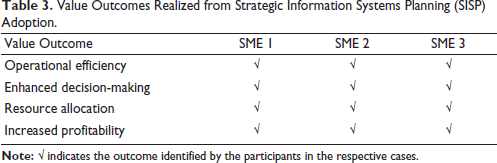
Value Outcomes Realized from Strategic Information Systems Planning (SISP) Adoption.
Use behavior exhibited patterns of committed and consistent engagement with SISP practices. Participants described the regular and systematic use of technology aligned with business objectives. The owner of SME 2 observed: “Our use of IT systems is not occasional; it is integral to how we operate daily. The technology has become embedded in our business processes.” The general manager of SME 3 noted, “We continuously use our systems because they deliver value. As long as they benefit our business, we will continue using and improving them.” These findings support Propositions 5 and 6, demonstrating that technology availability mediates adoption-behavior relationships and that behavioral intentions translate into sustained-use behavior.
Value Outcomes
All three SMEs reported substantial value outcomes from SISP adoption across four dimensions: operational efficiency, decision-making enhancement, resource allocation improvement, and profitability increase. Table 3 summarizes the value outcomes across the cases.
Improvements in operational efficiency have been universally reported. The proprietor of SME 2 explained, “Our operations run more smoothly now. The technology helps us track inventory, manage sales records, and coordinate with suppliers more efficiently.” The general manager of SME 3 noted: “We can serve more clients in less time while maintaining quality. The technology streamlines our workflow from client consultation through final delivery.”
Decision-making enhancement has emerged as a critical outcome. The owner of SME 1 articulated this as follows: “Our IT systems provide information that helps us make better business decisions. We can see sales patterns, identify which products perform well, and plan accordingly.” The cashier at SME 2 added: “Having accurate records helps management make informed decisions about inventory levels and supplier relationships.”
Resource allocation improvements were consistently identified. Participants described better deployment of financial, human, and material resources, enabled by strategic IS practices. The manager of SME 1 explained, “We allocate resources more effectively now. The technology helps us identify where resources are needed most and avoid wasteful spending.”
An increase in profitability represents the ultimate value outcome. All three SMEs reported revenue growth and cost reduction attributable to the SISP adoption. The proprietor of SME 2 summarized this by stating, “Our profit margin has improved since we implemented these systems. We serve customers better, manage costs more carefully, and make fewer errors.” The owner of SME 3 noted: “The technology investment has paid for itself many times over through increased business and reduced operational costs.” These findings strongly support Proposition 7, demonstrating that SISP use behavior translates into tangible value outcomes across multiple dimensions.
Discussion
This study investigated the determinants and value outcomes of SISP adoption among SMEs in a developing economy using the extended UTAUT framework. The findings offer several theoretical and practical insights that advance the understanding of technology adoption in resource-constrained organizational contexts.
Theoretical Implications
Extension of UTAUT to Organizational Strategic Planning
This study demonstrates the applicability of UTAUT constructs to organizational-level SISP adoption, extending the framework beyond its original individual technology-acceptance focus. All four core UTAUT constructs–performance expectancy, effort expectancy, social influence, and facilitating conditions–exhibited explanatory relevance in the SME SISP context. However, the relative salience of the constructs differed from typical individual-level applications. Social influence emerged as particularly prominent, consistent with the collectivist business culture in the study context. This finding extends Venkatesh et al.’s (2003) observation that social influence effects are stronger in the early adoption stages by demonstrating that cultural context amplifies social influence effects regardless of the adoption stage.
The study also revealed that UTAUT constructs interact differently at the organizational and individual levels. Facilitating conditions operate as enabling factors that determine whether adoption intentions can be translated into implementation, rather than simply adding explanatory power as in individual-level applications. This finding suggests that organizational-level UTAUT applications require reconceptualizing facilitating conditions as boundary conditions rather than additive predictors, particularly in resource-constrained contexts where basic infrastructure cannot be assumed to exist.
Incorporation of Outcome Constructs
Responding to calls for examining “new outcome mechanisms” (Venkatesh et al., 2016), this study extends the UTAUT by incorporating value outcomes as the ultimate dependent variable. The four-dimensional outcome of conceptualization, operational efficiency, decision-making enhancement, resource allocation improvement, and profitability increase captures the realized benefits of SISP adoption beyond use behavior. This extension addresses a significant limitation of traditional UTAUT applications, which treat usage as the endpoint, obscuring the organizational value that presumably motivates adoption in the first place.
The findings demonstrate that the value outcomes vary in their relationship with use behavior. Operational efficiency improvements appear to follow relatively directly from technology use, while profitability increases involve longer causal chains mediated by efficiency gains and improved decision-making. This suggests that future UTAUT extensions should model value outcomes hierarchically, rather than as undifferentiated constructs.
Social Influence Primacy in Collectivist Contexts
A notable finding is the prominent role of social influence in shaping SISP adoption. Three distinct sources of influence–peer influence, societal expectations, and competitor behavior–operated through different mechanisms to shape adoption decisions. This finding aligns with and extends the cross-cultural technology adoption literature, suggesting that collectivist cultures exhibit stronger social influence effects (Baguma et al., 2023; Srite & Karahanna, 2006). This study provides qualitative depth to this observation by revealing the specific social mechanisms through which influence operates in developing economy SME contexts.
The learning-from-peers dynamic identified in this study resonates with bricolage theory’s emphasis on social capital as a resource for overcoming constraints (Baker & Nelson, 2005). SME owner–managers lacking internal expertise compensated through social networks that provided both technology awareness and implementation guidance to SMEs. This suggests that social influence in resource-constrained contexts serves a dual function: shaping adoption intentions and enabling implementation by providing access to distributed expertise. Besides, the findings reveal the bounded compensation mechanisms through which SMEs navigate resource constraints to achieve SISP adoption. Access to expertise through social networks compensates for internal capability limitations, enabling implementation despite constraints on human capital. However, participants also described limits to compensation: persistent infrastructure deficits (unreliable power, intermittent connectivity) created hard constraints that could not be overcome through social mechanisms such as sharing. This bounded compensation finding extends bricolage theory (Baker & Nelson, 2005) by specifying the types of constraints amenable to social compensation and those requiring direct remediation.
Practical Implications
The findings offer actionable guidance for SME managers, policymakers, and support organizations seeking to promote SISP adoption and value realization in developing economies.
For SME owner–managers, this study highlights the importance of cultivating social networks that provide technology awareness and implementation support. Rather than viewing technology adoption as an individual decision, owner–managers should actively engage in business networks, attend industry events, and build relationships with technically skilled peers and consultants. The learning-from-peers approach identified across cases represents a practical strategy for overcoming internal expertise limitations.
For policymakers and SME support organizations, the findings suggest that interventions should leverage social influence dynamics rather than relying solely on individual training programs. Business network facilitation, peer mentoring programs, and industry association strengthening may prove more effective than isolated technology training. Additionally, policies addressing infrastructure constraints, particularly reliable electricity and Internet connectivity, are essential for enabling the adoption of SISP. Human capital development alone cannot compensate for severe infrastructure deficits in the Philippines.
For technology vendors and consultants serving SME markets, the findings emphasize the importance of perceived ease of use and ongoing support. Technologies perceived as complex face significant adoption barriers in contexts where technical expertise is limited. Vendors should invest in user-friendly interfaces, local language support, and accessible training resources for the same. Building long-term consulting relationships with SME clients enables ongoing support for SISP implementation.
Limitations and Future Research
Several limitations bound our findings and suggest directions for future studies. First, our cases represent a single geographic context (Northern Ghana) and may not be generalizable to other developing economies. Future research should examine the determinants of SISP adoption across diverse developing economies to identify context-specific versus generalizable dynamics. Comparative studies across sub-Saharan African countries would be particularly valuable for establishing regional patterns.
Second, our cross-sectional design captures SISP practices at a single point, limiting our ability to examine how adoption determinants and value outcomes evolve over time. Longitudinal designs could trace how the relative importance of the UTAUT constructs shifts as SMEs mature in their SISP practices and how value outcomes accumulate or plateau over implementation periods.
Third, reliance on retrospective self-reports may introduce recall bias regarding technology adoption decisions and perceived outcomes. Future research employing objective performance measures and contemporaneous data collection should strengthen causal claims regarding adoption–outcome relationships.
Fourth, while our qualitative approach provides rich insights into adoption mechanisms, quantitative testing of the extended UTAUT framework would establish effect sizes and enable hypothesis testing across larger samples. Survey-based research with structural equation modeling could validate the proposed relationships and identify the moderating effects of contextual factors.
Conclusion
This study investigated the determinants and value outcomes of SISP adoption among SMEs in Ghana using an extended UTAUT framework. Integrating qualitative evidence from 15 semi-structured interviews across three SMEs, we demonstrate that performance expectancy, effort expectancy, social influence, and facilitating conditions collectively shape SISP adoption intentions, with social influence being particularly salient in collectivist business contexts. Value outcomes identified include operational efficiency, enhanced decision-making, improved resource allocation, and increased profitability.
The findings establish several theoretical contributions: the extension of the UTAUT from individual to organizational-level analysis, incorporation of value outcomes beyond use behavior, identification of social influence primacy in collectivist contexts, and revelation of bounded compensation mechanisms in resource-constrained environments. Practically, the findings guide SME managers toward cultivating social networks for technology awareness and implementation support, inform policymakers about leveraging social influence dynamics in intervention design, and direct technology vendors toward user-friendly solutions with ongoing support relationships.
The limitations of this study include the single-country context, cross-sectional design, and reliance on self-reported outcomes. Future research should employ longitudinal designs, comparative studies across developing economies and quantitative validation of the extended framework. Despite its limitations, this study provides rare qualitative evidence on SISP adoption dynamics in sub-Saharan Africa, advancing both the theoretical understanding of technology adoption in resource-constrained contexts and practical guidance for promoting SISP implementation among SMEs in developing economies.
Footnotes
Declaration of Conflicting Interests
The author declared no potential conflicts of interest with respect to the research, authorship, and/or publication of this article.
Funding
The author received no financial support for the research, authorship, and/or publication of this article.
