







Abstract
The study aims to examine the livelihood of Sambalpuri handloom weavers of Western Odisha, India. By using the primary field survey data and analysing both the qualitative and quantitative data, it presents the socio-economic conditions of the weavers. A binary choice model is used to analyse the livelihood of weavers. The analysis shows that although the price of the product is quite high, almost all the weavers are not satisfied with the amount of the emoluments that they receive. The middleman plays a critical role in marketing. But the actual benefits from marketing the Sambalpuri handloom products are going to middleman rather than weavers. It recommends making necessary policies both by the central as well as the state governments to rescue these handloom weavers.
Introduction
Handloom weaving is one of the largest economic activities after agriculture, providing direct and indirect employment to more than 3,500,000 weavers and allied workers in India (Development Commissioner for Handloom, 2019). India provides a large percentage of the handloom product of the world. This sector contributes to the export earnings of India and 15% of the total cloth production of the country. Handloom industry has a unique place in our economy. The beauty of this profession is that, without any professional training, weaving skills are transferred to the next generation. Handloom is a traditional cottage industry of Odisha. In Odisha, 0.117 million handloom workers earn their livelihood from this industry. There are 63,223 weaver households in the state out of which 53,472 are weavers and 64,364 are allied workers as per the Fourth Handloom Census, 2019 conducted by Government of India. In order to analyse the employment and earnings of handloom weavers it is important to know the contextual factors that influence their choices.
Livelihood is defined as adequate stocks and flows of cash to meet basic needs (Chambers, 1989). However, this definition does not describe how adequate stocks and flows of cash come about. Chambers and Conway (1992) describe livelihood as the capabilities, assets and activities required for a means of living. Scoones (1998), Ellis (2000) and Niehof and Price (2001) following the work of Chambers propounded similar definitions of livelihood. However, these definitions associated the sustainability concept. A livelihood is sustainable when it enables people to cope with and recover from shocks and stresses. It also enhances its capabilities and assets both now and in future without undermining the natural resource base (Ashley & Carney, 1999).
In the handloom industry, productivity declined due to competition from foreign textiles. No new technologies were adopted in the handloom industry and it is traditional in nature. Here, there is no implementation of division of labour or economies of scale. This led to higher transaction cost for the merchants. Research on handloom industry has indicated that competition with machinery was more exceptional than the rule. Traditional preference for consumer goods of certain kind or quality enabled labour-intensive systems to survive. Saree (a long piece of clothing worn by some women) for example allowed design that can be produced by handloom only. These types of designs cannot be created on the textile produced either by the mill or power loom industries. Cultural context created demand for certain forms of craftsmanship in handloom industry. Demand for mass consumables as handloom cloth increased among a group of consumers especially peasants and workers (Roy, 2005). Besides, highly skilled crafts in shawls and carpets emerged as successful exports.
Weavers generally lack knowledge of and access to means of increasing quality and productivity especially in areas of skill development, design input and technical innovation. The crafts producers who lost their traditional markets often are not aware of the potential new markets for their products. Low level of education and rural orientation of majority craftsperson leave them vulnerable to exploitation by middlemen. These middlemen are the weavers’ means to access distant markets. Crafts producers suffer greatly from lack of working capital and access to credit and loan facility (Libel & Roy, 2004). Producers who receive large orders are not able to find funds necessary to purchase raw materials in bulk or to support the family while the work is in process. Various credit schemes are available primarily through government institutions. However, it is difficult for the less educated weavers to understand and access these programmes. They therefore resort to the informal sources of finance, as it is easily available. The weavers do not understand the terms and conditions of the loan and are trapped in these loans.
Sambalpuri handloom is one of the most beautiful textiles of both Odisha and India. The designs created here are intricate and outstanding. Ikat weaving technique is adopted in this type of handloom which is also known as ‘tie and dye’ culture and bandhakala in the local language. The design reflects traditional motifs such as local Gods and their various incarnations, conch shell and holy seed (Rudrakhya) (Ghosh & Ghosh, 2000; Mohapatra, 2014). Besides animals, birds, flowers, leaves, various patterns such as rectangle, square, circle, triangle, etc., are also found in the design (Pradhan & Khandual, 2020). Nowadays, the weavers are experimenting with new designs to enter the new market. 1 These various designs are depicted clearly not only in cotton but also in silk saree weaving. The approach of creating handloom is purely traditional. The main attraction is that these artisans preserve the local culture in their weaving. Creativity, innovative design and rich skill make Sambalpuri handloom unique around the world. It is now important to find that these handloom weavers are now trapped in livelihood crisis. Even though the profession encourages employment and women empowerment, they are prepared to leave this beautiful profession. They prefer to work in any other job where there is no risk, even as a daily wage earner. The problem is that there is no proper social protection or safety net programme which can take care of the handloom weavers.
Background
To enhance better livelihood outcomes, households combine a diverse set of income generating and social activities and construct a portfolio of livelihood activities. Sambalpuri handlooms are made from the fabric knitted on a handloom. The texture of the fabric varies upon the warp and weft yarns used for its production. The important raw materials used in the weaving of these handloom are both cotton and silk.
The Sambalpuri handloom weavers reside in the eastern state of Odisha. This state has one of the highest rates of unemployment among the low-income states of India (Planning Commission, 2002). In terms of development indicators such as literacy rate and infant mortality rate the living conditions of the people of the state are lower than national average. Craft based cottage industries are major source of employment in the region after agriculture. According to Planning Commission (now National Institution for Transforming India (NITI) Aayog) craft production holds considerable promise for gainful employment especially for the less educated and technically under qualified poor in Odisha. It also provides multiple advantages such as low capital investment, eco-friendly nature and migration reducing effects, all of which carry greater potential for economic development.
Among the traditional textiles 2 of Odisha the most renowned is the Ikat, which is popular for its tie-dye tradition. Ikat originated from the Malaysian term mangikat meaning bind knot or wind around (Desai, 1989). It is a type of resist dyeing which involves a sequence of tying or wrapping and dyeing sections of bundled yarn to a predetermined colour scheme prior to weaving. Odisha produces both single and double Ikat patterns. Single Ikat pattern is when only warp or weft is tie-dyed. In double Ikat, both warp and weft are tie-dyed to make complex patterns. Double Ikat design are now found in India, Indonesia and Japan (Desai, 1989). Crill (1998) described the skill required to make double Ikat patterns as it involves a great deal of careful sorting of threads before and after dyeing. Care is taken in setting up the warp and wefts on the loom to ensure that the pre-dyed section appears in the right place of the finished cloth.
Odisha Ikat fabrics are popular all over India. Bargarh, Sonepur, Bolangir, Sambalpur, Boudh and Jharsuguda are the districts where the weavers of Sambalpuri handloom are residing (Crill, 1998). Meher weaving community is the primary creator of Ikat or bandha 3 in Odisha. Bhulia Mehers weave the tie-dyed cotton sarees. There is a wide speculation about the origins of the Meher community who is thought to have migrated from another part of India. Mohanty (2003) stated that they originally migrated from North India perhaps from Rajasthan. Gittinger (1982) argued that it is possible that they migrated from Uttar Pradesh in the fourteenth century. Crill (1998) however is of the view that they migrated from Chhattisgarh.
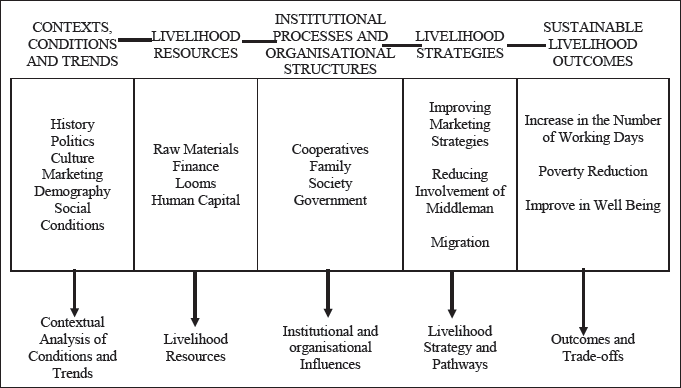
The livelihood framework of the weavers is presented in Figure 1. The various factors determining the livelihood are history, culture, marketing and social conditions in the context, condition and trends. Availability of raw materials, finance, looms and human capital are the various livelihood resources. Institutional processes include cooperatives, family, society and government. Improving marketing strategies and reducing involvement of middlemen are the available livelihood strategies. The livelihood framework is a complex archaeology of ideas and practices bridging perspectives across different fields of rural development (Scoones, 2009). Here some of the factors are internal and some are external. However, the external and internal factors are not mutually exclusive. The handloom weavers require raw materials, marketing, finance and skill development. These are provided by a mix of public and private service providers (Rao, 2012).
Handloom industry in Odisha like in other parts of the country falls under informal sector. The artisans use their family labour and work out of their homes. Artisans purchase the raw materials from service providers. Their access to market is unorganised with multiple channels to reach the consumer from village fairs to local shops with wholesale or retail trade. Generally, three categories of artisans are present. They are independent entrepreneur weaver, corporate weaver and contract weaver (Planning Commission, 2002). In all the three categories, artisans made the initial investment in fixed assets such as loom, yarn winding and sizing tools as well as wooden frames to make tie-dye. Each of the artisans also secured natural capital such as water and firewood required for weaving.
The skill and knowledge of weaving, amongst all the three types of artisans were acquired early in their childhood from immediate family members. The service providers in some cases helped them to raise this skill either by directly imparting the required knowledge or providing them with the opportunity to try new designs. They motivate the weavers to prepare complex designs with the assurance of buyback. This is especially true for the contract weavers working with the master weavers (Rao, 2012). The cooperative weavers received inputs in the form of saree designs or dye mixing techniques. Due to the consistently high quality standard advanced by the cooperatives, the weavers had a greater sense of excellence as well as ability to produce high quality work. In the case of independent weavers, skill and knowledge of tie-dye making were furthered through self-experimentation. The weavers receive finance in various forms such as payments from handloom sale, loan and savings facility. The contract weavers working with master weavers as well as cooperative weavers receive their payments and loan facility primarily through the service provider they work with (Rao, 2012). The cooperative weavers were extended savings facility by the cooperatives and take loan against it at times of need.
The contract artisans interacted with only one service provider for all their physical capital needs (yarn, colour, market and transportation). This is also true in case of cooperative weavers who mainly access different forms of capital through cooperatives. The dyes used for colouring are generally purchased from the village or local town shops. 4 Thus, they interfaced with two service providers. In the case of independent weavers however, the physical capital was often secured from three to four different types of service providers. These providers ranged from independent entrepreneurs to local shops to government organisations. The artisans here purchase yarn and dye from the nearby town. There are no fixed shops from where they buy this from but multiple shops depending on the need, convenience and price factor. They purchase small amount ready tie-dyed yarn from the local Balijuri market from fellow entrepreneurs.
Increasingly, weavers move out of weaving and from villages to cities. Government of India links migration to declining number of handloom weavers. Individuals from other castes come to weaving during period of higher demand (Brennig, 1986). In making the fabric, stages of production are finely differentiated, and different kinds of labour are engaged in different stages (Roy, 2002). In response to the distress of handloom weavers, the Indian Government set up protectionist support policies and systems for this industry by supporting weaver cooperatives at the village level and marketing organisation at the state level. But by the 1990s the Government run marketing organisations were in debt and had lost credibility in the marketplace. This crisis was attributed to the low productivity of outdated handloom technology and insufficient functioning of the cooperatives.
The traditional trader in the village is the master weaver entrepreneur. Usually, he is from the same caste as the weaver. The master weaver invested capital in the value chain and conveyed market information to the weaver. The marketing system was more robust here but less equitable to the weaver in the case of market failure (Mamidipudi et al., 2012). Crisis caused by increases in the prices of yarn resulted in waves of migrations out of weaving and out of villages. The problem can thus be summarised as handloom is unsustainable because it has low productivity and therefore is not competitive in the marketplace. It can also be stated that against mechanised production, loom is not productive enough, weaver is not efficient enough, colours he uses are not standard enough and therefore handloom product is not profitable enough on returns to capital.
Each successive national handloom census shows the number of weavers in villages as a reducing statistic. Reports by media about weaver distress describe it as exodus out of weaving. This is taken as evidence that handloom is chronically unsustainable as a livelihood for weavers. The perspective of handloom livelihoods as unsustainable then becomes the basis for policy making. The moment of unsustainability is supposedly never so clear as when the weaver stops weaving and moves out of village. It seems logical to view the movement of large number of people out of the village as an indication of unsustainability of handloom livelihoods within the village. On the other hand, the policy view of weaver migration with its embedded assumption of unsustainability of why some weavers stay back and continue to weave while others leave. Mindful of idea that migration from village to the city or traditional to modern livelihoods does not in itself a way out of poverty, instead the focus is on the act of moving or mobility. Mobility here includes movements in and out of weaving as livelihood, rural–urban mobility and intergenerational mobility to new identities (Mamidipudi et al., 2012).
Commitment to a livelihood or place depends on the concrete returns from the livelihood they are engaged in. Such returns would decide whether workers feel empowered by modernity or return with feelings of the loss and despair to village (De Neve, 2003). Population movements are not simple economic reactions to push and pull but embedded in local customs and ideologies (De Haan, 1999, 2011). Weavers do not leave home and heart as it was below the dignity of the weaver. The narratives of weavers’ mobility make a visible to and fro movement out of and back into weaving (Mamidipudi, 2016).
Frameworks and Perspectives Used
Western Odisha is known for its weaving and dyeing of fabrics, especially for the Sambalpuri saree. Weaving activity in Western Odisha was started by the Bhulia Meher community in 1726 AD. They were followed by the Costa Mehers (tussar weavers) and Kuli Mehers (relatively less skilled) (UNIDO, 2008). Rich artistry, which is the main architect of Sambalpuri handloom’s work is losing its importance with modernisation. The weavers of Sambalpuri handloom work together as a family business. They learn art of weaving from their forefathers in most of the cases. Almost all the family members are involved in the weaving business. They spend a large amount of time in colouring and preparing the yarn. The yarn generally needs to be processed before use. Preparation of the yarn includes de-gumming, spinning, bleaching, dyeing and reeling, that is, to be filled in the bobbin. It has been observed that usually the men set up the loom and weave and women take on ancillary activities such as colouring the yarn, preparing it and finishing the products. The amount of wage which they earn is very less as compared to the labour they devote for weaving work. Thus, the role played by the family labourers in the evolution of handloom sector is important. Most of the handloom weavers have no other means of livelihood and weaving is the only source of livelihood for them.
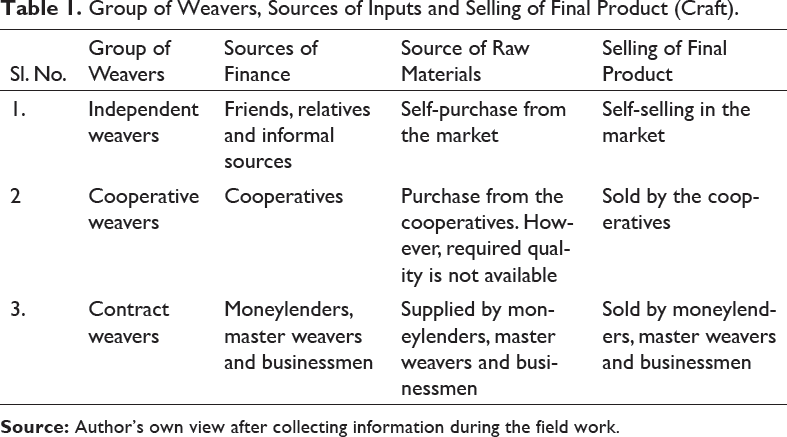
The weavers here are the victim of capitalist mode of production. Many committees and commissions in the past recommended for progressive cooperative sector of production to minimise the level of exploitation of the weavers. These weavers are being exploited by the middlemen and master weaver-cum-merchant capitalist. The cooperatives also in many cases failed to fulfil their objectives because of the role played by the vested interest groups in the management of the cooperatives at grassroot levels. It is observed that production of clothes in the handloom industry in Western Odisha is carried out under three different systems (Planning Commission, 2002). They are (a) independent weavers (entrepreneur weaver), (b) contract weavers (weavers working under master weavers cum merchant capitalist) and (c) cooperative weavers (weavers working under cooperative form of production). The three types of weavers are presented in Table 1.
Independent weavers: The weavers here work out of their home. They purchase raw materials directly from the market from variety of service providers and market their products themselves (Narasaiah & Krishna, 1999). Independent weavers work as entrepreneurs. They work as capitalists and employers but have limited capacity to withstand market fluctuations in supply and demand. This system is also referred to as ‘family firm system’ where all members of the family are engaged in production.
Contract weavers: Under this system, the weaver works on contract with a master weaver. A master weaver is a weaver turned entrepreneur who invests his own capital and employs other weavers (Narasaiah & Krishna, 1999). This is sometimes referred to as ‘putting out’ system where the weaver works on the materials ‘put out’ to him by the master weaver. Under this system, master weaver supplies weaver with working capital usually in the form of materials, design and so on and takes back the woven cloth for marketing. To earn maximum profit, they fix minimum wage for the weavers. This type of production is found in the tie and dye weaving in Sambalpuri handloom.
Cooperative weavers: In the cooperative system, several numbers of artisans are collectively organised, and each one is a shareholder. The idea of the cooperative is to ensure a fair deal for each of its members and avoid artisan exploitation. While artisan cooperatives are supposed to be locally owned or managed, many times they are promoted, subsidised and even managed by governments or non-profit organisations giving them a quasi-public or social enterprise like status. The cooperative typically provides its members with yarn, designs, marketing and financial services. Most of the Government welfare schemes for weavers are channelled through the cooperatives (Mines, 1984). The cooperative system of production is expected to be the best and least exploitative.
Group of Weavers, Sources of Inputs and Selling of Final Product (Craft).
Handloom industry is one of the oldest cottage industries. The art of weaving and dyeing of fabrics was practised from very ancient times. Rich cultural heritage of Odisha is reflected on the handloom. With the liberalisation of the economy the modern textile industry has posed serious threat to the traditional handloom industry. With growing competition from modern textile industry, the handloom sector has steadily deteriorated in last few decades. This led to serious threat to the socio-economic condition of the traditional weavers. Many weavers were unemployed and underemployed resulting in large scale closure of several societies and production units. After several years of prosperity Sambalpuri handloom weavers fallen on hard time. Under the stress of unemployment, low wage and distress sale of handloom cloth many Sambalpuri handloom weavers gave up weaving and adopted other means of livelihood. Some of them migrated to nearby states such as Andhra Pradesh, Tamil Nadu, Kerala, etc., to work as daily wage labourers. Few of them started vending vegetables, pulses and grains in local daily market (Mohapatra, 2014).
The weavers collect the livelihood resources such as raw materials, finance, looms and human capital and weave the handloom. They take help of the cooperatives, society and Government to continue their livelihood. Improving the marketing strategies and reducing the involvement of middlemen in selling handloom will increase the income of handloom weavers. Most of the time, the middlemen exploit the weavers as a result their income decreases. Therefore, it is important to determine the factors responsible for marketing of the products of handloom weavers.
Objectives
In light of this background and these issues, the study aims to find out the diverse contextual factors impacting the livelihoods of weavers and their family members, role played by middlemen in marketing of the products of Sambalpuri handlooms and marketing strategies adopted by weavers.
Research Methodology
Research with culturally diverse population has adopted either quantitative or qualitative methods which are limited by cultural relativity or generality, respectively. Researchers hence are mixing quantitative and qualitative methodologies to investigate experiences of diverse populations. Incorporating community participation into mixed method research design increases the potential benefits of research process (Robinson et al., 2016). The research approach adopted in this study is mixed methods.
Data and Design
Sample Villages and Number of Samples Taken from Clusters of Sambalpuri Handloom.
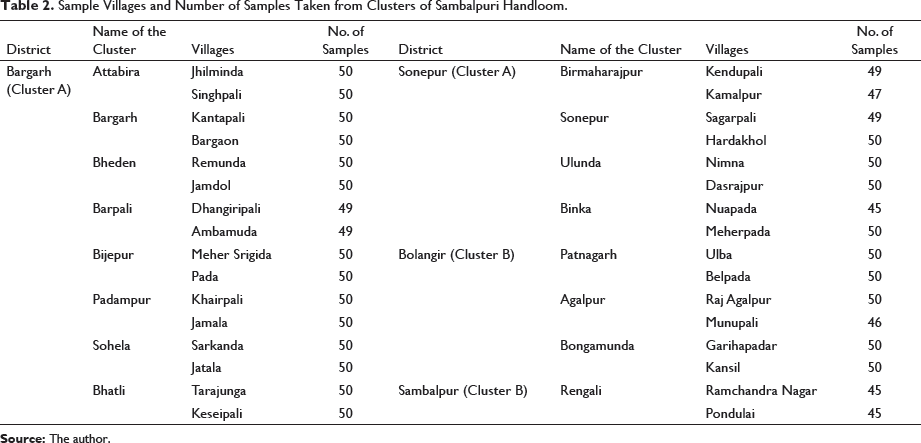
In the weaving districts from each cluster, two villages are chosen considering the number of weavers present in that village. So, a purposive sampling is used in selecting the villages in the cluster (Table 2). Again, some of the households in the specified village are of weavers. However, they are generally located in one part of the village. After location of the weaving households, households are taken for analysis in the sample. Here the households are selected using simple random sampling. The number of households taken for analysis for all the 32 villages are mentioned in Table 2. It ranges from 45 to 50 depending on the availability of weaver households. Interview schedule is prepared to collect primary data from the household. To test the schedule, pilot survey was conducted. Accordingly, the final schedule was prepared after making necessary changes.
Keeping in view the suitability of time of the respondents (weavers), data were collected from the head of the household during September and October 2019. The schedule was sent to the weaver by an interviewer. The interviewer explained the questions in local language and responses were recorded in the schedule. Data on household information, their consumption expenditure, income, time spent in weaving, sources of raw materials like from where they get the yarn, colours to dye, time spent in preparing the yarn, their indebtedness, bank loans, governments help, information on the price of their products, marketing of their products and heterogeneity of the products were collected.
Method of Analysis
With a view to compare the collected data and draw inferences, the data was classified and tabulated according to different district attributes of weaving.
Logit Model
To identify the factors responsible for the marketing of the products of handloom weavers’ logit model was proposed and estimated. The livelihoods of the weavers are dependent on the production and selling of handlooms. This also depends on the income of the household from weaving. The age of the family members engaged in weaving and their education level also plays a crucial role in their earning of a livelihood. Time spent in weaving, which includes preparing of colour and thread for weaving, is also important determinant of the livelihood of the weavers. Logistic regression is the appropriate regression analysis to conduct when the dependent variable is binary (dichotomous). It is used to obtain odds ratio in the presence of more than one explanatory variable (McFadden, 1973). Logit model is used in the study of livelihood when the dependent variable is dichotomous (Bortamuly et al., 2013; Liu et al., 2020; Parvin et al., 2020).
In the present analysis, the Logit model has been applied following McFadden (1973) and Bortamuly et al. (2013). The choice of the weaver to sell the product in the market or cooperative has been taken as the reference category that is Y
i
= 0.
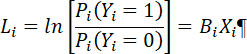
Analysing the influence of different variables in selling the products in handloom industry is proposed by the model is
Y i = b0 + b1 age i + b2 edu i + b3 fmem i + b4 loan i + b5 income i + b6 time i + ε,
where, Y i is the dependent variable with i = 0, 1.
Y i (=0) if weavers are selling the product in the market or cooperative and
Y i (=1) if the weaver is selling the products to him who provides the inputs namely businessman or moneylender.
Here, X i ’s are the independent variables. It includes variables such as
age i —age of the ‘i’ th respondent,
edu i —education of the ‘i’ th respondent,
fmem i —family member engaged in weaving of the ‘i’ th respondent,
loan i —loan is taken by the 'i’ th respondent,
income i —income of the ‘i’ th respondent,
time i —time consumed for weaving by the ‘i’ th respondent and
ε i —random disturbance term.
Here if the income of the household is more, the household will prefer to work as independent weaver. Similarly, if the household is well educated, he will prefer to work as independent weaver but, if loan is incurred from moneylender or businessmen they are bound to work as contract weaver. The significance of the coefficient is tested using the z-statistic. Interval estimation is applied to check the significance of z-statistic. Inferences are also drawn from the p-value.
Findings and Analysis
Purchase of Handloom Machine, Colour, Dye and Yarn
Purchase of Handloom Machine (Monga) by the Weavers (in Percentage).

Purchase of Thread, Colour and Dye by the Weavers (in Percentage).
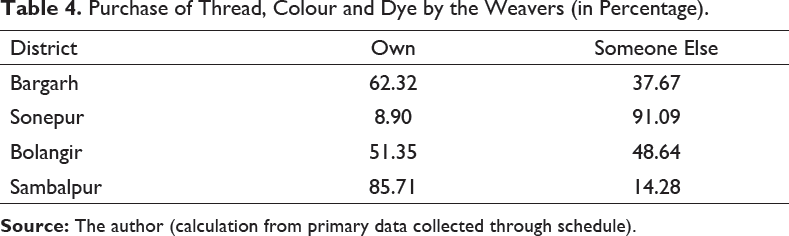
Usually, the master weaver or other businessmen finalise the design of the handloom they want to prepare. Once the design is finalised, they provide yarn, colour and dye to the weavers who are wage earners. Generally, the weaver takes on average a week to finish the Sambalpuri handloom weaving. If it is silk or tassur handloom then it takes more time to finish the work. In Sonepur, 91.09% of the yarn, colour and dye are provided by the businessman or the master weaver. Here the weaver does not have risk of marketing the product. Only 8.90% of the weavers purchase yarn, colour and dye of their own. These weavers have risk of marketing the product. But unlike the wage-earning weavers, they earn more profit. In Bolangir, 51.35% of the weavers purchase raw materials of their own, prepare handloom and sell the same in the market.
Selling of Finished Products
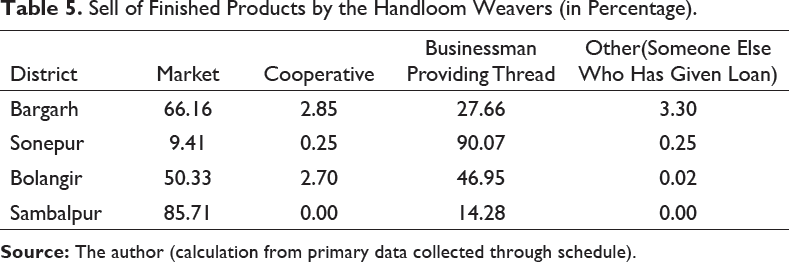
Sell of Finished Products by the Handloom Weavers (in Percentage).
Weavers’ Satisfaction and Dissatisfaction with Wage
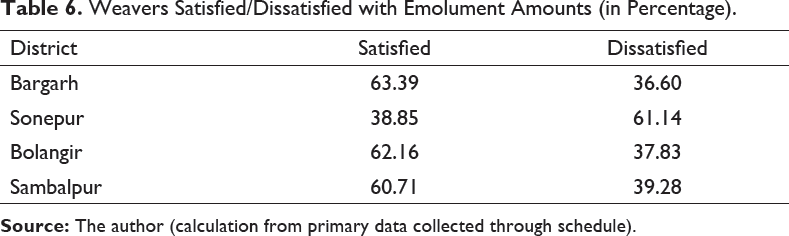
Weavers Satisfied/Dissatisfied with Emolument Amounts (in Percentage).
Sambalpuri Handloom is Costlier
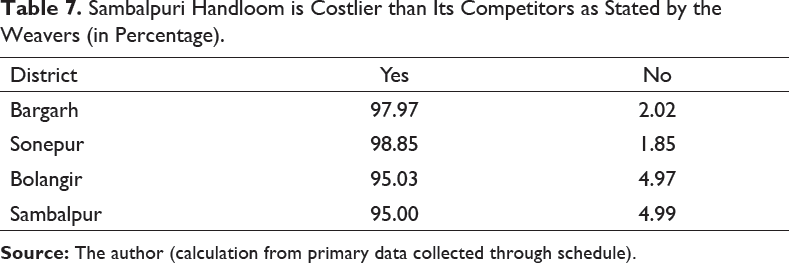
Sambalpuri Handloom is Costlier than Its Competitors as Stated by the Weavers (in Percentage).
Selling and Marketing of Handloom
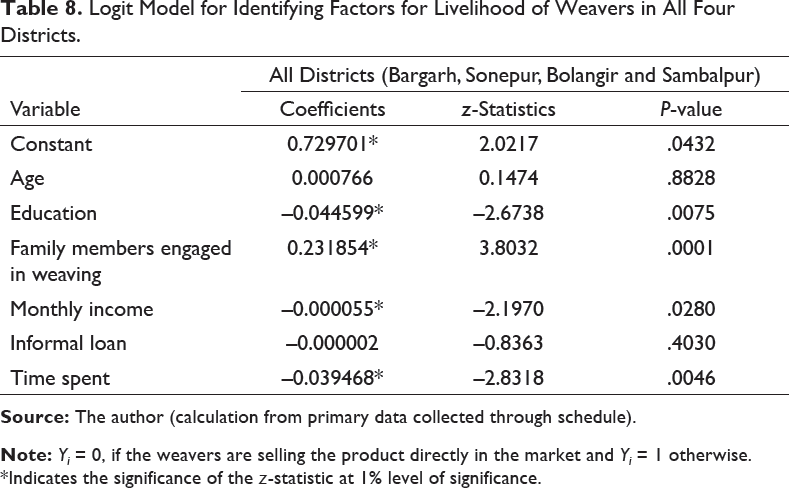
Logit Model for Identifying Factors for Livelihood of Weavers in All Four Districts.
*Indicates the significance of the z-statistic at 1% level of significance.
In the logit model, the estimated coefficients measure the change in the dependent variable due to a unit change in the independent variable keeping all other independent variables constant. The estimated coefficient, if positive it indicates that the weaver will choose to work with the businessmen or master weaver, that is, s/he will work as a contract weaver. Similarly, if the estimated coefficient is negative, there is less likely that the weaver will work as contract weaver. S/he will prefer not to work with the moneylender or master weaver. In this case the weaver will prefer to work as independent entrepreneur weaver. He will purchase the inputs from the market and sell the products independently in the market. The estimated p-value presents whether a change in independent variable significantly affects the logit in the accepted level. It will present how much change in the independent variable affects the choice of livelihood.
The result shows age and family members engaged in the weaving have a positive effect on the dependent variable. Also, the effect of family members engaged in the weaving have a significant effect on the dependent variable. If the number of a family member is more, than the weavers prefer to work with the businessman or moneylender. Factors such as education, monthly income, time spent and weavers having loans earlier, have negative effect on the dependent variable. That is if the household is educated, monthly income is more, more time is spent in weaving or if the loan is more, then the households prefer to do the weaving themselves. That is, they purchase the raw materials from the market, prepare the handloom and sell it in the market. The marketing of the handloom is also done by the weavers themselves. It involves more risk, and the weavers are prepared to take the risk.
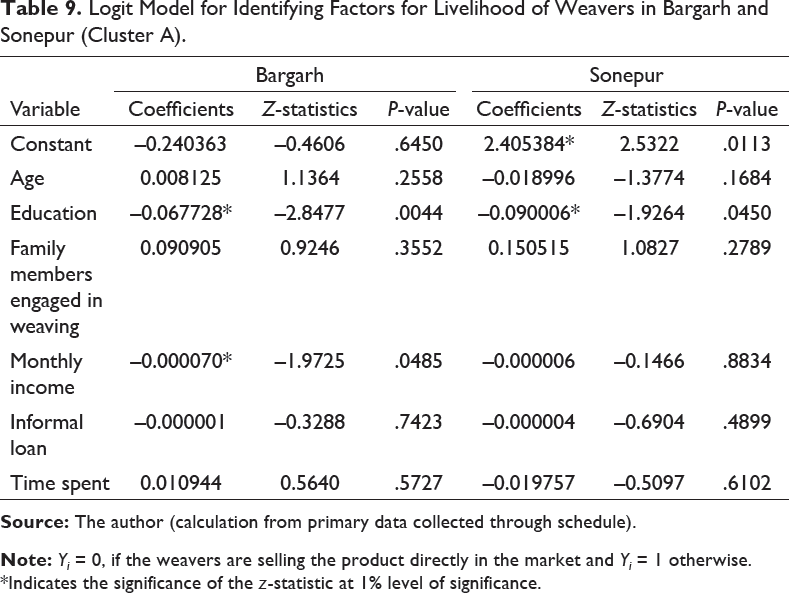
Logit Model for Identifying Factors for Livelihood of Weavers in Bargarh and Sonepur (Cluster A).
*Indicates the significance of the z-statistic at 1% level of significance.
In Sonepur, the total number of clusters is four. Here, the education of the head of the household has negative and significant effect on the dependent variable. This indicates that with an increase in the education level the household work as an independent weaver. It can be stated that the weavers' purchase inputs from the market, produce the handloom and sell them in the market. Effect of factors such as monthly income, loans by the weavers and time spent in the weaving have also negative coefficients. But these are not significant. These factors also help the weavers to work independently of the moneylenders and businessman. However, in Sonepur, the positive sign of the variable, that is, number of family members engaged in weaving indicates that if the number of persons engaged in weaving is more, they prefer to work with the businessman.
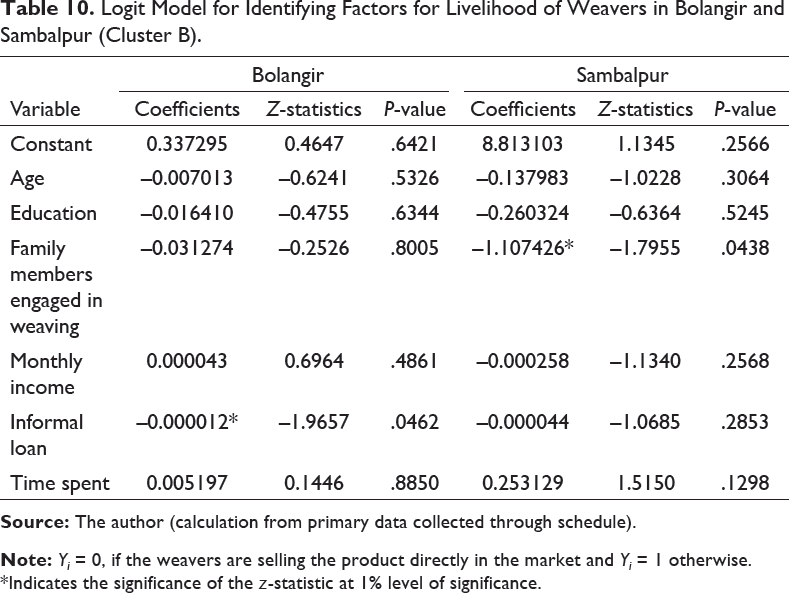
Logit Model for Identifying Factors for Livelihood of Weavers in Bolangir and Sambalpur (Cluster B).
*Indicates the significance of the z-statistic at 1% level of significance.
Conclusions
It has been observed that the handloom industry provides employment to large number of people associated with weaving. In Sambalpuri handloom industry, different artisans are associated with weaving namely, designer, tier, dyer and weavers. Each artisan is specialised with different skills. In applying the binary choice model, it is found that if the number of family members are more, then the weavers’ family prefer to work with master weaver or businessman. The weaver does not have to bother about the marketing of the handloom product. Here the weavers work on mutually agreed wages which is very less. On the other hand, if the family is educated or has not incurred loan, or the family income is more, then they prefer to work independently. However, these independent weavers who sell the output in the market, also get less price for their Sambalpuri handloom product due to inefficient marketing skill.
Necessary steps are warranted at both centre and state-level authorities to provide the required inputs in time to these weavers. It is evident that livelihoods of handloom weavers are in distress. Besides, strong political will is necessary to revive the livelihood of the weavers. This will protect the cultural heritage of handloom industry and in particular Sambalpuri handloom industry. National Handloom Development Corporation provides thread, colour, chemicals and dye to the handloom weavers through state-run cooperatives or handloom input banks. The weavers are of the view that the quality of the inputs is poor and the appropriate inputs are not available in time. Weavers get some discount if they purchase the inputs from the state-run handloom input banks or cooperatives as they are subsidised.
Large areas of Bolangir district are now converted for the production of cotton instead of rice. Businessmen from Gujarat and Maharashtra are coming to Bolangir district with cotton seed. They are taking agricultural land in rent and cultivating cotton in them. They are employing daily wage labourer from the localities for cultivation. After production, they are taking back the output to their states for processing of the cotton. On the other hand, many cotton spinning mills in Bolangir, Sonepur and Bargarh are closed. If the production of cotton is encouraged by the state government and appropriate policy is formulated to open the closed cotton spinning mills, then several persons can get employment in these spinning mills. This will also help the backward linkage of the Sambalpuri handloom industry in the state of Odisha.
In order to give a push to the Sambalpuri handloom weavers, government can take the orders from the customers via various e-portals with government initiative. These handloom orders can be forwarded to the weavers through various cooperatives, governmental agencies and self-help groups. Government should also take necessary steps to supply the various inputs such as yarn, dye and colour to these weavers at minimum price and finance with easy terms. These approaches may not only help the weavers to get the orders and produce according to requirements without exploitation, but also sustain employment, livelihood and Sambalpuri handloom.
Footnotes
Acknowledgement
The author would like to thank the reviewers and the editor of the journal for helpful comments on earlier versions of the article.
Declaration of Conflicting Interests
Funding
The author disclosed receipt of the following financial support for the research, authorship, and/or publication of this article: The author would like to acknowledge Indian Council of Social Science Research (ICSSR), New Delhi for financial support to undertake this work (Grant Number F. No.: 02/74/2017-18/RP/Major).
