







Abstract
This article examines the impact of the Social safety net program (SSNP) on poverty, food security and standard of living by focusing on types and features of SSNPs along with socio-economic and demographic characteristics in one enclave (Dahagram–Angarpota) and one ex-enclave (Dasiar Chhara) areas of Bangladesh. Quantitative and survey research methods were used for the study. The results show that amount supported under SSNPs, duration of SSNPs support and payment interval are the significant factors of poverty, food insecurity and standard of living. The results also identify some significant demographic and socio-economic factors of poverty, food insecurity and standard of living. Overall, this study suggests that a higher amount SSNPs support, longer duration of SSNPs support and shorter payment interval of SSNPs should be taken into consideration when redesigning the SSNPs. Furthermore, the significant demographic and socio-economic factors should be addressed in the policy formulation for improving poverty, food security and standard of living of the poor households in Bangladesh.
Introduction
The social safety net program (SSNP) is an effective policy instrument, which provides economic and social security to the improvised people (Barket-e-khuda, 2011; Pradhan et al., 2012). It aims to relieve distress and prevent destitution to the disadvantaged people (Grosh et al., 2008; Munro, 2005; Paitoonpong et al., 2008). The SSNP is mainly designated to provide money, food, education or treatment facilities to the distressed people (Pradhan et al., 2012; Suryahadi et al., 1999; Vivian, 1994). In developing countries, the vulnerable and poor households with social safety net programs (SSNPs) are benefited from the government, aid by donors or NGOs, private firms, charities, and informal household transfers (Hanlon et al., 2010; Tovar & Urrutia, 2017; Wetengere & Sabuni, 2015). It improves vulnerable people’s wellbeing through serving in their crisis period (Kenworthy, 1999). In Bangladesh, SSNPs cover vulnerable areas, even though it is very tiny comparing to the poor population. Every year, many people fall into vulnerable situation and face severe poverty, food insecurity due to climate change and natural disasters (Ahmed et al., 2014; Ahmed et al., 2009; Sen, 1982). According to HIES (2016), only 28.7% of the total population are under coverage of different SSNPs (HIES, 2016). In this regard, a robust and prolonged social safety net program is the main emphasis of the government’s vision to safeguard the poor from all types of social, economic and natural shocks (Government of Bangladesh, 2009).
In Bangladesh, about 21.5% or 36 million people live below the poverty line, where 19% are extremely poor in rural areas and food insecure population is estimated to be 40 million which is approximately 25% of the total population of the country (Imam et al., 2018; Sifat, 2020; World Food Program, 2021). A wide range of social safety net programs (SSNPs) are being implemented in Bangladesh and these are mainly rural-based programs. Past studies document that SSNPs intend to lessen the severity of social destitutions such as poverty, food insecurity, illiteracy, unemployment, disability, sickness, vulnerability through giving direct and indirect long-term benefits to the recipients (Barrett et al., 2002; Bhushan, 2004; Camacho et al., 2014; Devereux, 2002; Erhabor, 2015; Fiszbein et al., 2009; Grosh et al., 2008; Hossain & Ali, 2017; Khandker et al., 2011; Masud-All-Kamal & Saha, 2014; Melkamu & Mesfin, 2015; Ninno et al., 2013; Paynter et al., 2014; Perry et al., 2007; Slater, 2011; Tovar & Urrutia, 2017; Wetengere & Sabuni, 2015; Wheaton et al., 2011). For example, Mamun (2019) examines the effectiveness of old age allowance in Bangladesh, finding that old age allowance has a positive impact for reducing poverty among elderly people. Ahamad et. al. (2013) show that involvement with the safety net programs improves household food security status. However, to the best of the authors’ knowledge, little is known about how to improve and redesign the SSNPs for the betterment of impoverished people. Therefore, the current study examines the impacts of SSNPs on poverty, food security, and standard of living in a single framework by focusing on different types and features of SSNPs as well as targeting the minority group.
In Bangladesh, enclave/ex-enclave 1 areas (Rabbani et al., 2007), monga 2 areas (Khandker et al., 2011), hill tracts 3 (Majumder et al., 2012), haor 4 areas (Mozdalifa, 2012) are the most vulnerable areas than any other parts of the country. Geographical, regional, administrative, community approaches are important in SSNPs to target the eligible households (Ahmed et al., 2014; Nigussa & Mberengwa, 2009). The current study is conducted on one of the vulnerable areas, namely enclaves/ex-enclave, in Bangladesh. The enclaves are the consequence of the historical partition of Indian subcontinent awarded by Sir Redcliff in 1947. The imminent territory within these two countries (Bangladesh & India) created an inhuman situation for the people of these enclaves from 1950–2015. However, the situation is changed now and the enclaves have merged with the host land through the treaty on 31 July 2015; but more than seven years have passed of the signing of the treaty, the proper facilities and basic needs are not yet fulfilled (Misu et al., 2021). The inhabitants of the enclaves/ex-enclave are regarded as subaltern, marginal and minority group in terms of basic needs and the right of self-determination. Government of Bangladesh provides a package of SSNPs for the improvement in this minority group. Thus, the present study aims to examine the key impact SSNPs on poverty, food security and standard of living of the people in enclave and ex-enclave areas of Bangladesh. The study poses the following open questions: (a) Do SSNPs have any impact on poverty alleviation, food security amelioration and standard of living on the impoverished people in the selected enclaves ? (b) How would we improve and redesign the SSNPs for the betterment of impoverished people?
Background of the Enclaves
There are 162 enclaves in Bangladesh and Indian territories according to the Indira–Mujib Land Boundary Agreement. After implementation of the Land Boundary Agreement, India received 51 Bangladeshi enclaves (on an average 2,880 hectare) in the Indian territory. On the other hand, Bangladesh received 111 Indian enclaves (on an average 6,940 hectare) in the Bangladeshi mainland (Nagchoudhury, 2015). Bangladeshi enclaves are located in different districts within the country, for example, 12 in Kurigram, 59 in Lalmonirhat, 36 in Panchagarh, and rest 4 in Nilphamari districts. However, one counter-enclave and Dahagram–Angarpota, are not exchanged and retained as an exclave after the final implementation of the Land Boundary agreement, 2015 (Wiki, 2018).
Dahagram–Angarpota is the largest Bangladeshi composite enclave, located in Lalmonirhat district, lies within the Indian province of West Bengal (Wiki, 2020). The enclave has an area of 25.95 km2 with a resident population of 17,000 people (Dhaka Tribune, 2017). The only way to connect with the main land of Bangladesh is ‘Tin Bigha Corridor’, a strip of 85 metres width (Rabbani, 2007). The movement of the people of the enclave to and from the Bangladeshi main land was restricted within certain hours in a day. After 2011, the Indian corridor is open for 24 hours (full time access) for the easy movement of Bangladeshi exclave people. During the exchange agreement in 2015, Bangladesh took over Dasiar chhara enclave in Kurigram district, which lay 3 km (1.9 mi) from the main part of India and had an area of 6.65 km2 (Wiki, 2020). This change has created opportunities and brought subsequent development in the areas.
Social Safety Net Programs in Bangladesh
Social safety net programs (SSNPs) for widow, disabled, blind, orphan, aged people, freedom fighter, victim of natural disasters and extreme poor people, concern mainly with social protection and social empowerment (Ahmed et al., 2014; Alam & Hossain, 2016; Rahman & Choudhury, 2012; Raihan, 2013). The SSNPs are categorised into five groups, namely allowance for vulnerable groups with special needs; food security and disaster assistance; public works/employment; human development and empowerment; and urban poverty (Rahman & Choudhury, 2012). In Bangladesh, the main benefits are: Old age allowance (OA); Disabled allowance (DA); Widowed and distressed women allowance (WWA); Honorarium for insolvent freedom fighters (HIFF); Grants for orphan students (GOS), and so on. Food security and disaster assistance include: Open market sale (OMS); Vulnerable group development (VGD); Gratuitous relief (GR); Vulnerable group feeding (VGF); and Test relief (TR). Food-for-work (FW); Employment generation for the poorest (EGPP); and Rural employment opportunity for public asset (REOPA) consist of public works/employment programs. Stipend for primary students (SPS); Secondary education stipend project (SESP); Targeting the ultra poor (TUP) are main types of human development and empowerment programs. Urban poverty is addressed by one major program that is Fundamental Education for Urban Working Children (FEUWC) (Rahman & Choudhury, 2012).
Key Social Safety Net Programs in the Enclaves and Ex-enclaves
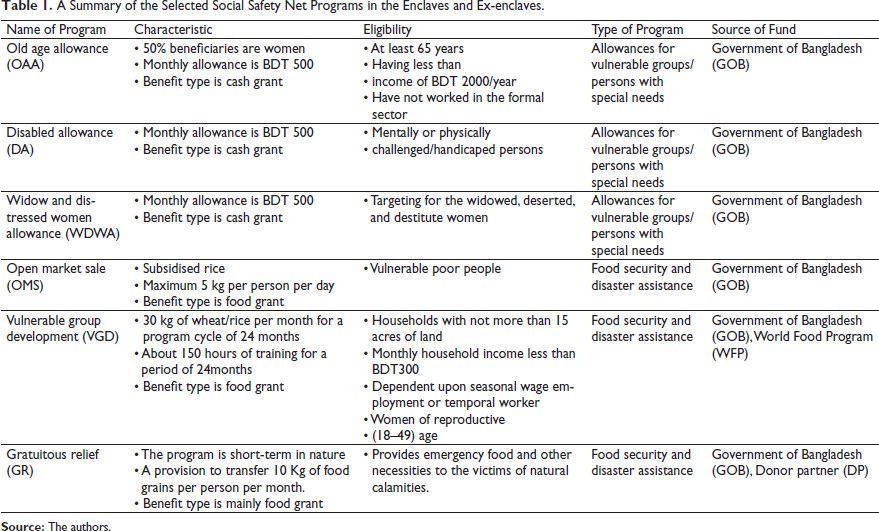
The study selected and examined six important SSNPs in the enclave and ex-enclave areas, which are categorised into cash transfer and food/in-kind transfer depending on the mode of payment with the main concern of social protection. Cash Transfers (CTs) SSNPs are regular and non-contributory payment of money, provided by the government to the poor individuals and households for reducing poverty, social and economic vulnerability (Samson et al., 2011). On the other hand, food/in-kind transfers (KTs) relating to SSNPs are tied to the provision of food, either directly, or through cash-like instruments (food stamps, coupons) that may be used to purchase food (Rogers & Coates, 2002) for improving nutritional status or increasing food security of the recipients’ household. Table 1 provides the details information about the selected six SSNPs in Bangladesh.
A Summary of the Selected Social Safety Net Programs in the Enclaves and Ex-enclaves.
Research Methods
Data and Sampling
A primary sample is collected to evaluate the impacts of social safety net programs on poverty, food security and standard of living. A random sampling method is used for collecting the data. The questionnaire for the primary data was prepared and pre-tested before going to the final survey. One enclave namely Dahagram–Angarpota, retained as exclave in Lalmonirhat district and one ex-enclave namely Dasiar chhara in Kurigram district of Bangladesh are selected purposively. We purposively selected these two areas because the Dahagram–Angarpota is the largest Bangladeshi composite enclave and the Dasiar Chhara is the largest ex-enclave contributing nearly one-fifth of the total enclave population in Bangladesh (Bose, 2018; Wiki, 2020). In enclave areas, only 10% population can get the benefit from different safety net programs in Bangladesh (Rafa, 2018). According to Rafa’s estimation, the total number of beneficiaries from both the selected areas was approximately 5,000. We used a sample size determination formula to identify the representative sample size developed by Cochran (1977; Daniel, 1999; Yamane, 1967) and several studies used this formula to determine the sample size (For example, Israel, 1992; Jain et al., 2015; Kasiulevičius et al., 2006; Naing et al., 2006; Singh & Masuku, 2014):

Where,
Poverty and Poverty Line Measurement
The cost of basic needs (CBN) approach has been implemented to represent the level of per capita expenditure of the members of a household with food and non-food consumption. For the measurement of poverty, poverty line has been estimated by using a semi log or exponential model. The poverty line (upper and lower) is used to define a subject as a poor or non-poor. A subject having per capita monthly expenditure less than the upper poverty line, is considered to be ‘absolute poor’, otherwise non-poor. Similarly, a subject whose per capita monthly expenditure is less than the lower poverty line, they are regarded as ‘hard-core poor’, otherwise non-poor. In Bangladesh, the following semi-log or exponential model is officially applied to calculate the poverty line (Bangladesh Bureau of Statistics, 2013; Rahman & Schmitz, 2007; Rahman & Sousa-Poza, 2010). The form of the model is as follows:

Where
Food Security Index
At the household level, food security is estimated from the crop along with the animal products consumed from own production and those purchased by the households. Food quantities consumed from the above sources converted into calories and divided by the adjusted household size in order to obtain per capita calorie intake. The World Bank suggested method for estimating adjusted household size is used for this study (Akerele et al., 2012; SPC/RPATW, 2007). Studies by Fawole et al. (2016), Muche et al. (2014), Okwoche and Benjamin (2012), Babatunde et al. (2007), and Oguntona and Akinyele (1995) used food security index to estimate the food security status of the household. For this study, to determine the food security status of the household the two food security lines using recommended daily calorie requirements approach, which are 2,122 kcal/day/person and 1,805 kcal/day/person equivalent, have been used (HIES, 2010; MFDM & WFP, 2005). A household is ‘moderate food deficit’ if per capita daily consumption is less than 2122 kcal and ‘hard-core food deficit’ if household per capita food consumption is below 1805 kcal. The food security index can be mathematically defined as:

Where,
Measurement of Standard of Living
In this study, standard of living is measured by the direct question in the survey. Households may or may not have experienced any improvement in their livelihood by using the allowance received from social safety net programs. Household heads are asked to provide their answer (‘yes’ or ‘no’) if they feel that there have been any changes in their living standard after receiving SSNPs. The improvement of living standard may be of any kind, such as increase of dignity in the family and society, increase of minimum basic needs (food, clothes and medicine), and improvement in family care or any other improvement.
Household Family Assets
Family assets include household cattle, goat, poultry, sheep, home furniture, television, refrigerator, tractor, van, rickshaw, and jewelleries of the household. Sum of the monetary values of all the above assets is used to find the total of family assets in monetary term.
Single Level Binary Logistic Regression Model
A single level binary logistic regression model is fitted to test the significance of SSNPs for alleviating poverty, achieving food security and improving standard of living alongside other socio-economic factors. We could not apply a multivariate regression because some of the combinations such as, poor, food insecure but improved standard of living will be difficult to interpret as well as there is a possibility to find some empty cells. In this study, five different single level binary logistic regression models for five response variables, namely poverty status using upper poverty line (Model 1), poverty status using lower poverty line (Model 2), food security status using 2,122 kcal (Model 3), food security status using 1,805 kcal (Model 4) and improvement in standard of living (Model 5), have been run separately with the same set of explanatory variables.
The dependent variable, say poverty status denoted as 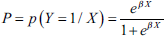
and,
Then a transformation of p known as the logit transformation and is defined as

There are many desirable properties of this transformation
Depending on the number of independent variables in the vector X = [x1, x2, … xk], the model can be generalised as
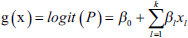
In this current study, the explicit form of the model may be written as

Where, β0 is the intercept, β1–β2 are the coefficients for respondent’s age categories, β3 is for gender, β4 is for household size, β5 is for household’s occupation, β6 is for number of earning member (s), β7–β9 are for the household’s land size, β10–β13 are for family assets, β14–β16 are for per capita monthly household income, β17 is for types if SSNPs, β18 is for monthly amount received from SSNPs, β19–β21 are for years of involvement with SSNPs, β22–β23 are for type of payment interval of SSNPs and β24 is for satisfaction with SSNPs.
Results
Household Poverty, Food Security and Living Standard
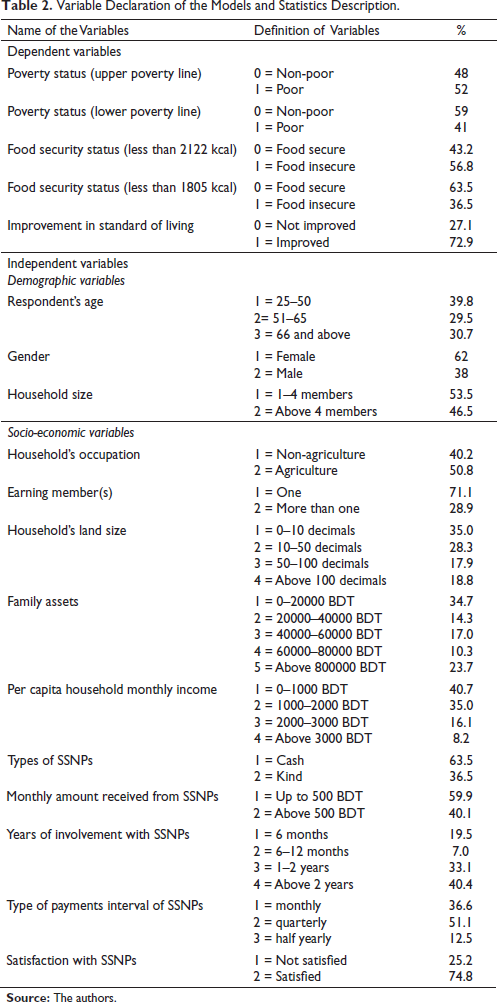
Categories and frequency distributions of the key dependent and independent variables are presented in the Table 2. Literature suggests that household poverty, food security and living standard, have internal links as resource availability is the common link of the three. Several studies found that poverty and food security are twin concern and they defined that poverty is a cause and food insecurity is a consequence (Ahmed et al., 2014; Kuwornu et al., 2012; Oluoko-Odingo, 2006, 2009). We also argue that standard of living is positively related to poverty alleviation and food security amelioration. Literature documents that increased poverty is the cause of food insecurity, resulting lower standard of living (Doessel & Whiteford, 2004; Evans & Lawson, 2020). Chi-square tests between the three response variables, that is, poverty, food security and living standard, suggest that these are associated among themselves (results not shown). However, though in case of a set of response variables, use of composite variable may be practiced (Harjule et al., 2021; Rahman & Chowdhury, 2007), we did not consider the same given the importance and the policy relevance of the variables. Also, different broad aspects, that is, poverty, food security and standard of living are being addressed separately in Bangladesh sometimes under different ministries. Almost 52% households are poor considering the upper poverty line and 41% are poor considering the lower poverty line. Moreover, 56.8% household are moderate food insecure who consume less than 2,122 kcal and 36.5% are hard-core food insecure who consume less than 1,805 kcal. On the other hand, 72.9% households have improved their standard of living with the help of SSNPs. Almost 40% respondents belong to the age group between 25–50 years and rest 60% respondents are above 50 years of age. About 60% respondents are female and around 50% household’s occupation is agriculture. Around 54% households have up to 4 family members and 71% have only one earning member. Households which have family assets up to BDT 20,000 and having maximum 10 decimal land areas count around 35%. About 41% household’s per capita per month income is below BDT 1,000. Households involved in cash type SSNPs count almost 64%, almost 60% SSNPs beneficiaries receive monthly BDT 500 or less, and around 40% are involved with SSNPs for more than 2 years. Almost half of the total beneficiaries of SSNPs receive payments quarterly and 74.8% are satisfied with SSNPs.
Variable Declaration of the Models and Statistics Description.
Determinants of Households’ Poverty
Factors associated with household’s poverty in the enclave and ex-enclave areas are presented in Table 3. In Model 1, the results show that households with family members above 4 are more at risk of being poor than the households with 1–4 members at home (OR: 2.71, p < .01). Households are less likely to fall in poverty with land area 50–100 decimals (OR: 0.48, p < .05) or above 100 decimals (OR: 0.41, p < .05) than those which possess land area below 10 decimals. In addition, households are less likely to be poor whose family assets are 60,000–80,000 BDT (US$1= 83.87 BDT) (OR: 0.21, p < .01) and above 80,000 BDT (OR: 0.50, p < .10) than those having family assets not exceeding 20,000 BDT. Households with per capita income 2,000–3,000 BDT (OR: 0.39, p < .05) and above 3,000 BDT (OR: 0.13, p < .01) are less likely to fall in poverty than their counterparts. Households which receive above 500 BDT per month from an SSNP (OR: 0.27, p < .01) are less likely to be poor than the households which receive up to 500 BDT per month. Households involved with SSNPs for more than 2 years (OR: 0.48, p < .05) are less likely to be poor than the households involved with SSNPs for less than 6 months.
Binary Logistic Regression Estimates of the Effect of Different Demographic and Socio-economic Characteristics on Household’s Poverty.
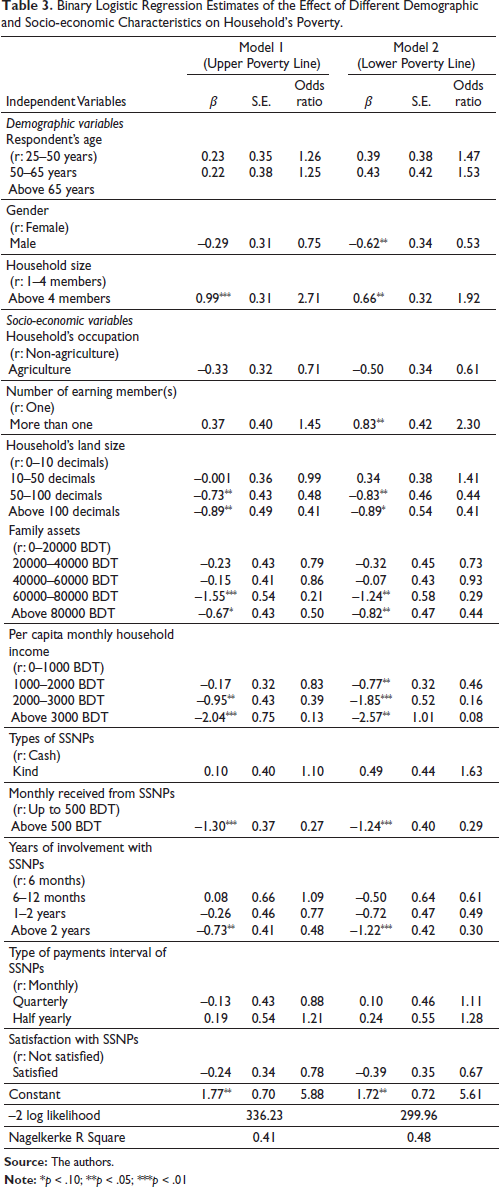
In Model 2, results depict significance of the same variables as in model 1. In addition, Model 2 shows that male respondents are less likely to fall in poverty than their counterparts (OR: 0.53, p < .05). Moreover, households with more than one earner are more at risk of falling in poverty (OR: 2.30, p < .05) than households with only one earner. The reason may be that in the rural Bangladeshi context more family members need to be involved in low income generating and seasonal employment activities to survive. Moreover, most of the earners other than the household head spend their own income for personal purposes and contribute a part of their earnings to support the household expenditure.
Determinants of Households’ Food Security
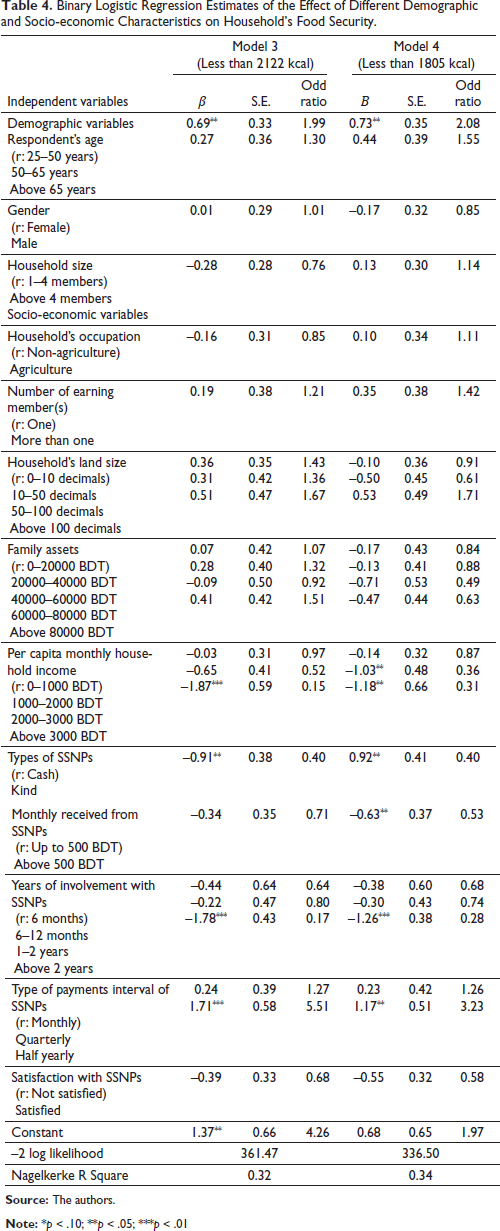
Factors associated with household’s food security in the enclave and ex-enclave areas are presented in Table 4. In Model 3, results exhibit that respondents with age between 50–65 years (OR: 1.99, p < .05) are more likely to be food insecure than those with age between 25–50 years. Households which per capita per month income is above 3,000 BDT (OR: 0.15, p < .01) are less likely to be food insecure than those having per capita income up to 1,000 BDT. Households which receive kind type SSNPs (OR: 0.40, p < .05) and involve with SSNPs for more than 2 years (OR: 0.17, p < .01) are less likely to be food insecure than their counterparts. In Model 4, results depict significance of the same variables as in Model 3. In addition, Model 4 reveals that households which receive above BDT 500 per month as part of SSNPs are less food insecure (OR: 0.53, p < .05) than the households which receive up to BDT 500 per month.
Binary Logistic Regression Estimates of the Effect of Different Demographic and Socio-economic Characteristics on Household’s Food Security.
Determinants of Change in Households’ Standard of Living
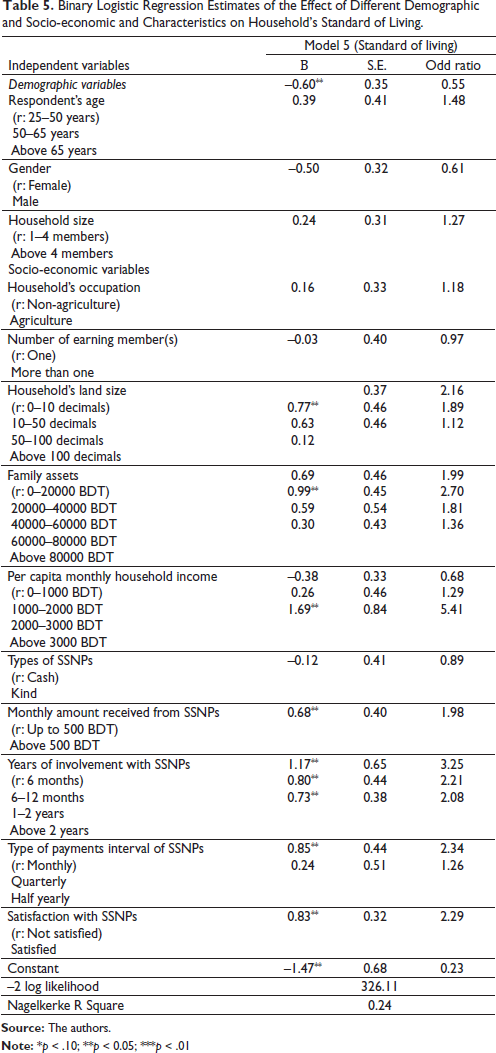
Factors associated with the change in household’s standard of living in the enclave and ex-enclave areas are presented in Table 5. In Model 5, results reveal that respondents with age between 50–65 years (OR: 0.55, p < .05) are less likely to improve their standard of living than those whose ages are between 25–50 years. Households having land size between 10–50 decimals (OR: 2.16, p < .05) are more likely to improve their standard of living than those having land size below 10 decimals. Households whose family assets fall between BDT 40,000–60,000 are more likely to improve their standard of living (OR: 2.70, p < .05) than those with family assets worth less than BDT 20,000. Households with per capita income above BDT 3,000 (OR: 5.41, p < .05) are less likely to improve their standard of living than households having per capita income up to BDT 1,000. Households which receive above BDT 500 per month (OR: 1.98, p < .05) from SSNPs and satisfied with SSNPs (OR: 2.29, p < .05) are more likely to improve their standard of living than their counterparts. Households which are involved with SSNPs for 6–12 months (OR: 3.25, p < .05) or 1–2 years (OR: 2.21, p < .05) or above 2 years (OR: 2.08, p < .05) are more likely to have positive change in standard of living than their counterparts. Also, households which receive payment quarterly from SSNPs (OR: 2.34, p < .05) are more likely to experience improvement in standard of living than their counterparts.
Binary Logistic Regression Estimates of the Effect of Different Demographic and Socio-economic and Characteristics on Household’s Standard of Living.
Discussion
The government of Bangladesh allocates more money every year for SSNPs to mitigate poverty and hunger problems within the country. About 97% of annual allocation for SSNPs is spent through 30 major programs (in excess of BDT 50 crores US $ ≅ 5,961,607) and 22 minor programs (less than BDT 50 crores) (Rahman & Choudhury, 2012). In recent times, the coverage and scope of SSNPs are increasing in the country (Pradhan et al., 2012). The present study examined the impacts of SSNPs on poverty, food security and standard of living in the enclave and ex-enclave areas of Bangladesh. The study gives emphasis on the enclave and ex-enclave areas because the degree of food insecurity in these areas is very high due to natural disaster; economic, social, demographic and administrative instability, stemming from the absence of state administration. Moreover, poverty, illiteracy, lack of safe drinking water, sanitation, and health services are next to food insecurity as major problems associated with these areas (Chakrabortty, 2016; Rabbani, 2007).
SSNPs play a key role in Bangladesh to protect the poor from their vulnerability (Ahmed et al., 2014). In this study, the amount received from SSNPs above BDT 500 has a significant effect to reduce poverty. At the same time, support of SSNPs for at least 2 years or above have significant effect for reducing poverty. Our result is similar with the findings of Wheaton et al. (2011), indicating that SSNPs dramatically reduce the poverty. Pradhan et al. (2012) and Mallik (2018) show that high budget allocation for social safety net programs has a positive effect on reducing the poverty rate during last decades in Bangladesh. However, previous studies do not examine the effects of the amount of money provided by SSNPs and time of involvement for reducing poverty. Therefore, this study suggests that the amount provided by SSNPs should be increased to a reasonable amount. The policy makers in Bangladesh must give priority about the amount and time of involvement when they design SSNPs for combating poverty. Some important determinants of poverty for example, household size, household’s land size, family assets and per capita household income, and so on, demand policy attention for mitigating poverty in Bangladesh.
Improving food security by providing supplementary food or cash is one of the main objectives of SSNPs. The present study finds that in kind types of SSNP benefits are significantly more effective to reduce food insecurity than the cash types of SSNPs. If the support of SSNPs is above BDT 500, it may significantly reduce food insecurity among hard-core food deficit households. At the same time, if the duration of SSNPs support is at least 2 years or above it has a significant effect to reduce food insecurity. However, the shorter the payment interval of SSNPs the more effective is the scheme to reduce food insecurity. A study by Hossain et al. (2005) has a consistent result with our study, finding that an additional food supplementary program is an effective means to increase the intake of food for malnourished children. Rahman (2012) uses secondary data and finds that SSNPs have a high impact on calorie consumption for the beneficiaries. However, none of the studies give priority to the types of SSNPs, amount of SSNPs support, and time of involvement with SSNPs for improving food security status. Therefore, the government and the policy makers should give emphasis on the in kind types of SSNPs, higher amount SSNPs support (above BDT 500) and shorter payment interval of SSNPs to reduce food insecurity problem in the enclave and ex-enclave areas as well as other vulnerable areas of Bangladesh. Some other significant factors for instance, respondent’s age and per capita household income should be considered in the policy formulation to curb down food insecurity in Bangladesh.
SSNPs are not only an effective mechanism to combat poverty and food insecurity but also a significant factor for the improvement of standard of living of poor households. The amount received from SSNPs worth above BDT 500 has a significant effect on improvement of standard of living among poor households. Long time (more than six months) involvement with the SSNPs and medium interval of payment (quarterly) system are positively significantly related to the improvement of standard of living. Mallik (2018) documents that social safety nets have immense positive effects on the life of the poor. However, there is a scarcity of researches that examine the SSNPs’ impact on standard of living. People’s satisfaction with the SSNPs activities affects their standard of living. If people are satisfied with the SSNPs activities, their standard of living improves or vice versa. Some socio-demographic variables such as, respondent’s age, household’s land size, family assets and per capita household income, identified in the study, should be addressed during the policy formulation. These factors have potentials to bring massive improvement in the poverty and food insecurity situation as well as standard of living. For example, household income is a strong factor for the reduction of poverty, food insecurity, and improvement of standard of living. People aged between 50–65 years are more vulnerable in term of food insecurity and also, they have fewer chances to improve standard of living than younger people. Females have more chances to fall into poverty. Therefore, it is necessary to focus on the above-mentioned points in the policy formulation for the overall development of Bangladesh. Finally, we can say that SSNPs have significant effects for reducing poverty and food insecurity as well as improving standard of living of the poor households in Bangladesh.
Conclusion
The study examined the impacts of SSNPs on poverty, food insecurity and standard of living along with socio-demographic variables in a single framework by focusing on different types and features of SSNPs from one enclave (Dahagram–Angarpota) and one ex-enclave (Dasiar chhara) areas in Bangladesh. Amount supported under SSNPs, duration of SSNPs support and interval of payment are the significant factors for reducing poverty and food insecurity as well as improving standard of living. In kind types SSNPs should be given emphasis for improving food security status. Future redesigning of SSNPs should take these issues into consideration. Also, the significant socio-demographic factors, such as per capita income, land, assets, female and people aged between 50–65 years should be taken into consideration for the improvement of poverty, food security and standard of living of the poor households in Bangladesh. Enclaves and ex-enclaves are lagging behind the main land Bangladesh in many respects. Especially, the corridor system and its management has posed restriction for free movement and local business activities with the mainland. Also, dependency of these territories on Indian boarder areas is still prevailing in many aspects. These barriers and dependencies should be addressed to make sustainable development in these areas as well the overall development of Bangladesh. Hence, urgent policy attention considering the recommendations may help to improve the SSNPs that will have direct and indirect effects on the poverty alleviation, food security amelioration and improvement in standard of living, contributing to SDGs as per expected timeline.
The study notes strengthens, limitations and possible directions for future research. It used a small sample size because of time and budget constraints and is only limited to enclave and exclaves areas of Bangladesh. Further studies with the same analytical framework in other vulnerable areas of Bangladesh with a large sample size will help to fully characterise the impact of SSNPs on different issues. In addition, this study neither separates the age and/or sex groups nor identifies the high-risk subjects when analysing the impacts of SSNPs. Therefore, future studies should be able to focus on addressing the high-risk subjects in different age and/or sex groups by collecting information possibly with a panel data structure. Moreover, a study of large sample data by covering all areas of Bangladesh about SSNPs is required to take necessary steps and revisiting policies to eliminate poverty, improve food security and increase standard of living. Despite these limitations, this study sheds light on three different key indicators of development: poverty, food security and standard of living. These findings may help redesigning the safety net programs in the needed areas in Bangladesh and beyond.
Footnotes
Declaration of Conflicting Interests
The authors declared no potential conflicts of interest with respect to the research, authorship and/or publication of this article.
Funding
The authors received no financial support for the research, authorship and/or publication of this article.
