







Abstract
This article examines the state of people’s access to the inclusive urban transport system in Dhaka and suggests strategies for improving access to the transport system. By adopting an exploratory approach, both quantitative and qualitative tools of data collection were employed to gather primary data through questionnaires and key informant interviews (KIIs). The findings reveal the lack of passengers’ trust and satisfaction in terms of the availability, accessibility, accommodation, acceptability and affordability of public buses for the vulnerable groups in Dhaka city. To make the transport system accessible and inclusive, suitable vehicles need to be introduced with additional resource commitments along with sensitive training and public awareness to respect and support vulnerable groups to access transport systems with ease in Dhaka and similar cities.
Introduction
Access to an inclusive public transport system in any city has immense importance for city dwellers, particularly for vulnerable groups, such as persons with disabilities (PWDs), women and senior citizens (Kakar et al., 2021). In general, city buses, trams, metro rails and subways are some examples of widely available public transport in cities across developed and developing countries. Of late, access to inclusive urban transportation has become a global agenda in the twenty-first century as it has been included in the Sustainable Development Goals (SDGs). The 11th Goal of the SDGs has set a target to make urban transport systems accessible, affordable, safe and sustainable (United Nations, 2015). However, the vulnerable groups in developing countries, mostly due to their socioeconomic conditions, supposedly have less access to a personal vehicles and rely mostly on public transport (Mashiri et al., 2005; Motta et al., 2013).
Inclusive urban transportation matters for various reasons of which at least three reasons hold great significance. It creates job opportunities for the urban poor and can ensure access to public transport for PWDs, women and elderly persons (United Nations Development Programme [UNDP], 2010). It can also improve affordability and convenience in terms of mobility for the vulnerable as well as low-income groups. Moreover, if properly managed, the inclusive urban transport system can promote economic growth by reducing transportation costs, assisting in raising national savings and providing middle and upper–middle-income households an incentive to invest in human capital as well as in businesses rather than investing in private vehicles (Banister & Berechman, 2001; Banister, 2012; Deng, 2013). Hence, the lack of access to public transport can leave a group of people deserted by cutting them off from various opportunities and services and therefore making them vulnerable to social exclusion.
The inclusiveness of public transport systems in terms of safety and accessibility issues related to roads, stops and vehicles is an important concern for the cities of developing countries than those of developed countries. Evidently, the urban transport system in the cities of developed countries is safer and more accessible to vulnerable groups including the PWDs and the elderly (Deng, 2015; Gwilliam, 2003; Motta et al., 2013; Pucher et al., 2005). Roads and stops have slopes attached to the footpaths as well as the platforms in the bus and train station so that a person sitting in a wheelchair can ride on a bus and train comfortably. Moreover, there are proper seats and other infrastructure for the senior citizens and the PWDs in public transport. Besides the accessibility issues, safety and security for women in public transport in the cities of developing countries have remained an important concern (Deng, 2015; Gwilliam, 2003; Motta et al., 2013; Pojani & Stead, 2015; Pucher et al., 2005).
In the context of Bangladesh as a lower–middle-income economy, issues such as the lack of accessibility to the public transportation system along with exorbitant traffic congestion and safety concerns for the passengers in its largest megacity (i.e., Dhaka) are widely evident (Khan et al., 2018; Niger, 2019; Rahman & Nahrin, 2012). The urban public transport system in Dhaka city, the capital of the country and one of the fastest-growing megacities of the world have been taken as a case for this article. With more than 15 million residents, the public transport system in Dhaka has immense importance for vulnerable groups including a vast majority of the city’s low-income earning residents. Hence, by adopting an analytical framework, this article seeks to evaluate the state of people’s access to inclusive urban transport systems in Dhaka.
The Context: Dhaka and Its Public Transportation System
Dhaka as the capital city has grown to become a city of more than 15 million residents today surpassing a wide number of megacities in terms of population size and density (Demographia World Urban Areas, 2020). Dhaka is one of the few megacities in the world where the urban population growth rate has been higher than 2.4% for the last four decades since 1975 (Alam, 2019). Dhaka’s growth partly reflects the progress of the country’s economy which has grown at over 6% annually from 2009 to 2020. The public transport system of Dhaka, however, has not kept up with the growth in the number of residents, and the city is known for the worse traffic congestion in the world (Khan et al., 2018; Niger, 2019). Like many other developing countries, the key elements contributing to Dhaka’s traffic mayhem are the lack of proper planning and the execution of integrated policies (Gallagher, 2016; Niger, 2019). Unplanned construction works like repeated and uncoordinated road repair and road digging in the city add to the suffering of the commuters as buses are the key public transport in Dhaka (Khan et al., 2018). Currently, the usual traffic speed within Dhaka city is about 5.5 kmph (Hossain, 2021) and, with the current growth of vehicle expansion and without major reform in the public transport system, the average traffic speed in Dhaka might come down to 4.7 kmph by 2035 (Gallagher, 2016).
Against the growing number of residents in Dhaka city, the existing road network is poorly configured with a very limited number of feeder roads and main roads. While a planned city needs to utilise 25% of its surface area for constructing roads, it is less than 10% in Dhaka (Mustaqeem et al., 2018). Furthermore, only about 30% of the total length of streets in Dhaka city which is approximately 400 km is available for motorised public transport system (Mustaqeem et al., 2018). The problem of insufficient road space for an ever-increasing number of residents is deteriorated by the sharing of the road space by both non-motorised vehicles (NMV) as well as motorised ones (Mahmud & Rabbani, 2012; Rahman & Nahrin, 2012). Three-wheeler rickshaws are the most available NMVs while three-wheeler vans and horse-drawn carriages are also available in some areas.
In terms of the availability of public transport, the city has motorised vehicles like buses as well as other NMVs like rickshaws, and a limited number of water buses in selected waterways (Rahman & Nahrin, 2012; United Nations Economic and Social Commission for Asia and the Pacific [UNESCAP], 2018). Besides the transport options for roads and waterways, a DEMU (Diesel Electronic Multiple Unit) train project was launched inside the city which eventually failed to generate passenger enthusiasm due to a lack of comfort in accessing and riding the trains. Currently, a metro rail project is under construction and is slated to open its doors to passengers in 2022 (The Daily Star, 2021). However, as buses are the most used public transport system in Dhaka, this study focuses on the state of passengers’ access to the buses in Dhaka city.
There are around 8,000 buses in Dhaka city (Hossain, 2021), one-third of which do not have proper fitness certificates to operate in the metropolitan area (Prothom Alo, 2019). Apparently, large buses and minibuses comprise only 9.7% of the total vehicle mix carrying 77% of passengers whereas the NMVs like rickshaws and vans comprise about 28% of all vehicles (Barua et al., 2013). On the other hand, private cars are 33 times more than those public buses and yet are responsible for only 13% of commuter transportation (Gallagher, 2016). Evidently, a vast majority of passengers (i.e., about 97%) from the low-income and middle-income groups prefer public buses, rickshaws and three-wheelers as their favourite modes of transport (Mustaqeem et al., 2018). However, public buses are often considered the least desirable mobility option for vulnerable people specifically in terms of dependability, coziness, rapidity and security (Khan et al., 2018; Rahman & Nahrin, 2012). Moreover, along with the fitness issues of the buses, the drivers and other staff buses have behavioural issues while lacking proper education and training (Rahman & Nahrin, 2012). In addition, narrow doors, steep stairs in the entry and congested seats with inadequate leg space (Rahman & Nahrin, 2012) make the bus ride less inclusive for commuters including PWDs, women and senior citizens.
In the literature, most of the papers often focus on the issue of access from the perspectives of the PWDs (Rahman & Ohmouri, 2014; Sajib, 2022), women (King et al., 2021; Rouf et al., 2019), or senior citizens (Jahangir et al., 2022) separately, but this article explores the three groups together. Similarly, although some papers discuss the issue of accessibility, performance and satisfaction regarding public transport in Dhaka (Ahmed, 2004; Andaleeb et al., 2007; Rahman & Nahrin, 2012), a comprehensive analysis was missing. In response to these gaps, drawing on the literature, this research develops an analytical framework to define and examine ‘access’ in terms of availability, accessibility, accommodation, acceptability and affordability of public transport.
Analytical Framework and the Objective
This study has focused on adopting and contextualizing an analytical framework to evaluate the state of access to the urban public transport system. Based on the review of existing literature, this study has identified and adopted five dimensions of access developed by Penchansky and Thomas (1981). The dimensions include availability, accessibility, accommodation, affordability and acceptability and these are further contextualised to evaluate the state of access to public transport (see Table 1).
Dimensions of Access to Public Transport.
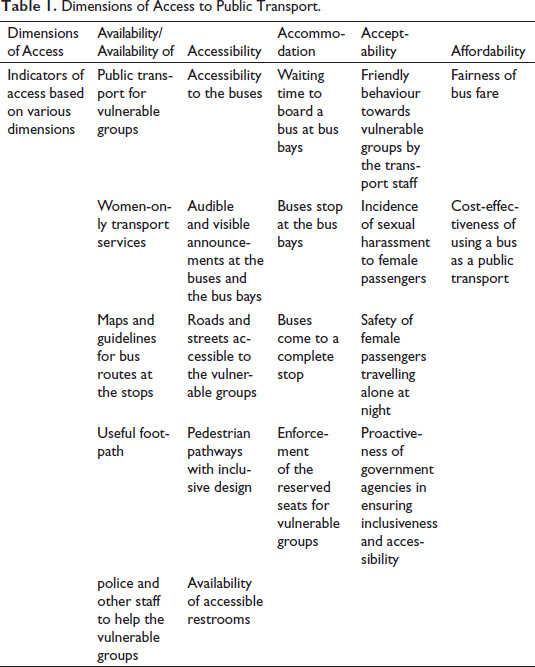
In the analytical framework, the availability of public transport means that public transport is available for vulnerable groups including the PWDs, women and senior citizens (Odufuwa, 2007; United Nations, 2019). Hence, the aspects like the availability of accessible buses for vulnerable groups, and the availability of maps as well as other assistive tools at the bus bays have been explored in the study. Second, accessibility of routes to and from transport centres (Marriotti & Gooding, 2007; United Nations, 2019) and accessibility to vehicles for vulnerable groups (Directgov, 2011; United Nations, 2019) have been considered major aspects of accessibility to public transport. Third, the accommodation dimension relates to the manner in which the services are organised as well as provided and the way the recipients accept those services. Here, in terms of accommodation, waiting time (Babinard et al., 2012; Lundebye et al., 2011) as part of the timeliness of services and accommodative nature of services for vulnerable groups including buses stopping appropriately at bus bays have been examined. Fourth, in terms of acceptability, a high level of safety and security for commuters (Kottenhoff, 2012) has been considered an important factor. Moreover, the sensitivity of the transport staff in public transport in dealing with passengers, especially the vulnerable groups, has been examined to evaluate the level of passenger satisfaction (Disabled World, 2010; 2013; United Nations, 2019). Fifth, the fare or the ticket price in public transport and the cost-effectiveness (Emmett, 2006; Gleeson, 1999) of using the bus as a public transport have been examined as part of affordability. By adopting this analytical framework, the article aims to evaluate the state of people’s access to the inclusive urban transport system in Dhaka and make policy recommendations to improve access to the transport system.
Research Design
In this study, an explorative approach has been adopted by using both quantitative and qualitative research methods. Quantitative data has been collected through a structured questionnaire from commuters, especially the vulnerable population of Dhaka city. Although the sample size and locations of data collection for this study were determined based on the convenience of the researchers, the respondents have been chosen randomly from 4 different bus bays in Dhaka. While the adult passengers at bus bays waiting for buses were randomly asked to participate in the survey, only the PWDs at the bus bays were purposively asked to respond to the survey. A total of 240 respondents have been surveyed from Paltan, Motijheel, Gulistan and Shahbag bus stops of Dhaka city as these survey locations represent major pick and drop spots for public transport.
To get 240 responses from the random passengers, the research team had to observe more than a thousand and ask 518 passengers in a week. Hence, the response rate for the survey has been 46% while the rest of the potential respondents either rejected to respond or had to leave the bus bay in a hurry to catch the bus. Through the standardised and printed questionnaire, quantitative data has been collected by using a Likert scale. The respondents have been asked to express their agreements and disagreements against the selected indicators of access on a scale of the strong agreement to strong disagreement. After gathering the data, quantitative data was computerised for the purpose of analysis by using SPSS software.
Qualitative data has also been collected to understand the state of access as well as the barriers to access to public transport. A total of 20 key informant interviews (KIIs) were conducted by using open-ended checklists. Like the questionnaire survey, 114 random passengers who are PWDs, women and senior citizens were asked if they are regular commuters and are willing to provide an interview for research to get 12 interviews to represent the vulnerable groups. The rest of the eight interviews were conducted among four staff (i.e., drivers and helpers) of public buses, an owner of the bus transport company and three representatives from relevant government agencies. The government agencies include the Ministry of Road Transport and Bridges (MRTB) and the Dhaka North City Corporation (DNCC). Data triangulation has been ensured as both quantitative and qualitative data have been collected from different groups of stakeholders and from both primary and secondary sources to portray a comprehensive understanding of the state of access to public transport in Dhaka. Here, government documents, websites, books, journal articles and newspaper articles have also been considered as the key sources of secondary data. In this study, the interpretive analysis method has been used for analyzing qualitative data to understand their meaning and directives (Bernard, 2000).
Findings
Background of Participants
Among the survey respondents, about 53% were male while about 47% were female respondents. All the participants were aged above 18 years and were passengers of public buses in Dhaka. While about half of the respondents (i.e., 53%) work in various government and private organisations, the other half consisted of students (12%), retired employees (16%) and unemployed people (19%). In terms of the representation of vulnerable groups among the respondents, about 14% of the respondents were PWDs of which the majority were female and about 18% were aged above 65 years. The PWDs covered in this study mostly had visual, hearing and physical impairments as they were identified using assistive tools and devices during their journey. Unlike the survey respondents, only seven out of 20 KII respondents were female. Here, seven female respondents belonged to the passenger group of 12 respondents while the service providers (i.e., bus owners and staffs) and regulators from government agencies were all-male respondents.
Availability of Public Transport
The availability of public transport, especially buses, has been examined from different perspectives. Aspects, such as the availability of buses for vulnerable groups, availability of maps at the bus bays and availability of appropriate footpaths have been explored (see Table 2).
Availability of Public Transport.
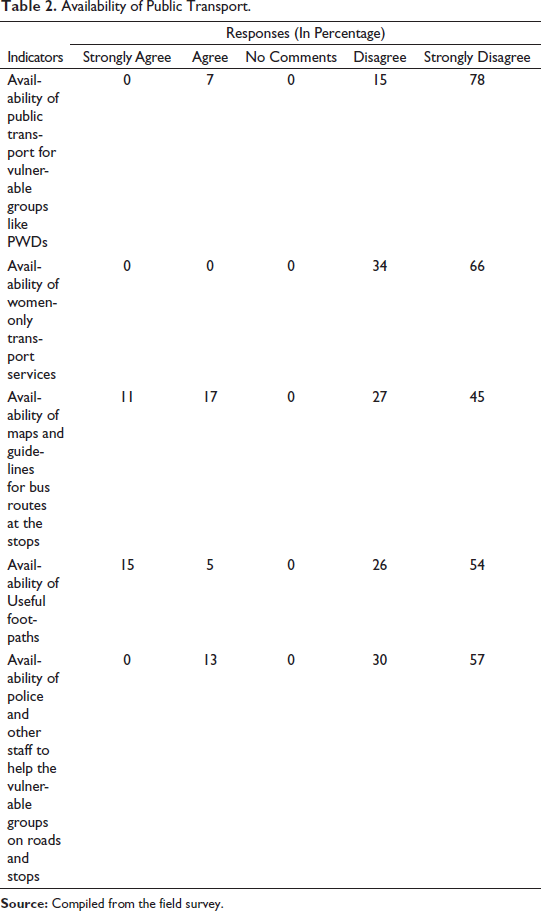
In Dhaka city, about 93% of the respondents opined that there are no special transport services available for the PWDs (see Table 2). Transport service vehicles in Dhaka include buses, minibuses, human hauler and legunas. According to the passengers, all the vehicles, especially the buses, in Dhaka lack any sort of assistive device to make the vehicles accessible. Because of the absence of assistive devices, public buses are totally inaccessible for physically impaired people, especially those who use wheelchairs and crutches. However, there are some women-only buses available in the streets of Dhaka, though the respondents mentioned that the women-only services where female passengers can travel safely without the risk of getting harassed are inadequate (see Table 2).
About 80% of the respondents reported that the footpaths leading to the bus bays are unusable in most of the areas (see Table 2). In some areas, it is difficult to find unobstructed footpaths as the footpaths are occupied by small tea stalls and other small vendors. Moreover, in the bus bays and transit terminals of Dhaka, about 72% of the respondents have never seen any route map or travel guidelines (see Table 2). In most cases, there are no sheds for the passengers at the bus bays, let alone the route maps and other guidelines. Furthermore, about 87% of the respondents observed that traffic police personnel are barely available near the bus bays to guide passengers, especially the vulnerable groups (see Table 2). As the traffic system in Dhaka is maintained manually rather than digitally, the personnel from the traffic police department are occupied with maintaining traffic signals at different bus stops and crossroads across the city. It is, therefore, very unusual for people to ask for and to get assistance from the traffic police at busy intersections.
Accessibility of Public Transport
Accessibility to public transport, specifically to buses, has been examined from different perspectives by using various indicators. Audible announcements at buses as well as bus bays, accessible roads as well as footpaths for the PWDs, accessible restrooms and access to the buses have been examined in this regard (see Table 3).
Accessibility to Public Transport.
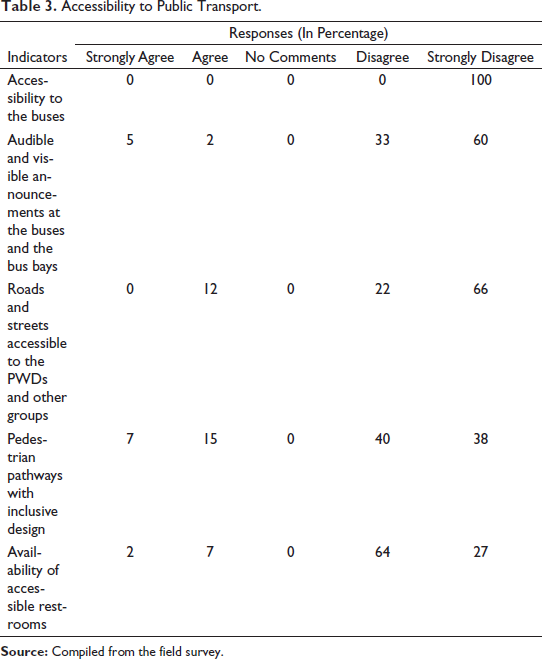
All the respondents have opined that the buses in Dhaka city are highly inaccessible for the vulnerable groups to commute alone (see Table 3). There are no Braille signs, hand grips, vertical stanchions, space for wheelchairs and other assistive services on the buses of Dhaka. Additionally, there are no audible and visible announcements in the buses and the bus bays for the persons in need. Though there is no recorded audio on the buses, the drivers and the staffs shout out before and after reaching a bus stop. In this regard, people with no hearing abilities face a lot of difficulties in finding out the right stations for getting off the bus as there are barely any digital displays inside the public transport.
According to the majority of the respondents (see Table 3), roads and streets are not often accessible for vulnerable groups to commute. Vulnerable groups cannot walk and move freely when they use roads, streets and footpaths due to unsmooth conditions. About 78% of the respondents have mentioned that the pedestrian pathways (i.e., narrow streets and lanes) are often not constructed with inclusive designs (see Table 3). Moreover, there are many damaged, unpaved and poorly maintained footpaths as well as pathways across the city which hinder the smooth movement of vulnerable groups, especially the PWDs. Moreover, restrooms are rare in public spaces along the roads and bus stops across the city. About 91% of the respondents told that in bus bays and bus stops, restrooms are often unavailable, let alone the availability of inclusive restrooms (see Table 3).
Accommodation Issues in Public Transportation
The accommodation dimension of access to inclusive transportation has been examined by the timeliness in the transport availability (Babinard et al., 2012; Lundebye et al., 2011) on the one hand. On the other hand, the accommodative nature of services for vulnerable groups including the buses stopping appropriately at bus bays, and the enforcement of reserved seats for vulnerable groups have been examined.
Responses to the waiting time at the bus bays to get the right bus has been mixed. While about 35% of the respondents agree that the waiting time is reasonable and short, about 65% of the respondents believe that the waiting time is long (see Table 4). According to the passengers, though there are buses on the streets during rush hours, the waiting time to get into one is high at the rush hours. Moreover, about 53% of respondents opined that the buses often do not stop at the bus bays, especially in the rush hours in the morning and in the evening (see Table 4). The buses rather stop at convenient places wherever a significant number of passengers gather. Furthermore, only about half of the respondents agreed that the buses come to a complete stop at bus bays and remain stopped until passengers have entered the bus. On the other hand, about half of the respondents have observed that the buses remain on the move, at a slow speed though, at most of the bus bays (see Table 4). Not coming to a complete stop makes it difficult for PWDs, elderly persons, and women to enter and board a bus.
Accommodation Issues in Public Transportation.
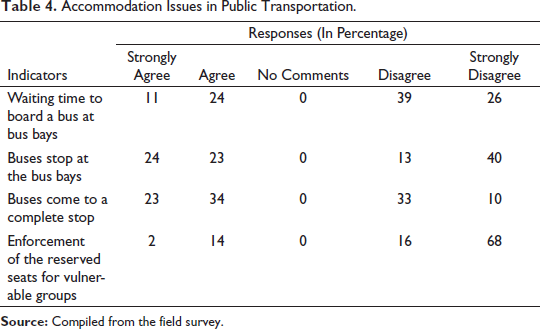
To accommodate the vulnerable groups, the provision to have reserved seats for vulnerable groups including women, PWDs and elderly passengers in the buses is barely adequate as only about 16% of the respondents have reportedly seen the proper enforcement of reserved seats (see Table 4). Sometimes, even if there are reserved seats on the buses, the available seats cannot accommodate all the passengers belonging to the vulnerable groups including the PWDs and elderly people. Often, the seats are mostly occupied mostly by women as the relevant law allows both the women and PWDs to have reserved seats. According to the passengers, men who are more vulnerable than a woman have lower chances to get reserved seats on a bus.
Acceptability of Public Transport
The acceptability of public transport, especially buses, in Dhaka has been evaluated by using several indicators. The behaviour of the transport staff with the vulnerable groups and the safety of the female passengers have been examined to understand the level of acceptability of public transport (see Table 5). Moreover, the proactiveness of relevant government agencies in ensuring inclusiveness and accessibility issues in the public transport system has also been examined.
Acceptability to Public Transport.
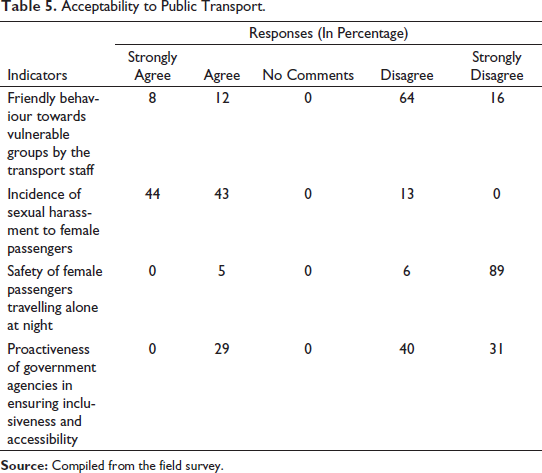
In the buses of Dhaka city, apart from the bus drivers, the bus helpers are the most seen staffs with whom the passengers mostly interact. The passengers often observe the bus helpers behaving uncourteously with the vulnerable groups. About 80% of the respondents observed the incidence of unfriendly behaviour of the transport staff with the vulnerable groups including the PWDs, women and elderly people (see Table 5). In addition, about 87% of the respondents have observed that female passengers are often harassed sexually while commuting via public buses (see Table 5). If the response is disaggregated by gender, it is found that all the female respondents have observed and experienced some sort of sexual harassment in public transport.
Sexual harassment of female passengers in public buses includes verbal and non-verbal behaviours, such as rude remarks, whistling, touching, pinching, groping and obstructing female passengers’ movement and so on. Both the transport staffs and the male passengers are responsible for conducting different forms of harassment on the buses. Nonetheless, while daytime travel has its pros and cons for female passengers, night travels are of serious concern for them in Dhaka. Only about 5% of the respondents opined that women are safe to travel alone at night (see Table 5). If the response is disaggregated by gender, all the female respondents have mentioned that the buses are unsafe for female passengers to travel alone at night.
In terms of the proactiveness of the regulatory agencies, about 71% of the survey respondents consider that the responsible government agencies are inefficient in ensuring inclusiveness in urban transport (see Table 5). The respondents who are service takers indicate towards to a lack of proactiveness from the responsible policymakers and an apparent lack of coordination among the responsible government agencies in ensuring a safer, inclusive and accessible public transport system in Dhaka. During the interviews, higher officials from government agencies also acknowledge that there is a lack of political will and coordination behind the failure of planning and implementation of policies for making public transport more accessible.
Affordability of Public Transport
The affordability of public transport in Dhaka has been evaluated by using a couple of indicators. One of the indicators is the fairness of bus fare while the other one is the cost-effectiveness of using the bus as a public transport (see Table 6).
Affordability of Public Transport.
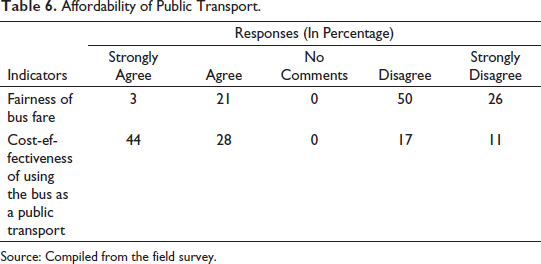
The bus services in different routes of Dhaka are informally categorised according to the differences in services. Some services run from one stop to the final stop without any break while some buses take passengers from every bus bay on the way to their destination. On the other hand, some services take passengers to strictly match the seat numbers while some take as much as they can accommodate inside the vehicle. Moreover, some services take passengers from specific counters with tickets at specific bus bays while the others neither have any specific counter nor have any ticketing system. Hence, the bus fare is charged at a different rate by different companies depending on the types of services they offer. About 76% of the respondents think that the bus fare is high and unfair in Dhaka while the fares vary highly among the bus services (see Table 6). Moreover, the quality of services against the fare is mostly unsatisfactory, according to the passengers. However, buses as the most used form of public transport among the commuters of Dhaka are still believed to be cost-effective compared to other modes of public transport as about 72% of the respondents echoed (see Table 6).
Discussion
The quantitative data suggests that the passengers have a lack of trust and satisfaction regarding the access to inclusive public buses as the public transport system in Dhaka is less inclusive, less accessible and less safe. Triangulation of data of both quantitative and qualitative nature from different groups of respondents has helped sketch a comprehensive picture of the state of access to public transportation in Dhaka city so far. Here, the qualitative data from the interviews reveal deeper insights mostly from the passengers on the demand side regarding the current state of access to public buses. Besides, views of the supply side respondents have also been covered by the interviews to supplement the data representing the demand side.
Almost all the respondents resonate with the opinion that public buses are totally inaccessible for physically impaired people who use wheelchairs and less accessible for people of age, people with illness and people with visual impairment. The buses lack accessible slopes, accessible stairs, spacious seating arrangements, Braille signs, hand grips, vertical stanchions, and space for wheelchairs and other assistive tools. Even the reserved seats for the vulnerable groups do not offer any extra space for the PWDs in need and are like the regular seats with prioritised seating opportunities only. In this case, the PWDs and other elderly people always ride on the buses with the help of other persons accompanying them. Moreover, there are no recorded audio and visual announcements on the buses to assist people with visual and hearing impairments in finding out the destination stations. A female respondent (aged 56 years) in a wheelchair stated that,
due to the accessibility issues in riding a bus, I take the bus and commute only when I have my son or a male family member with me. From coming to the bus bay to ride a bus and to get off the bus, the person accompanying me always has to lift me and my wheelchair up to avoid the unsmooth footpaths and inaccessible gates of the buses.
Not only that the buses are inaccessible, but a significant number of respondents have observed that the buses do not come to a complete stop and rather continue slow movement at most of the bus bays. Not coming to a complete stop makes it difficult for the PWDs, elderly persons and women to enter and board a bus. Moreover, many buses often do not stop at the designated bus bays, especially in the rush hours, and rather stop at convenient places wherever a significant number of passengers gather as there are no fixed bus bays in various places. A male respondent (aged 48 years) with a crutch stated that,
Someone like me can peacefully board a bus only from the very station where the bus starts its journey. As the bus bay near my residence is not the one from where buses start its journey, I usually avoid rush hours when it would be almost impossible for me to board a bus. Even in off-peak hours, I have to wait quite some time to board a bus as many bus staffs would not wait gently to pick me up.
Apart from the PWDs, interviews with the female passengers reveal that the drivers and helpers allegedly try to avoid taking female passengers during rush hours and from crowded bus bays. Moreover, there are issues of sexual harassment faced by female passengers from both bus helpers and fellow male passengers inside the bus. Female passengers feel most insecure to travel by public bus at night, mostly after ten at night, as revealed by the interviews. It is, hence, very difficult for female passengers to commute via buses in the rush hours and at night as the women-only bus services are scanty in the streets of Dhaka. A female respondent (aged 34 years) who works in a bank stated that,
It’s a bit easier to board the bus in the morning as my home is near the station from where the bus starts. However, the journey back home is scary as I have to board in a crowded bus where I sometimes experience bad touches and bad comments while boarding the bus with a bunch of male passengers.
Another female respondent (aged 22 years) who is a student stated that ‘Even though I take buses regularly, I would not take a bus at night, even after nine o’clock. I’ve read news about unfortunate incidents with girls commuting by buses at night and I don’t want to be in the news that way’.
Besides the accessibility and safety issues of the buses, the bus bays, footpaths and other infrastructures also have access issues. Mostly there are no well-maintained sheds for the passengers, let alone any audible as well as visible route maps and other guidelines. As a result, irregular passengers often need to ask strangers in the bus bay or find the names of the stops written on the body of the buses to find the appropriate bus for desired destinations. Moreover, almost all the bus bays do not have accessible restrooms nearby, while the poorly available ones have cleanliness and water supply issues. Furthermore, the main roads, inner roads and the footpaths leading to the bus bays are not highly accessible to vulnerable groups, especially those who are physically and visually impaired. A visually impaired respondent (aged 38 years) stated that,
I slowly walk with my white cane to avoid open manholes as well as unsmooth roads and footpaths to reach the bus bay. Every time, I have to take assistance from a fellow passenger to board the right bus. However, the loud announcement of the bus helper keeps me on track to get off the bus at the desired destination.
While the passengers from the demand side have expressed dissatisfaction regarding the different dimensions of access to public buses in Dhaka, the respondents from the supply side are often in disagreement with the passengers’ claims. The staffs of the buses, that is, bus drivers and bus helpers, are mostly reluctant to acknowledge the claims of poor quality and safety concerns in the public buses. Though they do not accept the claim that the bus staffs are rude and insensitive to vulnerable groups, they agreed to the need for training on hospitality and sensitivity to provide better services at public transport. Moreover, they recognise the accessibility issue which they think is out of their jurisdiction and can only be solved by the joint initiatives of government agencies and bus owners. The bus owners, however, accept the safety, accessibility and gender sensitivity issues of public transport. They think that higher bus fares can help provide accessible buses and better services inside the bus in future, though the supporting infrastructure, such as access roads, footpaths, bus bays and public restrooms can only be provided by the government agencies. On the other hand, officials from responsible government agencies blame the insensitivity and willingness of the bus owners and staff for failing to make bus services accessible and safe. The officials, however, accept that the roads, footpaths and bus bays also need to be more accessible to vulnerable groups which, according to them, the government is currently focusing on. Strong political will, enforcement of existing policies, coordination of responsible agencies and inclusive planning are the keys to ensuring everyone’s access to an inclusive transportation system, according to the officials.
Recommendations from the Respondents
As the findings from the study indicate several limitations of Dhaka’s public transport system, a few recommendations have been taken from the passengers and other stakeholders to make the public transport system more accessible and inclusive. Improving the quality of and making the vehicles, roads, footpaths and public restrooms accessible for vulnerable groups remain at the core of the passengers’ demands. In addition, introducing new buses for vulnerable groups including the PWDs, women and senior citizens with accessible doors and seats has been suggested as an immediate requirement to make public transport accessible. Ensuring the insertion of route maps and guidelines, braille prints, visible signs with high contrast colours, and audible public announcements in the bus bays as well as in the buses have also been prioritised by the respondents. Furthermore, the need for sensitivity training of all the transport staff and the proactiveness of the relevant government agencies in ensuring an accessible, safe and inclusive public transport system has been strongly recommended by the respondents. General public awareness about how to respectfully behave with co-passengers, particularly with vulnerable groups is critical.
Concluding Remarks
Dhaka, as the megacity of a developing country, at this point is well-known for its traffic mayhem as well as for its disorganised public transport system. On top of the management and coordination issues, the public transport system in Dhaka has been found less inclusive, less accessible and less safe. While evaluating the state of passengers’ access to inclusive public transport in Dhaka, this study has utilised several indicators under the five dimensions. It offers a deeper and broader insight into the state of vulnerable groups’ access to public transport. The study has uncovered the lack of passengers’ trust and satisfaction in almost all dimensions. In terms of availability and accessibility of public transport for vulnerable groups, lack of accessible bus services, footpaths, roads and bus bays have been found as the major concerns. Moreover, the quality of bus services in terms of dealing with vulnerable groups sensitively, ensuring the safety of the female passengers, and ensuring a fair bus fare, was found poor by the passengers. Therefore, the acceptability of the bus services as a major mode of the public transport system in Dhaka has remained poor. Finally, the study has exposed the need for immediate attention to ensure an accessible public transport system for the vulnerable groups in Dhaka.
This study on the state of access to an inclusive urban transport system in Dhaka, as the case of a megacity in a developing country context, leaves the scope for further research in related areas. On the one hand, the study lacks spatial coverage in terms of assessing the state of access to the public transportation system in a wide number of megacities from Bangladesh as well as from other countries. On the other hand, the study also limits its scope to focus more on the vulnerable groups’ access to the public transport system. Hence, further study with broader spatial and population dimensions can shed light on the state of commuters’ access to the public transport system in the urban areas of developing countries.
Footnotes
Declaration of Conflicting Interests
The authors declared no potential conflicts of interest with respect to the research, authorship and/or publication of this article.
Funding
The authors received no financial support for the research, authorship and/or publication of this article.
