







Abstract
The body of research examining the welfare systems of the Global South has expanded, yet there remains a lack of knowledge regarding the implications of modernising the welfare system in rural agrarian societies. A research gap in this area led us to conduct a live-in observation and 17 interviews with peasants in Merjosuro village—a rural area in Central Java, Indonesia—to examine how farmers’ rationality affects the perception of social risks and the decision-making process regarding health risks management. The study has two key findings. The first finding reveals that differences in the rationality of risk between policymakers and the Merjosuro community are the reason why the community does not participate in the National Health Insurance (JKN). The second finding indicates that the monthly contributory system promoted by JKN is incompatible with the livelihoods in an agrarian society characterised by unstable and irregular income depending on harvest time. Overall, the case in Merjosuro highlights the understudied phenomena of expanding modern-formal social policies within more traditional community-based informal welfare arrangements, which were found to have limited the pace of transformation of the welfare state expansion in the examined case. Additionally, the study has practical implications for rethinking contextualised designs of welfare state policies and practices for the Global South.
Keywords
Introduction
This article discusses the implications of the institutionalisation of the welfare state in agrarian societies based on a phenomenological study of Merjosuro village, a typical representation of rural areas that dominate Indonesia’s socio-economic landscape. The frame of reference is the rationality of farmers, which has shaped their understanding of the risks and the motivation to manage risks, which offer useful insights for designing and implementing policies and programmes in rural areas.
The last two decades have seen a substantial amount of research on the institutional dynamics of the Global South’s welfare system architecture (Barrientos & Hulme, 2013; Brooks, 2015; Béland et al., 2018; Huber & Niedzwiecki, 2015; Sharkh & Gough, 2010). However, we still lack an understanding of the consequences and mechanisms of the development of the welfare state in rural agrarian societies, which is a prominent characteristic of the Global South’s socio-economic systems.
Scholars studying the region trace the origins of welfare system reforms in the Global South back to the decade following the 1998 economic crisis, when a number of new institutions and policies expanded the role of government in a minimal welfare provision in multiple directions (cf. Yuda & Kühner, 2022; Koehler et al., 2021, for an overview). Moreover, as existing literature shows, welfare reform initiatives have presented significant societal obstacles in developing nations (Cruz-Martínez, 2017; Lavers & Hickey, 2016; Öktem, 2020), given that welfare state institutions were originally established for starkly dissimilar economic and social frameworks (Wood, 2015). Another welfare state problem of institutionalisation is that it was established on top of a well-developed informal system (Nurhadi et al., 2023; Sumarto, 2017). Many studies have highlighted this set of transformational dynamics in welfare, focusing on how the relationship of formal institutions with more traditional, informal ones has resulted in complex transformational dynamics (cf. Mok et al., 2017, for an overview).
The institutionalisation of the welfare state in Indonesia has experienced a similar trend. The economic crisis, parallel to the collapse of authoritarian regimes, stimulated decentralisation politics, resulting in a new pattern whereby welfare systems, especially healthcare, were expanded to cover those outside the formal sector (Aspinall, 2014; Fossati, 2017; Murphy, 2019; Yuda & Ashfina, 2023). Nevertheless, the sustainability of health insurance is faced with obstacles, especially in the informal sector, which is represented by the category of Non-Wage Recipient Participants (Peserta Bukan Penerima Upah, PBPU).
Recent studies conducted in Indonesia have shed light on the challenges related to the long-term sustainability of dues payments. These studies have found that over 25% of the participants fail to make their premium payments regularly due to various risk factors and income instability (Dartanto et al., 2020). On the other hand, the factors that promote the involvement of the informal sector in the Jaminan Kesehatan Nasional (JKN) are associated with the transmission of information from family and peers, as well as their own knowledge and experience (Dartanto et al., 2020). This finding builds on the earlier work of Nadiyah et al. (2017), who first examined the informal sector’s lack of participation in JKN and concluded that awareness of the programme is the primary factor that motivates individuals to enrol in it. Additionally, Offit (2015) has reported cases in which some individuals avoided modern insurance on religious grounds. In the Indonesian context, there is also opposition to the principle of joining JKN because its funds are saved in conventional banks, which are believed to promote riba (usury)—a financial system that is strictly prohibited in Shariah laws.
Regarding agrarian and communal societies, we propose an argument that the reason some communities do not participate in nationwide insurance is due to differences in their perception of risk and how policymakers believe they should view that risk, with the latter perception relating to the rationality of industrial societies. Another argument is that agricultural societies are tightly bound by mechanical social ties. The society’s mode of production is based on the principle of communalism, which has resulted in a tradition where social risks are not personalised, but rather distributed among community members within a limited geographical area and managed informally based on reciprocity (cf. Barrientos, 2008; Putnam, 2007). This understanding of communalism is, of course, different from the state-promoted health social security system, which is managed based on a principle called institutionalised solidarity (Gellisen, 2000) or artificial solidarity (Yuda, 2023). It demonstrates social bonds that are deliberately formed in pseudo-social spaces and structures and not in the form of real social interactions in a societal entity—a system that is not understood by relatively traditional social communities.
This article clarifies the visibility of the challenges and dynamics of the installation of the welfare state within the scope of agricultural societies, which we find has limited the pace of transformation of the welfare state in the examined case. Additionally, the article details the concept of social risks by analysing the differences between risks managed by the state and those that have long existed in social structures. The study in turn enriches the understanding of social welfare ideas in societies undergoing transition, which has theoretical and practical implications not only on the literature of welfare sociology but also on the search for alternative features for more contextually relevant welfare state institutions.
Institutionalisation of National Social Security in Indonesia
The establishment of the JKN system has deep roots in the economic history of the country, stemming from the process of industrialisation that began during the New Order era and has continued to evolve to the present (Murphy, 2019). Existing social policy literature argues that a major driving factor for the development of health policies for middle-income countries such as Indonesia lies in secular changes associated with the process of extensive industrialisation and, in particular, the destruction of traditional forms of social provision and family structure (cf. Dorlach, 2021, for an overview). These changes include economic growth and the expanding division of labour (Cruz-Martínez, 2017; Öktem, 2020). This argument may be relevant during the New Order period, with the introduction of various kinds of social security programmes such as Asuransi Sosial Angkatan Bersenjata, Insurance for Indonesian Armed Forces (ASABRI), Tabungan Asuransi Pegawai Negeri, Insurance Savings for Civil Servants (TASPEN), Jaminan Sosial Tenaga Kerja, Social Insurance for Private Sector Workers (JAMSOSTEK) and Badan Penyelenggara Dana Pemeliharaan Kesehatan, Health Care Fund Administering Agency (BPDPK), whose transformation into Asuransi Kesehatan, Health Insurance (ASKES) in 1992 occurred amid high economic growth (Yuda & Kühner, 2022).
However, all social security programmes were only limited to certain groups, namely, civil servants and workers in the formal sector (Murphy, 2019). After democratisation and the 1998 economic crisis, fundamental changes to Indonesia’s welfare system began. Beginning with a series of social safety net programmes designed to mitigate the impact of the 1997 Asian financial crisis on the poor, policy expansion has since moved in many directions (Aspinall, 2014). New provisions in the constitution (article 28h(3)) have given all citizens the right to social security. This transformation was ambitious, because it was not only the poor who were brought into the national social security system but also all income levels (Yuda & Pholpark, 2022).
JKN was then managed by a super administrative body called the Health Social Security Agency (BPJS Kesehatan), whose legality was confirmed through Law No. 24 of 2011. Implemented in 2014, JKN has successfully covered around 170 million participants, or around 70% of the population. As of June 2023, it has reached around 257 million participants, or around 94.9% of the population (
As a country just starting its late industrialisation, there is considerable variation in the degree of formalisation of the economic system, which is generally concentrated in a small number of regions (Yuda & Ashfina, 2023). Consequently, modern and traditional societies have developed in parallel, making efforts to install welfare state institutions side by side with informal social security (Nurhadi et al., 2023). The consequences of this installation process are rarely discussed in the literature, and this article outlines them in the case of Merjosuro village to show an alternative theorisation of the general process of installing welfare state institutions that have been recently taking place in democratic middle-income countries.
Theoretical Framework
This section discusses the concept of farmer rationality and risk dualism in agricultural society, which later becomes the frame of reference for analysis.
Theorising Peasant Rationality
The researchers analysed the issue of farmers’ non-participation in JKN by employing the theoretical framework of rational choice. This framework amalgamates epistemology derived from economics, sociology and anthropology. The intention was to ensure a comprehensive analysis of every social decision made and action taken by farmers.
The economic approach in rational choice theory assumes that social action lies in a profit-and-loss preference when faced with a wide variety of available configurations(Deliarnov, 2006). Anthropological research suggests that societal norms and values influence individual preferences. Scoot (1986) referred to it as the ethics of subsistence, which ultimately shaped the moral economy of farmers. Meanwhile, the sociological approach emphasises an axiom about reciprocity, which stresses that individuals with their rationality choose or act because it is based on something considered to be of direct benefit to them.
The article leans on a classical analysis written by Scoot (1976) on farmer behaviour in Southeast Asia. In his explanation, the farmers’ rational choice model focuses on what they think and believe about the economic reality of subsistence, which is then used to understand their actions. Scoot also emphasised that moral motivation plays an important role in shaping farmers’ behaviour and actions, which are shaped by the culturally specific belief system and values. Other studies that also lean on Scoot’s argument (Farmer, 2004; Hardin, 1982; Poteete et al., 2010) state that this moral construction is based on the imagination of the ‘believers’ or people whose actions are always guided by the ‘ideas of right and wrong’ that farmers learn, know and accept during their life course.
As Schejtman (1984, p. 124) stated:
In the case of peasant, his vulnerability to the effects of an adverse result is so extreme that…it seems appropriate to take the view that his behaviour as a producer is guided by a kind of “survival algorithm” which leads him to avoid risk despite the potential profit which would arise if he accepted them.
The survival algorithm is what Scoot (1976) referred to as the safety-first principle, also considered by Schejtman as an irrationality. This survival algorithm principle can also ultimately explain farmers’ preference for social economic arrangements that tend to prefer a relatively low but consistent level of income compared to a high-yield, high-risk one (Deliarnov, 2006).
The above philosophical view of moral economy starkly contradicts the rational economic theory, which is the basis of Samuel L. Popkin’s study (1980) on farmers. As a ‘political economist’, Popkin devoted his first two chapters to the debate against ‘moral economists’, whom he considered to be exaggerating the virtues of the past and assigning too low a value to modernisation and market economy. Popkin assumed that farmers, like humans in general, are homo economicus or rational actors who always took into account how they could improve their lives and welfare amid the situation at hand.
For Popkin, the emphasis on homo economicus is more solid as the basis for the study of peasant rationality than the romantic view of the communal man proposed by Scoot or other moral economic adherents (Ahimsa, 2006). Popkin also argued that although farmers are generally poor and live close to the margin, there are still times when they courageously invest even though it is full of risk. In this approach, Popkin (1979) ‘emphasizes individual decision making and strategic interaction’ (p. 30).
Popkin argued that in carrying out their economic activities, farmers primarily pay attention to the welfare and safety of themselves and their families. Whatever their values and life goals are, they will act ‘in a self-interested manner’ when they consider the possibility of achieving the desired result on the basis of individual actions. In addition, according to Popkin, a farmer’s relationship with others is not always based on some general moral principles, but on the calculation of whether such a relationship can or will be able to benefit themself or their family. Here, the concept of passive and consistently submissive farmers adhering to their social norms is replaced by a universalised economic man who makes decisions amid a number of constraints and challenges.
Our findings demonstrate that farmers in Merjosuro exhibit both rationalities debated by Scoot and Popkin, with a predominant focus on the moral economy. The emphasis on the moral economy that we discovered affects the way farmers think, which, to some extent, contrasts with the social insurance system based on predominantly rational principles.
Rationalities of Risk
What we often perceive as a universal notion of risk is actually influenced by local social, cultural and economic norms. This contradicts established literature on welfare states, which proposes that the shift towards modern industrial societies inevitably leads to the decline of mechanical solidarity, the core condition of the establishment of modern welfare states (Esping-Andersen, 1990; Van der Veen, 2012; Van Oorschot et al., 2005). In other words, risk framing in modern society departs from contextual and structural issues and focuses on how the process of industrialisation impacts increasingly personalised social vulnerabilities. Social policy ultimately functions as an instrument that moderates risk externalities so as not to adversely affect individuals (Bonoli, 2005, 2007).
However, the development process of Global South communities seems to have taken a different route. These communities, especially those working and living within traditional agricultural contexts, are witnessing another wave of complex socio-economic structural changes that have intensified existing social risks and exposed them to newer social risks as well. This makes it difficult for policymakers to determine how to compensate for this dualism of risks, apart from adopting welfare state ideas developed from the European welfare state system.
Adoption and expansion have continued, leading to a greater role for the state in economic and social development (Barrientos & Hulme, 2013; Béland et al., 2013; Brooks, 2015; Huber & Niedzwiecki, 2015; Sharkh & Gough, 2010). Simultaneously, certain literature focusing on the development of the welfare state in the southern world has encountered serious complications when welfare state ideas are confronted with the realities of societies in the Global South (Sumarto, 2017), a region that has not been massively industrialised and represented, such as the case of Merjosuro village that we examined. The tendency for those societies to adopt the communal and subsistence socio-economic system not only significantly serves as a safety net in mitigating traditional risks but also hampers the establishment of welfare state institutions in the region, as evidenced by the reluctance of farmers to participate in JKN. This can be explained with the rational theory by linking the rationality of actors who would only make suboptimal choices if the options for action are heavily constrained by structural limitations (e.g., farmers’ subsistence economic system) (cf. Taylor-Gooby, 2000). This phenomenon highlights the need for social development agendas to be formulated with a deep understanding of the more fragile nature of economic transition in the presence of informality and communal aspects.
Research Methods
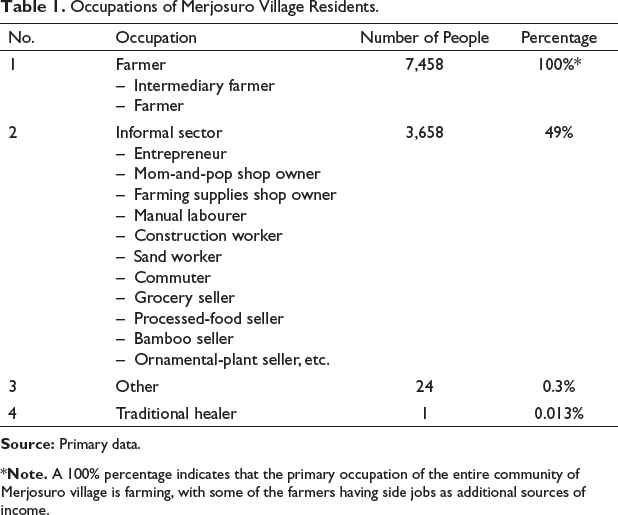
We developed this article based on a phenomenological study in Merjosuro village—a rural area in Central Java, Indonesia—whose real name we disguised for privacy reasons. One of the authors conducted an eight-week live-in observation in the village from January 2016 to June 2017 to gain a better understanding of how farmers negotiated with the formal social security system in their area. It is a fairly densely populated village that mostly depends on agriculture. In this village, there is no industrial sector; what exists are solely the agricultural sector and various informal sectors, with the formal sector accounting for a minimal percentage (see Table 1). These sectors are interconnected; the informal sector provides essential goods for agricultural production and also offers goods needed by the community. It serves as a support sector and an alternative source of income apart from agriculture.
Occupations of Merjosuro Village Residents.
In addition, the people of Merjosuro village also have various traditions that have nurtured their bond and solidarity to this day. The tradition is commonly referred to as merti deso, which consists of gatherings taking place on specific days or months (e.g., kliwonan, safaran and rejeban). Other traditions that remain preserved include neighbours voluntarily helping with the construction or renovation of fellow residents’ homes. In this kind of tradition, male community members will assist in the construction of the house, while female members help the homeowners prepare lunch for those who work for the construction (see also Bowen, 1986). Likewise, if there is a wedding party in one of the families, every community has a moral obligation to contribute by giving food or money. During the observation period, it was noted that such traditions come at a high cost. However, it is intriguing to see that they still endure because the people prioritise helping others and bringing happiness to them. The researcher actively participated in these communal activities during their stay and became a part of the established system.
In addition, the researchers conducted an intensive fieldwork consisting of interviews with 17 farmers, as well as participatory observations of daily interactions that occurred in Merjosuro. Specifically for interviews, we incorporated a purposive sampling approach, primarily to target individuals whom we considered to have extensive knowledge and experience on the research topic and were considered capable of providing insightful data.
To get access to the interviewers, we first contacted a village representative whom we had become acquainted with during the live-in observation. In this process, we emphasised that we wanted to interview people who refused to participate in the JKN scheme, including those who had experience using state-provided health services.
We selected the standard thematic analysis as a method to analyse the data collected. This approach left room for adapting and changing theoretical perspectives, hence allowing the researchers to be creative. We consider this approach appropriate because interviews were exploratory. The analysis also involved abductive reasoning, with data and theories influencing the interpretation. Moreover, we developed themes related to the reasons and logic of farmers who declined to participate in JKN. This involved an iterative process, and we adjusted and refined the themes to complete the paper—the results of which are presented in the next section.
Results
Farmers’ Economic Dualism
We argue that the way farmers work and earn income has influenced how they interpret JKN’s contributory system. The JKN system, traced from the historical roots of its creation (see Murphy, 2019; Yuda, 2023), is based on the logic of industrial society, which is identical to formal-sector work with a relatively stable and regular income, enabling participants to make monthly contributions. What happens in Merjosuro—an area that has not experienced much social transformation towards a modern industrial society—shows a pattern that is contrary to the characteristics and risks of the industrial society. From our live-in observation, two models of economic practice developed simultaneously, namely, moral economy and rational economy.
Moral economy is rooted in a philosophical view of humanity referred to as the ‘moral model’ (Ahimsa, 2006). In the context of our research, the moral model shapes farmers’ ‘worldview’, which then guides farmers in the actualisation of their lives, including in the case of economic activity. This phenomenon can be seen from the relationship between ‘farmers’ and ‘intermediary farmers’ in terms of economic security, observed at the dusun (hamlet) level.
In Merjosuro, farmers without capital can still start the agricultural production process by borrowing capital, in the form of both goods and money, from intermediary farmers. However, the loan payoff is not in the form of goods or money, but by making an agreement to only sell agricultural products to the intermediaries who lend the capital. These creditors then sell the products to other parties:
Here we are used to borrowing capital from intermediary farmers. This helps us because we don’t need to return the capital. But we have to sell our produce to the lenders, and they will later profit from selling our produce to the market. So, such profits will cover the money lent to us and give some extra to the lenders as well. (Interview with a farmer)
This reciprocity is maintained as a social and economic system that becomes the income safety net for both farmers and intermediaries. For farmers, this system is very helpful for them in carrying out production activities as well as distributing their agricultural products at a fair price, even in a crisis. Meanwhile, intermediary farmers who collect agricultural products from the local farmers benefit from the surplus generated by selling these products in the market—after deducting the amount of capital they lend to the farmers. All of these practices operate on the basis of ‘gotong royong’ (collective cooperation) values that are ingrained in the society, implying the dimensions of a dominating moral economy.
Among farmers themselves, rational economic practices can also be found in their daily lives. During the waiting period for the harvest, for example, most of them diversify their sources of income by engaging in other informal jobs temporarily (see Table 1) to fulfil their and their families’ needs:
While waiting for the harvest season, my farmer friends and I typically take up odd jobs like being a handyman, helping people with house construction, or doing small-scale selling. Besides keeping us occupied, it’s a practical way to earn a bit extra for our needs during the waiting period. (Interview with a farmer)
The coexistence of moral economy and rational economy applications simultaneously influences how farmers perceive risks, which we have classified into three categories, that is, shared risk, short-risk management and direct reward. All three, to some extent, contradict JKN’s risk management system, which is elaborated next.
The Idea of Risk in Farming Communities
Our data confirm that farmers’ mode of production has shaped farmers’ rationality in looking at social risks and their decision not to participate in the JKN. This section elaborates on three categories of farmers’ rationality towards social risks based on interview results:
The first one is the shared risk. This is a form of solidarity where mutualism (gotong royong) in society is expressed mechanically. The farmers assume that the community and its role in providing welfare can reduce social risks. For instance, if a farmer faces difficulties, they assume that these issues will naturally be resolved through the communal system (informal social security) embedded in the daily community life. Likewise, if a farmer falls ill, it has become customary for fellow community members to provide ‘sickness support’ in the form of cash, enabling access to essential healthcare services. The consequence of this tradition is that social risks are ultimately considered as not requiring individualised or formal institutional management, but are addressed collectively through reciprocal mechanisms:
Here, whenever there’s a special event or when a neighbor is in trouble, like when they’re sick, the community will always lend a hand, even without being asked. I’ll do the same. If a neighbor is facing difficulties or needs help, I’ll be there to do so. It’s not just because it’s a part of our faith, but also to make sure that we’re not left alone if something happens to us. (Interview with a farmer)
Second, short-risk management means that the risk imagination among farmers is confined to a short-term dimension. The type of risk management was formed as a result of the influence of the common practices of farmers who operate within a subsistence system to earn their income, which is spent on immediate needs. In addition, short-risk management also shows the growing relevance of the characteristics of the agricultural sector—there is always a gap between production expenses and the returns from production, known as the gestation period. The term refers to a temporary period (generally two months) in which farmers live without income until the harvest season arrives. This condition has implications for the farmers’ perspective on ‘insecurity’, which is perceived to only exist during the gestation period:
Even though we live modestly, we feel grateful and happy. As long as we can eat and be with our families, that’s enough for us. We usually face difficulties only during the waiting period for the harvest. After that, things go back to normal. (Interview with a farmer)
Indeed, some farmers acknowledge that this insecurity can potentially loom throughout the year. However, they often downplay the real threat of this insecurity and seek alternative explanations by adopting their own methods to cope with it. This is done by construing risk only during the waiting period for the harvest to emphasise that JKN’s regular premium system is not compatible with their economic system, thus providing them the option to opt out of the system. Overall, what farmers think about risk confirms that their understanding of it, which is distinct from that of industrial societies, is not a given but rather constructed by the existing structure:
Well, for us farmers, our income is seasonal, typically lasting for no more than two months. When you have to pay the monthly premium, the income may not cover it. The reality is, it barely covers [our needs] for those two months. But when the harvest season arrives, things get better, thankfully. We can get sick at any time, I know that, but what can you do? The money only comes in during the harvest season. (Interview with a farmer)
The third one is the principle of direct reward. Farmers engage in an action with the hope that they will directly receive something in return. Direct reward is practised by farmers through a tradition of reciprocity, such as by helping neighbours who are in difficulty. In many cases, this has led to the formation of trust among the community, serving as a moral bond among the members. Those who receive assistance are often encouraged to do the same when the giver faces difficulties. In addition, direct reward also means the assumption that ‘helping neighbors’ is a charity that will be compensated by God in the form of spiritual merit reward:
You see, for me, instead of paying the monthly JKN premium, I prefer to help a sick neighbor. The rewards are clear and guaranteed. Paying for JKN doesn’t assure me that ’’ll use it. Besides, the hospital is quite far away. Even if I fall ill, I have some savings, and if that runs out, my family and neighbors usually pitch in. (Interview with a farmer)
The concept of direct reward, as described by the farmers, is not reflected in the JKN system. This is because the JKN’s principle of risk pooling extends beyond narrow geographical areas to cover the entire country, which might not be comprehended by more traditionally rooted social communities that consider neighbours to be those residing nearby in the same village or community. Moreover, the implications of not participating in the JKN system are not directly experienced in their personal or social lives. This is in contrast to the reciprocity tradition found in rural communities, where the consequences of not participating in the tradition can be directly felt, potentially leading to exclusion or a lack of community assistance during challenging times:
...If a neighbor is facing difficulties or needs help, I’ll be there to do so. It’s not just because it’s a part of our faith, but also to make sure that we’re not left alone if something happens to us (Interview with a farmer)
Such a perception has caused people to be reluctant to participate in JKN and prefer the out-of-pocket model as their healthcare financing scheme. They opt for this model over an insurance system in which they have to regularly pay premiums without a clear understanding of when they will reap the benefits of their contributions.
Discussion and Conclusion
This article elaborates on the dynamics of the implementation of welfare state ideas and practices within a society characterised by the domination of the informal economy, particularly in the agricultural sector of Indonesia. Our phenomenological fieldwork has yielded three main findings.
First, the concept of a welfare state promoted by the government through the JKN system is not compatible with the farmers’ comprehension of the risks typically associated with communal values and moral economic principles. The primary disparity lies in the social insurance system, where monthly premium payments are not suitable for the income fluctuations and irregularities that are typical in agrarian communities. The mechanism is dependent on harvest seasons, which is in contrast to the workings of an industrial society.
Second, farmers are acutely aware that their livelihoods are fraught with risks capable of causing dysfunctionality, which could render them unable to engage in economic activities. However, due to their socio-economic conditions, they are cognitively ’forced’ to reconstruct their perception of risk only during specific periods, especially when they are in the waiting period for the harvest (gestation period). Although farmers have other alternative sources of income, these are only survival strategies during the gestation period. This characteristic has led to highly uncertain income levels for farmers, making them reluctant to pay regular JKN premiums. This also confirms that their understanding of risk, which is distinct from that of an industrial society, is not taken for granted but constructed by their unique subsistence economic system. These findings also revise the understanding presented in the previous set of studies (e.g., Dartanto et al., 2020; Nadiyah et al., 2017) that emphasised the non-participation of the informal sector in modern social insurance systems based on their knowledge, risk factors and experiences.
In a further discussion, the construction of risk rationality among these farmers provides a new insight into the concept of ‘situated rationality’, which is rationality inherently tied to a specific place, time and network and often constrained by the norms and values of the group (Douglas, 1992). Thus, in this case, farmers’ rationality regarding risk framing and social actions to mitigate risk can be moderated at times—when appropriate actions are hindered by structural constraints and a lack of agency (Douglas, 1992).
Third, from the understanding of risk among the farmers that we have uncovered, the principle of direct reward becomes another determinant factor contributing to their non-participation in the system. Farmers ultimately prefer the out-of-pocket payment model as their healthcare financing scheme over an insurance system where they have to regularly pay premiums without a clear understanding of ‘when’ they will benefit from their contributions. The direct reward principle is also related to the notion that ‘helping neighbours’ is more important because it is considered an act of charity that will be directly compensated by God in the form of spiritual merit or reward. It represents a moral obligation within a social community that highly values mechanical solidarity. The presented farmer’s understanding leads to implications for the welfare practices of rural communities. They choose to stick with the traditional system of assisting sick neighbours because it is considered more virtuous, brings them closer to God, and fulfils moral obligations within a community. Failure to do so may result in social sanctions such as ostracism. It should be emphasised that ‘neighbours’ here are defined as those who live in a geographical or administrative area that allows for social interaction in everyday life. These concepts are not represented in the JKN risk management system, which has a national scope, and the implications of their non-participation in the system are not directly manifested in their private or social lives. To a certain extent, this finding intersects with Offit’s (2015) argument on the transcendental dimension that prevents a person from accessing medical services while complementing it by adding the dimensions of communalism and tradition as determinants.
Our findings also highlight that the economic logic underlying the implementation of JKN is rooted in industrial or modern society, which assumes organic solidarity, formal-sector employment and regular income that allows for planned budget allocations. In a further discussion, the competing logic shows that the development of the welfare state in Indonesia is ahistorical and disregards the inherent informality in welfare provision.
In addition, the persistence of the competing welfare rationality is influenced by the development of the Merjosuro community, where mechanical solidarity is strong, and social institutions within it have a significant impact on managing the risks of its members. This contradicts the characteristics of modern rationality centred on individualism, where risks are considered something to be personalised with individual responsibility. As a consequence, individuals in industrial societies are more motivated to manage their risks through welfare state institutions as they recognise that their kinship networks have been dismantled.
On a theoretical level, the trends observed in the Merjosuro case imply that the establishment of welfare state institutions, at least up to the point when these data were collected, does not simply result in a substitution effect or trade-off that negatively impacts social solidarity. These findings refute the claims in social policy literature (Esping-Andersen, 1990; Van der Veen, 2012; Van Oorschot et al., 2005) regarding the negative effects of welfare on informal solidarity and social capital. Instead, they indicate a trend of increased resilience of informal institutions when faced with the modernisation processes of welfare institutions.
The case in Merjosuro highlights the significance of informal relationships and networks, especially in postcolonial countries where they reflect the prevailing moral economy. It is not easy to replace this with rational economics principles, as Popkin suggested. Consequently, this study prompts a rethinking of our understanding of the institutionalisation of welfare state ideas in developing countries with norms, values and practices rooted in starkly different historical trajectories to Western societies. Without proper contextualisation, welfare reforms will not yield any direct benefits to citizens, while the prevalence of informality will continue to undermine the effectiveness of welfare state programmes. To that end, a gradual and inclusive process may be preferable to a rapid and exclusionary one that sidelines stakeholder interests.
Although there is limited evidence of success at the time the reform was implemented, ex post outcomes of reforms remain ambiguous because improvements in some areas have been offset by negative outcomes elsewhere. Thus, making the system more in accordance with the farmers’ mode of production can be a strategic way to encourage farmers to take action to participate in JKN. This can be performed by adjusting the irregular and flexible premium dues for the farming community and the informal sector.
Overall, this article fills a gap in the social policy, welfare and sociology literature, which tends to overly focus on the discussion of welfare policy expansion (e.g., Barrientos & Hulme, 2013; Béland et al., 2018; Brooks, 2015; Huber & Niedzwiecki, 2015; Sharkh & Gough, 2010) while continuing to ignore how the process deals with widespread informality. However, this article is also subject to two limitations. First, the dualism argument of risk perception as an implication of farmers’ life dynamics cannot be generalised. Other studies need to investigate other determinants that contribute to the dualistic understanding of risk. Second, the scarcity of literature on the subject in the Indonesian and developing country contexts, in general, leads to an overemphasis on case exploration rather than synthesising it with established literature.
Last but not least, future research should delve further into the possible convergence or divergence of risk perceptions between communities and policymakers. Additionally, the research agenda should also cover the extent to which informality influences the quality and character of welfare state implementation in societies of developing countries.
Footnotes
Acknowledgement
The dataset for this article is drawn from the first author’s thesis, which was published at Universitas Gadjah Mada Library.
Declaration of Conflicting Interests
The authors declared no potential conflicts of interest with respect to the research, authorship and/or publication of this article.
Funding
The authors received no financial support for the research, authorship and/or publication of this article.
