






Abstract
Despite extensive conversations about the need for partnerships and ways to work together, barriers remain to practising it and engaging together at the cultural interface in Australian remote Aboriginal communities. Based on a project that explored building community-based approaches for youth in remote Aboriginal communities and drawing on community-based participatory research and the Indigenous method of Yarning, this article identifies barriers towards engagement at the cultural interface. One of the major barriers is the limited capacity of outside service providers to engage at the cultural interface, in building trusted relationships with community members that recognise, understand and make room for Indigenous worldviews unique to the community. This level of engagement is essential in providing a ‘both ways’ learning model. The recommendations from community members suggest that interactions at the cultural interface can only be achieved when trusted outsiders work flexibly and relationally alongside them. By working in this way, people at all levels of government are essentially getting alongside, supporting, equipping and building community-based solutions.
Introduction
It is widely known, appreciated and expected that place-based approaches to community-driven needs constitute best practice in Australian remote Aboriginal communities. Yet, despite this, policy and practice reflecting co-design and partnership approaches (Queensland Government, 2023), and the absence of effective solutions to closing the gap in health and education remains (Commonwealth of Australia, 2024). This study was conducted through a community-based participatory approach with two remote Australian Aboriginal communities on educational opportunities for youth, and identified barriers to the design of effective community-led solutions. Drawing on community perspectives, we discuss the barriers that prevented locally driven responses. The article outlines findings from the research that used a community-based perspective to foreground the experiences of adolescents and their families in two communities on Cape York Peninsula, Queensland. The study sought to articulate how the community understood the ‘problem’ of young people disengaged from mainstream education and what an alternative solution might be. We argue that this ‘problem’ is complex, yet solutions are frustratingly simple. We identify the failure of service providers to engage appropriately in intercultural interactions at the interface. Without it, a barrier remains in authentically building place-based approaches in culturally relevant ways.
Remote communities are populated by Indigenous people who are the Traditional Owners or have cultural ties to the country, along with a small number of outsiders employed and living in the community. These outsiders provide services funded through government or NGOs that employ ‘fly-in and fly-out’ workers on a weekly basis to deliver services to meet the externally driven values of their various organisations. Outsiders are government and non-government service providers, delivering health, education and technical services through local, state and federal government departments. An outsider employed in one of these roles will have varying understandings of the reality of the remote community contexts, including awareness of the cultural differences between a Western and Indigenous way of being. Their knowledge and expertise are dependent on their own histories (including unconscious biases), experiences within remote communities and the demands of their employer, which in turn influences their ability to engage at the interface where a mainstream non-Indigenous worldview and Indigenous culture unique to the specific community context meet.
Life in remote Aboriginal communities is complex and multifaceted. Despite historical, cultural, social, health, education, geographical and economic differences, remote communities receive services, including the provision of education, in the same way as regional and urban centres. This homogenous approach assumes a one-size-fits-all delivery of services in remote Indigenous communities. In many cases, this model of service delivery results in little engagement between service providers and community members. Programmes are built, services offered and research conducted without or with limited authentic local community input. As the majority of service provision is delivered by outsiders, community members lack the power and authority to effect and implement service solutions in ways meaningful to their context.
Families and youth in these remote communities sit at the interface of different cultures, navigating daily life, including education (Nakata, 2007). We witnessed service delivery and community input or consultation ticked off when a barbecue is conducted, or a single conversation is held and is then couched as ‘building partnership’ or ‘co-design’ to obtain funding or implement projects. Most often, service providers believe they are doing good work, yet cannot see the subtle ways this mode of operating undermines community members’ efforts.
Case Study Context
Youth, specifically those aged between 12 and 17 years of age, are legally required to attend school. In the case of Australian remote Aboriginal communities, there may be no secondary school or programme suitable to meet the educational needs of school-aged youth in the community, making boarding school the government’s recommended pathway and therefore, families’ ‘preferred’ (only) choice for secondary schooling (Commonwealth of Australia, 2017). Unfortunately, often, over half a cohort of these students do not complete their schooling away from community and, for a variety of reasons, return home (Britton, 2022; O’Bryan & Fogarty, 2020). Youth who return to their home community either have no school to return to and, for reasons other than academic failure (e.g., shame boredom), may hide away from active community life. Because of the legal assumption that all youth are enrolled in school, there are few regular programmes for young people within their community.
Community members indicated that outside service providers offer few services for young people; however, those that do are not satisfying the needs identified as appropriate for community life or in a way that is culturally applicable. Examples of services offered include one-off activities (visiting footballers or hip-hop dancers) or sessions embedded within health service delivery (counselling). The current programmes do not include ongoing developmental opportunities for these young people to engage with others or learn life skills that would assist them to meet their holistic needs within the context of their respective community. Service organisations lack the necessary awareness of the reality of community life and the need to engage at the cultural interface, and conversely, families do not understand the Western system. This creates difficulties for youth who may want to access further education. Community members recognise that service providers currently do not define the problem in the same way as they do, engage within the cultural interface, ensuring responses reflect local cultural understandings or listen to their perspectives on how it might be addressed.
Understanding the Cultural Interface
The literature defines the term ‘cultural interface’ as describing the place where Indigenous and non-Indigenous cultures collide (Nakata, 2007). The concept of the cultural interface is particularly pertinent in remote Aboriginal communities, given the lived experiences of Aboriginal residents and their engagement with outsiders who provide services (including education) within rigid policies and practices. Engaging at the cultural interface implies there is more than one culture and that these cultures interact in ways that develop effective relationships that meet the needs of both parties. Unfortunately, often, the engagement by outsiders is limited, one-sided, and lacks the time necessary for listening and to establish understanding. From the community perspective, there is little engagement by service providers in their daily lives, resulting in service delivery that does not take into account the way of life, community needs or worldview.
Although there are references to the concepts of forming productive partnerships at a policy and system level, guidance as to how this can be effectively established is absent. For example, the Queensland Closing the Gap Snapshot 2023 edition is couched within the expectation that a partnership approach to engagement and co-design in working with Indigenous communities will be employed (Queensland Government, 2023). While terms such as co-design are littered throughout the various documents, there is little guidance or understanding of how this specifically could look, or the time it will take, both from community perspectives and outsider service providers. Without an understanding of what productive partnerships actually look like in the remote context, it is left to community members to learn new ways to interact, negotiate and adapt when they interact with service providers. This is not necessarily a comfortable place for outsiders either, as the demands and constraints of the service they offer (i.e., policing or education) are often the same as those specified for the larger metropolitan centres, despite the differences in a remote community (Dwyer et al., 2020; Egan, 2018). Outsider service providers have a choice about this; they can continue to implement the services in ways familiar to them or learn how to engage at the interface in meaningful ways. Unfortunately, few are in positions that enable the time, commitment or awareness to do so. Such actions may also require deviation from their key performance indicators (KPIs) and funding timelines.
This is not a new conversation. Taylor et al. (2012) wrote about the dysfunction of community development from a community-based perspective in Australian remote Aboriginal communities over a decade ago. They highlighted the lack of social cohesion and differing worldviews between Indigenous and non-Indigenous peoples in understanding the functions of community. Moran (2010) explored governance issues within these same communities and the failure of nationally funded service delivery programmes, demonstrating the need for outside providers to develop skills in intercultural interactions for community members to engage and trust the processes. Many write of the impact of policy on community functioning in holistic ways through ground-up approaches (Bat & Guenther, 2013; Fogarty & Schwab, 2012; Fogarty et al., 2015; Kral, 2010; O’Bryan & Fogarty, 2020). Osborne’s early work spoke of connecting with the heart of the matter, effectively portraying engagement at the cultural interface while maintaining a sense of self for Indigenous young people in remote communities (Burton & Osborne, 2014; Minutjukur & Osborne, 2014; Osborne, 2014; Tjitayi & Osborne, 2014). His latter work reiterates the need for outsiders to practise listening, to effectively engage with families in communities (Osborne, 2023). In terms of education, many authors write about the reality that cultural and contextual approaches are paramount (Bat & Guenther, 2013; Osborne et al., 2020; Yunkaporta & McGinty, 2009), with the need to remember youth are unique given their age (Mills & McGregor, 2016; Te Riele, 2014), and the difficulties they face in attending school (Guenther & Osborne, 2020).
Objectives and Research Question
The objectives were to (a) determine the similarities and differences found in literature on alternative education for Indigenous communities, taking into account context; (b) develop an explanatory model of all the attributes that make up alternative models of education specific to the needs of the community; and (c) identify the enablers and barriers to implementation of the model of education.
The study addressed the following research question:
‘What learner-centred alternate model of education could meet the unique developmental needs of remote Indigenous adolescents who do not fit mainstream educational opportunities?’
Research Approach
This study used Community-Based Participatory Research (CBPR) with yarning methods embedded (Britton, 2022). Yarning or having a ‘yarn’ is expressed through the Aboriginal English term for having conversations and passing on knowledge through talking together and information sharing (Bessarab & Ng’andu, 2010; Fredericks et al., 2011). It is traditional, conversational, co-operative and reliant on cultural and relational protocols as knowledge is built together (Bessarab & Ng’andu, 2010; Walker et al., 2014). Yarning is not a set of questions delivered by the expert researcher, but rather a safe interaction where the researcher and participant journey together through topics relevant to the research question/s and, in the process, strengthen their relationship (Fredericks et al., 2011).
The principles of CBPR prioritised the voice of the families and adolescents in each community and their experiences of education (Crotty, 1998; Minkler & Wallerstein, 2008). A decision was made to limit the voices and experiences of outsider educators or service providers who hold professional roles within the community and instead, fully engage with families and youth. In both of the communities, a range of participants took part in the research at various stages and in different ways (17 and 14 youth; 20 and 33 adults; and 6 and 6 elders). Yarning as a method was used to connect with families and adolescents in a manner familiar to each community (Bessarab & Ng’andu, 2010). This approach enabled the formation of a co-produced story.
Participatory approaches to research, such as CBPR, are grounded in the context of practice where the researcher and community work together in partnership to affect a desired change to a problem the people themselves identify (Israel et al., 2012; Minkler & Wallerstein, 2008). The Indigenous method of yarning facilitated the research process in a way that met people in community ‘where they are at’ (Bessarab & Ng’andu, 2010).
Yarning took place over five fieldwork visits to two communities across 2018 and 2019. The yarns occurred in a variety of individual or small group settings. Following each visit, the data were analysed and synthesised using thematic analysis before being checked by community members on subsequent visits. The first author used a simple coding method to analyse initial data, and over time built themes from the data. Throughout this interactive process, people met together in small groups or individually and yarned with visual cues as prompts related to the initial codes and themes found. Here, the data were checked while at the same time new data were created. The process was repeated and occurred over four fieldwork visits, resulting in a total of 14 themes identified that then formed the co-produced story, discussed in part, in this article. The co-produced story was formed and approved by community members (Britton, 2022).
Positionality of the Research Team
Before presenting the findings of the study, the positionality of the authors is briefly outlined. The authors include a range of insiders and outsiders to remote Aboriginal communities. All fieldwork was conducted by the first author, including the formation and construction of this article. Amelia does not identify as Indigenous but has her own cultural ancestral connections with the Dharug nation in NSW. Through several decades of work and walking with people, she has been adopted into the Kokemenjena, Kokoberra and Kunjen families. These existing relationships, built over time, led to her being described by the participants as a ‘trusted outsider’ (Kovach, 2009; Moran, 2010). Though an outsider to the community, because of her prior relationships, connections and experiences, using CBPR was a natural fit for embedding the research.
Authors two and three are outsiders to remote Aboriginal communities and did not do any community-based fieldwork. Their role was in assisting with the conceptual analysis and theoretical approach to the original project and the construction of this article. However, both have had extensive experience in the field. Eileen worked for many years in education in the Kimberley and in Adult Education in Central Australia. She continues to engage in research in the area, mainly from a public health perspective. Miriam also has two decades of experience in alternative education and community development in Australian and international settings.
The Findings
Overview of the Metaphor for an Authentic Community Place-based Solution
To understand what community people envisage as appropriate engagement at the cultural interface, they first expressed a deep desire to challenge how the needs of young people are portrayed. Community people view an individual as a ‘whole’ person rather than examining them through a single lens of education, health, employment or any other compartmentalised approaches that underpin service provision (i.e., youth justice or child safety). This holistic view is currently at odds with the way service delivery is conducted. For example, the community believe that educational plans must include the aspirations of families for their children, the complexities of the context they are embedded in, the historical and cultural differences, worldview and the social realities of remote Aboriginal communities. The findings explain how these perspectives and relationships need to be established and are presented as a co-produced story with both a written narrative and a visual presentation of a tree (Figure 1).
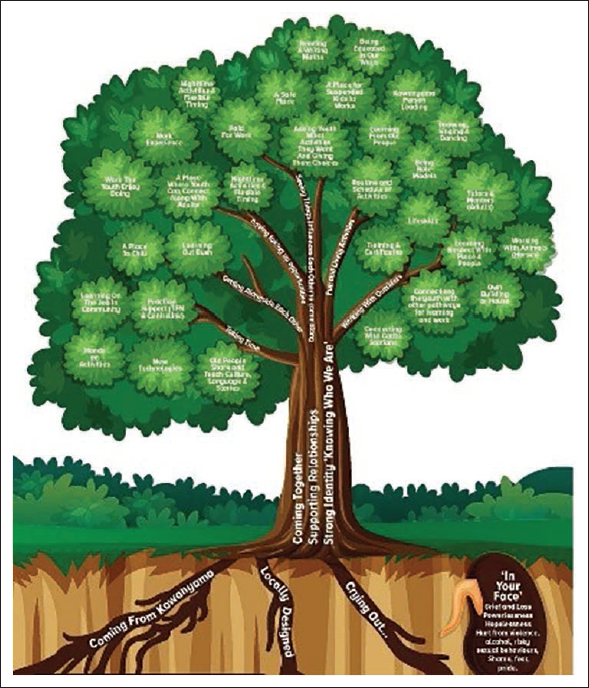
Community members want to work with outsider service providers to build an alternate model of education that is grounded in their ‘places’. They compared this to a seed when planted in the ground that grows from its roots from the foundations in which it is planted. These foundations include the realities of daily life unique to the context in which the tree is planted, and the well-established roots enable growth through the trunk, branches and leaves. The vision of community members was for the establishment of a youth hub or alternate model of education with support from outside service providers, but importantly, with leadership sourced from within the community. Several described it as any solution ‘must come from the community’ but recognised that ‘change actually needs to come with the parents stepping up’ and another saying ‘actions speak louder than words’. They recognised the power of a family, or in a community where everyone is family, knowing that leadership and the actions that flow from this influence the younger generations. Working in partnerships with outsiders, the foundations of the alternate model would be created by the community and service providers working in a way that enabled them to support each other and work together. Working together or as it was phrased by community members ‘getting alongside each other’ means adults are included as part of the design and implementation, with outsider service providers working alongside, rather than in a place of leadership and authority. Such an approach leaves room for community members to engage with young people in ways meaningful to them.
The branches of the tree are the strategies and actions that create an environment that fosters learning, growth and education for youth. Families know their young people and the realities of community life are not necessarily understood by outsiders. This means establishing a safe place for activities, learning and connection where young people can gain skills for their life, by interacting with adults whom young people trust and who take the time to sit with them. The ways of engaging at the interface between the local culture and the world of outside service providers need to be modelled and taught to young people. They need to be supported to take up opportunities within their community, while they face fears about the outside world, take risks and try out new opportunities. Using these strategies creates a tree that is functioning and produces leaves or fruit that flourish. This type of alternate model built up within the community would help young people develop a range of life skills, attitudes and abilities to gain employment, but also to be leaders within their community.
The Ways of Engaging at the Cultural Interface: Relational Work
Community members argued that underpinning engagement at the cultural interface is knowing and understanding who the youth are, their strengths and needs. If outsiders do not form relationships, work relationally or build authentic partnerships, engagement with youth will be impossible. A lack of genuine understanding and ignorance of the educational needs of youth, who they are and what their needs are, is a barrier to engaging young people in remote communities. Evidence from the community suggests that young people in these communities are not engaged or have limited engagement with services.
There were countless stories told during the field visits about the effects of living on the other side of community life and the impact on relating with outsiders and educational providers. Drugs and alcohol, for example, keep a person in shame, isolated and indoors, not willing to access services or engage in daily pursuits that are healthy (Britton, 2022). The lack of support and feeling down, depressed and unheard contribute, as does the shame people feel, in refusing to try out new learning. There is also a fear of speaking out against racism, being misunderstood, having a chronic illness or needing to care for family alongside trauma triggers that hinder engagement. These are the impacts of the social determinants that influence education and confront families every day.
There is a failure to recognise that young people have disengaged from mainstream education for a myriad of reasons and that the support required for them, or ‘nutrients’ needed for their growth, will differ from the mainstream approach to teaching and learning. The community argued that the approach needs to recognise the strengths that the young people do hold and provide bridges to support learning that they require, based in their own community and the people they know and respect. Only when this foundation is recognised will the resources of outside service providers be applicable.
To begin working with youth in communities, outside service providers need to understand that families are the key to understanding their young people. Young people trust their family, feel safe with those who understand them and take the time to listen. Family members are people who themselves have stressors far more than the average outsider comprehends. They understand intimately what the impact of these stressors is on daily life and how to navigate through them. These families have lived through failed attempts at boarding school, know the reality of living away from their country and what it is to live on the other side of community life. There is also family politics, dysfunction and negative influences that impact young people. Regardless of these contradictions in familial influence, families state that they are currently the ones who have the least say in how their children’s needs might be met.
Community members understand the unwillingness and inflexibility of outsiders’ approaches. They have their own, often negative history of interaction with outsiders to overcome. There is a pervasive weariness of not being listened to or understood regarding solutions that they consider would better meet specified needs. Perhaps because of this lack of power to contribute to the revolving door of government policies and outsider service providers coming in and out of the community, families consistently say that any solution ‘must come from community’ and ‘not outsiders’. The desire is for people to be part of building an alternate model of education that connects with the lived reality of the youth and their families and is built on the foundation of place. In this model, service providers would get alongside and work within defined community aspirations and timelines, not dictate programmes based on assumed goals defined from a Western mindset and meet the strategic goals of the outside organisation.
As community members define it, youth, particularly those disengaged from mainstream education, do not know how to be strong; they are lost. As one woman framed it:
because they left school early, or if they did attend school they were not focused on education. They do not know fully the cultural aspects of how things work culturally, properly. And they don’t even know the how the white man ways like the law work properly either. They’re lost in between. Like lost.
She went on to suggest that there are people in the community who can help youth navigate this intercultural divide. In another conversation with a different community member, it was noted that:
We sorta the front row and we have like all the support behind us because that’s what we need. And then once we understand from the support, we need to then translate that and to pass it onto our youth in a way that they understand… Sometimes it might have to be in our language [or] we have a thing called broken English and that’s a big thing in our community. Our way. And it’s understandable in our community.
The women highlighted that for intercultural interactions to occur, trusting relationships are required where adults have set roles and can lead and work in ways that are meaningful to the young person. Another young person said:
But they [youth] need to know that they can do it too, you know and be encouraged in doing it’… ‘and that’s how I used to be before. I used to be down and sad you know. And thinking about I don’t want to trust anybody cos nobody gonna don’t really like me or nobody don’t care about what I feel, or how I think or what I like as a person you know.
Not only do we need to speak in ways that young people understand, but the way we ‘help’ or interact must be meaningful too. Some young people do not feel worthy, so they need trusting relationships to help overcome these negative feelings. Trust can then be developed from the basis of being understood, heard and listened to. If a community member knows intuitively that the outsider does not share this understanding of who they are and what they need, they are less likely to work with them. This will prevent productive partnerships from being formed from the very start. On the surface it can look like community partnerships are functioning because there are Aboriginal teacher aides, health workers or staff employed in various roles in the provision of services in the community, but digging deeper it does not necessarily mean that their voices are heard when they suggest ways of working that enable meaningful change and growth for youth, based on strategies important to them (Britton, 2022).
Community members get frustrated at having to do business in ways not their own, when they want opportunities for meaningful and authentic solutions in their local community. Not only must community members have authority to play an active part in the leading, designing and monitoring of programmes they are delivering, they also desire to feel heard and understood within a partnership where the financial, resourcing and leadership ‘power’ is not simply held (or blocked) by the outsider. Several women outlined ways to know and interact with the youth at the interface while meeting them where they are. This included support of outsiders. They also indicated the support they themselves as adults gained from working alongside each other. The elder, Polly said ‘we need all knowledges together’, acknowledging the strength in bringing together the extra knowledge they do not have.
There are different ways of speaking in the community, understood best by those who use the local English register and terms familiar, described by Abigail (respected young adult, aunty and youth worker), as ‘[we] understand our own ways’. What these terms mean for the community is that learning relationally, for both the adult working with the outsiders and the family members with the youth, is the best way to navigate intercultural interactions at the interface and connect with the heart of the young person. Community members do not want to teach their young alone, but wish to work with outsiders, together, to provide education that is ‘both ways’. The co-produced story shows that a barrier to this combined approach lies in the lack of understanding that outsider service providers have of the needs of the youth and the fact that they are not prepared to engage with community members to tap into their strengths.
Discussion
The co-produced story summarised above is not a list of steps to include in an educational programme or a method for service delivery to be implemented by a government department or outsider service provider. Rather, it is a co-produced story illuminating the way in which community members want to work with outsiders to build an alternate model of education that is grounded in their ‘place’. It indicates the roles they wish to hold and the roles they wish service providers would embody at the cultural interface. This message is consistent with other remote Indigenous communities around Australia who have outlined local community-led solutions for their young people who are no longer connected to mainstream education (Fogarty et al., 2015; Kral, 2010; O’Bryan & Fogarty, 2020).
The tree in the co-produced story provided a picture of roots firmly situated in the ground (Britton, 2022). As it stands currently, the roots are not grounded in this deep collaboration, which results in the people in this study saying there is a lack of engagement with them. Without the skills of engaging in intercultural interactions in genuine partnership, it is difficult for anyone to work together ‘both ways’ for youth and families, as the outsider operates alone, without community knowledge or at their own pace to the exclusion of a successful partnership. Whilst the power continues to rest with outsiders, there will never be authentic relational ways of working together at the interface with youth, families and communities.
The very purpose of the current format of service provision is to meet a need or provide a service for community members (Staines & Moran, 2019). However, the services are designed by outsiders to meet externally mandated KPIs and funding requirements of organisations and government. This is an ongoing insurmountable barrier to engaging together at the interface. Though the target is to close the gap and meet national goals for education achievement (Commonwealth of Australia, 2024), the funding, timing and brief of the service is set up to meet expectations based on the service providers’ accountability to funding bodies and deadlines, rather than to the community (Staines & Moran, 2019). To know how to implement the policies best in individual communities requires relationships and engaging at the interface in order to respond appropriately within each context for the community to identify their needs ahead of, or within the parameters of, funding and governing policies. To facilitate this, opportunity must be given for community members to initiate how and when outsiders are invited to converse, to listen and work together at the cultural interface. This requires relational engagement between both the community and outside service providers that foregrounds local needs over bureaucratic demands. This form of engagement also requires the agencies providing services to allow those outsiders operating at the community level to engage directly with community members in determining services and how these might be operationalised.
In his work with local governance structures in remote communities, Moran (2010) introduced the term intercultural practice. This was what he observed as the nuanced human interactions between outsiders and the local people working together (Moran, 2010). His interest was to map how people from different cultures engaged at the interface to meet the requirements of the mainstream culture. He posits two direct reasons for why intercultural practice is not confronted: (a) an ideological ‘blinding’ by non-Indigenous practitioners in the community; and (b) a tendency to avoid the binary position between non-Indigenous and Indigenous peoples, with what he suggests is a reticence by academics to engage with the complexities and many dimensions of an intercultural field (Moran, 2010, p. 66). Moran argues with the first point that self-determination policies have constrained the ability of people to relationally interact with one another as Indigenous and non-Indigenous people, yet to get the job done, this is required. The act of service provision and social dependency has assumed hierarchical approaches in delivery, with little room for intense interactions at the interface.
The second point is that academic institutions historically have focused on communities as separate entities within a political post-colonial landscape, to the detriment of the intercultural realities within each place. He suggests that it is no longer appropriate to suggest Aboriginal organisations have radically separate structures to non-Aboriginal entities. We, as authors, would posit an additional reason, informed by our research. We suggest that the third reason (c) is the act of acknowledging humanity within the systems of service provision. We have outlined the way that established systems preclude the development of trusted relationships, retain power and decision-making and are not designed with the input of the human in mind, let alone through engagement within the cultural interface. Service providers work in silos, with very little communication between agencies, as they are tasked with meeting their own individual funding and policy requirements. People delivering services in remote communities do not necessarily get to know the ‘locals’ who live in the community (and work relationally) beyond when the community member engages in the services (i.e., clinic or school). There is also little interaction between service providers, with services offered in isolation. All of these interactions are not effective service provisions, but responses to the dictates of funding bodies, government departments or organisations in metropolitan centres and capital cities, with their KPIs. There is little room in policy or employment role descriptions for outsiders or non-Indigenous people to adapt their practice and expectations to that of community members living in remote locations, or to what they might want, and the time it takes to do so, particularly because it requires not one department but all service providers to operate from a community-based perspective.
Research supports this local understanding of the top-down approach, leaving little autonomy for individual communities to enact or contribute to the design of localised-based solutions (Bat & Guenther, 2013; Fogarty et al., 2015; Kral & Schwab, 2017; Staines & Moran, 2019). Depending on an outsider’s position in the community, they may or may not relationally engage with families and may or may not be trusted. As this study suggests, this reality is a barrier to effective engagement at the cultural interface. Again, this message is not new. However, as the message is still being raised by community members, it suggests that engagement at the cultural interface to build opportunities together is not happening. Without a clearer understanding of how to enact co-design, stakeholders are left to figure this out for themselves within their individual priorities and KPI’s, placing a barrier between themselves and communities. Communities are faced with multiple stakeholders asking the same or similar questions within their own individual co-designed projects that result in outcomes that do not meet the unique community contexts, much less provide engagement at the cultural interface.
Conclusion
To have place-based solutions that truly are built on engagement with community members at the cultural interface requires attention given to the factors raised in this article. Community members engage in the intercultural space constantly and as a consequence are making the required adaptations. Outsiders sometimes try to adapt their way of implementing their job in the mainstream environment to the remote community, but it is not necessarily in ways that meet the community where they are at, that reflect their Indigenous worldviews and ways of being in the local community. In meeting the community where they are at, engagement occurs within the cultural interface that enables practices that are reflective of Indigenous worldviews—the ways of understanding for community members. Outsiders have the opportunity to learn how to listen and understand how it is for people at the local level. However, currently, many are constrained by their fly-in-fly-out status, their own ignorance, where they live in the community (in a protected compound), extreme caseloads and expectations governing their job descriptions, as well as the evasive weariness community members find in engaging ‘again’ with the next outsider. All of these factors make finding room to develop the skills necessary and the time to engage within the cultural interface difficult, but not impossible. The simple reality is that this takes time, both in building relationships and in changing the ways and methods outsiders typically work. This requires working outside the box of typical service delivery, such as working after 5
Footnotes
Acknowledgements
The authors would like to acknowledge the support of the two remote Aboriginal communities (intentionally deidentified for the purposes of this article) for their contributions in the broader research study that this article, in part, reports upon. The first author would like to specifically acknowledge the work of the women in one community, with whom she walks closely and influences this past and present work.
Authors’ Contributions
Dr Amelia Britton undertook the fieldwork of the broader research study, formed the foundation and crafted this manuscript. Professor Eileen Willis and Dr Miriam Ham assisted in the conceptual analysis and theoretical approach of the broader research and assisted in crafting this manuscript.
Consent for Publication
Not applicable to this manuscript.
Consent to Participate
In the broader research study that this article reports on, appropriate consents to participate were obtained by all participants.
Declaration of Competing Interests
The authors declared no potential conflicts of interest with respect to the research, authorship and/or publication of this article.
Funding
The authors disclosed receipt of the following financial support for the research, authorship and/or publication of this article: Funding for the broader research study on which this article was based was obtained through Central Queensland University’s School of Graduate Research.
Research Ethics Statement
Ethics to conduct the study were obtained from the university’s Ethics Committee (Project Number 0000021053) in alignment with the Australian Institute of Aboriginal and Torres Strait Islander Studies (AIATSIS) Code of Ethics for Aboriginal and Torres Strait Islander Research. Though we have purposefully not named specific communities in this article, key community members gave consent/permission and felt it was important for it to be written as a representation of the co-produced story formed from the broader research (Britton, 2022).
Statements and Declarations
This manuscript is an original work that has not been submitted to nor published anywhere else. Dr Amelia Britton undertakes independent work separate from this research with families in one of the remote Aboriginal communities.
