







Abstract
Spousal violence is one of the most pervasive forms of interpersonal violence all over the world. Although violence against women within the household has been a subject of enquiry in Nigeria, there is a paucity of research on husband abuse. Drawing from the chivalry hypothesis, therefore, this article investigated the victimization experiences of male spouses in Lagos State, Nigeria. Quantitative and qualitative methods involving the use of questionnaires, in-depth interview and focus group discussions were employed as data collection methods. One thousand married men were selected through the multistage sampling method from five purposively selected Local Government Areas in Lagos State. In-depth interviews were held with 12 male victims, while four focus group discussions were also held with married men and women. Results showed that respondents experienced emotional abuse the most, although other forms of spousal abuse were also reported. Most of the respondents identified jealousy as the major trigger of spousal abuse perpetrated against them. Men experiencing spousal abuse are urged to seek professional intervention early to ensure their social and emotional well-being.
Introduction
Globally, spousal abuse is one of the widely recognized forms of interpersonal violence. This problem occurs in different shades and dimensions as it can be physical, emotional, financial or sexual in nature (Mabunda et al., 2025; Mazza et al., 2021). Spousal abuse in the context of this article refers to acts of violence that occur between a man and a woman in marital relationships. The concept is used interchangeably with husbands’ abuse and domestic abuse against men.
In Nigeria, spousal abuse is a pervasive problem which annually culminates in hundreds of interpersonal violence leading to homicide (Ojedokun et al., 2021). Although it is true that wife abuse has been extensively studied in Nigeria, research on husband abuse, on the other hand, is scanty. As a result, the extent and scope of the problem are unknown, making planning and designing a result-oriented framework for addressing it very difficult.
In spite of being a rare phenomenon, Alsawalqa (2023), Scott-Storey et al. (2023) and Tshoane et al. (2024) noted that spousal abuse of men is a reality and found in varying degrees in all societies. However, there are emerging and growing reports of women abusing their husbands now. Although men use their fists more than women in domestic violence, and due to their physical prowess, are more able to prevent a violent partner than women (Scott-Storey et al., 2023), women also perpetrate violence by flinging household items with the intention of injuring their partners, and by also brandishing a weapon (Tobin-Tyler, 2023). Natsa (2025) further submitted that cases of abuse against husbands, sometimes leading to death, are increasing in Nigeria.
Some other studies have also established the growing incidence of male abuse. Onwumere (2012) claims that close to 500,000 Kenyan males were subjected to physical abuse by their wives in 2011 due to the increasing female ‘sexual superiority complex’. Fayankinnu’s (2016) study in South-West Nigeria showed that males are experiencing physical abuse, sexual abuse and emotional abuse by their wives; this abuse makes male victims susceptible to poor health and identity loss. This research also identified abuse mostly committed by wives, to include denying their partner sex (88%), abusing their partner (81.2%), nagging their partner (63.3%), murmuring (54.6%) and grabbing their partners’ clothes (54.6%) (Fayankinnu, 2016).
To sum up, Ben Simon et al. (2024) and Hine et al. (2022) noted that the fact of male victims of spousal abuse is usually unacceptable and that there is a general non-acceptance of the concept of male victim. Due to this situation, an abused man is not only likely to face a shortage of resources; he is also likely to experience scepticism from law enforcement agents when seeking custody of children from an abusive mother (Hubbs Law, 2025).
The patriarchal structure of the Nigerian society has consistently relegated spousal abuse suffered by men to the background. Indeed, the normative gender expectation not only promotes a widely held erroneous belief that females are incapable of perpetrating spousal abuse, but it is also discouraging men suffering from this problem from speaking out due to fear of stigmatization and ridicule. Thus, a study of this nature, which examined the victimization experiences of men in Lagos State, is apt and imperative considering the fact that it provides unique insight into an under-researched form of interpersonal violence in Nigeria.
Chivalry Hypothesis and Male Victims of Spousal Abuse
Pollak’s (1950) chivalry hypothesis was used as the theoretical explanation for this study.
Gender has often been cited as playing an important role in the causation (Aderinto et al., 2024). Crime and arrest data repeatedly reveal that more men than women commit crimes. This shape continues even when literature keeps indicating an increasing wave of female crime (Aborisade, 2022). Such hypotheses arose as a result of what has been termed the chivalry effect.
The chivalry hypothesis, as used by criminologists, rests on the perceived weakness of the female gender. It suggests that women who engage in criminal acts are usually treated more leniently than their male counterparts, and that the legal process is often more likely to be merciful with respect to female offenders. Men, on the other hand, receive tougher treatment because of their masculinity.
The society is so protective of the female that even male victims do not often report abuse cases to the police. Even when they are reported, there is a tendency for the police not to take action, and judges are also very wary of pronouncing a guilty verdict.
Shields and Cochran (2020) also commented on the chivalry hypotheses by asserting that gender differences in punishment often arise because of the propensity of judges to view the female offender as a female relative. As a result, judges become chivalrous during the proceedings. The general perception of the woman is that of a nurturer, caregiver, affectionate mother, hardly the picture of someone that will cause harm. Women are also labelled as being emotionally ‘too weak’ to commit violent crimes (Scarduzio et al., 2017).
Female offences are also given minimal coverage in the media (Jegede et al., 2023). Anisur and Najuwa (2022) had earlier stated that the media are also implicated in their reportage of husband abuse. The media view domestic violence as always perpetrated by men against women. This position reduces the chances of husband abuse being given prominence in their reportage.
This theory appeals to traditional attitudes towards women. In a patriarchal society like Nigeria, domestic violence is principally supported by the culture. The man is always seen as the perpetrator of spousal abuse, while the female-perpetrated abuse is usually perceived as reactive, defensive and pre-emptive (Busari et al., 2017; Osezua & Agholor, 2018).
Spousal abuse perpetrated against men by women is considered unfeminine, and therefore treated as a very slight issue, or as a ‘family affair’. The chivalry hypothesis, therefore, provided the framework to explain the occurrence and victimization experiences of male victims of spousal abuse in Lagos State, Nigeria.
Methods
Lagos State served as the location of this study. Lagos State was chosen due to the fact that it is among the States with the highest incidence of intimate personal violence in Nigeria (Dim & Ogunye, 2017; Kunnuji, 2015). Married men and married women who were residents in Lagos State constituted the study population.
The study was largely both exploratory and descriptive in design. It explored the victimization experiences of men in their marital relationships. Essentially, the study captured the views of married men and married women regarding male victims of spousal abuse. Quantitative and qualitative methods were deployed for the purpose of data collection. Specifically, 1,000 copies of a set of semi-structured questionnaires were administered on married men selected across five purposively selected Local Government Areas (LGAs) of Lagos State, namely Kosofe, Lagos Mainland, Agege, Mushin and Ikorodu Local Government Areas. The LGAs represented both rural and urban areas of the state. Respondents were selected through a multistage sampling technique. The multistage sampling technique involved the use of stratified random sampling and purposive sampling to select the required sample at different stages of data collection. First, five LGAs were selected purposively. Second, from each of the five LGAs, four communities were selected using stratified random sampling to represent the different classes of people inhabiting Lagos State. Thereafter, married men were sampled from the communities through a systematic sampling technique. The questionnaire was used to collect quantitative data. The questionnaire was adapted from an existing questionnaire on spousal abuse against women, with some other questions specifically developed for the purpose. The questionnaire covered issues on socio-demographic characteristics of respondents, prevalence, frequency and severity of husband abuse, among others. Examples of the questions asked are: Does spousal abuse against men exist in Nigeria? Have you ever heard or witnessed a wife abusing her husband? What would you consider the most common form of abuse against men? What was/were the form(s) of abuse you heard of or witnessed?
In addition, in-depth interviews were conducted with 12 male victims of spousal abuse. Equally, four focus group discussion sessions comprising 8 participants each were conducted with married men and married women. The guides included issues such as: When the abuse started, the form of abuse, whether abuse was a normal occurrence or a one-off event, and whether the victims defended themselves. Other issues discussed included whether the abuse was ever reported, and reasons for reporting or for not reporting, among others.
The male victims of spousal abuse, as well as the focus group participants, were selected through a purposive sampling technique. Quantitative data were subjected to univariate analysis, while qualitative data were thematically and content analysed. No part of this article was written by artificial intelligence.
Prior to data collection, a conscious effort was made to protect and safeguard the respondents from any form of harm throughout the duration of this study. First, ethical approval was obtained before data gathering. Second, the consent of the respondents was obtained after carefully explaining the purpose of the research to them, after which they voluntarily participated in the study. They were also told that they reserved the right to disengage from the study whenever they deemed necessary. It is to be noted that the names mentioned in the presentation of the qualitative data are not real names.
Results
This section presents and discusses the findings of this study. The issues covered were the occurrence and the common forms of spousal abuse suffered by men in Lagos State, and their victimization experiences. First, the socio-demographic profile of the 1,000 married men involved in the study is presented.
The Socio-demographic Profile of the Respondents
The socio-demographic profile of the respondents are shown in Table 1. The age of the sampled respondents ranged from 24 to 83 years. The observed age distribution provided a higher chance of obtaining sufficient information from married men across a wider age range. The majority (31.4%) of the respondents were found to be in their 40s (40–49), followed by those aged 50–59 years (29.8%). However, about a quarter of the respondents fell between 30 and 39 years. The proportion of the respondents who were less than 30 years old was only about 3.4%. Over 92% of the respondents were in monogamous marriages, in contrast to about 8% who were in polygynous marriages.
Percentage Distribution of the Socio-demographic Characteristics of the Respondents.
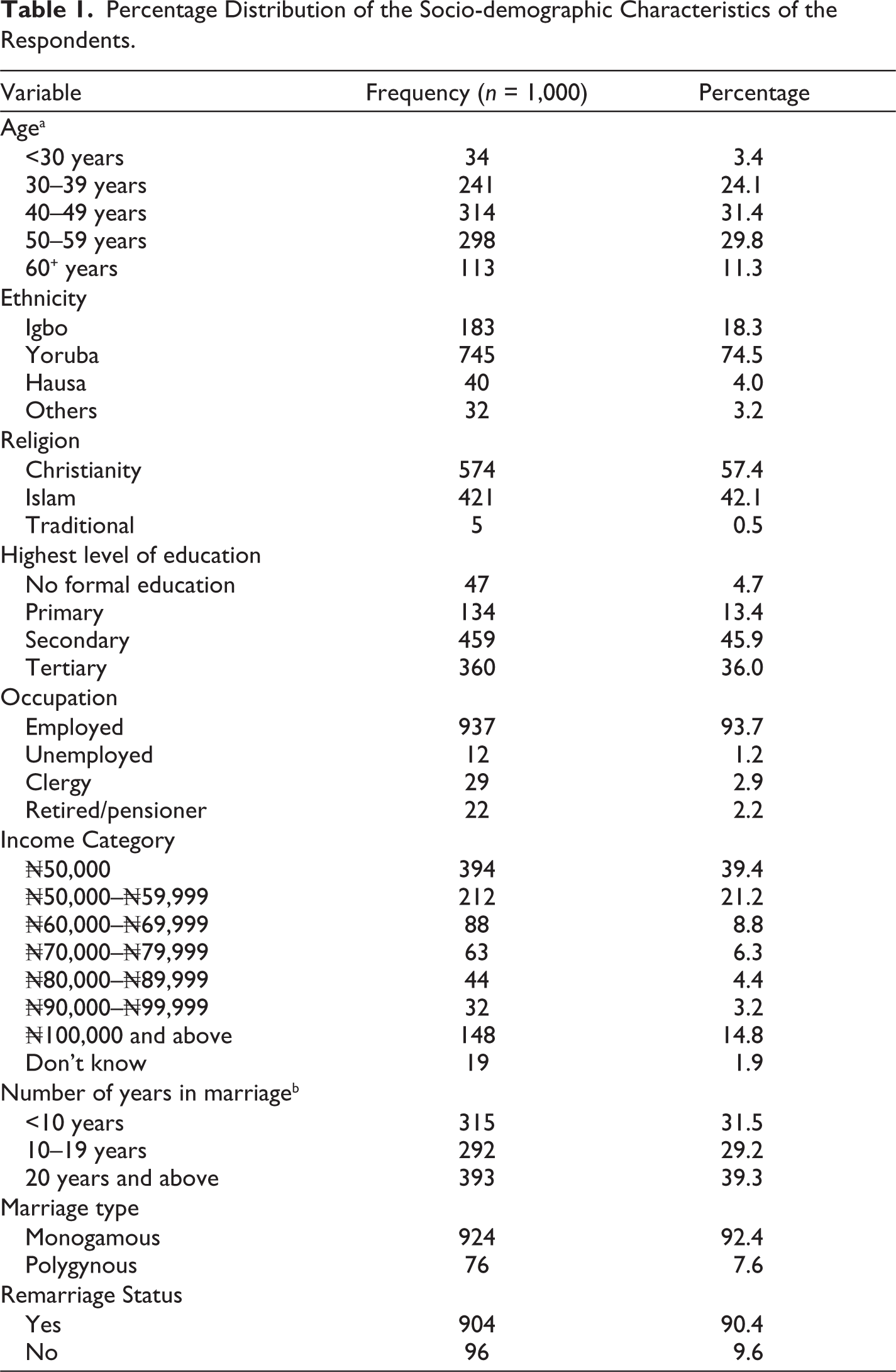
The three major ethnic groups and other ethnic groups in Nigeria were represented in this study. About 75% of the respondents were Yoruba, while 18% and 4% were Igbo and Hausa, respectively; a little above 3% belonged to other ethnic groups. With respect to religion, 57% of the respondents were Christians, 42% were Muslims, and less than 1% were into traditional worship.
The result showed that a high proportion of the respondents had formal education. This is evident as over one-third (36.0%) of the respondents had tertiary education, while 46% and 13% of the respondents had secondary and primary education, respectively; only about 5% of the respondents had no formal education.
Again, more than one-third (39%) of the respondents had been married for over 20 years, 29% had been married for 10–19 years, while 32% had been married for less than 10 years. The total number of years spent by these married men in their marriages ranged from 1 year to 50 years. By implication, the respondents in this study cut across individuals with varying levels of marital experiences, considering the number of years they had spent in their marriages.
In terms of economic engagement, most of the respondents were found to be economically active. This is not surprising in view of the fact that in the Nigerian society, men are expected to meet the financial needs of the household. Results indicate that over 90% of the married men were employed, 2% were retired, and only about 1% were unemployed. Although a vast majority of the married men were employed, 61% of the total respondents earned a monthly income that was less than ₦60,000, about 21% earned between ₦60,000 and ₦100,000, and only a minority earned ₦100,000 or more. However, about 2% of the respondents did not know specifically what they earned monthly.
Most (92.4%) of the respondents were in monogamous marriages, and just 7.6% of the respondents were in polygynous marriages. Also, most (90.4%) of the men were in their first marriages.
Understanding Spousal Abuse
Respondents were asked about their general understanding of what spousal abuse entails. Two themes emerged from the discussions.
Spousal Abuse as a Form of Maltreatment
The respondents described spousal abuse as a form of discomforting treatment, particularly between couples, which is mainly perpetuated by one of the partners against the other. Sade (not real name, as with other names mentioned in this report), one of the female participants in the focus group, said:
In my own opinion, it’s any form of maltreatment. It can be from a man to a woman but between couples. So, any form of maltreatment, it can be in form of physical or emotional. (FGD/Women/Married between 1 and 10 years)
Similarly, Kunle explained spousal abuse as follows:
Abuse generally…has to do with maltreating and insulting your spouse. (FGD/Men/Married over 10 years)
Another respondent, Kunmi, stated that:
Spousal abuse is causing harm physically or non-physical, to your partner. Physically could be fist, non-physically could be mental. (FGD/Men/Married over 10 years)
One of the respondents, Demola, also attempted to summarize spousal abuse as:
Any form of treatment that is causing psychological or emotional stress, that is placing stress on the man, I will say that is spousal abuse. (FGD/Men/Married 1–10 years)
Spousal Abuse: A Way of Taking Advantage of Spouse’s Weakness
Some of the respondents described spousal abuse as the negative attitude of a spouse towards the other, which is determined by identifying the weakness of one’s partner, coupled with the intention to take advantage of it. In other words, when the husband, for instance, is seen to be lagging behind or weak in a particular area, a possible effect is usually the experience of husband abuse. This was clearly articulated by Taju, who described spousal abuse as:
taking advantage of one’s spouse using the power you have to oppress your partner. Maybe you are the one who has the job that is paying more, you contribute more to what comes into the family and you are now using that to oppress the partner…. If you are at an advantage at any point and you use it to oppress your partner, I think that’s a form of spousal abuse. (FGD/Men/Married 1–10 years)
The respondents described spousal abuse as a way of making a spouse uncomfortable and treating the person badly, or abuse of power when a partner has more than the other and decides to use it against his/her partner, with emotional and psychological impact on the individual being abused.
The Occurrence and Frequency of Husband Abuse in Lagos State
After probing respondents’ understanding of what spousal abuse is, we also specifically probed on the occurrence of spousal abuse against men in Lagos State as a way of determining the existence of the problem. The quantitative data revealed that about 77% acknowledged the existence of spousal abuse against men, as opposed to 23.5% who claimed it did not exist because men are stronger than women and society is controlled by men. All the participants at the focus group discussions conducted affirmed that men also suffer different forms of spousal abuse, and identified emotional abuse/verbal abuse, sexual abuse and physical abuse as very frequent forms of husband abuse. Olamide, a respondent who had witnessed a man being threatened by his wife, had this to say:
The incident (spousal abuse) that I witnessed was more of verbal abuse of a husband by his wife. This particular incident got so bad to the extent that she (wife) locked their house, and prevented her husband from gaining access. She told him to go back to his parents’ house since he was fond of taking orders from his parents, and incapable of making decision independently. It got to the extent that the man had to leave their home for her. She said to him, ‘Do not come back to this house again, if you do, I will deal with you. (FGD/Married Men/1–10 years of Marriage)
In addition, most of the participants in the group discussion seemed to know victims of abuse very closely. In fact, some of the victims were related to them. Adewale submitted this way:
I had an uncle who was constantly physically abused by his wife. Their neighbours knew, everybody knew that she normally beats him. He is late now. This one was physical. She is stronger; he could not even try to challenge her. She is not small in stature. She is huge and scary. (FGD/Married Men/1–10 years of Marriage)
Another experience was shared by Omolade this way:
This particular incident actually happened to a friend of mine. Her husband accused her of infidelity. He invited her mum over because he felt she wanted to disgrace him. In the middle of the night, my friend told me that a spirit entered into her body that she really could not understand what came over her. She told me she just discovered that she was beating her husband. She disclosed that her husband did not see it coming. (FGD/Married Women/1–10 years)
Tolu also opined thus:
Some women inflict injury on their spouses as a result of being able to overpower them. I have seen a couple of cases like that. That is why I said it exists. (FGD/Married Men/1–10 years)
The above narratives confirm the existence of husband abuse in Lagos State. Most of the male victims of spousal abuse mentioned by the respondents were people who were well known to them. Most of them identified their male family members and male friends as people they knew to have experienced spousal abuse, while others claimed to know their male neighbour(s) experiencing similar problems.
Respondents were also asked about the frequency of abuse in the home. Their responses were categorized ‘sometimes’, ‘regularly’ or ‘never’, and are reflected in Table 2.
Frequency of Abuse Experienced by Male Partners.
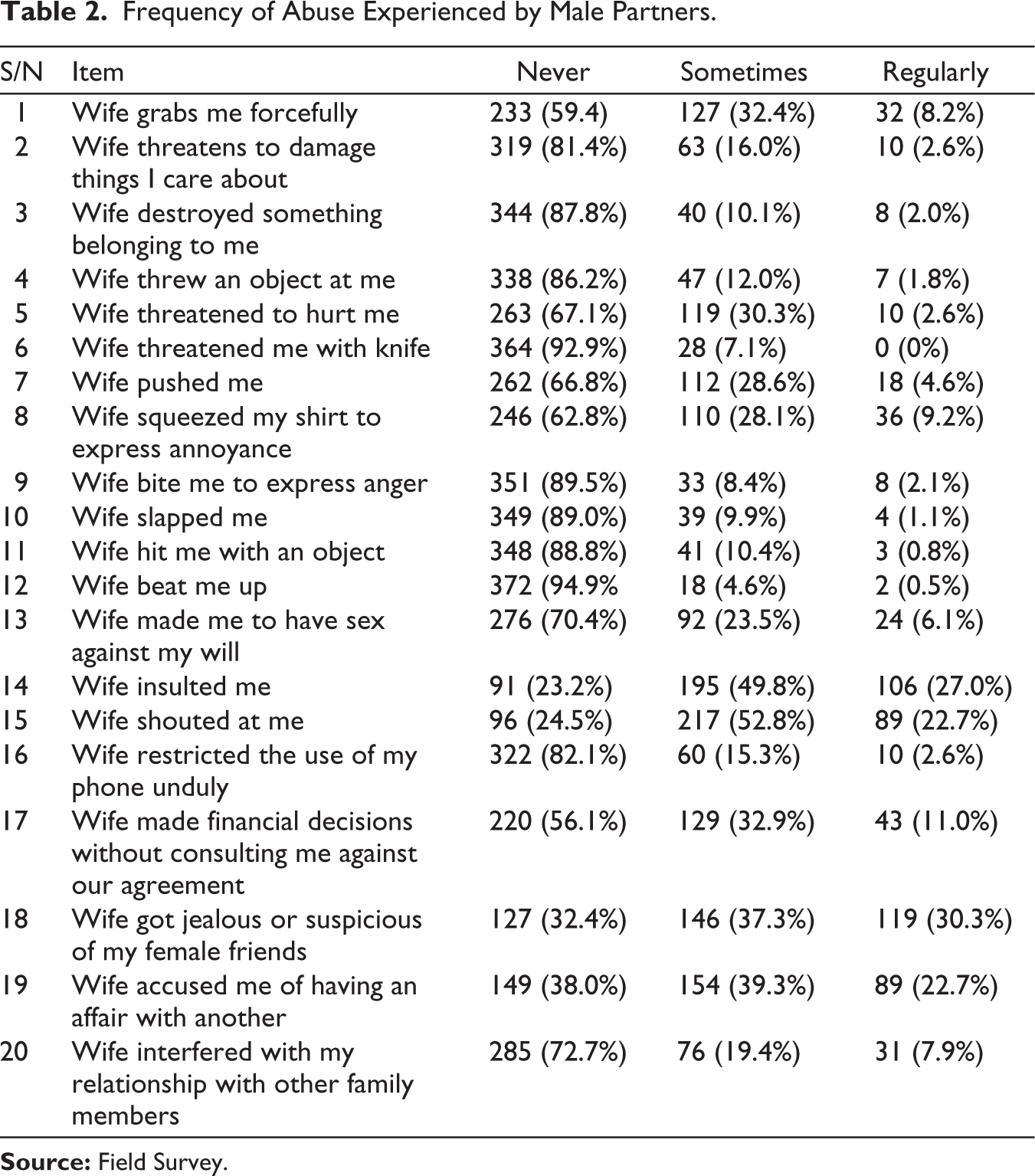
Close to one-third of the respondents (32.4%) reported that they were sometimes grabbed forcefully by their spouses, about 8% were regularly grabbed forcefully; about 19% would sometimes or regularly threaten to damage things their husbands cared about. Over 30% of the spouses would threaten to hurt their husbands sometimes, while 3% did so regularly. Some wives squeezed their husbands’ shirts to express their annoyance; 28% did it sometimes, while about 10% did it regularly. About one-third of the respondents reported that their wives would make financial decisions without carrying them along, and 11% did so regularly.
The majority (67%) of the respondents reported that their wives had once been jealous of their female friends; only one out of every three respondents did not have a spouse who felt jealous of their female friends. Over 37% of the respondents were sometimes accused by their spouses of having an affair with other women, and 23% of the married men said the accusation came regularly. About 6% of the respondents were regularly made to have sex against their will, while it was only experienced sometimes by 24% of the respondents.
Furthermore, 33.2% of the respondents reported that they were pushed by their wives. Wives shouting at their husbands was regularly reported by a relatively large group of respondents. Only a quarter of the respondents said that their spouses never shouted at them. Similarly, more than 76% of the respondents reported that their wives insulted them, and only about 23% of the respondents’ spouses had never insulted their husbands.
The data also revealed that there were spouses who beat their husbands, although the proportion was quite minimal. Less than 1% of the respondents disclosed being beaten regularly by their wives, while about 5% said that their wives beat them sometimes. The proportion of women who slapped their husbands was higher than those who beat up their husbands, as over 10% of the respondents were sometimes or regularly slapped by their wives. Some married men had sometimes been bitten by their spouses while attempting to express their anger. Some wives would also hit their husbands with an object. The result showed that a little above 10% experienced this sometimes, while about 1% only experienced it regularly.
The Common Forms of Husband Abuse in Lagos State
Information was sought from the respondents on the common forms of husband abuse in Lagos State as a way of estimating the severity and intensity of this type of intimate partner violence. The findings are shown in Table 3.
Common Forms of Husband Abuse in Lagos State.
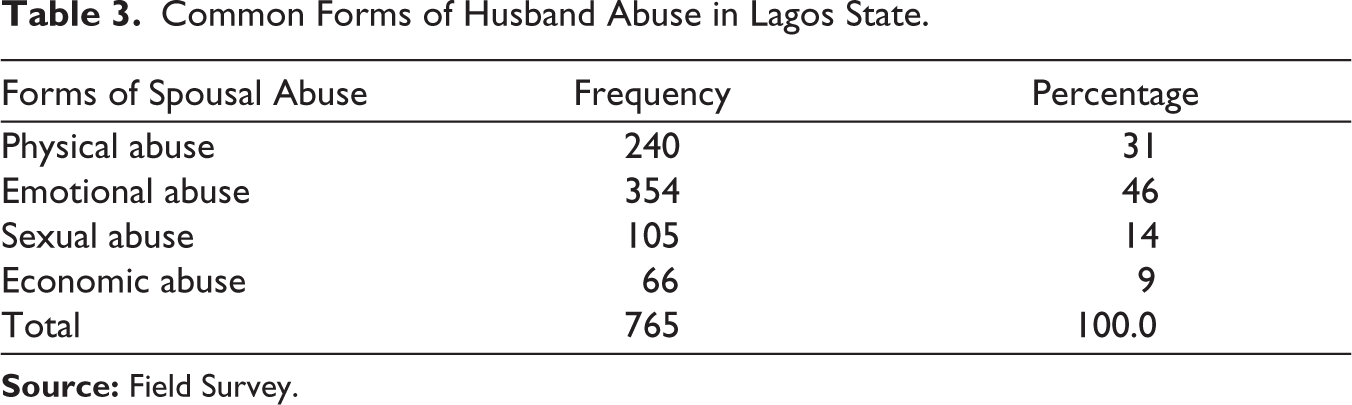
Findings revealed that 46% of the respondents were of the opinion that emotional abuse in the form of verbal insults, intentionally causing public embarrassment, yelling and screaming, preventing a partner from seeing or talking with friends and family, was the most common form of abuse men tend to experience from their spouses. This was followed by physical abuse (31.7%), which usually occurs in the form of scratching, beating, biting, strangling, kicking and throwing of harmful objects. Furthermore, 13.7% opined that some husbands do suffer sexual abuse, in the form of denial of sex by wives for an extended period of time. Less than 10% of the respondents mentioned economic abuse as the most common form of spousal abuse suffered by men. This was reported by men whose wives were the breadwinners of their families.
Victimization Experiences of Men Abused by Their Spouses in Lagos State
To have a profound appreciation of the nature and patterns of the problem, respondents who were identified as victims of spousal abuse were asked to state the types of abuse they had ever experienced from their spouses. The distribution of their responses is presented in Figure 1.
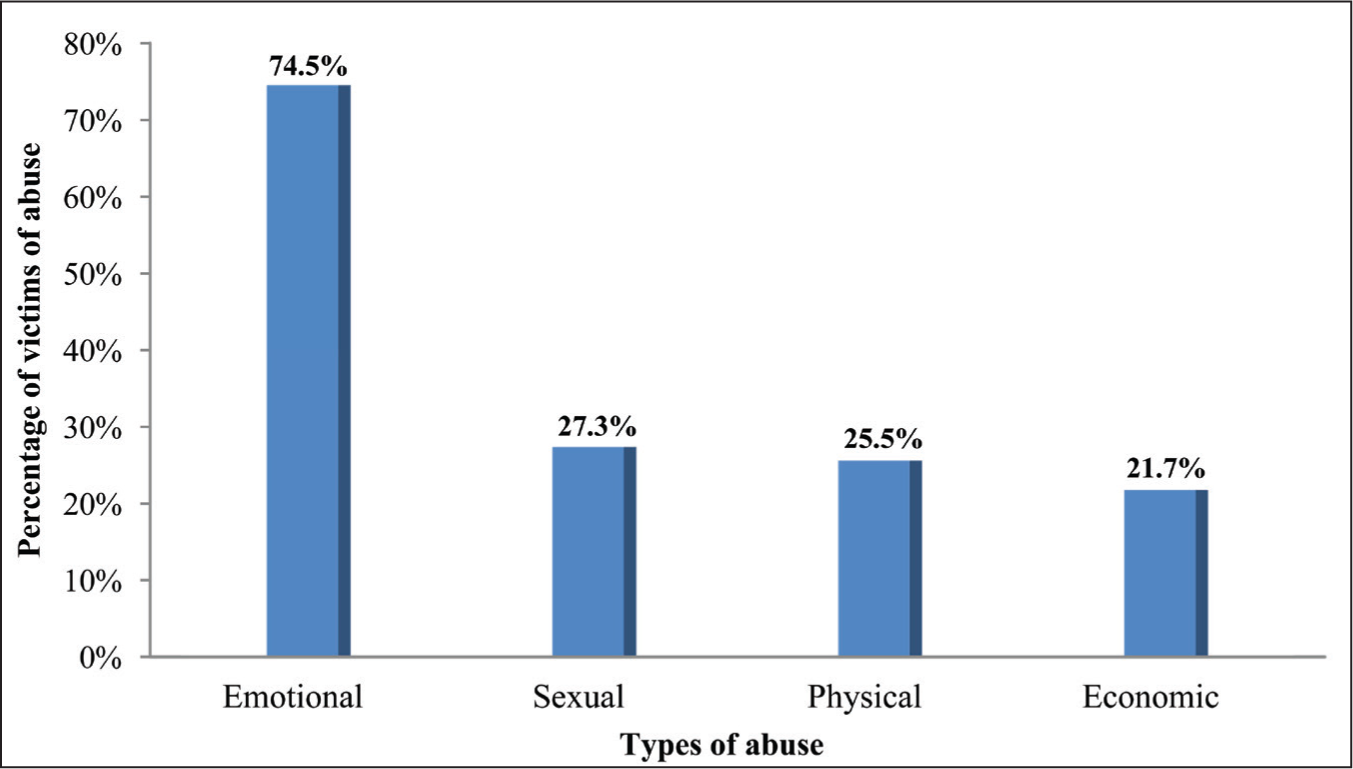
Results show that over 74% of the victims had been emotionally abused by their wives. This was followed by sexual abuse (27%), physical abuse (26%) and economic abuse (22%). The same forms of abuse also emerged during the qualitative interviews. In the various sessions, the participants shared their personal experiences. Lanre narrated the emotional abuse he suffered thus:
One day, I wanted to eat. My first son told me my food was in the kitchen. I picked the food but I could not eat it, because it was too salty. I had my son taste the soup, and he commented that the soup which was served to him was not that salty. I went into the kitchen, tasted the leftover soup in the pot, and I discovered that the salt level was normal which means she deliberately spiced my food with salt. I confronted her and a fight broke out. (IDI/Male Victim of Spousal Abuse/Married for 5 years)
Husband Abuse: Irony of Patriarchy
The patriarchal nature of the Nigerian society obligates wives to perform household chores, the most important of which is to cook for the family. This duty is expected to be performed in all circumstances except when ill. Conflict may arise if the woman is unable to fulfil this part of her marital obligations. Muyiwa narrated his experience in this regard:
One day, she (wife) just closed her shop for the day, and I went to pick her for us to go home. She told me she wanted to go to her mother’s house and I forbade it. It was really late at night, and I needed her to cook for me. In the heat of the argument, she insulted me publicly. There were so many people around. The most painful part of the abuse she perpetrated that was that she eventually did not do the cooking for me. (IDI/Male Victim of Spousal Abuse/Separated/Married for 10 years)
However, although the general rule is for the woman to cook for the family, the arrangement may be different in some other homes. In these homes, the man may do the cooking because the wife stays late at work or the man enjoys doing so. Even in this context, marital conflicts also arise. According to Wole:
I usually do 99% of the cooking, and she takes her food to her workplace. Whenever she returns from work, she normally tells me that she ate the food with her male colleague, and I hated that. The market where we normally buy food items is very close to my workplace, and she expects me to always buy foodstuffs. After I go to the market to buy them, she will still end up saying the time is gone, and that I would have to do the cooking. (IDI/Male Victim/Separated/Married for 7 years)
Goerge also narrated his own experience this way:
She (wife) normally closes her shop around 10 pm and before she is through with cooking, I am usually already asleep. I do the house chores; she does nothing. I have had to go to work late on different occasions because of this. She also habitually denied me of sex, and she never wanted me to talk to other girls around. (IDI/Male Victim/Separated/Married for 12–14 years)
Physical abuse sometimes accompanies the denial of sex. Persistent requests from men can lead to physical assault from women. This again is an irony of patriarchy. Fisayo, a victim of both physical and sexual abuse, stated:
Last month, I was trying to have sex with her and she hit me with a glass cup. And she has done this twice. The most painful part are her curses. She also sees other men. (IDI/Male Victim/Married for 4 years)
It can be concluded from the results that men suffer emotional and sexual abuses more than any other form of spousal abuse in their homes.
Discussion of Findings
Results have shown that despite the fact that spousal abuse against men is a largely hidden problem in Nigeria, as individuals affected are often unwilling to disclose their condition, it is a fairly common problem in society. This finding supports the position of that husband abuse of different forms occurs in Nigeria. The chivalry hypothesis has explained why the abuse of men in marital relationships goes unreported in Nigeria. Nigeria is a patriarchal nation. Men hold the authority in marital unions. As a result, they are expected to be strong to be able to protect their wives. Apart from this, men are also expected to be the breadwinners of their families. All of these expectations find expressions in the cultural norms of ethnicities in Nigeria, which promote male privilege. Ajayi et al. (2022) had reported how male privileges contribute to women’s experience of violence. Akpuogwu (2023) also explained the dominance of men over women in the context of patriarchy. According to him, men dominate women in African society mainly because of the supremacy that the society accords them as a result of the patriarchal cultural practice that is traditionally inherent within the African people. Ayodabo (2021) further revealed how cultural masculine norms of strength, toughness, honour, protection, and respect are transmitted to young Igbos in a bid to entrench masculine ideologies and messages that promote male dominance in the Igbo society. Such masculinities and feminities are also reflected through music among the Yoruba (Oludare, 2018).
Against this cultural background, wives’ abuse of their husbands is usually considered a cultural anathema. In this context, husbands’ abuse becomes a silent and hidden incidence not to be reported. Therefore, male victims of marital abuse do not speak out because of the stigma associated with being abused by a woman.
Results indicate that married men suffer a variety of domestic abuse inflicted by their spouses. These abuses were both violent and non-violent, simple, mild and severe in nature. All of these forms of spousal abuse are capable of having devastating consequences on the physical, social and psychological well-being of victims. Macassa et al. (2025) have also identified the incidence of mental health problems in abused men more than in non-abused men.
Findings also reveal that some wives do subject their husbands to a wide range of abuse, with emotional abuse being the most commonly reported. This finding confirms the submission of Chukwuma and Aderinto (2025) and Fayankinnu (2016) that males in south-western Nigeria are increasingly experiencing physical abuse, sexual abuse and emotional abuse from their wives. The dominance of emotional abuse may be due to the fact that they preferred to hurt the feelings of their spouses by failing to perform their marital obligations, rather than resorting to physical abuse, since they are likely to be incapable of overpowering their husbands. Equally, most wives in Nigeria are less likely to be financially powerful enough to be able to abuse their husbands economically. In fact, for most households in Nigeria, husbands are typically the breadwinners of their families, on whom wives depend for financial support. Therefore, engaging in emotional abuse by shirking in their domestic responsibilities is the most available option through which women can abuse their husbands. This finding corroborates Carrado et al.’s (1996) study, which found that 80% of the abuse perpetrated by women on their male partners was not an act of self-defence.
Contrary to the postulations of the chivalry hypothesis, our findings suggest that women are not always the weaker partner in terms of domestic violence. They are as capable of perpetrating violence as the men. The occurrences are only underreported in the media, and also because the abused men rarely report their situations, thus confirming the notion of the chivalry theory. Ayodele (2017) in his study of male victimization in domestic contexts in Lagos revealed that the non-disclosure of husband abuse arises as a result of the stigma that is often associated with the incidence, as such men are seen as weak and not fit to be a head of household. He noted that female aggressors sometimes used traditional mechanisms to control their male victims, and concluded that lack of support worsens the conditions of male victims of domestic violence in Lagos. Zubair and Albert (2025) also highlight how patriarchal norms, stigma and economic vulnerabilities intersect to perpetuate male victimhood and silence.
However, there have been many cases of physical abuse against men perpetrated by their wives, leading to death, reported in the media. In one case, the wife was reported to have killed her husband over an alleged involvement in extramarital affairs by the man (Vanguard Newspaper, 2024).
Conclusion
The central objective of this study was to examine the victimization experiences of male victims of spousal abuse in Lagos State, Nigeria. The study established that spousal abuse against men takes different forms, such as physical, emotional, financial and sexual abuses. The results from this study also show that spousal abuse knows no gender as both men and women experience abuse in different forms. Furthermore, against the general belief that women only abuse their spouses in self-defence, the results from this study showed that a lot of the abuse against men is deliberate and not done in self-defence. This notion underscores the fact that women are just as capable as men to abuse their spouses if they want to. However, their ‘femaleness’ owing to their chivalrous nature makes their violent acts less prone to arrest and prosecution by the authorities. This chivalrous hypothesis explains why interventions have mainly focused on female victims, as a result, male victims face significant challenges and unmet needs due to a lack of tailored interventions (Isangha, 2024). Therefore, the Federal and State governments should create organizations that will deal with male victims, help them get back on their feet and help prosecute their perpetrators. This suggestion becomes imperative because extant government organizations tackling domestic abuse only focus on women. This will also make individuals or organizations set up non-governmental organizations that target male victims of spousal abuse. Specifically, the Federal and State governments need to create laws and policies that protect male victims of spousal abuse.
In addition, it is imperative that the government at all levels (local, state and federal), traditional rulers and leaders in society create awareness to enlighten the public on the need to also acknowledge the needs of male victims of spousal abuse. This will make society realize that spousal abuse is not synonymous to husband beating his wife and will make male victims speak out more.
Married men suffering from spousal abuse should also be encouraged by their significant others on the need to seek professional intervention early to address their problems rather than keep silent because of stigma. Indeed, fear of stigmatization and ridicule is the major factor that is breeding a culture of silence amongst men experiencing spousal abuse. Isangha (2024) further recommends a balance in the law, the need for mental health services, creating a safe space, communal involvement and breaking the culture of silence of male victims as strategies that can be deployed to curtail husband abuse.
Footnotes
Acknowledgements
We acknowledge all persons who gave approval for this study to be conducted and all participants who willingly consented to be part of the study and gave valuable information.
Authors’ Contribution
Both authors were involved in the drafting and review of the article.
Data Availability Statement
The datasets generated during and/or analysed during the current study are available from the corresponding author on request.
Declaration of Conflicting Interests
The authors declared no potential conflicts of interest with respect to the research, authorship and/or publication of this article.
Ethical Considerations
All ethical principles and procedures performed in studies involving human participants were in accordance with the ethical standards of the social sciences and humanities research ethics committee (University of Ibadan Committee for the Protection of Human Subjects), Number: UI/SSHREC/2022/0000.
Funding
The authors received no financial support for the research, authorship, and/or publication of this article: No funding was received for the study.