






Abstract
The results of victimization self-report studies impact theory and justice system practice; therefore, accurate reporting is key. However, due to the sensitive nature of victimization, there are concerns about the accuracy of reports, and research generally assumes that increased reporting is more accurate. Additionally, few studies have examined face-to-face and self-report modes using the ISRD. Further examining the ISRD is important because of its widespread international use. To contribute to this research area, we experimentally examined mode effects on victimization reports using the ISRD3 victimization scale in a sample of college students. We found evidence that respondents in the interviewer-administered condition were more likely to report lifetime victimization experiences, compared to the self-administered condition, but not victimization in the prior year. The present findings are in apparent contradiction to the vast literature on sensitive questions, where the evidence favours self-administered conditions as being more accurate. Our results could be due to the young sample and/or low frequencies of past-year victimization reports. However, results may indicate that mode effects may operate differently for low-sensitivity ISRD items and high-sensitivity (i.e., sexual assault) items, where it is more likely a victim could be blamed.
Keywords
Introduction
Victimization self-reporting is critical to estimating crime trends, specifically within the National Crime Victimization Survey (NCVS, 2022) in the United States (see Morgan & Thompson, 2022). The NCVS primarily relies on self-reported data from households to measure crimes reported and not reported to police, and incident-specific information about the victim, perpetrator and crime type that is not captured in official crime data (i.e., Uniform Crime Reporting Program; Morgan & Thompson, 2022). Internationally, crime victimization is also of high interest (Bijleveld, 2023; Van Dijk, 2015), and the International Self-Report Delinquency (ISRD) study is one way to compare victimization across countries (Marshall et al., 2013). Victimization self-report studies are important because they help shape theory creation and testing, allow practitioners to develop better responses to victims and can assist researchers and practitioners in understanding the costs of victimization (Cantor & Lynch, 2000). Theory testing is a key motivation of the ISRD study (Marshall et al., 2013).
One of the largest challenges with collecting accurate victimization data and information on sensitive behaviours generally is that respondents may be unwilling to report victimization in interviews due to the sensitive nature of questions and/or social desirability bias (Gomes, 2025; Tourangeau & McNeeley, 2003). One solution to possible underreporting in interviews is to use a self-administration mode, which researchers believe to be more effective for sensitive questions (i.e., higher reports) because it can remove potential interviewer effects of social desirability and unwillingness to provide sensitive information (de Leeuw, 2005; Gomes et al., 2024; Tourangeau & Yan, 2007).
Prior studies explored various modes of administration to understand how they impact victimization reporting, resulting in a large literature examining mode effects on sensitive behaviour reporting (e.g., sexual behaviours and drug use) and delinquency (Gnambs & Kaspar, 2015; Gomes et al., 2019; Tourangeau & Yan, 2007). However, here we focused our literature review more narrowly on recent victimization and studies that examined similar modes to the ones that we tested. Within this literature, there are some mixed findings when it comes to victimization reporting, with some studies finding no mode effects and others indicating significant mode effects in victimization reporting. Additionally, more studies examine reporting substance use as a sensitive behaviour than victimization (Gnambs & Kaspar, 2015), resulting in less knowledge about victimization reporting, particularly for lower-level offences (i.e., not sexual victimization), compared to substance use and delinquency.
The goal of the present study is to contribute to our understanding of how mode effects impact victimization reporting using a more universal measure (the ISRD) than prior studies, which use a variety of victimization measures, making direct comparisons between study findings difficult. By further examining this, we can contribute to the understanding of mode effects in an internationally used victimization instrument, which is important because there is variation in how the ISRD is currently administered (Enzmann et al., 2018). Additionally, the ISRD focuses on non-sexual victimizations, whereas much of the prior mode effects literature focuses on these. There could be variation in mode effects based on the type and seriousness of the victimization, but by focusing on such a widely used instrument, our results may be more generalizable than those of others who used instruments less widely employed in practice.
Literature Review
Despite the relevance of victimization reports for crime statistics and criminological knowledge, a meta-analysis analysed 460 different effect sizes from studies examining mode effects (computer versus paper and pencil) on reporting sensitive behaviours and only 56 (12%) effect sizes were from victimization, whereas 300 (65%) were from substance use (Gnambs & Kaspar, 2015). Results indicated that mode effects on victimization trended towards more reporting for the computer mode, but the results were non-significant. When examining individual studies comparing victimization reporting mode effects, there is also a split in the literature, with some finding non-significant differences in reporting by mode, but others indicating significant differences. For example, to examine intimate partner violence victimization of men with female partners, Hines et al. (2010) compared self-administered online surveys to computer-assisted phone interviews and found no significant mode effects. Similarly, Guzy and Leitgöb (2015) found that computer-assisted phone interviews and online self-administered modes provided comparable reports of non-sexual victimization, once non-response was considered, with the exception being sexual victimization. Laaksonen and Heiskanen’s (2014) results indicated that a self-administered web mode resulted in higher, but non-significant, reports of property victimization compared to the face-to-face or phone interview modes.
Other studies found evidence of significant mode effects in reports of victimization, particularly for sensitive types of victimization. For example, Parks et al. (2005) found that college women (only freshmen, average age of 18.5 years old) were more likely to report sexual assault victimization in self-administered online surveys, compared to the phone mode, while Testa et al. (2005) found an increased likelihood of reporting sexual victimization on mailed self-administered surveys compared to in-person modes where some items were asked by an interviewer (also only among women). Testa et al.’s sample was also, on average, young, and they were recruited via random digit dialling in Buffalo, New York, ‘as part of a larger study on women’s alcohol use and sexual experiences’ (p. 346). Relatedly, Hayes and O’Neal (2021) found that victimization reports among college students were more common for the web-based survey than the paper-and-pencil survey; this was true for a variety of victimization items with various levels of seriousness: ‘bullying, sexual assault, rape, emotional abuse, and intimate partner violence’ (p. 2451). Finally, researchers comparing different types of interviewer and self-administered modes for the Dutch Crime Victimization Survey agreed that self-administered modes can produce less bias than interviewer modes (Schouten et al., 2013).
To underscore the need for continued examination beyond the issue of mixed findings, some of the studies mentioned had limited samples, for example, only female or (majority being of European descent in both Parks et al., 2005; Testa et al., 2005) male (Hines et al., 2010, average age of 44 years old) samples. Some samples were among college students (women only; Parks et al., 2005) or community samples (men only and majority White: Hines et al., 2010; women only: Testa et al., 2005), while others used larger, non-US, national or international samples (people aged 16 years or older in five different countries: Guzy & Leitgöb, 2015; people ages 15–74 years old in Finland: Laaksonen & Heiskanen, 2014; Netherlands: Schouten et al., 2013). Other studies analysed NCVS data post-2006, which include many more participants, are more representative, and use mixed modes for data collection. They compared first-wave in-person interview victimization reports to follow-up phone interview reports and found no mode effects once exposure to the NCVS was controlled for (Couzens et al., 2014). However, studies of earlier NCVS data (1999–2005) indicate mode effects, such that there is increased reporting of victimization via telephone (compared to in-person interviews) for both violence and property crime (Owens, 2017). Related to telephone and face-to-face interview modes, there is evidence that people interviewed face-to-face are more cooperative and engaged, and less suspicious (Holbrook et al., 2003).
Present Study Contributions
The aim of the present study is to provide evidence on the potential impact of modes of administration on self-reports of victimization by comparing victimization reports collected by self-administered or personal interview mode through a random experiment among both male and female US college students. One limitation of this literature broadly is that different studies used different items to measure victimization, reference periods, and data condensing techniques (e.g., counts, item-by-item analysis and variety scores), which could make conclusions about mode effects difficult across studies (see Lynch, 2006). Studies also examined different combinations and types of modes (e.g., face-to-face, telephone and internet). These limitations could make forming conclusions about mode effects difficult and possibly create a challenge for researchers looking to choose one mode. The present study contributes to this literature by using a randomization procedure, sampling a population of interest to policymakers, focusing on interviewer versus self-administered modes only, conducting item-by-item, overall, and a variety of victimization analyses, and using a common instrument that other researchers can easily access, which includes less sensitive items (ISRD3 Enzmann et al., 2018). The present study also builds on the work done in other college samples by including both men and women and using updated modes more commonly relied on by researchers today (that is, not mail or random digit dialling).
Results may also have global relevance because of the widespread use of the ISRD instrument in schools across the world (with 36 countries participating in the ISRD3 and approximately 50 countries in the ISRD4;
Considering the literature on sensitive behaviours and modes, we hypothesize that respondents will disclose more victimization in the self-administered mode compared to the face-to-face interview mode. In accordance with sensitive topics research, we will assume that increased reporting is more accurate; the ‘more is better’ assumption results from the large body of evidence showing that respondents tend to underreport sensitive information; therefore, the mode that results in higher estimates is assumed to be a more accurate estimate of the sensitive behaviour (Tourangeau & Yan, 2007). Victimization data are widely collected and used to inform criminal justice system policies and practices (Lynch, 2006). The variation in research methods and results (with some finding mode effects and others not) about the evidence of the impact of self-administration (compared to interviewer-administered) on participants’ willingness to self-disclose prior victimization experiences leaves researchers, practitioners and policymakers without best-practice guidelines for measuring victimization, which results in inconsistent methods and potentially misleading assessments of the true amount of victimization.
Methods
Participants
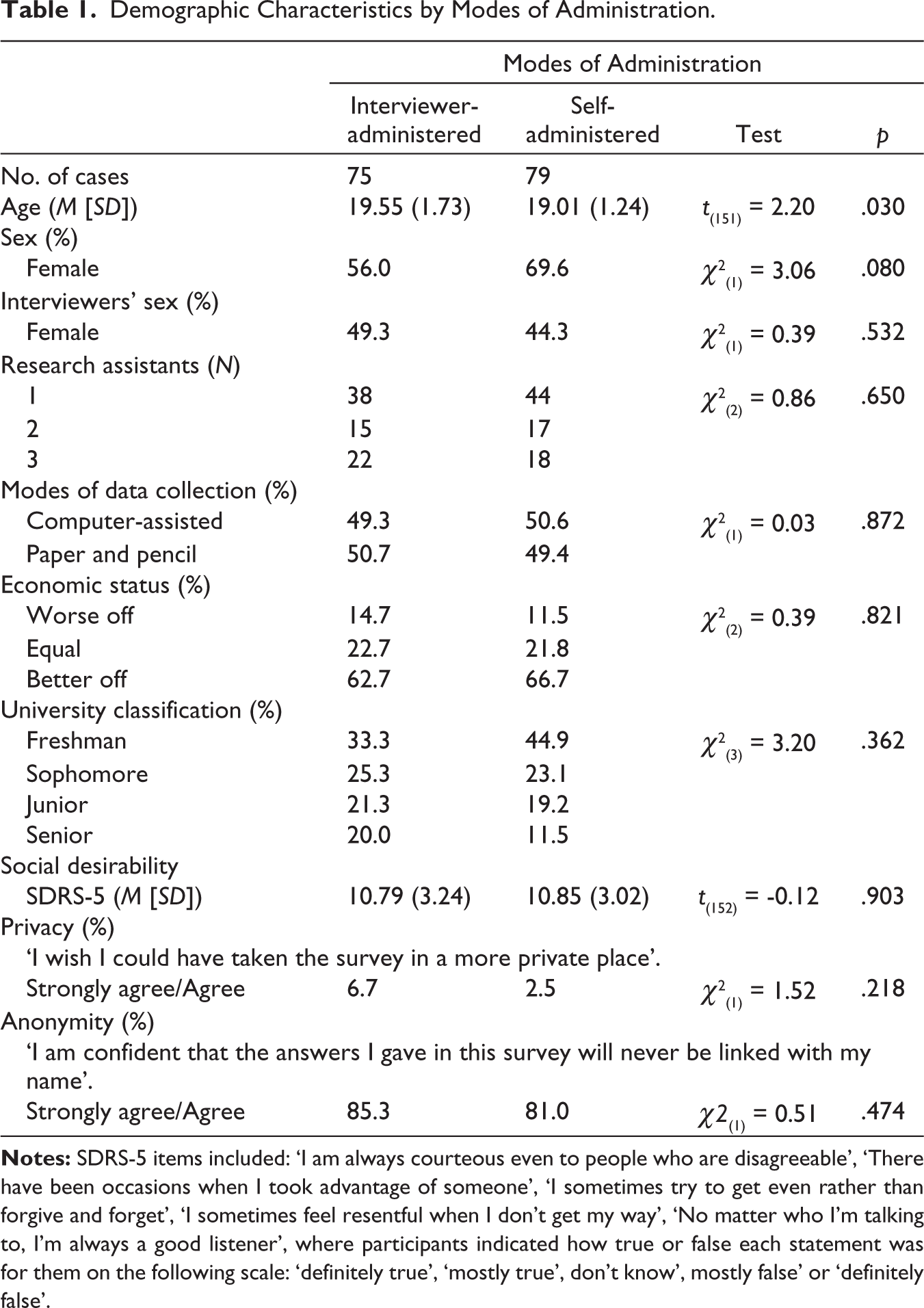
In 2019, a sample of 154 students at a large university in the south-eastern United States participated in our study in exchange for course credit. The sample included 97 female (63%) and 57 male (37%) students, mostly US citizens (88.3%, n = 136), between the ages of 17 and 29 years (M = 19.27, SD = 1.52). Students were approximately evenly distributed among their university classification (see Table 1). In terms of economic self-assessment, a greater proportion of students in both experimental conditions reported being economically ‘better off’ (62.7% in the interviewer condition and 66.7% in the self-administered condition) compared to the other two categories: ‘worse off’ (reported by 14.7% of respondents in the interviewer-administered condition and 11.5% in the self-administered condition) and ‘equal’ (reported by 22.7% in the interviewer-administered condition and 21.8% in the self-administered condition). There were no statistically significant differences between conditions in the distribution of these responses.
Demographic Characteristics by Modes of Administration.
Measures
We administered an adapted version with selected sections of the International Self-Report Delinquency 3 questionnaire (ISRD3; Enzmann et al., 2018), namely the sociodemographic and behavioural sections, including the victimization questionnaire. The victimization portion included seven questions about lifetime prevalence and past-year incidence of robbery, assault, theft, hate crime, cyberbullying, parental physical force and parental maltreatment (e.g., ‘Has your mother or father (or your stepmother or stepfather) ever hit you with an object, punched or kicked you forcefully or beat you up?’, if yes ‘How often has this happened to you in the last 12 months?’).
To understand the context of the experiment better, we also asked participants about social desirability, perceived privacy and anonymity. These questions were all self-administered, regardless of experimental condition, to understand potential social desirability effects. To measure social desirability, we used five items from the Socially Desirable Response Set 5 (SDRS-5; Hays et al., 1989), and to assess participants’ perceptions of privacy and anonymity, we asked two questions from Denniston et al. (2010; see items in Table 1). There were no significant differences between the two modes for these items (Table 1); therefore, we chose not to include them in regression models.
Design and Procedure
The university’s institutional review board approved data collection procedures. We collected data between July and November 2019. We obtained informed consent in a private on-campus room designated for research with only the respondent and researcher, explained the purpose of the research (i.e., to understand responses about sensitive topics), and informed students that participation was voluntary and confidential. Then, we randomly assigned students to either a self-administered condition (where respondents completed the survey on their own) or an interviewer-administered condition (where survey questions were read out loud by the interviewer and the respondents verbally indicated their answers). We also controlled for the potentially biasing effect of modes of data collection by randomly allocating participants to a paper-and-pencil or computer mode, another commonly studied method variation in prior studies. 2 This resulted in a 2 × 2 factorial design. To randomize the assigned condition, participants chose an envelope from a box containing a notecard with one of the four modes written on it. Trained graduate research assistants administered the survey by following the same interview protocol one-on-one in the randomly selected mode. Interviewers and participants were not matched on gender (two interviewers were female, one was male).
Analysis
We used SPSS to analyse data using descriptive statistics, logistic regression models (for prevalence of lifetime victimization) and negative binomial regression models (for lifetime victimization variety). To control for potential confounders, models included participant age, sex and paper/computer as covariates. We hypothesized that there would be higher reports of victimization in self-administered conditions; therefore, we used one-tailed tests. As a gauge of the robustness of results, we also conducted two-tailed tests and tests with additional control variables not tabled here for brevity. Results for these supplementary analyses are detailed in the next section.
Results
Descriptive Analysis
The random assignment procedure resulted in 75 (48.7%) participants completing the questionnaire in the interviewer-administered mode and 79 (51.3%) participants in the self-administered mode (Table 1). Overall, 70.8% (n = 109) of participants reported having experienced at least one type of victimization in their lifetime, while 35.1% (n = 54) reported having experienced at least one type of victimization in the last year. As illustrated in Table 1, sociodemographic characteristics were similar in both experimental conditions. However, there is one exception—age, where participants in face-to-face interviews (M = 19.55, SD = 1.73) were somewhat older than participants in the self-administered condition (M = 19.01, SD = 1.24) (t(151) = 2.20, p = .030). Research assistants were evenly distributed between modes (see Table 1).
Mode Effects
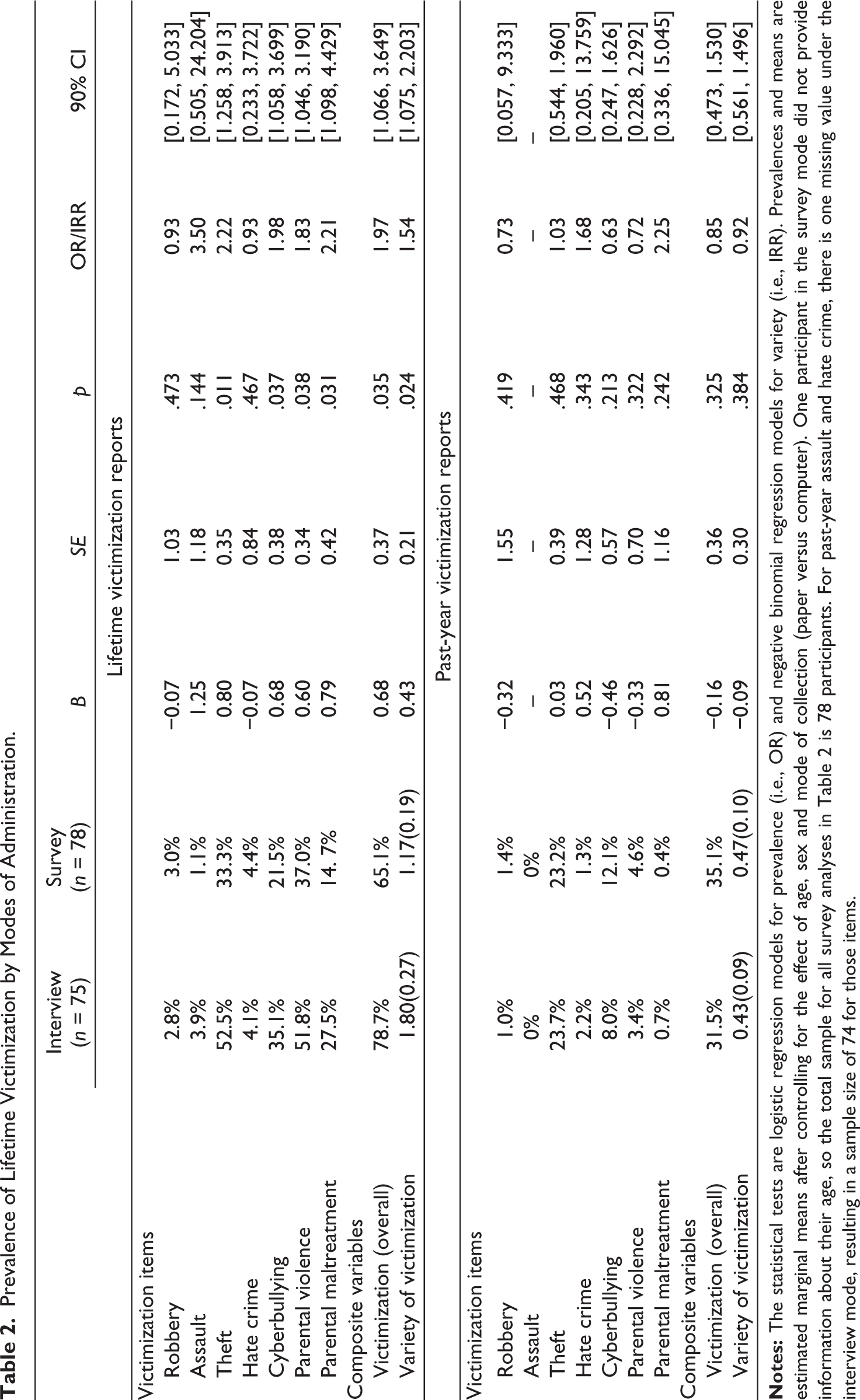
Table 2 indicates significant differences for four of the seven lifetime victimization items. For reports of theft, cyberbullying, parental violence and maltreatment, there is a significantly higher prevalence in face-to-face interviews than in the self-administered condition. It is important to highlight that for the three items where we failed to find mode effects (i.e., robbery, assault and hate crime), there is very low overall prevalence (lower than 5%). For the other items, where prevalence was higher, there is evidence of a statistically significant mode effect such that participants reported more lifetime victimization experiences when interviewed compared to self-administration. Effect sizes for logistic regression analyses (odds ratio; see Table 2) indicate small to medium effect sizes (Chen et al., 2010) for all individual victimization items. Results also indicated statistically significant differences by mode when we analysed overall lifetime victimization prevalence (prevalence of 78.7% in the face-to-face condition and 65.1% in the self-administered condition) (OR = 1.97, 90% CI [1.066, 3.649]). Similarly, the variety of victimization also demonstrated significant mode effects (IRR = 1.54, 90% CI [1.075, 2.203]) such that there was more victimization reported in the interview mode.
Prevalence of Lifetime Victimization by Modes of Administration.
We performed supplementary analyses to examine the potential effects of different research assistants interacting with respondents. We did not find any significant differences between the three research assistants and lifetime victimization variety scores (F(2) = 6.03, p = .187) or victimization prevalence (χ2(2) = 3.16, p = .206).
Regarding past-year victimization reports, we found no evidence of mode effects by self-administration for individual types of victimization, for overall victimization prevalence (OR = 0.85, 90% CI [0.473, 1.530]) or victimization variety (IRR = 0.92, 90% CI [0.561, 1.496]). We also performed supplementary one-tailed analysis with additional controls included for social desirability, privacy and anonymity, but substantive results were the same as what is reported in text and in tables for both lifetime and past-year victimization reports.
Finally, we performed supplementary analyses with the same additional controls for social desirability, privacy and anonymity using two-tailed t-tests. Results for past-year victimization reports are identical in non-significance and direction to those presented above using one-tailed tests. However, for lifetime victimization reports, the coefficient for cyberbullying is no longer significantly different between modes at the < 0.05 level (p = 0.056). Results for lifetime theft, parental violence and maltreatment, overall and variety of victimization were substantively the same in these two-tailed models with additional controls as the one-tailed models presented here, indicating that results are robust.
Discussion and Conclusion
The current study examined the relationship between mode of administration and victimization reporting in a college sample using a randomization procedure to assign mode. The goal was to clarify if there are mode differences in ISRD administration, as it is a widely used instrument, and prior research indicates mixed results when comparing face-to-face and self-report modes and victimization data. Additionally, victimization among college students is of great concern to policymakers, as evidenced by mandatory crime reporting and emergency communications to students and employees through the Clery Act (Clery Center, 2022). Further, evidence on the best practices to collect victimization reports is crucial for other sources of data, such as the BJS (2022) NCVS and the ISRD (
One potential interpretation of the present findings, considering the traditional ‘more reporting is better’ understanding of sensitive behaviours reporting, is that rapport built between participants and interviewers (i.e., increased trust) may have led to higher, and thus more accurate, reports for some low-sensitivity items (see Maxwell, 2013). It is possible that rapport operates uniquely for relatively low-sensitivity victimization items compared to other sensitive questions (delinquency/offending or drug use/sexual victimization) in the interviewer mode because the amount of culpability or embarrassment felt by the respondent may be lower for these types of victimization than other, more stigmatized, sensitive behaviours or other types of victimization. Therefore, respondents may be more willing to report to an interviewer whom they perceive as trustworthy compared to a computer or piece of paper that they feel no trustworthiness towards. That is, there may be an interaction effect between perceived trustworthiness of the mode of administration, and a person’s culpability assessment or feelings of embarrassment about the action being asked about, which may vary by item type, making respondents more willing to report to an interviewer about some victimization items but no other, more sensitive questions in the interview mode. This may be most apparent with the contradictory results from our study compared to others examining drug use and sexual victimization, two things that are highly stigmatized, for which prior research indicates more frequent reports for self-administered modes. However, the items asked about in the ISRD are not commonly blamed on the victim and are less stigmatized in society. This prompts us to hypothesize that for particularly sensitive items such as sexual victimizations, self-report may be more accurate than interview methods, as prior research indicates. But, for lower-sensitivity items in the ISRD, interviewing may lead to more accurate reports compared to a self-report mode as long as we assume more reporting is more accurate. Two of the prior studies that found increased victimization reports in self-administered modes compared to interviewer modes found these effects for sexual victimization (Parks et al., 2005; Testa et al., 2005). It is possible that respondents felt more comfortable disclosing less sensitive types of victimization to an interviewer in our study, but that this may not be true for other types of sensitive behaviours. However, prior studies used different comparisons than we did (i.e., we did not use phone or mail), so making direct comparisons by mode in the literature is a challenge, as mentioned previously.
Another possibility is that participants reported more victimization during interviews because they were trying to please the interviewer relative to victimization only, and reports may not reflect actual victimizations (Mosher et al., 2011). This would run contrary to the ‘more is better’ understanding of reporting, but is not something we can rule out entirely. As researchers, we take respondents’ answers at face value, but deception is possible. Further studies examining mode effects in the ISRD can explore this possibility.
We also controlled for paper-and-pencil or computer methods in regression analyses and found no significant differences for this control variable, indicating that the method was not as impactful as the mode (interviewer or self-administered).
Finally, when asked about past-year victimization, there was no evidence for mode effects, echoing prior studies (Guzy & Leitgöb, 2015; Hines et al., 2010) that did not find significant differences. Our hypothesis is that this sample had such low prevalence rates of victimization in the prior year that we could not detect any mode effects for past-year victimization as we could for lifetime victimization. Even if rapport is established, but victimization did not occur, we would expect to see no mode differences due to such low prevalence. While we can only speculate on the reasons, our results give pause to the notion that self-administration is always better for eliciting higher reports of victimization, and more research on the best practices to collect self-reports of victimization is clearly needed. Findings have global relevance because of the ISRD study’s widespread use (
Limitations and Future Directions
Limitations of the present study include a relatively small and homogeneous sample, which limits generalizability. Future directions include replication in a larger, college and non-college sample that is more diverse, which would aid in generalizability. Future research could also expand upon this study by examining possible mode effects on the reporting of impacts of victimization, sexual assault and related types of victimization, and by testing varying levels of privacy for self-administered modes (e.g., administration in a location of the respondents’ choosing instead of an on-campus room). We also acknowledge that survey administration is more complex than mode only. For example, across 21 experiments of self-report offending, interviewer characteristics, setting and survey size also matter (Gomes et al., 2019). Prior research also indicates that the setting of the study (e.g., home and school) and question order matter (see Tourangeau & McNeeley, 2003). We were unable to examine these other factors in the present study, but these are ripe areas of research for future studies. Additionally, future studies would benefit from asking respondents about perceived item sensitivity in different modes to examine our hypothesis that victimization items related to sexual assault are more sensitive compared to the ISRD items, and if this perception varies by mode.
In conclusion, college students in our sample had increased reporting for lifetime victimization items in the interviewer mode, but there were no differences in reporting when asked about victimization in the past year. This finding runs contrary to our typical understanding of self-reported modes of administration being better for more sensitive questions, such as drug use, crime and victimization, because they elicit higher frequencies in responses. We believe this could be because the items the ISRD uses are of low sensitivity, that is, they are not highly stigmatized in society, and people are not commonly victim-blamed for them. That is, people may be more likely to open up about them to an interviewer compared to more sensitive items, which are commonly stigmatized, such as drug use, or instances where victims are commonly blamed, such as sexual victimization. With our small sample size and the infrequency of past-year victimizations leading to non-significant findings, additional research is needed to more fully understand this, as the ISRD is used internationally and informs criminological theory and practice.
Footnotes
Acknowledgements
We would like to thank Joseph Hoft, Leigh Kassem, Sierra Molina and Jared Underkofler for their assistance with data collection.
Declaration of Conflicting Interests
The authors declared no potential conflicts of interest with respect to the research, authorship and/or publication of this article.
Funding
The authors disclosed receipt of the following financial support for the research, authorship and/or publication of this article: Hugo S. Gomes was supported by a doctoral grant from the Portuguese Foundation for Science and Technology (FCT; SFRH/BD/122919/2016).