






Abstract
Background
Recruitment of participants in stroke research is particularly challenging when targeting low-prevalence subgroups, such as young adults. Conventional recruitment strategies, including hospital-based enrolment, rehabilitation-centre recruitment and third-party research services, may be limited by high financial costs, administrative delays and restricted access to eligible participants.
Objective
To describe the use of social media as a cost-effective and accessible alternative recruitment strategy for stroke research involving uncommon populations.
Methods
This article is presented as a descriptive recruitment case study methodological feasibility report, rather than a formal comparative evaluation of recruitment strategies. We evaluated the feasibility of traditional recruitment approaches for a case-control study examining risk factors in young adults, including recruitment through clinical sites, rehabilitation centres and third-party polling firms. Targeting recruitment was subsequently conducted through stroke-specific online communities on Reddit and Facebook. Recruitment feasibility, reach and methodological considerations relevant to stroke epidemiology and stroke care research were assessed.
Results
Traditional recruitment methods yielded limited enrolment and were associated with substantial costs, administrative burden, or both. Social media recruitment facilitated rapid dissemination of study materials, increased engagement among eligible participants and broader geographic reach through established stroke survivor communities. Approximately 450 of 500 participants were recruited through social media, representing about 90% of the final analytic sample. Important limitations included potential selection bias, inability to independently verify stroke diagnosis and platform-specific demographic constraints.
Conclusion
Social media may be a feasible adjunct to conventional recruitment strategies for uncommon stroke populations, particularly when resources are limited.
Background
One of the most difficult aspects of primary research is recruiting participants, a challenge that is exponentially greater when studying rare populations. High costs, limited resources and lack of community or professional network connections often complicate recruitment efforts and limit the ability to obtain large, representative samples. These challenges are particularly relevant for students, junior researchers and early investigators, who have limited funding or fewer established connections.
In recent years, social media platforms, including Reddit and Facebook, have emerged as practical tools for reaching patient communities that may otherwise be difficult to identify through conventional recruitment pathways. This article explores the use of social media platforms for recruiting rare or uncommon populations. To illustrate this modern approach, we draw on the example of examining stroke risk in young adults. Accordingly, the purpose of this article is not to claim that social media is superior to conventional recruitment in all contexts, but to describe a pragmatic recruitment option and highlight methodological considerations for uncommon clinical populations.
Defining ‘Rare’ and ‘Uncommon’ Populations
The definition of what is considered a ‘rare population’ varies across studies. For this article, we adopt the definition of a population in which the prevalence of a particular trait is very low. 1 Similarly, the threshold for what is considered a ‘rare disease’ varies, with definitions of prevalence ranging from 5 to 80 cases per 100,000 individuals. 2 Although an outcome may not be within the definition of a rare disease, it can still be uncommon enough to create meaningful recruitment challenges.
Stroke among young adults provides a relevant example. Although stroke is generally considered common in the general population, it is much less common in young adults. For instance, Canada’s crude incidence rate for stroke in 2022-2023 was 936 per 100,000, while the rate among adults aged 20-49 years was 74 per 100,000. 3 This low prevalence creates important challenges for recruitment, especially when studies require a large sample size, geographic diversity or timely enrolment.
Methods
Study Design
This manuscript should be interpreted as a descriptive recruitment case study and methodological feasibility report embedded within an international case-control study of stroke risk factors in young adults. The aim was to describe the recruitment barriers of conventional recruitment approaches and the practical and methodological considerations related to using social media to reach an uncommon study population, namely young adult stroke survivors. The study was not designed as a formal competitive evaluation of recruitment strategies.
Recruitment Approaches
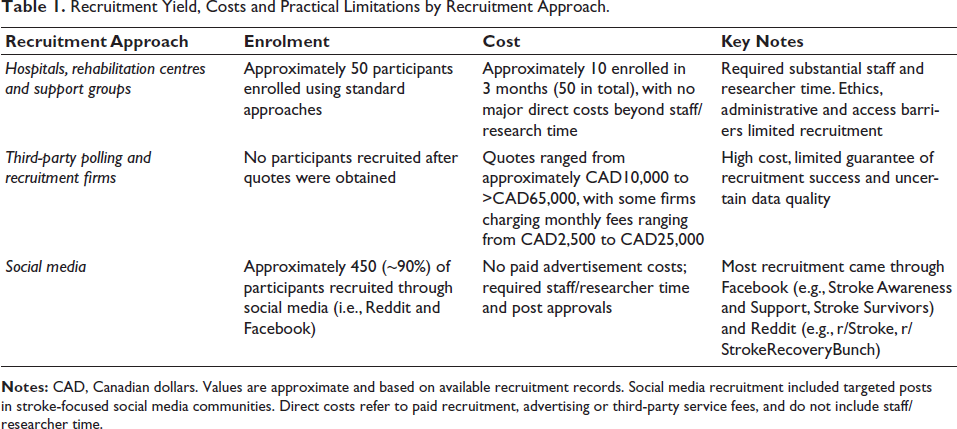
Our project examining the traditional and emerging risk factors of stroke in young adults provides a relevant example of recruitment challenges. Traditional methods, such as cross-sectional surveys, are often used due to their simplicity and effectiveness in examining associations of risk factors. However, survey collection for an uncommon outcome like stroke in young adults can be challenging due to difficulties in identifying and reaching enough eligible participants. A common strategy for completing such work is through third-party research polling firms. Upon approaching these firms, we were met with substantially high costs. Due to the low prevalence rate of the outcome, the estimated expenses from recruitment services ranged from CAD10,000 to over CAD65,000, often with no guarantee of recruitment or data quality. Monthly fees for research advertisements or introductions to collaborators similarly ranged from CAD2,500 to CAD25,000, without guaranteed partnerships. These substantial costs prohibit many researchers, especially those in earlier stages of their careers or with limited funding, from conducting such research. It may also be considered a (mis)use of valuable resources from funding agencies, limiting funds that may be better spent on answering research questions, graduate student training, and knowledge dissemination and translation activities.
Recruitment through traditional methods, such as hospitals and rehabilitation centres, introduces additional challenges. For instance, studies that involve multiple clinical sites often require correspondence with several Research Ethics Boards, each with distinct requirements and review processes. These additional review processes can significantly delay the initiation of the research process. Acute care centres and clinical settings may also not offer access to particular patient groups if follow-up is limited after an event. For example, in stroke research, young adults are frequently underrepresented in rehabilitation settings, where older patients are more common. While some younger patients with severe outcomes are admitted, many are reluctant to participate in research during recovery, further limiting participation. On the other hand, recruitment via collaboration with other researchers in the field may be hindered by gatekeeping of knowledge, data and research connections. For instance, data sets were not shared due to monetary or privacy issues, or assistance was contingent on authorship or compensation. Unfortunately, research and academia can be exclusive; in particular, those with pre-existing connections or large research grants are often advantaged.
Together, these conventional recruitment methods highlight the broader limitations of traditional approaches, particularly when targeting uncommon or rare populations. We achieved some success from survivor support groups and rehabilitation centres that generously shared our research. Based on our sample size calculation, we required approximately 425 participants for a case-control study with 1:1 matching. However, using these standard recruitment methods, we enrolled only approximately 10 participants over the first 3 months (approximately 50 in total), prompting the need for a more effective approach.
Eligibility Screening and Stroke Verification
Eligibility was assessed through a brief screening section at the start of the online survey. Stroke status was based on participant self-report, with no medical documentation, imaging reports or physician confirmation being requested or reviewed. Given the international scope of the study and the online nature of recruitment, medical record verification across jurisdictions was not feasible.
Ethics Approval and Participant Consent
Recruitment Yield, Costs and Practical Limitations by Recruitment Approach.
Results
The Use of Social Media for Recruitment of Rare and Uncommon Populations
The main solution to our recruitment challenges came through targeted social media posts, primarily on Reddit and Facebook. Reddit communities such as r/stroke and r/StrokeRecoveryBunch provided invaluable support. These communities were largely composed of young adults who had recently suffered from a stroke and recognised the value of the research, expressing a strong willingness to provide support. Moreover, many members had loved ones affected by stroke who were also happy to help. These communities were enthusiastic and openly shared our study in other support groups across multiple platforms, helping to facilitate recruitment beyond the reach of initial posting. The young stroke survivor group is unique, given that this outcome is not common, and survivors have created supportive online environments to share experiences, ask questions and find commonality. On Facebook, groups such as Stroke Awareness and Support, Stroke Survivors and Stroke Survivors Support Group similarly helped with dissemination of the questionnaire. Similar to Reddit, members of these groups happily and actively participated in or shared our study with eligible contacts.
The direct financial cost of social media recruitment was minimal, as posts were disseminated without paid advertisements. However, this approach still required staff and researcher time to identify appropriate groups, obtain moderator approval, respond to questions and monitor posts. Using social media, approximately 450 participants were recruited, representing about 90% of the final sample (Table 1). Approximately 95% of participants who started the survey completed it, supporting the feasibility of this approach.
Platform-specific Considerations and Selection Bias
While a promising opportunity for recruitment, researchers must consider several important factors prior to recruiting participants from social media. Some of these factors include platform-specific user demographics, access requirements and researcher privacy. Although there is limited information on user demographics of these platforms, researchers must consider their differences when looking for participants. For instance, it is estimated that 22% of all American adults aged 18-29 are Reddit users. 4 Based on a sub-sample study of Reddit users, 29.8% of the sample was aged 18-20 and 38.5% aged 21-54. 4 For the sake of stroke research on young adults, this population distribution closely aligns with the target population. Little is known about the demographics of Facebook users. In recent years, the platform has generally attracted older adults, though younger users are still present. Although this demographic makes up a minority of Reddit users, their inclusion offers a complementary recruitment strategy for our target population. Moreover, both Reddit and Facebook require permission to post research-related content within the group. On Reddit, providing proof of research ethics approval was generally a prerequisite for posting, typically mandated by each subreddit group. In contrast, Facebook was generally more lenient, although it required posts to be made using personal Facebook profiles and thus required a member of the research team to create a personal profile. Reddit, however, allowed us to create profiles dedicated to research, allowing researchers to maintain privacy. The choice between these platforms, or other platforms such as Instagram or X (formerly known as Twitter), should be guided by the research question and target population. Investigating the target population for these platforms, as well as how they are used, is a first step in determining the right platform(s) to assess.
The findings of our study are consistent with prior research suggesting that social media recruitment can be a useful way to reach uncommon populations, especially when traditional clinical recruitment is slow, expensive or difficult to coordinate.5, 6 Nonetheless, research findings also highlight similar important considerations of being transparent about where participants were recruited from, the potential biases of each platform, how eligibility was screened, and whether participant diagnosis could be verified.7, 8
Conclusion
By no means does this article suggest that social media can be used as a universal tool to collect data on any/all rare or uncommon populations, as it is not a ‘one-size-fits-all solution’ to recruitment challenges. For example, research examining rural West African elderly individuals with late-stage dementia would likely not benefit from using social media. Instead, the use of social media for recruitment depends on whether the research question(s) and the characteristics of the population of interest align with its use. For instance, many young adults actively use social media platforms, such as Reddit and Facebook, making targeted recruitment of this population through social media appropriate. Additionally, a significant proportion of young adults have a cryptogenic stroke, 9 resulting in many young adults gathering on social media communities seeking answers and support. This collective interest from survivors may enhance their interest and willingness to participate in research, increasing the usefulness of targeted social media recruitment. Recruitment through established stroke survivor communities also reframes recruitment from passive identification of eligible patients into active community mobilisation, in which survivors share, endorse and discuss the study with others. Ultimately, this recruitment method positions young stroke survivors as research partners and advocates, rather than passive subjects. However, this approach has important methodological limitations.
The main limitations of this approach were the inability to independently verify stroke diagnosis and the potential for selection bias. As described in the methods, stroke diagnosis was based on participant self-report and was not independently verified through medical records, physician documentation or imaging reports. This remains an important limitation, although the use of eligibility screening questions and the absence of financial compensation may have reduced the incentive for inappropriate participation. Misclassification, however, cannot be excluded. Social media recruitment may also overrepresent individuals who are younger, more digitally active, engaged in online stroke communities and well enough to complete an online survey. Simultaneously, this may underrepresent stroke survivors who have severe aphasia, cognitive impairments, limited internet access, lower digital literacy or less connection to online support communities. This selection bias may be further influenced by platform algorithms, as social media platforms use recommendation systems that shape which posts, communities or discussions users are exposed to. 10 Therefore, exposure to recruitment materials is not entirely random and may depend on users’ prior activity, engagement and online networks. These limitations should be transparently reported when social media is used for research recruitment.
Despite these limitations, the use of social media for recruitment makes possible what otherwise may feel impossible. Recruiting rare or uncommon participants presents substantial challenges due to low prevalence, high costs, limited resources and restricted access to potential participants. Traditional recruitment methods, such as third-party polling firms or researcher collaborations, are often expensive or difficult to navigate. Our experience with examining stroke risk factors in young adults illustrates these challenges. However, leveraging the use of social media offered an accessible and affordable way of collecting meaningful data, ultimately helping advance our understanding of these understudied groups. In our study, the absence of participant compensation, the use of stroke-specific online communities and the high survey completion rate support the feasibility of this approach; however, these factors do not completely remove the limitations related to self-reported diagnosis and non-probability sampling. Future research using social media recruitment should consider whether medical record confirmation, document upload or linkage to clinical registries is feasible, especially when diagnostic precision is central to the research question. Social media should therefore be viewed as a valuable recruitment strategy that requires careful application.
Footnotes
Acknowledgement
The authors would like to thank Dr Diane Williams and Dr Kanwal Singh for their assistance in editing and conceptual feedback on this project.
Authors’ Contributions
S. S.: Contributed to the conceptualisation, investigation, methodological design, formal analysis, data curation, validation, visualisation, writing of original drafts, as well as review and editing of the manuscript.
S. M.: Contributed to the conceptualisation, methodological design and analysis, review and editing of the manuscript, project administration, funding acquisition and supervision.
J. D.: Contributed to the conceptualisation, methodological design, validation, formal analysis, as well as review and editing of the manuscript.
M. S.: Contributed to the conceptualisation, methodological design, validation, formal analysis, as well as review and editing of the manuscript.
Consent for Publication
Not applicable.
Data Availability
The data that support the findings of this study are available upon reasonable request and permission from the corresponding author, but restrictions apply to the availability of these data, which are not publicly available due to participant privacy and ethical considerations.
Declaration of Conflict of Interests
The authors declared no potential conflicts of interest with respect to the research, authorship and/or publication of this article.
Ethical Approval
Ethics approval for this research was obtained from the University of Waterloo’s Research Ethics Board in correspondence with the Tri-Council Policy Statement: Ethical Conduct for Research Involving Humans (#46461).
Funding
The authors disclosed receipt of the following financial support for the research, authorship, and/or publication of this article: This work was supported by the University of Waterloo/SSHRC Research Incentive Fund (2025).
Guarantor
S. M.
Informed Consent
All participants within this study provided informed written consent, which was approved by the Institutional Review Board.
