






Abstract
In 1902, Charles E. Pratt, an American expatriate, purchased the right to be the sole provider of legal gambling games in Panama. Although Pratt expected to make a fortune once the United States began building the Panama Canal, circumstances conspired against him. This article presents the first full account of Pratt’s checkered life and the lawsuit that arose after his untimely death.
I. INTRODUCTION
In January 1902, Charles E. Pratt (1839–1904), an American expatriate, purchased the right to be the sole provider of legal gambling games in Panama. 1 Although the concession was not terribly profitable, Pratt was convinced that he would make a fortune once construction of the Panama Canal got underway. As matters turned out, however, Pratt never cashed in on his dream and died just a few months after construction of the canal began in May 1904.
To date, no one has written a biography of Pratt, and his dealings in Panama have been both misreported and told only disjointedly and incompletely. Accordingly, the purpose of this article is to present Pratt’s story as accurately and as coherently as is possible given the passage of so many years.
II. CHARLES E. PRATT
Charles E. Pratt was born in Adams, New York, 2 a small town 50 miles north of Syracuse, New York, 3 on August 21, 1839, 4 the son of Sarah A. and Charles E. Pratt. 5 Neither Charles E. Pratt the father nor Charles E. Pratt the son should be confused with two more notable men of the same name and era: the Boston patent attorney Charles E. Pratt (1845–98), 6 considered the foremost bicycle expert of his day, 7 and the New York City musician Charles E. Pratt (1841–1902), 8 who in 1881 wrote the popular song “My Bonnie Lies Over the Ocean.” 9
No information has been found regarding our Pratt’s early life. The first public mention of Pratt appears in May 1876, when he was 36 years old. In an article in the St. Louis Daily Globe-Democrat, Pratt is reported as having left town hastily after it was discovered that he and four other men were printing and selling counterfeit railroad tickets. 10 According to the article, Pratt had been working as a porter at St. Louis’s Olive Street Hotel at the time of the crime. 11
From 1878 to 1882, Pratt lived in Fort Worth, Texas, where he was affiliated with the notorious con man Jefferson R. “Soapy” Smith II. 12 The next few years are a mystery, although at some point Pratt made his way back east to New York City and began managing theaters. 13
In 1887, Pratt decided to go to Panama after he and a man named Edward H. Craig decided to start a theater in Colón:
Mr. Craig, in the winter of 1887, made the acquaintance in New York of Charles E. Pratt, a gentleman who has been connected with many theatrical ventures, and together they went to Colon, where they established a theater. Luck did not stay long with the Panama Theater, [as] it was called, and in less than a year Pratt and Craig found themselves penniless. Craig secured a place as manager of a laundry and Pratt got work in a store. 14
In December 1888, Craig and Pratt were arrested in Colón after “Mademoiselle De Blen,” the proprietress of the American Hotel, the boarding house at which the pair was staying, claimed that her jewelry had been stolen. 15 In April 1889, having been acquitted of the charges, Craig and Pratt returned to the United States and promptly “file[d] a claim against the Colombian government for $16,800 each.” 16
At some point in 1889, Pratt moved to Spokane, Washington, where he opened the Frankfurt Club with Henry G. “Doc” Brown. 17 Brown and Pratt likely met each other in Panama in 1887. 18
In February 1890, a local newspaper reported that the Frankfurt Club had been raided by the police:
[T]he Rudolf building on Riverside, between Howard and Mill, … is occupied on the ground floor by the Frankfurt saloon and upstairs [by] a gambling resort known as the Frankfurt Club… . The Frankfurt Club being one of the [city’s] leading [gambling houses], and probably receiving the largest patronage, the [Law and Order League] decided that the proprietors of this place should be made an example of… .
Attorneys W.E. King and James B. Jones were retained [by the League] … and last night … succeeded in securing three good reliable witnesses, one of them being Ellis McCammon. The latter swore out warrants for the arrest of the proprietors of the game, H.G. Brown and C. Pratt… .
In the [Club] at the time were about 150 persons… . When the officers announced their mission … a wild scramble took place… . Brown, who was dealing faro, and Pratt, who was running the roulette wheel, were immediately taken before Justice Dunning. Their bail was fixed at $500 each, and the former put up a $1,000 certificate of deposit for their appearance for examination this afternoon at 2 o’clock… .
Deputy Pugh procured an express wagon and removed all the gambling paraphernalia to his office at the courthouse. It was an interesting sight to see the two faro, two stud poker and one roulette table removed to the express wagon… . These tables, which will undoubtedly be confiscated, are valued at several hundred dollars. 19
Brown and Pratt soon changed the club’s name to “The Owl Club” and continued their partnership until 1892. 20
After parting ways with Brown, Pratt went into business with fellow Spokanites Peter Dueber and Reuben A. Freese. Together, the trio converted the Loewenberg Brothers’ wholesale dry goods building into a theater, bar, and gambling emporium called the Louvre Theater. 21 This enterprise, which opened in April 1892, 22 fared poorly and closed in April 1895. 23 While running the Louvre, Pratt was a supporter of local charities 24 but was threatened with arrest for operating without a license, allowing women to serve as barmaids, and violating the city’s Sunday blue laws. 25
Pratt married twice, although the name of his first wife and the dates of his two marriages are unknown. According to one of Pratt’s obituaries, at the time of his death, Pratt’s first wife and the couple’s two sons “reside[d] in the West” while Pratt’s second wife lived with her mother in Syracuse. 26 A different source identifies Pratt’s second wife as Marie Effie Pratt, 27 who was born in Germany in 1872 28 and whose maiden name was Gesell. 29 One of Pratt’s obituaries claims that Marie and Pratt married during Pratt’s time in Spokane. 30
In October 1895, Pratt left Spokane and moved to San Salvador, the capital of El Salvador. 31 By 1899, however, he had found his way back to Colón, 32 where, as will be detailed in just a bit, he became a gambling magnate. 33
Pratt died in Colón on November 6, 1904, 34 from what was later determined to be heart disease. 35 Initially, Pratt was buried in Colón’s Good Hope Cemetery. 36 Subsequently, however, Marie had him disinterred 37 and reburied in the Oakwood Cemetery in Syracuse, New York. 38 For unknown reasons, Pratt’s headstone incorrectly lists his birth year as 1850. 39
III. PRATT’S GAMBLING CONCESSION
In January 1902, Pratt purchased the right to offer legal gambling games in Panama:
The gambling concession … was granted on January 4, 1902, by the governor of the department of Panama to Mr. Charles E. Pratt, an American. The grantor was the governor, [Carlos] Alban, a Colombian general then exercising the functions of the chief executive of the department (now Republic) of Panama… . Adolfo Aleman, a Panaman [sic], was [Alban’s] secretary of finance.
The amount to be paid annually for three years for the exclusive privilege of operating gambling establishments throughout the country or of subletting the privilege was $51,000. 40
Due to the impoverished state of the Panamanian people, Pratt did not make much money during the concession’s first two years. But when the United States announced on May 4, 1904, that it would begin building the Panama Canal in two weeks, 41 Pratt looked forward to making a fortune off the more than 50,000 well-paid workers who soon would be pouring into the country. 42
The foregoing was first mentioned in an article that appeared in the November 27, 1903, issue of the New York American newspaper:
There is a gambling concession on the isthmus which is at present held by two Americans, Messrs. Seymour and Pratt. Roulette and other games are played openly, and this scheme helps to rob the poor and the foolish. This concession paid the local government about $76,000 gold this year. With the construction of the canal [about to start] and millions of dollars being spent here, the gambling concession will prove [to be] a new Eldorado. 43
Unfortunately, this story does not provide any details about Pratt’s partner Seymour. From other sources, however, it is known that his first name was John 44 and that he previously had been a “San Francisco gambler.” 45
During December 1903, two more articles about Pratt’s gambling concession appeared in American newspapers. In the first, Merrill A. Teague, a well-known Baltimore reporter who had been sent to Panama on a fact-finding mission by a group of newspapers, wrote:
The [central] government at Bogota realized, also, $87,000 Colombian silver annually in return for the gambling concession, which was openly sold to a firm known as Pratt & Seymour. By this concession the firm … is given the exclusive right for the entire department [of Panama] to maintain and operate gambling devices. In return for this concession, the firm has been paying Bogota $57,000 annually for the Pacific side of the isthmus and $30,000 annually for the Caribbean side, where its operations are restricted to the City of Colon. In addition to the various forms of gambling conducted by this firm, it leases to saloon[s] and other … establishments the right to maintain poker games, roulette wheels, crap tables, etc. 46
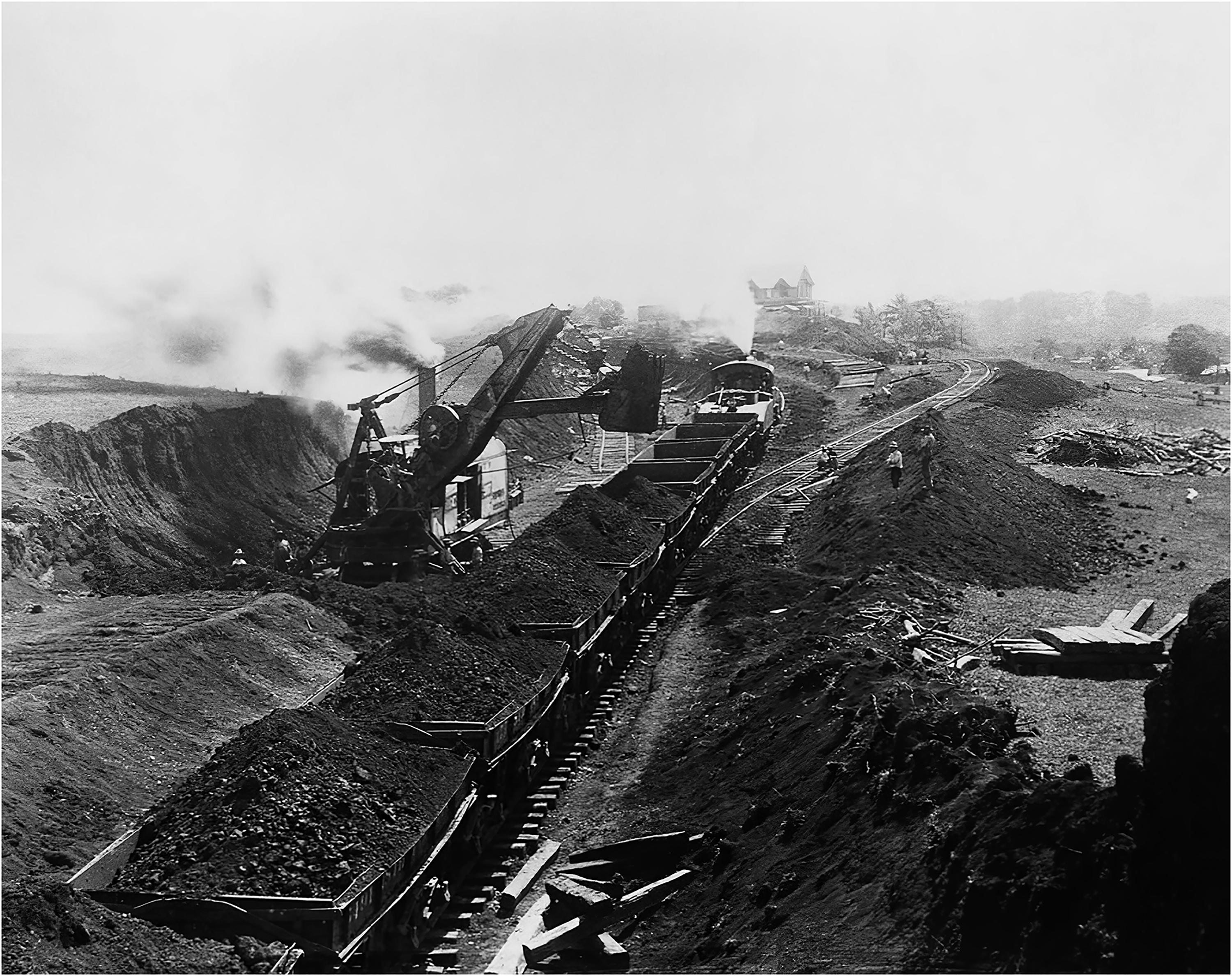
Between 1904 and 1913, the United States employed 57,000 workers who moved more than 235 million tons of dirt and rock to build the Panama Canal (Photograph courtesy of Alamy/Vintage Space).
A short time later, Pratt’s concession was the subject of an even longer article in New York’s Evening Post:
Mr. Pratt of Pratt & Seymour, holders of the gambling monopoly, came here 14 years or so ago with a light opera company, and never got away… .
Pratt & Seymour have been paying $200,000 a year for the gambling monopoly … [even though] all told, women and children [included], there are but 18,000 people in the canal strip, including the towns of Colon and Panama [City]… .
Pratt & Seymour do not profit greatly by their monopoly. Whether the people do not have the money, or whether the very openness and accessibility of the tables detract from the fascination, play is seldom high or long-continued. It frequently closes after two hours for lack of patrons.
The coming of 50,000 people to dig the canal is expected to change this condition. They will be away from home, with nothing to do after the daily labor, and [Pratt & Seymour] look [forward to] times like those when the French [under de Lesseps] were here [trying to build their canal from 1881 to 1889], and officers of construction sat by the tables with huge bags of silver, sending their servants for more when luck was bad. 47
In its reporting, the Evening Post also warned that chances were good that Pratt and Seymour would never cash in on their windfall:
[T]he hopes and expectations of [Pratt & Seymour existed] until [the] night before last [Dec. 12, 1903]. Mr. Pratt went to call then upon Dr. [Manuel] Amador, [who is about to become Panama’s first president and who has] just returned from Washington.
“All monopolies,” Dr. Amador told [Pratt], “except the lottery, must go. A gambling monopoly is especially objectionable to the Americans.” 48
As matters turned out, this reporting was entirely accurate: on August 22, 1904, the Isthmian Canal Commission (ICC), 49 as one of its first acts, made all gambling illegal in the Canal Zone. 50 Ten weeks later, Pratt was dead. 51
IV. CANAL ZONE v. CHRISTIAN
On January 26, 1905, just months after the ICC had made gambling illegal in the Canal Zone, and just weeks after Pratt had died and his gambling concession had expired, a case arose challenging the ICC’s authority to outlaw gambling. 52 By this time, the United States had set up its own legal system in the Canal Zone, which consisted of five municipal courts, three circuit courts, and an appellate court known as the Supreme Court of the Canal Zone. 53
Styled Canal Zone v. Christian, the case accused Charles Christian of running a roulette wheel in the Canal Zone. Christian admitted that he had done so but claimed that he had been an agent of Pratt & Seymour and therefore was protected by their gambling concession. Judge Osceola Kyle rejected this argument and sentenced Christian to 30 days in jail and ordered him to pay a $100 fine. 54
On appeal, the Canal Zone Supreme Court, in an opinion by Justice Hezekiah A. Gudger, 55 affirmed the fine but found that imprisonment was not warranted:
The prohibition of gambling within the limits of the Canal Zone was without doubt within the legislative power of the Isthmian Canal Commission, and Act No. 4 is in our opinion legal and valid.
This Act contains several sections, under any of which this defendant might have been tried and, if found guilty, punished. Under Section 6, imprisonment was obligatory, and under Section 2, the punishment was left discretionary with the judge.
It seems that the defendant labored under a mistaken idea that he had certain rights by virtue of the concession named, and that he acted apparently in good faith and for the purpose of testing his legal rights. The question of the legal rights of the defendant could only be determined in case the law was violated. The record leads us to believe that the act complained of was more to refer the question to legal determination than wilfully to violate the law. Therefore, considering all the facts and circumstances as revealed, we are of the opinion that the case comes properly under Section 2 of Act No. 4.
The judgment of the Circuit Court for the Second Judicial Circuit is modified by striking out that part imposing 30 days’ imprisonment and affirming said judgment in every other particular. 56
Justice Gudger issued his decision on September 1, 1905. 57 Although there is no evidence of an appeal being taken by either Christian or the government, 58 Charles E. Magoon, the Canal Zone’s second military governor, stated during an appearance before Congress on February 9, 1906, that an appeal had been taken to the U.S. Supreme Court but had been rejected due to a lack of jurisdiction:
Senator [John T.] Morgan [D-AL]: Does that action of the Canal Commission [outlawing gambling in the Canal Zone] take effect when the concession of Colombia expires [sic—the concession already had expired], or before?
Mr. Magoon: It took effect the minute it was executed, and it was tested in the courts. They denied our authority to do that. They said that it was a piece of property, that the treaty protected the property, and that we could not stop them from selling lottery tickets or from gambling.
Senator Morgan: That question has been settled in the courts of Panama?
Mr. Magoon: In the courts of the Zone.
Senator Morgan: But it has not been brought to the Federal court here?
Mr. Magoon: Yes, sir. It has been brought to the Supreme Court of the United States, and they declined to entertain the appeal.
Senator Morgan: Was that on the ground that they had no jurisdiction?
Mr. Magoon: It was on the ground that the Isthmian Canal Commission was without the authority to enact the statute under which it was prohibited and under which they were convicted.
Senator Morgan: And that there was no law upon which the appeal could be taken?
Mr. Magoon: On what ground did the Supreme Court decline jurisdiction, you mean?
Senator Morgan: Yes.
Mr. Magoon: That they did not have jurisdiction over the matters arising in the courts of the Zone; that is, that Congress had not yet extended their jurisdiction to the Zone. 59
Although Magoon never once said that he was talking about Christian, the only gambling case decided by the Canal Zone Supreme Court between the time of its creation in August 1904 and Magoon’s testimony in February 1906 was Christian. 60
V. LATER REPORTING ABOUT PRATT’S GAMBLING CONCESSION
To build a canal across Panama, the United States needed Colombia’s permission, because in September 1901, when Theodore Roosevelt became president of the United States, Panama was still a department (state) of Colombia. Although a treaty was worked out between Colombia and the United States in January 1903 (the Hay-Herrán Treaty), in August 1903, it was rejected by Colombia’s Senate. 61 As a result, the United States began actively encouraging Panama to secede from Colombia, which it did in November 1903. 62 The United States then quickly signed a replacement treaty with Panama (the Hay–Bunau-Varilla Treaty) authorizing the canal. 63
In 1906 and again in 1913, Congress investigated the role played by the United States in Panama’s secession from Colombia, a matter that had led to significant public criticism. 64 During the 1906 investigation, Pratt’s gambling concession was mentioned only in an exhibit that was entered into the record. 65
During the 1913 investigation, Earl Harding, who had worked in Panama in 1909–1910 as a reporter for The World (another New York newspaper), prepared a detailed report for Congress about Panama’s secession. Regarding Pratt’s gambling concession, Harding made several explosive claims:
A few years before [Panama’s secession from Colombia], Gov. Alban, of Panama, granted the concession to the American consul general, Hezekiah A. Gudger, who transferred it to Pratt & Seymour, Americans, for a fee which [Panama Railroad assistant superintendent Herbert G.] Prescott and John [M.] Popham, a Central American railroad builder, declare was $5,000. Prescott, [Panama Railroad port captain James R.] Beers, and Jesse [M.] Hyatt, American vice consul at Colon, arranged immediately after the revolution to obtain the gambling concession in their own names and sell it back to Pratt & Seymour for $60,000. They considered [it] quite … legitimate … for the American consul general to act as a broker in [this] transaction. 66
At this late date, there is no way to prove or disprove any of Harding’s assertions. It seems unlikely, however, that Gudger would have risked his job by purchasing, and then reselling to Pratt, a gambling concession. Similarly, the likelihood that Hyatt and two Panama railroad executives wrested the gambling concession away from Pratt and then resold it to him at an inflated price seems hard to believe, especially in the absence of any contemporaneous news reports.
VI. CONCLUSION
In many ways, Pratt’s story resembles that of Charles A. Biddle (1867–1919), a Californian who arrived in Shanghai, China, in 1895 and by 1904 had established an enormous gambling operation in the city’s American quarter. 67
Like Pratt, Biddle married twice (the second time to a much younger woman), was a member of the Masons, and died suddenly and unexpectedly at his home (due to a fall that fractured his skull). Like Marie, who was left with the task of winding down Pratt’s extensive financial affairs in Panama, Eleanor, Biddle’s second wife, was left to wind down Biddle’s extensive financial affairs in China.
Both Biddle and Pratt ran their gambling operations alongside (and out of) their more legitimate businesses, both of which also catered to the public. Pratt, of course, ran theaters. Biddle, on the contrary, ran hotels.
There was, however, one key difference between Biddle and Pratt. While Pratt’s gambling activities in Panama were completely legal (at least until the ICC passed its anti-gambling law in August 1904), Biddle’s gambling activities in Shanghai were completely illegal. As a result, Biddle frequently was hauled before the U.S. Court for China (USCC), one of America’s other early 20th-century federal extraterritorial courts.
Through a combination of luck and guile, Biddle repeatedly managed to avoid punishment for his misdeeds, although on one occasion in 1907, he was convicted by the USCC of illegal gambling, a decision later overturned by the Ninth Circuit. 68 Biddle’s case was the first one decided by the USCC; of course, Christian, the 1905 case involving Pratt’s gambling concession, was the first one decided by the Canal Zone’s Supreme Court.
Footnotes
Supplemental Material
APPENDIX 1
Contract No. 27
Adolfo Aleman, Secretary of Finance, having been duly authorized by the Civil and Military Commander of the Department, on the one hand, who hereafter will be designated as the Government, and Charles E. Pratt, in his own name, on the other, who will style himself the concessionary, have agreed to conclude the following contract:
Article 1. The Government hereby leases to the concessionary for a term of three years, reckoned from the 1st day of January of the present year until December 31st, 1904, the right to collect, in the province of Panama, the tax on games of chance and hazard which are allowed by law, and it authorizes him to establish said games himself or through his agent, on his own responsibility, in the aforesaid province, he consequently being at liberty to issue such licenses as he may think proper.
Article 2. The Government pledges itself to cause all necessary police to be lent to the concessionary by the proper authorities, for the maintenance of order, to which end the establishments in question must be situated in towns and localities that are easily accessible to the police officers.
Article 3. The concessionary pledges himself:
To pay to the Government by way of rental the sum of fifty-one thousand dollars ($51,000) in silver coin of 0.835 parts of pure silver for each year that the contract shall last, as follows: Twenty-five thousand five hundred dollars ($25,500) immediately after the signing of the present contract, and twelve thousand seven hundred and fifty dollars ($12,750) on the 1st day of October of the same year. In the years 1903 and 1904, the rental shall be quarterly in advance on the first day of each one of the months of January, April, July and October.
In case the work of the interoceanic canal shall be undertaken by the Government of the United States of North America, or in case it shall be undertaken by a respectable company of a well organized and permanent character, it being understood that such company shall have a force of employees numbering not less than four thousand engaged in the said work between Panama, Colon and the intermediate towns on the route of said canal, the concessionary pledges himself to pay to the Government the sum of seventy-five thousand dollars ($75,000), above the amount of the rental of the tax on the aforesaid games, or to pay to the Government three fourths of the amount of the net profits which he may derive from games of chance and hazard in the province of Panama, at the option of the Government, which shall be made at the time when work on the canal shall be resumed. In the latter case, the concessionary pledges himself to keep a clear and precise account of his business, proper vouchers whereof shall be furnished, and which account may be examined by the Government whenever it may think proper, through the agency of its officers, or of special commissioners designated for the purpose. The expenses occasioned by the establishment, surveillance, etc., of such games, shall be paid according to a previous agreement with the civil and military commander in case of the resumption of work on the canal in question, and in case the Government shall decide in favor of payment of the tax on the aforesaid games in the three fourths of the net profits of the business.
Not to establish, or permit the establishment of itinerant games in squares, streets and public places, or in places of transit. To establish the games of chance and hazard in buildings or places which are open and readily accessible to the police, and to prevent the games played in those buildings from being seen by passers-by. Not to transfer this contract without the previous consent of the Civil and Military Commander of the Department. Not to allow minors to enter his establishments, under penalty of a fine of fifty dollars for each infraction, which fine will be imposed by the chief political magistrate of the place, and to renounce the collection by process of law of any debt that is the outgrowth of a game or games, both from persons under age, and from military men in active service, and from public officers who are not allowed to enter such establishments. To renounce redress through diplomacy in any difficulties that may arise with regard to the understanding or performance of this contract.
Article 4. The causes that are mentioned by the law in general, and especially the non-fulfillment of the obligations contracted by this instrument shall cause the lapse of this contract.
Article 5. The police may freely enter the gaming establishments in the discharge of their official functions.
Article 6. It is understood that games of chance and hazard in the districts of Balboa, Chepigana and Pinogana are not included in this contract, the taxes thereon being leased separately, and it is further understood that the concessionary pledges himself to be responsible to the Government for the payment of his lease, whatever may be the condition of public order.
Article 7. The concessionary shall secure the fulfilment of the obligations which he hereby contracts, by means of a personal bond, to the satisfaction of the Government, in the sum of five thousand dollars ($5,000) in a check payable at sight, drawn on his bondsman and accepted by him, on the 1st day of April of the present year, or shall deposit in the general treasury the same amount in cash, as security for the strict fulfilment of this contract.
Article 8. Any differences that may arise with regard to the interpretation, etc., of this contract, shall be settled by arbitrators appointed by the contracting parties; and, while a state of war continues, the doors of the gaming houses or establishments shall continue, as at present, [to] open not later than ten o’clock p.m.
Article 9. It is understood and agreed that the present contract shall not take effect without the approval of the civil and military commander of the department.
In testimony whereof two copies of the same tenor have been drawn up and signed at Panama on this 4th day of January, one thousand nine hundred and two.
ADOLFO ALEMÁN,
H. A. GUDGER,
representing Charles E. Pratt.
Civil and Military Headquarters of the Department—Panama, 4 of January of 1902.
Approved-Register[ed,]
(L.S.) CARLOS ALBÁN.
The Secretary of Finance,
ADOLOFO ALEMÁN.
APPENDIX 2
PROHIBITION OF GAMBLING.
ACT No. 4.—An act to prohibit gambling in the Canal Zone, Isthmus of Panama, and to provide for the punishment of violations thereof, and for other purposes.
By authority of the President of the United States, be it enacted by the Isthmian Canal Commission:
SEC. 1. Parties engaged in gambling.—Every person who, within the limits of the Canal Zone, Isthmus of Panama, shall play at any game whatever for any sum of money or other property of value, or shall bet any money or property upon any gaming table, bank, or device, or at or upon any other gambling device, or who shall bet upon any game played at or by means of any such gaming table or gambling device, shall, upon conviction, be fined in any sum not exceeding five hundred dollars ($500.00), or be imprisoned not more than one year, or both, at the discretion of the court, and upon a second or any subsequent conviction shall be fined in any sum not less than one hundred dollars ($100.00) and not exceeding one thousand dollars ($1,000.00), or be imprisoned not more than two years, or both, at the discretion of the court.
SEC. 2. The proprietor of gambling devices.—Every person who, within the Canal Zone, Isthmus of Panama, shall set up or keep any gaming table, faro bank, keno, or any kind of gambling table or gambling device, or gambling machine of any kind or description, under any denomination or name whatever, adapted, devised, and designed for the purpose of playing any game of chance for money or property, except billiard tables, or who shall keep any billiard table for the purpose of betting or gambling, or shall allow the same to be used for such purpose, shall, upon conviction, be punished by a fine of not less than one hundred dollars ($100.00) and not exceeding five hundred dollars ($500.00), or be imprisoned not exceeding one year, or both, at the discretion of the court.
SEC. 3. Proprietor or occupant of private premises on which gambling is permitted.—If any person or persons, within the Canal Zone, Isthmus of Panama, shall suffer any game or games whatsoever to be played for gain upon or by means of any gaming device or machine of any denomination or name in his or their house, or any outhouse, booth, arbor, or erection of which he, she, or they are the owners, or have the care or possession, the persons or persons so offending shall, upon conviction, be punished by a fine of not less than one hundred dollars ($100.00) nor more than five hundred dollars ($500.00), or imprisonment not to exceed two years, or both, at the discretion of the court.
SEC. 4. The proprietor or occupant of public houses.—If any keeper or keepers within the Canal Zone, Isthmus of Panama, of any tavern, boarding house, ordinary, or other house of public resort, shall suffer any game or games whatever to be played for money or other property or token of value at or within such tavern, boarding house, ordinary, or other house of public resort, or in any outhouse, building, or erection appending thereto, every such keeper or keepers shall, upon conviction, be punished by a fine of not less than one hundred dollars ($100.00) nor more than five hundred dollars ($500.00), or be imprisoned not to exceed two years, or both, at the discretion of the court.
SEC. 5. The keepers of gambling rooms.—If any person within the Canal Zone, Isthmus of Panama, shall keep a room, building, arbor, booth, shed, or tenement, canal boat, or other water craft to be used or occupied for gambling, or if any person being the owner of any room, building, arbor, booth, shed, or tenement, canal boat, or other water craft shall rent the same to be used or occupied for gambling, the person so offending shall, upon conviction thereof, be punished by a fine of not less than one hundred dollars ($100.00), nor more than five hundred dollars ($500.00) for the first offense, and upon a second or any subsequent conviction shall be fined in any sum not less than five hundred dollars ($500.00) nor more than one thousand dollars ($1,000.00), or be imprisoned not less than one year nor more than two years, or both, at the discretion of the court. And if the owner of any room, building, arbor, booth, shed, or tenement, canal boat or other water craft shall know that any gambling table, gambling apparatus, or establishment is kept or used in such room, building, arbor, booth, shed, or tenement, canal boat, or other water craft for gambling, winning, betting, or gaining money or other property, and shall not forthwith cause complaint to be made against the person so keeping any such room, building, arbor, booth, shed, or tenement, canal boat, or other water craft, he shall be taken, held, and considered to have knowingly permitted the same to be used and occupied for gambling.
SEC. 6. Common gambler.—If any person within the Canal Zone, Isthmus of Panama, shall keep or exhibit any gaming table, establishment, device, or apparatus, to win or gain money or other property of value, or shall aid or assist or permit others to do the same, or if any person shall engage in gambling for a livelihood, or shall be without any fixed residence and in the habit or practice of gambling, he shall be deemed and taken to be a common gambler, and shall be imprisoned not less than one nor more than six months and be fined in any sum not exceeding one thousand dollars ($1,000.00).
SEC. 7. The court shall have authority to commit the party or parties found guilty of violating any provision or provisions of this act in default of payment of any fine or costs imposed therefor, and any person so committed shall be allowed a credit on said fine or costs of one dollar ($1.00) for each day of actual imprisonment inflicted on him: Provided, That in the event of a sentence to imprisonment in addition to a fine, the time allowance herein provided shall not commence or be counted until the expiration of the time of imprisonment fixed and inflicted as a punishment for the offense.
SEC. 8. Recovery of property or value.—Any person or persons who shall lose any property or money in a gambling house or other place at either cards or by means of any other gambling device, or game or device of any kind, such person, the wife or guardian of such person, his heirs, legal representatives or creditors, shall have the right to recover the money or amount thereof, or the other property or the value thereof, in a civil action, and may sue each or all persons participating in the game, and may join the keeper of the gambling establishment in the same action, who shall be jointly and severally liable for any money or property lost in any game or through any gambling device of any kind, and no title shall pass to said property or money by reason of its being lost in any such game or gambling device, and in an action to recover the same no evidence shall be required as to the specific kind or denomination of money, but only as to the amount so lost.
SEC. 9. Whereas an emergency exists, this act shall be in force and effect on and after its passage.
Enacted August 22, 1904.
J. G. WALKER,
Chairman Isthmian Canial Commission.
APPENDIX 3
CANAL ZONE versus CHRISTIAN.
No. 9. Argued August 7, 1905.—Decided September 1, 1905.
GAMBLING. ACT No. 4 OF LAWS OF THE CANAL ZONE VALID.
The United States, under the treaty with Panamá, was given full power to enact laws for the Canal Zone (Art. 3). The rights and privileges granted by the treaty were free from all prior concessions, etc. (Art. 21). Hence, an act prohibiting gambling within the Canal Zone is valid and in accordance with the treaty, although gambling within the Zone was covered by a concession from the Republic of Panamá, and the concessionaire violated a valid law when he operated a roulette table within the Zone.
Exceptions by defendant from the Circuit Court of the Second Judicial Circuit of the Canal Zone; Hon. Osceola Kyle, Judge.
The facts appear in the opinion.
Gilbert F. Little, for appellant. J. M. Keedy for respondent.
H. A. GUDGER, J. Information was filed in the Circuit Court for the Second Judicial Circuit charging the defendant, Charles Christian, with gambling. Trial was had before the Honorable Osceola Kyle, Judge of said Circuit, who found the defendant guilty in manner and form as charged in the bill of information. A motion for a new trial was made and overruled; judgment was entered on the finding, and defendant sentenced to pay a fine of one hundred dollars and to be imprisoned for a period of thirty days. From the judgment and sentence of the court, the defendant brings his appeal to this court.
Several grounds of reversal are urged, but the second assignment of error is all that is necessary for a consideration of the case. It is as follows:
That Act No. 4 of the Canal Commission, under which this defendant has been arrested, is unauthorized by the treaty or the act of Congress under and by virtue of which the Canal Commission came into existence.
The people living in the territory which had been the Department or State of Panamá, belonging to the Republic of Colombia, declared themselves independent from the mother country November 3, 1903, and held themselves forever absolved from any allegiance to the Republic of Colombia and to be a free and independent nation. The Republic of Panamá was recognized by the United States and other great powers. A treaty was signed between the United States of America and the Republic of Panamá November 18, 1903, and subsequently ratified by the Republic of Panamá December 2, 1903, and by the United States Senate February 23, 1904. This treaty, though having for its primary object the construction, maintenance and operation of an interoceanic canal connecting the Atlantic and Pacific oceans, granted to the United States other rights, powers and privileges incident thereto.
Article 2 of said treaty cedes to the United States in perpetuity the use, occupation and control of a zone of land and land under water for the construction, maintenance, operation, sanitation and protection of said canal of a width of ten miles, extending to a distance of five miles on each side of the central line of the route of the canal to be constructed. The words granting “in perpetuity the use, occupation and control of a zone of land” to a sovereign power carry with them by implication the right, power and authority to establish and maintain all needful and necessary forms of government.
If there be a doubt as to this view, Article 3 of said treaty is more explicit, and is as follows:
The Republic of Panamá grants to the United States all the rights, power and authority within the zone mentioned and described in Article 2 of this agreement, and within the limits of all auxiliary lands and waters mentioned and described in Article 2, which the United States would possess and exercise if it were the sovereign of the territory within which said lands and waters are located, to the entire exclusion of the exercise by the Republic of Panamá of any such rights, power or authority.
This article of the treaty gives to the United States full power and authority to legislate for the Government of the Canal Zone.
The 21st Article of the treaty further provides:
The rights and privileges granted by the Republic of Panamá to the United States in the preceding articles are understood to be free from all anterior debts, liens, trusts or liabilities, or concessions or privileges to other Governments, corporations, syndicates or individuals, and consequently, if there should arise any claims on account of the present concessions and privileges or otherwise, the claimants shall resort to the Government of the Republic of Panamá and not to the United States for any indemnity or compromise which may be required.
It was clearly the intention of the high contracting parties, expressed in unequivocal language, that the United States should have absolute, unqualified and unquestioned control over the zone mentioned, free from any debts, liabilities, concessions or privileges whatsoever.
The concession or the privilege in question was based on the personal covenants of the Republic of Panamá and Seymour & Pratt.
The Court could not construe it so as to prevent or inhibit the free alienation of land, such contracts never taking the nature of contracts that run with the land. Therefore, at common law and entirely independent of the treaty, had the Republic of Panamá been an individual, and a deed been given to some third person of a tract of land embraced within the zone, nothing being expressed about the concession, Seymour & Pratt would have had no right to enter upon said land for any purpose or to carry on gambling thereon. Should a sovereign power take less by conveyance than an individual? None would so contend. Yet in the case at bar there is a special warranty on the part of the Republic of Panamá that the United States should enjoy possession untrammeled and free from concessions, and should exercise the rights, power and authority of a sovereign of the territory.
It is needless to enter into an argument to show that the Republic of Panamá, a sovereign nation, had the right and the power to discontinue at any moment it became necessary any domestic contract made by it or by any other authority which it recognized. The moral right to exercise such a prerogative can hardly be questioned when it is remembered that the Government in the treaty referred to agrees to indemnify any one, suffering damage, against any loss. Besides, it is a well-established principle that all governments have the right to expropriate private property for public highways, the construction of railroads, street-car lines, sites for public buildings such as school-houses, court houses, jails, etc., and for other purposes of public utility; and that in so doing they have discharged in full their obligation to the private citizen when they have indemnified him against all loss. The rights of any one deprived of a concession to seek redress from the Republic of Panamá being recognized in the treaty, to it Seymour & Pratt must apply if aggrieved.
The prohibition of gambling within the limits of the Canal Zone was without doubt within the legislative power of the Isthmian Canal Commission, and Act No. 4 is in our opinion legal and valid.
This Act contains several sections, under any of which this defendant might have been tried and, if found guilty, punished. Under Section 6, imprisonment was obligatory, and under Section 2, the punishment was left discretionary with the judge.
It seems that the defendant labored under a mistaken idea that he had certain rights by virtue of the concession named, and that he acted apparently in good faith and for the purpose of testing his legal rights. The question of the legal rights of the defendant could only be determined in case the law was violated. The record leads us to believe that the act complained of was more to refer the question to legal determination than wilfully to violate the law. Therefore, considering all the facts and circumstances as revealed, we are of the opinion that the case comes properly under Section 2 of Act No. 4.
The judgment of the Circuit Court for the Second Judicial Circuit is modified by striking out that part imposing thirty days’ imprisonment, and affirming said judgment in every other particular. Let a mandate issue to the court below in conformity with this opinion.
All concur.
Affirmed in part and reversed in part.
Supplementary Material
Please find the following supplemental material available below.
For Open Access articles published under a Creative Commons License, all supplemental material carries the same license as the article it is associated with.
For non-Open Access articles published, all supplemental material carries a non-exclusive license, and permission requests for re-use of supplemental material or any part of supplemental material shall be sent directly to the copyright owner as specified in the copyright notice associated with the article.
