






Abstract
I. INTRODUCTION
In Novomatic Gaming Industry GmbH v. Palm Spring Gaming Company, decided May 28, 2025, the Supreme Court of Liberia, in a case of first impression, held that the plaintiff, an Austrian gaming device manufacturer, could use the replevin provision (§ 14.2(b)) contained in its lease agreement with the defendant, a defunct Liberian casino, to regain possession of 234 slot machines, even though the agreement also contained a broad arbitration clause (§ 15.16). The decision can be found online at https://judiciary.gov.lr/novomatic-gaming-industry-v-palm-spring-05-28-2025/. 1 It also is reproduced elsewhere in this issue.
II. LIBERIA’S GAMBLING HISTORY
Liberia (“Land of the Free”), a country roughly the size of Ohio, is located on Africa’s west coast. 2 It was founded in 1822 by the American Colonization Society (“ACS”), which believed that free Blacks would do better if they returned to Africa than if they stayed in the United States. 3 In 1847, Liberia became an independent republic. 4 By 1865, 11,000 U.S. Blacks had immigrated to Liberia. 5 Intentionally, Liberia’s constitution, laws, and legal system closely resemble their U.S. counterparts. 6 Additionally, Monrovia, the country’s capital, is named for U.S. president James Monroe. 7 Because of its American roots, English is Liberia’s official language 8 and U.S. currency is legal tender (along with the Liberian dollar). 9
In 1926, the Firestone Rubber Company organized what now is the world’s largest rubber plantation in Liberia. 10 In 1948, former U.S. Secretary of State Edward R. Stettinius, Jr. established the Liberian Registry, now the world’s largest shipping registry by tonnage. 11 These two undertakings, along with the export of gold, iron ore, and refined petroleum, now represent the mainstays of Liberia’s economy. 12
The first casino in Liberia was the Casino Monrovia, also known as the Africa Casino, located inside the five-star Hotel Africa. 13 The Hotel Africa was situated in (New) Virginia, a coastal suburb north of Monrovia. 14 The hotel and the casino were built in 1979 by the Liberian government to host a meeting of the Organization of Africa Unity. 15 During the 1980s, the Hotel Africa and the Casino Monrovia were run by Guus van Kouwenhoven, a Dutch arms dealer. 16 Both the Hotel Africa and the Casino Monrovia closed following the outbreak of the First Liberian Civil War (1989–97). 17
In 1982, Liberia adopted its first official gambling law (authorizing, as a war-time economic development measure, a national lottery). 18 The law was amended in 1993 and 2000 and repealed and replaced in 2014. 19 Today, Liberia’s US$50–$80 million gambling industry is overseen by the National Lottery Authority (“NLA”) and consists of casinos, lotteries, online gambling sites, prediction markets, slot machines, and sports books. 20
Liberia currently has six licensed casinos: Golden; Oceano; Platinum; Riverside Resort; Royal; and RS Multiplex Golden. 21 Of these, the oldest and best-known is the Oceano Casino at the 60-room Mamba Point Hotel on United Nations Drive in downtown Monrovia. 22
The Oceano Casino opened in 2004 23 and now is a local landmark. 24 Its 5,000-square-foot casino has 50 slot machines and 10 gaming tables. 25 In May 2025, Liberia’s Financial Intelligence Agency fined the Oceano Casino L$10 million (the equivalent of US$52,600) for multiple violations of Liberia’s anti-money laundering laws. 26
III. CASE ANALYSIS
In 2006, the Palm Spring Resort & Casino opened on Tubman Boulevard in the Monrovian suburb of Congo Town. 27 The resort’s casino (known simply as the Palm Spring Casino) quickly became, after the Oceano, Liberia’s best-known casino. 28 In March 2020, the property, which had been operated by Najib Kaman, a Lebanese businessman, was leased to Bou Najm Khaled, a Liberian businessman. Khaled renamed the hotel the Colony Club Resort & Casino 29 and later disavowed any responsibility for Kaman’s debts. 30
The Novomatic case arises from a lease agreement that the Palm Spring Casino, acting through an entity called Palm Spring Gaming Company (“PSGC”), entered into with Novomatic Gaming Industry GmbH (“Novomatic”), one of the world’s largest gaming equipment manufacturers, 31 dated November 1, 2018. 32 The agreement called for Novomatic to lease, for a period of 36 months, 117 “FV624” slot machines and 117 “FV830” sports betting kiosks to PSGC in exchange for “a monthly rental fee on the FV624 machines of 15% of the net win generated daily and … a flat rate [of] $7 (Seven United States Dollars) daily on the FV830 machines.” 33
Although PSGC made an initial payment of US$450,000, 34 by March 2021 it owed Novomatic US$1,900,532.35. 35 It also owed substantial sums to its other creditors, including US$100,000 to the Liberia Electricity Company. 36 In addition, due to Khaled having taken over the Palm Spring hotel, PSGC had moved Novomatic’s machines to three local slot parlors (Afri-Lodge, Mainline Spin to Win, and Riviera Amusement Center) where they were being “stored unwrapped in [an] area of very high humidity, with water on the floor, causing … serious risk of loss and damage.” 37
On March 30, 2022, Novomatic instituted a replevin action against PSGC before Judge Kennedy Peabody of Liberia’s Sixth Judicial Circuit Court (Montserrado County). 38 On April 14, 2022, PSGC responded by filing a lengthy answer and motion to dismiss. 39 In particular, it made three arguments: 1) Novomatic’s Liberian attorney (Benedict F. Sannoh) had not been properly retained by Novomatic, meaning that he could not appear on its behalf; 40 2) the May 2018 sales contract, 41 rather than the November 2018 lease agreement, controlled the case and under it Novomatic owed PSGC US$59 million for various defaults; 42 and 3) if the case was controlled by the lease agreement, then under §§ 15.15 and 15.16 of the lease agreement the case had to be submitted to arbitration in Vienna, Austria, before a single arbitrator, who, proceeding in English, would apply the laws of Austria and the rules of the International Chamber of Commerce (“ICC”). 43
On May 19, 2022, Judge Peabody agreed with PSGC’s first and third contentions. 44 On May 30, 2022, Novomatic filed an appeal to the Liberian Supreme Court. 45 Due to PSGC’s challenge to Novomatic’s appeal bond, 46 the case was not heard by the Supreme Court until November 18, 2024. 47
On May 28, 2025, all five justices voted to reverse the trial court. 48 The Court’s unanimous opinion was written by Justice Ceaineh D. Clinton-Johnson, at the time the Court’s most junior justice (Figure 1). 49
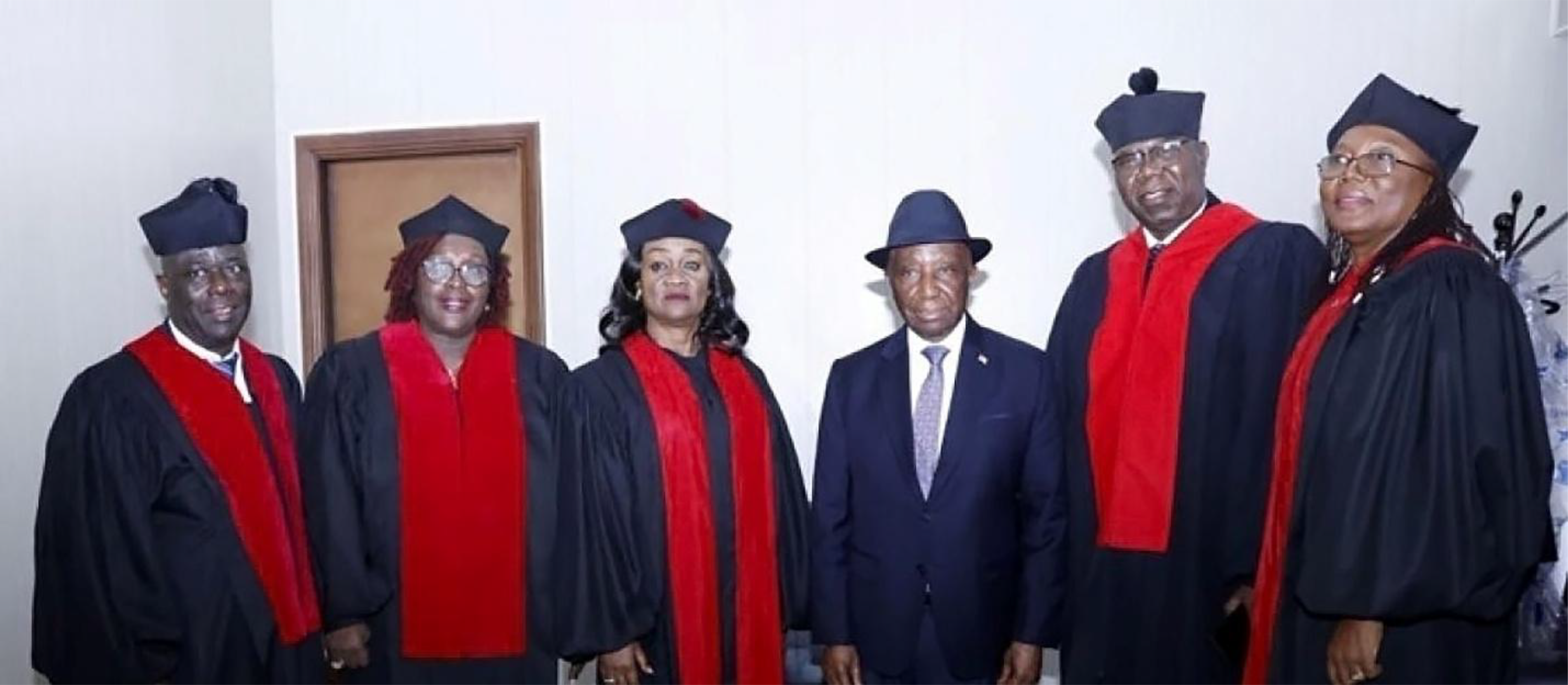
The Liberian Supreme Court with President Joseph Nyuma Boakai, Sr. (March 2025). From Left to Right: Justice Yamie Quiqui Gbeisay, Sr.; Justice Jamesetta H. Wolokolie; Chief Justice Sie-A-Nyene G. Yuoh; President Boakai; Justice Yussif D. Kaba; and Justice Ceaineh D. Clinton-Johnson. Photograph courtesy of the Republic of Liberia—Ministry of State for Presidential Affairs.
After recounting the case’s facts and procedural history, Justice Clinton-Johnson turned to the one issue that the Court felt was germane: “The issue that is determinative of this litigation before us is whether or not the trial judge erred when he dismissed the action to recover chattel based on the arbitration clause enshrined in the lease agreement.” 50
Justice Clinton-Johnson then undertook a detailed examination of Liberian arbitration law, 51 at the end of which she found that it fully supported parties choosing arbitration over litigation to resolve their disputes. 52 This conclusion, however, did not fully resolve the case because, as Justice Clinton-Johnson recognized, “the parties also agreed to a specific clause [§ 14.2(b)] that gives the appellant/plaintiff the right to recover their gaming machines due to [a] violation of the agreement[.]” 53
Finding no case law on the question, Justice Clinton-Johnson held that § 14.2(b) and the arbitration clause had to be read as simultaneously distinct and compatible, with the former giving the plaintiff the right to replevin its machines and the latter giving the defendant the right to file a claim with the arbitrator for damages for a wrongful replevin:
We are constrained to go beyond the arbitration clause … and address [the] specific consent [to replevin] also agreed [to] by the parties… . We are of the opinion that such [latter] right must be accorded the appellant/plaintiff as agreed upon by the parties… . In the instant case, the parties’ expressed consent to allow the appellant/plaintiff [to] remove[] their machines due to non-payment [must be upheld] because [the] arbitration clause is separate and distinct [from] the agreement [to arbitrate disputes].
54
IV. CONCLUSION
Although replevin clauses are common in U.S. gaming equipment contracts, 55 the present author has found no U.S. case construing such a clause. 56 As such, the Novomatic case, while not a U.S. decision (but issued by a court in a country whose laws closely resemble those of the United States), could be useful in a future dispute occurring in the United States, both as to the general validity of such clauses and for their survival in instances in which they are part of an agreement that also contains an arbitration clause. 57