







Abstract
At the early stage of mine feasibility assessment, decision-making is constrained by high geological uncertainty despite the need for rapid evaluation of economic viability. This study proposes a morphological texture-based classification framework as a screening tool for early-stage mine design. Distinct textural variants within a single ore deposit are classified using field and laboratory data and evaluated across slope stability, excavation energy, and ore grade. A multi-criteria decision analysis (MCDA) approach is applied to quantify trade-offs among these factors. Results show that weakly banded ores, such as deposition type 1 (DT), are easier to excavate but less stable, whereas competent units, such as DT6 and DT4, allow steeper, more stable slopes. The intermediate unit, as in DT5, exhibits higher grades but moderate constraints. MCDA ranking identifies DT6 as the most balanced unit. The framework demonstrates that morphological texture can effectively link geology with engineering and economic considerations, providing early-stage guidance for slope design and prioritisation under uncertainty.
Keywords
Introduction
Background
In pre-feasibility studies of surface mining projects, three interrelated factors critically influence both economic viability and operational design: slope stability (governing safety and pit configuration), energy requirements for excavation (including drilling, blasting and comminution) and grade premium (the net economic value after processing) (Garg and Moore, 2026; Rupprecht, 2004). Conventionally, these factors are evaluated independently through specialised and often resource-intensive methods – geotechnical characterisation for stability, comminution testing for energy consumption and metallurgical testing for grade–recovery relationships.
Such approaches, while robust, are typically undertaken during advanced exploration phases due to their cost and data requirements. As a result, early-stage feasibility assessments frequently rely on limited information, introducing significant uncertainty into preliminary decision-making. This disconnect highlights the need for rapid, low-cost indicators capable of informing multiple aspects of mine feasibility at the conceptual stage.
Research problem
Rock texture defined by the size, shape, arrangement and fabric of mineral grains and their intergrowths is widely recognised as a controlling factor in both mechanical and metallurgical behaviour (Askaripour et al., 2022; Frenzel et al., 2023). For instance, fine-grained or strongly foliated rocks may exhibit reduced shear strength and increased anisotropy, influencing slope stability. Conversely, equigranularity and interlocked textures are often associated with higher breakage resistance, thereby increasing excavation energy requirements. In metallurgical contexts, textural attributes such as grain-size distribution and mineral-liberation characteristics directly affect concentrate grade and recovery.
Despite this established qualitative understanding, rock texture is rarely utilised as an integrated, preliminary screening parameter capable of simultaneously informing stability, energy and grade considerations. This limitation is particularly evident in heterogeneous deposits, where multiple morphological variants (e.g., massive, brecciated or banded forms) may coexist within a single orebody and exhibit distinct textural signatures.
Literature context
Previous studies have demonstrated links between specific textural features and individual feasibility parameters. In rock mechanics, parameters such as foliation orientation, grain interlocking and microcrack density have been correlated with rock mass strength and deformability (Hoek and Brown, 2019; Palmström and Stille, 2010). In excavation and comminution research, indices incorporating grain size, mineral composition and fabric have been used to predict drillability and cuttability (e.g., Adhikari and Gupta, 1989; Simpson, 2019; Chen et al., 2024). Similarly, in mineral processing, textural characteristics, particularly those governing mineral liberation, have been shown to exert a strong influence on flotation performance and concentrate quality (e.g., Cropp, 2013; Butcher et al., 2023).
However, these studies are largely compartmentalised, focusing on isolated aspects of feasibility rather than adopting an integrated perspective. Moreover, comparative analyses of textural effects across different morphological variants within a single deposit type, particularly in skarn systems, are almost absent.
Research gap
A clear research gap therefore exists. To date, no exploratory framework has been developed that:
(1). Systematically identifies morphological variants within an ore deposit alongside their corresponding textural signatures. (2). Establishes a heuristic classification linking texture to deposit morphology. (3). Evaluates the trade-offs between slope stability, excavation energy and grade premium within a unified, multi-criteria framework. (4). Addressing this gap is particularly relevant in skarn deposits, where mineralisation processes commonly produce heterogeneous textures and morphologies over short spatial scales (Cox, 1995; Einaudi et al., 1981; Meinert, 1992). The absence of such a framework limits practitioners’ ability to leverage readily observable geological features during early-stage feasibility screening.
Objectives
To address the identified gap, this study pursues the following objectives:
To identify and characterise morphological variants within a Philippine skarn deposit, and to document their associated textural features through field observations (including ocular assessment and hardness testing) and laboratory-based physical property measurements. To develop a heuristic textural classification system linked to morphological deposit types, providing a structured basis for preliminary feasibility assessment. To evaluate trade-offs between slope stability, excavation energy requirements and grade premium using a multi-criteria approach based on the Analytical Hierarchy Process (AHP), informed by expert judgement.
Scope and limitations
This research is exploratory in nature and is intended as a proof of concept. The study is confined to a single skarn deposit in the Philippines and considers only the morphological variants present within this locality. The proposed textural classification is heuristic, ranging from qualitative to semi-quantitative, and the AHP-based trade-off analysis reflects informed expert judgement rather than statistically validated datasets. Accordingly, the findings should be interpreted as a preliminary framework that requires further validation and refinement across different deposit types, geological settings and operational contexts.
Methodology
Study area and geological setting
The study was conducted in Doña Remedios Trinidad, Bulacan, Philippines, within the Bayabas Formation (Philippines Mines and Geosciences Bureau, 2010). The area is characterised by intercalated volcanic and sedimentary sequences, primarily comprising basalt, andesite and sandstone.
Hydrothermal alteration associated with dioritic dike intrusions has resulted in skarn mineralisation of the host rocks (Bryner, 1969). This process has produced a range of morphological deposition types (e.g., massive, banded and brecciated forms), each exhibiting distinct textural characteristics. The geological heterogeneity of the deposit provides an appropriate setting for evaluating the relationship between morphology, texture and preliminary feasibility indicators.
Fieldwork and data acquisition
Field investigations were conducted between 2024 and 2025 and consisted of integrated geological, geotechnical, and sampling activities. These included:
Geological and structural mapping to delineate lithological boundaries and discontinuity patterns Ocular observation of rock texture at both hand specimen and outcrop scale Field hardness testing as a proxy indicator of relative material strength Semi-structured interviews with site engineers to contextualise operational conditions Systematic sampling across lithological and morphological variations
A total of 13 survey stations were established, of which 24 representative sample points were collected shown in Figure 1. Sampling was intentionally distributed across both mechanically strong and weak units to capture the full variability of textural and morphological expressions within the deposit. Photographic documentation at grain scale and rock mass scale was undertaken to support subsequent semi-quantitative interpretation.
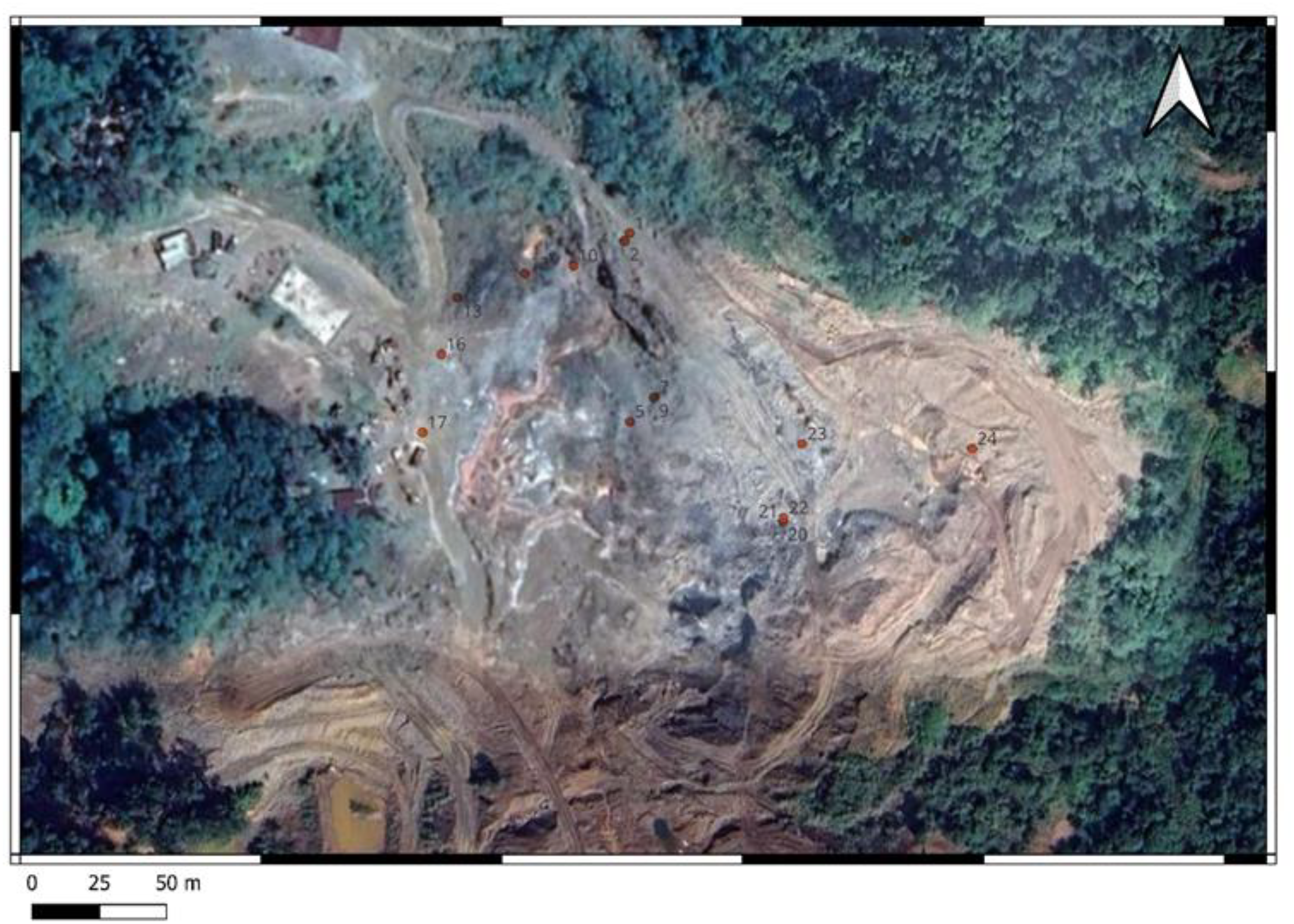
Spatial distribution map of survey and sampling stations numbered and marked in circles.
Laboratory testing
Laboratory analyses were conducted to complement field observations and provide baseline physical and mechanical properties. The following tests were performed:
Porosity determination Unit weight measurement Uniaxial Compressive Strength (UCS) testing Geochemical assay for iron content (%Fe)
These parameters were selected to represent proxies for the three feasibility aspects considered in this study:
strength-related properties (slope stability), mode of excavation (energy requirement), and ore quality (grade premium).
Morphological deposition types and their corresponding textural characteristics were identified through an integration of field observations and laboratory results. This process employed a semi-quantitative expert elicitation approach, whereby observable features such as grain size, mineral interlocking, fabric orientation and degree of alteration were systematically interpreted.
The classification was supported by:
Grain-scale and rock mass-scale photographic evidence Field descriptions and structural measurements Laboratory-derived physical and mechanical properties
This step resulted in the delineation of distinct morphologies and their associated textures within the skarn system.
Development of heuristic textural classification (objective 2)
Given the absence of an established theoretical framework linking rock texture directly to multi-criteria feasibility assessment, a heuristic classification approach was adopted (Hjeij and Vilks, 2023).
A nomenclature was developed by integrating morphological deposition type (e.g., massive, sheeted, brecciated) and strength-based descriptors derived from field hardness and UCS results.
For example, classifications such as soft-sheeted magnetite or hard-massive skarn were formulated to capture both textural and mechanical characteristics within a single descriptor. This classification scheme is not intended as a definitive taxonomy, but rather as a structured and transferable framework to organise textural information in a manner suitable for preliminary feasibility screening.
Multi-Criteria ranking of feasibility aspects (objective 3)
The developed textural classes (n = 8) were evaluated across three feasibility aspects: (1) Excavation energy requirement; (2) Slope stability and (3) Grade premium. Each class was assigned a rank from 1 to 8 for each criterion, where Rank 1 represents the least favourable condition and, on the other hand, Rank 8 represents the most favourable condition.
The ranking was based on an integrated interpretation of field observations, laboratory results and domain knowledge of rock behaviour and mineral processing performance. After which, the summation of three obtained ranks from three aspects of each texture class will be their combined score for the final position of ranking. This approach represents a qualitative additive multi-criteria decision analysis (MCDA) based on expert judgement (De Boer et al., 2026; Gongora-Salazar et al., 2023; Petchrompo and Parlikad, 2019). It assumes equal weighting across the three feasibility aspects and provides a transparent, straightforward mechanism for comparing trade-offs. The method is intended for exploratory comparison rather than rigorous optimisation.
Implications for slope geometry design
To extend the practical applicability of the classification, the inferred textural–mechanical relationships were qualitatively linked to slope design considerations. Each texture class was interpreted in terms of its likely influence on slope angle selection, bench configuration and/or stability risk.
These interpretations are conceptual and serve to illustrate how early-stage textural observations may inform preliminary geometric design decisions prior to detailed geotechnical analysis. The approach provides a structured proof-of-concept for integrating geological texture into early-stage feasibility assessment.
Results
The results presented herein a systematic arrangement of information, directly derived from fieldwork and laboratory work, to highlight the distinction between identified deposition types.
Identified morphological and textural variants of skarn deposit
There were eight identified ore-deposition types in the area, of which four are hosted by sedimentary rocks and the other four by igneous rocks. Their simple geological and physical characteristics are described one by one as follows, arranged in order of consecutive occurrence and/or elevation:
Deposition type 1 (DT1): Sedimentary-hosted semi-consolidated sheet magnetite
The ore-bearing material occurs within a sedimentary host sequence composed of semi-consolidated sandstone intercalated with thin calcisiltite layers. Two representative outcrops were documented within the open pit: one located in the western sector at approximately 375 m above mean sea level (masl) and another in the central sector at approximately 365 masl. The ore material is soil-like in nature, displaying a dusky brown colouration in a hand specimen. Texturally, the material is dominated by silty clay-sized particles with rounded grain shapes and well-sorted sediment fractions. Based on the Unified Soil Classification System (USCS), the material is classified as ML (inorganic silt with low plasticity). In the field, the ore material is moist to the touch and can be easily moulded, indicating a fine-grained and relatively plastic consistency. Morphologically, the ore occurs as thin concordant sheets within the sedimentary host, interpreted to represent replacement of calcisiltite interbeds within the sandstone sequence, consistent with characteristics expected from skarn-related alteration processes. Stratigraphic observations indicate two occurrences. In one exposure, the ore material forms part of the topsoil horizon, above or locally adjacent to non-cohesive magnetite accumulations (Deposition Type 2). In another exposure, the ore occurs in a horizontal stratigraphic sequence with a massive tabular magnetite unit (Figure 2).

Deposition type 1: (a) visual texture; (b–d) morphology and (e, f) stratigraphy.
Deposition type 2 (DT2): Sedimentary-hosted unconsolidated, irregularly massive magnetite
The ore-bearing material occurs within a sedimentary host rock identified as calcareous sandstone. Two representative outcrops were documented within the open pit: one located in the western sector at approximately 383 masl and another in the central sector at approximately 365 masl. The ore exhibits a dark grey to greyish black colouration in hand specimen and is soil-like in material character. Texturally, the material is composed of a mixture of sand- and gravel-sized particles with occasional boulders, displaying sub-rounded to sub-angular grain shapes and poor sorting. Based on the USCS, the material is classified as SM (silty sand). In field conditions, the ore material is relatively dry and easily disintegrates when handled, indicating weak particle bonding and a loose granular structure. Morphologically, the ore occurs as a large concordant disseminated body that follows the attitude of a sill intrusion within the host sedimentary sequence. Stratigraphic observations indicate two occurrences. In one exposure, the ore material forms the topsoil layer, underlain by a diorite sill intrusion. In another exposure, the ore occurs in a horizontal stratigraphic sequence with a semi-consolidated, soft sheet-like magnetite rock mass (DT1) (Figure 3).

Deposition type 2: (a, b) visual texture; (c, d) stratigraphy and (e, f) morphology.
Deposition type 3 (DT3): Sedimentary-hosted sub-horizontal to sub-vertical laminated magnetite
The ore occurrence is hosted within a sedimentary unit identified as calcareous sandstone, exposed along the western sector of the pit at approximately 379 masl. The ore material is classified as semi-rock, wherein the host rock remains cohesive and relatively hard, while the magnetite mineralisation occurs primarily as gouge-like material or infillings along pre-existing joints and discontinuities of the host rock. In hand specimen, the mineralised material exhibits a greenish-black colouration. The greenish colour suggests the presence of epidote a metamorphic mineral making the infillings to have been laminated. Texturally, the ore material is dominated by silty clay-sized particles with sub-rounded grain shapes and moderate sorting. The mineralisation occurs morphologically as concordant laminations with orientations ranging from sub-horizontal to sub-vertical, reflecting structural control along discontinuities within the host sandstone. It is suspected that the host sandstone bed is the continuation of the host sandstone of DT1, but this portion was affected by post-mineralisation geologic movement, causing the non-horizontal orientation. Stratigraphic relationships observed in the southwestern portion of the pit show that the sub-horizontal sheets occur in vertical sequence above disseminated, unconsolidated magnetite (DT2). Moving westward, the orientation of the mineralised sheets transitions from sub-horizontal to sub-vertical, where the ore then occurs in a horizontal stratigraphic sequence with the DT2 (Figure 4).

Deposition type 3: (a, b) visual texture; (c, d) morphology and (e, f) stratigraphy.
Deposition type 4 (DT4): Sedimentary-hosted bedded magnetite
The ore-bearing unit occurs within a sedimentary host rock identified as carbonaceous sandstone, exposed from the central to the eastern portion of the pit at approximately 386.6 m above mean sea level (masl). The ore material occurs in rock form and displays a very dusky purple colouration in hand specimens. Texturally, the mineralised rock feels rough and hard; it can be indented with one sharp blow from a point of pick hammer or 4 times heavy hammer blow. It is coarse-grained, with sub-angular grain shapes and well-sorted particles. The ore occurs as medium-thick concordant disseminations, with the orientation of mineralisation following the attitude of the host sandstone unit. Stratigraphically, the mineralised horizon is overlain by a pyroclastic flow unit and underlain by a more pronounced basaltic flow. In one outcrop section, the mineralised sandstone occurs adjacent to a dike intrusion. Field relationships indicate that this occurrence represents a distinct depositional type (DT4). The unit appears to be the continuity of the disseminated magnetite deposit type (DT2), but differs in its more hardened and compact nature, which is interpreted to result from younger volcanic interspersing and intrusion of sub-volcanic magma that subsequently compacted and lithified the deposit relative to the unconsolidated DT2 material (Figure 5).

Deposition type 4: (a–c) visual texture; (d, f) morphology and (e, f) stratigraphy.
Deposition type 5 (DT5): Igneous-hosted massive, tabular magnetite
The ore-bearing unit occurs within an igneous host sequence composed of andesitic to basaltic rocks, with exposures distributed across the western, northern, central, and eastern sectors of the pit at elevations ranging from 375 to 400 masl. The ore material occurs in rock form and displays a greyish dark blue colouration in a hand specimen. Texturally, the mineralised rock is coarse-grained with sub-angular grain shapes, while the overall rock fabric exhibits an aphanitic texture, consistent with the fine-grained groundmass typical of volcanic rocks. The ore occurs morphologically as massive concordant tabular bodies, following the structural and stratigraphic orientation of the host volcanic sequence. Stratigraphically, mineralisation occurs as proximal exoskarns bodies developed along the contact between basaltic units above and underlying andesitic rocks, indicating localisation of ore formation along the lithologic interface between these volcanic units (Figure 6).

Deposition type 5: (a, b) visual texture and (c) morphology.
Deposition type 6 (DT6): Igneous-hosted chimney to mantos magnetites
The ore-bearing material occurs within an igneous host rock identified as coherent andesite, exposed along the western, northern, and central sectors of the pit at approximately 382 masl. The ore occurs in rock form and exhibits a very dusky blue colouration in hand specimen. Texturally, the mineralised rock is coarse-grained, with angular grain shapes and a phaneritic texture, indicating visible interlocking mineral crystals. The mineralisation occurs morphologically as scattered, stratabound, discordant pods and also as vertically extensive, chimney-like bodies that locally extend laterally as mantos. Stratigraphically, the mineralised bodies occur in a lower sequence relative to deposit type DT5, indicating a deeper stratigraphic position within the volcanic host succession (Figure 7).

Deposition type 6: (a–d) visual texture and (e, f) morphology.
Deposition type 7 (DT7): Igneous-hosted vertical to sub-vertical vein-type magnetite
The ore-bearing material occurs within an igneous host rock identified as coherent basalt, exposed in the central and eastern sectors of the pit at elevations ranging from approximately 400 to 412 masl. The ore occurs in rock form and displays a blackish-red colouration in a hand specimen. Texturally, the mineralised rock is coarse-grained, with angular grain shapes and a phaneritic texture, indicating visible interlocking mineral crystals. The mineralisation is expressed morphologically as large vertical vein fillings and scattered small disseminations that appear as speckle-like occurrences within the host rock. The well-defined and uniform vein structures are particularly prominent, suggesting limited reaction between the mineralising fluids and the basaltic host rock due to its relatively low carbonate content, with mineralisation likely dominated by hydrothermal fluid deposition. Stratigraphically, the outcrop in the central portion of the pit occurs beneath DT4, where the mineralisation appears primarily as speckle-like disseminations within the basalt. In contrast, the outcrop in the eastern sector of the pit is located beneath a pyroclastic flow unit and above that sandstone bed, which hosts bedded magnetite (DT4), where the mineralisation is visually expressed as veins filling vertical joints within the basaltic host rock (Figure 8).

Deposition type 7: (a, b) visual texture; (c, d) stratigraphy and (e, f) morphology.
Deposition type 8 (DT8): Igneous-hosted irregular layers magnetite
The ore-bearing unit occurs within the uppermost igneous host rock identified as a pyroclastic flow deposit, exposed in the central and eastern sectors of the pit at elevations ranging from approximately 400 to 412 m above mean sea level (masl). The ore occurs in rock form and displays a dusky blue-green colouration in a hand specimen. Texturally, the mineralised rock is coarse-grained, with angular grain shapes and aphanitic to phaneritic textures, reflecting variations in the crystallinity of the host pyroclastic material. The mineralisation occurs morphologically as irregular layers with sub-horizontal orientations appearing as lens-shaped bodies. Stratigraphically, the pyroclastic flow unit overlies a basaltic flow, indicating that the mineralised lenses are developed within the upper volcanic sequence of the stratigraphic succession (Figure 9).

Deposition type 8: (a) visual texture; (b–d) morphology and (e) stratigraphy.
Mechanical property characterisation
The identified depositional types have corresponding mechanical properties, as consolidated below in Table 1. At the same time, strength classification according to the ISRM standard (Ulusay, 2015) is assigned to each deposit type.
Mechanical Properties and Strength Classification of Each Identified Deposition Type.
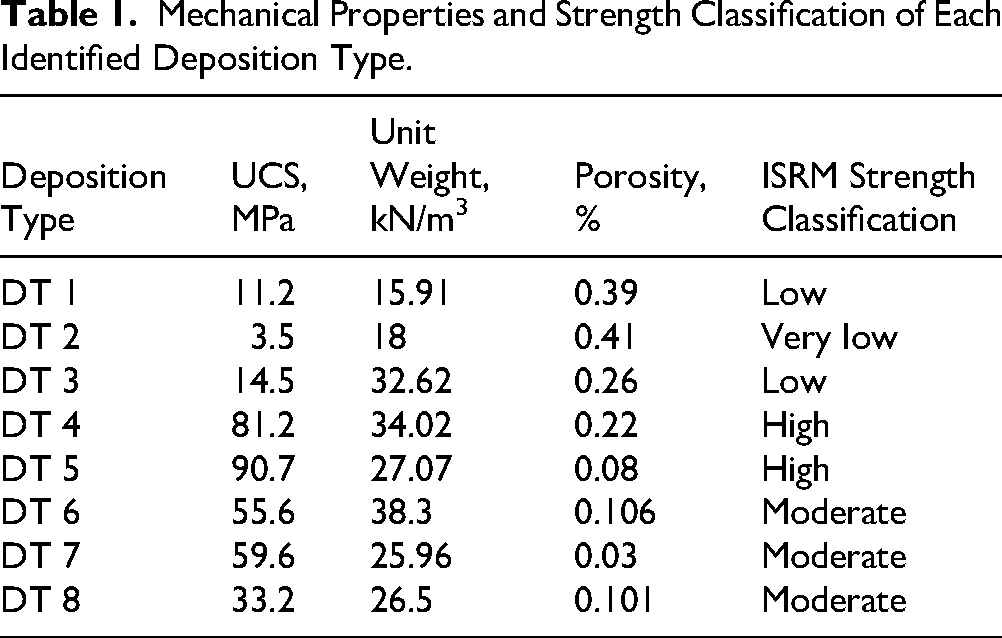
For DT2, the lowest recorded UCS reflects non-coherent soil material, while a relatively high unit weight reflects density coming from magnetite minerals (Liu et al., 2023). DT3 carries the general properties of the host rock, since the waste gap constitutes a higher proportion than the laminated ore itself. For DT4, although it is hosted by sedimentary rock, high UCS and unit weight suggest complete metasomatic replacement into skarn minerals (Meinert, 1992) and high porosity support the inference that the hardness likely arose from coherence rather than grain arrangement. DT5, having the highest UCS, suggests it is proximate to the intrusion source of ore mineralisation (Cox, 1995; Meinert, 1992). While almost similar UCS of DT6 and DT7 reflect the same rock (basalt) hosting the ore mineralisation, the low porosity of DT7 indicates closely packed mineral replacement (Kutina, 1981) consistent with smoothly confined vein filling. Moreover, the difference in their unit weights reflects the degree of mineral replacement. Nevertheless, all the DTs exhibit the usually expected mechanical degrees, in consonance with their deposition type and hydrothermal mineralisation background. DT1 to DT3 belong to the weak group classification of strength, DT6 to DT8 belong to the middle group strength classification, and DT5 and DT6 belong to the higher classification of strength.
Excavation strategies with assay grade notion
Based on a series of interviews with site engineers and ocular observation of the ongoing mining operations in the area, the following excavation strategies are noted as being implemented for these deposition types and are listed in Table 2. At the same time, a comparison has been made with the corresponding assay grade obtainable from each depositional type recovered through these excavation techniques.
Excavation Strategies With Assay Grade Notion for Each Deposition Type.
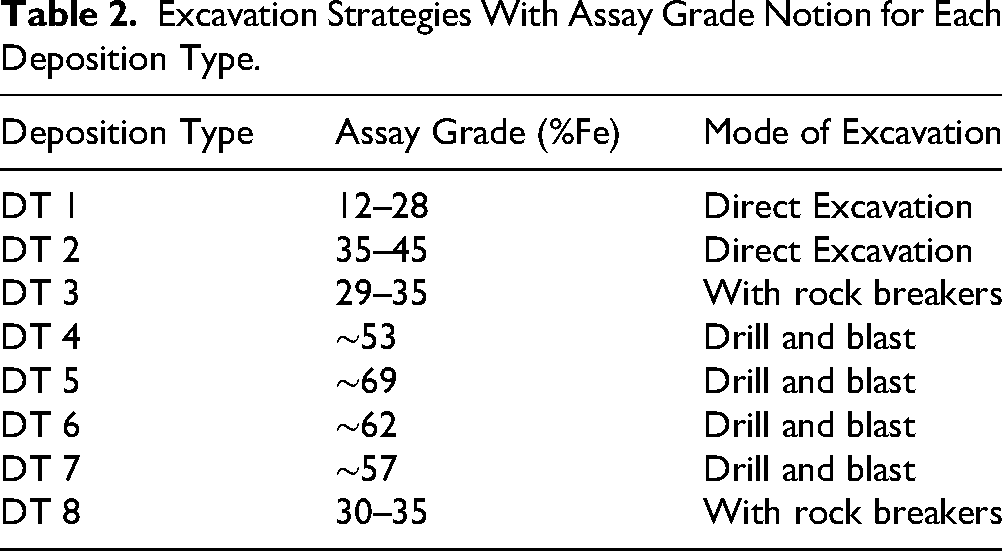
As noticed, DT1 to DT3, hosted by sedimentary rocks, are generally the ones with the lowest assay grade of interest. It is to be noticed, however, that DT2, which is a loose sediment of massive magnetites, has a moderately high iron grade comparable to igneous-hosted mineralisation, indicating that easy mobilisation of hydrothermal fluids along pores of loose sediments allows for the high dosage of metasomatism (Cooke et al., 2011; Cox, 1995). On the contrary, DT8, although hosted by igneous rocks, has moderately low grades of iron, suggesting that the variable composition of minerals in the pyroclastic host rocks does not react much to metasomatic replacement. Moreover, DT4, hosted by carbonaceous sandstone, as mentioned earlier, indicates high mineral-replacement activity, leading to moderately high-grade ore. And the rest, DT5 to DT6, follows the intuitive ore grade hosted by igneous hard rock (Meinert et al., 2005). DT1 to DT3 are being recovered through direct excavation, in which a backhoe excavator is used to break up the ore and load it into the truck in this study area. DT3 and DT8 ores are usually initially fragmented with hydraulic rock breakers before a payloader is used. At some point, depending on the fracture condition, DT8 already requires drill and blast for disintegration. Then DT4 to DT7, which are strong in-situ rockmass, are disintegrated upfront by drill-and-blast, while some oversized rocks are still broken into smaller pieces using rock breakers before being loaded onto the truck using a payloader.
Discussion
The following sub-chapters discuss how basic morphological and textural descriptions can be interpreted to develop a systematic textural classification framework well-suited for trade-off analysis.
Development of heuristic textural classification
As mentioned in the methodology section, a heuristic technique of nomenclature establishment tied to morphology was executed and organised in Table 3.
Ore Rockmass Textural Classification.
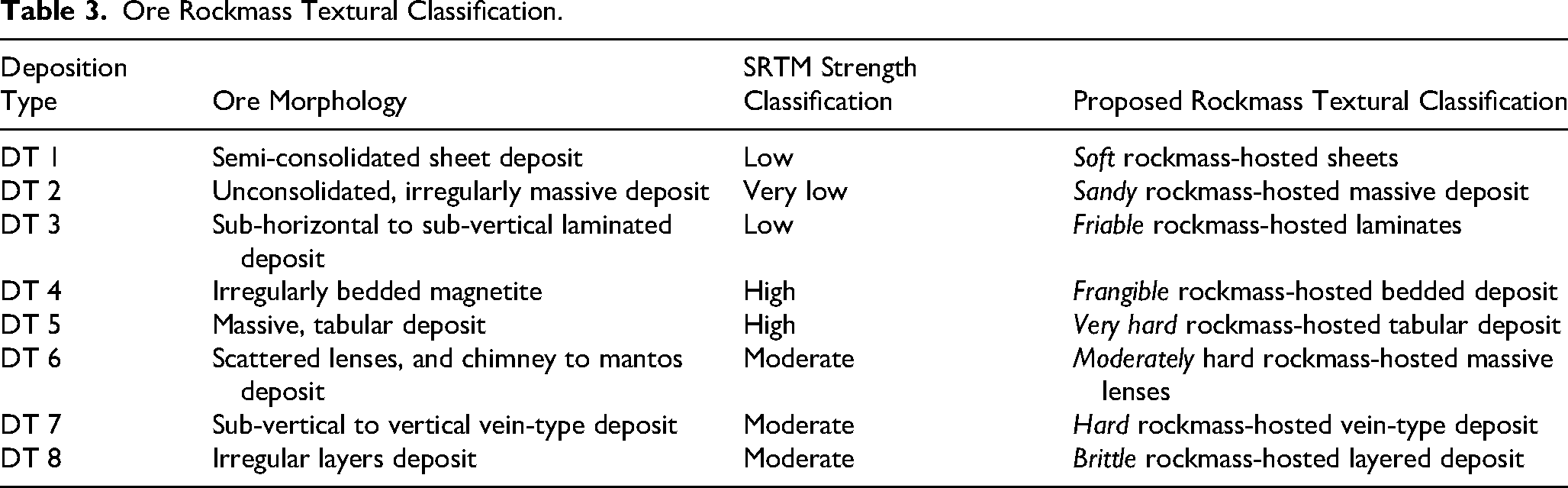
For DT1, since the rockmass is easily moulded by hand and the ore deposition appears to be in the form of horizontal sheets, the proposed textural name is Soft rockmass-hosted sheets. This soft rockmass as observed exhibits plastic behaviour when deformed. For DT2, the host material is unconsolidated, such as dry sand, classifying it as a sandy rockmass. It is generally weak and easily disintegrated by tension upon excavation. For DT3, while the host rockmass is coherent, the laminated ore remains friable. The overall behaviour of the rockmass upon excavation largely follows the weakest link, giving the rockmass a friable nature. For DT8, the ore disintegrates not in the intact solid rock but along the discontinuity planes, resulting in brittle behaviour when excavated. The DT7, DT6, and DT5 are designated as moderately hard, hard, and very hard rock masses, respectively, based on their UCS values. DT7 and DT6 appeared interchanged. However, field observations indicate that, due to the dense nature of DT6, it is more difficult to excavate. The frangible nature of DT4 is based on the behaviour that, although it is generally hard due to metasomatic replacement, it can suddenly crack, somewhat like glass, under a hard blow from a pick hammer, thus ending up carrying the material behaviour of sedimentary rock.
Multi-criteria ranking across feasibility aspects
A qualitative multi-criteria ranking method informed by expert judgement is completed and illustrated in Table 4. Rank 1 is assigned to deposition type carrying their characteristics, as the least favourable or least desirable across feasibility aspects and assigned a higher ranking to other DTs as their desirability degree increases.
Disadvantage Ranking of Texture Classess Across Mine Operational Parameters.
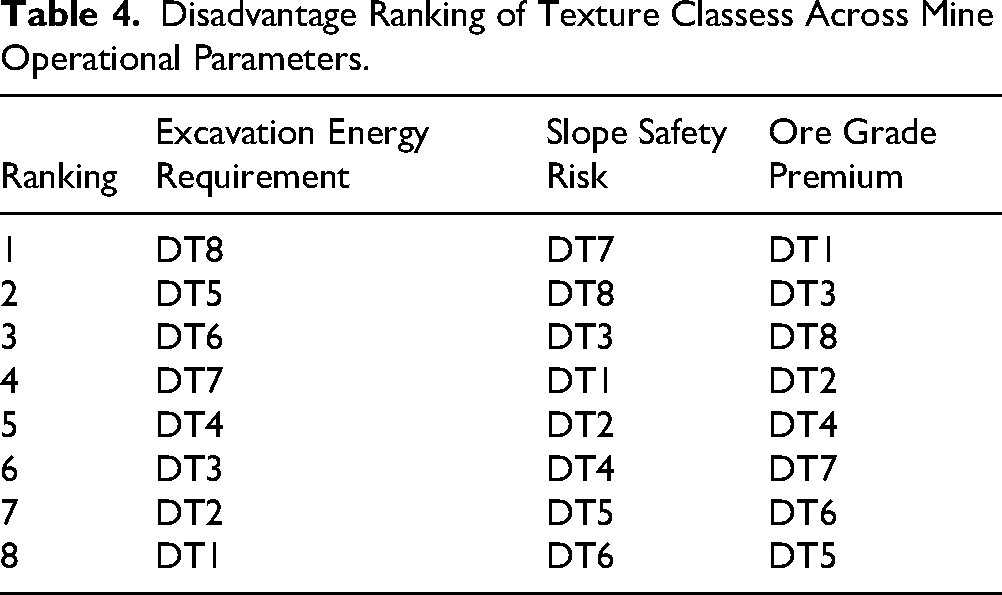
For the energy requirement of material handling, DT8 appears to be the least favourable due to the additional fragmentation it may require for the oversized material produced. Oversized rock in mining and excavation often stems from the natural joint blocks (pre-existing geological structures) within the rock mass that do not respond uniformly to a given drill-and-blast design. While blast design plays a role, the in-situ block size distribution determined by joints, fractures, bedding planes, and faults imposes an upper limit on the final fragmentation size (Adhikari and Gupta, 1989). The handling difficulty of DT5 to DT7 stems from their intrinsic hardness, which can only be fragmented by blasting. DT4 is also disintegrated by blasting, but requires less powder factor because of its weaker host rock (Tomar et al., 2025). DT3 to DT1 is ranked the most favourable in terms of material, simply because of the low cost from direct excavation.
For slope safety risk, DT7, DT8, and DT3 are the most likely to exhibit anisotropy due to structure-based ore filling and unavoidable waste gaps. It is widely recognised in engineering, materials science, and geology that the safety risks associated with anisotropy—where material properties differ depending on the direction of measurement—are often highly unpredictable, challenging to model, and a common cause of unexpected failures (Huber et al., 2024). These three are further arranged by the impact force they may cause when failure does occur, with DT7 being relatively heavy when a slide or rockfall occurs, and DT3, hosted by sedimentary rock, being relatively lighter. And DT8, due to pre-existing joints, makes angular joint blocks, which might give severe injury when workers are hit. DT1, DT2, and DT4 got their rank by simply having weak rockmass. It is widely known in geotechnical engineering that weak rock masses require extra attention, including the maintenance of gradual (flatter) slopes, to ensure stability (Azzuhry, 2017; Li et al., 2025). Weak rock masses, such as highly weathered, fractured, or low-durability rock types (e.g., shale, mudstone, claystone, and tuff), have lower shear strength and are prone to creating potential failure surfaces. DT5 and DT6, on the other hand, can make a steeper slope safe from being homogeneous hard rock (Azzuhry, 2017). They possess high shear strength and cohesion, allowing them to maintain steeper angles without failure.
In terms of the grade premium, DTs are plainly ranked based on obtained assay results and are cross-compared to energy required and risk of slope instability, just to get the reward of ore premium it could get from the specific DT. DT1, although the easiest to excavate, only yields a minimal grade equivalent, with a higher ore-to-waste ratio to maintain an optimally safe slope. The same goes with DT3 and DT2. DT8 is always the most unfavourable in all aspects, but interestingly, during field observation periods, it comprised the biggest volume of ore sustaining the current operation. Although from the perspective of resource reporting, it is recognised that the volume may constantly change as the mine development advances, eliminating the consideration for volume analysis here. DT4 is mid-ranked across the three aspects under review. DT7, as one of the highest grades, shares a moderate trade-off to material handling at first glance, but mitigating the risks associated with anisotropy, where rock strength, stress, or other physical properties vary by direction, commonly requires additional time, specialised expertise, and energy, all of which increase the overall mine design and operating costs (Huber et al., 2024; Shu et al., 2025). DT6 and DT5 might be the best targets in terms of controlled safety risk and uniform handling cost.
To evaluate trade-offs between competing feasibility aspects, the assigned ranks were treated as direct numerical scores. For each textural class, the scores across the three criteria were summed to obtain a total score (Total Score = S energy + S stability + S grade ). The resulting total scores were then used to re-rank the textural classes, identifying those DTs that provide the most balanced performance across all three feasibility aspects. This process was repeated for all classes, and final rankings were assigned based on descending total scores.
Following the MCDA approach, a rating of 24 is the highest a particular DT can receive, and 3 is the lowest. This concept is shown in Figure 10.
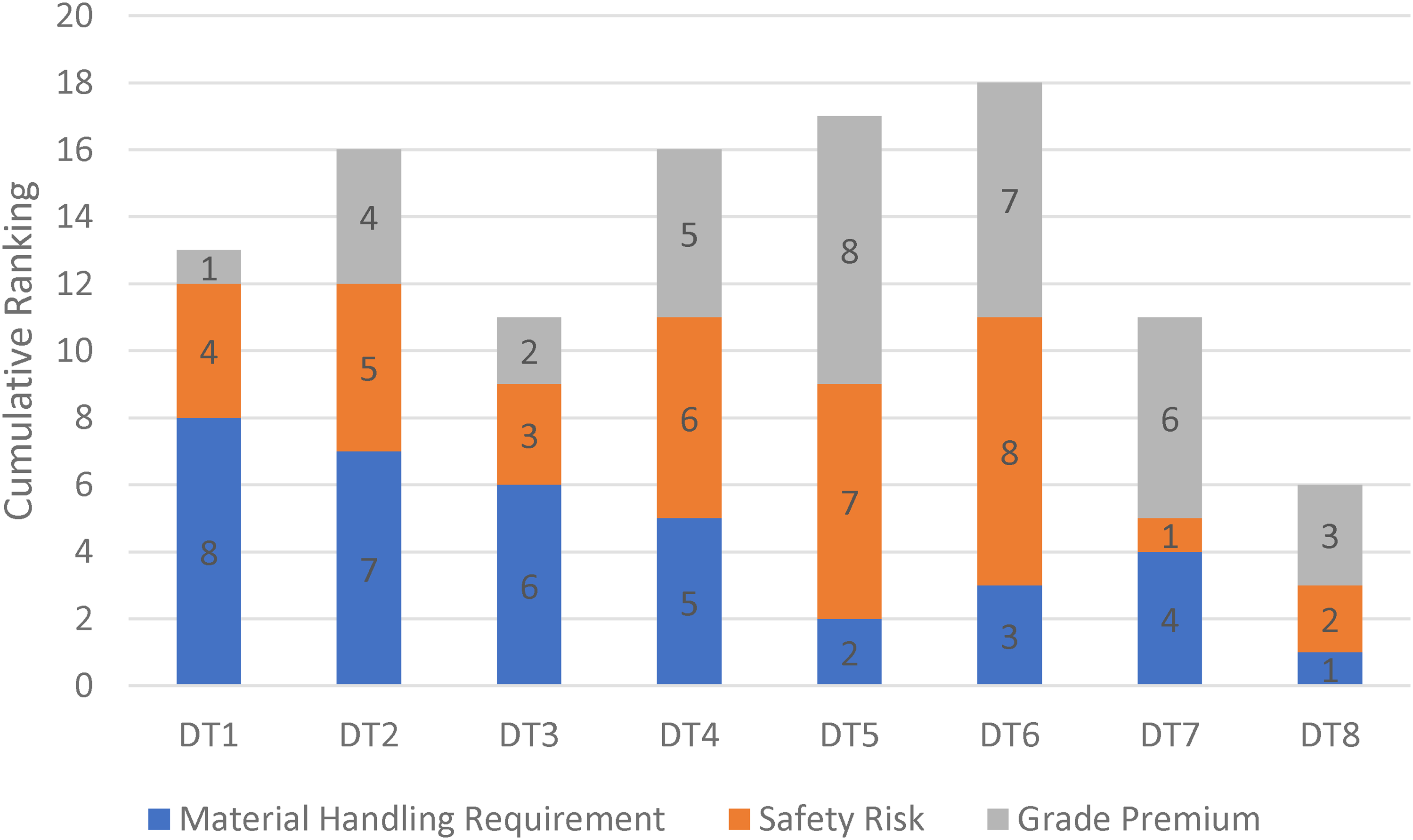
Final rating of balanced trade-offs.
Based on Figure 10, DT6 garnered the highest final ranking (18 points) from operational trade-offs, followed by DT5 (17 points) and a tie between DT4 and DT5 (16 points). It is also determined here that the highest final rating is only 18 points, while the lowest is 6, resulting in a 12-point gap. The high gap, similar to the concept of standard deviation (Urdan, 2005), indicates wide variability of performance expectations from these kinds of ore deposits. Moreover, the highest rating is only slightly above 50% of the maximum points expected, while the lowest rating among the DTs is about 200% above the minimum points it could get. The rating reflects that venturing into developing this kind of ore deposit is far from a bonanza, but at least not expecting the worst technical condition, then it is still worth developing. This confirms that from the operational sustainability point of view, all DTs have a fair share of challenges and rewards. It is also recognised here that the DTs at the upper rating are mostly hosted by hard rock, indicating that the rewards of targeting the excavation here outweigh the challenges it could bring.
Link to engineering application
The diagram should have been sufficient to illustrate balanced trade-offs among DTs across operational aspects. However, in actual geologic settings, the DTs as ore deposits are generally scattered rather than uniformly arranged in a simple linear manner. While they may be clustered along geological structures like faults, they vary widely in shape, size, and orientation, and are found at different elevations, making each deposit largely unique (Meinert, 1992; Ridley, 2013). As repeatedly mentioned in the previous section, each DT is found in sequence with another. Across the vertical section of an excavated slope, they come together in different combinations. One example is on the middle-east slope section (Figure 11(a)) of the study area, where the weak layer is found between hard rocks. The upper hard rocks exhibit anisotropy. Still on the east section, moving further into the southern portion about only 100 m away, the slope suddenly becomes composed of sandy magnetite above and sheet magnetite below (Figure 11(b)). A simple schematic diagram, not scaled, of how these DTs are arranged in consonance with the designed pit bottom and pit crest is shown in Figure 11.
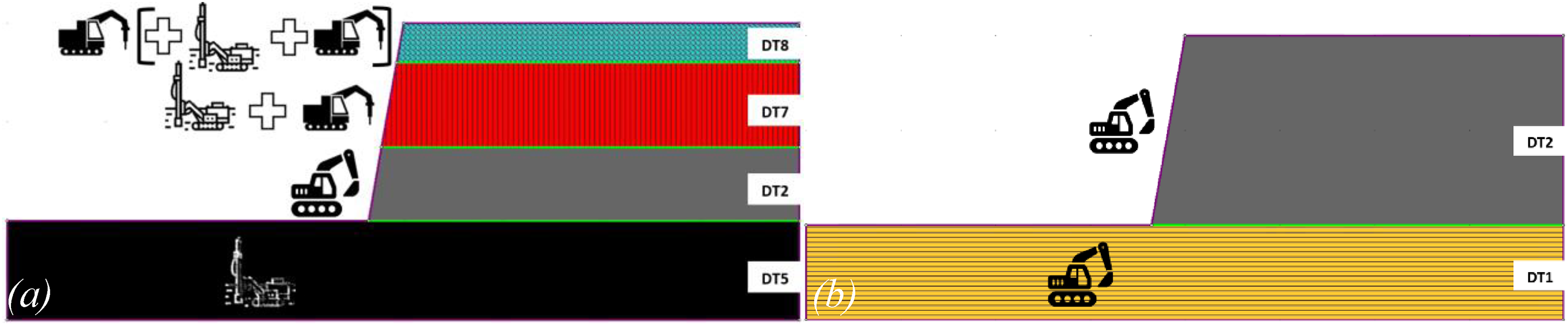
Schematic diagram showing textural contrast and applied excavation strategies: (a) middle-east section and (b) south-east section.
As seen in Figure 11, both horizontal and vertical sequencing of these DTs create textural contrast across the slope. The textural contrast necessitates multiple handling strategies in a single slope section. At the same time, it requires different levels of safety caution from the natural mechanical behaviour of each participating DT, warranting a meticulous slope design. The middle-east slope section has a hard-weak-hard rockmass composition. Blasting is required on the upper layer, but the middle weak layer can be excavated directly. It suggests introducing an inter-ramp-to-pit configuration to avoid placing excessive weight on the weak interlayer and to redistribute stress concentrations away from the slope face (Li et al., 2025; Shuheng and Yinjun, 2021; Valentino, 2023). The southeast slope section can be handled by direct excavation alone, but generally requires a lower slope angle to prevent rotational failure (Azarafza et al., 2021). For this reason, a change in the overall slope angle is necessary between these two sections, which implies that there will be no single overall slope angle on the entire pit geometry. The geometrical design, which first and foremost aligns with the precalculated waste-to-ore ratio, also considers the slope angle that ensures stability and avoids time lost to unwanted failure. This is the point where textural interpretation at the early stage of feasibility assessment has its advantage. In addition, a sudden change in ore deposit type between these two sections reflects the bounds of specific ore grades associated with the particular DT. In this case, the reward from targeting a particular DT is discounted by its association with another DT type on the same slope section.
Conclusion
The study was motivated by the need to reduce uncertainty in the conceptual stages of mine design through the use of accessible geological indicators. The proposed approach has offered two key contributions. First, it introduced a practical, field-oriented screening tool whereby geologists can utilise simple observations, supported by basic hardness testing and limited physical property measurements, to infer potential challenges related to stability, excavation energy, and metallurgical performance prior to detailed testing. Second, by explicitly linking textural characteristics to morphological deposit types, the study has proposed a structured heuristic framework for evaluating trade-offs between competing feasibility objectives. For example, a brecciated morphology may enhance mineral liberation and grade premium while potentially reducing slope stability. The recognised trade-offs at an early stage can inform strategic planning and risk management. More broadly, this work attempted to contribute to ongoing efforts to integrate geological characterisation into quantitative mine design workflows, thereby bridging the gap between descriptive geology and engineering decision-making.
Footnotes
Acknowledgments
The authors acknowledge JICA's support for the lead researcher's PhD programme. The authors also gratefully acknowledge Ore Asia and Mining Development Corporation for authorizing access to the site and providing the data necessary for this research.

Ethical approval and informed consent statements
The research did not involve any live samples but instead dealt with rock materials only, no ethical approval is needed.
Funding
The authors received no financial support for the research, authorship and/or publication of this article.
Declaration of conflicting interests
The authors declared no potential conflicts of interest with respect to the research, authorship and/or publication of this article.
Data availability statement
All data generated or analyzed during this study are included in this published article.