






Abstract
Both arc-related and enriched-mantle rocks occur within the Paleoproterozoic Birimian terrane; however, the geological implications of this remain enigmatic. This study thus investigates the geological implications of this occurrence by integrating major and trace element data from the mafic suites of the Winneba Segment and published geochemical data from other Birimian belts in Ghana. The Winneba Segment mafic suites are dominantly subalkaline basalts, with minor basaltic andesite and andesite similar to the other Birimian belts. Geochemical features of the Winneba Segment mafic suites and the other belts characterised by negative Nb-Ta peaks, enriched large-ion lithophile element, light rare earth element, and depleted high-field strength element support formation in an arc setting through subduction–accretionary processes. They are characterised by La/Nb of 0.9–7.2, Ti/Zr of 24–154, moderate to high Nb/Yb, and high Th/Yb values. The low values are characteristic of arc-influenced magmas, whereas the spread to very high ratios might indicate magma–crust interaction during their evolution. A few mafic suites of the Winneba Segment and the Bui Belt exhibit an enriched-mantle character with positive Ta, Nb, and Ti anomalies. The new geochemical data for the mafic suites of the Winneba Segment, and previously published data from mafic suites in other Birimian belts in Ghana, reveal the presence of two distinct types of mafic suites: enriched- and arc-related. The arc-related mafic suites are proposed to be associated with subduction-related accretionary processes during the Rhyacian Eburnean orogeny, while the enriched-mantle signature may result from magma–crust interaction and possibly sediment/upper-crustal contamination.
Keywords
Introduction
The occurrence of enriched mafic rocks in subduction-zone terranes has been widely documented in the geological record.1–6 Several explanations have been proposed for such occurrences. One of these is that the enriched mafic rocks resulted from the partial melting of a geochemically enriched component within the mantle wedge. 7 On the other hand, Johnson et al. 1 and Macpherson et al. 2 have suggested that the enriched mafic rocks originated from the decompression melting of a mantle source that has not previously undergone fluid-flux melting. In this scenario, changes in pressure conditions trigger the melting process. Other factors that can influence the composition of mafic rocks in subduction zones include changes in the Nb partition coefficient during flux melting 8 and variation in the oxygen fugacity conditions of the mantle source. 9 Recent work by 4 proposed a high-Nb ambient mantle.
The Paleoproterozoic Birimian terrane in West Africa (Figure 1) has, over the years, been proposed to represent a juvenile arc crust formed during the Rhyacian Eburnean orogeny.10–17 It is widely accepted that the rocks of the Birimian terrane formed in a suprasubduction zone, arc-back-arc basin, or by accretion of several oceanic arc terranes.10,13,14,18 However, formation in a plume- or enriched-mantle setting has also been proposed by others owing to the presence of enriched mafic suites.19–22 This suggests that both arc-related and enriched-mantle rocks occur within the Birimian terrane. The geological implications of this, however, remain enigmatic.
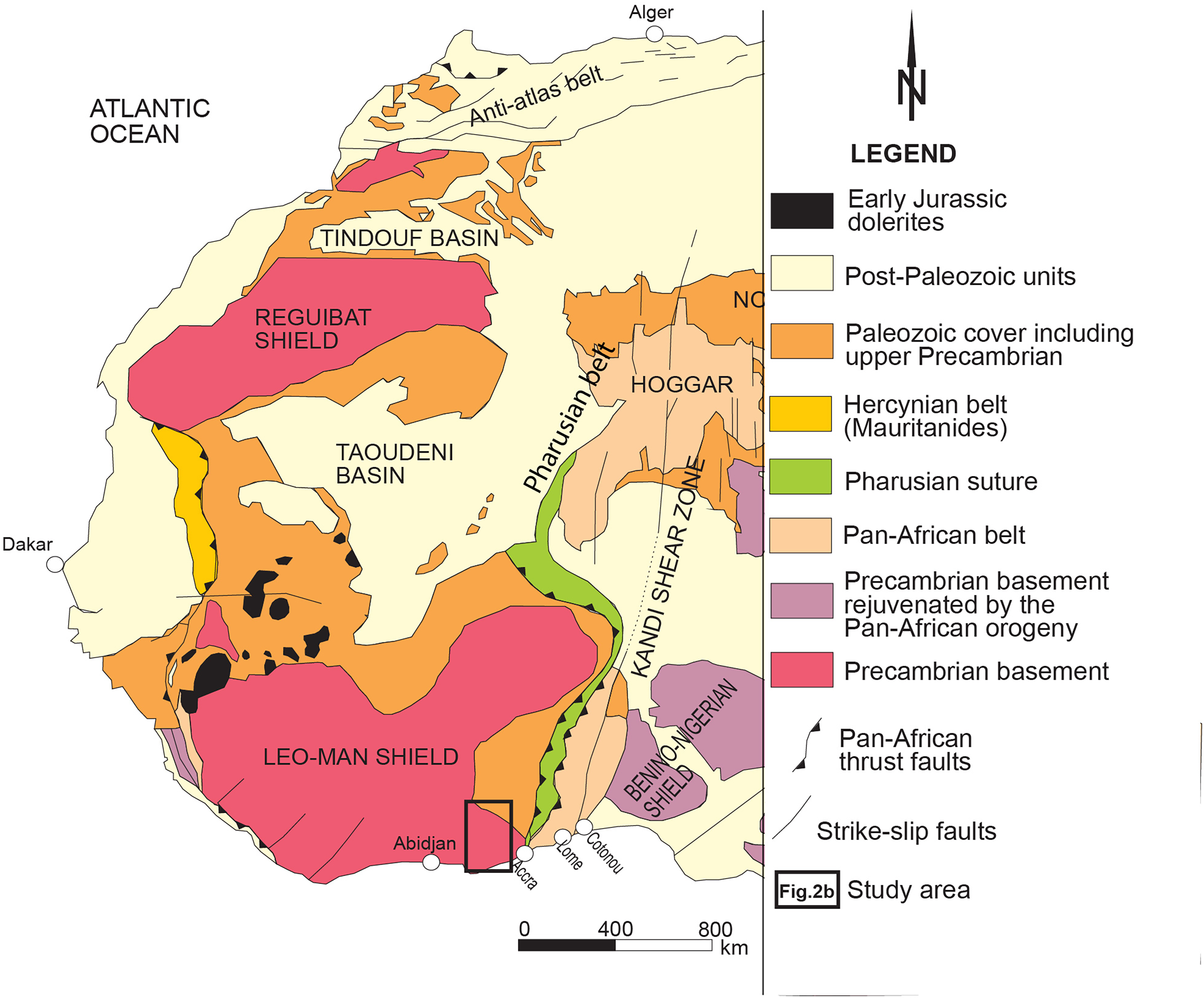
Geological map of the West African Craton (modified after 23 ).
In Ghana, six nearly evenly spaced greenstone belts, separated by sedimentary basins and intruded by a granitoid-gneiss complex, characterise the Birimian terrane (Figure 2(a)). The six belts are from NW to SE: Lawra, Bole-Nangodi, Bui, Sefwi, Ashanti, and Kibi-Winneba belts (Figure 2(a)). Various researchers have indicated that the Birimian belts share similar lithostructural features.10,14,25 The Birimian belts comprise massive and pillow lavas of basaltic to andesitic composition, metamorphosed into chlorite-epidote-actinolite rocks of low-grade metamorphism, and amphibolites, mostly at the contact zones with the granitoid-gneiss complex.13,26 Published geochemical features of negative Nb-Ta peaks displayed by the mafic suites of the Birimian belts have been interpreted to imply an arc-setting character, suggesting subduction-zone processes for their formation.10,12–14,27 The only exception is the Bui Belt (Figure 2(a)), which shows enriched-mantle geochemical features. 22 Nonetheless, no comprehensive geodynamic model exists to explain the occurrence of enriched-mantle rocks in arc-related settings within the Birmian terrane.
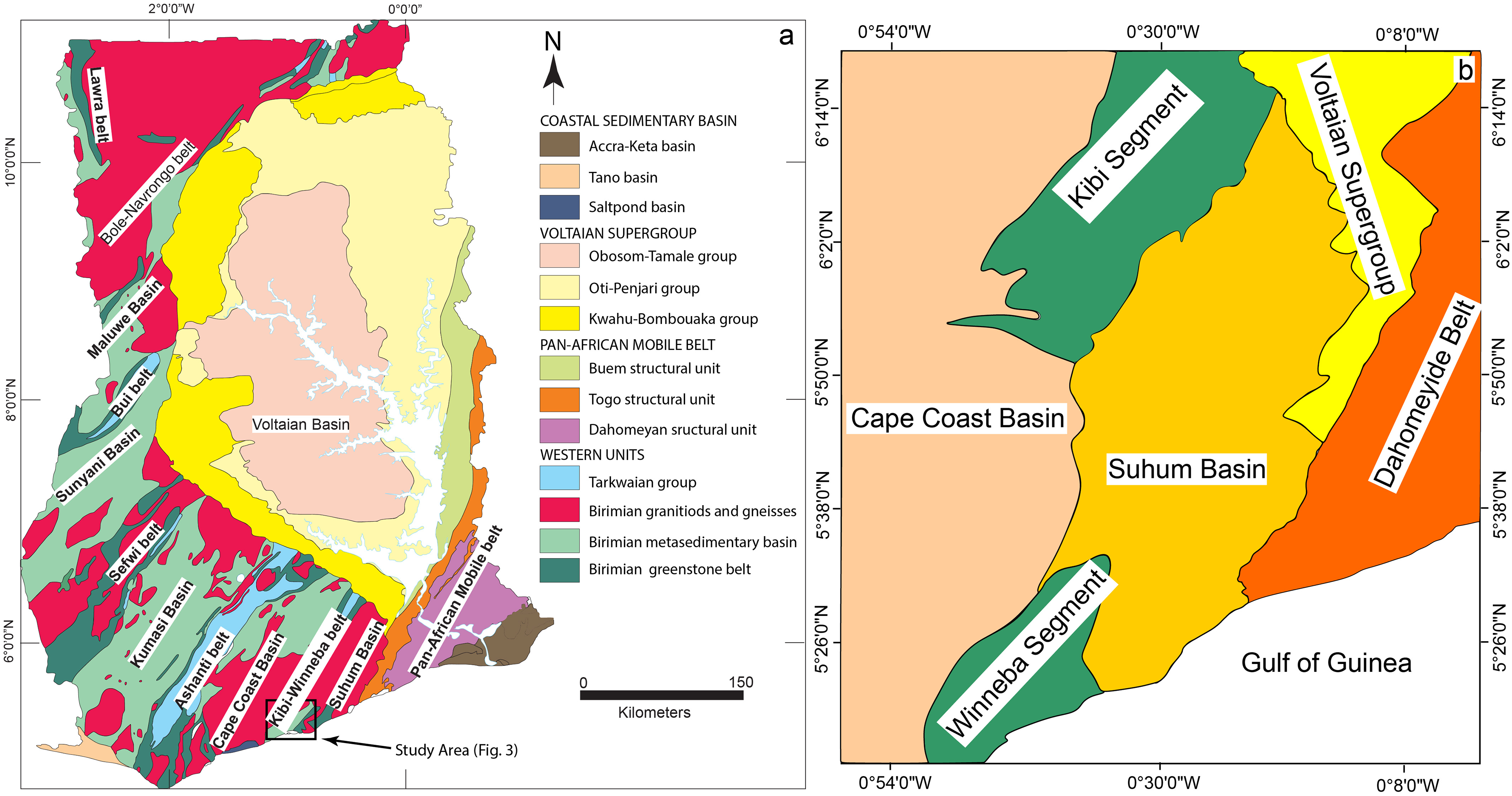
(a) Simplified geological map of Ghana, showing the greenstone belts of the Birimian terrane, (b) Geological map of the Kibi-Winneba belt (after 24 ).
The southeast portion of the Birimian terrane consists of rocks of the Kibi-Winneba Belt, which comprises mafic suites composed of metabasalt, metaandesite, and amphibolites. The belt is subdivided into two segments: the northern Kibi Segment and the southern Winneba Segment (Figure 2(b)). Geochemical and isotopic data on the northern Kibi Segment, which is characterised by negative Nb-Ta peaks, enrichment in large-ion lithophile elements (LILEs) and light rare earth elements (LREEs), as well as depletion in high-field strength elements (HFSEs) supports formation in an island-arc setting through subduction-related accretion processes. 13 There is however, limited petrographic and geochemical studies on the southern Winneba Segment to constrain their source and geodynamic setting. It is therefore essential to investigate the Winneba Segment to evaluate its geochemical and petrogenetic characteristics relative to the Kibi Segment and to assess its relationship within the broader context of the Birimian terrane.
This study, therefore, presents the petrographic and elemental (major and trace) compositions of the mafic suites (now metamorphosed into amphibolite) of the Winneba Segment of the Kibi-Winneba Belt to constrain their source and geodynamic setting. The data from this study are compared with published data from other mafic suites of the Paleoproterozoic Birimian terrane in Ghana and other regions within the West African Craton (WAC) to discuss possible geological implications for the coexistence of both arc- and enriched-mantle-related mafic suites within the Birimian terrane.
Geological setting
Paleoproterozoic Birimian Terrane
The Birimian terrane occupies the southeastern part of the WAC (Figure 1).19,28 It spans over 2800 km from Ghana to the Ivory Coast and is mainly composed of granitoids and greenstone belts, with sedimentary basins.22,29–31 The WAC was formed during three significant tectonomagmatic and metamorphic orogenic events that occurred around 3200-3000 Ma, 2900-2700 Ma, and 2250-2060 Ma, known as the Leonian, Liberian, and Eburnean orogenies, respectively.19,26,30–36 The WAC was stabilised during the Eburnean orogeny and was not affected by any major tectonomagmatic and metamorphic orogenic events until its incorporation into West Gondwana during the Neoproterozoic Pan-African orogeny.23,37–41 The WAC is covered by Meso- to Neoproterozoic, as well as Palaeozoic sediments of the Taoudeni and Iullemmeden basins.42,43 The WAC is also transected by several generations of doleritic dyke swarms and associated sills from ∼ 1700 to 200 Ma.44,45
In Ghana, the Paleoproterozoic Birimian terrane comprises five nearly evenly spaced NE–SW trending (Kibi-Winneba, Ashanti, Sefwi, Bui, and Bolo-Nangodi) and one N–S trending (Lawra) isoclinally folded greenstone belts (Figure 2(a)) with widths ranging from 15 to 40 km.22,25,34 These greenstone belts are separated by metasedimentary rocks formed in sedimentary basins (Suhum, Cape Coast, Kumasi, Sunyani, and Maluwe; Figure 2(a)).25,46–48 Several generations of granitoids intrude the belts and basins.26,28,31,34,35
The greenstone belts consist of metavolcanic sequences dominated by massive and pillow lavas of basaltic to andesitic compositions, with associated volcaniclastic units.10,12–14 These mafic suites were subjected to greenschist-facies metamorphism and intense deformation during the Eburnean orogeny (ca. 2.1-2.0 Ga), which involved crustal shortening, folding, thrusting, and granitoid intrusion.25,26,49,50 Subduction-related processes have been proposed for the formation of these mafic suites based on available geochemical data that suggests an arc-setting character.10,12–14 In addition, U-Pb zircon ages ranging from 2165 ± 2 Ma to 2196 ± 1 Ma have been reported for the mafic suites.51–53
The metasedimentary basins consist dominantly of greywackes, argillites, and siltstone, shale, and sandstone interbedded with volcaniclastic rock that are locally rich in graphite.16,46–48,55,56 Thin, but laterally extensive chemical sedimentary rocks made up of chert, carbonates, manganese-rich sediments, and graphite-rich rocks occur along the margins of the basins and mark the transitional zones between the greenstone belts and metasedimentary basins.25,56 Results from petrographic and geochemical analyses, including Rb-Sr and Sm-Nd isotopic data for the metasedimentary rocks, suggest they formed in an active continental margin setting.16,47,48,54,55 Their formation involved subduction–accretion processes, with sediments derived from the greenstone and granitoid-gneiss complexes of the Paleoproterozoic Birimian terrane.16,24,47,48 U-Pb detrital zircons ages for the metasedimentary successions indicate that depositional ages for the sediments are between c.2165 and 2125 Ma.57–59
Kibi-Winneba Belt
The Kibi-Winneba Belt occupies the southeastern portion of the Paleoproterozoic Birimian terrane in Ghana (Figure 2(a)). The granitoids of the Suhum and Cape-Coast basins separate the Kibi-Winneba Belt into two segments: the northern Kibi Segment and the southern Winneba Segment (Figure 2(b)). The Kibi Segment comprises metavolcanic rocks (metabasalts, meta-andesites, amphibolites) intruded by mafic rocks, including gabbros and dolerites.13,51 Sedimentary rocks, comprising argillites and greywackes, different types of granitoids, with porphyritic textures, and mafic-ultramafic intrusive rocks also occur within these volcanic rocks. 51 The mafic suites of the Kibi Segment are predominantly tholeiitic, LILE- and LREE-enriched, and HFS-depleted. They exhibit pronounced negative anomalies in Nb–Ta–Ti, consistent with subduction-related magmatism. 13 Their Sr–Nd isotopic data show low initial 87Sr/86Sr ratios and slightly negative to positive εNd values, suggesting derivation from a juvenile depleted mantle source with minor crustal input. 13 Altogether, the geochemical and isotopic characteristics of the Kibi Segment mafic suites support formation in an island-arc setting within an oceanic subduction zone, consistent with subduction-related accretion processes.
The Winneba Segment, on the other hand, consists of metasedimentary rocks, which comprise volcaniclastic/pelitic sediments, greywackes, argillites, and chemical sediments (chert, manganese-, carbon- and sulphide-rich rocks) as well as metavolcanic rocks dominantly made of massive and occasionally pillowed basaltic lavas, and a mafic suite mainly amphibolite also interbedded with minor volcaniclastic rocks (Figure 3). 51 The metasedimentary rocks are dated between 2195 and 2159 Ma, while the metavolcanic rocks are dated between 2200 and 2165 Ma. 51 Granitoids and granitoid gneisses emplaced between 2224 and 2102 Ma intrude both the metasedimentary and metavolcanic rocks.26,35,51 The Birimian rocks in the Winneba Segment generally exhibit greenschist-facies regional metamorphism. 26 Both the metasedimentary rocks and the mafic suites near granitoid batholiths display varying degrees of contact metamorphism and have metamorphosed into amphibolite. 26 Low-grade metasomatic alterations involving silicification, carbonation, and widespread formation of secondary chlorite and sericite also occur. 26
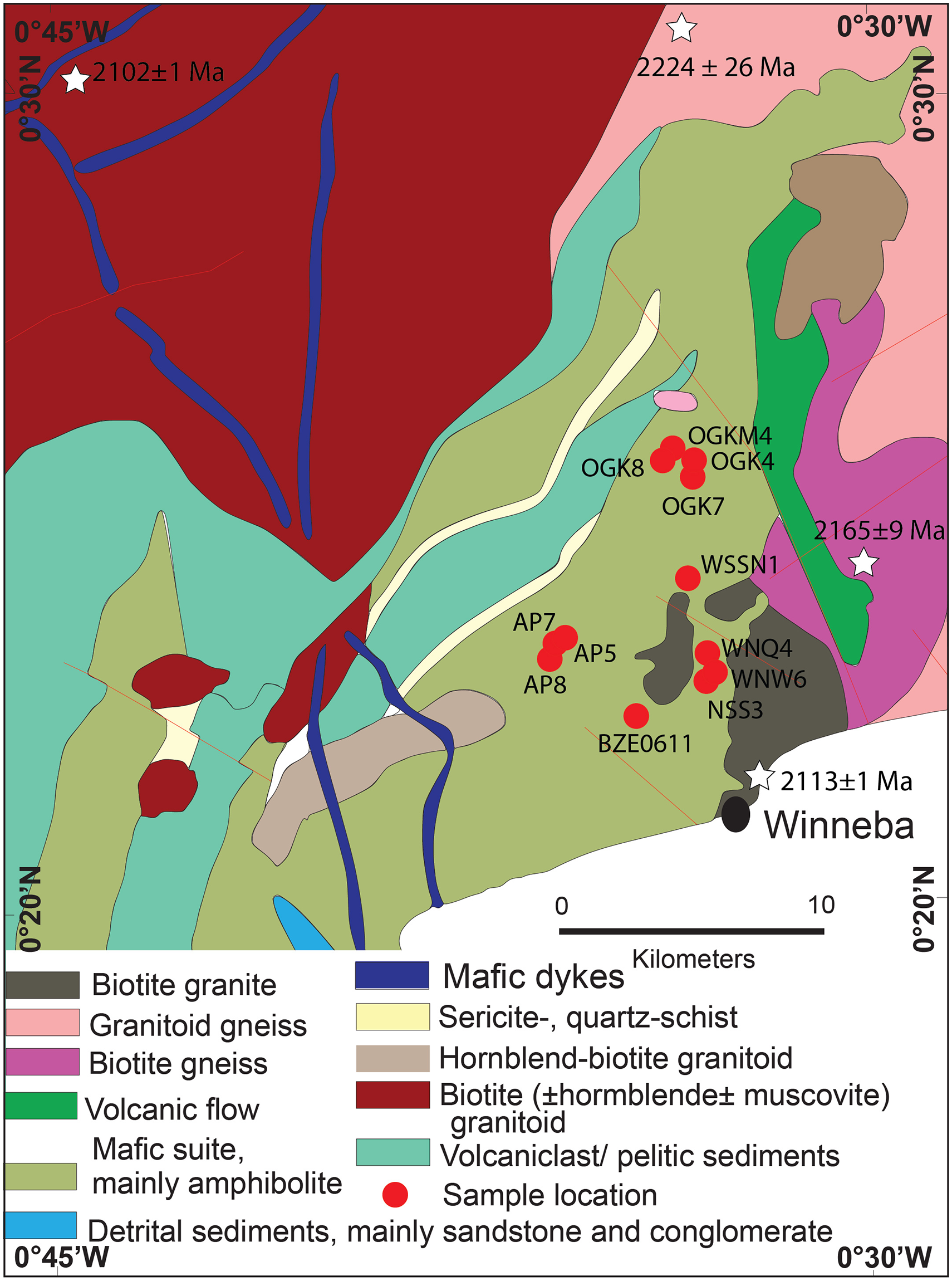
Geological map of the Winneba Segment (extracted from the 1:1000,000 map of Ghana by. 51
Materials and methods
Field traverse and sampling were carried out on outcrops from the Winneba Segment of the Kibi-Winneba Belt in the study area. Figure 3 illustrates the different lithological units in the study area, with sampling points of amphibolite marked in red. Twelve samples were collected for petrographic and geochemical analyses. Thin sections were prepared at the Department of Earth Sciences, Okayama University, Japan and studied for their textures and mineralogical compositions using a polarised petrological microscope.
For whole-rock major element analyses, the selected samples were analysed for these elemental concentrations using the Philips PW 1480 X-ray fluorescence (XRF) spectrometer at the Department of Earth Sciences, Okayama University, Japan. The measurements were carried out on borate-fusion glass discs of the samples. To ensure quality control in XRF analyses, 10 replicate samples of the GSJ JB-3 standard were analysed. Loss on ignition (LOI) analysis was conducted by heating oven-dried samples from 110 °C to 1000 °C for 2 h, then cooling to a constant weight.
Trace element concentrations were determined at Activation Laboratories Ltd (Actlabs), Ontario, Canada, using fusion inductively coupled plasma-mass spectrometry. The results obtained were corrected for spectral inter-element interferences. Calibration of the trace element analysis was achieved by digesting and diluting different amounts of primary (internal) standards BCR-2 (0.05 g, 0.10 g, and 0.15 g) together with the study samples. Precision and accuracy were better than 1% for major elements and 5% for trace elements.
In addition, secondary data was obtained from a total of 61 published whole-rock major, and trace elements data of mafic suites (metavolcanic rocks) from the Kibi Segment (24), Ashanti belt (12), Sefwi belt (18), Lawra belt (7), and Bui belt (24) and are presented (Supplementary Table S1) for comparison to the data obtained in this study. Samples with SiO2 less than 60 wt. % were selected for the comparative studies, which is within the range of the samples in this study.
It is important to note that the present study is based on 12 newly analysed samples from the Winneba Segment, which constitutes a relatively limited dataset for robust petrogenetic and geodynamic interpretations. Consequently, the regional geodynamic implications discussed here are interpreted cautiously and are supported through comparison with published geochemical data from the Kibi Segment and other Birimian belts. Further work involving a larger sample suite, isotope systematics, and additional geochronological constraints would be necessary to refine and test the proposed magma source and tectonic interpretations.
Results
Field observations and petrography
The best exposures of the Winneba Segment mafic suites occur along the Gulf of Guinea coast around Winneba and its surrounding areas (Figure 3). They are mostly in contact or proximity to granitoid (Figure 3). Occasionally, the mafic suites are associated with metasedimentary rocks with quartz and pegmatoid veins crosscutting them (Figure 4(a)). They are dark grey to greenish, massive to weakly foliated (Figure 4(b)). Petrographically, the rocks are composed mainly of plagioclase, amphibole, and subordinate pyroxene, with secondary epidote, chlorite, sericite, actinolite, and opaque minerals (Figures 4(c)–(e)). Plagioclase constitutes approximately 15–25 vol.% of the rock and occurs as subhedral to anhedral laths and tabular grains, often showing partial replacement by sericite and epidote. Amphibole forms about 40–65 vol.% and occurs as prismatic to irregular grains, defining a weak foliation in some samples (Figure 4(e)). Pyroxene is less abundant, generally 5–10 vol.% and occurs as subhedral to anhedral grains that are partly altered to amphibole, actinolite, and chlorite along grain margins and cleavage planes. Opaque minerals constitute about 2–5 vol.% and occur as fine disseminated or coarse granular grains, commonly along grain boundaries and within altered mafic minerals (Figures 4(c)–(e)). This mineral assemblage may suggest greenschist to lower amphibolite facies metamorphism, as observed in other Birimian mafic suites.12,26

Field photos of the mafic suite of the Winneba Segment (a) mafic suite in contact with metasedimentary rocks, (b) foliated mafic suite, photomicrographs of the mafic suite (c) showing actinolite, epidote and chlorite alteration, (d) and (e) amphibole-chlorite-epidote-opaque minerals, assemblage. Act: actinolite; amp: amphibole; chl: chlorite; ep: epidote; opq: opaque minerals. Mineral abbreviations are after. 60
Major and trace elements characteristics
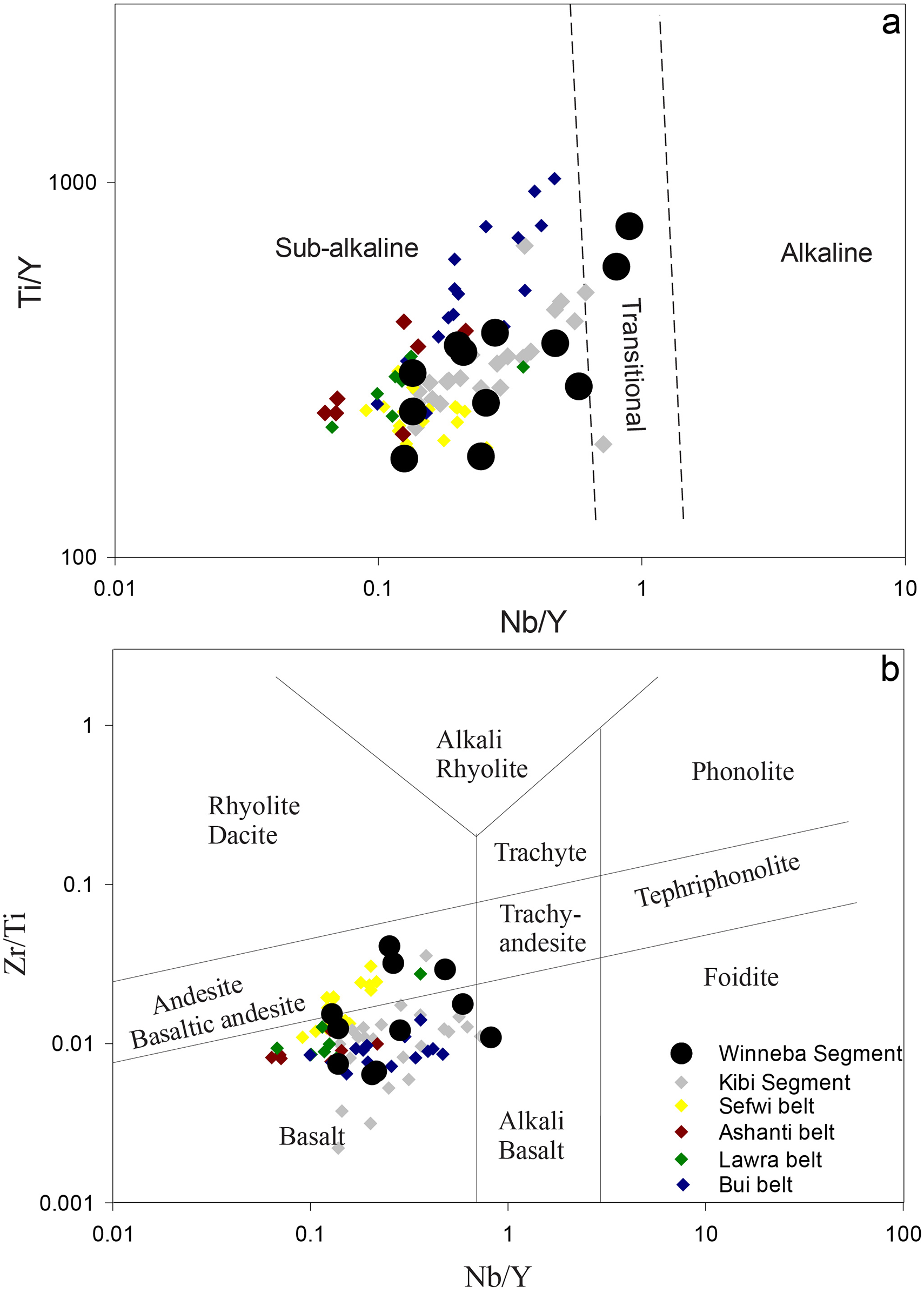
Table 1 presents the major and trace element concentrations of the analysed mafic suite samples from the Winneba Segment. The analysed samples show variable concentrations of major elements. Noteworthy among these, SiO2 contents range from 46.82 to 59.12 wt. %, whereas TiO2 contents are in the range of 0.38 to 4.37 wt. %. MgO content ranges from 3.49 to 24.62 wt. %, whereas Fe2O3 contents are in the range of 5.07 to 16.25 wt. % translating into a wide range of Mg# of 35 to 84. Regarding trace elements, the samples show wide variations. For example, Zr ranges from 27 to 284 ppm, Nb from 1.7 to 32.8 ppm, and Y from 7.4 to 56.4 ppm (Table 1). Since the alkali elements such as Na and K are mobile during alteration and metamorphism, the ratios of immobile trace elements, i.e. Nb/Y, Zr/Ti, Nb/Y, and Ti/Y, were determined to assess the alkalinity of the mafic suites. The mafic suites show dominantly Ti/Y and Nb/Y elemental values typical of rocks with subalkaline geochemical characteristics compared to mafic suites from other Birimian belts and the northern Kibi Segment of the Kibi-Winneba Belt (Table 2, Supplementary Table S1; Figure 5(a), after. 61 ). Two samples, on the other hand, are characterised by transitional magma series similar to that of one sample from the Kibi Segment (Figure 5(a)). A plot of Zr/Ti against Nb/Y (Figure 5(b), after 62 ) shows that the Winneba Segment samples have Zr/Ti and Nb/Y values comparable to compositions typical of subalkaline basalt, basaltic andesite and andesite, with only one sample being of alkali basalt composition. Mafic suites from the Kibi Segment, Ashanti, Lawra, and Bui belts show mainly subalkaline basalt compositions, whereas those from the Sefwi belt show subalkaline basalt, basaltic andesite, and andesite compositions (Figure 5(b)). One sample of the Kibi Segment, however, plots as alkali basalt (Figure 5(b)).
Major and trace element compositions for the Winneba Segment mafic suites.
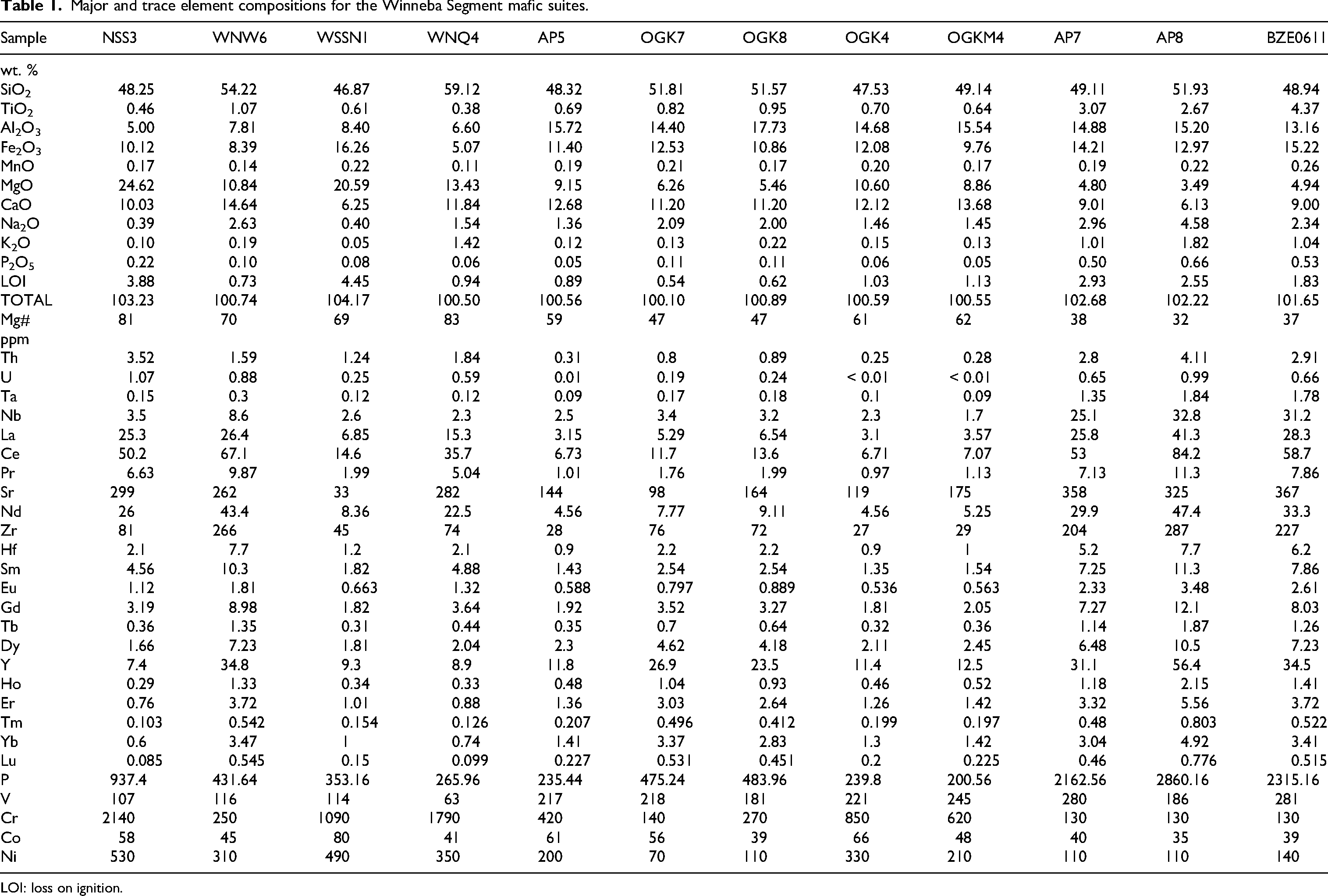
LOI: loss on ignition.
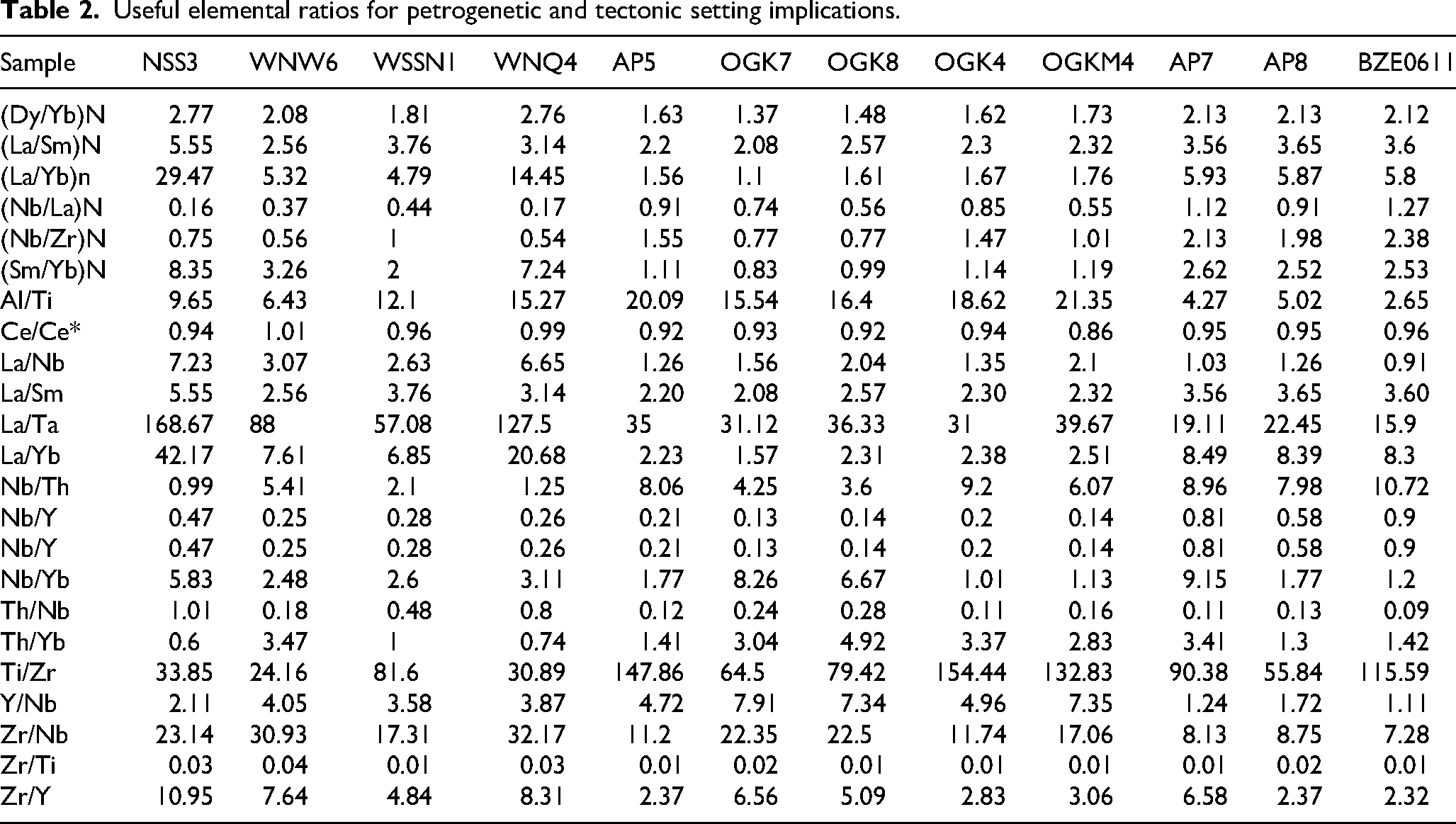
Useful elemental ratios for petrogenetic and tectonic setting implications.
The chondrite-normalised rare earth element (REE) patterns of the studied mafic suites from the Winneba Segment compared to those of the Kibi Segment and other Birimian belts are presented in Figure 6. The patterns, defined by the Winneba Segment samples
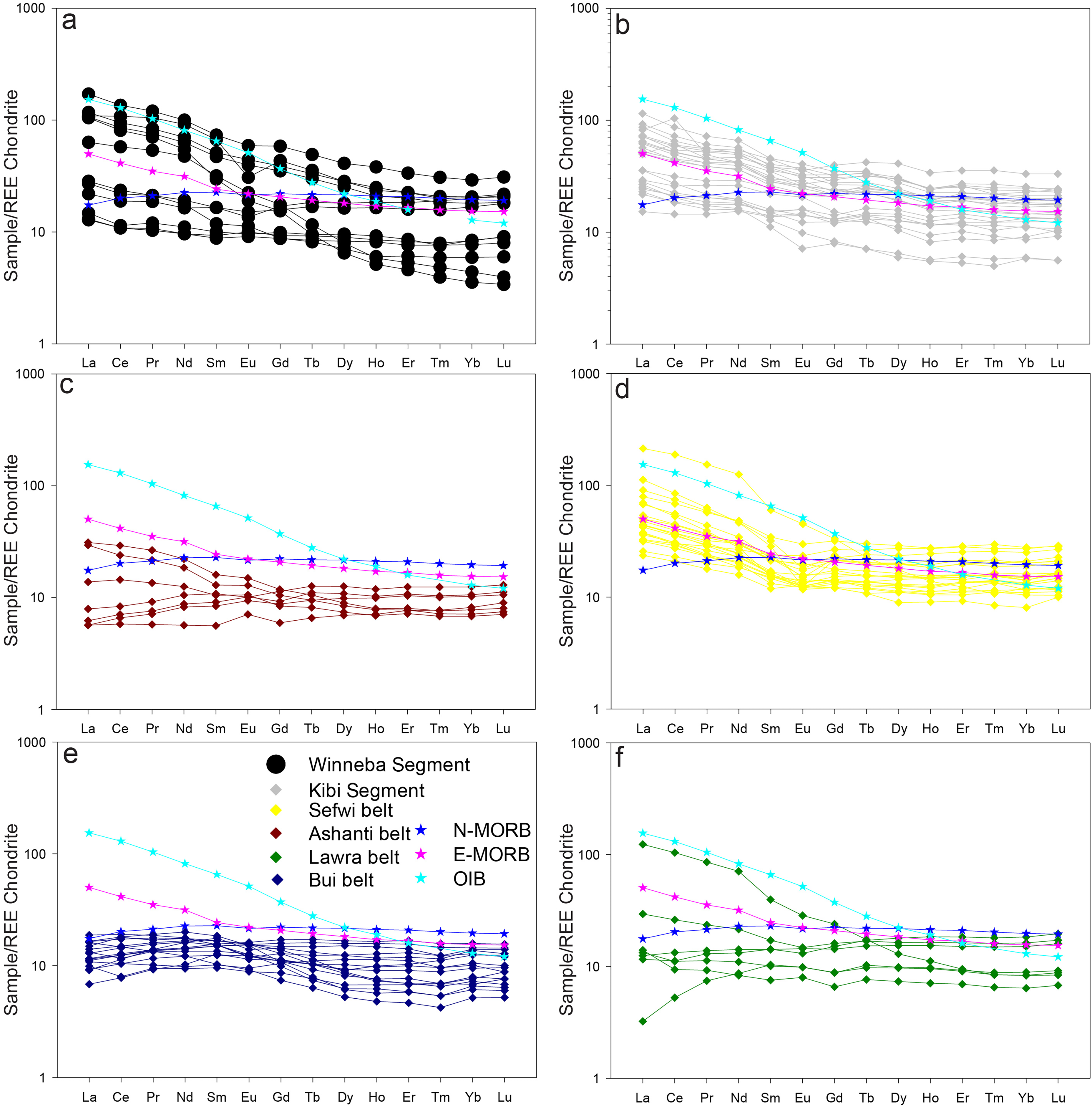
Cl chondrite-normalised REE diagrams for (a) Winneba Segment, (b) Kibi Segment, (c) Ashanti Belt, (d) Sefwi Belt, (e) Bui Belt, and (f) Lawra Belt. The Winneba data is compared to the data from the mafic suite for Sefwi, Kibi, Ashanti, Bui, and Lawra belt from,10,12–14,22 respectively, as well as CI-normalised N-MORB values taking from, 63 E-MORB values from, 64 and OIB values from. 65 OIB: ocean-island basalt.
On the multi-element spider diagram normalised to the primitive mantle (Figure 7), the different segments and belts reveal systematic enrichment in incompatible elements and distinct anomalies that vary between them. The mafic suite of the Winneba Segment is characterised by Ta, P, and Ti negative peaks, and both negative and positive peaks in Nb, and Hf-Zr (Figure 7(a)). Overall, they show relative LILE enrichment compared to HFSE (Figure 7(a)). This pattern is similar to samples from the Kibi Segment; however, different from those from the other Birimian belts under consideration. The samples from the Ashanti and Lawra belts exhibit a nearly flat multi-element pattern, with depletion of Nb, Ta, P, and Ti similar to rocks of an N-MORB composition, except for two samples from the Ashanti Belt, which show a positive Ta peak (Figure 7(c) and 7(F)). The pattern defined by the Sefwi Belt samples is characterised by significant LILE enrichment, accompanied by HFSE depletion, and strong negative peaks in Nb, Ta, P, and Ti (Figure 7(d)). The Bui Belt samples, however, display relatively low overall trace-element concentrations and flat patterns compared to those of the other belts. Their patterns resemble those of typical N-MORB (Figure 7(e)).
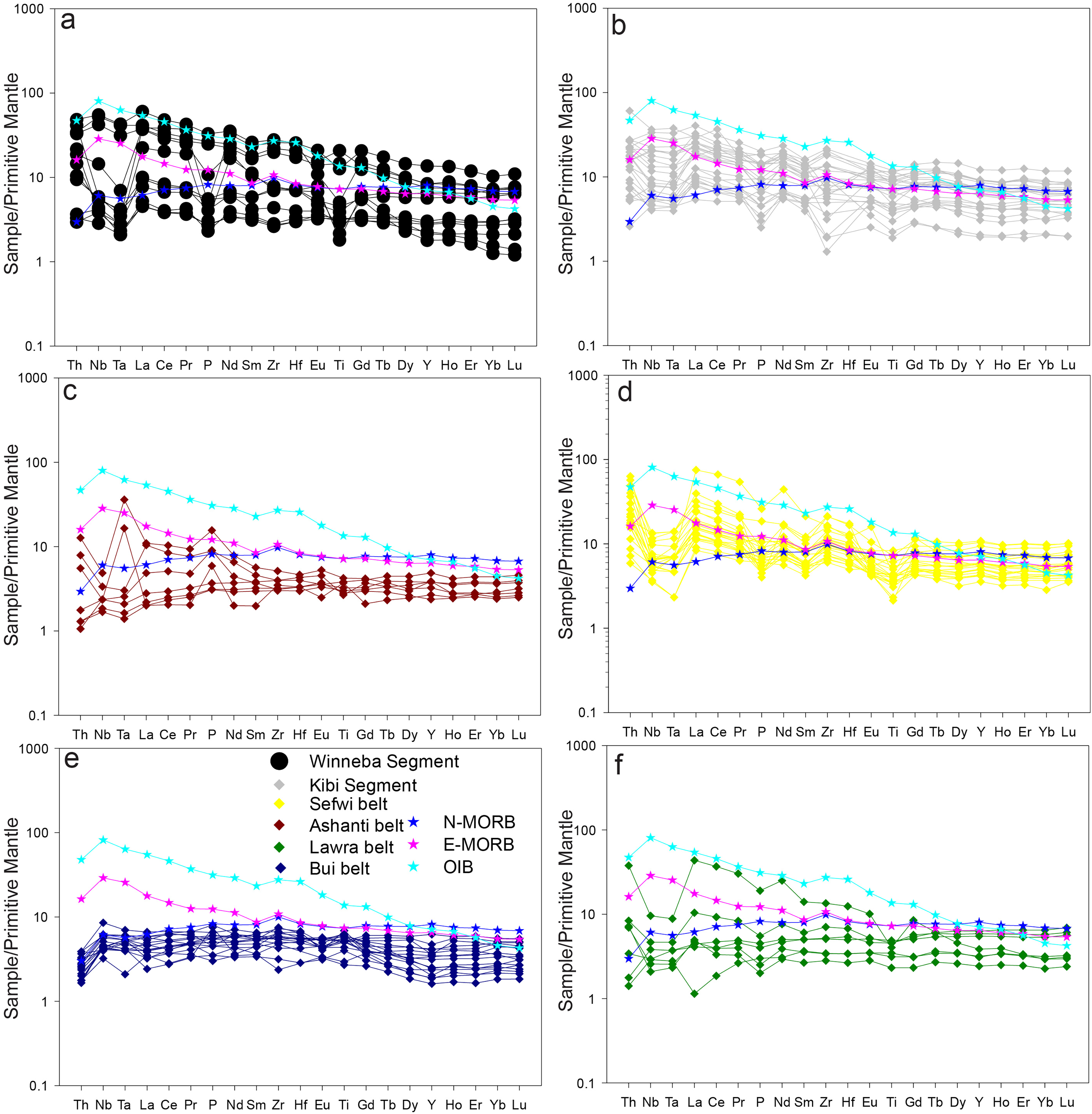
Primitive mantle-normalised multi-element diagrams for (a) Winneba Segment, (b) Kibi Segment, (c) Ashanti Belt, (d) Sefwi Belt, (e) Bui Belt, and (f) Lawra Belt mafic suite samples. The Winneba data is compared to the data from the mafic suite for Sefwi, Kibi, Ashanti, Bui, and Lawra belt from,10,12–14,22 respectively, as well as CI-normalised N-MORB values taking from, 63 E-MORB values from, 64 and OIB values from. 65 OIB: ocean-island basalt.
Discussion
Metamorphism and elemental mobility
The rocks of the Birimian terrane have undergone greenschist to lower amphibolite facies metamorphism,10,12,26 which may have led to elemental mobility. In this study, petrographic investigations, alteration box (AI–CCPI) plot after, 66 and the Y/Ho versus Zr/Hf systematics reveal a weak to significant effect of metamorphism on the studied samples. (Figure 4 and Figure 8(a)-(b)). The AI–CCPI plot shows that the Winneba Segment samples fall outside the least-altered field and are concentrated at high CCPI and moderate AI values, similar to samples from the Kibi Segment and other Birimian belts (Figure 8(a)). This reflects significant mobility of major elements, particularly Na and Ca depletion coupled with Fe–Mg enrichment, consistent with feldspar alteration and chloritisation. In contrast, the Zr/Hf–Y/Ho systematics (Figure 8(b)) show that all samples from the Winneba Segment cluster within the CHARAC field, much like the Kibi Segment samples and those from the other Birimian belts. The only exception is samples from the Bui Belt. This geochemical behaviour is an indication of coherent behaviour of HFSE and REE and limited overall trace-element mobility. 67
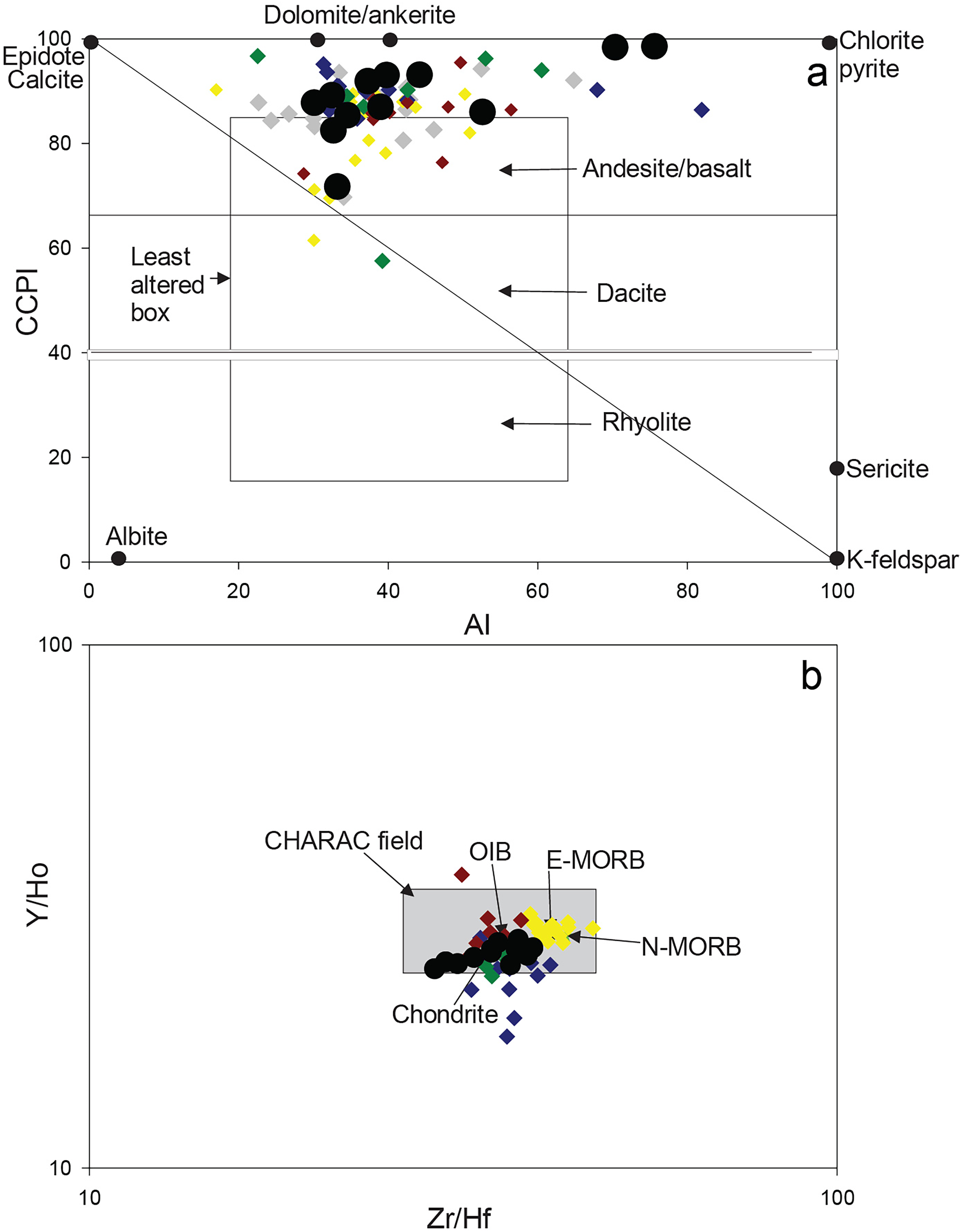
(a) CCPI versus Al alteration box plot (after 66 ) for the mafic suite samples from the Winneba Segment, and (b) Zr/Hf vs Y/Ho to assess the mobility of the trace elements after. 67 The Winneba data is compared to the data from the mafic suite for Sefwi, Kibi, Ashanti, Bui, and Lawra belt from,10,12–14,22 respectively. CCPI = 100(MgO = Fe2O3t)/(MgO + Fe2O3t + Na2O + K2O), and Al = 100(K2O + MgO)/(K2O + MgO + Na2O + CaO).
As a rule of thumb, altered rocks often show high LOI (LOI > 2 wt.%)40,68,69 content. The Winneba Segment mafic suites have LOI content ranging from 0.54–4.45 wt. %, avg. 2.50 wt. % (Table 1). These LOI values suggest a non-significant to somewhat significant effect of metamorphism. The LREE of the mafic suites of the Winneba Segment have not experienced significant mobility, especially for the trace elements, during metamorphism, as observed in the Ce/Ce* values that range from 0.91 to 1.01 69 and references therein. Since Zr is often immobile during metamorphism, it can be used to assess elemental mobility.70,71 On the Zr versus selected major and trace element diagram (Figure 9), the linear and coherent correlations may indicate no significant elemental mobility for the LREE and HFSE and thus can be used for petrogenetic and tectonic setting interpretations.
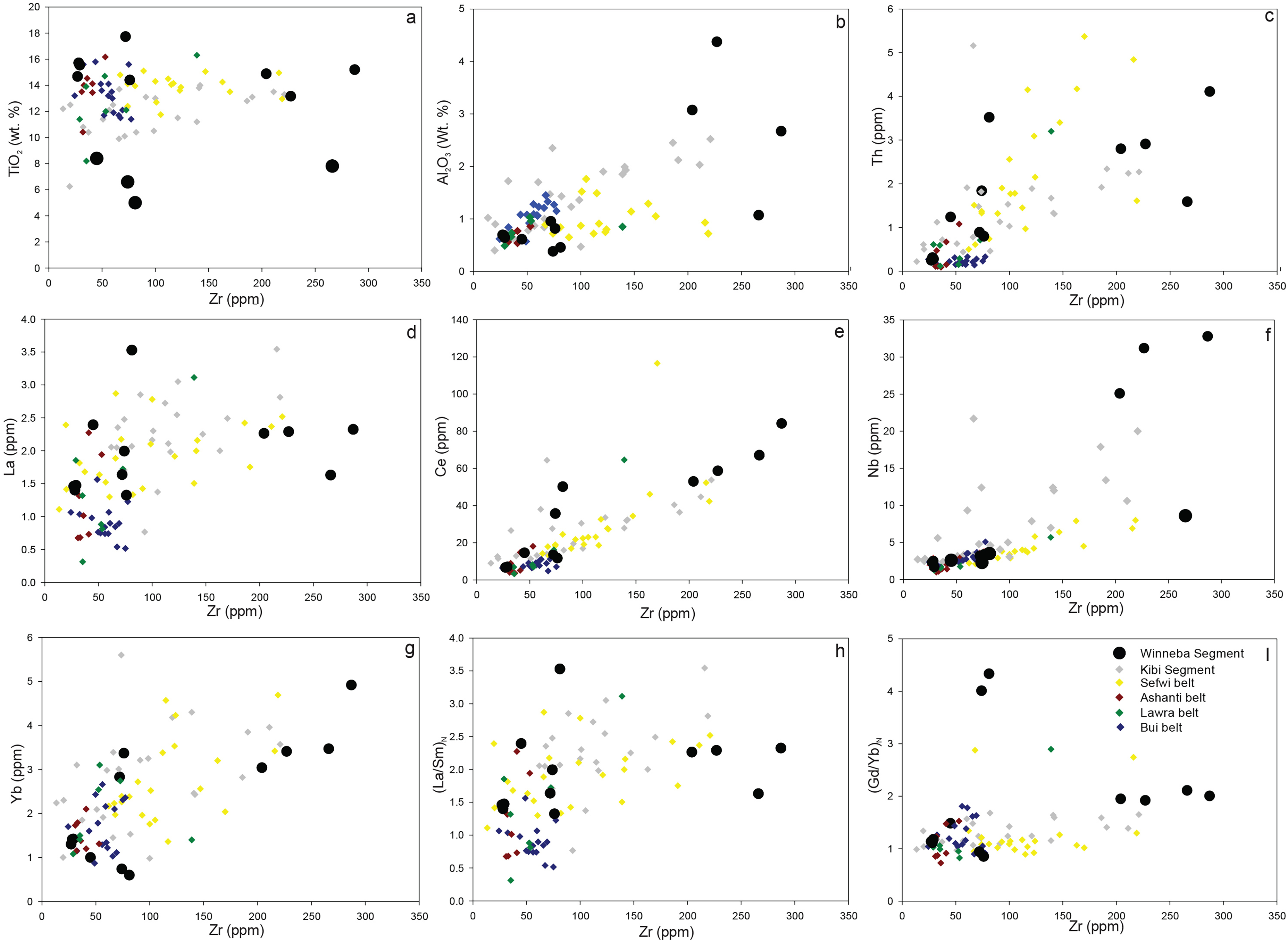
Plot of selected major and trace elements versus Zr for the mafic suite from the Winneba Segment. The linear and coherent correlations suggest insignificant elemental mobility during alteration or metamorphism. The Winneba data is compared to the data from the mafic suite for Sefwi, Kibi, Ashanti, Bui, and Lawra belt from,10,12–14,22 respectively.
Geochemical characteristics and source processes governing the magma genesis and evolution of the Winneba Segment mafic suites
The relative enrichment of the LREE to HREE for the mafic suite samples (Figure 6) of the Winneba Segment can be related to either low degrees of partial melting of a MORB-like source or derivation from an enriched source such as OIB-like rocks64,65,72 (Figure 5). The Zr/Nb ratio can be used to distinguish between partial melting of a MORB-like source and a source more enriched than MORB for the samples. This is because Zr/Nb ratios for typical N-MORBs are comparatively higher than chondritic values (i.e. 40-50 and 16-18, respectively), while those of OIBs are typically lower than those of chondritic values (i.e. 5).65,73 This range of ratios could imply that MORBs are derived from an incompatible-element-depleted source, whereas OIBs are derived from an incompatible-element-enriched source.64,65,73 The Zr/Nb ratios for the Winneba mafic suites are between 7 and 32 (Table 2), and this may indicate their derivation skewed towards MORB-like sources and/or from a source enriched in incompatible elements relative to chondrite and MORB.
The La/Nb ratio is a powerful tool for inferring the magma source of mafic suites.74,75 Rocks typically derived from sources enriched in incompatible elements, such as OIB, would have very low La/Nb values (<1), whereas rocks from a depleted source (N-MORB) have La/Nb values >1.74,75 The Winneba Segment samples have La/Nb values ranging from 0.9 to 7.2 (Table 2). These values suggest that the samples were probably derived from an OIB-like and/or MORB-like source, although the high La/Nb values could be due to the effect of crustal contamination.
Ti and Zr trace elements often behave incompatibly during fractionation unless Ti-Zr-bearing minerals are involved. 76 Thus, Ti/Zr ratios can be used to indicate source signature and to assess crustal contamination in mantle-derived magma. The primitive mantle typically has a high Ti/Zr ratio of about 122. 63 The Ti/Zr for MORB ranges between 83 and 90, 64 while OIB has a Ti/Zr of about 61. 65 Lower values are recorded for the continental crust (Ti/Zr = <30). 77 According to Table 2, the Ti/Zr values for the Winneba Segment samples range between 24 and 154. These low-to-high Ti/Zr values may indicate mantle-derived magmas with significant crustal contamination.
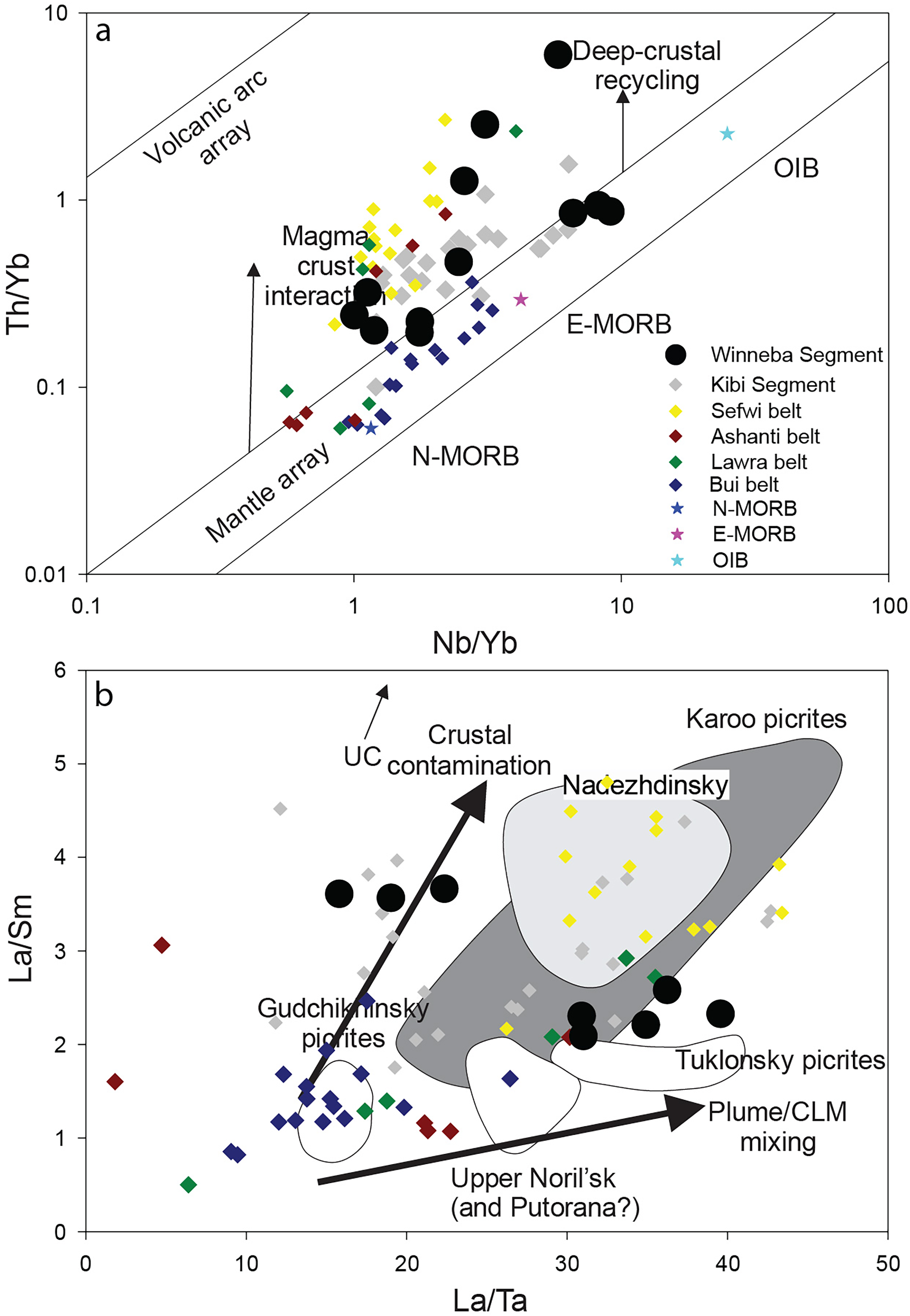
According to Pearce, 78 Nb, Th, and Ta are useful indicators for studying magma–crust interactions during magma genesis. These elements help in understanding the process of assimilation and contamination, crustal recycling, and subduction. By analysing the relationship between Nb/Yb and Th/Yb (Figure 10(a)), after, 61 the Winneba Segment samples plot at moderate to high Nb/Yb and elevated Th/Yb, extending toward the enriched-mantle (OIB-like) field while also deviating significantly above the mantle array. This might indicate the involvement of the lithospheric mantle in the formation of the parent magma and magma–crust interaction during their evolution. The elevated Th/Nb may also indicate significant crustal contamination or recycling of continental material. Conversely, high La/Sm (>3) values are characteristic of the upper crust, whereas high La/Ta values (>14) are typical of arc rocks.79,80 The Winneba Segment samples have La/Sm values ranging from 2.08 to 5.55 and La/Ta values ranging from 15.9 to 168.67. The low values are characteristic of arc-influenced magmas, whereas the spread to very high ratios (as seen for La/Ta) suggests strong enrichment in LILE relative to HFSE and therefore increasing contamination by crustal or slab-derived components.79,80 On the plot of La/Sm versus La/Ta (Figure 10(b)), the samples trend away from the plume/continental lithospheric mantle mixing field and toward the upper crust/crustal contamination field, implying magma generation from an enriched lithospheric mantle source, followed by significant upper crust/crustal contamination.
Depth and condition of the formation of the Winneba Segment mafic suites
The relative abundances of REE in mantle-derived magmas are significantly influenced by the degree of partial melting, the presence of Spinel or Garnet in the mantle source, as well as the bulk geochemical composition of the source.81–83 As such, the REE provide essential controls on the conditions of mantle melting.84–86 The HREE, particularly Yb, are compatible, while LREE, such as La, and medium rare earth elements, such as Sm and Gd, are incompatible in garnet. Yb, therefore, has a high garnet/melt partition coefficient relative to La, Sm, and Gd.87,88 Consequently, partial melting of a garnet lherzolite would strongly fractionate the La/Yb and Sm/Yb ratios, whereas these ratios and especially Sm/Yb ratios change far less during partial melting in the spinel-lherzolite stability field, although this is still dependent on the degree of partial melting.89–91 The Winneba Segment samples plot around typical values of N-MORB and E-MORB, with a few samples plotting above typical OIB values on the (La/Yb)N versus (Sm/Yb)N diagram (Figure 11(a)). This, coupled with the chondrite-normalised REE patterns, reflects moderate to high depletions of HREE. From Figure 11(a), it can be deduced that melting of the mantle sources for the Winneba Segment samples mostly took place in the spinel-lherzolite stability field. This deduction is confirmed by the plot of Dy/Yb versus La/Yb (Figure 11(b). after 92 ) where the samples plot mostly in the spinel-lherzolite field, with a few plotting very close to the boundary line between spinel and garnet lherzolite fields and in the garnet lherzolite field. The observed relative depletion in HREE could have resulted from remobilised ‘enrichments/metasomatised’ mantle source or variable degrees of crustal contamination, and not a derivation from a garnet source at the time of eruption.
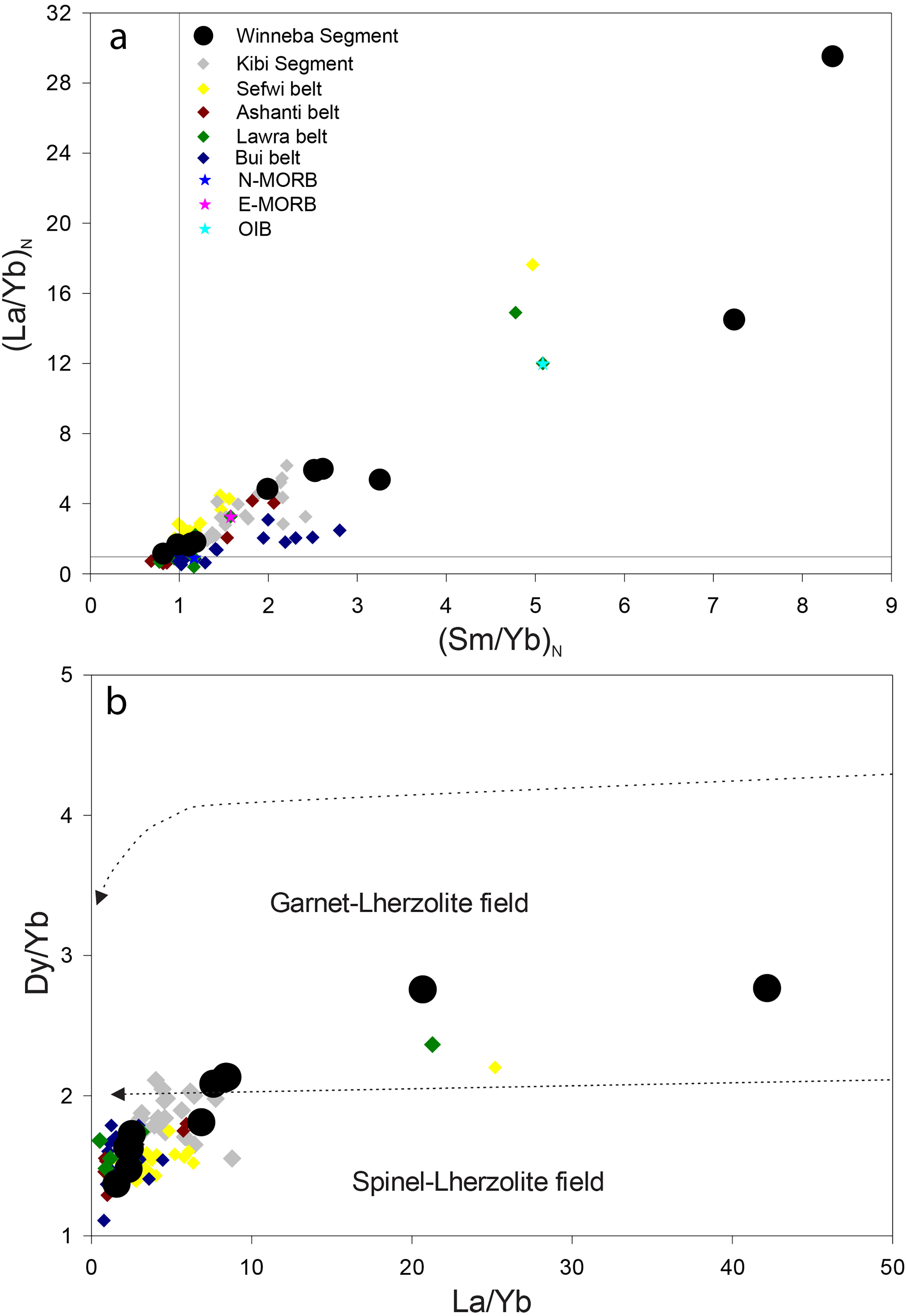
(a) (La/Yb)N versus (Sm/Yb)N and (b) Dy/Yb versus La/Yb (after 92 ) plots for the mafic suite samples from the Winneba Segment. The Winneba data is compared to the data from the mafic suite for Sefwi, Kibi, Ashanti, Bui, and Lawra belt from,10,12–14,22 respectively, as well as CI-normalised N-MORB values taking from, 63 E-MORB values from, 64 and OIB values from. 65 OBI: ocean-island basalt.
Melting at different depths results in varying Dy/Yb and Sm/Yb ratios. Deeper melting (Garnet lherzolite stability field) produces high Dy/Yb (>2.5) and Sm/Yb (>4) ratios, while shallower melting (spinel-lherzolite stability field) yields lower Dy/Yb (<2) and Sm/Yb (<1.5) values.64,65,93 The studied samples recorded a range of Dy/Yb values between 1.4 and 2.8, and Sm/Yb values between 0.8 and 7.6. It can therefore be deduced that the Winneba Segment samples were derived from depths in the spinel-lherzolite stability field. Experimental studies by94,95 have shown that spinel is stable at depths between 50 and 80 km, whereas garnet is stable at depths greater than 80 km. This implies that the Winneba Segment samples were produced by different degrees of partial melting of a mantle source within the spinel-lherzolite stability, probably at depths of 50 to 80 km.96,97
Tectonic implication
Geochemical signatures, such as enrichments in Ti, Nb, and Ta, are typical of rocks derived from MORB or OIB environments. Alternatively, subduction-related magmas are characterised by enrichment in Th and depletion in Nb, Ti, and Ta.98,99 Therefore, the negative Ti, Nb, and Ta peaks observed in the Winneba Segment samples (Figures 7(a)) may suggest that they are derived from subduction-related magmas. Their enriched LILE relative to HFSE patterns are similar to those of rocks from subduction zones. 100 However, a few of the samples exhibit positive Nb and Ti anomalies, an OIB-like REE pattern, and an incompatible-element pattern (Figures 6(a) and 7(a)), indicating geochemical modification by significant upper crust/crustal contamination. 81
Nb/Th and La/Nb ratios are often used to assess the impact of subduction-related components and their crustal contamination.65,101,102 The low Nb/Th and high La/Nb ratios, as shown on the Nb-Th-La diagram (Figure 12) by most of the Winneba Segment samples, indicate arc-related magmatism for the generation of their magmas. However, the extremely low Nb/Th values may also indicate crustal contamination. A few of the samples plot within the E-MORB and OIB fields, which shows they are different from arc-related rocks or rocks affected by crustal contamination (Figure 12). Additionally, most of the samples have Ti/Zr, Al/Ti, Th/Nb, and Zr/Nb elemental ratios consistently in the range of the Mid-Atlantic Ridge and Tonga arc rocks, whereas a few samples are consistently similar to basalts from the Hawaii Island and seamount suggesting their derivation from similar tectonic settings to these rocks (Figure 13(a) – (b), after 40 ).
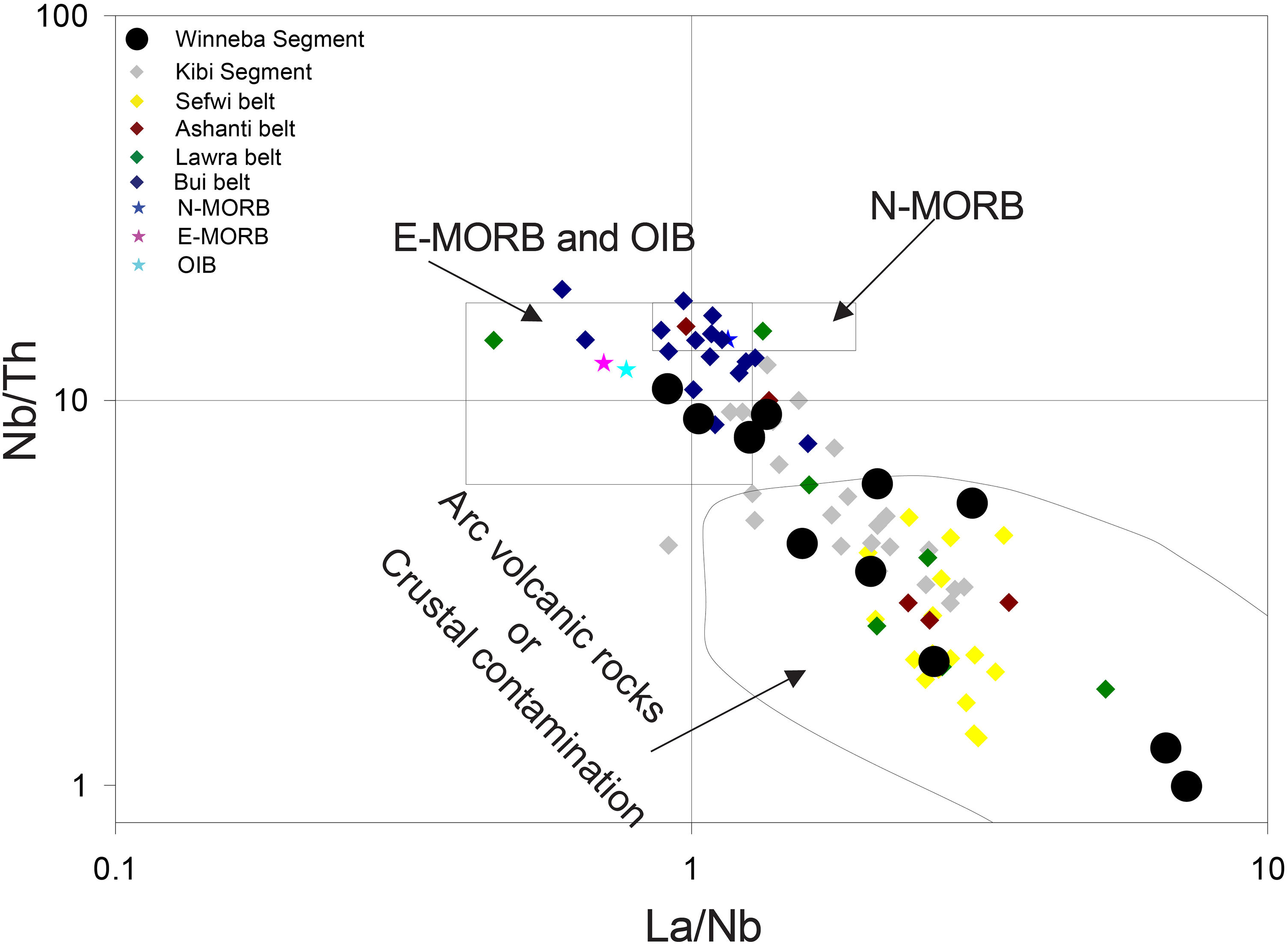
Nb/Th versus La/Nb plot (after 103 ) for the mafic suite samples from the Winneba Segment. The Winneba data is compared to the data from the mafic suite for Sefwi, Kibi, Ashanti, Bui, and Lawra belt from,10,12–14,22 respectively, as well as CI-normalised N-MORB values taking from, 63 E-MORB values from, 64 and OIB values from. 65 OBI: ocean-island basalt.
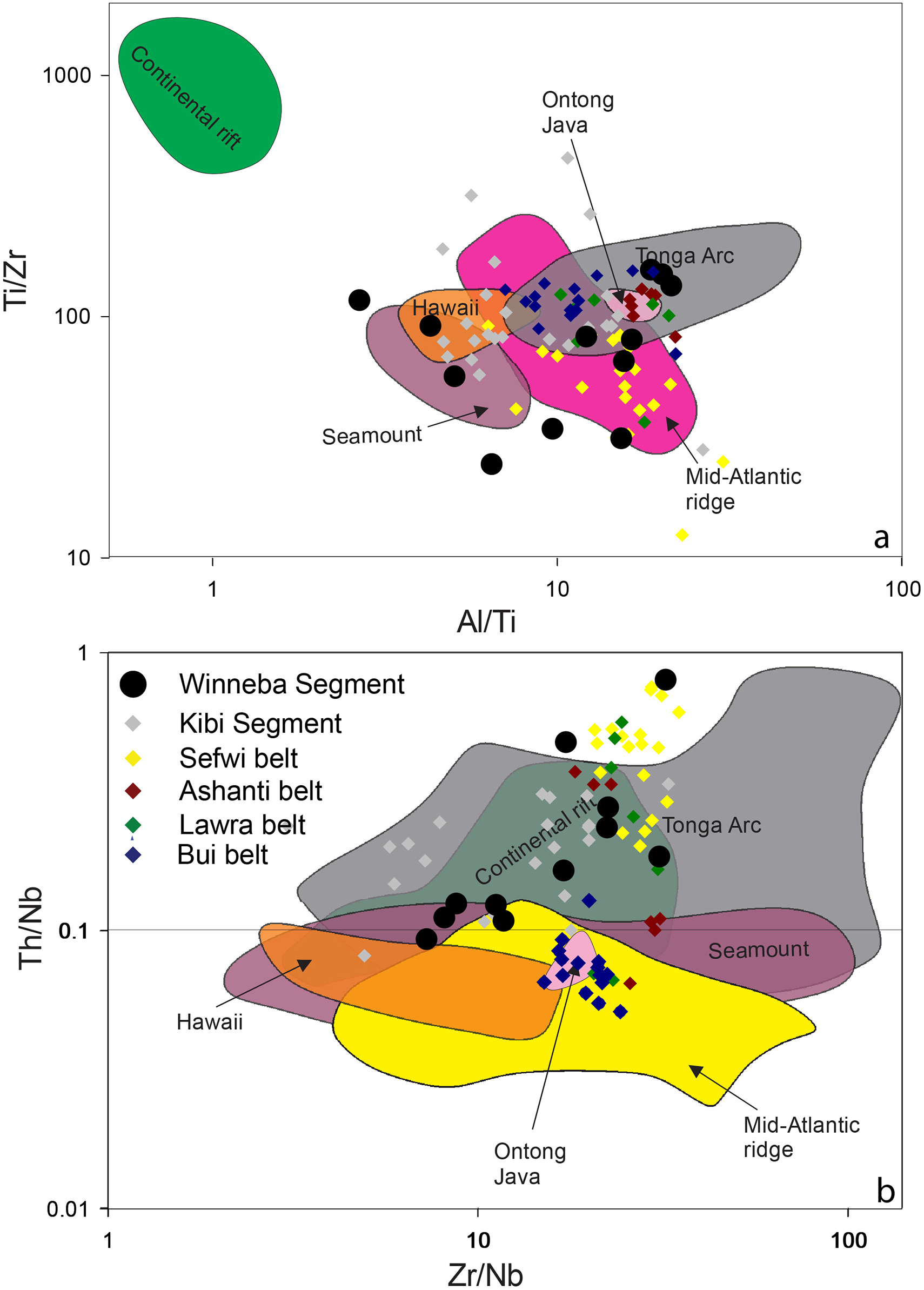
Tectonic discrimination diagrams of (a) Ti/Zr versus Al/Ti and (b) Th/Nb versus Zr/Nb (after 40 ) for the mafic suite samples from the Winneba Segment. The Winneba data is compared to the data from the mafic suite for Sefwi, Kibi, Ashanti, Bui, and Lawra belt from,10,12–14,22 respectively, as well as CI-normalised N-MORB values taking from, 63 E-MORB values from, 64 and OIB values from. 65 OIB: ocean-island basalt.
Overall, the Winneba Segment samples show dominant arc-like elemental signatures, whereas minor signatures related to enriched-mantle characteristics (enrichment of LILE relative to HFSE, Figure 7(a)) exist. Hence, the mafic suites of the Winneba Segment may be consistent with a subduction-related origin for their magma generation. Nevertheless, a plume-related origin could be inferred for the magma generation in some of the samples. A plume origin is not considered the preferred model because the geochemical patterns lack the typical within-plate affinity expected for plume-derived magmas. In particular, Ta, Nb, and Ti negative anomalies (Figure 7(a)) are more characteristic of subduction-related magmatism than of plume-related mantle melts, often showing relative enrichment in HFSE,2,7,9,98,99 which is not the case for the Winneba enriched-mantle suites. Furthermore, the high La/Sm and La/Ta values (Table 2) suggest enrichment by slab-derived components, sediment recycling, or interaction with upper-crustal material rather than derivation from an uncontaminated plume source. Therefore, while limited enriched-mantle signatures may indicate source heterogeneity or minor mantle enrichment, the overall geochemical evidence favours a subduction-related origin for the mafic suites of the Winneba Segment.
Relationships between the Winneba Segment mafic suite and other Birimian Greenstone Belt mafic suites
The major and trace element compositions of the mafic suites of the Winneba Segment are compared to those of other greenstone belts in the Birimian terrane in Ghana (i.e. Sefwi, Kibi, Ashanti, Bui, and Lawra belts). The mafic suites of the Winneba Segment has major- and trace-element characteristics similar to those of the Kibi Segment and other Birimian belts. The mafic suites from the other Birimian belts are dominantly classified as subalkaline basalts (Figure 5), with low Mg# and Nb contents similar to those of the Winneba Segment. The Winneba Segment mafic suites on the primitive mantle-normalised multi-element diagram show typical Nb-Ta negative peaks (Figure 7). Negative Nb-Ta peaks displayed by all the mafic suites from the Kibi Segment, Sefwi, Ashanti, and Lawra belts have been interpreted to imply an arc-setting character, and therefore, subduction-zone processes for their formation have been proposed (Figure 7(b)-(f).10,12–14 In essence, the mafic suites of the Winneba Segment may have formed from a similar subduction-zone setting. The mafic suites from the Kibi Segment, Sefwi, Ashanti, and Lawra belts also have Ti/Zr, Al/Ti, Th/Nb, and Zr/Nb elemental ratios consistently in the range of Mid-Atlantic Ridge and Tonga arc rocks, similar to those of the Winneba Segment mafic suites (Figure 13). These belts also have low Mg# (<65), suggesting derivation from an evolved magma.
The mafic suites from the Ashanti, Bui and Lawra belts were derived from a depleted mantle source with a higher degree of partial melting, depicting nearly flat REE patterns (Figure 6(c), 6(e), and 6(f)). Although the LREE patterns of the Kibi Segment and Sefwi belt are similar to those of the Winneba Segment, their generally flat HREE patterns are significantly different (Figure 6). These geochemical features suggest that the mafic suites of the Kibi Segment and Sefwi belts were derived from a source relatively different from that of the Winneba Segment. The REE patterns shown by the mafic suites of the Kibi Segment and Sefwi belt resemble those of E-MORB, an indication of moderate degrees of partial melting. The Winneba Segment mafic suites, on the other hand, may have evolved from lower degrees of partial melting of an enriched-mantle source.
In general, this study has revealed that the mafic suites from the Birimian terrane in Ghana were derived from heterogeneous mantle sources of variable degrees of partial melting. This may explain the inconsistencies in geodynamic models proposed for their formation.10,12–14,18,19,22 However, additional sampling, isotopic data, and geochronological constraints are required to fully test the proposed tectonic model.
Geological implications of the occurrence of both arc- and enriched-mantle-related mafic suites
Our new geochemical data on mafic suites from the Winneba Segment of the Kibi-Winneba belt and published geochemical data from mafic suites in other Birimian greenstone belts in Ghana indicate the coexistence of both arc- and enriched-mantle-related mafic suites. As mentioned earlier, there are multiple geological explanations in the literature for the phenomenon, such as the melting of a geochemically enriched component in the mantle wedge, 7 decompression melting of a mantle source that has not undergone previous fluid-flux melting,1,2 a change in the Nb partition coefficient during fluxed melting, 8 variations in the oxygen fugacity conditions, 9 and a high-Nb ambient mantle. 4 Taken together, two main mantle sources have been proposed. These are either OIB-type/enriched-mantle (metasomatised) sources2,7,9 or interactions between the mantle wedge and adakitic melts.104,105
The arc-related mafic suites in this study correspond to subduction-zone-accretionary processes during the Rhyacian Eburnean orogeny.10,12–1418 In Ghana, there is no geological evidence of mantle plume activity, such as regional doming, an anomalous thermal regime, or basaltic plateaus. There is also no hot-spot track in the vicinity of the Birimian terrane. OIB-type mantle sources typically have positive Nb, Ta and Ti anomalies, which is not the case for the Winneba enriched-mantle suites.2,7,9 The mafic suites of the Winneba Segment, with enriched-mantle signatures, show positive Nb, negative Ta, and both positive and negative Ti anomalies (Figure 7(a)).
Thus, the OIB-like signature observed in the samples of this study could reflect a source enrichment due to magma–crust interaction during the subduction–accretion process. Therefore, the partial melting of a geochemically enriched component (source enriched by sediment recycling of contamination by upper crustal material) deep in the asthenosphere is plausible. Furthermore, the interaction of the mantle wedge with adakitic melt would have elevated the Th, U, and K contents and depleted the Nb, Ta, and Ti contents.104,105 It is therefore proposed that the Rhyacian Birimian terrane in Ghana evolved from oceanic subduction and accretion to produce an arc-related mafic suite, and that magma–crust interaction during its evolution formed an enriched-mantle-related mafic suite (Figure 14).
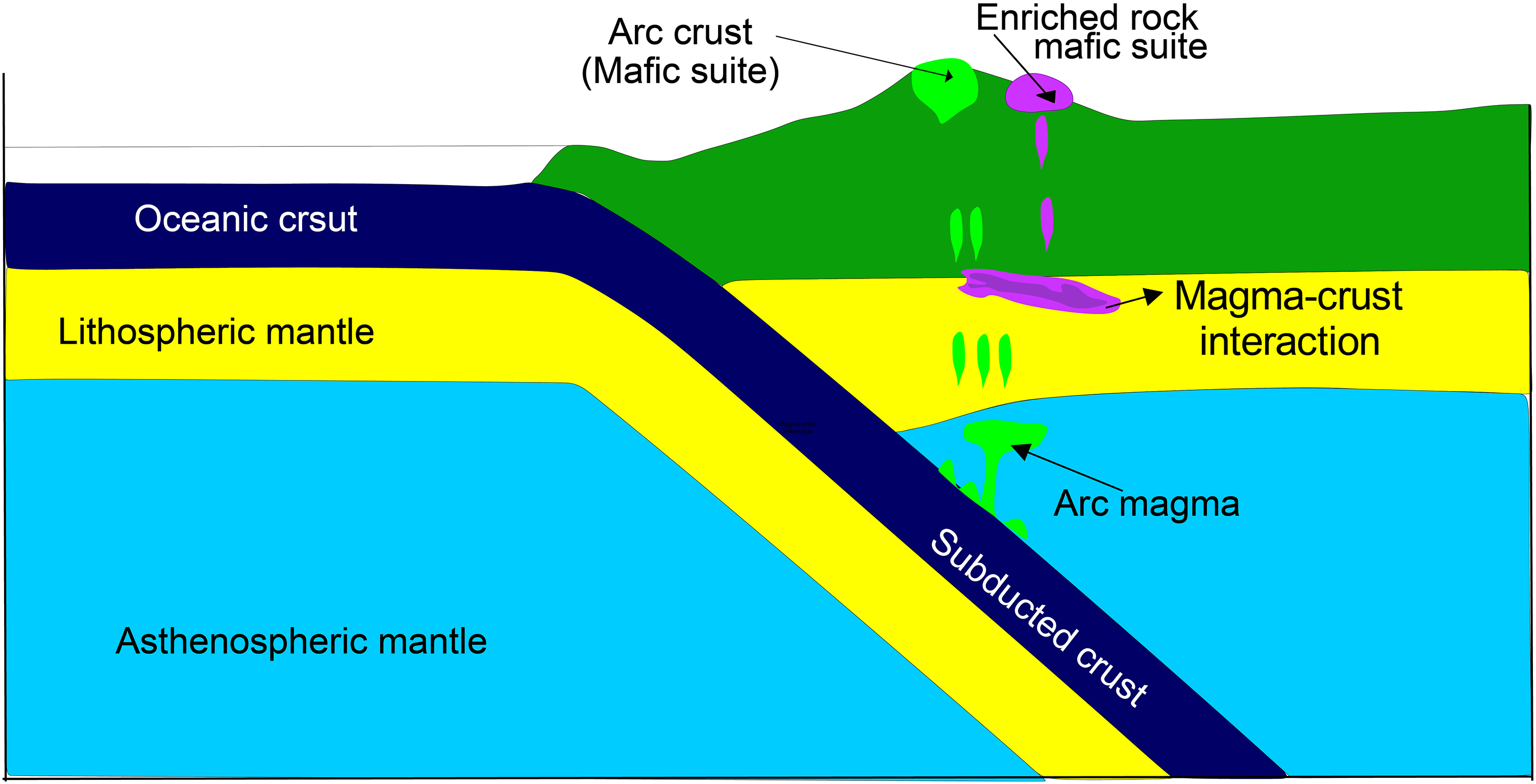
Schematic model for the geodynamic evolution of the Birimian terrane in Ghana.
Conclusions
The following conclusions have been drawn from the present study:
The Winneba Segment mafic suites are predominantly subalkaline basalts, with minor basaltic andesite and andesite, showing compositional affinity with mafic suites from other Birimian belts in Ghana. Their geochemical signatures, including negative Nb–Ta anomalies, enrichment in LILE and LREE, and depletion in HFSE, indicate derivation in a subduction-related arc setting. Variations in trace element ratios (e.g. La/Nb, Ti/Zr, Nb/Yb, Th/Yb) reflect a spectrum from typical arc-related magmas to compositions modified by magma–crust interaction during magma evolution. Minor enriched signatures, marked by positive Nb, Ta, and Ti anomalies in parts of the Winneba Segment and Bui Belt, point to contributions from enriched-mantle sources. Integrated analysis of new and published geochemical datasets reveals the coexistence of arc-related and enriched-mantle-derived mafic suite types within the Birimian belts. This study provides new geological implications by linking arc magmatism to Rhyacian Eburnean subduction–accretion processes, while highlighting the role of magma–crust interaction and possible sediment/upper crustal material involvement in generating enriched signatures.
Supplemental Material
sj-xlsx-1-ape-10.1177_25726838261455712 - Supplemental material for The coexistence of arc- and enriched-mantle-related mafic suites within the Winneba Segment: Implications for the geodynamic evolution of the Rhyacian Birimian Terrane of West Africa
Supplemental material, sj-xlsx-1-ape-10.1177_25726838261455712 for The coexistence of arc- and enriched-mantle-related mafic suites within the Winneba Segment: Implications for the geodynamic evolution of the Rhyacian Birimian Terrane of West Africa by Samuel B. Dampare, Tsugio Shibata, Daniel Kwayisi, Marian S. Sapah, Daniel K. Asiedu, Osamu Okano and Samuel Y. Ganyaglo in Applied Earth Science
Footnotes
Acknowledgements
The fieldwork conducted in Ghana was made possible with the support of the National Nuclear Research Institute (NNRI) of the Ghana Atomic Energy Commission (GAEC). Additionally, the first author would like to express their gratitude towards the Japanese Society for the Promotion of Science (JSPS) for the financial assistance provided during their postdoctoral studies at Okayama University, Japan.

Funding
The authors disclosed receipt of the following financial support for the research, authorship, and/or publication of this article: This work was supported by the Japanese Society for the Promotion of Science.
Declaration of Conflicting Interests
The authors declared no potential conflicts of interest with respect to the research, authorship, and/or publication of this article.
Supplemental Material
Supplemental material for this article is available online.
References
Supplementary Material
Please find the following supplemental material available below.
For Open Access articles published under a Creative Commons License, all supplemental material carries the same license as the article it is associated with.
For non-Open Access articles published, all supplemental material carries a non-exclusive license, and permission requests for re-use of supplemental material or any part of supplemental material shall be sent directly to the copyright owner as specified in the copyright notice associated with the article.
