






Abstract
The porosity evolution and diagenetic controls of the middle-late Eocene carbonate rocks of the Pila Spi Formation in the Khanaga section, Bjeel area, were investigated to understand their impact on aquifer potential and quality, which is an important issue for water resource management in carbonate aquifers. The formation, with an overall thickness of 37.5 m, is composed of fractured limestone, marly limestone, and dolomitic limestone, with thin beds of marl and mudstone characterised by karstic fissures and pores. The study is based on petrographic analysis of 25 thin sections, supported by quantitative porosity assessment and diagenetic interpretation. A petrographic analysis of thin sections from the Pila Spi Formation revealed that the matrix is predominantly micrite with minor microspar, containing skeletal grains indicative of a shallow marine environment. While non-skeletal grains are poloids, intraclasts, and monocrystalline quartz. Numerous diagenetic processes, such as micritisation, dolomitisation, physical compaction, solution, cementation, neomorphism, silicification, pyritisation, iron oxidation, and fracturing, influenced the formation. Five porosity types were identified in the Pila Spi carbonate, most of which are of secondary origin. They are fenestral and intraparticle porosities (primary) and moldic, vuggy, and fracture porosities (secondary). Quantitatively, secondary porosity constitutes particularly vuggy and moldic porosities that represent the most common types, with average values of 2.25% and 0.99%. Solution and fracturing processes enhanced porosity, particularly secondary types, in the Pila Spi Formation carbonates. Early dolomitisation also contributed to the development of fenestral porosity. In contrast, cementation, compaction, neomorphism, silicification, and pyritisation reduced porosity. Karstic fissures and pores are the main factors enhancing the aquifer potential of the formation, whereas iron oxidation negatively affects the groundwater quality. This study provides a comprehensive and quantitative framework linking diagenetic processes to porosity evolution, significantly improving the understanding of aquifer behaviour and groundwater quality in the Pila Spi Formation.
Introduction
Carbonate rocks make up more than half of all hydrocarbon reservoirs worldwide. 1 Carbonate rocks, primarily limestone, form some of the world's most productive aquifers. 2 One of the main issues associated with carbonate rocks, particularly in shallow marine environments, is the heterogeneity of porosity and permeability, which results from complex depositional conditions and subsequent diagenetic processes. 3 Diagenetic processes significantly impact the quality of aquifers and reservoirs, by controlling the pore system.4,5
The shallow marine carbonate Pila Spi Formation was initially noted by Less in 1930 in the Pila Spi area, which is located on the southern margin of the High Folded Zone. 6 Subsequently, Wetzel in 1947 re-examined the formation around Darbandikhan town in the Kurdistan Region of Iraq. 6 It is approximately 85 m thick and mainly consists of bedded white chalky limestone and bituminous limestone, which is porous in the lower part and crystalline and contains green and white marl bands with chert nodules in the upper part. It is deposited in a terminal lagoon setting during the middle to late Eocene sedimentary cycle northeastern Iraq. 7 It acts as a hydrocarbon reservoir in several oil fields of the Iraqi Kurdistan region. 8 In the Erbil and Duhok governorates, there are many water springs and drilled wells within the Pila Spi Formation with high discharge rates and moderate water quality.9,10 Waters from the Pila Spi Formation in Ain Al Safra exhibit higher concentrations of the ions Ca, Mg, Mn, Fe, Cu, and Co, particularly manganese (Mn), than other spring waters in the Jabal Ain Al Safra area. 11
Several scholars have investigated the sedimentological and diagenetic processes within the Pila Spi Formation in northern Iraq; however, none have examined the role of diagenesis in the porosity evolution of the formation in the studied area. Understanding this gap is crucial, as diagenetic alterations significantly influence aquifer characterisation and groundwater quality of Pila Spi succession in northern Iraq. The most interesting works,12–19 whose main focus was on the microfacies and depositional setting of the formation, as well as8,20 those that focused on the reservoir potentiality of the formation. The current study aims to clarify diagenetic processes that influence the porosity evolution of the Pila Spi Formation in the Khanaga outcrop.
Geological setting
The middle-late Eocene Pila Spi Formation is a well-exposed carbonate unit situated in the lower part of the High Folded Zone, near the margin of the Low Folded Zone in northern Iraq. 21 It belongs to the early Paleocene–late Eocene AP10 Arabian Plate tectonostratigraphic megasequence. 22 It was deposited during the Neo-Tethys closure linked to Arabian–Eurasian subduction in the Paleocene–Eocene. 23 The studied section is located 200 m southwest of Khanaga village, 12.5 km east of Akre town, and 1.5 km west of Bjeel town. Approximately in Latitude (36°43′46.01″N) and Longitude (43°59′26.57″E) (Figure 1(a)). Structurally, it is located in the eastern segment of the Aqra anticline's southwestern limb in the southern margin of the High Folded Zone (Figure 1(a) and (b)). The Aqra anticline is characterised by a double plunge, an asymmetrical shape, and the southwesterly limb being steeper than the northeasterly limb. 24 The Cretaceous rocks occupied the core of the anticline, while the Cenozoic rocks settled at the limbs of it. 25

From a stratigraphic perspective, the core of the Aqra anticline in the Khanaga section formed of reefal limestone of the Aqra Formation (Late Cretaceous), overlain by the carbonate-dominant Khurmala Formation (Paleocene-early Eocene), clastic facies of the Gercus Formation (middle Eocene), that in turn is overlain by the Pila Spi Formation (middle-late Eocene), which is overlain by the Fatha Formation (middle Miocene), Injana (late Miocene), and further away, the Mukdadiya and Bi Hassan formations (late Miocene-Pleistocene), heading to the anticline's southern limb (Figures 1(a) and 2(a)). The Pila Spi contacts in the studied outcrop are gradational, conformable with the red siltstone of the Gercus Formation (Figure 2(b)), and unconformable with the marly limestone and mudstone of the Fatha Formation (Figure 2(c)), which are assigned over brecciated limestone beds bearing oolites and Triloculina Tricarinata (Figure 2(c 1 )).

Field photographs. (a) Cretaceous-Tertiary succession in the Khanaga section, southern limb of the Aqra anticline. (b) Yellow-white thin-bedded limestone interbedded with yellow marl of Pilaspi Formation overlain by the red siltstone of Gercus Formation. (c) Yellow to white limestone beds of the Pila Spi Formation underline marly limestone interbedded and brecciated limestone interbedded with yellow marl and red mudstone of the Fatha Formation. (c1) Oolitic packstone including Triloculina Tricarinata.
Materials and methods
The fieldwork involved a detailed description and measurement of the studied outcrop, along with logging of lithology, grain size, mineralogy, and sedimentary structures. The predominant lithology of the Pila Spi Formation in the examined section comprises of limestone, dolomitic limestone, marly limestone, and marl. The collected specimens of the carbonate rocks of the Pila Spi Formation are 25 intact samples. Additionally, several samples were obtained from the lower and upper contacts to determine the nature and position of both boundaries. Samples were collected at each lithological transition through random sampling, with the lower and upper surfaces of each sample clearly marked. A macroscopic study of the samples was conducted using a hand lens and dilute HCl acid.
The total of 25 thin sections (One thin section for each sample) was made at the Earth Sciences and Petroleum Department workshop in Salahaddin University-Erbil. They were dyed in Alizarin Red Solution following 28 to distinguish calcite from dolomite.
A detailed petrographic investigation, along with the analysis of diagenetic processes and porosity types were carried out. The petrographic study was based on the work of Scholle and Ulmer-Scholle, 29 whereas porosity types were identified according to the classification scheme of Choquette and Pray. 30 The microscopic study was conducted using a Carl Zeiss Jena (JENALAB POL) polarising microscope.
Thin sections of each carbonate sample were examined under a transmitted light petrographic microscope to identify and quantify pore types. The point-counting method was applied by systematically moving the microscope stage in a grid pattern to ensure unbiased sampling of the thin section area. At each observation point, the pore types were recorded based on textural and morphological characteristics. The total number of points counted per sample was sufficient to achieve statistical reliability, generally exceeding 300 points. The percentage of each pore type was calculated by dividing the number of points for that pore type by the total counted points and multiplying by 100. The sum of all pore-type percentages represents the total porosity for each sample.
Results
Lithology
The overall thickness of Pila Spi Formation in Khanaga section reaches 37.5 m (Figure 3(a)). The lower 5.2 m of the formation consists of thin-bedded (1–10 cm) yellow to white limestone interbedded with yellow marl. This is followed by 1.8 m medium- to thick-bedded (30–50 cm) fractured yellow limestone and marly limestone (Figure 3(b)) characterised by karstic fissures (Figure 3(b)) and wrinkle structures (Figure 3(c)), the latter being microbial-induced structures formed by cyanobacteria on the bedding planes of siliciclastic and carbonate beds. 31 It overlain by 4 m of thick-bedded (50–100 cm) grey to yellow dolomitic limestone interbedded with yellow marl (Figure 3(d)). Subsequently, by 2.2 m of medium-bedded (10–30 cm) yellow marly limestone containing calcite geodes (Figure 3(e)) which is overlain by 2.2 m of medium- to thick-bedded grey dolomitic limestone (Figure 3(e)). The rest comprised of 11.5 consist of intercalations of thin- to medium-bedded (10–40 cm) yellow to white limestone with thin-bedded yellow marl and red mudstone (Figure 3(f)) and overlain by 10.6 m of thick-bedded (50–100 cm) yellow to white fractured limestone (Figure 3(g)).

Field photographs and columnar section of Pila Spi Formation. (a) Columnar section of middle-late Eocene Pila Spi Formation in Khanaga locality, Aqra anticline. (b) Thin to medium bedded fractured limestone in the lower part of the studied section, characterised by vugs and karstic fissures (Red arrows). The red rectangle is (c). (c) The wrinkle structure created on the Pila Spi limestone beds is mainly composed of calcite. (d) Grey to yellow dolomitic limestone intercalated with yellow marl. (e) Yellow marly limestone bearing calcite geodes (red arrows) underlines medium to thick bedded grey dolomitic limestone (green arrow). (f) Interbedding between yellow to white thin to medium bedded limestone and thin bedded of yellow marl and red mudstone. (g) Thick-bedded yellow to white fractured limestone.
Petrography
The microscopic inspection of thin sections of Pila Spi carbonate revealed that there is difficulty in identifying skeletal grains due to their obliteration by diagenetic processes. Skeletal grains constitute less than 50% of the matrix, typically ranging from 5% to 30%, whereas non-skeletal grains reach up to 70% in some intervals. The recognised skeletal grains are shallow marine derivative faunas include benthonic foraminifers (Figure 4(a) and (b)), ostracods (Figure 4(c)), dasycladacean algae (Figure 4(d)), red algae (Figure 4(e)), bryozoan (Figure 4(f)), gastropods (Figure 5(a)) and bioclasts (Figure 4(f)). Non-Skeletal grains involve peloids (Figure 4(a) and (b)), intraclasts (Figure 4(e)), and extraclasts, which are mainly monocrystalline quartz (Figure 4(d)). The matrix is commonly micrite, which is affected by early dolomitisation and changed intervalley to microspar due to neomorphism.

Microphotographs of the Pila Spi Formation in Khanaga outcrop. (a) Benthonic foraminifera (Miliolid) (red arrow) surrounded by peloids in micritic matrix affected by dolomitisation (K.P.20, P.P., A.S.). (b) Benthonic foraminifera subjected to partial dissolution forming intraparticle pores (red arrows) surrounded by peloids (green arrows), the grains and matrix affected by neomorphism and iron oxidisation in the upper left side K.P.1, X.N. (c) Inarticulated ostracoda valve (red arrow) and dasycladacean green algae (yellow arrow) in dolomitised groundmass (K.P.8, P.P). (d) Silicified dasycladacean green algae (red arrow) and monocrystalline quartz (yellow arrow) within the vuggy pores (K.P.23, X.N.). (e) Red algae (red arrow), bioclasts (yellow arrow), intraclasts (white arrow), and peloids (green arrow) characterised by close packing of grains (K.P.22, P.P.). (f) Bryozoa (red arrows) and bioclasts of mollusca (yellow arrow) (K.P.3, P.P.). K.P.: Khanaga Pila Spi; P.P.: Plane Polarised; X.N.: Crossed Nicholes; A.S: Alizarine Stain.

Photomicrographs of Pila Spi carbonate in the Khanaga section. (a) Gastropoda shell breaking by physical compaction (red arrow) surrounded by peloids in micritic matrix (K.P.10, P.P., A.S.). (b) Ostracods affected by dissolution forming moldic pores and micrite rims created on the margin of their shell (red arrow) surrounded by peloids in dolomitised matrix (K.P.20, X.N.). (c) Very fine to fine crystals of dolomite, including fracture porosity (red arrow) and pyrite cubic (yellow arrow) (K.P.4, X.N.). (d) Fractures infilled with granular calcite cement (red arrow) in micrite matrix that is affected by iron oxidisation (green arrows) (K.P.12, P.P.). (e) Blocky calcite cement filled the fracture in micritic matrix (K.P.14, X.N.). (f) Dissolution of microspar matrix forming vuggy porosity (red arrow) (K.P.13, X.N.). K.P.: Khanaga Pila Spi; P.P.: Plane Polarised; X.N.: Crossed Nicholes; A.S.: Alizarine Stain.
Diagenetic processes
According to Flügel 32 and Ahr, 33 diagenesis is a sedimentary phenomenon that encompasses all physical and chemical alteration occurring after deposition but prior to the onset of metamorphism. Generally, it obscures primary depositional characteristics, 34 However, in some cases, remnants of original features may still be preserved and used to interpret pre-diagenetic environments. 35 The studied rocks of Pila Spi carbonates are strongly affected by diagenetic processes, and the dominant ones of them are the following (Figure 6):
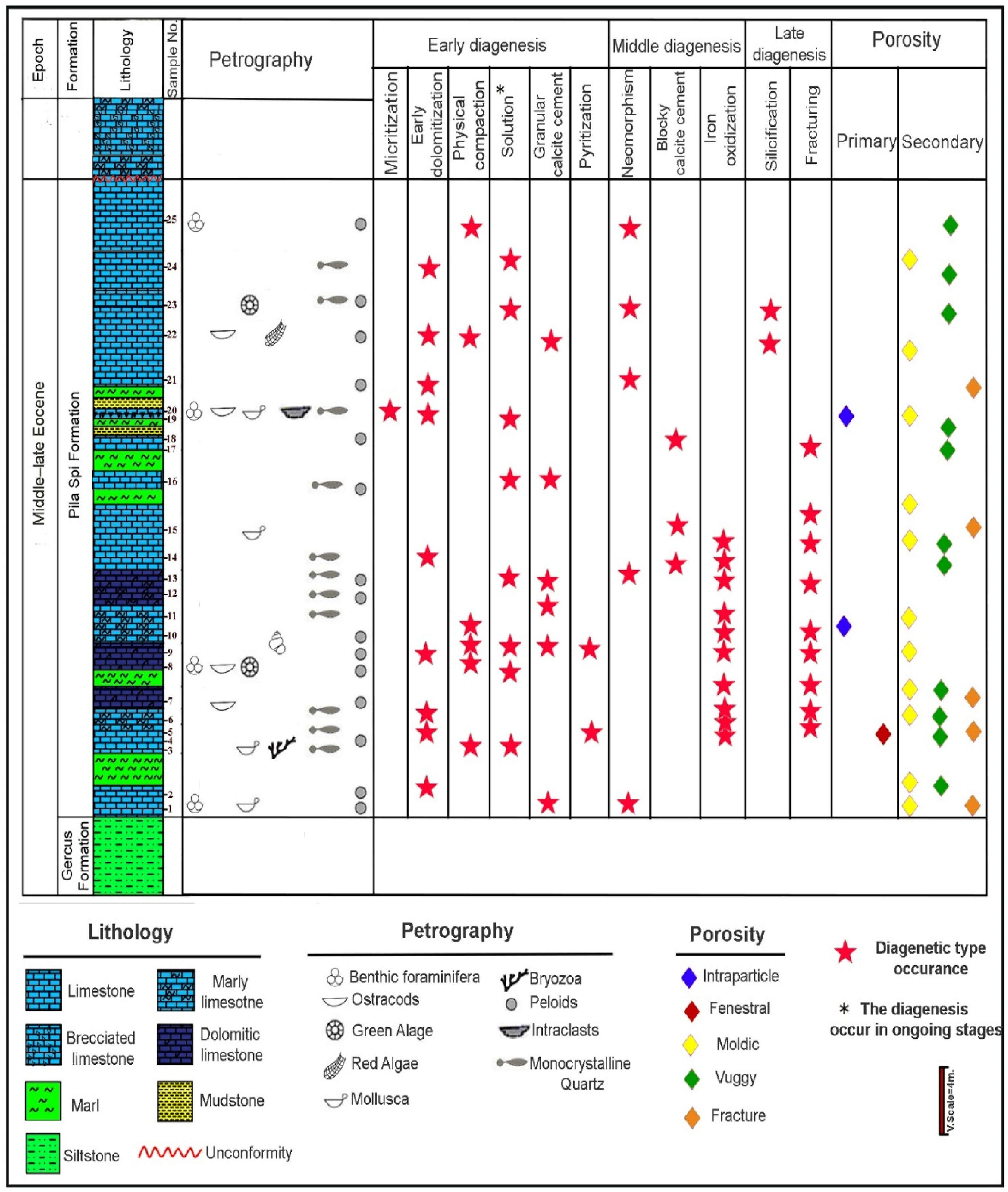
Columnar section of Pila Spi Formation in Khanaga outcrop, Aqra anticline, high folded zone showing distribution of petrographic components, diagenetic processes, and porosity types.
Micritisation
It is defined as an early diagenesis process that involves the transformation of primary carbonate sediment grains through repeated cycles of dissolution and reprecipitation of microcrystalline calcite (micrite). 36 The presence of boring organisms like endolithic algae or fungi within carbonate deposits leads to this process. 37 It occurs mainly as rims around skeletal grains in the middle part of the Pila Spi Formation (Figure 5(b)).
Dolomitisation
Dolomitisation is defined as the partial or complete transformation of limestone or its precursor deposits into dolomite, occurring when magnesium replaces calcium in CaCO3 due to the presence of magnesium-rich fluids. 32 The common dolomitisation type in the studied rocks of the Pila Spi Formation is early dolomitisation, characterised by very fine to fine dolomite crystals dispersed within the micrite matrix and common in the lower and upper parts of the studied section (Figure 5(c)). Early dolomitisation, also referred to as syngenetic dolomitisation, occurs concurrently with or immediately following the limestone deposition. 38
Compaction
Compaction in sediments can be classified into two types based on the overburden pressure: mechanical and chemical. The mechanical compaction starts immediately after deposition. 39 In the investigated rocks of the Pila Spi Formation, only physical compaction has been noticed and occurred in the different parts of the formation, as evidenced by the close packing (Figure 4(d)) and breaking of grains (Figure 5(a)).
Solution
Solution is formed mainly due to the dissolution of metastable minerals such as high-Mg calcite and aragonite. 40 It is observed in different parts of the Pila Spi rocks in the Khanaga section (Figure 5(c) and (f)).
Cementation
Cementation refers to the chemical precipitation of calcium carbonate from saturated fluids. This process takes place within or between grains, as well as in pores and fissures formed by solution processes, resulting in the precipitation of calcite cement in these spaces. 41 Two types of cement are observed in the carbonate rocks of the Pila Spi Formation in the studied section: granular calcite (Figure 5(d)) and blocky calcite cements (Figure 5(e)). The first is usually produced in a marine vadose setting, whereas the second forms under meteoric phreatic condition. 32
Neomorphism
The term of neomorphism was first introduced by Folk 42 to describe the phenomena of recrystallisation and polymorphic transformations that may involve changes in mineral composition. It is supposed to be formed in the meteoric-phreatic diagenetic environment. 43 It commonly affects the carbonate rocks of Pila Spi Formation in Khanaga section, where it obliterates the fossil structures (Figure 4(b)) and transforms the groundmass into microspar (Figure 5(f)).
Silicification
Silicification is a diagenetic process in which the carbonate minerals are replaced by silica minerals or silica precipitated as cement within pore spaces. 44 It occurs within the carbonate grains of the Pila Spi carbonate, particularly in the upper part of the studied section (Figure 4(d)).
Pyritisation
This diagenesis is primarily produced by the decomposition of organic matter by anaerobic bacteria or by sulphate reduction mediated by bacteria, leading to the formation of various pyrite shapes. 45 Similar relationships between pyrite generation and fluid evolution have been documented in the Anglo–Brabant fold belt, where early diagenetic pyrite forms during sedimentary burial, while syntectonic pyrite formed along cleavage planes and veins in response to deformation-related hydrothermal fluid flow. 46 In the studied section, pyritisation occurs in the lower part of the sequence and is represented by small cubic crystals (Figure 5(c)), consistent with formation under early diagenetic, reducing conditions.
Iron oxidisation
It is interpreted to form through the oxidisation of pyrite due to the influence of oxygenated meteoric waters. 47 The high abundance of iron oxides relative to pyrite observed in thin sections of the Pila Spi Formation confirms their derivation from pyrite (Figures 4(b) and 5(d)).
Fracturing
Fracturing has a significant impact on the carbonate rocks of the Pila Spi Formation in the Khanaga section, with the majority of fractures filled with calcite cement (Figure 5(d)).
Porosity evolution
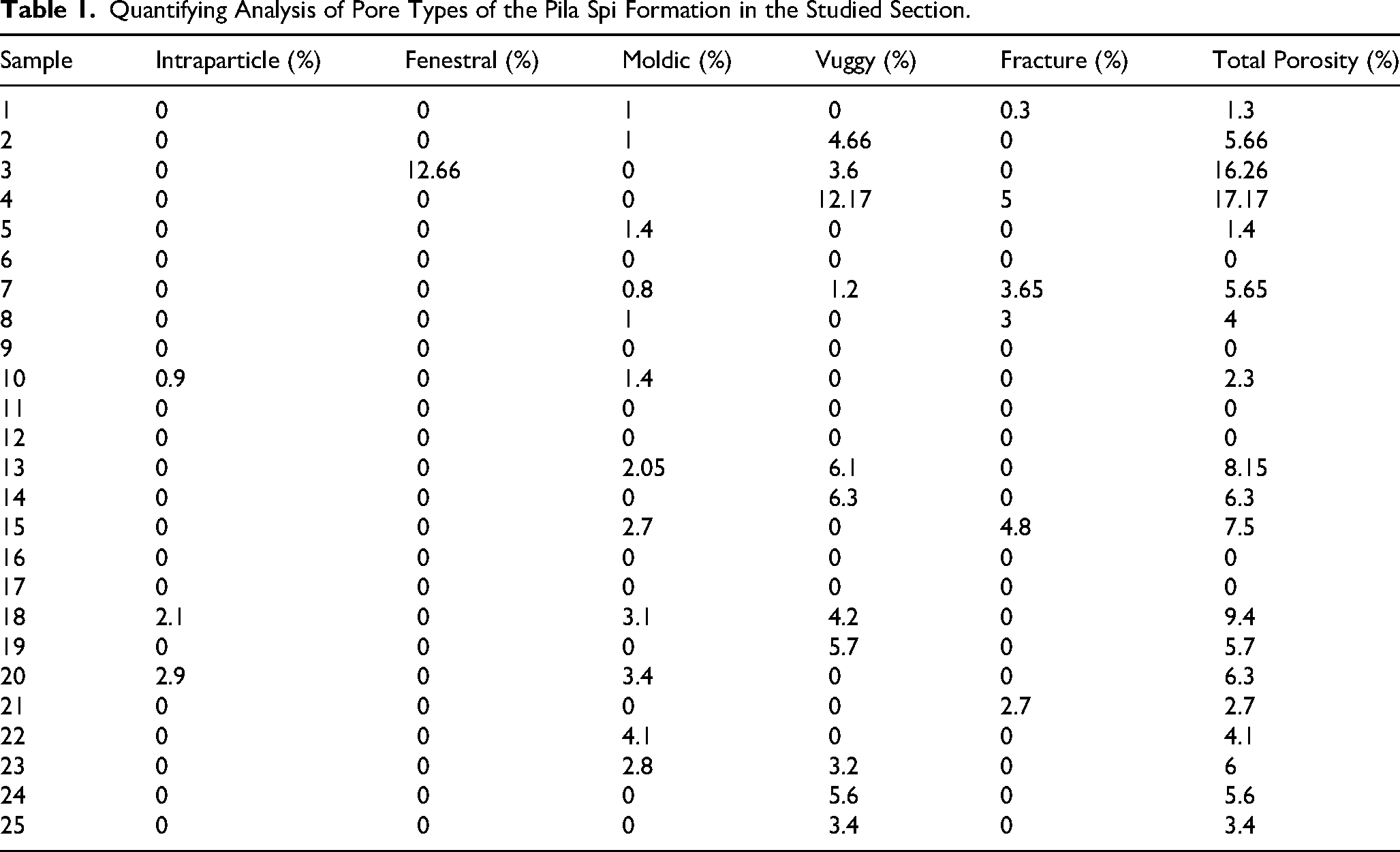
Several pore types from both primary and secondary origins were identified in the carbonate rocks of the Pila Spi Formation, following the classification scheme proposed by Choquette and Pray. 30 A quantitative analysis of these pores was conducted using the point-counting method (Table 1) to determine their relative abundance. They are including the following:
Quantifying Analysis of Pore Types of the Pila Spi Formation in the Studied Section.
Primary porosity
Primary porosity refers to pores formed before or during the depositional phase of sediments.
32
The following types of primary pores have been identified in the studied rocks of the Pila Spi Formation:
Fenestral porosity: This fabric-selective pore type, first proposed by Tebbutt et al.
48
refers to penecontemporaneous voids within the rock framework that are larger than normal grain-supported interstices. It occurs in the interval within the lower part of the studied section (Figure 7(a)) and reaches 12.66% of the total thin-section constituents. Intraparticle porosity: They are believed to have been formed at the location of the soft dissolved portions of the carbonate grains before they lithified.30,49 Intraparticle porosity is observed within the skeletal grains, mainly occurring in the middle and upper parts of the Pila Spi Formation (Figure 4(b)), where it may locally reach up to 2.9%. Analysis of the studied samples shows that this type of porosity amounts to 5.9%, with an average value of 0.236%. In general, it represents a minor component of the total porosity, typically ranging between 0% and 0.9%.
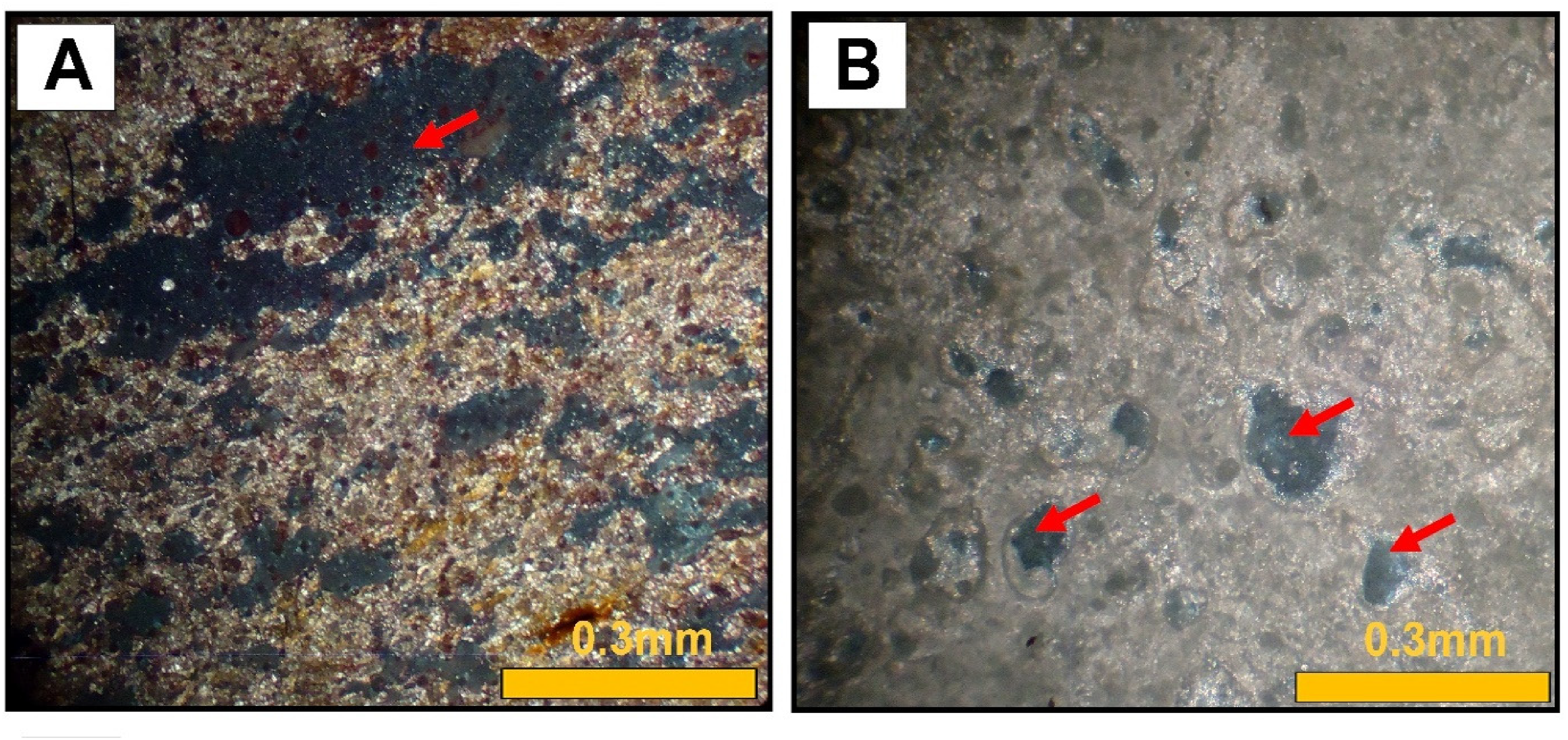
Photomicrographs of carbonate rocks of the Pila Spi Formation in the Khanaga section. (a) Fenestral porosity formed within dolomitised micritic matrix evolved to vuggy porosity in the upper part (red arrow) (K.P.3, X.N.). (b) Moldic porosity formed within the ostracods shell and peloids grain (red arrows). K.P.: Khanaga Pila Spi; X.N.: Crossed Nicholes.
Secondary porosity
Secondary porosity is more abundant than primary porosity in the studied rocks of the Pila Spi Formation. It includes all pore types formed after deposition during different stages of diagenesis.
32
The following types were identified:
Moldic porosity: It is a fabric-selective type created due to the dissolution of unstable shell materials.
50
It represents one of the most common pore types in the Pila Spi carbonates and occurs throughout different parts of the studied section, forming within both skeletal and non-skeletal grains (Figures 5(b), 6, and 7(b)). According to quantitative analysis, moldic porosity has an average value of 0.99% and reaches to 24.75% of the entire Pila Spi formation. It is rather low, typically falling between 0% and 4.1% in the upper part of the formation. Vuggy porosity: It is a non-fabric-selective pore type formed due to the enlargement of pre-existing fabric-selective pores such as moldic and intragranular pores.
51
It is observed in various parts of the studied section (Figures 5(f), 6, and 7(a)). Quantitative analysis reveals that vuggy porosity, the most predominant type of porosity in the formation, accounts for 56.13% of the formation, with an average value of 2.25%, reaching a maximum of 12.17% in the lower part of the succession. The vugs are irregular in shape and vary in size from centimetres to decimetres in diameter (Figure 3(b)). Fracture porosity: This porosity type is non-fabric selective and is supposed to be formed as a result of either tectonic activity or compaction.
52
It is common in the lower and middle parts of the Pila Spi Formation in Khanaga section (Figure 5(c)) and occasionally filled by calcite cement (Figure 5(d)). Analytical results show that fracture porosity constitutes 19.45% of the formation, with an average value of 0.77%, and ranges from 0% to 4.8% throughout the succession.
Discussion
The Pila Spi Formation in the Khanaga section is subjected to several diagenetic processes, which may enhance or reduce the porosity of the carbonate rocks of the Pila Spi Formation. The Pila Spi Formation in the studied area (Bjeel area) is regarded as one of the best groundwater aquifers, and Bjeel spring, located 1.5 km east of the studied section, which is hosted by Pila Spi carbonates is a higher discharge in the area reaches 20 L/s, 53 The most common pore types of Pila Spi Formation in the studied section are from secondary kinds. The dominant type is moldic porosity, which is formed by the selective dissolution of metastable minerals within the carbonate grains. 54 The second dominant type is vuggy porosity, which is formed mainly by enlargement of moldic pores in the Pila Spi carbonate due to dissolution, in addition to dissolution of the matrix. Fracture porosity that is obvious in the lower part of the studied formation is supposed to be formed mainly by compaction during the burial stage or during uplift due to tectonic activity. The primary pores, which are less dominant in the studied section and have occurred occasionally with some thin sections, include fenestral and intraparticle. The first are synsedimentary open-space structures created within dolomitised bryozoan framework in Pila Spi carbonate and associated with tidal flat settings. 55 While the intraparticle pores are formed by dissolution of unstable materials inside the carbonate grains.
The quantified distribution ratio of different pore types, including intraparticle, fenestral, moldic, vuggy, and fracture porosities (Table 1), reveals that vuggy and moldic porosities represent the most common types, with average values of 2.25% and 0.99%, respectively. Fracture porosity, though less common, averages 0.77%, followed by fenestral porosity, which occurs mainly in the lower part of the section with an average of 0.5%. Intraparticle porosity is locally present, with an average of 0.24%. These findings are aligned with earlier petrographic observations but yield lower absolute values than those reported from other locations such as Taq Taq and Duhok, where large-scale karstification and pervasive dolomitisation have produced higher effective porosity.8,9 They demonstrate that diagenesis is the primary control on reservoir and aquifer properties. Al-Qayim and Othman 8 reported that porosity is highly heterogeneous (5%–20%) and mainly governed by dolomitisation, dissolution, and fracturing, with dominant vuggy, moldic, and intercrystalline pore types, whereas Kadhim and Hussein 9 emphasised intense diagenetic alteration, including dolomitisation, recrystallisation, silicification, and cementation, leading to destruction of primary textures and development of cavities, fractures, and microspar-filled pores. These findings are broadly consistent with the present study in highlighting the dominance of diagenetically modified (secondary) porosity; however, the current results differ by providing quantitative pore-type distribution and showing lower porosity values, as well as demonstrating that dissolution, karstification, and fracturing—rather than dolomitisation alone—are the principal controls on porosity evolution and aquifer performance in the Khanaga section. The total porosity varies significantly between samples, reflecting the heterogeneity of the pore system and diagenetic overprinting within the studied carbonate sequence.
The main porosity-enhancing diagenetic process in the Pila Spi carbonate in the studied section is dissolution. It is thought to be created in the early and ongoing stages of diagenesis. It occurs in different parts of the studied section and is produced by the solution of metastable minerals (high-Mg calcite and aragonite), leading to the formation of different pore types, particularly secondary pores. 40 Fracturing process also led to the creation of many fractures, particularly in the lower part of the studied section, and formed fracture porosity. The early dolomitisation in the lower part of the studied section within the bryozoan framework aids the fenestral porosity formation. 56 Another important source of increasing the aquifer capacity of the Pila Spi Formation is Karstic fissures and pores (Figure 3(b)), particularly this characteristic made it to be large reserves and in some drilled wells, the recharge capacity of the formation reaches 40 L/s with high artesian pressure in the Duhok area. 9
On the other hand, the major porosity-reducing diagenetic type in the studied rocks of the Pila Spi Formation is cementation. The formation of granular calcite cement began during eogenesis (early diagenesis) in a marine vadose environment. 32 It developed on the skeletal walls and fractures, resulting in a decrease in intraparticle, moldic, and fracture porosities. Blocky calcite cement that formed during the later stages of rock formation filled fractures in the Pila Spi carbonates (Figure 5(e)), reducing secondary porosity. Mechanical compaction packing of the grains also reduces the porosity ratio in the Pila Spi Formation. The presence of neomorphism, silicification, and pyritisation in the Formation had an adverse impact on the evolution of porosity, specifically affecting secondary types of pores. 54 The current study shows a clear similarity with the findings of Pirot and Edilbi, 57 as both works emphasise that secondary porosity and diagenetic modification, especially cementation and dissolution, are the factors controlling the reservoir and aquifer behaviour of the Pila Spi Formation. Iron oxidisation, which is supposed to be the oxidation product of pyrite formed under meteoric conditions by acidic water, 58 negatively affects on the water quality of the Pila Spi aquifer in the studied area and is indicated by faster water tanker rusting.
From a hydrogeological standpoint, the results demonstrate the extent to which diagenesis and tectonism influence aquifer performance in the Pila Spi Formation. The formation is one of the most productive carbonate aquifers in the High Folded Zone due to the dominance of secondary porosity, especially vuggy, fracture, and karstic types, which provide significant transmissivity and groundwater yield. Consequently, the hydrogeological potential of the Pila Spi Formation depends on the balance between porosity-generating and porosity-occluding diagenetic processes, controlled by structural position and postdepositional history. Moreover, previous hydrogeological studies have demonstrated that groundwater interacting with Pila Spi carbonates is known to become enriched in Ca, Mg, Mn, Fe, Cu, and Co, particularly Mn, due to dissolution along fine-grain-calcite-rich beds and marl interlayers. 11
Conclusions
The petrographic analysis of the Pila Spi Formation in the studied section shows that the main matrix is micrite that occasionally changed to microspar and involves skeletal grains such as benthonic foraminifers, ostracods, dasycladacean algae, red algae, bryozoan, gastropods, and bioclasts. Whereas, non-skeletal grains are peloids, intraclasts, and monocrystalline quartz.
Ten diagenetic processes were recognised, among which dolomitisation, solution, and fracturing enhanced porosity, while compaction, cementation, neomorphism, and silicification reduced it.
Five pore types were recognised in the Pila Spi Formation. The porosity system of the formation is highly heterogeneous and largely of secondary origin. Vuggy and moldic porosities represent the dominant types, followed by fracture, fenestral, and intraparticle pores with average values of 2.25%, 0.99%, 0.77%, 0.5%, and 0.24%, respectively.
Strong diagenetic overprinting and lithological heterogeneity within the carbonate sequence are reflected in the overall porosity variation. The Pila Spi Formation, one of the primary groundwater reservoirs in the Bjeel region, has a higher aquifer potential due to the predominance of secondary porosity. This work demonstrates that aquifer performance is controlled by the spatial distribution of diagenetic alterations rather than depositional texture alone, offering a refined model for carbonate aquifer evaluation.
The karstic fissures and pores are the principal cause for increasing aquifer characteristics of the Pila Spi Formation in the studied area, and iron oxidisation negatively affect on the water quality within their aquifer. The results highlight the practical importance of integrating diagenetic analysis with hydrogeological evaluation, providing a framework applicable to groundwater exploration and carbonate reservoir characterisation in similar geological settings.
Footnotes
Acknowledgments
The authors express their appreciation to the Department of Earth Sciences and Petroleum for providing all laboratory facilities for this project. Special thanks are extended to Mr Mario Kasha from Salahaddin University-Erbil for his assistance with the computer facilities.
ORCID iDs

Funding
The authors received no financial support for the research, authorship, and/or publication of this article.
Declaration of conflicting interests
The authors declared no potential conflicts of interest with respect to the research, authorship, and/or publication of this article.