Abstract
A well-designed CRISPR system can edit a genome, but an exciting science story can edit a mindset. While researchers around the world have been perfecting their CRISPR tools, I have been witnessing the transformation that occurs when a non-scientist realizes they too can have a seat at the table of the genetic revolution.
The challenge we face is one of visibility: while the public is saturated with the promises and perils of artificial intelligence, CRISPR remains a silent revolution—this despite the awarding of the 2020 Nobel Prize in Chemistry and prominent media coverage, including features on 60 Minutes, at least two documentary films, and a TIME cover story.
To test the local reach of these headlines, I conducted an informal survey in Bellingham, WA, a community anchored by a state university with a robust science curriculum. Of 15 non-physician health care professionals I questioned, not one knew what CRISPR is. Nor did 20 Trader Joe’s shoppers.
So here I am, 96 years in, riding CRISPR’s coattails as a science edutainer (educator & entertainer) working to dent this public unawareness. I am using the “STEAM” approach to weave the visual, language, physical, music, and film Arts into STEM presentations—connecting worlds that too often stay apart.
That drive to bridge what is separated began with how differently my older brother Joel, 3½ years my senior, was treated growing up. Our parents separated before I was born, leaving Joel as the dominant family influence. During weekly visits, our dad coached him in sports but never me. I hated being left out and that boys always got to do the cool stuff while girls did not. Bridging divides became the first bedrock of my calling.
Joel was a constant tease, yet when he started school, I begged him to teach me what he had learned. Surprisingly, he was a superb teacher—fair, patient, and clear. For hours, the “girls can’t do anything” taunts stopped. Dad was also a gifted educator; neighborhood bankers raved about his night courses at Pitt. Education became the second bedrock of my calling.
A few months after my second birthday, Lady Luck delivered the Breckenridges—an intact family with father, mother, daughter Jean (3 months older than me) and dog—who rented the garage next door. Jean and I were inseparable for a decade, dreaming up creations to sell or perform and roping neighborhood kids into our schemes. When Jean was away, I lost myself in crafts or sports.
I embraced “The Brecks” as my chosen family. They were Gentile; we were Jewish. I added Jewish–Gentile to girl–boy divides: my bridging habit seeks to avoid sacrificing any treasured parts of myself, no matter how incompatible our culture deems them.
Fast Forward
I earned a B.A. (summa cum laude) in chemistry from Mount Holyoke College, whose department excelled in teaching and research. MIT rising star Jack Roberts lectured there, and I joined his group for doctoral research. A year later, he was wooed away by Caltech—an institution that had never admitted a woman. The preeminent chemist Linus Pauling clinched my admission “over the dead bodies” of a third of the faculty. I earned my PhD 2 years later.
While teaching chemistry at Pomona College, I enjoyed wonderful colleagues and motivated students. My interest in psychology resurfaced there, leading to a second PhD and a career dedicated to unleashing creativity and advocating for women’s rights. In 2003, as the Human Genome Project wrapped up, my passions for science, games, and art united. In 2016, I published DNA Ahead Game & More, a board game used by more than 600 teachers.
The pandemic transformed my embryonic CRISPR board game into the CRISPR Whisperer Picture Series. Available free at CRISPRwhisperer.org, these STEAMy episodes offer your family and friends a fun way to appreciate the vital work you do (Fig. 1). Experience has shown me that when non-scientists actively participate in CRISPR-related activities, their understanding deepens and their involvement endures. The public’s persistent unawareness of CRISPR calls for more such opportunities, especially those that bring them into direct contact with CRISPRers like the readers of this journal.
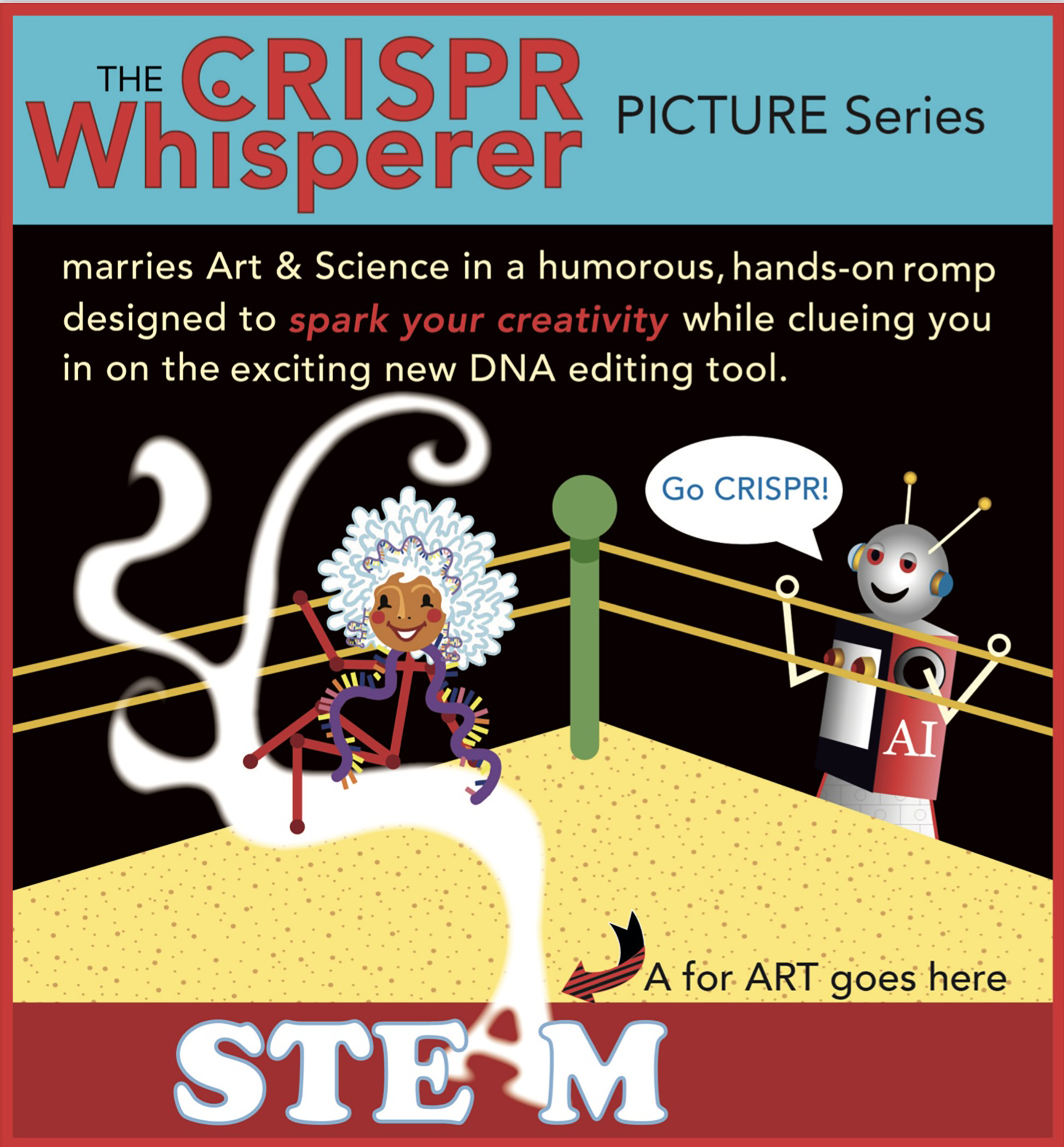
CRISPR Whisperer Picture Series.
A Proposal to Increase CRISPR Awareness
Raise the goal for non-scientists from science literacy to active participation in the science enterprise—hands-on, not by doing science, but by becoming active backers, some even ambassadors who create STEAMy presentations about your research. Win-win partnerships!
For those who take on the ambassador role, the next steps involve close collaboration to develop STEAMy presentations that bring the research to life and are entertaining and fun—inviting enthusiastic involvement. The capacity to laugh at oneself helps. (That’s the “secret” of my longevity!)
Clarify what each of you brings to the partnership so that expectations are clear. Give your ambassador the background they need to design persuasive presentations and herald the arrival of their creations as special events on your home turf. Together, host gatherings where everyone gets involved. Ask each participant how the research might touch their own lives, then share what the collaboration has taught you:
Then spark hands-on engagement with a game like CRISPR, Will You?, where one team represents CRISPR and the other (the seekers) proposes edits to create organisms with specific traits—and explains why they want them. Let curiosity lead the way.
As a bonus, if you embark on a Researcher-Ambassador adventure and play your cards right, your ambassador might even write you a recommendation to boost your next grant application! Invite attendees to sign up on the spot for a hands-on activity. The Share Your Stance card game, by PGED.org, is a topnotch model for such activities. 1
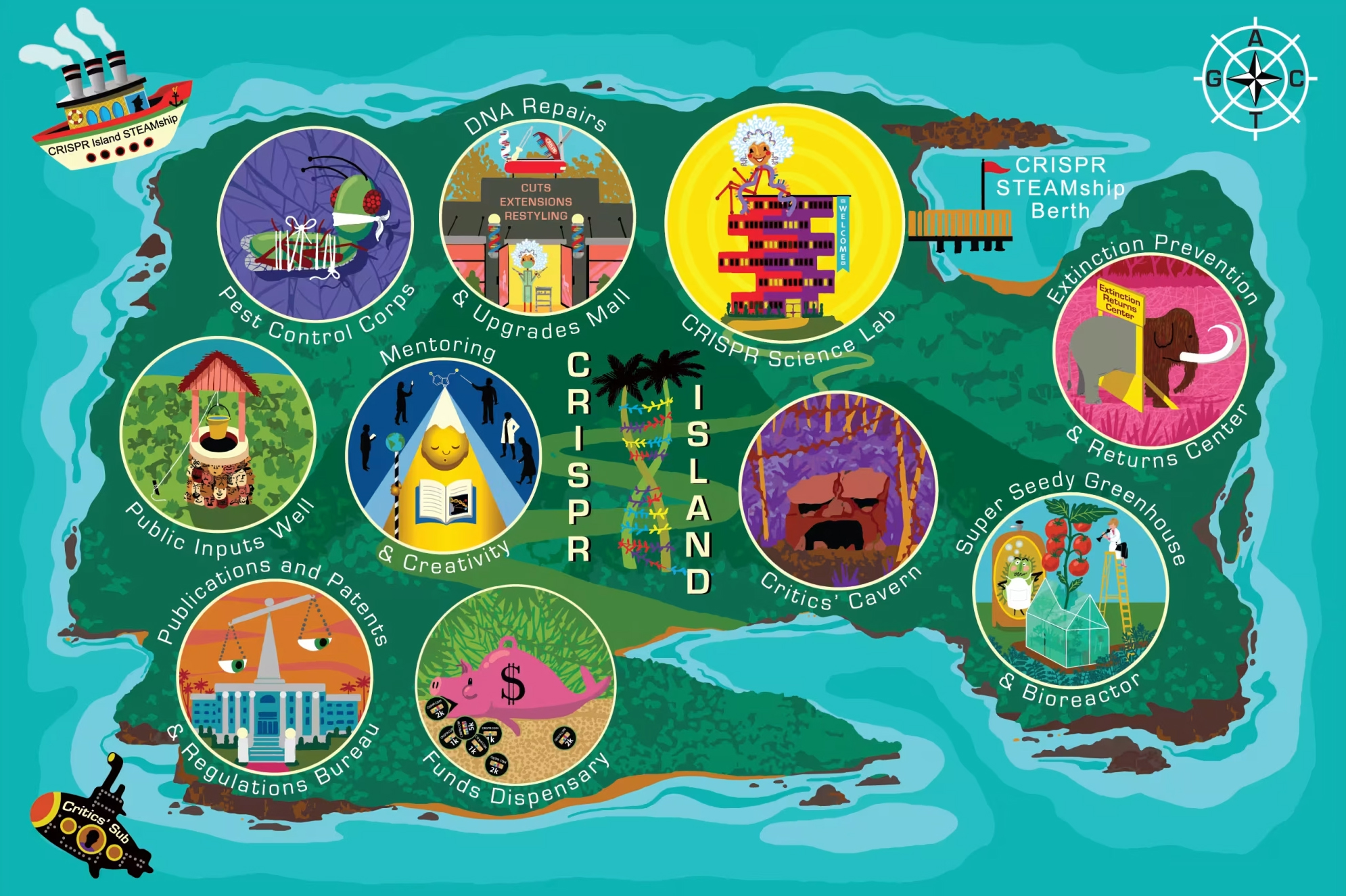
If you are interested in partnering with an ambassador, please contact us. The CRISPR Island Map is available to download free, 2 as are numerous tips on mentoring and creativity at CRISPR Whisperer Picture Series Episode 02. 3
Conclusion
I view commitment to public science communication as a Warren Buffett-type investment—one that will, in time, reap approval, support, and reward for both communicators and the science community.
My grandest dream is for science to gain fun-loving fans like sports do. Won’t you help make that happen?
The author can be reached at: https://crisprwhisperer.org/contact/