







Abstract
Background:
Many autistic adults still live in worlds that don’t understand or accommodate their sensory needs, creative interests, or ways of structuring everyday life. We explored how autistic adults use nonhuman supports such as objects, plants, animals, creative activities, and structured routines to navigate sensory and emotional demands and sustain their well-being.
Methods:
Led by an autistic researcher, we conducted qualitative interviews with 12 autistic adults in Australia to reveal how everyday nonhuman supports helped them manage overwhelm, reduce decision fatigue, and affirm personal identity.
Results:
Participants described sensory rituals including brewing tea in a familiar mug, tending to gardens, or carrying plush toys, alongside creative pursuits such as drawing, replaying games, and decorating spaces with bright character-themed items. Many also developed tailored systems, using planners, checklists, and structured shopping, to ease executive functioning challenges. However, the use of these supports was often stigmatized and incurred scrutiny from others. Participants worried that plushies or playful décor might be judged as childish or unprofessional. In the face of exclusion, social discrimination, and stigma, they envisioned more inclusive futures, imagining workplaces that normalize sensory breaks, planning tools designed for autistic adults, and community hubs blending plants, crafts, and social connection.
Conclusion:
Our findings challenge deficit-focused views of autism, highlighting instead how autistic people creatively build meaningful, sustaining environments. By centering autistic perspectives, this study calls for supports and spaces that respect and celebrate autistic ways of being, moving toward genuine acceptance and belonging.
Community Brief
Why is this an important issue?
Many autistic adults live in environments that do not recognize or support their sensory needs, creative interests, or everyday ways of organizing life. We argue that listening directly to autistic people about what supports their well-being is essential for designing respectful and effective supports.
What was the purpose of this study?
We explored how autistic adults use nonhuman supports—such as objects, plants, animals, creative projects, and daily routines—to manage sensory and emotional demands, express their identities, and imagine better futures.
What did the researchers do?
We conducted interviews with 12 autistic adults living in Australia. An autistic researcher led the interviews, and participants described how they care for themselves, which sensory and emotional supports matter most to them, and what tools, systems, or social attitudes they wish existed. We used a neurodiversity-affirming approach that treated autistic participants as experts in their own lives.
What were the results and conclusions of the study?
We identified five key themes from the interviews:
Nonhuman supports for comfort and regulation: Participants described how everyday objects and routines—such as making tea in a favorite mug, carrying plush toys, gardening, or cuddling a cat—help them feel calmer and more grounded. Creative interests, play, and immersive media: Participants described activities such as drawing, gaming, and decorating personal spaces as important sources of joy and self-expression. Building routines and supportive environments: Participants described using personal routines, checklists, and planning tools to manage stress and reduce overwhelm. Experiences of stigma and lack of understanding: Participants reported facing judgment for using supports that others view as childish or unprofessional, particularly women and gender-diverse people. Imagining better, more inclusive supports: Participants described futures that include workplaces, technologies, and social spaces that respect autistic ways of being.
What is new or controversial about these findings?
While previous research has documented differences in autistic sensory and social needs, our findings show how autistic adults actively build complex and meaningful systems of support. We provide new insight into the role of creative and playful interests in well-being, the influence of gender and stigma on support use, and how autistic adults imagine futures where others fully accept their needs and preferences.
What are potential weaknesses in the study?
Because we interviewed a small group of participants, most of whom were women and Anglo-Celtic, our findings may not reflect the experiences of all autistic adults. Future research should examine how ethnicity, gender, and culture shape autistic sensory and emotional supports.
How will these findings help autistic adults now or in the future?
By centering autistic people’s own knowledge about what helps them live well, our findings can inform how workplaces, services, families, and communities support autistic adults. We also show the importance of designing supports in direct partnership with autistic people, based on their priorities rather than assumptions. In doing so, we contribute to a future where autistic ways of managing, creating, and connecting are respected and valued.
Background
Autistic well-being is increasingly recognized as emerging from diverse, often non-normative ways of relating to the world. For many autistic people, flourishing depends on cultivating environments, routines, and relationships that honor their sensory, affective, and social preferences. Rather than aligning with dominant expectations of health or sociability, autistic people often sustain their lives through forms of connection and regulation that extend beyond conventional human interactions, including objects, spaces, animals, and imaginative engagements. However, much of this work remains conceptual, offering limited empirical insight into how autistic adults enact these forms of connection and regulation in their everyday lives.
Previous research has highlighted the detrimental impacts that neurotypical social worlds and social stereotypes have on autistic communities. For instance, research details the psychological toll of masking (using strategies to conform to neurotypical norms) on autistic people.1–3 Research also highlights how pervasive anxiety, rumination, and loneliness often arise from navigating interactions not designed with autistic communication styles in mind.4,5 Researchers have linked these challenges to the “double empathy problem,” demonstrating that misunderstandings between autistic and allistic people stem from mutual gaps in perspective rather than unilateral autistic deficits,6–9 with emerging research pointing to the strength of communication between people of similar neurotypes.9,10 Building on this body of research, our study contributes to a growing body of work that explores how autistic people sustain connection, regulation, and well-being within and beyond these constraints.
Despite thousands of papers published annually, research predominantly frames autistic people as lacking agency, overlooking the capacities they use to build community and sustain well-being.11,12 Emerging research counters this trend by documenting the distinctive joy and support autistic people find in relationships with one another, illustrating how autistic cultures and shared languages flourish outside clinical narratives.13–15 These studies show that fostering acceptance can meaningfully reduce bias against autistic people and reshape relational dynamics. 16 Fraser-Barbour et al. and Bertilsdotter Rosqvist et al. therefore call for participatory, co-designed studies that actively redistribute power17,18 and dismantle neurotypical privilege, including unpacking and challenging the assumption that neurotypical ways of thinking, communicating, and being are neutral and normative. 19 Although neurodiversity-affirming and participatory research has made important advances in recognizing autistic agency and culture, fewer studies have examined nonhuman supports as central components of autistic well-being.
Social inquiry demonstrates that nonhuman supports play a key role in the lives of autistic people, used as tools that empower them to build sustaining worlds. Many autistic adults—particularly those diagnosed later in life—draw on structured environments and predictable routines to support their mental health within systems poorly designed for neurodivergent needs.20,21 Sensory practices play a central role in these processes, despite often being pathologized in clinical frameworks.22,23 For instance, studies by Colombo et al. and Sagar et al. critique interventions that seek to suppress stimming without attending to its benefits for regulation and well-being.24,25 Meanwhile, other research has drawn attention to how autistic people adapt sensory practices in response to shifting environments. Felepchuk documented how stimming and sensory engagements evolved during COVID-19, reflecting flexible strategies for maintaining well-being under new constraints. 26 Rapaport et al. describe how autistic adults navigate cycles of inertia and motion, drawing on carefully chosen supports, both human and nonhuman, to restore balance. 27 Such findings expand notions of care to include dynamic sociomaterial practices that sustain everyday life.
Relationships with nonhuman agents and a capacity for play and improvisation are equally critical in developing sensory-supportive environments. Emerging studies challenge preexisting narratives that autistic people lack empathy, offering a diverse range of autistic people’s experiences, including a capacity for “hyper-empathy.” 28 Autistic people’s deep capacities for empathy and attachment to objects and fictional figures can offer the kinds of comfort and stability that are often absent in neurotypical social settings.29,30 Holt et al. further complicate assumptions that autistic people lack imagination or social insight, showing how insider perspectives challenge narrow “theory of mind” interpretations. 31 Cross, Piovesan, and Atherton also demonstrate how heightened pattern recognition can shape unique engagements with animated or symbolic worlds, adding another layer to autistic relational life. 32 While research increasingly recognizes autistic play, imagination, and nonhuman relationships, these practices are less frequently framed as intentional, health-sustaining forms of work shaped by autistic values and priorities.
Taken together, this research points toward the importance of play, imagination, and nonhuman relationships in autistic lives, creating space to further examine how autistic people understand and use these practices as health-sustaining work. We argue that nonhuman supports provide a means for play. 32 Autistic adults experience both solitary and social play; parallel interactions and familiar scenarios foster valuable immersive “flow” states, which are periods of deep and effortless concentration. These experiences bring joy and stress relief, 33 although sometimes at the expense of other forms of self-care. 34 Autistic cultural practices and imaginative engagements can therefore be understood as deliberate, creative “work,” a perspective that challenges deficit views of autistic interests as merely obsessive or restricted. 15
Building on the scholarship cited above, our study sought to explore the varied ways that autistic adults express themselves and experience the world, engaging in a wide array of sensory, affective, and relational practices, including connections with nonhuman supports, to sustain their health, identities, and social lives. Rather than positioning autistic cultural practices as monolithic, we approach them as enriched through pluralistic experiences and norms. 35 This study is informed by our positionality as researchers working within neurodiversity-affirming and participatory traditions. Both authors brought distinct but complementary positionalities to the analysis. One author identifies as autistic, while the other brings lived experience as an allistic person supporting an autistic family member. This positioning shaped our attention to nonhuman supports as meaningful sites of agency, care, and well-being, as well as our commitment to centering autistic expertise throughout the research process.
Methods
Research design and community involvement
In 2023, we conducted 12 in-depth semi-structured interviews with autistic adults aged 18 years or older who identified as autistic (with or without a formal diagnosis). The study received ethical approval from the University of New South Wales (UNSW) Sydney Human Research Ethics Committee (approval no. HC230354). It aimed to address the following research questions: 1) What kinds of nonhuman supports do autistic people use and why? 2) How do these supports contribute to the social connection, health, and well-being of autistic people? 3) What kinds of supports would autistic people like to see developed in the future to best meet their needs? Drawing on critical disability studies11,15,33,36 and participatory autistic research principles15,17,37,38 we approach these practices not as compensatory responses to deficit but rather as meaningful sites of agency, creativity, and flourishing.
Our research design was informed by inclusive and participatory methodologies.37–41 Community involvement shaped the design and delivery of this project from the outset as an autistic-led project, placing autistic expertise at the center. Both authors designed the study together, and the first author, an autistic researcher, conducted all interviews, which was clearly communicated in the recruitment materials. We treated participants not simply as subjects but as experts in their own lives, with interviews structured flexibly to respect different communication styles, sensory needs, and energy levels. Our approach was also shaped with respect and care for neurodiverse styles of sharing and providing information. This emphasis on relational trust and insider-led perspective aligns with broader movements in participatory autism research that seek to challenge traditional hierarchies, prioritize lived expertise, and ensure that studies reflect community priorities rather than external agendas. By foregrounding autistic voices throughout, we aimed not only to document existing supports but to contribute to broader conversations about how research itself can better honor and serve autistic people.
Participants and recruitment
We selected an online format to facilitate accessibility for participants across Australia. We recruited participants through a combination of targeted social media outreach and collaboration with disability and health consumer organizations. Recruitment materials were circulated on platforms such as X (formerly known as Twitter) using hashtags such as #ActuallyAutistic and via trusted community networks. We used word of mouth to reach those who were not social media users or involved in these networks.
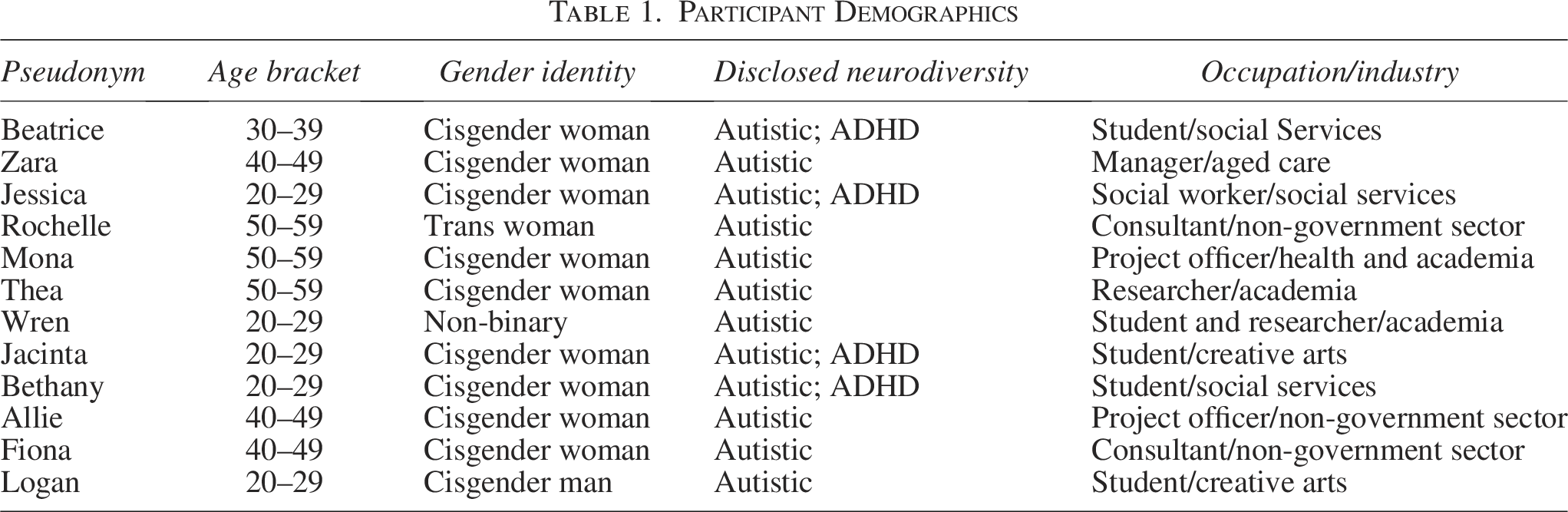
Demographic characteristics of the 12 participants are summarized in Table 1. The final sample included individuals aged 25–60 years, all residing in Australia at the time of interview. Participants did not have carers or support workers in place at the time of interview. Nine participants identified as having Anglo-Celtic heritage, one as Indigenous Australian and two as mixed heritage (Eurasian). While we invited people of all genders to participate, responses skewed heavily towards women and gender-diverse individuals. The final group consisted of nine cisgender women, one transwoman, one nonbinary participant, and one cisgender man.
P
Interview procedure
We conducted semi-structured interviews with the participants (see Supplementary Data for the interview schedule). This involved a co-constructed exchange of information generated between the participant and interviewee, as opposed to a verbally administered questionnaire. The interviews explored how participants engage with supports other than people in their daily lives, such as sensory tools, pets, digital devices, and physical spaces (for the interview structure, see the provided Supplementary Data). We approached the definition of “support” broadly, inviting participants to reflect on anything that helped them navigate life as an autistic person, manage challenges, or enhance well-being. Participants were encouraged to describe the items, systems, or living things with which they engaged regularly, what they valued or disliked, and what they would create if they could design their own ideal support. Each interview lasted between 40 and 60 minutes, and all participants were thanked with an AUD100 gift card. We assigned pseudonyms throughout to preserve confidentiality.
We conducted the interviews using an inclusive, participant-led format. Many participants indicated that being interviewed by a fellow autistic person helped them feel more comfortable and less anxious about being misunderstood. This rapport was especially valuable given widespread concerns about misrepresentation and stigma in autism research. 11 Participants were informed that they could ask for flexible pacing, the option to turn off video, to reply to questions via email and the opportunity to preview questions in advance. None of the participants requested these accommodations, but knew they had the option to use them at any time during the research process. We informed the participants ahead of the interview about the nature of the questions, with many opting to take notes on what they used in their daily lives ahead of the interviews.
Participants described feeling more comfortable sharing personal experiences knowing that the research was conducted by someone who also identified as neurodivergent, fostering a sense of shared understanding and reducing fears of judgment. They frequently responded in the rich, detail-oriented style sometimes referred to within autistic communities as an “info-dump”, stemming from intense interest in a topic, 33 which we welcomed and supported as an expression of trust and engagement. In this case, the semi-structured format of the interview gave the participant the power to speak and share, while the interviewer listened and checked off questions as they were answered as part of the story-sharing process. In recognition that this empathetic connection could lead to oversharing, we redacted off-topic discussions from the transcript and provided the transcripts to interviewees for their approval and clarification.
Data analysis
All interviews were recorded and transcribed using Zoom’s built-in transcription function, with the first author reviewing and correcting transcripts for accuracy. While transcripts were carefully reviewed and corrected, the use of automated transcription introduces a small possibility of transcription error and, consequently, minor interpretive uncertainty. We analyzed the data using inductive reflexive thematic analysis, following Braun and Clarke’s guidelines. 42 This approach acknowledges that researchers are always situated within their own life contexts, and that all research is therefore inevitably structured through their life experiences.37,42 We understood interviews as co-constructed narratives shaped through interaction between interviewer and participant. 43 The first author undertook initial familiarization through repeated readings of the transcripts and generated preliminary codes inductively, focusing on how participants described their sensory, emotional, and relational experiences with nonhuman supports. Both authors then engaged in iterative reflexive discussion to examine emerging patterns, values, and meanings, treating differences in interpretation as analytically productive rather than seeking consensus or inter-rater reliability. Throughout this process, the analysis was guided by our commitment to a strength-based, neurodiversity-affirming framework.33,38
Results
Analysis of the interview data generated five themes that capture the complex assemblages of tools, places, and nonhuman relationships participants described as supporting autistic well-being and contributing to feelings of comfort, safety, and belonging. These themes are as follows:
nonhuman supports for comfort, regulation, and anchoring; creative interests, play, and immersive media as sustaining practices; crafting autonomy, routines, and personal environments; navigating ableism and imagining better supports; and imagining tailored supports and systems grounded in autistic lived experience.
Theme 1: Nonhuman supports for comfort, regulation and anchoring
Participants described turning to a wide array of nonhuman supports to regulate sensory experiences, ease anxiety, and build daily rhythms of comfort. These included objects, textures, plants, animals, and personal rituals that were deeply interwoven with their sense of identity and security. Beatrice explained that simply making tea in a childhood mug helped “anchor her to herself and sense of place,” offering a reliable point of calm amid the complexities of AuDHD. (“AuDHD” refers to someone who is both autistic and has ADHD, which are commonly co-occurring types of neurodiversity.) Mona described the soothing repetition of machine embroidery, saying the “predictable up-and-down” of the needle was “very stimmy,” providing a stable rhythm that grounded her body when social or sensory demands felt overwhelming.
Tactile and portable sensory setups were common strategies people used for maintaining equilibrium. Zara carried a transparent bucket filled with “visual things” such as plush toys called “Squishmallows” and small sensory toys, along with practical things such as hair ties that she would carry from room to room. “A lot of the time, I get immobilized by the overthinking each night about what I need to do,” Zara explained. Her bucket system reduced cognitive load. Zara had also got a rainbow tattoo on her wrist as she finds bracelets to be sensorily challenging but “I like stuff to look at.” Jessica and Rochelle both described reaching for specific textures at moments of stress, such as running soft fabrics through their hands or brushing them across their face during difficult conversations.
Plants and small living rituals provided additional grounding for many. Beatrice spoke about the tactile pleasure of tending to a garden and feeling the warmth of soil, despite a dislike of certain insects, describing these moments as chances to “focus on something else” when anxious thoughts crowded in. Furry animals were also a crucial part of these sensory and emotional ecosystems. Wren, Thea, Mona and Jacinta relied on the steady presence of pets to regulate their bodies and moods. “What I find comforting about having a cat as a companion is that they’re just so predictable and reliable,” Jacinta explained. “She also kind of unintentionally provides really good deep pressure […] she likes to sit on my chest and my legs a lot, especially in the winter mornings when it’s cold.”
For all participants, technologies played an important anchoring and regulating role. For Bethany, Jessica, Allie, Jacinta, Zara, and Wren, headphones were the most salient form of technological support. They not only reduced the sensory overload of external noise but also created predictable, regulating soundscapes through podcasts or music with adjustable volume and looping features. Zara explained: “I cannot move if there isn’t any music.” The headphones were often paired with nondigital tools such as earplugs, including Loops 1 or industrial-grade ear protectors. For Rochelle, using shopping apps such as eBay provided a grounding outlet by allowing them to search for and curate items related to their special interests. Similarly, for both Rochelle and Jessica, photo apps offered a calming resource, enabling them to organize folders or browse soothing images.
Together, these accounts show how participants wove tactile items, plants, pets, and small rituals into intricate personal systems that offered sensory safety, and nurtured identities that are otherwise marginalized in broader social spaces.
Theme 2: Creative interests, play, and immersive media as sustaining practices
Participants described how engaging in creative, playful, and immersive activities was fundamental to sustaining their well-being and forging identities that felt authentic and affirming. These practices often offered safe, predictable frameworks to explore ideas, aesthetics, or social dynamics without the risk of direct interpersonal misunderstandings. Fiona shared that drawing anime-style art and collecting trading cards provided a longstanding thread of comfort that connected to her childhood: “My grandparents would travel and bring me stuff back from Japan or from Korea and stuff, like little erasers and pencils. Just beautiful.” She now shares these passions with her son, embedding her special interests in layers of family care.
Immersive media worlds also played a prominent role in participants’ efforts to regulate mood and explore scenarios not easily accessible in everyday life. Games offered many participants structured, low-stakes opportunities to process decision-making and experiment with different outcomes. Logan explained that, “if I know that my actions have consequences in the game, it means I’m on board. Which means, if I do something wrong, and my character ends up dying, I want to go back to the start and see if I can try that again with the lessons that I have learned.” Wren spent long stretches building lives in The Sims, 2 using it as a way to “get out of their head” and step into social or domestic scenes where risks and responses were safely contained. Jessica explained that world building in games and comics provided her space to feel “emotionally invested, because of these characters and their relationships with each other, and getting a desired interaction, a desired outcome.”
Social media platforms such as TikTok and Instagram also served as key spaces for both regulation and connection. Rochelle, Fiona, Allie, and Jessica described using social media to seek out special interest content and to engage in what Rochelle described as “parallel play”. These platforms were not without challenges, however, as targeted harassment and online bullying were reported. For Allie and Jessica, other entertainment apps, including Hole and Fill, Japanese visual novels, and gacha games 3 , provided regulating stimulation through their repetitive patterns, sounds, and rhythms. “Somehow doing that repetitive task just brings me back to being able to re-engage with the world,” Jessica explained. “It’s funny, like when you’re talking to behaviorists with kids, they try and get rid of all that stuff. But for me […] it’s just knowing what’s coming next. It’s just comforting, like a hug.”
These creative pursuits were not idle pastimes but essential ways participants crafted spaces and stories where their identities could flourish without compromise, weaving pleasure and personal meaning into everyday life.
Theme 3: Crafting autonomy, routines, and personal environments
Participants described building highly personalized structures and routines to navigate the complex demands of daily life, protect their mental energy, and reduce the strain of unpredictable environments. These systems helped manage executive function challenges, lessen decision fatigue, and create a sense of control in contexts that might otherwise become overwhelming. For example, Mona explained that “doing grocery shopping online is also another support, for not having to deal with stuff and people and attitudes, and not becoming dysregulated in the process as well of the whole sensory stuff of shopping.”
Most participants turned to practical tools to organize and visually structure their days. Digital and physical planning systems also featured prominently. Bethany explained that she had many visual aids that she used at work and home and had designed her own when she couldn’t find one to best that suits her: “looking online, almost everything is sort of aimed at kids […] there is a real lack of aesthetically different visual daily schedules and things like that. So I made one myself”. For Allie and Thea, productivity apps designed for neurodiverse users, such as Finch, 4 as well as more general tools such as Google Calendar, helped them structure routines and sustain a sense of flow and momentum.
Several participants also spoke of arranging their physical spaces in ways that made routines easier to sustain. Rochelle curated her bedroom with bright, feminine items such as soft toys, a red vase and vivid floral clothing, explaining how this space functioned as both an emotional refuge and a site of everyday affirmation, helping her maintain a grounded routine in line with her gender and cultural identity. “It’s as though my memories are embedded by objects,” she explained. “My life is sort of footprinted through the objects. The connection to me and to the world and I is through my objects”.
Taken together, these carefully constructed systems, spanning visual calendars, deliberate scheduling, and spatial organization, highlight how participants actively shaped their environments and habits to support cognitive and emotional stability in contexts often ill-suited to their needs.
Theme 4: Navigating ableism and imagining better supports
Participants described how, despite building extensive personal systems of care, they often faced stigma and a lack of understanding from workplaces, social contexts, and even broader cultural narratives. Most had not disclosed their disability to their employers. Those who had disclosed it received mixed support, with one person not having their contract renewed. The small number of participants who had sufficient support worked in the autism support sector.
Several people worried about being judged as childish or incompetent for using sensory objects, carrying plush toys, decorating work devices with bright stickers, or wearing playful clothing that soothed them but fell outside normative expectations of professional adulthood. Zara described being keenly aware of how her use of sensory supports might be unwelcome in professional spaces: “It’s hard to really be authentic and portray yourself as a corporate worker. It’s the perception of other people [that] you can’t be a manager and bring a Squishmallow to a meeting as a sensory support.” Jessica described the incredible relief of being allowed to work from home, “because it’s not socially acceptable for me to like myself. I’m always pretending to be professional. We need a policy, for me to be able to take my things into work, to be able to present my best self.”
Wren and Fiona envisioned supportive social communities that valued shared special interests and hobbies: places where talking extensively about games, house layouts, or animation would be met with curiosity rather than dismissal. Fiona explained that she wanted social media spaces to “connect better with some people that are on the same kind of level. There’s some really horrible people out there, and I don’t think we need to be made to feel like we’re stupid, or worse or less than anyone else you know.”
In summary, these reflections reveal that while participants have built highly individualized systems of care to protect their sensory, emotional, and cognitive well-being, they also dream of broader societal changes that would affirm and celebrate their ways of engaging with the world, freeing them from the burdens of stigma and constant negotiation.
Theme 5: Imagining tailored supports and systems grounded in autistic lived experience
When invited to reflect on what kinds of supports or systems they would design to best meet their needs, participants offered strikingly creative, practical, and often deeply personalized visions. Many of these ideas emerged directly from frustrations with existing tools or from the heavy cognitive and emotional labor required to maintain their current individual systems. For example, Mona imagined more opportunities for flexible, shared roles and job structures that allowed disabled mothers to work alongside each other in supportive environments that respected both sensory needs and family responsibilities.
Participants who relied heavily on planning tools and household systems articulated desires for resources that were explicitly designed for autistic adults. Bethany spoke about wanting planning boards and calendars that were visually clear and structured yet avoided infantilizing designs or pastel palettes that made her feel conspicuous or patronized, describing how such tools might better respect her autonomy and dignity. Jacinta imagined a tangible personal assistant who could help with executive function and daily tasks such as washing and cooking.
Ideas for digital tools also featured prominently. Fiona, Wren, and Allie envisioned an app that could help people connect over shared special interests—ranging from specific video games to architectural floor plans—offering a protected social space where discussing niche passions would be welcomed, not dismissed as obsessive or odd. Allie elaborated that an app that provided a space for neurodivergent people to share tips and tricks for regulation, with careful checks, could be part of the space. Bethany described the value of online spaces and messaging systems that allowed her to coordinate household needs with minimal verbal repetition, hoping these could evolve into more community-driven platforms designed by autistic people themselves. Rochelle would design an app that would allow her to collect and curate items to help create her ideal living spaces and sensory environments. Logan imagined a helpline that autistic people living in regional areas could call, noting that many carer and support services are focused in city areas.
Other participants focused on aesthetics and sensory safety. Fiona described wanting community spaces that integrated bright, playful design elements similar to the colorful character items she loved, without those environments being coded as childish or trivial. Others, including Beatrice and Thea, imagined social sensory hubs for everyone to enjoy, including natural plants and wildlife, and adjustable smart lights to control sensory input. For Jessica and Rochelle, their hope was simply that plush toys, bright accessories, and soft furnishings would be unremarkable features in professional and adult environments and treated similarly to any other ordinary tools for well-being.
Some participants highlighted the need for stronger policy supports to help autistic people access and use the accommodations they require to thrive at work. At the time of interview, many were experiencing burnout and preparing to exit their current workplaces. Zara and Mona expressed a wish for sensory kits or wearable objects that were both stylish and satisfying to touch, so they could be used comfortably in public or professional settings without fear of judgment. Zara and Jessica also reflected on the importance of workplace policies that permit the use of essential supports, noting that, unlike other disabilities, there are relatively few “official” accommodations for autistic adults. Zara noted that “people don’t understand the need for sensory aids, whereas, like they understand that you need glasses to see.” Consequently, the supports on which autistic people rely may appear “ad hoc” or improvised but are nonetheless vital. Mona further emphasized the importance of workplace structures that support job shares and part-time employment, particularly for autistic women who have taken time away from the workforce to be caregivers.
These future-oriented ideas emerged directly from participants’ day-to-day work of managing sensory overload, structuring routines, and defending their identities against misunderstanding. In their envisioned supports, participants sought not just to replicate individual coping strategies at scale, but to build systems and spaces fundamentally grounded in autistic priorities, aesthetics, and lived experience that could ease the constant effort of adaptation and allow for more genuine comfort, agency, and mutual recognition.
Discussion
Our study contributes to a growing body of research that foregrounds autistic perspectives on well-being, centering nonhuman supports, sensory practices, and imaginative engagements as meaningful sites of care, regulation, and identity. Our findings resonate with scholarship that critiques the narrow framing of autism through deficit-based models, instead emphasizing how autistic people actively cultivate environments and practices that sustain their lives.15,21,23,37,38,44 Across accounts, participants described how nonhuman supports functioned as integral components of everyday life, shaping comfort, regulation, and identity rather than serving as ancillary coping tools.
Consistent with previous research findings,22,26,33 participants’ narratives revealed how sensory practices were foundational to their well-being. These practices supported affect regulation, reduced cognitive load, and helped participants navigate environments that frequently exceeded their sensory and emotional thresholds. Our research echoes the findings of Lilley et al. and Harmens et al.,20,21 who show how autistic adults (particularly those diagnosed later in life) turn to carefully structured environments to mitigate mental health risks in systems poorly designed for neurodivergent needs. Importantly, our findings illustrate that these supports were not static. Participants continuously adjusted sensory strategies in response to life’s shifting demands, aligning with Rapaport et al.’s observations of how autistic people navigate cycles of inertia and motion. 27
Participants also described creative and playful practices as integral to their identity work and emotional regulation. These activities provided immersive contexts in which participants could exercise agency, explore aesthetics, and rehearse alternative social or domestic possibilities. Such pursuits often unfolded outside the misunderstandings of neurotypical social dynamics, aligning with research showing that autistic play supports joy and stress management even when it competes with other forms of self-care. 34 For some participants, immersion also functioned as a form of strategic withdrawal or escapism, offering relief from chronic stress associated with masking and conflict. This interpretation has implications for autistic mental health research, including work on burnout and substance use. They also align with the work of Atherton and Cross and White and Remington, who demonstrate how relationships with objects and fictional worlds can provide autistic people with emotional grounding often unavailable in typical social interactions.29,30
Structuring time and environment emerged as another critical thread. Participants detailed how checklists, playlists, planning boards, and household photo systems helped them manage executive function challenges and reduced cognitive load. Such practices illustrate how autistic people actively shape environments to reduce friction and sustain engagement across daily demands. As Fraser-Barbour et al. argue, these are not merely compensatory techniques but deliberate, agentive acts that shape environments to better fit neurodivergent minds. 17 Such practices also underline Botha’s critique of mainstream autism research, which frequently overlooks the sophisticated ways that autistic people build and maintain lives in contexts rarely designed for them. 11
Despite the value of these rich systems of support, participants often encountered stigma and gendered scrutiny, particularly around sensory aids and playful aesthetics. Plush toys, colorful stickers on laptops, or bright, feminine clothing were central to participants’ sensory regulation and identity affirmation, yet many felt these were viewed by colleagues or strangers as childish or unprofessional. These accounts highlight how stigma extends beyond social behavior to encompass sensory regulation practices, prompting participants to mask or abandon supports critical to their well-being in anticipation of misinterpretation—dynamics that align with the double empathy problem’s emphasis on reciprocal misunderstanding rather than individual deficit.1,19,33
At the same time, participants powerfully articulated what more supportive futures might look like. Participants envisioned workplaces and social spaces where diverse sensory supports, playful aesthetics, and flexible regulation practices were treated as ordinary rather than exceptional. Others described dreams of apps connecting people through shared special interests, or community hubs blending plants, crafts, and gentle socializing: spaces structured around autistic ways of connecting and regulating rather than forcing adaptation. Such visions echo calls by Bertilsdotter Rosqvist et al. and Botha and Cage for autism research to move beyond mere observation toward actively collaborating with autistic people to reshape social environments and dismantle neurotypical privilege.11,18
Our research also highlights the importance of adopting what participants themselves suggested: supports designed with a “monotropic” perspective that values autistic focus, pattern-making, and sensory looping.15,45 These insights have practical implications for workplaces and services, suggesting that employers should recognize nonhuman supports and sensory practices as legitimate disability accommodations and ensure that policies address stigma, harassment, or informal discouragement directed at those who use them. As participants described, technologies and systems often fail to accommodate flexible, shifting sensory needs, while tactile or repetitious practices—from knitting and puzzles to managing digital avatars—offer crucial outlets that combine care for external objects with care for self. These insights suggest that both technological and non-technological supports should be co-designed with autistic users to respect not only their sensory profiles but also their imaginative and affective priorities.
Strengths and limitations
A key strength of this study is that it was led by an autistic researcher, fostering rapport and reducing the risks of pathologization and stigma that participants often fear. 7 Many participants indicated that being interviewed by someone who shared aspects of their neurotype allowed them to speak more freely, providing detailed insights that might otherwise have remained guarded. This underscores the value of participatory and insider-led research for producing data that genuinely reflects autistic experiences.17,33 The research also offers insights from Australian autistic adults, who have not often been included in in-depth qualitative studies such as ours.
Several limitations should also be noted. The sample size was small, and while participants spanned a broad adult age range and diverse sexual identities, despite efforts to recruit a more diverse group, participants were predominantly Anglo-Celtic and included mostly women and gender-diverse people. The participant group reflects both patterns of the type of person who engages in autism research and gaps still present in reaching autistic men and people of color. This demographic imbalance, while a limitation, also goes some way to alleviating wider patterns of underrepresentation in autism research,37–39 and highlights the importance of creating inclusive research environments for autistic women and gender-diverse people.
Future research should work with larger samples and address intersectionality to better capture how ethnicity and cultural heritage, gender and sexual identities, and geographical location intersect with autistic sensory, relational, and support needs. It should also examine the dynamic nature of these support practices across the life course and how people’s needs change as the contexts in which they live change over time. Longitudinal and cross-national research would be valuable in teasing out these complexities and in examining how autistic well-being practices vary across cultural and national contexts.
Conclusion
We explored how autistic adults build everyday systems of sensory, emotional, and creative support, and how these practices connect to questions of identity, stigma, and imagined futures. By centering participants’ own accounts, we reveal the sophisticated ways they craft environments and routines that allow them to manage demands, affirm who they are, and look ahead to more inclusive possibilities. Importantly, these insights challenge traditional deficit-based approaches to autism, highlighting instead the agency, creativity, and resilience embedded in autistic life. At the same time, participants’ stories point to the persistent weight of social stigma and narrow expectations that continue to shape how their supports and needs are perceived. Their visions for different kinds of workplaces, planning tools, and shared community spaces remind us that meaningful change must extend beyond individual adaptations to broader cultural shifts.
Ultimately, the study adds to the growing imperative to rethink how autism is conceptualized in research and society. Our findings go some way to contribute to reshaping autism research by moving it beyond narrow clinical framings to support futures where diverse modes of living, relating, and caring are not only accommodated but actively understood, valued, and celebrated. Participants’ stories showed that supports were not simply about mitigating deficit but about crafting livable worlds—through sensory rituals, creative play, structured environments, and hopeful reimaginings—where they could flourish on their own terms. Listening to these articulations not only improves the relevance of research but also offers pathways toward more compassionate, nuanced, and genuinely inclusive social futures. 37 Our findings underscore the value of participatory, autistic-led research that documents the practices that support well-being and amplifies how autistic people imagine thriving on their own terms. Such perspectives are essential for building futures that move beyond accommodation toward genuine acceptance and belonging.
Authors’ Contributions
M.C.R. contributed to the conceptualization and methodology of the study, the formal analysis and investigation, project administration, and the writing of the original draft, as well as reviewing and editing of the article. D.L. contributed to the conceptualization and methodology of the study, the formal analysis, writing of the original draft, reviewing and editing of the article, and was responsible for overall supervision of the project and funding acquisition. Both co-authors reviewed and approved the article before submission. The article has been submitted solely to this journal and is not published, in press, or submitted elsewhere.
Footnotes
Acknowledgments
The authors thank all the autistic participants for their support in sharing their experiences with them, and the autistic community for their ongoing feedback.
Author Disclosure Statement
None of the authors has any conflicts of interest to disclose.
Funding Information
This research was conducted by the Vitalities Lab, UNSW Sydney, and the ARC Centre of Excellence for Automated Decision-Making and Society (CE200100005), and funded partially by the Australian Government through the Australian Research Council.
Supplemental Material
References
Supplementary Material
Please find the following supplemental material available below.
For Open Access articles published under a Creative Commons License, all supplemental material carries the same license as the article it is associated with.
For non-Open Access articles published, all supplemental material carries a non-exclusive license, and permission requests for re-use of supplemental material or any part of supplemental material shall be sent directly to the copyright owner as specified in the copyright notice associated with the article.
