







Abstract
Background:
Understanding independence in autism requires a nuanced exploration of how developmental challenges intersect with socio-cultural factors. There is a lack of research exploring how autistic adults in the Global South, including India, understand and experience independence. In this study, we examined independence as a culturally situated, participant-defined construct shaped by autistic lived experience and Indian sociocultural contexts. We aimed to deepen understanding of the ways in which Indian autistic adults conceptualize independence, the barriers they encounter, and the coping strategies they develop to experience independence.
Methods:
We conducted semi-structured interviews with 15 purposively sampled autistic adults in India. We analyzed the data using reflexive thematic analysis following an inductive, iterative approach to develop themes from participants’ narratives.
Results:
Three themes captured autistic adults’ lived experiences of independence. Aspirations of independence described independence as an interplay between embracing courage, exercising self-determination, and demonstrating psychological resilience. “Independence cannot be easily achieved/attained” reflected on navigating a society that often overlooks neurodiversity, which makes achieving independence particularly challenging. Navigating independence through support and self-advocacy highlighted how participants actively managed their independence by drawing on external support and advocating for their needs.
Conclusions:
Our findings provide a foundation for developing culturally responsive frameworks to support independence among autistic adults in India. Key implications for practitioners and policymakers involve designing contextually grounded interventions and addressing systemic barriers.
Community Brief
Why is this an important issue?
When people talk about “independence,” they often focus only on day-to-day tasks like cooking, cleaning, or socializing. However, independence is not a one-size-fits-all concept. Autistic people may perceive it very differently from non-autistic people. In Global South countries, like India, autistic voices are rarely heard. This study is the first qualitative exploration in India of autistic adults’ experiences of independence, and it recognizes that their needs and experiences may differ from those in developed countries. Listening to autistic voices from underrepresented backgrounds is vital for inclusive policies and support systems.
What was the purpose of this study?
The study examined how autistic adults in Indian cultural contexts perceive and define independence. It also sought to understand how they use different coping strategies to overcome challenges and achieve their desired level of independence.
What did the researchers do?
Researchers interviewed 15 autistic adults from two metropolitan cities in India, Kolkata and Mumbai. Open-ended questions explored participants’ perceptions, experiences, challenges, and strategies related to independence. The researchers used thematic analysis to identify key patterns in how autistic adults view, experience, and navigate independence in their daily lives.
What were the results and conclusions of the study?
The findings revealed that Indian autistic adults view independence as a gradual journey—something that grows over time. The participants stated that real independence is not just about doing tasks alone; it is about having courage, making your own choices, having the right support, being respected, and having emotional strength. Participants emphasized the challenges of achieving independence in a society that often does not understand autism, highlighting the need for greater understanding and inclusivity. They also shared how support from family, safe spaces, and speaking up for themselves play crucial roles in helping them navigate barriers and maintain independence. These insights underline the importance of empowering autistic people while addressing societal and systemic obstacles.
What is new or controversial about these findings?
This study looks at independence from the viewpoint of Indian autistic adults themselves. Our findings highlighted that true independence goes beyond functional abilities. The study also revealed how things like strict parenting, gender roles, and discrimination can have an impact on autistic people’s mental health and limit their freedom. Hence, independence entails resilience, choice, and challenging these unfair barriers.
What are potential weaknesses in the study?
Autistic researchers bring lived experience and insights that can shape relevant and respectful questions, notice and highlight overlooked details, and ensure interpretation reflects autistic perspectives. In this study, they joined only in later phases due to timeline and funding constraints, contributing to theme refinement, reviewing interpretations, and co-authoring outputs. However, they could not influence the original questions or approach—a missed opportunity future research should address. In addition, participants noted that if they had received interview schedules beforehand, they could have provided deeper responses. Since the researchers conducted the study in two metropolitan cities in India, the findings may not fully represent the autistic experiences in rural areas or other socio-cultural contexts.
How will these findings help autistic adults now or in the future?
The study provides critical insights to build more inclusive and supportive environments for autistic adults. By identifying barriers like societal ableism and highlighting strategies such as self-advocacy and technology use, the findings can guide families, practitioners, and policymakers to focus on strengths, respect, and accessibility in promoting independence and well-being. Future research should include autistic voices from across India and provide interview materials in advance to capture diverse perspectives and ensure a more comfortable interview experience.
Background
Prevailing neurotypical conceptualizations of independence are deeply rooted in Western psychological traditions that equate independence with self-reliance, autonomy, and minimal need for external support.1,2 Researchers have increasingly critiqued such views for their cultural and contextual limitations.3,4 In India, for instance, cultural norms for independence are shaped by collectivist values that prioritize relational interdependence, defined by harmonious relationships and mutual reliance within the family and community. 4 In this sense, independence is not an absence of reliance, but the capacity to function and contribute within a system. 5 As a result, we need a more culturally sensitive and pluralistic understanding of independence. For autistic people, this may be particularly important, as their independence can be constrained by social or structural barriers.
Conceptions of autistic independence from research in the Global North
Researchers have only recently published studies on the independence of autistic adults in economically developed countries, commonly referred to as the Global North.6,7 Much of this work tends to define independence functionally.6,7 Although these qualitative studies have acknowledged that support can be integral to independence, their analysis still focused on functional and adaptive abilities (such as self-care, socialization),6,7 rather than capturing the diverse and personal ways autistic people may experience it.
We recently conducted a qualitative study in the United Kingdom and showed that independence for autistic people is multifaceted and extends far beyond self-sufficiency in daily activities. 8 Participants emphasized that true independence has interrelated cognitive, emotional, social, and functional aspects. 8 For autistic adults, it involves gaining freedom from institutional dependency to exercise control over one’s life by making independent decisions about the support received. Many participants saw independence as a dynamic process influenced by internal psychological resilience and external societal conditions. Overall, we advocated for a broader, more inclusive understanding of independence, recognizing individual differences, respecting autistic identities, and fostering societal changes that reduce barriers and misconceptions. 8 While this body of work is growing in the Global North, the voices of autistic adults in the Global South remain largely unheard.
Autism and independence in the Indian context
In India, the understanding and identification of autism is a relatively new phenomenon. 9 The Rights of Persons with Disabilities Act of 2016 marked the first official acknowledgement of autism as a disability in India.10,11 Autism prevalence in India is less systematically assessed than in many high-income countries 12 and is reported to be much lower, around 0.09%–0.11% among children aged 1–18 years. 13 Given its population, it is likely that there are more than 15 million autistic Indians, but over 90% of them remain undiagnosed.14,15 This is largely due to limited public awareness, inadequate diagnostic infrastructure, and cultural stigma surrounding neurodevelopmental conditions. 16 The scarcity of trained professionals and regionally validated screening tools further compounds this issue, particularly in rural and underserved areas.17,18 A lack of diagnosis can lead to a lack of access to supports and adaptations.19,20
The lived realities, cultural contexts, and structural inequalities faced by autistic people in countries like India may differ significantly from those in the Global North.21,22 For example, inaccessible public infrastructure, inflexible employment practices, and inadequate healthcare accommodations exist and are often compounded by persistent stigma and discrimination. 23 Ableist assumptions and a lack of inclusive design often create these barriers, disproportionately affecting autistic people’s ability to participate fully in society. 24 Many autistic adults in India lead isolated lives, with limited contact outside their immediate families. 17 Employment opportunities for Indian autistic adults are scarce, with many resorting to sheltered vocational centers or “special schools,” even in their 30s and 40s. 9 Well-qualified autistic people encounter challenges in securing employment, navigating job interviews, and interacting effectively in workplace environments.9,25 Furthermore, Indian autistic people face distinct challenges related to family dynamics, societal expectations, and access to resources, all of which shape their experiences of independence. 26 Indian families often adopt protective or controlling roles, particularly when autism is poorly understood or stigmatized, which can limit opportunities for self-directed decision-making.27,28 Limited inclusive practices and a lack of trained staff may exclude autistic students in educational settings, affecting their long-term skill development and autonomy.28,29 These examples highlight the urgent need to explore how autistic adults in India navigate independence within these constraints.
Rationale
The Global North has dominated current understandings of independence, 9 conceptualizing independence within a typical path of development, often equated with self-sufficiency.30,31 For many autistic people, independence does not follow this conventional route, and there may be particular differences in the Global South, where cultural, societal, and economic factors significantly shape experiences of independence in ways that may differ from Western contexts.32–34 In this qualitative study, we aimed to represent the voices of autistic people in India, contributing to a more inclusive understanding of independence. 8
In this study, we asked the following two main research questions:
How do autistic adults in India conceptualize independence? How do autistic adults in India find ways to cope with barriers to independence?
Methods
We took a qualitative approach for this study and used semi-structured interviews, with a critical realist positionality. We analyzed the data using reflexive thematic analysis (RTA) following an “iterative-inductive approach.” 35 This approach emphasized the central role of autistic adults as expert informants, highlighting their unique perspectives in shaping the research. Many recent qualitative studies with autistic participants have used RTA,36–38 as it supports the interpretation of complex social and cultural constructs, which are shaped by neurodivergent experiences.
Ethics
We gained approval for the study from the university’s ethical committee. We gave each participant a pseudonym and removed any personal identifying information from the transcripts to ensure anonymity. We ensured participants were clear on our study’s goals and procedures before any interviews, and we obtained their consent to participate.
Participant eligibility and recruitment
We recruited 15 autistic adults from Kolkata and Mumbai using purposive sampling. We carried out recruitment from local support groups, advocacy forums, and special education institutions. We determined the sample size by the concept of information power. 39 This meant we focused on the richness and relevance of the data. As we progressed, we continuously assessed the depth and focus of the data, concluding that the existing sample adequately addressed our research questions, 40 making additional recruitment unnecessary. The final sample size was in line with guidance for a “medium TA project.”i, 41
Eligible participants needed a formal autism diagnosis, to be aged between 18 and 50 years, and be able to give informed consent. To increase commonality of experience, we chose to exclude certain co-occurring conditions that were themselves considered likely to have a particularly substantial impact on participants’ experiences of independence. Participants confirmed that they did not have a severe and enduring mental health condition (e.g., schizophrenia, personality disorders), a severe physical health condition (e.g., cancer), and an intellectual disability or a severe sensory impairment (e.g., blindness, deafness). Note that, for some criteria, participants had to judge for themselves the severity of their co-occurring condition and thus determine their eligibility. We did not exclude any participants who deemed themselves eligible based on a self-reported co-occurring condition. Table 1 presents the participant demographics, including their self-reported co-occurring conditions.
Participant Demographic Information
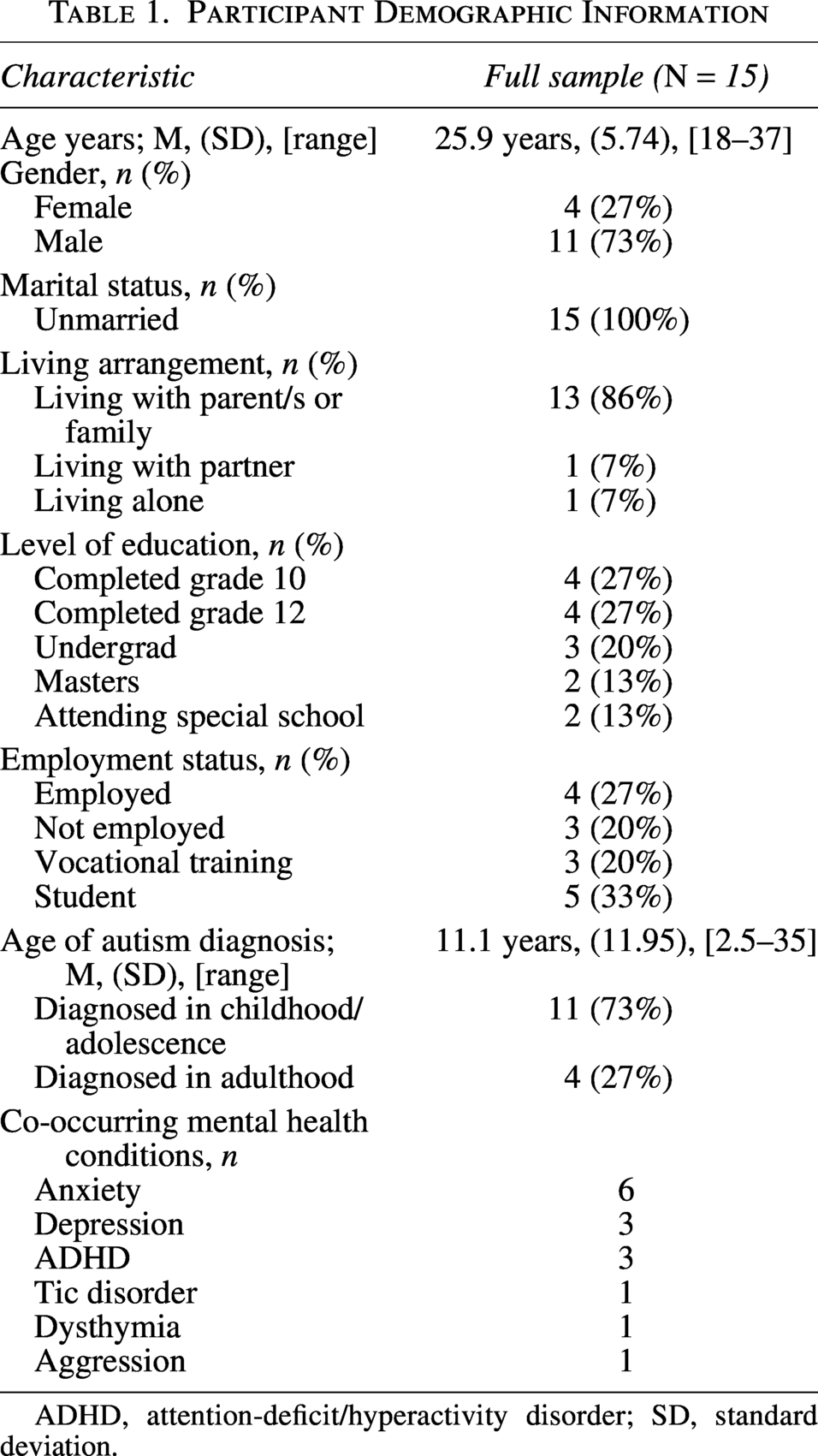
ADHD, attention-deficit/hyperactivity disorder; SD, standard deviation.
Interviews
We used a semi-structured interview guide42,43 (included in Supplementary Data). The lead researcher (P.B.) initially developed the guide based on the study objectives and existing literature. We refined the guide collaboratively through consultations with the research team (A.D.R.S., K.A.W., and M.B.), who helped rephrase questions to enhance clarity and improve cultural relevance. To encourage authentic responses, we did not provide a predefined definition of “independence.” Instead, we used open-ended questions, such as “What does a good, independent life look like for you?”, “What factors are most important for you to feel independent?” This method created space for participants to share their understandings and to explore personal meanings, experiences, hurdles, and strategies related to independence. We used follow-up questions to encourage elaboration in participants’ chosen language, enabling richer, contextually grounded narratives.
We sent a study overview and purpose to potential participants via email. Those interested contacted P.B. and signed an informed consent form after reading the participant information sheet. We conducted the interviews between December 2022 and April 2023, either in person or online, based on participant preference. We also collected demographic information (e.g., age, education, occupation, living status, and co-existing mental health conditions). P.B. conducted all interviews in Bengali, English, or Hindi as per participants’ preference, ensuring that each participant could express themselves comfortably in their preferred language.
P.B. built rapport before each interview to ensure participants felt comfortable discussing their experiences. 38 Rapport building included providing detailed interview procedures and accommodating specific needs, such as allowing a support person to remain nearby, giving sensory breaks, and extended time to think and frame responses. 39 We did not permit support people to rephrase interview questions to help with comprehension during interviews, to maintain consistency in data collection, and to focus on participants’ own perspectives. P.B. also used brief self-disclosure 40 (e.g., sharing pronouns and affiliations) to foster an equitable, stigma-free environment. 39 During interviews, P.B. followed the semi-structured guide, using open-ended prompts as needed while allowing participants to lead the conversation. P.B. recorded detailed notes on key responses, impressions, and emotions to support the analysis.
Interviews ranged from 20 minutes to 90 minutes (mean duration = 47 minutes), and participants provided consent for audio-recording. P.B. transcribed and quality-checked all interviews to ensure accuracy. Each participant received an Amazon voucher worth Rs. 200 as a token of appreciation.
Data analysis
We analyzed the data using Braun and Clarke’s six-step RTA process. 44 P.B. conducted the initial coding, engaging deeply with the data through line-by-line handwritten coding to generate semantic (surface-level) and latent (underlying) codes. D.R. reviewed the codes, refining them by focusing on micro-level meanings, which included close, line-by-line examination of participants’ language to capture nuance, context, and implicit meanings of particular words or phrases. P.B. then used an inductive approach to cluster individual codes into overarching codes (groups of codes that shared surface or latent similarity), which were then developed into preliminary themes and sub-themes. P.B. visually mapped these preliminary themes in a spreadsheet to examine relationships and coherence. P.B., D.R., and M.B. then discussed these preliminary themes and sub-themes in the source language and further refined them. P.B. then made thematic summaries, which synthesized the coded extracts grouped under each theme and its sub-themes into a coherent narrative to ensure the core concepts were accurately captured before translation. P.B. (a multilingual researcher) then translated the thematic summaries into English, drawing on familiarity with both autistic discourse and cultural nuances. A.D.R.S., K.A.W., H.H., D.R., M.B., and P.B. then used the translated materials to refine the thematic structure collaboratively.
In the final stage, P.B. translated quotes representing themes and sub-themes into idiomatic English while preserving a naturalized version of participants’ speech. This naturalized version captured details such as non-verbal elements (e.g., pauses, hesitations, expressions) and irregular grammar, which can offer important insights into a participant’s life and meaning-making. 45 Throughout, P.B. addressed challenges in translation with guidance from D.R. and M.B. P.B., D.R., and M.B. engaged in iterative translation checks and team discussions to address potential shifts in meaning and to reflect critically on the power dynamics of rendering autistic narratives into English for an international academic audience.
To enhance inclusivity, two Indian autistic advocates, who are also co-authors of this study (T.R. and S.S.), reviewed the draft themes and sub-themes, offering feedback that refined theme labels and interpretations to ensure alignment with the participants’ experiences. Notable additions and changes following input from autistic advocates included reframing the theme of “determination” to “aspirations for independence,” ensuring it reflected participants’ future-oriented goals rather than an individual personality trait. They also recommended revising “living in a neurotypical world” to “independence cannot be easily achieved/attained,” a phrase drawn directly from the data that centers autistic experiences rather than neurotypical norms. Advocates additionally suggested refining wording throughout to avoid deficit-based interpretations and to better foreground agency and lived experience. The Supplementary Data provides detailed information on these refinements. All authors provided collaborative input to achieve full consensus on the final themes.
Researchers’ reflexivity
Five authors of this study are non-autistic, and two are autistic. Three of the seven authors are experts in autism research, and five of them have a background in psychology. P.B., M.B., and D.R. identify as Indian, heterosexual, neurotypical females, with M.B. and D.R. being senior researchers. A.D.R.S., K.A.W., and H.H. are senior researchers, who are Caucasian, heterosexual, and from the United Kingdom. S.S. is an Indian autistic female, a self-advocate, and a music therapist. T.R. is an Indian man and an autistic advocate. As a team, we share a neurodiversity-affirming perspective, recognizing that while autistic people may experience the world differently, these differences are not deficits. Nevertheless, it can be difficult (challenging) and incapacitating (disabling) to be autistic in a society that was primarily designed by and for non-autistic people. The team’s varied cultural, neurobiological, and gender identities improved the study process’s reflexivity by surfacing questions about potential biases.
Results
The study included 15 autistic adults (mean age = 25.9 years, range = 18–37 years), with a majority identifying as male (N = 11) and all being unmarried. Most participants lived with parent/s or family (N = 13). The mean age of autism diagnosis was 11.1 years, with 11 participants receiving the diagnosis in childhood or adolescence. Participants (N = 6) reported anxiety as the most common co-occurring mental health condition. Table 1 provides a complete breakdown of this demographic information. Through RTA of 15 interviews, we created three primary themes (Table 2).
Participants’ Perspectives on Experiencing Independence (Themes and Sub-Themes)
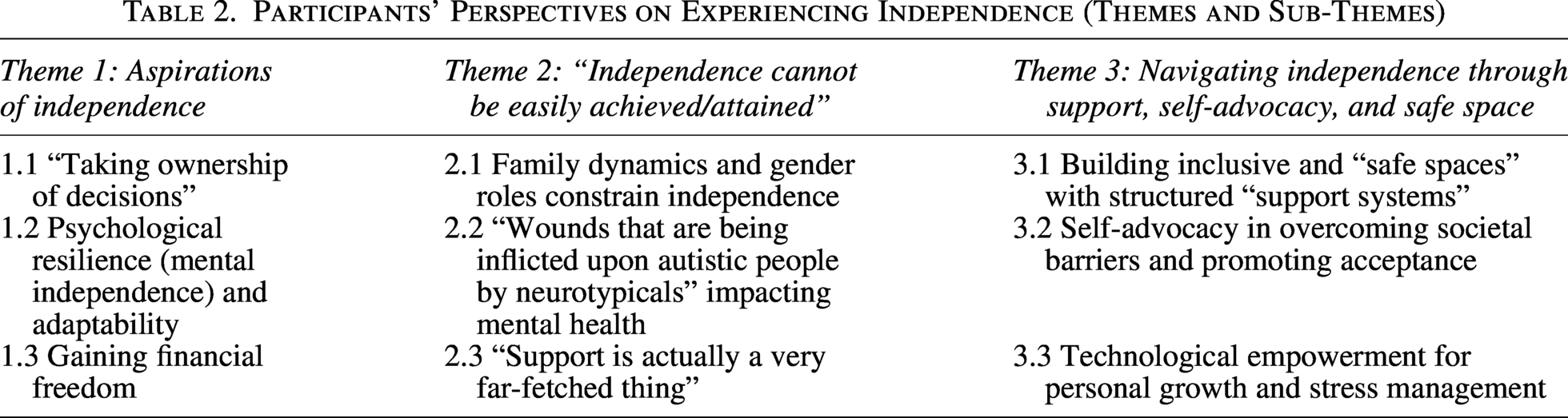
Theme 1: Aspirations of independence
This theme captures participants’ aspirations for independence—how they envisioned, hoped for, and defined independence in their own lives. Rather than describing only their current circumstances, participants articulated independence as something to strive toward, rooted in their values and future-oriented goals. They aspired to self-determination, emphasizing the importance of making personal choices and maintaining control over their paths. For some, this meant resilience in pursuing nontraditional life trajectories; for others, it meant building supportive networks that allowed them to thrive. Financial independence also stood out as a key aspiration, and participants regarded it as essential for everyday autonomy and authentic self-expression. Together, these accounts reflect a participant-driven vision of independence as both an empowering ideal and a guiding aspiration central to well-being and individual freedom.
“Taking ownership of decisions.”
Participants saw the concept of independence to have a liberating power, and they emphasized the significance of independence in terms of taking control of their decisions and time.
“Independence is um- doing things that way um- I would like to do. And uh- ideally without feeling guilty of mistakes. But then we- we do feel oh! … we shouldn’t do this; we shouldn’t do that. Then the society comes in place, but then, so independence would be living my own life, making my own choices…. It all comes to choice. The way I live, the way I want to be, uh- what I want to listen, what I want to wear, all of them.” [Sumitra, Female, Age—34]
When speaking about decision-making power, Sumitra particularly emphasized guilt-free decision-making in relation to her own wishes, desires, and preferences without feeling remorse or pressure from societal expectations. This included making choices in lifestyle, clothing, and music, embodying a sense of personal freedom and self-expression.
Psychological resilience (mental independence) and adaptability
Many participants associated independence with embracing courage and the ability to make life decisions confidently, even in the face of opposition or societal expectations. This included significant decisions like not getting married to prioritize caring for parents. Tariq mentioned the courage and self-determination required to break free from parental expectations and norms, emphasizing the importance of making personal choices and exploring life on his own terms (self-directed living).
“I think it’s the same for being a neurotypical person as well like, why do neurotypical person want to be independent? Why can’t a neurotypical person be at home and be supported by their parents? Because they want to do things on their own, because they want to explore things which parents are not comfortable with, but parents don’t want you to do or even if they want you do things, they want you to live in their way, right…” [Tariq, Male, Age—28]
Psychological resilience was evident from participants’ accounts in the determination to create a life aligned with personal values, rather than adhering to externally dictated conditions.
Gaining financial freedom
Participants also stressed the importance of having financial freedom to live an independent, self-directed, and fulfilling life. Many participants reported that liberation comes with gaining financial independence, such as buying everyday items, experimenting with clothing styles, and getting tattoos. Making these choices significantly contributed to people’s sense of self and well-being by giving them control over their everyday decision-making. “If I have money, I can buy everything I need and live life on my own terms. I can eat what I like and buy clothes. I bought a mobile phone with my own money. If I had a vehicle, I could travel far distances by myself.” [Tanmay, Male, Age—34]
This quote highlights the crucial role of financial independence in enabling independence.
Overall, the theme captures the interplay of courage, self-determination, and resilience in participants’ lives. This perspective shows that independence, rooted in individual decision-making, has a liberating power not limited by neurodiversity.
Theme 2: Independence cannot be easily achieved/attained
This theme explores how challenges posed by external factors affect autistic people’s independence. For several participants, being autistic in a neurotypical society, and lack of support from immediate family and society compromised their well-being and independence. For example, Sumitra compared independence to a kite flying; the imagery of the kite as flying free but ultimately tethered, with her parents holding (controlling) it. “Independence is like uh- the reel of a kite. Where you know the kite is flying. But there’s someone holding the- the -the string. I used to picture my parents holding the string.” [Sumitra, Female, Age—34]
Family dynamics and gender roles constrain independence
Several participants described their experiences with perceived overprotective parents who imposed many restrictions, including fashion choices, and especially regarding interactions with the opposite sex that restricted/limited their independence. Over time, they expressed a desire for more trust and independence from their parents about fashion and relationships, indicating a shift toward seeking greater autonomy in their personal lives. “uh- my mother used to, I don’t know like I won’t say mollycoddle but used to fret a lot on- now you should wear this and be like this, and don’t talk to them, talk- talk less with them. And I was like- I was quite worried about like- I was in my late twenties, and uh- a lot of these, you know, comments on- you should not talk so- so long with boys, etcetera.” [Sumitra, Female, Age—34]
The above quote illustrates the participant’s experience of feeling overly controlled by her parents, even into adulthood. This had a profound impact on the participant, causing her to feel anxious and restricted.
Balancing academic studies and household chores was a significant challenge for some female participants who described the gendered division of household tasks. Nisha expressed frustration with managing both responsibilities, feeling overwhelmed because her male family members (her father and brothers) did not support her. “Ma’am is scolding—who will study? So much work (household chores)! Oh my god! Tell your brother to work, who will do your studies? ….my younger brother says work, ‘Chal’ when I ask him to work. My mother also helps with all the household chores. Papa doesn’t help in household chores, he scolds, ‘Who will do the utensils? Shall I do all this? Leave it, your mom would have done it’ I have to study, I have to do all the household chores, study- have to work- I can’t do so much work.” [Nisha, Female, Age—22]
For our autistic participants, the added stress and sensory overload from managing these dual roles and adhering to family and gender norms hindered their independence, making it even harder to balance personal aspirations with familial duties.
“Wounds that are being inflicted upon autistic people by neurotypicals” impacting mental health
Almost all the participants raised another significant issue, which was the “social anxiety” they experienced when surrounded by neurotypical people, whom they perceived as judgmental. Sumitra expressed heightened sensitivity to social scrutiny and criticism from her relatives and neighbors, which negatively impacted her mental health and created familial tensions. These pressures often led to self-doubt and diverted energy toward managing the emotional aftermath rather than focusing on her own growth or independence. “Those words- like it impacted my uh…. it affected my daily functions. …. why is she not getting married, why is she not married, is something wrong with her? Questions coming from the relatives, questions coming from the neighbours but you know, they’ll not ask me, they’ll ask my parents. Um- and that somewhere it affected my work, my independence because I used to question a lot of things ki why- why are they- uh- torturing my parents.” [Sumitra, Female, Age—34]
Participants described significant challenges due to neurotypical society’s lack of understanding, which led to mental health issues and hindered their independence. Shreya identified “ableism” as a major hurdle, noting that societal misconceptions and prejudices against autism caused alienation and increased anxiety. Many participants spoke about their challenges using public transportation. They felt anxious due to hurried drivers, unaccommodating conductors, and crowded conditions, which led to heightened stress and a reluctance to use public transport, thereby limiting their independence. “The (mental health) comorbidities are not caused by autism. You know, the comorbidities are caused by people who have been nasty towards autistic people [smiles]. You know, and uh- [smiles, stammers] these are just wounds that are being inflicted upon- autistic people by other, so-called neurotypicals. They affected my independence because of this fact that, most of us… most of the autistic individuals are in an unfavourable environment” [Ashwin, Male, Age—37]
“Support is actually a very far-fetched thing”
Most participants highlighted that lack of support resulted in intense struggles in managing the demands of daily life independently. The absence of support systems contributed to feelings of isolation and despair, making it challenging to cope with life’s difficulties and maintain a sense of independence. “It sounds a little weird, like you know, but it really is a reality. To this day, no, none, that’s the truth. No support. And for me, like you know, it is a miracle. I find that this is really miraculous, that I’m actually still alive…. So uh- after multiple attempts to…. end it all…. So- so, for me, support is actually a very far-fetched thing… I’ve learned not to seek support from people, because I’ve never received it, when I needed it the most, all I get it, is like, ‘Don’t, you’re so annoying. Oh, don’t be a pain in the neck. Oh, my God, okay! Why are you so depressed?… It’s okay.’ So, these are the kind of judgmental attitudes that I have received.… So…. when I’m in distress I sort of shut myself down, and uh- philosophically, I know this too shall pass.” [Ashwin, Male, Age—37]
Another participant shared how a lack of acceptance and support from close family members or relatives forced them to navigate life’s challenges alone. For Shreya, constant criticism from relatives, such as comments on her appearance, resulted not only in emotional distress but also in a deeper pattern of burnouts and shutdowns, which further hampered her independence. This cycle reflects how external judgments can erode both emotional resilience and the capacity to navigate life autonomously. “In my life, I didn’t have much support, you know, like for me, so I learned… to be alone… I just wear what I feel so like, it’s your relatives… they would comment on like uh- everything. Like I’ve also dealt with fat shaming from my relatives, and all that. So that’s uh- also hampered my independence…. I would go through burnouts and shut down. So, I would like to try to like recoup from that….” [Shreya, Female, Age—29]
The interviews emphasized the “wounds inflicted by neurotypicals” [Ashwin, Male, Age—37]—judgment, ableism, and lack of support—as significantly damaging participants’ mental health and independence. These experiences led to anxiety and depression, fostering a cycle of hostility and dejection that obstructed autonomy and hindered their ability to be themselves and live independently.
Theme 3: Navigating independence through support, self-advocacy, and safe spaces
This theme underscores how participants navigate their lives while striving for independence, despite the challenges they encounter. The interplay of supportive family environments, the creation of safe spaces, self-advocacy, and the strategic use of technology were considered vital in nurturing the independence of autistic people.
Building inclusive and “safe spaces” with structured “support systems”
Participants emphasized the importance of “inclusive and safe spaces” and “support systems” for maintaining independence, noting a delicate balance between autonomy and assistance. While they valued their independence, they acknowledged needing support at times. Participants further shared that family members, particularly parents and siblings, played a pivotal role in supporting and nurturing the “independence mindset.” “For people like me, achieving independence is very important—but reaching that goal is not possible for everyone. Because the level I have reached today is due to the way my parents raised me from childhood. So many people might not be able to achieve this.” [Kamal, Male, Age—20]
Echoing this sentiment, another participant shared that their family environment fostered independent thinking and decision-making. This approach, which allowed for learning through trial and error, was crucial in building their self-confidence and independence.
Many participants also reported that they would thrive in environments where there are clear norms and boundaries. These “safe spaces” would allow them to feel secure and understood, minimizing the anxiety that can arise from unpredictable situations and thereby increase their independence. “I share a safe space. I have built that safe space. We have all together, come together, have certain norms in that safe space, and we explore. Everybody has their own boundaries, and nobody in that safe space crosses anybody, any other person’s boundaries… Similarly, I have my safe spaces at my home with my partner, with my friends. I have created them. I have told them, these are my challenges, and these are ways you can support me, and this is how the safe space would look like for me.” [Tariq, Male, Age—28]
Tariq managed to create safe spaces where his and other people’s personal boundaries were respected. Furthermore, he shared that having these spaces has helped in reducing sensory overload and other stressors that can impede independence. Choosing their own safe spaces was understood to allow autistic people to feel more comfortable and confident, enhancing their ability to function independently.
Self-advocacy in overcoming societal barriers and promoting acceptance
Many participants expressed that self-advocacy was crucial for autistic people to navigate societal barriers and promote acceptance. However, they also expressed that not many autistic people dare to advocate and stand up for themselves and others. Ashwin shared experiences of trauma in both the workplace and academic settings. Over time, this led him to advocate for himself and stand up to societal judgments. Developing self-advocacy and resilience became crucial strategies for asserting their independence. “I was very bad at detecting lies and manipulation, and these are apparently social skills, right? You need to lie, and you need to be able to manipulate other people, others, to be a successful human being, which I find is sick. But uh- but apparently that’s supposed to be [stammers] these are supposed to be social skills. So given that I lack these social skills. I really did not fit in anywhere, and I decided to stay away from people, for the most part… Now I really don’t care about judging, because that’s when my self-advocacy comes in, you know, now that- that’s when, like I became, like, you know, beyond a point when like you know, when you reach a point when you really don’t have anything to lose. Then you stop caring, you know.” [Ashwin, Male, Age—37]
Technological empowerment for personal growth and stress management
A few participants expressed a strong sense of independence, and their interactions with technology fostered this growth. “I think I’m quite independent. I- my uh- interactions with the technology is, pretty good. And I’m able to use uh- technology in a way that it helps me overcome whatever challenges I have. I use technology for my independence, as my support… which makes life easier for us.” [Tariq, Male, Age—28]
Tariq emphasized the importance of travel apps, providing real-time information about travel, a marker of independence that he struggled with. These apps promoted greater independence and less reliance on others.
Together, the participants’ narratives highlight that personal agency—expressed through decision-making, financial control, and resilience—is essential to fostering independence. Although supportive environments can empower autistic people, persistent stereotypes and a lack of societal awareness about autism often restrict their progress, emphasizing the need for broader systemic change.
Discussion
This was the first qualitative study in India to explore how autistic people define and navigate independence. We found that three core elements shaped autistic Indian adults’ lived experiences of independence: aspirations of independence (theme 1), “independence cannot be easily achieved/attained” (theme 2), and navigating independence through support and self-advocacy (theme 3).
Participants’ aspirations of independence (theme 1) emphasized decision-making, asserting control over their lives, and moving beyond diagnostic labels. Participants defined independence through resilience and courage to express themselves, contrasting with traditional deficit-centered models.46,47 While consistent with UK-based findings 8 on self-determination and internal agency, the Indian context revealed a more overt struggle against rigid cultural hierarchies, family-imposed limitations, and diagnostic essentialism. Indian participants highlighted independence as empowering, challenging conventional views on limitations imposed by cognitive differences. 8
Participants highlighted external challenges that impacted their journey toward independence (theme 2). Key challenges included parental control, stereotypical gender roles, and the undervaluing of autistic identities. Overprotective parenting, which is often linked to traditional notions of familial obedience, can unintentionally restrict personal growth and decision-making opportunities.48–50 In Indian cultures, traditional values emphasizing familial interdependence and obedience to elders often exacerbate these restrictions.33,51 Our participants described feeling micromanaged, anxious, and reliant on external validation.
Gendered expectations add another layer of complexity to independence for autistic adults in India. Participants frequently reported pressure to conform to gendered stereotypes around social skills and behaviors. Female participants highlighted the dual burden of academic responsibilities and household chores. Prior research showed that women are often expected to balance multiple roles, including caregiving and academic or professional pursuits, which can lead to stress and hinder personal aspirations. 52 Our results show that this issue is compounded for autistic women, who face a variety of additional challenges, such as managing sensory overload alongside these responsibilities 53 and who may also experience more stigma than autistic men. 54
Participants outlined several broader societal barriers to independence, including structural ableism, judgment, and unrealistic societal expectations on the mental health and independence of autistic adults. Many described a notable lack of understanding about support needs across diverse autism experiences, and the emotional toll of navigating a world built on neurotypical norms. This aligns with research linking societal exclusion to poor mental health outcomes in autistic adults. 55 While a previous study found UK participants similarly described mental health struggles linked to societal non-acceptance, 8 Indian participants attributed these struggles more directly to culturally driven stigma and misconceptions about autism. Participants feared being seen as “stereotypically autistic,” echoing literature on how stereotypes of social incompetence or intellectual limitations create stigma and restrict growth. 36 Societal biases further limit access to resources, reinforcing dependency despite autistic people’s capabilities. 56 These findings emphasize the importance of supportive family environments and safe spaces in fostering independence. Such environments help to meet psychological needs by offering encouragement, promoting self-confidence, and reducing barriers to personal decision-making57,58 without the pressure of conforming to neurotypical expectations, allowing personal growth without social anxiety.59,60
To counteract the barriers to independence, participants also identified enablers. Participants viewed self-advocacy for systemic change as beneficial for independence (theme 3), as it enabled them to create inclusive opportunities by navigating social challenges, meeting their needs, and building identity, consistent with prior research. 61 Furthermore, participants perceived self-advocacy as beneficial by promoting acceptance and inclusivity. They believed their voices could help shift societal attitudes, encouraging others to see them as individuals rather than just labels or stereotypes. 62 Tools like scheduling apps, communication aids, and assistive devices reduce executive functioning challenges, enhance self-management, and provide greater control, thereby fostering independence.63,64 Therefore, theme 3 highlights how supportive environments and self-advocacy function as a crucial counterforce to these power dynamics.
Findings in theoretical context
Shifting the focus from purely functional to more individualized understandings of independence highlights commonality between the experiences of our autistic participants and broader theory around the experiences of marginalized groups. Modified labeling theory 65 describes how the act of labeling can lead to negative self-perceptions (internalization) and social discrimination and restricted opportunities (externalized stigma).65,66 Indian autistic adults (particularly represented by theme 2) regularly described how people made assumptions about and discriminated against them due to being autistic and how they were expected to be more dependent than their neurotypical peers. They tied this to their experiences of self-doubt and mental health problems. Conversely, theme 1 reflects a resistance to these labels; participants articulated a vision of independence rooted in self-determination and future-oriented goals, effectively using these aspirations to reject the “dependent” identity imposed by external labels.
Equally, power dynamics clearly impacted our participants’ experiences of independence. Power dynamics framework centers on the concept of social control, the mechanisms (e.g., authority, cultural norms, hierarchy) used to regulate people’s access to agency and maintain the status quo in social systems. 67 In our findings, theme 2 maps directly onto the restrictive elements of this framework. Theme 2 highlights how societal stigma, family control, and intersectional gendered expectations function as forms of social regulation that strictly constrain autistic agency, particularly for Indian autistic women. However, themes 1 and 3 illustrate how these power dynamics can be shifted or circumvented in ways that facilitate independence, as power is not solely restrictive but can also be productive and enabling. 68 Rather than merely reflecting restricted agency, theme 3 demonstrates how power and control can be redistributed. For instance, participants described how autonomy-supportive parenting, self-advocacy, and access to technology shifted decision-making authority toward autistic adults themselves. Family members exercised enabling power when they encouraged choice, experimentation, and learning through experience rather than control and surveillance (theme 3). Theme 1, in turn, represents the resulting expression of independence and self-determination that becomes possible under these more empowering and autonomy-supportive conditions. Considered within the context of power dynamics theory, these findings suggest that autistic adults were able to counteract social control in specific contexts when relational, structural, and technological conditions support agency. Further work is needed to examine the mechanisms that facilitate shifts in power, including changing societal attitudes in Indian (urban) society,69,70 or the role of technology in reducing reliance on interpersonal or institutional gatekeepers, thereby enabling independent navigation of everyday life (as discussed in theme 3).
Limitations and future directions
While we involved autistic co-researchers in theme development, they joined the project too late to influence its design or data collection. 71 Earlier involvement could have enhanced accessibility and relevance, such as by co-developing interview schedules. 72 Participants also suggested that receiving interview schedules beforehand would have enabled more thoughtful responses. The exclusion of self-diagnosed autistic people limits the scope of understanding autistic experiences, potentially overlooking the perspectives of a significant portion of the autistic community. Another key limitation is the exclusion of autistic adults with co-occurring intellectual disabilities and those with high sensory support needs. This exclusion likely shaped our findings by limiting the scope of understanding independence from a wider range of experiences. Future research should prioritize including this group by incorporating accessible communication methods (e.g., augmentative and alternative communication, proxy interviews) to capture the full spectrum of autistic voices and challenges.
Although qualitative research does not aim for generalizability, 35 we acknowledge that our study was limited to two metropolitan cities in India. Given India’s cultural and geographical diversity and the fact that a large part of the population lives in rural areas and lower resource settings, future research on rural populations will help reflect the full spectrum of autistic experiences across different social, cultural, and economic contexts to better capture their unique journeys. Future work should also explicitly examine how familial expectations, gender roles, and societal norms shape autistic experiences.
Implications and Conclusion
Our findings suggest that policies in India must move beyond generic disability provisions to address culturally specific barriers that shape autistic adults’ pathways to independence. Family-centered interventions are essential, as families play a central role in shaping independence. Policies should therefore promote family education programs that encourage autonomy-supportive parenting and help families understand autism beyond deficit models, allowing caregivers to balance protection with the promotion of independence. Gender-inclusive support services are also critical. Autistic women face unique challenges due to societal expectations, including the dual burden of domestic responsibilities and academic or professional expectations. Policies tailored to the needs of autistic people should address gendered expectations that limit autistic women’s opportunities for autonomy and participation, including through targeted supports in education, employment, and community life.
Currently, legislative frameworks73,74 provide rights-based provisions for reasonable accommodations and mental health support for disabled people in India. However, participants’ accounts suggest that formal rights do not always translate into meaningful everyday support for autistic adults. Their experiences of stigma, ableism, lack of support, and inaccessible social environments indicate the need for more autism-focused guidance on how accommodations and supports should be implemented in everyday settings. Clearer implementation processes are, therefore, needed to help translate formal rights into practical support for autonomy, well-being, and equitable participation.
Although autistic adults across cultural contexts share core aspirations for autonomy, self-expression, and acceptance, sociocultural structures dictate the pathways they take toward independence and the specific barriers they encounter. These findings highlight the need for culturally sensitive support systems that account for these dynamics and balance familial involvement with the promotion of individual agency.
Authors’ Contributions
P.B.: Conceptualization, methodology, investigation, formal analysis, and writing—original draft and editing; M.B.: Validation, writing—review and editing, and supervision; D.R.: Validation and writing—review and editing; T.R.: Writing—review and editing; S.S.: Writing—review and editing; H.H.: Methodology and writing—review and editing; K.A.W.: Methodology, validation, writing—review and editing, and supervision; A.D.R.S.: Conceptualization, methodology, validation, writing—review and editing, and supervision.
Footnotes
Acknowledgments
The authors would like to sincerely thank the autistic adults who participated in this research for generously sharing their experiences with us.
P.B. would also like to thank her friends, Souvik Bhattacharya for translating the participant information sheet, consent form, and semi-structured interview schedule from English to Bengali, and Biyas Mohanta and Surbhi Sinha for translating the same materials from English to Hindi.
In addition, P.B. extends her gratitude to Rose Matthew for proofreading the final chapter and offering valuable feedback to help refine and strengthen it.
Author Disclosure Statement
The study presented in this paper represents a portion of P.B.’s thesis at the University of Birmingham. The authors have no other conflicts of interest to disclose.
Funding Information
The authors acknowledge the financial support from the School of Psychology at the University of Birmingham for paying the participants. No other funding was associated with this research.
Supplemental Material
References
Supplementary Material
Please find the following supplemental material available below.
For Open Access articles published under a Creative Commons License, all supplemental material carries the same license as the article it is associated with.
For non-Open Access articles published, all supplemental material carries a non-exclusive license, and permission requests for re-use of supplemental material or any part of supplemental material shall be sent directly to the copyright owner as specified in the copyright notice associated with the article.
