






Abstract
Background:
The number of autistic students entering higher education (HE) has increased, yet many continue to face systemic barriers that can hinder their academic success. Despite their unique cognitive strengths, such as hyperfocus, attention to detail, and strong analytical skills, many autistic students report challenges with academic learning experiences. This study aimed to develop and validate the Academic Learning Experiences Questionnaire (ALEQ), a tool designed to assess specific learning experiences and inform autism-inclusive educational practices.
Methods:
We cocreated the ALEQ with autistic and nonautistic students to assess learning experiences across five academic contexts: small and large group teaching, examinations, coursework, and self-directed study. A total of 829 university students (formally diagnosed autistic: n = 106; self-diagnosed autistic: n = 112; nonautistic: n = 611) completed an online survey comprising the ALEQ and an autism screening measure (Social Responsiveness Scale-2). To establish the ALEQ’s psychometric properties, we conducted exploratory and confirmatory factor analyses and tested for measurement invariance between the autistic and nonautistic groups.
Results:
The ALEQ produced seven theoretically relevant factors with good local and global fit: Microtransitions, Social Anxiety, Sensory Reactivity, Planning and Prioritizing, Monotropic Focus, Group Work, and Global Comprehension. Configural and metric invariance were supported across autistic and nonautistic groups, indicating a common factor structure and comparable factor loadings. However, scalar invariance was not achieved, meaning that observed mean differences may not reflect pure differences in the underlying latent constructs. Using the final 34-item version of the ALEQ, autistic students reported significantly more challenges than nonautistic students across all seven subscales, with the greatest disparities in Sensory Reactivity and Microtransitions.
Conclusion:
The ALEQ provides a structured way to understand the academic challenges that autistic students face in different learning contexts. By identifying key learning experiences, it offers both a practical tool for educators and a measurement instrument for researchers that can identify adjustment needs and, ultimately, enhance accessibility and inclusion in HE.
Community Brief
Why is this an important issue?
More autistic students are going to university, but many struggle with academic experiences that nonautistic students find easier. These challenges can prevent them from reaching their full academic potential. Universities need better ways to understand autistic students’ experiences to create more inclusive learning environments.
What was the purpose of this study?
This study aimed to explore the academic learning experiences of autistic students at university. We created a questionnaire that could be used both in research and by educators to help understand and support autistic students’ learning needs.
What did the researchers do?
We worked with both autistic and nonautistic students to develop the Academic Learning Experiences Questionnaire (ALEQ). This questionnaire assesses a range of learning experiences, including social anxiety, learning styles, and sensory sensitivity—across different university contexts, such as lectures, small-group teaching, exams, coursework, and self-directed study. A total of 829 university students took part in the study; some were formally diagnosed autistic, some self-identified as autistic, and some were not autistic.
What were the results of the study?
We found that the ALEQ measured seven key areas of academic learning experiences:
Microtransitions: how small, frequent changes in routine (like moving between classes or adapting to sudden changes) can be overwhelming. Social anxiety: how students feel in social learning situations, such as group discussions or presentations. Sensory reactivity: how distractions like noise, lighting, or crowds affect focus and learning. Planning and prioritizing: how students organize their workload and manage deadlines. Monotropic focus: describes a tendency to concentrate intensely on specific details or ideas, which can make it harder to take in multiple sources of information or shift to the bigger picture. Group work: how well students feel they can participate in group work and discussions. Global comprehension: how easily students grasp the main ideas and overall meaning of what they study, focusing on the “big picture” rather than the finer details.
As expected, autistic students reported higher levels of difficulty in all seven domains compared with nonautistic students. The largest differences in reported scores were observed for Sensory Reactivity and Microtransitions.
We also found that the questionnaire measures the same types of learning experiences for autistic and nonautistic students, but the two groups may use the rating scale slightly differently. This means that differences in average scores should be read as showing where experiences differ, not as exact measures of how much more or less difficulty one group has.
What do these findings add to what was already known?
This study shows that autistic students report distinct patterns of learning-related difficulty, particularly in Sensory Reactivity, Microtransitions between tasks, Group Work, and Monotropic Focus. It is the first to capture these experiences within a single questionnaire.
What are the potential weaknesses in the study?
The study included fewer autistic students than nonautistic students, and many nonautistic students were excluded because they scored highly on autistic traits. Some of the learning experiences assessed by the ALEQ, particularly global comprehension and group work experiences, were based on fewer questions and may not yet be fully understood. The ALEQ also focused more on challenges than on the strengths of autistic students. Finally, we did not explore differences within the autistic group or how other characteristics, such as anxiety, might influence students’ learning experiences.
How will these findings help autistic adults now or in the future?
The ALEQ can help universities and educators identify specific learning-related challenges that autistic students face, so that support and teaching approaches can be better matched to their needs. It can be used by researchers and educators, and disability support staff can use the ALEQ on a one-to-one basis with students. Over time, it can also guide improvements in how universities create more inclusive learning environments.
Introduction
Autism is characterized by a distinct social communication style, sensory hyper- or hypo-reactivity, focused interests, and a preference for routine.1,2 Historically framed as deficits, these traits are increasingly seen through a neurodiversity lens, shifting focus from the autistic individual to their broader social and physical environments.3,4 Higher education (HE) represents one such environment, where the number of autistic students has grown significantly, nearly doubling in university entrants from 2016 to 2021, 5 although many remain undisclosed or undiagnosed.6,7 Despite having average to above-average intelligence quotients 8 and often excelling in specialized knowledge,9,10 autistic people frequently encounter barriers to academic inclusion when they participate in HE7,11–13 with implications for later workforce participation.
HE outcomes are important not only in their own right but also because they shape future employment trajectories. Although autistic individuals may sometimes pursue career priorities that differ from those of nonautistic peers,14–16 many aspire to stable roles that align closely with their cognitive strengths and expertise.17–19 Despite their qualifications, employment rates remain disproportionately low, with only 40%–47% of cognitively able autistic adults in paid work, 20 often in positions that do not capitalize on their abilities.21,22 Population-level data indicate that autistic graduates are less likely than their nondisabled peers to secure full-time employment despite comparable qualifications, 23 an inequity associated with reduced self-worth, 24 and lower quality of life. 25 These disparities underscore the critical role that HE experiences play in shaping employment trajectories for autistic individuals.
Although sensory, cognitive, and social domains are discussed separately below for conceptual clarity, these processes are highly interrelated and dynamically shape students’ experiences within HE. Research examining barriers to academic inclusion in HE has often concentrated on socio-emotional challenges such as social isolation and mental health,26–29 but the specific academic learning experiences of autistic students remain less well understood. Sensory reactivity, which is a common feature of autism, has been particularly underexamined in the university context despite repeated accounts of its disruptive impact on concentration, participation, and engagement.11–13,26 Specifically, sensory input interacts with cognitive and social processes 30 and overstimulation can intensify executive-functioning difficulties, elevate social anxiety, and lead to disengagement. In large lecture halls, unpredictable sensory stimuli may overwhelm, and in group settings, fluctuating noise and movement can destabilize focus. Such experiences may explain why academic outcomes are inconsistent. Some studies report parity in grades, 31 while others find lower attainment, higher failure, and greater withdrawal among autistic students.7,11,32 Graduation rates, while inconsistent, have been lower among autistic students than the total student population when aggregating findings across time and institutions 32 and institutional practices such as rigid teaching formats, reliance on lectures, and group-based assessment are likely to contribute to these disparities.28,29,33
Cognitive processing styles also influence how students navigate HE. A local processing bias34,35 can enhance visuospatial ability36–38 and analytical precision, but it may hinder broader conceptual integration35,39 and flexible transfer of knowledge.11,26,40,41 Executive-functioning differences, which include difficulties with flexibility and planning, 42 present further challenges in managing workloads and adapting to scheduling changes.26,43 However, structured teaching strategies such as explicit guidance on theoretical application, consistent timetabling, and scaffolded support11,43 can reduce these difficulties. Because such approaches are valuable for many students, they strengthen the case for Universal Design for Learning (UDL). 44
Social participation in HE is similarly shaped by a combination of intrinsic and contextual factors. Bird and Cook’s alexithymia hypothesis 45 suggests that co-occurring alexithymia, which affects around 50% of autistic people,46–48 can hinder emotional recognition and expression and contribute to social anxiety,49,50 which can affect engagement in group learning settings. Sensory differences have also been linked to loneliness, withdrawal, and anxiety.51,52 The “double empathy problem” 53 emphasizes that communicative difficulties often result from mismatches between autistic and nonautistic styles rather than a unilateral deficit. Learning contexts such as group work illustrate how these pressures converge, as tasks involving unfamiliar peers in evaluative or competitive contexts may increase stress and social anxiety instead of drawing on autistic strengths.11,26,27,43 Although many autistic students value social connection,11,27 environmental barriers can restrict opportunities to develop relationships and to participate fully in social learning.
Sensory, cognitive, and social experiences rarely occur in isolation; instead, they intersect in the everyday demands of HE. For autistic students, sensory overload may simultaneously produce cognitive disengagement and social withdrawal. 30 Traits such as persistence, attention to detail, and analytical focus,11,13,26,54 which are often strengths, can become stressors in environments that demand constant adaptability and rapid transitions. The environment is therefore not a neutral backdrop but an active determinant of participation, either enabling or reinforcing exclusion.
Despite recognition of these issues, systematic quantification of autistic students’ academic experiences remains limited. Few studies have taken this approach,7,11 and no appropriate psychometrically validated measure is currently available. Existing measures, such as those used by McLeod et al., 7 offer breadth but lack the necessary granularity to capture domains central to inclusive practice, including group learning, social anxiety, and sensory experiences. The absence of such tools fragments the literature, 33 prevents meaningful comparison across studies, 55 and constrains the field to small-scale investigations.
Existing assessments often fail to capture nuanced academic challenges across neurotypes, particularly in areas such as group learning and sensory sensitivities. Developing an inclusive measure allows comparison across groups using the same constructs, supporting both targeted adjustments and broader inclusive practice.
In the present study, we set out to develop a new measure of academic learning experiences that is inclusive of autistic students. Our primary aim was to create a tool educators could use to capture the challenges and supports shaping learning in HE, but we also wanted to ensure the measure would function as a psychometrically robust research instrument. The focus of the measure was on academic learning contexts, and we incorporated constructs that intersect with well-being, such as sensory reactivity and social anxiety, because these factors are integral to academic participation and success.
A secondary aim was to carry out a preliminary comparison of autistic (including self-diagnosed) and nonautistic students, to explore how their reported experiences diverge. This comparison was intended not as a benchmark of ability, but as a way of identifying areas where academic environments may disadvantage or enable different learners. Based on the reviewed literature, we hypothesized that autistic students would report greater challenges in academic learning experiences than their nonautistic peers.
Methods
Participants
An international sample of autistic and nonautistic university students (n = 912) completed an online survey. We recruited most participants through a UK university research participation scheme (where participation contributed to degree credit). Smaller numbers were recruited through social media and, in the autistic group, through the disability services of partnering American universities. Before analyzing demographic variables, we excluded six respondents due to careless responding and 78 respondents with missing data in the core demographic measures, leaving an overall sample size of 829 (formally diagnosed autistic: 106; self-diagnosed autistic: 112; nonautistic: 611). We then split the sample and made further exclusions before analysis (see the “Data Analysis” section for details and Table 1 for demographic statistics).
Demographic Statistics by Group
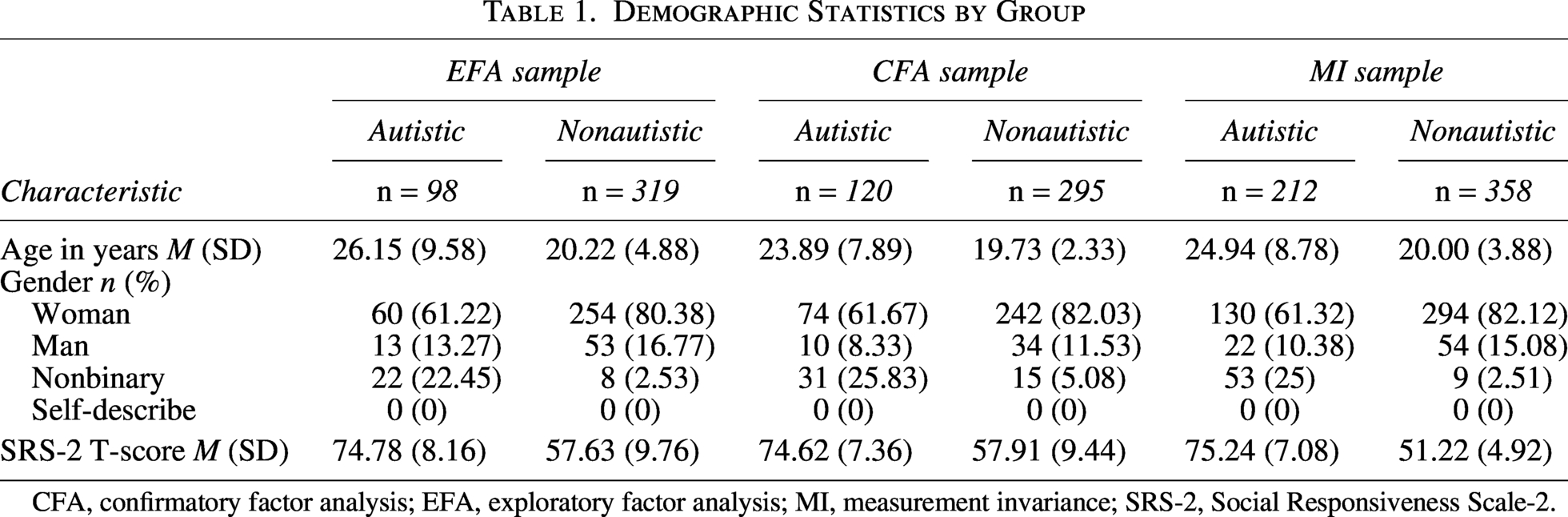
CFA, confirmatory factor analysis; EFA, exploratory factor analysis; MI, measurement invariance; SRS-2, Social Responsiveness Scale-2.
Materials and procedure
Following ethical approval from the University of Sussex, we collected data via an anonymous Qualtrics survey. Participants provided informed consent and answered a series of demographic questions. They then completed the Social Responsiveness Scale-2 (SRS-2) 56 for group screening purposes, followed by the Academic Learning Experiences Questionnaire (ALEQ).
Academic learning experiences questionnaire
We co-created the ALEQ with six autistic university students, one of whom is the second author on this paper; and seven nonautistic students, one of whom is the third author. Of these, three autistic and four nonautistic students participated in the focus group described below, while the remaining students contributed through earlier consultation, item generation and iterative feedback on wording and content. The questionnaire aimed to capture a broad range of academic learning experiences with relevance to all students, but to include areas with particular significance to autistic students, including sensory reactivity, organization, adaptability, attention to detail, focused interests, groupwork experiences, and peer support.7,11,13,26,28,40,57 We designed the items to capture a continuum of strengths and challenges, defined in relation to HE demands and measured on a 5-point Likert scale (1 = strongly disagree; 5 = strongly agree).
Item Development and Refinement
We developed the ALEQ’s theoretical framework through focus groups with three autistic and four nonautistic university students from Undergraduate to PhD level. This dialogical method allowed for negotiation and integration of diverse student perspectives, producing a widely applicable but autism-inclusive understanding of academic learning experiences. The autistic students built on existing research insights7,11,13,26,28,40,57 by situating their strengths and challenges in different academic learning contexts and, in particular, highlighting less “visible” autistic strengths, such as enhanced focus in independent study contexts. To better capture these nuances, we delineated five experientially distinct academic learning contexts, through ongoing discussions with the student contributors, to guide item development: small and large group teaching, examinations, coursework, and self-directed study. The students worked in equal partnership with researchers to iteratively generate and screen the items, ensuring a firm grounding in lived experience 58 and a balanced representation of autistic characteristics, strengths, and challenges across contexts.
We piloted the initial set of 45 items with autistic (n = 71) and nonautistic (n = 83) students (see Supplementary Data S1). Preliminary item checks (e.g., skewness, clarity, redundancy) and exploratory analyses were used to identify broad patterns of association between items. These analyses suggested seven tentative factors, including sensory and attentional issues, interaction in group learning, time management and organization, peer support, social anxiety, self-efficacy in exams, and seminar preparation experiences. We treated these as provisional indicators of underlying domains rather than as a stable structure.
The pilot phase was not designed or powered as a formal exploratory factor analysis (EFA) for publication, but rather as a formative stage to guide item refinement. Based on these exploratory patterns and feedback from autistic coresearchers, we dropped 15 items (e.g., double-barreled, skewed, or ambiguously loading), and added 18 new or adapted items to strengthen weaker content areas (e.g., hyperfocus, attention to detail). The revised 48-item ALEQ balanced representation across learning contexts and maintained alignment with lived-experience insights. We conducted further psychometric evaluation (EFA, confirmatory factor analysis [CFA], and measurement invariance [MI]) on the main sample, as reported below.
Social Responsiveness Scale-2
The SRS-2 Adult Self-Report form 56 is a continuous measure of autistic traits, with 65 items rated on a 4-point Likert scale (1 = not true; 4 = almost always true). The items span five subscales, including four domains of social functioning (e.g., “I would rather be alone than with others,” “My behaviour is socially awkward, even when I am trying to be polite”) and “restricted interests and repetitive behaviour” (e.g., “I can’t get my mind off something once I start thinking about it”). The SRS-2 provides a threshold for clinical significance based on standardized total scores (T-score > 60), 59 which has been reported to converge closely with gold-standard autism diagnostic instruments. 60
Data analysis
Stage 1: ALEQ validation
As the ALEQ was revised following the pilot study and because our larger sample size should have given rise to more stable estimates, we re-examined its psychometric properties.
First, we conducted an EFA upon a random selection of ∼50% of the full sample (n = 414; the “EFA Sample”) to determine the factor structure, using the psych package (version 2.4.3) for R. 61 We prescreened the data to ensure suitability for EFA and then conducted a parallel analysis (PA) with a polychoric (because our data is ordinal) correlation matrix and minimal residual estimator. We determined the number of factors to extract based on converging evidence from the PA, scree plot, Minimum Average Partial (MAP) criterion, and Sample Size Adjusted BIC (SABIC) indices. No single item had more than 6.8% missing data. Given this fairly trivial level, any bias from non-MCAR data was likely negligible. We therefore used pairwise deletion to maximize available data, resulting in the removal of 39 cases (9.4%).
Second, we fitted a CFA model to cross-validate the factor structure in the remaining data (n = 415; the “CFA Sample”), using the lavaan package (version 0.6–17) for R. 62 We used the diagonally weighted least squares (DWLS) estimator for ordinal data. We applied conventional cut-offs 63 for CFI and Tucker–Lewis Index (TLI) (≥0.90 is acceptable, ≥0.95 is optimal), RMSEA (≤0.08 is acceptable, ≤0.06 is optimal), and SRMR (≤0.08 is acceptable, ≤0.05 is optimal), but acknowledge RMSEA and CFI/TLI can be less reliable in this context and place greater emphasis on SRMR, which performs more robustly under DWLS. No single item had more than 7.5% missing data, so we again applied pairwise deletion and removed the 38 cases (9.2%) with missing data.
Third, we conducted MI analyses to ensure that items functioned similarly across groups and could be used for group comparisons. We combined the EFA and CFA Samples, collapsing formally diagnosed and self-diagnosed autistic students into one larger group to allow the models to converge. To help ensure the integrity of the groups, we excluded autistic participants with an SRS-2 T-score < 60 (n = 6) and nonautistic participants with an SRS-2 T-score > 60 (n = 253), leaving an overall sample of n = 570 (the “MI Sample”). No single item had more than 7.1% missing data, so we applied pairwise deletion again and removed the 77 cases (13.5%) with missing data. Using the retained EFA solution (Table 2), and the same model fit criteria as for the CFA, we tested MI across groups (autistic; nonautistic) by fitting a series of CFA models: configural invariance, whereby the same factor structure was imposed on all groups; metric invariance, a model whereby the factor loadings were constrained to be equal across groups; and scalar invariance, a model whereby the factor loadings and intercepts were constrained to be equal across groups. Full scalar invariance was not achieved, so we explored partial invariance by iteratively freeing thresholds and then loadings identified by modification indices, provided the adjustments were theoretically defensible. We compared the models sequentially using ANOVA—first testing whether adding equality constraints on factor loadings (metric model) significantly reduced model fit compared with the configural model, and then whether adding intercept constraints (scalar model) further reduced fit. A change in CFI (ΔCFI) of ≤0.01 was taken to indicate that model fit had not meaningfully worsened and that the stricter model could be retained. 64 Given the high number of SRS-2–based exclusions from the nonautistic group, we conducted a sensitivity analysis by rerunning the full MI sequence in the unfiltered sample using the same final item set and model specification as in the primary analyses, to isolate the impact of the SRS-2–based exclusions.
Academic Learning Experiences Questionnaire Subscales and Factor Loadings
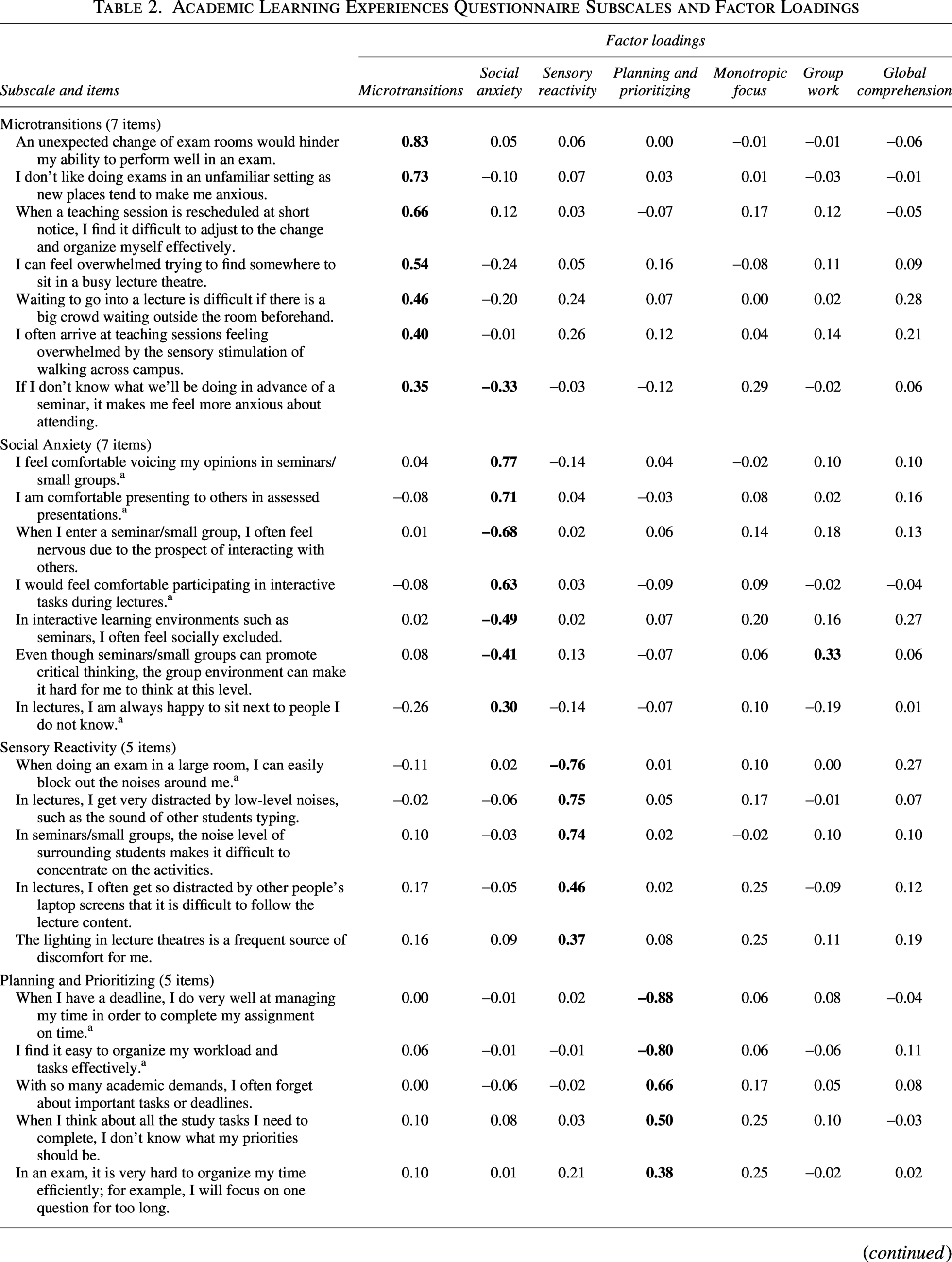
Factor loadings with an absolute value ≥ 0.30 are shown in bold.
Reverse-scored items.
Items removed during measurement invariance analysis.
Fourth, we calculated the internal consistency of each ALEQ subscale in the MI Sample, by obtaining Cronbach’s alpha, again using the psych package.
Stage 2: Group differences
In Stage 2, we tested the hypothesized group differences in the MI Sample by fitting a series of robust linear models (t-tests) using the robust package (version 0.7–4) in R. 65 In each model, group membership (autistic; nonautistic) predicted either mean scores on one of the seven ALEQ subscales identified in Stage 1 or the mean of the composite of all ALEQ items.
Given the high number of SRS-2 based exclusions from the nonautistic group, we reanalyzed autistic versus nonautistic group differences using the pre-exclusion sample as a sensitivity check.
Results
Stage 1: ALEQ validation
Exploratory factor analysis
Polychoric interitem correlations revealed no signs of multicollinearity (│ρ│ < 0.80). Several interitem correlations were weak (│ρ│< 0.30), which was unsurprising given the ALEQ was designed to tap a diverse range of broadly defined constructs. Aiming to preserve this breadth while obtaining solid factors, we removed eight items that failed to correlate moderately (│ρ│ ≥ 0.30) with at least three others. We also removed one item with skew >1. The reduced correlation matrix was significantly nonzero [χ2(741) = 9032.35, p < 0.001] and displayed excellent Kaiser-Meyer-Olkin sampling adequacy (KMO = 0.92), 66 confirming its suitability for EFA.
To estimate the number of factors, we ran a PA with a polychoric correlation matrix and minimum residual (minres) estimator, which we consulted alongside other criteria. PA suggested 12 factors, SABIC suggested eight, MAP suggested four, and the scree plot was unclear. As there was no consensus, we examined each suggested solution using principal-axis factor analysis and oblique oblimin rotation (to allow any interfactor correlations driven, e.g., by autistic traits 67 ). The 4-factor solution was underfactored with nine cross-loading items, and the 8- and 12-factor solutions were overfactored, each with numerous theoretically uninterpretable factors with few items. We subsequently explored a seven-factor solution, which had only one theoretically uninterpretable factor with few items and two cross-loadings, as well as a six-factor solution, which had the same theoretically uninterpretable factor and nine cross-loadings, suggesting it was underfactored. Thus, we retained the seven-factor solution (Table 2; Supplementary Data S2). The seven-factor solution explained 54% of the total variance, with optimal model fit according to RMSEA (0.06, 95% confidence interval [CI] [0.055, 0.064]) and RMSR (0.03), though TLI (0.87) was just below acceptable levels. Interfactor correlations were mostly moderate (│r│ = 0.22–.63), but smaller for the seventh factor (│r│ = 0.03–.19). Note that although there were two cross-loadings exceeding the suggested upper bound of 0.32, 67 both appeared to be theoretically justified, and each factor benefited from at least three non-cross-loading items.
The resulting seven-factor solution (Table 2; Supplementary Data S2) captured academic experience dimensions rather than the academic learning contexts. Factor 1 convincingly captured Microtransitions, encompassing the frequent, small-scale shifts throughout the day, such as moving between spaces or switching tasks, that can be particularly challenging for autistic students due to their impact on sensory processing, social demands, and adaptability. Factor 2 captured Social Anxiety caused by the need to engage with others in various learning contexts, such as lectures. Factor 3 captured Sensory Reactivity, which is characterized by situations in which cues in the academic environment can cause discomfort and/or distraction while learning. Factor 4 captured Planning and Prioritizing, which covered the organization of a student’s academic workload. Factor 5 captured Monotropic Focus, which reflects an intense, detail-focused style of attention, where concentration on one idea or aspect can make it difficult to shift focus or update understanding when new information appears. Factor 6 captured Group Work, particularly the preference to work individually, rather than feelings of discomfort, which are captured by Factor 2. Finally, Factor 7 appeared to be picking up on the ability to perceive the overall structure and meaning of information, connecting ideas and adapting to new angles or questions aligning with Global Comprehension. However, it only contained three items, accounting for just 3% of the total variance, and was not well-correlated with other factors.
Confirmatory factor analysis
We conducted CFA on the retained EFA solution (Table 2) using the remainder of the sample (n = 415). We fitted the model using polychoric correlations and the corresponding DWLS estimator and allowed the latent factors to correlate. The model converged and did not provide an improper solution. Most (scaled) global fit statistics were good, but not excellent: χ2(573, N = 415) = 1832.91, p < 0.001, CFI = 0.90, TLI = 0.90, RMSEA = 0.073, SRMR = 0.069. In terms of local fit, all items loaded strongly (≥|0.35|) onto their respective latent factors.
Measurement invariance
The configural model converged and did not produce an improper solution. Most (scaled) global fit statistics were acceptable, with RMSEA indicating excellent fit: χ2(1146, N = 570) = 2085.85, p < 0.001, CFI = 0.90, TLI = 0.89, root mean square error of approximation (RMSEA) = 0.054, standardized root mean square residual (SRMR) = 0.074. One item from Factor 6 (“I am often compelled to do more independent research on the topics that I am interested in”) no longer loaded (<0.01) onto its respective factor and had an R2 < 0.007 in both groups, so we removed this item and refitted the model. Another item (“By collaborating with others in seminars/small groups, I make intellectual breakthroughs that I could not achieve alone”) showed a loading of 0.08 (R2 = 0.006) in the nonautistic group and 0.52 (R2 = 0.27) in the autistic group. As this item contributed little to the nonautistic group and could distort model fit, it was also dropped. In the refitted configural model, global fit statistics improved slightly but remained broadly similar, with continued strong RMSEA: χ2(1012, N = 570) = 1873.83, p < 0.001, Comparative Fit Index (CFI) = 0.90, TLI = 0.90, RMSEA = 0.055, SRMR = 0.072. These results support configural invariance and justify proceeding to tests of metric invariance.
The metric model (constraining all factor loadings to equality across groups) also converged and did not produce an improper solution. Model fit was equivalent or slightly improved relative to the configural model: χ2(1039, N = 570) = 1885.73, p < 0.001, CFI = 0.91, TLI = 0.90, RMSEA = 0.054, SRMR = 0.077. Local fit was also acceptable, with all items showing at least moderate loadings (>|0.37|) in both groups. A scaled chi-square difference test indicated a statistically significant difference between the metric and configural models: χ2diff(27) = 77.40, p < 0.001. However, the change in CFI (ΔCFI = + 0.01) was within recommended thresholds. Together, these results support metric invariance, indicating that the factor loadings were equivalent across groups and that the items were interpreted similarly by autistic and nonautistic students.
The scalar model (constraining thresholds to equality across groups) also converged without improper solutions, but model fit decreased slightly: χ2(1134, N = 570) = 2238.82, p < 0.001, CFI = 0.88, TLI = 0.88, RMSEA = 0.059, SRMR = 0.073. The scaled chi-square difference test comparing the scalar to the metric model was statistically significant: χ2diff(95) = 345.65, p < 0.001, and ΔCFI = −0.03, exceeding the cut-off for invariance violations, suggesting at least some items violated the equal-threshold assumption. We therefore explored partial scalar invariance by iteratively freeing threshold and then loading constraints based on modification indices. However, even after freeing 24 thresholds and 12 loadings, global fit indices did not improve sufficiently to meet conventional cut-offs (e.g., CFI < 0.90, ΔCFI still > 0.01). Thus, neither full nor partial scalar invariance could be established. The same pattern of results was observed in our sensitivity analysis where configural and metric invariance were supported, whereas scalar invariance was not. This indicates that the primary conclusions regarding MI were robust to group definition (see Supplementary Data S3).
Metric invariance indicates that the ALEQ measures the same underlying constructs in autistic and nonautistic students, allowing meaningful comparison of the structure of learning experiences across groups. However, because scalar invariance was not achieved, group differences in ALEQ scores cannot be interpreted as unbiased estimates of latent mean differences. Accordingly, Stage 2 reports observed score differences across groups as descriptive indicators of how learning experiences are reported and distributed across academic domains, rather than as precise estimates of latent trait differences.
Internal consistency
We evaluated the internal consistency of the ALEQ’s subscales using Cronbach’s alpha. After adjusting for reverse-scoring (see Table 2), the overall scale was highly reliable (α = 0.94). Factor-level α values also demonstrated good to excellent reliability for most subscales: Microtransitions = 0.88, Social Anxiety = 0.83, Sensory Reactivity = 0.87, Planning and Prioritizing = 0.80. The Monotropic Focus subscale showed acceptable reliability (α = 0.70), though caution may be warranted due to the small number of items. Internal consistency for the Group Work (α = 0.66) and Global Comprehension (α = 0.59) subscales was lower, which is not uncommon for brief scales and may also reflect greater item-level heterogeneity. We advise interpreting these latter subscale scores cautiously, especially if used independently.
Stage 2: Group differences
Group difference analyses indicated a statistically significant difference between autistic (M = 3.86, SD = 0.51) and nonautistic (M = 2.77, SD = 0.53) in overall ALEQ scores, t(568) = 23.04, b = 1.12, p < 0.001. We also found statistically significant group differences in each of the ALEQ’s subscales. Specifically, and as demonstrated in Figure 1, compared with the nonautistic group, the autistic group experienced greater challenges with Microtransitions, t(568) = 23.34, b = 1.63, p < 0.001, Social Anxiety, t(568) = 11.84, b = 0.83, p < 0.001, Sensory Reactivity, t(568) = 23.32, b = 1.60, p < 0.001, Planning and Prioritizing, t(568) = 9.53, b = 0.78, p < 0.001, Monotropic Focus, t(568) = 14.80, b = 1.02, p < 0.001, and Group Work, t(568) = 17.67, b = 1.28, p < 0.001. The autistic group also showed a significantly greater difficulty with Global Comprehension, t(568) = 7.72, b = 0.56, p < 0.001. These results should be interpreted as potential experiential differences rather than differences in underlying latent traits, because scalar invariance was not established.
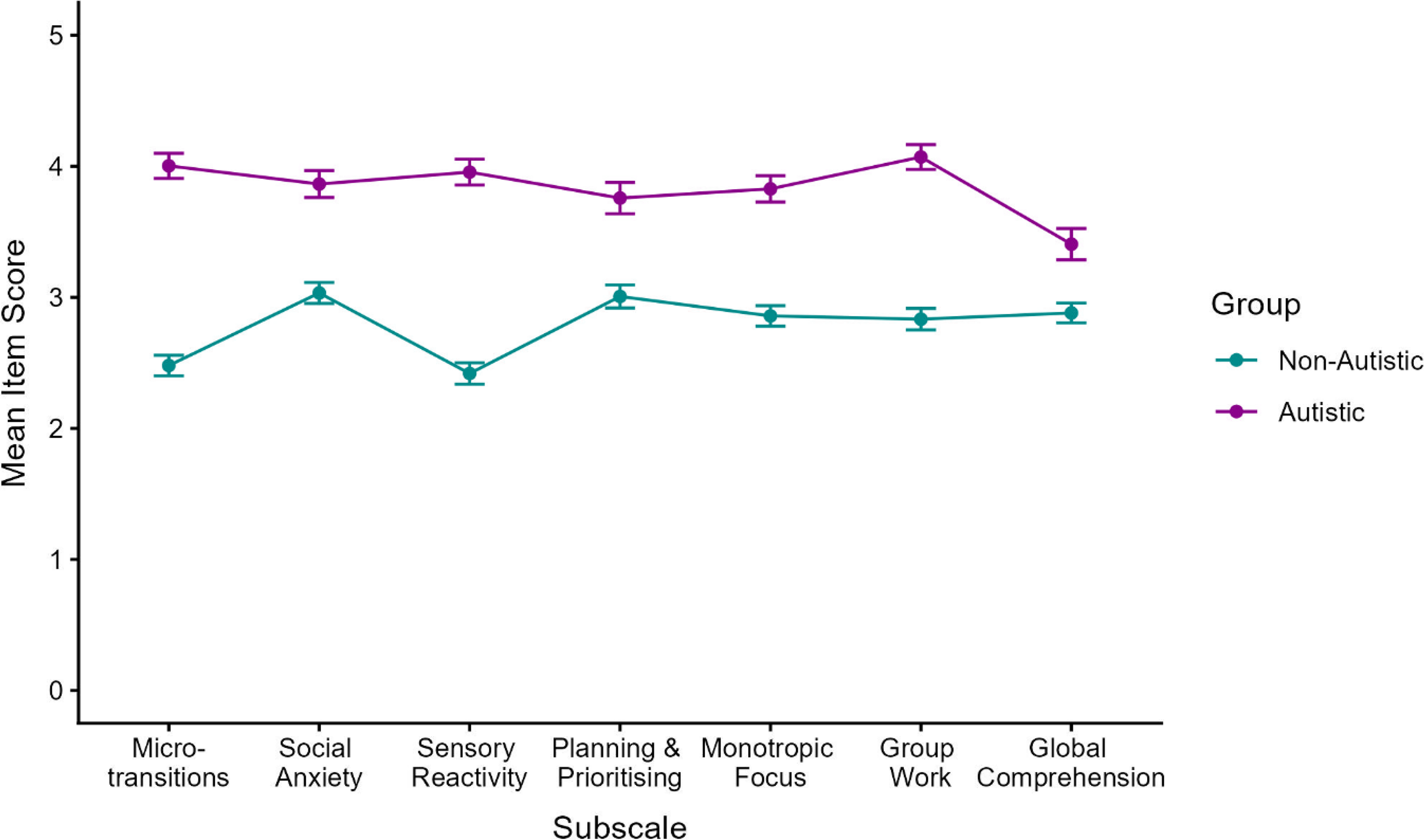
Mean ALEQ subscale scores for autistic and nonautistic students. Error bars represent 95% confidence intervals.
Our sensitivity analysis indicated that the SRS-2 exclusions (see Supplementary Data S4) did not alter our core conclusions about which group experienced greater challenges. However, the difference in group means was reduced across all subscales.
Discussion
The current study aimed to develop a questionnaire for investigating the academic learning experiences of autistic and nonautistic university students, which could serve as both a practical tool for educators and a psychometrically robust research measure. Following a three-step validation process, the ALEQ contained 34 items across seven subscales. Group difference analyses using the ALEQ revealed that autistic students reported significantly more challenges than nonautistic students overall and across all seven subscales, highlighting key areas where university environments may not be optimally designed to support autistic learners.
Validation of the ALEQ
Psychometric testing confirmed that the ALEQ successfully captured multiple dimensions of academic learning experiences. Our EFA produced seven factors with theoretical relevance to autistic students, each containing at least three items: Microtransitions, Social Anxiety, Sensory Reactivity, Planning and Prioritizing, Monotropic Focus, Group Work, and Global Comprehension. CFA confirmed this factor solution to have a good fit in a separate sample, and our evidence for metric MI indicates that the factor loadings were equivalent between autistic and nonautistic groups.
The Sensory Reactivity and Planning and Prioritizing factors were particularly well-defined and strongly aligned with existing literature of autistic students’ experiences in HE. Sensory reactivity is cited as a key accessibility barrier by autistic students,12,13,68 often reported to impair focus and trigger feelings of sensory overload, which may be particularly acute in the busy, dynamic learning environments of HE.12,26 The Planning and Prioritizing factor reflects the challenges that autistic students often report with organizing their time and study tasks.11,43 These difficulties align with broader executive functioning difficulties, 69 which can impact task prioritization, workload regulation, and flexible responses to academic demands.
The Microtransitions factor captures a phenomenon that has received little direct attention in the autism and HE literature, despite explaining more variance than any other factor in the ALEQ. Microtransitions refer to frequent, minor shifts in task, activity, or environment that require cognitive, sensory, or social adaptation. 70 While often overlooked in neurotypical contexts, autistic individuals often experience heightened stress during these small transitions, particularly due to monotropism (deeply focused, single-channel attention), intolerance of uncertainty, and sensory sensitivity.71,72 For instance, navigating a crowded lecture hall or adjusting to a last-minute class rescheduling can induce stress, aligning with research on the impact of unpredictability on autistic anxiety. 73 The difficulty of entering new spaces, such as unfamiliar exam settings, further reflects intolerance of uncertainty and reliance on routine for self-regulation. 74 Sensory overwhelm when transitioning across campus echoes findings that unpredictable environmental changes can increase sensory load, leading to heightened distress. 75 The ALEQ’s emphasis on Microtransitions as a distinct challenge highlights a critical area for targeted support strategies such as predictable timetabling, structured transitions, and presession guidance on content changes. The ALEQ now provides researchers and educators with a dedicated tool to investigate Microtransitions systematically, enabling further study of this previously underexplored aspect of autistic students’ learning experiences.
The social aspects of academic learning were split across two factors, namely, Social Anxiety and Group Work. While these experiences are likely to overlap, the Group Work factor appeared to capture a lack of personal motivation and opportunities for group learning, rather than social anxiety per se. It is possible that these experiences are more specific to autism. Specifically, a “double empathy gap” between autistic and nonautistic people 53 may contribute to reduced social interaction between groups,76,77 limiting social connections and group learning opportunities. 7 By the same token, autistic students may report lower motivation to engage in group learning scenarios where they may feel excluded or misunderstood. 78 The Social Anxiety factor, which was more clearly defined, likely taps into clinical characteristics that are prevalent across the university student population, 79 although still more likely to impact autistic students.
Monotropic Focus as a distinct factor aligns with monotropism theory 71 which conceptualizes attention as deep, sustained and often single-channeled. This focus style can support intense engagement and absorption in academic material, yet may create challenges when autistic students have to rapidly divide or switch attention between sources or ideas. Identifying this dimension within the ALEQ highlights how attentional style, rather than deficit, shapes learning experiences for many autistic students.
Global Comprehension appears to reflect the ability to extract overarching meaning and adapt understanding to novel or unfamiliar perspectives. Relative challenges in this domain among autistic students suggest that identifying “big picture” concepts under time pressure or in unfamiliar formats can be more effortful, consistent with research describing differences in information integration.26,40 Together, these two latter factors provide a more nuanced account of cognitive diversity in university learning, illustrating that both depth-focused and meaning-integrative processing styles can influence how students engage with academic demands.
Often overlooked in scale development work, we tested the ALEQ for MI. While scalar invariance was not achieved, metric invariance was supported, indicating that the ALEQ captures the same underlying constructs, with items relating to these constructs in comparable ways across autistic and nonautistic students. Accordingly, group differences in ALEQ scores should be interpreted as reflecting patterns of reported experience across domains, rather than as unbiased estimates of latent mean differences. This interpretative boundary is consistent with the aim of identifying where academic challenges are differentially experienced and reported and still allows the scale to inform inclusive teaching and support practices.
Group differences in academic learning experiences
The ALEQ revealed a consistent pattern in which autistic students reported greater challenges than nonautistic students across all seven subscales. The largest differences were observed for Sensory Reactivity and Microtransitions, indicating that these domains show the greatest divergence in how academic challenges are experienced and reported across groups.
For Sensory Reactivity, this pattern aligns with research demonstrating that autistic university students can struggle with filtering background noise, adapting to fluctuating sensory conditions, and maintaining focus in overstimulating environments.11,13,26 Autistic students may therefore expend additional cognitive effort to regulate sensory input, which can contribute to faster mental fatigue in academic settings. These findings reinforce the importance of sensory-friendly adjustments in HE settings, such as quiet study spaces, captioned lectures, and flexible attendance options, consistent with UDL principles. 54
Similarly, the strong divergence on the Microtransitions subscale is consistent with qualitative accounts of autistic individuals experiencing distress in response to unanticipated changes.26,72,75 Timetabling inconsistencies, unexpected classroom relocations, and rapid changes in lecture format can disrupt executive functioning and increase anxiety, reinforcing the need for greater predictability in academic structures. 74
In contrast, the Social Anxiety subscale showed one of the smaller group differences, despite autism often being characterized in terms of social difficulties. One possibility is that increases in reported social anxiety across the wider student population 80 may reduce the distinction between autistic and nonautistic social experiences. However, the larger divergence observed for Group Work suggests that autistic students may report particular challenges in collaborative settings, where social anxiety may interact with social exclusion, unpredictable group dynamics, and sensory demands. These findings highlight differences in how group-based academic demands are experienced and reported, rather than implying uniform social avoidance. While some autistic students may prefer independent study, many value social connection11,27 and benefit from inclusive, collaborative environments.81,82 Educators should therefore avoid blanket adjustments; instead, class-wide approaches such as smaller group sizes may support constructive engagement without singling out autistic students.
Reported difficulties in organizing academic tasks, as captured by the Planning and Prioritizing subscale, also differed systematically across groups, consistent with previous research on executive functioning differences.42,83 Autistic students more frequently reported challenges with managing workloads, determining task priorities, and adapting study strategies when facing multiple academic demands. Importantly, these challenges should not be construed as reflecting lower academic capability but rather as indicating differences in how academic demands are experienced and managed. These findings point to the value of teaching practices that align with diverse cognitive processing styles, such as structured instruction, explicit task breakdowns, and clear guidance on time management.11,28 As many of these supports are likely to benefit a wide range of students, including those with attention-deficit/hyperactivity disorder, a UDL approach is recommended.
Differences were also found for Monotropic Focus and Global Comprehension. Autistic students reported greater monotropic focus alongside greater difficulty with global comprehension. These patterns are consistent with known differences in attentional style and information processing, and suggest sustained, detail-focused engagement alongside challenges in extracting overarching meaning in academic contexts. In line with monotropism theory, 71 Monotropic Focus and Global Comprehension should be understood as distinct yet complementary dimensions of learning, reflecting depth and persistence of attention versus breadth and adaptability in understanding.
Overall, patterns of ALEQ scores are consistent with current literature demonstrating increased academic barriers for autistic students in HE.7,11 At the same time, the absence of scalar invariance suggests that autistic and nonautistic students may apply different thresholds when endorsing items, even when those items reflect the same underlying construct. In other words, respondents may interpret key terms or anchor their responses to different reference situations. For example, what counts as an “unexpected” change, a manageable level of distraction, or effective adaptation may differ systematically across groups. Where respondents answer with different thresholds or scenarios in mind, mean score differences can reflect not only differences in lived experience but also differences in how response options are used. Interpreted in this way, the ALEQ provides insight into how academic challenges are differentially experienced and reported across domains. By capturing these patterns within a single questionnaire, the ALEQ contributes to a more nuanced understanding of autistic students’ firsthand experiences. 33 Furthermore, the inclusion of self-diagnosed students may provide a more accurate reflection of the autistic student population, particularly reflecting the barriers that women and minoritized groups can face in accessing clinical diagnosis,84,85 and enhancing the ecological validity of these findings.
Limitations and future directions
The current study has its limitations. Practical sampling constraints meant that the autistic group was smaller than the nonautistic group; however, the size of the autistic group (n = 212) was still substantial relative to field norms. 33 In addition, although the nonautistic group was larger, the SRS-2 screening resulted in the exclusion of 42% of nonautistic participants, who scored above the threshold for clinically significant autistic traits. This may reflect undiagnosed autism in the student population and/or the underspecificity of the SRS-2. The SRS-2 has been considered a gold-standard tool, 60 but recent findings show that SRS-2 scores are inflated by anxiety, 86 which could explain the higher scores in nonautistic students. 79 Our sensitivity analyses showed that these exclusions, while increasing the magnitude of group differences, did not alter our core conclusions. Nonetheless, the high exclusion rate warrants further investigation and will be explored in a separate paper.
The reduction in group differences when the excluded (primarily nonautistic) students were retained suggests that many of these students may experience similar academic challenges to those who were classified as autistic in our sample. This highlights a key methodological limitation of group-based designs that rely on diagnostic or self-identification categories, namely that misclassification and boundary cases can inflate apparent group differences and obscure the true continuum of experience. At the same time, this pattern underscores the importance of more inclusive research approaches that capture a spectrum of subjective experiences rather than treating autism as a simple categorical distinction. 87 The ALEQ adopts this dimensional approach and can therefore be used to explore how diverse cognitive styles affect learning across the wider student population, including those who do not identify as, or yet recognize themselves as, autistic.
The ALEQ has some other limitations that future work could address. The Group Work and Global Comprehension subscales each contained only three moderate-to-strong loading items, limiting their stability. Global Comprehension items showed conceptual unity, while Group Work items were less clearly defined, but may relate to concepts such as the double empathy problem. Expanding both subscales with additional items could strengthen their reliability and theoretical coherence. In the meantime, these subscales should be treated as exploratory if scored individually. 88
Another potential limitation is that our aim to situate academic learning experiences in a balance of academic contexts may not have been fully realized. The reduction from 48 to 34 items led to an underrepresentation of independent learning contexts (e.g., self-directed study) relative to collaborative learning contexts (e.g., small-group teaching). Independent study may provide a calmer and more predictable environment where autistic strengths, such as attention to detail, can flourish. 89 Therefore, our reduced item pool may have overemphasized the disadvantages that autistic students face, and future work should explore ways to represent the diversity of HE learning contexts more holistically.
The current study focused on differences between autistic and nonautistic students, but the ALEQ also allows for explorations of diversity within the autistic population. Future work could examine how intersecting factors, such as co-occurring conditions, cultural background, or self-identification, influence academic learning experiences. In addition, further cross-validation work is needed to confirm whether the experiences captured by the ALEQ are equally applicable to non-UK countries, where teaching formats and academic expectations may differ. We further note that this study was not designed to assess concurrent or discriminant validity, and future work should address these aspects to further establish the scale’s validity across contexts.
Beyond research applications, the ALEQ offers a practical framework for change within HE. Disability support teams could draw on their findings to shape more tailored and anticipatory support, while faculties and departments might use them to evaluate the inclusivity of their teaching and assessment practices. At an institutional level, longitudinal use could inform strategic decisions about accessibility, investment, and policy, providing evidence of the real impact of inclusive teaching initiatives. Most importantly, the ALEQ can act as a platform for dialogue, enabling student-staff partnerships that place autistic students’ lived experiences at the center of meaningful, sustained improvement.
Conclusion
The ALEQ is the first measure of autistic university students’ academic learning experiences, offering new insights into how cognitive, sensory, and social factors shape engagement in HE. We established metric MI for the ALEQ, indicating that it captures the same underlying constructs in autistic and nonautistic students and can be used to compare the structure and correlates of learning experiences across groups. Although observed group differences should be interpreted with caution in the absence of scalar invariance, the ALEQ provides a robust research tool and a practical resource for educators and support staff. Its structured subscales allow for both broad institutional analysis and tailored, one-to-one use with students, helping to identify individual learning needs and inform inclusive teaching practices. By focusing on subjective, dimensional experiences, the ALEQ has the potential to advance inclusive practices beyond the constraints of diagnostic categories.
Footnotes
Acknowledgments
The authors would like to thank all students who participated in this research.
Authorship Confirmation Statement
S.A. devised the concept of the study. J.M., S.A., and C.D. developed the pilot and study items and collected the pilot and study data, respectively. S.A., J.M., and C.D. designed and produced the online questionnaires. J.T. and C.D. led the data analysis, and S.A., J.T., C.D., and J.M. drafted the paper. All authors have reviewed and approved the article prior to submission. This article has been submitted solely to Autism in Adulthood and is not published, in press, or submitted elsewhere (see the “Acknowledgements” section).
Author Disclosure Statement
No competing financial interests exist.
Funding Information
The author(s) did not receive any funding for this study.
Supplemental Material
Supplemental Material
Supplemental Material
Supplemental Material
References
Supplementary Material
Please find the following supplemental material available below.
For Open Access articles published under a Creative Commons License, all supplemental material carries the same license as the article it is associated with.
For non-Open Access articles published, all supplemental material carries a non-exclusive license, and permission requests for re-use of supplemental material or any part of supplemental material shall be sent directly to the copyright owner as specified in the copyright notice associated with the article.
