






Abstract
Background:
Autistic adults often encounter barriers in initiating and sustaining romantic relationships, including fewer opportunities to meet partners, elevated social anxiety, and increased vulnerability to rejection or victimization compared with non-autistic people. Digital platforms may offer novel pathways for connection, yet little is known about how autistic users navigate online dating.
Methods:
As part of a larger mixed-methods project, we conducted 20 in-depth interviews with autistic adults (aged 23–54; eight men, 11 women, one nonbinary) who had used dating apps to explore their lived experiences of these platforms. A mixed autistic and non-autistic research team performed reflexive thematic analysis through coding and theme development.
Results:
We developed four major themes through reflexive engagement with participants’ accounts: (1) Dating apps expand social connections: Apps broadened social circles, reduced in-person pressures, and supported active screening for compatibility. (2) Making connections online can come with a cost: Participants described online dating as draining, exhausting, and sometimes harmful due to manipulation, ghosting, and stigma. (3) Disclosing “can go either way”: Disclosing autism served as both identity affirmation and protective filtering, yet also exposed users to stereotyping and rejection; decisions about timing and method were strategic and nuanced. (4) Designing for inclusion and safety: Participants advocated for stronger safety features, richer profiles, and simple guidance or peer supports to improve accessibility and inclusion.
Conclusion:
Online dating offers autistic adults opportunities for connection while also presenting similar social and emotional challenges to offline contexts. Disclosure on dating apps is a nuanced, context-dependent process, and inclusive, safety-centered design can help create more supportive digital spaces.
Community Brief
Why is this an important issue?
Many autistic adults want romantic relationships, but meeting partners can be difficult. Anxiety, communication differences, and limited chances to meet people can make meeting new people hard. Dating apps such as Tinder or Bumble might help because they allow people to communicate online, take time to respond, and get to know each other before meeting in person. However, we do not know much about how autistic adults experience these apps, especially whether they meet new people, feel safe when using apps, and how they decide how and when to disclose their autistic identity.
What was the purpose of this study?
This study explored autistic adults’ use of dating apps. We wanted to learn about the kinds of relationships they formed, what good or bad experiences they have, and how they decided whether to tell others they were autistic.
What did the researchers do?
This project was part of a larger study. In the first stage, 102 autistic adults completed an online survey about dating-app use, disclosure, and victimization (reported separately in another paper). In this paper, we focus on the follow-up interviews we conducted with 20 of the survey participants. We explored their experiences in more depth, including both the benefits and challenges of using apps to form romantic or intimate connections.
What were the results and conclusions of the study?
We developed four themes from the data. (1) Dating apps expand social connections: Participants described dating apps as both helpful and hard. Apps expanded social circles and allowed for text-based communication that reduced anxiety. Many used apps to “filter” for compatible partners or shared interests. (2) Making connections online can come with a cost: The process could be draining, with frequent ghosting, rejection, or manipulation. (3) Disclosing “can go either way”: Disclosure of autism was a major theme: some saw it as an important part of identity and a way to be honest and filter out ableist partners, while others avoided disclosure due to fear of stigma or exploitation. (4) Designing for inclusion and safety: Participants suggested ways to make apps safer and more inclusive, including better verification and moderation, more space for interests and communication preferences, and simple safety guidance or peer supports.
What is new or controversial about these findings?
This study adds to a small but growing body of research on autistic adults and online dating. It builds on earlier work by exploring disclosure decisions, safety concerns, and design suggestions in greater depth. It highlights that autistic people are active, thoughtful users who develop their own strategies, but that current app design often fails to support their needs.
What are potential weaknesses in the study?
Most participants were highly educated and based in Australia, which means their experiences might not represent all autistic adults. People who had some success using dating apps may also have been more likely to participate.
How will these findings help autistic adults now or in the future?
These findings can help autistic adults and those who support them make decisions about online dating. They can also help app designers, practitioners, and policymakers to improve safety, accessibility, and inclusion in digital dating spaces so that autistic people have fairer, safer, and more positive opportunities to connect.
Introduction
Autistic adults often express a strong desire for romantic relationships, 1 yet the path to forming and maintaining these connections can be marked by significant obstacles. Compared to their non-autistic peers, autistic individuals report fewer opportunities to meet potential partners, shorter relationship durations, greater anxiety when approaching new relationships, and increased concern about sustaining them over time.1–3 These barriers may lead to increased isolation, lower self-esteem, and fewer opportunities to develop and practice relational skills. 4 Contributing factors can be found at both individual and societal levels. On an individual level, differences in social communication, elevated anxiety in social situations, 5 distinct emotional regulation patterns, 6 and sensory sensitivities may complicate the navigation of intimate relationships. 7 At a societal level, stigma, discrimination, and media portrayals that reinforce stereotypes about autism further constrain opportunities for meaningful connection.8–11
Online dating apps have created new ways for people to overcome some of these barriers. Consistent with existing research, in this paper, we use the term “dating apps” as an umbrella term to encompass both mobile-based applications (e.g., Tinder, Bumble) and web-based dating platforms as these formats are typically grouped together rather than analyzed separately. 12 Dating apps are now mainstream avenues for meeting partners, with large-scale survey studies showing that online dating has become the most common method for establishing romantic relationships in the United States. 13 These platforms offer users convenience, expanded access to a wider range of potential partners, and increased control over the pace and style of interaction. For many people, including those who face challenges in traditional social contexts, these features can make dating apps an attractive alternative to in-person approaches.
For autistic adults in particular, dating apps may hold both promise and risk. Online environments can create opportunities for controlled and paced communication, support self-expression, and connect individuals with like-minded partners. 14 Some autistic people report that the ability to engage at their own speed, reduce the immediate pressures of face-to-face encounters, and interact within a structured digital format makes online dating more comfortable and accessible.15–17 At the same time, these benefits must be weighed against risks. Autistic people already encounter discrimination, rejection, stereotyping, and victimization across many contexts,18–21 and emerging work suggests these patterns may also occur in online dating spaces.12,22,23
The current study
Although dating apps have become a common way to meet partners, research examining autistic adults’ experiences within these digital spaces remains limited. A recent review found that existing studies have primarily explored patterns of app use or specific barriers such as communication challenges, with most studies relying on survey methods that provide limited insight into lived experience. 12 Qualitative research remains scarce, with little exploration of how autistic adults interpret, negotiate, and make sense of online dating interactions in practice. The current study forms part of a broader convergent mixed-methods project examining autistic adults’ experiences of using dating apps. We collected quantitative and qualitative data concurrently to gain complementary perspectives on online dating experiences. In our previously published quantitative study, 24 autistic adults reported both meaningful opportunities for connection through dating apps and substantial challenges, including harassment, victimization, and uncertainty surrounding disclosure decisions. In the current qualitative study, we build on these findings by exploring in greater depth how autistic adults interpret and navigate these opportunities and challenges within online dating environments.
Methods
Positionality
The research team included autistic researchers, two of whom have had experience using dating apps, and a parent and sibling of an autistic person, bringing diverse lived experiences to the study. The lead author is a non-autistic autism researcher and the parent of an autistic young adult. Her son’s experiences of struggling to meet people and turning to dating apps with limited success have shaped an interest in exploring autistic people’s experiences of meeting others through dating apps. Two members of the research team (V.G. and A.P.) have conducted previous research into victimization predominantly in offline contexts, documenting high rates and significant impacts. This may have heightened our sensitivity to issues of safety, trust, and exploitation when interpreting participants’ accounts. In contrast, one team member, an autistic adult who has had some positive experiences with online dating (C.E.), may have helped us remain attentive to the potential of online platforms. All but one member of the team had also led or contributed to prior research on disclosure decisions, bringing a strong appreciation of the potential complexity and nuance surrounding such decisions in an online environment. All members of the research team have extensive experience conducting and publishing qualitative research across multiple projects, including the use of reflexive thematic analysis and other interpretive methodologies. These collective perspectives informed our approach to the interviews and thematic analysis and likely shaped our interpretation of participants’ narratives.
Procedure
We obtained ethical approval from the Griffith University Human Research Ethics Committee (2025/187). We recruited participants via social media organizational and personal accounts (LinkedIn, Facebook, X), and emails circulated via the research team’s personal and professional networks between April and June 2025 as part of a larger, mixed-methods project. Eligible participants were autistic adults aged 18 years or older (professionally diagnosed or self-identified) who had used dating apps or websites at any time in the past to try to meet a romantic or intimate partner (including casual hook-ups, casual, and long-term relationships). As interviews were conducted in English, we required participants to have sufficient English proficiency to provide informed consent and participate in discussion. We provided a link to an online Participant Information Statement and Consent form, which participants completed before accessing the online survey for the larger project. We have reported on the findings from the survey component in a separate article. 24 In line with recent recommendations for maintaining data integrity in online autism research, 25 we incorporated several proactive measures within the broader survey study to reduce the risk of fraudulent participation. These included built-in Qualtrics security tools such as CAPTCHA and IP duplication prevention, additional validity checks including cross-referencing participants’ reported age with birth year and including two attention-check items, and the use of indirect rather than direct incentives. Specifically, we invited participants to nominate a charity to receive a small donation ($2 AUD) as a gesture of appreciation for participation. We did not advertise compensation for the interview component during survey recruitment. Instead, participants who later completed a follow-up interview received a $50 AUD gift card in recognition of their time and contribution to the interview study. In addition, all interview participants engaged directly with members of the research team via video call, phone, or written correspondence, providing a further level of confidence regarding participant authenticity.
At the end of the survey, 35 participants provided their contact details (via a separate online form) to indicate their interest in participating in a follow-up interview with the research team. We then emailed all 35 who expressed an interest and provided them with the Participant Information and Consent form for the interview component, along with further information. Of these, 15 did not respond to the follow-up email, and 20 agreed to participate in an interview. Consistent with reflexive thematic analysis, we did not recruit to a predetermined sample size or aim for data saturation; instead, we conducted interviews with all eligible participants who expressed interest in the follow-up study.26,27
Participants
Our 20 participants ranged in age from 23 to 54 (Mage = 36.5) and included eight men, 11 women, and one nonbinary person. Table 1 provides further details regarding the age, gender, sexual orientation, and ethnicity of each participant. To protect anonymity, we summarized further participant characteristics only in text: all participants had a professional autism diagnosis; all but one had completed a postsecondary qualification; most resided in Australia (n = 17); and 14 were single at the time of the interview.
Participants
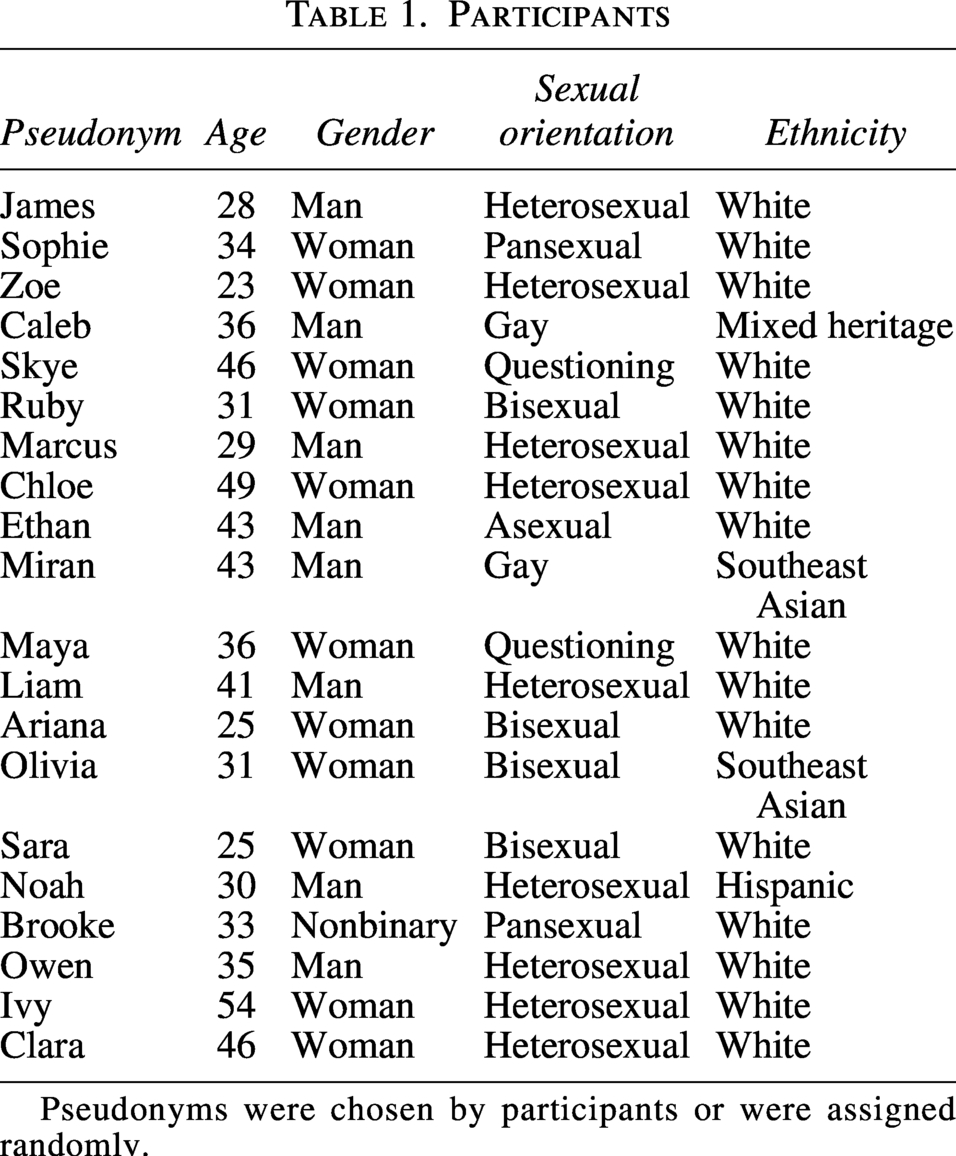
Pseudonyms were chosen by participants or were assigned randomly.
Interview
We offered participants the choice to engage in interviews via phone, video call, or written response, enabling them to select their most comfortable communication method. Three participants shared their experiences via writing, and the remaining 17 connected through video calls. We recorded the audio for each verbal interview, with participants’ prior permission, and used Otter.ai for initial transcription. The lead researcher carefully reviewed and refined each transcript while listening to the audio recording to ensure accuracy. Conversations lasted between 26 and 56 minutes, averaging 34 minutes.
Our interviews were designed to explore participants’ experiences of using dating apps and were conducted by members of the research team. To facilitate open and participant-led discussion, we began with broad questions about their use of dating apps and their motivations for seeking potential partners online. We then invited participants to describe their experiences of meeting people through the apps, including any relationships formed and perceived benefits or challenges. We also explored participants’ approaches to disclosing being autistic, the responses they received, and their views on whether disclosure was advisable for others. Finally, we asked participants about the broader value of dating apps for autistic people and their suggestions for making apps more accessible and inclusive. We include the full interview schedule in the Supplementary Data.
Data analysis
We conducted a reflexive thematic analysis, adopting an inductive approach within an essentialist framework to report the experiences, meanings, and reality of participants.28,29 In line with reflexive thematic analysis, we understood themes as interpretive constructions developed through researcher reflexivity and dialogue.
We imported the interview transcripts into NVivo version 14, and V.G. began coding after initial familiarization with the data, drawing on both semantic and latent coding to identify candidate themes and subthemes. After initial coding, V.G. met with members of the research team based in Australia to discuss and refine the codes. V.G. then emailed the draft thematic framework to A.P. for her input. A.P. provided feedback on theme clarity and organization, which was incorporated to refine and strengthen the coherence of the thematic structure prior to finalizing the analysis. V.G. then reviewed each transcript and collated the data under each theme and subtheme. The research team subsequently discussed and reviewed the draft analysis, making further minor adjustments to enhance clarity and coherence. The analytic process was therefore iterative and reflexive in nature. 29
Results
Participants described a wide range of experiences using dating apps, capturing both the opportunities these platforms provided and the challenges they posed (Fig. 1). Theme 1, “Dating apps expand social connections,” highlights how apps create new pathways for meeting people and reduce social barriers. Theme 2, “Making connections online can come with a cost,” reflects the emotional, cognitive, and safety burdens associated with app use. Theme 3, “Disclosing can go either way,” explores the complex and context-dependent nature of disclosing autism when using dating apps. Theme 4, “Designing for inclusion and safety,” captures participants’ recommendations for platform-level and community-level improvements to promote accessibility, safety, and inclusion. Each theme comprised several subthemes, which we outline below with illustrative quotes from participants.
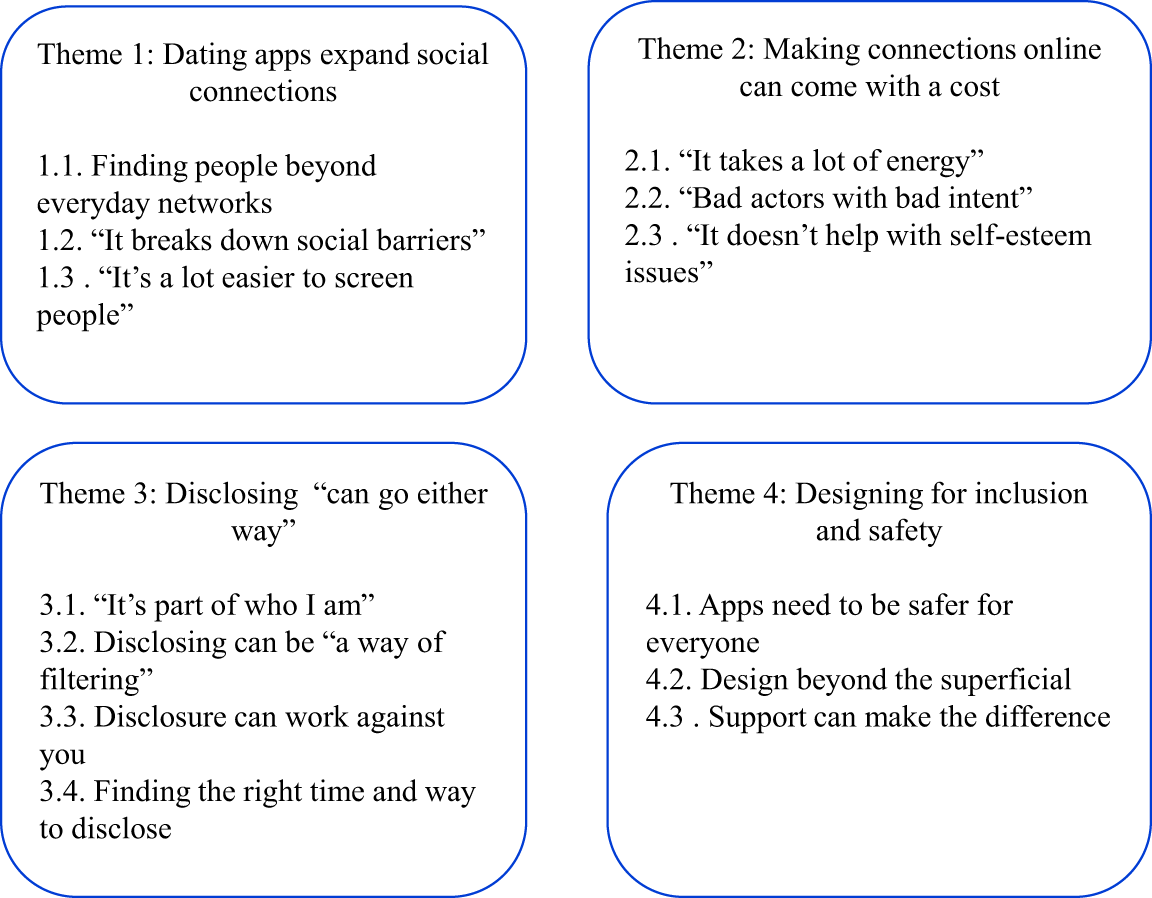
Thematic map of autistic adults’ experiences of dating apps.
Theme 1: Dating apps expand social connections
This theme captures how dating apps provide autistic adults with opportunities, supports, and strategies that make connecting with others more feasible compared with in-person contexts.
Subtheme 1.1: Finding people beyond everyday networks
Participants described apps as expanding access to like-minded or geographically distant individuals, broadening social circles otherwise limited offline. Maya explained that, for someone living in a regional area where there was “no one with my interests, like nobody even vaguely similar to me,” dating apps were the “easiest way to see who’s out there.” Zoe described wanting “to just put myself out there more” but finding this difficult “without the sort of help that the app can give.” Owen similarly felt that apps provided access to a wider pool of more suitable partners because he was “not good at sports or dancing, not interested in drinking,” limiting offline opportunities. Traditional routes of meeting partners, such as being introduced by friends, were not common in the social circles of our participants, with many of their peers already partnered: “apps are just the way the world is now” (Brooke).
Subtheme 1.2: “It breaks down social barriers.”
Participants described dating apps as lowering barriers that made in-person encounters feel daunting. Beginning relationships through text reduced anxiety and gave participants greater control over self-presentation. Clara felt “much better able to express myself through written words” while Skye described being able to “put your toe in a little bit, and gauge how comfortable you are with somebody online.” The asynchronous, text-based format provided safety and predictability before meeting in person. Brooke noted, “being able to do it via text is easier for me,” and James felt “a little bit safer, a little bit more confident…just to text something through.”
Subtheme 1.3: “It’s a lot easier to screen people.”
Participants highlighted how apps functioned as filtering mechanisms, allowing rapid assessment of compatibility and safety. Zoe described the apps as operating “like a filter,” helping her identify people with shared interests quickly. For Sara, this made it “very easy to identify who isn’t a good fit for me.” Participants also used screening to seek out like-minded or neurodivergent partners. Maya examined profiles for signs of shared identity or values: “I will look for flags, either they’ve explicitly mentioned that they’re neurodivergent in some way, or they support a certain cause.” Similarly, Miran noted that he took time to “read people’s profile carefully and see if there’s a match there.” Ariana appreciated being able to “weed out men… that don’t have good intentions,” highlighting how screening supported safety and self-protection.
Theme 2: Making connections online can come with a cost
While dating apps expanded opportunities, they also carried emotional, cognitive, and safety costs. Many participants described apps as draining, exposing, and at times harmful.
Subtheme 2.1: “it takes a lot of energy.”
Participants frequently described using dating apps as exhausting, requiring sustained effort to maintain profiles, swipe through options, and sustain conversations. Maya managed this by scheduling app use: “I set a calendar reminder at 8 pm to check Bumble. Otherwise, I’d end up doom scrolling—it’s so time consuming and takes too much social energy.” Ruby similarly described messaging potential matches as “a part-time job,” with little guarantee of reward and “a lot of energy that I just don’t have to give right now.”
Participants often described messaging as pressured and unrewarding because they spent significant time crafting responses only for conversations to fizzle out. Zoe noted: “Sometimes I’ll spend half an hour thinking of what to say, and then people cut you off if you haven’t answered in five seconds.” Brooke described repeatedly introducing herself as “copying and pasting information about yourself.”
Many reported taking breaks to recover. Owen explained, “you can’t just keep going at full throttle with it… I only try to engage when I’ve got my spirits up.” Others described burnout after one-sided or unfulfilling exchanges, “putting out so much energy into those interactions where I didn’t feel like I was getting anything rewarding in return” (Brooke). Sara reflected on the emotional toll: “There’s been times where it really was impacting, like I was becoming so angry and so negative.”
Subtheme 2.2: “Bad actors with bad intent.”
Participants raised serious concerns about encountering exploitative or manipulative users. Maya described apps as “full of people that are there for self-esteem bumps…bullying and catfishing and manipulation.” Participants worried about being targeted because of their differences. Clara worried about abuse, concluding that “there’s always going to be bad actors with bad intent.” Several participants felt that autistic openness and difficulty recognizing social red flags could heighten vulnerability. Maya explained, “you miss predator signals, you don’t see narcissistic traps as easily” while Ivy noted that disclosing disability might signal to some that someone “is an easier kind of a target.” Chloe similarly feared predators would identify those who were “easily taken advantage of.”
Other participants shared direct experiences of exploitation. Miran recounted someone who “collected all of my personal information… then they start threatening” to misuse it. He also worried that even autism-specific apps could be infiltrated by outsiders with malicious intent.
Subtheme 2.3: “It doesn’t help with self-esteem issues.”
For many, repeated rejection and ghosting 1 left them feeling demoralized. Skye observed that “dating apps are not good for people who’ve got any sort of self-esteem issues,” explaining how unanswered messages or stalled matches prompted relentless self-questioning: “there’s the constant questioning of, well, what did I do wrong.” Marcus found it discouraging that despite getting matches, “people seldom reply when I send a simple hello.” For Ethan, repeated letdowns took the form of no-shows: he estimated “probably about 30 times.”
Ghosting was described as painful and destabilizing, leading to feelings of “depression, sadness or loss” (Miran). James recounted that “you suggest a catch up, and that’s the end of that conversation, and you don’t know what happened.” Sophie observed similar patterns among autistic men she knew who just “keep on getting ghosted.”
Repeated negative experiences eroded resilience over time. Owen described online dating as “incredibly depressing,” while Maya warned that autistic people, who “tend to have pretty shit self-esteem,” were especially vulnerable to being overwhelmed by rejection. Not surprisingly, Sophie emphasized the importance of self-care: “You have to be in a really good place mentally to be able to cope with it.” Skye framed engaging with apps as a calculated gamble: “It’s going to wind up absolutely ripping me to shreds, but I just might find somebody to connect with.”
Theme 3: Disclosing “can go either way”
A central tension for many participants was how, when, and whether to disclose that they are autistic. Within online environments, these decisions were shaped by profile visibility, filtering features, and the possibility of being evaluated or dismissed before any in-person interaction occurred.
Subtheme 3.1: “It’s part of who I am.”
For some participants, autism was an integral part of their identity and something they wanted potential partners to know. Sara explained: “it’s such a big part of me… it affects me every day. So if I want someone to be my life partner… they need to know upfront.” Skye similarly reflected, “It’s part of my identity…and if that’s something that people will turn away from… then that’s not someone I want to be with.” For these participants, disclosure ensured that relationships were grounded in acceptance.
Others viewed disclosure as a way of normalizing autism and setting the tone for how partners would understand it within the relationship. Clara described updating her profile to mention autism as she moved toward greater pride: “I’m disclosing much more often these days.” Ariana emphasized that disclosure could facilitate accommodations and mutual understanding: “then perhaps they can modify the first date… I’ve always preferred walking dates or dates where I don’t have to give them eye contact or where it’s quieter for me.” Similarly, Olivia stated that disclosure mattered because “it’s important for the other person to know… how it impacts your relationship needs [and] potential accommodations.”
Subtheme 3.2: Disclosing can be “a way of filtering.”
In the context of dating apps, disclosure influenced not only how someone might respond but also whether a match or conversation would occur at all. For many, disclosure functioned as a deliberate filter, helping them avoid hurtful encounters and conserve emotional energy. Sara described it as a way “to weed out the people who are immediately ableist.” Similarly, Clara saw it as “a nice way of filtering out people who feel like they might not be able to connect or… have maybe some discriminatory ideas.”
Participants noted that early transparency reduced the sting of later rejection. As Sophie explained, while upfront disclosure might lead to being “swiped past,” it hurt less than investing emotionally before facing “a harsh rejection.” Disclosure also supports boundary-setting and screening for compatibility. Chloe noted that choosing to disclose up front drove away one man, but she reframed this as a success: “like the trash takes itself out sometimes.” Brooke similarly preferred not to match at all with someone unwilling to accept her autism. For others, disclosure felt like a pragmatic way of ensuring matches with those genuinely open to autistic partners: “if somebody can’t deal with that, I’d rather not ever match with them in the first place” (Brooke).
Subtheme 3.3: Disclosure can “work against you”
While disclosure could be a way of fostering authenticity or filtering out unsuitable matches, participants also recognized risks. Ruby stated: “It can really work against you—people make assumptions straight away and you don’t get the chance to show them who you are.” Brooke worried that people might “jump to their own judgments….and not give me a chance.” James feared being dismissed “in a split second.”Noah noted that his online conversations “slowly die off” once disclosure occurred.
Some described stereotyping when they revealed their autism. Sara noted that disclosing often triggered trivializing responses, such as being compared with “maths autism” or reduced to TikTok catchphrases like “neurospicy.”
Disclosure also heightened fears of being seen as vulnerable or easy to manipulate. Zoe worried that disclosing on her profile might signal she was “easy to manipulate,” and Clara echoed this concern, suggesting that “maybe there’s some people out there who go, oh, somebody who’s autistic is automatically going to be vulnerable, and so they might have… nefarious motives.”
Subtheme 3.4: Finding the right time and way to disclose
Participants considered timing and context when deciding whether to disclose. Some preferred to be upfront, disclosing in their profiles or early in conversation, while others worried that revealing too soon could mean “an automatic no” (Skye). As Hanna summarized: “It’s about finding the right moment—too soon and they might bolt, too late and it feels dishonest.”
For many, timing disclosure on dating apps involves weighing safety, stigma, and authenticity. Emma sometimes discloses ADHD before mentioning autism “as a sense check,” while Maya prefers subtle hints rather than outright disclosure, such as noting “neurodiversity rights” under causes supported on her profile, before explicit disclosure. Several participants described choosing to wait until they could gauge the other person’s openness to disability or difference. As Sophie explained, she preferred to disclose in person, so she could “look at body language and how someone reacts.”
Others highlighted disclosure as something best introduced gradually, in context, or only if relevant. Noah avoided mentioning autism “straight up” on his profile but would share “if it seemed relevant.” Miran described disclosing “one at a time,” and Owen embedded subtle references in his profile to signal identity without naming it directly.
Theme 4: Designing for inclusion and safety
Finally, participants offered ideas for improving platforms and for helping autistic people navigate them more effectively. Suggestions focused on platform-level changes (design, moderation, inclusivity) and user-level supports (safety, guidance, community).
Subtheme 4.1: Apps need to be safer for everyone
Participants emphasized stronger safety measures, particularly improved verification, moderation, and reporting systems. Noah noted that requiring government ID verification in some countries increased confidence that “you’re talking to a real person.” Zoe similarly wanted “a better way to sort of understand who people really are,” explaining that stronger verification would make her “feel a lot safer.”
Safety was not just about preventing scams but also about addressing ableist language and harassment. Sara described reporting derogatory remarks, arguing that users should contribute to a safer community: “You can make this place a more enjoyable place for everybody by using the report function.”
Improved moderation was also essential. Owen urged apps to “have better moderation so you don’t run into so many shitty people.” While artificial intelligence could assist with flagging harmful content, participants emphasized the need for human oversight to interpret context and enforce standards.
Subtheme 4.2: Design beyond the superficial
Participants criticized the emphasis on appearance, noting that profiles limited to photos and brief text made it difficult to convey personality. Marcus argued apps could be “more inclusive if [they] didn’t put an emphasis on external aesthetics and made it more oriented around what the person is like on the inside.” James echoed this, noting that apps relied on “a couple of photos” and a short tagline, which was particularly difficult for autistic people who “aren’t very socially aware,” making it “hard to sell yourself in a lot of ways.”
Many proposed features that support richer self-expression. Owen suggested allowing longer posts, noting that “info dumping on our profiles” suits autistic communication styles, and recommended including photos of interests rather than just appearance.
There was also interest in optional neurodivergent matching that preserved privacy. Olivia imagined a hidden field where users could indicate neurodivergence, visible only if both parties shared it. Owen praised one feature where a postmatch pop-up allows users to automatically signal important information upfront to anyone they match with, reducing repeated explanations.
Subtheme 4.3: Support can make the difference
Participants emphasized that both in-app tools to aid conversations and external supports, such as mentors or friends, could make dating apps more inclusive. Clara suggested clearer “guidance for autistic people on red flags or some underlying meanings of words,” alongside practical safety reminders. Zoe felt prompts could help stalled conversations. Ariana imagined AI tools that could help interpret messages and flag risks: “I use ChatGPT to literally interpret every neurotypical conversation I ever have with anyone… that could be a possible feature.”
External networks of support were also viewed as important. Noah recommended involving a trusted friend who can “help with your profile, if you’re going to meet someone on a date, tell someone where you’re going.” Sophie described friends sharing live locations during dates, while Ivy stressed the importance of “a trusted confidante” to help identify warning signs. Liam described how a therapist had helped craft his profile, and Ruby suggested that mentors or support workers could assist in practical ways, such as drafting responses together.
Discussion
This study offers a rich account of how autistic adults engage with dating apps, highlighting both the opportunities these platforms create and the emotional, cognitive, and safety costs they can impose. Participants described apps as expanding access to potential partners and enabling greater control over communication, while also requiring significant effort to manage rejection, ambiguity, and risk. Disclosure decisions were framed as an ongoing, strategic process, serving authenticity and boundary-setting for some, yet risking stereotyping or rejection for others. Participants also articulated concrete platform- and user-level improvements to make online dating safer and more supportive.
Our qualitative findings complement the published quantitative findings from the broader convergent mixed-methods project. 24 Whereas our survey identified patterns of connection, disclosure, and victimization, the interviews illuminate the processes behind those patterns, including how participants carefully weigh authenticity against safety, manage emotional strain, and navigate risk. In doing so, we extend the literature on autistic adults’ relationship experiences by providing detailed insight into how these dynamics unfold within app-based contexts.
The reported benefits of apps, such as access to a broader pool of potential partners, paced/asynchronous communication, and greater control over self-presentation, align with prior accounts that online environments can lower initial social demands.12,14 Consistent with this, many autistic adults report a preference for written or text-based communication that allows time to process and compose responses, which maps closely onto message-driven app interactions. 30 Likewise, special interests can serve as a bridge to connection; identifying and sharing these interests helps initiate and sustain relationships, including romantic ones. 31 Our participants expanded on these ideas by describing how they used text exchanges to build rapport and “filtered” for shared interests or neurodivergent identity when choosing whom to engage with. In addition, several reflected on how they structured their use of apps to manage energy, anxiety, and mood over time. Together, these insights help explain why dating apps can feel more manageable and authentic to some autistic people than in-person encounters.
Despite these potential benefits, participants also highlighted significant costs, describing energy drain, messaging pressure, ghosting, and exposure to “bad actors.” Although such challenges have been reported in studies of the general population,32,33 they may be particularly problematic for autistic adults, who already contend with executive functioning difficulties, stigma, discrimination, and marginalization in daily life.8,18,34 Participants in our study described how repeated experiences of ghosting, no-shows, and rejection were not merely inconvenient but cumulative blows to mood, motivation, and self-esteem. Their strategies (taking breaks, scheduling app time, leaning on trusted others) underscore the emotional labor not only in staying engaged with the apps but also in managing mood and conserving energy.
Our findings show that disclosure on dating apps was not treated as a simple “yes or no” choice, but rather as a careful decision shaped by how, when, and to whom it occurred. Participants described carefully weighing disclosure against competing priorities: the desire for authenticity and acceptance of their whole selves on the one hand, and concerns about dismissal, stereotyping, or exploitation on the other. Once a decision to disclose was made, approaches varied. Some took an upfront stance, others revealed information gradually or indirectly, and many timed disclosure to moments where safety and openness could be gauged. This mirrors broader research on disclosure in employment, education, and social contexts, which similarly highlights both the potential benefits of accommodations, pride, and authenticity and the risks of stigma and exclusion.35–38 However, disclosure in romantic and dating contexts may carry additional interpersonal weight: delaying or withholding disclosure for too long can risk being interpreted by partners as concealment, with potential implications for trust and intimacy. Prior research underscores how fraught this process can be, where autistic individuals have described experiences of rejection, discrimination, and relationship breakdown following disclosure, with some choosing not to disclose at all to avoid stigma or loss of connection. 39 These accounts highlight that while disclosure can foster authenticity, it can also expose individuals to misunderstanding and exclusion, making it an especially challenging issue in intimate relationships. Our study extends previous work by providing a nuanced account of disclosure within online dating contexts, where relational expectations intersect with platform dynamics, anonymity, and rapid rejection. In this space, disclosure served several functions: an act of identity expression, a filtering mechanism, and a boundary-setting strategy, illustrating how autistic adults navigate the need to protect themselves while seeking genuine connection.
Participants’ recommendations included design features such as stronger verification and moderation features, richer profile options such as longer bios and interest-focused formats, optional neurodivergent matching that protects privacy, conversation scaffolds like prompts or question banks, and guidance on red flags as well as safety reminders. While participants acknowledged that users play a role in managing safety and communication, they emphasized that platforms should share this responsibility by embedding inclusion and safety into their core design. Autism-specific platforms such as Hiki have emerged in response to similar concerns; however, our findings suggest that inclusive design principles should not be confined to niche spaces but integrated across mainstream dating environments.
Limitations
This study offers insights into the experiences of autistic people on dating apps, yet several limitations should be acknowledged. The participants were predominantly based in Australia, White, and highly educated. Their experiences may not reflect those of the broader autistic community, particularly those from other cultural or socioeconomic contexts. Higher education levels may also be associated with greater digital literacy, access to resources, and confidence navigating online platforms, potentially shaping both app use strategies and perceived risks. Although we examined variation across gender and sexual orientation in relation to victimization, we did not undertake a systematic intersectional analysis of how gender, sexuality, race/ethnicity, or socioeconomic position may have shaped other aspects of app use, such as disclosure decisions or connection formation. Existing research suggests that these intersecting identities can meaningfully influence exposure to discrimination and relational dynamics in online spaces, and future research should adopt more explicitly intersectional approaches.40,41 In addition, participants self-selected into the study; people willing to discuss dating may differ from those who opted out. Recruitment through social media and professional networks may have favored participation by individuals who had experienced at least some success in forming connections online, while those who had more negative, discouraging, or unsuccessful experiences may have been less inclined to take part. The first author’s perspective as a parent of an autistic young adult who has faced limited success on dating apps may have shaped our interpretations, particularly in emphasizing barriers and safety concerns. Ongoing reflexivity and dialogue across autistic and non-autistic team members helped us critically reflect on these perspectives throughout the analytic process. Finally, only one participant identified as nonbinary, limiting exploration of gender-diverse perspectives. Given the higher prevalence of gender diversity among autistic people 42 and evidence that victimization rates are higher for gender-diverse people in offline environments, 43 future research should prioritize understanding their experiences and safety needs in online dating contexts.
Practical implications
The findings suggest several areas where platform providers could play a constructive role in supporting safer and more inclusive online dating experiences. Incorporating safety-by-design principles such as stronger identity verification, timely and transparent moderation, and clear, accessible pathways for reporting ableist abuse and harassment could enhance user confidence and well-being. Similarly, design features that foster depth and connection, including richer, interest-based profiles, optional fields for communication or sensory preferences, and conversation scaffolds such as prompt banks, may help reduce superficial filtering and ease the cognitive demands of early interactions. Finally, privacy-preserving ways of signaling neurodivergence (e.g., reciprocal opt-in matching indicators rather than public labels) may offer a practical way to promote compatibility while minimizing stigma risk.
For practitioners and other people supporting autistic adults, the results suggest focusing on practical, skills-based preparation and emotional load management. Preengagement planning could help people clarify goals and boundaries, select platforms aligned with those goals, and craft profiles that communicate preferences effectively. Brief coaching or mentoring could support common app tasks (messaging, planning first meetings), while simple safety checklists (public venue, transport plan, letting a trusted person know) can scaffold safer participation. Finally, normalizing ghosting and rejection as common features of app-based dating—not reflections of personal worth—may help sustain motivation and reduce self-blame.
At a policy and research level, the study underscores the value of shared accountability for safety and inclusion. Industry standards on verification, moderation transparency, and accessibility could lift baseline protections for autistic users. Future work should evaluate specific design features, such as interest-forward profiles or reciprocal matching for autistic people, for their effects on inclusion, safety, and connection quality. Priorities include sampling across diverse genders, sexualities, cultures, and regions (including non-metropolitan contexts).
Conclusion
This study highlights the dual nature of online dating for autistic adults—offering opportunities for connection, control, and self-expression, while also exposing users to emotional fatigue, rejection, and safety risks. Disclosure of autism was a central and carefully managed process, balancing authenticity with self-protection. Participants demonstrated agency and adaptability, developing strategies to navigate complex social dynamics online. Their insights point to practical ways of improving inclusion and safety through design features such as stronger verification, clearer reporting pathways, richer interest-based profiles, and privacy-preserving options for indicating neurodivergence. Support from peers and professionals can further enhance confidence and safety. Ultimately, fostering safer, more affirming digital spaces requires shared attention from platform designers, policymakers, and communities. Embedding autistic perspectives in these efforts will help ensure that online dating environments truly enable autonomy, dignity, and meaningful connections for all users.
Footnotes
Acknowledgments
The authors thank the autistic adults who generously shared their experiences and insights.
Authorship Confirmation Statement
V.G.: Conceptualization, methodology, investigation, formal analysis, writing—original draft, writing—review and editing, and project administration. A.M.A.L.: Conceptualization, methodology, investigation, and writing—review and editing. R.Y.C.: Conceptualization, methodology, investigation, and writing—review and editing. C.E.: Conceptualization, investigation, and writing—reviewing and editing. A.P.: Conceptualization, methodology, investigation, and writing—reviewing and editing. The article has been submitted solely to Autism in Adulthood.
Author Disclosure Statement
All authors declare no competing interests.
Funding Information
This research was internally funded by Autism Spectrum Australia (Aspect). All authors, except A.P., conducted the work as part of their employment with Aspect. A.P. contributed on a voluntary basis as part of her academic role at Durham University.