






Abstract
Background:
Researchers increasingly recognize Autistic parents as an important source of insight into Autistic adulthood and family life, yet the perspectives of Autistic people who identify as fathers remain almost entirely absent from research. Fathers have distinct experiences, and the absence of their stories and perspectives limits understanding of Autistic parenting more broadly. Our study addressed this gap by exploring how Autistic fathers understand and experience parenting.
Methods:
We co-produced the study with four Autistic fathers who contributed to design, interview development, and analysis. Nineteen Autistic fathers took part in semi-structured interviews, either spoken or written, depending on their preference. We analyzed the data using reflexive thematic analysis informed by constructionist and participatory research principles.
Results:
Our analysis generated five themes: (1) Finding joy and meaning in everyday moments, which captured the emotional rewards of fatherhood; (2) becoming myself through fatherhood, describing how parenting strengthened self-understanding and Autistic identity; (3) walking the tightrope of family life, reflecting the effort of balancing sensory, emotional, and practical demands; (4) parenting as relational work, showing how fathers negotiated understanding and communication within family relationships and the tension that arose when they felt misunderstood; and (5) parenting in systems stacked against us, highlighting the barriers fathers encountered in services and wider society.
Conclusion:
Autistic fathers’ accounts deepen understanding of Autistic adulthood and family life. Their experiences show that fatherhood can strengthen identity and connection while exposing the limits of systems that rarely recognize Autistic needs. These fathers’ insights call for change in how research, policy, and services engage with Autistic people and their families.
Community Brief
Why is this an important issue?
Parenting can bring great joy as well as many challenges. While there is some research about what parenting is like for Autistic people, Autistic fathers are rarely heard in research or public discussions. Learning about their experiences helps to challenge stereotypes, show their strengths, and make sure support services reflect real Autistic family life.
What was the purpose of this study?
We wanted to understand how Autistic fathers experience parenting.
What did the researchers do?
We worked together with four Autistic fathers who helped design the project, develop interview questions, and review the findings. Nineteen Autistic fathers from across Australia took part. Participants could choose a video, phone, or written interview, depending on what suited them best. We looked for common patterns and themes in their stories to understand what fatherhood means to them.
What were the results and conclusions of the study?
We created five main themes. Fathers talked about the deep joy and meaning they found in everyday family life, such as spending time with their children and watching them grow. Many said that becoming a father helped them understand and accept themselves as Autistic people. At the same time, fathers described working hard to balance their own needs with their family’s needs. They often needed quiet time to recharge and could feel overwhelmed or misunderstood by others. Some said that health, education, and social systems did not recognize their needs as fathers, often focusing instead on mothers or assuming all parents are non-autistic.
What is new or controversial about these findings?
This is one of the first published studies to look specifically at Autistic fathers, which brings attention to a group that has been almost completely missing from previous research. The findings challenge long-standing stereotypes that Autistic people lack empathy or cannot be caring and capable parents. The fathers in this study also described parenting, including parenting Autistic children, as a source of joy, connection, and shared understanding. This perspective is still far less common in public discussions, which often focus only on stress or difficulty. Our study also shows that many services and programs are still organized around non-autistic or mother-focused ideas of parenting. As a result, Autistic fathers often feel overlooked or unsupported.
What are potential weaknesses in the study?
Our study involved a small group of Australian fathers, most of whom were highly educated and White. Different researchers or participants might produce different insights, and future studies should include more diverse families from different cultures.
How will these findings help Autistic adults now or in the future?
Our study helps make Autistic fathers visible in both research and everyday life. It offers insight that professionals in health, education, and family services can use to better understand and support Autistic parents. By listening to Autistic fathers, we can build systems and communities that recognize them as capable, caring, and valued members of their families.
Background
Becoming a parent involves a major life transition, involving shifts in identity, responsibility, and family relationships. 1 Research on fatherhood shows that this transition is emotionally significant, with fathers describing heightened vulnerability and self-reflection as they negotiate new caregiving roles and responsibilities within family life.2–5 Fathers commonly describe parenting as both deeply meaningful and demanding, as they balance expectations to provide financially, be emotionally available, and take an active caregiving role while navigating dominant norms of masculinity.4,6–8 Despite growing discussion of involved fatherhood, many fathers continue to report feeling marginalized within perinatal, parenting, and workplace systems, which largely prioritize maternal norms of care and offer limited recognition of fathers’ well-being and support needs.8–11 Yet, autism researchers have rarely examined these broader experiences of fatherhood in studies of parenting.
Autism and parenting research
When researchers have examined parenting in autism research, they have most often used study designs focusing on families raising Autistic children and have historically framed autism as a source of strain. Recent reviews have focused on child behavior,12,13 parental stress, 14 perceived burden, 15 and coping. 16 While this work has been vital in identifying challenges and informing practical and emotional support, it has also tended to construct autism primarily through a deficit lens, portraying it as a stressor within family life rather than, as neurodiversity approaches propose, 17 a form of human diversity that can also enrich family relationships.
More recently, researchers have begun to focus on Autistic parents themselves, marking the emergence of a distinct and much-needed field of inquiry.18,19 This body of research demonstrates that Autistic people are active, reflective parents whose experiences encompass both profound rewards and significant barriers. Across studies, Autistic parents describe parenting as a source of joy, meaning, and identity, characterized by deep emotional bonds and a sense of shared understanding within their families.19–22 At the same time, they report encountering systemic challenges, including stigma, inaccessible services, and a lack of recognition of Autistic communication and sensory needs when engaging with health care, education, and social systems.22–25 Many also highlight the social isolation that arises from difficulties connecting with other parents or finding autism-affirming peer support.18,19
Given the strong heritability of autism, 26 it is perhaps unsurprising that many of these studies focus on families in which Autistic parents are raising Autistic children. This research has begun to describe the strengths and rewards within such families, challenging long-held deficit views. Autistic parents often describe deep bonds with their Autistic children, marked by mutual understanding, shared ways of seeing the world, and moments of joy.20–22,27
However, this emerging literature has been uneven in its focus. Most Autistic parenthood research to date has focused on Autistic mothers with a focus on the perinatal period. Studies of pregnancy, childbirth, and early parenting experiences have provided valuable insight into sensory, communication, and emotional dimensions of Autistic parenthood.23,28–31 Collectively, these works highlight the need for autism-informed perinatal care and demonstrate both the strengths and the challenges Autistic women encounter when interacting with health and maternity services. However, by concentrating primarily on birthing experiences, this literature leaves major gaps in understanding parenting beyond early childhood and the perspectives of non-birthing Autistic parents. The voices of Autistic people who identify as fathers, whether cisgender, trans, or non-binary, remain almost entirely absent.
Autistic fathers: An overlooked perspective
Recent systematic reviews confirm that no peer-reviewed studies have specifically examined Autistic fathers’ experiences of parenting.18,19 The only known empirical investigation is an unpublished dissertation by Turner, 32 who conducted interviews with nine Autistic fathers in the United Kingdom. Turner 32 found that fatherhood was deeply meaningful yet often challenging, shaped by sensory sensitivities, family dynamics, and the value of connecting both with other Autistic fathers and with their own Autistic children through a shared neurotype. This small but important contribution underscores how little is known about Autistic fatherhood and highlights the need for further exploration of fathers’ lived experiences across the lifespan.
Current study
Parenting is central to many Autistic adults’ lives, yet the experiences of those who identify as fathers remain almost invisible in research. Their perspectives are vital for developing a better understanding of Autistic family life and for creating resources that reflect the diversity of Autistic parenting identities. To address this gap, this exploratory qualitative study asked: How do Autistic fathers experience and make sense of fatherhood?
Method
Positionality
We co-produced our study with a team of four Autistic fathers, whose lived experience informed the direction of the project from its inception. Consistent with co-production principles described by den Houting, 33 we engaged the advisory team as equal partners throughout the research process. We assembled the advisors prior to study design, and they guided the development of the research scope, identified priority areas for understanding Autistic fatherhood, and contributed to the development of the interview questions. The Autistic advisors included fathers of children ranging from early childhood through to adulthood and represented diverse professional backgrounds, including both autism-related roles and other fields.
The lead researcher identified as an Autistic man but was not a parent. He led engagement with the advisory team and met with them prior to involving the broader research team to ensure their perspectives shaped key aspects of the study. This positionality informed analytic decisions, including an emphasis on remaining close to participants’ expressed meanings and seeking ongoing input from Autistic fathers during interpretation. Our advisors also reviewed study materials and provided feedback on the interview protocol. We offered each advisor co-authorship in recognition of their substantive contributions and compensated them for their time and expertise.
The broader research team comprised researchers with training in psychology and/or education, including two psychologists working in the perinatal space who support parents, including Autistic fathers, during pregnancy and early parenthood. The team also comprised autism researchers and clinicians, as well as individuals with personal connections to autism, including a parent and a sibling of an Autistic person. Throughout the research process, the team engaged in ongoing reflexive discussions to consider how members’ professional backgrounds, lived experiences, and assumptions might shape the research process and interpretation of findings.
Procedure
We obtained ethical approval for this study from the Griffith University Human Research Ethics Committee (2025/345). To recruit participants, we shared promotional materials, including a link to the background survey, through Aspect’s (Autism Spectrum Australia’s) social media channels and mailing lists, as well as via the personal and professional networks of the research team. Interested individuals first completed a brief background survey hosted on Qualtrics to determine their suitability for the study and gather demographic information. To be eligible, participants needed to be Australian adults who identified as Autistic (either through formal diagnosis or self-identification) and as a father or dad. This included biological and non-biological fathers, as well as trans and non-binary individuals who use the term “father” or “dad” to describe their parenting role. Given our exploratory aim, the absence of prior research to guide more targeted sampling, and input from the Autistic father advisory team, we placed no restrictions on the age of participants’ children, allowing inclusion of fathers parenting children across a wide age range.
In total, 37 people accessed the background survey. Of these, four were ineligible, six were identified as potential bots or scammers using Qualtrics’ security features, and one was unavailable during the data collection period. We invited the remaining 26 to take part in an interview, and 19 agreed to participate. All data collection took place during July 2025. We removed all identifying details during transcription and assigned each participant a pseudonym to protect their confidentiality.
Participants
Nineteen Autistic fathers participated in our study (ages 29–61). Participants reported having between one and four children (M = 1.79, standard deviation [SD] = 0.85). Across our sample, participants described experiences related to 34 children, whose ages ranged from 2 to 26 years (M = 13.56, SD = 6.41). Thirteen participants (68%) reported having at least one child who was Autistic (see Table 1).
Participant Demographics
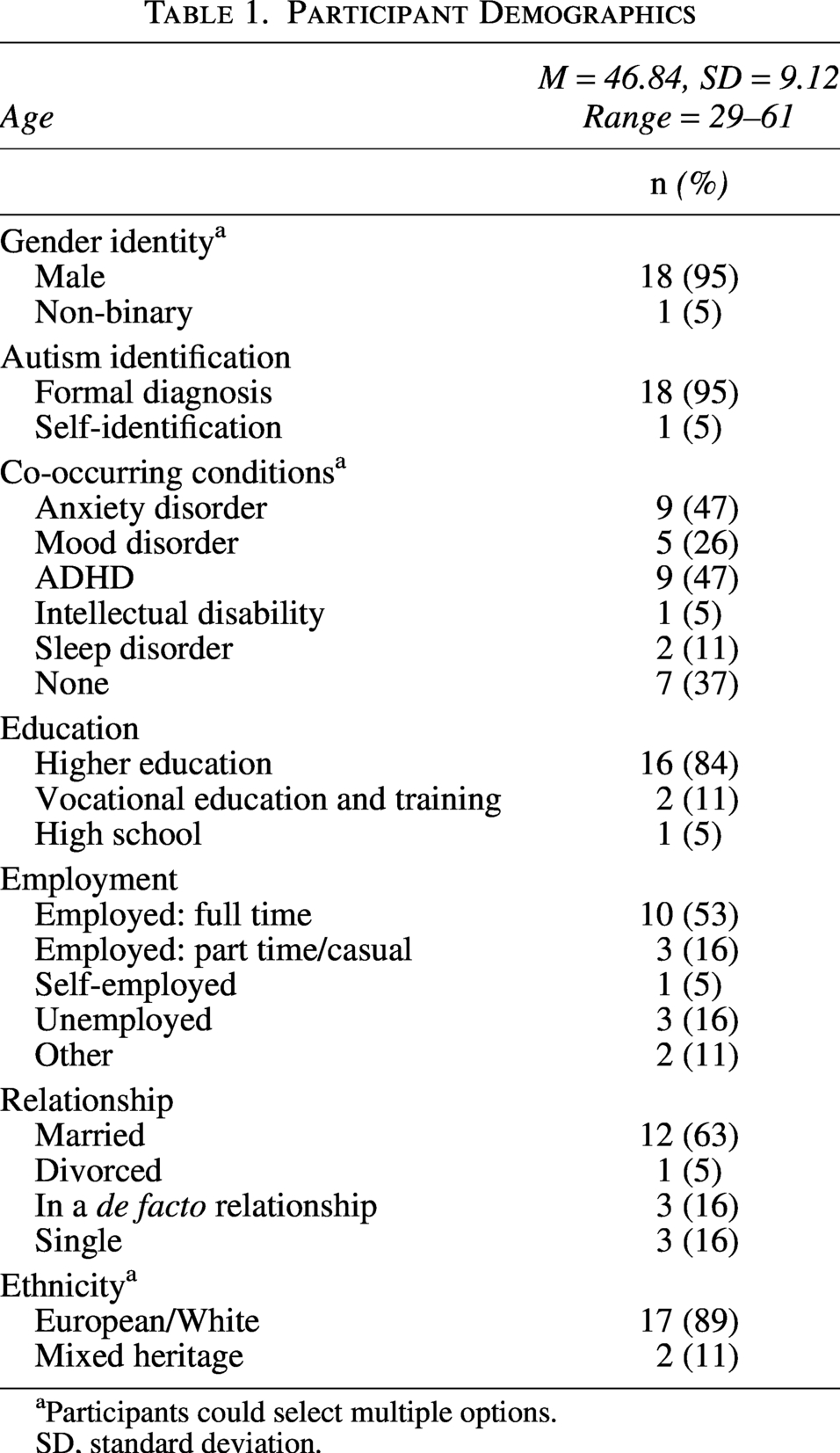
Participants could select multiple options.
SD, standard deviation.
Interview
We developed a semi-structured interview schedule (see Supplementary Data) to explore the parenting experiences of Autistic fathers. In line with recommendations from our advisory team, we designed the interview questions to capture broad reflections on fatherhood, alongside more focused questions related to topics of interest. Given the limited existing research on Autistic fatherhood, this broad and exploratory scope was an intentional design choice, consistent with our constructionist 34 and experiential approach, 34 and we did not design it to test or apply a single predefined model of parenting or fatherhood. Guided by our co-production approach, 33 we selected questions to reflect the priorities and lived concerns identified by Autistic fathers themselves, ensuring that interviews centered on issues most meaningful to participants. The interview schedule covered Autistic identity, participants’ own childhoods, parenting strengths and challenges, sensory experiences, family relationships, and interactions with services.
We provided the full interview schedule to all prospective participants in advance to support informed consent and accommodate individual communication preferences. Participants could choose to complete the interview via video (Microsoft Teams), phone, or in writing. The lead researcher, an Autistic man, conducted all interviews to support consistency and rapport across formats.
The lead researcher conducted 13 interviews via Teams and one via phone, with an average duration of 48 minutes. The first author reviewed and corrected transcripts while listening to each audio recording to ensure accuracy and clarity. Five participants opted to provide written responses via email, and their responses averaged 1454 words in length. For these participants, this included follow-up emails with the first author, seeking clarification and elaboration to ensure the same depth of engagement as in verbal interviews. We provided all participants with a $50 (AUD) gift card as a token of appreciation for their time and contributions.
Data analysis
We analyzed the data using Braun and Clarke’s six-phase approach to reflexive thematic analysis,35–37 and the first author conducted all coding using NVivo 15 to support data management and coding. A constructionist epistemology 34 and an experiential orientation 34 underpinned our analysis, which aimed to capture how Autistic fathers made sense of their parenting experiences. Given the exploratory nature of the research and the limited existing work on Autistic fatherhood, we adopted an inductive approach so participants’ accounts could ground the themes. Although we used both semantic and latent coding, the analysis prioritized semantic coding by focusing on participants’ explicit language and self-described meanings, rather than inferring underlying motivations or theoretical explanations beyond what participants articulated in the data. We took this approach to remain close to Autistic fathers’ accounts, particularly given the lead researcher’s position as an Autistic researcher but not a parent.
Following initial coding, we shared preliminary codes and candidate themes with the Autistic father advisory team via their preferred mode of communication (online meetings or email), using written summaries of candidate themes, illustrative data extracts, and proposed thematic structures. We then discussed these materials with members of the wider research team in a meeting and subsequently revisited them with the Autistic father advisors. These reflexive discussions informed the development, refinement, and naming of themes, ensuring that the final analysis prioritized and elevated Autistic fathers’ voices.
Results
Our analysis of interviews with 19 Autistic fathers generated five themes, as shown in Figure 1: (1) Finding joy and meaning in everyday moments, (2) becoming myself through fatherhood, (3) Walking the tightrope of family life, (4) parenting as relational work, and (5) parenting in systems stacked against us.
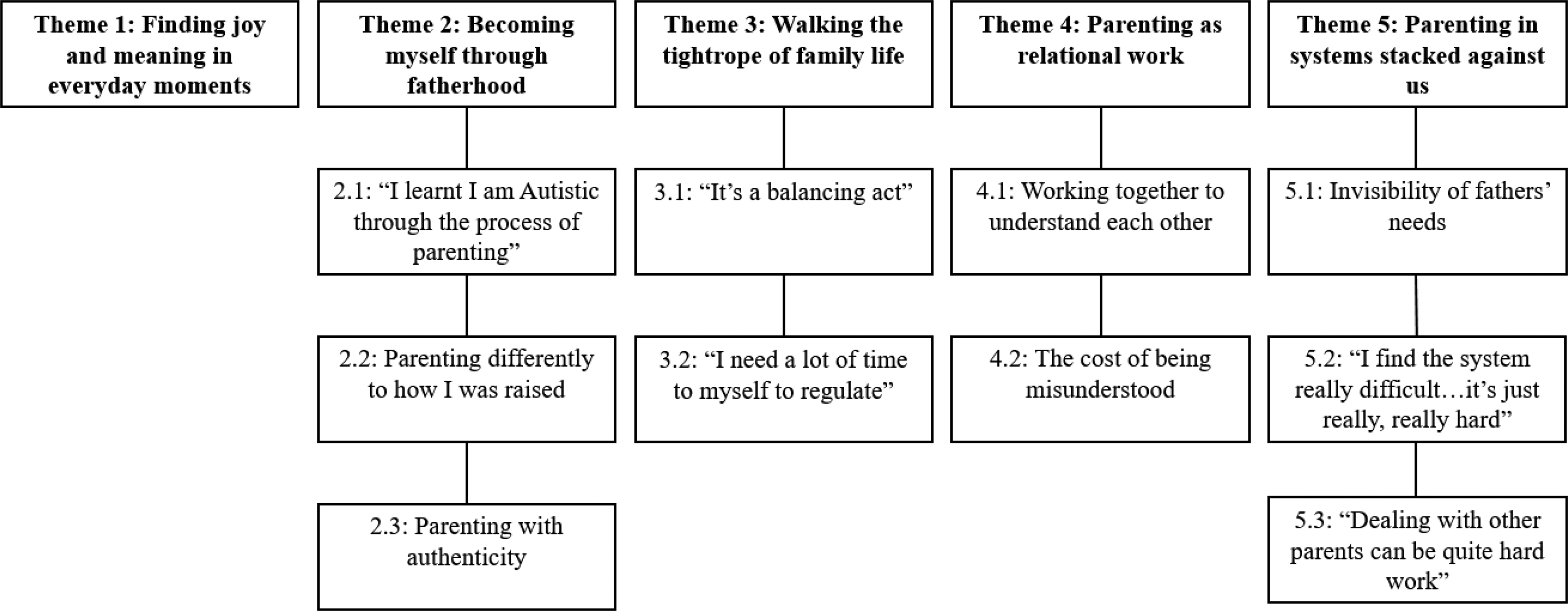
Thematic Map of Parenting as an Autistic Father.
Theme 1: Finding joy and meaning in everyday moments
Autistic fathers in our study described experiencing fatherhood as deeply meaningful through an appreciation of everyday moments, where simple interactions carried a sense of connection and significance. These moments were central to how fathers experienced and made sense of parenting. As Luca reflected: I think I appreciate a lot of the simple things in life and get a lot of joy out of, I guess even just this morning for example, just going for a walk with my wife and daughter and the dogs and just like really appreciating those special moments… I really love, love my life… treasure so much being an Autistic parent.
Luca’s account highlights how fathers found meaning in being present within ordinary routines, with fatherhood experienced as something grounded in these small, shared moments. Similarly, Connor described the significance of “looking at your kids and observing your kids and seeing, you know, the parts of you or the parts of your partner that are coming out in them, and that’s amazing.” Fathers also described actively creating these moments of connection through play and shared experiences. As Asher explained, “I love creating games… the daggy (silly or playful) stuff that young kids enjoy, like silly voices… I’ve really been able to embrace all that.” Asher’s account highlights how fathers not only found joy in everyday moments but also intentionally created, describing a sense of freedom in engaging in playful, embodied interactions with their children.
Participants also emphasized that their experiences of joy were often tied to valuing what others might overlook. Joel, the primary caregiver of a child with disabilities, explained that: We don’t take things for granted. So, what most parents would take for granted. It’s like the big win and a big challenge to get to some places for us. So, everything’s celebrated as a win. Even things that other people think, well, what’s a big deal? It is all a big deal.
Joel’s account suggests that meaning-making involved a shift in how success and progress were understood, with everyday achievements taking on heightened importance. Despite recognizing the demands of parenting, these meaningful moments remained particularly salient. As Cole noted: “[parenting] has its ups and downs… it’s tiring with lots of happy moments. But I think a lot of the time when I look back, I remember all the individual happy moments… but don’t really remember the exhaustion.” Taken together, these accounts suggest that finding meaning in everyday moments was a central way Autistic fathers experienced and made sense of fatherhood, shaping how they understood its value in their lives.
Theme 2: Becoming myself through fatherhood
Being a parent prompted many fathers to reflect on who they were and who they wanted to be, leading to new understandings of themselves as Autistic and reshaping how they approached parenting and relationships.
Subtheme 2.1: “I learnt I am Autistic through the process of parenting.”
For some fathers, the experience of parenting illuminated aspects of themselves that had previously gone unrecognized, prompting their autism journey, particularly through the increased demands and sensory challenges of caring for young children. Luca reflected: I think it was about six months after my daughter was born when I started sort of considering a little bit more seriously my own neurodivergence… I think sometimes the increase in demands… less time that you have to engage in special interests, obviously the sensory challenges that might come from that then might, I guess lead someone to questioning or understanding their own neurodivergence a little bit more.
Similarly, Arden described how everyday parenting situations brought these challenges into sharper focus: By the time we got home [from the party] … I had a meltdown. I just got overwhelmed from all the jumping and the screaming… So, there were a few incidents like that that led my wife to suggest that I might need to talk to someone.
These examples from Luca and Arden illustrate how many fathers began reflecting on themselves through their parenting experiences, ultimately leading to the recognition of their own autism.
For other fathers, this realization emerged specifically through parenting their Autistic children, particularly through recognizing similarities in behavior, needs, or challenges. Blake captured this succinctly, stating, “I learnt I am Autistic through the process of parenting my children and their autism.” Joel elaborated on how parenting his Autistic daughter prompted a reappraisal of his own life history: “It definitely helps you understand. it’s more made me realize what my life was actually like… the light bulb just went off. Now everything makes sense, [like] the challenges I went through as a kid.” For these fathers, parenting an Autistic child did not simply heighten awareness of autism in the present; it enabled a retrospective understanding of their own childhood experiences, reframing earlier difficulties through an Autistic lens.
Subtheme 2.2: Parenting differently to how I was raised
Fathers described how their own childhood experiences shaped their parenting, often motivating them to do things differently with their own children. Some reflected on difficult or unsupportive upbringings, such as “being told quite regularly by my own mother both not to have kids and, later, that I wouldn’t be a good dad” (Drew). Others spoke about rejecting the authoritarian or emotionally distant approaches they had experienced. Joel explained, “I don’t wanna be the same kind of father that my dad was to me,” while Grant shared, “my parents are overbearing, controlling, and very controlling and traditional. I refused to bring up my son like that.” Several participants emphasized a conscious effort to “not repeat mistakes” from their parents. As Connor reflected, “we are trying to improve. We’re trying to do things better.” Vaughn described his determination to show his children the love and affection he had missed, “I never felt loved by him [dad]. I was determined that when I had kids I would shower them with love and affection.” These accounts suggest that fatherhood prompted participants to reflect on their own past experiences, shaping how they understood what it meant to be a father. Rather than simply adopting different parenting practices, fathers described actively redefining fatherhood in response to their own upbringing, with these reflections informing their sense of who they wanted to be as parents.
For some, this determination was tied to a desire to create better opportunities for their Autistic children than they themselves had received: Reflecting back on my life right now… what could have been, where could I have been if I had the supports? Would I have been stable in jobs? … Would I have been successful? … I want better opportunities for my [Autistic] daughter. (Joel)
Similarly, Mark stressed the importance of giving his Autistic child the freedom to be themselves, noting the value of “just trying to let him be him. And that’s probably out of the experience of me not having that.” In this way, fathers’ parenting reflected how they made sense of their own childhood experiences, often involving a conscious effort to become a different kind of parent.
Subtheme 2.3: Parenting with authenticity
Fathers described authenticity as central to their parenting and something they hoped to model for their children. Many spoke about experiencing fatherhood as closely tied to being their authentic selves, shaping how they related to their children and understood themselves as parents. Miles reflected that “being a parent of [an Autistic child] is a really strong driver for that, for me… to be a role model… to be authentic, to show him that he can be him.” For many, this involved openness and honesty within family life. Drew explained that “my wife and I bring a lot of honesty to parenting. Our daughter knows that we say what we mean.” Luca similarly spoke about normalizing difference and acceptance from an early age: “I certainly model and normalize with my daughter about brain differences and sensory accommodations… trying to model that from an early age, I think is really quite important.” This suggests that authenticity was not only something fathers encouraged in their children but also a way of experiencing fatherhood itself, where being open, honest, and accepting of difference shaped their sense of connection within the family.
Authenticity also shaped how fathers related to their children as they grew older. Connor described sharing his own autism diagnosis with his Autistic child: “developing… a relationship and a connection where… there’s a level of understanding of one another… she knows about my diagnosis… so she didn’t feel kind of alone on things.” For Arden, authenticity was expressed in the comfort of being fully themselves at home as “I know they get home from school and they’re dumb because they’ve been pretending to be like the other kids all day. I’m happy when they’re able to be their authentic selves… they’re hilarious and I love hearing it.” In this way, fathers described authenticity as central to how they experienced connection, acceptance, and identity within family life. Taken together, these subthemes illustrate how fatherhood functioned as a catalyst for self-understanding, prompting Autistic fathers to re-evaluate their identities, reinterpret their past experiences, and parent in ways that aligned with their values and sense of self.
Theme 3: Walking the tightrope of family life
Everyday family life involved a constant balancing of sensory, emotional, and practical demands, as fathers worked to sustain equilibrium within their households and themselves.
Subtheme 3.1: “It’s a balancing act.”
Fathers often discussed daily life as a careful negotiation of needs, energy, and sensory space. Asher reflected: We’re [a] very neurodiverse household, and um, we are in a small house with like one living area… trying to find the balance… being in the same space together… managing like my own um and my partner’s needs… it’s, yeah, [a] challenge.
Blake similarly described how “we all have our separate corners of the house that we use. Sometimes the noise/mess/chaos bleeds into another’s bubble and it becomes very stressful… there is a lot of headphone use and negotiating different rooms, lights etc.” Together, these accounts highlight how fathers were constantly negotiating shared space, sensory input, and individual needs within the household, making everyday family life feel like an ongoing balancing act.
For many, the balancing act extended beyond sensory management to the emotional and physical demands of everyday life, such as Spencer who found it difficult to balance “being exhausted (from work) and wanting to spend time with the kids.” Arden shared how family routines could be logistically complex, such as when their children have different sensory preferences with “textures with foods. So, we end up making like 100 different dinners every night because sometimes the chicken nuggets are just wrong. It’s really, really hard.” Arden’s account illustrates the ongoing effort required to manage competing needs, with everyday tasks such as preparing meals becoming a constant balancing act between children’s preferences and fathers’ own limits.
Subtheme 3.2: “I need a lot of time to myself to regulate.”
As part of managing the constant balancing act of family life, fathers described experiencing the need for time alone to regulate, particularly as the ongoing sensory and emotional demands of parenting became overwhelming. Parker explained that having “kids constantly talking Dad, Dad, Dad, Dad, cause they wanna get your attention” can be quite overwhelming from a sensory perspective. For many, creating dedicated spaces or routines was essential to managing overstimulation, such as Mason who created “my own sort of like little computer room which is very helpful for me… when the kids go to bed.”
Fathers recognized that without this recovery time, they struggled to support their children as they wanted to. Luca shared that “if I’m getting more dysregulated myself or maybe not, um, sort of supporting her in the best way, that’s when I know that maybe I’m not taking care of myself.” Fathers often described stress as cumulative, with Arden calling it “the stress lasagna. It’ll just add another layer and suddenly it’s overflowing.” Others highlighted their particular need for solitude, noting that they “really, really need some quiet, alone time that I’m perhaps not getting enough of,” while also acknowledging that “I suppose no parent really gets enough of that” (Cole). Together, these accounts highlight how self-regulation was not simply a coping strategy but a necessary part of sustaining involvement in family life, with fathers needing to actively manage their own capacity in order to remain present and supportive.
Theme 4: Parenting as relational work
Fathers experienced parenting as deeply relational, requiring ongoing negotiation, communication, and emotional work within family relationships.
Subtheme 4.1: Working together to understand each other
Fathers described parenting as a shared process of adaptation and understanding, requiring honest communication between partners. Connor reflected that: [Learning I am Autistic has been] the main topic of certainly my marriage and parenting in the last 12 months, because I think we just realized how much that needed unpacking in terms of what were our differences as individuals and how does that then correspond to different approaches to parenting, different approaches to being in a marriage.
For many, openness and mutual respect were central to maintaining connection. Cole shared that in their relationship with their Autistic partner they: Try very much to be understanding. We are already aware that each other’s facial expressions and mannerisms and our tones of voice may not necessarily reflect how we’re actually feeling… we talk about things a lot. We talk things out.
Gavin described similar communication strategies in “sharing with my partner… we have a really kind of open dialogue.”
Differences in communication were acknowledged but managed with cooperation and flexibility. Drew acknowledged that “my wife and I have different communication styles but we are usually fairly united on important decisions.” For Luca, learning he was Autistic shifted understanding within his marriage as “it has helped in terms of her [wife] understanding me a little bit more… if I get really overwhelmed… my wife can have a greater understanding now.” Parker described how parenting together involved clear structure and sharing the load as “we have set nights that we put the boys to bed and do dinner, so the other one can… recharge their batteries.” This highlights how fathers experienced parenting as a shared responsibility, requiring ongoing communication and cooperation with their partners.
Subtheme 4.2: The cost of being misunderstood
While many fathers spoke of collaboration and mutual understanding when reflecting on their relationships with their partners, some described the strain that came from being misunderstood within other relationships. Elliot shared, “the marriage really broke down. Um, I think a lot stemming from relational challenges from autism, which, you know, meant like I was never really understood and I was misunderstood by, um, my then wife.” For Grant, these relational challenges overshadowed the parenting experience, as “I found my son relatively easy to parent. It was dealing with his mother that was traumatic.”
Some described the exhaustion of having to conceal their Autistic traits to avoid conflict or judgment. Soren explained how he: Had to mask at work, and then I got home and I had to mask at home too, because my wife didn’t understand… the kids didn’t understand, so I behaved like they wanted me to behave. And the only time I could wind down is when they all went to bed.
Miscommunication could be particularly painful in intimate relationships. Elliot described how: Texts were of the devil… they could so easily be misunderstood… I got in trouble because… they were too blunt or the tone wasn’t right. And I could never win… they were very easy to be weaponized, very easy to be misunderstood… I’m still weary of text messages in a loving relationship for that reason.
These accounts underscore how parenting as an Autistic father involved continual relational work, with efforts to foster understanding and shared responsibility occurring alongside the emotional toll when misunderstood in intimate relationships.
Theme 5: Parenting in systems stacked against us
Fathers located their parenting experiences within a wider social context that frequently failed to recognize their strengths or accommodate their needs, reflecting the ways in which societal expectations and institutional systems remain stacked against Autistic parents.
Subtheme 5.1: Invisibility of fathers’ needs
Fathers reflected on the lack of recognition and support for their needs, both as fathers and as Autistic parents. Elliot noted that “no one talks about the birthing experience as a father that’s Autistic… the confronting nature of it. No one talks about, you know, how to deal with changing a nappy when you have severe sensory triggers.” Similarly, Vaughn described being unprepared for the sensory realities of birth, and how they wished “someone had told me what the birthing experience was really like… I was not at all prepared for the real deal—the sights, the sounds and the smells. It was profoundly overstimulating.” Cole recalled how, amid the focus on his partner and newborn baby, his own well-being went unnoticed as “I don’t remember anyone for a couple of days actually asking me how I was doing.”
Joel described how isolating it could be to occupy a role rarely recognized within social or service systems, as a male primary caregiver of a child with disabilities. He reflected that “[my experience] is completely different than everyone else around… [it] can be a very lonely place.” He added that this invisibility extended beyond emotional support to a lack of practical resources as “in terms of dads with disability or dads looking after a child with disability, there’s nothing out there.” These findings describe how fathers’ needs were often overlooked, with limited recognition of both their sensory experiences and their roles within family and support systems.
Subtheme 5.2: “I find the system really difficult… it’s just really, really hard.”
Fathers spoke about the exhaustion of navigating complex and often unresponsive systems, including schools, health services, and bureaucratic agencies. Fathers described these institutional processes as draining, confusing, and frequently unsympathetic to Autistic needs. Asher mentioned the challenges of managing “support… when dealing with… schools and medical and state bureaucracies for like your kids.” Blake similarly reflected, “I can also find it exhausting navigating issues with school and the many issues surrounding that… I have had to interact with schools many times and it is a draining and tedious process.” Grant described how not recognizing his autism until later in life added to the difficulty of navigating systems that were already challenging: “if I knew about my ASD, I think I would have dealt with my son’s mother and the family court system a lot more assertively and confidently.”
Other fathers described experiences of being Autistic dismissed or disbelieved by professionals. Arden recalled that “some teachers are a bit dismissive and think it’s [autism] being over diagnosed… you can instantly tell when you raise it… you just feel dismissed.” Elliot described similar prejudice in medical settings: “there’s been a couple of encounters with like a GP or whatever and you know, you get some of the kind of judgey, archaic views of, you know, well you don’t look Autistic. Or, you know, you can speak.”
Miles noted that privilege shaped how easily one could access help, acknowledging that “I’m from a real place of privilege… if I was a young dad trying to navigate the system, fuck me, you know?” He also spoke to the emotional labor of having to educate others, explaining, “you feel like you’ve got to make them understand. And it’s like, that’s not my job, right? That’s really tiring. You don’t ask the person suffering from the thing to educate everyone about it, right?” This highlights how navigating systems was not only practically demanding but also emotionally exhausting, requiring fathers to manage both institutional barriers and the additional burden of advocating for understanding and support.
Subtheme 5.3: “Dealing with other parents can be quite hard work.”
Many Autistic fathers discussed the social demands that came with parenting and the discomfort of navigating expectations of interaction with other parents. Drew captured this sense of discomfort, explaining how social support spaces felt more like obligations than genuine sources of connection: [My] wife attended a mother’s group when our daughter was born. I preferred to avoid support options that conflicted with my social interaction challenges; as a new dad, the idea of sharing personal stories with dad-strangers in an unfamiliar physical environment seemed more like multi-layered torture than informal peer support.
Gavin similarly described the strain of everyday interactions with other parents, where uncertainty about social rules and fear of negative judgment created additional stress: At a school picnic or whatever, or it’s at soccer… those interactions are quite, um, hard and I don’t really know how to do them and I do wonder how much other parents think I’m a rude asshole… because I just kind of stay to myself… Especially if I’m with one of the kids too, that kind of takes priority.
For some, even well-intentioned participation was experienced as a form of endurance. Arden explained: It’s a chore for me to go and be social. I hate it, but I have to do it… it just causes an awful knot in my stomach… you get lumped with someone and you know they want to talk and it’s horrible.
Vaughn reflected on how this dynamic could easily be misread by others: Autistic fathers who avoid their children’s special events… may not be disinterested or uninvested… it may be that these events are simply too loud and bright, and there is an expectation of superficial social interaction with strangers, all of which can be very overwhelming.
Collectively, these subthemes illustrate how Autistic fathers experienced institutional processes and everyday social expectations as stacked against them, requiring substantial emotional labor simply to access support, understanding, and participation.
Discussion
Our study contributes to emerging research on Autistic parenthood by showing how Autistic fathers experience parenting as a relational and identity-shaping part of everyday life. Drawing on accounts from 19 Autistic fathers, many of whom were also parenting Autistic children (n = 13), our findings highlight fatherhood as a source of joy, meaning, and ongoing self-discovery, while also involving continual work to balance sensory, emotional, and practical demands. Fathers described parenting as deeply relational, shaped by ongoing efforts to understand and support their children and partners, and situated within broader social and institutional contexts that often failed to recognize or accommodate Autistic ways of being. Furthermore, our findings extend prior research on Autistic parenthood by showing that Autistic fathers, like Autistic mothers, experience parenting as a source of joy, meaning, and connection that is central to identity and family life within Autistic family systems.19–22,38
Importantly, our Autistic fathers did not explicitly describe their parenting experiences as fundamentally different from fatherhood in the general population but as shaped and intensified by autism-related ways of being. While fatherhood involves a significant life transition, including shifts in identity, responsibility, and emotional engagement,3–6 fathers in our study described these processes as unfolding alongside heightened sensory, emotional, and relational demands. As reported in wider fatherhood literature, 4 participants reflected on their own parents and fatherhood figures when considering the kind of father they wanted to be. However, for many participants the identity shifts were more autism-specific, as caring for their children drew attention to aspects of themselves that had previously been hidden or misunderstood, sometimes leading to self-recognition or formal diagnosis later in life, an experience echoed in studies of late-identified Autistic adults. 39 In this way, fatherhood involved many of the same developmental changes described in the wider literature, while also bringing autism-related differences and the ways others understood or misunderstood them into clearer view.
A central feature of fathers’ accounts was the continual work of balancing their families’ needs with their own need for regulation and rest. Although all parents face competing demands, this balancing act appeared especially complex for the Autistic fathers in our study, who navigated sensory and emotional challenges alongside caregiving. While participants did not explicitly frame their experiences in terms of Autistic burnout,40,41 one Autistic advisor noted that continually prioritizing family needs without adequate opportunities to regulate or rest can make “burnout feel almost inevitable.” Our findings extend existing research on the sensory demands of Autistic parenting19,20,22,29 by underscoring the centrality of recovery and self-regulation to Autistic fathers’ well-being and capacity for connection. Fathers described carving out moments of solitude not as withdrawal from parenting but as a relational practice that enabled continued care and responsiveness, particularly in the context of sustained demands to manage sensory input and social expectations across family life.
Beyond the immediate family, many fathers reflected on the social dimensions of parenting and the challenges of navigating conventional parent networks. While peer-based groups are often valued for promoting connection and emotional support, 42 Autistic fathers found these environments socially demanding or poorly aligned with their communication preferences, echoing previous findings in Autistic parenting research.19,20 These experiences can be understood through the double empathy problem, 43 where difficulties in connection arise from mismatches in communication styles and social expectations rather than individual deficit. Their accounts highlight the potential value of Autistic-led or autism-affirming peer spaces, where shared understanding can reduce the pressure to perform normative social scripts and support experiences of belonging rather than isolation.
Fathers also described their parenting experiences within broader social and institutional systems that were often difficult to navigate and poorly attuned to Autistic ways of being. While fathers frequently described interactions with education, health, and bureaucratic systems as draining and confusing, they also demonstrated resilience and competence, as they continued to advocate for their children and families. Consistent with research highlighting the systemic nature of parenting challenges for Autistic parents,19,24,25 these difficulties reflect systems organized around neurotypical communication styles, sensory expectations, and interactional norms, an interpretation consistent with neurodiversity approaches to disability. 17 In this way, many challenges associated with Autistic fatherhood arose not because fathers were Autistic but because of structural and relational barriers that constrained how parenting could be enacted and recognized. While fathers in the general population also report marginalization within perinatal and parenting services,8–11,44 our findings suggest that Autistic fathers experience this exclusion more acutely, often feeling unseen within systems not designed with Autistic communication styles, sensory needs, and ways of relating in mind.
Implications for policy and practice
Our findings highlight the importance of embedding neuroaffirming approaches across parenting, perinatal, education, and family services to better support Autistic fathers. Neuroaffirming practice recognizes autism as a valid way of being rather than a deficit and prioritizes responsiveness to sensory, communication, and relational needs, as articulated in emerging consensus-based frameworks developed with Autistic adults themselves. 45 This is particularly important given that several fathers in this study recognized or pursued an autism diagnosis only after becoming parents. Services therefore need to be designed to support Autistic fathers regardless of diagnostic status, reducing reliance on self-advocacy and enabling appropriate accommodations from the outset. This requires changes to how services engage with fathers. Training for professionals across health, education, and family support sectors should explicitly address Autistic fatherhood and be developed in partnership with Autistic fathers themselves, ensuring that assumptions, examples, and language reflect diverse ways of parenting. Concrete steps include providing written summaries of appointments, offering information in accessible formats, proactively discussing sensory needs and preferred communication styles, and avoiding reliance on informal, group-based interactions as the primary mode of support.
Participants’ accounts also point to the need for parenting resources and peer supports that do not require masking or sustained social performance. Co-designed written, visual, or asynchronous resources may be particularly accessible for Autistic fathers, alongside opportunities for connection within Autistic-led or autism-affirming spaces. Evidence from Autistic peer programs suggests that connection and well-being are fostered when environments are built around Autistic interaction styles, offering a valuable model for father-focused supports. 46
At a policy level, family, parenting, and disability frameworks must more explicitly recognize Autistic fathers within funding priorities and service design. This includes recognizing non-birthing parents as primary caregivers, challenging gendered assumptions that position mothers as default recipients of parenting support, and ensuring funding models allow flexibility in how and when support is accessed. Without such changes, existing systems risk continuing to exclude Autistic fathers and other non-birthing parents. Taken together, these shifts would support more inclusive and equitable systems that recognize Autistic fathers as active, caring, and valued members of their families and communities.
Limitations
This study offers insights into the experiences of Autistic fathers, yet we acknowledge several limitations. The participants were based in Australia and were predominantly European/White and highly educated, shaping the kinds of stories that could be told. Although we sought to include fathers of diverse gender identities and both formally diagnosed and self-identified Autistic participants, some perspectives were less represented, including those of single fathers and fathers from culturally and linguistically diverse backgrounds. We also did not explicitly ask participants about their sexual orientation or the gender of their partners. In addition, we did not collect systematic data on when participants first recognized or received an autism diagnosis, although many narratives suggested that this occurred after becoming a parent. Finally, the first author’s position as an Autistic researcher but not a parent inevitably shaped the analytic process; his interpretations were informed by both shared experiential knowledge and distance from the phenomenon itself.
Future research
As one of the first published and focused explorations of Autistic fatherhood, these findings lay essential groundwork for a new research area. Future work should build on this foundation by examining Autistic fatherhood across different cultural, social, and policy contexts and by exploring how intersecting factors such as class, ethnicity, and gender shape these experiences. There is also a pressing need for robust quantitative research to better understand the characteristics and support needs of Autistic fathers, including when compared with non-autistic fathers. Importantly, future studies should include the perspectives of children, partners, and other family members to develop richer understandings of family dynamics and relational processes. Given the centrality of relational work, authenticity, and regulation in fathers’ accounts, research that centers children’s experiences could illuminate how these parenting practices are experienced by children themselves and how they shape children’s well-being, identity, and sense of belonging within Autistic family systems. Longitudinal and community-based research may also show how Autistic fatherhood evolves over time, including how fathers manage their well-being and connection within systems that often overlook their needs. Continued participatory and reflexive approaches will be crucial for expanding the visibility of Autistic parents in research and for informing policy and practice that recognize Autistic fathers as valued members of family life.
Conclusion
The fathers in our study described lives marked by care, complexity, and continual adjustment. Parenting brought moments of deep joy and a renewed sense of self, yet it also demanded constant negotiation of sensory, emotional, and practical needs within family life. For many, fatherhood offered a new way of understanding themselves as Autistic and parents, shaped by reflection, growth, and the relationships they built with their children. At the same time, the fathers spoke of systems that often failed to recognize or accommodate them, services still built around neurotypical and maternal assumptions that left little room for their ways of parenting and relating. Their experiences highlight how exclusion and misunderstanding constrain family life. Recognizing Autistic fathers means making visible those who have long been overlooked and ensuring that the supports available to parents genuinely reflect the diversity of families and the many ways they nurture and belong.
Authors’ Contributions
C.E.: Conceptualization, methodology, investigation, formal analysis, writing—original draft, writing—review and editing, and project administration. A.M.A.L. and R.Y.C.: Conceptualization, methodology, investigation, and writing—review and editing. K.A., D.D., S.H., and A.T.: Conceptualization, investigation, and writing—reviewing and editing. S.E. and B.L.: Investigation and writing—reviewing and editing. V.G.: Conceptualization, methodology, investigation, writing—reviewing and editing, and supervision.
Footnotes
Acknowledgments
The authors thank the Autistic fathers who generously shared their experiences and insights, and our Autistic father advisory team for their invaluable guidance and partnership throughout the research process.
Authorship Confirmation Statement
B.L. and S.E. are practicing psychologists who provide clinical support to parents in the perinatal and early parenthood period, including Autistic fathers. These roles did not influence the design, conduct, or reporting of the research. All other authors declare no competing interests. The article has been submitted solely to Autism in Adulthood.
Funding Information
This research was internally funded by Aspect for staff researchers and advisors; all other contributors participated on a voluntary basis.