







Abstract
Introduction:
Cannabis sativa L. is an annual herbaceous plant with a long history of multipurpose use, including food, textile, and medicinal applications. The progressive legalization in several countries has significantly increased its large-scale cultivation, consequently generating a substantial amount of biomass waste. This scenario calls for innovative and sustainable strategies to valorize Cannabis residues, aiming at promoting the circular economy and technological innovation.
Materials and Methods:
An integrative review was conducted following Preferred Reporting Items for Systematic Reviews and Meta-Analyses guidelines. Systematic searches were performed in SCOPUS, PubMed, and SciELO, complemented by specialized platforms such as CANNUSE and CONSENSUS. Peer-reviewed empirical studies were included if they addressed the utilization, reutilization, or recycling of C. sativa by-products or residues for the development of industrial products, processes, or inputs. The analysis considered thematic and commercial domains, geographic origin, and biomass type.
Results:
A total of 262 studies were included, with 144 retrieved from indexed databases and 118 from alternative methods. The most commonly explored residues were stems (48.2%), seeds (21.0%), and postextraction residuum (9.7%). The majority of applications were related to technology and innovation (37.5%) and industrial sectors (36.9%). A total of 328 technologies were identified, highlighting applications such as textile fibers, bioplastics, biofuels, functional foods, adsorbents, and natural cosmetics. Italy, China, and the United States led in scientific production. Leaves (7.0%) and roots (0.9%) were significantly underexplored despite their bioactive potential.
Discussion:
The findings demonstrate a growing global interest in the valorization of C. sativa residues, with promising applications in bioeconomy, regenerative agriculture, phytoremediation, and energy transition. The integration of traditional knowledge and green technologies is a key strategy to enhance sustainability and socioterritorial inclusion. Nonetheless, regulatory gaps and a lack of robust clinical and toxicological studies limit the use of by-products in food and feed chains.
Conclusion:
The residual biomass of C. sativa holds high technological, environmental, and economic value. Strategic valorization demands regulatory advancement, the development of green technologies, and the strengthening of multidisciplinary research. Industrial Cannabis emerges as a driver of ecological, social, and economic transformation toward sustainable circular production systems.
Introduction
Cannabis sativa L. (family Cannabaceae) is an annual herbaceous plant historically utilized by diverse cultures as a source of food, fiber, and medicine. The earliest record of Cannabis use dates back to non-medicinal purposes in the pyramids of Memphis, the ancient capital of Egypt, during the end of the Fifth Dynasty (circa 2350 BCE), where a stone inscription reads: “The King tied the hemp ropes.”1–4 The use of the plant for manufacturing ropes and other utilitarian tools was widespread. Although its medicinal applications were occasionally mentioned, such references are rare in ancient medical papyri, underscoring the plant’s multifunctionality.1,2,5
Throughout history, species of the genus Cannabis have been widely acknowledged for their remarkable versatility, playing a pivotal role in both therapeutic and industrial contexts. However, cultural and legal perceptions surrounding Cannabis have fluctuated over time, oscillating between periods of recognition and prohibition.6,7
Since the 1920s, Cannabis has been prohibited in most Western countries. Nonetheless, recent decades have witnessed shifts in legislation across parts of Europe and, more recently, the Americas. Despite these changes, stigma rooted in prohibitionist narratives still persists, particularly in association with the plant’s vernacular names.8,9
The legal reform in multiple countries has prompted renewed scientific and ethnopharmacological assessments of Cannabis, emphasizing its intrinsic value for medicinal and industrial applications. For instance, in Canada, the legalization and regulation of both recreational and medicinal Cannabis have led to a notable expansion in cultivation and significant economic, social, and public health impacts.10,11
This transition is grounded in contemporary paradigms of sustainability and industrial efficiency. Among its most promising dimensions is the strategic valorization of vegetal residues derived from Cannabis cultivation.12,13 These residues, comprising leaves, stems, roots, and seeds, are often discarded, although recent ethnobotanical reports highlight their use as pharmacological agents, stimulating the search for bioactive compounds in these parts.14–16 Despite this, few systematic frameworks have consolidated data on the reuse and recycling of Cannabis residues.
Recycling, utilization (i.e., value-adding use), and reutilization (i.e., creative repurposing) may lead to the development of a wide array of products with varied technological complexity, encouraging a holistic and sustainable approach to Cannabis usage. Generally, “utilization” refers to the efficient use of resources, often encompassing both recycling and reutilization. 17 “Reutilization” denotes the creative reuse of materials without industrial transformation (e.g., repurposing containers), whereas “recycling” involves the industrial processing of materials into new products and contributes to waste reduction.18–22
Often, residues are prematurely labeled as waste. At what stage of the production chain can Cannabis residues be considered waste? When does repurposing begin, and which by-products and tools are applicable to this species? Addressing such questions is key to fostering an integrated perspective on sustainability, as Cannabis is increasingly embedded within diverse production systems and methodologies.
This integrated approach emphasizes the valorization of every plant part, aligning with contemporary demands for more conscious and responsible production practices.23–25 It promotes environmental preservation, economic efficiency, technological innovation, and a commitment to social and ecological responsibility.26–29
Understanding how the valorization of Cannabis-derived vegetal residues may lead to novel applications, from biofuels to pharmaceutical and cosmetic products, is imperative. In light of this, the present study investigates the approaches and techniques currently being tested to enable recycling, utilization, and reutilization of Cannabis production residues, with a focus on efficient, sustainable, and ecologically sound use.
Methodology
This integrative review was conducted to address the following research question: “What types of products can be generated through the utilization, reutilization, or recycling of production residues and various anatomical parts of the plant Cannabis sativa?” The primary aim was to systematically map and critically analyze existing alternatives for the processing and repurposing of discarded plant biomass, including leaves, stems, roots, seeds, and other by-products.
Study design and data collection
The review followed the Preferred Reporting Items for Systematic Reviews and Meta-Analyses (PRISMA) guidelines to ensure methodological rigor, transparency, and reproducibility. 30 The PRISMA flowchart (Fig. 1) summarizes the search and selection process. Data collection was conducted from August 4 to 8, 2024, using structured queries across SCOPUS, PubMed, and SciELO databases. In addition, supplementary analyses were performed using specialized platforms such as CANNUSE and CONSENSUS, as well as citation mining of relevant review articles, given their extensive coverage of peer-reviewed literature in biomedical and industrial fields. Controlled keywords were combined using Boolean operators (AND, OR), including: “Cannabis,” “reuse,” “reutilization,” “utilization,” “recycling,” “recovery,” “biomass,” “Cannabis-derived,” “by-products,” “industrial,” and “waste.”
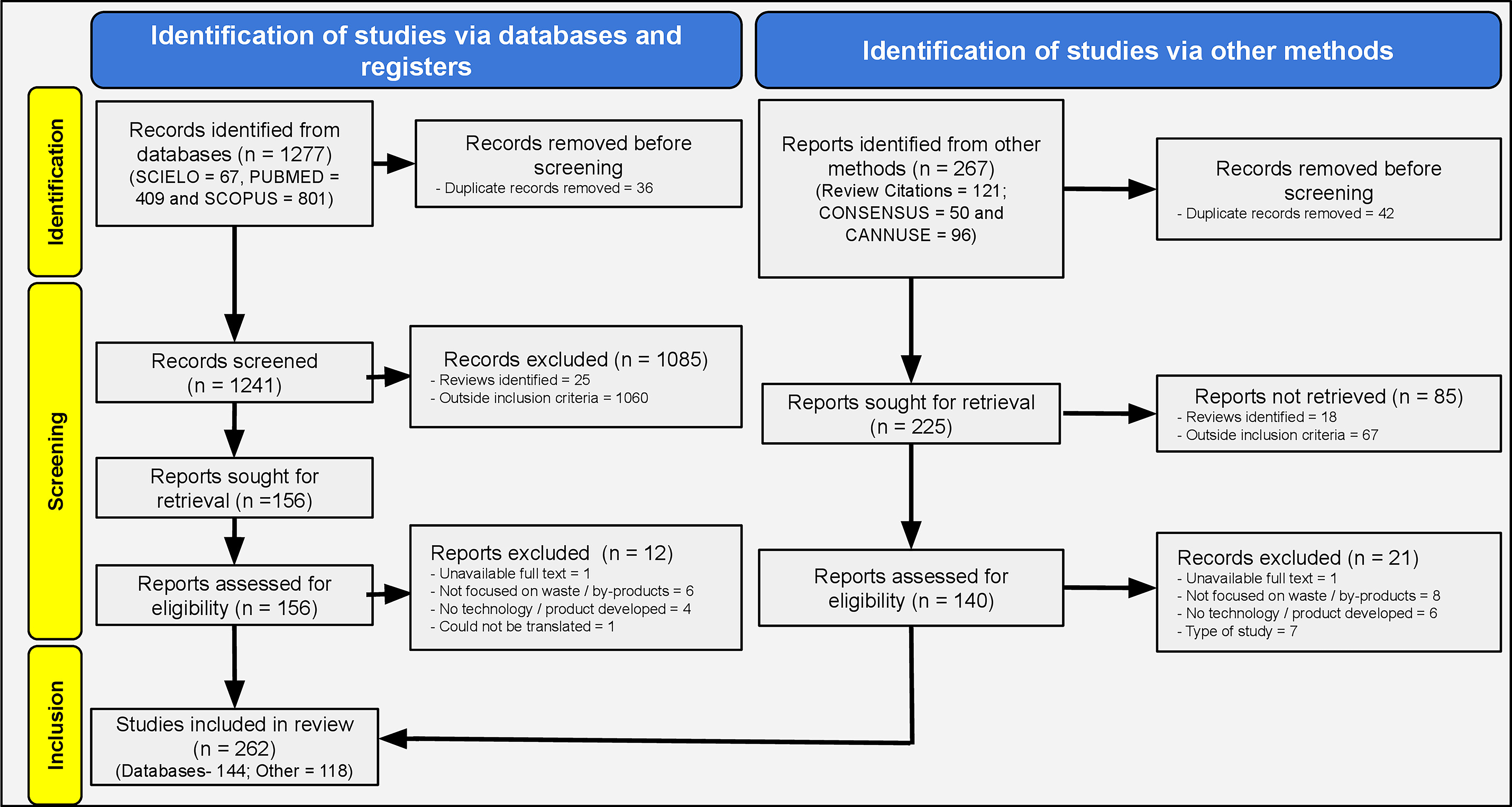
PRISMA flow diagram of the study selection process. PRISMA, Preferred Reporting Items for Systematic Reviews and Meta-Analyses.
Eligibility criteria
Studies were included if they met the following criteria: (1) original empirical works with experimental, case study, or clinical designs published in peer-reviewed journals; (2) investigations addressing the utilization, reutilization, recycling, or valorization of C. sativa residues or by-products; (3) presentation of data on the development of products, processes, or inputs derived from residual biomass; and (4) exploration of technological, industrial, or agricultural applications, including safety assessments or regulatory implications.
Exclusion criteria included: (1) literature reviews, editorials, commentaries, translations, or reports lacking empirical data; (2) failure to clearly identify the plant part used or omission of residues/by-products as the main input; (3) unavailability of full-text or non-peer-reviewed publications; (4) duplicate or substantively overlapping content without added data or perspectives; and (5) articles that could not be translated due to limitations in digital translation tools.
Data extraction and processing
To ensure a comprehensive and structured analysis, each included study was profiled to extract the following variables: title, author(s), country and continent of origin of the corresponding author, year of publication, field(s) of study, plant part utilized, type of processing, product and/or process application domain, study location, and key findings.
Articles underwent a rigorous multistage selection process. First, titles and abstracts were screened for relevance to the research objective. Subsequently, full texts were reviewed according to predefined inclusion criteria. To minimize selection and publication bias, critical appraisal was independently conducted by at least two members of the research team.
Following selection, applications were categorized into five primary commercial domains: Agriculture, Energy, Industry, Natural Resources, and Technology & Innovation. In addition, 10 thematic domains were defined based on the final use of the products and/or processes, including: Food, Biochar, Biofuels, Construction, Cosmetics, Fibers, Nanomaterials, Other Applications, Textiles, and Veterinary. Alluvial diagrams were constructed using OriginPro 2021b (OriginLab Corporation, Northampton, MA) to visually represent the relationships between products, processing methods, and application domains. 31
To contextualize sector-specific applications, commercial domains were subdivided into relevant application areas. Agriculture included grains, fruits, vegetables, livestock, and forestry. The industrial domain encompassed manufacturing, chemical, metallurgy, mining, and construction. The energy sector included petroleum and gas, renewable energy, and electricity. Technology and innovation covered ICT, biotechnology, and the pharmaceutical industry, while natural resources included mining and aquaculture.
Bias and validity assessment
To mitigate publication bias, a systematic assessment was performed, comparing findings across databases and methodological approaches. A structured categorization framework was used to synthesize results and support a detailed analysis of technological innovations and their implications for the sustainable utilization of Cannabis. This methodological strategy ensures that the review’s conclusions reflect a comprehensive and impartial evaluation of the current literature.
Results and Discussion
The search strategy was conducted through two complementary approaches: indexed databases and additional methods for study identification. Initially, 1,277 records were retrieved from SCOPUS (n = 801), PubMed (n = 409), and SciELO (n = 67). After removing 36 duplicate entries, 1,241 studies were screened based on titles and abstracts. At this stage, 1,085 records were excluded for not meeting the inclusion criteria (including 25 systematic reviews and 1,060 off-topic articles), resulting in 156 records selected for full-text review, all of which were accessible (Fig. 1).
Following full-text analysis, 12 studies were excluded due to the absence of product or technology development (n = 4), inadequate thematic focus (n = 6), or untranslatable content (n = 1). As a result, 144 studies from indexed databases were included. In parallel, 267 additional records were identified via other strategies, including citation tracking from reviews (n = 121) and searches in specialized platforms such as CONSENSUS (n = 50) and CANNUSE (n = 96). After removing 42 duplicates, 225 studies were deemed eligible for retrieval.
Among these, 85 records were excluded at the eligibility stage; 18 were reviews, and 67 did not meet the inclusion criteria. Subsequently, 140 studies underwent full-text analysis, from which 22 were excluded due to unavailability (n = 1), lack of focus on residues or by-products (n = 8), absence of technology development (n = 6), or unsuitable study design (n = 7). Ultimately, 118 additional studies were included from alternative sources.
At the end of the selection and assessment process, 262 studies fully met the eligibility criteria and composed the final corpus of this systematic review, including 144 from indexed databases and 118 from alternative sources.
Temporal analysis of the scientific output on the reuse and valorization of C. sativa residues revealed a progressive growth trend starting in 2010, with a more pronounced inflection from 2015 onwards. Prior to 2009, annual publications remained below 5; this number increased to 6 in 2010, 16 in 2014, and 18 in 2015, suggesting the emergence of systematic academic interest (see Supplementary Data). This growth likely reflects regulatory shifts and increased funding for circular economy and green innovation initiatives. 32
In 2018, a jump from 18 to 25 studies may indicate a consolidation of the field within applied research. Between 2019 and 2021, publication numbers stabilized between 20 and 22 per year, suggesting a critical mass of researchers and institutions dedicated to this topic. A publication peak occurred in 2023 with 42 studies, the highest annual output in the series, coinciding with a global surge in interest regarding sustainable applications of plant residues in bioenergy, regenerative agriculture, functional food, and biomaterials. 33 In 2024, 35 publications were recorded up to the time of data collection, maintaining the upward trend.
Three main factors are likely driving this growth: (1) advancements in international regulatory frameworks allowing not only Cannabis cultivation but also full biomass utilization, including agro-industrial by-products 34 ; (2) integration of C. sativa into bioeconomy and circular economy agendas, stimulating research in composting, nanomaterials, bioactive formulations, and supercapacitor development 35 ; and (3) increased industrial interest, particularly in the pharmaceutical, food, and functional cosmetics sectors.36–38
Figure 2 presents an alluvial diagram summarizing the interrelationships among plant parts used, commercial domains, application sectors, and the countries where studies were conducted.

Alluvial flow diagram of technological applications of Cannabis sativa L. derivatives.
The 262 studies analyzed yielded 328 technologies, classified according to the plant part used for product and/or process development (all data are available in the Supplementary Data). Stems were the most frequently explored (n = 158; 48.2%), followed by seeds (n = 69; 21.0%), postextraction residuum (n = 32; 9.7%), by-products (n = 26; 8.0%), leaves (n = 23; 7.0%), whole plant (n = 17; 5.2%), and roots (n = 3; 0.9%). Figure 3 provides a graphical summary of the proportional distribution of C. sativa fractions employed across the technologies retrieved in this review, as previously mentioned. These data indicate a marked concentration of technological development in stems and seeds, while also highlighting the persistent underutilization of leaves and roots, thereby identifying them as priority targets for future research and innovation.

Graphical summary of Cannabis sativa biomass utilization across the technologies included in this review. Percentages were calculated based on the frequency of technologies assigned to each fraction (see Supplementary Data for full dataset).
The most prevalent application categories were Technology and Innovation (37.5%) and Industry (36.9%), focusing on the development of bioplastics, nanomaterials, encapsulation technologies, and stem-derived materials for textile and composite industries. The Energy (11.3%) and Agriculture (13.4%) categories highlighted biomass use for biofuels, activated carbon, biofertilizers, and animal feed. Natural Resources (0.9%) was the least represented, despite Cannabis’s phytoremediation and carbon sequestration potential. These findings underscore a strong emphasis on industrial sustainability and innovation while also revealing research gaps in environmental conservation and regenerative agriculture.
Geographic analysis revealed that Italy accounted for the highest number of publications (n = 38; 14.5%), followed by China (n = 21; 8.0%) and the United States (n = 17; 6.5%) (Fig. 3). These countries appear as leaders in research on C. sativa residue reuse and valorization, possibly due to favorable regulations and sustained investments in sustainable technologies.
Other countries with significant participation included Spain and India (n = 13 each; 5.0%), Pakistan (n = 12; 4.5%), and Australia, Canada, France, and Poland (n = 11 each; 4.0%). Morocco and Turkey contributed eight studies each (3.0%), while Germany, the United Kingdom, and Sweden had five each (1.9%). Countries like Greece, Turkey, South Africa, Serbia, and Latvia contributed six each (2.3%).
The data highlight significant engagement from both Global North and Global South nations, particularly in regions with historical hemp cultivation or national strategies aimed at biomass innovation. Several other countries contributed fewer than 2% of studies individually, reflecting the topic’s global relevance but also the concentration of research efforts in select centers.
Notably, there is growing engagement from Global South nations such as India, Pakistan, Morocco, Turkey, and South Africa, indicating strategic potential for valorizing agricultural residues in the context of sustainable development and local innovation.
Stem
The stem of C. sativa represents the largest fraction of residual biomass in production chains oriented toward both the medicinal and fiber industries, accounting for 48.2% of the technologies identified. This high prevalence is attributed to its highly lignocellulosic composition, with significant levels of cellulose, hemicellulose, and lignin, which confer elevated mechanical rigidity, making the stem a strategic raw material for use in biorefineries, civil construction, and the production of biobased products.39–43 Mhlongo et al. 44 suggest that despite variations in lignin content, biodegradable Cannabis fiber residues can be utilized to synthesize cellulose microfibers via environmentally friendly processes.
The primary technological application of the stem lies in the production of textile fibers and biocomposites. Fiber extraction typically involves microbial retting, a critical stage wherein fungi and bacteria selectively degrade pectin and hemicellulose matrices, enabling efficient separation of the external bast fibers from the woody inner core (hurds). Hurds are used as bedding material for animals due to their high absorptive capacity and biodegradability and also serve as raw material for bioplastics and lignocellulosic composites, such as construction materials.45–48
In the construction sector, a wide range of technologies employ the stem in the production of thermal and acoustic insulation panels, structural blocks, and lightweight fillers. These applications are aligned with the principles of bioclimatic architecture and the circular economy, contributing to the reduction of the environmental footprint of the construction industry and promoting the use of renewable natural resources.47,49–53
Recent advances have shown that the cellulose fraction of Cannabis stems can be used to produce high-crystallinity nanocellulose, 54 whose physicochemical properties, such as high tensile strength, low density, and large surface area, make this nanomaterial highly promising and eco-efficient. It serves as a viable alternative in advanced engineering for applications such as nanopaper fabrication, reinforcement of biodegradable polymers, functional films, and composites used in the electronics, ceramics, and metallurgy industries.44,55,56
Traditional communities also use C. sativa stems in various artisanal products. In the Gironès region (Catalonia, Spain), stems are traditionally processed for textile fiber production. 57 Among the Hmong (Miao ethnic group) along the China–Vietnam border, stem fibers are used for making clothes, ropes, and grain storage sacks. 58 In the Himalayas, similar uses have been documented. 59 These practices underscore the value of traditional knowledge in the integral use of the plant, with processing techniques transmitted across generations.
In addition to structural applications, the stem possesses significant energetic potential. It can be enzymatically hydrolyzed into reducing sugars for biofuel generation, and acid hydrolysis may optimize production of bioethanol and cogeneration of methane.39,60,61 Choi et al. 62 demonstrated that biodegradable packaging derived from Cannabis stems can be valorized as biofuel, and Kanchanatip et al. 63 confirmed that hydrothermal carbonization can convert these residues into hydrochar of comparable quality to mineral coal.
Ethnobotanical studies have also documented the energetic use of Cannabis stems in traditional communities. In Nepal, peeled stems are used as torches. 64 In Pakistan, in both Mardan and Buner districts, the plant is burned as firewood.65,66 These practices illustrate the integral use of the plant, wherein stems, often considered by-products of agricultural or textile processing, are transformed into sustainable energy resources, consistent with traditional biomass management strategies.
Thermochemical processes, such as controlled pyrolysis, can also produce biochar. Beyond serving as a renewable energy source, biochar exhibits specific properties beneficial for environmental remediation. 67 When unsuitable for energy applications, biochar can act as an efficient adsorbent for organic pollutants and heavy metals in contaminated soils, in addition to contributing to atmospheric carbon sequestration, aligning with global climate change mitigation strategies. 68
The stem has also been successfully used as a precursor for synthesizing activated carbon with high specific porosity, applied in the adsorption of aquatic contaminants, including industrial dyes and pharmaceutical residues. Studies show that graphite oxide-treated fibers exhibit enhanced functional properties and high adsorption capacity for dyes such as methylene blue, proving effective in wastewater purification and tertiary effluent treatment.69–71 This same activated carbon also shows potential in the electronics industry for the development of supercapacitors. 72
An emerging aspect is the cultivation of Cannabis in phytoremediation programs, owing to its rapid growth rate, high biomass yield, and capacity to absorb soil contaminants. In this context, stems from plants cultivated in contaminated areas retain utility as biomass for energy or safe textile production, as the accumulated contaminants do not significantly transfer to the fibers. 73
Seeds
The seeds of C. sativa have emerged as the most extensively explored by-product in the studies analyzed, accounting for 21% of the technologies reviewed. Renowned for their unique nutritional composition, these seeds are characterized by high levels of polyunsaturated fatty acids, particularly omega-3 and omega-6 in optimal ratios, alongside high-quality proteins, dietary fiber, vitamins, and phytosterols.74–76 These attributes grant Cannabis seeds the status of a “superfood,” with expanding applications in the food, nutraceutical, and veterinary industries.77–79
In the food industry, key products derived from hemp seeds include hemp seed oil, used as a functional ingredient and dietary supplement, 80 and defatted hemp meal, which contains over 30% protein and is employed in the formulation of breads and baked goods.76,79,81 Fermented products based on hemp seed meal have demonstrated prebiotic effects, thereby enhancing their use in functional foods aimed at improving intestinal health. 82
Ethnobotanical studies across Asia and the Middle East have documented the role of Cannabis seeds and derivatives in traditional human diets. In Pakistan, seeds are consumed directly83,84 and used as culinary oil. 84 In Nepal, they are consumed whole, ground into flour, or used as an oil source, with emphasis on their nutritional value. 64 Among the Hmong ethnic group, seeds are eaten as snacks or processed into “medicinal tofu” used for treating gastric ailments 58 ; in the Himalayas, they are also consumed raw. 59 These records support the historical continuity of seed consumption and suggest potential for reintroduction into Western markets as scientifically validated traditional food.
Cannabis seeds also play a role in traditional veterinary nutrition. In Pakistan, they are used as a dietary supplement for poultry to enhance egg laying66,84 and as feed for wild birds.83,85 In Spain, they serve as bait for capturing Fringillidae 86 ; in India, crushed seeds are used to treat gastric disorders in cattle, 87 and seed oil is employed as a nutritional supplement. 88
Ethnobotanical literature also documents the cosmetic use of Cannabis seeds across various cultures. In Pakistan, seed oil is traditionally used to treat skin ulcers and hair disorders. 84 In Morocco, seeds are prepared as infusions for hair strengthening89,90 and included in traditional cosmetic formulations. 91 Among the Gbaya and Vhavenda peoples, seed macerates are applied for hair growth and alopecia treatment.92,93 These applications highlight the potential of Cannabis seeds in the development of innovative, natural, organic, and functional dermocosmetics. The convergence between traditional practices and modern scientific applications illustrates a continuum of innovation rooted in empirical knowledge and ancestral cultural practices.
Despite their wide range of uses, there remains a lack of clinical studies assessing the safety of long-term consumption of Cannabis-derived foods or supplements, particularly concerning the potential accumulation of cannabinoids.94–96 The absence of clear and standardized regulatory guidelines also constrains the integration of these products into markets with strict sanitary and legislative requirements.
Nonetheless, the compiled data indicate increasing academic and industrial interest in the comprehensive valorization of Cannabis seeds, whether as functional ingredients, dietary supplements, cosmetic inputs, or alternative protein sources.97–101 The versatility of the seeds, combined with the sustainability of their production and the potential reutilization of associated by-products and postextraction residuum, positions them as a strategic vector for innovation in Cannabis-based products within the framework of a circular economy.
Leaves
Although constituting a significant portion of the discarded biomass in C. sativa production systems, leaves were the focus of only 7.0% of the technologies analyzed in this review, revealing a critical gap in the contemporary scientific literature. This underrepresentation contrasts with the large volume of foliar biomass generated throughout the vegetative and reproductive stages, particularly in cultivation systems dedicated to medicinal and textile purposes, where foliage is frequently removed to optimize inflorescence development or facilitate fiber processing.60,102
Existing investigations, albeit limited in number, have demonstrated that leaf biomass concentrates a substantial diversity of secondary metabolites, particularly flavonoids, terpenes, and phenolic compounds, that exhibit antioxidant, antimicrobial, anti-inflammatory, and neuroprotective properties. These bioactive compounds are of particular relevance to the pharmaceutical, cosmeceutical, and functional food industries and can be obtained through green extraction techniques, such as supercritical CO2 extraction, microwave-assisted hydrodistillation, and subcritical water extraction.102,103
Beyond bioactivity, leaves have also emerged as a promising feedstock for energetic valorization of biomass. Studies have indicated their feasibility in the production of bioethanol via fermentation of nonstructural sugars, biogas (methane) through anaerobic digestion, and biochar via pyrolysis.60,104,105 These pathways provide strategic solutions for energy matrix diversification, especially in countries lacking fossil fuel reserves, and align with global policies for emission mitigation and sustainable energy transition.
The conversion of leaves into second-generation biofuels, such as cellulosic ethanol, offers additional advantages, including noncompetition with food chains and potential integration into circular-bioeconomy systems. Moreover, the solid residues resulting from these conversions can be employed in the production of biofertilizers or adsorbents, thereby enhancing the circularity of production systems. 106
It is also important to highlight the medicinal and agroecological uses of leaves in traditional communities. Dried and pulverized leaves exhibit antibacterial and antifungal activities, 85 suggesting potential for the development of phytotherapeutics. In Uganda, aqueous leaf extracts are employed as agricultural pesticides for insect control and postharvest disease management, 107 while in India, fresh or dried leaves are traditionally used as repellents in grain silos. 108 In addition, leaves are utilized as green manure 85 and as firewood. 109
The underutilization of leaves identified in this review is evident, particularly when contrasted with the long-standing ethnobotanical relevance of leaves across diverse communities worldwide. A plausible explanation for this persistent underuse is that foliar biomass is routinely removed during crop management to optimize inflorescence development and/or facilitate fiber processing, which has historically directed this fraction to low-value disposal streams rather than standardized industrial routes.60,102 In addition, the chemical complexity of leaf matrices and the need to control cannabinoid carryover may increase analytical workload and compliance costs, particularly for food and feed applications, where long-term exposure risks remain insufficiently supported by clinical evidence and where standardized regulatory guidance is still heterogeneous.94–96 From a circular-bioeconomy standpoint, these constraints reinforce the need for validated, scalable, and low-impact processing protocols (e.g., green extraction cascades coupled with energy recovery), enabling leaves to transition from residual biomass to a consistent feedstock for functional ingredients, bioenergy, and downstream circular applications.60,102–106
Roots
Roots remain one of the least studied anatomical fractions of C. sativa, representing only approximately 0.9% of the studies analyzed. No root-based technologies were identified in the ethnobotanical sources consulted. This limited scientific attention contrasts with preliminary evidence suggesting high added value and substantial potential for applications across multiple industrial sectors.16,110–112 Early studies indicate that Cannabis roots accumulate a distinct profile of secondary metabolites compared with aerial parts, with anti-inflammatory, astringent, and antioxidant properties.113–115
From a technological standpoint, one of the most notable applications of Cannabis roots lies in the production of specialty papers, particularly filter paper for engines, which has demonstrated superior mechanical strength and filtration efficiency compared with cotton-based alternatives. 116 This application reinforces the potential of roots as a sustainable and innovative raw material for industrial biomaterials.
Despite the potential identified, the scientific literature still lacks systematic and in-depth investigations focused on the chemical characterization, safety, and technological feasibility of compounds obtained from roots. This knowledge gap represents a strategic opportunity for bioprospecting initiatives, particularly those guided by the full valorization of the plant within circular-bioeconomy models.
The still incipient valorization of roots appears to arise from a set of combined logistical and analytical constraints, including the complexity of belowground harvesting, greater vulnerability to soil-derived contaminants, and the lack of consolidated postharvest routes compatible with industrial scale. Nevertheless, available evidence suggests that roots exhibit a secondary-metabolite profile distinct from aerial organs and may support higher value-added applications, provided that robust standardization and safety-control strategies are implemented.16,110–115
In this context, targeted metabolomic profiling, the adoption of decontamination procedures fit for the intended use, and the development of reproducible workflows for extraction and fractionation constitute operational priorities to convert this underexplored biomass into regulated and technologically viable products.
Whole plant
The utilization of the entire C. sativa plant was reported in approximately 5.2% of the technologies reviewed, with emphasis on applications in energy conversion and the development of sustainable materials. This integrative approach has been promoted as a model of plant-based biorefinery, in which various biomass fractions—including seeds, leaves, stems, roots, and inflorescences—are simultaneously processed through distinct technological pathways, aiming to maximize resource-use efficiency and minimize losses throughout the production chain.106,117 Such applications underscore the value of Cannabis as a renewable resource within energy transition frameworks, particularly in regions with limited access to fossil fuels.
The whole plant, when treated as residual biomass, has potential applicability in the agribusiness sector. It may be used as a biofertilizer to enhance soil quality or as fodder for ruminants. However, its use in animal feed is currently restricted in countries such as Australia due to legal constraints and the limited number of studies on the nutrient content and cannabinoid residues present in this emerging agricultural commodity.95,106,118 While the use of whole-plant biomass as livestock feed remains legally uncertain, it has demonstrated promise as a substrate for insect farming aimed at producing alternative protein sources. Evidence suggests that larvae cultivated on Cannabis-based feedstock do not retain illegal or psychoactive cannabinoid compounds. 119
This diverse raw material therefore represents a promising strategy for industrial sustainability, integrating technological innovation with ecological responsibility. Nonetheless, its large-scale implementation requires advancements in regulatory frameworks, logistics infrastructure, and technological standardization to ensure safety, efficiency, and market competitiveness.
Postextraction industrial residue (residuum)
Residuum represents a significant by-product in C. sativa production systems. Although frequently categorized as Cannabis waste, this biomass fraction was addressed in 9.7% of the technologies reviewed, highlighting its potential for both technological and environmental valorization.
The primary utilization pathways for residuum include its incorporation into formulations for animal feed, organic fertilizers, cosmeceutical products, and as a matrix for sequential extraction of residual bioactive compounds, such as oxygenated terpenes, flavonoids, and lignans.120,121 Studies have demonstrated that this material can be fermented or microencapsulated, enhancing its potential as a functional food ingredient while improving oxidative stability and prolonging antioxidant activity.122,123
In the field of environmental engineering, residuum has shown promise as a precursor for the synthesis of activated carbon and biochar, both of which are effective in adsorbing organic contaminants and heavy metals from wastewater, reinforcing its strategic application in sanitation and environmental remediation technologies.69,124
Nevertheless, the use of residuum, particularly in food and animal feed contexts, demands rigorous evaluation of the risks associated with cannabinoid bioaccumulation and potential transfer to animal-derived products such as milk, eggs, and meat. This concern underscores the urgent need for robust toxicological data to ensure short- and long-term safety, thereby supporting the development of specific regulatory frameworks and facilitating broader market acceptance.
By-products
The valorization of C. sativa by-products constitutes a strategic approach to advancing a circular bioeconomy, promoting the integral utilization of biomass while mitigating the environmental impacts of agro-industrial waste. In the medicinal, food, and textile production chains, parts such as leaves, stems, roots, and seed residues are frequently discarded, despite their demonstrated technological potential. 125
Recent studies have shown that C. sativa by-products can be transformed into activated carbon with high surface area and porosity, which is effective in adsorbing heavy metals and industrial dyes in water purification processes, as demonstrated by El Mansouri et al. 124 Complementarily, Kontodimos et al. 126 reported that lignocellulosic by-products of Cannabis possess a high potential for biomethane production via anaerobic digestion, contributing to energy transition in regions undergoing decarbonization.
In the veterinary field, hemp seed cake, a by-product of oil extraction, has been investigated as a sustainable alternative to soybean meal in animal nutrition, particularly in feed for ruminants and poultry. Studies have indicated no detrimental effects on meat or egg quality,127,128 underscoring its economic and environmental viability, especially in regions where soy is imported or environmentally contentious.
In the food and animal nutrition sectors, seed treatment by-products such as hulls and meals exhibit high protein content and a balanced nutritional profile, being explored as functional ingredients in fish and swine diets. 129 Banskota et al. 130 confirmed that protein isolates derived from Cannabis by-products are highly digestible, rich in essential amino acids, and exhibit strong in vitro antioxidant activity. Furthermore, Nissen et al. 131 demonstrated that colonic fermentation of hemp seed meal hydrolyzed with alcalase led to increased production of short-chain fatty acids such as butyric and pentanoic acids and positively modulated human gut microbiota in vitro, reinforcing the prebiotic potential of these by-products.
The biorefinery model applied to Cannabis proposes the conversion of each plant fraction into distinct inputs, including textile fibers, bioplastics, biofertilizers, cosmetics, and food products, thus maximizing biomass utilization and strengthening sustainable value chains. 132 In this regard, Fan et al. 133 showed that enzymatic processing of seed by-products enhances the bioavailability of phytochemicals and nutrients during digestion and microbial fermentation, supporting their use as functional ingredients for metabolic and intestinal health.
In addition, Bárta et al. 98 revealed through proteomic analysis that hemp seed hulls are enriched with defense-related, metabolic, and stress-response proteins, supporting their potential in biomedical applications. The use of by-products as functional additives in processed foods is also noteworthy, as evidenced in the reformulation of meatballs enriched with hemp cake, which exhibited reduced lipid and protein oxidation during refrigerated storage. 132
Despite these advancements, there are still regulatory and safety concerns regarding the use of by-products in formulations for human and animal consumption. As pointed out by recent studies, 118 bioactive cannabinoids have been detected in the plasma of cattle fed Cannabis by-products. Therefore, investment in clean technologies, such as controlled fermentation, chemical lignin modification, and green extraction, is essential to ensure the safety, efficacy, and sustainability of proposed applications.43,134
Future perspectives
The consolidation of C. sativa as a strategic crop for the pharmaceutical, food, cosmeceutical, energy, and biomaterials sectors underscores the need for systemic approaches that maximize the full utilization of its biomass. In this context, the findings of this review suggest that the valorization of vegetal residues, including leaves, stems, roots, seeds, whole plant, by-products, and postextraction residual biomass (residuum), constitutes a promising avenue for both technological innovation and industrial sustainability.
However, critical gaps remain. The underutilization of leaves and roots contrasts with evidence indicating that these fractions contain bioactive metabolites with high pharmacological and cosmeceutical potential. Similarly, the use of residuum still lacks clear regulatory guidelines, particularly for veterinary and agricultural applications, leading to legal uncertainty and limiting access to regulated markets. The absence of robust clinical and toxicological studies attesting to the safety of Cannabis use in food and animal feed further restricts its integration into value chains with high sanitary standards.
To advance toward a circular bioeconomy based on Cannabis, a development model is proposed, articulated along three interdependent axes: (i) Scientific: to promote multidisciplinary investigations into the chemical composition, toxicological profile, physicochemical properties, and bioactivity of Cannabis residues, emphasizing validated analytical methods and risk-benefit assessment; (ii) Technological: to develop and validate sustainable, scalable, and economically feasible industrial processes for converting waste into high-value inputs (biofuels, adsorbents, functional foods, cosmetics, biomaterials); and (iii) Regulatory: to review and update existing legal frameworks, establishing specific guidelines for the safe and standardized use of C. sativa by-products, including technical criteria for quality control, traceability, and biosafety.
In addition, the integration of emerging technologies with traditional knowledge, as documented in ethnobotanical databases such as CANNUSE, represents a unique opportunity to generate innovations rooted in ancestral practices and socially inclusive systems. Recognizing the epistemological value of traditional practices can guide the bioprospecting of new applications and foster socioproductive chains grounded in cultural contexts.
In the face of the climate emergency and the growing demand for sustainable inputs, C. sativa is consolidating as a platform plant capable of integrating biotechnology, circular-economy principles, and environmental justice. Accordingly, research aimed at the utilization and recycling of its residues should incorporate transdisciplinary approaches, socioterritorial inclusion, and ecological responsibility.
Regulatory and legislative fragmentation remains a cross-cutting barrier to the industrial translation of Cannabis residue valorization. Although several studies demonstrate technological feasibility across food, veterinary, materials, and environmental applications, market entry is frequently constrained by uncertainties regarding permissible cannabinoid levels, traceability requirements, and safety parameters.94–96 In animal production chains, for instance, the detection of cannabinoids in biological matrices following the use of Cannabis by-products reinforces concerns about potential transfer to animal-derived products and supports the need for risk-based regulatory limits, validated analytical methods, and harmonized surveillance protocols.43,118,134 Similarly, the use of whole-plant biomass as feed remains prohibited in some jurisdictions (such as Australia), highlighting the mismatch between the pace of innovation and the availability of standardized evidence on nutritional composition and cannabinoid residues.95,106,118
For postextraction residuum and other secondary streams, regulatory ambiguity tends to be even more pronounced, particularly for veterinary and agricultural endpoints, which limits adoption in highly regulated markets and discourages private investment. This context reinforces the need for explicit frameworks establishing quality specifications, contaminant limits, and standardized processing routes for each biomass fraction, supported by robust toxicological evidence and, when applicable, clinical evidence.94–96 Such regulatory maturity may help explain the concentration of scientific output in countries with legal environments and investment policies more favorable to industrial hemp innovation. As practical guidance, the “regulatory axis” proposed in this article should be operationalized through technical guidelines for quality control, traceability, and biosafety, thereby enabling the safe implementation of the circular economy at scale.
Within this horizon, the industrial development of Cannabis is likely to advance through the convergence of frontier science, biodiversity valorization, and social transformation, offering conditions for innovative solutions that respond in an integrated manner to environmental urgencies, market demands, and socio-environmental justice imperatives.
Conclusion
In response to the central question of this study—Industrial Cannabis, Cannabic Residue or Industrial Cannabis Waste?—the analyzed data clearly demonstrate that C. sativa residues should not be regarded as mere waste but rather as high-value by-products or residues suitable for a broad spectrum of industrial, environmental, and technological applications. Stems, seeds, leaves, roots, and postextraction waste present concrete opportunities for the construction of circular production models.
However, fully realizing the potential of this biomass requires overcoming regulatory gaps, expanding research on underexplored fractions, and integrating clean technologies with traditional knowledge. Industrial Cannabis thus emerges not only as a promising economic crop but as a pivotal vector for sociotechnological innovation, essential to the transition toward a sustainable bioeconomy.
Achieving this goal requires greater collaboration among academic, industrial, and governmental sectors to facilitate the implementation of these technologies and sustainable practices, thereby promoting the responsible use of Cannabis and its derivatives. Pragmatic and efficient policies that support research, development, and deployment of green technologies are crucial to accelerating the shift to a circular and sustainable economy, ultimately benefiting society as a whole. Industrial Cannabis is not merely a promising industry; it is a catalyst for social and environmental transformation.
Authors’ Contributions
All individuals who meet authorship criteria are listed as authors, and all authors certify that they have participated sufficiently in the work to take public responsibility for its content, including involvement in the conception, design, analysis, writing, and/or critical revision of the article. R.A.d.A.B.: Conceptualization, data curation, formal analysis, investigation, methodology, software, original draft, and review/editing. E.S.L.: Data curation and review/editing. J.G.G.-S.: Investigation, project administration, and review/editing. C.d.C.-O.: Project administration, validation, and review/editing. L.D.V.-O.: Investigation, software, and review/editing. P.G.M.: Funding acquisition, resources, validation, and review/editing. A.E.d.V.: Project administration, supervision, validation, and review/editing. Y.J.R.: Conceptualization, formal analysis, funding acquisition, methodology, software, supervision, validation, and review/editing.
Footnotes
Acknowledgments
The authors wish to acknowledge the traditional enchanted guardians of the lands, who gave us the strength to systematize these data and made it possible for harmony in nature to sustain the existence of these beings.
Author Disclosure Statement
No competing financial interests exists.
Funding Information
This work was financially supported by CAPES, CNPq, and the Committee Judging the Special Cooperation Program with the Ministry of Health—COSAU, project number 444648/2023-2, and FAPESP (2022/11241-8, 2022/06228-2); and the Young Researcher UFBA 2024 Call (PRPPG 010/2024).
Supplemental Material
Abbreviations
References
Supplementary Material
Please find the following supplemental material available below.
For Open Access articles published under a Creative Commons License, all supplemental material carries the same license as the article it is associated with.
For non-Open Access articles published, all supplemental material carries a non-exclusive license, and permission requests for re-use of supplemental material or any part of supplemental material shall be sent directly to the copyright owner as specified in the copyright notice associated with the article.
