







Abstract
Since the 1980s, Western higher education governance reforms have shared characteristics such as market doctrine, competition, and deregulation. Despite diverse governance models and paths, a “homogeneous heterogeneity” describes the whole system. France, Germany, and the United Kingdom have implemented modernization measures involving state control, administrative autonomy, market competition, academic autonomy, and external participation. Utilizing institutional isomorphism and historical institutionalism, this paper examines how these countries emulate and learn from external experiences while considering path dependence caused by internal institutional differences. Based on the analysis, we propose three suggestions for higher education governance modernization in China: exploring a development approach that fits China's national context, establishing a system with Chinese characteristics featuring cooperation and co-governance, and deepening reform to fully realize the positive role of market mechanisms in higher education governance modernization.
Keywords
Introduction
Modernization is a term commonly used to describe the social and cultural transformation phenomena that have occurred in modern times (Haviland, 1987). It refers to the historical phenomenon of homogeneous transformation in various social fields experienced by developing societies as they move toward advanced industrial societies, as well as a conceptual framework for studying these transformation processes. The modernization of higher education governance is a reform that countries around the world are carrying out to adapt to the development of the times, taking the characteristics of the higher education systems of developed countries as a means to achieve the goal of university modernization (Zhou, 2014). Since the 1980s, with the promotion of the New Public Management (NPM) movement worldwide, higher education in Western developed countries, including Europe, has undergone a reform that shifts from the traditional management model dominated by academics or scientific hierarchies to a new public management model that introduces marketization, decentralization, and accountability. In addition, there is a continuous exploration of higher education governance systems involving multiple stakeholders, which has opened up the reform of reshaping the relationship between universities, the government, and the market.
As Simon Marginson has stated, universities in the era of globalization have already transcended the boundaries of nation-states and exist within a three-tiered space of “global-national-local" (Marginson & Rhoades, 2002). Along with this comes the academic community's attention to and concerns about the phenomenon of “isomorphic evolution” in governance models among different countries and regions (Gorostiaga et al., 2014). Despite being influenced by external homogenizing elements, the institutional designs and policy tools of different countries have distinctive characteristics of differentiation, known as heterogeneity (Miao, 2009). These two trends of change were initially outlined by Vaira (2004) as “homogeneous heterogeneity” to emphasize the processes of homogenization and the diverse, pluralistic, and localized responses to the globalization and modernization of higher education governance changes.
Why does “homogeneous heterogeneity” exist in the modernization process of higher education governance, and what are the underlying formation mechanisms? By conducting case studies on several representative European countries, the study examines their higher education governance modernization reform processes. The primary objective is to develop an analytical framework grounded in public policy analysis and comparative institutional research theories to elucidate the “homogeneous heterogeneity” phenomenon and its formation mechanism. Ultimately, to provide empirical references for China's higher education governance modernization.
The Modernization Process of Higher Education Governance in Europe
As the birthplace of modern universities, Europe has been at the forefront of both theoretical development and practical exploration in university governance. The Bologna Process has not only promoted integrated development in fields such as degree systems, curriculum programs, and student mobility within the EU but has also profoundly influenced the governance patterns of higher education in various countries due to the change in the transnational policy environment. As major higher education powers in Europe, France, Germany, and the United Kingdom have formed distinct university governance models in history and have actively explored the path of governance modernization in the past three decades.
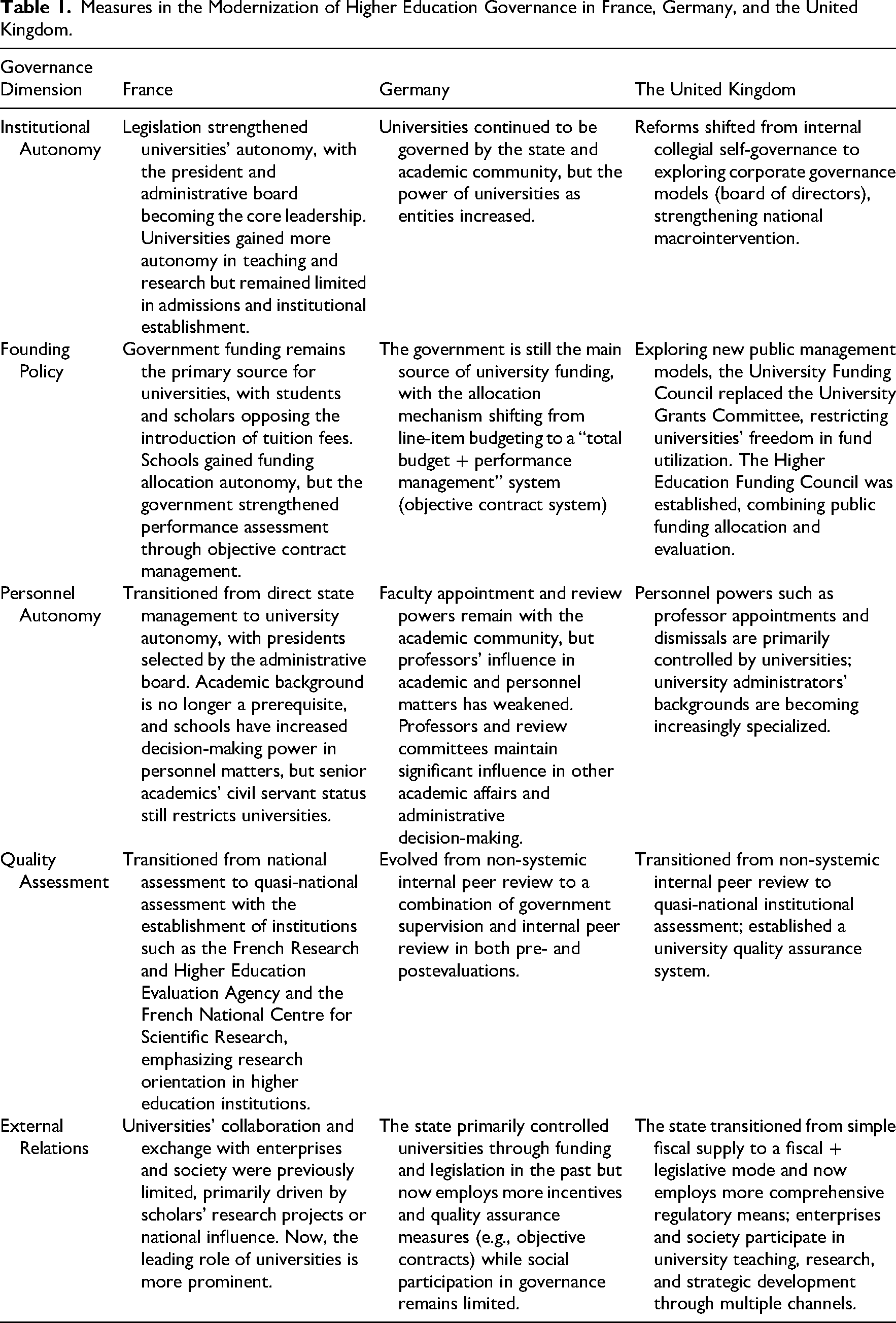
To clearly understand the governance process and measures of higher education in the above mentioned three countries, this article takes Michael Dobbins and Knill's (2014) policy analysis process as the basis and analyzes the higher education governance reform measures of France, Germany, and the United Kingdom from five significant governance elements: institutional autonomy, founding policy, personnel autonomy, quality assessment, and external relations (Table 1).
Measures in the Modernization of Higher Education Governance in France, Germany, and the United Kingdom.
France
Higher education governance in France is primarily characterized by a centralized management system, representing a typical example of the “state-centric” model in continental Europe. Post-World War II reforms failed to change the fundamental structure of this system (Yin, 2009). At the beginning of the twenty-first century, the framework effect of European higher education integration, symbolized by the Bologna Process, began to emerge. The French Ministry of Education's market-oriented reforms aimed at promoting university autonomy and adapting to international standards under the context of European regional integration and globalization faced resistance from domestic interest groups. With the subpar performance of French universities in major global university rankings, public perception of the higher education system's “failure” continued to grow. The prevailing view attributed the success of universities in countries such as the United Kingdom and the United States to their high levels of autonomy and the implementation of market mechanisms. Based on this, the French Parliament passed the “University Freedom and Responsibility Law” (also known as the “Pécresse Law”) in 2007, granting universities maximum legal autonomy and promoting the modernization of university governance across various domains.
Germany
The governance tradition of higher education in Germany has been described as a dualistic model of “state-centric + academic oligarchy” since the Humboldt era (Xiao, 2018). Post-World War II, under the influence of the popularization and democratization movement, Germany strengthened the status of universities as legal entities through legislation (the “Higher Education Framework Act” in 1976) in the 1970s. It established an internal “collegial governance” model composed of administrators, scholars, and students at the school level, which to some extent weakened the power of the academic oligarchy. However, this co-governance model lacked an effective core of administrative leadership in major decision-making and was thus inefficient. Before the Bologna Process, internal reforms in Germany did not fundamentally change the governance structure. Academic oligarchs still had a strong influence in decision-making and coordination bodies at all levels; schools found it difficult to recruit students according to their own standards, and there was little competition between institutions; quality assurance was dominated by internal peer review, lacking systematic external quality control. In the late 1990s, the expansion of higher education and financial issues emerged, prompting the German government to actively participate in and promote the Bologna Process, gradually introducing the “New Public Management” model in governance structure, financial allocation, and quality assessment. In addition, universities also included more external participants in the governance structure through forms such as the University Council.
The United Kingdom
The traditional governance of higher education in the United Kingdom has been characterized by academic autonomy, with universities maintaining an appropriate distance from the state. Before the 1970s, although the higher education system, dominated by public universities, had a high degree of dependence on national finances, the government rarely interfered in the internal affairs of universities while fulfilling its responsibility for fiscal allocation. The economic stagnation, financial crisis, and unemployment issues in the 1970s provoked external skepticism toward the public management system, including universities. The government sought to enhance universities’ awareness and capacity to serve economic and social development through reform. Consequently, the Education Reform Act (1988) and the Further and Higher Education Act (1992) were enacted to implement market-oriented reform. This reduced fiscal allocations and compelled universities to raise funds through market-oriented channels. The introduction of performance-based funding and accountability systems strengthened the government's macrocontrol over higher education (Hoareau, 2012). When market-oriented reforms swept continental Europe, the United Kingdom reflected on the drawbacks of excessive marketization in the New Public Management movement and increased state macrocontrol. Overall, the UK public governance system has transitioned toward a model of state management and market orientation, exhibiting significant characteristics of macrocontrol over national fiscal allocations, enterprise-like university management, and public supervision and accountability.
Analysis of the “Homogeneous Heterogeneity” Phenomenon in Higher Education Governance Modernization Reforms
Higher education systems are power systems. In the 1970s, Burton Clark proposed the “Triangle Model” of power coordination based on the relationships among the state, market, and academic authority in various higher education systems. This model categorized different countries’ higher education systems into state control, Humboldtian academic self-governance, and Anglo-American market-oriented models (Clark, 1978). In the mid-to-late 1980s, the promotion of globalization brought varying degrees of influence on higher education worldwide, accompanied by the rapid development and significant expansion of universities at the global level. The emergence of large, diverse universities has profoundly changed the practices of higher education governance. Traditional “Triangle Model” systems, with their single-mode approach of “state-centeredness,” “academic autonomy,” or “market regulation,” struggle to explain the practical realities of higher education governance reforms.
In light of this, the present study draws on Burton Clark's triangular power model and adds two dimensions, “external participation” and “administrative autonomy,” forming a five-dimensional radar chart. The addition of these dimensions acknowledges that Clark's original forces (state, academia, and market) cannot fully capture the multipolar nature of contemporary governance, where external stakeholders and institutionalized administrative structures play a defining role (Zhou & Liu, 2018; Jansen, 2007).
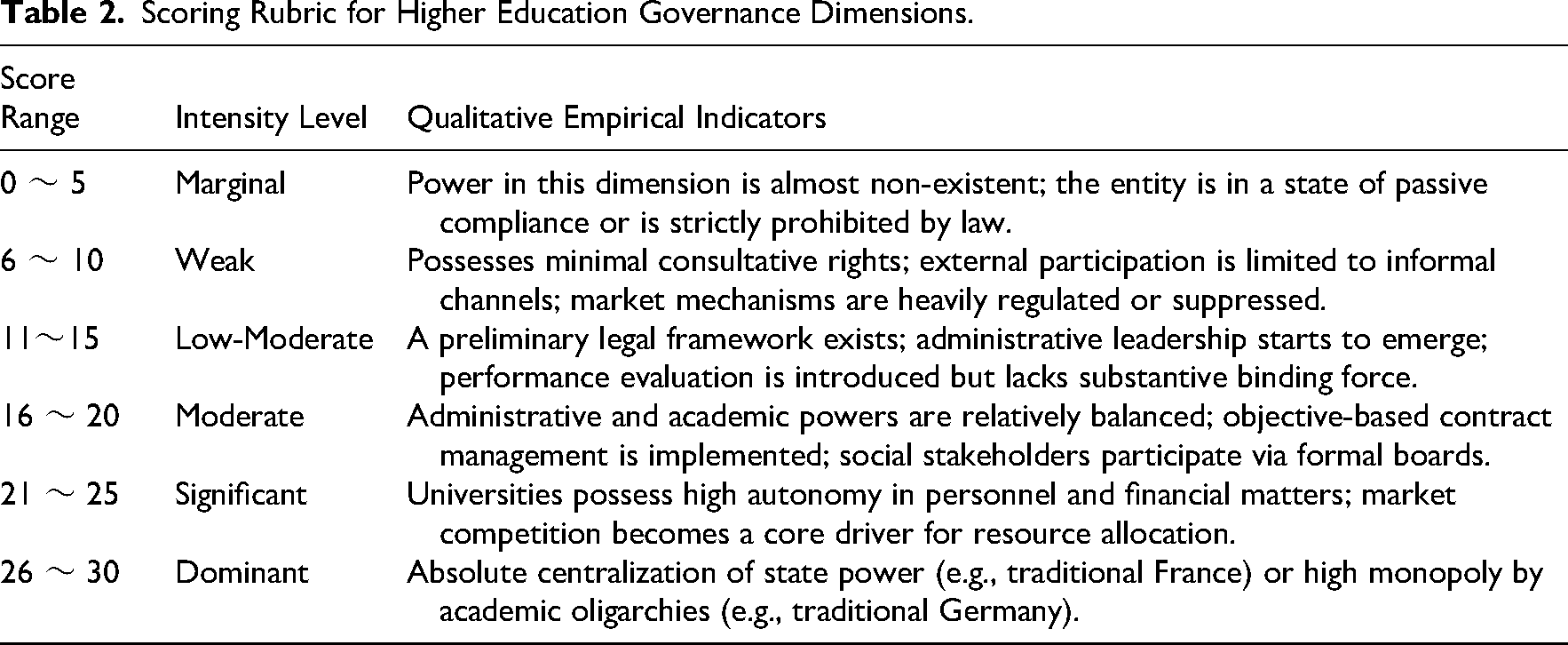
To ensure the rigor of the visual comparison in Figure 1, the scores for each dimension were determined through a systematic qualitative-to-quantitative coding process based on a standardized scoring rubric (see Table 2). We utilized a five-point heuristic scale (with increments corresponding to values 5, 10, 15, 20, 25, 30 in the chart to represent relative intensity; 5 = minimal presence, 30 = dominant influence).
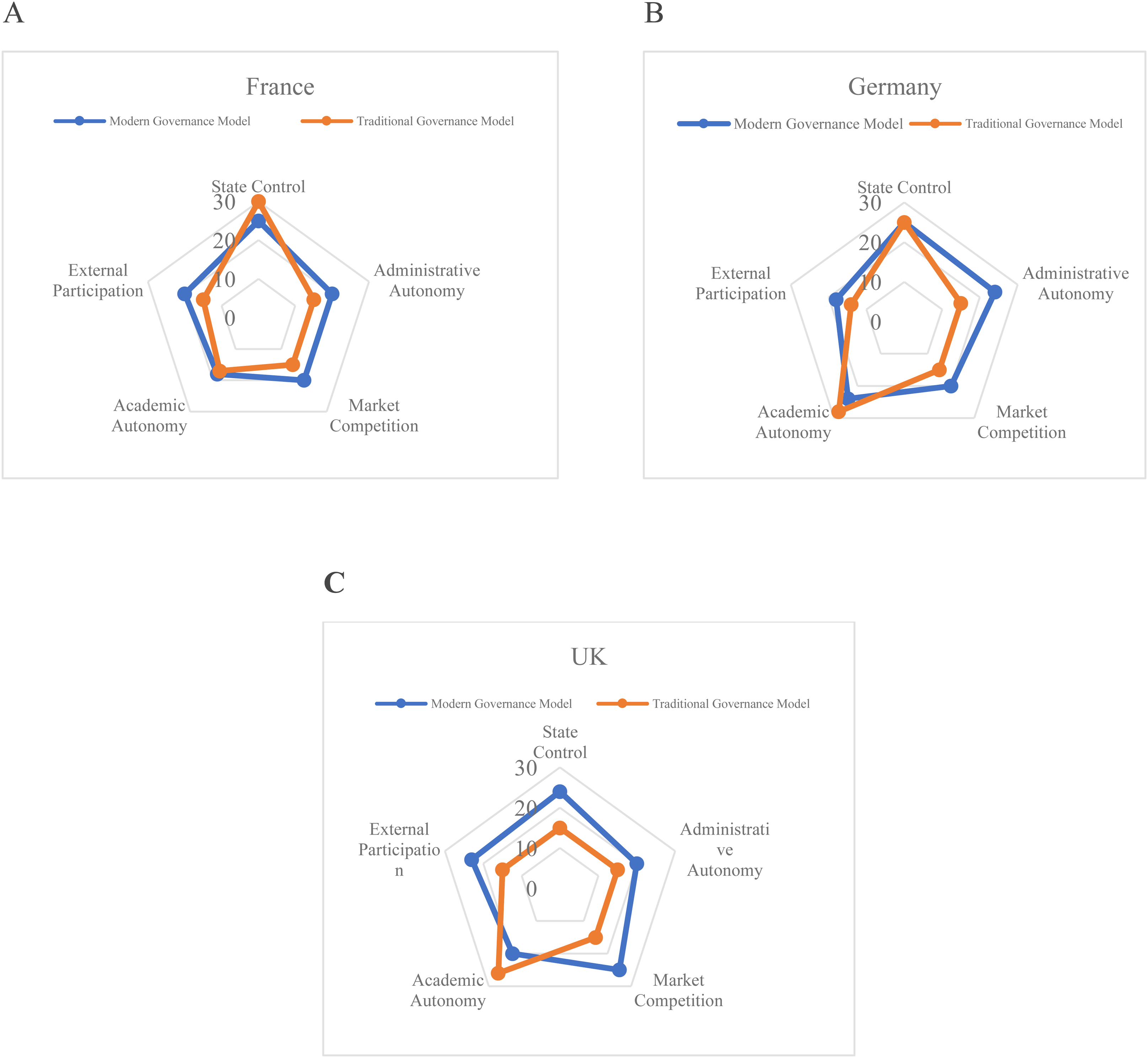
The five-dimensional radar chart of (A) France, (B) Germany, and (C) the United Kingdom higher education governance system compared between traditional and modern model.
Scoring Rubric for Higher Education Governance Dimensions.
The assignment of specific values followed a triangulated logic to ensure consistency across three analytical planes. First, Temporal Logic (Horizontal) reflects the trajectory of modernization, capturing the universal increase in “Market Competition” and “Administrative Autonomy” in modern models compared to traditional ones. Second, Cross-National Logic (Vertical) captures the relative intensity of specific dimensions between nations; for instance, the United Kingdom's modern “Market Competition” score (25) is higher than that of France (20), reflecting the United Kingdom's more extensive market-oriented transformation. Third, Structural Logic (Internal) illustrates the internal shift in power equilibrium within a single nation, such as France's evolution from an “absolute state-centric” traditional model (Score 30) toward a more balanced “multientity participation” modern model.
Notably, the inclusion of the 0–10 range (Marginal to Weak) establishes a necessary methodological baseline representing states where specific dimensions are functionally suppressed or prohibited by law. However, as France, Germany, and the United Kingdom possess mature and modernized systems, their empirical scores primarily fall within the 11–30 range, reflecting the interactive and functional presence of all five dimensions in the modern era.
The scoring was based on a comparative analysis of three primary data sources: (1) national legislative frameworks and higher education acts governing each period; (2) official policy documents and “White Papers” regarding university funding and autonomy; and (3) established secondary literature on the historical evolution of the specific national systems. Each dimension was evaluated against specific criteria (e.g., “Academic Autonomy” was scored based on the degree of faculty control over curricula and research agendas, while “State Regulation” was scored based on the centralization of funding and appointment powers).
This approach allows the radar charts (see Figure 1A–1C) to function as a formalized heuristic for comparing the structural “outlines” of governance across different eras. Thus, our study constructs a five-dimensional radar chart for higher education governance in the three countries, comparing the outlines of their governance systems through a static comparison while presenting each country's reform trends from the dynamic perspective of historical development. The higher education governance radar charts for France, Germany, and the United Kingdom are shown in Figure 1. The “traditional model” refers to the power distribution within the higher education systems of the three countries before the 1970s and 1980s, while the “modern model” represents the patterns that have emerged during the modernization process up until the present. As evident in the radar charts, the higher education governance structures of France, Germany, and the United Kingdom have undergone varying degrees of change, exhibiting the “homogeneous heterogeneity” phenomenon.
The Homogeneity of Modernization Reforms in European Higher Education Governance
As observed from the higher education governance structures of the three countries, the power distribution among the governing bodies has become more balanced compared to the past. Simultaneously, all three countries have expanded the roles of market competition, administrative autonomy, and external participation in higher education governance. Specifically, first, the role of market competition in higher education governance is valued. Both France and Germany have strengthened market competition mechanisms for higher education development, leveraging market forces to promote the reform of higher education governance systems. After experiencing a highly marketized development in higher education and summarizing its drawbacks, the United Kingdom strengthened national macroregulation but still allows the market to play a significant role in higher education governance. Second, the status of universities as primary entities in higher education governance has been enhanced. All three countries have expanded universities’ autonomy to varying degrees, clarifying the boundaries of responsibilities between the state and universities. By delegating more administrative autonomy, the governance level and educational quality of universities are promoted. Third, more stakeholders are involved in university governance. All three countries encourage cooperation and exchange between universities, enterprises, and other social organizations through official or unofficial means. This diversifies channels for enterprises and society to participate in university teaching, research, services, and strategic development, ultimately improving university governance efficiency and outcomes.
The Heterogeneity of Modernization Reforms in European Higher Education Governance
Although France, Germany, and the United Kingdom exhibit homogeneous evolution in higher education governance modernization, each country's governance structure retains unique historical characteristics. Consequently, the reform paths, focal points, and specific measures vary among them.
First, the reform paths differ. France leveraged its centralized system to implement structural reforms in a top-down manner, expanding universities’ administrative power over human resources. This allows universities to establish or eliminate academic positions without state approval. Germany's federal structure and Humboldtian governance tradition constrained its reform of university human resources systems, yielding more cautious changes. While universities’ administrative power has increased, academic councils maintain dominance in appointment issues (Toens, 2009). In contrast, the UK universities hold the highest degree of autonomy and marketization in staff appointments and salary settings among the three countries.
Second, reform priorities differ. In France, the traditional higher education governance system is a binary structure dominated by academia and state power. Universities’ administrative autonomy in human resource management has expanded. In Germany, reform initiatives are more cautious due to the influence of its federal system and Humboldtian model. Academic councils still dominate decision-making despite universities’ increased administrative power. The UK universities maintain a comparatively higher degree of autonomy and marketization in staff appointments and salary settings.
Third, there are significant differences in specific governance measures. For example, in personnel systems, France utilized its centralized institutional advantages to implement top-down structural reforms, expanding university administration powers in personnel management. Universities can autonomously establish or abolish academic positions without state approval. Conversely, Germany's federal structure and bottom-up governance tradition led to more cautious reforms in personnel systems. Despite some expansion of administrative powers, academic councils remain dominant in issues like faculty appointments. Compared to France and Germany, the United Kingdom exhibits the highest university autonomy and marketization in personnel appointments and salary settings.
In conclusion, while France, Germany, and the United Kingdom share a common trend toward modernizing higher education governance, their paths, priorities, and specific measures diverge, reflecting each nation's historical, political, and cultural contexts.
The Mechanism of “Homogeneous Heterogeneity” in Higher Education Governance Modernization Reforms
The institutional “homogeneous heterogeneity” phenomenon arising during higher education governance modernization has garnered scholarly attention, yet current research predominantly offers empirical descriptions. In-depth analysis of the underlying mechanisms is lacking. This study aims to fill this gap by developing a theoretical framework to examine the mechanisms behind the “homogeneous heterogeneity” in higher education governance modernization reforms.
An Analytical Framework for “Homogeneous Heterogeneity” in Higher Education Governance Modernization
Homogeneity in higher education is prevalent, involving both organizational forms and institutional systems. Isomorphism mechanism in Neo-institutional theory and the “policy convergence” theory in public policy analysis explain this homogeneity. Isomorphism mechanism in Neo-institutional theory posits that higher education and its decision-makers operate in a highly interactive and competitive global environment, facing challenges and uncertainties. To enhance legitimacy or competitiveness, they often “mimic peers’ practices or adopt proven experiences recognized within the institutional network” (Dimaggio & Powell, 1983). Additionally, recognized organizational forms and institutional norms create new concepts and discourse systems, rapidly disseminating through various networks and fostering shared values and institutional isomorphism regionally. Similarly, policy convergence theory suggests that policy reforms are primarily driven by communication and information exchange among nations, involving learning from others’ experiences, resolving cross-national issues, and advocacy through (cross-national) expert networks (Holzinger & Knill, 2005). The Bologna Process exemplifies a transnational policy network, a “soft governance” framework that has significantly promoted policy convergence in European higher education and advanced European educational integration.
While institutional homogeneity is widely discussed, national and regional diversity in governance reforms cannot be overlooked (Wang, 2016). Historical institutionalism, a significant branch of new institutionalism, emphasizes the influence of a nation's political systems and historical cultural traditions on public policy choices. It highlights the “heavy hand of history” affecting higher education governance, where traditional models provide reformers with legitimacy while constraining their actions, leading to path dependency (Hall & Taylor, 1996). Even if policymakers decide to introduce external experiences, they might filter, interpret, transform, or distort them according to national needs or preferences (Vaira, 2004). Such selective adaptation not only reduces convergence but also results in localized governance models. Additionally, higher education systems exhibit “bottom-heavy” organizational characteristics with widespread resistance to management culture and marketization, subtly influencing reform processes (Clark, 1984). Although transnational policy networks’ influence is increasingly prominent, they cannot replace nation-states’ primary role in higher education governance. Thus, historical institutionalism complements neo-institutional theory, enhancing the understanding of national differences in modernizing higher education governance.
In summary, neo-institutional theory explains the homogeneity observed in higher education governance modernization, while historical institutionalism elucidates national differences. Both theories possess explanatory power within their respective perspectives but also exhibit limitations. A synthesis of the two frameworks is necessary to better comprehend the “homogeneous heterogeneity” phenomenon during higher education governance reforms and further analyze its implications and insights. Concisely, the “homogeneous heterogeneity” in regional and global higher education governance results from the interplay between transnational policy networks and indigenous institutional environments (see Figure 2).
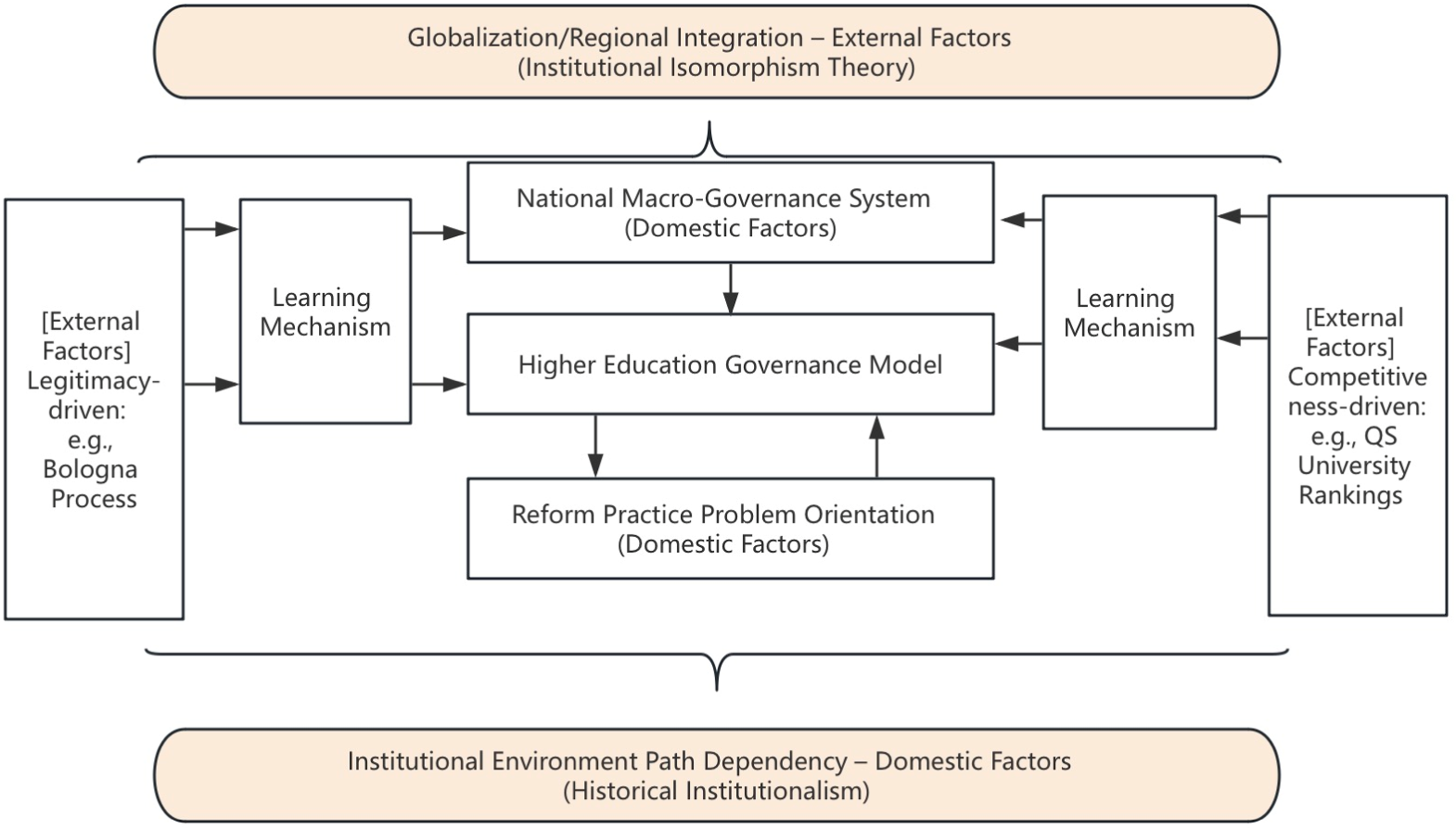
Analytical framework for the formation mechanism of “homogeneous heterogeneity” in European higher education governance reforms.
Exploring the Mechanism of “Homogeneous Heterogeneity” in Higher Education Governance Modernization
External competitive and legitimizing pressures prompt nations to adopt advanced international practices. Globalization and regional integration first provide a new institutional environment and legitimacy for higher education. The Bologna Process disseminates an ideal model detached from historical patterns and contexts via cyclical international conferences, declarations, and communiqués (Schriewer, 2007). Open transnational networks and global university rankings also stimulate competition and exchange among universities. Under external legitimacy and competitive pressures, governments and universities tend to learn from and emulate policy network-recognized “advanced models.” For instance, French governmental marketization reforms initially faced resistance from student unions but gained external competitive pressure when French universities underperformed in global rankings. Similarly, Germany retained its “silent bureaucracy” governance structure until the late 1990s when the government's active Bologna Process engagement utilized transnational policy networks’ legitimacy to gradually instigate marketization in governance, funding, and quality assessment. The United Kingdom initially perceived the Bologna Process as European integration intruding upon and controlling UK higher education (Ferlie & Andresani, 2009). However, as universities in Europe and other regions rose, competition for UK universities intensified globally. Recognizing that transnational policy networks could benefit their regional and international standing in higher education markets, the United Kingdom adopted a more proactive stance, integrating into the Bologna Process and utilizing transnational platforms to further refine national higher education governance systems.
Internal local factors primarily drive national reform trajectories. Firstly, national higher education reform policies are constrained by path dependency, shaped by existing institutional traditions. For instance, while Bologna Process-driven market-oriented reforms gradually diminish the traditional “Humboldtian model” in German universities, academic power remains significant. Germany transitions from a traditional “state + academic oligarchy” dual model toward “a balance between the Humboldtian model and limited marketization” (Mayer & Ziegele, 2009). In France, old institutional inertia prompts student and faculty concerns over educational equity, state oversight, and academic capitalism. Under its centralized system, state influence in French higher education remains significant. France shifts from “state-centrism” toward a “Humboldtian, market, and state” hybrid model combining historical embeddedness and transnational mimicry (Dobbins & Knill, 2017). In contrast, the United Kingdom introduced market mechanisms into its pre-existing academic-led model, strengthening central governmental macrocontrol. Although the United Kingdom reconsidered extreme marketization and locally adjusted policies, it still primarily emphasizes state management and market orientation. These trajectories demonstrate the persistent influence of indigenous institutional configurations, albeit with varying degrees of adaptation to external pressures for marketization and coordination.
Secondly, policy-makers may have differing goals and motivations when addressing indigenous governance practices and reform contexts. Their interpretation, transformation, and implementation of external experiences can also differ. Unlike France and Germany, external homogenizing factors, such as the Bologna Process, have primarily influenced UK policy refinement rather than structural transformation. Specifically, France's reforms aim to strengthen university autonomy within a state-led national system, adopting performance funding, quality assessment, and corporate governance practices to encourage competition. Germany cautiously introduces market mechanisms with limited reforms while preserving the traditional Humboldtian model. The United Kingdom, though implementing marketization early, avoids US-style hypermarketization by balancing institutional autonomy and macrocontrol. It adjusts quality assurance policies and incentivizes public responsibility with planned market tools. These divergent reform trajectories reflect distinct policy-making contexts, goals, and priorities, further shaping the “homogeneous heterogeneity” of higher education governance modernization.
Thirdly, reforms need not entail complete abandonment of existing models. New and old systems can coexist, overlap, or fuse. Sometimes, reform's superficial form and substance may decouple—a common occurrence in policy transformations. For instance, in French higher education governance, state power remains despite adopting market-oriented “performance contract management” and university quality assessments. Government remains the reform architect and driver, altering control strategies but retaining influence. Similarly, Germany's “quasi-financial autonomy” and “Target Agreements” have limited impact, with performance playing a minor role, weak penalties for underperformance, and state/federal approval required for budget allocations, preventing tuition fee expansion. In governance structures, University Councils, resembling US Boards, exert minimal influence due to members’ unfamiliarity with university affairs and lack of specialized subsidiaries. Overall, external homogenizing pressures and indigenous institutional factors shape European higher education governance modernization pathways.
Reflections and Implications
The 20th Party Congress report identifies modernizing national governance systems and capabilities as a primary goal over the next 5 years. Within this, modernizing higher education governance is crucial. This study evaluates the modernization of higher education governance in France, Germany, and the United Kingdom in five dimensions—institutional autonomy, financial allocation, personnel systems, governance evaluation, and external relations—offering an analytical framework integrating new institutionalism and historical institutionalism. This comparative research expands beyond individual countries’ experiences (Clark, 1986), aligning with the legacy of comparative higher education research pioneers (Tilly, 1984).
Western nations’ higher education modernization, with its policy initiatives, trends, and diversity, mirrors inherent needs and adaptive efforts. China's path to education modernization involves higher education governance reform, from which the “homogeneous heterogeneity” of Western nations offers valuable insights.
Exploring a Higher Education Governance Modernization Path Suited to China's National Conditions
Despite converging trends in France, Germany, and the United Kingdom's higher education governance modernization, their reform trajectories diverge due to unique institutional contexts and cultural conditions, showing path dependency and national characteristics. China's higher education modernization cannot overlook China's unique circumstances and existing institutional mechanisms. Therefore, China must selectively draw on international experiences. In contrast to the three European nations, China's higher education field operates under a system where the central government monopolizes symbolic capital linked to economic capital, leading to high stratification and homogeneity (Li, 2018). Hence, China should cautiously consider claims that higher education governance reform has entered the “second half” (Zhou & Guo, 2020). Future modernization efforts must leverage China's centralized leadership, two-tiered management, and provincial-led institutional advantages. This necessitates perfecting top-level design, optimizing policy instruments, and enhancing scientific decision-making. Long-term, optimizing legal rights and powers allocation via legislation refinement (Wang, 2017) will enable gradual higher education governance system transformation, ultimately achieving good governance (Zhou, 2021).
Establishing a Multientity Collaborative Governance System With Chinese Characteristics
Modernizing governance systems underpins governance capacity modernization. With multiple teaching, research, service, and cultural transmission missions, higher education requires diverse entities’ collaborative governance. Nations like France, Germany, and the United Kingdom increasingly balance their governance systems through mechanisms such as charter establishment, as guided by documents like China's “Interim Measures for Formulating Charters of Institutions of Higher Learning” and “Regulations of Academic Committee of Institutions of Higher Learning.” However, current “legislation” fails to enhance governance capacity synchronously. Specifically, external governance lacks effective coordination between governments, universities, and markets. Internal governance faces blurred Party-government boundaries, misaligned academic and administrative powers, and missing governing entities like social organizations and student bodies, causing power-responsibility imbalances (Gan, 2015). This situation reflects long-term “omnipotence” governance and government-centric “division-block” mechanisms.
Consequently, establishing a multientity collaborative governance system with Chinese characteristics requires mobilizing various entities’ governance awareness, creating sustainable participation mechanisms, and leveraging specific functions. For instance, involving social organizations and student bodies in democratic decision-making in higher education governance and implementing supervision and evaluation mechanisms for internal and external communication. (University of Tianjin Research Group, 2024) Moreover, collaborative governance demands clarifying roles and responsibilities between universities and governments/markets under party committee leadership, legalizing higher education governance, and granting universities more autonomy. It also involves coordinating roles between universities and constituent academic organizations to promote synergy across system levels and enhance internal governance (Luo & Chen, 2023). Finally, institutions and systems should focus on cultural development (Li, 2011) for governance alongside regulatory construction. This entails fostering a shared commitment toward modernized governance, improving trust and collaboration among governance entities, and supporting the necessary values for a multientity governance system.
Leveraging Market Mechanisms in China's Higher Education Governance Modernization
Amid the global rise of new public management, market influence in higher education governance systems has become increasingly prominent. For instance, France, Germany, and the United Kingdom have introduced competition and performance-oriented funding systems while emphasizing market guidance.
China, as a socialist state, positions higher education as a mediating mechanism between the state and individuals, requiring political and social control. Thus, government retains a dominant role in higher education resource allocation, personnel arrangements, and governance (Luo & Ye, 2005). However, the 20th Party Congress report suggests that higher education's healthy development necessitates orderly market participation. Currently, resource allocation through market competition mechanisms faces both “absence” and “failure” dilemmas in higher education governance (Xiao & Wang, 2023). Therefore, during China's higher education systemic reform, while maintaining macrocontrol, China should fully leverage market mechanisms to optimize resource allocation, enhance assessment and supervision, and improve quality and efficiency. This involves exploring characteristic fiscal funding systems, bolstering third-party evaluation and supervision, and integrating government-led initiatives and market mechanisms to advance higher education reform and governance modernization (Zhong, 2021).
Footnotes

Ethics Statement
Ethical approval was not required for this study since this research did not involve human participants, animals, or any data collected from individuals.
Authors’ Contributions
Lingmei Huang contributed to the design of this study, supervised data collection, interpreted findings, drafted the manuscript, and edited it for final submission. Jian Chen contributed to the collection and analyzation of data, wrote the initial draft of the manuscript, and edited the final submission. Xi Zhang conceived the study, contributed to the study design, and assisted with data analysis.
Funding
The authors disclosed receipt of the following financial support for the research, authorship, and/or publication of this article: This work was supported by the Research Project on Graduate Professional Development Agency and its mechanisms of impact on academic socialization, funded by the Central University Basic Research Business Fee Special Fund (Grant Number 2022NTSS16).
Declaration of Conflicting Interests
The authors declared no potential conflicts of interest with respect to the research, authorship, and/or publication of this article.