






Abstract
Objective
This study examined the associations of self-efficacy on the social and emotional skills among students with disabilities in secondary vocational schools and analyzed the potential indirect pathways of emotion regulation strategies.
Methods
This study utilized the Self-Efficacy Scale, Social and Emotional Skills Scale, and Emotion Regulation Scale to survey 350 students with disabilities in mainstream secondary vocational schools across eastern, central, and western China.
Results
(1)Self-efficacy was positively associated with social and emotional skills among the students with disabilities in secondary vocational schools. (2) Cognitive reappraisal partially mediated the relationship between self-efficacy and social and emotional skills, while expressive suppression showed a masking effect. (3) Cognitive reappraisal and expressive suppression jointly played a parallel mediating role in the relationship between self-efficacy and social and emotional skills.
Conclusion
The results suggest possible mechanisms by which self-efficacy may be linked to social and emotional skills through emotion regulation strategies. These findings have certain implications for promoting the social and emotional skills of students with disabilities in secondary vocational schools.
Keywords
Introduction
China has increasingly prioritized vocational education as a part of its broader effort to develop a high-quality and robust educational system. The revised Vocational Education Law (2022) explicitly emphasizes that vocational education for students with disabilities should be provided not only by special education institutions, but also by vocational schools, vocational training institutions, and other educational institutions as well, which are required to admit students with disabilities in accordance with national regulations (Ministry of Education, 2022). Inclusive vocational education has thus become a key component in modernizing vocational education and advancing the educational rights and inclusion of persons with disabilities. Currently, students with disabilities in China primarily access vocational education through two main pathways: (1) special schools offering secondary vocational classes or vocational schools establishing special majors for students with disabilities; and (2) inclusive vocational education in mainstream vocational schools. National statistics show that during the “14th Five-Year Plan” period, approximately 75,800 students with disabilities were enrolled in secondary vocational education nationwide (State Council Information Office, 2025), indicating that inclusive vocational education is becoming an increasingly significant trend.
However, inclusive settings mean that students with disabilities must now function within the high-standard, performance-driven environment of mainstream vocational schools. This complex environment creates a new ecological pressure that distinguishes secondary vocational education from earlier schooling stages. For these students, the primary challenge lies in a “double-transition.” Unlike their non-disabled peers focusing on professional skills, or the general disabled population concerned with daily life adaptation, these students must simultaneously navigate the developmental move into adulthood and the high-pressure transition from a protected school system to a competitive labor market (Muzite & Gasa, 2024; Zhang et al., 2024). Such a critical period places an extraordinary premium on their overall adaptive capacity to survive and grow in professional social ecologies.
To successfully navigate this demanding landscape, social and emotional skills (SES) emerge as the most vital competencies. SES refer to the ability to perceive, understand, express, and manage emotions, pursue goals, build positive relationships, and regulate emotional skills effectively (OECD, 2021). For students with disabilities in mainstream vocational education schools, SES provide immediate benefits, including reduced emotional distress, increased classroom engagement, and improved academic performance (Steinmayr et al., 2018). Moreover, SES facilitate positive peer relationships and help prevent bullying and other negative behaviors (Huo & Ning, 2025), even enhancing job performance and career prospects (Du et al., 2018). Existing studies have shown that students with disabilities generally exhibit weaker SES, particularly in social interaction domains (Du, 2023). However, most of these studies have been conducted in general or compulsory education settings, while empirical evidence focusing specifically on students with disabilities in secondary vocational education remains limited. Meanwhile, vocational schools typically emphasize technical skills training while neglecting noncognitive competencies (Xie et al., 2024). The narrow focus limits the holistic development of students with disabilities, reinforcing their existing disadvantage and reduces social positive feedback that foster growth. Therefore, investigating the mechanisms and pathways associated with the SES development in students with disabilities attending mainstream vocational schools is crucial for fostering their holistic development and social adaptation.
Existing research has consistently highlighted the important role of self-efficacy in the development of SES. A substantial body of studies conducted in general student populations suggests that self-efficacy is closely associated with a range of positive developmental outcomes, including more effective emotion regulation, stronger interpersonal competence, and more adaptive social behaviors (Salavera et al., 2017). Despite this well-established relationship, current evidence is largely derived from general education contexts, with relatively limited attention given to students with disabilities. As a result, it remains unclear whether these findings can be directly generalized to students with disabilities, particularly those in secondary vocational education, where individuals face distinct developmental demands and contextual pressures.
In addition, prior studies have primarily focused on the direct relationship between self-efficacy and SES. However, the underlying psychological mechanisms remain insufficiently explored, especially within special education populations. Among the potential explanatory pathways, emotion regulation strategies have been widely recognized as key processes influencing individuals’ social and emotional functioning. These strategies may serve as important channels through which self-efficacy translates into social and emotional outcomes. However, existing studies have rarely examined these mediating processes in the context of vocational education for students with disabilities.
Guided by social cognitive theory, the present study provides valuable insights into the pathways linking self-efficacy, emotion regulation strategies, and SES among students with disabilities in mainstream secondary vocational schools. By examining these psychological mechanisms, the current study seeks to provide a theoretical basis for developing targeted interventions to support the SES development of students with disabilities in inclusive vocational education.
Theoretical Framework
The present study is based on Bandura's Social Cognitive Theory (SCT), which posits a triadic reciprocal interaction among personal factors, environmental influences, and behavioral processes (Bandura, 1986). Within this framework, individuals’ beliefs about their capabilities shape how they interpret environmental demands and regulate their behaviors accordingly, while environmental conditions in turn influence both cognitive processes and behavioral responses. Building on this perspective, the present study conceptualizes SES as the outcome of a dynamic interplay among self-efficacy (personal factor), vocational environmental demands (environment), and emotion regulation strategies (behavior). In the context of vocational education for students with disabilities, there is a stronger focus on performance evaluation, skill-based assessment, and preparation for labor market entry. Such features create a context of relatively high performance pressure, which may function as a salient environmental trigger that shapes how individuals translate self-efficacy into emotion regulation strategies. Specifically, students with higher self-efficacy tend to perceive challenging situations as manageable and engage in adaptive strategies such as cognitive reappraisal, whereas those with lower self-efficacy may perceive the same demands as threatening and rely more on expressive suppression. Meanwhile, positive features of inclusive environments may serve as a contextual amplifier. For instance, supportive peer interaction can provide alternative perspectives and emotional support, thereby strengthening the effectiveness of cognitive reappraisal in promoting SES. In this way, emotion regulation strategies represent contextually shaped responses through which self-efficacy influences SES (Figure 1).
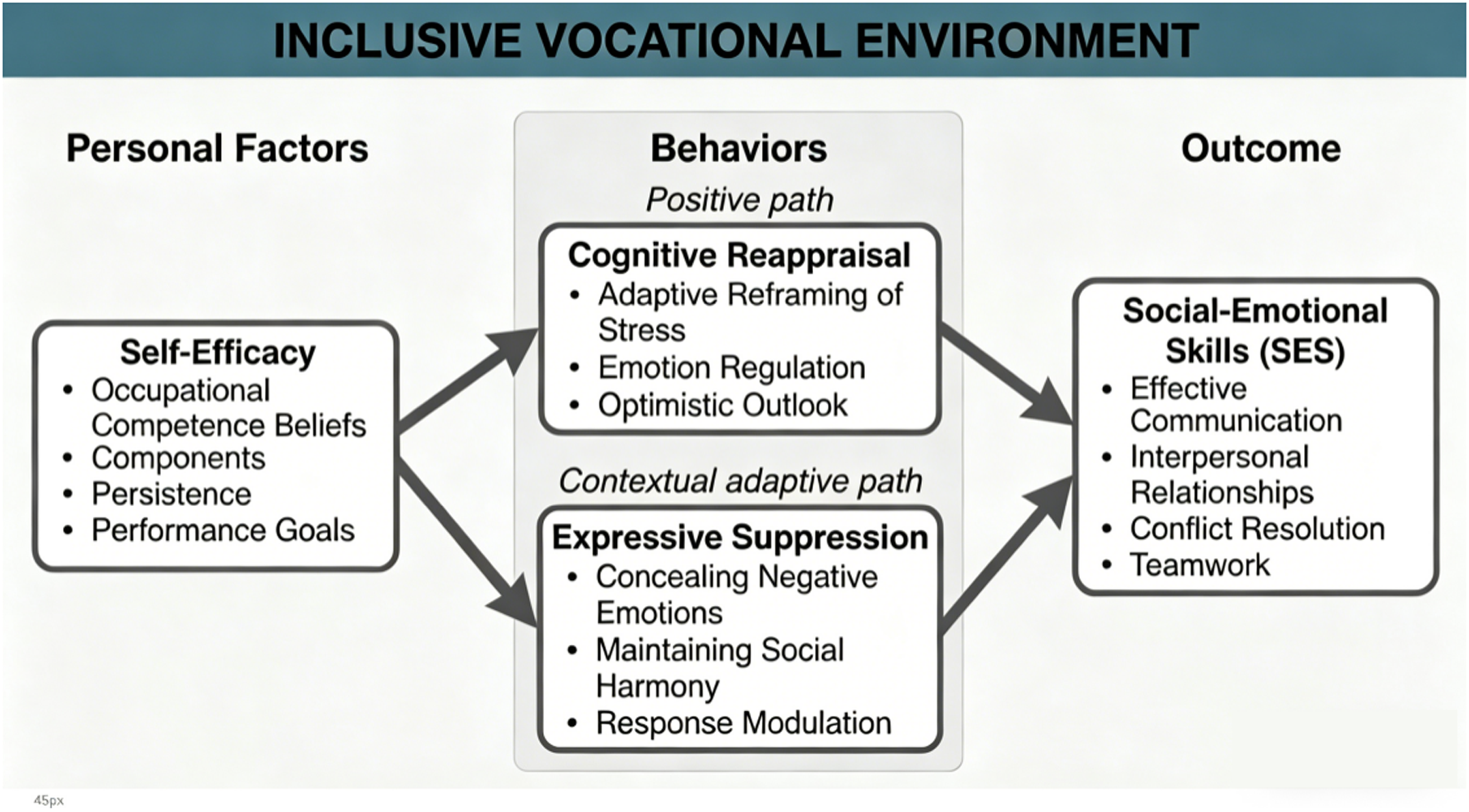
Theoretical framework.
The Relationship Between Self-Efficacy and SES
Self-efficacy is an individual's belief in their ability to successfully accomplish a task or achieve a goal (Bandura, 1982). Substantial evidence indicated that self-efficacy is strongly associated with SES (Li et al., 2025; Totan, 2014). Self-efficacy is related to the five core components of SES: self-awareness, self-management, social awareness, relationship skills, and responsible decision-making (Collaborative for Academic, Social and Emotional Learning, 2025). Individuals with high self-efficacy usually have a stable and positive self-concept, enabling them to set reasonable goals, face challenges with confidence, and adjust strategies when needed. The self-awareness serves as the foundation for effective self-management, fostering continuous reflection and improvement of emotional and behavioral regulation across diverse contexts. In addition, self-efficacy strongly predicts social awareness and interpersonal skills (Salavera et al., 2017), high self-efficacy enhances empathy and social understanding by improving cognitive processing and emotional regulation to pay more attention to others’ emotions (Bandura, 1986). Furthermore, such individuals are also more likely to act in prosocial and socially responsible ways (Weber & Johnson, 2009).
In general student populations, cross-lagged panel analyses have revealed a close and stable relationship between self-efficacy and SES (Chernyshenko et al., 2018; Hamed, 2012). However, this relationship may take on particular significance for students with disabilities. Compared with their peers without disabilities, these students often encounter additional challenges in social participation, peer relationships, and academic adaptation. Such contextual barriers may make internal psychological resources, such as self-efficacy, especially important for navigating social interactions and managing emotional experiences. In this context, self-efficacy can function as a key motivational and regulatory resource that supports students’ engagement in social situations and helps them cope with perceived difficulties (Miller & Kass, 2023). Research has found that students with disabilities may demonstrate levels of self-efficacy comparable to, or even higher than, those of their peers without disabilities despite facing greater challenge (Blake & Rust, 2002). High self-efficacy helps them to participate more confidently in social interactions and peer interactions, thereby facilitating the development of SES. These findings imply that the fundamental relationship between self-efficacy and SES also applies to students with disabilities, and may even play a more vital role.
The Role of Emotion Regulation Strategies
Emotion regulation strategies refer to the cognitive or behavioral approaches that individuals employ to modify or control emotion-related responses. The two most widely used strategies are cognitive reappraisal and expressive suppression (Gross, 1999). They work at different stages of emotional responses and affect social interactions, emotional experiences, and SES development (Gross, 2002).
The Role of Cognitive Reappraisal
Cognitive reappraisal refers to changing individual’s interpretation of emotional events before the emotional response happens. It is an advanced complex cognitive process that needs flexible thinking and perspective taking (McRae et al., 2012). By reframing negative emotional experiences in a more positive or rational way, individuals can mitigate negative emotions and enhance psychological well-being (Gross, 1999). From the perspective of social cognitive theory, self-efficacy plays a pivotal role in this process. People with high self-efficacy feel more in control over life events, displaying lasting resilience under the pressure and challenges to offset the resources and energy consumed. The effectiveness of cognitive reappraisal also depends on how creatively they reinterpret emotions (Oh & Pyo, 2023). Individuals with high self-efficacy typically trust their ability to manage emotions, and also tend to generate constructive ways to rethink emotional events. For example, in an interpersonal conflict, they may see it as an opportunity to understand rather than threat. This reduces emotional distress and maintains relationships. Furthermore, cognitive reappraisal can also alleviate the empathy-related distress triggered by the strong emotional contagion. It enables them shift attention from avoiding emotions to caring for others, eventually promote the development of SES.
Research has shown that self-efficacy positively predicts the use of cognitive reappraisal (Li et al., 2020). Those who use cognitive reappraisal more habitually exhibit greater emotional regulation, stronger self-concepts, and improved interpersonal relationships, thereby enhancing SES (Yang & Lin, 2017). For students with disabilities in secondary vocational schools, cognitive reappraisal may play a particularly important role in shaping the relationship between self-efficacy and SES. Vocational education environments often emphasize practical performance, peer collaboration, and workplace preparation. In such contexts, students with disabilities may face heightened performance pressure and social comparison. Individuals with higher self-efficacy may be more likely to reinterpret challenging experiences in constructive ways through cognitive reappraisal, which may facilitate adaptive social interactions and the development of SES.
The Role of Expressive Suppression
Expressive suppression refers to holding back emotional expressions after an emotional response has already been generated (Gross, 1999). According to social cognitive theory, individuals with low self-efficacy often have fragile and limited emotion-regulation skills (Bandura, 2014). They may struggle to effectively process and regulate negative emotions in daily life and are more likely to adopt expressive suppression as a defensive strategy to hide emotions and avoid social risks. As a post-response strategy, expressive suppression may provide temporary relief from negative emotions (Wylie et al., 2025). However, it depletes psychological energy and consumes cognitive resources. Gross's process model of emotion regulation suggests that expressive suppression limits the critical social cues and attentional resources (Gross, 2004). By focusing too much on their own expressions, individuals may become less sensitive to others’ emotions, which impair empathy and responsiveness. Consequently, students who habitually rely on expressive suppression may struggle to develop effective self-regulation abilities to cause emotional contagion when others face painful emotions, and often lack motivation to engage in prosocial behavior, constraining the development of SES (Chang et al., 2018).
Therefore, expressive suppression may also have a positive indirect association between self-efficacy and SES. Studies have found that individuals with low self-efficacy are more inclined to use expressive suppression, which heightens cognitive load and reduces social functioning, and ultimately have a negative impact on SES development (Lonigro et al., 2023). The function of expressive suppression may also be shaped by the vocational education context for students with disabilities. Vocational classrooms and training environments often involve frequent interpersonal interaction and performance evaluation. In such settings, regulating emotional expression may help students maintain harmonious relationships and manage social expectations. Students with higher self-efficacy may feel more capable of controlling emotional expressions in socially demanding situations, which may influence how expressive suppression relates to the development of SES.
The Current Study
Previous studies have indicated the role of emotion regulation strategies in relationship between self-efficacy and SES in general student populations (Hodge et al., 2023; Yang & Lin, 2017). However, such relationships remain understudied among students with disabilities, especially in secondary vocational education. Given the unique challenges and constraints faced by this group in social-emotional development, these pathways require further validation. Guided by social cognitive theory, the present study aimed to examine the pathways linking self-efficacy, emotion regulation strategies, and social and emotional skills among students with disabilities in mainstream secondary vocational schools.
By clarifying these psychological mechanisms, this research provides a theoretical basis for designing targeted SES interventions that address the unique needs of students with disabilities. Ultimately, these findings contribute to educational equity and high-quality inclusion by ensuring that vocational education supports not only skill acquisition but also the holistic growth and long-term social integration of the students with disabilities
Accordingly, the study proposed the following hypotheses:
Method
Participants
Data for this study were derived from the National Vocational College Students’ Development Survey Project conducted from July to August 2023. The sample comprised 350 students with disabilities from 74 mainstream secondary vocational schools across seven provinces, including Jiangsu, Hunan, and Sichuan. The questionnaire was distributed via official school channels, and all participants were capable of completing it independently.
Among the participants, 120 (34.3%) were in Grade 1, 145 (41.4%) were in Grade 2, and 85 (24.3%) were in Grade 3. Regarding disability types, 71 students (20.3%) had hearing impairments, 170 (48.5%) had physical disabilities, 77 (22.0%) had visual impairments, 30 (8.6%) had speech impairments, and two (0.6%) reported other types. All participants could complete the questionnaire independently. To ensure representativeness, participants were distributed geographically: 126 students (36.0%) were from western provinces, 197 (56.3%) from central provinces, and 27 (7.7%) from eastern provinces.
Measures
Self-Efficacy Scale
Self-efficacy was measured using the “Resilience” scale from PISA 2018, conceptualized as self-efficacy in the OECD PISA 2018 Assessment Report (OECD, 2019). The scale consists of five items, such as: “I believe I can handle multiple tasks at the same time.” Responses were rated on a 5-point Likert scale ranging from 1 (strongly disagree) to 5 (strongly agree), with higher scores indicating greater self-efficacy. In this study, Cronbach's α = 0.90.
Social and Emotional Skills Scale
The SES was measured using a scale comprising nine items across three dimensions: self-awareness, communication and social skills, and responsibility. The responsibility dimension was adapted from the OECD's SEES scale (OECD, 2025), while the other two dimensions were based on Bowie and Liu (Bao & Liu, 2016) and revised by Guo and Wu (Guo & Wu, 2017). Responses were rated on a 5-point Likert scale ranging from 1 (strongly disagree) to 5 (strongly agree). A sample items is: “I can communicate and interact effectively with others.” Higher scores indicate stronger SES. In this study, Cronbach's α = 0.90.
Emotion Regulation Strategies Scale
Emotion regulation strategies were measured using the Emotion Regulation Questionnaire (ERQ; Gross & John, 2003). A pretest led to the removal of one item for psychometric standards. The final version scale comprised nine items across two dimensions: cognitive reappraisal (sample item: “To feel more positive emotions, I try to change the way I think about the situation”) and expressive suppression (sample item: “I keep my emotions to myself”). Responses were rated on a 5-point Likert scale from 1 (strongly disagree) to 5 (strongly agree). Higher scores on a given dimension indicate more frequent use of that strategy. In this study, the overall Cronbach's α = 0.91, with subscale Cronbach's α = 0.85 for cognitive reappraisal and Cronbach's α = 0.80 for expressive suppression.
Procedure
The study received ethical approval from the Ethics Committee of the Faculty of Education, Beijing Normal University. All subjects provided informed consent prior to participation, and strict anonymity was maintained throughout the data collection process to adhere to international ethical standards.
Data Analysis
The data were analyzed using IBM SPSS 27.0 and PROCESS marco (Version 4.1). The analysis included: (1) Harman's single factor test was used to examine potential common method bias. (2) Descriptive statistics (mean and standard deviation) were calculated for self-efficacy, cognitive reappraisal, expressive suppression, and SES of students with disabilities in secondary vocational schools. (3) Pearson correlation analysis was used to examine relationships among these variables. (4) Model 4 of PROCESS was performed to test the potential indirect associations of cognitive reappraisal and expressive suppression in the relationship between self-efficacy and SES of students with disabilities in secondary vocational schools, controlling for grade level. Although the analysis followed the structure of a mediation model, the results should be interpreted as statistical rather than causal mediation, given the cross-sectional design.
Results
Common Method Bias Test
Harman's single-factor test was conducted using exploratory factor analysis (Harman, 1976). All variables were included in the exploratory factor analysis, yielding four factors with eigenvalues greater than 1. The first factor accounted for 39.6% of the total variance (less than 40%), indicating that common method bias was not a serious concern in this study (Wen & Ye, 2014).
Descriptive Statistics and Correlation Analysis
Descriptive statistics and correlation coefficients are presented in Table 1. The results indicate that self-efficacy was significantly and positively correlated with SES expressive suppression and cognitive reappraisal. SES was significantly positively correlated with expressive suppression and cognitive reappraisal, expressive suppression and cognitive reappraisal were significantly positively correlated as well. In addition, disability type, major categories and regions were not significantly correlated with main variables, whereas grade was significantly positively correlated with self-efficacy. Therefore, grade was included as a control variable in the mediation analysis.
Descriptive Statistics and Correlation Analysis Results of Variables (n = 350).
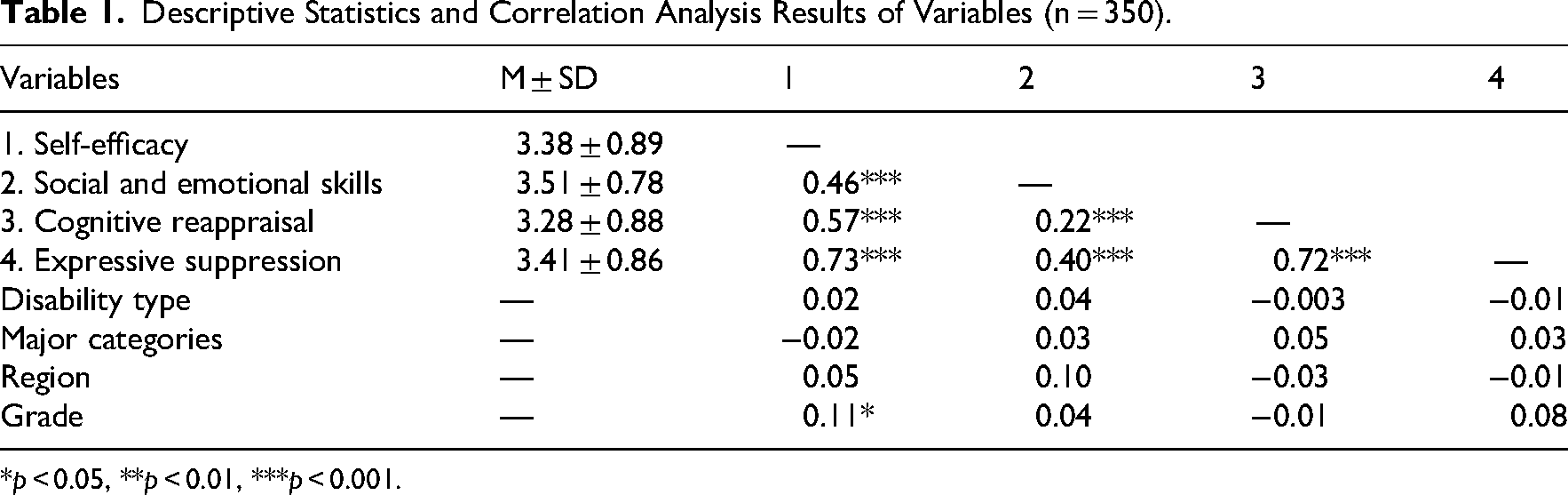
*p < 0.05, **p < 0.01, ***p < 0.001.
Indirect Pathway Analysis
This study used Model 4 of the SPSS PROCESS macro to test the potential indirect associations of emotion regulation strategies on the relationship between self-efficacy and SES. After controlling for grade level, the results (see Table 2) showed that self-efficacy significantly and positively associated SES, cognitive reappraisal, and expressive suppression. Both self-efficacy and cognitive reappraisal significantly and positively related SES, while expressive suppression was negatively associated with SES in the model. These results suggest that cognitive reappraisal and expressive suppression may statistically account for the relationship between self-efficacy and SES.
Regression Analysis of Model Variables.
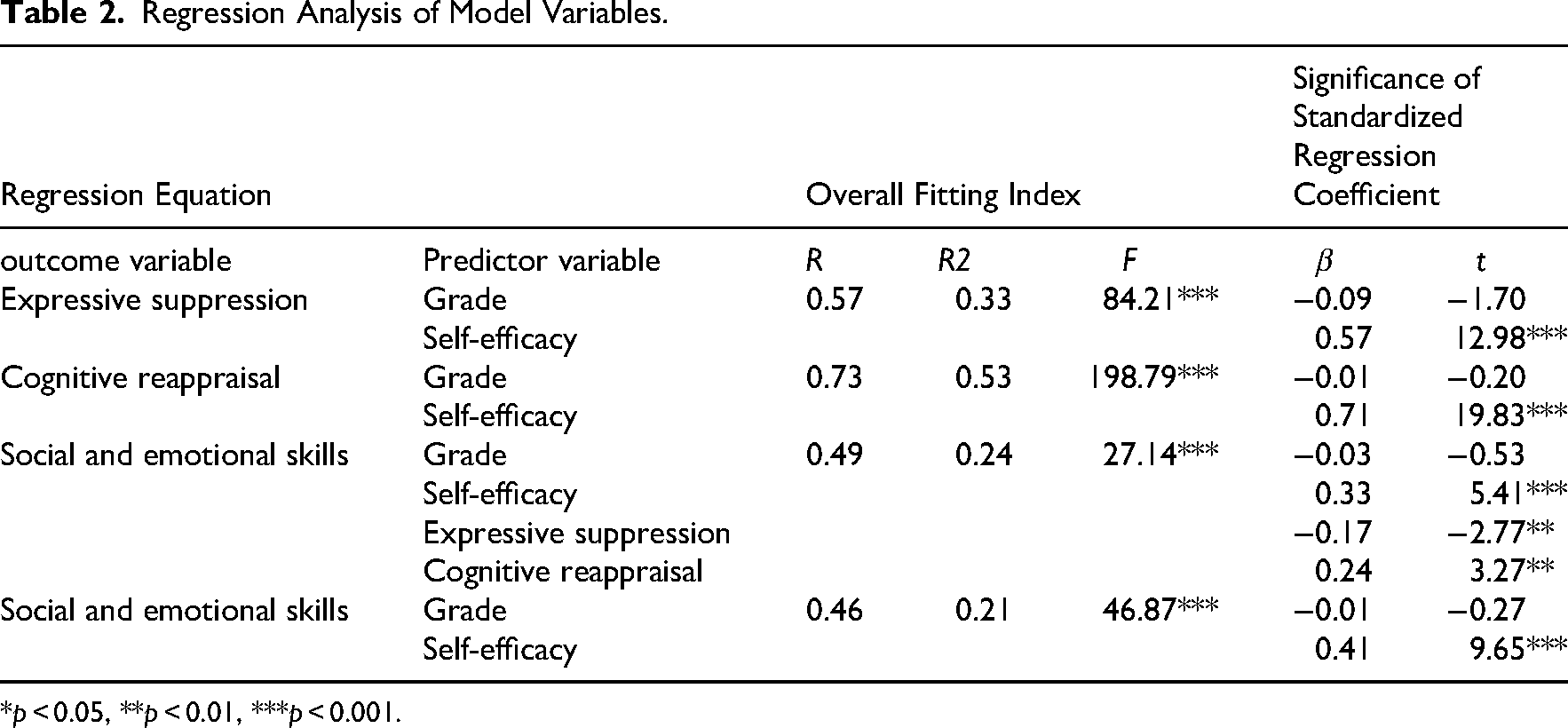
*p < 0.05, **p < 0.01, ***p < 0.001.
Bootstrapping with 5,000 resamples (see Table 3 and Figure 2) indicated that the indirect pathway through cognitive reappraisal on the relationship between self-efficacy and SES was statistically significant (95% CI [0.06, 0.28]). The indirect pathway through expressive suppression was also significant (95% CI [−0.17, −0.03]). Since the indirect and direct pathways had opposite signs, expressive suppression appeared to statistically mask part of the positive association between self-efficacy and SES. Following Wen and Ye (Wen & Ye, 2014), the absolute ratio of indirect effect to direct effect was used to reflect the relative magnitude of the statistical mediation. In summary, cognitive reappraisal and expressive suppression partially and simultaneously accounted for the link between self-efficacy and SES, demonstrating a parallel statistical mediation.
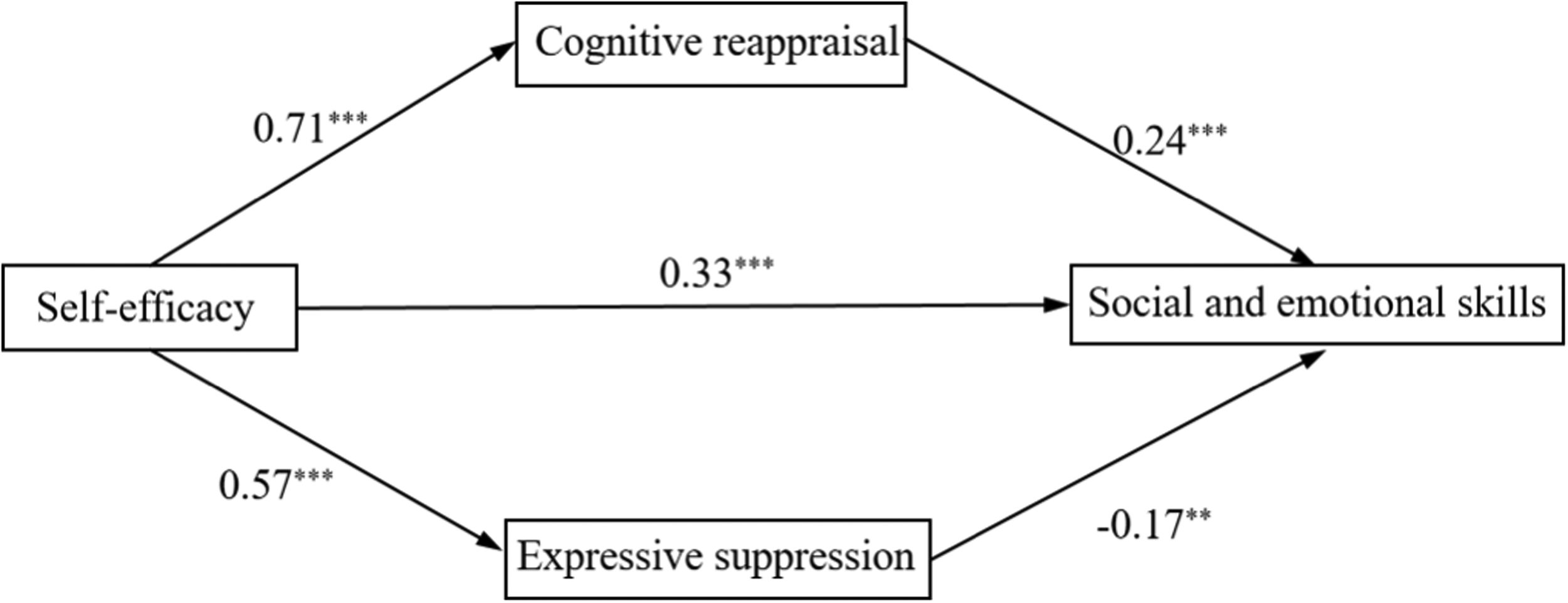
Parallel indirect pathways linking self-efficacy and social and emotional skills through emotion regulation strategies. Note: *p < 0.05, **p < 0.01, ***p < 0.001.
Indirect Effect Test.
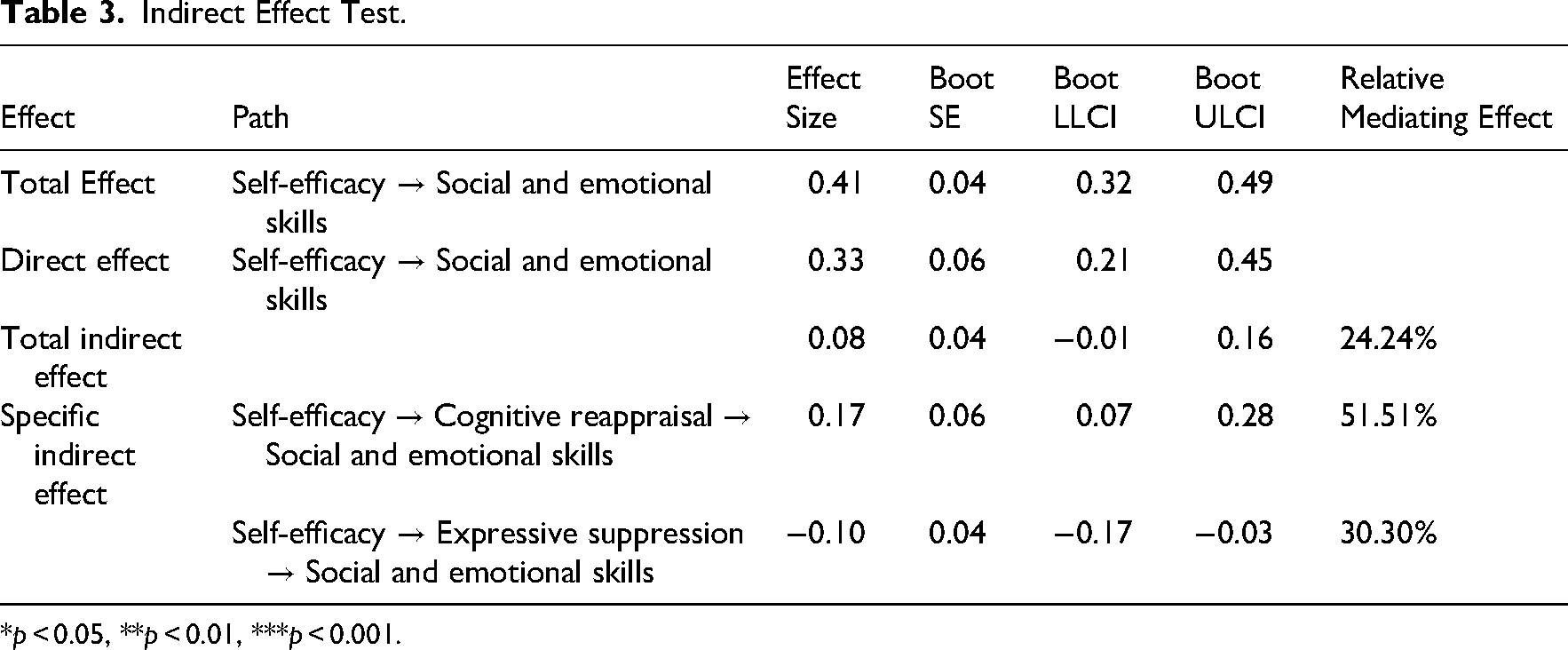
*p < 0.05, **p < 0.01, ***p < 0.001.
Discussion
The Association Between Self-Efficacy and SES Among the Secondary Vocational Students With Disabilities
The results revealed that self-efficacy was significantly and positively correlated with SES among secondary vocational students with disabilities. This finding aligns with previous research conducted at different educational stages (Gotseva Balgaranova, 2023; Moradi & Chemelnezhad, 2021), suggesting that self-efficacy serves as a robust predictor of SES development. From the perspective of Social Cognitive Theory, self-efficacy functions as a core personal resource that shapes individuals’ motivation, behavioral engagement, and persistence in social and academic contexts (Woreta et al., 2025). Importantly, inclusive educational environments provide a vital foundation for fostering self-efficacy and SES among students with disabilities. In such settings, opportunities for participation, peer interactions, and feedback are more readily available, enabling students with disabilities to practice communication, cooperation, and self-management skills (Ge, 2025; Maphie, 2025). Students with higher self-efficacy are more likely to actively utilize these supportive conditions, as they tend to perceive such resources as opportunities for successful engagement rather than potential sources of difficulty. As a result, they can more effectively translate their confidence into actual social participation and skill development. This process further contributes to the development of SES, while also strengthening positive self-acceptance and a stronger sense of social identity among students with disabilities (Jardinez & Natividad, 2024).
The Indirect Pathway of Cognitive Reappraisal
This study confirmed that cognitive reappraisal and expressive suppression jointly play a parallel mediating role of the relationship between self-efficacy and SES among students with disabilities in secondary vocational schools. Notably, the two strategies exerted distinct effects: The positive effect of self-efficacy on cognitive reappraisal facilitates the development of SES, whereas expressive suppression played a partial masking role between self-efficacy and SES.
Inclusive education creates an emotionally complex environment for vocational students with disabilities, in which they must cope with both the limitations of disabilities and the social pressures and identity-related anxieties of integrating into mainstream classrooms. Emotion regulation thus becomes a critical adaptive behavior. Cognitive reappraisal, as an adaptive strategy helps individuals reinterpret negative emotional events to generate more positive experiences (Stover et al., 2024). According to Social Cognitive Theory, self-efficacy plays a central role in shaping how individuals interpret environmental demands (Chou et al., 2024). Students with higher self-efficacy believe that they possess the capability to cope with difficulties, and therefore tend to perceive academic and social challenges as manageable rather than threatening. This cognitive appraisal process is critical, as it directly influences the selection of emotion regulation strategies. When stressful situations are interpreted as controllable, individuals are more likely to engage in adaptive strategies such as cognitive reappraisal, reframing difficulties in a constructive manner. In contrast, when the same situations are perceived as threatening, individuals may be more inclined to rely on less adaptive strategies such as expressive suppression (Gao & Yang, 2023). Such difference in emotional adjustment further shapes the development of SES. By promoting constructive social functioning and enhancing emotional stability, cognitive reappraisal enables students to respond more calmly, communicate more effectively, and engage more positively in interpersonal interactions, thereby supporting core dimensions of SES such as self-management and relationship skills. This mechanism may be particularly important for students with disabilities, who are more likely to experience loneliness and low self-esteem. In such contexts, the ability to reinterpret negative experiences plays a key role in improving well-being, stabilizing life satisfaction, and fostering harmonious interpersonal relationships (Liu et al., 2016a; Liu et al., 2020).
The Indirect Pathway of Expressive Suppression
In contrast, expressive suppression appeared to statistically mask part of the positive association between self-efficacy and SES. Expressive suppression involves the inhibition of emotional expression, rather than modifying the emotional experience itself. From the perspective of Social Cognitive Theory, self-efficacy reflects individuals’ beliefs in their capability to regulate their behavior in response to situational demands. Students with higher self-efficacy may therefore be more confident in their ability to control emotional expression when necessary, and may selectively employ expressive suppression as a situational strategy (Ramos-Cejudo et al., 2024)
However, expressive suppression does not reduce negative emotions at their source, but instead requires individuals to continuously exert cognitive effort to manage outward expression. This process creates a conflict between inner emotional experiences, increasing psychological strain and emotional burden (Masumoto et al., 2016). Over time, such persistent self-inhibition prevents emotional awareness and regulation skills, while prolonged internalization further obstructs the growth of SES. In addition, suppressed emotions may be redirected to other psychological or physiological channels, which intensify negative emotional experiences and burdens. Students who rely heavily on suppression may experience greater difficulty in open communication, emotional expression, and maintaining positive interpersonal relationships (Kalokerinos et al., 2014). Consequently, more cognitive and emotional resources are required for regulation, which may hinder the development of SES among secondary vocational students with disabilities.
The Parallel Pathway of Cognitive Reappraisal and Expressive Suppression
Despite its limitations, students with higher self-efficacy frequently employed both expressive suppression and cognitive reappraisal (Liu et al., 2016b). Research indicates that the function of expressive suppression varies across cultures: while often associated with negative outcomes in individualistic societies, however, in collectivist cultural contexts such as China, expressive suppression may sometimes be used as a socially adaptive strategy to maintain interpersonal harmony (Soto et al., 2011). In these cultures, humility and self-control are emphasized, and maintaining composure by concealing strong emotions is often seen as beneficial for success. In vocational inclusive settings, students with disabilities are often preparing for entry into structured workplace environments where emotional control and professional demeanor are socially expected. Thus, these cultural influences may be even stronger.
From the perspective of Social Cognitive Theory, cultural context can be understood as an important environmental factor that shapes individuals’ efficacy beliefs and behavioral regulation (de la Fuente et al., 2023). In collectivist cultures where emotional restraint and social harmony are highly valued, individuals are more likely to develop beliefs about their capability to regulate emotional expression in accordance with social norms. Students with higher self-efficacy may possess stronger confidence in their ability to control emotional expression, and are more likely to intentionally adopt expressive suppression as a context-appropriate strategy. In this context, expressive suppression is not merely a passive response to emotional stress, but a goal-directed regulatory behavior guided by efficacy beliefs and social expectations (Shangguan et al., 2024). Such regulation may facilitate short-term social adaptation by helping individuals maintain appropriate interpersonal conduct. However, as a response-focused strategy, prolonged reliance on suppression may also limit emotional processing and interpersonal authenticity, thereby constraining the long-term development of SES.
Suggestions
Focusing on Enhancing Self-Efficacy of Vocational Students With Disabilities
Given that self-efficacy directly associated with SES, strengthening self-efficacy should be considered a key target for intervention among secondary vocational students with disabilities, as it influences students’ willingness to engage, persist, and participate in social and learning activities. From the perspective of Social Cognitive Theory, self-efficacy develops through mastery experiences, vicarious learning, social persuasion, and emotional regulation, which are all shaped through repeated interactions within learning and social contexts. Therefore, schools should not only aim to enhance students’ confidence at a general level, but more importantly create structured opportunities in which students can experience success, observe others, and receive feedback through active participation. First, schools can establish activity embedded within regular classroom or training contexts that incorporate empathy-based dialogue, social communication training, and resilience development. These activities allow students to engage in supported social interaction, thereby generating successful interpersonal experiences that directly strengthen their sense of efficacy in managing social challenges. For students with relatively lower confidence or learning difficulties, tasks can be simplified and accompanied by immediate feedback, while students with higher competence can be encouraged to take on more complex or collaborative roles.
Second, providing vicarious experiences through role models is particularly important. Inviting successful individuals with disabilities, alumni of vocational education, or professionals working in inclusive workplaces can help students envision possible career pressure, thereby transforming abstract beliefs about ability into concrete expectations of what they themselves can achieve.
Third, vocational training should be better aligned with students’ individual strengths and career aspirations. Schools may establish collaborative advisory teams involving teachers, career counselors, and employers to provide integrated services including career assessment, internship opportunities, and employment guidance. Accessible training environments, simulated workplaces, and digital assistive technologies can further help students build confidence in their ability to succeed in future employment contexts, as they allow students to repeatedly test and confirm their capabilities in task-oriented situations. For lower-grade students, the focus may be on building basic confidence in participation and task completion, whereas for higher-grade students, it becomes increasingly important to connect these experiences with real workplace expectations and performance demands.
Promoting Learning and Application of Emotion Regulation Strategies Among Secondary Vocational Students With Disabilities
The findings also highlight the important role of emotion regulation strategies in the development of SES, as they influence how students respond to stress and engage in social interaction. Therefore, it should be developed through guided practice in real or simulated learning situations where emotional responses naturally occur.
In inclusive vocational classrooms, emotionally demanding situations frequently arise during group collaboration, skill assessment, and performance evaluation, providing natural contexts for intervention. Teachers can make use of these moments by incorporating brief, structured reflection activities following such situations, guiding students to identify emotional triggers, examine their interpretations, and consider alternative ways of understanding the experience. In particular, training in cognitive reappraisal should be emphasized, as it enables students to reinterpret stressful situations and develop more adaptive emotional responses. At the same time, expressive suppression should not be treated as entirely maladaptive, but as a situational strategy that requires flexible use. In contexts where emotional control is socially expected, such as classroom performance or workplace simulations, temporary suppression may help students maintain appropriate behavior. Educators should therefore guide students to use this strategy flexibly and situationally. However, if used in isolation, suppression may prevent emotional processing and increase cognitive and emotional burden, which may in turn interfere with effective social interaction and self-regulation. Therefore, opportunities for emotional processing should be incorporated following such situations, for example through guided discussion, reflection activities, or individual journaling. Through repeated cycles of emotional experience, reflection, and adjustment, students can gradually develop more flexible and adaptive regulation strategies across different social and vocational contexts.
Strengthening Coordinated Support for SES Across Contexts
The development of SES among students with disabilities depends on how consistently they are supported across school, classroom, and family contexts, as these environments jointly shape opportunities for participation, feedback, and emotional adjustment. Rather than relying on isolated interventions, effective support should be embedded within everyday practices, allowing students to repeatedly experience engagement, interaction, and reflection in different situations.
At the school level, SES should be integrated into routine teaching and evaluation processes. In practice, some students may require more structured opportunities to participate, while others may benefit more from open-ended interaction or leadership roles. Designing flexible activity formats can therefore help ensure that different students are able to engage meaningfully.
At the classroom level, teachers play a key role in shaping interaction patterns. By structuring group work, assigning roles, and guiding peer interaction, teachers can create conditions in which students gradually become more comfortable expressing themselves and responding to others (Li et al., 2021). For students who are less inclined to participate, lower-pressure entry points such as pair work or guided interaction can be used, while students who are more confident can be encouraged to take on more active or facilitative roles.
At the family level, consistent emotional support and communication can reinforce what students experience in school. Rather than providing general encouragement, parents can support students by listening to their experiences, validating their emotions, and helping them reflect on how to respond to challenges. When school and family environments provide consistent responses to students’ participation and emotional experiences, students are more likely to develop stable patterns of engagement and interaction.
Through such coordinated support, students can more effectively translate their abilities and experiences into sustained social participation and emotional functioning, thereby supporting the long-term development of SES.
Limitations and Future Direction
Firstly, the uneven distribution of disability types limits the generalization of the findings. Future studies could recruit more balanced proportion of disability types to enhance the external validity. Secondly, this study is a cross-sectional study, which limits the ability to establish a clear temporal sequence among the exposure, mediators, and outcome. Consequently, the results represent statistical associations rather than causal mechanisms. Future research should adopt longitudinal designs to track the development of these variables among vocational students with disabilities over time. For instance, tracking changes in self-efficacy and SES from enrollment to graduation would provide valuable insights into the long-term effects of educational interventions. Third, this study primarily focused on individual-level psychological mechanisms, did not fully control for potential confounding factors between the mediators and the outcome, or between the exposure and the mediators. Such unmeasured confounders like teacher feedback, classroom climate, or family emotional support may have influenced the observed associations. Future research should further examine potential confounding and contextual variables, incorporating these variables into multilevel or structural equation models would provide a more comprehensive understanding of how individual and environmental factors interact. Fourth, comparative analyses between students with and without disabilities could deepen insights into similarities and differences in the mechanisms linking self-efficacy, emotion regulation, and SES. This could further clarify the unique characteristics of students with disabilities in terms of emotional regulation and social adaptation, offering evidence for more targeted support strategies. Finally, this study also holds implications for inclusive vocational education in international contexts. Countries worldwide face the challenge of balancing skill training with social and emotional development in vocational education for students with disabilities. The mechanisms identified in this study may serve as valuable references for intervention in other countries. Future research should test the applicability of these findings across different cultural and educational contexts.
Footnotes

Ethical Statement
Ethical approval was obtained from the Ethics Committee of the Faculty of Education, Beijing Normal University. All participants provided informed consent prior to participation.
CRediT Authorship Contribution Statement
Yunbo Liu: project administration, investigation, and funding acquisition. Yuexin Zhang: conceptualization, supervision, funding acquisition, and writing—review and editing. Wanqin Chen: visualization, writing—original draft, and writing—review and editing. Qi Wang: investigation, data curation, and writing—original draft. Zhilin Wu: data curation, software, formal analysis, and writing—original draft.
Funding
The authors disclosed receipt of the following financial support for the research, authorship, and/or publication of this article: This work was supported by the National Natural Science Foundation of China Youth Project, the Beijing Normal University First-class Discipline Excellence Cultivation Project “Optimization of Special Education Resources under the Background of Inclusive Development” (Grant Numbers 72104030, YLXKPY-XSDW202407).
Declaration of Conflicting Interests
The authors declared no potential conflicts of interest with respect to the research, authorship, and/or publication of this article.