







Abstract
Extractive industries often cause serious environmental harm, and even social harm, to the local populations of the commodity regions, especially in the Global South. The increasing demand and extraction of raw materials needed for the production of new technologies in the Global North is a specific case of this, which emphasizes asymmetrical global economic conditions. This article describes these harmful commodity relationships and presents the meaning behind the increase in the demand for and production of raw materials. The case of lithium is offered as an example of this development. Further, in the article, it is suggested that the lack of regulation and control promotes a series of deviant and criminal practices which can be systematically organized for criminological analysis. The harm caused by this industry, by its part, is presented as well, as well as a first categorization of its impact on the local population even in terms of human rights violations. Instead of a conclusion, an invitation to the study of these renewed forms of exploitation and victimization is made to criminologists, and especially, to criminologists from the particular regions that benefit from the development of new, innovative “clean” technologies.
Decades ago, Galtung (1969) said that “research in the Americas should focus on structural violence, between nations as well as between individuals, (…) the manifest structural violence in the Americas (and not only there) already causes an annual toll of nuclear magnitude” (p. 183). I would like to take this assessment as a starting point for this article because it reflects all parts of the main argument in this text: The asymmetrical power relationships between regions, states, and societies are historically and structurally defined, and these relationships can be seen today in the disproportional relationship between countries of the Global North, which develop expensive, highly innovative industries thanks to countries of the Global South, which offer the raw materials for this development at the cost of their own resources and the living conditions of their own people. In these relationships, the lack of regulation and control can be understood as part of that structural invisible violence; further, the harm produced at the collective level can be considered criminal. The asymmetric economic relationships, therefore, can be explained as deviant and criminal business relationships in which corporations and industrialized countries participate in a joint exploitative enterprise—an enterprise causing harm of nuclear magnitude.
In Latin America, for example, structural violence has occurred from the very beginning and has been characterized by its severity and scope from the first contact with the European Christian world (Yuralivker, 1992). Marginalization and economic interests are always rearing their heads, and land is the nucleus of conflict. However, this is not a novelty of the 21st century. When the Spanish “conquerors” arrived, they occupied the lands with the objective of obtaining their minerals, and indigenous people were transformed into slaves or were “reduced” to indigenous communities, that is, semi-enslaved (Martínez Sarasola, 2013, p. 145–210). In the same way, at present, territory in possession and with titles of dominion recognized in favor of indigenous communities are very few, and these lands continue to be coveted by the interests of private actors that crave the exploitation of the minerals, of the land for agricultural use or even for speculation with land prices. Those who are in the area see a gradual loss of land (although their rights may expand on paper) and receive very little in exchange. Indeed, they are the ones who dismantle their own land and clear the forests in order to leave the land clean for corporations.
The high price of land, water, oil, minerals, and soil makes of nature a commodity and makes of people living in the area obstacles to the conversion of nature into money. Because of this, the harm produced by extraction activities easily becomes social harm. This article, a first presentation of a work in progress, offers some reflections on how this seems to be happening in the specific case of the increasing demand for raw materials needed for the production of new technologies. In the Commodity Relationships Surrounding New Technologies section, commodities relationships are drafted; the Emerging Technologies and the Desired Commodities: Lithium as an Example section focuses on the increase in demand for and production of raw materials and offers the case of lithium as an example of this development; the lack of regulation and a catalog of deviance and criminal practices derived from this lack are analyzed in the Economic Deregulation and the Possibility of Regulation: A Catalog Draft section. A first proposal of harm categorization and the gravity of the impact of the increased demand on the local population of commodity regions even in terms of human rights violations is offered in the Reality Beyond Any Catalog Proposal and Harm Revisited: A Broader Concept From a Victimological Social Perspective sections, respectively. The Conclusion—or Invitation section, lastly, is more an invitation than a conclusion, since it stresses the necessity for more research and contributions on the part of the Global North in order to address the criticism of academics who speak out against the grave harm caused by the most innovative industries of the North to people of the Global South.
Commodity Relationships Surrounding New Technologies
New and emerging technologies developed mainly in Europe and the United States, and also in China, Russia, and India, have a need for specific raw materials—commodities—that form an ascendant curve with respect to both their quantity and diversity. Latin America, Africa, and many countries in Asia are the main areas of the Global South where these raw materials are available, and they can be considered, therefore, as commodity regions.
This relationship, which we could call a raw material relationship, and the tension it can cause, is described very well on the homepage of one of the leading institutes for new technologies in Germany, the Fraunhofer Institut: Industrialized nations, being high-wage countries, gain competitive advantages in the global market through technical innovations. The research and development race triggered by these framework conditions increases the pace of innovations constantly and in the long term. At the same time, German industry depends almost entirely on imports, not only of energy resources, but also of metals. Germany’s success in exporting its high-tech and cutting-edge technology products, and thus the prosperity of its society, therefore rely essentially on an undisrupted supply of raw materials at reasonable prices.
1
Latin America and Africa, historically, have provided Europe with raw materials and natural resources. The United States have also found cheap labor, oil, and of course, sugar cane, bananas, and cotton in those regions (Altvater, 2011, pp. 25–34; Galeano, 1984). In the past, this all took place through colonial systems. “At least initially, slavery and colonialism were acts of enterprising individuals and companies; governments entered later, often with softening effect” (Galtung, 1996, p. 49). Since then, there have been military interventions in many cases, new corporate interventions in many others, or simply diplomatic and free market relationships in the rest. In the present, there are no more colonies in the old sense of the word. For this reason, goods and financial transfers have become more and more sophisticated (Guha, 1987; Guha & Vivekananda, 1987). The commodities’ supply direction, however, has not changed. The Global South seems to be locked in this perpetual reality. The exploitation of non-renewable natural resources in Latin America is carried out by large consortiums of Canadian and American origin, whose objective is to have a strategic reserve in 100 different natural resources and minerals in the next 10 years, that is, they act under geopolitical objectives. (Catalán Leman, 2011) The economic decisions that affect the large sectors in this country are taken in Spain, they are taken in the United States, in Japan, in New Zealand, or at the different stock exchanges of New York, Tokyo, or anywhere else. What we have in Chile are servile political classes subordinated to those great economies, and that economic model is the one that is depredating our natural resources, the opulence of the economic system that can develop in Europe is financed by the misery of my people and by the misery of many peoples in both America and Africa and the rest of the world, who have been called Third World peoples. (Apaga y vámonos, 2005. Documentary film, Director Manel Mayol, Spain)
Emerging Technologies and the Desired Commodities: Lithium as an Example
Emerging technologies are industrially exploitable technical capabilities which cause revolutionary pushes of innovation far beyond the borders of individual industrial sectors. Emerging technologies cannot be restricted to 5, 10 or 20 innovations. Rather, a fundamental renewal of the economy is under way in all sectors, which is driven by the goal of the industrialized high-wage countries to improve their position in the global competition due to technological excellence. (Fraunhofer/IZT, 2009, p. XV)
The development of all these fields means an increase in the need for raw materials. New technologies developed primarily in the Global North, thus, need more extraction of the scarce natural resources available mainly in the Global South.
2
The required expansion of mining capacity is, therefore, obvious, and this should attract attention to the vulnerability and “criticality” of the industrial manufacturing sectors, which is defined firstly by the scarcity of certain raw materials and by the impossibility of substitution: Soaring prices of all metals, and supply problems for some, have led to the notion of critical metals—those that are essential for modern industry but whose future supply may be interrupted. Metals are usually deemed critical when they are considered to be vital by industry, sourced from a restricted number of regions that are potentially unstable, and cannot be substitute by other metals. Many of the metals used in the high-technology industry, including those that generate renewable energy, have high levels of criticality. (Vidal, Goffé, & Arndt, 2013, p. 895)
Main Raw Materials for Selected Emerging Technologies.
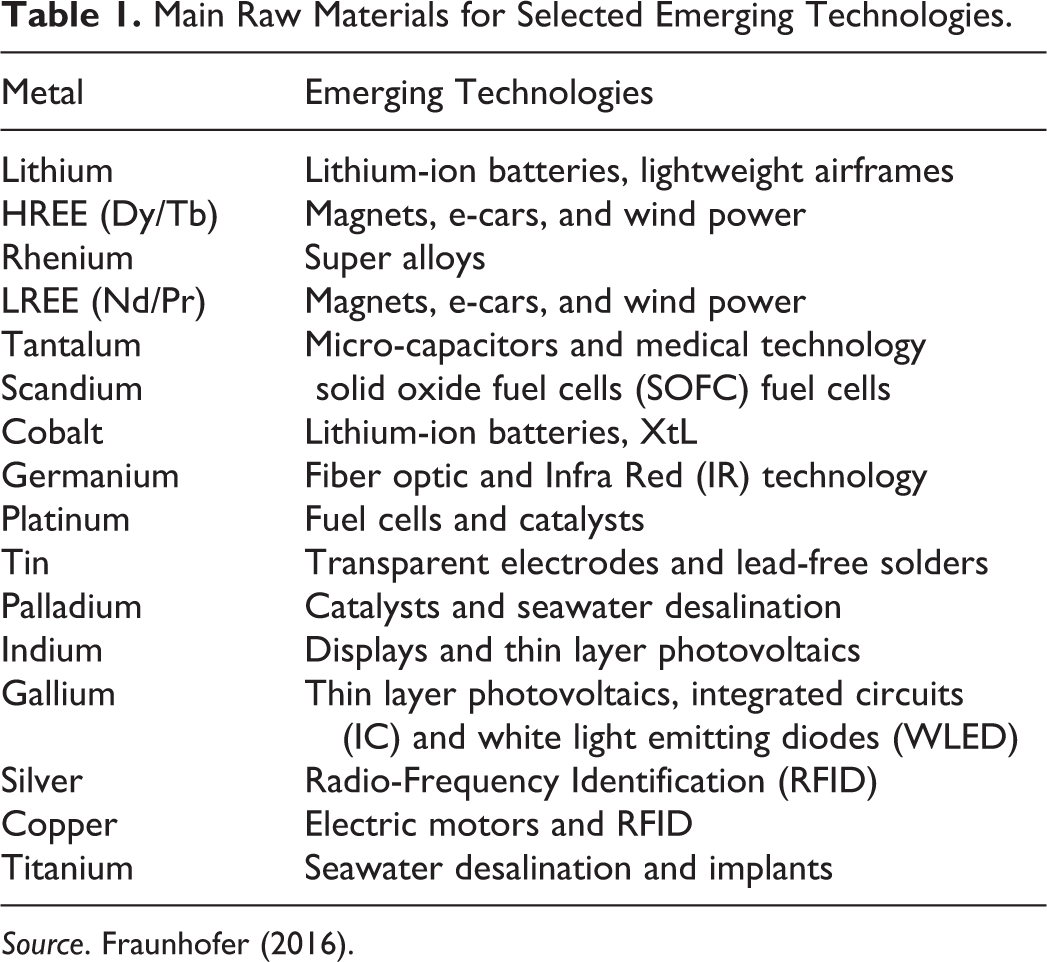
Source. Fraunhofer (2016).
Both studies focused on the increase in demand for specific metals estimated for the years 2030 (Fraunhofer/IZT, 2009, p. XXVII) and 2035 (Fraunhofer, 2016, p. 19), respectively, in proportion to the demand that was presented for the same metal in the years 2006 and 2013, respectively. The studies show a sustained growth trend for most minerals and metals, and it is evident that production at the time of each report does not cover the demand of the moment, much less the demand that will be presented in the future.
3
The introduction of new technologies, such as cell phones or hybrid vehicles, requires a diverse set of previously little-used metals. The demand for base metals is currently increasing by 5% annually, and if this trend continues, the quantity of metal production for the next 15 years will need to match that form the start of humanity to 2013. (Vidal et al., 2013, p. 895)
The industrial use of lithium covers various items of traditional end-use products such as ceramics glass, lubricants, continuous casting, primary aluminum production, polymers, rubber, and pharmaceuticals (Cui, Guo, Yin, Huy, & Liedtke, 2016; U.S. Geological Survey [USGS], 2015). More recently, it has been applied in new technologies such as lithium-ion batteries and lightweight airframes (Fraunhofer, 2016; USGS, 2019). The use of lithium, however, has increased substantially in recent years due to its application in the production of lithium-ion batteries. According to USGS 4 data, lithium-ion batteries account for more than half of the final consumer goods for which lithium is currently used, whereas they comprised only 25% of the final destination in 2008. While in 2003 the volume of lithium use had not yet been elucidated, it has been outlined in the most recent surveys, which show the growth in importance of this technological development and its applications on the market (see Table 2).
Global End-Use Lithium Market.
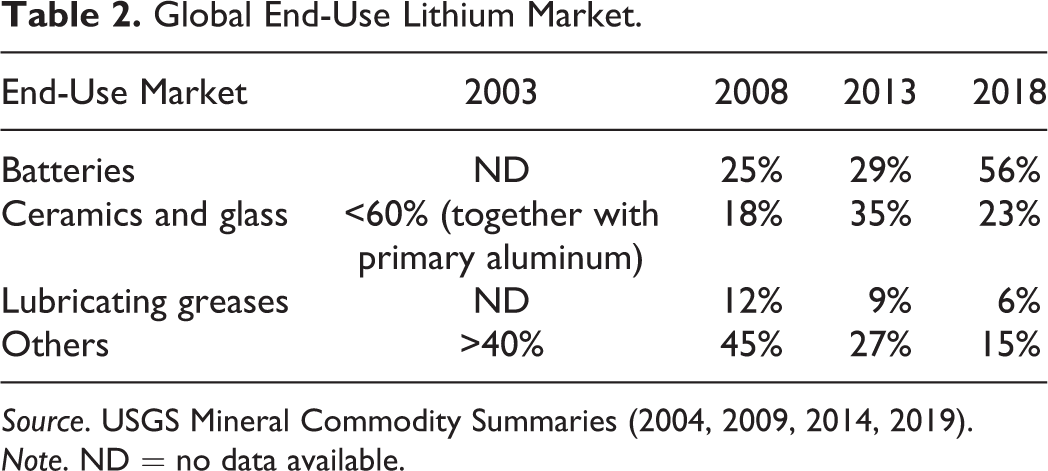
Source. USGS Mineral Commodity Summaries (2004, 2009, 2014, 2019).
Note. ND = no data available.
Increased industrial use, of course, goes hand in hand with greater demand for the mineral and therefore with an increase in production. The following Table 3 shows the five countries that currently represent the largest sources of lithium (Argentina, Australia, Bolivia, Chile, and China) and allows us to observe the increase in production measured in tons, which exceeds the level of production in 2003 by 4–5 times, on average, both individually by country and in world production overall. 5
Estimated Lithium Production in Metric Tons by the Main Producer Countries.
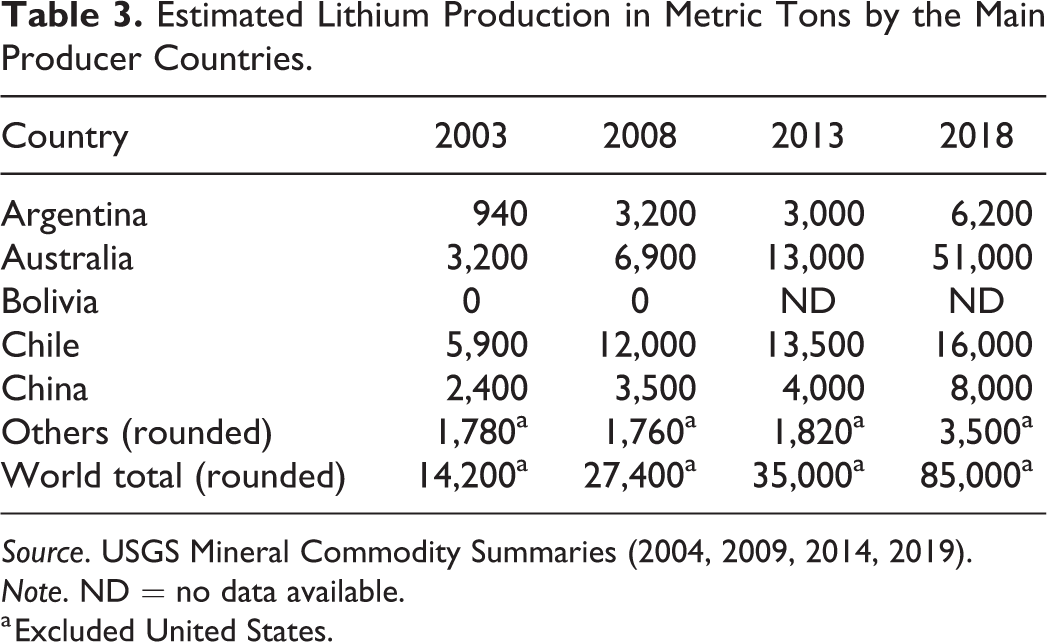
Source. USGS Mineral Commodity Summaries (2004, 2009, 2014, 2019).
Note. ND = no data available.
a Excluded United States.
Naturally, at the scientific and technological level, this increased demand has mobilized an increase in projects of identification and prospecting aimed at the exploitation of resources in order to meet the necessary increase in production. This means that the estimated reserves have also increased, even in countries where there was no available information concerning reserves until a few years ago (see Table 4).
Estimated Lithium Reserves in Metric Tons by the Primary Reserve Countries.
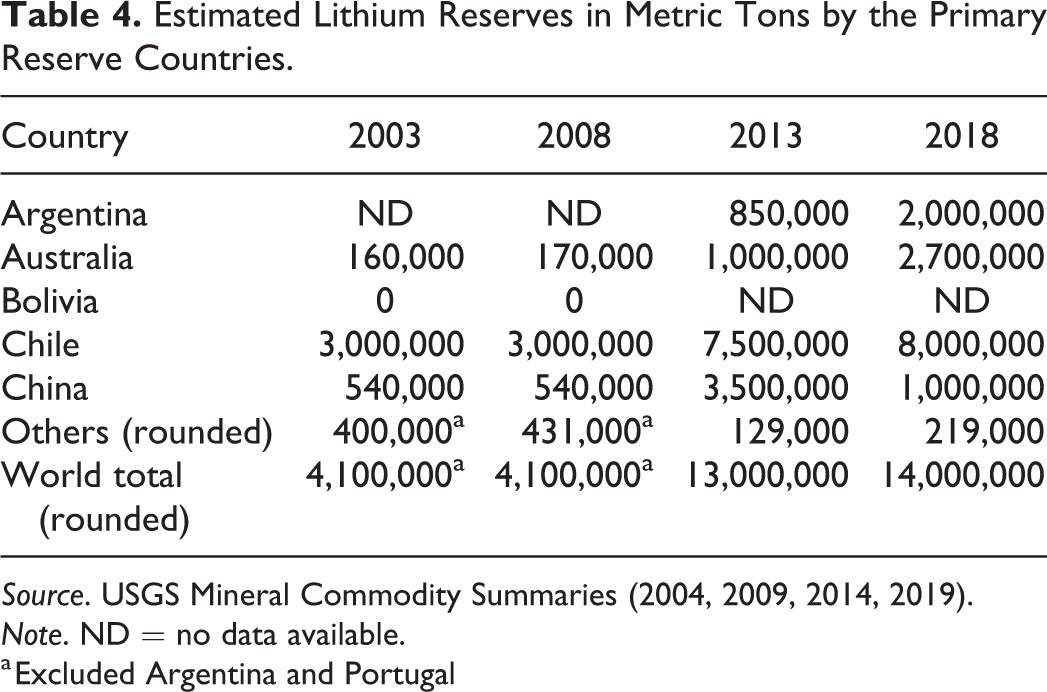
Source. USGS Mineral Commodity Summaries (2004, 2009, 2014, 2019).
Note. ND = no data available.
a Excluded Argentina and Portugal
While Australia and China have been producing countries with well-identified reserves right from the beginning of the 20th century, the so-called lithium triangle formed by Argentina, Bolivia, and Chile (Cui et al., 2016, p. 13) is a region just recently “discovered.” The current and future interest in this region on the part of the industrialized countries is easy to understand because of the estimated lithium resources currently present in these countries: of the approximately 62 million tons of lithium estimated as a global resource today, more than half are located in the regions of Argentina, Bolivia, and Chile (see Table 5). 6
Estimated Lithium Resources in Metric Tons by the Main Resource Countries.
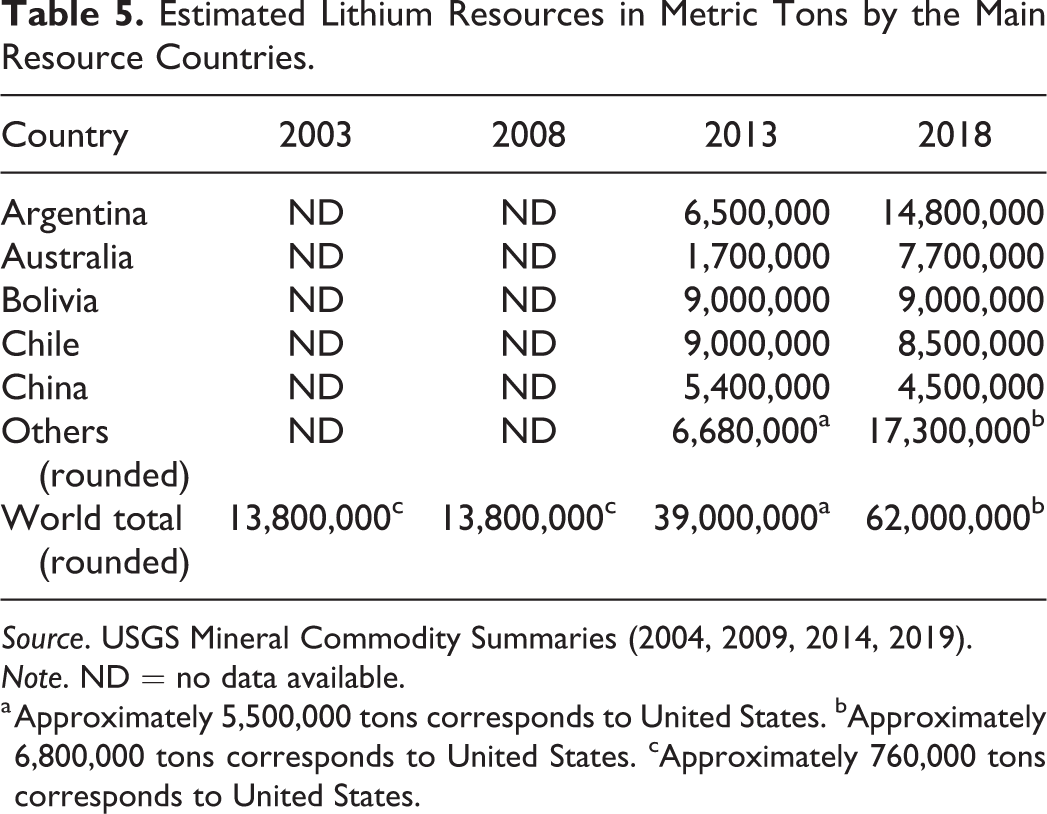
Source. USGS Mineral Commodity Summaries (2004, 2009, 2014, 2019).
Note. ND = no data available.
a Approximately 5,500,000 tons corresponds to United States. bApproximately 6,800,000 tons corresponds to United States. cApproximately 760,000 tons corresponds to United States.
The presence of this mineral in the Global South is alarming in terms of its volume and form of exploration and exploitation when we consider the estimated growth in demand that has been calculated for use in the abovementioned new technologies. In 2013, world lithium production was estimated between 30,000 and 35,000 tons (Fraunhofer, 2016, p. 7 y; USGS, 2014, p. 95, respectively). In the same year, demand for lithium for use in new technologies was approximately 610 tons worldwide (Fraunhofer, 2016, p. 7). In other words, production was clearly sufficient to cover demand. It has been estimated, however, that the demand for lithium (only) for new technologies in 2035 will reach at least 110,000 tons (Fraunhofer, 2016, p. 7). Other reports refer to demand for more than 120,000 tons of lithium by 2025 (Bronstein, 2017). It is apparent that the necessary increase in production will have a direct impact on the space in which said production is carried out. Unlike classic ore-mining operations for lithium in Australia, mining in Latin American countries takes place by evaporating naturally occurring lithium-bearing brine from the salt lakes in the lithium triangle (Salar del Hombre Muerto in Argentina, Salar de Uyuni in Bolivia, and Salar de Atacama in Chile). Although the extraction of lithium from salt lakes by using the sun for selective evaporation is considered relatively environmentally friendly, “the associated intensive use of water in desert-like areas can worsen existing water conflicts” (Bardt & Hübner, 2017, p. 6). These “conflicts” mean that local people—principally indigenous people—lack access to potable water, and these conflicts are taking place in the region right now.
This explanation about lithium use for new technologies and the situation of its demand, exploration, production, and future development is presented here merely as a concrete example of what is happening and can be expected to be happening with regard to other raw materials for use in technology. This is a work in progress that aims to identify and explain the specific challenges emerging from each raw material.
An interesting example of the relationship between the growing demand for specific metals, the need for the water resources associated with their exploitation and the impact on the local population is presented by the cases of Mina Frisco-Tayahua and Mina Goldcorp-El Peñasquito. Both projects were developed in the Mazapil municipality of the State of Zacatecas in Mexico. The Tayahua mine in Salaverna was operated from the 1990s until 2013—in an initial period—by the Frisco company of Mexican majority capital, and at present the activity has resumed—second period—due to great international demand and despite the conflicts generated in its first period. For its part, El Peñasquito mine has been active since 2007 and is operated by the Canadian capital company Goldcorp. In both cases, metal exploitation is aimed at the extraction of gold, silver, zinc, copper, and lead. The activities are carried out in a Mexican state with a semidesert climate, and therefore, with a lack of water, which has generated serious conflicts due to the obstruction of access to water for the local population, their crops and their livestock, since the water used in the mines implies a decrease in the availability of water for the population. This company pretends to carry out “cleaner” mining activity.
7
All the same, its projects have involved the (literal) destruction of villages and the displacement of the population to Nuevo Salaverna and Nuevo Peñasquito.
8
Highly illustrative of this situation is the testimony of a teacher on the asymmetrical and harmful relationship between Goldcorp and the local population: The population is poor. Marginalized. Abandoned by neoliberal policies, it was a breeding ground for the arrival of the transnational Goldcorp Peñasquito. The state, municipal authorities, all levels, were accessories to this dispossession. They handled the peasants: You are free. We are in a free and democratic country where you are going to decide whether you do business with the company, and only you. They did not talk to the people about what open-pit mining was, about the implications, they did not tell them it was a mining industry different from the traditional one that had been there in that region for three hundred years, or well, since the arrival of the Spaniards. They were not told that dynamite had to be used; they were not told that cyanide would be used; they were not told that 4,500 hectares would be dismantled at the start. They were not told that to grind a ton of gold a ton of water was needed, in a region where water is vitally important. (Lecturer Octavio Vásquez, Universidad Autónoma de Zacatecas)
9
Economic Deregulation and the Possibility of Regulation: A Catalog Draft
For a long time, natural resources were taken from Latin America by other states with total impunity, then exchanged via agreements between countries, and later through the financerization of economies driven by dictatorial regimes or through business with conflict regimes and control groups (Heredia, 2013; Taiana, 2013). Today, the mechanisms of negotiation, extraction, and transport have become sophisticated in every way. From the design or redesign of international regulations at international and interstate levels (European Union directives, creation of economic zones, strategic unions, etc.) to bilateral agreements that regulate investment conditions and specific industrial areas, more and more instruments are scattered in the global economy which are weaving the networks of an economic matrix. Metal mining (particularly opencast mining); hydrocarbons (traditional extraction and fracking); agroindustry (monocultures, chemical packages, and genetically modified seeds and cultures); hydroelectric, wind, and nuclear power; and infrastructure projects (roads and canals) are among the most affected markets. Deregulation, therefore, is related to the reregulation of some areas by means of new rules; “de-”regulation is based only on new regulations that, precisely, modify the state of the previous order (Gorenstein, 2016; Gorenstein & Ortiz, 2016; Silveira Gorski, 2014). The deregulative economic practices, instruments, and policies leave fewer and fewer responsibilities in state hands and, at the same time, fewer responsibilities in the hands of private economic actors.
Furthermore, consider that even when criminal prohibitions and sanctions are provided on paper, in practice, they are not effective enough at protecting individual and collective rights from state and transnational corporate harmful practices. 10 In this sense, the Global South can be considered a “frontier” for transnational business (Ebus & Kuijpers, 2016, p. 125), a place where the rules of the corporations’ own countries of origin seem to lose validity. The exception, Agamben (2004) would say (p. 41), comes into force. Neither the political power for its acts against the interests of its citizens nor the economic power that is governed principally by the rules of the free market is held liable or judged—although formally there are possibilities, only sporadically are they valid enough to become a reality.
Without a doubt, the possibility of greater regulation exists, and there is even the possibility of implementing said regulation through the corresponding institutions. An invaluable work done in this regard was that of the Swiss nongovernmental organization (NGO) Public Eye. Public Eye created a fictive follow-up institution and a corresponding regulation proposal for the supply chain of natural resources that are imported into Switzerland, and named and created a web page for that new institution proposal, ROHMA or Rohstoffmarktaufsicht für die Schweiz (Swiss Commodity Market Supervisory Authority). 11 To make this proposal, the inventors of ROHMA based their proposal on Switzerland’s institution governing the regulation and monitoring of the financial market, FINMA (Eidgenössische Finanzmarktaufsicht FINMA). That is to say, the model proposed by Public Eye would be viable, and as the NGO itself explains on its page, the fact that a control institution in the financial market has been created and works successfully demonstrates that sufficient political will could equally set up a regulatory and control authority in the commodities market.
ROHMA describes a proposed Act and explains that art. 4 of this Act would establish the activities of the commodities market that would be prohibited or that would require prior authorization from ROHMA. In the following Table 6, I have arranged and rearranged these activities and complemented them with other activities that I understand should also be considered as prohibited or requiring special attention. The list is not exhaustive and it does not express the situation in any particular country, 12 but it can be understood as a relatively systematic overview of the diversity of harmful and potentially harmful activities involved in the commodities market.
Catalog of Prohibited Activities in the Commodity Market—Draft.
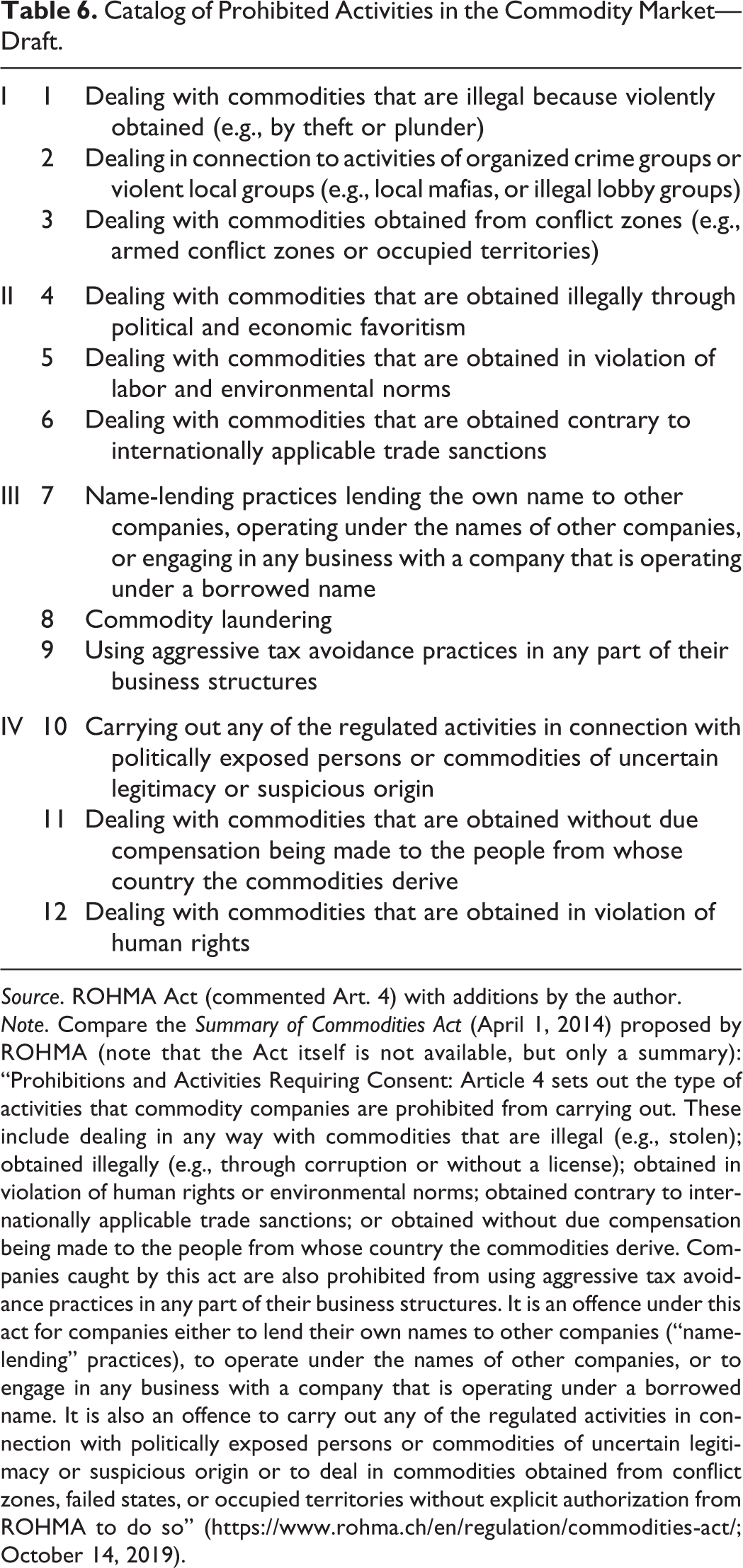
Source. ROHMA Act (commented Art. 4) with additions by the author.
Note. Compare the Summary of Commodities Act (April 1, 2014) proposed by ROHMA (note that the Act itself is not available, but only a summary): “Prohibitions and Activities Requiring Consent: Article 4 sets out the type of activities that commodity companies are prohibited from carrying out. These include dealing in any way with commodities that are illegal (e.g., stolen); obtained illegally (e.g., through corruption or without a license); obtained in violation of human rights or environmental norms; obtained contrary to internationally applicable trade sanctions; or obtained without due compensation being made to the people from whose country the commodities derive. Companies caught by this act are also prohibited from using aggressive tax avoidance practices in any part of their business structures. It is an offence under this act for companies either to lend their own names to other companies (“name-lending” practices), to operate under the names of other companies, or to engage in any business with a company that is operating under a borrowed name. It is also an offence to carry out any of the regulated activities in connection with politically exposed persons or commodities of uncertain legitimacy or suspicious origin or to deal in commodities obtained from conflict zones, failed states, or occupied territories without explicit authorization from ROHMA to do so” (https://www.rohma.ch/en/regulation/commodities-act/; October 14, 2019).
I have organized the activities into four groups, and I propose in this way that the enumeration has in turn an analytical utility in criminological terms. Although the selection criteria are not highly precise, they can be explained in terms of the following guidelines:
Group I brings together physically violent activities which are not usually associated in the collective imagination with the economic activity of a transnational company. However, they are more common than intended and highly damaging in physical terms, both individual and collective. There is usually a criminal prohibition in this regard both in the field of the host state and in the state of origin of the company. Theft, looting, internal armed conflict, and extortion are prohibited conduct. They are usually carried out by physical individuals, and their link with business activity is difficult to follow. The criminal sanction is usually a threat on paper. The criminological study that provides information for a proper formulation of criminal policy in terms of prevention, monitoring, sanction, and reparation would probably be linked to the proposals of the dirty economies and the Gewaltökonomien. In the 1990s, in Europe, Ruggiero (1997, 2007) worked profusely on the concept of dirty economies and in the following decade in Germany the concept of the economies of violence (Gewaltökonomien) was presented (Albrecht, 2007). Both concepts refer to the relationship between the economy, commercial operations—primarily transnationals—and violence. While the first concept emphasizes commercial operations and their brown relationship with politics, the second analyzes the commercial relationships that can be maintained with regimes or territories in armed conflict, to the point of involving such operations in collaboration in the violation of rights of the population that is being subjected or attacked.
Group II brings together activities directly linked to economic practices, especially in the international arena, in terms of favors and licenses, lack of control, and interests and abuses in the exchange between economic activity and politics. Although they appear in the list as mere regulatory violations or economic regulations, the damage they can generate, as will be seen, is very serious in its individual and collective impact on the lives of people living in the place of extractive activity. Here, the prohibitions may be foreseen in the domestic areas in the criminal field, although the forecasts prevail in the administrative and economic fields, especially. Economic regulations and agreements are the frame of reference that usually goes through and constrains this type of activities—but not really in practice. This happens in the field of labor rights and in the field of environmental regulation. In cases in which an environmental impact study is required before the start of an exploitation project or for the evaluation of a new economic policy by the state, it is common that the results are not impartial, since even scientific and academic institutions might be involved for the sake of their own interests or well-founded fears; and in the case, that they are impartial, they are often considered an affront to the corporation or to the government. In many other cases, the environmental license for a mining project is granted independently of any environmental impact study (Mayoral, Ojeda, & Dworesky, 2019).
However, the harm caused or emergent is not only environmental. The environment means life for the local population—as will be shown. The concept of horizon scanning (White & South, 2013), therefore, can be useful as a possible instrument to be applied not only with respect to the environment but also to the affected populations. Natali (2016) has also shown, through potentialities of the visually qualitative approach and contact with the affected people at a narrative level, that the environment is of interest because people are living there. The connection of these proposals with the inherent meaning of the environment for the indigenous people in Latin America or tribal life in Africa, for instance, could take the analysis to even further levels.
Activities from Group II are good examples of state-corporate crime (Kramer, Michalowski, & Kauzlarich, 2002), extended to include even environmental harm (for a review, see Brisman & South, 2015). And this field, for its part, leads also to the criminological studies of white-collar crime, and its various ramifications and updates, which are of central importance for the understanding of these activities. It is worth summarizing here—due to the differences with the problems focused on Group I, the main conceptual approaches that could be applied and developed in this area of concern. Starting with the idea that there is a gray zone between legal and illegal activities (Fernández Steinko, 2008, p. 38; Huisman, 2008), it is worth mentioning that this gray zone is often caused by de- and reregulation; and thus, further, grievous harm is often not perceived as “criminal” (Hillyard & Tombs, 2015) if it is not defined by the criminal code and if there is no visible individual harm to be causally explained and claimed (Albrecht, 2007). This happens in these kinds of activities in Group II. What is more, large companies usually occupy a strong economic and political position in the country or countries where they carry out their activities. This circumstance, added to the aforementioned reality that specific politicians are usually immediately related and recognized as being involved in the adoption of specific political measures and decisions, may be analyzed from the perspective of the criminality of the powerful (Barak, 2015; Pearce, 1976; Scheerer, 1993). According to this concept, the structural conditions for committing criminal acts in a systematic way are shaped by economic actors, economic relationships, and powerful networks and structural institutional conditions (cultural or religious, for example). The state-routinized crime and crime control through the “decriminalization and deregulation of the powerfuls’ production of harmful behavior,” the “nonindictment of obvious criminal offenses,” and “the discursive rationalization by ideologues for and defenders of the prevailing political and economic arrangements” (Barak, 2017, p. 62) explain, further, that these crime forms remain unchecked. Many of them, in fact, are not recognized as crimes at all—at neither the national nor at the international level.
Viewed from an institutional perspective, states in the Global South are often characterized by corruption, opacity in the functioning of bureaucratic proceedings, foreign-oriented conservative groups uninterested in the development of the low-class population, and lack of respect for their own native people (“lack of solidarity”; Ruggiero, 2001, p. 141). Besides, inequality is often accepted as historically conditioned and almost as normal (Böhm, 2019a, p. 24); only political and economic actors belonging to the selected strong sectors are those who are usually in the position of running businesses with foreign actors at corporate levels. Because of these factors, it is not difficult to understand that damage caused in the course of big business in the framework of deregulation of economic rules, and the resulting individual and social harm, will not easily be brought to the judicial system. If businessmen, politicians, and judges belong to a similar socioeconomic sector (and they usually do) with similar attitudes, it is not surprising that the harm caused by some members of this group will be neither condemned nor judged by the others. The good or bad relations between political and economic actors, therefore, have an immediate effect on the respect or violation of regulations and therefore on the avoidance or cause of severe harm. 13
All these interconnections and networks, therefore, are at the center of the needed research about commodity markets and politicians on the different sides of the supply chain. Transnational cooperation is often present on the criminal side; on the institutional and academic side, therefore, transnational cooperation should be present as well.
Group III involves a company’s own practices in the course of its establishment for extraction and supply and marketing chains that are not usually recognized as crimes and that may not even be recognized as practices that should be strictly regulated, since they belong to the normal course of business in the international arena. Name lending, the registration of companies in places or with conditions that imply lower taxes, for example, are practices that cause lack of transparency to their capitals, their nationality, and thus, to the definition of regulations or jurisdictions applicable to possible lawsuits—beyond the economic losses that affect the respective national economy. For its part, commodities laundering is very topical, but of insufficient attention in the domestic or international criminal political agenda, with few exceptions. However, it is directly linked to activities that can be extremely violent (Group I) and that are often political and economically regulated to the detriment of the local population (Group II). The concept of Crimes of Globalization presented by Friedrichs (2007) as an “emerging hybrid form” of white-collar crimes (p. 165), which developed quickly as an interesting field of study (Rothe, Mullins, & Sandstrom, 2008), must be mentioned here because the international economic arrangements between corporations and between these corporations and the host states would not be possible without permissive financial structures. Friedrichs and Rothe (2015) explain the various features and fields of the new category and start with the idea that “globalization has important political and cultural dimensions” (Friedrichs, 2007, p. 168). In their analysis, the economic aspect prevails and the focus of the study is aimed at international financial institutions such as the World Bank, and on the impact that several financing regulations, requirements, and preferences have in the world, for example, through the link between international finances and financing institutions and extractive industries, or through the imposition of extremely difficult economic conditions on states of the Global South, such as external debt. I share their idea that the (also negative) impact of the international financing institutions is fundamentally seen in the Global South and that the criminological approach should open the view to forms of activity which would not be considered criminal from an ordinary perspective. That is precisely the problem in this group of activities, where legal definitions are lacking, and the indifference of the sanctioning system in the face of these activities even explains that the criminological discipline does not yet have sufficient discourse and analysis in this regard. So far, it is rather the economic space and the range of business self-regulation mechanisms that guide peer monitoring.
Group IV, finally, contains practices of extraction, marketing, and supply of very high damage and very low risk in terms of responsibility. Normative controls regarding the regulation or eventual prohibition, as well as institutions that could make the sanctioning measures effective, are dispersed throughout national and international spheres, and the formulations are usually very strong on paper, moderately considered at the institutional level, and absolutely ignored in practice. Politically exposed persons or suspicious regions are too broad as criteria to be able to define them in a normative scope, much less to act as the basis of a generalized prohibition. Equally difficult is the estimate of “fair compensation” for the raw materials extracted, to the country of origin, and in particular, to its population, which is usually completely ignored in the equation. And this leads to the third formulation, which somehow brings together and takes to the extreme all the activities of the previous groups: Dealing with commodities obtained in violation of human rights. What does this mean exactly? What documents must have been signed by the country in question in order for its representatives to be held responsible? and the company? This single reference covers a myriad of actors, regulations, jurisdictional areas, and a great etcetera, which only accentuate and make visible the complexity of their reality and the sensitivity of the subject. This group includes even damaging practices which are only lightly regulated (use of asbestos, for example) or not regulated at all (militarization of an extractive zone?). The link between business and human rights, and more specifically, between extractive companies and human rights, has given study and work material to numerous disciplines (economic, social, legal, and environmental, among others), but so far it has received very little attention from criminology.
This lack of attention is related to the “invisibility” factor that I consider as one of those that characterize this group, and especially, that characterize activities related to a wide range of human rights violations. This invisibility is related to the characteristics of the immediately affected subjects and collectives, which are not always in a position to make demands, protest, or speak out against corporations and states; when they do, they usually become victims of violent “silencing” practices, again on the part of corporations and states (compare Inter-American Court of Human Rights, 2015a, 2015b). The more strength they achieve in their claims (NGOs, the academy, and civil society play a main role in this achievement), the “more visible” their situation becomes, of course, 14 but this does not necessarily lead to a better approach from the state. 15 There are many examples of this. For this reason, the state action needs more attention. The situation is similar when the environment is the affected subject, but the environment does not even have the possibility of a proper voice.
The perspective of green criminology has already explained some central aspects in terms of the environment as the object of the damaging activity. It has provided interesting results on the severe impact of those crimes on the life and rights of the most marginalized segments of the world’s population and the conflicts of interest related to natural resources such as minerals, water, oil, and gas as well as to surfaces ideal for the production of energy (rivers, wind) and primary food (grains, soy; Brisman, South, & White, 2015; Hall, 2014, p. 103; Jarrell & Ozymy, 2014; Walters, 2006), and in particular, on the life and rights of indigenous people (Boekhout van Solinge & Kuijpers, 2013, p. 202; Brisman et al., 2015, p. 2; Carrasco & Fernández, 2009). Furthermore, this subdiscipline adds an interesting look at infractions committed by complex offenders against widely dispersed victim groups and spatial areas—which often remain diffuse (Spapens, 2014, p. 224; White & South, 2013).
I will return later to these approaches to complex structures of activities and actors with little voice and low visibility and to the link between environmental damage and its consequences for human beings. It is worth mentioning here the presence of works focused on the subject that, without a doubt, are tools to be considered in the specific studies related to the market of raw materials and their processing and commercialization in terms of new technologies.
In any case, the table presented and the four groups expose the diversity of situations and their difficulties. In particular, the last section of activities, that of violations of fundamental rights, is a thematic hinge. This item demands progress in the study of the impact of prohibited activities and what that impact means in the field of reality located in time and space. That reality, beyond categories, far from the rooms of technological institutes and far from the offices of politicians and jurists who define legislation and political–economic measures is a reality that must be attended to as well—almost, I would say, in the first place.
Reality Beyond Any Catalog Proposal
The distribution into groups that I have suggested highlights the diversity of intervening and affected areas, their effects, and so on. And yet, despite the enormous achievement of having a draft catalog of prohibitions or activities requiring authorization, if you look at the phenomenon from the perspective not of who performs the activity, but of who is affected by it, the picture becomes more complex.
Think that activities that can be foreseen by law, and that have on their horizon exclusively business activity and the sanction or regulation by the State, are not reflected in the diversity of effects that each of these prohibited activities can generate. This seems obvious. However, it is not so clear when the field of consequences is of incalculable dimension and the damages cover a spectrum of great magnitude. This is what happens along the path of a natural resource until it becomes the raw material for a new technology. A “simple” violation of an environmental regulation results in damage to the environment that leads to health effects and danger to life, even death.
The case of Mina San Martín in Honduras is an example of invisible deviance behind the most serious forms of harm. In 1995, the Company Mar West Resources, then Goldcorp through its Honduran subsidiary Entre Mares started exploring for gold in the Valle de Siria. Exploitation using the open-pit method lasted until 2008, and this generated various forms of environmental damage (superficial and deep contamination of the land, cyanide-based contamination of water and air). This led to injuries to the physical integrity, health and lives of the inhabitants, and severe negative effects at the socioeconomic level (Cálix, 2017
16
; Torres Funes, 2016; Trucchi, 2014). According to Clara Vega, director of the Institute of Environmental Law of Honduras (IDAMHO), the authorizations given by the state did not considered the results, and granting an environmental license to develop a mining project does not imply a previous environmental impact study.
17
As a consequence, more than 50 million tons of land were removed to extract gold, affecting agricultural production, which fell by 70%. Moreover, 19 of the 21 existing water sources have dried up; those that remain are contaminated with heavy metals, which “generated an unprecedented water emergency” (Pedro Landa in Trucchi, 2014). On the results, two references must be quoted. The research study “Water pollution in the area of mining exploitation of the San Martín project and repercussions on human health,” carried out by Flaviano Bianchini in 2006, reveals that in one of the communities affected by mining exploitation, infant mortality reaches the value of 300‰ (per thousand), which is 12 times higher than the national average. These values increase markedly for the children of mine workers. In their cases, the mortality rate reaches 833‰ or 33 times the national average. (Trucchi, 2014) In the case of Girl—10—of New Palo Ralo, there is no indicator of Werdnig-Hoffmann syndrome in her parental history. The girl has blood values of 173 ug/dl of lead and 263 ug/dl of arsenic. Both metals, and others that could be present in her blood, are teratogens; that is to say they cause genetic mutations and are transmissible between mother and daughter via the placenta. Then the most likely cause of the disease is that the pollutants to which the parents and the girl herself have been exposed for years have caused the genetic mutation on chromosome 5 in the girl, causing Werdnig-Hoffmann syndrome. It can be affirmed that from now on, this girl’s days are numbered. Soon her lungs will no longer be able to move alone and her stomach will not be able to fulfill the movements necessary for digestion. If it is possible, the girl could be fed by a tube leading directly into her stomach, and helped with an artificial lung for some time, but it will not be possible in the long term and the girl will die very young. (IDAMHO, 2012, p. 68)
Concrete Harms Collected by the Analysis of 90 Current Cases of Violations of Human Rights Related to Extractive Projects by Transnational Corporations in Latin America.
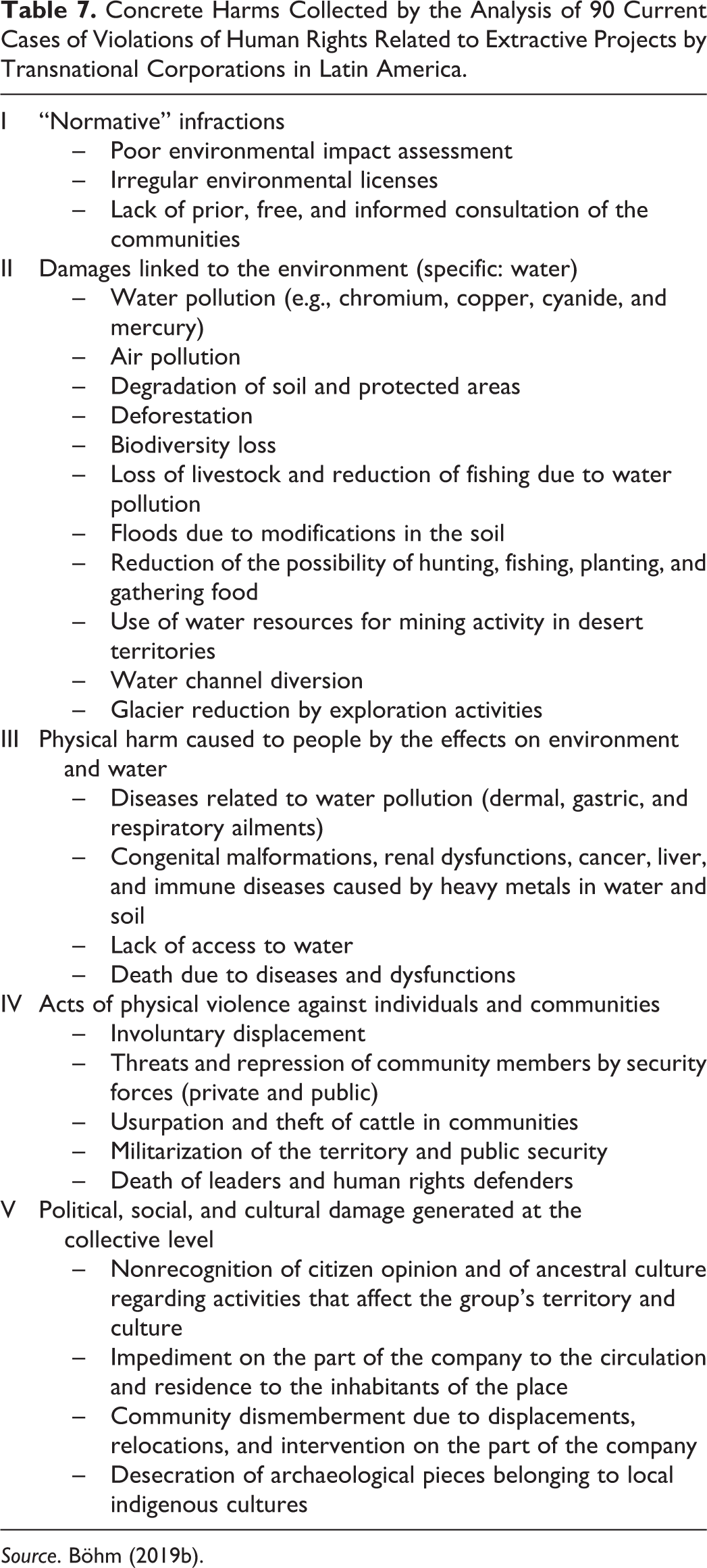
Source. Böhm (2019b).
At all times, there are overlaps and interconnections among the different types of infractions or harmful behaviors, as well as among the damages they produce. From the gradual reading and the passage from one group to the next of the table presented, the enveloping and cumulative effect of infractions and damages is evident: the infractions generate damages, the effects on the environment generate disease and death, and the violence toward individual actors entails damage even in collective and cultural terms. These and other types of consequences have been illustrated in various reports in a panoramic way. 18 In this case, if the list is not exhaustive, it is only because it refers to a survey carried out on specific cases and damages exposed are current effects of conflicts still in progress in Latin American countries where transnational commodity market corporations from Europe, North America, Asia, and Central and South America are involved (Böhm, 2019b).
From the survey and mapping of the 90 cases, it was concluded that practically all Latin American states have situations of human rights violations linked to extractive mega-entrepreneurship activities. For its part, the in-depth case study (12 cases selected according to the nationality of the transnational company, the host Latin American country, and the type of activity) revealed the cultural, economic, political, and legal links in each context, as well as its common elements. It verified that the conflicts generated by the activity of extractive companies in Latin America are interconnected with and correspond to measures of economic deregulation and legal protection and that indigenous and peasant communities are usually those who become victims in these conflicts since they inhabit territories that are rich in mineral, aquifer, forestry, and carbide resources and are therefore industrially profitable. The investigation has shown that the links between national and transnational political and economic actors correlate with the greater or lesser avoidability of the deficiencies and violence that the extractive enterprises generate.
It is usual to relate the extractive activities of minerals with the environmental damage that could be generated, at present, or in the future. Various reports linked to the conflict or sensitivity of mineral raw materials highlight this aspect of the impact. This is noted in the detail of the increasingly prolific regulations in terms of environmental prohibitions and regulations. However, the trace of such consequences is rarely highlighted in the reports issued by chambers of industry or in state technological development plans. To mention, the impact on the populations of other states would be to bring an excessively critical issue to the economic field. And yet, when talking about transnational relations in political and economic terms for technological development, this aspect cannot be ignored. For this reason, I suggest that the concept of damage must be comprehensively reviewed.
Harm Revisited: A Broader Concept From a Victimological Social Perspective
Raw material extraction and processing often has implications for the local population and their living conditions, ranging from environmental damage (often categorizable as environmental crimes) to serious damage to health or loss of housing (even rankable as violations of fundamental rights).
In the Global South, even the most expressively progressive government can often not withstand the temptation (or necessity?) of maintaining quick access to the economic benefits of natural resources in order to have enough cash money to pay for the infrastructural and urgent social needs of the population. Latin American presidents, for example, who have won elections thanks to the promise of recognition and respect for ancestral cultures and their environment and original lands have broken this promise. Green progressivism has become “brown progressivism” (“progresismo marrón”), as it is called by Gudynas (2015), since at the beginning of the current century, extractive industries have entered their most aggressive period ever. The state acknowledges its role and responsibility and works for the respect and realization of social rights, but all this comes at the price of the natural resources, the financing source. The “financerization of nature” (Bruckmann, 2017) or “commodification of nature” (Svampa, 2017, p. 88–89, and similarly, Gorenstein, 2016; Gudynas, 2015) is therefore a general problem in the Global South context because it is the connection between international interests and needs, and the real, local existence of wealth under the poorly and insufficiently organized, socially marginal life of individuals and communities. For example, although almost all companies promise new labor positions and conditions, the formation of “human capital,” in economic terms, does not belong to the field of investments that are interesting in the international sphere, and therefore they are not encouraged by national governments in their international relationships either. For this reason, the division of labor at the international level does not seem to be able to change. There are deficiencies and dependency spaces that have been perpetuated. Similar situations have been raised and data collected from various countries such as the Philippines, Turkey, and Mexico, and in relation to the development index of the World Bank—among other agencies. The result was the recognition that there are situations of inequality between different portions of the population according to their greater or lesser access to quality natural resources which can be raised in terms of conflict, violence, and insecurity (Baechler, 1999, pp. 13–19, 24–30), and this eventually becomes a static dependency situation (Altvater, 2011; Islam, 1987; Singh, 1987). This happens at the internal level, and at the international level as well.
This reiteration of dynamics perpetuates the role of the South as a supplier of primary products and of cheap, unqualified manpower to the center or Global North. The same thing has happened in the history of metal mining, hydrocarbons, renewable energy (hydroelectric, wind), and infrastructure industries (roads, bridges, and facilities for those who produce the above and their transport). The concentration of the exploitation spaces generated by the increasing demand for specific raw materials suggests an increase in competition and, therefore, an exacerbation of economic struggles. These include not only the struggles for space, exploitation concessions, and tenders, 19 but usually an increase in illegal markets and legal but harmful practices in terms of impact on territory, local population, and intermediate links in supply chains as well. 20 The permanent internationalization of the actors is, further, another of the central themes that make up new structures. States, economic unions, corporations, and international financing institutions are international actors shaping the structural conditions at the local level (similar Friedrichs & Rothe, 2015). This internationalization contributes in turn to the complexity of conflicts and the possibilities of unraveling them on the part of the local population (cf. Daniela Egger, in Mathias, 2017). Besides, due to the intensification of the conditions of structural violence, conflicts are increasing (Böhm, 2016, 2019a).
The modification of the society–nature relationship is the result of the permanent defense of one’s own space, and this explains the new forms of resistance that have arisen in Latin America over the past decades and that have been conceptualized as “the ecoterritorial turn of the resistances” (“giro ecoterritorial de las resistencias”; Svampa, 2017, p. 88–92) also thought of as “socioterritorial conflict” (“conflicto socioterritorial”; Altvater, 2011, p. 41–48).
This exchange, generator and reproducer of dependencies and generator and deepener of consequences to the minimum conditions of dignified existence of the local population and of the fundamental rights of its members, is what I have called the crime of maldevelopment. It is not only about damage but about damage that runs deep into the structural conditions of life (Böhm 2019a, pp. 40–62, 180–216).
With regard to the commodities market, therefore, it is clear that foreign investments bring huge capital flow, but also, numerous problematic projects (Ebus & Kuijpers, 2016) for extractive industries (McGregor, 2009). The linking of the presence of transnational companies with a positive image, and the silencing of the negative impacts of this presence, is a field that is being studied extensively in the field of social, communication, and criminological disciplines (Jewkes, 2015; Lee, 2005; Natali, 2016; Seaga Shaw, 2011) and that without a doubt should also provide sufficient information to the area of legal studies on the subject. If you think about the concepts of “invisible victims” (Spapens, 2014) or “socially expendable victims” (Fattah, 2010), the connection with the criminological studies space is evident.
Regarding the relation of these collectives with the social and civil position they occupy in their countries and following Fattah, some authors (Costanzo, Mannará, Álvarez Icaza, & Anativia, 2018) suggest that living in certain areas (near natural resources, for example) can be considered a “risk activity” and that there is, in addition, further structural and cultural exposure in the cases of rural and indigenous communities. The whole picture puts these sectors, actual victims, or potential victims, not only in an unfavorable situation with respect to the national actors, but with respect to international actors as well (see also Viano, 1990, pp. xiv–xv).
In this same direction, the social distance, linked to the greater or lesser possibility of empathy between actors according to their different hierarchies and mutual knowledge (Edeso Natalías, 2005) which can ultimately become an explanatory factor of linked violence situations to the lack of solidarity and social disorganization (Arteaga Botello & Lara Carmona, 2004), is, in this sense, a concept that links the macro study of conflicts and their possible causes and approaches, with the microspace for analysis and intervention, as well as with the work on the structural configuration of a certain space, and the existing conflicts in it.
And here, the approach of the mass media studies offers conceptual components related to the social distance—between political and economic actors, civil society, and victim groups—which facilitates the visibility or invisibility of illegal activities and their consequences (see Jewkes, 2015, chapter 1). Conflicts related to big companies are only partly shown or reported in order to avoid the formation of negative public opinion (Lee, 2005, pp. 133, 148) and also because the questioning of the neoliberal economic system by the mainstream media is quite impossible (Pauls, Zagorski, & Ferguson, 2015, pp. 268–269). In this way, the audience’s degree of empathy with conflicts and their protagonists is strictly managed. The idea of harm, in this sense, is managed as well. Abudara Bini 21 explains that the images on television and the need to commercialize the news, which is actually a commodity more than a service provided by the corporate mass media, do not allow the persistent or integral following of some realities when these occur in “slow motion,” that is, when there are no instant, quick pictures or new headlines from day to day. The news about what is happening right now is not capable of showing or reporting death that takes place in slow motion, the invisible death of those who are affected with toxic metals now that are not going to kill them until years in the future.
The most damaging acts are not always identified as crimes in national penal codes, and if they are, specific cases and forms of prosecution have in many cases rendered them useless for large-scale damage caused by structures that follow extremely complex rules of interaction. For these reasons, only a focus on the social damage (criminal offences, violation of human rights, or whatever label they have been given) can give a dimension of the real harm caused (see the terminological discussion in Hillyard & Tombs, 2015; Rivera Beiras, 2014, p. 253) and the required accountability. Thus, in a recent work published in Barcelona, the need to expand categories and to compromise the legal order with solutions of a political nature is discussed, as it had been already said by Aniyar de Castro (2010), but brought to the field of conflicts and to the economic violence of today. In that work, Ferrajoli (2014) says, Only by adopting the autonomous and external point of view of critical criminology—the one that refers to the ‘social damage’ […]– can we investigate and even see the existence of crimes that are not foreseen as crimes by any penal order…. (p. 84)
Conclusion—or Invitation
The road from a raw material to an emerging technology is hard not only from the material, economic, scientific, and political sides of things. This road is especially hard for people living near this raw material. They bear the harm caused, and even die, but they usually do not profit from the better standard of living that comes with the technological innovation—quite the contrary. It has been shown that the increase in demand to feed technological innovation leads to a concomitant increase in the exploitation of raw materials, including those which have hitherto lain outside market interest—as is the case with lithium. If we have learned anything from the main traditional extractive industries and their negative impact, we can be sure that more demand for commodities will lead to more deviance and more harm, just as more economic benefit for some will lead to more individual and collective victims elsewhere. Therefore, deviance and criminal links in the practices of states, corporations, and powerful actors require more attention.
All kinds of transnational networks must be considered. The technological advances carried out mainly in the Global North, as we have seen, have a direct impact on the Global South. Therefore, these actors’ networks at the political, economic, and social levels require multifactorial transnational approaches. I have proposed elsewhere the concept of the crime of maldevelopment following precisely this concern, and I understand that it is necessary to deepen and expand research in this regard in order to address the most current economic and social transformations that are taking place.
From the side of the highly industrialized and highly technologized countries, the perspective should encompass not only the formal regulation and even prohibition of some activities. Attention should also be given to the complexity of phenomena which are related to the commodities supply, the political goals in the international economic arena, and particularly to the powerful actors involved. In order to do this in the most comprehensive way possible, it is necessary to be informed about the effects of each new technological innovation that demands raw materials, about the socioeconomic context where the needed raw material is available, and about ways to avoid harmful effects, and forms of reparation for harm already caused. Criminologists related to the studies of green criminology, victimology, white-collar crime, or global crime perspectives should be willing, in this sense, to work in a transversal, cooperative way inside and outside the discipline, and both within and beyond their usual research fields—even in territorial terms.
In some way, this essay presents several aspects of a work in progress and is intended as an invitation to social and legal scientists in the industrialized countries to include these new transnational issues and technological challenges on their scientific agendas. Contributing to the visibility of this reality would be, without a doubt, an invaluable first step toward an integral and global approach. Data collection and advice for the design of new regulation and control policies at domestic and international levels would thus become a feasible next move.
Footnotes
Declaration of Conflicting Interests
The author(s) declared no potential conflicts of interest with respect to the research, authorship, and/or publication of this article.
Funding
The author(s) received no financial support for the research, authorship, and/or publication of this article.